An Introduction To Humanenvironment Geography
Local Dynamics And Global Processes Paperback
William G Moseley download
https://ebookbell.com/product/an-introduction-to-
humanenvironment-geography-local-dynamics-and-global-processes-
paperback-william-g-moseley-10045556
Explore and download more ebooks at ebookbell.com
Here are some recommended products that we believe you will be
interested in. You can click the link to download.
An Introduction To Humanenvironment Geography Local Dynamics And
Global Processes 1st Edition William G Moseley
https://ebookbell.com/product/an-introduction-to-humanenvironment-
geography-local-dynamics-and-global-processes-1st-edition-william-g-
moseley-5133692
An Introduction To Human Molecular Genetics Mechanisms Of Inherited
Diseases 2nd Edition Jack J Pasternak
https://ebookbell.com/product/an-introduction-to-human-molecular-
genetics-mechanisms-of-inherited-diseases-2nd-edition-jack-j-
pasternak-2195088
An Introduction To Human Factors Engineering Pearson New International
Edition Second Edition Wickens
https://ebookbell.com/product/an-introduction-to-human-factors-
engineering-pearson-new-international-edition-second-edition-
wickens-21969918
An Introduction To Human Geography Issues For The 21st Century 3rd
Edition 3rd Peter Daniels
https://ebookbell.com/product/an-introduction-to-human-geography-
issues-for-the-21st-century-3rd-edition-3rd-peter-daniels-2362144
An Introduction To Human Services Sixth Edition 6th Edition Marianne R
Woodside
https://ebookbell.com/product/an-introduction-to-human-services-sixth-
edition-6th-edition-marianne-r-woodside-2389024
An Introduction To Humananimal Relationships A Psychological
Perspective 1st Edition Hollin
https://ebookbell.com/product/an-introduction-to-humananimal-
relationships-a-psychological-perspective-1st-edition-hollin-34358914
An Introduction To Human Evolution Deon Liles
https://ebookbell.com/product/an-introduction-to-human-evolution-deon-
liles-4166680
An Introduction To Human Resource Management 3rd Edition John
Stredwick
https://ebookbell.com/product/an-introduction-to-human-resource-
management-3rd-edition-john-stredwick-42894748
An Introduction To Human Prehistory In Arabia The Lost World Of The
Southern Crescent Jeffrey I Rose
https://ebookbell.com/product/an-introduction-to-human-prehistory-in-
arabia-the-lost-world-of-the-southern-crescent-jeffrey-i-rose-43679020
24.9mm
193mm 193mm
252mm
AN INTRODUCTION TO
HUMAN-ENVIRONMENT
GEOGRAPHY
Local Dynamics and Global Processes
William G. Moseley, Eric Perramond,
Holly M. Hapke, & Paul Laris
AN
INTRODUCTION
TO
HUMAN-ENVIRONMENT
GEOGRAPHY
Moseley,
Perramond,
Hapke,
&
Laris
“A first of its kind, and in my opinion a complete winner. An introductory textbook that presents,
in an engaging and accessible style, geography’s unique approach to environmental issues. Highly
recommended.” 			 				 Judith Carney, UCLA
“A long-overdue textbook that is at once comprehensive while remaining accessible. The authors
have done an impressive job with a clarity that is refreshing and engaging. This book provides
students with a guide to this dynamic sub-field, including features such as clear chapter objectives,
critical questions, and ‘ice-breakers,’ and demonstrates how to address important and complex
issues in the contemporary world.”
Antoinette WinklerPrins, Johns Hopkins University
The myriad ways in which humans interact with their surroundings in the natural world have consequences
that are both positive and negative. An Introduction to Human–Environment Geography offers an
engaging and unique view of the spatial relationships between humans and their environment across
geographical locations around the world.
This introductory-level text presents the rich tapestry of theoretical approaches to the tradition, and
demonstrates how these may be productively applied to understand human–environment interactions.
Introducing many of the fundamental concepts and major theoretical traditions within human–
environment geography, the book explores various thematic issues within the field, such as population,
food and agriculture, and water resources. It carefully balances exposure to the theoretical underpinnings
of human–environment geography with the inclusion of a variety of real-world policy questions and
illustrative field notes contributed by prominent nature society geographers. An engaging and student-
friendly introduction, it offers rich and rewarding insights into a tradition of growing importance in the
twenty-first-century world.
William G. Moseley is Professor and Chair of the Department of Geography at Macalester College.
He is the author of over 60 peer-reviewed articles and book chapters, as well as four edited volumes.
Eric Perramond is Associate Professor in both the Environmental Science and Southwest Studies
programs at the Colorado College. He is the author of Political Ecologies of Cattle Ranching in Northern
Mexico: Private Revolutions (2010), and a former Fulbright-García Robles Fellow to Mexico.
Holly M. Hapke is Associate Professor in the Department of Geography at East Carolina University.
She has published articles in various journals and is a contributing author to World Regional Geography:
Global Patterns, Local Lives (3rd edition, 2006).
Paul Laris is Professor and Chair of the Department of Geography at California State University
at Long Beach.
17mm 17mm
17mm
17mm
An Introduction to Human–Environment
Geography
An Introduction to Human–Environment
Geography
Local Dynamics and Global Processes
William G. Moseley, Eric Perramond,
Holly M. Hapke, & Paul Laris
This edition first published 2014
© 2014 William G. Moseley, Eric Perramond, Holly M. Hapke, Paul Laris
Blackwell Publishing was acquired by John Wiley & Sons in February 2007. Blackwell’s publishing
program has been merged with Wiley’s global Scientific, Technical, and Medical business to form
Wiley-Blackwell.
Registered Office
John Wiley & Sons, Ltd, The Atrium, Southern Gate, Chichester, West Sussex, PO19 8SQ, UK
Editorial Offices
350 Main Street, Malden, MA 02148-5020, USA
9600 Garsington Road, Oxford, OX4 2DQ, UK
The Atrium, Southern Gate, Chichester, West Sussex, PO19 8SQ, UK
For details of our global editorial offices, for customer services, and for information about
how to apply for permission to reuse the copyright material in this book please see our website
at www.wiley.com/wiley-blackwell.
The right William G. Moseley, Eric Perramond, Holly M. Hapke, and Paul Laris to be identified as the
authors of this has been asserted in accordance with the UK Copyright, Designs and Patents Act 1988.
All rights reserved. No part of this publication may be reproduced, stored in a retrieval system,
or transmitted, in any form or by any means, electronic, mechanical, photocopying, recording or
otherwise, except as permitted by the UK Copyright, Designs and Patents Act 1988, without the
prior permission of the publisher.
Wiley also publishes its books in a variety of electronic formats. Some content that appears in print
may not be available in electronic books.
Designations used by companies to distinguish their products are often claimed as trademarks.
All brand names and product names used in this book are trade names, service marks, trademarks
or registered trademarks of their respective owners. The publisher is not associated with any
product or vendor mentioned in this book. This publication is designed to provide accurate and
authoritative information in regard to the subject matter covered. It is sold on the understanding
that the publisher is not engaged in rendering professional services. If professional advice or other
expert assistance is required, the services of a competent professional should be sought.
Library of Congress Cataloging-in-Publication Data
Moseley, William G.
â•…
An introduction to human-environment geography : local dynamics and global processes /
William G. Moseley, Eric Perramond, Holly M. Hapke, Paul Laris.
â•…â•…pagesâ•…cm
â•… Includes bibliographical references and index.
â•… ISBN 978-1-4051-8932-3 (hardback : alk. paper) – ISBN 978-1-4051-8931-6 (pbk. : alk. paper)
1.╇Human ecology–Textbooks.â•… 2.╇Human geography–Textbooks.â•… I.╇Title.
â•… GF43.M67 2013
â•…304.2–dc23
2013006409
A catalogue record for this book is available from the British Library.
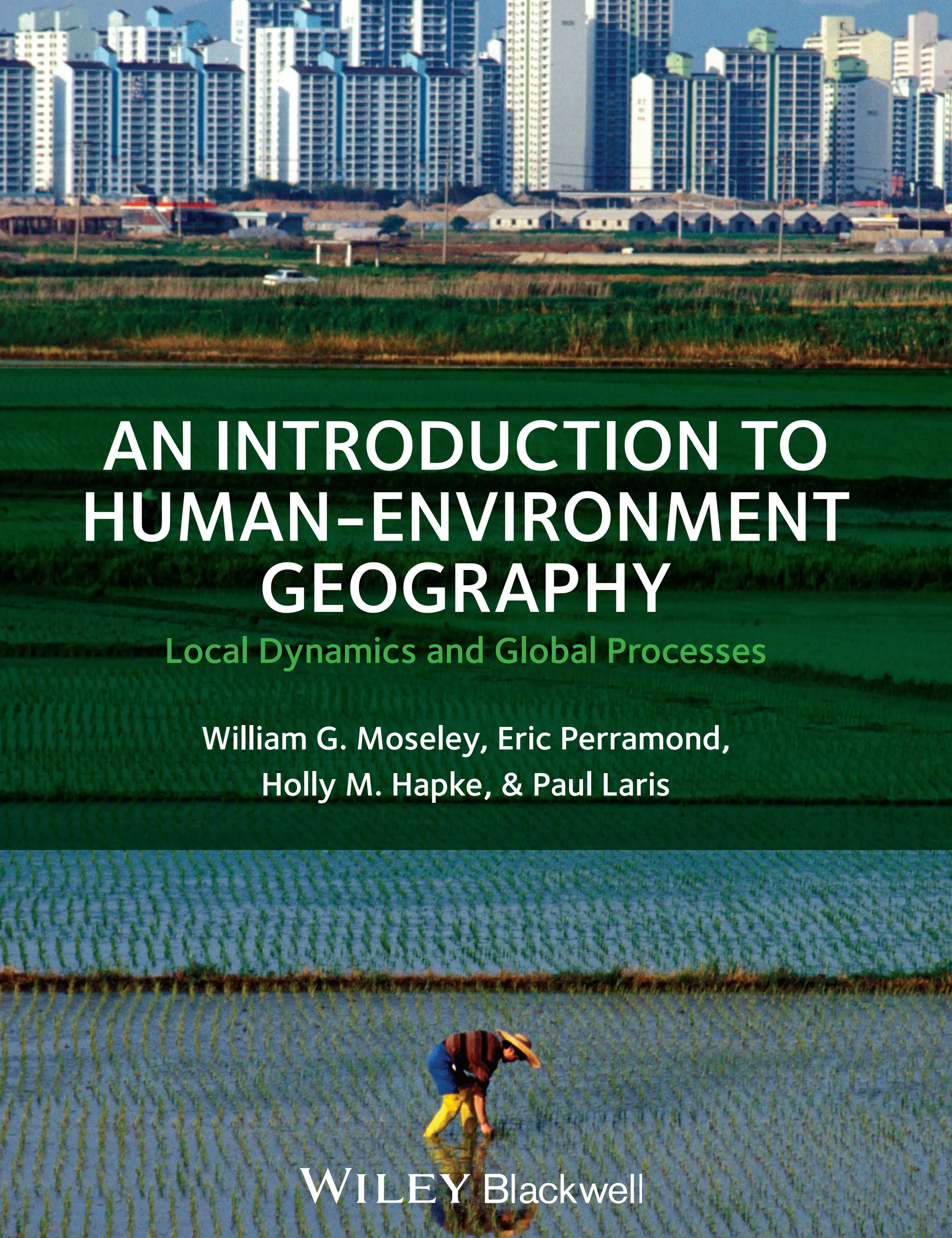
Cover image: A man planting rice in paddy fields on the outskirts of Seoul, South Korea.
© Philippe Lissac/Godong/Panos.
Cover design by www.cyandesign.com
Set in 11/13pt Dante by SPi Publisher Services, Pondicherry, India
1â•…2014
For B. Ikubolajeh Logan (WM)
For Marshall Bowen (EP)
For my daughter, Syona, and to John Agnew (HH)
For B.L. Turner (PL)
Contents
Notes on the Authors ix
Preface and Acknowledgmentsxi
Part I: Fundamentals of Human–Environment
Geography1
â•⁄ 1 Introduction: A Geographic Perspective on
Human–Environment Interactions 3
â•⁄ 2 The Politics of Nature 31
â•⁄ 3 The Biophysical Environment 47
Part II: Contemporary Perspectives in
Human–Environment Geography 87
â•⁄ 4 Cultural and Political Ecology: Local Human–Environment
Interactions in a Global Context 89
â•⁄ 5 Environmental History 111
â•⁄ 6 Hazards Geography and Human Vulnerability 137
â•⁄ 7 Environmental Justice: The Uneven Distribution of People,
Pollution, and Environmental Opportunity 157
Part III: Thematic Issues in Human–Environment
Geography189
â•⁄ 8 Climate, Atmosphere, and Energy 191
â•⁄ 9 The Population–Consumption–Technology Nexus 227
10 Agriculture and Food Systems 255
11 Biodiversity, Conservation, and Protected Areas 285
12 Water Resources and Fishing Livelihoods 309
viii Contents
Part IV: Bridging Theory and Practice 341
13 Geographic Research 343
14 Conclusion: Making a Difference 375
Index389
Notes on the Authors
William G. Moseley is a professor and chair of geography at Macalester College,
where he teaches courses on environment, development, and Africa. His
research interests include political ecology, tropical agriculture, environment
and development policy, and livelihood security. His research and work
�
experiences have led to extended stays in Mali, Zimbabwe, South Africa,
Botswana, Malawi, Niger, and Lesotho. He is the author of over 60 peer-reviewed
articles and book chapters that have appeared in such outlets as Proceedings of the
National Academy of Science, Ecological Economics, the Geographical Journal, the
GeographicalReview, AppliedGeography, the SingaporeJournalof TropicalGeography,
and Geoforum. His books include: four editions of Taking Sides: Clashing Views on
African Issues (2004, 2006, 2008, 2011); (with David Lanegran and Kavita Pandit)
The Introductory Reader in Human Geography: Contemporary Debates and Classic
Writings (Blackwell, 2007); (with Leslie Gray) Hanging by a Thread: Cotton,
Globalization and Poverty in Africa (2008); and (with B. Ikubolajeh Logan) African
Environment and Development: Rhetoric, Programs, Realities (2004). His fieldwork
has been funded by the National Science Foundation and the Fulbright-Hays
Program. He has served as editor of the African Geographical Review, as a national
councilor to the Association of American Geographers, and as chair of the
cultural and political ecology specialty group.
Eric Perramond, a geographer, is an associate professor in both the Environmental
Science and Southwest Studies programs at the Colorado College. His teaching
and research interests include cultural-political ecology, environment and
development issues, GIS and research methods, and agro-climate governance
issues. He conducts human–environment research in the Greater Southwest,
�
semi-arid Mexico, and the French and Spanish Pyrenees. He has published in the
Geographical Review, Area, the Journal of Latin American Geography, and the Journal
of Political Ecology. He serves on the editorial board for the Journal of Political
Ecology, and was associate editor for the Journal of Latin American Geography and on
the editorial board for ACME: An International E-Journal for Critical Geographies. He
x Notes on the Authors ˘Notes on the Authors
is the author of Political Ecologies of Cattle Ranching in Northern Mexico (2010) and is
aformerFulbright-GarciaRoblesFellowtoMexico.HealsoservedastheChairman
of the Conference of Latin Americanist Geographers (CLAG) during 2008–10.
Holly M. Hapke is an associate professor in the Department of Geography at East
Carolina University, where she also teaches courses in the International Studies
program. Her research and teaching interests include political economy and
development; fisheries and coastal livelihoods; ecological conflict; gender;
�migration; and research methods. Her regional area of expertise is South Asia, and
she has conducted research on rural development issues in the US South. Her field
research on gender, fisheries development, and fisherfolk livelihoods in India has
been funded by the National Science Foundation, the Association of American
Geographers, and the US Department of Education Fulbright-Hays Program. She
has published articles in journals such as Economic Geography, Annals of the
Association of American Geographers, Professional Geographer, Gender, Place  Culture,
andGeographicalReview,andsheisacontributingauthortoPulsipherandPulsipher,
World Regional Geography: Global Patterns, Local Lives, third edition. She currently
serves on the editorial board of Gender, Place  Culture.
Paul Laris is professor and chair of the Department of Geography at California
State University, Long Beach, where he also teaches in the Environment, Science,
and Policy Program. His teaching and research interests include biogeography,
cultural and political ecology, fire ecology, global change, ecological restoration,
and remote sensing. He has conducted research in the savanna of Mali, the
�grasslands of Tierra del Fuego, and the shrublands of California. He has published
in such journals as Human Ecology, The Annals of the Association of American
Geographers, Remote Sensing of Environment, Geoforum, and Bois et Forêts des Tropiques.
His fieldwork has been funded by NASA and the National Geographic Society.
Preface and Acknowledgments
This book has been a long time in the making. Like any good text, it emerged from
a series of conversations, many in bars and cafés, and frequently when we met at
our annual professional meeting. We had a few concerns which motivated us to
write this book, foremost of which was a text that would convey geography’s
�
theoretically rich tradition and unique approach to environmental issues. Our
other concern was to have a text that would be accessible to introductory students,
many from allied environmental fields who were encountering geography for the
first time, and others in geography for whom this was their first course on human–
environment themes. While there are other environmental geography texts on the
market, none (in our view) did all that we wanted. We felt that the lower level texts
didn’t do enough to convey geography’s unique approach to the subject matter,
frequently differing little from more generic environmental studies or environ-
mental science texts. Those books that did convey the theoretical richness of the
human environment tradition tended to be pitched at too high a level of student,
or too narrowly focused on a particular subtheme of human–Â�
environment geog-
raphy. The text that follows is our attempt to fill this niche.
You will note that the book is divided into four parts. The first part is meant
to be a broad overview of the basic information needed to understand human–Â�
environment geography, from the geographic perspective, to environmental
politics, to some basic physical geography and ecology. The second section explores
a sampling of geography’s rich theoretical traditions in the realm of human–Â�
environment geography. The third part is more thematic in nature, most closely
resembling the traditional textbook approach except for a concerted effort to make
connections between this material and the theoretical approaches detailed in the
second section. The final part is meant to connect the book’s material to the real
world by showing the student how geographers undertake fieldwork and collect
and analyze data. The concluding chapter makes suggestions for using the �concepts
in this text to understand environment-related problems and bring about change.
Each of the chapters in these four sections has a similar structure. Chapters begin
with an icebreaker, or a meaningful vignette which brings out the major themes of
xii Preface and Acknowledgments
the chapter. This is followed by a statement of chapter objectives, an introduction,
and then the main text. All chapters end with a chapter summary, critical �questions,
key terms, and references.
While this book was very much a collective project, our varied regional and
thematic expertise helped ensure that a range of material would be covered from
some position of comfort and familiarity. We also hail from different types of
�
institutions, private colleges in Minnesota and Colorado, and public universities in
North Carolina and California, and thus have experience working with different
types of students. All of us relied heavily on our own teaching, research, and work
experience to inform this project. This book took longer to complete than
�
originally anticipated. We particularly wish to thank Justin Vaughan and Ben
Thatcher at Wiley-Blackwell for attempting to keep us on track and for showing
endless patience and understanding when we fell behind. We also thank our
�
families for their understanding and support while we labored at writing, for
reading and re-reading drafts in some cases, and for patiently listening to us over
meals as we shared our geographic revelations. We finally express our appreciation
to the anonymous reviewers who provided feedback on various portions of this
text, and to our students with whom our interactions in the classroom have
informed the way we present this material.
Fundamentals of
Human–Environment
Geography
Part I
An Introduction to Human–Environment Geography: Local Dynamics and Global Processes,
First Edition. William G. Moseley, Eric Perramond, Holly M. Hapke and Paul Laris.
© 2014 William G. Moseley, Eric Perramond, Holly M. Hapke, Paul Laris.
Published 2014 by John Wiley  Sons, Ltd.
Introduction
A Geographic Perspective on
Human–Environment Interactions
Icebreaker: Human–Environment Connections
Across Time and Space
Before chemical fertilizers came into heavy use in the 20th century, guano (bird or bat
�
droppings) was the leading internationally traded source of agricultural plant nutri-
ents. It was valued because of its high levels of phosphorous and nitrogen and lack
of odor. The Incas of South America understood the value of guano long before the
1
Icebreaker: Human–Environment Connections Across
Time and Space 3
Chapter Objectives 5
Introduction6
Animals and Their Habitats 6
What Is Geography and What Does It Have To Do with Studying
the Environment?8
A Geographic Perspective on Environmental Questions 11
Plan for the Rest of the Book 25
Chapter Summary 28
Critical Questions 28
Key Vocabulary 28
Notes29
References29
4 Introduction: A Geographic Perspective
Europeans and regulated its extraction quite carefully. The Incan government divided
up the guano-�
bearing islands off the coast of modern-day Peru between its different
provinces. Guano had �
accumulated on these islands over centuries because of abun-
dant bird life due to rich fish stocks, a uniquely dry climate which enhanced guano
preservation, rocky shores for nesting, and protection for the birds from predators
and humans. Rules were established concerning when and where guano could
be �
harvested and disturbing the nesting birds which produced guano was an offense
punishable by death.
The geographer and explorer Alexander von Humboldt was the first European to
�
recognize the potential value of guano. He returned from his 1799–1804 voyage around
South America with samples which he shared with two French chemists who subsequently
confirmed the value of the substance. American farmers experimented with guano in the
1820s, and then British farmers in the 1840s. Despite the initial concerns of farmers that
such a powerful fertilizer would upset the nutrient balance of agricultural soils, demand
for guano soon surged. The United Kingdom imported over 2 million tons of guano between
1841 and 1857. The fury over the guano trade was intense. It led to the Guano War of
1865–66 between Spain and Peru. The US Navy fought with Peru to maintain access to
guano. The US also colonized over 50 islands in the Pacific and the Caribbean (including
Midway Island) because of their guano resources. By 1900, the world’s guano resources
were all but depleted.
Fast forward to the 21st century, when one of the authors of this text was traveling
with a group of students along the Atlantic Coast of South Africa. Here he visited
Lambert’s Bay, a fishing village on the coast with a history as a source of guano which
was exported as fertilizer to Britain in the 19th century. The small island in Lambert’s
Bay was now a bird sanctuary where nature lovers and tourists could come and
observe the courting rituals and the nesting habits of the Cape gannet. The gannet was
a �
prodigious producer of the guano that had once accumulated in vast quantities on
rocky islands along this semi-arid coastline. The author had been to the island the
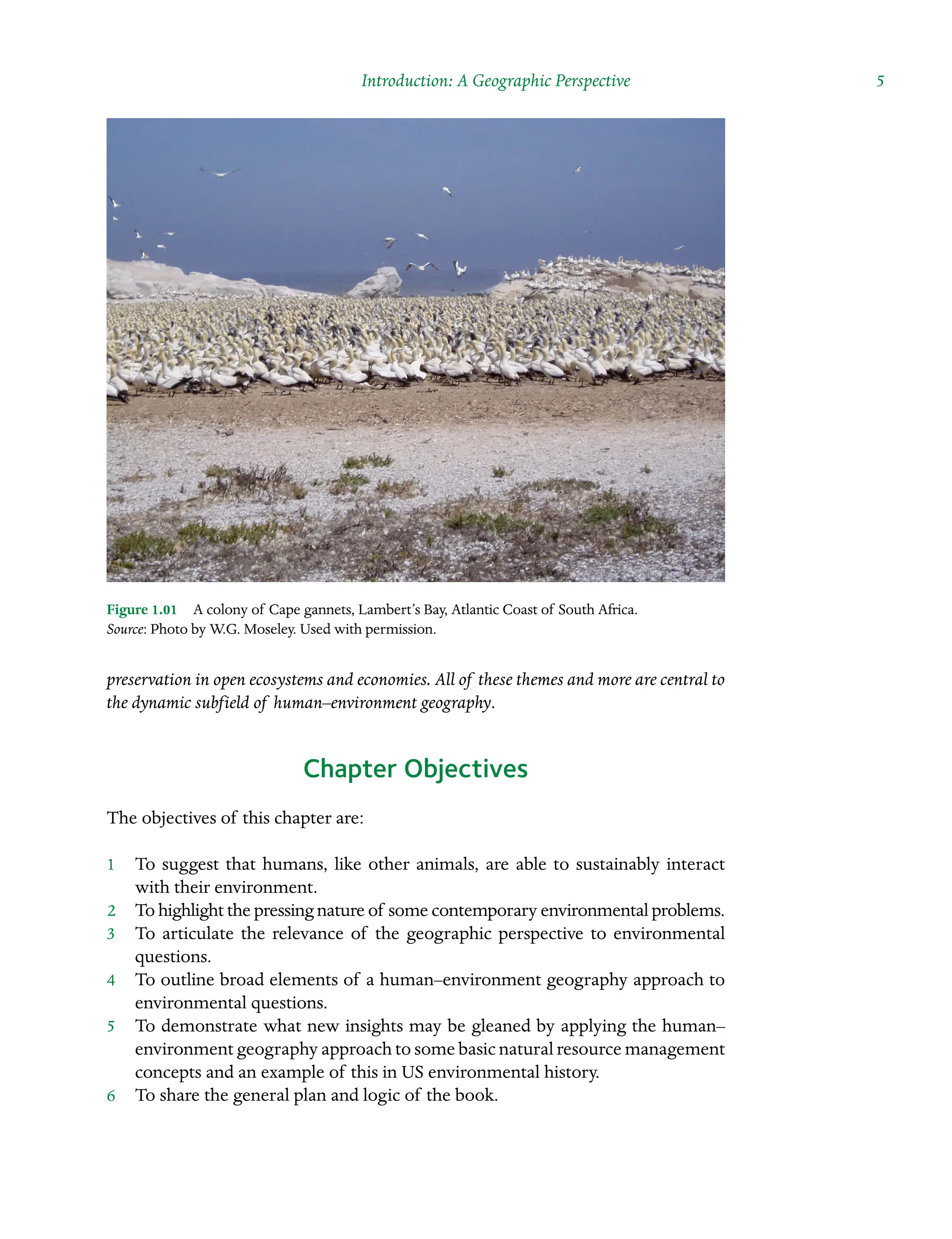
previous year and seen large numbers of Cape gannets (see Figure 1.01). As he crossed
over the bridge to the island, he noticed that something was quite different, there were no
gannets. He came to learn that the entire colony had left because they were being attacked
by seals. This was, in itself, highly unusual as the seals had long coexisted with the
gannets and never bothered them. The problem was that the seals were competing with
fishermen for the same food source and were losing. As such, it was hunger which led the
seals to attack the gannets on the island and it was this atypical behavior which caused
the colony of Cape gannets to leave. While some of the overfishing in this area was
caused by South African commercial fishers, the bigger culprit was large �
international
fishing fleets.
The twists and turns of this story raise a number of important issues for consideration.
These include: the ability of some societies to manage their resources sustainably, the role
of science in the use and management of resources, the seeming inability of the global
capitalist system to limit consumption, the role that non-human actors may play in
�
transmitting the impacts of one human action to another human group, and the limits of
Introduction: A Geographic Perspective  5
preservation in open ecosystems and economies. All of these themes and more are central to
the dynamic subfield of human–environment Â�
geography.
Chapter Objectives
The objectives of this chapter are:
1â•… To suggest that humans, like other animals, are able to sustainably interact
with their environment.
2â•… To highlight the pressing nature of some contemporary environmental problems.
3â•… To articulate the relevance of the geographic perspective to environmental
questions.
4â•… To outline broad elements of a human–environment geography approach to
environmental questions.
5â•… To demonstrate what new insights may be gleaned by applying the human–
environment geography approach to some basic natural resource management
concepts and an example of this in US environmental history.
6â•… To share the general plan and logic of the book.
Figure 1.01â•… A colony of Cape gannets, Lambert’s Bay, Atlantic Coast of South Africa.
Source: Photo by W.G. Moseley. Used with permission.
6 Introduction: A Geographic Perspective
Introduction
The broad objective of this chapter is to introduce to students to the way that
human–environment geographers look at the world. We begin by exploring how
humans are similar to, and different from, other animals which manipulate the
environment. We then review geography and its distinctive human–environment
tradition, followed by an exploration of some broadly similar ways that human
environment geographers often examine environmental questions. The chapter
ends with a specific case of how the geographic lens yields new insights when
trained on some common environmental management approaches, namely
exploitation, conservation, and preservation.
Animals and Their Habitats
Beavers (Castor canadensis in North America, Castor fiber in Eurasia) are known for
their ability to modify the landscape for their own benefit and that of other species.
By damming streams, beavers raise the water level to form protective moats
around their lodges. The resulting beaver ponds also create the deep water needed
for winter food storage in northern climates. While other animals struggle with
winter cold and hunger, beavers stay warm in their lodges with an underwater
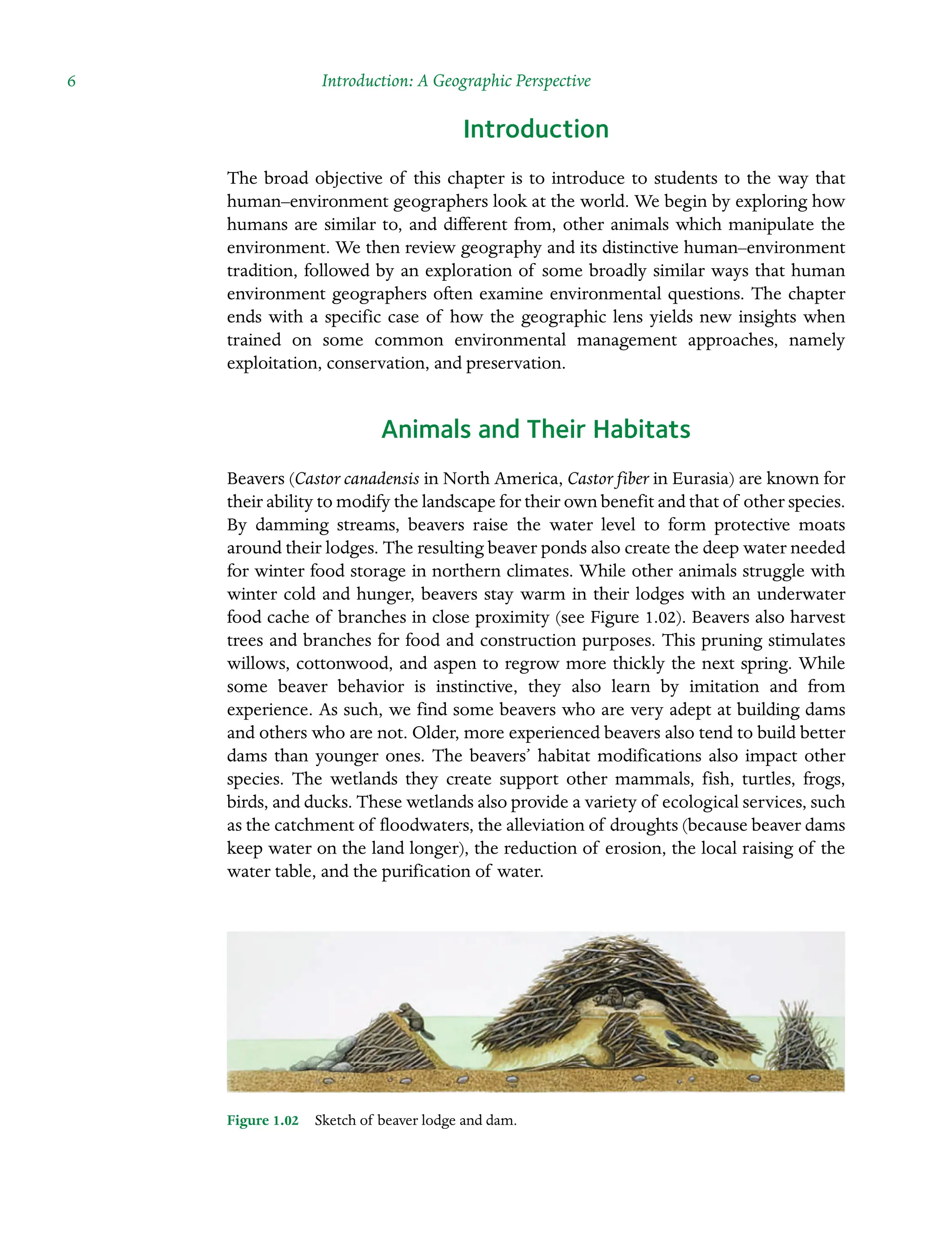
food cache of branches in close proximity (see Figure 1.02). Beavers also harvest
trees and branches for food and construction purposes. This pruning stimulates
willows, cottonwood, and aspen to regrow more thickly the next spring. While
some beaver behavior is instinctive, they also learn by imitation and from
�
experience. As such, we find some beavers who are very adept at building dams
and others who are not. Older, more experienced beavers also tend to build better
dams than younger ones. The beavers’ habitat modifications also impact other
species. The wetlands they create support other mammals, fish, turtles, frogs,
birds, and ducks. These wetlands also provide a variety of ecological services, such
as the catchment of floodwaters, the alleviation of droughts (because beaver dams
keep water on the land longer), the reduction of erosion, the local raising of the
water table, and the purification of water.
Figure 1.02â•… Sketch of beaver lodge and dam.
Introduction: A Geographic Perspective  7
Humans, like other animals, also modify the landscape. We manipulate the land,
for example, through burning, cutting, tilling, planting, harvesting, dam building,
and home construction to meet our own objectives. Through a process of experi-
mentation, success and failure, observation, and the sharing and stealing of ideas,
humans have learned how to manipulate the environment for their own purposes.
For example, through careful observation of local environmental feedback,
humans often developed farming systems that were highly productive, and
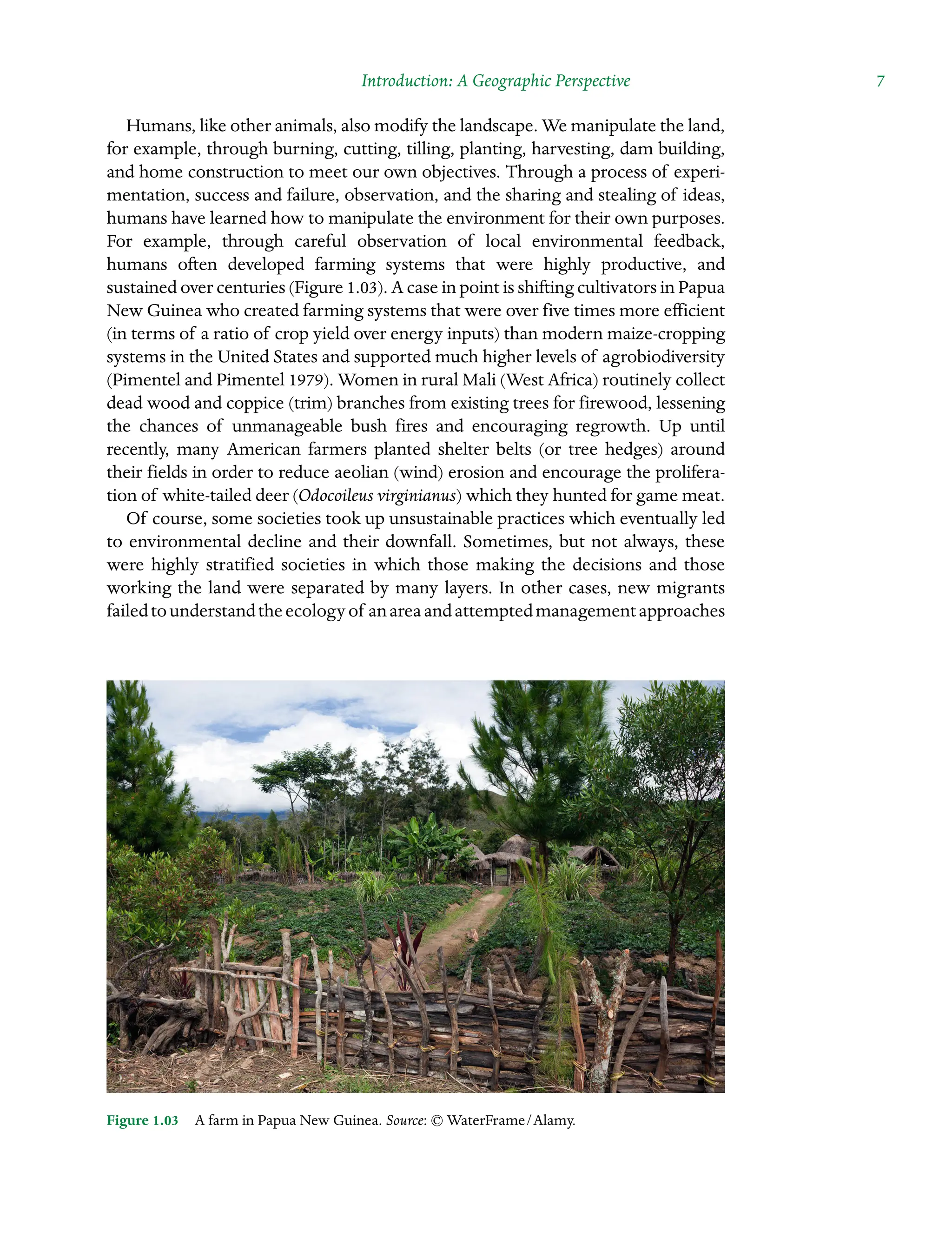
sustained over centuries (Figure 1.03). A case in point is shifting cultivators in Papua
New Guinea who created farming systems that were over five times more efficient
(in terms of a ratio of crop yield over energy inputs) than modern maize-cropping
systems in the United States and supported much higher levels of agrobiodiversity
(Pimentel and Pimentel 1979). Women in rural Mali (West Africa) routinely collect
dead wood and coppice (trim) branches from existing trees for firewood, lessening
the chances of unmanageable bush fires and encouraging regrowth. Up until
recently, many American farmers planted shelter belts (or tree hedges) around
their fields in order to reduce aeolian (wind) erosion and encourage the prolifera-
tion of white-tailed deer (Odocoileus virginianus) which they hunted for game meat.
Of course, some societies took up unsustainable practices which eventually led
to environmental decline and their downfall. Sometimes, but not always, these
were highly stratified societies in which those making the decisions and those
working the land were separated by many layers. In other cases, new migrants
failedtounderstandtheecologyof anareaandattemptedmanagementapproaches
Figure 1.03â•… A farm in Papua New Guinea. Source: © WaterFrame/Alamy.
8 Introduction: A Geographic Perspective
that were inappropriate for their new location. Still others developed intensive
production systems which required significant amounts of human labor to main-
tain. When political instability or disease disrupted these labor flows, such systems
quickly fell into decline and the productivity of the environment declined.
As humans societies grew and prospered, and people traveled greater and
greater distances, they began to trade. While trade was initially in luxury items,
food and raw materials eventually came to be traded in significant quantities.
By the 20th century, even garbage was being shipped around the world. The
�
significance of this trade, combined with urbanization, was that it gradually sep-
arated people from the sources of their food and goods and the byproducts of
their �
consumption. We were losing our ability to productively and sustainably
engage with ecosystems. Today we live in a world where many consumers in the
most developed areas of the world have little to no idea where their provisions
�
originate from and how they are produced. We also live on a planet where the
consequences of such detachment from the biophysical world seem to be growing.
Increasing carbon emissions, and resulting climate change, is probably one of the
most disquieting, global-scale environmental challenges. Other challenges, like
�
deforestation, ground water depletion, and the loss of biodiversity, are also of
great �concern.
Not all ecological challenges are a direct result of humans modifying the
�
environment in a problematic manner. In some cases it may have more to do with
how humans position themselves vis-à-vis the biophysical world. Hurricanes, for
example, become more of an issue for humans when they build homes close to
coastlines, or inundations are a problem when towns and cities are established in
floodplains. Some biomes have naturally sparse or erratic rainfall, so trying to live
in such areas without adapting to these patterns is destined to be problematic.
Clearly many of the challenges described above could be avoided if we better
understood our place within, and relationship to, the biophysical world. This text
helps the student explore that world and how we got to this particular point in
human history. While many disciplines and fields of study examine these ques-
tions, this text helps students understand these issues from the perspective of
human–environment geography. We begin this chapter with a brief introduction
to geography and then a more thorough examination of some basic elements of
human–environment geography.
What Is Geography and What Does It Have
To Do with Studying the Environment?
Geography is so basic that we all seem to have some idea of what it is, yet curi-
ously, many would have trouble describing the subject to another person in casual
conversation. Geography comes from the Greek word meaning “earth writing” or
“earth describing.” Even though the emphasis in geography has changed over the
years, this is still a fairly accurate statement.
Introduction: A Geographic Perspective  9
While the Greeks were the first to organize geography as a coherent body of
knowledge, the need for geographic knowledge is as old as humankind. For as long
as people have been traveling, exploring, and migrating, they have been
�
encountering different environments and other human societies. As such, the
survival and success of human populations meant that they needed to understand
other groups, faraway lands, where these were located spatially (if for no other
reason than to know how to get there again), the processes that connect one human
group to others, and ways in which each group is unique. In the process, such
�
travelers, explorers, and migrants learned a lot about where they had come from,
that is, it helped them to understand what was special about their own homes.
Geography is a broad discipline that essentially seeks to understand and study
the spatial organization of human activity and of people’s relationships with their
environment. It is also about recognizing the interdependence among places and
regions, without losing sight of the individuality and uniqueness of specific places.
Geography is rather unique for a discipline in that it straddles the science–social
science–humanities divide, using a broad arsenal of methods and perspectives to
tackle questions. It is also not an armchair science (in which data is downloaded
for analysis) but rather has a long tradition of fieldwork. Finally, many geographers
do get excited about maps (some might call us map geeks) but it is important
to remember that maps are a means to an end for most geographers. By displaying
data spatially, it pushes us to ask why things are distributed the way they are, or it
may reveal patterns or correlations which had not previously been seen.
While the general tenets of a geographic approach (i.e., attention to spatial
�
patterns, human–environment dynamics, the uniqueness of place, and connections
between regions and across scales) apply to all areas of geography, geography has
grown over time to recognize sub-specialties within the discipline based on the sub-
ject matter addressed. At the broadest level, there is a commonly recognized divide
between the study of biophysical phenomena (physical geography) and the exami-
nation of human or social phenomena (human geography). Physical geographers
seek to understand long-term climate patterns and change (climatology), patterns
of plant and animal distribution (biogeography), and the origin and evolution of
landforms (geomorphology). Human geographers study the patterns and dynamics
of human activity on the landscape, including settlement, urbanization, economic
activity, culture, population, development, and disease.
Between physical and human geography, lies the vibrant arena of human–Â�
environment geography. The investigation of nature–society relationships lies at
the heart of geography and has been one of the pillars of the discipline since the
modern academic structure crystallized in 19th-century Germany. This realm of
inquiry also has been an important bridge between geography and other fields.
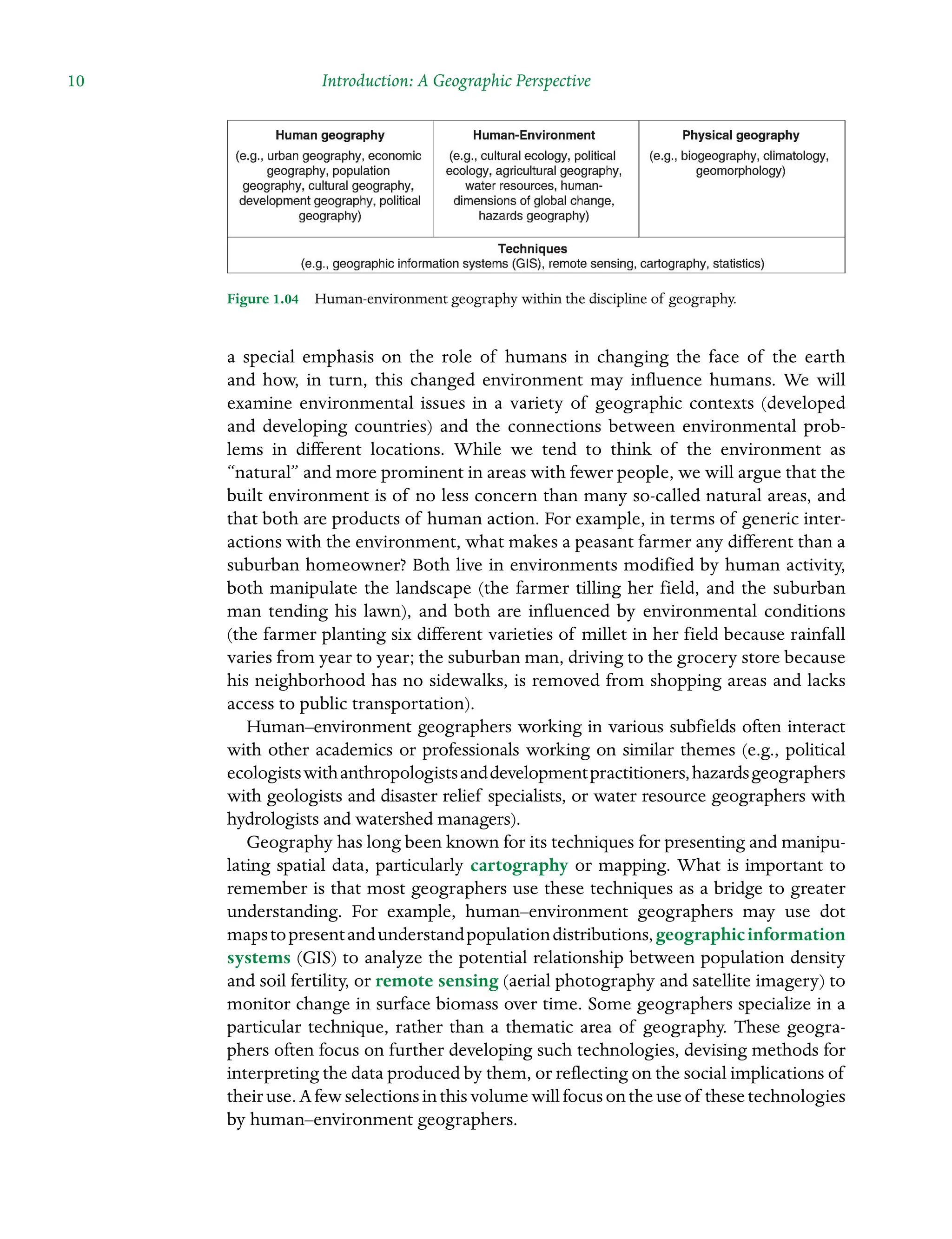
Figure 1.04 depicts the position of human–environment geography within the
�
discipline of geography.
This textbook is focused on a dynamic and burgeoning subfield of geography
known as human–environment geography. The book introduces you to the
study of human–environment interactions from a geographic perspective, with
10 Introduction: A Geographic Perspective
a special emphasis on the role of humans in changing the face of the earth
and how, in turn, this changed environment may influence humans. We will
examine environmental issues in a variety of geographic contexts (developed
and �
developing �
countries) and the connections between environmental prob-
lems in different �
locations. While we tend to think of the environment as
“natural” and more prominent in areas with fewer people, we will argue that the
built environment is of no less �
concern than many so-called natural areas, and
that both are products of human action. For example, in terms of generic inter-
actions with the environment, what makes a peasant farmer any different than a
suburban homeowner? Both live in environments modified by human activity,
both manipulate the landscape (the farmer tilling her field, and the suburban
man tending his lawn), and both are influenced by environmental conditions
(the farmer planting six different varieties of millet in her field because rainfall
varies from year to year; the suburban man, driving to the grocery store because
his neighborhood has no sidewalks, is removed from shopping areas and lacks
access to public transportation).
Human–environment geographers working in various subfields often interact
with other academics or professionals working on similar themes (e.g., political
ecologistswithanthropologistsanddevelopmentpractitioners,hazards�geographers
with geologists and disaster relief specialists, or water resource geographers with
hydrologists and watershed managers).
Geography has long been known for its techniques for presenting and manipu-
lating spatial data, particularly cartography or mapping. What is important to
remember is that most geographers use these techniques as a bridge to greater
understanding. For example, human–environment geographers may use dot
mapstopresentandunderstandpopulationdistributions,geographicinformation
systems (GIS) to analyze the potential relationship between population density
and soil fertility, or remote sensing (aerial photography and satellite imagery) to
monitor change in surface biomass over time. Some geographers specialize in a
particular technique, rather than a thematic area of geography. These geogra-
phers often focus on further developing such technologies, devising methods for
interpreting the data produced by them, or reflecting on the social implications of
theiruse.Afewselectionsinthisvolumewillfocusontheuseof these �technologies
by human–environment geographers.
Figure 1.04â•… Human-environment geography within the discipline of geography.
Introduction: A Geographic Perspective  11
A Geographic Perspective on Environmental
Questions1
Students may wonder what differentiates an introductory-level human–Â�
environment geography course from its corollary in environmental studies
or environmental science. Later in this book, we will explore a number of
�
subdisciplines in geography that offer distinctive lenses through which
to explore environmental issues (e.g., cultural ecology, political ecology,
�
hazards geography, environmental history, and environmental justice). In
this chapter we articulate more fundamental geographic perspectives that
often characterize the discipline’s approach to human–environment questions.
While not offering an exhaustive list of such generalized approaches, here we
investigate and apply four perspectives: scale-sensitive analysis, attention to
spatial patterns of resource use, a conception of the human–environment
system as a single unit (rather than two separate parts), and a cognizance of the
connections between places and regions.
As a way of introducing these four perspectives, we apply them to three basic
approaches to environmental management that you would encounter at the start
of most environmental studies texts: exploitation, conservation, and preservation.
We start by exploring the conventional understandings of these approaches and
then show how they may be understood somewhat differently from a geographic
angle. We then re-examine, using this geographic perspective, a famous case in
US environmental history that has been used to illustrate the conventional
�
understandings of conservation and preservation, not to mention an early rift in
the US environmental movement.
Conventional Understandings of Exploitation,
Conservation, and Preservation
The concepts of exploitation, conservation, and preservation are typically used to dif-
ferentiate human management and use of renewable resources (e.g., forests, fisheries,
many sources of water). Exploitation is the easiest of these three �
concepts to grasp.
It refers to the use of a resource without regard to its long-term productivity, usually
by over-harvesting in the short term. As such, an exploitative approach to forest
management might entail clear cutting, and not replanting, large tracts of land.
While the terms conservation and preservation are sometimes used inter-
changeably in public discussions, environment-related fields carefully use these
words to refer to particular management regimes for renewable resources.
Conservation (sometimes also described as the utilitarian approach in environ-
mental history, or as resource conservation in the UK) typically refers to use within
certain biological limits, or within the annual growth increment of a particular
resource. In the case of forests or fisheries, this annual growth increment is also
referred to as the sustainable yield2
or maximum sustainable yield.
12 Introduction: A Geographic Perspective
The US government natural resource management agency most closely
�
associated with the conservation approach is the US Forest Service (USFS), and
the same approach is also applied by government forest agencies in many other
parts of the world. Since the US Sustained-Yield Forest Management Act of 1944,
the USFS has managed many of its forests under the principle of maximum
�
sustainable yield. Typically the formula (forest area/age to maturity) is used to
determine the percentage of the total forest area that may be harvested and
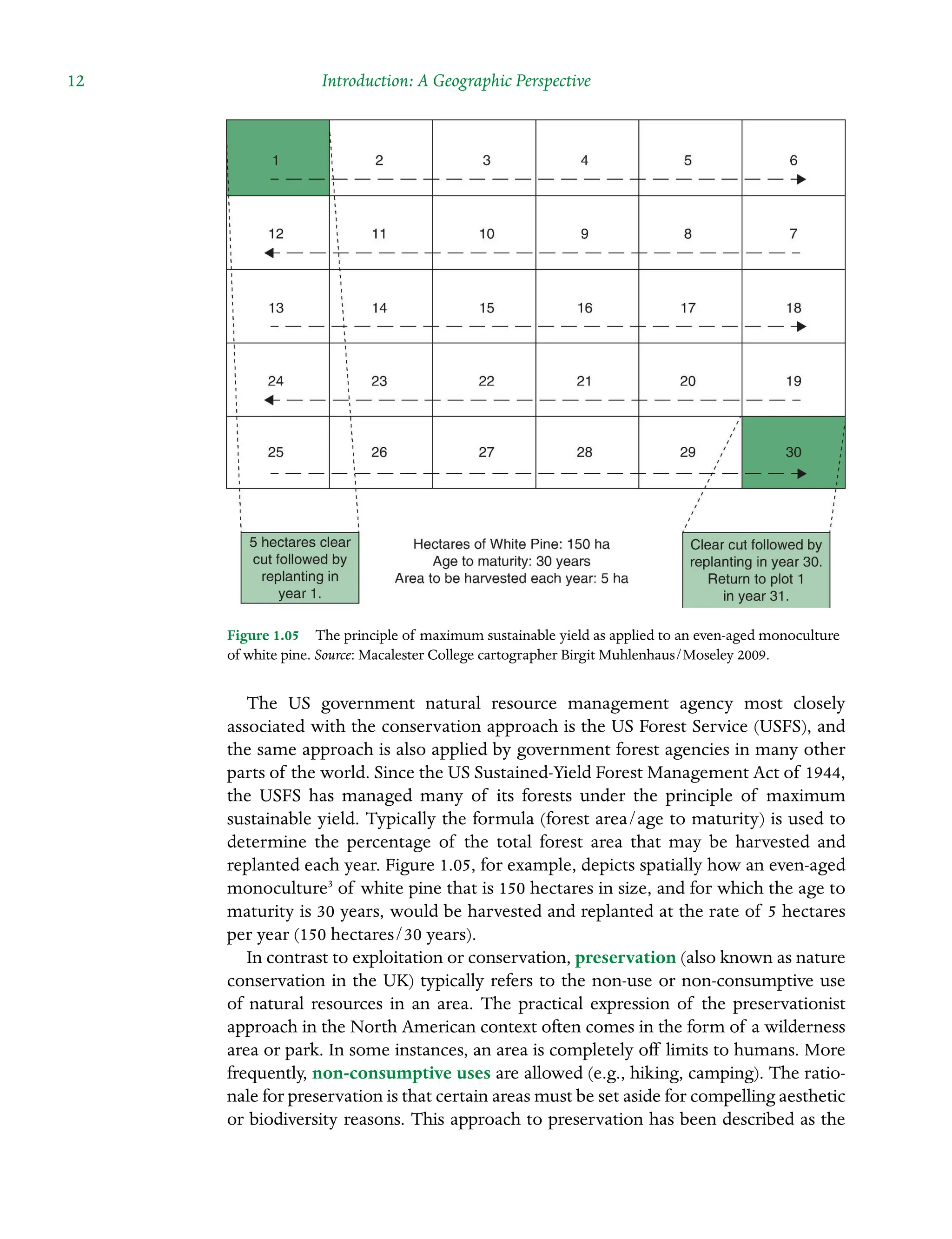
replanted each year. Figure 1.05, for example, depicts spatially how an even-aged
monoculture3
of white pine that is 150 hectares in size, and for which the age to
maturity is 30 years, would be harvested and replanted at the rate of 5 hectares
per year (150 �
hectares/30 years).
In contrast to exploitation or conservation, preservation (also known as nature
conservation in the UK) typically refers to the non-use or non-consumptive use
of natural resources in an area. The practical expression of the preservationist
approach in the North American context often comes in the form of a wilderness
area or park. In some instances, an area is completely off limits to humans. More
frequently, non-consumptive uses are allowed (e.g., hiking, camping). The ratio-
nale for preservation is that certain areas must be set aside for compelling aesthetic
or biodiversity reasons. This approach to preservation has been described as the
Figure 1.05â•… The principle of maximum sustainable yield as applied to an even-aged monoculture
of white pine. Source: Macalester College cartographer Birgit Muhlenhaus/Moseley 2009.
Introduction: A Geographic Perspective  13
“Yellowstone model,”4
a model that emphasizes national parks which people may
visit as tourists, but neither reside in nor exploit to support a resource-based
�livelihood.TheUSParkServiceistheUSgovernmentnaturalresourcemanagement
agency most clearly identified with the preservationist approach (as is the case for
government park services in many other parts of the world). The preservationist
approach was introduced to developing countries during the colonial era when
many parks and wilderness areas were established. Parks and preserves in the
world’s tropical regions have received considerable attention since the 1992 World
Summit on Environment and Development in Rio de Janeiro. For example, over
10% of territory in some African countries is now managed by state and interna-
tional organizations for preservation purposes.
Geographic Perspectives on Exploitation,
Conservation, and Preservation
Geography’s focus on scale, synergistic human–environment interactions,
land-use patterns, and the connections between places and regions offers intri�
guing insights into the concepts of exploitation, preservation, and conservation.
Attention to scale is a core geographic concern and a framing device that is
�profoundly implicated in any form of spatial analysis. The concept of scale may be
used in somewhat different ways. In cartography (or the science of map-making),
scale refers to the distance on the map in relation to the distance on the surface of
Earth. As such, relatively small-scale maps show larger areas because the fraction
of distance on the map over distance on the Earth’s surface is small. In contrast,
large-scale maps show smaller areas because the ratio or fraction of distance on
the map over distance on the surface of the Earth is relatively large. Unlike the
relatively specific idea of map scale, we can also think of this term more
�
conceptually, e.g., local versus global scale (see Chapter 4 for further discussion of
scale). As such, one might analyze a problem at the scale of a local community,
or at the level of a park, or using data aggregated at the scale of a state or province
(or some broader scale).
The geographer Stan Openshaw (1983) problematized a-scalar analysis in terms
of the modifiable areal unit problem. In discussing this problem, Openshaw
focused on two issues related to scale (the level at which data is aggregated and
the boundaries of spatial units) to show how variation in these factors greatly
affected findings.
Within geography, there is also a body of scholarship on the politics of scale.
These studies examine the political implications of the choice of scale at which an
environmental issue is articulated and conceptualized. Different groups frequently
struggle over the scale at which an issue is framed. Mansfield and Haas (2006: 78),
for example, discuss how “using scale as a framing device is a powerful political
strategy … because focusing on a particular scale presupposes certain kinds of
solutions while foreclosing others.” Similarly, attention to scale complicates con-
ventional understandings of exploitation, conservation, and preservation. We may
14 Introduction: A Geographic Perspective
think about scale in at least three different ways in our case: the scale at which the
approach is implemented, the scale at which the approach is analyzed, and the
scale at which the approach is discussed, or discursive scale (the last point will
be addressed in the subsequent section on Hetch Hetchy Valley). The scales at
which an approach is implemented or analyzed are sometimes referred to as scale
frames (e.g., Kurtz 2003).
In practical terms, the scale at which the preservationist approach may be imple-
mented is limited by the need for humans to use natural resources. As such, unless
an area is lightly populated, it is challenging to set aside extremely large tracts of
land as preserves because people need to use some land to sustain themselves. With
the possible exception of Antarctica (a continental example), most lands set aside for
preservation are modest in scale. More specifically, most of the world’s big IUCN
(International Union for the Conservation of Nature) category Ia and Ib parks are
in the high Arctic or sparsely populated tropic forests, whereas most �
preservation
units (IUCN category IV ) in densely populated Europe are relatively small. While
parks appear as preservation (if the unit of analysis stops at the park boundary), this
perception quickly changes at broader scales of analysis if �
surrounding areas are
overexploited. For example, national parks in Costa Rica have been referred to as
diamonds in a sea of devastation (Sanchez-Azofeifa et al. 2002).
Incontrasttopreservation,conservationcould(atleastintheory)be�implemented
at a much broader scale because it allows for human use of resources within
biological limits. In such a situation, people in all places would be allowed to tend
to their needs, yet would be required to operate within the biological limits of the
environment. This is a very integrated and spatially broad vision of conservation
that shares commonalities with certain (i.e., the strong or radical green) concep-
tions of sustainable development (see Chapter 2). In practice, such an approach
would require a significant departure from current development patterns. This
departure would be necessary because market economies (which tend to produce
haves and have-nots) may not be able to coexist with an approach where the limits
of allenvironmentsarerespected.Inotherwords,manywouldassertthatcapitalism
itself promotes a patchwork of uses on the landscape, with capital accumulation
in one area leading to capital depletion in another (Frank 1979; Wallerstein 1979;
Harvey 1996).
In the real world, conservation (like preservation) is often implemented at a
more local scale. As described earlier, foresters managing a wood lot under the
principles of sustainable yield carve it up into equal-sized plots (derived via the
�
formula: forest area/age to maturity) and then harvest and replant one such plot
per year until eventually they return to the first plot that was cut and replanted.
Hereagain,examiningthesituationatavarietyof scaleframesallowsoneto�recognize
that the management of the forest as a whole might be labeled as conservation
(scale frame A in Figure 1.06). Conversely, when examined at the scale of the
individual plot being harvested (often several hectares in size), the situation might
more aptly be described as exploitation (scale frame B in Figure 1.06). Exploitation
might be the more appropriate term at this scale because such plots are often
Introduction: A Geographic Perspective  15
clear-cut, and lie barren for some time before they are replanted. While such a pro-
cess incrementally impacts biodiversity, soil stability, and infiltration at the scale of
the forest management unit, all three of these factors decline dramatically at the
plot scale after a clear cut.
Analyzing preservation and conservation at the scale of a land management
unit allows one to arrive at one set of conclusions about the nature of these
approaches. However, as the scale frame is narrowed or broadened, the homoge-
neity or heterogeneity of land-use practices changes, and the characterization of
what is happening changes as well. As such, the scale at which an approach is
�
presented or analyzed is a choice with political and ideological implications.
If one pulls back from the land management unit and begins to analyze the
situation at broader scales, at least three other geographic issues begin to become
apparent: (1) patterns of land use (i.e., how the landscape is divided up into different
land-use units); (2) the economic and ecological connections between different areal
units – and the politics of these linkages; and (3) synergistic human–Â�
environment
interactions.
In the first instance, for example, preservation at a limited scale means that
humans must divide up the landscape into areas designated for preservation and
those for other types of land use (ranging in use from overexploitation to
Figure 1.06â•… Scale analysis of forest managed under principles of maximum sustainable yield.
Source: Macalester College cartographer Birgit Muhlenhaus/Moseley 2009.
16 Introduction: A Geographic Perspective
conservation). As such, when viewed from a broader scale perspective (scale frame A
in Figure 1.07), one sees a patchwork landscape of exploitation, conservation, and
preservation, which (by definition) could not be considered preservation. Such
patchworklandscapes,withpreservationinsomeareas(scaleframeBinFigure1.07)
and different uses in others, may represent conservation at best (use within
biological limits) and (more likely) overexploitation in many instances. In other
words, preservation at the local scale could violate conservation at a broader scale
if it leads to overexploitation on other parcels.
Secondly, underpinning the land-use mosaic are a variety of economic and
�
ecological linkages between preservation areas and other points on the landscape.
Accounting for linkages, or chains of explanation, between local land-use �strategies
and the broader political economy has been standard practice in geography,
�
especially in such subfields as political ecology, where there is an emphasis on the
political economy of human–environment interactions (see Chapter 4).
At a very basic level, the non-use or non-consumptive use of resources in certain
areas implies that uses that could have occurred in these areas likely have shifted
elsewhere. While it is acknowledged that US national parks often were established
on economically marginal lands, it is difficult to deny that these could have been
sites of resource extraction. In other words, it is the “subsidy” provided by intensive
use of “normal use areas” (both as sources of resources and sites of human
�
habitation) that allows people to set aside areas for preservation. Another way to
conceptualize one unit of land subsidizing preservation on another is to consider
Figure 1.07â•… Scale/space analysis of preservation. Source: Macalester College cartographer Birgit
Muhlenhaus/Moseley 2009.
Introduction: A Geographic Perspective  17
the net primary productivity5
(NPP) of any ecosystem. If a human population
was to consume a large portion of an area’s NPP per year, and then half the land
was turned into a preserve, then the human population would need to look
�
elsewhere for the resources it needs to survive. These resources (garnered from
unpreserved land) then support or subsidize the preserve. The subsidy provided to
preserves from normal land-use areas may come from inside or outside the country
(see Figure 1.07 showing the subsidy provided by a distant site of production or
exploitation). For example, a reduction in US timber harvests from 1990 (because
of stricter requirements to sustain biodiversity and other ecosystems functions)
was possible in the face of growing US demand for wood products because of
increasing imports from Canada (Martin and Darr 1997) and several tropical coun-
tries (Tucker 2002). The global economic system, with its increasingly global set of
commodity chains, is sufficiently opaque to prohibit most people from seeing the
impact of resources they may be drawing on from overseas (Princen 2002).
Beyond shifts in resource extraction, a second connection between preserves and
other points on the landscape may be the dislocation of peoples. A large body of
geographic scholarship on parks and peoples has documented how the creation of
parks in developing countries often implies the relocation of peoples to other areas
(see Chapter 11). For example, Guha (1997) describes an on-going �
controversy in
NagarholeNationalParkinKarnatakaProvince,India,wheretheForestDepartment
has been trying to relocate 6000 local people. Relocated peoples, while (arguably)
lessening impact within the preserve, often augment impact �
elsewhere (another
dimension of outside areas “subsidizing” preserves). Furthermore, displaced peo-
ples often bear considerable costs for the creation of such preserves in terms of
compromised livelihoods. While a lesser-known phenomenon, the establishment
of national parks in the US (and other areas of the Global North) often involved the
displacement of native peoples (Burnham 2000; Braun 2002). While most proposed
US national parks were described as economically worthless and uninhabited by
their proponents in the early 20th century in order to avoid conflicts with economic
interests, many of these areas were far from uninhabited. The environmental
historian Philip Burnham has described the role of public agencies in removing
Native Americans from lands that were to become Glacier, Badlands, Mesa Verde,
Grand Canyon, and Death Valley national parks (2000).
A third connection exists to outside areas when preserves are supported by the
fees of ecotourists, increasingly the case in many developing countries. These fees
represent real financial transfers that may offset the resources forgone when an
area is set aside for a preserve. However, those bearing the costs of the park (often
local people in terms of compromised livelihoods) and those benefiting from
user fees and tourist revenues (e.g., national governments, tour companies) are
often �
different. Globetrotting ecotourists also generate significant environmental
�
externalities when they consume large amounts of resources to travel across the
world to visit wildlife preserves and parks in Africa, Latin America, and Asia.
What the above examples suggest is that preservation is only preserva�
tion �(non-use or non-consumptive use) at the scale of the preserve. When such
18 Introduction: A Geographic Perspective
a �
preserve is viewed at broader scale frames, we see that this is not really
�
preservation because non-use/non-consumptive use in one area is almost
always subsidized by use in surrounding areas (or even distant centers of pro-
duction and consumption). In either instance (conservation or preservation),
we suggest that the distinctions between �
exploitation, conservation, and pres-
ervation begins to become blurred when they are analyzed at multiple scales.
Key to understanding this multi-scaler analysis is attention to how humans
divide up space to apply either principle (conservation or preservation) and
to socio-economic and ecological connections that exist between regions
and places.
Another issue which becomes clear when discussing approaches to resource
management (exploitation, conservation, and preservation) is a tendency to sepa-
rate humans from nature, rather than viewing humans as part of nature (that is,
just another animal among many). As the story about beavers at the beginning of
this chapter suggests, humans are not really all that different from other animals
who manipulate their environments to achieve certain ends. This is not to �insinuate
that, if humans are part of nature, then anything goes. Rather, the idea is to
acknowledge that we are not all that different from other actors in the environ-
ment and that it is problematic to think of ourselves as being able to operate
outside of such systems. If humans are a part of nature, then the preservation
approach in particular becomes problematic as it operates from a position that
humans are (or ought to be) outside of natural areas if these are to be considered
natural. The approach also ignores that fact that preserves are a product of human
action as these are areas where we have deliberately chosen not to pursue certain
types of activities.
Gifford Pinchot, John Muir, and Conventional Interpretations
of the Hetch Hetchy Valley Controversy
In the US, the conservationist and preservationist philosophies evolved quickly
in the wake of large-scale deforestation (i.e., exploitation) in the post-Civil War
period as American cities and industry boomed (Williams 1989). Along with this
destruction came the realization by some that America’s vast natural resource base
was not inexhaustible.
Two iconic figures, Gifford Pinchot and John Muir, are used in many texts to
help illustrate the two approaches to resource management (Miller 1990;
Cunningham and Saigo 2001; Holechek et al. 2003; Chiras and Reganold 2005;
Righter 2005). Gifford Pinchot, a German-trained forester who established the
Yale School of Forestry (the first school of forestry in the US) and the founding
head of the US Forest Service, was probably the most visible early 20th-century
proponent of the conservationist approach in the US (Miller 2001). Pinchot did
not see conservation and development as incompatible. In fact, Pinchot saw the
wise use of natural resources as the key to sustained development and produc-
tion over time (not all that dissimilar from the sustainable development discourse
Introduction: A Geographic Perspective  19
that would rise to prominence in the late 1980s and 1990s (see Chapter 2)).
Pinchot wanted to maximize human benefit from the resource base over time
(instead of just maximizing human benefit in the short run). According to
Pinchot, resources should be used “for the greatest good, for the greatest number
for the longest time” (quoted in Cunningham and Saigo 2001: 18). Pinchot’s por-
trayal of forestry practices (especially sustainable yield) as “scientific,” allowed
him to build the US Forest Service into a powerful and well-resourced agency
(Clarke and McCool 1985).
John Muir played a key role in the establishment of some of the first national
parks in the US and was one of a handful of American intellectuals who began
to write about the aesthetic beauty of the American wilderness in the late
19th century (Runte 1987). Muir, a Scottish immigrant, spent his early years
in Wisconsin and then traveled to California where he helped establish and
became the first president of the Sierra Club. Muir and others (e.g., Ralph
Waldo Emerson, Henry David Thoreau) often described the American
wilderness in quasi-religious terms. This sentiment is reflected in Muir’s
description of the Hetch Hetchy Valley. He wrote that to dam the Hetch Hetchy
one “may as well dam for water-tanks the people’s cathedrals and churches, for
no holier temple has ever been consecrated by the heart of man” (Muir 1908).
As others have noted (most notably Cronon 1996), “nature” for these writers
was a place without humans. As such, the �
preservation of nature not only
entailed limits on the consumptive use of resources, but a prohibition on peo-
ple living in these spaces. Wilderness eventually came to be defined as a place
“where man himself is a visitor who does not remain” (US Wilderness Act
1964, section 2c).
The early 20th-century conflict between Gifford Pinchot and John Muir over
the decision to dam or not dam the Hetch Hetchy Valley in California is used by
many texts to starkly differentiate between conservation and preservation. Hetch
Hetchy Valley was reported by many, including Muir, to be more beautiful than
Yosemite Valley. Both of these valleys, Hetch Hetchy and Yosemite, are found
within Yosemite Park, which was established as a California state park in 1864 and
then became a US national park in 1906. Figure 1.08 shows Yosemite National
Park and its position within the state of California. The conventional wisdom is
that Muir favored preserving the valley for aesthetic beauty whereas Pinchot advo-
cated damming the valley to provide water and hydroelectric power for the city of
San Francisco.
Muir and the preservationists eventually lost the battle with Pinchot and the
conservationists when the US Congress passed the Raker Bill in 1913 allowing
flooding of Hetch Hetchy Valley. The Hetch Hetchy Valley was �submerged in 1923
when construction of O’Shaughnessy Dam was completed. Figure 1.09 features
�
historical photos of Hetch Hetchy Valley before and after the dam was built.
As demonstrated by the two quotes below, readers of texts using the Hetch Hetchy
case in this context are led to conclude that conservation is a highly problematic
approach that ends in the destruction of beautiful sites.
20 Introduction: A Geographic Perspective
Figure 1.08â•… The location of Hetch Hetchy Reservoir (formerly Valley) and Yosemite National
Park. Source: Macalester College cartographer Birgit Muhlenhaus/Moseley 2009.
Introduction: A Geographic Perspective  21
Figure 1.09aâ•… Hetch Hetchy Valley before the O’Shaughnessy Dam. Source: F.E. Matthes/United
States Geological Survey Photographic Archive.
Figure 1.09bâ•… Hetch Hetchy Valley after the O’Shaughnessy Dam. Source: © Anthony Dunn/Alamy.
22 Introduction: A Geographic Perspective
Scientific conservationists, led by Gifford Pinchot, wanted to build a dam and
flood the valley to create a reservoir to supply drinking water for San Francisco.
Preservationists, led by John Muir, wanted to keep the beautiful spot from being
flooded. After a long and highly publicized battle, a dam was built and the valley was
flooded. (Miller 1990: 39; emphasis added)
One of the first and most divisive of these battles was over the flooding of the
Hetch Hetchy Valley in Yosemite National Park. In the early 1900s, San Francisco
wanted to dam the Tuolumne River to produce hydroelectric power and provide
water for the city water system … Muir said that Hetch Hetchy Valley rivaled
Yosemite itself in beauty and grandeur and should be protected. After a prolonged
and bitter fight, the developers won and the dam was built. (Cunningham and
Saigo 2001: 439)
Hetch Hetchy Valley Reinterpreted
So how does an alternative, geographic perspective change our understanding of
how this controversy is often presented? Many writers, and the mainstream
�
environmental movement more broadly, depict this narrative from a certain scale
perspective in that they tell a story focused on changes in the valley (rather than at
another scale such as the river basin).
Early in this century conservationists disagreed over how the beautiful Hetch
Hetchy Valley in what is now Yosemite National Park was to be used. This controversy
split the American conservation movement into two schools of thought, the
�preservationists and the scientific conservationists. (Miller 1990: 41; emphasis added)
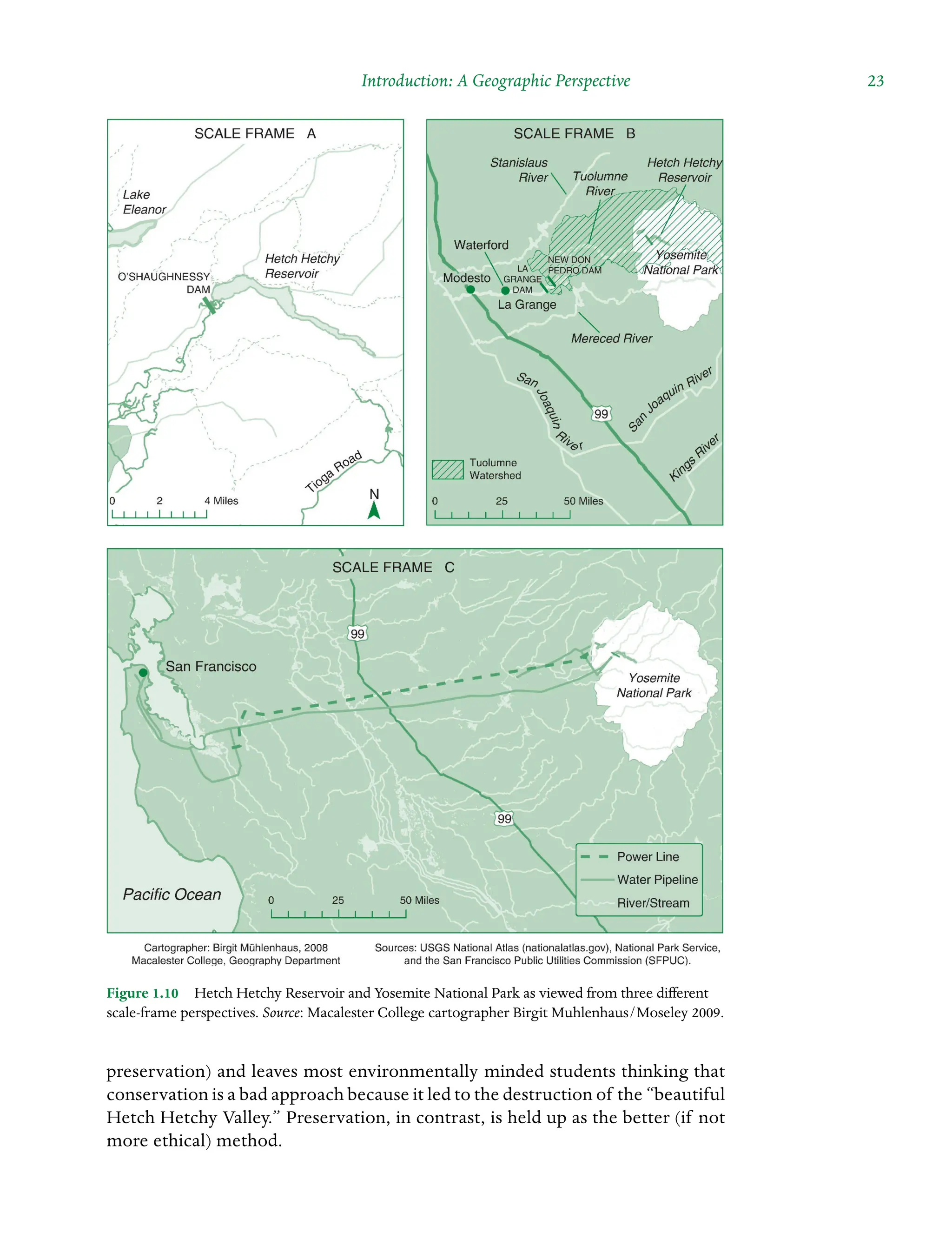
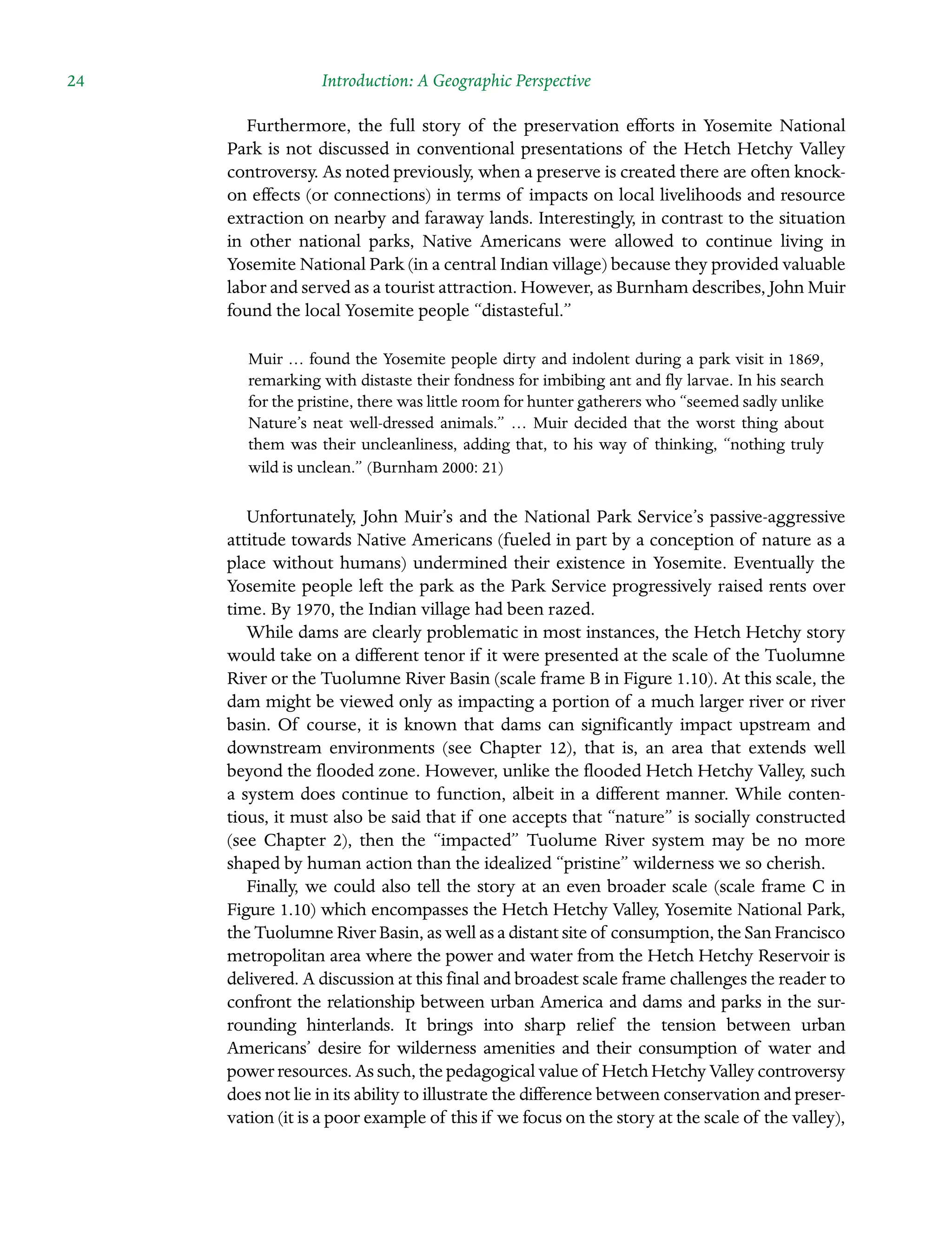
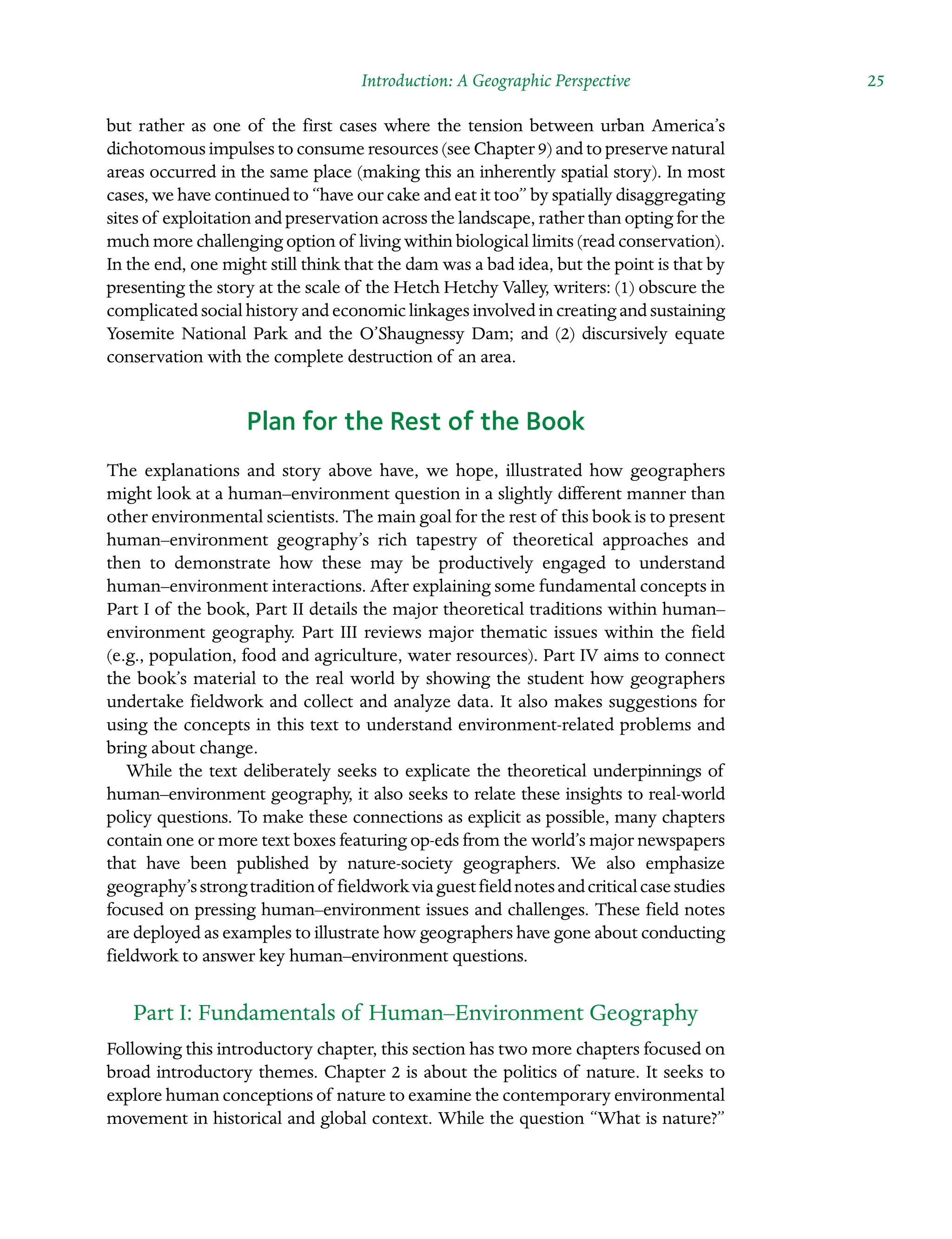
Given that the story is presented at the scale of the valley (scale frame A in
Figure 1.10), is what happened in the valley after the O’Shaughnessy Dam was
built a reasonable and fair example of conservation? We would argue that this
story misrepresents the true meaning of conservation (use within biological
limits) by focusing on a particular scale frame where the result is really one of
total destruction or exploitation (as the valley was completely flooded). In
other words, the story, as conventionally told, is focused on the area submerged
following construction of the O’Shaugnessy Dam, i.e., the destroyed riparian
zone and upper reaches of the valley floor. For example, Philp (2002) notes that
the “Hetch Hetchy is submerged under 117 billion gallons of water. In one of
the great �
contradictions of all time, Congress decided … in 1913 to drown
Hetch Hetchy to supply water for San Francisco.” Interestingly, and further
proof that the environmentally minded public is most concerned about the
impact of the dam on the valley itself (rather than the larger river basin) are
contemporary efforts to remove the dam (see Restore Hetch Hetchy 2006). By
manipulating the discursive scale, conservation (operating at the scale of the
watershed) is presented as exploitation (operating at the scale of the valley).
As such, the case study as conventionally told conflates conservation and exploi-
tation (making it a poor example of the difference between conservation and
Introduction: A Geographic Perspective  23
preservation) and leaves most environmentally minded students thinking that
conservation is a bad approach because it led to the destruction of the “beautiful
Hetch Hetchy Valley.” Preservation, in contrast, is held up as the better (if not
more ethical) method.
Figure 1.10â•… Hetch Hetchy Reservoir and Yosemite National Park as viewed from three different
scale-frame perspectives. Source: Macalester College cartographer Birgit Muhlenhaus/Moseley 2009.
24 Introduction: A Geographic Perspective
Furthermore, the full story of the preservation efforts in Yosemite National
Park is not discussed in conventional presentations of the Hetch Hetchy Valley
controversy. As noted previously, when a preserve is created there are often knock-
on effects (or connections) in terms of impacts on local livelihoods and resource
extraction on nearby and faraway lands. Interestingly, in contrast to the situation
in other national parks, Native Americans were allowed to continue living in
Yosemite National Park (in a central Indian village) because they provided valuable
labor and served as a tourist attraction. However, as Burnham describes, John Muir
found the local Yosemite people “distasteful.”
Muir … found the Yosemite people dirty and indolent during a park visit in 1869,
remarking with distaste their fondness for imbibing ant and fly larvae. In his search
for the pristine, there was little room for hunter gatherers who “seemed sadly unlike
Nature’s neat well-dressed animals.” … Muir decided that the worst thing about
them was their uncleanliness, adding that, to his way of thinking, “nothing truly
wild is unclean.” (Burnham 2000: 21)
Unfortunately, John Muir’s and the National Park Service’s passive-aggressive
�
attitude towards Native Americans (fueled in part by a conception of nature as a
place without humans) undermined their existence in Yosemite. Eventually the
Yosemite people left the park as the Park Service progressively raised rents over
time. By 1970, the Indian village had been razed.
While dams are clearly problematic in most instances, the Hetch Hetchy story
would take on a different tenor if it were presented at the scale of the Tuolumne
River or the Tuolumne River Basin (scale frame B in Figure 1.10). At this scale, the
dam might be viewed only as impacting a portion of a much larger river or river
basin. Of course, it is known that dams can significantly impact upstream and
downstream environments (see Chapter 12), that is, an area that extends well
beyond the flooded zone. However, unlike the flooded Hetch Hetchy Valley, such
a system does continue to function, albeit in a different manner. While conten-
tious, it must also be said that if one accepts that “nature” is socially constructed
(see Chapter 2), then the “impacted” Tuolume River system may be no more
shaped by human action than the idealized “pristine” wilderness we so cherish.
Finally, we could also tell the story at an even broader scale (scale frame C in
Figure 1.10) which encompasses the Hetch Hetchy Valley, Yosemite National Park,
the Tuolumne River Basin, as well as a distant site of consumption, the San Francisco
metropolitan area where the power and water from the Hetch Hetchy Reservoir is
delivered. A discussion at this final and broadest scale frame challenges the reader to
confront the relationship between urban America and dams and parks in the sur-
rounding hinterlands. It brings into sharp relief the tension �
between urban
Americans’ desire for wilderness amenities and their consumption of water and
power resources. As such, the pedagogical value of Hetch Hetchy Valley �controversy
does not lie in its ability to illustrate the difference between conservation and preser-
vation (it is a poor example of this if we focus on the story at the scale of the valley),
Introduction: A Geographic Perspective  25
but rather as one of the first cases where the tension between urban America’s
dichotomous impulses to consume resources (see Chapter 9) and to preserve natural
areas occurred in the same place (making this an inherently spatial story). In most
cases, we have continued to “have our cake and eat it too” by spatially disaggregating
sites of exploitation and preservation across the landscape, rather than opting for the
much more challenging option of living within biological limits (read conservation).
In the end, one might still think that the dam was a bad idea, but the point is that by
presenting the story at the scale of the Hetch Hetchy Valley, writers: (1) obscure the
complicated social history and economic linkages involved in creating and sustaining
Yosemite National Park and the O’Shaugnessy Dam; and (2) discursively equate
conservation with the complete destruction of an area.
Plan for the Rest of the Book
The explanations and story above have, we hope, illustrated how geographers
might look at a human–environment question in a slightly different manner than
other environmental scientists. The main goal for the rest of this book is to present
human–environment geography’s rich tapestry of theoretical approaches and
then to demonstrate how these may be productively engaged to understand
human–environment interactions. After explaining some fundamental concepts in
Part I of the book, Part II details the major theoretical traditions within human–
environment geography. Part III reviews major thematic issues within the field
(e.g., population, food and agriculture, water resources). Part IV aims to connect
the book’s material to the real world by showing the student how geographers
undertake fieldwork and collect and analyze data. It also makes suggestions for
using the concepts in this text to understand environment-related problems and
bring about change.
While the text deliberately seeks to explicate the theoretical underpinnings of
human–environment geography, it also seeks to relate these insights to real-world
policy questions. To make these connections as explicit as possible, many chapters
contain one or more text boxes featuring op-eds from the world’s major Â�
newspapers
that have been published by nature-society geographers. We also emphasize
Â�geography’sstrongtraditionof fieldworkviaguestfieldnotesandcriticalcasestudies
focused on pressing human–environment issues and challenges. These field notes
are deployed as examples to illustrate how geographers have gone about conducting
fieldwork to answer key human–environment questions.
Part I: Fundamentals of Human–Environment Geography
Following this introductory chapter, this section has two more chapters focused on
broad introductory themes. Chapter 2 is about the politics of nature. It seeks to
explore human conceptions of nature to examine the contemporary environmental
movement in historical and global context. While the question “What is nature?”
26 Introduction: A Geographic Perspective
may seem simple, most geographers would tell you it is not. As such, this chapter
begins by exploring the social construction of nature and resources – and the
�
implications of this for policy and praxis. The chapter then examines the history of
contemporary environmentalism in the Global North and Global South. Particular
emphasis will be given to the rise of the conservation, preservation, and environ-
mental movements in the Global North (from the mid-19th century onward), the
different phases of these movements, and their spread to other world regions.
We will also explore environmental ethics from different cultural perspectives.
Throughout the discussion, we will attempt to create a healthy tension between
need for conservation and the often problematic way in which it has been imple-
mented. Chapter 3 is about the bio�
physical environment. It reviews key concepts in
ecology and physical geography. Its purpose is to impart some basic knowledge
of biophysical processes and to introduce the spatial perspective that physical
�
geographers often bring to these issues.
Part II: Contemporary Perspectives in
Human–Environment Geography
Each of the chapters in this section explores a different conceptual perspective
within geography on human–environment interactions. The goal is to get readers
to think about the environment in terms of its “relationship” to people and to
examine how different social science and humanities perspectives are useful for
explaining human environmental phenomenon and processes. Chapter 4 explores
the lens of cultural and political ecology. The interdisciplinary field of cultural
ecologycametoprominenceinthe1960sand1970slargelyinreactionto �modernist
interpretations of development in the Global South. The field played an important
role in the decolonization process by documenting and explaining local agricul-
tural and resource management practices. In reaction to a series of critiques �leveled
against the field in the 1980s, it eventually came to view local human–Â�environment
interactions within the context of a broader political economy. This new field is
now known as political ecology. Chapter 5 examines environmental history. This
highly interdisciplinary field is a key reference point for many human–environ-
ment geographers. The chapter examines important environmental histories from
the post-industrial era as well as the growing literature on paleoclimatology.
Chapter 6 explores the evolving subfield of hazards geography, which has shifted
over time from a technocratic concern with risk to the political economy of natural
hazards. Geography’s hazards tradition will be presented, as well as an analysis of
various natural hazards (e.g., drought, tsunamis, earthquakes, floods, etc.) and
related societal vulnerability around the world. The final chapter of this section
examines environmental justice, or the uneven distribution of pollution and
�
environmental opportunity. This tradition bears some resemblance to political
ecology, but has a separate history and an increasing number of practitioners who
are geographers. While historically focused on the disproportionate burden of
Introduction: A Geographic Perspective  27
pollution borne by minority communities in the USA, environmental justice is
now being used as a lens to understand problems in the Global South.
Part III: Thematic Issues in Human–Environment Geography
The goal of this section is to explore major environmental themes and apply some
of the theoretical perspectives described in Part II to these issues. Chapter 8 exam-
ines climate, atmosphere, and energy. Here, energy resources will be discussed in
relation to their impact on climate and the atmosphere. Local atmospheric issues
will be reviewed, followed by an examination of the big three global climate issues
(acid deposition, stratospheric ozone depletion, and global warming). Chapter 9
examines the nexus of human population, consumption, and technology in terms
of their environmental impacts. Chapter 10 looks at agriculture and food systems.
This topic has a long history of study within human–environment geography. This
chapter explores agricultural systems around the world as well, and the impact of
global markets for various products. Chapter 11 examines biodiversity, wildlife,
and protected areas. Building on discussions in Chapters 2, 3, and 4, this chapter
introduces more sophisticated biodiversity concepts and examines conservation
efforts in this realm. Water resources and fishing livelihoods are explored in
Chapter 12. The chapter examines basic water concepts, freshwater and marine
resources, as well as fishing livelihoods.
Part IV: Bridging Theory and Practice
The final section articulates the connections between theory and practice. Human–
environment geographers’ approach to research is detailed in Chapter 13, as many
introductory students have a limited understanding of how geographers actually
conceptualize research projects and collect and analyze data to arrive at certain
conclusions. This chapter details a number of approaches to collecting and ana-
lyzing information as examples of how some human–environment geographers
practice their craft. In the concluding chapter (14), we examine how the many
ideas in this book may be employed in the real world to understand environment-
related problems and bring about change. It is suggested that the way we
�
understand the world has important implications for how we act in the world.
Furthermore, human–environment geographic research need not necessarily be
an activity isolated from “real-world” policy and change. There are many examples
wherein the actual process of research (particularly action-research) is a vital com-
ponent of the change process. Finally, there are strains of human–environment
geography which are quite applied in nature (meaning used in the everyday work
environment, be it consulting firms or government offices) and there are a number
of geographers who have worked directly on policy issues. As such, 21st-century
geography students are well positioned to bridge the worlds of theory and practice
by being thoughtful practitioners and engaged scholars.
28 Introduction: A Geographic Perspective
Chapter Summary
This chapter began by giving students a sense of how humans, like other animals,
have manipulated the environment in order to encourage the production of
certain types of resources. Sometimes people have been successful at doing this
over time and on other occasions we have exhausted the resource base with unwel-
come consequences. We then introduced the field of geography and its relevance
to �
environmental questions. We outlined some generalized perspectives that
human–environment geographers often take when examining resource questions.
These perspectives included attention to: scale, spatial patterns of environmental
use, a conception of the human–environment system as a single unit (rather than
two separate parts), and the connections between places and regions. In order to
illustrate such perspectives, the second half of the chapter applied these to develop
a revised understanding of three resource-management approaches as well as to a
famous case in US environmental history, the Hetch Hetchy Valley controversy.
The last part of the chapter simply described the plan for the rest of the book.
Critical Questions
1â•… Is human manipulation of the landscape necessarily a bad thing? Explain.
2â•… Are humans unique in their ability to manipulate the physical environment?
If not, what may distinguish humans’ ability to manage the environment from
that of other animals?
3â•… How might you describe geography to a friend? If this is your first geography
class, how has your understanding of geography changed since you started this
course and read this chapter?
4â•… What are some fairly general, yet distinctive, elements of the way human–
environment geographers approach natural resource questions?
5â•… Why, according to geographers, is the Hetch Hetchy controversy in US
�
environmental history not a very good example of the difference between
conservation and preservation?
Key Vocabulary
cartography
conservation
exploitation
geographic information systems (GIS)
Gifford Pinchot
Hetch Hetchy Valley
human geography
human–environment geography
John Muir
modifiable areal unit problem
net primary productivity
non-consumptive use
physical geography
politics of scale
preservation
remote sensing
scale
sustainable yield
Introduction: A Geographic Perspective  29
Notes
1â•… Much of the material in this section is based on:
Moseley 2009.
2â•… This is the amount of a renewable resource that
could be safely harvested each year without
reducing its long-term productive potential.
3â•… Monoculture refers to a farm field or forest stand
that is planted with one crop or tree as opposed to
a variety of such plants.
4â•… As Yellowstone National Park in the USA was the
first expression of a preserve in the modern era.
5â•… For terrestrial ecosystems, net primary produc-
tivity (NPP) refers to the total amount of bio-
mass generated for a given area (usually per
square meter) for a given time period (usually
a year).
References
Braun, B. (2002) The Intemperate Rainforest: Nature,
Culture and Power on Canada’s West Coast
(Minneapolis: University of Minnesota Press).
Burnham, P. (2000) Indian Country, God’s Country:
Native Americans and the National Parks (Washington,
DC: Island Press).
Chiras, D.D. and Reganold, J.P. (2005) Natural Resource
Conservation: Management for a Sustainable Future
(Upper Saddle River, NJ: Prentice Hall).
Clarke J.N. and McCool, D. (1985) Staking Out the
Terrain: Power Differentials among Natural Resource
Management Agencies (Albany, NY: State University
of New York Press).
Cronon, W. (1996) The trouble with nature or, getting
back to the wrong wilderness. Environmental History,
1(1), pp. 7–28.
Cunningham,W.P.andSaigo,B.W.(2001)Environmental
Science: A Global Concern. 6th edn. (New York:
McGraw-Hill).
Frank, A. (1979). Dependent Accumulation and Under�
development (New York: Monthly Review Press).
Guha, R. (1997) The authoritarian biologist and
the arrogance of anti-humanism: wildlife conser�
vation in the Third World. The Ecologist, 27(1),
pp. 14–20.
Harvey, D. (1996) Justice Nature and the Geography of
Differences (Oxford: Blackwell).
Holechek, J.L., Cole, R.A., Fisher, J.T., and Valdez, R.
(2003) Natural Resources: Ecology, Economics and Policy
(Upper Saddle River, NJ: Prentice Hall).
Kurtz, H.E. (2003) Scale frames and counter-scale
frames: constructing the problem of environmental
justice. Political Geography, 22, pp. 887–916.
Mansfield, B. and Haas, J. (2006) Scale framing of
scientific uncertainty in controversy over the
endangered Steller sea lion. Environmental Politics,
15(1), pp. 78–94.
Martin, R.M. and Darr, D.R. (1997) Market respon�
ses to the US timber demand-supply situation of
the 1990s: implications for sustainable forest
management. Forest Products Journal, 47(11–12), pp.
27–32.
Miller, C. (2001) GiffordPinchotandtheMakingof Modern
Environmentalism (Washington, DC: Island Press).
Miller, G.T. (1990) Living in the Environment: An
Introduction to Environmental Science. 6th edn.
(Belmont, CA: Wadsworth).
Moseley, W.G. (2009) Beyond knee-jerk environmental
thinking: teaching geographic perspectives on
conservation, preservation and the Hetch Hetchy
Valley Controversy. Journal of Geography in Higher
Education, 33(3), pp. 433–51.
Muir, J. (1908) The Hetch Hetchy Valley. Sierra Club
Bulletin. January.
Openshaw, S. (1983) The Modifiable Areal Unit Problem
(Norwich, UK: Geo Books).
Philp, T. (2002) Water: bring back Hetch Hetchy?
Sacramento Bee, April 21.
Pimentel, D. and Pimentel, M. (1979) Food, Energy and
Society (London: Edwin Arnold).
Princen, T. (2002) Distancing: consumption and the
severing of feedback. In T. Princen, M. Maniates,
and K. Conca (eds.), Confronting Consumption,
pp. 103–31 (Cambridge, MA: MIT Press).
Restore Hetch Hetchy (2006) Available at http:www.
hetchhetchy.com (accessed January 19, 2013).
30 Introduction: A Geographic Perspective
Righter, R. (2005) The Battle over Hetch Hetchy: America’s
Most Controversial Dam and the Birth of Modern
Environ�mentalism (New York: Oxford University
Press).
Runte,A.(1987)NationalParks:TheAmericanExperience,
2nd edn. (Lincoln: University of Nebraska Press).
Sanchez-Azofeifa, G.A., Rivard, B., and Calvo, J. (2002)
Dynamics of tropical deforestation around national
parks: remote sensing of forest change on the Osa
Peninsula of Costa Rica. Mountain Research and
Development, 22(4), pp. 352–8.
Tucker, R. (2002) Environmentally damaging
�
consumption: the impact of American markets
on tropical ecosystems in the twentieth century. In
T. Princen, M. Maniates, and K. Conca (eds.),
Confronting Consumption, pp. 177–95 (Cambridge,
MA: MIT Press).
Wallerstein, I.M. (1979) The Capitalist World Economy:
Essays (New York: Cambridge University Press).
Williams, M. (1989) Americans and Their Forests: A
Historical Geography (New York: Cambridge
University Press).
An Introduction to Human–Environment Geography: Local Dynamics and Global Processes,
First Edition. William G. Moseley, Eric Perramond, Holly M. Hapke and Paul Laris.
© 2014 William G. Moseley, Eric Perramond, Holly M. Hapke, Paul Laris.
Published 2014 by John Wiley  Sons, Ltd.
The Politics of Nature
Icebreaker: Evolving Environmentalism
In the 1960s, environmental issues became a visible and controversial part of daily life in
many parts of the world. The impacts of pesticides on the environment, concerns over
population growth, and the constant fear of radiation and nuclear warfare were all at the
forefront at that time. Since then, the prime environmental issues have shifted. From
population, to the decline of biological diversity, to the latest work on global climate change,
these all involve a real politics of nature. But what is nature? And why does your particular
conception of nature influence real life in your community?
2
Icebreaker: Evolving Environmentalism 31
Chapter Objectives 32
Introduction32
Human Conceptions of Nature 32
The Contemporary Environmental Movement
in Historical and Global Context 34
Chapter Summary 44
Critical Questions 45
Key Vocabulary 45
Notes45
References46
32 The Politics of Nature ˘The Politics of Nature
Chapter Objectives
The objectives of this chapter are:
1â•… To understand the different perspectives on “nature” within geography.
2â•… To consider how different perspectives on nature might influence one’s envi-
ronmental politics.
3â•… To understand how environmentalism and environmental politics have evolved
over the past 150 years.
4â•… To situate the student’s own region and environmental movement with respect
to the global push to recognize humanity’s increasing footprint on the planet.
Introduction
This chapter has two broad goals: (1) to explore human conceptions of nature; and
(2) to examine the contemporary environmental movement in historical and
global context. While the question “What is nature?” may seem simple, most
geographers would tell you it is not. As such, this chapter begins by exploring the
social construction of nature and resources – and the implications of this for policy
and praxis. The chapter then examines the history of contemporary environmen-
talism in the Global North and Global South. Particular emphasis will be given to
the rise of the conservation, preservation, and environmental movements in the
Global North (from the mid-19th century onward), the different phases of these
movements, and their spread to other world regions. We will also explore environ-
mental ethics from different cultural perspectives. Throughout the discussion, we
will attempt to create a healthy tension between the need for conservation or pres-
ervation and the often problematic ways these approaches have been implemented.
Human Conceptions of Nature
In contemporary geography, there are arguably three major ways of conceptua�
lizing the relationship between humans and their environment.
â•¢
• Human–environment geography: Humans play a role in modifying environ-
ments, and these environments – in turn – influence (but do not determine)
human actions or behaviors. It is a two-way, synergistic relationship.
â•¢
• Ecocentric (non-human) perspective: Non-human nature not only matters, but
organisms are agents of change, change humans, and deserve consideration
and special focus.
â•¢
• Social construction of nature: Nature or the environment is constructed (men-
tally) by humans and human concepts of nature are culturally, temporally, and
politically changing.
The Politics of Nature ˘The Politics of Nature 33
Since the rest of this book is largely about the human–environment perspective,
here we give some attention to the other two major perspectives in geography: the
ecocentric, and the social constructivist. These are somewhat artificial boundaries
as many human–environment geographers actually sympathize with and deploy
ecocentric or constructivist perspectives in their work. The aim here is to at least
explain some different human–environment perspectives in geography.
The ecocentric approach treats non-human nature as equally important as peo-
ple (if not more so). This means acknowledging that other animals, insects,
microbes, and plants have not only an obvious role in our mutual relations on
Earth, but they should be given a more important consideration and focus. The
argument is twofold. First, “consideration” refers to an ethical stance that would
have us humans recognize the rights of other beings on the planet. Second, by
“focus” ecocentric geographers mean that we should be paying greater attention
in our research to the agency of non-human nature (see Wolch and Emel 1998 for
a ground-breaking example).
Let’s briefly explore two examples which illustrate this approach. For the ethical
dimension, ecocentrists might ask “What are the rights of domesticated animals,
like cats and dogs, in our society?” (Haraway 2003). On the second question, they
might ask all of us “How do the ants in the soils you study shape the soils them-
selves, and how can you account for that biological agent role when you write
about soils?” A newer, more subtle version of this ecocentric perspective is taking
shape in what some are calling “post-humanism,” a philosophy that pushes
beyond a focus on the meaning of the world for humans, and includes non-human
nature in it. It should be noted that in most cases, ecocentrism and the construc-
tivist perspective are hard to tell apart.
The social constructivists in geography take an explicitly social stance on the
concept of nature. Or, as Noel Castree (2001: 5) has put it: nature has never been
simply “natural.” From the constructivist notion of environment, or nature, they
speak of socionature. This is a combination of the social and the natural that,
from this perspective, removes the separating lens between the social and the
natural. For these authors and philosophers, then, they are one and the same and
you cannot talk about “the natural world” as if it was separate from humans.
Take, for example, the seemingly natural condition of a drought. Human expe-
rience of such a situation is deeply conditioned by the way a society is structured.
One farming society might anticipate drought as a form of natural variability and
store surplus grain in good years to be redistributed to households in years of poor
rainfall. Another society might be enmeshed in a global economic system which
extracts all food and fiber from a region at minimal prices. As such, the experience
of these two groups with the same drought in a given year may be very different,
with one group surviving with little hardship and the other facing extreme hunger
and possible famine. Clearly the experience of this natural event is as much a prod-
uct of social factors as it is of biophysical ones (based on the work of Watts 1983).
We can also illustrate these differences, between human–environment, ecocentric,
and constructivist stances, with a set of diagrams (see Figures 2.01, 2.02, and 2.03).
34 The Politics of Nature ˘The Politics of Nature
In both the human–environment and ecocentric perspectives, there is
a clear flow and dialectic between the environmental and human sides
of the relationship. The separate boxes are a convenient way to think
with and through this relationship, and should not necessarily be taken
as a sure-fire sign that thinkers view these components as separate or
discrete. In the third perspective (Figure 2.03), proponents claim that
this holistic, socially informed view is more representative of how
society goes about working in nature, producing socionature that is
difficult to disentangle from economics, politics, and daily life (see
Braun 2002; Mansfield 2003). These figures are gross simplifications,
but should at least spark some discussion in your class (see Box 2.01 for
an activity idea).
The Contemporary Environmental
Movement in Historical and Global Context
From Limitless Resources to Conservation
Europe in the 17th century was a region of turmoil and change.
Changes in �maritime technology and European thirst for gold driven
bymercantilism1
hadopeneduptheNewWorldalittleoveracentury
before. A combination of changes in European cities and rural areas
was simultaneously creating a surplus of people and a thirst for more
and more raw materials. Formerly feudalist landscapes had given
rise to a new mercantile class in the cities who were vying with the
rural, landed aristocracy for power. Rural landlords were responding
by enclosing much of the land that had previously been available
to commoners (or villagers) for the grazing of their animals or hunt�
ing and gathering (see a discussion of the enclosure movement in
Chapter 9). The elimination of such safety nets was putting pressure
on the poor, forcing many of them to leave the countryside. This led
to a great exodus of Europe’s poor to North America, South Africa,
and Australia/New Zealand in the 18th and 19th centuries.
Figure 2.02â•… The ecocentric point of
view, where humans and environments
are not just in a reciprocal relationship,
but where nature informs and is the
source of inspiration and future human
action. Source: Drafted by Eric
Perramond.
Figure 2.03â•… The socionature
perspec�
tive: the view that all of nature
is really a social construction. One cannot
separate society from nature; therefore
it is viewed as one entity: socionature.
Source: Drafted by Eric Perramond.
Figure 2.01â•… The human–
environment perspective, simplified
in a diagram. Source: https://www.�
e-education.psu.edu/geog030/book/
export/html/111.
Box 2.01â•… What is your conception of the
human–environment relationship?
Out of the three brief portraits above, can you easily identify which stance
or approach appeals to you most? Can you then identify why one or two of
those perspectives match your idea of the relationship between humans,
society, and nature?
The Politics of Nature ˘The Politics of Nature 35
Many of these poor were excited by the prospect of having land they could call
their own in their new-found homes. As in many frontier societies, resources in the
USA were essentially viewed as limitless prior to the 1860s. Once resources in one
area were exhausted, settlers just moved on to a new area. This approach, also
known as exploitation (discussed in Chapter 1) or cowboy economics,2
worked as
long as there were new areas to which to move. This frontier mentality was not
unique to North America but was repeated in other regions where European
�
settlers moved, such as Australia and South Africa (Beinart and Coates 1995).
Of course, local people inhabited many of the areas into which European
�settlers moved and they typically had a different approach to resource management
given their longer-term residence in the area. This is not to romanticize local
�
people’s approach to resource management (see Denevan 1992) but simply to
acknowledge important differences. In many instances, Europeans had brought
exotic species and diseases with them that proved deadly to environments and local
people with no previous exposure. Such biological warfare (intentional or not) was
less detrimental in regions or with peoples who had previous exposure to such dis-
eases (much of Africa) or in areas with diseases (such as malaria) which were
equally problematic for Europeans (Crosby 2004). The combination of �
disease,
theft, and warfare meant that European newcomers often displaced local peoples.
The beginnings of modern environmentalism began after roughly a century of
industrialization in Europe and some of its settler colonies.3
Environmentalism in
the modern sense4
refers to a concern for human impacts on the environment. Up
until this point, most scholarship had focused on the effects of various environ-
ments on human cultures rather than the other way around. Industrialization
fueled two phenomena to which environmentalism might, in some sense, be
�
considered a reaction: urbanization and resource exploitation. First, urbanization
produced a longing for rural life. In Europe, this produced a generation of painters
(late 18th to mid-19th century) known as the Romantics who, among other themes,
idealized rural life. In the United States, this gave rise to several intellectuals, essay-
ists, and writers in the 19th century (e.g., Ralph Waldo Emerson, Henry David
Thoreau, and John Muir), who went beyond idealizing working rural landscapes
to celebrating areas without people – or what we would now call wilderness. In
some sense, urbanization had separated people from the rural landscape and, in
their attempts to reconnect with it, they came to view it differently. It was a place
to be visited and appreciated for its aesthetic beauty rather than a landscape to be
cultivated or managed to produce food, fiber, or fuel. Furthermore, some writers
were concerned that young boys in particular needed to have experiences in under-
developed, rural, or wilderness areas in order to become truly male (Cronon 1996).
This new understanding of nature led to a desire to set aside areas as preserves
(also known as preservation, discussed in Chapter 1) or nature reserves as it became
clear that less and less undeveloped land would remain.
The other problem giving rise to early environmentalism was the over-�
exploitation
of resources. Raw materials were needed to supply the factories and build the
�
cities. In North America, previously a continent of endless resources for European
36 The Politics of Nature ˘The Politics of Nature
immigrants, it was becoming clear by the second half of the 19th century that such
resources might run out if something were not done. As discussed in Chapter 1,
conservation is a resource management philosophy which seeks to use renew�
able resources within their biological limits. Gifford Pinchot most famously
�advocated this approach by applying it to forestry as per his training in Germany (a
place where timber supplies had come under stress much earlier). What Pinchot
understood was a basic relationship between natural capital and man-made capital
(subsequently written about by ecological economists like Herman Daly (1991).
In the case of forestry, were the US to run out of timber, this would constrain all
of the industries that depended on wood and cripple the country’s economy.
An investment in a timber mill would be rendered useless without adequate
supplies of raw trees to hew into lumber. As the first head of the US Forest Service
(1905–10), Pinchot attempted to rationalize the use of the nation’s forests in order
to produce “the greatest good for the greatest number of people for the greatest
amount of time.”
A second environmental crisis would bring about another wave of
conservation in the 1930s, except this time soil resources would be the target.
From 1927 to 1932, there was an extended drought in the central United States
which caused massive crop failure. This drought and it consequences were the
result of both natural events (decreased rainfall) and human action. Farmers
had plowed under large areas of the central US grasslands, leaving topsoil
exposed. With neither ground cover nor rainfall of any significance, this region
was racked by terrible windborne erosion or, as it came to be known, the Dust
Bowl (Worster 1979). The government responded with aggressive soil erosion
control plans, promoting contour plowing, wind breaks, shelter belts, and the
like (see Chapter 10 for a longer discussion of these measures). At the same
time, a Depression-era work program was created, known as the Civilian
Conservation Corps (CCC). While the short-term goal was jobs, the long-term
goal was building infrastructure to support the nation’s conservation and pres-
ervation efforts. The Dust Bowl experience and the way it was addressed would
reverberate outside of the US For example, Hugh Bennett, then Chief of the US
Soil Conservation Service, toured South Africa in the early 1940s. He identified
soil erosion in South Africa’s wheat belt and recommended a series of soil
conservation measures (Meadows 2003). Similarly, ideas from the Dust Bowl
experience reinforced a concern that desertification5
was primarily a human-
caused phenomenon which influenced concerns about this in West Africa (Swift
1996; Moseley and Laris 2008).
The Rise of Modern Environmentalism in the 1960s and 1970s
In contrast to environmental movements in the late 19th century and 1930s,
�
environmentalism in the 1960s and 1970s was fundamentally different in a few
ways. First, it largely was focused on brown issues (pollution related to industri-
alization and urbanization) rather than green issues (forestry, parks, wildlife).
Exploring the Variety of Random
Documents with Different Content
“As long ago as ten o’clock last night?” asked Haynes.
“Very probably.”
“What killed him; the crashing of the skull or the stab-wound?”
“Whichever came first.”
“Assuming the correctness of your hypothesis that this unhappy
man rushed into the oak patch from the other side, Mr. Haynes, how
is the fact that we find his body here, several rods distant from the
apparent end of his flight, to be explained?” asked the professor.
“On the ground that he rushed out again,” replied the reporter
dryly.
“Then you discerned returning footprints?”
“No; there was none there, so far as I could see.”
“And there is none here,” said Colton, who had been examining
the grassless soil under the thick canopy. “But see how the thicket is
broken, almost as if he had flung himself upon it. Haynes! What’s
wrong?”
Without any warning the reporter had thrown up his hands and
fallen at full length into the oak. They rushed to his aid, but he was
up at once.
“Don’t be alarmed,” he said, smiling. “I’m all right. Just an
experiment. I shall go over with this man to make some inquiries at
the fishing colony and arrange for the disposal of the body. It may
take me all day. In that case, I’ll see you this evening.”
He took the fisherman by the arm. The man seemed dazed with
horror, and went along with hanging jaw. Colton and Professor
Ravenden returned to Third House, in pondering silence.
At the house Dick found himself suffering from a return of his old
restlessness. In the afternoon he saw Miss Ravenden, but she
evaded even the necessity of speaking to him. With a vague hope of
diverting his mind and perhaps of finding some fresh clue, he
returned to the lake, and studied the land not only near the spot
where the kites had fallen, but between there and the sea-cliff,
without finding anything to lighten the mystery.
At nine o’clock Haynes came in, pale and tired, and stopped at
Dick’s room.
“They have arranged to ship Mr. Ely’s body back to Connecticut
where he lived,” he said. “The fishermen are in a state of almost
superstitious terror.”
“Anything new?”
“Yes and no. It’s too indefinite to talk about. What little there is
only tends to make the whole question more fantastic and less
possible.”
Colton looked at him. “You need sleep, and you need it badly,” he
said. “Any pain?”
“Oh, the usual. A little more, perhaps.”
“Take this,” said the other, giving him a powder. “That’ll fix you. I
wish it would me; I feel tonight as if sleep had become a lost art.”
Nodding his thanks, the reporter left. Dick threw himself on his
bed; but the strange events of the few days at Montauk crowded his
brain and fevered it with empty conjectures. When finally he closed
his eyes there returned upon him the nauseating procession of
medicine bottles. Then came a bloody sheep, which fled screaming
from some impending horror. The sheep became a man frantically
struggling in an oak patch, and the man became Dick himself.
Almost he could discern the horror; almost the secret was solved.
Blackness descended upon him. He threw himself upward with a
shriek—and was awake again. When at length he lay back, the
visions were gone; a soft drowsiness overcame him, and at the end
the deep eyes of Dorothy Ravenden blessed him with peace.
F
CHAPTER ELEVEN
THE BODY ON THE SAND
OUR days had passed since the schooner came ashore on
Graveyard Point. It now was the twentieth of September. The
little community in Third House, which had bade fair to be such
a happy family, was in rather a split-up state. After their tilt of
the day before, Dolly Ravenden and Dick Colton were in a condition
of armed neutrality. Dolly was ashamed that her guardian imp had
led her to so misrepresent herself to Dick, ashamed too of the warm
glow at her heart because he cared so deeply. Thus a double
manifestation of her woman’s pride kept her from making amends.
Dick was longing to abase himself, but wisely took Helga’s advice,
which he wholly failed to understand. Helga’s beautiful voice rang
like an invocation to happiness through the house, but Everard
Colton sat in gloom and reviled himself because he had promised
Dick to stay several days longer. Haynes was irritable because the
puzzle was getting on his nerves. Professor Ravenden brooded over
the loss of a fine specimen of Lycona which had proved too agile for
him, after a stern chase which developed into a long chase early that
morning. Breakfast was not a lively meal.
The morning was thick. A still mist hung over the knolls. It was an
ideal day for quiet and secret reconnoissance.
“This is our chance,” said Haynes after breakfast to Dick Colton
and Professor Ravenden. “We’ll get the horses and ride out across
the point. We may happen on something.”
The others readily agreed, and soon they had disappeared in the
greyness. Their tacit purpose was to find some trace of the
Wonderful Whalley. All the morning they rode, keeping a keen
outlook from every hilltop, but without avail. They lunched late at
First House and started back well along in the afternoon.
“He may be in any one of those thousand scrub-oak patches,” said
Haynes as they remounted. “It’s like hunting a crook on the Bowery.
This fog is thickening. Let’s hustle along.”
To hustle along was not so easy, for presently a fine rain came
driving down, involving the whole world in a grey blur. For an hour
the three circled about, lost. From the professor came the first
suggestion:
“I believe that I hear the surf,” said he. “Guiding our course by the
sound, we may gain the cliff, by following the line of which we easily
should reach our destination.”
“Bravo, Professor!” said Haynes, and they made for the sea.
As they reached the crest of the sand-cliff some eighty feet above
the beach, the rain ceased, a brisk puff of wind blew away the mist,
and they found themselves a quarter of a mile west of Graveyard
Point.
A short distance toward the point a steep gully debouched upon
the shore, and a few rods out from its mouth the riders saw the
body of a man stretched on the hard sand.
The face was hidden. Something in the huddled posture struck the
eye with a shock as of violence. With every reason for assuming, at
first sight, the body to have been washed up, they immediately felt
that the man had not met death by the waves. Where they stood,
the cliff fell too precipitously to admit of descent; but the ravine
farther on offered easy access. Half-falling, half-slipping, they made
their way down the abrupt declivity to the gully’s opening, which was
partly blocked by a great boulder, and came upon a soft and pebbly
beach, beyond which the hard clean level of sand stretched to the
receding waves. As they reached the open a man appeared around
the point to the eastward, sighted the body, and broke into a run.
Haynes recognised him as Bruce, the Bow Hill station patrol, who
had been on the cliff the night of the wreck. Dick Colton also started
forward, but Haynes called to him:
“Hold on, Colton. Don’t go out on the sand for a moment.”
“Why not,” he asked in surprise.
“No use marking it all up with footsteps.”
At this moment the coast-guard hailed them. “How long has that
been there?”
“We’ve just found it,” said Colton.
“I’m on patrol duty from the Bow Hill station,” said the other. “Oh,
it’s you, Mr. Haynes,” he added, recognising the reporter.
“These gentlemen are guests at Third House, Bruce,” said Haynes.
“Here’s fresh evidence in our mystery, I fear.”
“Looks so,” said the patrol. “Let’s have a closer look.” He walked
toward the body, which lay with the head toward the waves.
Suddenly he stood still, shaking.
“Good God! it’s Paul Serdholm!” he cried. Then he sprang forward
with a great cry: “He’s been murdered!”
“Oh, surely not murdered!” expostulated Professor Ravenden.
“He’s been drowned and——”
“Drowned?” cried the man in a heat of contempt. “And how about
that gash in the back of his neck? It’s his day on patrol from the
Sand Spit station, and this is where the Bow Hill and Sand Spit lines
meet. Three hours ago I saw him on the cliff yonder. Since then he’s
come and gone betwixt here and his station. And——” he gulped
suddenly and turned upon the others so sharply that the professor
jumped—“what’s he met with?”
“Perhaps the surf dashing him on a rock made the wound,”
suggested Haynes.
“No, sir!” declared the guard with emphasis. “The tide ain’t this
high in a month. It’s murder, that’s what it is—bloody murder!” and
he bent over the dead man with twitching shoulders.
“He’s right,” said Colton, who had been examining the corpse
hastily. “This is no drowning case, The man was stabbed and died
instantly.”
“Was the unfortunate a friend of yours?” asked Professor
Ravenden benevolently of the coastguard.
“No, nor of nobody’s, was Paul Serdholm. No later than yesterday
he picked a fight with me, and——” he broke off and looked blankly
at the three men.
“How long would you say he had been dead?” asked Haynes of
Colton.
“A very few minutes.”
“Then we may catch the murderer!” cried the reporter
energetically. “Professor Ravenden, I know I can count on you.
Colton, will you take orders?”
“You’re the captain,” was the quiet reply.
“Then get to the cliff top and scatter, you three. The murderer
must have escaped that way. You can see most of the gully from
there. Not that way. Make a detour. I don’t want any of our
footprints on the sand between here and the cliff.”
The patrol hesitated.
“Bruce, I’ve had twenty years’ experience in murder cases,” said
Haynes quickly. “I’ll be responsible. If you will do as I direct for the
next few minutes we should clear this thing up.”
“Right, sir,” said the man.
“Come back here in fifteen minutes, then, if you haven’t found
anything. Professor Ravenden, I will meet you at the Sand Spit
station in half an hour. You the same, Dr. Colton.”
As the three started away, Haynes moved up to Colton and said in
a low tone: “The same wound?” Dick nodded. “Without a shadow of
doubt. It’s Whalley of course. What will you do?”
“Stay here and collect the evidence we shall need.”
No sooner had the searchers disappeared up the gully than
Haynes set himself whole-heartedly to the work he loved. His nerves
were tense with the certainty that the answer was writ large for him
to read. Indeed, it should have been almost ridiculously simple. On
three sides was the beach, extending eastward and westward along
the cliff and southward to the water-line. Inland from where he
stood over the body, the hard sand stretched northward, terminating
in the rubble at the gully’s mouth. In this mass of rubble, footprints
would be indeterminable. Anywhere else they would stand out like
the mark on a coin.
On their way forward to meet the patrolman the party from Third
House had passed along the pebble beach and stepped out on the
hard sand at a point east of the body, making a circuitous route.
Haynes had contrived this, and as he approached he noted that
there were no trail marks on that side. Toward the ocean there was
nothing except numerous faint bird tracks, extending almost to the
water. Now, taking off his shoes, Haynes followed the spoor of the
dead man. Plain as a poster it stood out, to the westward. For a
hundred yards he trailed it. There was no parallel track. To make
doubly certain that the slayer had not crept upon Serdholm from
that direction, Haynes examined the prints for evidences of
superimposed steps. None was there. Three sides, then, were
eliminated. As inference at first had suggested, the killing was done
from the cliff side.
Haynes’ first hasty glance at the sand between the body and the
ravine’s opening had shown him nothing. Here, however, must be
the telltale evidence. Striking off from the dead man’s line of
approach, he walked out upon the hard surface. The sand was
deeply indented beyond the body, where his three companions had
hurried across to the cliff. But no other shoe had broken its
evenness.
Not until he was almost on a line between the body and the
mouth of the gully did he find a clue. Clearly imprinted on the clean
level was the outline of a huge claw. There were the five talons and
the nub of the foot. A little forward and to one side was a similar
mark, except that it was slanted differently.
Step by step, with starting eyes and shuddering mind, Haynes
followed the trail. Then he became aware of a second, confusing the
first, the track of the same creature. At first the second track was
distinct, then it merged with the first, only to diverge again. The
talons were turned in the direction opposite to the first spoor. From
the body of Serdholm to the soft sand stretched the unbroken lines.
Nowhere else within a radius of many yards was there any other
indication. The sand lay blank as a white sheet of paper; as blank as
the observer’s mind, which struggled with one stupefying thought:
that between the body of the dead life-saver and the refuge of the
cliff no creature had passed except one that stalked on monstrous,
taloned feet.
Sitting down upon the beach, Haynes reasoned with himself
aloud: “This thing,” he said, “cannot be so. You ought not to have
sent the others away. Someone in full command of his eyesight and
faculties should be here.”
Then, the detective instinct holding faithful, he hastily gathered
some flat rocks and covered the nearest tracks, in case of rain. A
field sparrow hopped out on the rubble and watched him.
“To-morrow,” said Haynes to the sparrow, “I’ll pick up those rocks
and find nothing under them. Then I’ll know that this was a
phantasm. I wonder if you’re an illusion.”
Selecting the smallest stone, he threw it at the sparrow. With a
shriek of insulted surprise the bird flew away. Haynes produced a
pencil, with which he drew, upon the back of an envelope, a rough
but pretty accurate map of the surroundings. He was putting on his
shoes when Bruce came out of the gully.
“See anything?” called Haynes.
“Nothing moving to the northward,” replied Bruce, approaching.
“Have you found anything?”
“Not that you could call definite. Don’t cross the sand there. Keep
along down. We’ll go to Sand Spit and report this.”
But the man was staring beyond the little column of rock shelters.
“What’s that thing?” he said, pointing to the nearest unsheltered
print. “My God! It looks like a bird track. And it leads straight to the
body!” he cried in a voice that jangled on Haynes’ nerves. But when
he began to look fearfully overhead, into the gathering darkness,
drawing in his shoulders like one shrinking from a blow, that was too
much.
Haynes jumped up, grabbed him by the arm and started him
along.
“Don’t be a fool!” he said. “Keep this to yourself. I won’t have a lot
of idiots prowling around those tracks. Understand? You’re to report
this murder, and say nothing about what you don’t know. Later we’ll
take it up again.”
The man seemed stunned. He walked along quietly, close to his
companion, to whom it was no comfort to feel him, now and again,
shaken by a violent shudder. They had nearly reached the station,
when Professor Ravenden and Colton came down to the beach in
front of them. Colton had nothing to tell. The professor reported
having started up a fine specimen of sky-blue butterfly, which led
him astray. This went to show, he observed, that a man never
should venture out lacking his net.
“Whalley might have bumped into him, and he probably wouldn’t
have noticed it,” remarked Haynes aside to Colton. “It takes
something really important, like a bug, to attract the scientific notice.
A mere murderer doesn’t count.”
“Then you’ve found evidence against the juggler?” asked Colton
eagerly.
“I’ve found nothing,” returned the reporter, “that’s any clearer than
a bucket of mud.”
He refused to say anything more until they were close to the
station. Then he tested a hopeless theory.
“The man wasn’t stabbed; he was shot,” he observed.
“What’s the use?” said Colton. “You know that’s no bullet wound.
You’ve seen the same thing twice before, not counting the sheep,
and you ought to know. The bullet was never cast that could open
such a gap in a man’s head. It was a broad-bladed, sharp instrument
with power behind it.”
“To Dr. Colton’s opinion I must add my own for what it is worth,”
said Professor Ravenden.
“Can you qualify as an expert?” asked the reporter with the
rudeness of rasped nerves. He was surprised at the tone of certainty
in the scientist’s voice as he replied:
“When in search of a sub-species of the Papirlionido in the Orinoco
region, my party was attacked by the Indians that infest the river.
After we had beaten them off, it fell to my lot to attend the
wounded. I thus had opportunity to observe the wounds made by
their slender spears. The incision under consideration bears a rather
striking resemblance to the spear gashes which I saw then. I may
add that I brought away my specimens of Papilionidointact, although
we lost most of our provisions.”
“No man has been near enough the spot where Serdholm was
struck down to stab him,” Haynes said. “Our footprints are plain: so
are his. There are no others. What do you make of that?” He was
not yet ready to reveal the whole astounding circumstance.
“Didn’t I hear somethin’ about that juggler that was cast ashore
from the Milly Esham bein’ a knife-thrower?” asked Bruce timidly.
“Maybe he spiked Serdholm from the gully.”
“Then where’s the knife!” said Haynes. “He’d have to walk out to
get it, wouldn’t he?”
“You must have overlooked some vestigia,” said the professor
quietly. “The foot may have left a very faint mark, but it must have
pressed there.”
“No; I’m not mistaken. Had you used your eyes, you would have
seen.”
“How far did Bruce’s footprints go?” asked Colton.
The three looked at the coast-guard, who stirred uneasily.
“Gentlemen,” said he, “I’m afraid there’s likely to be trouble for me
over this.” His harassed eyes roved from one to the other.
“Quite likely,” said Haynes. “They may arrest you.”
“God knows, I never thought of killing Serd-holm or any other
man!” he said earnestly. “But I had a grudge against him, and I
wasn’t far away when he was killed. Your evidence will help me,
unless-” he swallowed hard.
“No; I don’t believe you had any part in it,” said Haynes,
answering the unfinished part of the sentence. “I don’t see how you
could have unless you can fly.”
The man smiled dismally. “And then about those queer tracks——”
“Nothing about that now,” interrupted Haynes quickly. “You’d
better report to your captain and keep quiet about this thing.”
“All right,” said Bruce. “Good-night, gentlemen.”
“What’s that about tracks?” asked Colton.
“I want you and the professor to come to my room sometime this
evening,” said the reporter. “I’ll have a full map drawn out by then,
and I want your views. Perhaps you’d better feel my pulse first,” he
added, with a slant smile.
Colton looked at him hard. “You’re excited, Haynes,” he said. “I
haven’t seen you this much worked up. You’ve got something big,
haven’t you?”
“Just how big I don’t know. But it’s too big for me.”
“Well, after you’ve got it off your mind on paper you’ll probably
feel better.”
“On paper?”
“Yes; you’ll report it for your office, won’t you?”
“Colton,” said the reporter earnestly, “if I sent in this story as I
now see it, it would hit old Deacon Stilley on the telegraph desk. The
Deacon would say: ‘Another good man gone wrong,’ and he’d take it
over to Mr. Clare, the managing editor. Mr. Clare would read it and
say: ‘Too bad, too bad!’ Then he’d work one of the many pulls that
he’s always using for his friends and never for himself, and get board
and lodging for one, for an indefinite period at reduced rates, in
some first-class private sanitarium. The ‘one’ would be I. Let’s go
inside.” For two hours Haynes talked with the men in the life-saving
station. Then he and Professor Ravenden and Colton walked home in
silence, broken only by the professor.
“I wish I could have captured that Lyccena” he said wistfully.
A
CHAPTER TWELVE
THE SENATUS
LL five of the men who composed the male populace of Third
House gathered in Haynes’ room at ten o’clock that night.
Everard Colton and old Johnston had been told briefly of the
killing of Serdholm.
“Thus far,” said Haynes, addressing the meeting, “this vigilance
committee has been a dismal failure. Had anyone told me that five
intelligent men could fail in finding the murderer, with all the
evidence at hand, I should have laughed at him.”
“Some features which might be regarded as unusual have
presented themselves,” suggested Professor Ravenden mildly.
“Unusual? They’re absurd, insane, impossible! But there are the
dead bodies, man and brute. We’ve got to explain them, or no one
knows who may come next.”
“We’ve got to be careful, certainly,” said Colton; “but I think if we
can capture Whalley, we’ll have no more mysterious killings.”
“Oh, that does very well in part; but it doesn’t fill out the
requirements,” said the reporter impatiently. “Now, I’m going to run
over my notes briefly, and if anyone can add anything, speak up.
First, the killing of the seaman, Petersen, on the night of the
shipwreck. That was on the thirteenth, an uncanny date, sure
enough. Next, the killing of the sheep by the same wound, on the
fourteenth, and on the same evening Professor Ravenden’s
experience with some threatening object overhead.”
“Pardon me; I did not ascribe any threatening motive or purpose
to the manifestation,” put in the professor. “Indeed, if I may
challenge your memory, I suggested an air-ship. It seems that the
unhappy aero-expert’s kites well may have been the source of the
sound I heard.”
“Let us assume so for the present. Next we come to Mr. Colton’s
encounter and the death of the mare on the evening of the
fifteenth.”
“The kites again, of course,” said Everard. “Even allowing that—
and I expect to get conclusive proof against it later—what, then,
chased the animal over the cliff?”
“Maybe the kites came down later and blew along the ground
after her. If you were a horse, and a string of six-foot kites came
bounding along in the darkness after you, wouldn’t you jump a
cliff?”
“Ask Professor Ravenden,” suggested Haynes maliciously.
“The jest is not an unfair one,” said the scientist good-humouredly.
“I fear that I should.”
“Charge the death of the mare to the kites, then. Pity we can’t lay
the sheep to their account too. The third count against them is
Professor Ravenden’s adventure of the eighteenth, and the death of
the aeronaut. As to Professor Ravenden’s part, there remains to be
explained the cutting of the kite strings, if they were cut.”
“That must have been done, it would seem, in mid-air, just as
Petersen the sailor was killed,” said Dick Colton.
Haynes looked at him quickly. “Colton, you’re beginning to show
signs of reasoning powers,” he said. “I think I’d better appoint you
my legatee for the work, if my turn should come next.”
“My dear Haynes,” Professor Ravenden protested, “under the
circumstances that remark at least is somewhat discomforting.”
“You’re quite right, Professor. Down with presentiments! Well, as
Dr. Colton suggests, there’s a rather interesting parallel between the
mid-air killing of the sailor and the mid-air cutting of the kite cord.
Let that go, for the present. Mr. Ely’s death we can hardly ascribe to
his own kites. There’s the cutting of the string near his hand.”
“That blasted Portuguese murderer, Whalley,” said Johnston.
“Most probably. The wound is such as his big knife would make;
we know he’s abroad on the knolls. But why should he kill Mr. Ely,
whom he never saw before, and why in the name of all that’s dark
should he cut the kite strings?”
“Murderous mania; the same motive that drove him to kill the
sheep,” said Dick Colton. “As for the kite string, perhaps he got
tangled in it.”
“There is no tangle,” replied the reporter, “except in the evidence.
But we’ll call that Whalley’s work. We come to to-day’s murder now.
Who did that?”
“Without assuming any certainty in the matter, I should assume
the suspicion to rest upon the juggler,” said Professor Ravenden.
“Motive is there,” said Dick Colton. “What Serdholm told us about
his thumping Whalley shows that.”
“Yes; but there is motive in the case of Bruce also. And we know
that Bruce was there. Moreover, he was on the cliff-head when
Petersen came in, and the two wounds are the same.”
“Surely,” began the young doctor, “you don’t believe that Bruce-”
“No, I don’t believe it,” interrupted the reporter; “but it’s a
hypothesis we’ve got to consider. Suppose Bruce and Serdholm
recognised this man Petersen as an enemy, and Bruce slipped a
knife into him as he took him from the buoy?”
“But I thought Petersen was killed halfway to the shore.”
“So we suppose; but it is partly on the testimony of these two that
we believe it, corroborated by circumstantial evidence. Now, if Bruce
killed the sailor, Serdholm knew it. The two guards quarrelled and
fought. Bruce had reason to fear Serdholm. There’s the motive for
the murder of Serdholm. He met him alone—there is opportunity. I
think the case against him is stronger than that against Whalley, in
this instance. I’ve looked into his movements on the night of the
sheep-killing and the murder of Mr. Ely. He was out on the former,
and in on the latter.”
“That weakens the case,” said Everard Colton. “Yes; but what
ruins the case against both Bruce and Whalley in the killing of
Serdholm is this.” Haynes spread out on his table a map which he
had drawn. “There is the situation, sketched on the spot. You will
see that there are no footprints other than our own leading to or
going down from the body. Gentlemen, as sure as my name is
Haynes, the thing that killed Paul Serdholm never walked on human
feet!”
There was a dead silence in the room. Dick Colton’s eyes,
narrowed to a mere slit, were fixed on the reporter’s face. Johnston’s
jaw dropped and hung. Everard Colton gave a little nervous laugh.
Professor Ravenden bent over the map and studied it with calm
interest.
“No,” continued Haynes, “I’m perfectly sane. There are the facts.
I’d like to see anyone make anything else out of it.”
“There is only one other solution,” said Professor Ravenden
presently: “the fallibility of the human senses. May I venture to
suggest again that there may be evidences present which you, in
your natural perturbation, failed to note?”
“No,” said the reporter positively. “I know my business. I missed
nothing. Here’s one thing I didn’t fail to note. Johnston, you know
this neck of land?”
“Lived here for fifty-seven years,” said the innkeeper.
“Ever hear of an ostrich farm hereabouts?”
“No. Couldn’t keep ostriches here. Freeze the tail-faithers off’em
before Thanksgiving.”
“Professor Ravenden, would it be possible for a wandering ostrich
or other huge bird, escaped from some zoo, to have its home on
Montauk?”
“Scientifically quite possible in the summer months. In winter, as
Mr. Johnston suggests, the climate would be too rigorous, though I
doubt whether it would have the precise effect specified by him. May
I inquire the purpose of this? Can it be that the tracks referred to by
the patrol were the cloven hoof-prints of-”
“Cloven hoofs?” Haynes cried in sharp disappointment. “Is there
no member of the ostrich family that has claws?”
“None now extant. In the processes of evolution the claws of the
ostrich, like its wings, have gradually——”
“Is there any huge-clawed bird large enough and powerful enough
to kill a man with a blow of its beak?”
“No, sir,” said the professor. “I know of no bird which would
venture to attack man except the ostrich, emu or cassowary, and the
fighting weapon of this family is the hoof, not the beak.”
“Professor,” interrupted Haynes, “the only thing that approached
Serdholm within striking distance walked on a foot armed with five
great claws. You can see the trail on this map.” He produced a large
sheet of paper on which was a crude but careful drawing. “And there
is its sign-manual, life-size,” he added, pushing a second sheet
across the table to the scientist.
Imagination could hardly picture a more precise, unemotional and
conventially scientific man than Professor Ravenden. Yet, at sight of
the paper his eyes sparkled, he half started from his chair, a flush
rose in his cheeks, he looked keenly from the sketch to the artist,
and spoke in a voice that rang with a deep under-thrill of
excitement:
“Are you sure, Mr. Haynes—are you quite sure that this is
substantially correct?”
“Minor details may be inexact. In all essentials that will correspond
to the marks made by something that walked from the mouth of the
gully to the spot where we found the body and back again.” Before
he had fairly finished the professor was out of the room. He returned
almost immediately with a flat slab of considerable weight. This he
laid on the table, and taking the drawing, sedulously compared it
with an impression, deep-sunken into the slab. For Haynes a single
glance was enough. That impression, stamped as it was on his brain,
he would have identified as far as the eye could see it.
“That’s it!” he cried with the eagerness of triumphant discovery.
“The bird from whose foot that cast was made is the thing that killed
Serdholm.”
“Mr. Haynes,” said the entomologist dryly, “this is not a cast.”
“Not a cast?” said the reporter in bewilderment. “What is it, then?”
“It is a rock of the cretaceous period.”
“A rock?” he repeated dully. “Of what period?”
“The cretaceous. The creature whose footprint you see there trod
that rock when it was soft ooze. That may have been one hundred
million years ago. It was at least ten million.”
Haynes looked again at the rock, and superfluous emotions stirred
among the roots of his hair. “Where did you find it?” he asked
presently.
“It formed a part of Mr. Johnston’s stone fence. Probably he picked
it up in his pasture yonder. The maker of the mark inhabited the
island where we now are—this land then was distinct from Long
Island—in the incalculably ancient ages.”
“What did this bird thing call itself?” Haynes demanded. A sense
of the ghastly ridiculousness of the affair was jostling, in the core of
his brain, a strong shudder of mental nausea born of the void into
which he was gazing.
“It was not a bird. It was a reptile. Science knows it as the
pteranodon.”
“Could it kill a man with its beak?”
“The first man came millions of years later—or so science thinks,”
said the professor. “However, primeval man, unarmed, would have
fallen a helpless victim to so formidable a brute as this. The
pteranodon was a creature of prey,” he continued, with an attempt
at pedantry which was obviously a ruse to conquer his own
excitement. “From what we can reconstruct, a reptile stands forth
spreading more than twenty feet of bat-like wings, and bearing a
four-foot beak as terrible as a bayonet. This monster was the
undisputed lord of the air; as dreadful as his cousins of the earth,
the dinosaurs, whose very name carries the significance of terror.”
“And you mean to tell us that this billion-years-dead flying
swordfish has flitted out of the darkness of eternity to kill a
miserable coast-guard within a hundred miles of New York, in the
year 1902?” broke in Everard Colton.
“I have not said so,” replied the entomologist quickly. “But if your
diagram is correct, Mr. Haynes, if it is reasonably accurate, I can tell
you that no living bird ever made the prints which it reproduces, that
science knows no five-toed bird, and no bird whatsoever of
sufficiently formidable beak to kill a man; furthermore, that the one
creature known to science which could make that print, and could
slay a man or a creature far more powerful than man, is the tiger of
the air, the pteranodon.”
“Evidence wanted from the doctor!” cried Haynes. “Colton, can
you add anything to this theory that Serdholm was killed by a
bayonet-beaked ghoul that lived ten or a hundred or a thousand
million years ago?”
“I’ll tell you one thing,” said the doctor: “The wound isn’t unlike
what a heavy, sharp beak would make.”
“And that would explain the sailor being killed while he was
coming in on the buoy!” exclaimed Everard Colton. “But—but this
pteranodon—is that it? Oh, the deuce! I thought all those
pteranothings were dead and buried long before Adam’s great-
grandfather was a protoplasm.”
“My own belief is that Mr. Haynes’ diagram is faulty,” said Professor
Ravenden, to whom he had turned.
“Will you come and see?” challenged Haynes.
“Willingly. Would it not be well to take the rock along for
comparison?”
“Then we’d better all go,” said Everard Colton, “and carry the rock
in shifts. It doesn’t look as if it had lost any weight with age.”
As the party reached the large living-room, Helga Johnston sprang
up from the long cushioned rest near the fireplace. Her face was
flushed with sleep. In the glow of the firelight an expression of
affright lent her beauty an uncanny aspect. Her breath came in little
gasps, and her hands groped and trembled.
“What is it, Miss Helga?” cried Everard, running eagerly forward.
Unconsciously her fingers closed on his outstretched hand, and
clung there.
“A dream!” she said breathlessly. “A horrid dream!” Then turning
to Haynes: “Petit Père, you aren’t going out to-night?” she said,
glancing at the lanterns which her foster-father had brought.
“Yes, Princess, we’re all going.”
“Into danger?” asked the girl. She had freed herself from Colton’s
grasp, but now her eyes fell on his again.
“No; just to clear up a little point. We shall all hang together.”
“Don’t go to-night, Petit Père!” There was an imploring intonation
in the girl’s flute-like voice.
Haynes crossed over to her rapidly. “Princess, you’re tired out and
nervous. Go to bed, won’t you?”
“Yes; but promise me—father, you too, all of you—promise me you
won’t any of you let yourselves be alone.”
“My dear child,” said Professor Ravenden, “I’ll give you my word
for the party, as I am the occasion of the expedition.”
“I—I suppose I am foolish,” Helga said; “but I have dreamed so
persistently of some terrible danger overhanging—floating down like
a pall.” With a sudden gesture she caught Haynes’ hand to her
cheek. “It hung over you, Petit Père!” she whispered.
“I’ll throw a pebble at your window to let you know I’m back alive
and well,” he said gaily. “I’ve never seen you so nervous before,
Princess.”
“You’ll hardly need the lantern,” said the girl, walking to the door,
and looking up at the splendid moon, sailing in the unflecked sea of
the Heavens.
“When you’re looking for foot-prints on the sands of time,”
observed Everard, “you need the light that never was on sea or
land.”
He dropped back as the exploring party filed out into the night,
and fell into step with Professor Ravenden.
“Isn’t it true,” he asked, “that all these flying monsters are
extinct?”
“Science has assumed that they were extinct,” said the Professor.
“But a scientific assumption is a mere makeshift, useful only until it
is overthrown by new facts. We have prehistoric survivals. The gar of
our rivers is unchanged from its ancestors of fifteen million years
ago. The creature of the water has endured; why not the creature of
the air?”
“But,” said Colton combatively, “where could it live and not have
been discovered?”
“Perhaps at the North or South Pole,” said the professor. “Perhaps
in the depths of unexplored islands; or possibly inside the globe.
Geographers are accustomed to say loosely that the earth is an open
book. Setting aside the exceptions which I have noted, there still
remains the interior, as unknown and mysterious as the planets. In
its possible vast caverns there well may be reproduced the
conditions in which the pteranodon and its terrific contemporaries
found their suitable environment on the earth’s surface, ages ago.”
“Then how would it get out?”
“The recent violent volcanic disturbances might have opened an
exit.”
“Oh, that’s too much!” Haynes broke in. “I was at Martinique
myself, and if you expect me to believe that anything came out of
that welter of flame and boiling rocks alive-”
“You misinterpret me again,” said the professor blandly. “What I
intended to convey was that these eruptions were indicative of great
seismic changes, in the course of which vast openings might well
have occurred in far parts of the earth. However, I am merely
defending the pteranodon’s survival as an interesting possibility. As I
stated before, Mr. Haynes, I believe the gist of the matter to lie in
some error of your diagram.”
“We’ll see in a moment,” said Haynes; “for here’s the place. Let it
down easy, Johnston. Wait, Professor, here’s the light. Now I’ll
convince you.”
Holding the lantern with one hand, he uncovered one of the tracks
with the other. The mark was perfectly preserved. “Good God!” said
the professor under his breath.
He dropped on his hands and knees beside the print, and as he
compared the to-day’s mark on the sand with the rock print of
millions of years ago, his breath came hard. Indeed, none of the
party breathed as regularly as usual. When the scientist lifted his
head, his face was twitching nervously.
“I have to ask your pardon, Mr. Haynes,” he said. “Your drawing
was faithful.”
“But what in Heaven’s name does it mean?” cried Dick Colton.
“It means that we are on the verge of the most important
discovery of modern times,” said the professor. “Savants have
hitherto scouted the suggestions to be deduced from the persistent
legend of the roc and from certain almost universal North American
Indian lore, notwithstanding that the theory of some monstrous,
winged creature widely different from any recognised existing forms
is supported by more convincing proofs. In the north of England, in
1844, reputable witnesses found the tracks, after a night’s fall of
snow, of a creature with a pendent tail, which made flights over
houses and other obstructions, leaving a trail much like this before
us. There are other corroborative instances of a similar nature. In
view of the present evidence, I would say that this unquestionably
was a pteranodon, or a descendant little altered, and a gigantic
specimen, for these tracks are distinctly larger than the fossil marks.
Gentlemen, I congratulate you both on your part in so epoch-making
a discovery.”
“Do you expect a sane man to believe this thing?” Haynes
demanded.
“That’s what I feel,” said Everard Colton. “But, on your own
showing of the evidence, what else is there to believe?”
“But, see here,” Haynes expostulated, all the time feeling as if he
were arguing in and against a dream. “If this is a flying creature,
how explain the footprints leading up to Serdholm’s body, as well as
away from it?”
“Owing to its structure,” said the professor, “the pteranodon could
not rise rapidly from the ground in flight. It either sought an acclivity
from which to launch itself, or ran swiftly along the ground,
gathering impetus for a leap into the air with outspread wings.
Similarly, in alighting, it probably ran along on its hind feet before
dropping to its small fore feet. Now, conceive the pteranodon to be
on the cliff’s edge, about to start upon its evening flight. Below it
appears a man. Its ferocious nature is aroused at the sight of this
unknown being. Down it swoops, skims swiftly with pattering feet
toward him, impales him on its dreadful beak, then returns to climb
the cliff and again launch itself for flight.”
All this time Haynes had been holding one of the smaller rocks in
his hand. Now he flung it toward the gully and turned away, saying
vehemently: “If the shore was covered with footprints, I wouldn’t
believe it! It’s too—”
He never finished that sentence. From out of the darkness there
came a hoarse cry. Heavy wings beat the air with swift strokes. In
that instant panic fell upon them. Haynes ran for the shelter of the
cliff, and after him came the Coltons. Johnston dropped on hands
and knees and scurried like a crab for cover. Only the professor
stood his ground; but it was with a tremulous voice that he called to
his companions:
“That was a common marsh or short-eared owl that rose. The Asio
accipitrinus is not rare hereabouts, nor is it dangerous to mankind.
There is nothing further to do to-night, and I believe that we are in
some peril remaining here, as the pteranodon appears to be
nocturnal.”
The others returned to him ashamed. But all the way home they
walked under an obsession of terror hovering in the blackness
above.
It was a night of restless and troubled sleep at Third House. For
when the incredible takes the form of undeniable reason, and
demands credence, the brain of man gropes fitfully along dim
avenues of conjecture. Helga’s premonition of impending disaster lay
heavy upon the household.
T
CHAPTER THIRTEEN
THE NEW EVIDENCE
HE morning of September 21 impended in sullen splendour
from a bank of cloud. As the sudden sun struggled into the
open it brought a brisk blow from the southwest, dispelling a
heavy mist. The last of the fog was being scoured from the
earth’s face when Dick Colton was awakened from an unrefreshing
sleep by a quick step passing down the hall. Jumping out of bed, he
threw open the door and faced Haynes.
“Don’t wake the others,” said the reporter in a low voice.
“Where are you off to?” inquired Colton.
“To the beach. I’ve got a notion that I can settle this Serdholm
question here and now.”
“Wait fifteen minutes and I’ll go with you.”
“If you don’t mind, Colton, I’d rather you wouldn’t. I want to go
over the ground alone, first. But if I’m not back for breakfast, meet
me there and I’ll probably have something to tell you.”
“Very well. It’s your game to play. Good luck! Oh, hold on. Have
you got a gun?”
“No, mine hasn’t come yet.”
“Better take mine.”
“You must have been having bad dreams,” said the other lightly.
“What sleep I’ve had has banished the professor’s cretaceous jub-
jub bird from my mental premises. Anyhow, I don’t think a revolver
would be much use against it, do you?”
“Take it, anyway,” urged Colton.
“All right,” assented the reporter. “Much obliged. I’ll take it along if
you want me to.”
The doctor handed out his long Colt’s. “Well, good luck!” he said
again, and with a strange impulse he stretched out his hand.
Haynes seemed a little startled; but he said nothing, as he shook
hands, except: “See you in a couple of hours, then.”
Although it was only six o’clock, Dick Colton could not get back to
sleep. A sound of splashing water from Everard’s room showed that
he too was up. Dick was dressing with those long pauses between
each process which are the surest sign of profound thought in the
masculine creature, when he heard a knock on Haynes’ door
followed by the music of Helga Johnston’s voice.
“Petit Père. Oh, Petit Père!”
Before Dick could reach the door and explain, the low call came
again:
“Petit Père! Oh, please wake up!”
“Miss Helga,” began Dick, thrusting out his head.
“Oh, Dr. Colton, I’ve—I’ve had such a dreadful dream again. I
want to speak to Mr. Haynes.”
“He started for the beach fifteen minutes ago.”
“Oh-h-h!” It was a long, shuddering gasp. The next instant he
heard her swift footsteps patter downstairs, through the living-room
and out upon the porch. A few minutes later Everard Colton in
trousers and shirt came into the room.
“Was that Helga’s voice I heard?”
“Yes.”
“Anything wrong?” asked the young man anxiously.
“Haynes has gone to the beach, and she has followed. She’s had a
dream-warning or some fool thing”—Colton had the professional
impatience of the supernatural—“and would be hysterical if she was
of that type.”
Everard exploded into a curse. “And you let her go alone?”
“Am I likely to do a cross-country run in my underclothes?”
demanded his brother.
The young man was down the stairs in two leaps, and out upon
the lawn. Helga’s fair head shone far to the south on a hillock’s top.
She was running.
“Take the cross-cut!” shouted Dick Colton. “You can head her off
at Graveyard Point. I’ll follow.”
There were few men of his time who could keep near Everard
Colton to the end of a mile run. Heartbreaking country this was, with
its ups and downs; but the young man had the instinct of a cross-
country runner, and subconsciously his feet led him along the easiest
course. When he came out on the summit of the cliff above
Graveyard Point, his eyes, eagerly searching, saw the flying figure of
the girl he loved coming down the beach, a quarter of a mile away.
“Helga, Helga!” he shouted. “I’m coming to you!”
Her ringing soprano came back to him, like an echo magically
transmuted into golden beauty: “The other side! Around the point.”
She waved him vehemently toward the hidden shore beyond the
headland. Something of her foreboding terror passed into the soul of
her lover. Plunging down into the gully, Everard ran out upon the
beach and doubled the point. Whatever peril there was, if any
existed, lay there; he would reach it first. The waves almost washed
his feet as he toiled through the loose sand at the base of the little
ravine. Breathless, he pushed on until he reached the point, where
he had full view of the stretch of sand. Then at what he saw the
breath came back to him in one gasping inhalation. He stopped
short in his tracks, and stood shaking.
The sun had just risen above the cloudbank. Black, on the shining
glory of the beach, a man lay sprawled grotesquely. It was almost at
the spot where Serdholm had been found. Though the face was
hidden and the posture distorted, Everard knew him instantly for
Haynes, and as instantly knew that he was dead. He ran forward
and bent over the body.
Haynes had been struck opposite the gully, by a weapon driven
with fearful impetus between his ribs from the back, piercing his
heart. A dozen staggering prints showed where he had plunged
forward before he fell. The flight was involuntary—for he was dead
almost on the stroke—the blind, mechanical instinct of escape from
the death-dealing agency. There was no mistaking that great gash in
the back. Haynes had been killed as Serdholm was.
Sickening with the certainty of what he was to find, Everard Colton
turned his eyes to the tablet of the sand. There, exactly as the ill-
fated reporter had drawn it on his map, the grisly track of the talons
stretched in double line across the clean beach, toward the gully’s
mouth. Except for this the sand was blank.
For a few steps he followed the trail, then turned back to the
body. In the pocket he found his brother’s revolver. So Haynes had
been struck down without warning! For the moment, shock had
driven from Colton’s mind the thought of Helga. Now he rose to fend
her from the sight of this horror, and saw her moving swiftly around
the point.
“Go back!” he cried. “You must not come nearer!”
With no more heed of him than if he were a rock in her path, the
girl made a half-circle of avoidance, and sinking upon the sand
gazed into the dead man’s face. The eyes were closed, and from the
calm features all the expression of harshness had fled. Gone were
the lines of pain; the dead face wore for Helga the same sweetness
and gentleness that, living, Haynes had kept for her alone, and the
lips seemed to smile to her as she lifted the head to her lap and
smoothed back the hair from the forehead.
“He is dead?” she asked dully, looking up at Everard.
“Yes,” said the young man.
“I warned him,” she whispered. “I saw it so plainly—death flying
across the sands to strike him. Oh, Petit Père, why didn’t you heed
me? Couldn’t you trust the loving heart of your little princess?”
In that moment Everard Colton forgot his hopes. A great surge of
pity and grief for the girl rose within him. It came to him that she
had loved the better man, the man who lay dead on the sands, and
as the first pang of that passed there was left in him only the sense
of service. Throwing his coat across Haynes’ body, he bent over
Helga.
“My dear,” he said, “my dear.”
That was all; but her woman’s swift intuition recognised the new
feeling and responded to it. She groped for his hand and clung to it.
“Don’t leave us!” she said pitifully.
“I will wait here with you,” he answered.
Slowly the tide rose toward the mournful little group on the sand.
An investigating gull swooped down near to them, and the girl
roused with a shudder from her reveries, thrusting out her hands as
if to ward off the bird.
“It was like that in my dream,” she said, looking up at Everard
with tearless eyes. “Oh, why did I not compel him to heed my
warning! He used to say the sea-spirits that brought me in from the
storm had given me second sight. Why did he not trust in that?”
“He loved you very dearly,” said Everard gently. “Ah, you do not
know what he was to me!” cried the girl. “Everything that was noble,
everything that was generous. From the time when I was a child—
Oh, he can’t be dead. Can’t you do something?”
Everard choked. Before he could command himself for a reply,
there was a rattle of stones down the face of the cliff. Necessity for
action was a boon to his tortured sensibilities. Catching up the
revolver from the spot where he had laid it, he walked toward the
sound. A confused noise of voices caused him to drop the muzzle of
his weapon, as Dick Colton, Professor Ravenden and his daughter
came into view.
“Too late, Dick,” said Everard.
“Good God!” said Dick. “Not Haynes?”
Everard nodded. “He was dead when we got here.”
With a little, broken cry, Dolly Ravenden flew to Helga and threw
her arms around the girl’s neck.
Dick Colton drew the coat from the body, looked at the wound,
and then followed the tracks to the spot where they disappeared in
the soft rubble. Returning, he said to Dolly Ravenden:
“Get Miss Helga away.”
“She won’t come. I can’t persuade her to move,” said Dolly.
Everard came and knelt beside the girl. “Helga,” he said, “Helga,
dear, you must go back home. We will bring him as soon as we can.
Will you go back with me now, dear?”
“Yes,” said the girl.
Bending over, she kissed Haynes’ forehead. She got to her feet,
and Everard and Dolly Ravenden led her away. Dick leaned over the
dead face and looked down upon it with a great sense of sorrow and
wrath. So gazing, he recalled the reporter’s half-jesting charge that
he should take up the trail, “if my turn comes next.”
“It’s a promise, old man,” he said softly to the dead. “You might
have left me your clue; but I’ll do my best. And until I’ve found your
slayer or my turn comes I’ll not give up the work that you’ve left to
me.”
Meantime Professor Ravenden had been examining the marks with
every mark of deep absorption. “Professor Ravenden!” called Dick
somewhat impatiently.
The professor turned reluctantly.
“This—is—a very interesting case,” he muttered brokenly. “I—I will
notify the coast-guard.”
And Dick saw, with amazement, before the dry-as-dust scientist
turned again to post down the beach, that his eyes were filled with
tears.
Welcome to our website – the perfect destination for book lovers and
knowledge seekers. We believe that every book holds a new world,
offering opportunities for learning, discovery, and personal growth.
That’s why we are dedicated to bringing you a diverse collection of
books, ranging from classic literature and specialized publications to
self-development guides and children's books.
More than just a book-buying platform, we strive to be a bridge
connecting you with timeless cultural and intellectual values. With an
elegant, user-friendly interface and a smart search system, you can
quickly find the books that best suit your interests. Additionally,
our special promotions and home delivery services help you save time
and fully enjoy the joy of reading.
Join us on a journey of knowledge exploration, passion nurturing, and
personal growth every day!
ebookbell.com

An Introduction To Humanenvironment Geography Local Dynamics And Global Processes Paperback William G Moseley
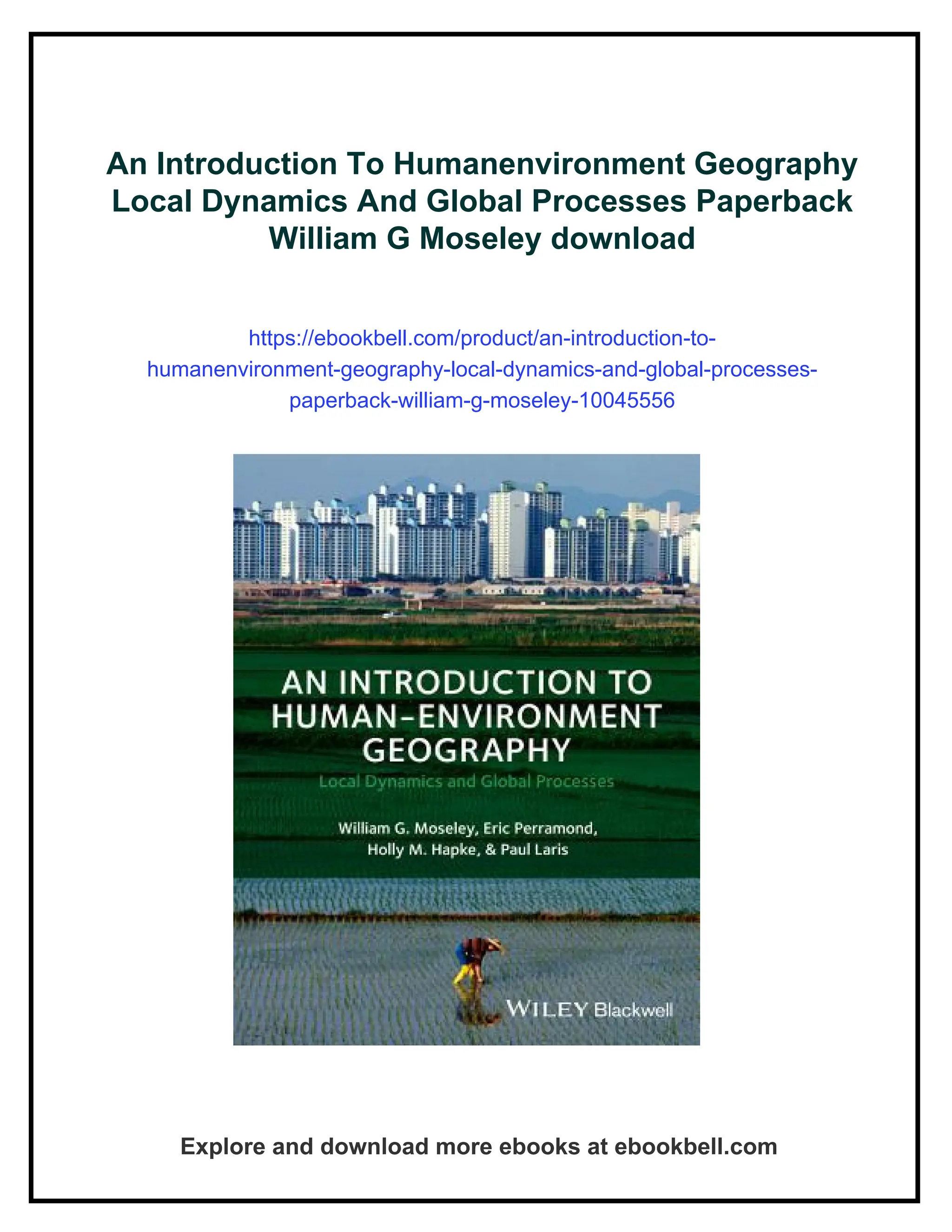
  • 1.
    An Introduction ToHumanenvironment Geography Local Dynamics And Global Processes Paperback William G Moseley download https://ebookbell.com/product/an-introduction-to- humanenvironment-geography-local-dynamics-and-global-processes- paperback-william-g-moseley-10045556 Explore and download more ebooks at ebookbell.com
  • 2.
    Here are somerecommended products that we believe you will be interested in. You can click the link to download. An Introduction To Humanenvironment Geography Local Dynamics And Global Processes 1st Edition William G Moseley https://ebookbell.com/product/an-introduction-to-humanenvironment- geography-local-dynamics-and-global-processes-1st-edition-william-g- moseley-5133692 An Introduction To Human Molecular Genetics Mechanisms Of Inherited Diseases 2nd Edition Jack J Pasternak https://ebookbell.com/product/an-introduction-to-human-molecular- genetics-mechanisms-of-inherited-diseases-2nd-edition-jack-j- pasternak-2195088 An Introduction To Human Factors Engineering Pearson New International Edition Second Edition Wickens https://ebookbell.com/product/an-introduction-to-human-factors- engineering-pearson-new-international-edition-second-edition- wickens-21969918 An Introduction To Human Geography Issues For The 21st Century 3rd Edition 3rd Peter Daniels https://ebookbell.com/product/an-introduction-to-human-geography- issues-for-the-21st-century-3rd-edition-3rd-peter-daniels-2362144
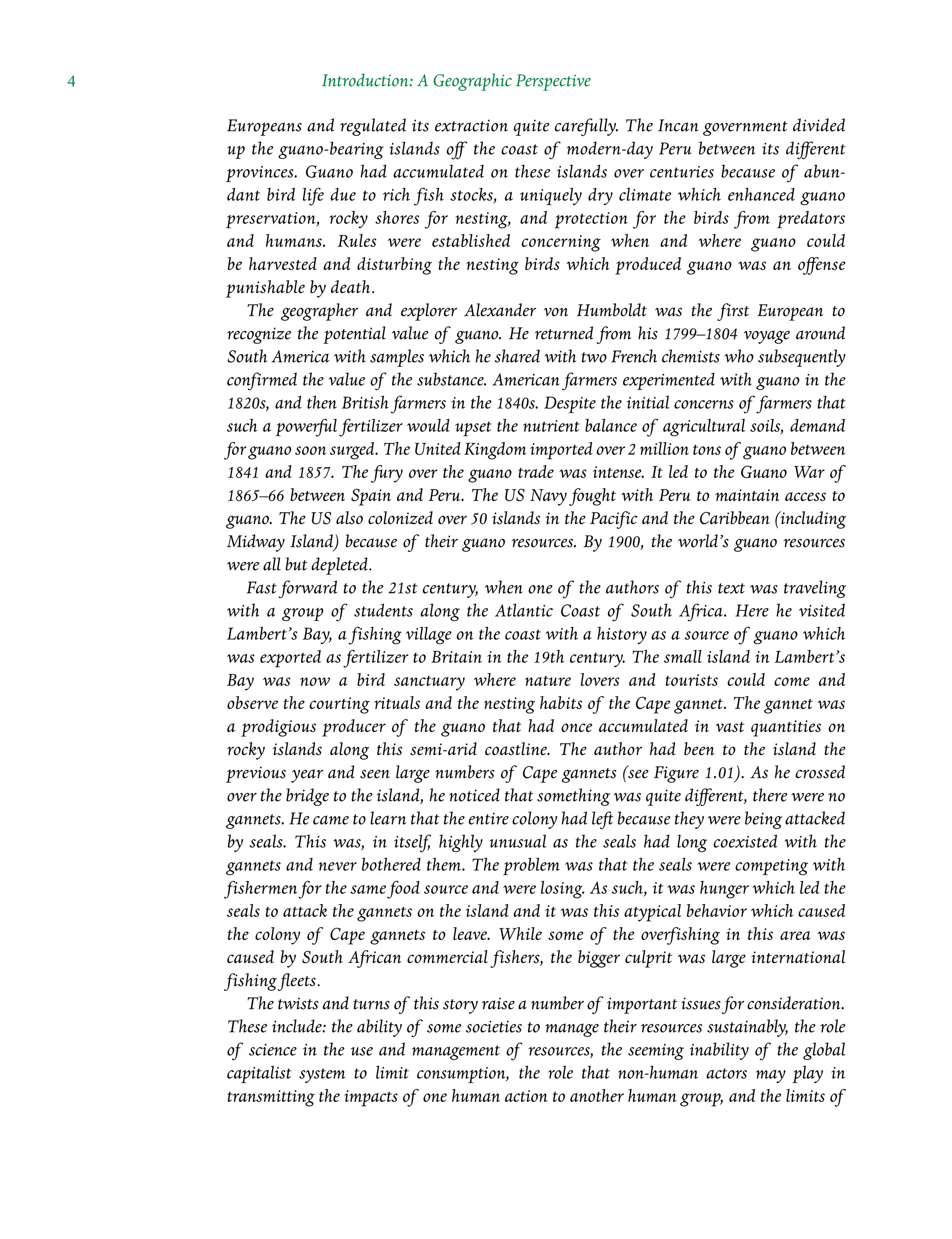
  • 3.
    An Introduction ToHuman Services Sixth Edition 6th Edition Marianne R Woodside https://ebookbell.com/product/an-introduction-to-human-services-sixth- edition-6th-edition-marianne-r-woodside-2389024 An Introduction To Humananimal Relationships A Psychological Perspective 1st Edition Hollin https://ebookbell.com/product/an-introduction-to-humananimal- relationships-a-psychological-perspective-1st-edition-hollin-34358914 An Introduction To Human Evolution Deon Liles https://ebookbell.com/product/an-introduction-to-human-evolution-deon- liles-4166680 An Introduction To Human Resource Management 3rd Edition John Stredwick https://ebookbell.com/product/an-introduction-to-human-resource- management-3rd-edition-john-stredwick-42894748 An Introduction To Human Prehistory In Arabia The Lost World Of The Southern Crescent Jeffrey I Rose https://ebookbell.com/product/an-introduction-to-human-prehistory-in- arabia-the-lost-world-of-the-southern-crescent-jeffrey-i-rose-43679020
  • 5.
    24.9mm 193mm 193mm 252mm AN INTRODUCTIONTO HUMAN-ENVIRONMENT GEOGRAPHY Local Dynamics and Global Processes William G. Moseley, Eric Perramond, Holly M. Hapke, & Paul Laris AN INTRODUCTION TO HUMAN-ENVIRONMENT GEOGRAPHY Moseley, Perramond, Hapke, & Laris “A first of its kind, and in my opinion a complete winner. An introductory textbook that presents, in an engaging and accessible style, geography’s unique approach to environmental issues. Highly recommended.” Judith Carney, UCLA “A long-overdue textbook that is at once comprehensive while remaining accessible. The authors have done an impressive job with a clarity that is refreshing and engaging. This book provides students with a guide to this dynamic sub-field, including features such as clear chapter objectives, critical questions, and ‘ice-breakers,’ and demonstrates how to address important and complex issues in the contemporary world.” Antoinette WinklerPrins, Johns Hopkins University The myriad ways in which humans interact with their surroundings in the natural world have consequences that are both positive and negative. An Introduction to Human–Environment Geography offers an engaging and unique view of the spatial relationships between humans and their environment across geographical locations around the world. This introductory-level text presents the rich tapestry of theoretical approaches to the tradition, and demonstrates how these may be productively applied to understand human–environment interactions. Introducing many of the fundamental concepts and major theoretical traditions within human– environment geography, the book explores various thematic issues within the field, such as population, food and agriculture, and water resources. It carefully balances exposure to the theoretical underpinnings of human–environment geography with the inclusion of a variety of real-world policy questions and illustrative field notes contributed by prominent nature society geographers. An engaging and student- friendly introduction, it offers rich and rewarding insights into a tradition of growing importance in the twenty-first-century world. William G. Moseley is Professor and Chair of the Department of Geography at Macalester College. He is the author of over 60 peer-reviewed articles and book chapters, as well as four edited volumes. Eric Perramond is Associate Professor in both the Environmental Science and Southwest Studies programs at the Colorado College. He is the author of Political Ecologies of Cattle Ranching in Northern Mexico: Private Revolutions (2010), and a former Fulbright-García Robles Fellow to Mexico. Holly M. Hapke is Associate Professor in the Department of Geography at East Carolina University. She has published articles in various journals and is a contributing author to World Regional Geography: Global Patterns, Local Lives (3rd edition, 2006). Paul Laris is Professor and Chair of the Department of Geography at California State University at Long Beach. 17mm 17mm 17mm 17mm
  • 7.
    An Introduction toHuman–Environment Geography
  • 9.
    An Introduction toHuman–Environment Geography Local Dynamics and Global Processes William G. Moseley, Eric Perramond, Holly M. Hapke, & Paul Laris
  • 10.
    This edition firstpublished 2014 © 2014 William G. Moseley, Eric Perramond, Holly M. Hapke, Paul Laris Blackwell Publishing was acquired by John Wiley & Sons in February 2007. Blackwell’s publishing program has been merged with Wiley’s global Scientific, Technical, and Medical business to form Wiley-Blackwell. Registered Office John Wiley & Sons, Ltd, The Atrium, Southern Gate, Chichester, West Sussex, PO19 8SQ, UK Editorial Offices 350 Main Street, Malden, MA 02148-5020, USA 9600 Garsington Road, Oxford, OX4 2DQ, UK The Atrium, Southern Gate, Chichester, West Sussex, PO19 8SQ, UK For details of our global editorial offices, for customer services, and for information about how to apply for permission to reuse the copyright material in this book please see our website at www.wiley.com/wiley-blackwell. The right William G. Moseley, Eric Perramond, Holly M. Hapke, and Paul Laris to be identified as the authors of this has been asserted in accordance with the UK Copyright, Designs and Patents Act 1988. All rights reserved. No part of this publication may be reproduced, stored in a retrieval system, or transmitted, in any form or by any means, electronic, mechanical, photocopying, recording or otherwise, except as permitted by the UK Copyright, Designs and Patents Act 1988, without the prior permission of the publisher. Wiley also publishes its books in a variety of electronic formats. Some content that appears in print may not be available in electronic books. Designations used by companies to distinguish their products are often claimed as trademarks. All brand names and product names used in this book are trade names, service marks, trademarks or registered trademarks of their respective owners. The publisher is not associated with any product or vendor mentioned in this book. This publication is designed to provide accurate and authoritative information in regard to the subject matter covered. It is sold on the understanding that the publisher is not engaged in rendering professional services. If professional advice or other expert assistance is required, the services of a competent professional should be sought. Library of Congress Cataloging-in-Publication Data Moseley, William G. â•… An introduction to human-environment geography : local dynamics and global processes / William G. Moseley, Eric Perramond, Holly M. Hapke, Paul Laris. â•…â•…pagesâ•…cm â•… Includes bibliographical references and index. â•… ISBN 978-1-4051-8932-3 (hardback : alk. paper) – ISBN 978-1-4051-8931-6 (pbk. : alk. paper) 1.╇Human ecology–Textbooks.â•… 2.╇Human geography–Textbooks.â•… I.╇Title. â•… GF43.M67 2013 â•…304.2–dc23 2013006409 A catalogue record for this book is available from the British Library. Cover image: A man planting rice in paddy fields on the outskirts of Seoul, South Korea. © Philippe Lissac/Godong/Panos. Cover design by www.cyandesign.com Set in 11/13pt Dante by SPi Publisher Services, Pondicherry, India 1â•…2014
  • 11.
    For B. IkubolajehLogan (WM) For Marshall Bowen (EP) For my daughter, Syona, and to John Agnew (HH) For B.L. Turner (PL)
  • 13.
    Contents Notes on theAuthors ix Preface and Acknowledgmentsxi Part I: Fundamentals of Human–Environment Geography1 â•⁄ 1 Introduction: A Geographic Perspective on Human–Environment Interactions 3 â•⁄ 2 The Politics of Nature 31 â•⁄ 3 The Biophysical Environment 47 Part II: Contemporary Perspectives in Human–Environment Geography 87 â•⁄ 4 Cultural and Political Ecology: Local Human–Environment Interactions in a Global Context 89 â•⁄ 5 Environmental History 111 â•⁄ 6 Hazards Geography and Human Vulnerability 137 â•⁄ 7 Environmental Justice: The Uneven Distribution of People, Pollution, and Environmental Opportunity 157 Part III: Thematic Issues in Human–Environment Geography189 â•⁄ 8 Climate, Atmosphere, and Energy 191 â•⁄ 9 The Population–Consumption–Technology Nexus 227 10 Agriculture and Food Systems 255 11 Biodiversity, Conservation, and Protected Areas 285 12 Water Resources and Fishing Livelihoods 309
  • 14.
    viii Contents Part IV:Bridging Theory and Practice 341 13 Geographic Research 343 14 Conclusion: Making a Difference 375 Index389
  • 15.
    Notes on theAuthors William G. Moseley is a professor and chair of geography at Macalester College, where he teaches courses on environment, development, and Africa. His research interests include political ecology, tropical agriculture, environment and development policy, and livelihood security. His research and work Â� experiences have led to extended stays in Mali, Zimbabwe, South Africa, Botswana, Malawi, Niger, and Lesotho. He is the author of over 60 peer-reviewed articles and book chapters that have appeared in such outlets as Proceedings of the National Academy of Science, Ecological Economics, the Geographical Journal, the GeographicalReview, AppliedGeography, the SingaporeJournalof TropicalGeography, and Geoforum. His books include: four editions of Taking Sides: Clashing Views on African Issues (2004, 2006, 2008, 2011); (with David Lanegran and Kavita Pandit) The Introductory Reader in Human Geography: Contemporary Debates and Classic Writings (Blackwell, 2007); (with Leslie Gray) Hanging by a Thread: Cotton, Globalization and Poverty in Africa (2008); and (with B. Ikubolajeh Logan) African Environment and Development: Rhetoric, Programs, Realities (2004). His fieldwork has been funded by the National Science Foundation and the Fulbright-Hays Program. He has served as editor of the African Geographical Review, as a national councilor to the Association of American Geographers, and as chair of the cultural and political ecology specialty group. Eric Perramond, a geographer, is an associate professor in both the Environmental Science and Southwest Studies programs at the Colorado College. His teaching and research interests include cultural-political ecology, environment and development issues, GIS and research methods, and agro-climate governance issues. He conducts human–environment research in the Greater Southwest, Â� semi-arid Mexico, and the French and Spanish Pyrenees. He has published in the Geographical Review, Area, the Journal of Latin American Geography, and the Journal of Political Ecology. He serves on the editorial board for the Journal of Political Ecology, and was associate editor for the Journal of Latin American Geography and on the editorial board for ACME: An International E-Journal for Critical Geographies. He
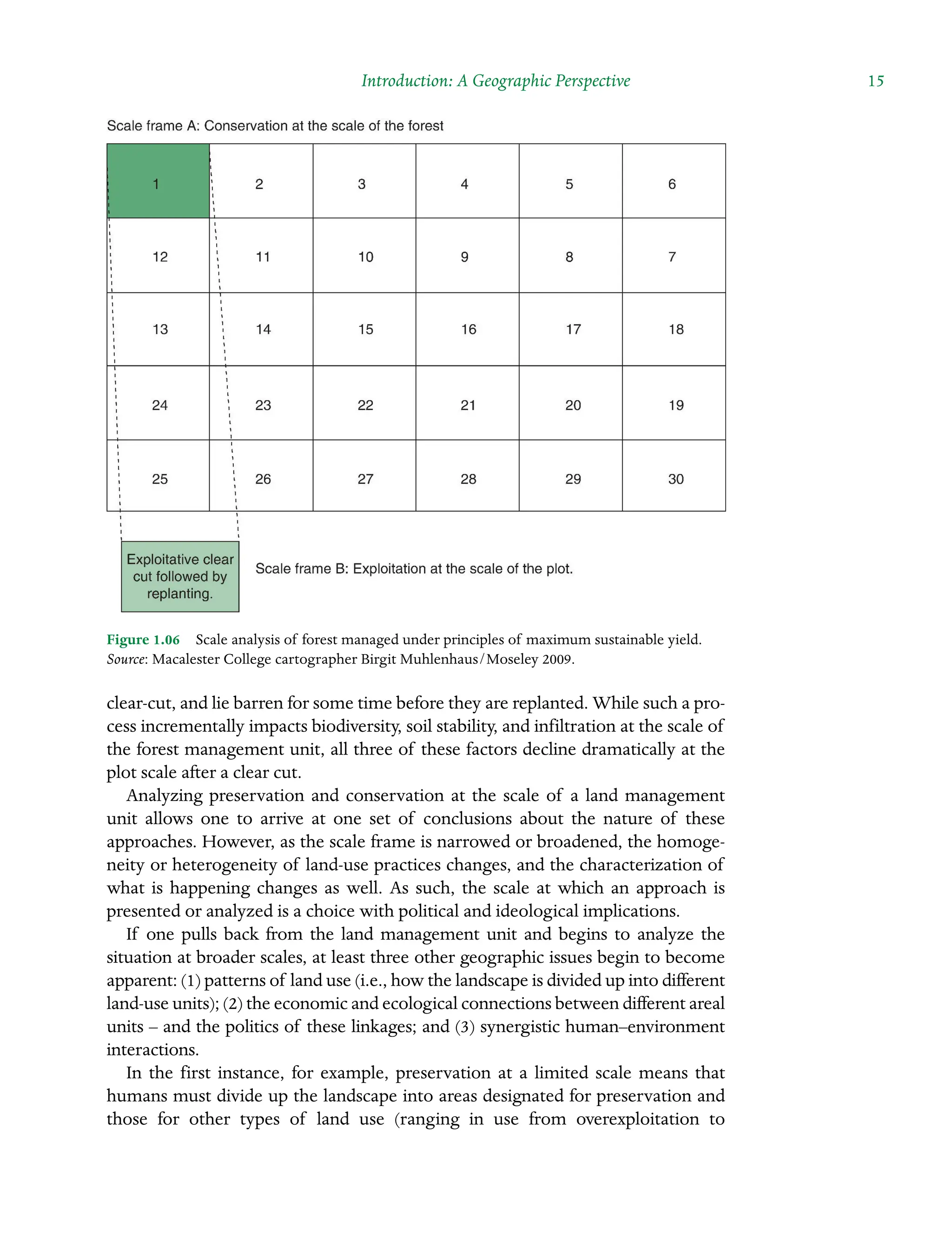
  • 16.
    x Notes onthe Authors ˘Notes on the Authors is the author of Political Ecologies of Cattle Ranching in Northern Mexico (2010) and is aformerFulbright-GarciaRoblesFellowtoMexico.HealsoservedastheChairman of the Conference of Latin Americanist Geographers (CLAG) during 2008–10. Holly M. Hapke is an associate professor in the Department of Geography at East Carolina University, where she also teaches courses in the International Studies program. Her research and teaching interests include political economy and development; fisheries and coastal livelihoods; ecological conflict; gender; Â�migration; and research methods. Her regional area of expertise is South Asia, and she has conducted research on rural development issues in the US South. Her field research on gender, fisheries development, and fisherfolk livelihoods in India has been funded by the National Science Foundation, the Association of American Geographers, and the US Department of Education Fulbright-Hays Program. She has published articles in journals such as Economic Geography, Annals of the Association of American Geographers, Professional Geographer, Gender, Place Culture, andGeographicalReview,andsheisacontributingauthortoPulsipherandPulsipher, World Regional Geography: Global Patterns, Local Lives, third edition. She currently serves on the editorial board of Gender, Place Culture. Paul Laris is professor and chair of the Department of Geography at California State University, Long Beach, where he also teaches in the Environment, Science, and Policy Program. His teaching and research interests include biogeography, cultural and political ecology, fire ecology, global change, ecological restoration, and remote sensing. He has conducted research in the savanna of Mali, the Â�grasslands of Tierra del Fuego, and the shrublands of California. He has published in such journals as Human Ecology, The Annals of the Association of American Geographers, Remote Sensing of Environment, Geoforum, and Bois et Forêts des Tropiques. His fieldwork has been funded by NASA and the National Geographic Society.
  • 17.
    Preface and Acknowledgments Thisbook has been a long time in the making. Like any good text, it emerged from a series of conversations, many in bars and cafés, and frequently when we met at our annual professional meeting. We had a few concerns which motivated us to write this book, foremost of which was a text that would convey geography’s Â� theoretically rich tradition and unique approach to environmental issues. Our other concern was to have a text that would be accessible to introductory students, many from allied environmental fields who were encountering geography for the first time, and others in geography for whom this was their first course on human– environment themes. While there are other environmental geography texts on the market, none (in our view) did all that we wanted. We felt that the lower level texts didn’t do enough to convey geography’s unique approach to the subject matter, frequently differing little from more generic environmental studies or environ- mental science texts. Those books that did convey the theoretical richness of the human environment tradition tended to be pitched at too high a level of student, or too narrowly focused on a particular subtheme of human–Â� environment geog- raphy. The text that follows is our attempt to fill this niche. You will note that the book is divided into four parts. The first part is meant to be a broad overview of the basic information needed to understand human–Â� environment geography, from the geographic perspective, to environmental politics, to some basic physical geography and ecology. The second section explores a sampling of geography’s rich theoretical traditions in the realm of human–Â� environment geography. The third part is more thematic in nature, most closely resembling the traditional textbook approach except for a concerted effort to make connections between this material and the theoretical approaches detailed in the second section. The final part is meant to connect the book’s material to the real world by showing the student how geographers undertake fieldwork and collect and analyze data. The concluding chapter makes suggestions for using the Â�concepts in this text to understand environment-related problems and bring about change. Each of the chapters in these four sections has a similar structure. Chapters begin with an icebreaker, or a meaningful vignette which brings out the major themes of
  • 18.
    xii Preface andAcknowledgments the chapter. This is followed by a statement of chapter objectives, an introduction, and then the main text. All chapters end with a chapter summary, critical �questions, key terms, and references. While this book was very much a collective project, our varied regional and thematic expertise helped ensure that a range of material would be covered from some position of comfort and familiarity. We also hail from different types of � institutions, private colleges in Minnesota and Colorado, and public universities in North Carolina and California, and thus have experience working with different types of students. All of us relied heavily on our own teaching, research, and work experience to inform this project. This book took longer to complete than � originally anticipated. We particularly wish to thank Justin Vaughan and Ben Thatcher at Wiley-Blackwell for attempting to keep us on track and for showing endless patience and understanding when we fell behind. We also thank our � families for their understanding and support while we labored at writing, for reading and re-reading drafts in some cases, and for patiently listening to us over meals as we shared our geographic revelations. We finally express our appreciation to the anonymous reviewers who provided feedback on various portions of this text, and to our students with whom our interactions in the classroom have informed the way we present this material.
  • 19.
  • 21.
    An Introduction toHuman–Environment Geography: Local Dynamics and Global Processes, First Edition. William G. Moseley, Eric Perramond, Holly M. Hapke and Paul Laris. © 2014 William G. Moseley, Eric Perramond, Holly M. Hapke, Paul Laris. Published 2014 by John Wiley Sons, Ltd. Introduction A Geographic Perspective on Human–Environment Interactions Icebreaker: Human–Environment Connections Across Time and Space Before chemical fertilizers came into heavy use in the 20th century, guano (bird or bat Â� droppings) was the leading internationally traded source of agricultural plant nutri- ents. It was valued because of its high levels of phosphorous and nitrogen and lack of odor. The Incas of South America understood the value of guano long before the 1 Icebreaker: Human–Environment Connections Across Time and Space 3 Chapter Objectives 5 Introduction6 Animals and Their Habitats 6 What Is Geography and What Does It Have To Do with Studying the Environment?8 A Geographic Perspective on Environmental Questions 11 Plan for the Rest of the Book 25 Chapter Summary 28 Critical Questions 28 Key Vocabulary 28 Notes29 References29
  • 22.
    4 Introduction: AGeographic Perspective Europeans and regulated its extraction quite carefully. The Incan government divided up the guano-Â� bearing islands off the coast of modern-day Peru between its different provinces. Guano had Â� accumulated on these islands over centuries because of abun- dant bird life due to rich fish stocks, a uniquely dry climate which enhanced guano preservation, rocky shores for nesting, and protection for the birds from predators and humans. Rules were established concerning when and where guano could be Â� harvested and disturbing the nesting birds which produced guano was an offense punishable by death. The geographer and explorer Alexander von Humboldt was the first European to Â� recognize the potential value of guano. He returned from his 1799–1804 voyage around South America with samples which he shared with two French chemists who subsequently confirmed the value of the substance. American farmers experimented with guano in the 1820s, and then British farmers in the 1840s. Despite the initial concerns of farmers that such a powerful fertilizer would upset the nutrient balance of agricultural soils, demand for guano soon surged. The United Kingdom imported over 2 million tons of guano between 1841 and 1857. The fury over the guano trade was intense. It led to the Guano War of 1865–66 between Spain and Peru. The US Navy fought with Peru to maintain access to guano. The US also colonized over 50 islands in the Pacific and the Caribbean (including Midway Island) because of their guano resources. By 1900, the world’s guano resources were all but depleted. Fast forward to the 21st century, when one of the authors of this text was traveling with a group of students along the Atlantic Coast of South Africa. Here he visited Lambert’s Bay, a fishing village on the coast with a history as a source of guano which was exported as fertilizer to Britain in the 19th century. The small island in Lambert’s Bay was now a bird sanctuary where nature lovers and tourists could come and observe the courting rituals and the nesting habits of the Cape gannet. The gannet was a Â� prodigious producer of the guano that had once accumulated in vast quantities on rocky islands along this semi-arid coastline. The author had been to the island the previous year and seen large numbers of Cape gannets (see Figure 1.01). As he crossed over the bridge to the island, he noticed that something was quite different, there were no gannets. He came to learn that the entire colony had left because they were being attacked by seals. This was, in itself, highly unusual as the seals had long coexisted with the gannets and never bothered them. The problem was that the seals were competing with fishermen for the same food source and were losing. As such, it was hunger which led the seals to attack the gannets on the island and it was this atypical behavior which caused the colony of Cape gannets to leave. While some of the overfishing in this area was caused by South African commercial fishers, the bigger culprit was large Â� international fishing fleets. The twists and turns of this story raise a number of important issues for consideration. These include: the ability of some societies to manage their resources sustainably, the role of science in the use and management of resources, the seeming inability of the global capitalist system to limit consumption, the role that non-human actors may play in Â� transmitting the impacts of one human action to another human group, and the limits of
  • 23.
    Introduction: A GeographicPerspective 5 preservation in open ecosystems and economies. All of these themes and more are central to the dynamic subfield of human–environment Â� geography. Chapter Objectives The objectives of this chapter are: 1â•… To suggest that humans, like other animals, are able to sustainably interact with their environment. 2â•… To highlight the pressing nature of some contemporary environmental problems. 3â•… To articulate the relevance of the geographic perspective to environmental questions. 4â•… To outline broad elements of a human–environment geography approach to environmental questions. 5â•… To demonstrate what new insights may be gleaned by applying the human– environment geography approach to some basic natural resource management concepts and an example of this in US environmental history. 6â•… To share the general plan and logic of the book. Figure 1.01â•… A colony of Cape gannets, Lambert’s Bay, Atlantic Coast of South Africa. Source: Photo by W.G. Moseley. Used with permission.
  • 24.
    6 Introduction: AGeographic Perspective Introduction The broad objective of this chapter is to introduce to students to the way that human–environment geographers look at the world. We begin by exploring how humans are similar to, and different from, other animals which manipulate the environment. We then review geography and its distinctive human–environment tradition, followed by an exploration of some broadly similar ways that human environment geographers often examine environmental questions. The chapter ends with a specific case of how the geographic lens yields new insights when trained on some common environmental management approaches, namely exploitation, conservation, and preservation. Animals and Their Habitats Beavers (Castor canadensis in North America, Castor fiber in Eurasia) are known for their ability to modify the landscape for their own benefit and that of other species. By damming streams, beavers raise the water level to form protective moats around their lodges. The resulting beaver ponds also create the deep water needed for winter food storage in northern climates. While other animals struggle with winter cold and hunger, beavers stay warm in their lodges with an underwater food cache of branches in close proximity (see Figure 1.02). Beavers also harvest trees and branches for food and construction purposes. This pruning stimulates willows, cottonwood, and aspen to regrow more thickly the next spring. While some beaver behavior is instinctive, they also learn by imitation and from Â� experience. As such, we find some beavers who are very adept at building dams and others who are not. Older, more experienced beavers also tend to build better dams than younger ones. The beavers’ habitat modifications also impact other species. The wetlands they create support other mammals, fish, turtles, frogs, birds, and ducks. These wetlands also provide a variety of ecological services, such as the catchment of floodwaters, the alleviation of droughts (because beaver dams keep water on the land longer), the reduction of erosion, the local raising of the water table, and the purification of water. Figure 1.02â•… Sketch of beaver lodge and dam.
  • 25.
    Introduction: A GeographicPerspective 7 Humans, like other animals, also modify the landscape. We manipulate the land, for example, through burning, cutting, tilling, planting, harvesting, dam building, and home construction to meet our own objectives. Through a process of experi- mentation, success and failure, observation, and the sharing and stealing of ideas, humans have learned how to manipulate the environment for their own purposes. For example, through careful observation of local environmental feedback, humans often developed farming systems that were highly productive, and sustained over centuries (Figure 1.03). A case in point is shifting cultivators in Papua New Guinea who created farming systems that were over five times more efficient (in terms of a ratio of crop yield over energy inputs) than modern maize-cropping systems in the United States and supported much higher levels of agrobiodiversity (Pimentel and Pimentel 1979). Women in rural Mali (West Africa) routinely collect dead wood and coppice (trim) branches from existing trees for firewood, lessening the chances of unmanageable bush fires and encouraging regrowth. Up until recently, many American farmers planted shelter belts (or tree hedges) around their fields in order to reduce aeolian (wind) erosion and encourage the prolifera- tion of white-tailed deer (Odocoileus virginianus) which they hunted for game meat. Of course, some societies took up unsustainable practices which eventually led to environmental decline and their downfall. Sometimes, but not always, these were highly stratified societies in which those making the decisions and those working the land were separated by many layers. In other cases, new migrants failedtounderstandtheecologyof anareaandattemptedmanagementapproaches Figure 1.03â•… A farm in Papua New Guinea. Source: © WaterFrame/Alamy.
  • 26.
    8 Introduction: AGeographic Perspective that were inappropriate for their new location. Still others developed intensive production systems which required significant amounts of human labor to main- tain. When political instability or disease disrupted these labor flows, such systems quickly fell into decline and the productivity of the environment declined. As humans societies grew and prospered, and people traveled greater and greater distances, they began to trade. While trade was initially in luxury items, food and raw materials eventually came to be traded in significant quantities. By the 20th century, even garbage was being shipped around the world. The Â� significance of this trade, combined with urbanization, was that it gradually sep- arated people from the sources of their food and goods and the byproducts of their Â� consumption. We were losing our ability to productively and sustainably engage with ecosystems. Today we live in a world where many consumers in the most developed areas of the world have little to no idea where their provisions Â� originate from and how they are produced. We also live on a planet where the consequences of such detachment from the biophysical world seem to be growing. Increasing carbon emissions, and resulting climate change, is probably one of the most disquieting, global-scale environmental challenges. Other challenges, like Â� deforestation, ground water depletion, and the loss of biodiversity, are also of great Â�concern. Not all ecological challenges are a direct result of humans modifying the Â� environment in a problematic manner. In some cases it may have more to do with how humans position themselves vis-à-vis the biophysical world. Hurricanes, for example, become more of an issue for humans when they build homes close to coastlines, or inundations are a problem when towns and cities are established in floodplains. Some biomes have naturally sparse or erratic rainfall, so trying to live in such areas without adapting to these patterns is destined to be problematic. Clearly many of the challenges described above could be avoided if we better understood our place within, and relationship to, the biophysical world. This text helps the student explore that world and how we got to this particular point in human history. While many disciplines and fields of study examine these ques- tions, this text helps students understand these issues from the perspective of human–environment geography. We begin this chapter with a brief introduction to geography and then a more thorough examination of some basic elements of human–environment geography. What Is Geography and What Does It Have To Do with Studying the Environment? Geography is so basic that we all seem to have some idea of what it is, yet curi- ously, many would have trouble describing the subject to another person in casual conversation. Geography comes from the Greek word meaning “earth writing” or “earth describing.” Even though the emphasis in geography has changed over the years, this is still a fairly accurate statement.
  • 27.
    Introduction: A GeographicPerspective 9 While the Greeks were the first to organize geography as a coherent body of knowledge, the need for geographic knowledge is as old as humankind. For as long as people have been traveling, exploring, and migrating, they have been Â� encountering different environments and other human societies. As such, the survival and success of human populations meant that they needed to understand other groups, faraway lands, where these were located spatially (if for no other reason than to know how to get there again), the processes that connect one human group to others, and ways in which each group is unique. In the process, such Â� travelers, explorers, and migrants learned a lot about where they had come from, that is, it helped them to understand what was special about their own homes. Geography is a broad discipline that essentially seeks to understand and study the spatial organization of human activity and of people’s relationships with their environment. It is also about recognizing the interdependence among places and regions, without losing sight of the individuality and uniqueness of specific places. Geography is rather unique for a discipline in that it straddles the science–social science–humanities divide, using a broad arsenal of methods and perspectives to tackle questions. It is also not an armchair science (in which data is downloaded for analysis) but rather has a long tradition of fieldwork. Finally, many geographers do get excited about maps (some might call us map geeks) but it is important to remember that maps are a means to an end for most geographers. By displaying data spatially, it pushes us to ask why things are distributed the way they are, or it may reveal patterns or correlations which had not previously been seen. While the general tenets of a geographic approach (i.e., attention to spatial Â� patterns, human–environment dynamics, the uniqueness of place, and connections between regions and across scales) apply to all areas of geography, geography has grown over time to recognize sub-specialties within the discipline based on the sub- ject matter addressed. At the broadest level, there is a commonly recognized divide between the study of biophysical phenomena (physical geography) and the exami- nation of human or social phenomena (human geography). Physical geographers seek to understand long-term climate patterns and change (climatology), patterns of plant and animal distribution (biogeography), and the origin and evolution of landforms (geomorphology). Human geographers study the patterns and dynamics of human activity on the landscape, including settlement, urbanization, economic activity, culture, population, development, and disease. Between physical and human geography, lies the vibrant arena of human–Â� environment geography. The investigation of nature–society relationships lies at the heart of geography and has been one of the pillars of the discipline since the modern academic structure crystallized in 19th-century Germany. This realm of inquiry also has been an important bridge between geography and other fields. Figure 1.04 depicts the position of human–environment geography within the Â� discipline of geography. This textbook is focused on a dynamic and burgeoning subfield of geography known as human–environment geography. The book introduces you to the study of human–environment interactions from a geographic perspective, with
  • 28.
    10 Introduction: AGeographic Perspective a special emphasis on the role of humans in changing the face of the earth and how, in turn, this changed environment may influence humans. We will examine environmental issues in a variety of geographic contexts (developed and Â� developing Â� countries) and the connections between environmental prob- lems in different Â� locations. While we tend to think of the environment as “natural” and more prominent in areas with fewer people, we will argue that the built environment is of no less Â� concern than many so-called natural areas, and that both are products of human action. For example, in terms of generic inter- actions with the environment, what makes a peasant farmer any different than a suburban homeowner? Both live in environments modified by human activity, both manipulate the landscape (the farmer tilling her field, and the suburban man tending his lawn), and both are influenced by environmental conditions (the farmer planting six different varieties of millet in her field because rainfall varies from year to year; the suburban man, driving to the grocery store because his neighborhood has no sidewalks, is removed from shopping areas and lacks access to public transportation). Human–environment geographers working in various subfields often interact with other academics or professionals working on similar themes (e.g., political ecologistswithanthropologistsanddevelopmentpractitioners,hazardsÂ�geographers with geologists and disaster relief specialists, or water resource geographers with hydrologists and watershed managers). Geography has long been known for its techniques for presenting and manipu- lating spatial data, particularly cartography or mapping. What is important to remember is that most geographers use these techniques as a bridge to greater understanding. For example, human–environment geographers may use dot mapstopresentandunderstandpopulationdistributions,geographicinformation systems (GIS) to analyze the potential relationship between population density and soil fertility, or remote sensing (aerial photography and satellite imagery) to monitor change in surface biomass over time. Some geographers specialize in a particular technique, rather than a thematic area of geography. These geogra- phers often focus on further developing such technologies, devising methods for interpreting the data produced by them, or reflecting on the social implications of theiruse.Afewselectionsinthisvolumewillfocusontheuseof these Â�technologies by human–environment geographers. Figure 1.04â•… Human-environment geography within the discipline of geography.
  • 29.
    Introduction: A GeographicPerspective 11 A Geographic Perspective on Environmental Questions1 Students may wonder what differentiates an introductory-level human–Â� environment geography course from its corollary in environmental studies or environmental science. Later in this book, we will explore a number of Â� subdisciplines in geography that offer distinctive lenses through which to explore environmental issues (e.g., cultural ecology, political ecology, Â� hazards geography, environmental history, and environmental justice). In this chapter we articulate more fundamental geographic perspectives that often characterize the discipline’s approach to human–environment questions. While not offering an exhaustive list of such generalized approaches, here we investigate and apply four perspectives: scale-sensitive analysis, attention to spatial patterns of resource use, a conception of the human–environment system as a single unit (rather than two separate parts), and a cognizance of the connections between places and regions. As a way of introducing these four perspectives, we apply them to three basic approaches to environmental management that you would encounter at the start of most environmental studies texts: exploitation, conservation, and preservation. We start by exploring the conventional understandings of these approaches and then show how they may be understood somewhat differently from a geographic angle. We then re-examine, using this geographic perspective, a famous case in US environmental history that has been used to illustrate the conventional Â� understandings of conservation and preservation, not to mention an early rift in the US environmental movement. Conventional Understandings of Exploitation, Conservation, and Preservation The concepts of exploitation, conservation, and preservation are typically used to dif- ferentiate human management and use of renewable resources (e.g., forests, fisheries, many sources of water). Exploitation is the easiest of these three Â� concepts to grasp. It refers to the use of a resource without regard to its long-term productivity, usually by over-harvesting in the short term. As such, an exploitative approach to forest management might entail clear cutting, and not replanting, large tracts of land. While the terms conservation and preservation are sometimes used inter- changeably in public discussions, environment-related fields carefully use these words to refer to particular management regimes for renewable resources. Conservation (sometimes also described as the utilitarian approach in environ- mental history, or as resource conservation in the UK) typically refers to use within certain biological limits, or within the annual growth increment of a particular resource. In the case of forests or fisheries, this annual growth increment is also referred to as the sustainable yield2 or maximum sustainable yield.
  • 30.
    12 Introduction: AGeographic Perspective The US government natural resource management agency most closely � associated with the conservation approach is the US Forest Service (USFS), and the same approach is also applied by government forest agencies in many other parts of the world. Since the US Sustained-Yield Forest Management Act of 1944, the USFS has managed many of its forests under the principle of maximum � sustainable yield. Typically the formula (forest area/age to maturity) is used to determine the percentage of the total forest area that may be harvested and replanted each year. Figure 1.05, for example, depicts spatially how an even-aged monoculture3 of white pine that is 150 hectares in size, and for which the age to maturity is 30 years, would be harvested and replanted at the rate of 5 hectares per year (150 � hectares/30 years). In contrast to exploitation or conservation, preservation (also known as nature conservation in the UK) typically refers to the non-use or non-consumptive use of natural resources in an area. The practical expression of the preservationist approach in the North American context often comes in the form of a wilderness area or park. In some instances, an area is completely off limits to humans. More frequently, non-consumptive uses are allowed (e.g., hiking, camping). The ratio- nale for preservation is that certain areas must be set aside for compelling aesthetic or biodiversity reasons. This approach to preservation has been described as the Figure 1.05╅ The principle of maximum sustainable yield as applied to an even-aged monoculture of white pine. Source: Macalester College cartographer Birgit Muhlenhaus/Moseley 2009.
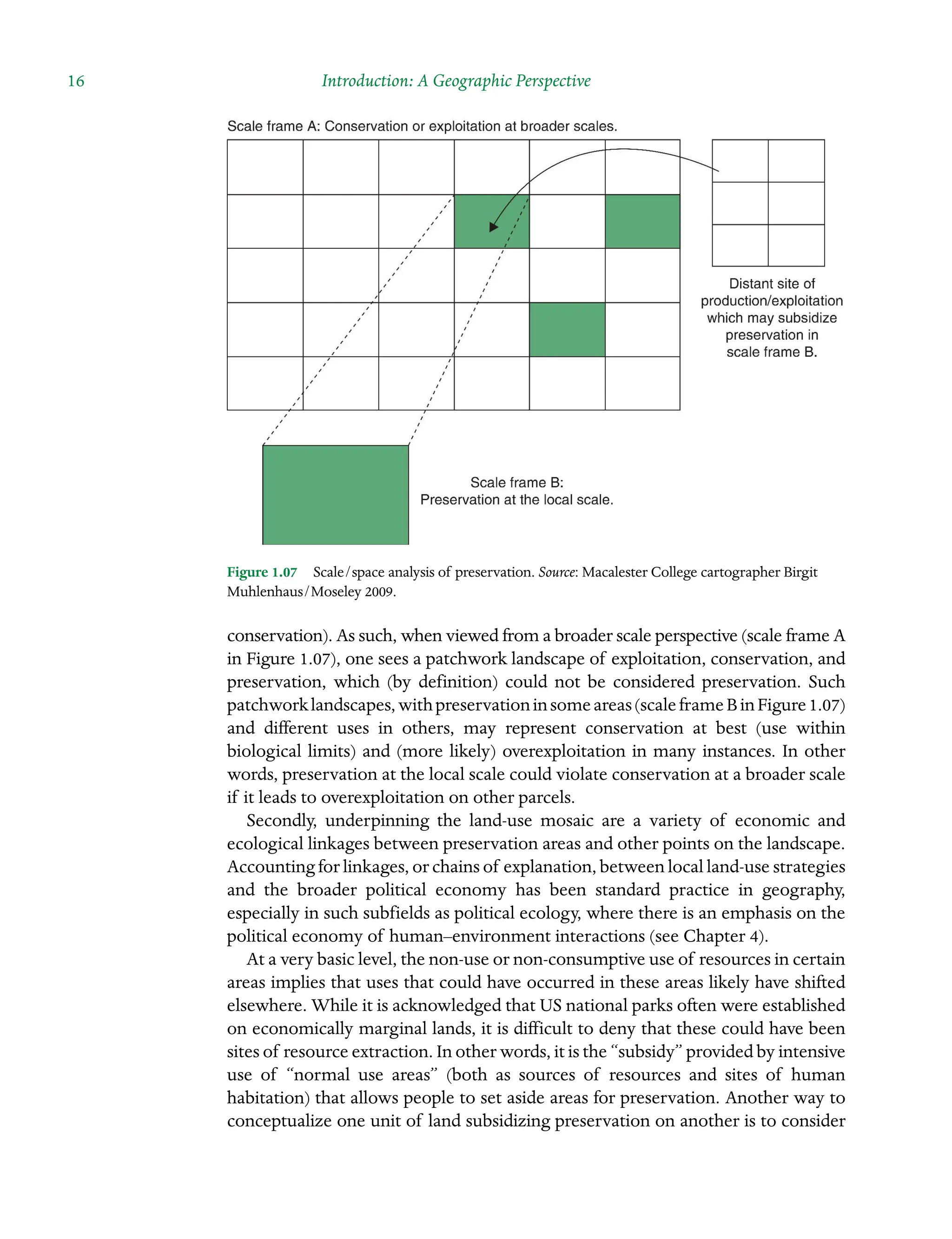
  • 31.
    Introduction: A GeographicPerspective 13 “Yellowstone model,”4 a model that emphasizes national parks which people may visit as tourists, but neither reside in nor exploit to support a resource-based Â�livelihood.TheUSParkServiceistheUSgovernmentnaturalresourcemanagement agency most clearly identified with the preservationist approach (as is the case for government park services in many other parts of the world). The preservationist approach was introduced to developing countries during the colonial era when many parks and wilderness areas were established. Parks and preserves in the world’s tropical regions have received considerable attention since the 1992 World Summit on Environment and Development in Rio de Janeiro. For example, over 10% of territory in some African countries is now managed by state and interna- tional organizations for preservation purposes. Geographic Perspectives on Exploitation, Conservation, and Preservation Geography’s focus on scale, synergistic human–environment interactions, land-use patterns, and the connections between places and regions offers intriÂ� guing insights into the concepts of exploitation, preservation, and conservation. Attention to scale is a core geographic concern and a framing device that is Â�profoundly implicated in any form of spatial analysis. The concept of scale may be used in somewhat different ways. In cartography (or the science of map-making), scale refers to the distance on the map in relation to the distance on the surface of Earth. As such, relatively small-scale maps show larger areas because the fraction of distance on the map over distance on the Earth’s surface is small. In contrast, large-scale maps show smaller areas because the ratio or fraction of distance on the map over distance on the surface of the Earth is relatively large. Unlike the relatively specific idea of map scale, we can also think of this term more Â� conceptually, e.g., local versus global scale (see Chapter 4 for further discussion of scale). As such, one might analyze a problem at the scale of a local community, or at the level of a park, or using data aggregated at the scale of a state or province (or some broader scale). The geographer Stan Openshaw (1983) problematized a-scalar analysis in terms of the modifiable areal unit problem. In discussing this problem, Openshaw focused on two issues related to scale (the level at which data is aggregated and the boundaries of spatial units) to show how variation in these factors greatly affected findings. Within geography, there is also a body of scholarship on the politics of scale. These studies examine the political implications of the choice of scale at which an environmental issue is articulated and conceptualized. Different groups frequently struggle over the scale at which an issue is framed. Mansfield and Haas (2006: 78), for example, discuss how “using scale as a framing device is a powerful political strategy … because focusing on a particular scale presupposes certain kinds of solutions while foreclosing others.” Similarly, attention to scale complicates con- ventional understandings of exploitation, conservation, and preservation. We may
  • 32.
    14 Introduction: AGeographic Perspective think about scale in at least three different ways in our case: the scale at which the approach is implemented, the scale at which the approach is analyzed, and the scale at which the approach is discussed, or discursive scale (the last point will be addressed in the subsequent section on Hetch Hetchy Valley). The scales at which an approach is implemented or analyzed are sometimes referred to as scale frames (e.g., Kurtz 2003). In practical terms, the scale at which the preservationist approach may be imple- mented is limited by the need for humans to use natural resources. As such, unless an area is lightly populated, it is challenging to set aside extremely large tracts of land as preserves because people need to use some land to sustain themselves. With the possible exception of Antarctica (a continental example), most lands set aside for preservation are modest in scale. More specifically, most of the world’s big IUCN (International Union for the Conservation of Nature) category Ia and Ib parks are in the high Arctic or sparsely populated tropic forests, whereas most Â� preservation units (IUCN category IV ) in densely populated Europe are relatively small. While parks appear as preservation (if the unit of analysis stops at the park boundary), this perception quickly changes at broader scales of analysis if Â� surrounding areas are overexploited. For example, national parks in Costa Rica have been referred to as diamonds in a sea of devastation (Sanchez-Azofeifa et al. 2002). Incontrasttopreservation,conservationcould(atleastintheory)beÂ�implemented at a much broader scale because it allows for human use of resources within biological limits. In such a situation, people in all places would be allowed to tend to their needs, yet would be required to operate within the biological limits of the environment. This is a very integrated and spatially broad vision of conservation that shares commonalities with certain (i.e., the strong or radical green) concep- tions of sustainable development (see Chapter 2). In practice, such an approach would require a significant departure from current development patterns. This departure would be necessary because market economies (which tend to produce haves and have-nots) may not be able to coexist with an approach where the limits of allenvironmentsarerespected.Inotherwords,manywouldassertthatcapitalism itself promotes a patchwork of uses on the landscape, with capital accumulation in one area leading to capital depletion in another (Frank 1979; Wallerstein 1979; Harvey 1996). In the real world, conservation (like preservation) is often implemented at a more local scale. As described earlier, foresters managing a wood lot under the principles of sustainable yield carve it up into equal-sized plots (derived via the Â� formula: forest area/age to maturity) and then harvest and replant one such plot per year until eventually they return to the first plot that was cut and replanted. Hereagain,examiningthesituationatavarietyof scaleframesallowsonetoÂ�recognize that the management of the forest as a whole might be labeled as conservation (scale frame A in Figure 1.06). Conversely, when examined at the scale of the individual plot being harvested (often several hectares in size), the situation might more aptly be described as exploitation (scale frame B in Figure 1.06). Exploitation might be the more appropriate term at this scale because such plots are often
  • 33.
    Introduction: A GeographicPerspective 15 clear-cut, and lie barren for some time before they are replanted. While such a pro- cess incrementally impacts biodiversity, soil stability, and infiltration at the scale of the forest management unit, all three of these factors decline dramatically at the plot scale after a clear cut. Analyzing preservation and conservation at the scale of a land management unit allows one to arrive at one set of conclusions about the nature of these approaches. However, as the scale frame is narrowed or broadened, the homoge- neity or heterogeneity of land-use practices changes, and the characterization of what is happening changes as well. As such, the scale at which an approach is Â� presented or analyzed is a choice with political and ideological implications. If one pulls back from the land management unit and begins to analyze the situation at broader scales, at least three other geographic issues begin to become apparent: (1) patterns of land use (i.e., how the landscape is divided up into different land-use units); (2) the economic and ecological connections between different areal units – and the politics of these linkages; and (3) synergistic human–Â� environment interactions. In the first instance, for example, preservation at a limited scale means that humans must divide up the landscape into areas designated for preservation and those for other types of land use (ranging in use from overexploitation to Figure 1.06â•… Scale analysis of forest managed under principles of maximum sustainable yield. Source: Macalester College cartographer Birgit Muhlenhaus/Moseley 2009.
  • 34.
    16 Introduction: AGeographic Perspective conservation). As such, when viewed from a broader scale perspective (scale frame A in Figure 1.07), one sees a patchwork landscape of exploitation, conservation, and preservation, which (by definition) could not be considered preservation. Such patchworklandscapes,withpreservationinsomeareas(scaleframeBinFigure1.07) and different uses in others, may represent conservation at best (use within biological limits) and (more likely) overexploitation in many instances. In other words, preservation at the local scale could violate conservation at a broader scale if it leads to overexploitation on other parcels. Secondly, underpinning the land-use mosaic are a variety of economic and Â� ecological linkages between preservation areas and other points on the landscape. Accounting for linkages, or chains of explanation, between local land-use Â�strategies and the broader political economy has been standard practice in geography, Â� especially in such subfields as political ecology, where there is an emphasis on the political economy of human–environment interactions (see Chapter 4). At a very basic level, the non-use or non-consumptive use of resources in certain areas implies that uses that could have occurred in these areas likely have shifted elsewhere. While it is acknowledged that US national parks often were established on economically marginal lands, it is difficult to deny that these could have been sites of resource extraction. In other words, it is the “subsidy” provided by intensive use of “normal use areas” (both as sources of resources and sites of human Â� habitation) that allows people to set aside areas for preservation. Another way to conceptualize one unit of land subsidizing preservation on another is to consider Figure 1.07â•… Scale/space analysis of preservation. Source: Macalester College cartographer Birgit Muhlenhaus/Moseley 2009.
  • 35.
    Introduction: A GeographicPerspective 17 the net primary productivity5 (NPP) of any ecosystem. If a human population was to consume a large portion of an area’s NPP per year, and then half the land was turned into a preserve, then the human population would need to look Â� elsewhere for the resources it needs to survive. These resources (garnered from unpreserved land) then support or subsidize the preserve. The subsidy provided to preserves from normal land-use areas may come from inside or outside the country (see Figure 1.07 showing the subsidy provided by a distant site of production or exploitation). For example, a reduction in US timber harvests from 1990 (because of stricter requirements to sustain biodiversity and other ecosystems functions) was possible in the face of growing US demand for wood products because of increasing imports from Canada (Martin and Darr 1997) and several tropical coun- tries (Tucker 2002). The global economic system, with its increasingly global set of commodity chains, is sufficiently opaque to prohibit most people from seeing the impact of resources they may be drawing on from overseas (Princen 2002). Beyond shifts in resource extraction, a second connection between preserves and other points on the landscape may be the dislocation of peoples. A large body of geographic scholarship on parks and peoples has documented how the creation of parks in developing countries often implies the relocation of peoples to other areas (see Chapter 11). For example, Guha (1997) describes an on-going Â� controversy in NagarholeNationalParkinKarnatakaProvince,India,wheretheForestDepartment has been trying to relocate 6000 local people. Relocated peoples, while (arguably) lessening impact within the preserve, often augment impact Â� elsewhere (another dimension of outside areas “subsidizing” preserves). Furthermore, displaced peo- ples often bear considerable costs for the creation of such preserves in terms of compromised livelihoods. While a lesser-known phenomenon, the establishment of national parks in the US (and other areas of the Global North) often involved the displacement of native peoples (Burnham 2000; Braun 2002). While most proposed US national parks were described as economically worthless and uninhabited by their proponents in the early 20th century in order to avoid conflicts with economic interests, many of these areas were far from uninhabited. The environmental historian Philip Burnham has described the role of public agencies in removing Native Americans from lands that were to become Glacier, Badlands, Mesa Verde, Grand Canyon, and Death Valley national parks (2000). A third connection exists to outside areas when preserves are supported by the fees of ecotourists, increasingly the case in many developing countries. These fees represent real financial transfers that may offset the resources forgone when an area is set aside for a preserve. However, those bearing the costs of the park (often local people in terms of compromised livelihoods) and those benefiting from user fees and tourist revenues (e.g., national governments, tour companies) are often Â� different. Globetrotting ecotourists also generate significant environmental Â� externalities when they consume large amounts of resources to travel across the world to visit wildlife preserves and parks in Africa, Latin America, and Asia. What the above examples suggest is that preservation is only preservaÂ� tion Â�(non-use or non-consumptive use) at the scale of the preserve. When such
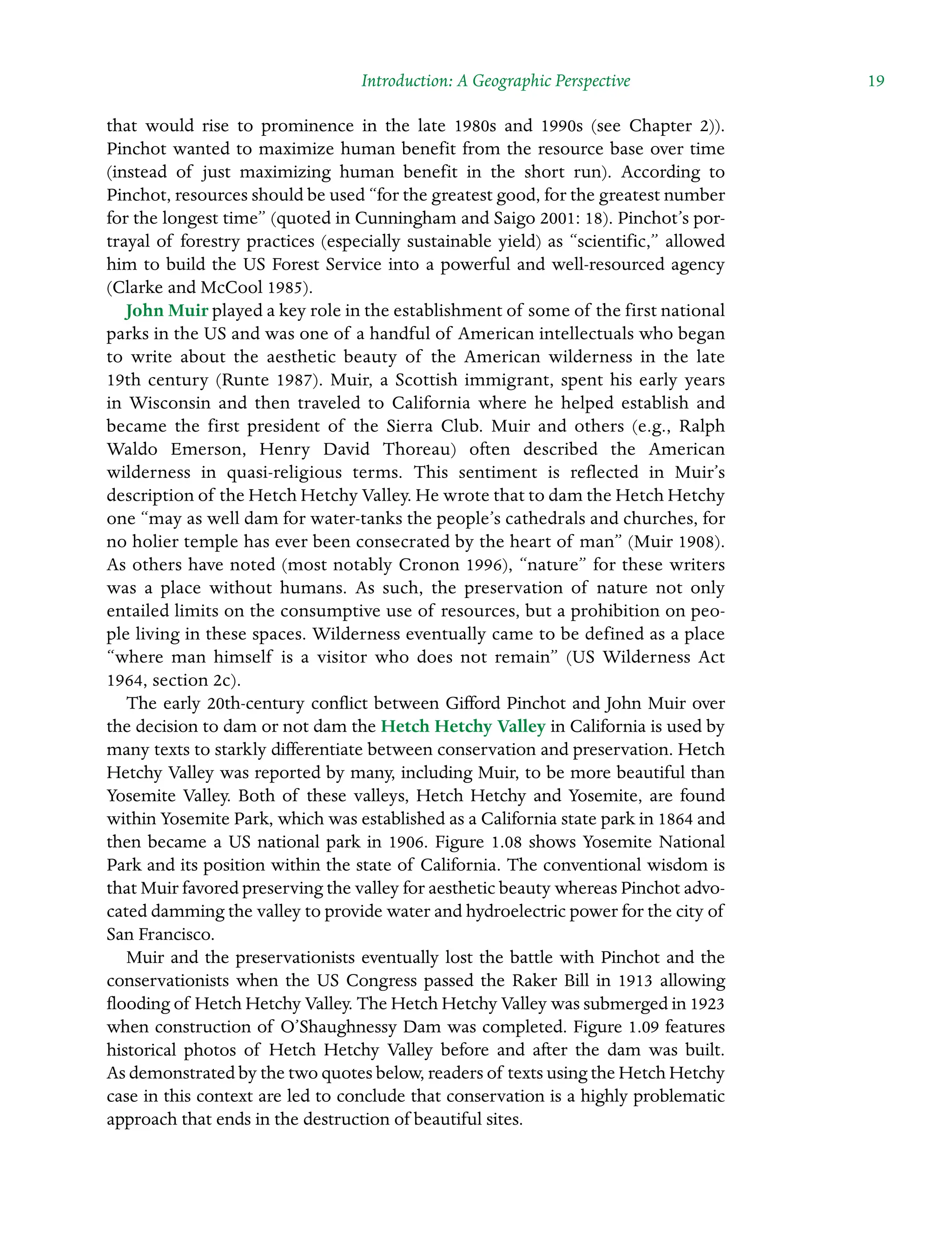
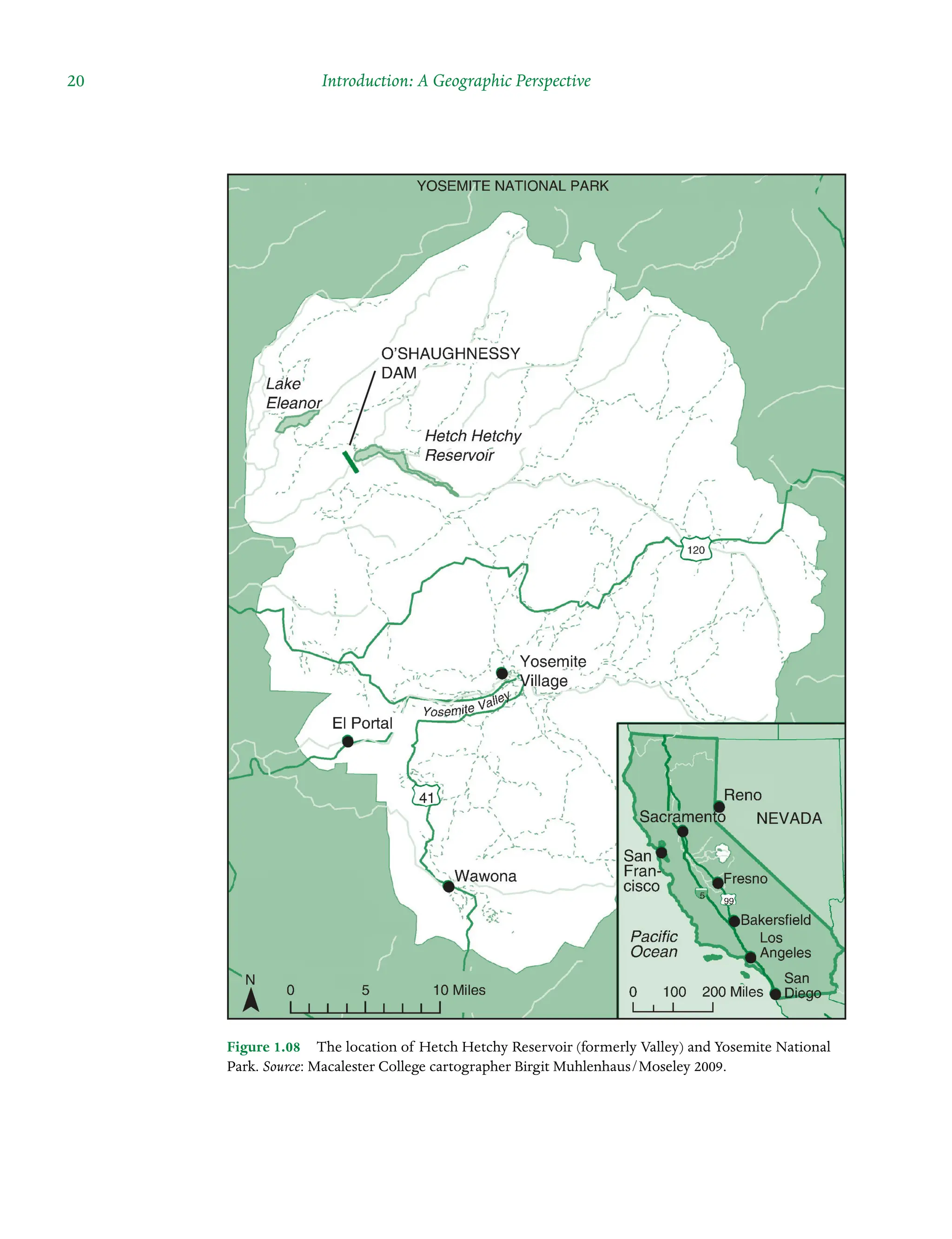
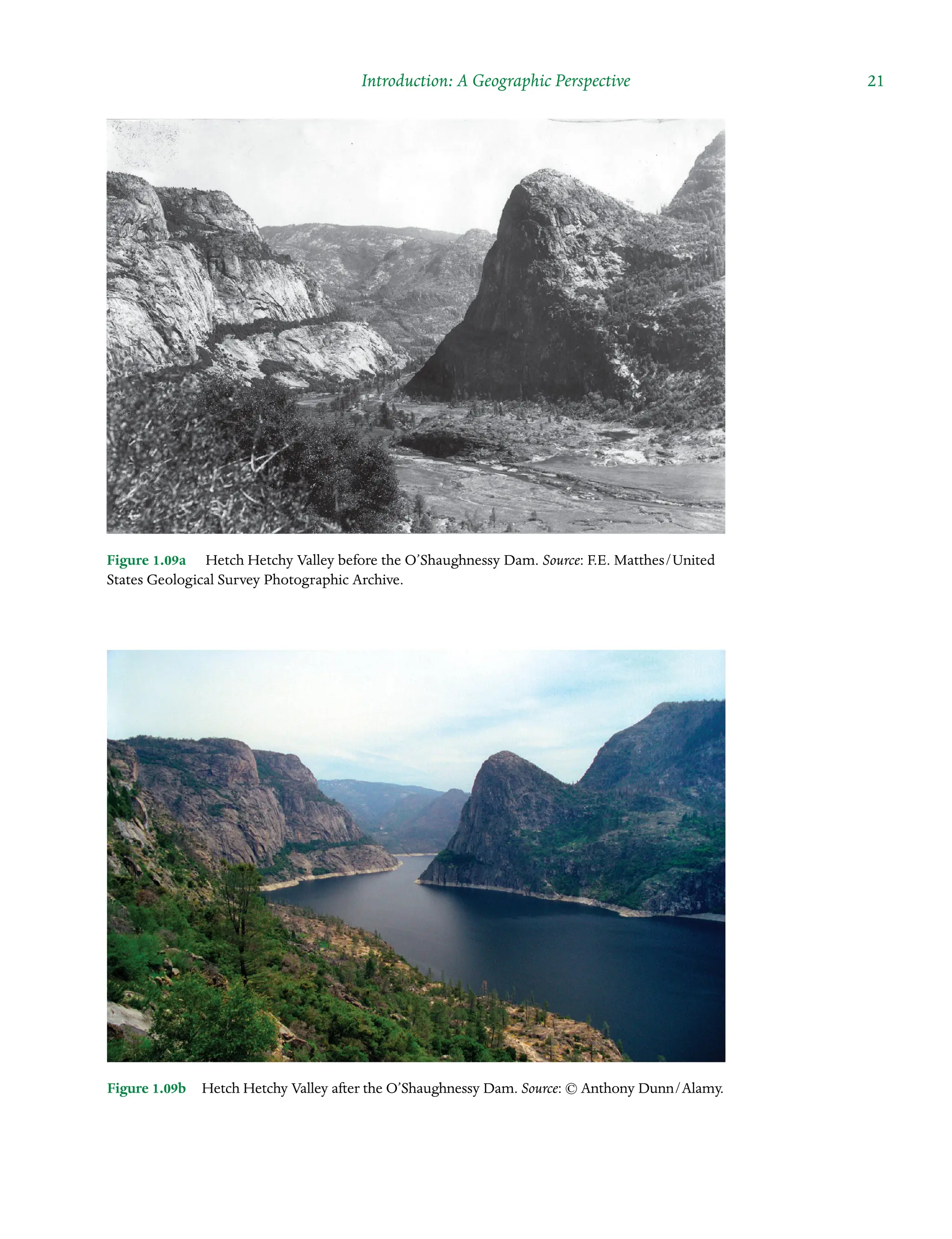
  • 36.
    18 Introduction: AGeographic Perspective a Â� preserve is viewed at broader scale frames, we see that this is not really Â� preservation because non-use/non-consumptive use in one area is almost always subsidized by use in surrounding areas (or even distant centers of pro- duction and consumption). In either instance (conservation or preservation), we suggest that the distinctions between Â� exploitation, conservation, and pres- ervation begins to become blurred when they are analyzed at multiple scales. Key to understanding this multi-scaler analysis is attention to how humans divide up space to apply either principle (conservation or preservation) and to socio-economic and ecological connections that exist between regions and places. Another issue which becomes clear when discussing approaches to resource management (exploitation, conservation, and preservation) is a tendency to sepa- rate humans from nature, rather than viewing humans as part of nature (that is, just another animal among many). As the story about beavers at the beginning of this chapter suggests, humans are not really all that different from other animals who manipulate their environments to achieve certain ends. This is not to Â�insinuate that, if humans are part of nature, then anything goes. Rather, the idea is to acknowledge that we are not all that different from other actors in the environ- ment and that it is problematic to think of ourselves as being able to operate outside of such systems. If humans are a part of nature, then the preservation approach in particular becomes problematic as it operates from a position that humans are (or ought to be) outside of natural areas if these are to be considered natural. The approach also ignores that fact that preserves are a product of human action as these are areas where we have deliberately chosen not to pursue certain types of activities. Gifford Pinchot, John Muir, and Conventional Interpretations of the Hetch Hetchy Valley Controversy In the US, the conservationist and preservationist philosophies evolved quickly in the wake of large-scale deforestation (i.e., exploitation) in the post-Civil War period as American cities and industry boomed (Williams 1989). Along with this destruction came the realization by some that America’s vast natural resource base was not inexhaustible. Two iconic figures, Gifford Pinchot and John Muir, are used in many texts to help illustrate the two approaches to resource management (Miller 1990; Cunningham and Saigo 2001; Holechek et al. 2003; Chiras and Reganold 2005; Righter 2005). Gifford Pinchot, a German-trained forester who established the Yale School of Forestry (the first school of forestry in the US) and the founding head of the US Forest Service, was probably the most visible early 20th-century proponent of the conservationist approach in the US (Miller 2001). Pinchot did not see conservation and development as incompatible. In fact, Pinchot saw the wise use of natural resources as the key to sustained development and produc- tion over time (not all that dissimilar from the sustainable development discourse
  • 37.
    Introduction: A GeographicPerspective 19 that would rise to prominence in the late 1980s and 1990s (see Chapter 2)). Pinchot wanted to maximize human benefit from the resource base over time (instead of just maximizing human benefit in the short run). According to Pinchot, resources should be used “for the greatest good, for the greatest number for the longest time” (quoted in Cunningham and Saigo 2001: 18). Pinchot’s por- trayal of forestry practices (especially sustainable yield) as “scientific,” allowed him to build the US Forest Service into a powerful and well-resourced agency (Clarke and McCool 1985). John Muir played a key role in the establishment of some of the first national parks in the US and was one of a handful of American intellectuals who began to write about the aesthetic beauty of the American wilderness in the late 19th century (Runte 1987). Muir, a Scottish immigrant, spent his early years in Wisconsin and then traveled to California where he helped establish and became the first president of the Sierra Club. Muir and others (e.g., Ralph Waldo Emerson, Henry David Thoreau) often described the American wilderness in quasi-religious terms. This sentiment is reflected in Muir’s description of the Hetch Hetchy Valley. He wrote that to dam the Hetch Hetchy one “may as well dam for water-tanks the people’s cathedrals and churches, for no holier temple has ever been consecrated by the heart of man” (Muir 1908). As others have noted (most notably Cronon 1996), “nature” for these writers was a place without humans. As such, the Â� preservation of nature not only entailed limits on the consumptive use of resources, but a prohibition on peo- ple living in these spaces. Wilderness eventually came to be defined as a place “where man himself is a visitor who does not remain” (US Wilderness Act 1964, section 2c). The early 20th-century conflict between Gifford Pinchot and John Muir over the decision to dam or not dam the Hetch Hetchy Valley in California is used by many texts to starkly differentiate between conservation and preservation. Hetch Hetchy Valley was reported by many, including Muir, to be more beautiful than Yosemite Valley. Both of these valleys, Hetch Hetchy and Yosemite, are found within Yosemite Park, which was established as a California state park in 1864 and then became a US national park in 1906. Figure 1.08 shows Yosemite National Park and its position within the state of California. The conventional wisdom is that Muir favored preserving the valley for aesthetic beauty whereas Pinchot advo- cated damming the valley to provide water and hydroelectric power for the city of San Francisco. Muir and the preservationists eventually lost the battle with Pinchot and the conservationists when the US Congress passed the Raker Bill in 1913 allowing flooding of Hetch Hetchy Valley. The Hetch Hetchy Valley was Â�submerged in 1923 when construction of O’Shaughnessy Dam was completed. Figure 1.09 features Â� historical photos of Hetch Hetchy Valley before and after the dam was built. As demonstrated by the two quotes below, readers of texts using the Hetch Hetchy case in this context are led to conclude that conservation is a highly problematic approach that ends in the destruction of beautiful sites.
  • 38.
    20 Introduction: AGeographic Perspective Figure 1.08â•… The location of Hetch Hetchy Reservoir (formerly Valley) and Yosemite National Park. Source: Macalester College cartographer Birgit Muhlenhaus/Moseley 2009.
  • 39.
    Introduction: A GeographicPerspective 21 Figure 1.09aâ•… Hetch Hetchy Valley before the O’Shaughnessy Dam. Source: F.E. Matthes/United States Geological Survey Photographic Archive. Figure 1.09bâ•… Hetch Hetchy Valley after the O’Shaughnessy Dam. Source: © Anthony Dunn/Alamy.
  • 40.
    22 Introduction: AGeographic Perspective Scientific conservationists, led by Gifford Pinchot, wanted to build a dam and flood the valley to create a reservoir to supply drinking water for San Francisco. Preservationists, led by John Muir, wanted to keep the beautiful spot from being flooded. After a long and highly publicized battle, a dam was built and the valley was flooded. (Miller 1990: 39; emphasis added) One of the first and most divisive of these battles was over the flooding of the Hetch Hetchy Valley in Yosemite National Park. In the early 1900s, San Francisco wanted to dam the Tuolumne River to produce hydroelectric power and provide water for the city water system … Muir said that Hetch Hetchy Valley rivaled Yosemite itself in beauty and grandeur and should be protected. After a prolonged and bitter fight, the developers won and the dam was built. (Cunningham and Saigo 2001: 439) Hetch Hetchy Valley Reinterpreted So how does an alternative, geographic perspective change our understanding of how this controversy is often presented? Many writers, and the mainstream Â� environmental movement more broadly, depict this narrative from a certain scale perspective in that they tell a story focused on changes in the valley (rather than at another scale such as the river basin). Early in this century conservationists disagreed over how the beautiful Hetch Hetchy Valley in what is now Yosemite National Park was to be used. This controversy split the American conservation movement into two schools of thought, the Â�preservationists and the scientific conservationists. (Miller 1990: 41; emphasis added) Given that the story is presented at the scale of the valley (scale frame A in Figure 1.10), is what happened in the valley after the O’Shaughnessy Dam was built a reasonable and fair example of conservation? We would argue that this story misrepresents the true meaning of conservation (use within biological limits) by focusing on a particular scale frame where the result is really one of total destruction or exploitation (as the valley was completely flooded). In other words, the story, as conventionally told, is focused on the area submerged following construction of the O’Shaugnessy Dam, i.e., the destroyed riparian zone and upper reaches of the valley floor. For example, Philp (2002) notes that the “Hetch Hetchy is submerged under 117 billion gallons of water. In one of the great Â� contradictions of all time, Congress decided … in 1913 to drown Hetch Hetchy to supply water for San Francisco.” Interestingly, and further proof that the environmentally minded public is most concerned about the impact of the dam on the valley itself (rather than the larger river basin) are contemporary efforts to remove the dam (see Restore Hetch Hetchy 2006). By manipulating the discursive scale, conservation (operating at the scale of the watershed) is presented as exploitation (operating at the scale of the valley). As such, the case study as conventionally told conflates conservation and exploi- tation (making it a poor example of the difference between conservation and
  • 41.
    Introduction: A GeographicPerspective 23 preservation) and leaves most environmentally minded students thinking that conservation is a bad approach because it led to the destruction of the “beautiful Hetch Hetchy Valley.” Preservation, in contrast, is held up as the better (if not more ethical) method. Figure 1.10â•… Hetch Hetchy Reservoir and Yosemite National Park as viewed from three different scale-frame perspectives. Source: Macalester College cartographer Birgit Muhlenhaus/Moseley 2009.
  • 42.
    24 Introduction: AGeographic Perspective Furthermore, the full story of the preservation efforts in Yosemite National Park is not discussed in conventional presentations of the Hetch Hetchy Valley controversy. As noted previously, when a preserve is created there are often knock- on effects (or connections) in terms of impacts on local livelihoods and resource extraction on nearby and faraway lands. Interestingly, in contrast to the situation in other national parks, Native Americans were allowed to continue living in Yosemite National Park (in a central Indian village) because they provided valuable labor and served as a tourist attraction. However, as Burnham describes, John Muir found the local Yosemite people “distasteful.” Muir … found the Yosemite people dirty and indolent during a park visit in 1869, remarking with distaste their fondness for imbibing ant and fly larvae. In his search for the pristine, there was little room for hunter gatherers who “seemed sadly unlike Nature’s neat well-dressed animals.” … Muir decided that the worst thing about them was their uncleanliness, adding that, to his way of thinking, “nothing truly wild is unclean.” (Burnham 2000: 21) Unfortunately, John Muir’s and the National Park Service’s passive-aggressive Â� attitude towards Native Americans (fueled in part by a conception of nature as a place without humans) undermined their existence in Yosemite. Eventually the Yosemite people left the park as the Park Service progressively raised rents over time. By 1970, the Indian village had been razed. While dams are clearly problematic in most instances, the Hetch Hetchy story would take on a different tenor if it were presented at the scale of the Tuolumne River or the Tuolumne River Basin (scale frame B in Figure 1.10). At this scale, the dam might be viewed only as impacting a portion of a much larger river or river basin. Of course, it is known that dams can significantly impact upstream and downstream environments (see Chapter 12), that is, an area that extends well beyond the flooded zone. However, unlike the flooded Hetch Hetchy Valley, such a system does continue to function, albeit in a different manner. While conten- tious, it must also be said that if one accepts that “nature” is socially constructed (see Chapter 2), then the “impacted” Tuolume River system may be no more shaped by human action than the idealized “pristine” wilderness we so cherish. Finally, we could also tell the story at an even broader scale (scale frame C in Figure 1.10) which encompasses the Hetch Hetchy Valley, Yosemite National Park, the Tuolumne River Basin, as well as a distant site of consumption, the San Francisco metropolitan area where the power and water from the Hetch Hetchy Reservoir is delivered. A discussion at this final and broadest scale frame challenges the reader to confront the relationship between urban America and dams and parks in the sur- rounding hinterlands. It brings into sharp relief the tension Â� between urban Americans’ desire for wilderness amenities and their consumption of water and power resources. As such, the pedagogical value of Hetch Hetchy Valley Â�controversy does not lie in its ability to illustrate the difference between conservation and preser- vation (it is a poor example of this if we focus on the story at the scale of the valley),
  • 43.
    Introduction: A GeographicPerspective 25 but rather as one of the first cases where the tension between urban America’s dichotomous impulses to consume resources (see Chapter 9) and to preserve natural areas occurred in the same place (making this an inherently spatial story). In most cases, we have continued to “have our cake and eat it too” by spatially disaggregating sites of exploitation and preservation across the landscape, rather than opting for the much more challenging option of living within biological limits (read conservation). In the end, one might still think that the dam was a bad idea, but the point is that by presenting the story at the scale of the Hetch Hetchy Valley, writers: (1) obscure the complicated social history and economic linkages involved in creating and sustaining Yosemite National Park and the O’Shaugnessy Dam; and (2) discursively equate conservation with the complete destruction of an area. Plan for the Rest of the Book The explanations and story above have, we hope, illustrated how geographers might look at a human–environment question in a slightly different manner than other environmental scientists. The main goal for the rest of this book is to present human–environment geography’s rich tapestry of theoretical approaches and then to demonstrate how these may be productively engaged to understand human–environment interactions. After explaining some fundamental concepts in Part I of the book, Part II details the major theoretical traditions within human– environment geography. Part III reviews major thematic issues within the field (e.g., population, food and agriculture, water resources). Part IV aims to connect the book’s material to the real world by showing the student how geographers undertake fieldwork and collect and analyze data. It also makes suggestions for using the concepts in this text to understand environment-related problems and bring about change. While the text deliberately seeks to explicate the theoretical underpinnings of human–environment geography, it also seeks to relate these insights to real-world policy questions. To make these connections as explicit as possible, many chapters contain one or more text boxes featuring op-eds from the world’s major Â� newspapers that have been published by nature-society geographers. We also emphasize Â�geography’sstrongtraditionof fieldworkviaguestfieldnotesandcriticalcasestudies focused on pressing human–environment issues and challenges. These field notes are deployed as examples to illustrate how geographers have gone about conducting fieldwork to answer key human–environment questions. Part I: Fundamentals of Human–Environment Geography Following this introductory chapter, this section has two more chapters focused on broad introductory themes. Chapter 2 is about the politics of nature. It seeks to explore human conceptions of nature to examine the contemporary environmental movement in historical and global context. While the question “What is nature?”
  • 44.
    26 Introduction: AGeographic Perspective may seem simple, most geographers would tell you it is not. As such, this chapter begins by exploring the social construction of nature and resources – and the Â� implications of this for policy and praxis. The chapter then examines the history of contemporary environmentalism in the Global North and Global South. Particular emphasis will be given to the rise of the conservation, preservation, and environ- mental movements in the Global North (from the mid-19th century onward), the different phases of these movements, and their spread to other world regions. We will also explore environmental ethics from different cultural perspectives. Throughout the discussion, we will attempt to create a healthy tension between need for conservation and the often problematic way in which it has been imple- mented. Chapter 3 is about the bioÂ� physical environment. It reviews key concepts in ecology and physical geography. Its purpose is to impart some basic knowledge of biophysical processes and to introduce the spatial perspective that physical Â� geographers often bring to these issues. Part II: Contemporary Perspectives in Human–Environment Geography Each of the chapters in this section explores a different conceptual perspective within geography on human–environment interactions. The goal is to get readers to think about the environment in terms of its “relationship” to people and to examine how different social science and humanities perspectives are useful for explaining human environmental phenomenon and processes. Chapter 4 explores the lens of cultural and political ecology. The interdisciplinary field of cultural ecologycametoprominenceinthe1960sand1970slargelyinreactionto Â�modernist interpretations of development in the Global South. The field played an important role in the decolonization process by documenting and explaining local agricul- tural and resource management practices. In reaction to a series of critiques Â�leveled against the field in the 1980s, it eventually came to view local human–Â�environment interactions within the context of a broader political economy. This new field is now known as political ecology. Chapter 5 examines environmental history. This highly interdisciplinary field is a key reference point for many human–environ- ment geographers. The chapter examines important environmental histories from the post-industrial era as well as the growing literature on paleoclimatology. Chapter 6 explores the evolving subfield of hazards geography, which has shifted over time from a technocratic concern with risk to the political economy of natural hazards. Geography’s hazards tradition will be presented, as well as an analysis of various natural hazards (e.g., drought, tsunamis, earthquakes, floods, etc.) and related societal vulnerability around the world. The final chapter of this section examines environmental justice, or the uneven distribution of pollution and Â� environmental opportunity. This tradition bears some resemblance to political ecology, but has a separate history and an increasing number of practitioners who are geographers. While historically focused on the disproportionate burden of
  • 45.
    Introduction: A GeographicPerspective 27 pollution borne by minority communities in the USA, environmental justice is now being used as a lens to understand problems in the Global South. Part III: Thematic Issues in Human–Environment Geography The goal of this section is to explore major environmental themes and apply some of the theoretical perspectives described in Part II to these issues. Chapter 8 exam- ines climate, atmosphere, and energy. Here, energy resources will be discussed in relation to their impact on climate and the atmosphere. Local atmospheric issues will be reviewed, followed by an examination of the big three global climate issues (acid deposition, stratospheric ozone depletion, and global warming). Chapter 9 examines the nexus of human population, consumption, and technology in terms of their environmental impacts. Chapter 10 looks at agriculture and food systems. This topic has a long history of study within human–environment geography. This chapter explores agricultural systems around the world as well, and the impact of global markets for various products. Chapter 11 examines biodiversity, wildlife, and protected areas. Building on discussions in Chapters 2, 3, and 4, this chapter introduces more sophisticated biodiversity concepts and examines conservation efforts in this realm. Water resources and fishing livelihoods are explored in Chapter 12. The chapter examines basic water concepts, freshwater and marine resources, as well as fishing livelihoods. Part IV: Bridging Theory and Practice The final section articulates the connections between theory and practice. Human– environment geographers’ approach to research is detailed in Chapter 13, as many introductory students have a limited understanding of how geographers actually conceptualize research projects and collect and analyze data to arrive at certain conclusions. This chapter details a number of approaches to collecting and ana- lyzing information as examples of how some human–environment geographers practice their craft. In the concluding chapter (14), we examine how the many ideas in this book may be employed in the real world to understand environment- related problems and bring about change. It is suggested that the way we Â� understand the world has important implications for how we act in the world. Furthermore, human–environment geographic research need not necessarily be an activity isolated from “real-world” policy and change. There are many examples wherein the actual process of research (particularly action-research) is a vital com- ponent of the change process. Finally, there are strains of human–environment geography which are quite applied in nature (meaning used in the everyday work environment, be it consulting firms or government offices) and there are a number of geographers who have worked directly on policy issues. As such, 21st-century geography students are well positioned to bridge the worlds of theory and practice by being thoughtful practitioners and engaged scholars.
  • 46.
    28 Introduction: AGeographic Perspective Chapter Summary This chapter began by giving students a sense of how humans, like other animals, have manipulated the environment in order to encourage the production of certain types of resources. Sometimes people have been successful at doing this over time and on other occasions we have exhausted the resource base with unwel- come consequences. We then introduced the field of geography and its relevance to Â� environmental questions. We outlined some generalized perspectives that human–environment geographers often take when examining resource questions. These perspectives included attention to: scale, spatial patterns of environmental use, a conception of the human–environment system as a single unit (rather than two separate parts), and the connections between places and regions. In order to illustrate such perspectives, the second half of the chapter applied these to develop a revised understanding of three resource-management approaches as well as to a famous case in US environmental history, the Hetch Hetchy Valley controversy. The last part of the chapter simply described the plan for the rest of the book. Critical Questions 1â•… Is human manipulation of the landscape necessarily a bad thing? Explain. 2â•… Are humans unique in their ability to manipulate the physical environment? If not, what may distinguish humans’ ability to manage the environment from that of other animals? 3â•… How might you describe geography to a friend? If this is your first geography class, how has your understanding of geography changed since you started this course and read this chapter? 4â•… What are some fairly general, yet distinctive, elements of the way human– environment geographers approach natural resource questions? 5â•… Why, according to geographers, is the Hetch Hetchy controversy in US Â� environmental history not a very good example of the difference between conservation and preservation? Key Vocabulary cartography conservation exploitation geographic information systems (GIS) Gifford Pinchot Hetch Hetchy Valley human geography human–environment geography John Muir modifiable areal unit problem net primary productivity non-consumptive use physical geography politics of scale preservation remote sensing scale sustainable yield
  • 47.
    Introduction: A GeographicPerspective 29 Notes 1â•… Much of the material in this section is based on: Moseley 2009. 2â•… This is the amount of a renewable resource that could be safely harvested each year without reducing its long-term productive potential. 3â•… Monoculture refers to a farm field or forest stand that is planted with one crop or tree as opposed to a variety of such plants. 4â•… As Yellowstone National Park in the USA was the first expression of a preserve in the modern era. 5â•… For terrestrial ecosystems, net primary produc- tivity (NPP) refers to the total amount of bio- mass generated for a given area (usually per square meter) for a given time period (usually a year). References Braun, B. (2002) The Intemperate Rainforest: Nature, Culture and Power on Canada’s West Coast (Minneapolis: University of Minnesota Press). Burnham, P. (2000) Indian Country, God’s Country: Native Americans and the National Parks (Washington, DC: Island Press). Chiras, D.D. and Reganold, J.P. (2005) Natural Resource Conservation: Management for a Sustainable Future (Upper Saddle River, NJ: Prentice Hall). Clarke J.N. and McCool, D. (1985) Staking Out the Terrain: Power Differentials among Natural Resource Management Agencies (Albany, NY: State University of New York Press). Cronon, W. (1996) The trouble with nature or, getting back to the wrong wilderness. Environmental History, 1(1), pp. 7–28. Cunningham,W.P.andSaigo,B.W.(2001)Environmental Science: A Global Concern. 6th edn. (New York: McGraw-Hill). Frank, A. (1979). Dependent Accumulation and UnderÂ� development (New York: Monthly Review Press). Guha, R. (1997) The authoritarian biologist and the arrogance of anti-humanism: wildlife conserÂ� vation in the Third World. The Ecologist, 27(1), pp. 14–20. Harvey, D. (1996) Justice Nature and the Geography of Differences (Oxford: Blackwell). Holechek, J.L., Cole, R.A., Fisher, J.T., and Valdez, R. (2003) Natural Resources: Ecology, Economics and Policy (Upper Saddle River, NJ: Prentice Hall). Kurtz, H.E. (2003) Scale frames and counter-scale frames: constructing the problem of environmental justice. Political Geography, 22, pp. 887–916. Mansfield, B. and Haas, J. (2006) Scale framing of scientific uncertainty in controversy over the endangered Steller sea lion. Environmental Politics, 15(1), pp. 78–94. Martin, R.M. and Darr, D.R. (1997) Market responÂ� ses to the US timber demand-supply situation of the 1990s: implications for sustainable forest management. Forest Products Journal, 47(11–12), pp. 27–32. Miller, C. (2001) GiffordPinchotandtheMakingof Modern Environmentalism (Washington, DC: Island Press). Miller, G.T. (1990) Living in the Environment: An Introduction to Environmental Science. 6th edn. (Belmont, CA: Wadsworth). Moseley, W.G. (2009) Beyond knee-jerk environmental thinking: teaching geographic perspectives on conservation, preservation and the Hetch Hetchy Valley Controversy. Journal of Geography in Higher Education, 33(3), pp. 433–51. Muir, J. (1908) The Hetch Hetchy Valley. Sierra Club Bulletin. January. Openshaw, S. (1983) The Modifiable Areal Unit Problem (Norwich, UK: Geo Books). Philp, T. (2002) Water: bring back Hetch Hetchy? Sacramento Bee, April 21. Pimentel, D. and Pimentel, M. (1979) Food, Energy and Society (London: Edwin Arnold). Princen, T. (2002) Distancing: consumption and the severing of feedback. In T. Princen, M. Maniates, and K. Conca (eds.), Confronting Consumption, pp. 103–31 (Cambridge, MA: MIT Press). Restore Hetch Hetchy (2006) Available at http:www. hetchhetchy.com (accessed January 19, 2013).
  • 48.
    30 Introduction: AGeographic Perspective Righter, R. (2005) The Battle over Hetch Hetchy: America’s Most Controversial Dam and the Birth of Modern EnvironÂ�mentalism (New York: Oxford University Press). Runte,A.(1987)NationalParks:TheAmericanExperience, 2nd edn. (Lincoln: University of Nebraska Press). Sanchez-Azofeifa, G.A., Rivard, B., and Calvo, J. (2002) Dynamics of tropical deforestation around national parks: remote sensing of forest change on the Osa Peninsula of Costa Rica. Mountain Research and Development, 22(4), pp. 352–8. Tucker, R. (2002) Environmentally damaging Â� consumption: the impact of American markets on tropical ecosystems in the twentieth century. In T. Princen, M. Maniates, and K. Conca (eds.), Confronting Consumption, pp. 177–95 (Cambridge, MA: MIT Press). Wallerstein, I.M. (1979) The Capitalist World Economy: Essays (New York: Cambridge University Press). Williams, M. (1989) Americans and Their Forests: A Historical Geography (New York: Cambridge University Press).
  • 49.
    An Introduction toHuman–Environment Geography: Local Dynamics and Global Processes, First Edition. William G. Moseley, Eric Perramond, Holly M. Hapke and Paul Laris. © 2014 William G. Moseley, Eric Perramond, Holly M. Hapke, Paul Laris. Published 2014 by John Wiley Sons, Ltd. The Politics of Nature Icebreaker: Evolving Environmentalism In the 1960s, environmental issues became a visible and controversial part of daily life in many parts of the world. The impacts of pesticides on the environment, concerns over population growth, and the constant fear of radiation and nuclear warfare were all at the forefront at that time. Since then, the prime environmental issues have shifted. From population, to the decline of biological diversity, to the latest work on global climate change, these all involve a real politics of nature. But what is nature? And why does your particular conception of nature influence real life in your community? 2 Icebreaker: Evolving Environmentalism 31 Chapter Objectives 32 Introduction32 Human Conceptions of Nature 32 The Contemporary Environmental Movement in Historical and Global Context 34 Chapter Summary 44 Critical Questions 45 Key Vocabulary 45 Notes45 References46
  • 50.
    32 The Politicsof Nature ˘The Politics of Nature Chapter Objectives The objectives of this chapter are: 1â•… To understand the different perspectives on “nature” within geography. 2â•… To consider how different perspectives on nature might influence one’s envi- ronmental politics. 3â•… To understand how environmentalism and environmental politics have evolved over the past 150 years. 4â•… To situate the student’s own region and environmental movement with respect to the global push to recognize humanity’s increasing footprint on the planet. Introduction This chapter has two broad goals: (1) to explore human conceptions of nature; and (2) to examine the contemporary environmental movement in historical and global context. While the question “What is nature?” may seem simple, most geographers would tell you it is not. As such, this chapter begins by exploring the social construction of nature and resources – and the implications of this for policy and praxis. The chapter then examines the history of contemporary environmen- talism in the Global North and Global South. Particular emphasis will be given to the rise of the conservation, preservation, and environmental movements in the Global North (from the mid-19th century onward), the different phases of these movements, and their spread to other world regions. We will also explore environ- mental ethics from different cultural perspectives. Throughout the discussion, we will attempt to create a healthy tension between the need for conservation or pres- ervation and the often problematic ways these approaches have been implemented. Human Conceptions of Nature In contemporary geography, there are arguably three major ways of conceptuaÂ� lizing the relationship between humans and their environment. â•¢ • Human–environment geography: Humans play a role in modifying environ- ments, and these environments – in turn – influence (but do not determine) human actions or behaviors. It is a two-way, synergistic relationship. â•¢ • Ecocentric (non-human) perspective: Non-human nature not only matters, but organisms are agents of change, change humans, and deserve consideration and special focus. â•¢ • Social construction of nature: Nature or the environment is constructed (men- tally) by humans and human concepts of nature are culturally, temporally, and politically changing.
  • 51.
    The Politics ofNature ˘The Politics of Nature 33 Since the rest of this book is largely about the human–environment perspective, here we give some attention to the other two major perspectives in geography: the ecocentric, and the social constructivist. These are somewhat artificial boundaries as many human–environment geographers actually sympathize with and deploy ecocentric or constructivist perspectives in their work. The aim here is to at least explain some different human–environment perspectives in geography. The ecocentric approach treats non-human nature as equally important as peo- ple (if not more so). This means acknowledging that other animals, insects, microbes, and plants have not only an obvious role in our mutual relations on Earth, but they should be given a more important consideration and focus. The argument is twofold. First, “consideration” refers to an ethical stance that would have us humans recognize the rights of other beings on the planet. Second, by “focus” ecocentric geographers mean that we should be paying greater attention in our research to the agency of non-human nature (see Wolch and Emel 1998 for a ground-breaking example). Let’s briefly explore two examples which illustrate this approach. For the ethical dimension, ecocentrists might ask “What are the rights of domesticated animals, like cats and dogs, in our society?” (Haraway 2003). On the second question, they might ask all of us “How do the ants in the soils you study shape the soils them- selves, and how can you account for that biological agent role when you write about soils?” A newer, more subtle version of this ecocentric perspective is taking shape in what some are calling “post-humanism,” a philosophy that pushes beyond a focus on the meaning of the world for humans, and includes non-human nature in it. It should be noted that in most cases, ecocentrism and the construc- tivist perspective are hard to tell apart. The social constructivists in geography take an explicitly social stance on the concept of nature. Or, as Noel Castree (2001: 5) has put it: nature has never been simply “natural.” From the constructivist notion of environment, or nature, they speak of socionature. This is a combination of the social and the natural that, from this perspective, removes the separating lens between the social and the natural. For these authors and philosophers, then, they are one and the same and you cannot talk about “the natural world” as if it was separate from humans. Take, for example, the seemingly natural condition of a drought. Human expe- rience of such a situation is deeply conditioned by the way a society is structured. One farming society might anticipate drought as a form of natural variability and store surplus grain in good years to be redistributed to households in years of poor rainfall. Another society might be enmeshed in a global economic system which extracts all food and fiber from a region at minimal prices. As such, the experience of these two groups with the same drought in a given year may be very different, with one group surviving with little hardship and the other facing extreme hunger and possible famine. Clearly the experience of this natural event is as much a prod- uct of social factors as it is of biophysical ones (based on the work of Watts 1983). We can also illustrate these differences, between human–environment, ecocentric, and constructivist stances, with a set of diagrams (see Figures 2.01, 2.02, and 2.03).
  • 52.
    34 The Politicsof Nature ˘The Politics of Nature In both the human–environment and ecocentric perspectives, there is a clear flow and dialectic between the environmental and human sides of the relationship. The separate boxes are a convenient way to think with and through this relationship, and should not necessarily be taken as a sure-fire sign that thinkers view these components as separate or discrete. In the third perspective (Figure 2.03), proponents claim that this holistic, socially informed view is more representative of how society goes about working in nature, producing socionature that is difficult to disentangle from economics, politics, and daily life (see Braun 2002; Mansfield 2003). These figures are gross simplifications, but should at least spark some discussion in your class (see Box 2.01 for an activity idea). The Contemporary Environmental Movement in Historical and Global Context From Limitless Resources to Conservation Europe in the 17th century was a region of turmoil and change. Changes in Â�maritime technology and European thirst for gold driven bymercantilism1 hadopeneduptheNewWorldalittleoveracentury before. A combination of changes in European cities and rural areas was simultaneously creating a surplus of people and a thirst for more and more raw materials. Formerly feudalist landscapes had given rise to a new mercantile class in the cities who were vying with the rural, landed aristocracy for power. Rural landlords were responding by enclosing much of the land that had previously been available to commoners (or villagers) for the grazing of their animals or huntÂ� ing and gathering (see a discussion of the enclosure movement in Chapter 9). The elimination of such safety nets was putting pressure on the poor, forcing many of them to leave the countryside. This led to a great exodus of Europe’s poor to North America, South Africa, and Australia/New Zealand in the 18th and 19th centuries. Figure 2.02â•… The ecocentric point of view, where humans and environments are not just in a reciprocal relationship, but where nature informs and is the source of inspiration and future human action. Source: Drafted by Eric Perramond. Figure 2.03â•… The socionature perspecÂ� tive: the view that all of nature is really a social construction. One cannot separate society from nature; therefore it is viewed as one entity: socionature. Source: Drafted by Eric Perramond. Figure 2.01â•… The human– environment perspective, simplified in a diagram. Source: https://www.Â� e-education.psu.edu/geog030/book/ export/html/111. Box 2.01â•… What is your conception of the human–environment relationship? Out of the three brief portraits above, can you easily identify which stance or approach appeals to you most? Can you then identify why one or two of those perspectives match your idea of the relationship between humans, society, and nature?
  • 53.
    The Politics ofNature ˘The Politics of Nature 35 Many of these poor were excited by the prospect of having land they could call their own in their new-found homes. As in many frontier societies, resources in the USA were essentially viewed as limitless prior to the 1860s. Once resources in one area were exhausted, settlers just moved on to a new area. This approach, also known as exploitation (discussed in Chapter 1) or cowboy economics,2 worked as long as there were new areas to which to move. This frontier mentality was not unique to North America but was repeated in other regions where European Â� settlers moved, such as Australia and South Africa (Beinart and Coates 1995). Of course, local people inhabited many of the areas into which European Â�settlers moved and they typically had a different approach to resource management given their longer-term residence in the area. This is not to romanticize local Â� people’s approach to resource management (see Denevan 1992) but simply to acknowledge important differences. In many instances, Europeans had brought exotic species and diseases with them that proved deadly to environments and local people with no previous exposure. Such biological warfare (intentional or not) was less detrimental in regions or with peoples who had previous exposure to such dis- eases (much of Africa) or in areas with diseases (such as malaria) which were equally problematic for Europeans (Crosby 2004). The combination of Â� disease, theft, and warfare meant that European newcomers often displaced local peoples. The beginnings of modern environmentalism began after roughly a century of industrialization in Europe and some of its settler colonies.3 Environmentalism in the modern sense4 refers to a concern for human impacts on the environment. Up until this point, most scholarship had focused on the effects of various environ- ments on human cultures rather than the other way around. Industrialization fueled two phenomena to which environmentalism might, in some sense, be Â� considered a reaction: urbanization and resource exploitation. First, urbanization produced a longing for rural life. In Europe, this produced a generation of painters (late 18th to mid-19th century) known as the Romantics who, among other themes, idealized rural life. In the United States, this gave rise to several intellectuals, essay- ists, and writers in the 19th century (e.g., Ralph Waldo Emerson, Henry David Thoreau, and John Muir), who went beyond idealizing working rural landscapes to celebrating areas without people – or what we would now call wilderness. In some sense, urbanization had separated people from the rural landscape and, in their attempts to reconnect with it, they came to view it differently. It was a place to be visited and appreciated for its aesthetic beauty rather than a landscape to be cultivated or managed to produce food, fiber, or fuel. Furthermore, some writers were concerned that young boys in particular needed to have experiences in under- developed, rural, or wilderness areas in order to become truly male (Cronon 1996). This new understanding of nature led to a desire to set aside areas as preserves (also known as preservation, discussed in Chapter 1) or nature reserves as it became clear that less and less undeveloped land would remain. The other problem giving rise to early environmentalism was the over-Â� exploitation of resources. Raw materials were needed to supply the factories and build the Â� cities. In North America, previously a continent of endless resources for European
  • 54.
    36 The Politicsof Nature ˘The Politics of Nature immigrants, it was becoming clear by the second half of the 19th century that such resources might run out if something were not done. As discussed in Chapter 1, conservation is a resource management philosophy which seeks to use renewÂ� able resources within their biological limits. Gifford Pinchot most famously Â�advocated this approach by applying it to forestry as per his training in Germany (a place where timber supplies had come under stress much earlier). What Pinchot understood was a basic relationship between natural capital and man-made capital (subsequently written about by ecological economists like Herman Daly (1991). In the case of forestry, were the US to run out of timber, this would constrain all of the industries that depended on wood and cripple the country’s economy. An investment in a timber mill would be rendered useless without adequate supplies of raw trees to hew into lumber. As the first head of the US Forest Service (1905–10), Pinchot attempted to rationalize the use of the nation’s forests in order to produce “the greatest good for the greatest number of people for the greatest amount of time.” A second environmental crisis would bring about another wave of conservation in the 1930s, except this time soil resources would be the target. From 1927 to 1932, there was an extended drought in the central United States which caused massive crop failure. This drought and it consequences were the result of both natural events (decreased rainfall) and human action. Farmers had plowed under large areas of the central US grasslands, leaving topsoil exposed. With neither ground cover nor rainfall of any significance, this region was racked by terrible windborne erosion or, as it came to be known, the Dust Bowl (Worster 1979). The government responded with aggressive soil erosion control plans, promoting contour plowing, wind breaks, shelter belts, and the like (see Chapter 10 for a longer discussion of these measures). At the same time, a Depression-era work program was created, known as the Civilian Conservation Corps (CCC). While the short-term goal was jobs, the long-term goal was building infrastructure to support the nation’s conservation and pres- ervation efforts. The Dust Bowl experience and the way it was addressed would reverberate outside of the US For example, Hugh Bennett, then Chief of the US Soil Conservation Service, toured South Africa in the early 1940s. He identified soil erosion in South Africa’s wheat belt and recommended a series of soil conservation measures (Meadows 2003). Similarly, ideas from the Dust Bowl experience reinforced a concern that desertification5 was primarily a human- caused phenomenon which influenced concerns about this in West Africa (Swift 1996; Moseley and Laris 2008). The Rise of Modern Environmentalism in the 1960s and 1970s In contrast to environmental movements in the late 19th century and 1930s, Â� environmentalism in the 1960s and 1970s was fundamentally different in a few ways. First, it largely was focused on brown issues (pollution related to industri- alization and urbanization) rather than green issues (forestry, parks, wildlife).
  • 55.
    Exploring the Varietyof Random Documents with Different Content
  • 56.
    “As long agoas ten o’clock last night?” asked Haynes. “Very probably.” “What killed him; the crashing of the skull or the stab-wound?” “Whichever came first.” “Assuming the correctness of your hypothesis that this unhappy man rushed into the oak patch from the other side, Mr. Haynes, how is the fact that we find his body here, several rods distant from the apparent end of his flight, to be explained?” asked the professor. “On the ground that he rushed out again,” replied the reporter dryly. “Then you discerned returning footprints?” “No; there was none there, so far as I could see.” “And there is none here,” said Colton, who had been examining the grassless soil under the thick canopy. “But see how the thicket is broken, almost as if he had flung himself upon it. Haynes! What’s wrong?” Without any warning the reporter had thrown up his hands and fallen at full length into the oak. They rushed to his aid, but he was up at once. “Don’t be alarmed,” he said, smiling. “I’m all right. Just an experiment. I shall go over with this man to make some inquiries at the fishing colony and arrange for the disposal of the body. It may take me all day. In that case, I’ll see you this evening.” He took the fisherman by the arm. The man seemed dazed with horror, and went along with hanging jaw. Colton and Professor Ravenden returned to Third House, in pondering silence. At the house Dick found himself suffering from a return of his old restlessness. In the afternoon he saw Miss Ravenden, but she evaded even the necessity of speaking to him. With a vague hope of diverting his mind and perhaps of finding some fresh clue, he returned to the lake, and studied the land not only near the spot where the kites had fallen, but between there and the sea-cliff, without finding anything to lighten the mystery.
  • 57.
    At nine o’clockHaynes came in, pale and tired, and stopped at Dick’s room. “They have arranged to ship Mr. Ely’s body back to Connecticut where he lived,” he said. “The fishermen are in a state of almost superstitious terror.” “Anything new?” “Yes and no. It’s too indefinite to talk about. What little there is only tends to make the whole question more fantastic and less possible.” Colton looked at him. “You need sleep, and you need it badly,” he said. “Any pain?” “Oh, the usual. A little more, perhaps.” “Take this,” said the other, giving him a powder. “That’ll fix you. I wish it would me; I feel tonight as if sleep had become a lost art.” Nodding his thanks, the reporter left. Dick threw himself on his bed; but the strange events of the few days at Montauk crowded his brain and fevered it with empty conjectures. When finally he closed his eyes there returned upon him the nauseating procession of medicine bottles. Then came a bloody sheep, which fled screaming from some impending horror. The sheep became a man frantically struggling in an oak patch, and the man became Dick himself. Almost he could discern the horror; almost the secret was solved. Blackness descended upon him. He threw himself upward with a shriek—and was awake again. When at length he lay back, the visions were gone; a soft drowsiness overcame him, and at the end the deep eyes of Dorothy Ravenden blessed him with peace.
  • 58.
    F CHAPTER ELEVEN THE BODYON THE SAND OUR days had passed since the schooner came ashore on Graveyard Point. It now was the twentieth of September. The little community in Third House, which had bade fair to be such a happy family, was in rather a split-up state. After their tilt of the day before, Dolly Ravenden and Dick Colton were in a condition of armed neutrality. Dolly was ashamed that her guardian imp had led her to so misrepresent herself to Dick, ashamed too of the warm glow at her heart because he cared so deeply. Thus a double manifestation of her woman’s pride kept her from making amends. Dick was longing to abase himself, but wisely took Helga’s advice, which he wholly failed to understand. Helga’s beautiful voice rang like an invocation to happiness through the house, but Everard Colton sat in gloom and reviled himself because he had promised Dick to stay several days longer. Haynes was irritable because the puzzle was getting on his nerves. Professor Ravenden brooded over the loss of a fine specimen of Lycona which had proved too agile for him, after a stern chase which developed into a long chase early that morning. Breakfast was not a lively meal. The morning was thick. A still mist hung over the knolls. It was an ideal day for quiet and secret reconnoissance. “This is our chance,” said Haynes after breakfast to Dick Colton and Professor Ravenden. “We’ll get the horses and ride out across the point. We may happen on something.”
  • 59.
    The others readilyagreed, and soon they had disappeared in the greyness. Their tacit purpose was to find some trace of the Wonderful Whalley. All the morning they rode, keeping a keen outlook from every hilltop, but without avail. They lunched late at First House and started back well along in the afternoon. “He may be in any one of those thousand scrub-oak patches,” said Haynes as they remounted. “It’s like hunting a crook on the Bowery. This fog is thickening. Let’s hustle along.” To hustle along was not so easy, for presently a fine rain came driving down, involving the whole world in a grey blur. For an hour the three circled about, lost. From the professor came the first suggestion: “I believe that I hear the surf,” said he. “Guiding our course by the sound, we may gain the cliff, by following the line of which we easily should reach our destination.” “Bravo, Professor!” said Haynes, and they made for the sea. As they reached the crest of the sand-cliff some eighty feet above the beach, the rain ceased, a brisk puff of wind blew away the mist, and they found themselves a quarter of a mile west of Graveyard Point. A short distance toward the point a steep gully debouched upon the shore, and a few rods out from its mouth the riders saw the body of a man stretched on the hard sand. The face was hidden. Something in the huddled posture struck the eye with a shock as of violence. With every reason for assuming, at first sight, the body to have been washed up, they immediately felt that the man had not met death by the waves. Where they stood, the cliff fell too precipitously to admit of descent; but the ravine farther on offered easy access. Half-falling, half-slipping, they made their way down the abrupt declivity to the gully’s opening, which was partly blocked by a great boulder, and came upon a soft and pebbly beach, beyond which the hard clean level of sand stretched to the receding waves. As they reached the open a man appeared around the point to the eastward, sighted the body, and broke into a run.
  • 60.
    Haynes recognised himas Bruce, the Bow Hill station patrol, who had been on the cliff the night of the wreck. Dick Colton also started forward, but Haynes called to him: “Hold on, Colton. Don’t go out on the sand for a moment.” “Why not,” he asked in surprise. “No use marking it all up with footsteps.” At this moment the coast-guard hailed them. “How long has that been there?” “We’ve just found it,” said Colton. “I’m on patrol duty from the Bow Hill station,” said the other. “Oh, it’s you, Mr. Haynes,” he added, recognising the reporter. “These gentlemen are guests at Third House, Bruce,” said Haynes. “Here’s fresh evidence in our mystery, I fear.” “Looks so,” said the patrol. “Let’s have a closer look.” He walked toward the body, which lay with the head toward the waves. Suddenly he stood still, shaking. “Good God! it’s Paul Serdholm!” he cried. Then he sprang forward with a great cry: “He’s been murdered!” “Oh, surely not murdered!” expostulated Professor Ravenden. “He’s been drowned and——” “Drowned?” cried the man in a heat of contempt. “And how about that gash in the back of his neck? It’s his day on patrol from the Sand Spit station, and this is where the Bow Hill and Sand Spit lines meet. Three hours ago I saw him on the cliff yonder. Since then he’s come and gone betwixt here and his station. And——” he gulped suddenly and turned upon the others so sharply that the professor jumped—“what’s he met with?” “Perhaps the surf dashing him on a rock made the wound,” suggested Haynes. “No, sir!” declared the guard with emphasis. “The tide ain’t this high in a month. It’s murder, that’s what it is—bloody murder!” and he bent over the dead man with twitching shoulders.
  • 61.
    “He’s right,” saidColton, who had been examining the corpse hastily. “This is no drowning case, The man was stabbed and died instantly.” “Was the unfortunate a friend of yours?” asked Professor Ravenden benevolently of the coastguard. “No, nor of nobody’s, was Paul Serdholm. No later than yesterday he picked a fight with me, and——” he broke off and looked blankly at the three men. “How long would you say he had been dead?” asked Haynes of Colton. “A very few minutes.” “Then we may catch the murderer!” cried the reporter energetically. “Professor Ravenden, I know I can count on you. Colton, will you take orders?” “You’re the captain,” was the quiet reply. “Then get to the cliff top and scatter, you three. The murderer must have escaped that way. You can see most of the gully from there. Not that way. Make a detour. I don’t want any of our footprints on the sand between here and the cliff.” The patrol hesitated. “Bruce, I’ve had twenty years’ experience in murder cases,” said Haynes quickly. “I’ll be responsible. If you will do as I direct for the next few minutes we should clear this thing up.” “Right, sir,” said the man. “Come back here in fifteen minutes, then, if you haven’t found anything. Professor Ravenden, I will meet you at the Sand Spit station in half an hour. You the same, Dr. Colton.” As the three started away, Haynes moved up to Colton and said in a low tone: “The same wound?” Dick nodded. “Without a shadow of doubt. It’s Whalley of course. What will you do?” “Stay here and collect the evidence we shall need.” No sooner had the searchers disappeared up the gully than Haynes set himself whole-heartedly to the work he loved. His nerves
  • 62.
    were tense withthe certainty that the answer was writ large for him to read. Indeed, it should have been almost ridiculously simple. On three sides was the beach, extending eastward and westward along the cliff and southward to the water-line. Inland from where he stood over the body, the hard sand stretched northward, terminating in the rubble at the gully’s mouth. In this mass of rubble, footprints would be indeterminable. Anywhere else they would stand out like the mark on a coin. On their way forward to meet the patrolman the party from Third House had passed along the pebble beach and stepped out on the hard sand at a point east of the body, making a circuitous route. Haynes had contrived this, and as he approached he noted that there were no trail marks on that side. Toward the ocean there was nothing except numerous faint bird tracks, extending almost to the water. Now, taking off his shoes, Haynes followed the spoor of the dead man. Plain as a poster it stood out, to the westward. For a hundred yards he trailed it. There was no parallel track. To make doubly certain that the slayer had not crept upon Serdholm from that direction, Haynes examined the prints for evidences of superimposed steps. None was there. Three sides, then, were eliminated. As inference at first had suggested, the killing was done from the cliff side. Haynes’ first hasty glance at the sand between the body and the ravine’s opening had shown him nothing. Here, however, must be the telltale evidence. Striking off from the dead man’s line of approach, he walked out upon the hard surface. The sand was deeply indented beyond the body, where his three companions had hurried across to the cliff. But no other shoe had broken its evenness. Not until he was almost on a line between the body and the mouth of the gully did he find a clue. Clearly imprinted on the clean level was the outline of a huge claw. There were the five talons and the nub of the foot. A little forward and to one side was a similar mark, except that it was slanted differently.
  • 63.
    Step by step,with starting eyes and shuddering mind, Haynes followed the trail. Then he became aware of a second, confusing the first, the track of the same creature. At first the second track was distinct, then it merged with the first, only to diverge again. The talons were turned in the direction opposite to the first spoor. From the body of Serdholm to the soft sand stretched the unbroken lines. Nowhere else within a radius of many yards was there any other indication. The sand lay blank as a white sheet of paper; as blank as the observer’s mind, which struggled with one stupefying thought: that between the body of the dead life-saver and the refuge of the cliff no creature had passed except one that stalked on monstrous, taloned feet. Sitting down upon the beach, Haynes reasoned with himself aloud: “This thing,” he said, “cannot be so. You ought not to have sent the others away. Someone in full command of his eyesight and faculties should be here.” Then, the detective instinct holding faithful, he hastily gathered some flat rocks and covered the nearest tracks, in case of rain. A field sparrow hopped out on the rubble and watched him. “To-morrow,” said Haynes to the sparrow, “I’ll pick up those rocks and find nothing under them. Then I’ll know that this was a phantasm. I wonder if you’re an illusion.” Selecting the smallest stone, he threw it at the sparrow. With a shriek of insulted surprise the bird flew away. Haynes produced a pencil, with which he drew, upon the back of an envelope, a rough but pretty accurate map of the surroundings. He was putting on his shoes when Bruce came out of the gully. “See anything?” called Haynes. “Nothing moving to the northward,” replied Bruce, approaching. “Have you found anything?” “Not that you could call definite. Don’t cross the sand there. Keep along down. We’ll go to Sand Spit and report this.” But the man was staring beyond the little column of rock shelters.
  • 64.
    “What’s that thing?”he said, pointing to the nearest unsheltered print. “My God! It looks like a bird track. And it leads straight to the body!” he cried in a voice that jangled on Haynes’ nerves. But when he began to look fearfully overhead, into the gathering darkness, drawing in his shoulders like one shrinking from a blow, that was too much. Haynes jumped up, grabbed him by the arm and started him along. “Don’t be a fool!” he said. “Keep this to yourself. I won’t have a lot of idiots prowling around those tracks. Understand? You’re to report this murder, and say nothing about what you don’t know. Later we’ll take it up again.” The man seemed stunned. He walked along quietly, close to his companion, to whom it was no comfort to feel him, now and again, shaken by a violent shudder. They had nearly reached the station, when Professor Ravenden and Colton came down to the beach in front of them. Colton had nothing to tell. The professor reported having started up a fine specimen of sky-blue butterfly, which led him astray. This went to show, he observed, that a man never should venture out lacking his net. “Whalley might have bumped into him, and he probably wouldn’t have noticed it,” remarked Haynes aside to Colton. “It takes something really important, like a bug, to attract the scientific notice. A mere murderer doesn’t count.” “Then you’ve found evidence against the juggler?” asked Colton eagerly. “I’ve found nothing,” returned the reporter, “that’s any clearer than a bucket of mud.” He refused to say anything more until they were close to the station. Then he tested a hopeless theory. “The man wasn’t stabbed; he was shot,” he observed. “What’s the use?” said Colton. “You know that’s no bullet wound. You’ve seen the same thing twice before, not counting the sheep, and you ought to know. The bullet was never cast that could open
  • 65.
    such a gapin a man’s head. It was a broad-bladed, sharp instrument with power behind it.” “To Dr. Colton’s opinion I must add my own for what it is worth,” said Professor Ravenden. “Can you qualify as an expert?” asked the reporter with the rudeness of rasped nerves. He was surprised at the tone of certainty in the scientist’s voice as he replied: “When in search of a sub-species of the Papirlionido in the Orinoco region, my party was attacked by the Indians that infest the river. After we had beaten them off, it fell to my lot to attend the wounded. I thus had opportunity to observe the wounds made by their slender spears. The incision under consideration bears a rather striking resemblance to the spear gashes which I saw then. I may add that I brought away my specimens of Papilionidointact, although we lost most of our provisions.” “No man has been near enough the spot where Serdholm was struck down to stab him,” Haynes said. “Our footprints are plain: so are his. There are no others. What do you make of that?” He was not yet ready to reveal the whole astounding circumstance. “Didn’t I hear somethin’ about that juggler that was cast ashore from the Milly Esham bein’ a knife-thrower?” asked Bruce timidly. “Maybe he spiked Serdholm from the gully.” “Then where’s the knife!” said Haynes. “He’d have to walk out to get it, wouldn’t he?” “You must have overlooked some vestigia,” said the professor quietly. “The foot may have left a very faint mark, but it must have pressed there.” “No; I’m not mistaken. Had you used your eyes, you would have seen.” “How far did Bruce’s footprints go?” asked Colton. The three looked at the coast-guard, who stirred uneasily. “Gentlemen,” said he, “I’m afraid there’s likely to be trouble for me over this.” His harassed eyes roved from one to the other.
  • 66.
    “Quite likely,” saidHaynes. “They may arrest you.” “God knows, I never thought of killing Serd-holm or any other man!” he said earnestly. “But I had a grudge against him, and I wasn’t far away when he was killed. Your evidence will help me, unless-” he swallowed hard. “No; I don’t believe you had any part in it,” said Haynes, answering the unfinished part of the sentence. “I don’t see how you could have unless you can fly.” The man smiled dismally. “And then about those queer tracks——” “Nothing about that now,” interrupted Haynes quickly. “You’d better report to your captain and keep quiet about this thing.” “All right,” said Bruce. “Good-night, gentlemen.” “What’s that about tracks?” asked Colton. “I want you and the professor to come to my room sometime this evening,” said the reporter. “I’ll have a full map drawn out by then, and I want your views. Perhaps you’d better feel my pulse first,” he added, with a slant smile. Colton looked at him hard. “You’re excited, Haynes,” he said. “I haven’t seen you this much worked up. You’ve got something big, haven’t you?” “Just how big I don’t know. But it’s too big for me.” “Well, after you’ve got it off your mind on paper you’ll probably feel better.” “On paper?” “Yes; you’ll report it for your office, won’t you?” “Colton,” said the reporter earnestly, “if I sent in this story as I now see it, it would hit old Deacon Stilley on the telegraph desk. The Deacon would say: ‘Another good man gone wrong,’ and he’d take it over to Mr. Clare, the managing editor. Mr. Clare would read it and say: ‘Too bad, too bad!’ Then he’d work one of the many pulls that he’s always using for his friends and never for himself, and get board and lodging for one, for an indefinite period at reduced rates, in some first-class private sanitarium. The ‘one’ would be I. Let’s go
  • 67.
    inside.” For twohours Haynes talked with the men in the life-saving station. Then he and Professor Ravenden and Colton walked home in silence, broken only by the professor. “I wish I could have captured that Lyccena” he said wistfully.
  • 68.
    A CHAPTER TWELVE THE SENATUS LLfive of the men who composed the male populace of Third House gathered in Haynes’ room at ten o’clock that night. Everard Colton and old Johnston had been told briefly of the killing of Serdholm. “Thus far,” said Haynes, addressing the meeting, “this vigilance committee has been a dismal failure. Had anyone told me that five intelligent men could fail in finding the murderer, with all the evidence at hand, I should have laughed at him.” “Some features which might be regarded as unusual have presented themselves,” suggested Professor Ravenden mildly. “Unusual? They’re absurd, insane, impossible! But there are the dead bodies, man and brute. We’ve got to explain them, or no one knows who may come next.” “We’ve got to be careful, certainly,” said Colton; “but I think if we can capture Whalley, we’ll have no more mysterious killings.” “Oh, that does very well in part; but it doesn’t fill out the requirements,” said the reporter impatiently. “Now, I’m going to run over my notes briefly, and if anyone can add anything, speak up. First, the killing of the seaman, Petersen, on the night of the shipwreck. That was on the thirteenth, an uncanny date, sure enough. Next, the killing of the sheep by the same wound, on the fourteenth, and on the same evening Professor Ravenden’s experience with some threatening object overhead.”
  • 69.
    “Pardon me; Idid not ascribe any threatening motive or purpose to the manifestation,” put in the professor. “Indeed, if I may challenge your memory, I suggested an air-ship. It seems that the unhappy aero-expert’s kites well may have been the source of the sound I heard.” “Let us assume so for the present. Next we come to Mr. Colton’s encounter and the death of the mare on the evening of the fifteenth.” “The kites again, of course,” said Everard. “Even allowing that— and I expect to get conclusive proof against it later—what, then, chased the animal over the cliff?” “Maybe the kites came down later and blew along the ground after her. If you were a horse, and a string of six-foot kites came bounding along in the darkness after you, wouldn’t you jump a cliff?” “Ask Professor Ravenden,” suggested Haynes maliciously. “The jest is not an unfair one,” said the scientist good-humouredly. “I fear that I should.” “Charge the death of the mare to the kites, then. Pity we can’t lay the sheep to their account too. The third count against them is Professor Ravenden’s adventure of the eighteenth, and the death of the aeronaut. As to Professor Ravenden’s part, there remains to be explained the cutting of the kite strings, if they were cut.” “That must have been done, it would seem, in mid-air, just as Petersen the sailor was killed,” said Dick Colton. Haynes looked at him quickly. “Colton, you’re beginning to show signs of reasoning powers,” he said. “I think I’d better appoint you my legatee for the work, if my turn should come next.” “My dear Haynes,” Professor Ravenden protested, “under the circumstances that remark at least is somewhat discomforting.” “You’re quite right, Professor. Down with presentiments! Well, as Dr. Colton suggests, there’s a rather interesting parallel between the mid-air killing of the sailor and the mid-air cutting of the kite cord.
  • 70.
    Let that go,for the present. Mr. Ely’s death we can hardly ascribe to his own kites. There’s the cutting of the string near his hand.” “That blasted Portuguese murderer, Whalley,” said Johnston. “Most probably. The wound is such as his big knife would make; we know he’s abroad on the knolls. But why should he kill Mr. Ely, whom he never saw before, and why in the name of all that’s dark should he cut the kite strings?” “Murderous mania; the same motive that drove him to kill the sheep,” said Dick Colton. “As for the kite string, perhaps he got tangled in it.” “There is no tangle,” replied the reporter, “except in the evidence. But we’ll call that Whalley’s work. We come to to-day’s murder now. Who did that?” “Without assuming any certainty in the matter, I should assume the suspicion to rest upon the juggler,” said Professor Ravenden. “Motive is there,” said Dick Colton. “What Serdholm told us about his thumping Whalley shows that.” “Yes; but there is motive in the case of Bruce also. And we know that Bruce was there. Moreover, he was on the cliff-head when Petersen came in, and the two wounds are the same.” “Surely,” began the young doctor, “you don’t believe that Bruce-” “No, I don’t believe it,” interrupted the reporter; “but it’s a hypothesis we’ve got to consider. Suppose Bruce and Serdholm recognised this man Petersen as an enemy, and Bruce slipped a knife into him as he took him from the buoy?” “But I thought Petersen was killed halfway to the shore.” “So we suppose; but it is partly on the testimony of these two that we believe it, corroborated by circumstantial evidence. Now, if Bruce killed the sailor, Serdholm knew it. The two guards quarrelled and fought. Bruce had reason to fear Serdholm. There’s the motive for the murder of Serdholm. He met him alone—there is opportunity. I think the case against him is stronger than that against Whalley, in this instance. I’ve looked into his movements on the night of the
  • 71.
    sheep-killing and themurder of Mr. Ely. He was out on the former, and in on the latter.” “That weakens the case,” said Everard Colton. “Yes; but what ruins the case against both Bruce and Whalley in the killing of Serdholm is this.” Haynes spread out on his table a map which he had drawn. “There is the situation, sketched on the spot. You will see that there are no footprints other than our own leading to or going down from the body. Gentlemen, as sure as my name is Haynes, the thing that killed Paul Serdholm never walked on human feet!” There was a dead silence in the room. Dick Colton’s eyes, narrowed to a mere slit, were fixed on the reporter’s face. Johnston’s jaw dropped and hung. Everard Colton gave a little nervous laugh. Professor Ravenden bent over the map and studied it with calm interest. “No,” continued Haynes, “I’m perfectly sane. There are the facts. I’d like to see anyone make anything else out of it.” “There is only one other solution,” said Professor Ravenden presently: “the fallibility of the human senses. May I venture to suggest again that there may be evidences present which you, in your natural perturbation, failed to note?” “No,” said the reporter positively. “I know my business. I missed nothing. Here’s one thing I didn’t fail to note. Johnston, you know this neck of land?” “Lived here for fifty-seven years,” said the innkeeper. “Ever hear of an ostrich farm hereabouts?” “No. Couldn’t keep ostriches here. Freeze the tail-faithers off’em before Thanksgiving.” “Professor Ravenden, would it be possible for a wandering ostrich or other huge bird, escaped from some zoo, to have its home on Montauk?” “Scientifically quite possible in the summer months. In winter, as Mr. Johnston suggests, the climate would be too rigorous, though I
  • 72.
    doubt whether itwould have the precise effect specified by him. May I inquire the purpose of this? Can it be that the tracks referred to by the patrol were the cloven hoof-prints of-” “Cloven hoofs?” Haynes cried in sharp disappointment. “Is there no member of the ostrich family that has claws?” “None now extant. In the processes of evolution the claws of the ostrich, like its wings, have gradually——” “Is there any huge-clawed bird large enough and powerful enough to kill a man with a blow of its beak?” “No, sir,” said the professor. “I know of no bird which would venture to attack man except the ostrich, emu or cassowary, and the fighting weapon of this family is the hoof, not the beak.” “Professor,” interrupted Haynes, “the only thing that approached Serdholm within striking distance walked on a foot armed with five great claws. You can see the trail on this map.” He produced a large sheet of paper on which was a crude but careful drawing. “And there is its sign-manual, life-size,” he added, pushing a second sheet across the table to the scientist. Imagination could hardly picture a more precise, unemotional and conventially scientific man than Professor Ravenden. Yet, at sight of the paper his eyes sparkled, he half started from his chair, a flush rose in his cheeks, he looked keenly from the sketch to the artist, and spoke in a voice that rang with a deep under-thrill of excitement: “Are you sure, Mr. Haynes—are you quite sure that this is substantially correct?” “Minor details may be inexact. In all essentials that will correspond to the marks made by something that walked from the mouth of the gully to the spot where we found the body and back again.” Before he had fairly finished the professor was out of the room. He returned almost immediately with a flat slab of considerable weight. This he laid on the table, and taking the drawing, sedulously compared it with an impression, deep-sunken into the slab. For Haynes a single
  • 73.
    glance was enough.That impression, stamped as it was on his brain, he would have identified as far as the eye could see it. “That’s it!” he cried with the eagerness of triumphant discovery. “The bird from whose foot that cast was made is the thing that killed Serdholm.” “Mr. Haynes,” said the entomologist dryly, “this is not a cast.” “Not a cast?” said the reporter in bewilderment. “What is it, then?” “It is a rock of the cretaceous period.” “A rock?” he repeated dully. “Of what period?” “The cretaceous. The creature whose footprint you see there trod that rock when it was soft ooze. That may have been one hundred million years ago. It was at least ten million.” Haynes looked again at the rock, and superfluous emotions stirred among the roots of his hair. “Where did you find it?” he asked presently. “It formed a part of Mr. Johnston’s stone fence. Probably he picked it up in his pasture yonder. The maker of the mark inhabited the island where we now are—this land then was distinct from Long Island—in the incalculably ancient ages.” “What did this bird thing call itself?” Haynes demanded. A sense of the ghastly ridiculousness of the affair was jostling, in the core of his brain, a strong shudder of mental nausea born of the void into which he was gazing. “It was not a bird. It was a reptile. Science knows it as the pteranodon.” “Could it kill a man with its beak?” “The first man came millions of years later—or so science thinks,” said the professor. “However, primeval man, unarmed, would have fallen a helpless victim to so formidable a brute as this. The pteranodon was a creature of prey,” he continued, with an attempt at pedantry which was obviously a ruse to conquer his own excitement. “From what we can reconstruct, a reptile stands forth spreading more than twenty feet of bat-like wings, and bearing a
  • 74.
    four-foot beak asterrible as a bayonet. This monster was the undisputed lord of the air; as dreadful as his cousins of the earth, the dinosaurs, whose very name carries the significance of terror.” “And you mean to tell us that this billion-years-dead flying swordfish has flitted out of the darkness of eternity to kill a miserable coast-guard within a hundred miles of New York, in the year 1902?” broke in Everard Colton. “I have not said so,” replied the entomologist quickly. “But if your diagram is correct, Mr. Haynes, if it is reasonably accurate, I can tell you that no living bird ever made the prints which it reproduces, that science knows no five-toed bird, and no bird whatsoever of sufficiently formidable beak to kill a man; furthermore, that the one creature known to science which could make that print, and could slay a man or a creature far more powerful than man, is the tiger of the air, the pteranodon.” “Evidence wanted from the doctor!” cried Haynes. “Colton, can you add anything to this theory that Serdholm was killed by a bayonet-beaked ghoul that lived ten or a hundred or a thousand million years ago?” “I’ll tell you one thing,” said the doctor: “The wound isn’t unlike what a heavy, sharp beak would make.” “And that would explain the sailor being killed while he was coming in on the buoy!” exclaimed Everard Colton. “But—but this pteranodon—is that it? Oh, the deuce! I thought all those pteranothings were dead and buried long before Adam’s great- grandfather was a protoplasm.” “My own belief is that Mr. Haynes’ diagram is faulty,” said Professor Ravenden, to whom he had turned. “Will you come and see?” challenged Haynes. “Willingly. Would it not be well to take the rock along for comparison?” “Then we’d better all go,” said Everard Colton, “and carry the rock in shifts. It doesn’t look as if it had lost any weight with age.”
  • 75.
    As the partyreached the large living-room, Helga Johnston sprang up from the long cushioned rest near the fireplace. Her face was flushed with sleep. In the glow of the firelight an expression of affright lent her beauty an uncanny aspect. Her breath came in little gasps, and her hands groped and trembled. “What is it, Miss Helga?” cried Everard, running eagerly forward. Unconsciously her fingers closed on his outstretched hand, and clung there. “A dream!” she said breathlessly. “A horrid dream!” Then turning to Haynes: “Petit Père, you aren’t going out to-night?” she said, glancing at the lanterns which her foster-father had brought. “Yes, Princess, we’re all going.” “Into danger?” asked the girl. She had freed herself from Colton’s grasp, but now her eyes fell on his again. “No; just to clear up a little point. We shall all hang together.” “Don’t go to-night, Petit Père!” There was an imploring intonation in the girl’s flute-like voice. Haynes crossed over to her rapidly. “Princess, you’re tired out and nervous. Go to bed, won’t you?” “Yes; but promise me—father, you too, all of you—promise me you won’t any of you let yourselves be alone.” “My dear child,” said Professor Ravenden, “I’ll give you my word for the party, as I am the occasion of the expedition.” “I—I suppose I am foolish,” Helga said; “but I have dreamed so persistently of some terrible danger overhanging—floating down like a pall.” With a sudden gesture she caught Haynes’ hand to her cheek. “It hung over you, Petit Père!” she whispered. “I’ll throw a pebble at your window to let you know I’m back alive and well,” he said gaily. “I’ve never seen you so nervous before, Princess.” “You’ll hardly need the lantern,” said the girl, walking to the door, and looking up at the splendid moon, sailing in the unflecked sea of the Heavens.
  • 76.
    “When you’re lookingfor foot-prints on the sands of time,” observed Everard, “you need the light that never was on sea or land.” He dropped back as the exploring party filed out into the night, and fell into step with Professor Ravenden. “Isn’t it true,” he asked, “that all these flying monsters are extinct?” “Science has assumed that they were extinct,” said the Professor. “But a scientific assumption is a mere makeshift, useful only until it is overthrown by new facts. We have prehistoric survivals. The gar of our rivers is unchanged from its ancestors of fifteen million years ago. The creature of the water has endured; why not the creature of the air?” “But,” said Colton combatively, “where could it live and not have been discovered?” “Perhaps at the North or South Pole,” said the professor. “Perhaps in the depths of unexplored islands; or possibly inside the globe. Geographers are accustomed to say loosely that the earth is an open book. Setting aside the exceptions which I have noted, there still remains the interior, as unknown and mysterious as the planets. In its possible vast caverns there well may be reproduced the conditions in which the pteranodon and its terrific contemporaries found their suitable environment on the earth’s surface, ages ago.” “Then how would it get out?” “The recent violent volcanic disturbances might have opened an exit.” “Oh, that’s too much!” Haynes broke in. “I was at Martinique myself, and if you expect me to believe that anything came out of that welter of flame and boiling rocks alive-” “You misinterpret me again,” said the professor blandly. “What I intended to convey was that these eruptions were indicative of great seismic changes, in the course of which vast openings might well have occurred in far parts of the earth. However, I am merely defending the pteranodon’s survival as an interesting possibility. As I
  • 77.
    stated before, Mr.Haynes, I believe the gist of the matter to lie in some error of your diagram.” “We’ll see in a moment,” said Haynes; “for here’s the place. Let it down easy, Johnston. Wait, Professor, here’s the light. Now I’ll convince you.” Holding the lantern with one hand, he uncovered one of the tracks with the other. The mark was perfectly preserved. “Good God!” said the professor under his breath. He dropped on his hands and knees beside the print, and as he compared the to-day’s mark on the sand with the rock print of millions of years ago, his breath came hard. Indeed, none of the party breathed as regularly as usual. When the scientist lifted his head, his face was twitching nervously. “I have to ask your pardon, Mr. Haynes,” he said. “Your drawing was faithful.” “But what in Heaven’s name does it mean?” cried Dick Colton. “It means that we are on the verge of the most important discovery of modern times,” said the professor. “Savants have hitherto scouted the suggestions to be deduced from the persistent legend of the roc and from certain almost universal North American Indian lore, notwithstanding that the theory of some monstrous, winged creature widely different from any recognised existing forms is supported by more convincing proofs. In the north of England, in 1844, reputable witnesses found the tracks, after a night’s fall of snow, of a creature with a pendent tail, which made flights over houses and other obstructions, leaving a trail much like this before us. There are other corroborative instances of a similar nature. In view of the present evidence, I would say that this unquestionably was a pteranodon, or a descendant little altered, and a gigantic specimen, for these tracks are distinctly larger than the fossil marks. Gentlemen, I congratulate you both on your part in so epoch-making a discovery.” “Do you expect a sane man to believe this thing?” Haynes demanded.
  • 78.
    “That’s what Ifeel,” said Everard Colton. “But, on your own showing of the evidence, what else is there to believe?” “But, see here,” Haynes expostulated, all the time feeling as if he were arguing in and against a dream. “If this is a flying creature, how explain the footprints leading up to Serdholm’s body, as well as away from it?” “Owing to its structure,” said the professor, “the pteranodon could not rise rapidly from the ground in flight. It either sought an acclivity from which to launch itself, or ran swiftly along the ground, gathering impetus for a leap into the air with outspread wings. Similarly, in alighting, it probably ran along on its hind feet before dropping to its small fore feet. Now, conceive the pteranodon to be on the cliff’s edge, about to start upon its evening flight. Below it appears a man. Its ferocious nature is aroused at the sight of this unknown being. Down it swoops, skims swiftly with pattering feet toward him, impales him on its dreadful beak, then returns to climb the cliff and again launch itself for flight.” All this time Haynes had been holding one of the smaller rocks in his hand. Now he flung it toward the gully and turned away, saying vehemently: “If the shore was covered with footprints, I wouldn’t believe it! It’s too—” He never finished that sentence. From out of the darkness there came a hoarse cry. Heavy wings beat the air with swift strokes. In that instant panic fell upon them. Haynes ran for the shelter of the cliff, and after him came the Coltons. Johnston dropped on hands and knees and scurried like a crab for cover. Only the professor stood his ground; but it was with a tremulous voice that he called to his companions: “That was a common marsh or short-eared owl that rose. The Asio accipitrinus is not rare hereabouts, nor is it dangerous to mankind. There is nothing further to do to-night, and I believe that we are in some peril remaining here, as the pteranodon appears to be nocturnal.”
  • 79.
    The others returnedto him ashamed. But all the way home they walked under an obsession of terror hovering in the blackness above. It was a night of restless and troubled sleep at Third House. For when the incredible takes the form of undeniable reason, and demands credence, the brain of man gropes fitfully along dim avenues of conjecture. Helga’s premonition of impending disaster lay heavy upon the household.
  • 80.
    T CHAPTER THIRTEEN THE NEWEVIDENCE HE morning of September 21 impended in sullen splendour from a bank of cloud. As the sudden sun struggled into the open it brought a brisk blow from the southwest, dispelling a heavy mist. The last of the fog was being scoured from the earth’s face when Dick Colton was awakened from an unrefreshing sleep by a quick step passing down the hall. Jumping out of bed, he threw open the door and faced Haynes. “Don’t wake the others,” said the reporter in a low voice. “Where are you off to?” inquired Colton. “To the beach. I’ve got a notion that I can settle this Serdholm question here and now.” “Wait fifteen minutes and I’ll go with you.” “If you don’t mind, Colton, I’d rather you wouldn’t. I want to go over the ground alone, first. But if I’m not back for breakfast, meet me there and I’ll probably have something to tell you.” “Very well. It’s your game to play. Good luck! Oh, hold on. Have you got a gun?” “No, mine hasn’t come yet.” “Better take mine.” “You must have been having bad dreams,” said the other lightly. “What sleep I’ve had has banished the professor’s cretaceous jub- jub bird from my mental premises. Anyhow, I don’t think a revolver would be much use against it, do you?”
  • 81.
    “Take it, anyway,”urged Colton. “All right,” assented the reporter. “Much obliged. I’ll take it along if you want me to.” The doctor handed out his long Colt’s. “Well, good luck!” he said again, and with a strange impulse he stretched out his hand. Haynes seemed a little startled; but he said nothing, as he shook hands, except: “See you in a couple of hours, then.” Although it was only six o’clock, Dick Colton could not get back to sleep. A sound of splashing water from Everard’s room showed that he too was up. Dick was dressing with those long pauses between each process which are the surest sign of profound thought in the masculine creature, when he heard a knock on Haynes’ door followed by the music of Helga Johnston’s voice. “Petit Père. Oh, Petit Père!” Before Dick could reach the door and explain, the low call came again: “Petit Père! Oh, please wake up!” “Miss Helga,” began Dick, thrusting out his head. “Oh, Dr. Colton, I’ve—I’ve had such a dreadful dream again. I want to speak to Mr. Haynes.” “He started for the beach fifteen minutes ago.” “Oh-h-h!” It was a long, shuddering gasp. The next instant he heard her swift footsteps patter downstairs, through the living-room and out upon the porch. A few minutes later Everard Colton in trousers and shirt came into the room. “Was that Helga’s voice I heard?” “Yes.” “Anything wrong?” asked the young man anxiously. “Haynes has gone to the beach, and she has followed. She’s had a dream-warning or some fool thing”—Colton had the professional impatience of the supernatural—“and would be hysterical if she was of that type.”
  • 82.
    Everard exploded intoa curse. “And you let her go alone?” “Am I likely to do a cross-country run in my underclothes?” demanded his brother. The young man was down the stairs in two leaps, and out upon the lawn. Helga’s fair head shone far to the south on a hillock’s top. She was running. “Take the cross-cut!” shouted Dick Colton. “You can head her off at Graveyard Point. I’ll follow.” There were few men of his time who could keep near Everard Colton to the end of a mile run. Heartbreaking country this was, with its ups and downs; but the young man had the instinct of a cross- country runner, and subconsciously his feet led him along the easiest course. When he came out on the summit of the cliff above Graveyard Point, his eyes, eagerly searching, saw the flying figure of the girl he loved coming down the beach, a quarter of a mile away. “Helga, Helga!” he shouted. “I’m coming to you!” Her ringing soprano came back to him, like an echo magically transmuted into golden beauty: “The other side! Around the point.” She waved him vehemently toward the hidden shore beyond the headland. Something of her foreboding terror passed into the soul of her lover. Plunging down into the gully, Everard ran out upon the beach and doubled the point. Whatever peril there was, if any existed, lay there; he would reach it first. The waves almost washed his feet as he toiled through the loose sand at the base of the little ravine. Breathless, he pushed on until he reached the point, where he had full view of the stretch of sand. Then at what he saw the breath came back to him in one gasping inhalation. He stopped short in his tracks, and stood shaking. The sun had just risen above the cloudbank. Black, on the shining glory of the beach, a man lay sprawled grotesquely. It was almost at the spot where Serdholm had been found. Though the face was hidden and the posture distorted, Everard knew him instantly for Haynes, and as instantly knew that he was dead. He ran forward and bent over the body.
  • 83.
    Haynes had beenstruck opposite the gully, by a weapon driven with fearful impetus between his ribs from the back, piercing his heart. A dozen staggering prints showed where he had plunged forward before he fell. The flight was involuntary—for he was dead almost on the stroke—the blind, mechanical instinct of escape from the death-dealing agency. There was no mistaking that great gash in the back. Haynes had been killed as Serdholm was. Sickening with the certainty of what he was to find, Everard Colton turned his eyes to the tablet of the sand. There, exactly as the ill- fated reporter had drawn it on his map, the grisly track of the talons stretched in double line across the clean beach, toward the gully’s mouth. Except for this the sand was blank. For a few steps he followed the trail, then turned back to the body. In the pocket he found his brother’s revolver. So Haynes had been struck down without warning! For the moment, shock had driven from Colton’s mind the thought of Helga. Now he rose to fend her from the sight of this horror, and saw her moving swiftly around the point. “Go back!” he cried. “You must not come nearer!” With no more heed of him than if he were a rock in her path, the girl made a half-circle of avoidance, and sinking upon the sand gazed into the dead man’s face. The eyes were closed, and from the calm features all the expression of harshness had fled. Gone were the lines of pain; the dead face wore for Helga the same sweetness and gentleness that, living, Haynes had kept for her alone, and the lips seemed to smile to her as she lifted the head to her lap and smoothed back the hair from the forehead. “He is dead?” she asked dully, looking up at Everard. “Yes,” said the young man. “I warned him,” she whispered. “I saw it so plainly—death flying across the sands to strike him. Oh, Petit Père, why didn’t you heed me? Couldn’t you trust the loving heart of your little princess?” In that moment Everard Colton forgot his hopes. A great surge of pity and grief for the girl rose within him. It came to him that she
  • 84.
    had loved thebetter man, the man who lay dead on the sands, and as the first pang of that passed there was left in him only the sense of service. Throwing his coat across Haynes’ body, he bent over Helga. “My dear,” he said, “my dear.” That was all; but her woman’s swift intuition recognised the new feeling and responded to it. She groped for his hand and clung to it. “Don’t leave us!” she said pitifully. “I will wait here with you,” he answered. Slowly the tide rose toward the mournful little group on the sand. An investigating gull swooped down near to them, and the girl roused with a shudder from her reveries, thrusting out her hands as if to ward off the bird. “It was like that in my dream,” she said, looking up at Everard with tearless eyes. “Oh, why did I not compel him to heed my warning! He used to say the sea-spirits that brought me in from the storm had given me second sight. Why did he not trust in that?” “He loved you very dearly,” said Everard gently. “Ah, you do not know what he was to me!” cried the girl. “Everything that was noble, everything that was generous. From the time when I was a child— Oh, he can’t be dead. Can’t you do something?” Everard choked. Before he could command himself for a reply, there was a rattle of stones down the face of the cliff. Necessity for action was a boon to his tortured sensibilities. Catching up the revolver from the spot where he had laid it, he walked toward the sound. A confused noise of voices caused him to drop the muzzle of his weapon, as Dick Colton, Professor Ravenden and his daughter came into view. “Too late, Dick,” said Everard. “Good God!” said Dick. “Not Haynes?” Everard nodded. “He was dead when we got here.” With a little, broken cry, Dolly Ravenden flew to Helga and threw her arms around the girl’s neck.
  • 85.
    Dick Colton drewthe coat from the body, looked at the wound, and then followed the tracks to the spot where they disappeared in the soft rubble. Returning, he said to Dolly Ravenden: “Get Miss Helga away.” “She won’t come. I can’t persuade her to move,” said Dolly. Everard came and knelt beside the girl. “Helga,” he said, “Helga, dear, you must go back home. We will bring him as soon as we can. Will you go back with me now, dear?” “Yes,” said the girl. Bending over, she kissed Haynes’ forehead. She got to her feet, and Everard and Dolly Ravenden led her away. Dick leaned over the dead face and looked down upon it with a great sense of sorrow and wrath. So gazing, he recalled the reporter’s half-jesting charge that he should take up the trail, “if my turn comes next.” “It’s a promise, old man,” he said softly to the dead. “You might have left me your clue; but I’ll do my best. And until I’ve found your slayer or my turn comes I’ll not give up the work that you’ve left to me.” Meantime Professor Ravenden had been examining the marks with every mark of deep absorption. “Professor Ravenden!” called Dick somewhat impatiently. The professor turned reluctantly. “This—is—a very interesting case,” he muttered brokenly. “I—I will notify the coast-guard.” And Dick saw, with amazement, before the dry-as-dust scientist turned again to post down the beach, that his eyes were filled with tears.
  • 86.
    Welcome to ourwebsite – the perfect destination for book lovers and knowledge seekers. We believe that every book holds a new world, offering opportunities for learning, discovery, and personal growth. That’s why we are dedicated to bringing you a diverse collection of books, ranging from classic literature and specialized publications to self-development guides and children's books. More than just a book-buying platform, we strive to be a bridge connecting you with timeless cultural and intellectual values. With an elegant, user-friendly interface and a smart search system, you can quickly find the books that best suit your interests. Additionally, our special promotions and home delivery services help you save time and fully enjoy the joy of reading. Join us on a journey of knowledge exploration, passion nurturing, and personal growth every day! ebookbell.com