Santosh . V. Janamatti M.Tech(Ph.D)
Assistant Professor, BITM,ME Ballari
6/15/2021
Santosh . V. Janamatti M.Tech(Ph.D)
Assistant Professor, BITM,ME Ballari
1
Module-3
IntroductIon
 Additive manufacturing
increasing in their practical
 And engineers are starting
and how they could be the
 Rather than looking
conventional manufacturing
 Materials like polymers
significant part in determining
process to be used
6/15/2021
IntroductIon
process are gradually
practical applications
starting to figure out where when
most useful
completely replace all
manufacturing technique.
and metals are playa a
determining how and where the
2
 In AM process polymers are amongst the cheapest
materials and can be used widely for commercial
printing .
 Common plastics can be used in 3D Printing
1. ABS 6. Glass filled nylon
2. PLA 7. Epoxy resin
3. PC 8. Wax
4. Polyamide 9. Photopolymer resins
5. Nylon 12
6/15/2021
In AM process polymers are amongst the cheapest
materials and can be used widely for commercial 3d
Common plastics can be used in 3D Printing
6. Glass filled nylon
7. Epoxy resin
8. Wax
9. Photopolymer resins
3
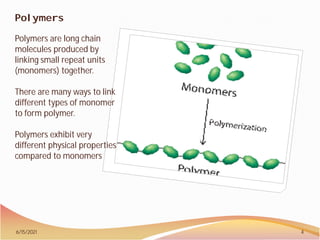
Polymers
Polymers are long chain
molecules produced by
linking small repeat units
(monomers) together.
There are many ways to link
different types of monomer
to form polymer.
Polymers exhibit very
different physical properties
compared to monomers
6/15/2021 4
6/15/2021
Classification of Polymers.
1. Natural & Synthetic polymer
Ex. For natural polymers are cotton,
Ex. For synthetic polymer are Polyethylene,
2. Organic & Inorganic polymer
Organic polymers are essentially
synthetic polymers are organic polymers
Inorganic polymers on the other hand
Glass & Silicon rubber
5
Classification of Polymers.
cotton, silk, wool, rubber, cellulose & leather
Polyethylene, PVC, Nylon & Terylene.
polymer
made of carbon atoms & majority of
polymers.
hand contains no carbon atoms for ex.
6/15/2021
3. Thermo Plastics & Thermoset polymers.
Ex. For thermo plastic are polyethylene, PVC, ABS, polystyrene etc.,
Ex. for Thermoset polymers are Epoxy, Phinolex & Polyester.
6
3. Thermo Plastics & Thermoset polymers.
Ex. For thermo plastic are polyethylene, PVC, ABS, polystyrene etc.,
Ex. for Thermoset polymers are Epoxy, Phinolex & Polyester.
Molecular weight(Mw)
 The molecular weight of a polymer is a way of
describing how long the polymer chains are.
 Each monomer has a molecular weight, adding the
monomers together to make polymers increases the
molecular weight.
 The longer the chain, the higher the molecular weight
6/15/2021
Molecular weight(Mw)
The molecular weight of a polymer is a way of
describing how long the polymer chains are.
Each monomer has a molecular weight, adding the
monomers together to make polymers increases the
The longer the chain, the higher the molecular weight
7
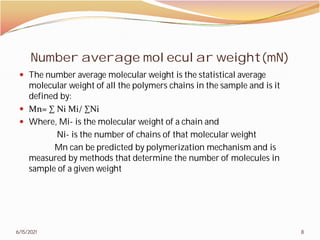
Number average molecular weight(mN)
 The number average molecular weight is the statistical average
molecular weight of all the polymers chains in the sample and is it
defined by:
 Mn= ∑ Ni Mi/ ∑Ni
 Where, Mi- is the molecular weight of a chain and
Ni- is the number of chains of that molecular weight
Mn can be predicted by polymerization mechanism and is
measured by methods that determine the number of molecules in
sample of a given weight
6/15/2021
Number average molecular weight(mN)
The number average molecular weight is the statistical average
molecular weight of all the polymers chains in the sample and is it
is the molecular weight of a chain and
is the number of chains of that molecular weight
Mn can be predicted by polymerization mechanism and is
measured by methods that determine the number of molecules in
8
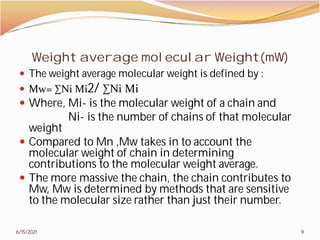
Weight average molecular Weight(mW
 The weight average molecular weight is defined by :
 Mw= ∑Ni Mi2/ ∑Ni Mi
 Where, Mi- is the molecular weight of a chain and
Ni- is the number of chains of that molecular
weight
 Compared to Mn ,Mw takes in to account the
molecular weight of chain in determining
contributions to the molecular weight average.
 The more massive the chain, the chain contributes to
Mw, Mw is determined by methods that are sensitive
to the molecular size rather than just their number.
6/15/2021
Weight average molecular Weight(mW)
The weight average molecular weight is defined by :
is the molecular weight of a chain and
is the number of chains of that molecular
Compared to Mn ,Mw takes in to account the
molecular weight of chain in determining
contributions to the molecular weight average.
The more massive the chain, the chain contributes to
Mw, Mw is determined by methods that are sensitive
to the molecular size rather than just their number.
9
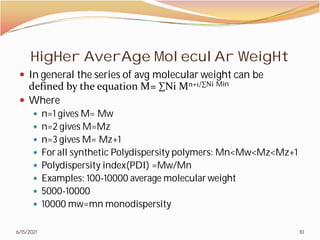
HigHer AverAge MoleculAr WeigHt
 In general the series of avg molecular weight can be
defined by the equation M= ∑Ni M
 Where
 n=1 gives M= Mw
 n=2 gives M=Mz
 n=3 gives M= Mz+1
 For all synthetic Polydispersity polymers: Mn<Mw<
 Polydispersity index(PDI) =Mw/Mn
 Examples: 100-10000 average molecular weight
 5000-10000
 10000 mw=mn monodispersity
6/15/2021
HigHer AverAge MoleculAr WeigHt
In general the series of avg molecular weight can be
defined by the equation M= ∑Ni Mn+1/∑Ni Min
For all synthetic Polydispersity polymers: Mn<Mw<Mz<Mz+1
Polydispersity index(PDI) =Mw/Mn
10000 average molecular weight
monodispersity
10
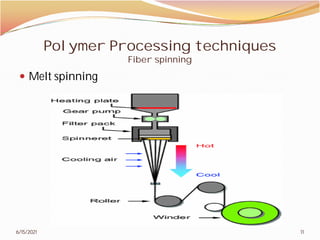
Polymer Processing techniques
Fiber spinning
 Melt spinning
6/15/2021
Polymer Processing techniques
Fiber spinning
11
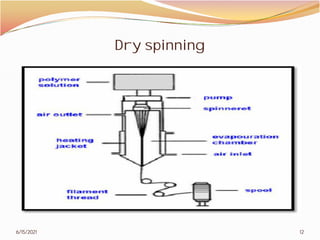
Dry spinning
6/15/2021
Dry spinning
12
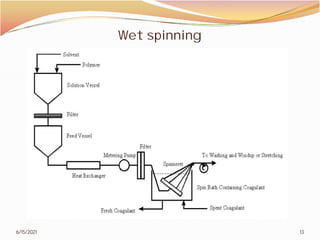
Wet spinning
6/15/2021
Wet spinning
13
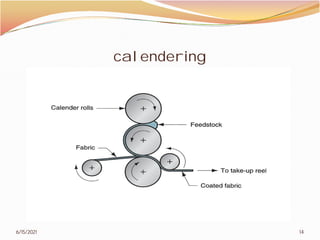
calendering
6/15/2021
calendering
14
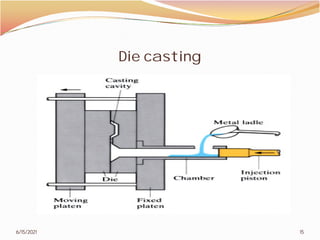
Die casting
6/15/2021
Die casting
15
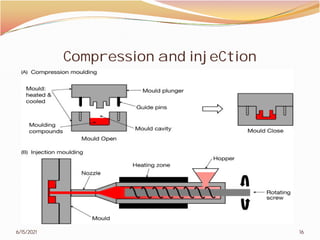
Compression and injeCtion
6/15/2021
Compression and injeCtion
16
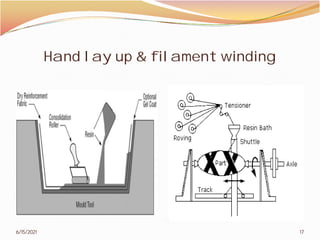
Hand lay up & filament winding
6/15/2021
Hand lay up & filament winding
17
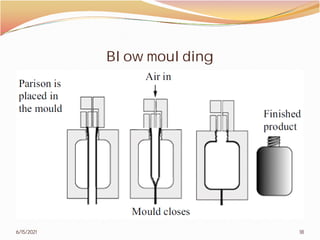
Blow moulding
6/15/2021
Blow moulding
18
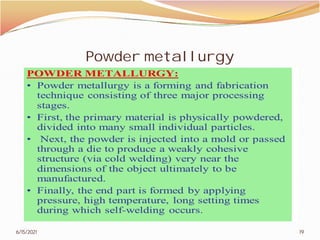
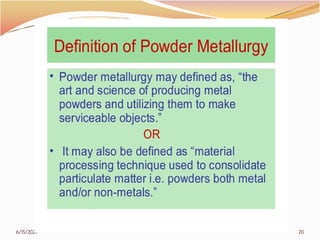
Powder metallurgy
6/15/2021
Powder metallurgy
19
6/15/2021 20
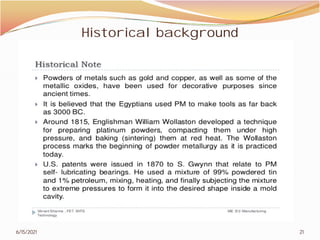
Historical background
6/15/2021
Historical background
21
6/15/2021 22
6/15/2021 23
6/15/2021 24
6/15/2021 25
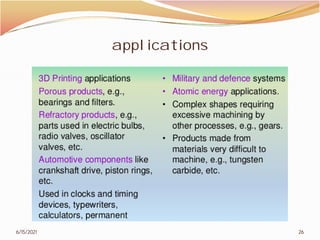
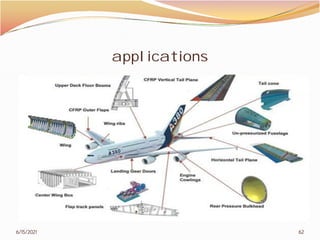
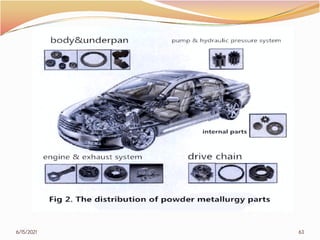
applications
6/15/2021
applications
26
6/15/2021 27
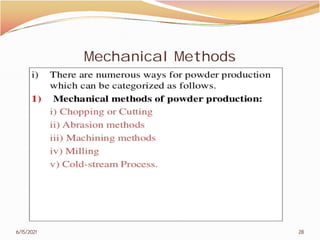
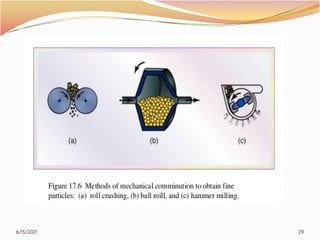
Mechanical Methods
6/15/2021
Mechanical Methods
28
6/15/2021 29
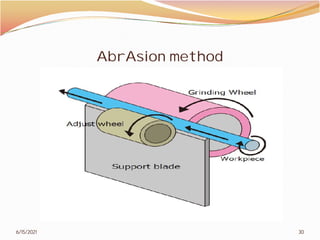
AbrAsion method
6/15/2021
AbrAsion method
30
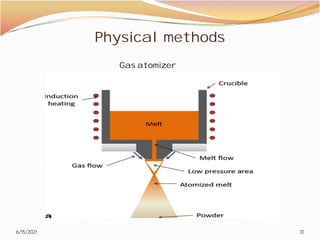
Physical methods
6/15/2021
Gas atomizer
Physical methods
31
Gas atomizer
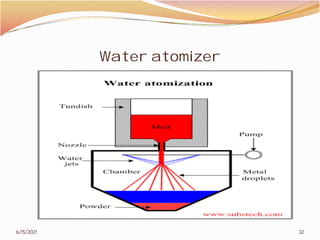
Water atomizer
6/15/2021
Water atomizer
32
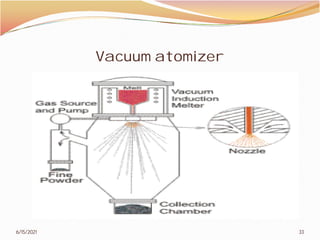
Vacuum atomizer
6/15/2021
Vacuum atomizer
33
Metal powder characterization
 Chemical
 Physical
 processing
6/15/2021
Metal powder characterization
34
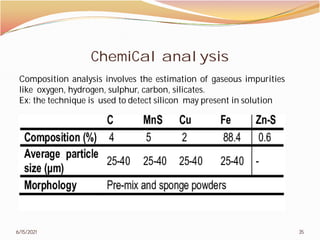
ChemiCal analysis
6/15/2021
Composition analysis involves the estimation
like oxygen, hydrogen, sulphur, carbon,
Ex: the technique is used to detect silicon
ChemiCal analysis
35
estimation of gaseous impurities
carbon, silicates.
silicon may present in solution
6/15/2021 36
6/15/2021 37
Compressibility of metal powder
 Compressibility and compactable
describe the extent to which
densified by the application
 The compressibility of a powder
factors.
1.Inherent hardness of the metal
2.Particle shape
3. Internal porosity
4. Particle size distribution
5.Presencr of non metallic
6. Use of solid lubricants
6/15/2021
Compressibility of metal powder
compactable are terms used to
which a mass of powder can be
application of pressure alone.
powder is influenced by several
metal or alloy
38
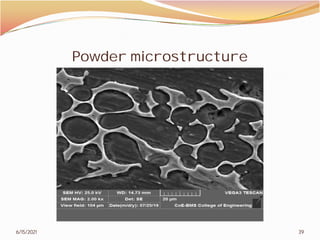
Powder microstructure
6/15/2021
Powder microstructure
39
Powder Pressing and comPaction
 Binders: the binder is mixed with the powder to form the
feedstock. Most binder are multiple component mixtures
that contains a major ingredients which indicates the basic
properties along with additives used to obtain the other
desired properties.
 Characteristic
 A good binder
 1. must have low inherent viscosity at the shaping
temperature
 2.must be strong and rigid after shaping
 3.should have low molecular Weight
6/15/2021
Powder Pressing and comPaction
Binders: the binder is mixed with the powder to form the
feedstock. Most binder are multiple component mixtures
that contains a major ingredients which indicates the basic
properties along with additives used to obtain the other
1. must have low inherent viscosity at the shaping
2.must be strong and rigid after shaping
3.should have low molecular Weight
40
Powder interaction
1.Wet and adhere to the powder
2.Be chemically passive
3.Be stable during mixing and shaping
6/15/2021
Powder interaction
1.Wet and adhere to the powder
3.Be stable during mixing and shaping
41
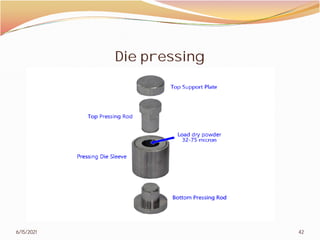
Die pressing
6/15/2021
Die pressing
42
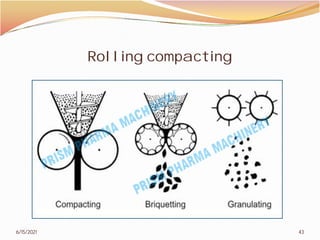
Rolling compacting
6/15/2021
Rolling compacting
43
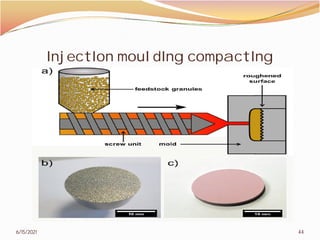
InjectIon mouldIng compactIng
6/15/2021
InjectIon mouldIng compactIng
44
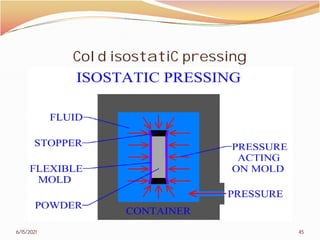
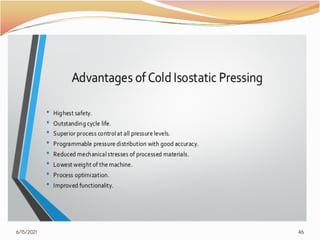
Cold isostatiC pressing
6/15/2021
Cold isostatiC pressing
45
6/15/2021 46
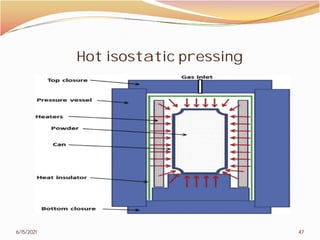
Hot isostatic pressing
6/15/2021
Hot isostatic pressing
47
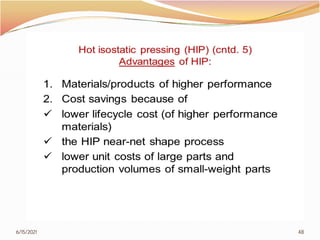
6/15/2021 48
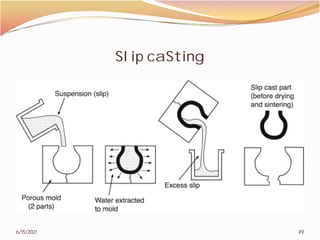
Slip caSting
6/15/2021
Slip caSting
49
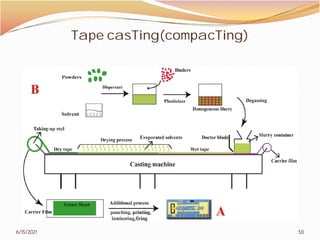
Tape casTing(compacTing)
6/15/2021
Tape casTing(compacTing)
50
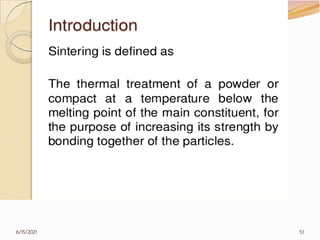
6/15/2021 51
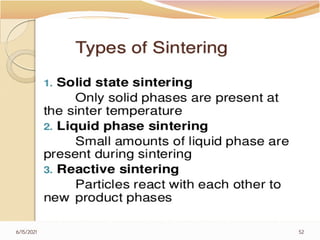
6/15/2021 52
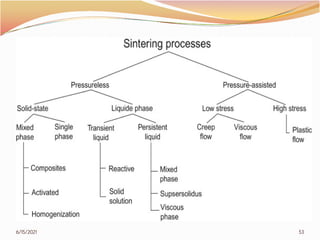
6/15/2021 53
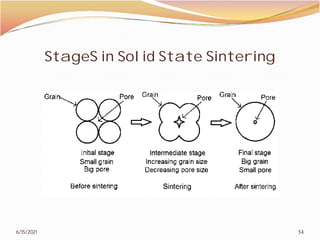
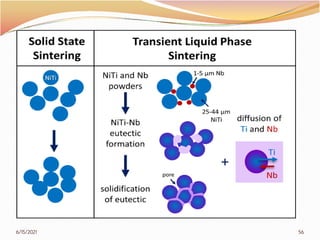
StageS in Solid State Sintering
6/15/2021
StageS in Solid State Sintering
54
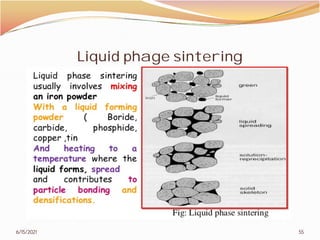
Liquid phage sintering
6/15/2021
Liquid phage sintering
55
6/15/2021 56
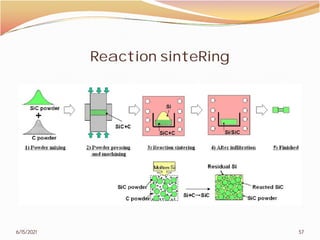
Reaction sinteRing
6/15/2021
Reaction sinteRing
57
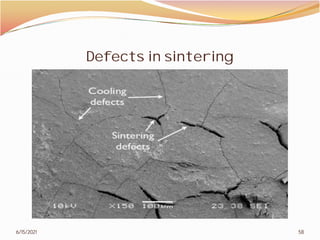
Defects in sintering
6/15/2021
Defects in sintering
58
6/15/2021 59
6/15/2021 60
6/15/2021 61
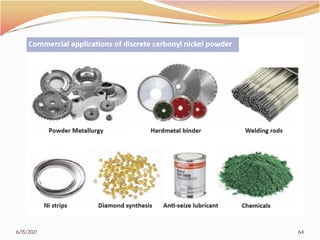
applications
6/15/2021
applications
62
6/15/2021 63
6/15/2021 64

AM-Mod-3.pdf