

ALLOSTATIC LOAD
 STUDY DESIGN
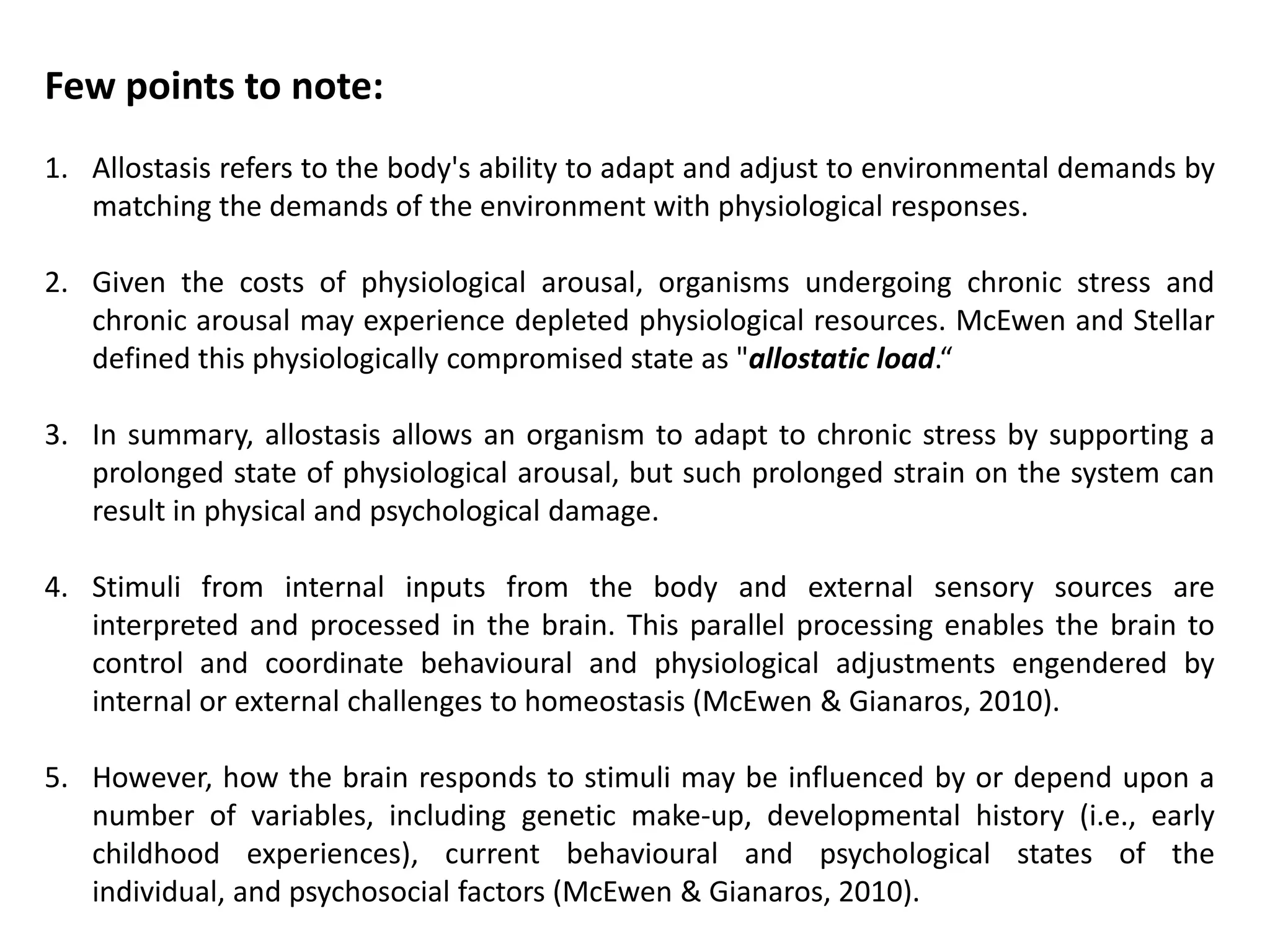
Few points to note:
1. Allostasis refers to the body's ability to adapt and adjust to environmental demands by
   matching the demands of the environment with physiological responses.

2. Given the costs of physiological arousal, organisms undergoing chronic stress and
   chronic arousal may experience depleted physiological resources. McEwen and Stellar
   defined this physiologically compromised state as "allostatic load.“

3. In summary, allostasis allows an organism to adapt to chronic stress by supporting a
   prolonged state of physiological arousal, but such prolonged strain on the system can
   result in physical and psychological damage.

4. Stimuli from internal inputs from the body and external sensory sources are
   interpreted and processed in the brain. This parallel processing enables the brain to
   control and coordinate behavioural and physiological adjustments engendered by
   internal or external challenges to homeostasis (McEwen & Gianaros, 2010).

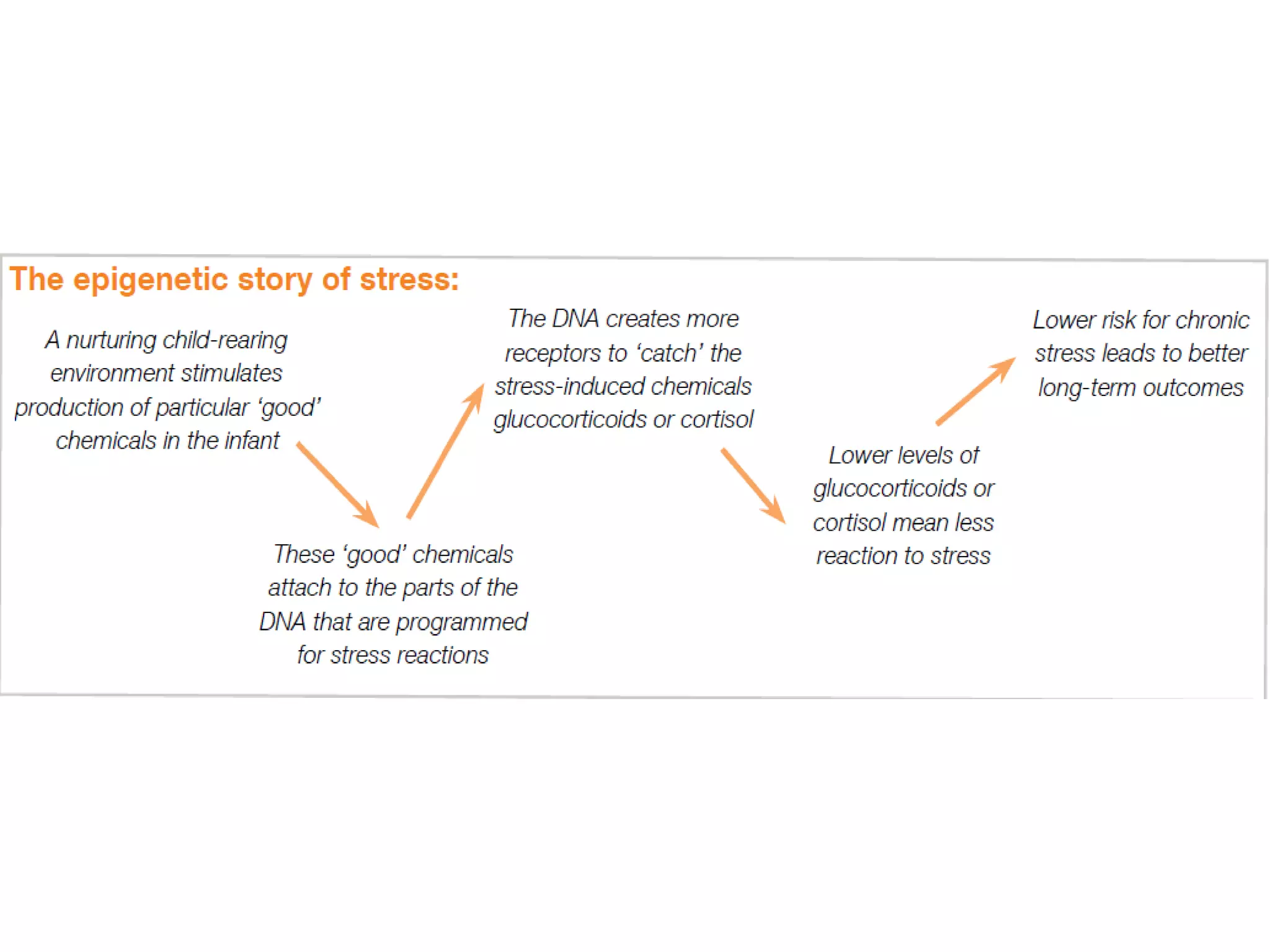
5. However, how the brain responds to stimuli may be influenced by or depend upon a
   number of variables, including genetic make-up, developmental history (i.e., early
   childhood experiences), current behavioural and psychological states of the
   individual, and psychosocial factors (McEwen & Gianaros, 2010).
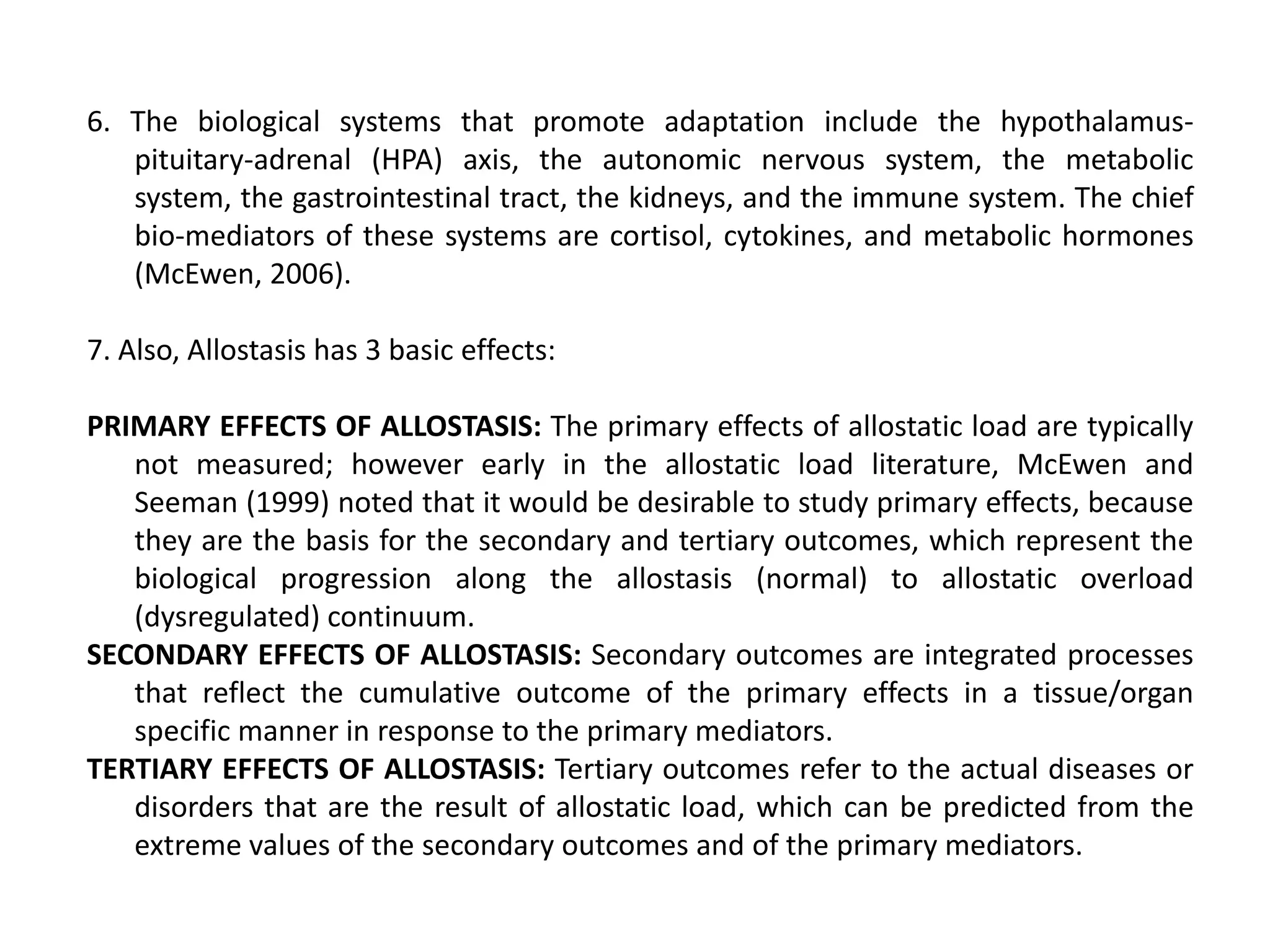
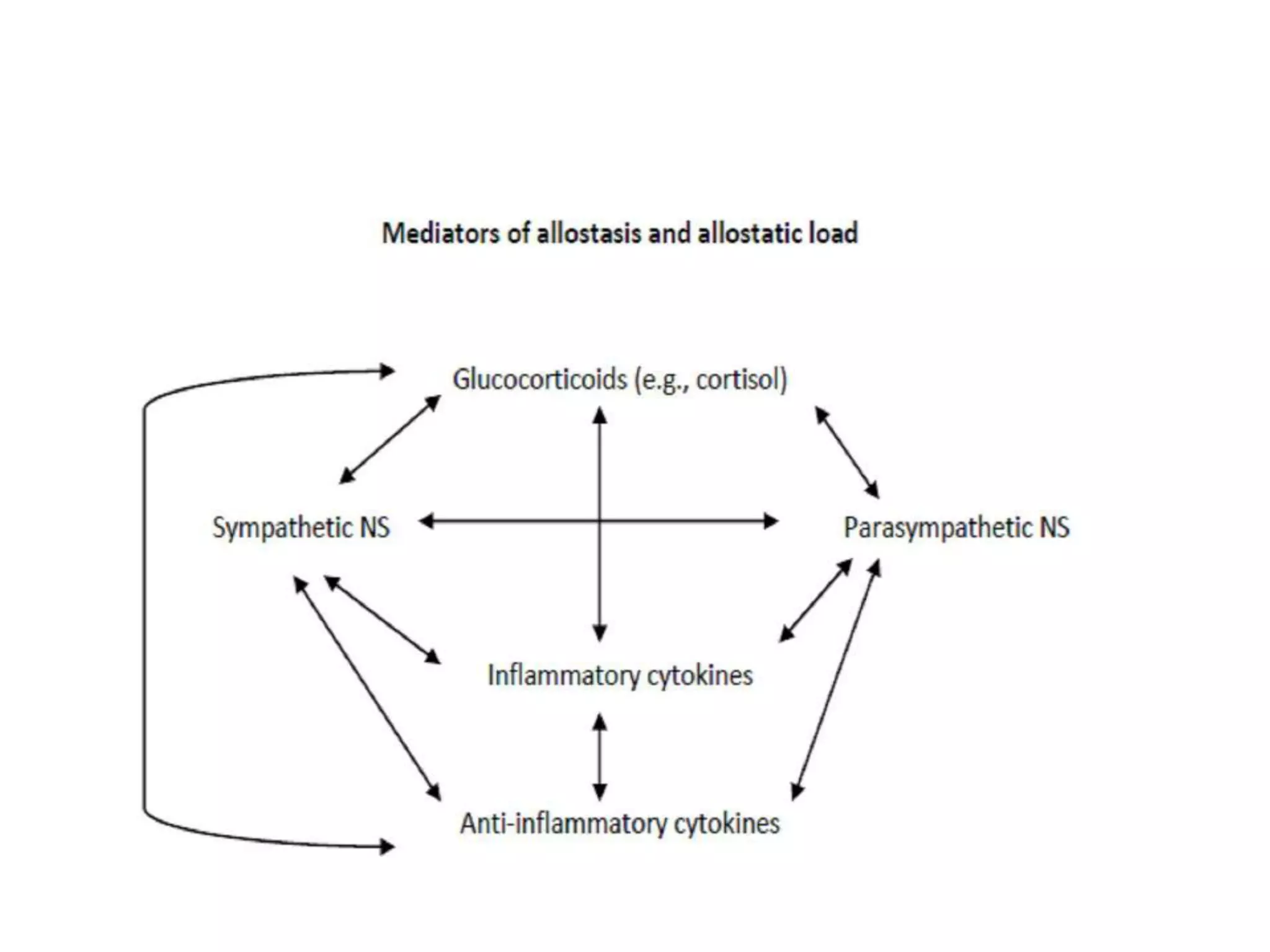
6. The biological systems that promote adaptation include the hypothalamus-
   pituitary-adrenal (HPA) axis, the autonomic nervous system, the metabolic
   system, the gastrointestinal tract, the kidneys, and the immune system. The chief
   bio-mediators of these systems are cortisol, cytokines, and metabolic hormones
   (McEwen, 2006).

7. Also, Allostasis has 3 basic effects:

PRIMARY EFFECTS OF ALLOSTASIS: The primary effects of allostatic load are typically
   not measured; however early in the allostatic load literature, McEwen and
   Seeman (1999) noted that it would be desirable to study primary effects, because
   they are the basis for the secondary and tertiary outcomes, which represent the
   biological progression along the allostasis (normal) to allostatic overload
   (dysregulated) continuum.
SECONDARY EFFECTS OF ALLOSTASIS: Secondary outcomes are integrated processes
   that reflect the cumulative outcome of the primary effects in a tissue/organ
   specific manner in response to the primary mediators.
TERTIARY EFFECTS OF ALLOSTASIS: Tertiary outcomes refer to the actual diseases or
   disorders that are the result of allostatic load, which can be predicted from the
   extreme values of the secondary outcomes and of the primary mediators.
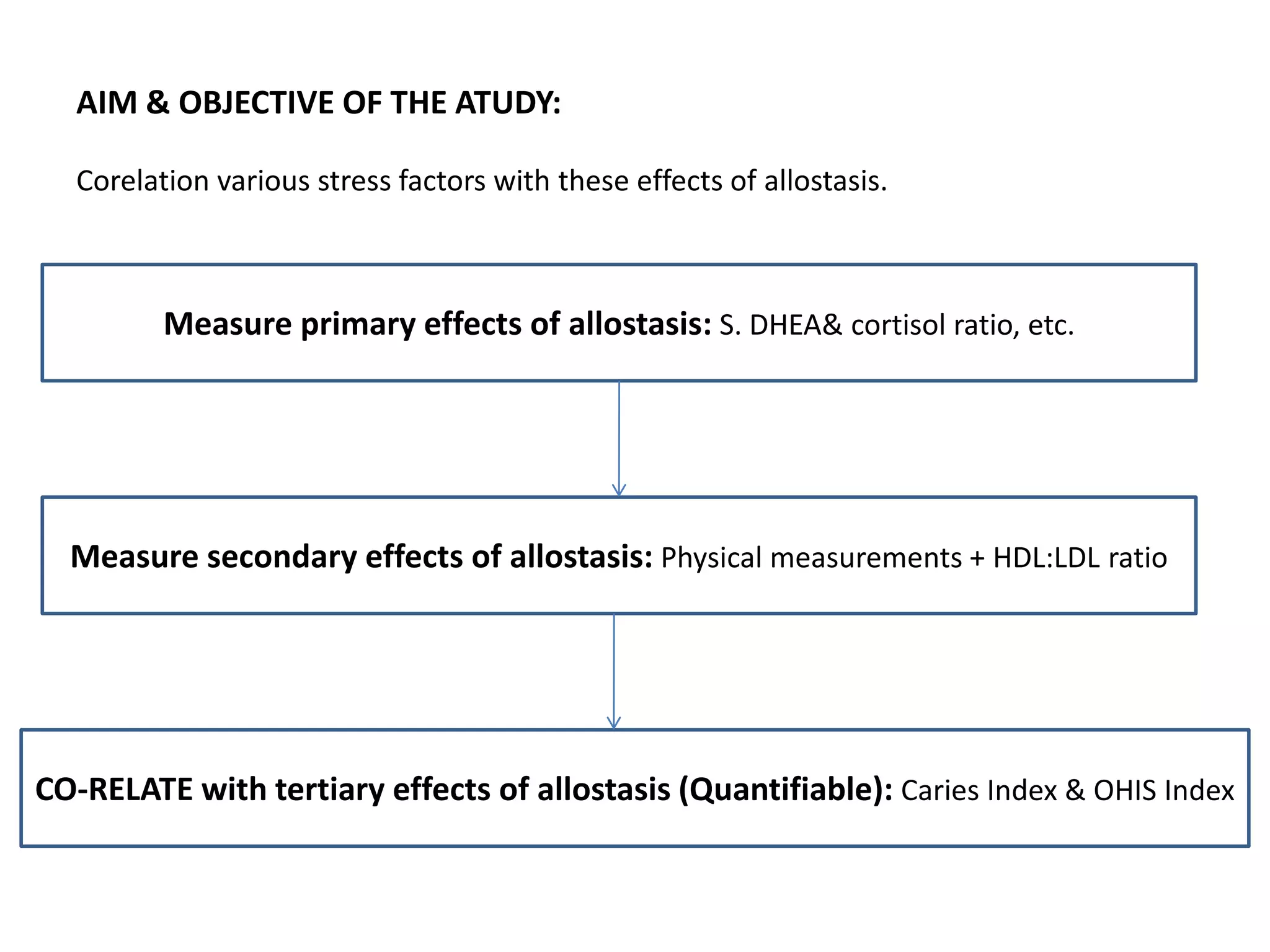
AIM & OBJECTIVE OF THE ATUDY:

  Corelation various stress factors with these effects of allostasis.


         Measure primary effects of allostasis: S. DHEA& cortisol ratio, etc.


  Measure secondary effects of allostasis: Physical measurements + HDL:LDL ratio


CO-RELATE with tertiary effects of allostasis (Quantifiable): Caries Index & OHIS Index
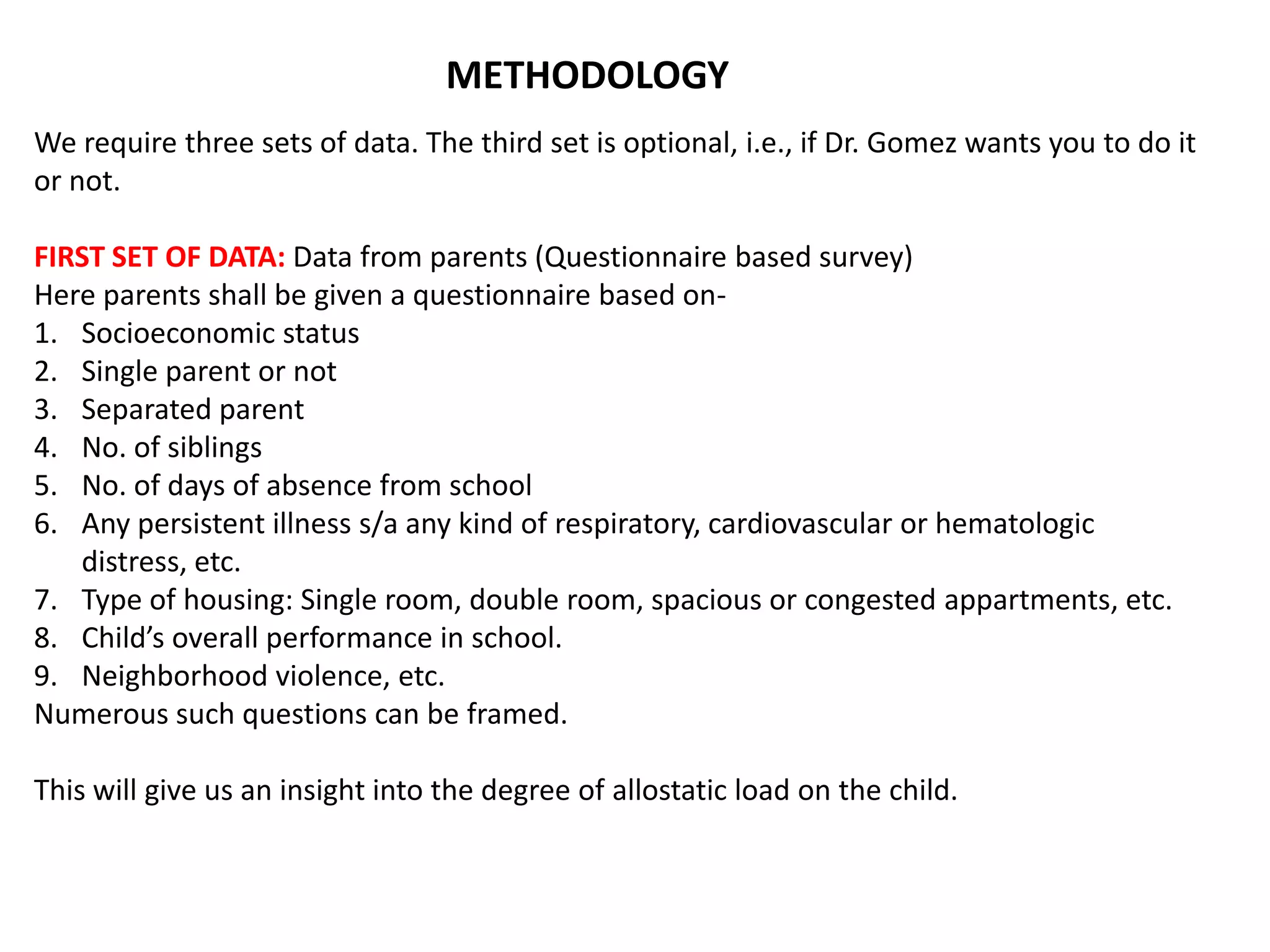
METHODOLOGY
We require three sets of data. The third set is optional, i.e., if Dr. Gomez wants you to do it
or not.

FIRST SET OF DATA: Data from parents (Questionnaire based survey)
Here parents shall be given a questionnaire based on-
1. Socioeconomic status
2. Single parent or not
3. Separated parent
4. No. of siblings
5. No. of days of absence from school
6. Any persistent illness s/a any kind of respiratory, cardiovascular or hematologic
   distress, etc.
7. Type of housing: Single room, double room, spacious or congested appartments, etc.
8. Child’s overall performance in school.
9. Neighborhood violence, etc.
Numerous such questions can be framed.

This will give us an insight into the degree of allostatic load on the child.
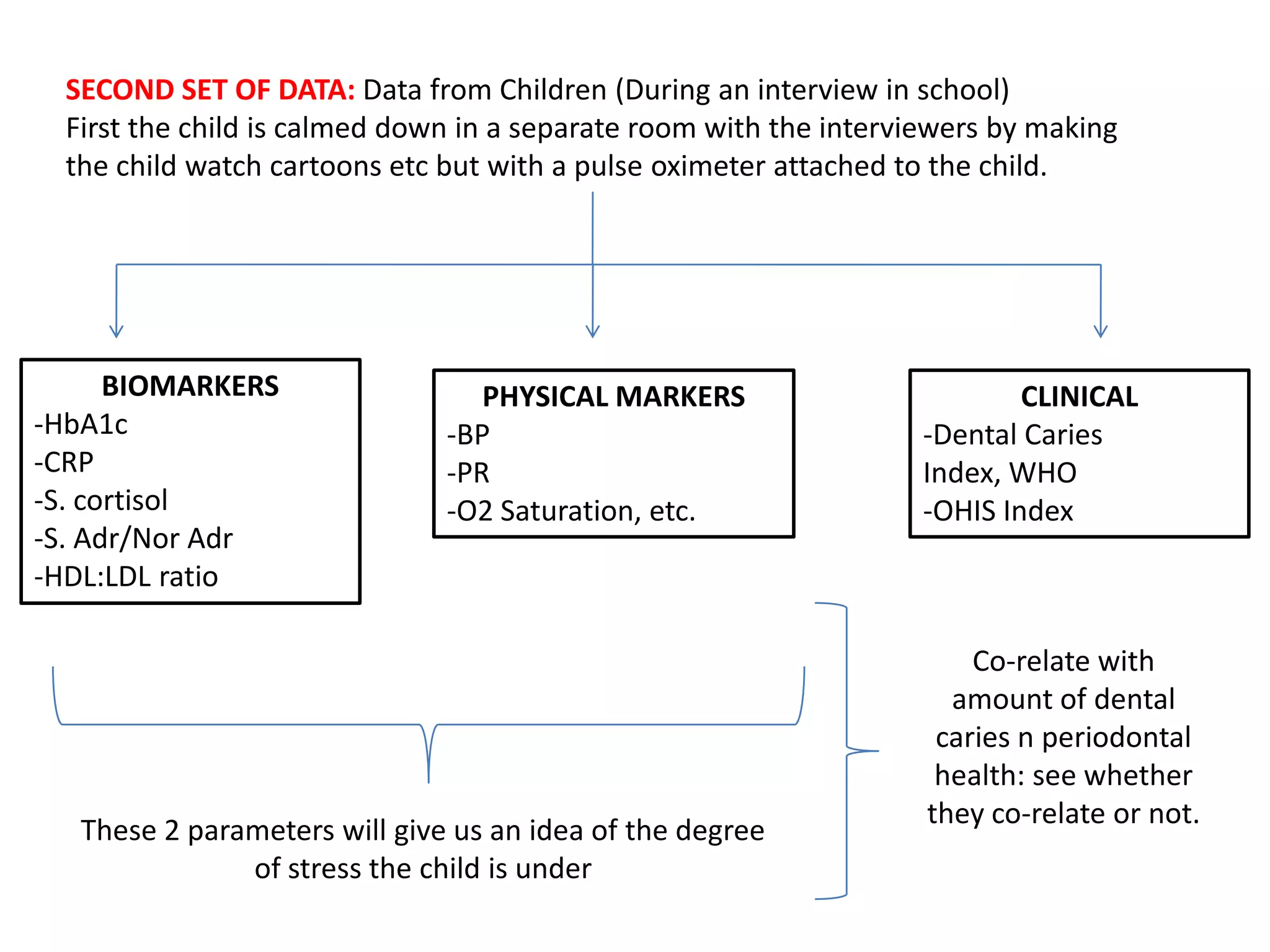
SECOND SET OF DATA: Data from Children (During an interview in school)
  First the child is calmed down in a separate room with the interviewers by making
  the child watch cartoons etc but with a pulse oximeter attached to the child.


      BIOMARKERS                  PHYSICAL MARKERS                          CLINICAL
-HbA1c                         -BP                                  -Dental Caries
-CRP                           -PR                                  Index, WHO
-S. cortisol                   -O2 Saturation, etc.                 -OHIS Index
-S. Adr/Nor Adr
-HDL:LDL ratio

                                                                        Co-relate with
                                                                      amount of dental
                                                                     caries n periodontal
                                                                     health: see whether
                                                                    they co-relate or not.
   These 2 parameters will give us an idea of the degree
               of stress the child is under
THIRD SET OF DATA (OPTIONAL): Racial Distinction
The same set of data can be evaluated in various races & comparatively evaluated .
Allostatic load study design

Allostatic load study design

  • 1.
  • 2.
    Few points tonote: 1. Allostasis refers to the body's ability to adapt and adjust to environmental demands by matching the demands of the environment with physiological responses. 2. Given the costs of physiological arousal, organisms undergoing chronic stress and chronic arousal may experience depleted physiological resources. McEwen and Stellar defined this physiologically compromised state as "allostatic load.“ 3. In summary, allostasis allows an organism to adapt to chronic stress by supporting a prolonged state of physiological arousal, but such prolonged strain on the system can result in physical and psychological damage. 4. Stimuli from internal inputs from the body and external sensory sources are interpreted and processed in the brain. This parallel processing enables the brain to control and coordinate behavioural and physiological adjustments engendered by internal or external challenges to homeostasis (McEwen & Gianaros, 2010). 5. However, how the brain responds to stimuli may be influenced by or depend upon a number of variables, including genetic make-up, developmental history (i.e., early childhood experiences), current behavioural and psychological states of the individual, and psychosocial factors (McEwen & Gianaros, 2010).
  • 3.
    6. The biologicalsystems that promote adaptation include the hypothalamus- pituitary-adrenal (HPA) axis, the autonomic nervous system, the metabolic system, the gastrointestinal tract, the kidneys, and the immune system. The chief bio-mediators of these systems are cortisol, cytokines, and metabolic hormones (McEwen, 2006). 7. Also, Allostasis has 3 basic effects: PRIMARY EFFECTS OF ALLOSTASIS: The primary effects of allostatic load are typically not measured; however early in the allostatic load literature, McEwen and Seeman (1999) noted that it would be desirable to study primary effects, because they are the basis for the secondary and tertiary outcomes, which represent the biological progression along the allostasis (normal) to allostatic overload (dysregulated) continuum. SECONDARY EFFECTS OF ALLOSTASIS: Secondary outcomes are integrated processes that reflect the cumulative outcome of the primary effects in a tissue/organ specific manner in response to the primary mediators. TERTIARY EFFECTS OF ALLOSTASIS: Tertiary outcomes refer to the actual diseases or disorders that are the result of allostatic load, which can be predicted from the extreme values of the secondary outcomes and of the primary mediators.
  • 4.
    AIM & OBJECTIVEOF THE ATUDY: Corelation various stress factors with these effects of allostasis. Measure primary effects of allostasis: S. DHEA& cortisol ratio, etc. Measure secondary effects of allostasis: Physical measurements + HDL:LDL ratio CO-RELATE with tertiary effects of allostasis (Quantifiable): Caries Index & OHIS Index
  • 5.
    METHODOLOGY We require threesets of data. The third set is optional, i.e., if Dr. Gomez wants you to do it or not. FIRST SET OF DATA: Data from parents (Questionnaire based survey) Here parents shall be given a questionnaire based on- 1. Socioeconomic status 2. Single parent or not 3. Separated parent 4. No. of siblings 5. No. of days of absence from school 6. Any persistent illness s/a any kind of respiratory, cardiovascular or hematologic distress, etc. 7. Type of housing: Single room, double room, spacious or congested appartments, etc. 8. Child’s overall performance in school. 9. Neighborhood violence, etc. Numerous such questions can be framed. This will give us an insight into the degree of allostatic load on the child.
  • 6.
    SECOND SET OFDATA: Data from Children (During an interview in school) First the child is calmed down in a separate room with the interviewers by making the child watch cartoons etc but with a pulse oximeter attached to the child. BIOMARKERS PHYSICAL MARKERS CLINICAL -HbA1c -BP -Dental Caries -CRP -PR Index, WHO -S. cortisol -O2 Saturation, etc. -OHIS Index -S. Adr/Nor Adr -HDL:LDL ratio Co-relate with amount of dental caries n periodontal health: see whether they co-relate or not. These 2 parameters will give us an idea of the degree of stress the child is under
  • 7.
    THIRD SET OFDATA (OPTIONAL): Racial Distinction The same set of data can be evaluated in various races & comparatively evaluated .