ALLERGY
DONE BY:
DEVCHARAN
WHAT IS
ALLERGY?
Allergy can be defined
as a hypersensitivity
reaction by our body to
the foreign substances
that enter or interact with
the body. These foreign
substances are called
antigens
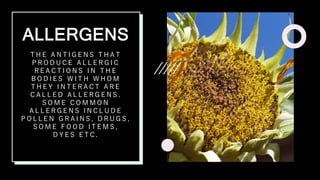
ALLERGENS
T H E A N T I G E N S T H A T
P R O D U C E A L L E R G I C
R E A C T I O N S I N T H E
B O D I E S W I T H W H O M
T H E Y I N T E R A C T A R E
C A L L E D A L L E R G E N S .
S O M E C O M M O N
A L L E R G E N S I N C L U D E
P O L L E N G R A I N S , D R U G S ,
S O M E F O O D I T E M S ,
D Y E S E T C .
WHEN CAN
ALLERGIC
REACTIONS BE
SEEN?
Allergic reactions can be seen
as symptoms when the
immune system of the body is
weak and is prone to allergies.
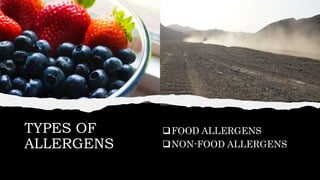
TYPES OF
ALLERGENS
FOOD ALLERGENS
NON-FOOD ALLERGENS
FOOD ALLERGENS
Food allergens include food products like eggs, overripe
fruits, sea food, etc. The possible treatments for food
allergies has not been found yet. It can be avoided by
avoiding the causative food allergen.
NON-FOOD
ALLERGENS
Non-food allergens include
pollen, dust, insect bites such
as bites of ants and bees,
certain injections such as
penicillin, etc.
HOW DO
ALLERGENS
ENTER OUR
BODY??
Different allergens can enter our body
through different routes such as mouth, nose
and skin.
For example, pollen may enter our body
through nose and mouth and sunlight effects
our skin
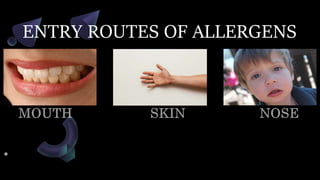
ENTRY ROUTES OF ALLERGENS
MOUTH
Allergens can enter the body by ingestion through
the mouth. The allergy caused in the mouth is
called as oral energy. The main symptoms of oral
allergy include itchiness in mouth, scratchy throat,
swelling in lips, mouth, tongue and throat.
Nose
The allergens can enter through the nose during
breathing. The allergic reactions caused in the nose
is known as nasal allergy. The main allergies
include pollen allergy, dust, cat saliva, mould,
animal fur, cigarette smoke, etc. The main
symptoms of nasal allergy include sneezing,
coughing, nose congestion, etc.
Skin
Skin allergies are caused when the allergens are
rubbed against the skin.
The allergies include soaps, detergents, certain
cosmetics, chemicals, etc. Skin allergies can cause
redness, itchiness, blisters, etc in the skin
TYPES OF ALLERGIES
Allergies can
be of two
types
• SEASONAL
ALLERGY
• PERENNIAL
ALLERGY
SEASONAL ALLERGY
Allergies that occur in a particular season are called
seasonal allergies.
For example, pollen allergies mostly occur in spring season.
Pollen allergies are also known as hay fever. Seasonal
allergies often occur on onset of different seasons. Summer
and spring are two seasons in which most people are prone
to allergy. During spring season, pollen grains travel in air
and affect people sensitive to them. For example, people
suffering from cold and asthma are more prone to seasonal
allergies during spring. During summer, sunlight is one of
the reasons for allergy who are sensitive to it. Some of the
triggers of seasonal allergy may be pollens in spring and
grasses in summer.
Moulds grow in rainy seasons at humid places. The spores
released by moulds can cause severe allergies in certain
people.
PERENNIAL
ALLERGIES
Allergies that occur anytime of the year or remain
throughout the year are known as perennial allergies. For
example, cold. Allergies due to dust are examples of
perennial allergies as dust is present all the year. These
allergies happen to people who are sensitive to dust. They
suffer from perennial allergies every time they come in
contact to them.
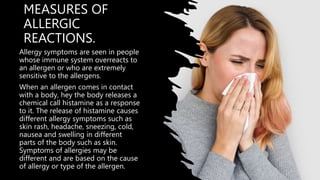
MEASURES OF
ALLERGIC
REACTIONS.
Allergy symptoms are seen in people
whose immune system overreacts to
an allergen or who are extremely
sensitive to the allergens.
When an allergen comes in contact
with a body, hey the body releases a
chemical call histamine as a response
to it. The release of histamine causes
different allergy symptoms such as
skin rash, headache, sneezing, cold,
nausea and swelling in different
parts of the body such as skin.
Symptoms of allergies may be
different and are based on the cause
of allergy or type of the allergen.
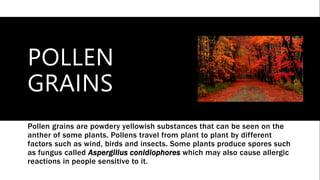
POLLEN
GRAINS
Pollen grains are powdery yellowish substances that can be seen on the
anther of some plants. Pollens travel from plant to plant by different
factors such as wind, birds and insects. Some plants produce spores such
as fungus called Aspergillus conidiophores which may also cause allergic
reactions in people sensitive to it.
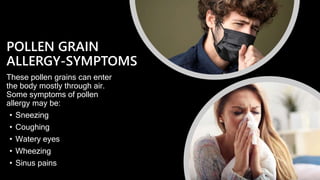
POLLEN GRAIN
ALLERGY-SYMPTOMS
These pollen grains can enter
the body mostly through air.
Some symptoms of pollen
allergy may be:
• Sneezing
• Coughing
• Watery eyes
• Wheezing
• Sinus pains
POLLEN GRAIN ALLERGY- PREVENTION
◦ Consult an allergen to know the causes and symptoms and prevention
of pollen grain allergy. Some methods to prevent allergy from pollen
grains are:
◦ Avoid going out during times when pollen production is maximum.
◦ Wash your clothes and keep your shoes outside to prevent entry of
pollen grains in the house.
◦ Cover your nose and mouth to prevent entry of pollen grains in the
body.
◦ Keep your medication handy, in case the allergy gets severe.
◦ Drink warm water or hot drinks to get relief from itchy throat.
DUST MITES
Dust mites are the
organisms that are too small
to be seen through naked
eyes. Mostly the waste
released by the dust mite
creates allergic reactions in
people who are sensitive to
it.
DUST MITE ALLERGY-
SYMPTOMS
– The symptoms of dust mite allergy are:
– Sneezing
– Running or stuffy nose
– Itching in throat or nose
– Coughing
– Releasing of mucous from behind the nose into the
throat.
DUST MITE ALLERGY- PREVENTION
PREVENTION OF DUST MITE ALLERGY CAN BE DONE BY THE FOLLOWING WAYS:
• DUST MITES MOSTLY GROW IN HUMID PLACES MOSTLY AT THE TEMPERATURE OF ABOUT
70-DEGREE FAHRENHEIT. THEREFORE, REMOVE SUCH CONDITIONS TO PREVE NT THEIR
GROWTH.
• USE DUST-PROOF PILLOW AND MATTRESS COVERS.
• WASH THE BEDDINGS IN HOT WATER TO KILL THE DUST MITES IF THEY AR E PRESENT IN
THEM.
• AVOID USE OF CARPETS IN THE HOUSE TO PREVENT GROWTH OF DUST MITE S.
• WHILE DUSTING OR CLEANING CARPETS, ETC. WEAR A MASK TO PREVENT I NHALING OF
DUST MITES WASTE.
DUST
ALLER
GY
Dust is released
into air by
different ways
such as
vehicles, wind,
DUST ALLERGY-
SYMPTOMS
THE SYMPTOMS OF DUST
ALLERGY ARE:
• SNEEZING
• RUNNING OR STUFFY NOSE
• RED, ITCHY OR TEARY EYES
• SEVERE SYMPTOMS MAY
INCLUDE WHEEZING,
BREATHLESSNESS AND CHEST
PAIN.
DUST ALLEGY- PREVENTION
 Prevention: Following methods can be adopted to
prevent oneself from dust allergy
 Try to keep your surroundings and where you
spend more time away from dust.
 Keep your mouth and nose covered while sweeping
or mopping your house.
 Consult an allergist to find triggers, symptoms and
preventive measures for the allergy.
 Keep checking the filters in air conditioners time to
time.
ALLERGY TO STRONG
SUNLIGHT
Some people are allergic to sunlight. It is also known as
photosensitivity.
ALLERGY TO STRONG
SUNLIGHT-SYMPTOMS
• Mostly the body parts exposed to the
sunlight reacts to it and shows symptoms
such as:
• Itching and reddish rashes
• Hives or small blisters in severe cases
• Headache
• Nausea
ALLERGY
TO STRONG
SUNLIGHT-
PREVENTIO
N
To prevent allergic reactions to
sunlight, following steps can be
followed:
• Apply sunscreen lotion before
stepping out to sunlight.
• Cover your body as much as
possible when out in the sun.
• Wear sunglasses to prevent
harmful rays from getting into the
eyes.
• Avoid going out in the peak time
or at noon time when the sunlight
is maximum.
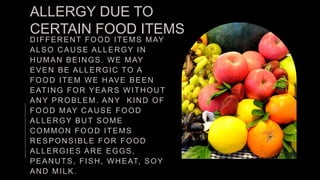
ALLERGY DUE TO
CERTAIN FOOD ITEMS
DIFFERENT FOOD ITEMS MAY
ALSO CAUSE ALLERGY IN
HUMAN BEINGS. WE MAY
EVEN BE ALLERGIC TO A
FOOD ITEM WE HAVE BEEN
EATING FOR YEARS WITHOUT
ANY PROBLEM. ANY KIND OF
FOOD MAY CAUSE FOOD
ALLERGY BUT SOME
COMMON FOOD ITEMS
RESPONSIBLE FOR FOOD
ALLERGIES ARE EGGS,
PEANUTS, FISH, WHEAT, SOY
AND MILK.
FOOD ALLERGY-
SYMPTOMS
S O M E S Y M P T O M S
O F F O O D
A L L E R G Y A R E :
• S T O M A C H A C H E
• V O M I T I N G
• W H E E Z I N G
• D I Z Z I N E S S
• C O U G H
• S W E L L I N G I N
T H R O AT A N D
T R O U B L E I N
S WA L L O W I N G
F O O D .
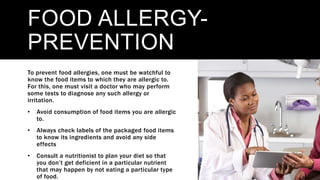
FOOD ALLERGY-
PREVENTION
To prevent food allergies, one must be watchful to
know the food items to which they are allergic to.
For this, one must visit a doctor who may perform
some tests to diagnose any such allergy or
irritation.
• Avoid consumption of food items you are allergic
to.
• Always check labels of the packaged food items
to know its ingredients and avoid any side
effects
• Consult a nutritionist to plan your diet so that
you don’t get deficient in a particular nutrient
that may happen by not eating a particular type
of food.
THANK YOU

ALLERGY .pptx

  • 1.
  • 2.
    WHAT IS ALLERGY? Allergy canbe defined as a hypersensitivity reaction by our body to the foreign substances that enter or interact with the body. These foreign substances are called antigens
  • 3.
    ALLERGENS T H EA N T I G E N S T H A T P R O D U C E A L L E R G I C R E A C T I O N S I N T H E B O D I E S W I T H W H O M T H E Y I N T E R A C T A R E C A L L E D A L L E R G E N S . S O M E C O M M O N A L L E R G E N S I N C L U D E P O L L E N G R A I N S , D R U G S , S O M E F O O D I T E M S , D Y E S E T C .
  • 4.
    WHEN CAN ALLERGIC REACTIONS BE SEEN? Allergicreactions can be seen as symptoms when the immune system of the body is weak and is prone to allergies.
  • 5.
  • 6.
    FOOD ALLERGENS Food allergensinclude food products like eggs, overripe fruits, sea food, etc. The possible treatments for food allergies has not been found yet. It can be avoided by avoiding the causative food allergen.
  • 7.
    NON-FOOD ALLERGENS Non-food allergens include pollen,dust, insect bites such as bites of ants and bees, certain injections such as penicillin, etc.
  • 8.
    HOW DO ALLERGENS ENTER OUR BODY?? Differentallergens can enter our body through different routes such as mouth, nose and skin. For example, pollen may enter our body through nose and mouth and sunlight effects our skin
  • 9.
    ENTRY ROUTES OFALLERGENS
  • 10.
    MOUTH Allergens can enterthe body by ingestion through the mouth. The allergy caused in the mouth is called as oral energy. The main symptoms of oral allergy include itchiness in mouth, scratchy throat, swelling in lips, mouth, tongue and throat.
  • 11.
    Nose The allergens canenter through the nose during breathing. The allergic reactions caused in the nose is known as nasal allergy. The main allergies include pollen allergy, dust, cat saliva, mould, animal fur, cigarette smoke, etc. The main symptoms of nasal allergy include sneezing, coughing, nose congestion, etc.
  • 12.
    Skin Skin allergies arecaused when the allergens are rubbed against the skin. The allergies include soaps, detergents, certain cosmetics, chemicals, etc. Skin allergies can cause redness, itchiness, blisters, etc in the skin
  • 13.
    TYPES OF ALLERGIES Allergiescan be of two types • SEASONAL ALLERGY • PERENNIAL ALLERGY
  • 14.
    SEASONAL ALLERGY Allergies thatoccur in a particular season are called seasonal allergies. For example, pollen allergies mostly occur in spring season. Pollen allergies are also known as hay fever. Seasonal allergies often occur on onset of different seasons. Summer and spring are two seasons in which most people are prone to allergy. During spring season, pollen grains travel in air and affect people sensitive to them. For example, people suffering from cold and asthma are more prone to seasonal allergies during spring. During summer, sunlight is one of the reasons for allergy who are sensitive to it. Some of the triggers of seasonal allergy may be pollens in spring and grasses in summer. Moulds grow in rainy seasons at humid places. The spores released by moulds can cause severe allergies in certain people.
  • 15.
    PERENNIAL ALLERGIES Allergies that occuranytime of the year or remain throughout the year are known as perennial allergies. For example, cold. Allergies due to dust are examples of perennial allergies as dust is present all the year. These allergies happen to people who are sensitive to dust. They suffer from perennial allergies every time they come in contact to them.
  • 16.
    MEASURES OF ALLERGIC REACTIONS. Allergy symptomsare seen in people whose immune system overreacts to an allergen or who are extremely sensitive to the allergens. When an allergen comes in contact with a body, hey the body releases a chemical call histamine as a response to it. The release of histamine causes different allergy symptoms such as skin rash, headache, sneezing, cold, nausea and swelling in different parts of the body such as skin. Symptoms of allergies may be different and are based on the cause of allergy or type of the allergen.
  • 17.
    POLLEN GRAINS Pollen grains arepowdery yellowish substances that can be seen on the anther of some plants. Pollens travel from plant to plant by different factors such as wind, birds and insects. Some plants produce spores such as fungus called Aspergillus conidiophores which may also cause allergic reactions in people sensitive to it.
  • 18.
    POLLEN GRAIN ALLERGY-SYMPTOMS These pollengrains can enter the body mostly through air. Some symptoms of pollen allergy may be: • Sneezing • Coughing • Watery eyes • Wheezing • Sinus pains
  • 19.
    POLLEN GRAIN ALLERGY-PREVENTION ◦ Consult an allergen to know the causes and symptoms and prevention of pollen grain allergy. Some methods to prevent allergy from pollen grains are: ◦ Avoid going out during times when pollen production is maximum. ◦ Wash your clothes and keep your shoes outside to prevent entry of pollen grains in the house. ◦ Cover your nose and mouth to prevent entry of pollen grains in the body. ◦ Keep your medication handy, in case the allergy gets severe. ◦ Drink warm water or hot drinks to get relief from itchy throat.
  • 20.
    DUST MITES Dust mitesare the organisms that are too small to be seen through naked eyes. Mostly the waste released by the dust mite creates allergic reactions in people who are sensitive to it.
  • 21.
    DUST MITE ALLERGY- SYMPTOMS –The symptoms of dust mite allergy are: – Sneezing – Running or stuffy nose – Itching in throat or nose – Coughing – Releasing of mucous from behind the nose into the throat.
  • 22.
    DUST MITE ALLERGY-PREVENTION PREVENTION OF DUST MITE ALLERGY CAN BE DONE BY THE FOLLOWING WAYS: • DUST MITES MOSTLY GROW IN HUMID PLACES MOSTLY AT THE TEMPERATURE OF ABOUT 70-DEGREE FAHRENHEIT. THEREFORE, REMOVE SUCH CONDITIONS TO PREVE NT THEIR GROWTH. • USE DUST-PROOF PILLOW AND MATTRESS COVERS. • WASH THE BEDDINGS IN HOT WATER TO KILL THE DUST MITES IF THEY AR E PRESENT IN THEM. • AVOID USE OF CARPETS IN THE HOUSE TO PREVENT GROWTH OF DUST MITE S. • WHILE DUSTING OR CLEANING CARPETS, ETC. WEAR A MASK TO PREVENT I NHALING OF DUST MITES WASTE.
  • 23.
    DUST ALLER GY Dust is released intoair by different ways such as vehicles, wind,
  • 24.
    DUST ALLERGY- SYMPTOMS THE SYMPTOMSOF DUST ALLERGY ARE: • SNEEZING • RUNNING OR STUFFY NOSE • RED, ITCHY OR TEARY EYES • SEVERE SYMPTOMS MAY INCLUDE WHEEZING, BREATHLESSNESS AND CHEST PAIN.
  • 25.
    DUST ALLEGY- PREVENTION Prevention: Following methods can be adopted to prevent oneself from dust allergy  Try to keep your surroundings and where you spend more time away from dust.  Keep your mouth and nose covered while sweeping or mopping your house.  Consult an allergist to find triggers, symptoms and preventive measures for the allergy.  Keep checking the filters in air conditioners time to time.
  • 26.
    ALLERGY TO STRONG SUNLIGHT Somepeople are allergic to sunlight. It is also known as photosensitivity.
  • 27.
    ALLERGY TO STRONG SUNLIGHT-SYMPTOMS •Mostly the body parts exposed to the sunlight reacts to it and shows symptoms such as: • Itching and reddish rashes • Hives or small blisters in severe cases • Headache • Nausea
  • 28.
    ALLERGY TO STRONG SUNLIGHT- PREVENTIO N To preventallergic reactions to sunlight, following steps can be followed: • Apply sunscreen lotion before stepping out to sunlight. • Cover your body as much as possible when out in the sun. • Wear sunglasses to prevent harmful rays from getting into the eyes. • Avoid going out in the peak time or at noon time when the sunlight is maximum.
  • 29.
    ALLERGY DUE TO CERTAINFOOD ITEMS DIFFERENT FOOD ITEMS MAY ALSO CAUSE ALLERGY IN HUMAN BEINGS. WE MAY EVEN BE ALLERGIC TO A FOOD ITEM WE HAVE BEEN EATING FOR YEARS WITHOUT ANY PROBLEM. ANY KIND OF FOOD MAY CAUSE FOOD ALLERGY BUT SOME COMMON FOOD ITEMS RESPONSIBLE FOR FOOD ALLERGIES ARE EGGS, PEANUTS, FISH, WHEAT, SOY AND MILK.
  • 30.
    FOOD ALLERGY- SYMPTOMS S OM E S Y M P T O M S O F F O O D A L L E R G Y A R E : • S T O M A C H A C H E • V O M I T I N G • W H E E Z I N G • D I Z Z I N E S S • C O U G H • S W E L L I N G I N T H R O AT A N D T R O U B L E I N S WA L L O W I N G F O O D .
  • 31.
    FOOD ALLERGY- PREVENTION To preventfood allergies, one must be watchful to know the food items to which they are allergic to. For this, one must visit a doctor who may perform some tests to diagnose any such allergy or irritation. • Avoid consumption of food items you are allergic to. • Always check labels of the packaged food items to know its ingredients and avoid any side effects • Consult a nutritionist to plan your diet so that you don’t get deficient in a particular nutrient that may happen by not eating a particular type of food.
  • 32.

Editor's Notes

  • #22 KOAKXAKXPAKXPAXKAPKAPAOOAXOAXAOAPAXAOXAOOAOAOAANAJNANANAININAIFRUUFUGFIGYOGUVGOUVGOVGYDFDUYDYDFTETDTDFDWTDEGEFEEFYEFEYFYEYFGDGDGFFFFFFBF6DFDYWDH87EGF7EGFYEFGUYFEFGYEFEFVUYFTEUYOOIEW PUGR7 EGOETRYRVEJB FEGFUEFHEBFE7FG UEB7 8GE UW7RIRGIGRO W G8WGWR 2 OIWWHUWQEHHHHHHHHHHHHHWUGEOUI GOGEEE UGIOGEUOIGRRUGEUREGOW UEGUOEGOUIW EGUOIEGOUOEGUEOGUEGOUWEWGUOOEGWU G EUOW OEGUW UEGOWO UGE RUUEHUHHUHUHPEHPEHFUEHFEHEFHEFHUEFPU EEHEHEHUEPIWHRP HO PQHEO HWEP HOPI HWPIUHIORGEHHHHHHHHHHHHHHHHHHHHHHHHHHHHHHHHHHHHHHHHHHHHHHHHHHHHHHHHHUGGGGGGGGGGGGGGGGGGGGGDUPRG UHHUEHUHUHHH[OH[OIFHOIEFHEOIFHEFGUYERU322883720838220282082082OI82827027008084838027272298228328Y333336666666666666666666666666666666666666666666666666666666666666666666666666666666666666666666666666666666666666666666666666666666666666666666666666666666666666666666666666666666666666666666666666666666666666666666666666666666666666666666666666666666666666666666666666666666666666666666666666666666666666666666666666666666666666666666666666666666666666666666666666666666666666666666666666666666666666666666666666666666666666666666666666666666666