FUTURE HEALTH RISKS:
MISUNDERSTOOD, DEVALUED, AND DISCOUNTED
By
Alison K. Irvine
B.S. The University of South Dakota
M.S. The University of South Dakota
Dissertation Submitted in Partial Fulfillment
of the Requirements for the Degree of
Doctor of Philosophy in Psychology
______________________________________
Department of Psychology
Human Factors Program
In the Graduate School
The University of South Dakota
i
  	
  
Table of Contents
Abstract............................................................................................................................... 1	
  
Introduction......................................................................................................................... 2	
  
Heart Disease ...................................................................................................................... 2	
  
Heart disease defined.............................................................................................. 5	
  
Treatment and early detection................................................................................. 6	
  
Prevalence............................................................................................................... 8	
  
Public and Corporate Health Campaigns.............................................................. 11	
  
Health Risk Information for the Public................................................................. 13	
  
Computing probabilities........................................................................................ 16	
  
Relative risk. ......................................................................................................... 16	
  
Absolute risk reduction. ........................................................................................ 18	
  
Decision ............................................................................................................................ 21	
  
Uncertainty............................................................................................................ 23	
  
Control, valence, and value................................................................................... 25	
  
Statistical Illiteracy and Availability .................................................................... 28	
  
Time...................................................................................................................... 31	
  
Influences on discounting. .................................................................................... 33	
  
Theories of discounting......................................................................................... 38	
  
Do I feel lucky?................................................................................................................. 44	
  
Method.............................................................................................................................. 47	
  
Sample............................................................................................................................... 47	
  
Apparatus and Materials ................................................................................................... 48	
  
Procedure .......................................................................................................................... 54	
  
Design ............................................................................................................................... 56	
  
Results............................................................................................................................... 57	
  
Tests for Assumptions ...................................................................................................... 60	
  
Primary Analyses.............................................................................................................. 65	
  
Exploratory Analyses........................................................................................................ 69	
  
Discussion......................................................................................................................... 73	
  
Conclusion ........................................................................................................................ 77	
  
References......................................................................................................................... 79	
  
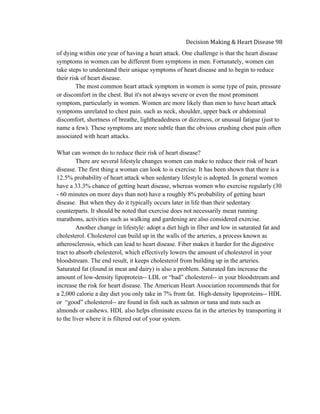
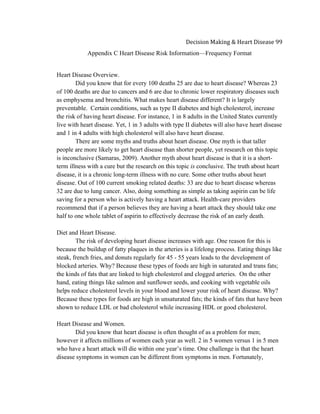
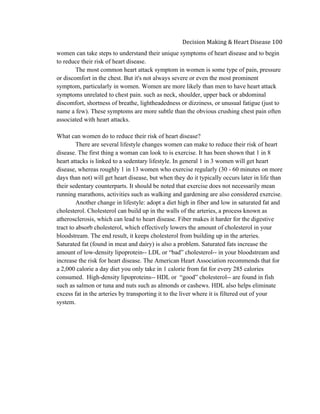
Appendix B: Heart Disease Risk Information—Probability Format................................ 97	
  
Appendix C Heart Disease Risk Information—Frequency Format.................................. 99	
  
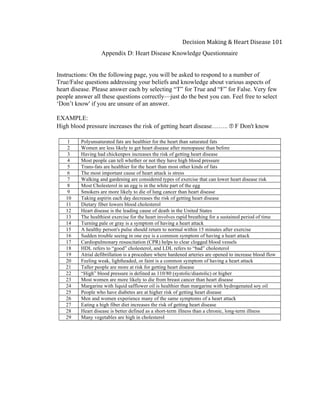
Appendix D: Heart Disease Knowledge Questionnaire.................................................. 101	
  
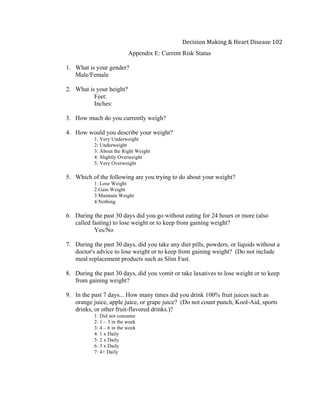
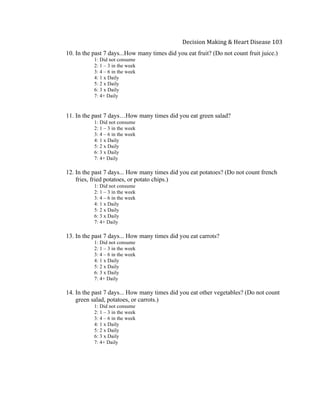
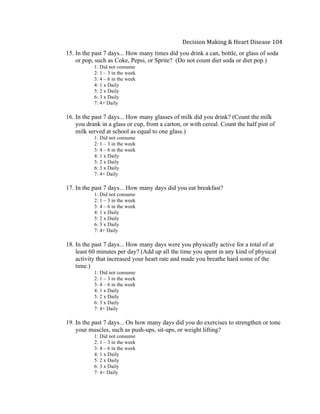
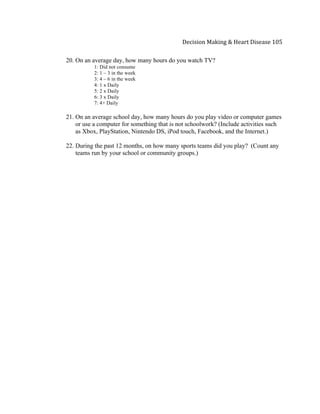
Appendix E: Current Risk Status.................................................................................... 102	
  
ii
  	
  
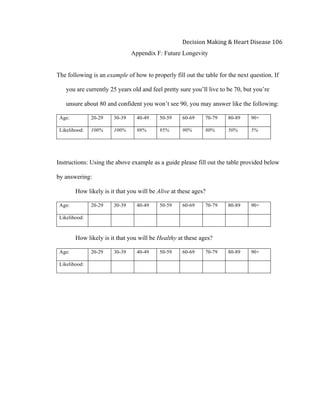
Appendix F: Future Longevity........................................................................................ 106	
  
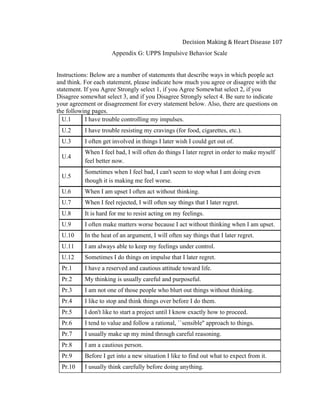
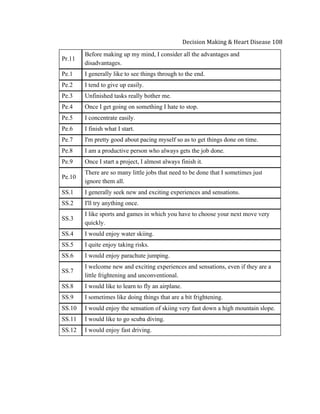
Appendix G: UPPS Impulsive Behavior Scale............................................................... 107	
  
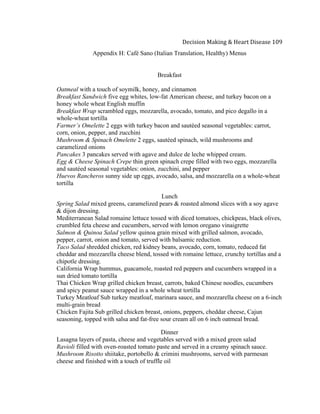
Appendix H: Café Sano (Italian Translation, Healthy) Menus....................................... 109	
  
Appendix I: Cafe Brutto (Italian Translation Bad) Menus............................................. 110	
  
Appendix J: Nutrition Facts............................................................................................ 112	
  
List of Tables and Figures
Table 1. Percentage of Adults who have had their blood cholesterol checked and were
told it was high.	
  ...............................................................................................................................	
  17	
  
Table 2. Percentage of Adults who have consumed fruits and vegetables five or more
times per day.	
  ...................................................................................................................................	
  19	
  
Table 3. Future Lifespan Assessment Scale	
  ....................................................................................	
  52	
  
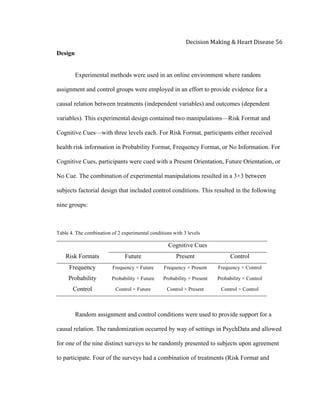
Table 4. The combination of 2 experimental conditions with 3 levels	
  ...................................	
  56	
  
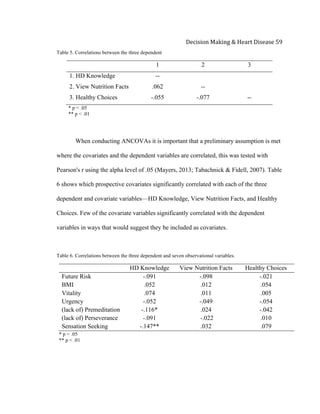
Table 5. Correlations between the three dependent	
  ......................................................................	
  59	
  
Table 6. Correlations between the three dependent and seven observational variables.	
  ..	
  59	
  
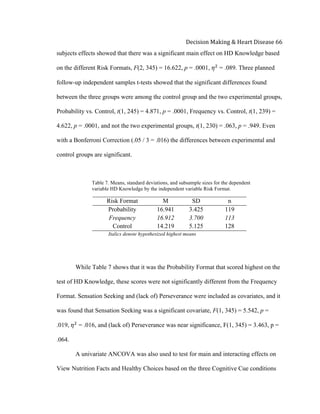
Table 7. Means, standard deviations, and subsample sizes for the dependent variable HD
Knowledge by the independent variable Risk Format.	
  ......................................................	
  66	
  
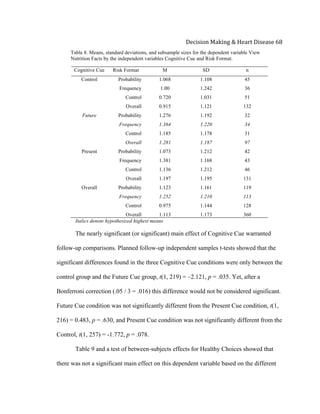
Table 8. Means, standard deviations, and subsample sizes for the dependent variable
View Nutrition Facts by the independent variables Cognitive Cue and Risk Format.
	
  ...............................................................................................................................................................	
  68	
  
Table 9. Means, standard deviations, and subsample sizes for the dependent variable
Healthy Choices by the independent variables Cognitive Cue and Risk Format.	
  .....	
  69	
  
Table 10. Percent of participants reporting HD Rates from the Heart Disease Risk
information by the two experimental conditions.	
  ................................................................	
  70	
  
Table 11. Cross tabulation of the variables View Nutrition Facts by Cognitive Cues.	
  .....	
  71	
  
Table 12. Cross tabulation of the variables Healthy Choics by Cognitive Cues.	
  ................	
  71	
  
Table 13. Percent of participants that mentioned “Heart” and/or “Cholesterol” in the two
Cognitive Cue experimental conditions	
  ..................................................................................	
  73	


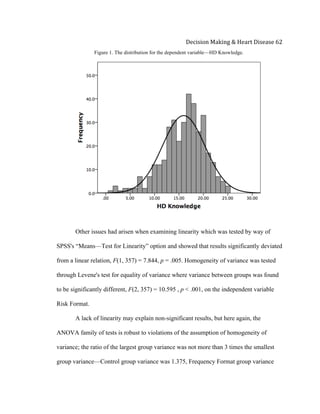
Figure 1. The distribution for the dependent variable—HD Knowledge.	
   62	
  
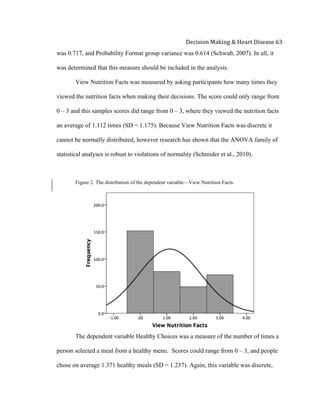
Figure 2. The distribution of the dependent variable—View Nutrition Facts.	
   63	
  
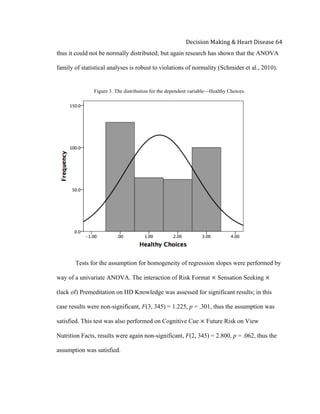
Figure 3. The distribution for the dependent variable—Healthy Choices.	
   64	
  
iii
 
Decision	
  Making	
  &	
  Heart	
  Disease	
  1	
  
Abstract
Heart disease is the leading cause of death in all industrialized countries, and the
treatments for it are not as effective as prevention (WHO, 2014; Roger, et al., 2011).
Prevention means people need to change their behaviors, not when they are cued by their
doctor that their cholesterol is high, but before they get high cholesterol. Even though
people now have access to a wealth of health risk information, they still seem to believe
“it won't happen to me” (Weinstein, 1980).
Risks are hard to understand, and many people are left subjectively perceiving
them (Gigerenzer, Gaissmaier, Kurz-Milcke, Schwartz, & Woloshin, 2009; Loewenstein,
Weber, Hsee, & Welch, 2001). Research has shown that different risk formats are easier
to understand, and that different cues can reduce future discounting, but these two ideas
have not yet been tied together (Gigerenzer, et al., 2009; Weber, et al., 2007). This
dissertation explored these combined effects. It looked at the extent to which both the
format of health risk information and cues before decisions could influence knowledge
and behavior in an effort to get people to change their behaviors sooner rather than later.
Specifically, the goal was to show that college students, between the ages of 18
and 20, could better understand their risks of heart disease, be persuaded to read nutrition
information before they made a meal choice, and make better meal choices in the end. To
accomplish this, a 3 x 3 between subjects factorial design was used and analyses tested
the separate and combined effects of increasing the readability of health risk information
with cuing people to think about what they eat before making that decision.
ANOVA/ANCOVA results revealed that heart disease information was associated
with a better understanding of heart disease and that cuing was associated with reading
nutrition facts more. While heart disease risk information was recalled when cued to do
so, neither this information nor the cuing had an impact on actual meal choices. In all, the
findings from this research were not overwhelmingly supportive of the hypotheses but
were instead supportive of follow-up research.
Dissertation Advisor: __________________________________
Dr. Holly Straub
 
Decision	
  Making	
  &	
  Heart	
  Disease	
  2	
  
Introduction
Decision-making is a cognitive process that results in a preference for a course of
action among alternatives. Of interest here are three components of this definition—
cognitive process, course of action, and among alternatives. This dissertation will explore
in detail each of these three components of decision making within the broader context of
heart disease. First, the “course of action” here is preventative health behaviors. Second,
“among alternatives” stands to imply risk, in this case the risk in a chosen course of
action. Third, the “cognitive processes” of interest are the ways in which people devalue
the preventative health behaviors, misunderstand the risks of doing so, and discount the
future consequences of their current preferences.
Risk, probability, and uncertainty are all common terms for the same idea—
unknown outcomes among alternatives. If we know that the lifetime risk of getting heart
disease is 0.33, we know something about this outcome. Yet, people demonstrate a
preference for certainty; decision-making research has revealed that people have an
aversion to uncertainty and undervalue central probabilities (Kahneman, 2003). In other
words, we prefer known outcomes, avoid unknown outcomes, and care little about
common outcomes. Computation and comprehension of probabilities are cognitively
laborious tasks for people; we are poor judges of them (Hoffrage, Lindsey, Hertwig, &
Gigerenzer, 2000). We simultaneously avoid, devalue, and misunderstand risks. We are
left with our own subjective perceptions of risks; we feel risks (Loewenstein, Weber,
Hsee, & Welch, 2001; Tversky & Kahneman, 1984; Weinstein, 1984). But, when risks
are presented as frequencies, it can help people to better understand them (Gigerenzer, et
al., 2009).
 
Decision	
  Making	
  &	
  Heart	
  Disease	
  3	
  
Cognitive decision-making research rarely addresses the subjective perceptions of
heart disease risks. In the instances where heart disease related decisions have been
addressed, the focus has been on courses of action such as adherence to blood pressure
and cholesterol medications, rather than on preventative actions such as regular exercise
and a healthy diet (Chapman et al., 2001). Preventative health behaviors specific to heart
disease are not often studied directly, but risk factors for heart disease, such as smoking,
exercise, and being overweight, have been studied and are found to be associated with
time discounting—caring more about the present in spite of future consequences (Fuchs,
1982). Meanwhile, one process level account of decision-making, query theory, has
addressed time discounting, but not in the context of preventative health choices.
Other preventative health decisions such as getting a flu shot or a mammogram
have been well researched (Chapman & Coups, 1999; Chapman et al., 2001; Gigerenzer,
et al., 2008). But, these preventative behaviors are very different from the preventive
health behaviors associated with heart disease. A flu shot is a once per year choice that
decreases the likelihood of certain flu strains that year. Mammograms are a once every
few years choice that do not decrease the risk of getting breast cancer; instead they
increase the likelihood of early detection and false positive test results. Heart disease
preventative behaviors are multiple choices made daily that could eventually decrease the
likelihood of illness in the distant future.
It is widely accepted by medical professionals that the roots of heart disease lie in
a person’s preference for a course of action, or in this case a lack of action. If heart
disease risks were clearly and objectively understood would we see an increase in people
with no known risk factors? Alternatively, do people with no known risk factors better
 
Decision	
  Making	
  &	
  Heart	
  Disease	
  4	
  
understand their risks of heart disease? It will be suggested here that heart disease has
become a large problem because at the time that it is developing people are devaluing the
risks, and people are devaluing the risks because they do not understand them. It will also
be suggested that in order to prevent heart disease people need to be cognizant of their
choices in activity and diet beginning in their early 20's, before the risks have bear a
tangible value. But first, it is important to know what heart disease is, how it occurs,
when it occurs, and who should be concerned. For that reason a brief medical and
epidemiological introduction to heart disease will be presented before going into the
problems with public campaigns against heart disease and theories in psychology that
could offer solutions.
Heart Disease
Heart disease has been the leading cause of death in the U.S. since 1921, where
roughly one in four people will die of heart disease (Ford & Capewell, 2007; CDC, n.d.).
The rates of heart disease fatalities are high, and while these rates have been on the
decline since the late 1960’s, they are projected to increase again soon (Schiller, et al.,
2012). Currently, 11.8% of the U.S. population actively lives with heart disease
(Schiller, et al., 2012). Coronary heart disease (the most common type of heart disease)
costs the U.S. $108.9 billion each year in health care services, medications, and most
importantly—lost productivity (CDC, 2014). In sum, peoples’ health in the US is poor, it
is costing billions of dollars each year, and this problem is projected to get worse.
This introduction to heart disease will cover its definition, methods for treatment,
prevalence, and public campaigns, primarily for the purpose of explicating the fact that
 
Decision	
  Making	
  &	
  Heart	
  Disease	
  5	
  
prevention is ideal. In doing so, the following problems with heart disease will also be
made clear: (a) the projected future for heart disease is worse than the present state; (b)
neither treatment nor early detection is as effective as prevention; (c) public campaigns
aimed at decreasing heart disease rates are misdirected.
Heart disease defined.
Heart disease is a colloquial term used in the media, but is rarely used in medical
research. Oftentimes medical journals will refer to it more specifically as coronary heart
disease or cardiovascular disease. In fact, there are many lay terms that replace medical
terminology. For instance, coronary artery bypass grafting (CABG: pronounced cabbage)
is open-heart surgery and non ST-elevated myocardial infarction (NSTEMI) is a heart
attack.
The more common conditions that fall under the umbrella term Heart Disease
include atherosclerosis, arrhythmia, high blood pressure, heart failure, and heart attack.
Realistically, there are numerous other conditions that can be classified as heart disease,
but an exhaustive list is not necessary to adequately describe the problems with it. Three
sources contained a high level of consistency in their definitions of heart disease and its
associated risk factors: The American Heart Association (AHA), The Mayo Clinic, and
the U.S. National Library of Medicine (PubMed). Regarding this heart disease
introduction, information from these three sources was used (unless otherwise specified).
Atherosclerosis is a common condition associated with heart disease; it is
characterized by plaque build-up in the arteries that leads to arterial fibrosis and
calcification (i.e. a hardening of the arteries). This calcification develops over a long
 
Decision	
  Making	
  &	
  Heart	
  Disease	
  6	
  
period of time, sometimes beginning in childhood, yet problems do not become evident
until mid to late adulthood (Kavey et al., 2003; Sillesen & Falk, 2011). One study found
the precursors for and/or early stages of atherosclerosis in men as young as 15 – 19 years
of age and women as young as 30 – 34 years of age (McGill, et al., 2000). There are other
common heart disease conditions that are related to atherosclerosis and include the
following:
• Arrhythmia, which is any change from the normal sequence of heartbeat:
too fast, too slow, early, fluttering, or quivering.
• High blood pressure, which is when the force of blood against the arterial
walls is too high.
• Heart failure, is said to occur when the heart muscle can no-longer pump
blood out of or into the heart effectively.
• Heart attacks, these are said to come about when blood clots in an artery
that damage or destroy part of the heart muscle (the heart does not
necessarily stop from a heart attack, whereas the heart does stop beating in
the case of cardiac arrest).
Treatment and early detection.
Treatments for heart disease vary greatly in their invasiveness and effectiveness.
Medical or drug therapies are used when the risk of heart attack is high (Bolookie &
Askari, 2010). As a preventative technique drug therapies have been shown to work as
well as invasive techniques (Stergiopoulos & Brown, 2012). One study found that rates
 
Decision	
  Making	
  &	
  Heart	
  Disease	
  7	
  
of death, non-fatal heart attacks, unplanned open heart surgery, and persistent angina
were not significantly different between those that received medical therapies and those
that received stent implantation (Stergiopoulos & Brown, 2012).
Simple early detection tools include electrocardiographs and blood pressure
meters, which can quickly determine if people have arrhythmia, heart failure, heart attack
and/or high blood pressure (Mayo Clinic, 2014; McManus et al., 2011; Tavakoli, Sahba,
& Hajebi, 2009). However, of the many tests for atherosclerosis, the Farmingham Risk
Score (FRS) and Coronary Artery Calcium (CAC) scan are used most often, but these
tests are lacking in accuracy. Approximately 40% - 60% of the first signs of
atherosclerosis come in the form of a heart attack (Gibbons et al., 2008). Practicing
cardiologists are the biggest proponents for CAC scans, yet the American Heart
Association has been reluctant to recommend wide spread use of CAC scans as there is
limited support for improved patient outcomes and decreased future medical costs
(Hecht, 2008; Roger et al., 2012; Schlendorf, Nasir, & Blumenthal, 2009; Shah, 2010;
Sillesen & Falk, 2011).
When the initial lifetime risk of heart disease is low, or there are no major risk
factors throughout life, it tends to stay that way across time (Greenland & Lloyd-Jones,
2007; McGill, McMahan, & Gidding, 2008). Physical activity has been found to improve
functioning; it is linked to decreased blood pressure, decreased risk of diabetes, increased
weight loss, and decreased cholesterol levels (Hamman et al., 2006; Shaw, Gennat,
O’Rourke, & Del Mar, 2006; Zimmermann-Sloutskis, Warner, Zimmermann, & Martin,
2010). It has been found that more active or fit individuals tend to develop heart disease
less often and/or less severely (Myers, 2003).
 
Decision	
  Making	
  &	
  Heart	
  Disease	
  8	
  
Prevalence.
The rate of heart disease fatalities is high, but the bigger concern is those living
with it. Among 34 developed countries, the U.S. ranking for life expectancy at birth has
recently dropped from 18th
to 27th
, more importantly healthy life expectancy dropped
from 14th
to 26th
(Murray et al., 2013). This should come as no surprise considering the
following:
• 45.1% of adults have at least one of three diagnosed or undiagnosed conditions—
high blood pressure, high cholesterol, or diabetes (Fryar, Hirsch, Eberhardt, Yoon,
& Wright, 2010);
• 16.2% of adults (≥ 20 years of age) have been diagnosed with high cholesterol
(Roger, et al., 2012);
• 31% of adults (≥18 years of age) have been diagnosed with high blood pressure
(Gillespie, Kuklina, Briss, Blair, & Hong, 2011);
• 70% of the adults (≥18 years of age) diagnosed with high blood pressure are
receiving treatment for it (Gillespie, Kuklina, Briss, Blair, & Hong, 2011);
• 20.3% of young people (12 – 19 years of age) have abnormal lipid levels (CDC,
2010);
• 40% of obese young people (12 – 19 years of age) have abnormal lipid levels
(CDC, 2010).
To further this point, obesity significantly increases the likelihood of type 2
diabetes, taken together these two conditions more than doubles a person’s risk of heart
disease and 68% of the U.S. population is currently overweight or obese (CDC, 2011;
 
Decision	
  Making	
  &	
  Heart	
  Disease	
  9	
  
Fletcher et al., 2011; Hu et al., 2001; Roger et al., 2012; Wilson, D’Agostino, Sullivan,
Parise, & Kannel, 2002). Although estimates do not always agree, it has been found that
of adults ages 20 or more, 14% have been diagnosed with type 2 diabetes, and another
14% to 37% are considered pre-diabetic (CDC, 2011; Roger et al., 2012). The
Farmingham Heart Study reported a doubling in incidence of type 2 diabetes from 1971
to 2001, where most of the increase in cases occurred in those individuals with a body
mass index indicative of obesity (Fox et al., 2006). More recent data showed that in the
1980’s the crude average diagnosed cases of type 2 diabetes was 2.6% of the US
population, this rose to 3.23% in the 1990’s, another increase to 5.47% in the 2000’s, and
between 2010 and 2014 the average percent of people diagnosed with type 2 diabetes
rose to 7% (CDC, 2015a).
While some risk factors for heart disease are unavoidable (age, gender, and family
history) the health care community seems to agree that heart disease is primarily due to
personal behaviors such as physical inactivity, poor diet, smoking, excessive alcohol
consumption, and high levels of stress (Mayo Clinic, 2014). For instance, exercise has
many know benefits, but one study found that 33% of adults reported no engagement in
this personal behavior (i.e. they participated in no leisure-time aerobic activity that lasted
at least 10 minutes per week; Schiller et al., 2012). While this rate may not seem high, it
should be noted that there is a general inclination for people to over report physical
activity; research has shown that men tend to report 44% greater physical activity, and
women tend to report 138% greater physical activity (Prince et al., 2008). It has also been
found that physical activity consistently declines with age, more so for women than men
(Schiller et al., 2012; Zimmermann-Sloutskis et al., 2010).
 
Decision	
  Making	
  &	
  Heart	
  Disease	
  10	
  
Of greater concern, even fewer U.S. adults eat a healthy diet — while fruit and
vegetable consumption has increased since the 1970's so has the consumption of added
sugars by 19% (Wells & Buzby, 2008). Research on spending patterns has shown that
U.S. households are out-of-step with USDA food recommendation, where fruits and
vegetables are still being consumed at a fraction of the rate they should, but cheese,
refined grains, red meat, and frozen entrees are consumed more often than recommended
(Wells & Buzby, 2008).
The research presented above suggests that the prevalence of heart disease is high
and costly, also that treatment and early detection of heart disease is not as effective as
prevention. Public and government agencies such as the USDA and CDC have been
reporting on heart disease. Organizations such as the American Heart Association (AHA)
have been campaigning against heart disease, and seek to engage specific populations
such as with their Go Red for Woman campaign. Also, First Lady Michelle Obama
brought personal health into popular culture with her Let's Move campaign that was
primarily directed at children. Finally, there is widespread popularity for company health
programs, further evidence that more incentive is necessary to effectively decrease the
prevalence of unhealthy lifestyles.
There are problems with these efforts, they are not working; the rates of
overweight and obesity are increasing. Reporting on the increasing problem of heart
disease does not appear to be causing alarm. Efforts directed at decreasing childhood
obesity and indirectly decreasing future cases of heart disease suffer due to the fact that
children rarely have a voice regarding what is prepared for dinner. Lastly, efforts directed
 
Decision	
  Making	
  &	
  Heart	
  Disease	
  11	
  
at adults could be too little, too late—heart disease starts showing up in early adulthood
(20’s for men, 30’s for women; McGill, et al., 2000).
Public and Corporate Health Campaigns
There is more to the problem of public and corporate health efforts. This can be
seen in the contrasting the two main approaches to public health campaigns: downstream
approaches or upstream approaches. Efforts can either be directed towards helping those
people that have drifted downstream, and are really drowning, or preventing people from
getting in the stream altogether. The downstream approach would hold the individual
accountable, whereas the upstream approach would focus on the environment. Evidence
has already been presented to suggest that treating those that already have heart disease
(save those downstream that are drowning) is less effective, and could limit resources for
more effective prevention efforts (the events causing people to fall into the river in the
first place).
Many of the common risk factors for heart disease are starting to show up in
children and young-adults (Roger et al., 2012). The rate of heart disease has increased
from 13% in the 1960’s, to 30% in 2000, and it is believed to rise to 40% by 2030
(Heidenreich et al., 2011; Schiller et al., 2012; Wang & Beydoun, 2007). If we can see a
wave of people headed downstream why should we wait for them to begin drowning
before help is offered?	
  A food choice environment could provide people with knowledge
of their risks of heart disease in an effort to decrease the volume of people drowning; it
could support healthy food choices by making health-damaging choices more difficult to
make and health-promoting choices easier to make (Dorfman & Wallack, 2007).
 
Decision	
  Making	
  &	
  Heart	
  Disease	
  12	
  
The downstream approach with heart disease focuses on personal responsibility,
poor character, and willpower; it orients peoples’ thinking towards weight loss, often for
appearance purposes (Dorfman & Wallack, 2007). In the case of obesity this can lead
people to adopt “10 pounds in 10 days” weight loss diets rather than investing in whole-
health lifestyle changes that include a nutritious diet (Cohen, Perales, & Steadman, 2005).
Nonetheless, a recent poll of major corporations found that 80 percent currently offer or
plan to offer monetary rewards to employees that participate in health initiatives such as
adopting a wellness plan or having their cholesterol tested; conversely, companies also
report plans to penalize those non-participants with consequences such as higher
insurance premiums (Toland, 2012).
This downstream approach does appear lucrative; Johnson & Johnson has
championed their workplace wellness program since 1970, and report that this has saved
the company $250 million in health care costs during the past decade (Berry, Mirabito, &
Baun, 2010). Many of these programs focus on weight loss, gloss over other health risk
factors, and poor general health; they are typically one size-fits-all wellness programs
purchased from outside consultants (Tu & Mayrell, 2010). But, the problem with this
preventative approach is that workplace health promotion programs are not universally
accepted by employees (Tu & Mayrell, 2010; Zoller, 2004).
Upstream approaches, which focus on nutrition, create environments that support
healthy food choices. A newer trend in the field of cognitive decision making—
behavioral economics—made popular by the book NUDGE, provides recommendations
and supporting evidence for how to guide peoples’ choices and produce measurable
 
Decision	
  Making	
  &	
  Heart	
  Disease	
  13	
  
differences in outcomes (Thaler, Sunstein, & Balz, 2013). In other words, the upstream
approach is possible.
Heart disease, and its associated conditions, is not typically present in people with
no known risk factors—low blood pressure, normal cholesterol level, normal weight, lack
of type 2 diabetes, regular physical activity and a diet low in saturated fats and sodium. It
is widely accepted that heart disease’s roots lie in personal behavior/choice but it is
dangerous to suggest that the individual is solely to blame. It is not necessarily their fault
that they are drowning. Prevention is the solution; it has the potential to save billions of
dollars, but the “right” approach requires tailored programs for a variety of demographics
of people.
Health Risk Information for the Public
The preventative efforts of organizations like the American Heart Association
include providing people with information about the risks of heart disease. In general,
patient education materials are notorious for having poor readability, despite the
existence of objective measures of readability (Anderson, 2012). If health information
were more clearly presented to people, perhaps they would be less apt to engage in
unhealthy behaviors—perhaps. If heart disease risks were clearly and objectively
understood would people avoid unhealthy foods and sedentary activities? Creating better
health risk information is an upstream approach; there is a chance that it could improve
peoples' wellbeing.
Health information can be written in ways that are easier to read; improving the
readability of health information is important, but improving the recall of this information
 
Decision	
  Making	
  &	
  Heart	
  Disease	
  14	
  
is even more important for people’s health (Marrow, et al., 2005). Likewise, health risk
information can be computed in ways that allow people to arrive at the right conclusions.
Transparency in health risk information could mean the difference between a person
feeling like it will or will not happen to them and knowing or not knowing their chances
of a heart attack.
Readability is not simply a matter of writing things better. Ambiguousness,
intelligibility, semantics, grammar, the ratio of words per sentence to syllables per
word—these all factor into the readability of a given text (Proctor & Van Zandt, 2008).
Readability can start with a simple test, for instance, a quick select/copy/paste of this
section tells us that it has a Flesch Reading Ease score of 65.4 and is written at an average
grade level of 7.6; whereas “the cat ate the mouse” earns a reading ease score of 117.2
and an average grade level of 0.7.
The Flesch reading ease formula rates text on a continuous scale where the higher
the score the easier it is to understand; for this readability score, average length of
sentence and average number of syllables per word are included in the calculation
(Kincaid, Fishburne, Rogers, & Chissom, 1975). The Flesch-Kincaid grade level test
offers a different objective way to assess the readability of text; it too examines sentence
length and number of syllables but the score suggests at what grade level a body of text
will be readable to all. For instance, a score of 8.0 means that an 8th
grader should
understand the text, this is also the score at which most newspapers are written. Yet
patient education materials are often found to be written at an average level of 10.2, too
high for the average consumer to read (Falconer, Reicherter, Billek-Sawhney, & Chesbro,
2011; Gal & Prigat, 2005; Wallace & Lennon, 2004).
 
Decision	
  Making	
  &	
  Heart	
  Disease	
  15	
  
It has been suggested that in order to improve readability writers need to decrease
ambiguity, and using words with unfamiliar meanings and structuring sentences in
complex ways can confuse readers (Proctor & Van Zandt, 2008). For example, the
sentence “Colorless green ideas sleep furiously” famously coined by Noam Chompsky in
1957 demonstrates how a collection of words grouped in proper syntax is not necessarily
logical. Further, the use of words such as “myocardial infarction” versus “heart attack”
could leave a reader feeling unsure or confident in their understanding of the exact topic.
Presenting written materials in a way that is consistent with a reader's mental
representation of information can facilitate the consolidation of this new information
(Proctor & Van Zandt, 2008).
It is assumed that pamphlets, brochures, and webpages containing health
information are designed to either inform or raise awareness; in either case later recall
and application seem essential. But, recall is known to be inhibited by existing schemes
(e.g. people like me do not have heart attacks; Roediger & Marsh, 2003), biases (e.g. I am
in control, I will not let that happen to me; Schacter, 1999), and environmental or
contextual conditions (e.g. it just tastes better; Loftus & Palmer, 1974). To override these
schemes, biases, and environmental cues health information needs to be easily digestible
by the average person, and research on the presentation of health statistics has shown that
there is a way to present health information that is easier for people to understand
(Gigerenzer, Gaissmaier, Kurz-Milcke, Schwartz, & Woloshin, 2008; Gigerenzer,
Hoffrage, & Kleinbolting, 1991; Slovic, Monahan, & MacGregor, 2000; Tan et al.,
2005). This point will be explored in greater detail later, before doing so it is important to
make clear how health statistics are computed.
 
Decision	
  Making	
  &	
  Heart	
  Disease	
  16	
  
Computing probabilities.
Effective health information would direct cognitive resources toward the act of
learning (recall and application) about one’s health; we know this from research on
cognitive load (Chandler & Sweller, 1991). While not the focus of this paper, it is easy to
see how Cognitive Load Theory applies here; information overload makes the act of
learning more difficult (Sweller, 1994). But health statistics can be presented in one of
two ways, relative or absolute, and there are benefits and problems with both. Relative
risk, for example, serves well to raise alarm, but can mislead a layperson to believe that
there is an autism epidemic (Gernsbacher, Dawson, & Goldsmith, 2005; Gigerenzer et
al., 2008; Spitalnic, 2005). Whereas absolute risk offers an accuracy or honesty to the
health risks, but is not always alarming enough to sway public opinion. These two
methods for computing risk, relative and absolute, will be further explored using
publically accessible prevalence and trends data from the CDC’s Behavioral Risk Factor
Surveillance System that is specific to heart disease risk factors in South Dakota (CDC,
2012).
Relative risk.
People might not understand how relative risk is computed; this could be why
statements such as, “the risk of death is decreased by nearly 67%.” can be so impactful.
When presented with findings in a relative risk format, people tend to endorse these
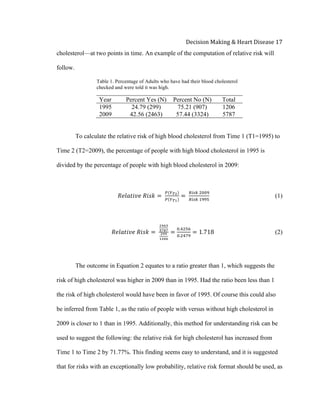
findings (Sarfati, Howden-Chapman, Woodward, & Salmond, 1998). The data in Table 1
shows base rate information for a common risk factor for heart disease—high
 
Decision	
  Making	
  &	
  Heart	
  Disease	
  17	
  
cholesterol—at two points in time. An example of the computation of relative risk will
follow.
Table 1. Percentage of Adults who have had their blood cholesterol
checked and were told it was high.
Year Percent Yes (N) Percent No (N) Total
1995 24.79 (299) 75.21 (907) 1206
2009 42.56 (2463) 57.44 (3324) 5787
To calculate the relative risk of high blood cholesterol from Time 1 (T1=1995) to
Time 2 (T2=2009), the percentage of people with high blood cholesterol in 1995 is
divided by the percentage of people with high blood cholesterol in 2009:
𝑅𝑒𝑙𝑎𝑡𝑖𝑣𝑒  𝑅𝑖𝑠𝑘 =  
!(!!!)
! !!!
=  
!"#$  !""#
!"#$  !""#
(1)
𝑅𝑒𝑙𝑎𝑡𝑖𝑣𝑒  𝑅𝑖𝑠𝑘 =  
!"#$
!"#"
!""
!"#$
=
!.!"#$
!.!"#$
= 1.718 (2)
The outcome in Equation 2 equates to a ratio greater than 1, which suggests the
risk of high cholesterol was higher in 2009 than in 1995. Had the ratio been less than 1
the risk of high cholesterol would have been in favor of 1995. Of course this could also
be inferred from Table 1, as the ratio of people with versus without high cholesterol in
2009 is closer to 1 than in 1995. Additionally, this method for understanding risk can be
used to suggest the following: the relative risk for high cholesterol has increased from
Time 1 to Time 2 by 71.77%. This finding seems easy to understand, and it is suggested
that for risks with an exceptionally low probability, relative risk format should be used, as
 
Decision	
  Making	
  &	
  Heart	
  Disease	
  18	
  
it will lead to an increase in risk avoidant behaviors (Stone, Yates, & Parker, 1994).
People will go to great lengths to eliminate a small risk, a good example of this can be
found with asbestos, more on this later (Rabin & Thaler, 2001).
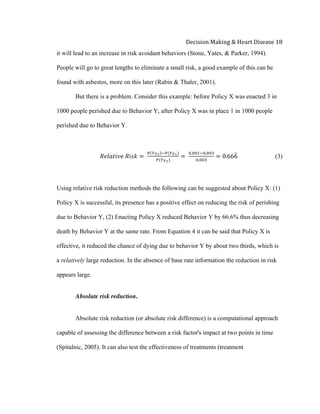
But there is a problem. Consider this example: before Policy X was enacted 3 in
1000 people perished due to Behavior Y, after Policy X was in place 1 in 1000 people
perished due to Behavior Y.
𝑅𝑒𝑙𝑎𝑡𝑖𝑣𝑒  𝑅𝑖𝑠𝑘 =  
! !!! !!(!!!)
!(!!!)
=  
!.!!"!!.!!"
!.!!"
= 0.666 (3)
Using relative risk reduction methods the following can be suggested about Policy X: (1)
Policy X is successful, its presence has a positive effect on reducing the risk of perishing
due to Behavior Y, (2) Enacting Policy X reduced Behavior Y by 66.6% thus decreasing
death by Behavior Y at the same rate. From Equation 4 it can be said that Policy X is
effective, it reduced the chance of dying due to behavior Y by about two thirds, which is
a relatively large reduction. In the absence of base rate information the reduction in risk
appears large.
Absolute risk reduction.
Absolute risk reduction (or absolute risk difference) is a computational approach
capable of assessing the difference between a risk factor's impact at two points in time
(Spitalnic, 2005). It can also test the effectiveness of treatments (treatment
 
Decision	
  Making	
  &	
  Heart	
  Disease	
  19	
  
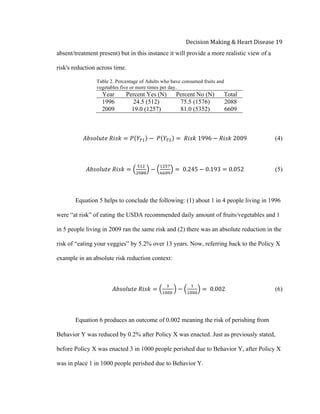
absent/treatment present) but in this instance it will provide a more realistic view of a
risk's reduction across time.
Table 2. Percentage of Adults who have consumed fruits and
vegetables five or more times per day.
Year Percent Yes (N) Percent No (N) Total
1996 24.5 (512) 75.5 (1576) 2088
2009 19.0 (1257) 81.0 (5352) 6609
𝐴𝑏𝑠𝑜𝑙𝑢𝑡𝑒  𝑅𝑖𝑠𝑘 = 𝑃 𝑌!! −   𝑃 𝑌!! =   𝑅𝑖𝑠𝑘  1996 − 𝑅𝑖𝑠𝑘  2009 (4)
𝐴𝑏𝑠𝑜𝑙𝑢𝑡𝑒  𝑅𝑖𝑠𝑘 =
!"#
!"##
−
!"#$
!!"#
=   0.245 − 0.193 = 0.052   (5)
Equation 5 helps to conclude the following: (1) about 1 in 4 people living in 1996
were “at risk” of eating the USDA recommended daily amount of fruits/vegetables and 1
in 5 people living in 2009 ran the same risk and (2) there was an absolute reduction in the
risk of “eating your veggies” by 5.2% over 13 years. Now, referring back to the Policy X
example in an absolute risk reduction context:
𝐴𝑏𝑠𝑜𝑙𝑢𝑡𝑒  𝑅𝑖𝑠𝑘 =
!
!!!!  
−
!
!"""
=   0.002   (6)
Equation 6 produces an outcome of 0.002 meaning the risk of perishing from
Behavior Y was reduced by 0.2% after Policy X was enacted. Just as previously stated,
before Policy X was enacted 3 in 1000 people perished due to Behavior Y, after Policy X
was in place 1 in 1000 people perished due to Behavior Y.
 
Decision	
  Making	
  &	
  Heart	
  Disease	
  20	
  
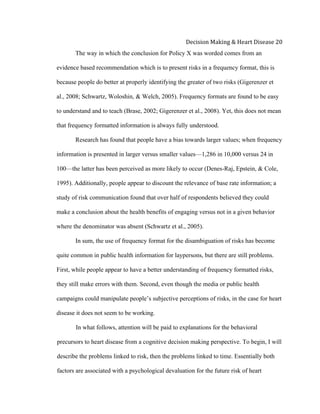
The way in which the conclusion for Policy X was worded comes from an
evidence based recommendation which is to present risks in a frequency format, this is
because people do better at properly identifying the greater of two risks (Gigerenzer et
al., 2008; Schwartz, Woloshin, & Welch, 2005). Frequency formats are found to be easy
to understand and to teach (Brase, 2002; Gigerenzer et al., 2008). Yet, this does not mean
that frequency formatted information is always fully understood.
Research has found that people have a bias towards larger values; when frequency
information is presented in larger versus smaller values—1,286 in 10,000 versus 24 in
100—the latter has been perceived as more likely to occur (Denes-Raj, Epstein, & Cole,
1995). Additionally, people appear to discount the relevance of base rate information; a
study of risk communication found that over half of respondents believed they could
make a conclusion about the health benefits of engaging versus not in a given behavior
where the denominator was absent (Schwartz et al., 2005).
In sum, the use of frequency format for the disambiguation of risks has become
quite common in public health information for laypersons, but there are still problems.
First, while people appear to have a better understanding of frequency formatted risks,
they still make errors with them. Second, even though the media or public health
campaigns could manipulate people’s subjective perceptions of risks, in the case for heart
disease it does not seem to be working.
In what follows, attention will be paid to explanations for the behavioral
precursors to heart disease from a cognitive decision making perspective. To begin, I will
describe the problems linked to risk, then the problems linked to time. Essentially both
factors are associated with a psychological devaluation for the future risk of heart
 
Decision	
  Making	
  &	
  Heart	
  Disease	
  21	
  
disease. Yet, the rationale behind the discounting effects differ greatly. After a review of
the research on discounting, attention will then be paid to proposing cognitive strategies
aimed at preventative efforts for university populations.
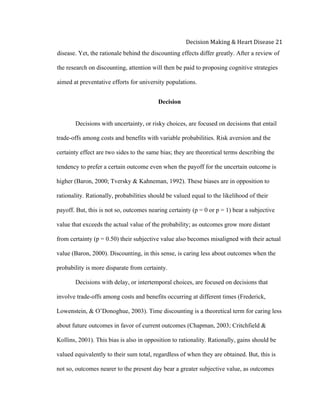
Decision
Decisions with uncertainty, or risky choices, are focused on decisions that entail
trade-offs among costs and benefits with variable probabilities. Risk aversion and the
certainty effect are two sides to the same bias; they are theoretical terms describing the
tendency to prefer a certain outcome even when the payoff for the uncertain outcome is
higher (Baron, 2000; Tversky & Kahneman, 1992). These biases are in opposition to
rationality. Rationally, probabilities should be valued equal to the likelihood of their
payoff. But, this is not so, outcomes nearing certainty (p = 0 or p = 1) bear a subjective
value that exceeds the actual value of the probability; as outcomes grow more distant
from certainty (p = 0.50) their subjective value also becomes misaligned with their actual
value (Baron, 2000). Discounting, in this sense, is caring less about outcomes when the
probability is more disparate from certainty.
Decisions with delay, or intertemporal choices, are focused on decisions that
involve trade-offs among costs and benefits occurring at different times (Frederick,
Lowenstein, & O’Donoghue, 2003). Time discounting is a theoretical term for caring less
about future outcomes in favor of current outcomes (Chapman, 2003; Critchfield &
Kollins, 2001). This bias is also in opposition to rationality. Rationally, gains should be
valued equivalently to their sum total, regardless of when they are obtained. But, this is
not so, outcomes nearer to the present day bear a greater subjective value, as outcomes
 
Decision	
  Making	
  &	
  Heart	
  Disease	
  22	
  
grow more distant from the present; their subjective value also decreases (Frederick,
Lowenstein, & O’Donoghue, 2003). Time discounting, in this sense, is caring less about
future outcomes and more about present outcomes.
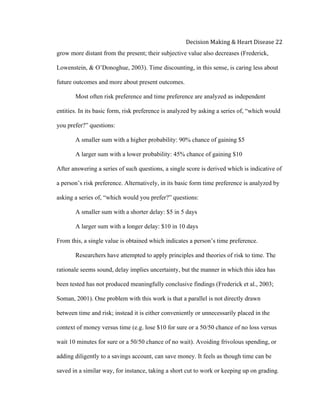
Most often risk preference and time preference are analyzed as independent
entities. In its basic form, risk preference is analyzed by asking a series of, “which would
you prefer?” questions:
A smaller sum with a higher probability: 90% chance of gaining $5
A larger sum with a lower probability: 45% chance of gaining $10
After answering a series of such questions, a single score is derived which is indicative of
a person’s risk preference. Alternatively, in its basic form time preference is analyzed by
asking a series of, “which would you prefer?” questions:
A smaller sum with a shorter delay: $5 in 5 days
A larger sum with a longer delay: $10 in 10 days
From this, a single value is obtained which indicates a person’s time preference.
Researchers have attempted to apply principles and theories of risk to time. The
rationale seems sound, delay implies uncertainty, but the manner in which this idea has
been tested has not produced meaningfully conclusive findings (Frederick et al., 2003;
Soman, 2001). One problem with this work is that a parallel is not directly drawn
between time and risk; instead it is either conveniently or unnecessarily placed in the
context of money versus time (e.g. lose $10 for sure or a 50/50 chance of no loss versus
wait 10 minutes for sure or a 50/50 chance of no wait). Avoiding frivolous spending, or
adding diligently to a savings account, can save money. It feels as though time can be
saved in a similar way, for instance, taking a short cut to work or keeping up on grading.
 
Decision	
  Making	
  &	
  Heart	
  Disease	
  23	
  
This feeling is irrational—time can never be saved, only lost. This is because each person
travels along a personal time continuum (i.e. their life span) with no way of stock piling
amounts of time. Also, the end point is unknown; no one is certain of when they will die.
This would suggest that time cannot be compared to money, but it can be compared to
uncertainty.
There are elements of both risk and delay with health behaviors and heart disease.
Healthy behaviors adopted early in one's lifespan and maintained throughout adulthood,
such as regularly exercising or sticking with a 2,000-calorie diet, lead to a decreased risk
of heart disease. Unhealthy behaviors throughout one's lifespan, such as abstaining from
exercise and indulging in overeating, lead to an increased risk of heart disease. In
essence, these behaviors should either increase or decrease the certainty of what people
may have come to expect, that their personal time continuum contains a total of 78.8
units of time. In other words, people on average live 78.8 years, but when it is commonly
referred to as “life expectancy”, rather than being understood as an average, it could
become an expectation.
Uncertainty
Research on decisions with uncertainty often shows deviations from normative
theory in the way of decision biases and paradoxes. Normative theories in decision-
making are essentially prescriptive statistical models that compute what we should
choose. Many descriptive theories in decision-making use different statistical models to
show how peoples’ choices systematically deviate from what we should choose. This
 
Decision	
  Making	
  &	
  Heart	
  Disease	
  24	
  
approach ignores cognition as a process—how we choose—it also ignores the connection
between cognition and the environment.
It has been suggested that behavior is shaped by both the structure of task
environments and the computational capabilities of the actor (Gigerenzer & Goldstein,
1996; Simon, 1990). In the case of decision-making, a choice architect will shape the
structure of a decision environment, and the computational capabilities of the actor, the
decision maker, include their existing knowledge, biases and processing of information in
the environment. The information choice architects choose to provide for the decision
maker can take into account deviations from normative theory, biases, and paradoxes;
they can influence decisions via noticeable and unnoticeable features (Thaler, et al.,
2013).
Human factors, by definition, seeks to improve performance. In this context,
improving human performance on a cognitive task means creating an environment that
supports learning, retention, and retrieval (Proctor & Van Zandt, 2008). This is best
approached by taking into account cognitive processes. In doing so, normative theory or
how we should choose is irrelevant. However, how we use the information in an
environment to make a choice is relevant.
There are several findings in descriptive theory that are particularly relevant to
perceptions of health and heart disease. It will be shown that for risky choices, the
perceived subjectivity of a risk leads to a psychological devaluation of it, and an
additional devaluation occurs in when there is a delay in the outcome. After describing
the factors linked to the devaluation of the outcome heart disease, the focus will then turn
to theories best suited to offer solutions.
 
Decision	
  Making	
  &	
  Heart	
  Disease	
  25	
  
Control, valence, and value.
This section will show that because probabilistic events are difficult for people to
compute they create strategies that tend to be good enough, but these strategies can lead
to errors in decision making. It will also be made clear that instead of knowing risks,
people subjectively perceive them. The subjectivity of risk perception can involve
control, valence, and value. Control, relates to a person’s varying perception of risk based
on their choice in the matter. Valence, in this context, refers to the positive or negative
label assigned to an outcome. Value, suggests that the actual probability of an event’s
occurrence is different from the subject value of the event’s occurrence. Each of these
will be further explained in turn.
A classic study suggested that people are willing to accept greater risks when they
are voluntarily engaging in behaviors such as smoking or sky diving, versus involuntarily
subjected to risks such as natural disaster or asbestos exposure (Starr, 1969). Others
support that control is associated with a denial of risk susceptibility; when people are in
control of the behavior they underestimate the likelihood of negative outcomes, whereas
when people have no control over an event they overestimate the likelihood of negative
outcomes (Slovic, Fischhoff, & Lichtenstein, 1986; Weinstein, 1980). More recently, this
has been found in vaccination decisions; parents that fully immunize their children
believe they do not have control over exposure and feel the risk of illness is high,
whereas parents that do not immunize believe they have control over exposure and feel
the risk of illness is low (Bond & Nolan, 2011; Palfreman, 2015).
 
Decision	
  Making	
  &	
  Heart	
  Disease	
  26	
  
Risk and valence—the degree to which outcomes are viewed as positive or
negative—uncover another irrationality (Plous, 1993). Studies on why it won’t happen to
me, show that people have an unrealistic optimism for future events, they tend to believe
that they are more likely to have good things happen to them and less likely to have bad
things happen to them (Weinstein, 1984). For example, college students believe they are
more likely than their peers to receive a good starting wage and own their own home
soon after college; in contrast, they also believed themselves to be less likely to develop a
drinking problem or to have a heart attack (Weinstein, 1980). Valence finds it way into
food preferences as well; mutation bred foods are often perceived the same as genetically
modified, have a negative valence ascribed to them, and the risks associated with such
foods are overgeneralized and overestimated as simply bad for your health (Hagemann &
Scholderer, 2007).
To know that there are predictable biases in how people feel risks is a good
starting point. While control and valence provide surface descriptions that are applicable
to heart disease and food choices, these two factors do not offer a viable platform for
moving towards heart disease prevention. Knowing more about these biased perceptions
in the context of the subjective value of risks offers a deeper level of understanding.
Prospect Theory further explains decisions concerning probability and utility; it
suggests that people do not value stated probability’s values incrementally (Baron, 2000).
People are biased towards “certain” outcomes (probabilities closest to 0.0 and 1.0); there
is a tendency to view central probabilities as more equal, and the tails as more important
(Kahneman, 2003). An excellent example of this is the value people place on the
elimination of asbestos. The likelihood of undisturbed asbestos insulation becoming
 
Decision	
  Making	
  &	
  Heart	
  Disease	
  27	
  
airborne is low; nonetheless people strongly value changing that slight possibility to an
impossibility.
When probability is plotted on the x-axis and psychological value on the y-axis an
S-shaped relation exemplifies the Pi Function. This function has three key characteristics:
(1) impossibilities are discarded, (2) low probabilities are psychologically over-weighted,
and (3) moderate and high probabilities are psychologically under-weighted (Tversky &
Kahneman, 1986). The latter effect is the focus here because the Pi Function
demonstrates an important finding: many moderately probabilistic events are
underweighted or psychologically valued as less of a risk than the actual risk. Applying
the Pi Function to heart disease, it can be understood that the psychological value for the
lifetime risk of heart disease is equal to the statistical value of it (π (x) = 0.33 = p (x)).
Yet, as a person accumulates more risk factors, or increases their risk of heart disease,
one could suggest that this would hold little more value to the person than their initial risk
of heart disease (π (x) < x = p (x)). This would be explained by the Pi Functions center
where moderate probabilities are psychologically under-weighted.
The other component to Prospect Theory, utility, separates out the subjective
value of gains versus losses, according to a person’s current reference point. Typically
this value function is applied to money or other material goods and suggests that it hurts
twice as much to lose a sum as it feels good to gain a similar sum (Thaler, 1985). The
shape of this function is similar to the Pi Function yet they represent very different
concepts. The y-axis, representing psychological value, divides the x-axis into losses on
the left and gains on the right. This value function supports the commonly found risk
averse behavior in decision-making research: losses are increasingly painful, thus we
 
Decision	
  Making	
  &	
  Heart	
  Disease	
  28	
  
avoid them (Kahneman & Tversky, 1984). It also provides an explanation for risk taking
behaviors in different contexts; in general people avoid risks, but people are more willing
to take risks to avoid losses (Baron, 2000). This could help to explain why even the most
extreme treatments for heart disease are often considered viable solutions.
Prospect theory has been a dominant theory for decisions under uncertainty since
early 1980; it gained significant attention in 2002 when Daniel Kahneman won the Nobel
Memorial Prize in Economic Science. It provides evidence for decision strategies: first,
people tend to put probabilistic information into one of three simple categories,
impossible, possible, or certain; second, people view losses and gains differently
according to a reference point (Baron, 2000). Prospect theory also demonstrates that the
value of events is subjective and irrational (Kahneman & Tversky, 1984). This theory's
usefulness for description puts many behaviors into a context, especially the subjective
value of risks, but applying it to heart disease risk factors proves less useful. While
people may feel no more or less threatened by the accumulation of heart disease risk
factors, how would they feel about gains in weight or losses in cholesterol levels? Finally,
prospect theory describes decisions well, but offers little in the way of solutions.
Statistical Illiteracy and Availability
The work of Gigerenzer and colleagues, on the other hand, provides experimental
evidence for similar biases and heuristics while also providing usable solutions. Studies
have shown that people (doctors and patients alike) do not understand conditional
probabilities or draw the wrong conclusions from them, such as those encountered with
heart disease risks (Eddy, 1982; Gigerenzer et al., 2008). College students especially lack
 
Decision	
  Making	
  &	
  Heart	
  Disease	
  29	
  
knowledge of heart disease risk factors; they demonstrate a greater knowledge of
psychological disorders and sexually transmitted diseases than heart disease (Bergman,
Reeve, Moser, Scholl, & Klein, 2011; Collins, Dantico, Shearer, & Mossman, 2004).
Research has found that college students will, on average, fail a true/false quiz for heart
disease knowledge (Bergman et al., 2011). Exacerbating this problem, findings that show
that as knowledge of heart disease decreases, cardiovascular risk increases (Lambert,
Vinson, Shofer, & Brice, 2013). That is to say, college students have demonstrated that
they possess poor knowledge of heart disease, and this lack of knowledge is associated
with an increased risk of future cardiovascular health problems.
Gigerenzer (et al., 2008) suggested that statistical literacy is a necessary
precondition in today’s technological atmosphere. With online health information readily
available, peoples’ notion of risk factors can easily be skewed and they can fall victim to
the availability heuristic. For example, contrasting the number of deaths due to heart
disease (611,105) versus cancer (584,881) in 2014 with the number of stories in the new
about heart disease (8,540,000) versus cancer (94,200,000) helps to explain why heart
disease may not seem as problematic. Additionally, college students are not looking for
information on heart disease; instead they tend to search for information regarding
illness/conditions, mental health, weight loss, exercise, and nutrition (Banas, 2008).
When knowledge of these health issues is greater and a majority of the health information
directed at college students is consistent with this knowledge, they could be more likely
to over estimate their risks due to the ease with which they can recall information
pertaining to it.
 
Decision	
  Making	
  &	
  Heart	
  Disease	
  30	
  
Basic competence in statistics does not require a college degree; statistical literacy
implies that people are capable of recognizing that survival rates can vary based on many
personal factors (Gigerenzer et al., 2008). Another way to mislead, especially those who
lack statistical literacy, is to omit base rates for risks and study limitations, and frame
risks in sensationalized ways; as is often the case with the popular press (Gigerenzer et
al., 2008). For instance, a Newsweek article—The new obesity campaigns have it all
wrong—provided no rates to support the claim that exercise is an ineffective method for
weight loss, that the calorie/energy balance does not work, or that the USDA food guide
serves to fatten us up and increase our risk of heart disease (Taubes, 2012). However,
minimal and non-transparent statistical information was provided for the authors
proposed solution: no exercise and an Atkin’s style diet (a diet high in meat, eggs, and
cheese, and low in fruits, vegetables, and grains).
The problems with risk and uncertainty in personal health can be summed up in
three ways: people do not understand probability, the media easily misleads people, and
people feel their personal risks are low (Broadbent et al., 2006; Gigerenzer et al., 2008;
Kahneman & Tversky, 1984; Weinstein, 1980). For example, people do not understand
the risks with asbestos, they are easily misled about autism by the media, and they feel
that these risks are high. But it is those central probabilities, such as heart disease risks,
where people feel their risks are low. Unhealthy foods, when consumed in excess, can be
just as toxic as asbestos, obesity has been linked to cancer in that there are simply more
cells to become cancerous (AICR, 2014). Behavioral patterns of inactivity early in life
can be as difficult to manage as some of the behavioral patterns associate with autism;
children that rarely run can lack the skeletal integrity to effectively do so in adulthood
 
Decision	
  Making	
  &	
  Heart	
  Disease	
  31	
  
(McKay & Smith, 2008). However, the time lag between these actions and their
consequences is great enough that they are further devalued. This leads us to the second
half of the problem.
Time
The salient feature of intertemporal choice is the psychological weighing out of
benefits between immediate and delayed outcomes, and the most commonly associated
subject matters are future discounting, time discounting, and time preference. Future
discounting is the rate at which future goods are devalued with delay indexes; Time
discounting is any reason for caring less about future consequences; Time preference is
the preference for immediate utility over delayed utility (Frederick et al., 2003; Wilson &
Daly, 2004). All of the above terms have been likened to impulsivity or impulsive
behaviors such as inadequate saving for retirement, drug and alcohol abuse, pathological
gambling, or health impairing habits (Bickel & Johnson, 2003; Kirby & Herrnstein, 1995;
Logue, 1995).
In fact, studies have found that 60% of Americans do not trust their own impulses
with their retirement savings (Laibson, Repetto, & Tobacman, 1998). Parallels can be
drawn between investing for retirement and investing in one’s future health. Not only
because many people do a very poor job of it, but also because people tend to put it off
(O’Donoghue & Rabin, 1998). But, the most common solution for improving retirement
saving behaviors, default options, could not possibly stand to work for long term health
decisions.
 
Decision	
  Making	
  &	
  Heart	
  Disease	
  32	
  
While future discounting and time preference are focused on measurement that
results in a single value, time discounting is more general and appropriate to apply to
heart disease. The time lag between the actions and benefits of healthy behaviors helps to
explain why people often do not engage in them (Chapman, 2003). For example, the act
of jogging does not produce immediate health benefits; months of regular jogging will
produce benefits. But also, the act of eating a piece of chocolate cake does not produce
immediate health consequences; months of regular cake eating will produce these
consequences. Not surprisingly, health consequences such as heart disease are temporally
discounted more than four times that of monetary losses (Chapman et al., 2001).
A well-known finding in intertemporal choice is that time discounting is
hyperbolic. There is a declining rate of time preference relative to the delay; in other
words, people tend to value options that occur earlier rather than later (Bickel & Johnson,
2003; Frederick et al., 2003). For instance, the psychological value of $100 is valued at
its full worth when receipt is immediate. Yet, when there is a delay, the psychological
value of that $100 declines steadily. Interestingly, the shape of the curve is similar to that
of the loss curve in Prospect Theory’s s-shaped value function. Even more interesting, the
scope of this hyperbolic function is not limited to monetary gains; health decisions can be
modeled by the same function (Chapman, 2003).
The hyperbolic function of time discounting would suggest that there are two
ways to minimize discounting: decreasing the delay or increasing the magnitude of the
outcome. Taking this one step further, future discounting of heart disease could be
minimized getting heart disease earlier in life or increasing the severity of the symptoms.
Of course neither of these suggested solutions is plausible. Yet, living an extremely
 
Decision	
  Making	
  &	
  Heart	
  Disease	
  33	
  
unhealthy lifestyle will increase the severity of health problems and the time with which
they are expressed. As it stands, these outcomes do not occur soon enough in one’s
lifetime, in turn young people do not value the risks. But, if young adults did have a clear
understanding of what it means to have heart disease, it may be possible for their future
discounting of heart disease to be lessened.
Influences on discounting.
Pigeons’, rats’, and humans’ future discount rates have all been found to follow
the same hyperbolic curve (Bickel & Johnson, 2003). Future discount rates can be
influenced by a variety of factors such as age, gender, SES, perceived life expectancy,
mating mindset, thoughts of death, blood sugar levels, personality traits, and drug
dependence (Bickel & Johnson, 2003; Daly & Wilson, 2005; Green, Fry, & Myerson,
1994; Kirby & Maraković, 1996; Liu & Aaker, 2007; Wang & Dvorak, 2010). The
factors most relevant to this work are individuals’ beliefs in their own life expectancy and
the personality traits that are known to be associated with impulsivity.
An individual's belief in their own life expectancy, perceived life expectancy, is
their personal perception of their total allotted time with which they can budget life
events. For example, a person may believe that they will live until they are well into their
80's, for this individual it is realistic spend more than 10 years pursuing advanced college
degrees and wait until their 30's to have children. However, a person who believes they
will only live until they are 50, may feel that 10 additional years in school is a “waste of
time” and child bearing in their 30's would mean that they would barely see their children
graduate from high school.
 
Decision	
  Making	
  &	
  Heart	
  Disease	
  34	
  
The “expectation” of a lifespan may be psychologically salient, but not
necessarily a conscious expectation; people behave as if they adjust their discounting
rates in relation to local life expectancies (Wilson & Daly, 1997). The direct causes for
differences in perceived life expectancy are less understood, but relations have been
found between it and gender, personal/familial health history, age, and income; all of
which are factors that also directly impact heart disease risks (Fischhoff et al., 2000;
Hamermesh & Hamermesh, 1983; Klein, 2007; Wang & Beydoun, 2007; Wilson & Daly,
1997).
In some contexts people are fairly accurate in their perceptions of their own
mortality. For instance men tend to report a lower perceived life expectancy than do
women, as do smokers (Hamermesh & Hamermesh, 1983; Klein, 2007). Yet in other
contexts, namely exercise and familial longevity, people overestimate these positive
benefits to their own lifespan (Hamermesh & Hamermesh, 1983). The impact age has on
perceived life expectancy is of some concern due to findings that young teens (around the
age of 15) tend to overestimate their own likelihood of death before the age of 20; this
could be due to their perceived lack of control or belief in an uncertain future (Fischhoff
et al., 2000). However, other research finds that once people have reached young
adulthood, the average estimates of perceived life expectancy tend to better align with
national averages (Klein, 2007).
Research on income and perceived life expectancy offers a different description
of behaviors often judged as impulsive (e.g. reproduction earlier in the life-time).
Findings suggest that in some instances teen pregnancies, often deemed as impulsive,
could be the result of a shorter life expectancy (Daly & Wilson, 2005; Wilson & Daly,
 
Decision	
  Making	
  &	
  Heart	
  Disease	
  35	
  
1997). Statistically, people with fewer resources have shorter life expectancies, as a
result, they have less time to accomplish life's milestones such as bear children and watch
them grow up. The link between perceived life expectancy and impulsivity is not often
drawn, neither is it with time discounting; but all of these connections can and should be
made with heart disease more directly.
People can be guided towards estimating or constructing higher life expectancies
just as they can have a greater value for the future (Payne, Sagara, Shu, Appelt, &
Johnson, 2012; Weber et al., 2007). When life expectancy is framed as “live to” (versus
“die by”) people consistently construct higher life expectancies (Payne et al., 2012).
Perceived life expectancy has also been tested in relation to the psychological value of
time added to the entire lifespan; where a positive relation was uncovered, people with
the belief in a higher life expectancy also increasingly value time added to their lifespan
(Klein, 2007). From all this, an interesting question arises: do people who believe their
lives will be longer make greater efforts to ensure it?
Perceived life expectancy, compared with personality, is a less popular area of
study in psychology; personality is largely regarded as relevant in most fields of
psychology. However, literature suggests that human factors psychologists tend to pay
less attention to topics regarding personality or emotion (Eccles et al., 2011). Yet, time
discounting rates are shown to be linked to personality traits, and personality traits are
shown to be linked to health behaviors, because of this it seems natural to introduce the
idea of understanding personality in relation to decision environments, especially for
health related choices (Edmonds, Bogg, & Roberts, 2009; Madden, Petry, Badger, &
Bickel, 1997; Mitchell, 1999; Ostaszewski, 1996).
 
Decision	
  Making	
  &	
  Heart	
  Disease	
  36	
  
Thus far, some inconsistencies have been uncovered between some health related
behaviors and the personality measures linked to impulsivity; for example, substance
abusers in general show greater discounting while smokers and drinkers show less
consistency in personality measures (Bickel & Johnson, 2003; Kirby & Maraković, 1996;
Reynolds, Richards, Horn, & Karraker, 2004). Although, many of the studies examining
this specific relation employed the Barratt Impulsiveness Scale, the Impulsiveness and
Adventuresomenss sub-scales, or a measure of Sensation Seeking (Green & Myerson,
2004).
An alternative measure of impulsivity, the UPPS (Urgency, lack of Premeditation,
lack of Perseverance, and Sensation Seeking), drew from the above mentioned measures,
along with the EASI-III Impulsivity Scales, Dickman’s Functional and Dysfunctional
Impulsivity Scales, the I.7 Impulsiveness Questionnaire, Personality Research Form
Impulsivity Scale, Multidimensional Personality Questionnaire Control Scale,
Temperament and Character Inventory, and the Revised NEO Personality Inventory
(Whiteside & Lynam, 2001). In combining these measures, and arriving at a
parsimonious conclusion—that impulsivity is comprised of four factors—the UPPS has
proven useful in a wide variety of research contexts and in numerous cultures, it has also
been translated into many different languages.
The UPPS has been used to demonstrate that impulsivity has a mediating
relationship between time perception and health behaviors, a correlating relation with
impulsive decision-making, and predicting ability for eating disorders (Anestis, Selby,
Fink, & Joiner, 2007; Daugherty, 2011; Van der Linden et al., 2006). There is widespread
use of this measure within the contexts of personal health and obesity. UPPS related
 
Decision	
  Making	
  &	
  Heart	
  Disease	
  37	
  
research that directly relates to heart disease has uncovered associations between
impulsivity and body mass index (BMI), the somatosensory cortex, binge eating, and
snack avoidance.
People with higher BMIs (overweight and obese) show elevations in Urgency,
Sensation Seeking, and lack of Perseverance (Delgado-Rico, Río-Valle, González-
Jiménez, Campoy, & Verdejo-García, 2012; Mobbs, Crépin, Thiéry, Golay, & Van der
Linden, 2010). In fact, when impulsivity was therapeutically treated, BMI levels were
significantly lowered compared to a control (Delgado-Rico, Río-Valle, Albein-Urios, et
al., 2012). Additionally, adolescents with higher BMIs, compared to their healthy weight
counterparts, showed differences in their somatosensory cortex that was linked to the
Urgency sub-scale (Moreno-López, Soriano-Mas, Delgado-Rico, Rio-Valle, & Verdejo-
García, 2012). Binge eaters also showed significant differences in Urgency and Sensation
Seeking (Kelly, Bulik, & Mazzeo, 2013). Whereas, those who plan to avoid snacking but
lack the ability to follow through, show higher scores on Urgency and lack of
Perseverance (Vainik, Dagher, Dubé, & Fellows, 2013). From this it is clear that Urgency
and Sensation Seeking play some role in overeating.
There is less research on the role of impulsivity in decision-making. Sensation
Seeking and Urgency have been linked to disadvantageous decisions, but lack of
Premeditation has been found to be linked with advantageous rapid or time-sensitive
decisions (Bayard, Raffard, & Gely-Nargeot, 2011). To know that impulsivity is related
to overeating is helpful in description alone. However, two findings prove actionable:
impulsivity can be treated and in certain contexts, it serves a functional purpose.
 
Decision	
  Making	
  &	
  Heart	
  Disease	
  38	
  
Process level theories of discounting.
Many other factors contribute to discount rates; likewise, many of the research
models describe the differences in discounting. For instance, we know that there is a knee
in a hyperbolic curve for time discounting, and this will shift in relation to one's age; this
does well with description and prediction, yet it does not explain any underlying
processes (Brandstätter, Gigerenzer, & Hertwig, 2006). The argument has been made that
decision research will progress more rapidly by focusing on process instead of prediction
and models (Johnson, Schulte-Mecklenbeck, & Willemsen, 2008). Calls for a shift
towards process-level accounts of decision-making are nothing new, it is recognized that
they provide richer descriptions of preferences because the research is focused on
function over outcome (Einhorn, Kleinmuntz, & Kleinmuntz, 1979; Johnson et al., 2008).
It has been suggested that these process-level accounts are the key to opening the black
box that is decision-making (Brandstätter et al., 2006).
There are two process-level theories in cognitive decision making that provide
functional accounts and rich descriptions for how people arrive at a preference—
construal level theory and query theory. Construal level theory holds that temporal
distance influences intertemporal choices by systematically changing the way outcomes
are construed (Trope & Liberman, 2003). Query theory suggests that intertemporal
choices are constructed based on memory and the accessibility of information regarding
choice features, and these serve to determine preferences (Weber et al., 2007).
Construal level theory would explain the decision process for reading an
educational text based on the features being construed at abstract/high-levels and
 
Decision	
  Making	
  &	
  Heart	
  Disease	
  39	
  
concrete/low-levels. The delayed or future benefits of reading this text are abstract:
expanding knowledge or gaining a new perspective. The immediate benefits are more
concrete and less rewarding: scanning words on a page to extrapolate meaning. When the
decision to read the text or not read the text is construed at a concrete/low-level, people
would be more likely to choose to read the text as it would simply be viewed as a task
(Trope & Liberman, 2003). Construing at high levels would be lofty and easily
discounted.
This theory also accounts for intertemporal preference reversals (Stephan,
Liberman, & Trope, 2010; Weber et al., 2007). The authors of construal level theory
suggest that so long as choice features are represented at a low-level or concretely,
discounting may not occur (Trope & Liberman, 2003). However, it is less capable of
accounting for the discounting asymmetries traditionally found via SS/LL choice task
methods (Weber et al., 2007). More importantly, research finds that construal level theory
does less well at accounting for healthy choices; people construe healthy and unhealthy
foods at low and high levels equally often and presenting health risk information at a
higher level (year rather than day) enhances the salience of future risks when it should
have a discounting effect (Bonner & Newell, 2008; Lo, Smith, Taylor, Good, & von
Wagner, 2012; Ronteltap, Sijtsema, Dagevos, & de Winter, 2012).
Construal level theory could be useful in constructing health risk information that
is more concrete, and according to this theory making it more concrete will make people
discount the risk less, but findings support the contrary (Bonner & Newell, 2008). The
theory of more interest—query theory—has provided process level accounts for attribute
framing, default effects, sunk cost biases, time discounting, and the endowment effect
 
Decision	
  Making	
  &	
  Heart	
  Disease	
  40	
  
(Dinner, Johnson, Goldstein, & Liu, 2011; Hardisty, Johnson, & Weber, 2010; Ting &
Wallsten, 2011; Weber et al., 2007). While the endowment effect may seem slightly off
track for this research, the example nicely demonstrates this theory's ability to fully
account for a decision making process and corresponding bias, it offers insights into
possible solutions to reduce biases, and it is a seminal piece of query theory research.
In classic endowment studies half of the participants are randomly given an item
(a university coffee mug), then all the participants engage in a market experience where
there are selling prices from mug owners, and buyer bids from the other half of the
participants. Typically, findings suggest that those who were given a mug, have a selling
price 2 to 3 times more than the bidding prices. Historically, this finding has been
suggested to support loss aversion and the endowment effect—where people irrationally
avoid loss and place a higher value on items that they own—in this instance people place
a greater value on the mug (Kahneman & Tversky, 2000). But this is half an explanation,
it does not account for the perspective held by those that have money in their endowment.
Query theory provides explanations for both sides. The endowment effect, from a
query theory perspective, suggests that sellers and bidders have differing reference points
and that these different reference points predict differing valuations. Both sellers and
bidders ask themselves “why should I?” sellers ask, “why should I sell?” and bidders ask,
“why should I buy?” In shifting decision makers' attention to their alternate reference
point, the endowment effect can either be eliminated or exacerbated (Johnson, Häubl, &
Keinan, 2007).
The roots of query theory lie in the idea that preferences are constructed or
created in a way similar to the recreation of a memory. Recalling a scene from memory is
 
Decision	
  Making	
  &	
  Heart	
  Disease	
  41	
  
not like reproducing a photograph, it is more like painting a picture; having a preference
is not a stamped-in scheme, it unfolds in the moment (Weber & Johnson, 2009).
Decisions depend equally on attention and memory processes where the principles of
proactive interference can be used to influence and even minimize irrational choices
(Anderson & Neely, 1996; Johnson et al., 2007; Weber & Johnson, 2009).
Returning now to the example of a decision to read (or not to read) a text, query
theory accounts for this decision based on four premises. The first two premises are that
decision makers will break down the choice into a series of mental inquiries starting with
a person's status quo, “why should I read this text?” and that these queries are executed
serially and automatically (Johnson et al., 2007; Sternberg, 1966). The features that a
decision maker will construct from these queries can be retrieved from memory and
acquired from the environment. The third and fourth premises of query theory hold that
order matters, due to retrieval interference, as does perspective (Johnson et al., 2007).
The first query will produce more features than subsequent queries, and these features
will effectively interfere or block one's ability to construct features to the contrary.
Interference is the reason perspective is also important; the first query is dependent on
one's perspective. In other words, query theory suggests that if a person begins by asking
“do I know enough about this topic?” they will be more likely to read the text than if they
start with “do I know about this topic?”
An appealing feature of query theory is its thoroughness in accounting for and
predicting intertemporal discounting. Construal level theory explains intertemporal
preference reversals but provides little explanation for asymmetries in discounting
between acceleration and delay decisions when they involve comparing the same two
 
Decision	
  Making	
  &	
  Heart	
  Disease	
  42	
  
choice options, an immediate one and a later one (Weber et al., 2007). Whereas query
theory does, and in this case offers the following three insights into an intertemporal
decision process: (1) Decision makers decompose intertemporal choices into a series of
questions, in this instance two common queries would be “Why should I consume now?”
and “Why should I wait to get more later?” (2) Queries occur serially and begin with a
person's status quo or immediate state, “Why should I consume now?” (3) Retrieval
interference will occur for all but the first query; reasons for immediate consumption will
block peoples' ability to produce reasons for delayed consumption (Weber et al., 2007).
Due to the three insights outlined above, query theory suggests that query order is
critical to the decision process. It has been found that when query order begins with
“Why should I wait to get more later?” people demonstrate greater value for the future
than when query order begins with “Why should I consume now?” (Weber et al., 2007).
These insights provide design consideration for decision environments that are conducive
to the reduction of impulsive choices. While query theory has yet to be applied in a heart
healthy decision environment it has proven useful in accounting for methods to help
people pick the right paths and avoid the wrong ones (Dinner et al., 2011; Weber &
Johnson, 2009).
Research has also tested perceived life expectancy from a query theory
perspective and produced findings which support that this value is constructed just as
many other preferences are constructed; people in a “live to” condition produce more
positive thoughts about living to target age than those in a “die by” condition (Payne et
al., 2012). Live to conditions were also found to influence the decision to invest more in
one’s own future (Payne et al., 2012). The theory’s ability to account for similar decision
 
Decision	
  Making	
  &	
  Heart	
  Disease	
  43	
  
biases, such as attribute framing, the endowment effect, and default effects, suggests that
it may be suited to address other similar consumption behaviors such as overeating or
impulsive food selections (Dinner et al., 2011).
Applying query theory to a hungry 18-year-old college student, research has
found that convenience will be their reference point or status quo, followed by price,
pleasure, then health and weight (Marquis, 2005). Query theory would suggest that their
first query would be “What food is easiest to get right now?” Given that this query would
be followed by “What’s affordable?” then “What will taste good?” It seems unlikely that
a college student would ever make it to “How will this meal benefit my long term
health?” or “Will this meal eventually cause me to have a heart attack?” These questions
are not related to their status quo. When this is the status quo (or starting point) it is easy
to see how a mental query would not often lead to the construction of a preference for
heart healthy nutritious foods.
It is being suggested here that college students should be aware of heart disease
risks when making food choices because this is the around the age where they are starting
to develop it, and when they can begin to choose foods autonomously. Devalued risks,
discounted futures, perceived life expectancy, and impulsivity are thought to contribute to
the unhealthy food choices and eating habits of young people. It is thus argued here that
if an information environment contained heart disease risks in a format that was more
salient and accessible, that information would be more easily recalled later, and if
peoples' attention was shifted to their future reference points, more people might choose
heart healthier foods.
 
Decision	
  Making	
  &	
  Heart	
  Disease	
  44	
  
Preventative health behaviors had been gaining cultural, organizational, and
governmental support, but in the wake of the 2-foot bacon wrapped pizza, the future of
heart healthy campaigns is uncertain. The lifetime risk of heart disease is p = 0.33, and
indulging in one unhealthy meal will not ensure a heart attack later (p ≠ 1.00), just as
eating a single healthy meal will not ensure the absence of a heart attack (p ≠ 0.00).
Certainty is psychologically over-appreciated, but the future is full of uncertainties that
are not fully appreciated (Frederick et al., 2003; Kahneman, 2003).
Do I feel lucky?
~Dirty Harry, 1971
As previously mentioned, risks are generally understood subjectively; students
feel that they are less likely than their peers to have a heart attack. There are two
problems with this: they feel the risk, and the risk is too far in the future for students to
care. A study of the prevalence of heart disease risk factors and screening behaviors of
young adults (ages 20 – 35) found that less than 50% were screened for heart disease and
nearly 59% were at risk (Kuklina, Yoon, & Keenan, 2009). Realistically, heart disease
should be a concern for a sizable portion of the population of interest. Fortunately, there
is growing interest in this population.
Research on the topic of heart disease in college student populations is increasing.
While not a precise method, counting the results from Scholar.Google.com search terms
can provide a rough estimate for a trend. In searching for the exact terms “College
Student” and “Heart Disease” 30,800 results were produced. For comparison, “College
 
Decision	
  Making	
  &	
  Heart	
  Disease	
  45	
  
Student” and “Sexually Transmitted Disease” produced 8,750 total results. Searching for
the College Student/Heart Disease term combination over time, it only ever accounts for
a fraction of a percent of total articles. Yet, the percentage has increased from less than
0.1% in the 1970’s to over 0.6% in the last 5 years.
While “College Students” and “Heart Disease” generates a sizeable list of results,
combined with “Cognitive Decision-Making” or “Human Factors Psychology” there are
only about 50 results retuned. But, with these two approaches a unified goal is
appropriate, optimizing human performance in a decision environment. More precisely,
optimizing college students’ objective understanding of the risks of heart disease and
recognizing the long-term consequences of their immediate actions could influence them
to make healthier choices and improve their wellbeing.
Health information materials are typically created to effect some change; to do
this the written material first needs to be comprehensible. This can be accomplished
through structuring sentences in less complex ways, using familiar words, decreasing the
ambiguity of the written information, and increasing the transparency of both the text and
statistics (Gigerenzer, 2009; Proctor & Van Zandt, 2008). The Flesch Reading Ease test
and the Flesch-Kincaid Grade Level test examine sentence length in the context of
syllables per word, and offer objective assessments of the readability of text.
While it is important for the wording of health information to be easy to
understand, it is just as important for the health risks to be easy to understand. Health
information, where the risks are presented in a frequency format, has been shown to
accomplish this (Gigerenzer et al., 2008, 1991; Slovic et al., 2000; Tan et al., 2005).
 
Decision	
  Making	
  &	
  Heart	
  Disease	
  46	
  
Further, research supports that health information can be created in a way that is
associated with improved accuracy in comprehension, retention, and later retrieval
(Gigerenzer & Hoffrage, 1995; Proctor & Van Zandt, 2008; Sedlmeier & Gigerenzer,
2001).
But, in those moments when someone is making a decision about what to eat,
when it counts, it takes more than just having read good health information at one point
in time. People may need help tying the two together. Simple cues can direct peoples'
attention and prime their memory in ways that help them to avoid common decision
making biases (Weber et al., 2007). Research is needed which supports that the use of
cues can decrease other intertemporal choice biases, in this case the bias towards
choosing unhealthy foods. Choice architecture, oftentimes overlaps with findings in
human factors psychology, and suggests that steering peoples' choices in a healthy
direction is possible (Thaler, Sunstein, & Balz, 2010). The proposed study is designed
with a similar goal, and is guided by one question: Can health information and cues steer
peoples' choices in a heart healthy direction? From this question the following three
hypotheses were generated which take into consideration environmental and personal
factors:
H1: Young adults, ages 18 – 20, that read about heart disease, where the risks are
in a frequency format, will score higher on a test of heart disease knowledge than
those that read about risks in a probability format.
H2: Young adults, ages 18 – 20, that read about heart disease risks in frequency
format and/or get cognitively cued to think about the future, will look at nutrition
 
Decision	
  Making	
  &	
  Heart	
  Disease	
  47	
  
facts more and choose healthy foods more than those that read about risks in a
probability format and/or get cued to think about the present.
H3: Young adults’, ages 18 – 20, individual differences in impulsivity, belief in
future vitality, future risk of heart disease, and/or body mass index will interfere
with the effectiveness of heart disease risk information and/or cognitive cues on
performing on a test of heart disease knowledge, looking at nutrition facts, and
choosing healthy foods.
Method
Sample
A total of 422 participants were recruited using The University of South Dakota’s
SONA Systems subject pool that is primarily, but not limited to, Introductory Psychology
students. Participation was voluntary, course credit was earned for participation, and
informed consent was obtained from all who participated. Because this was an online
survey clicking “continue” at the bottom of the informed consent statement (Appendix A)
equated to establishing informed consent.
While this population is typically considered a convenience sample they are the
ideal population for this work. In order to decrease variance due to demographic
characteristics participation was limited to students between the ages of 18 and 20 years
old.
There were 58 participants that dropped out of the study immediately after the
heart disease information was viewed (i.e. they did not answer any of the items). There
were two questions following the heart disease information page that were mandatory,
 
Decision	
  Making	
  &	
  Heart	
  Disease	
  48	
  
two participants answered those questions and nothing further, and two others completed
the test of heart disease knowledge before dropping out. In all, 62 people dropped out
without completing the study. The remaining 360 participants all completed the research
protocol. Of the two experimental treatments, group sizes ranged from 97 to 132, and of
the nine possible experimental combinations, group sizes ranged from 31 to 51.
Apparatus and Materials
Stimuli were presented via PsychData, a survey application that enables users to
create and conduct web-based research. This tool is suitable for psychological surveys
and allows for anonymous response.
The first independent variable, Risk Format, was developed by writing two
versions of heart disease risk information (Appendix B and C). Information was focused
on heart disease and included a brief sub-section for women. A test of the readability of
these materials showed that it was written at the Flesch-Kincaid 9th
grade level of reading
ease.
The second independent variable, Cognitive Cue, was used in conjunction with
the meal choices. Participants were instructed, “Before making your choice: think of
some reasons why your preference would benefit your [present/future] state of wellbeing
and list those reasons here.”
There were seven measures used in this study, one with four distinct factors: HD
Knowledge, View Nutrition Facts, and Healthy Choices were measured as dependent
variables and Future Risk, Body Mass Index (BMI), Future Vitality, and Impulsivity
 
Decision	
  Making	
  &	
  Heart	
  Disease	
  49	
  
(Urgency, (lack of) Premeditation, (lack of) Perseverance, and Sensation Seeking) were
covariate measures.
HD Knowledge, a dependent variable, was assessed using the Heart Disease
Knowledge Questionnaire (HDKQ; Appendix D). This measure was developed and
tested on undergraduate students enrolled in introductory psychology courses, whereas all
other similar measures have been tested on older adult populations, tailored to other sub-
populations, contained items leading to ceiling effects, and/or contain outdated terms
(Bergman, Reeve, Moser, Scholl, & Klein, 2011). This measure has a true/false format
with an “I don’t know” option to prevent guessing. The HDKQ was developed using
exploratory and confirmatory factor analytic techniques. A five-factor solution showed
good fit statistics (CFI = 0.96, TLI = 0.97, and RMSEA = 0.02) with factor loadings on
dietary knowledge, epidemiology, medical information, risk factors, and heart attack
symptoms (Bergman, Reeve, Moser, Scholl, & Klein, 2011).
The score on this measure is the cumulative number of statements correctly
identified as true or false. Statements incorrectly identified as true or false and all “I don’t
know” selections were counted as zero. For the purposes of this research the five factors
were not analyzed separately. Scores on this measure provided evidence for differences
in heart disease knowledge after receiving the treatment.
View Nutrition Facts, another dependent measure, asked participants the question,
“In making your menu choices did you view the nutrition information?” They were then
given a drop down option which included the following: never, for 1 meal, for 2 meals,
for all three meals. In other words, participants self-reported the frequency with which
they followed the provided links to nutrition information. This variable produced a
 
Decision	
  Making	
  &	
  Heart	
  Disease	
  50	
  
discrete score ranging from 0 – 3, where 0 suggests nutrition facts were never viewed,
through to 3 which suggests nutrition facts were viewed for all three meals (breakfast,
lunch, and dinner). The nutrition facts (Appendix J) were available to participants via a
link below each menu, and were displayed in table format for ease of use (Goldberg,
Probart, & Zak, 1999; Russo, 1977). The information contained in these tables was the
same as that found in standard nutrition fact tables on common packaged food items.
Healthy Choices was the third dependent measure; scores were based on the total
number of healthy menus selected. This was measured by asking participants, “From
which of the two menus would you like to order?” Items were scored 0 if the unhealthy
menu was chosen and 1 if the healthy menu was chosen. The materials were developed
based on a variety of restaurant menus available online. There were six total Meal
Options: one healthy and one unhealthy menu for breakfast, lunch, and dinner. The
healthy and unhealthy menus were relatively similar in overall content but dramatically
different in nutrition content. Breakfast, lunch, and dinner menus were compiled to
generate an overall discrete score ranging from 0 (all unhealthy menus selected) to 3 (all
healthy menus selected).
Future Risk, a potential covariate, includes 16 body weight and dietary behavior
questions and five physical activity questions which were taken from the Youth Risk
Behavior Surveillance System (YRBSS), as was created and administered by the CDC
(Appendix E; CDC, 2015b). The full measure has been in use since 1991 and has
undergone three major revisions (Brener et al., 2004, 2013). Altogether, it measures six
priority health risk behaviors—behaviors that contribute to the leading causes of
morbidity and mortality among youths and adults (Brener et al., 2013). The full survey
 
Decision	
  Making	
  &	
  Heart	
  Disease	
  51	
  
covers unintentional injuries and violence, sexual behaviors, tobacco use, alcohol and
drug use, unhealthy dietary behaviors, and physical inactivity. For the purposes of this
research only the latter two sections of questions were used as they align with the goal of
the study and the dominant view of a healthy diet as suggested by the USDA's MyPlate.
The dietary and physical activity questions from the YRBSS that were used to
determine a person’s risk entailed summing all fruit, vegetable, milk, breakfast, and
physical activity questions, then computing the inverse of that sum. The variable Future
Risk could thus range from 10 to 70 where a lower value suggests lower risk (or healthier
diet and physical activity level). Questions about height and weight were also taken from
the YRBSS and used to compute Body Mass Index (BMI). These two values Future Risk
and BMI were analyzed separately.
Belief in Future Vitality, another potential covariate, was measured using the
Future Lifespan Assessment scale (Appendix F; Hill, Ross, & Low, 1997). To capture
people’s perceptions of their own vitality they were directed to indicate how likely they
were to be Alive and be Healthy at each of the chronological 10-year age categories (e.g.
50 – 59, 60 – 69, 70 – 79, etc.) on a scale from 0 (extremely unlikely) to 10 (extremely
likely). An example was given to participants, based on prior experience with this
measure it is sometimes difficult for participants to answer this set of questions (it could
be that most people do not think about their lifespan in concrete terms such as this). The
example offers information from the perspective of a person who is 18 years old and
believes they are certain to be alive through their 60’s, in which case they would fill in
the second row of Table 3 as indicated (italicized). In this example it can be seen that this
individual was certain to be Alive and be Healthy through their 60’s and believe they
 
Decision	
  Making	
  &	
  Heart	
  Disease	
  52	
  
have a good chance of living until they are 70 – 79, but feel that there is less of chance
that they will be healthy in these advanced years and they believe there is only a slight
possibility of living until they 89 years old.
Table 3. Future Lifespan Assessment Scale
Age 20 – 29 30 – 39 40 – 49 50 – 59 60 – 69 70 – 79 80 – 89 90+
Alive 10 10 10 10 10 6 1 0
Healthy 10 10 10 10 10 3 1 0
Alive and Healthy scores were based on individuals’ confidence ratings and
averaged together for a single Future Vitality score that could range from 20 to 100.
Table 3 shows a person’s response pattern who believes they will likely live to 71.25
years of age, be healthy until they are 67.5 years of age, and averaged together suggests
that they believe they will be alive and healthy until the age of 69.375. Originally created
by Hill, Ross, and Low (1997) this scale has demonstrated good internal consistency
(alpha = 0.88). This measure is also a follow-up on thesis findings where a correlation
was uncovered between the Alive variable, and peoples’ value for adding time to their
total life expectancy, r = 0.285, p < 0.01, (Klein, 2007). In other words, as one’s belief in
life expectancy increased so did their value for gaining more of it.
The final potential covariates, Urgency, (lack of) Premeditation, (lack of)
Perseverance, and Sensation Seeking were assessed via the UPPS Impulsive Behavior
Scale (Appendix G; Whiteside, Lynam, Miller, & Reynolds, 2005; Whiteside & Lynam,
2001). This 46-item inventory contains four sub-scales that breakdown impulsivity into
the above mentioned factors. Each sub-scale was analyzed separately. Completion of this
scale requires subjects to read each of 46 statements that describe ways in which people
 
Decision	
  Making	
  &	
  Heart	
  Disease	
  53	
  
act and think and indicate their level of agreement with each statement from 1 (agree
strongly) to 4 (disagree strongly).
Since 2001, the UPPS has been revised and validated in English, Spanish,
German, and French with other translations currently being tested. This measure has been
used to research many disordered/impulsive behaviors; of interest to this research are the
studies that have successfully uncovered relations between disordered eating behaviors,
delay discounting, and risky choice (Anestis, Smith, Fink, & Joiner, 2008; Field,
Santarcangelo, Sumnall, Goudie, & Cole, 2006). Internal consistency coefficients for the
four sub-scales were acceptable 0.91, 0.86, 0.90, and 0.82 respectively (Whiteside &
Lynam, 2001). Convergent corrected item-total correlations ranged from 0.38 to 0.79 for
the four sub-scales with an average of 0.58, divergent item-total correlations ranged from
0.05 to 0.33, with a mean of 0.17 (Whiteside & Lynam, 2001). Follow-up work
validating this scale found that it can account for 7% - 64% of the overall variance in
different psychopathology measures thus supporting the construct validity for a four-
factor model of impulsivity traits (Whiteside et al., 2005).
Studies have uncovered relations between time discounting and the personality
trait “impulsive,” also health behaviors and impulsivity. Pertinent to this work is the
suggestion that the sub-scale Urgency may be related to behaviors such as binge eating
(Claes, Vandereycken, & Vertommen, 2005; Whiteside, Lynam, Miller, & Reynolds,
2005). Evidence supporting the use of the UPPS, in the context of positive health
decision-making, would be useful for researchers, physicians, and clinicians alike.
 
Decision	
  Making	
  &	
  Heart	
  Disease	
  54	
  
Procedure
The very first task required of participants was to read over the consent statement,
where selecting “continue” at the bottom of the screen implied consent. The first
experimental task was associated with the Risk Format independent variable. Participants
were asked to read a page of information, similar to a pamphlet or short report, which
contained heart disease facts, statistics, risk factors, and preventative actions. They were
urged to read this information carefully. Participants were randomly assigned to one of
three levels of Risk Format: the control condition (participants would be taken directly to
the HDKQ), a frequency format condition, or a probability format. Within this
information there were rates related to heart disease presented in frequencies or
probabilities.
At the end of the heart disease information page participants were asked two
open-ended questions relevant to the information they just read, “What of the heart
disease facts did you find most interesting?” and “What risks or facts will you be most
likely to tell your friends/family about heart disease after reading this information?” In
previous research it was found that some participants' responses to open ended questions
demonstrated that they simply selected a series of random keys (e.g. jfdsa or fjdk).
Therefore, these questions served two purposes: to better ensure that participants
sufficiently attended to the stimuli and/or to provide support for the elimination of a
respondent’s data. After answering the two questions, participants were then taken to the
next page where they were to complete the HDKQ.
 
Decision	
  Making	
  &	
  Heart	
  Disease	
  55	
  
Then participants were prompted to continue to the second experimental task,
which was associated with the independent variable—Cognitive Cue. They were asked to
read over menus and select from one. Menus appeared side by side and the healthy vs.
unhealthy menus were randomly presented on the right vs. left. At face value one of the
two menus appeared slightly healthier but at the bottom of each menu there was an option
to view the nutrition facts for the corresponding menu. Participants were randomly
assigned to one of three levels of Cognitive Cue: the control condition (participants were
not asked about their preference), a future orientation condition, or a present orientation
condition. They were asked to generate reasons why a menu would benefit their current
or future state. Participants could (but did not have to) view the linked nutrition facts that
revealed dramatic differences in content. After generating reasons, they indicated from
which of the two menus they would be more likely to order. After the final menu choice
was made participants were asked, on a separate page, how many times they viewed the
nutrition facts.
Following completion of the two experimental tasks, the potential covariate
measures were administered: Future Risk, BMI, Future Vitality, Urgency, (lack of)
Premeditation, (lack of) Perseverance, and Sensation Seeking. Questions contained in the
measure of Future Risk were all multiple choice, where subjects provided details
regarding current diet and exercise regimens. Future Vitality followed and the UPPS was
the last of these measures completed by participants. On the final page of the study a
“Thank You” message appeared.
 
Decision	
  Making	
  &	
  Heart	
  Disease	
  56	
  
Design
Experimental methods were used in an online environment where random
assignment and control groups were employed in an effort to provide evidence for a
causal relation between treatments (independent variables) and outcomes (dependent
variables). This experimental design contained two manipulations—Risk Format and
Cognitive Cues—with three levels each. For Risk Format, participants either received
health risk information in Probability Format, Frequency Format, or No Information. For
Cognitive Cues, participants were cued with a Present Orientation, Future Orientation, or
No Cue. The combination of experimental manipulations resulted in a 3×3 between
subjects factorial design that included control conditions. This resulted in the following
nine groups:
Table 4. The combination of 2 experimental conditions with 3 levels
Cognitive Cues
Risk Formats Future Present Control
Frequency Frequency × Future Frequency × Present Frequency × Control
Probability Probability × Future Probability × Present Probability × Control
Control Control × Future Control × Present Control × Control
Random assignment and control conditions were used to provide support for a
causal relation. The randomization occurred by way of settings in PsychData and allowed
for one of the nine distinct surveys to be randomly presented to subjects upon agreement
to participate. Four of the surveys had a combination of treatments (Risk Format and
 
Decision	
  Making	
  &	
  Heart	
  Disease	
  57	
  
Cognitive Cue) and five surveys had some level of a control condition (No Information or
No Cue or Neither).
Results
There were a total of 360 participants: 22.5 percent were Male, 73.6 percent were
Female, and 3.9 percent did not indicate their gender. Participant age ranged from 18 –
20, but was determined via sampling procedure (i.e. younger or older did not qualify as
participants). Most participants (61.5%) reported a normal/healthy weight, according to
BMI standards. Underweight people made up 4.4% of the sample, overweight people
made up 24.7% of the sample, and obese people made up 7.5% of the sample.
Descriptive findings of self reported dietary behaviors showed that only 26.9% of
the sample was consuming the recommended servings of fruit per day (at least 3 serving)
and 3.2% reported no fruit consumption at all. But, 82.4% reported consuming the
recommended servings of vegetables per day (4 or more), while only 1.2% reported no
vegetable consumption at all. Reports of soda consumption showed that 34.1% did not
consume soda in the past 7 days, but 14.7% reported consuming at least one can, bottle,
or glass of soda each day.
Self reported physical activity showed that 12.2% of the sample reported
engaging in no physical activity in the past 7 days, but 69.6% reported getting the
recommended amount of physical activity for that week (i.e. 30 minutes a day 5 days a
week). Self reported sedentary activity showed that 7.5% of the sample reported no
screen time (e.g. playing video games, watching television, facebooking) other than that
 
Decision	
  Making	
  &	
  Heart	
  Disease	
  58	
  
related to schoolwork, but a vast majority (92.5%) reported at least one hour of screen
time (sedentary activity) each day.
Gender was assessed due to possible an adverse impacts on the findings. Much of
the research on intertemporal choice suggests that there are gender differences; however
after performing a series of one-way ANOVA tests concern was minimized. There was
only one significant gender difference which existed between males and females in the
observational measure Sensation Seeking, F(1, 345) = 4.416, p = .036. Where male
participants (M = 2.027, SD = 0.632) self-rated lower than female participants (M =
2.202, SD = 0.662). Concern was further minimized after conducting chi-square tests
which showed that the distribution of males to females across treatment groups was even,
Risk Format, 𝜒!
(2, N = 346) = 0.201, p = .904, and Cognitive Cue, 𝜒!
(2, N = 348) =
2.487, p = .288. Due to these findings it was determined that both genders could safely be
included in analyses, and the variable Gender would not unduly influence findings.
Prior to the primary analysis, it was also necessary to determine whether a
MANCOVA or ANCOVA would be most appropriated for the analysis of these data, and
to determine if any of the potential covariates were appropriate to be included in the
analysis. Because none of the three dependent variables, HD Knowledge, View Nutrition
Facts, or Healthy Choices (Table 5), were significantly correlated it was decided to
conduct three separate ANCOVAs instead of one MANCOVA.
 
Decision	
  Making	
  &	
  Heart	
  Disease	
  59	
  
Table 5. Correlations between the three dependent
1 2 3
1. HD Knowledge --
2. View Nutrition Facts .062 --
3. Healthy Choices -.055 -.077 --
* p < .05
** p < .01
When conducting ANCOVAs it is important that a preliminary assumption is met
where the covariates and the dependent variables are correlated, this was tested with
Pearson's r using the alpha level of .05 (Mayers, 2013; Tabachnick & Fidell, 2007). Table
6 shows which prospective covariates significantly correlated with each of the three
dependent and covariate variables—HD Knowledge, View Nutrition Facts, and Healthy
Choices. Few of the covariate variables significantly correlated with the dependent
variables in ways that would suggest they be included as covariates.
Table 6. Correlations between the three dependent and seven observational variables.
HD Knowledge View Nutrition Facts Healthy Choices
Future Risk -.091 -.098 -.021
BMI .052 .012 .054
Vitality .074 .011 .005
Urgency -.052 -.049 -.054
(lack of) Premeditation -.116* .024 -.042
(lack of) Perseverance -.091 -.022 .010
Sensation Seeking -.147** .032 .079
* p < .05
** p < .01
 
Decision	
  Making	
  &	
  Heart	
  Disease	
  60	
  
Two covariates correlated with the dependent variable HD Knowledge, (lack of)
Premeditation, r(346) = –.116, p = .031, and Sensation Seeking, r(346) = –.147, p = .006.
The dependent variable View Nutrition Facts did not significantly correlate with any of
the covariates. However it did negatively correlate with Future Risk but did not reach
statistical significance, r(346) = –.098, p = .068. Last, there were no meaningful
correlations with the dependent variable Healthy Choices, suggesting that a simple
ANOVA is appropriate for this variable. Thus, the three covariates—(lack of)
Premeditation, Sensation Seeking, and Future Risk—were included in the ANCOVAs as
covariates where appropriate.
Tests for Assumptions
Before conducting the primary analysis, a series of three univariate
ANOVA/ANCOVAs, it was necessary to determine that the variables fulfilled all
assumptions. Normality of the three dependent variables was analyzed through the
Shapiro-Wilks test, this test is appropriate for datasets up to N = 2000, where non-
significant differences (p > .05) suggest that the observed distribution is not significantly
different from a normal distribution (Flynn, 2003; Mayers, 2013). Skewness and kurtosis
were also assessed to better determine if there was a problem with the distribution;
skewness and kurtosis were deemed acceptable if they ranged between –1.00  &  1.00
(Liang et al., 2008; Schwab, 2007). Linearity was tested by way of SPSS's “Means—Test
for Linearity” option, where the output for deviation from linearity was assessed for non-
significance (p > .05; Schwab, 2007). Homogeneity of variance was tested through
Levene's test for equality of variance, where non-significant (p > .05) differences suggest
 
Decision	
  Making	
  &	
  Heart	
  Disease	
  61	
  
that the variances were not significantly different between groups (Mayers, 2013).
Homogeneity of regressions slopes was conducted on the covariates by way of univariate
general linear model procedure to test for non-significant (p > .05) interactions between
the covariates (Schwab, 2007). Finally, independence of covariance was tested with one-
way ANOVAs (p > .05; Mayers, 2013).
	
  
HD Knowledge was tested through the Heart Disease Knowledge Questionnaire,
where scores could potentially range from 0 – 29. Results from this study showed that the
sample’s scores ranged from 1 – 25 (M = 15.963, SD = 4.371). Normality was analyzed
through the Shapiro-Wilks test and results showed that the distribution deviated from a
normal distribution, (S–W = 0.966, df = 339, p < .001), but skewness (–0.687) and
kurtosis (0.686) statistics were within an acceptable range. This is also made clear in
Figure 1. Monte Carlo methods have been used to test the notion that the ANOVA family
of statistical analyses is “really robust” to violations of normality and it was determined
that this violation is less of a concern (Schmider, Ziegler, Danay, Beyer, & Bühner,
2010).
 
Decision	
  Making	
  &	
  Heart	
  Disease	
  62	
  
Figure 1. The distribution for the dependent variable—HD Knowledge.
Other issues had arisen when examining linearity which was tested by way of
SPSS's “Means—Test for Linearity” option and showed that results significantly deviated
from a linear relation, F(1, 357) = 7.844, p = .005. Homogeneity of variance was tested
through Levene's test for equality of variance where variance between groups was found
to be significantly different, F(2, 357) = 10.595 , p < .001, on the independent variable
Risk Format.
A lack of linearity may explain non-significant results, but here again, the
ANOVA family of tests is robust to violations of the assumption of homogeneity of
variance; the ratio of the largest group variance was not more than 3 times the smallest
group variance—Control group variance was 1.375, Frequency Format group variance
 
Decision	
  Making	
  &	
  Heart	
  Disease	
  63	
  
was 0.717, and Probability Format group variance was 0.614 (Schwab, 2007). In all, it
was determined that this measure should be included in the analysis.
View Nutrition Facts was measured by asking participants how many times they
viewed the nutrition facts when making their decisions. The score could only range from
0 – 3 and this samples scores did range from 0 – 3, where they viewed the nutrition facts
an average of 1.112 times (SD = 1.175). Because View Nutrition Facts was discrete it
cannot be normally distributed, however research has shown that the ANOVA family of
statistical analyses is robust to violations of normality (Schmider et al., 2010).
Figure 2. The distribution of the dependent variable—View Nutrition Facts.
The dependent variable Healthy Choices was a measure of the number of times a
person selected a meal from a healthy menu. Scores could range from 0 – 3, and people
chose on average 1.371 healthy meals (SD = 1.237). Again, this variable was discrete,
 
Decision	
  Making	
  &	
  Heart	
  Disease	
  64	
  
thus it could not be normally distributed; but again research has shown that the ANOVA
family of statistical analyses is robust to violations of normality (Schmider et al., 2010).
Figure 3. The distribution for the dependent variable—Healthy Choices.
Tests for the assumption for homogeneity of regression slopes were performed by
way of a univariate ANOVA. The interaction of Risk Format × Sensation Seeking ×
(lack of) Premeditation on HD Knowledge was assessed for significant results; in this
case results were non-significant, F(3, 345) = 1.225, p = .301, thus the assumption was
satisfied. This test was also performed on Cognitive Cue × Future Risk on View
Nutrition Facts, results were again non-significant, F(2, 345) = 2.800, p = .062, thus the
assumption was satisfied.
 
Decision	
  Making	
  &	
  Heart	
  Disease	
  65	
  
The assumption of independence of covariates was met for the three covariates of
interest. One-way ANOVA results showed that for Risk Format, Sensation Seeking was
not significantly different between the three groups, F(2, 345) = 2.471, p = .086, neither
was (lack of) Premeditation, F(2, 345) = 0.161, p = .851. Also, for Cognitive Cue, Future
Risk was not significantly different between the three groups, F(2, 345) = 1.235, p =
.292.
In all, there were several measures that were theoretically sound, yet in sifting
through the preliminary analyses and tests for assumptions it was found that not all
measures were ultimately appropriate to include in the primary analyses. Nonetheless,
the three dependent variables—HD Knowledge, View Nutrition Facts, and Healthy
choices—will be analyzed via univariate ANOVA/ANCOVA with their appropriately
correlated covariates.
Primary Analyses
First, HD Knowledge was examined for significant differences based on Risk
Format, and (lack of) Premeditation and Sensation Seeking were included as covariates.
Second, View Nutrition Facts was tested for main and interacting effects based on
Cognitive Cue and Risk Format, Future Risk was included as a covariate. Third, Healthy
Choices was tested for main and interacting effects based on Cognitive Cue and Risk
Format. These tests were followed-up with planned contrasts, when findings warranted it,
to determine where the significant differences more definitively existed.
Univariate ANCOVA was used to test for significant differences (main effect)
between the three Risk Format conditions on HD Knowledge. The tests of between-
 
Decision	
  Making	
  &	
  Heart	
  Disease	
  66	
  
subjects effects showed that there was a significant main effect on HD Knowledge based
on the different Risk Formats, F(2, 345) = 16.622, p = .0001, 𝜂!
= .089. Three planned
follow-up independent samples t-tests showed that the significant differences found
between the three groups were among the control group and the two experimental groups,
Probability vs. Control, t(1, 245) = 4.871, p = .0001, Frequency vs. Control, t(1, 239) =
4.622, p = .0001, and not the two experimental groups, t(1, 230) = .063, p = .949. Even
with a Bonferroni Correction (.05 / 3 = .016) the differences between experimental and
control groups are significant.
Table 7. Means, standard deviations, and subsample sizes for the dependent
variable HD Knowledge by the independent variable Risk Format.
Risk Format M SD n
Probability 16.941 3.425 119
Frequency 16.912 3.700 113
Control 14.219 5.125 128
Italics denote hypothesized highest means
While Table 7 shows that it was the Probability Format that scored highest on the
test of HD Knowledge, these scores were not significantly different from the Frequency
Format. Sensation Seeking and (lack of) Perseverance were included as covariates, and it
was found that Sensation Seeking was a significant covariate, F(1, 345) = 5.542, p =
.019, 𝜂!
= .016, and (lack of) Perseverance was near significance, F(1, 345) = 3.463, p =
.064.
A univariate ANCOVA was also used to test for main and interacting effects on
View Nutrition Facts and Healthy Choices based on the three Cognitive Cue conditions
 
Decision	
  Making	
  &	
  Heart	
  Disease	
  67	
  
and the three Risk Format conditions. The tests of between-subjects effects and Table 8
showed that there was a nearly significant main effect on View Nutrition Facts based on
the different Cognitive Cues, F(2, 345) = 2.946, p = .054, 𝜂!
= .017. But, there was not a
significant main effect on View Nutrition Facts based on Risk Format, F(2, 345) = 1.060,
p = .348, and there was not a significant interaction effect based on Cognitive Cue × Risk
Format, F(4, 345) = 0.406, p = .805. Removing Risk Format from the analysis produced a
noticeable impact on the findings. Cognitive Cue was then significant, F(2, 345) = 3.334,
p = .036, 𝜂!
  = .019, and the covariate Future Risk was nearly significant, F(1, 345) =
3.786, p = .053, 𝜂!
= .011.
 
Decision	
  Making	
  &	
  Heart	
  Disease	
  68	
  
Table 8. Means, standard deviations, and subsample sizes for the dependent variable View
Nutrition Facts by the independent variables Cognitive Cue and Risk Format.
Cognitive Cue Risk Format M SD n
Control Probability 1.068 1.108 45
Frequency 1.00 1.242 36
Control 0.720 1.031 51
Overall 0.915 1.121 132
Future Probability 1.276 1.192 32
Frequency 1.364 1.220 34
Control 1.185 1.178 31
Overall 1.281 1.187 97
Present Probability 1.073 1.212 42
Frequency 1.381 1.168 43
Control 1.136 1.212 46
Overall 1.197 1.195 131
Overall Probability 1.123 1.161 119
Frequency 1.252 1.210 113
Control 0.975 1.144 128
Overall 1.113 1.173 360
Italics denote hypothesized highest means
The nearly significant (or significant) main effect of Cognitive Cue warranted
follow-up comparisons. Planned follow-up independent samples t-tests showed that the
significant differences found in the three Cognitive Cue conditions were only between the
control group and the Future Cue group, t(1, 219) = –2.121, p = .035. Yet, after a
Bonferroni correction (.05 / 3 = .016) this difference would not be considered significant.
Future Cue condition was not significantly different from the Present Cue condition, t(1,
216) = 0.483, p = .630, and Present Cue condition was not significantly different from the
Control, t(1, 257) = -1.772, p = .078.
Table 9 and a test of between-subjects effects for Healthy Choices showed that
there was not a significant main effect on this dependent variable based on the different
 
Decision	
  Making	
  &	
  Heart	
  Disease	
  69	
  
Cognitive Cues, F(2, 341) = 1.099, p = .335. Nor was there a significant main effect on
Healthy Choices based on Risk Format, F(2, 341) = 0.706, p = .494, and there was not a
significant interaction effect based on Cognitive Cue × Risk Format, F(4, 341) = 0.684, p
= .603. These findings did not warrant any follow-up comparisons.
Table 9. Means, standard deviations, and subsample sizes for the dependent variable Healthy
Choices by the independent variables Cognitive Cue and Risk Format.
Cognitive Cue Risk Format M SD n
Control Probability 1.500 1.285 45
Frequency 1.389 1.271 36
Control 1.500 1.255 51
Overall 1.469 1.261 132
Future Probability 1.310 1.198 32
Frequency 1.515 1.326 34
Control 1.385 1.359 31
Overall 1.409 1.283 97
Present Probability 0.976 1.151 42
Frequency 1.220 1.215 43
Control 1.500 1.191 46
Overall 1.238 1.196 131
Overall Probability 1.263 1.227 119
Frequency 1.364 1.261 113
Control 1.475 1.245 128
Overall 1.368 1.244 360
Italics denote hypothesized highest mean
Exploratory Analyses
Further analyses were conducted in an effort to uncover explanations for the
findings. Reviewing the open-ended responses to the question, what of the heart disease
facts did you find the most interesting, revealed that participants in both experimental
 
Decision	
  Making	
  &	
  Heart	
  Disease	
  70	
  
conditions mentioned HD rates equally often, 𝜒!
(1, N = 232) = 0.8109, p = .368. This
can also be seen in Table 10.
Table 10. Percent of participants reporting HD Rates from the Heart Disease Risk
information by the two experimental conditions.
Risk Format
Mentioned HD Rates
Percent Yes (N) Percent No (N) Total (N)
Probability 31.9% (38) 68.1% (81) 100% (119)
Frequency 26.5% (30) 73.5% (83) 100% (113)
There was also evidence in the open-ended responses that some participants had a
better understanding of probability as they converted probabilities into frequencies and
vice versa, independent of any instruction to do so. For instance, a participant in the
Frequency condition replied, “That twenty-five percent of people will be diagnosed with
heart disease. Also that 1/3 of people with type 2 diabetes will be diagnosed with heart
disease.” While a participant in the Probability condition replied, “that it is one in every
four deaths”.
Because the two dependent measures tested with Cognitive Cue were discrete not
continuous, chi-squares were conducted. First by looking at the three groups in the
context of the four response options (Table 11). Test results produced non-significant
differences, 𝜒!
(6, N = 349) = 8.662, p = .193.
 
Decision	
  Making	
  &	
  Heart	
  Disease	
  71	
  
Table 11. Cross tabulation of the variables View Nutrition Facts by Cognitive Cues.
How many times did you view the nutrition information?
Cognitive Cues Never Once Twice Three Times Total
Control 67 27 16 21 131
Present 51 32 15 30 128
Future 34 18 18 20 90
Total 152 77 49 71 349
Then in an effort to simplify, the response variables were recoded as 0 = Never Looked
(at nutrition facts) and 1 = Did Look (at nutrition facts). A greater percentage of people in
the Future Cue (62.2%) versus the Present Cue (60.2%) condition looked at nutrition
facts at least once, but differences were not significant, 𝜒!
(1, N = 218) = 0.780, p = .434.
In other words, findings from these analyses did not produce results that were any more
or less useful than the initial ANCOVA.
The same was true when further exploring Healthy Choices. Examining the three
groups in the context of the four response options (Table 12) produced non-significant
differences, 𝜒!
(6, N = 356) = 8.008, p = .238.
Table 12. Cross tabulation of the variables Healthy Choics by Cognitive Cues.
How many times did they choose the healthy menu?
Cognitive Cues Never Once Twice Three Times Total
Control 44 21 23 42 130
Present 50 31 19 30 130
Future 36 12 20 28 96
Total 130 64 62 100 356
 
Decision	
  Making	
  &	
  Heart	
  Disease	
  72	
  
After recoding for simplification (0 = Never choose a healthy meal, 1 = chose at least one
healthy meal) it was found that a greater percentage of people in the Future Cue (62.5%)
versus Present Cue (61.5%) chose at least one healthy meal, but again these differences
were not significant, 𝜒!
(1, N = 226) = 0.891, p = .497.
Responses to Cognitive Cues were also examined for possible explanations and
tested with chi-square. In reviewing the open-ended responses to the cues, think of some
reasons why your preference would benefit your [future/present] state of wellbeing and
list those reasons, two themes emerged. First, often times when people go out to eat they
are less concerned with health and more concerned with treating themselves or eating
something they “want”, this was mentioned in both conditions. Second, participants did
less well at abiding by the intention of their respective cue, some participants in the
Future Cue condition mentioned building muscle, a current state; conversely, some
participants in the Present Cue condition mentioned better eating habits for a healthier
heart, a future state.
Yet, what proved promising were the mentions of heart disease based on the
different cues. In cuing participants, 77.1% mentioned variations of “Health” in their
responses regardless of the Cognitive Cue. Table 13 supports that there was a significant
difference in the percentage of participants that mentioned “Heart” and/or “Cholesterol”
in the Future Cue condition, participants mentioned these words significantly more than
in the Present Cue condition, 𝜒!
(1, N = 228) = 14.474, p = .0001.
 
Decision	
  Making	
  &	
  Heart	
  Disease	
  73	
  
Table 13. Percent of participants that mentioned “Heart” and/or “Cholesterol” in the
two Cognitive Cue experimental conditions
Cognitive Cue
Mentioned “Heart” and/or “Cholesterol”
Percent Yes (N) Percent No (N) Total (N)
Future 33.0% (32) 67.0% (65) 100 (97)
Present 12.2% (16) 87.8% (115) 100 (131)
Discussion
This 3 x 3 between subjects factorial design study examined the independent and
interacting effects of heart disease risk information and cues to think before choosing. Of
interest were the effects on college students’ (ages 18 - 20) knowledge of heart disease,
whether or not they looked at nutrition information, and whether or not they made
healthier choices. These analyses took into account individual differences in impulsivity
and already established health behaviors.
Health behaviors should be a concern for many college students, the prevalence of
screening behaviors of young adults (ages 20 – 35) has been found to be at less than 50%,
but nearly 59% are suggested to be at risk for heart disease (Kuklina, Yoon, & Keenan,
2009). Research on the topic of heart disease in college student populations is increasing,
but not in the fields of cognitive decision making or human factors psychology. But, with
these two approaches it could be possible to optimize college students’ objective
understanding of the risks of heart disease and help them recognize the long-term
consequences of their immediate actions. Research supports this; health information can
be created in a way that is associated with improved accuracy in comprehension,
 
Decision	
  Making	
  &	
  Heart	
  Disease	
  74	
  
retention, and later retrieval (Gigerenzer & Hoffrage, 1995; Proctor & Van Zandt, 2008;
Sedlmeier & Gigerenzer, 2001).	
  
The first hypothesis, that Frequency Formatted heart disease risks will aid in a
measurably higher understanding of heart disease risk over Probability Formatted heart
disease risks, was tested with univariate ANCOVA by looking for a main effect on HD
Knowledge based on the three Risk Format conditions. Findings did not support the
hypothesis, but instead showed that any information about heart disease produced
significantly higher scores on a follow-up test than no information at all. Responses to
open-ended questions revealed that the health information did help them recognize the
long-term consequences of their immediate actions. These responses also suggested that
the heart disease information was generally easy enough to understand and therefore easy
to recall when asked to do so.
But, in the moments when participants were asked to make a decision about what
to eat, it took more than having read good health information. Simple cues were used to
direct participants’ attention and prime their memory in ways that would help them to
avoid starting their mental query at their typical reference point—convenience. This
relates to the second hypothesis, people that read about heart disease risks in frequency
format and/or get cognitively cued to think about the future will look at nutrition facts
more and choose healthy foods more than people that do not. This was tested with
univariate ANCOVA/ANOVA by looking for main and interacting effects on View
Nutrition Facts and Healthy Choices based on the three Cognitive Cue conditions and the
three Risk Format conditions. Again, this hypothesis was not supported, but results
 
Decision	
  Making	
  &	
  Heart	
  Disease	
  75	
  
proved promising. Cuing was associated with getting participants to look at the nutrition
information more.
Getting college students to take that final step, choose healthier foods, may prove
difficult. It could be that because people have control over what they eat, they
underestimate the likelihood of their regular diet being associated with a heart attack in
the future. Research on control has shown a denial of risk susceptibility when people are
in control of a behavior; it has been found that they underestimate the likelihood of
negative outcomes (Slovic, Fischhoff, & Lichtenstein, 1986; Weinstein, 1980). Also, the
choice scenarios were purely hypothetical, and they were going out to eat at a new or
novel restaurant. There was evidence in the open-ended responses that suggested
participants’ reference points, or initial query, when going out to eat may have started
with pleasure. Recall that typically college students’ reference points start with
convenience, then cost, followed by pleasure (Marquis, 2005).
Regardless of the fact that the second hypothesis was not supported, findings from
the primary and exploratory analyses were promising. While the information regarding
heart disease appeared to have no statistically significant impact on participants viewing
the provided nutrition information or making healthy choices, an exploratory analysis
showed that the health information was recalled when cued. This suggests that the
information was not completely irrelevant to the decision process.
Also, the cues in this research did have an impact on a real behavior—viewing
nutrition facts; statistical significance was achieved, and this was perhaps the most
promising finding of all. The Future Cue condition was associated with viewing nutrition
facts most often and the control condition was associated with viewing nutrition facts
 
Decision	
  Making	
  &	
  Heart	
  Disease	
  76	
  
least often. Prompting people to think about their health may someday be linked to a real
health behavior—turning over a package to see what help or harm that food might cause
them. However, the findings in this study were not strong enough to conclude this just
yet. It could be that the cues were compelling enough to get participants to think, but too
vague or open to interpretation to get participants to act.
This line of research would benefit from studies that would more definitively
determine if Query Theory is appropriate in this context. Follow-up studies could offer a
time neutral cue with a list of future and present reasons that participants can choose
from, then determine which reasons were more often selected and more strongly
associated with healthier choices, from there apply those “reasons” to the creation of
more tailored cues. These newly created cues could then be tested with real-world meal
choices such as with the popular app Up. On the home screen of this app people are
presented with a series of daily activity challenges and dietary suggestions, tailored cues
could be tested against their logged food intake and healthy food score, and daily
activities.
In all, only the third hypothesis was supported, Peoples’ individual differences in
impulsivity, belief in future vitality, future risk of heart disease, and/or body mass index
will interfere with the effectiveness of heart disease risk information and/or cognitive
cues on performing on a test of heart disease knowledge, looking at nutrition facts, and
choosing healthy foods. The first hypothesis was not supported due to the finding that
frequency formatted health risk information did not help participants perform better on a
follow-up test of heart disease knowledge. The second hypothesis was not supported due
to the finding that there were no significant differences between the experimental groups
 
Decision	
  Making	
  &	
  Heart	
  Disease	
  77	
  
in the extent to which participants viewed nutrition facts or selected healthy meals. Yet,
the third hypothesis was supported because one covariate, Sensation Seeking, was found
to be significant, and two covariates, (lack of) Perseverance and Future Risk, were nearly
significant.
There could also be more appropriate covariate variables. Many of the covariate
variables measured for this work we not significantly related to the dependent variables.
Sensation Seeking was the only truly significant covariate for the HD Knowledge.
Whereas Future Risk, a measure of recent food and activity choices, was nearly
significantly different for viewing nutrition facts. Measures more in line with Sensation
Seeking and a better measure of one’s future health risks could benefit the efforts to
determine the complex relation between internal states, external environments, positive
health behaviors, and healthy food choices.
Conclusion
Heart disease is largely preventable but in the U.S. efforts have not yet been widely
successful. There are three plausible explanations: campaigns are targeting the wrong
audience, information about the risks of heart disease is hard to understand, and/or people
subjectively perceive risks. Findings from human factors and cognitive psychology were
strategically applied to optimize young peoples' performance in a heart disease
knowledge and food choice scenario, where efforts were directed at getting them to think
before they eat.
 
Decision	
  Making	
  &	
  Heart	
  Disease	
  78	
  
This study combined increasing the readability of health risk information with
cuing people to think about what they eat, before making a decision, and was unique in a
few ways. First, other studies have examined the effect of experimentally testing different
health risks, but not in the context of heart disease risks. Second, cognitive cues have
been tested on many classic decision making biases or theoretical settings, but have rarely
been tested in health or more applied settings. Third, the connection between these
external influences has rarely been considered in conjunction with internal influences.
Taken all together, the findings from this study did not definitively support the
idea that better heart disease information and cognitive cues (ones that get young people
to think about their future) can help to prevent heart disease in people with internal
motivations to care more about their future. But, considering the level of risks taken with
this work, the conclusion that further research could support the above idea proves
promising in and of itself.
 
Decision	
  Making	
  &	
  Heart	
  Disease	
  79	
  
References
American Institute for Cancer Research (AICR). (2014). Obesity and Cancer: What You
Need to Know. Retrieved November 3, 2015, from
http://www.aicr.org/enews/2014/01-january/enews-obesity-cancer-need-to-
know.html?gclid=CJac1PzL9MgCFZRefgodqg8JbQ?referrer=https://www.google.c
om/
Anderson, K. (2012). Blog Post: Wikipedia’s Writing—Tests Show It’s Too
Sophisticated for Its Audience. Retrieved August 2, 2014, from
http://scholarlykitchen.sspnet.org/2012/09/24/wikipedias-writing-tests-show-its-too-
sophisticated-for-its-audience/
Anderson, M. C., & Neely, J. H. (1996). Interference and inhibition in memory retrieval.
In E. L. Bjork & R. A. Bjork (Eds.), Memory Handbook of Perception and
Cognition (2nd ed., pp. 237 – 313). San Diego, CA. doi:10.1016/B978-012102570-
0/50010-0
Anestis, M. D., Selby, E. A., Fink, E. L., & Joiner, T. E. (2007). The multifaceted role of
distress tolerance in dysregulated eating behaviors. The International Journal of
Eating Disorders, 40(8), 718–26. doi:10.1002/eat.20471
Anestis, M. D., Smith, A. R., Fink, E. L., & Joiner, T. E. (2008). Dysregulated eating and
distress: Examining the specific role of negative urgency in a clinical sample.
Cognitive Therapy and Research, 33(4), 390–397. doi:10.1007/s10608-008-9201-2
Gernsbacher, A., M., Dawson, M., & Goldsmith, H. H. (2005). Three reasons not to
believe in an autism epidemic. Current Directions in Psychological Science, 14(2),
55–58. doi:10.1111/j.0963-7214.2005.00334.x
Banas, J. (2008). A tailored approach to identifying and addressing college students’
online health information Literacy. American Journal of Health Education, 39(4),
228–236. doi:10.1080/19325037.2008.10599043
Baron, J. (2000). Thinking and Deciding (2nd ed.). New York, NY: Cambridge
University Press. Retrieved from
http://psycnet.apa.org/index.cfm?fa=search.displayRecord&uid=1994-98389-000
Bayard, S., Raffard, S., & Gely-Nargeot, M.-C. (2011). Do facets of self-reported
impulsivity predict decision-making under ambiguity and risk? Evidence from a
community sample. Psychiatry Research, 190(2-3), 322–6.
doi:10.1016/j.psychres.2011.06.013
Bergman, H. E., Reeve, B. B., Moser, R. P., Scholl, S., & Klein, W. M. P. (2011).
Development of a comprehensive heart disease knowledge questionnaire. American
Journal of Health Education, 42(2), 74–87. doi:10.1080/19325037.2011.10599175
 
Decision	
  Making	
  &	
  Heart	
  Disease	
  80	
  
Berry, L. L., Mirabito, A. M., & Baun, W. B. (2010). What’s the hard return on employee
wellness programs? Harvard Business Review, 88(12), 104–12, 142. Retrieved from
http://europepmc.org/abstract/MED/21188899
Bickel, W. K., & Johnson, M. W. (2003). Delay discounting: A fundamental behavioral
process of drug dependence. In G. Loewenstein, D. Read, & R. Baumeister (Eds.),
Time and Decision: Economic and Psychological Perspectives on Intertemporal
Choice (pp. 419 – 440). New York, NY: Russell Sage Foundation. Retrieved from
http://psycnet.apa.org/psycinfo/2003-06265-014
Bolookie, H. M., & Askari, A. (2010). Acute Myocardial Infarction. Retrieved December
22, 2014, from
http://www.clevelandclinicmeded.com/medicalpubs/diseasemanagement/cardiology/
acute-myocardial-infarction/
Bond, L., & Nolan, T. (2011). Making sense of perceptions of risk of diseases and
vaccinations: a qualitative study combining models of health beliefs, decision-
making and risk perception. BMC Public Health, 11(1), 943. doi:10.1186/1471-
2458-11-943
Bonner, C., & Newell, B. R. (2008). How to make a risk seem riskier: The ratio bias
versus construal level theory. Judgment and Decision Making, 3, 411–416.
Retrieved from http://econpapers.repec.org/RePEc:jdm:journl:v:3:y:2008:i::p:-416
Brandstätter, E., Gigerenzer, G., & Hertwig, R. (2006). The priority heuristic: Making
choices without trade-offs. Psychological Review, 113(2), 409–32.
doi:10.1037/0033-295X.113.2.409
Brase, G. L. (2002). Which statistical formats facilitate what decisions? The perception
and influence of different statistical information formats. Journal of Behavioral
Decision Making, 15(5), 381–401. doi:10.1002/bdm.421
Brener, N. D., Kann, L., Kinchen, S. A., Grunbaum, J. A., Whalen, L., Eaton, D., …
Ross, J. G. (2004). Methodology of the youth risk behavior surveillance system.
Morbidity and Mortality Weekly Report, 53(RR12), 1 – 13. Retrieved from
http://www.cdc.gov/mmwr/preview/mmwrhtml/rr5312a1.htm
Brener, N. D., Kann, L., Shanklin, S., Kinchen, S., Eaton, D. K., & Hawkins, J. (2013).
Methodology of the youth risk behavior surveillance system — 2013. Morbidity and
Mortality Weekly Report, 62(1), 1 – 23. Retrieved from
http://www.cdc.gov/mmWR/preview/mmwrhtml/rr6201a1.htm
Broadbent, E., Petrie, K. J., Ellis, C. J., Anderson, J., Gamble, G., Anderson, D., &
Benjamin, W. (2006). Patients with acute myocardial infarction have an inaccurate
understanding of their risk of a future cardiac event. Internal Medicine Journal,
36(10), 643–7. doi:10.1111/j.1445-5994.2006.01150.x
 
Decision	
  Making	
  &	
  Heart	
  Disease	
  81	
  
CDC. (n.d.). Leading Causes of Death, 1900 – 1998. Retrieved from
http://www.cdc.gov/nchs/data/dvs/lead1900_98.pdf
CDC. (2011). National Diabetes Fact Sheet, 2011. Atlanta, GA. Retrieved from
http://www.cdc.gov/diabetes/pubs/pdf/ndfs_2011.pdf
CDC. (2012). Behavioral Risk Factor Surveillance System. Retrieved March 11, 2012,
from http://www.cdc.gov/brfss/annual_data/annual_data.htm
CDC. (2014). Heart Disease Facts. Atlanta, GA. Retrieved from
http://www.cdc.gov/heartdisease/facts.htm
CDC. (2015a). Crude and Age-Adjusted Rates of Diagnosed Diabetes per 100 Civilian,
Non-Institutionalized Population, United States, 1980–2014. Retrieved March 1,
2016, from http://www.cdc.gov/diabetes/statistics/prev/national/figage.htm
CDC. (2015b). Youth Risk Behavior Surveillance System. Retrieved March 13, 2016,
from http://www.cdc.gov/healthyyouth/data/yrbs/index.htm
Chandler, P., & Sweller, J. (1991). Cognitive Load Theory and the Format of Instruction.
Cognition and Instruction, 8(4), 293–332. doi:10.1207/s1532690xci0804_2
Chapman, G. B. (2003). Time discounting of health outcomes. In G. Lowenstein, D.
Read, & R. F. Baumeister (Eds.), Time and Decision: Economic and Psychological
Perspectives on Intertemporal Choice (pp. 395 – 417). New York, NY: Russell Sage
Foundation.
Chapman, G. B., Brewer, N. T., Coups, E. J., Brownlee, S., Leventhal, H., & Levanthal,
E. A. (2001). Value for the future and preventive health behavior. Journal of
Experimental Psychology, 7(3), 235 – 250. Retrieved from
http://psycnet.apa.org/journals/xap/7/3/235/
Chapman, G. B., & Coups, E. J. (1999). Time preferences and preventive health
behavior: Acceptance of the influenza vaccine. Medical Decision Making, 19(3),
307–314. doi:10.1177/0272989X9901900309
Claes, L., Vandereycken, W., & Vertommen, H. (2005). Impulsivity-related traits in
eating disorder patients. Personality and Individual Differences, 39(4), 739–749.
doi:10.1016/j.paid.2005.02.022
Cohen, L., Perales, D. P., & Steadman, C. (2005). The O word: Why the focus on obesity
is harmful to community health. California Journal of Health Promotion, 3(3), 154
– 161. Retrieved from http://www.cjhp.org/Volume3_2005/Issue3/154-161-
cohen.pdf
Collins, K. M., Dantico, M., Shearer, N. B. C., & Mossman, K. L. (2004). Heart disease
awareness among college students. Journal of Community Health, 29(5), 405–420.
doi:10.1023/B:JOHE.0000038655.19448.b2
 
Decision	
  Making	
  &	
  Heart	
  Disease	
  82	
  
Critchfield, T. S., & Kollins, S. H. (2001). Temporal discounting: basic research and the
analysis of socially important behavior. Journal of Applied Behavior Analysis,
34(1), 101–22. doi:10.1901/jaba.2001.34-101
Daly, M., & Wilson, M. (2005). Carpe diem: Adaptation and devaluing the future. The
Quarterly Review of Biology, 80(1), 55–60. Retrieved from
http://www.ncbi.nlm.nih.gov/pubmed/15884736
Daugherty, J. R. (2011, August 23). Time perception’s effect on individual differences
and behavior: the mediating role of impulsivity on the relationship between time
perception and intertemporal health behaviors. Kansas State University. Retrieved
from http://krex.k-state.edu/dspace/handle/2097/9164
Delgado-Rico, E., Río-Valle, J. S., Albein-Urios, N., Caracuel, A., González-Jiménez, E.,
Piqueras, M. J., … Verdejo-García, A. (2012). Effects of a multicomponent
behavioral intervention on impulsivity and cognitive deficits in adolescents with
excess weight. Behavioural Pharmacology, 23(5-6), 609–15.
doi:10.1097/FBP.0b013e328356c3ac
Delgado-Rico, E., Río-Valle, J. S., González-Jiménez, E., Campoy, C., & Verdejo-
García, A. (2012). BMI predicts emotion-driven impulsivity and cognitive
inflexibility in adolescents with excess weight. Obesity (Silver Spring, Md.), 20(8),
1604–10. doi:10.1038/oby.2012.47
Denes-Raj, V., Epstein, S., & Cole, J. (1995). The generality of the ratio-bias
phenomenon. Personality and Social Psychology Bulletin, 21(10), 1083–1092.
doi:10.1177/01461672952110009
Dinner, I., Johnson, E. J., Goldstein, D. G., & Liu, K. (2011). Partitioning default effects:
Why people choose not to choose. Journal of Experimental Psychology. Applied,
17(4), 332–41. doi:10.1037/a0024354
Dorfman, L., & Wallack, L. (2007). Moving nutrition upstream: the case for reframing
obesity. Journal of Nutrition Education and Behavior, 39(2 Suppl), S45–50.
doi:10.1016/j.jneb.2006.08.018
Eccles, D. W., Ward, P., Woodman, T., Janelle, C. M., Le Scanff, C., Ehrlinger, J., …
Coombes, S. A. (2011). Where’s the emotion? How sport psychology can inform
research on emotion in human factors. Human Factors: The Journal of the Human
Factors and Ergonomics Society, 53(2), 180–202. doi:10.1177/0018720811403731
Eddy, D. M. (1982). Judgment under uncertainty. In D. Kahneman, P. Slovic, & A.
Tversky (Eds.), Judgment Under Uncertainty Heuristics and Biases (pp. 249 – 267).
Cambridge: Cambridge University Press. doi:10.1017/CBO9780511809477
 
Decision	
  Making	
  &	
  Heart	
  Disease	
  83	
  
Edmonds, G. W., Bogg, T., & Roberts, B. W. (2009). Are personality and behavioral
measures of impulse control convergent or distinct predictors of health behaviors?
Journal of Research in Personality, 43(5), 806–814. doi:10.1016/j.jrp.2009.06.006
Einhorn, H. J., Kleinmuntz, D. N., & Kleinmuntz, B. (1979). Regression models and
process tracing analysis. Psychological Review, 85(5), 465 – 485. doi:10.1037/0033-
295X.86.5.465
Falconer, N., Reicherter, E. A., Billek-Sawhney, B., & Chesbro, S. (2011). An analysis of
the readability of education materials on the consumer webpage of a health
professional organization: Considerations for practice. The Internet Journal of Allied
Health Sciences and Practice, 9(3), 1 – 8. Retrieved from
http://ijahsp.nova.edu/articles/Vol9Num3/Falconer.htm
Field, M., Santarcangelo, M., Sumnall, H., Goudie, A., & Cole, J. (2006). Delay
discounting and the behavioural economics of cigarette purchases in smokers: The
effects of nicotine deprivation. Psychopharmacology, 186(2), 255–63.
doi:10.1007/s00213-006-0385-4
Fischhoff, B., Parker, A. M., Bruine De Bruin W, Downs, J., Palmgren, C., Dawes, R., &
Manski, C. F. (2000). Teen expectations for significant life events. Public Opinion
Quarterly, 64(2), 189–205. Retrieved from
http://www.ncbi.nlm.nih.gov/pubmed/10984333
Fletcher, A., Meade, T. W., Wormser, D., Kaptoge, S., Di Angelantonio, E., Wood, A.
M., … Danesh, J. (2011). Separate and combined associations of body-mass index
and abdominal adiposity with cardiovascular disease: collaborative analysis of 58
prospective studies. Lancet, 377(9771), 1085 – 1095. doi:10.1016/S0140-
6736(11)60105-0 <http://dx.doi.org/10.1016/S0140-6736(11)60105-0>
Flynn, D. (2003). Student Guide to SPSS. New York, NY. Retrieved from
https://barnard.edu/sites/default/files/inline/student_user_guide_for_spss.pdf
Ford, E. S., & Capewell, S. (2007). Coronary heart disease mortality among young adults
in the U.S. from 1980 through 2002: concealed leveling of mortality rates. Journal
of the American College of Cardiology, 50(22), 2128–32.
doi:10.1016/j.jacc.2007.05.056
Fox, C. S., Pencina, M. J., Meigs, J. B., Vasan, R. S., Levitzky, Y. S., & D’Agostino, R.
B. (2006). Trends in the incidence of type 2 diabetes mellitus from the 1970s to the
1990s: the Framingham Heart Study. Circulation, 113(25), 2914–8.
doi:10.1161/CIRCULATIONAHA.106.613828
Frederick, S., Lowenstein, G., & O’Donoghue, T. (2003). Time Discounting and Time
Preference: A Critical Review. In G. Loewenstein, D. Read, & R. Baumeister (Eds.),
Time and Decision: Economic and Psychological Perspectives on Intertemporal
 
Decision	
  Making	
  &	
  Heart	
  Disease	
  84	
  
Choice (1st ed., pp. 13 – 88). New York, NY: Russell Sage Foundation. Retrieved
from http://philpapers.org/rec/LOETAD
Fryar, C. D., Hirsch, R., Eberhardt, M. S., Yoon, S. S., & Wright, J. D. (2010).
Hypertension, high serum total cholesterol, and diabetes: Racial and ethnic
prevalence differences in U.S. adults, 1999-2006. NCHS Data Brief, (36), 1–8.
Retrieved from http://europepmc.org/abstract/med/20423605
Fuchs, V. R. (1982). Time Preference and Health: An Exploratory Study. In V. R. Fuchs
(Ed.), Economic Aspects of Health (pp. 93 – 120). Chicago, IL: University of
Chicago Press. Retrieved from
http://books.google.com/books?hl=en&lr=&id=hUfzI3nrrNQC&pgis=1
Gal, I., & Prigat, A. (2005). Why organizations continue to create patient information
leaflets with readability and usability problems: an exploratory study. Health
Education Research, 20(4), 485–93. doi:10.1093/her/cyh009
Gernsbacher, M. A., Dawson, M., & Goldsmith, H. H. (2005). Three Reasons Not to
Believe in an Autism Epidemic. Current Directions in Psychological Science, 14(2),
55–58. doi:10.1111/j.0963-7214.2005.00334.x
Gibbons, R. J., Jones, D. W., Gardner, T. J., Goldstein, L. B., Moller, J. H., & Yancy, C.
W. (2008). The American Heart Association’s 2008 statement of principles for
healthcare reform. Circulation, 118(21), 2209–18.
doi:10.1161/CIRCULATIONAHA.108.191092
Gigerenzer, G. (2009). Making sense of health statistics. Bulletin of the World Health
Organization, 87(8), 567. doi:10.1590/S0042-96862009000800003
Gigerenzer, G., Gaissmaier, W., Kurz-Milcke, E., Schwartz, L. M., & Woloshin, S.
(2008). Helping doctors and patients make sense of health statistics. Psychological
Science in the Public Interest, 8(2), 53–96. doi:10.1111/j.1539-6053.2008.00033.x
Gigerenzer, G., & Goldstein, D. G. (1996). Reasoning the fast and frugal way: Models of
bounded rationality. Psychological Review, 103(4), 650–669. doi:10.1037/0033-
295X.103.4.650
Gigerenzer, G., & Hoffrage, U. (1995). How to improve Bayesian reasoning without
instruction: Frequency formats. Psychological Review, 102(4), 684 – 804.
doi:10.1037/0033-295X.102.4.684
Gigerenzer, G., Hoffrage, U., & Kleinbolting, H. (1991). Probabilistic mental models: A
Brunswikian theory of confidence. Psychological Review, 98(4), 506– 528.
Retrieved from http://eric.ed.gov/?id=EJ495681
Gillespie, C., Kuklina, E. V., Briss, P. A., Blair, N. A., & Hong, Y. (2011). Vital signs:
Prevalence, treatment, and control of hypertension--United States, 1999-2002 and
2005-2008. MMWR. Morbidity and Mortality Weekly Report, 60(4), 567. Retrieved
from http://www.ncbi.nlm.nih.gov/pubmed/21293325
 
Decision	
  Making	
  &	
  Heart	
  Disease	
  85	
  
Goldberg, J. H., Probart, C. K., & Zak, R. E. (1999). Visual search of food nutrition
labels. Human Factors: The Journal of the Human Factors and Ergonomics Society,
41(3), 425–437. doi:10.1518/001872099779611021
Green, L., Fry, A. F., & Myerson, J. (1994). Discounting of delayed rewards: A life-span
comparison. Psychological Science, 5(1), 33–36. doi:10.1111/j.1467-
9280.1994.tb00610.x
Green, L., & Myerson, J. (2004). A discounting framework for choice with delayed and
probabilistic rewards. Psychological Bulletin, 130(5), 769–92. doi:10.1037/0033-
2909.130.5.769
Greenland, P., & Lloyd-Jones, D. (2007). Time to end the mixed—and often incorrect—
messages about prevention and treatment of atherosclerotic cardiovascular disease.
Journal of the American College of Cardiology, 50(22), 2133–5.
doi:10.1016/j.jacc.2007.05.055
Hagemann, K., & Scholderer, J. (2007). Consumer versus expert hazard identification: A
mental models study of mutation‐bred rice. Journal of Risk Research, 10(4), 449–
464. doi:10.1080/13669870701417819
Hamermesh, D. S., & Hamermesh, F. W. (1983). Does perception of life expectancy
reflect health knowledge? American Journal of Public Health, 73(8), 911–914.
doi:10.2105/AJPH.73.8.911
Hamman, R. F., Wing, R. R., Edelstein, S. L., Lachin, J. M., Bray, G. A., Delahanty, L.,
… Wylie-Rosett, J. (2006). Effect of weight loss with lifestyle intervention on risk
of diabetes. Diabetes Care, 29(9), 2102 – 2107. doi:10.2337/dc06-0560
Hardisty, D. J., Johnson, E. J., & Weber, E. U. (2010). A dirty word or a dirty world?:
Attribute framing, political affiliation, and query theory. Psychological Science,
21(1), 86–92. doi:10.1177/0956797609355572
Hecht, H. S. (2008). The deadly double standard (the saga of screening for subclinical
atherosclerosis). The American Journal of Cardiology, 101(12), 1805 – 1807.
doi:10.1016/j.amjcard.2008.02.086
Heidenreich, P. A., Trogdon, J. G., Khavjou, O. A., Butler, J., Dracup, K., Ezekowitz, M.
D., … Woo, Y. J. (2011). Forecasting the future of cardiovascular disease in the
United States: a policy statement from the American Heart Association. Circulation,
123(8), 933–44. doi:10.1161/CIR.0b013e31820a55f5
Hill, E. M., Ross, L. T., & Low, B. S. (1997). The role of future unpredictability in
human risk-taking. Human Nature, 8(4), 287–325. doi:10.1007/BF02913037
Hoffrage, U., Lindsey, S., Hertwig, R., & Gigerenzer, G. (2000). Medicine:
Communicating statistical information. Science, 290(5500), 2261–2262.
doi:10.1126/science.290.5500.2261
 
Decision	
  Making	
  &	
  Heart	
  Disease	
  86	
  
Hu, F. B., Manson, J. E., Stampfer, M. J., Colditz, G., Liu, S., Solomon, C. G., & Willett,
W. C. (2001). Diet, lifestyle, and the risk of type 2 diabetes mellitus in women. The
New England Journal of Medicine, 345(11), 790–7. doi:10.1056/NEJMoa010492
Johnson, E. J., Häubl, G., & Keinan, A. (2007). Aspects of endowment: A query theory
of value construction. Journal of Experimental Psychology. Learning, Memory, and
Cognition, 33(3), 461–74. doi:10.1037/0278-7393.33.3.461
Johnson, E. J., Schulte-Mecklenbeck, M., & Willemsen, M. C. (2008). Process models
deserve process data: Comment on Brandstätter, Gigerenzer, and Hertwig (2006).
Psychological Review, 115(1), 263–73. doi:10.1037/0033-295X.115.1.263
Kahneman, D. (2003). A perspective on judgment and choice: Mapping bounded
rationality. The American Psychologist, 58(9), 697–720. doi:10.1037/0003-
066X.58.9.697
Kahneman, D., & Tversky, A. (1984). Choices, values, and frames. The American
Psychologist, 39(4), 341–350. doi:10.1037/0003-066X.39.4.341
Kahneman, D., & Tversky, A. (2000). Choices, values, and frames. (D. Kahneman & A.
Tversky, Eds.) (1st ed.). New York, NY: Cambridge University Press.
Kavey, R. E., Daniels, S. R., Lauer, R. M., Atkins, D. L., Hayman, L. L., & Taubert, K.
(2003). American Heart Association guidelines for primary prevention of
atherosclerotic cardiovascular disease beginning in childhood. Circulation, 107(11),
1562–1566. doi:10.1161/01.CIR.0000061521.15730.6E
Kelly, N. R., Bulik, C. M., & Mazzeo, S. E. (2013). Executive functioning and behavioral
impulsivity of young women who binge eat. The International Journal of Eating
Disorders, 46(2), 127–39. doi:10.1002/eat.22096
Kincaid, J. P., Fishburne, R. P., Rogers, R. L., & Chissom, B. S. (1975). Derivation of
New Readability Formulas (Automated Readability Index, Fog Count and Flesch
Reading Ease Formula) for Navy Enlisted Personnel. Memphis, TN: National
Technical Information Service. Retrieved from http://eric.ed.gov/?id=ED108134
Kirby, K. N., & Herrnstein, R. J. (1995). Preference reversals due to myopic discounting
of delayed reward. Psychological Science, 6(2), 83–89. doi:10.1111/j.1467-
9280.1995.tb00311.x
Kirby, K. N., & Maraković, N. N. (1996). Delay-discounting probabilistic rewards: Rates
decrease as amounts increase. Psychonomic Bulletin & Review, 3(1), 100–4.
doi:10.3758/BF03210748
Klein, A. (2007). Mental Accounting, Intertemporal Choice, and the Discount Ratio
Effect. (Unpublished Master’s Thesis). The University of South Dakota, South
Dakota.
Kuklina, E. V., Yoon, P. W., & Keenan, N. L. (2009). Trends in high levels of low-
density lipoprotein cholesterol in the United States, 1999 – 2006. JAMA  : The
 
Decision	
  Making	
  &	
  Heart	
  Disease	
  87	
  
Journal of the American Medical Association, 302(19), 2104–2110.
doi:10.1001/jama.2009.1672.
Laibson, D. I., Repetto, A., & Tobacman, J. (1998). Self-Control and Saving for
Retirement. Brookings Papers on Economic Activity, 1998(1), 91 – 172.
doi:10.2307/2534671
Lambert, C., Vinson, S., Shofer, F., & Brice, J. (2013). The relationship between
knowledge and risk for heart attack and stroke. Journal of Stroke and
Cerebrovascular Diseases  : The Official Journal of National Stroke Association,
22(7), 996–1001. doi:10.1016/j.jstrokecerebrovasdis.2012.02.002
Liang, Z., Wei, J., Zhao, J., Liu, H., Li, B., Shen, J., & Zheng, C. (2008). The statistical
meaning of kurtosis and its new application to identification of persons based on
seismic signals. Sensors, 8(8), 5106–5119. doi:10.3390/s8085106
Liu, W., & Aaker, J. (2007). Do you look to the future or focus on today? The impact of
life experience on intertemporal decisions. Organizational Behavior and Human
Decision Processes, 102(2), 212–225. doi:10.1016/j.obhdp.2006.02.004
Lo, S. H., Smith, S. G., Taylor, M., Good, A., & von Wagner, C. (2012). The effect of
temporal framing on behavioral intentions, expectations, and behavior: The case of
healthy eating. Journal of Applied Biobehavioral Research, 17(3), 202–213.
doi:10.1111/j.1751-9861.2012.00085.x
Loewenstein, G. F., Weber, E. U., Hsee, C. K., & Welch, N. (2001). Risk as feelings.
Psychological Bulletin, 127(2), 267–86. Retrieved from
http://www.ncbi.nlm.nih.gov/pubmed/11316014
Loftus, E. F., & Palmer, J. C. (1974). Reconstruction of automobile destruction: An
example of the interaction between language and memory. Journal of Verbal
Learning and Verbal Behavior, 13(5), 585–589. doi:10.1016/S0022-5371(74)80011-
3
Logue, A. W. (1995). Self-Control: Waiting Until Tomorrow for What You Want Today.
Retrieved from http://www.pearsonhighered.com/educator/product/SelfControl-
Waiting-Until-Tomorrow-for-What-You-Want-Today/9780138037505.page
Madden, G. J., Petry, N. M., Badger, G. J., & Bickel, W. K. (1997). Impulsive and self-
control choices in opioid-dependent patients and non-drug-using control
participants: drug and monetary rewards. Experimental and Clinical
Psychopharmacology, 5(3), 256–62. Retrieved from
http://www.ncbi.nlm.nih.gov/pubmed/9260073
Marquis, M. (2005). Exploring convenience orientation as a food motivation for college
students living in residence halls. International Journal of Consumer Studies, 29(1),
55–63. doi:10.1111/j.1470-6431.2005.00375.x
Morrow, D. G., Weiner, M., Young, J., Steinley, D., Deer, M., & Murray, M. D. (2005).
Improving Medication Knowledge Among Older Adults With Heart Failure: A
 
Decision	
  Making	
  &	
  Heart	
  Disease	
  88	
  
Patient-Centered Approach to Instruction Design. The Gerontologist, 45(4), 545–
552. doi:10.1093/geront/45.4.545
Mayers, A. (2013). Introduction to Statistics and SPSS in Psychology. Pearson Education
Limited. Retrieved from http://www.amazon.com/Introduction-Statistics-
Psychology-Andrew-Mayers/dp/0273731017
Mayo Clinic. (2014). Diseases and Conditions- Heart disease. Retrieved January 30,
2015, from http://www.mayoclinic.org/diseases-conditions/heart-
disease/basics/definition/con-20034056
McGill, H. C., McMahan, C. A., Zieske, A. W., Tracy, R. E., Malcom, G. T., Herderick,
E. E., & Strong, J. P. (2000). Association of Coronary Heart Disease Risk Factors
With Microscopic Qualities of Coronary Atherosclerosis in Youth. Circulation,
102(4), 374–379. doi:10.1161/01.CIR.102.4.374
McGill, H. C., McMahan, C. A., & Gidding, S. S. (2008). Preventing heart disease in the
21st century: Implications of the Pathobiological Determinants of Atherosclerosis in
Youth (PDAY) study. Circulation, 117(9), 1216–27.
doi:10.1161/CIRCULATIONAHA.107.717033
McKay, H., & Smith, E. (2008). Winning the battle against childhood physical inactivity:
the key to bone strength? Journal of Bone and Mineral Research  : The Official
Journal of the American Society for Bone and Mineral Research, 23(7), 980–5.
doi:10.1359/jbmr.080306
McManus, D. D., Gore, J., Yarzebski, J., Spencer, F., Lessard, D., & Goldberg, R. J.
(2011). Recent trends in the incidence, treatment, and outcomes of patients with
STEMI and NSTEMI. The American Journal of Medicine, 124(1), 40–7.
doi:10.1016/j.amjmed.2010.07.023
Mitchell, S. H. (1999). Measures of impulsivity in cigarette smokers and non-smokers.
Psychopharmacology, 146(4), 455–464. doi:10.1007/PL00005491
Mobbs, O., Crépin, C., Thiéry, C., Golay, A., & Van der Linden, M. (2010). Obesity and
the four facets of impulsivity. Patient Education and Counseling, 79(3), 372–7.
doi:10.1016/j.pec.2010.03.003
Moreno-López, L., Soriano-Mas, C., Delgado-Rico, E., Rio-Valle, J. S., & Verdejo-
García, A. (2012). Brain structural correlates of reward sensitivity and impulsivity in
adolescents with normal and excess weight. PloS One, 7(11), e49185.
doi:10.1371/journal.pone.0049185
Murray, C. J. L., Abraham, J., Ali, M. K., Alvarado, M., Atkinson, C., Baddour, L. M.,
… Lopez, A. D. (2013). The state of US health, 1990-2010: Burden of diseases,
injuries, and risk factors. JAMA  : The Journal of the American Medical Association,
310(6), 591–608. doi:10.1001/jama.2013.13805
Myers, J. (2003). Exercise and cardiovascular health. Circulation, 107(1), 2e–5.
doi:10.1161/01.CIR.0000048890.59383.8D
 
Decision	
  Making	
  &	
  Heart	
  Disease	
  89	
  
O’Donoghue, T., & Rabin. (1998). Procrastination in Preparing for Retirement. In H. J.
Aaron (Ed.), Behavioral Dimensions of Retirement Economics (p. 289). Washington,
D.C.: Brookings Institution Press.
Ostaszewski, P. (1996). The relation between temperament and rate of temporal
discounting. European Journal of Personality, 10(3), 161–172.
doi:10.1002/(SICI)1099-0984(199609)10:3<161::AID-PER259>3.0.CO;2-R
Palfreman, J. (2015). The Vaccine War. United States: Frontline-PBS. Retrieved from
http://www.pbs.org/wgbh/pages/frontline/the-vaccine-war/
Payne, J. W., Sagara, N., Shu, S. B., Appelt, K. C., & Johnson, E. J. (2012). Life
expectancy as a constructed belief: Evidence of a live-to or die-by framing effect.
Journal of Risk and Uncertainty, 46(1), 27–50. doi:10.1007/s11166-012-9158-0
Plous, S. (1993). The Psychology of Judgment and Decision Making (1st ed.). New York,
NY: McGraw-Hill series in social psychology.
Prince, S. A., Adamo, K. B., Hamel, M. E., Hardt, J., Connor Gorber, S., & Tremblay, M.
(2008). A comparison of direct versus self-report measures for assessing physical
activity in adults: A systematic review. The International Journal of Behavioral
Nutrition and Physical Activity, 5(1), 56. doi:10.1186/1479-5868-5-56
Proctor, R. W., & Van Zandt, T. (2008). Human Factors in Simple and Complex Systems
(2nd ed.). Boca Raton, FL: Taylor & Francis. Retrieved from
http://www.amazon.com/Factors-Simple-Complex-Systems-Edition/dp/0805841199
Rabin, M., & Thaler, R. H. (2001). Anomalies: Risk Aversion. Journal of Economic
Perspectives, 15(1), 219–232. doi:10.1257/jep.15.1.219
Reynolds, B., Richards, J. B., Horn, K., & Karraker, K. (2004). Delay discounting and
probability discounting as related to cigarette smoking status in adults. Behavioural
Processes, 65(1), 35–42. Retrieved from
http://www.ncbi.nlm.nih.gov/pubmed/14744545
Roediger, H. L., & Marsh, E. J. (2003). Episodic and Autobiographical Memory. In I. B.
Weiner (Ed.), Handbook of Psychology (pp. 475–497). Hoboken, NJ, USA: John
Wiley & Sons, Inc. doi:10.1002/0471264385.wei0417
Roger, V. L., Go, A. S., Lloyd-Jones, D. M., Benjamin, E. J., Berry, J. D., Borden, W. B.,
… Turner, M. B. (2012). Heart disease and stroke statistics—2012 update: A report
from the American Heart Association. Circulation, 125(1), e2–e220.
doi:10.1161/CIR.0b013e31823ac046
Ronteltap, A., Sijtsema, S. J., Dagevos, H., & de Winter, M. A. (2012). Construal levels
of healthy eating: Exploring consumers’ interpretation of health in the food context.
Appetite, 59(2), 333–40. doi:10.1016/j.appet.2012.05.023
Russo, E. J. (1977). The value of unit price information. Journal of Marketing Research,
14(2), 193 – 201. doi:10.2307/3150469
 
Decision	
  Making	
  &	
  Heart	
  Disease	
  90	
  
Sarfati, D., Howden-Chapman, P., Woodward, a, & Salmond, C. (1998). Does the frame
affect the picture? A study into how attitudes to screening for cancer are affected by
the way benefits are expressed. Journal of Medical Screening, 5(3), 137–40.
Retrieved from http://www.ncbi.nlm.nih.gov/pubmed/9795874
Schacter, D. L. (1999). The seven sins of memory: Insights from psychology and
cognitive neuroscience. American Psychologist, 54(3), 182–203. doi:10.1037//0003-
066X.54.3.182
Schiller, J. S., Lucas, J. W., Ward, B. W., & Peregoy, J. A. (2012). Summary health
statistics for U.S. adults: National Health Interview Survey, 2010. Vital and Health
Statistics. Series 10, Data from the National Health Survey, (252), 1–207. Retrieved
from http://europepmc.org/abstract/med/22834228
Schlendorf, K. H., Nasir, K., & Blumenthal, R. S. (2009). Limitations of the Framingham
risk score are now much clearer. Preventive Medicine, 48(2), 115–6.
doi:10.1016/j.ypmed.2008.12.002
Schmider, E., Ziegler, M., Danay, E., Beyer, L., & Bühner, M. (2010). Is it really robust?
Reinvestigating the robustness of ANOVA against violations of the normal
distribution assumption. Methodology: European Journal of Research Methods for
the Behavioral and Social Sciences, 6(4), 147–151. doi:10.1027/1614-2241/a000016
Schwab, A. J. (2007). Course Materials – Data Analysis 1. Retrieved August 17, 2015,
from http://www.utexas.edu/courses/schwab/
Schwartz, L. M., Woloshin, S., & Welch, H. G. (2005). Can patients interpret health
information? An assessment of the medical data interpretation test. Medical
Decision Making  : An International Journal of the Society for Medical Decision
Making, 25(3), 290–300. doi:10.1177/0272989X05276860
Sedlmeier, P., & Gigerenzer, G. (2001). Teaching Bayesian reasoning in less than two
hours. Journal of Experimental Psychology: General, 130(3), 380 – 400.
doi:10.1037/0096-3445.130.3.380
Shah, P. K. (2010). Screening asymptomatic subjects for subclinical atherosclerosis: Can
we, does it matter, and should we? Journal of the American College of Cardiology,
56(2), 98–105. doi:10.1016/j.jacc.2009.09.081
Shaw, K., Gennat, H., O’Rourke, P., & Del Mar, C. (2006). Exercise for overweight or
obesity. The Cochrane Database of Systematic Reviews, (4), CD003817.
doi:10.1002/14651858.CD003817.pub3
Sillesen, H., & Falk, E. (2011). Why not screen for subclinical atherosclerosis? Lancet,
378(9792), 645–6. doi:10.1016/S0140-6736(11)60059-7
Simon, H. A. (1990). Invariants of human behavior. Annual Review of Psychology, 41, 1–
19. doi:10.1146/annurev.ps.41.020190.000245
 
Decision	
  Making	
  &	
  Heart	
  Disease	
  91	
  
Slovic, P., Fischhoff, B., & Lichtenstein, S. (1986). The Psychometric Study of Risk. In
V. T. Covello, J. Menkes, & J. Mumpower (Eds.), Risk Evaluation and
Management: Contemporary Issues in Risk Analysis (1st ed., Vol. 1, pp. 3 – 24).
New York, NY: Springer US. doi:10.1007/978-1-4613-2103-3
Slovic, P., Monahan, J., & MacGregor, D. G. (2000). Violence risk assessment and risk
communication: The effects of using actual cases, providing instruction, and
employing probability versus frequency formats. Law and Human Behavior, 24(3),
271–296. doi:10.1023/A:1005595519944
Soman, D. (2001). The mental accounting of sunk time costs: Why time is not like
money. Journal of Behavioral Decision Making, 14(3), 169–185.
doi:10.1002/bdm.370
Spitalnic, S. (2005). Risk assessment 1: Relative risk and absolute risk reduction.
Hospital Physician, 41(10), 43 – 46. Retrieved from http://www.w.turner-
white.com/memberfile.php?PubCode=hp_oct05_risk.pdf
Starr, C. (1969). Social benefit versus technological risk. Science, 165(3899), 1232 –
1238. Retrieved from http://www.ncbi.nlm.nih.gov/pubmed/5803536
Stephan, E., Liberman, N., & Trope, Y. (2010). Politeness and psychological distance: A
construal level perspective. Journal of Personality and Social Psychology, 98(2),
268–80. doi:10.1037/a0016960
Stergiopoulos, K., & Brown, D. L. (2012). Initial coronary stent implantation with
medical therapy vs medical therapy alone for stable coronary artery disease: Meta-
analysis of randomized controlled trials. Archives of Internal Medicine, 172(4), 312–
9. doi:10.1001/archinternmed.2011.1484
Sternberg, S. (1966). High-speed scanning in human memory. Science (New York, N.Y.),
153(3736), 652–4. Retrieved from http://www.ncbi.nlm.nih.gov/pubmed/5939936
Stone, E. R., Yates, J. F., & Parker, A. M. (1994). Risk communication: Absolute versus
relative expressions of low-probability risks. Organizational Behavior and Human
Decision Processes, 60(3), 387–408. doi:10.1006/obhd.1994.1091
Sweller, J. (1994). Cognitive load theory, learning difficulty, and instructional design.
Learning and Instruction, 4(4), 295–312. doi:10.1016/0959-4752(94)90003-5
Tabachnick, B. G., & Fidell, L. S. (2007). Using Multivariate Statistics (5th ed.). Boston,
MA: Pearson/Allyn & Bacon, Inc. Retrieved from
http://dl.acm.org/citation.cfm?id=1213888
Tan, S., Goh, C., Thumboo, J., Che, W., Chowbay, W., & Cheung, Y. (2005). Risk
perception is affected by modes of risk presentation among Singaporeans. Annals of
the Academy of Medicine, Singapore, 34(2), 184–187. Retrieved from
http://cat.inist.fr/?aModele=afficheN&cpsidt=16690202
 
Decision	
  Making	
  &	
  Heart	
  Disease	
  92	
  
Taubes, G. (2012). The New Obesity Campaigns Have It All Wrong. Newsweek, 32 – 36.
Retrieved from
http://scholar.googleusercontent.com/scholar?q=cache:_2zCQFhYL0MJ:scholar.goo
gle.com/+the+new+obesity+campaigns+have+it+all+wrong&hl=en&as_sdt=0,45
Tavakoli, V., Sahba, N., & Hajebi, N. (2009). A fast and accurate method for arrhythmia
detection. Conference Proceedings  : ... Annual International Conference of the IEEE
Engineering in Medicine and Biology Society. IEEE Engineering in Medicine and
Biology Society. Annual Conference, 2009, 1897–900.
doi:10.1109/IEMBS.2009.5333032
Thaler, R. (1985). Mental accounting and consumer choice. Marketing Science, 4(3),
199–214. doi:10.1287/mksc.4.3.199
Thaler, R. H., Sunstein, C. R., & Balz, J. P. (2010). Choice architecture. SSRN Electronic
Journal, April, 2, 17. doi:10.2139/ssrn.1583509
Thaler, R. H., Sunstein, C. R., & Balz, J. P. (2013). Choice architecture. In E. Shafir
(Ed.), The Behavioral Foundations of Public Policy (pp. 428 – 439). Princeton, NJ:
Princeton University Press. doi:10.2139/ssrn.1583509
Ting, H., & Wallsten, T. S. (2011). A query theory account of the effect of memory
retrieval on the sunk cost bias. Psychonomic Bulletin & Review, 18(4), 767–73.
doi:10.3758/s13423-011-0099-4
Toland, B. (2012, January 27). Companies examining health care incentives to cut costs.
Pittsburgh Post-Gazette. Pittsburgh, PA. Retrieved from http://www.post-
gazette.com/home/2012/01/27/Companies-examining-health-care-incentives-to-cut-
costs/stories/201201270166
Trope, Y., & Liberman, N. (2003). Temporal construal. Psychological Review, 110(3),
403–21. Retrieved from http://www.ncbi.nlm.nih.gov/pubmed/12885109
Tu, H. T., & Mayrell, R. C. (2010). Employer Wellness Initiatives Grow, but
Effectiveness Varies Widely. Washington, D.C. Retrieved from
http://www.nihcr.org/Employer-Wellness-Initiatives.html
Tversky, A., & Kahneman, D. (1986). Rational choice and the framing of decisions. In R.
M. Hogarth & M. W. Reder (Eds.), Rational Choice: The Contrast Between
Economics and Psychology (pp. 67 – 94). Chicago, IL: University of Chicago Press.
Tversky, A., & Kahneman, D. (1992). Advances in prospect theory: Cumulative
representation of uncertainty. Journal of Risk and Uncertainty, 5(4), 297–323.
doi:10.1007/BF00122574
Vainik, U., Dagher, A., Dubé, L., & Fellows, L. K. (2013). Neurobehavioural correlates
of body mass index and eating behaviours in adults: a systematic review.
 
Decision	
  Making	
  &	
  Heart	
  Disease	
  93	
  
Neuroscience and Biobehavioral Reviews, 37(3), 279–99.
doi:10.1016/j.neubiorev.2012.11.008
Van der Linden, M., D’Acremont, M., Zermatten, A., Jermann, F., Laroi, F., Willems, S.,
… Bechara, A. (2006). A French adaptation of the UPPS impulsive behavior scale.
European Journal of Psychological Assessment, 22(1), 38 – 42. doi:10.1027/1015-
5759.22.1.38
Wallace, L. S., & Lennon, E. S. (2004). American Academy of Family Physicians patient
education materials: Can patients read them? Family Medicine, 36(8), 571 – 574.
Retrieved from http://www.stfm.org/fmhub/fm2004/September/Lorraine571.pdf
Wang, X. T., & Dvorak, R. D. (2010). Sweet future: Fluctuating blood glucose levels
affect future discounting. Psychological Science, 21(2), 183–8.
doi:10.1177/0956797609358096
Wang, Y., & Beydoun, M. A. (2007). The obesity epidemic in the United States—gender,
age, socioeconomic, racial/ethnic, and geographic characteristics: a systematic
review and meta-regression analysis. Epidemiologic Reviews, 29, 6–28.
doi:10.1093/epirev/mxm007
Weber, E. U., & Johnson, E. J. (2009). Decisions Under Uncertainty: Psychological,
Economic, and Neuroeconomic Explanations of Risk Preference. In P. W. Glimcher,
C. F. Camerer, E. Fehr, & R. A. Poldrack (Eds.), Neuroeconomics: Decision Making
and the Brain (pp. 127–144). Oxford, England: Elsevier. doi:10.1016/B978-0-12-
374176-9.00010-5
Weber, E. U., Johnson, E. J., Milch, K. F., Chang, H., Brodscholl, J. C., & Goldstein, D.
G. (2007). Asymmetric discounting in intertemporal choice: A query-theory
account. Psychological Science, 18(6), 516–23. doi:10.1111/j.1467-
9280.2007.01932.x
Weinstein, N. D. (1980). Unrealistic optimism about future life events. Journal of
Personality and Social Psychology, 39(5), 806 – 820. doi:10.1037/0022-
3514.39.5.806
Weinstein, N. D. (1984). Why it won’t happen to me: Perceptions of risk factors and
susceptibility. Health Psychology  : Official Journal of the Division of Health
Psychology, American Psychological Association, 3(5), 431–57. Retrieved from
http://www.ncbi.nlm.nih.gov/pubmed/6536498
Wells, H. F., & Buzby, J. C. (2008). Dietary Assessment of Major Trends in U.S. Food
Consumption, 1970-2005. Washington, DC. Retrieved from
http://www.ers.usda.gov/media/210681/eib33_1_.pdf
 
Decision	
  Making	
  &	
  Heart	
  Disease	
  94	
  
Whiteside, S. P., & Lynam, D. R. (2001). The five factor model and impulsivity: Using a
structural model of personality to understand impulsivity. Personality and Individual
Differences, 30(4), 669–689. doi:10.1016/S0191-8869(00)00064-7
Whiteside, S. P., Lynam, D. R., Miller, J. D., & Reynolds, S. K. (2005). Validation of the
UPPS impulsive behaviour scale: A four-factor model of impulsivity. European
Journal of Personality, 19(7), 559–574. doi:10.1002/per.556
Wilson, M., & Daly, M. (1997). Life expectancy, economic inequality, homicide, and
reproductive timing in Chicago neighbourhoods. BMJ, 314(7089), 1271–1271.
doi:10.1136/bmj.314.7089.1271
Wilson, M., & Daly, M. (2004). Do pretty women inspire men to discount the future?
Proceedings. Biological Sciences / The Royal Society, 271 Suppl (Suppl_4), S177–9.
doi:10.1098/rsbl.2003.0134
Wilson, P. W. F., D’Agostino, R. B., Sullivan, L., Parise, H., & Kannel, W. B. (2002).
Overweight and obesity as determinants of cardiovascular risk. Archives of Internal
Medicine, 162(16), 1867. doi:10.1001/archinte.162.16.1867
Zimmermann-Sloutskis, D., Wanner, M., Zimmermann, E., & Martin, B. W. (2010).
Physical activity levels and determinants of change in young adults: a longitudinal
panel study. The International Journal of Behavioral Nutrition and Physical
Activity, 7(2), 1 – 13. doi:10.1186/1479-5868-7-2
Zoller, H. M. (2004). Manufacturing health: Employee perspectives on problematic
outcomes in a workplace health promotion initiative. Western Journal of
Communication, 68(3), 278–301. doi:10.1080/10570310409374802
 
Decision	
  Making	
  &	
  Heart	
  Disease	
  95	
  
Appendix A: Consent Statement


04.10.2014	


Dear	
  Student,	


You	
  are	
  invited	
  to	
  participate	
  in	
  a	
  dissertation	
  research	
  project.	
  	
  The	
  purpose	
  of	
  the	
  
study	
  is	
  to	
  gain	
  an	
  understanding	
  of	
  how	
  to	
  better	
  present	
  health	
  information	
  to	
  
people	
  so	
  that	
  they	
  understand	
  their	
  risks	
  of	
  certain	
  illnesses	
  and	
  make	
  choices	
  
based	
  on	
  this	
  information.	
  We	
  are	
  inviting	
  you	
  to	
  be	
  in	
  this	
  study	
  because	
  you	
  are	
  a	
  
student	
  at	
  USD.	


If	
  you	
  agree	
  to	
  participate,	
  we	
  would	
  like	
  you	
  to	
  read	
  a	
  page	
  of	
  health	
  and	
  answer	
  
questions	
  about	
  what	
  you	
  read.	
  Once	
  completed,	
  	
  you	
  will	
  be	
  directed	
  to	
  view	
  a	
  
series	
  of	
  menus:	
  two	
  for	
  breakfast,	
  lunch	
  and	
  dinner,	
  and	
  asked	
  to	
  choose	
  one	
  of	
  the	
  
two	
  menus	
  for	
  each	
  meal.	
  You	
  will	
  also	
  be	
  asked	
  about	
  your	
  thought	
  processes	
  
before	
  making	
  each	
  choice.	
  The	
  second	
  half	
  of	
  the	
  survey	
  will	
  ask	
  some	
  simple	
  
demographic,	
  physical	
  activity	
  and	
  nutrition	
  questions,	
  a	
  48	
  statement	
  personality	
  
inventory,	
  and	
  about	
  your	
  belief	
  in	
  your	
  personal	
  health	
  and	
  life	
  expectancy.	
  In	
  all	
  
this	
  survey	
  could	
  take	
  up	
  to	
  30	
  –	
  40	
  minutes.	


We	
  will	
  keep	
  the	
  information	
  you	
  provide	
  anonymous,	
  however	
  federal	
  regulatory	
  
agencies	
  and	
  the	
  University	
  of	
  South	
  Dakota	
  Institutional	
  Review	
  Board	
  (a	
  
committee	
  that	
  reviews	
  and	
  approves	
  research	
  studies)	
  may	
  inspect	
  and	
  copy	
  
records	
  pertaining	
  to	
  this	
  research.	


Your	
  responses	
  will	
  be	
  anonymous	
  to	
  ensure	
  that	
  they	
  cannot	
  be	
  linked	
  to	
  you.	
  	
  
There	
  are	
  no	
  known	
  risks	
  from	
  being	
  in	
  this	
  study,	
  and	
  you	
  will	
  not	
  benefit	
  
personally.	
  However,	
  we	
  hope	
  that	
  others	
  may	
  benefit	
  in	
  the	
  future	
  from	
  what	
  we	
  
learn	
  as	
  a	
  result	
  of	
  this	
  study.	


All survey responses that we receive will be treated anonymously/confidentially and
stored on a secure server. However, given that the surveys can be completed from any
computer (e.g., personal, work, school), we are unable to guarantee the security of the
computer on which you choose to enter your responses. As a participant in our study, we
want you to be aware that certain "key logging" software programs exist that can be used
to track or capture data that you enter and/or websites that you visit.
	
  
Your	
  participation	
  in	
  this	
  research	
  study	
  is	
  completely	
  voluntary.	
  	
  If	
  you	
  decide	
  not	
  
to	
  be	
  in	
  this	
  study,	
  or	
  if	
  you	
  stop	
  participating	
  at	
  any	
  time,	
  you	
  will	
  not	
  be	
  penalized	
  
or	
  lose	
  any	
  benefits	
  for	
  which	
  you	
  are	
  otherwise	
  entitled.	


Decision	
  Making	
  &	
  Heart	
  Disease	
  96	
  
If	
  you	
  have	
  any	
  questions,	
  concerns	
  or	
  complaints	
  now	
  or	
  later,	
  you	
  may	
  contact	
  us	
  
at	
  the	
  number	
  below.	
  	
  If	
  you	
  have	
  any	
  questions	
  about	
  your	
  rights	
  as	
  a	
  human	
  
subject,	
  complaints,	
  concerns	
  or	
  wish	
  to	
  talk	
  to	
  someone	
  who	
  is	
  independent	
  of	
  the	
  
research,	
  contact	
  the	
  Office	
  for	
  Human	
  Subjects	
  Protections	
  at	
  605.677.6184.	


Thank	
  you	
  for	
  your	
  time.	


Alison	
  K.	
  Irvine	
  (primary	
  contact)	
  
Holly	
  Straub	
  (dissertation	
  advisor)	
  
South	
  Dakota	
  Union-­‐	
  Psychology	
  
414	
  E.	
  Clark	
  St.	
  Vermillion,	
  SD	
  	
  
605.677.5351	


Decision	
  Making	
  &	
  Heart	
  Disease	
  97	
  
Appendix B: Heart Disease Risk Information—Probability Format
Heart Disease Overview.
Did you know that the probability of death due to heart disease is 25%? Whereas
the probability of death due to cancer is 23% and chronic lower respiratory diseases (such
as emphysema or bronchitis) is 6%. What makes heart disease different? It is largely
preventable. Certain conditions, such as type II diabetes and high cholesterol, increase
the risk of having heart disease. For instance, in the United States, adults (ages 18 or
older) have a 12.5% probability of currently having heart disease. Yet, adults with type II
diabetes have a 33.3% chance of having heart disease and adults with high cholesterol
have a 25% probability of having heart disease.
There are some myths and truths about heart disease. One myth is that taller
people are more likely to get heart disease than shorter people, yet research on this topic
is inconclusive (Samaras, 2009). Another myth about heart disease is that it is a short-
term illness with a cure but the research on this topic is conclusive. The truth about heart
disease, it is a chronic long-term illness with no cure. Some other truths about heart
disease. Of all recent smoking related deaths there is a 33.3% probability that the death is
due to heart disease whereas there is a 32% probability that the death is due to lung
cancer. Also, doing something as simple as taking aspirin can be life saving for a person
who is actively having a heart attack. Health-care providers recommend that if a person
believes they are having a heart attack they should take one half to one whole tablet of
aspirin to effectively decrease the risk of an early death.
Diet and Heart Disease.
The risk of developing heart disease increases with age. One reason for this is
because the buildup of fatty plaques in the arteries is a lifelong process. Eating things like
steak, french fries, and donuts regularly for 45 - 55 years leads to the development of
blocked arteries. Why? Because these types of foods are high in saturated and trans fats;
the kinds of fats that are linked to high cholesterol and clogged arteries. On the other
hand, eating things like salmon and sunflower seeds, and cooking with vegetable oils
helps reduce cholesterol levels in your blood and lower your risk of heart disease. Why?
Because these types for foods are high in unsaturated fats; the kinds of fats that have been
shown to reduce LDL or bad cholesterol while increasing HDL or good cholesterol.
Heart Disease and Women.
Did you know that heart disease is often thought of as a problem for men;
however it affects millions of women each year as well. Women have a 40% probability
of dying within one year of having a heart attack versus men who have a 20% probability
 
Decision	
  Making	
  &	
  Heart	
  Disease	
  98	
  
of dying within one year of having a heart attack. One challenge is that the heart disease
symptoms in women can be different from symptoms in men. Fortunately, women can
take steps to understand their unique symptoms of heart disease and to begin to reduce
their risk of heart disease.
The most common heart attack symptom in women is some type of pain, pressure
or discomfort in the chest. But it's not always severe or even the most prominent
symptom, particularly in women. Women are more likely than men to have heart attack
symptoms unrelated to chest pain. such as neck, shoulder, upper back or abdominal
discomfort, shortness of breathe, lightheadedness or dizziness, or unusual fatigue (just to
name a few). These symptoms are more subtle than the obvious crushing chest pain often
associated with heart attacks.
What can women do to reduce their risk of heart disease?
There are several lifestyle changes women can make to reduce their risk of heart
disease. The first thing a woman can look to is exercise. It has been shown that there is a
12.5% probability of heart attack when sedentary lifestyle is adopted. In general women
have a 33.3% chance of getting heart disease, whereas women who exercise regularly (30
- 60 minutes on more days than not) have a roughly 8% probability of getting heart
disease. But when they do it typically occurs later in life than their sedentary
counterparts. It should be noted that exercise does not necessarily mean running
marathons, activities such as walking and gardening are also considered exercise.
Another change in lifestyle: adopt a diet high in fiber and low in saturated fat and
cholesterol. Cholesterol can build up in the walls of the arteries, a process known as
atherosclerosis, which can lead to heart disease. Fiber makes it harder for the digestive
tract to absorb cholesterol, which effectively lowers the amount of cholesterol in your
bloodstream. The end result, it keeps cholesterol from building up in the arteries.
Saturated fat (found in meat and dairy) is also a problem. Saturated fats increase the
amount of low-density lipoprotein-- LDL or “bad” cholesterol-- in your bloodstream and
increase the risk for heart disease. The American Heart Association recommends that for
a 2,000 calorie a day diet you only take in 7% from fat. High-density lipoproteins-- HDL
or “good” cholesterol-- are found in fish such as salmon or tuna and nuts such as
almonds or cashews. HDL also helps eliminate excess fat in the arteries by transporting it
to the liver where it is filtered out of your system.
 
Decision	
  Making	
  &	
  Heart	
  Disease	
  99	
  
Appendix C Heart Disease Risk Information—Frequency Format
Heart Disease Overview.
Did you know that for every 100 deaths 25 are due to heart disease? Whereas 23
of 100 deaths are due to cancers and 6 are due to chronic lower respiratory diseases such
as emphysema and bronchitis. What makes heart disease different? It is largely
preventable. Certain conditions, such as type II diabetes and high cholesterol, increase
the risk of having heart disease. For instance, 1 in 8 adults in the United States currently
live with heart disease. Yet, 1 in 3 adults with type II diabetes will also have heart disease
and 1 in 4 adults with high cholesterol will also have heart disease.
There are some myths and truths about heart disease. One myth is that taller
people are more likely to get heart disease than shorter people, yet research on this topic
is inconclusive (Samaras, 2009). Another myth about heart disease is that it is a short-
term illness with a cure but the research on this topic is conclusive. The truth about heart
disease, it is a chronic long-term illness with no cure. Some other truths about heart
disease. Out of 100 current smoking related deaths: 33 are due to heart disease whereas
32 are due to lung cancer. Also, doing something as simple as taking aspirin can be life
saving for a person who is actively having a heart attack. Health-care providers
recommend that if a person believes they are having a heart attack they should take one
half to one whole tablet of aspirin to effectively decrease the risk of an early death.
Diet and Heart Disease.
The risk of developing heart disease increases with age. One reason for this is
because the buildup of fatty plaques in the arteries is a lifelong process. Eating things like
steak, french fries, and donuts regularly for 45 - 55 years leads to the development of
blocked arteries. Why? Because these types of foods are high in saturated and trans fats;
the kinds of fats that are linked to high cholesterol and clogged arteries. On the other
hand, eating things like salmon and sunflower seeds, and cooking with vegetable oils
helps reduce cholesterol levels in your blood and lower your risk of heart disease. Why?
Because these types for foods are high in unsaturated fats; the kinds of fats that have been
shown to reduce LDL or bad cholesterol while increasing HDL or good cholesterol.
Heart Disease and Women.
Did you know that heart disease is often thought of as a problem for men;
however it affects millions of women each year as well. 2 in 5 women versus 1 in 5 men
who have a heart attack will die within one year’s time. One challenge is that the heart
disease symptoms in women can be different from symptoms in men. Fortunately,
 
Decision	
  Making	
  &	
  Heart	
  Disease	
  100	
  
women can take steps to understand their unique symptoms of heart disease and to begin
to reduce their risk of heart disease.
The most common heart attack symptom in women is some type of pain, pressure
or discomfort in the chest. But it's not always severe or even the most prominent
symptom, particularly in women. Women are more likely than men to have heart attack
symptoms unrelated to chest pain. such as neck, shoulder, upper back or abdominal
discomfort, shortness of breathe, lightheadedness or dizziness, or unusual fatigue (just to
name a few). These symptoms are more subtle than the obvious crushing chest pain often
associated with heart attacks.
What can women do to reduce their risk of heart disease?
There are several lifestyle changes women can make to reduce their risk of heart
disease. The first thing a woman can look to is exercise. It has been shown that 1 in 8
heart attacks is linked to a sedentary lifestyle. In general 1 in 3 women will get heart
disease, whereas roughly 1 in 13 women who exercise regularly (30 - 60 minutes on more
days than not) will get heart disease, but when they do it typically occurs later in life than
their sedentary counterparts. It should be noted that exercise does not necessarily mean
running marathons, activities such as walking and gardening are also considered exercise.
Another change in lifestyle: adopt a diet high in fiber and low in saturated fat and
cholesterol. Cholesterol can build up in the walls of the arteries, a process known as
atherosclerosis, which can lead to heart disease. Fiber makes it harder for the digestive
tract to absorb cholesterol, which effectively lowers the amount of cholesterol in your
bloodstream. The end result, it keeps cholesterol from building up in the arteries.
Saturated fat (found in meat and dairy) is also a problem. Saturated fats increase the
amount of low-density lipoprotein-- LDL or “bad” cholesterol-- in your bloodstream and
increase the risk for heart disease. The American Heart Association recommends that for
a 2,000 calorie a day diet you only take in 1 calorie from fat for every 285 calories
consumed. High-density lipoproteins-- HDL or “good” cholesterol-- are found in fish
such as salmon or tuna and nuts such as almonds or cashews. HDL also helps eliminate
excess fat in the arteries by transporting it to the liver where it is filtered out of your
system.
 
Decision	
  Making	
  &	
  Heart	
  Disease	
  101	
  
Appendix D: Heart Disease Knowledge Questionnaire
Instructions: On the following page, you will be asked to respond to a number of
True/False questions addressing your beliefs and knowledge about various aspects of
heart disease. Please answer each by selecting “T” for True and “F” for False. Very few
people answer all these questions correctly—just do the best you can. Feel free to select
‘Don’t know' if you are unsure of an answer.
EXAMPLE:
High blood pressure increases the risk of getting heart disease…….. Ⓣ F Don't know
1 Polyunsaturated fats are healthier for the heart than saturated fats
2 Women are less likely to get heart disease after menopause than before
3 Having had chickenpox increases the risk of getting heart disease
4 Most people can tell whether or not they have high blood pressure
5 Trans-fats are healthier for the heart than most other kinds of fats
6 The most important cause of heart attack is stress
7 Walking and gardening are considered types of exercise that can lower heart disease risk
8 Most Cholesterol in an egg is in the white part of the egg
9 Smokers are more likely to die of lung cancer than heart disease
10 Taking aspirin each day decreases the risk of getting heart disease
11 Dietary fiber lowers blood cholesterol
12 Heart disease is the leading cause of death in the United States
13 The healthiest exercise for the heart involves rapid breathing for a sustained period of time
14 Turning pale or gray is a symptom of having a heart attack
15 A healthy person's pulse should return to normal within 15 minutes after exercise
16 Sudden trouble seeing in one eye is a common symptom of having a heart attack
17 Cardiopulmonary resuscitation (CPR) helps to clear clogged blood vessels
18 HDL refers to “good” cholesterol, and LDL refers to “bad” cholesterol
19 Atrial defibrillation is a procedure where hardened arteries are opened to increase blood flow
20 Feeling weak, lightheaded, or faint is a common symptom of having a heart attack
21 Taller people are more at risk for getting heart disease
22 “High” blood pressure is defined as 110/80 (systolic/diastolic) or higher
23 Most women are more likely to die from breast cancer than heart disease
24 Margarine with liquid safflower oil is healthier than margarine with hydrogenated soy oil
25 People who have diabetes are at higher risk of getting heart disease
26 Men and women experience many of the same symptoms of a heart attack
27 Eating a high fiber diet increases the risk of getting heart disease
28 Heart disease is better defined as a short-term illness than a chronic, long-term illness
29 Many vegetables are high in cholesterol
 
Decision	
  Making	
  &	
  Heart	
  Disease	
  102	
  
Appendix E: Current Risk Status
1. What is your gender?
Male/Female
2. What is your height?
Feet:
Inches:
3. How much do you currently weigh?
4. How would you describe your weight?
1: Very Underweight
2: Underweight
3: About the Right Weight
4: Slightly Overweight
5: Very Overweight
5. Which of the following are you trying to do about your weight?
1: Lose Weight
2:Gain Weight
3:Maintain Weight
4:Nothing
6. During the past 30 days did you go without eating for 24 hours or more (also
called fasting) to lose weight or to keep from gaining weight?
Yes/No
7. During the past 30 days, did you take any diet pills, powders, or liquids without a
doctor's advice to lose weight or to keep from gaining weight? (Do not include
meal replacement products such as Slim Fast.
8. During the past 30 days, did you vomit or take laxatives to lose weight or to keep
from gaining weight?
9. In the past 7 days... How many times did you drink 100% fruit juices such as
orange juice, apple juice, or grape juice? (Do not count punch, Kool-Aid, sports
drinks, or other fruit-flavored drinks.)?
1: Did not consume
2: 1 – 3 in the week
3: 4 – 6 in the week
4: 1 x Daily
5: 2 x Daily
6: 3 x Daily
7: 4+ Daily
 
Decision	
  Making	
  &	
  Heart	
  Disease	
  103	
  
10. In the past 7 days...How many times did you eat fruit? (Do not count fruit juice.)
1: Did not consume
2: 1 – 3 in the week
3: 4 – 6 in the week
4: 1 x Daily
5: 2 x Daily
6: 3 x Daily
7: 4+ Daily
11. In the past 7 days…How many times did you eat green salad?
1: Did not consume
2: 1 – 3 in the week
3: 4 – 6 in the week
4: 1 x Daily
5: 2 x Daily
6: 3 x Daily
7: 4+ Daily
12. In the past 7 days... How many times did you eat potatoes? (Do not count french
fries, fried potatoes, or potato chips.)
1: Did not consume
2: 1 – 3 in the week
3: 4 – 6 in the week
4: 1 x Daily
5: 2 x Daily
6: 3 x Daily
7: 4+ Daily
13. In the past 7 days... How many times did you eat carrots?
1: Did not consume
2: 1 – 3 in the week
3: 4 – 6 in the week
4: 1 x Daily
5: 2 x Daily
6: 3 x Daily
7: 4+ Daily
14. In the past 7 days... How many times did you eat other vegetables? (Do not count
green salad, potatoes, or carrots.)
1: Did not consume
2: 1 – 3 in the week
3: 4 – 6 in the week
4: 1 x Daily
5: 2 x Daily
6: 3 x Daily
7: 4+ Daily
 
Decision	
  Making	
  &	
  Heart	
  Disease	
  104	
  
15. In the past 7 days... How many times did you drink a can, bottle, or glass of soda
or pop, such as Coke, Pepsi, or Sprite? (Do not count diet soda or diet pop.)
1: Did not consume
2: 1 – 3 in the week
3: 4 – 6 in the week
4: 1 x Daily
5: 2 x Daily
6: 3 x Daily
7: 4+ Daily
16. In the past 7 days... How many glasses of milk did you drink? (Count the milk
you drank in a glass or cup, from a carton, or with cereal. Count the half pint of
milk served at school as equal to one glass.)
1: Did not consume
2: 1 – 3 in the week
3: 4 – 6 in the week
4: 1 x Daily
5: 2 x Daily
6: 3 x Daily
7: 4+ Daily
17. In the past 7 days... How many days did you eat breakfast?
1: Did not consume
2: 1 – 3 in the week
3: 4 – 6 in the week
4: 1 x Daily
5: 2 x Daily
6: 3 x Daily
7: 4+ Daily
18. In the past 7 days... How many days were you physically active for a total of at
least 60 minutes per day? (Add up all the time you spent in any kind of physical
activity that increased your heart rate and made you breathe hard some of the
time.)
1: Did not consume
2: 1 – 3 in the week
3: 4 – 6 in the week
4: 1 x Daily
5: 2 x Daily
6: 3 x Daily
7: 4+ Daily
19. In the past 7 days... On how many days did you do exercises to strengthen or tone
your muscles, such as push-ups, sit-ups, or weight lifting?
1: Did not consume
2: 1 – 3 in the week
3: 4 – 6 in the week
4: 1 x Daily
5: 2 x Daily
6: 3 x Daily
7: 4+ Daily
 
Decision	
  Making	
  &	
  Heart	
  Disease	
  105	
  
20. On an average day, how many hours do you watch TV?
1: Did not consume
2: 1 – 3 in the week
3: 4 – 6 in the week
4: 1 x Daily
5: 2 x Daily
6: 3 x Daily
7: 4+ Daily
21. On an average school day, how many hours do you play video or computer games
or use a computer for something that is not schoolwork? (Include activities such
as Xbox, PlayStation, Nintendo DS, iPod touch, Facebook, and the Internet.)
22. During the past 12 months, on how many sports teams did you play? (Count any
teams run by your school or community groups.)
 
Decision	
  Making	
  &	
  Heart	
  Disease	
  106	
  
Appendix F: Future Longevity
The following is an example of how to properly fill out the table for the next question. If
you are currently 25 years old and feel pretty sure you’ll live to be 70, but you’re
unsure about 80 and confident you won’t see 90, you may answer like the following:
Age: 20-29 30-39 40-49 50-59 60-69 70-79 80-89 90+
Likelihood: 100% 100% 98% 95% 90% 80% 50% 5%
Instructions: Using the above example as a guide please fill out the table provided below
by answering:
How likely is it that you will be Alive at these ages?
Age: 20-29 30-39 40-49 50-59 60-69 70-79 80-89 90+
Likelihood:
How likely is it that you will be Healthy at these ages?
Age: 20-29 30-39 40-49 50-59 60-69 70-79 80-89 90+
Likelihood:
 
Decision	
  Making	
  &	
  Heart	
  Disease	
  107	
  
Appendix G: UPPS Impulsive Behavior Scale
Instructions: Below are a number of statements that describe ways in which people act
and think. For each statement, please indicate how much you agree or disagree with the
statement. If you Agree Strongly select 1, if you Agree Somewhat select 2, if you
Disagree somewhat select 3, and if you Disagree Strongly select 4. Be sure to indicate
your agreement or disagreement for every statement below. Also, there are questions on
the following pages.
U.1 I have trouble controlling my impulses.
U.2 I have trouble resisting my cravings (for food, cigarettes, etc.).
U.3 I often get involved in things I later wish I could get out of.
U.4
When I feel bad, I will often do things I later regret in order to make myself
feel better now.
U.5
Sometimes when I feel bad, I can't seem to stop what I am doing even
though it is making me feel worse.
U.6 When I am upset I often act without thinking.
U.7 When I feel rejected, I will often say things that I later regret.
U.8 It is hard for me to resist acting on my feelings.
U.9 I often make matters worse because I act without thinking when I am upset.
U.10 In the heat of an argument, I will often say things that I later regret.
U.11 I am always able to keep my feelings under control.
U.12 Sometimes I do things on impulse that I later regret.
Pr.1 I have a reserved and cautious attitude toward life.
Pr.2 My thinking is usually careful and purposeful.
Pr.3 I am not one of those people who blurt out things without thinking.
Pr.4 I like to stop and think things over before I do them.
Pr.5 I don't like to start a project until I know exactly how to proceed.
Pr.6 I tend to value and follow a rational, ``sensible'' approach to things.
Pr.7 I usually make up my mind through careful reasoning.
Pr.8 I am a cautious person.
Pr.9 Before I get into a new situation I like to find out what to expect from it.
Pr.10 I usually think carefully before doing anything.
 
Decision	
  Making	
  &	
  Heart	
  Disease	
  108	
  
Pr.11
Before making up my mind, I consider all the advantages and
disadvantages.
Pe.1 I generally like to see things through to the end.
Pe.2 I tend to give up easily.
Pe.3 Unfinished tasks really bother me.
Pe.4 Once I get going on something I hate to stop.
Pe.5 I concentrate easily.
Pe.6 I finish what I start.
Pe.7 I'm pretty good about pacing myself so as to get things done on time.
Pe.8 I am a productive person who always gets the job done.
Pe.9 Once I start a project, I almost always finish it.
Pe.10
There are so many little jobs that need to be done that I sometimes just
ignore them all.
SS.1 I generally seek new and exciting experiences and sensations.
SS.2 I'll try anything once.
SS.3
I like sports and games in which you have to choose your next move very
quickly.
SS.4 I would enjoy water skiing.
SS.5 I quite enjoy taking risks.
SS.6 I would enjoy parachute jumping.
SS.7
I welcome new and exciting experiences and sensations, even if they are a
little frightening and unconventional.
SS.8 I would like to learn to fly an airplane.
SS.9 I sometimes like doing things that are a bit frightening.
SS.10 I would enjoy the sensation of skiing very fast down a high mountain slope.
SS.11 I would like to go scuba diving.
SS.12 I would enjoy fast driving.


Decision	
  Making	
  &	
  Heart	
  Disease	
  109	
  
Appendix H: Café Sano (Italian Translation, Healthy) Menus
Breakfast
Oatmeal with a touch of soymilk, honey, and cinnamon
Breakfast Sandwich five egg whites, low-fat American cheese, and turkey bacon on a
honey whole wheat English muffin
Breakfast Wrap scrambled eggs, mozzarella, avocado, tomato, and pico degallo in a
whole-wheat tortilla
Farmer’s Omelette 2 eggs with turkey bacon and sautéed seasonal vegetables: carrot,
corn, onion, pepper, and zucchini
Mushroom & Spinach Omelette 2 eggs, sautéed spinach, wild mushrooms and
caramelized onions
Pancakes 3 pancakes served with agave and dulce de leche whipped cream.
Egg & Cheese Spinach Crepe thin green spinach crepe filled with two eggs, mozzarella
and sautéed seasonal vegetables: onion, zucchini, and pepper
Huevos Rancheros sunny side up eggs, avocado, salsa, and mozzarella on a whole-wheat
tortilla
Lunch
Spring Salad mixed greens, caramelized pears & roasted almond slices with a soy agave
& dijon dressing.
Mediterranean Salad romaine lettuce tossed with diced tomatoes, chickpeas, black olives,
crumbled feta cheese and cucumbers, served with lemon oregano vinaigrette
Salmon & Quinoa Salad yellow quinoa grain mixed with grilled salmon, avocado,
pepper, carrot, onion and tomato, served with balsamic reduction.
Taco Salad shredded chicken, red kidney beans, avocado, corn, tomato, reduced fat
cheddar and mozzarella cheese blend, tossed with romaine lettuce, crunchy tortillas and a
chipotle dressing.
California Wrap hummus, guacamole, roasted red peppers and cucumbers wrapped in a
sun dried tomato tortilla
Thai Chicken Wrap grilled chicken breast, carrots, baked Chinese noodles, cucumbers
and spicy peanut sauce wrapped in a whole wheat tortilla
Turkey Meatloaf Sub turkey meatloaf, marinara sauce, and mozzarella cheese on a 6-inch
multi-grain bread
Chicken Fajita Sub grilled chicken breast, onions, peppers, cheddar cheese, Cajun
seasoning, topped with salsa and fat-free sour cream all on 6 inch oatmeal bread.
Dinner
Lasagna layers of pasta, cheese and vegetables served with a mixed green salad
Ravioli filled with oven-roasted tomato paste and served in a creamy spinach sauce.
Mushroom Risotto shiitake, portobello & crimini mushrooms, served with parmesan
cheese and finished with a touch of truffle oil
 
Decision	
  Making	
  &	
  Heart	
  Disease	
  110	
  
Skirt Steak grilled skirt steak, served with roasted pepper, crispy potatoes and mixed
greens salad.
Turkey Meatballs two turkey meatballs in a light marinara sauce
Grilled Turkey Burger with sliced tomatoes, mixed greens, and feta cheese
Salmon Burger pan-seared salmon, with ripe tomato, green leaf lettuce, and red onion
Buckin’ Bison Burger Canadian bison burger served with chipotle peppers, tomato,
onion, and romaine lettuce.
Sirloin Burger 90% lean ground sirloin, low-fat American cheese, lettuce, tomato and
your choice of honey mustard, tangy chipotle, or ranch sauce.
Veggie Burger made with black beans, onions, peppers, and brown rice served with
tomato, lettuce and a sweet & spicy barbecue sauce.
Appendix I: Cafe Brutto (Italian Translation Bad) Menus
Breakfast
Oatmeal with brown sugar and 2% milk
Eggs Benedict two basted eggs and Canadian bacon on a grilled English muffin and
covered in hollandaise sauce.
Farmer’s Omelette 3 eggs, filled with smoked bacon and country sausage, sautéed yellow
onions, green peppers and shredded cheddar cheese.
Everything Omelette 3 eggs, smoked ham, American cheese, and sauteed mushrooms,
green peppers, tomatoes, onions, and celery
Strawberry Bliss Pancakes 3 buttermilk pancakes with glazed strawberries, powdered
sugar, and whipped topping
Potato Pancakes 3 pancakes of grated potatoes, onions, and parsley.
French Toast 5 slices of specialty French toast bread, batter-dipped in a blend of eggs,
cinnamon, and vanilla
Bacon, Egg & Cheese Melt smoked bacon, fried eggs, Swiss, American, and cheddar
cheeses with mayo served on grilled sourdough bread
Lunch
Chicken & Spinach Salad grilled chicken on spinach with hard-boiled egg, mushrooms,
tomatoes, smoked bacon and topped with a hot bacon dressing
Honey Mustard Chicken Crunch Salad chicken strips, red onions, green peppers,
tomatoes, Monterey jack and cheddar cheeses, bacon crisps and topped with a honey
mustard dressing
Garden Harvest Salad served in a baked bread bowl with tomatoes, green onions, black
olives, cucumber, carrot and shredded cheddar cheese topped with a blue cheese dressing.
Italian Market Pasta Salad grape tomatoes, kalamata olives, blue cheese and pine nuts
tossed with salad greens and ziti pasta, topped with Italian dressing
Triple Decker Club bacon, turkey, tomato, lettuce and mayo on toasted sour dough bread
The Buffalo Wrap chicken strips coated in buffalo hot sauce with lettuce, pepper jack
cheese and blue cheese dressing wrapped in a flour tortilla.
 
Decision	
  Making	
  &	
  Heart	
  Disease	
  111	
  
Ham & Turkey BLT Wrap honey ham, turkey, smoked bacon, lettuce, tomatoes and
ranch dressing wrapped in a flour tortilla
Kickin’ Honey Mustard and Chicken Sub grilled chicken and smoked bacon with pepper
jack cheese, onion, tomato, mayo and honey mustard on a 6 inch white bread
Dinner
Chicken Alfredo grilled chicken tossed with fettuccine and fresh Alfredo sauce
Spaghetti & Meatballs traditional meat sauce over spaghetti with meatballs
Spicy Shrimp Ziti shrimp sautéed in a blend of cherry peppers, roasted red peppers,
spinach and arrabbiata sauce served over ziti pasta
Braised Beef & Tortelloni tender sliced short ribs and Portobello mushrooms tossed with
asiago-filled tortelloni in a basil-marsala sauce
Cheese Ravioli with Marinara Sauce cheese-filled ravioli topped with marinara sauce and
melted Italian cheeses
Spicy Pulled Pork Burger grilled pulled pork and ham with salsa, fried jalapeno, red
onion, and chipotle mayo
Portobello Burger breaded Portobello mushroom lettuce, tomato, onion, American
cheese, mayo, and cheddar cheese sauce
Traditional Hamburger onion, pickle, ketchup, mayo and optional American Cheese
Savory Burger blue cheese, caramelized onion, mushroom, lettuce, tomato, and mayo
Real Ham Burger smoked Gouda, ground ham and bacon, and truffle mayo
 
Decision	
  Making	
  &	
  Heart	
  Disease	
  112	
  
Appendix J: Nutrition Facts
Calories%"Kcalfrom+FatTotal+FatSaturated+Fat
Trans+
FatCholesterolSodium
Total+
Carbohydrate
Dietary+
FiberSugarsProtienVitamin+AVitamin+CCalcium+Iron
Breakfast"G20006520300250030025
Oatmeal30015%152g"(3%)0g"(0%)0g"0g"(0%)60mg"(2%)27g"(9%)5g"(20%)2g7g0%5%20%25%
Breakfast"Sandwich36018%555g"(7%)1g"(0.5%)0g"15g"(5%)233mg"(9%)44g"(15%)2g"(8%)0.5g23g15%6%35%30%
Breakfast"Wrap39020%6015g"(23%)2g"(1%)0g"70g"(23%)235mg"(9%)31g"(10%)4g"(16%)0.5g34g17%15%30%25%
Farmer's"Omelette78039%31044g"(67%)15g"(75%)0.5g100g"(33%)1000mg"(40%)100g"(33%)10g"(40%)23g30g55%45%70%30%
Mushroom"&"Spinach"Omelette54027%9011g"(17%)5g"(25%)0g96g"(32%)1045mg"(42%)130g"(43%)14g"(56%)33g27g12%70%60%25%
Pancakes83542%21523g"(35%)10g"(50%)0g85g"(28%)950mg"(38%)155g"(52%)15g"(60%)24g19g60%35%40%30%
Egg"&"Cheese"Spinach"Crepe68034%17515g"(23%)10g"(50%)0g100g"(33%)1060mg"(42%)89g"(30%)10g"(40%)15g21g40%15%65%40%
Huevos"Rancheros71536%39543g"(66%)15g"(75%)0g110g"(36%)1090mg"(44%)67g"(22%)10g"(40%)2g23g45%14%55%50%
Lunch+G
Spring"Salad49525%10030g"(46%)14g"(70%)0g24g"(8%)650mg"(26%)20g"(67%)4g"(16%)8g25g25%14%35%20%
Mediterranean"Salad63032%9522g"(34%)21g"(105%)0g35g"(12%)780mg"(31%)25g"(8%)15g"(60%)14g34g85%45%55%25%
Salmon"&"Quinoa"Salad44522%26535g"(54%)22g"(110%)0g10g"(3%)830mg"(33%)90g"(30%)25g"(100%)5g28g75%40%77%30%
Taco"Salad42021%11544g"68%)10g"(50%)0g95g"(32%)730mg"29%)30g"(10%)13g"(52%)6g24g70%32%82%18%
California"Wrap60530%34047g"(72%)15g"(75%)0g100g"(33%)1300mg"(52%)70g"(23%)12g"(48%)4g33g25%25%45%40%
Thai"Chicken"Wrap72036%45043g"(66%)25g"(125%)0g115g"(38%)1030mg"(41%)85g"(28%)10g"(40%)2g27g18%15%65%35%
Turkey"Meatloaf"Sub61031%31035g"(54%)14g"(70%)0g95g"(32%)980mg"(39%)115g"(38%)10g"(40%)6g18g28%19%35%25%
Chicken"Fajita"Sub51026%21033g"(51%)15g"(75%)0g83g"(28%)1205mg"(48%)120g"(40%)12g"(48%)7g31g40%18%50%4500%
Dinner+G
Lasagna86543%30042g"(65%)20g"(100%)0.5g174g"(58%)1800mg"(72%)115g"(38%)5g"(20%)5g37g23%10%50%40%
Ravioli80040%25015g"(23%)8g"(40%)0.5g158g"(53%)1530mg"(61%)130g"(43%)5g"(20%)3g42g30%18%60%35%
Mushroom"Risotto69535%33544g"(68%)21g"(105%)0g45g"(15%)1720mg"(68%)145g"(48%)12g"(48%)7g28g16%25%60%35%
Skirt"Steak63032%34033g"(51%)12g"(60%)0.5g85g"(28%)980mg"(39%)87g"(29%)10g"(40%)6g25g20%20%35%25%
Turkey"Meatballs85043%15020g"(31%)6g"(30%)0g23g"(77%)1340mg"(54%)60g"(20%)13g"(52%)12g38g35%18%45%45%
Grilled"Turkey"Burger50025%12026g"(40%)17g"(85%)0g22g"(73%)1320mg"(53%)70g"(23%)14g"(56%)8g29g22%27%20%36%
Salmon"Burger47024%8018g"(28%)18g"(90%)0g13g"(43%)1060mg"(42%)89g"(30%)14g"(56%)4g30g32%25%50%30%
Buckin'"Bison"Burger71036%21034g"(52%)22g"(110%)0.5g15g"(5%)890mg"(36%)90g"(30%)13g"(52%)6g27g20%18%17%35%
Sirloin"Burger77039%19045g"(69%)24g"(120%)0.5g18g"(6%)920mg"(37%)90g"(30%)12g"(48%)5g40g19%12%60%45%
Veggie"Burger43022%20033g"(51%)19g"(95%)0g8g"(3%)1050mg"(42%)123g"(41%)20g"(80%)6g28g16%21%35%45%
Café+Sano+Nutrition+Facts
 
Decision	
  Making	
  &	
  Heart	
  Disease	
  113	
  
Breakfast)BCalories%)Kcalfrom)FatTotal)FatSaturated)FatTrans)FatCholesterolSodium
Total)
CarbohydrateDietary)FiberSugarsProtienVitamin)AVitamin)CCalcium)Iron
20006520300250030025
Oatmeal33017%506g)(9%)2g)(10%)0g10mg)(3%)90mg)(4%)60g)(20%)4g)(16%)33g10g6%2%20%10%
Eggs)Benedict116058%46051g)(78%)19g)(95%)0.5g515g)(172%)3450mg)(144%)138g)(46%)9g)(36%)20g39g50%60%20%30%
Farmer's)Omelette146073%73081g)(125%)29g)(145%)0.5g705mg)(235%)3320mg)(138%))127g)(42%)9g)(36%)11g57g40%50%50%30%
Everything)Omelette156078%63070g)(108%)23g)(115%)0.5g755)(252%)4050mg)(169%)180g)(69%)9g)(36%)47g53g45%40%60%20%
Strawberry)Bliss)Pancakes92046%22024g)(37%)9g)(45%)0g90mg)(30%)1700mg)(71%)159g)(53%)0g)(0%)62g15g2%80%40%10%
Potato)Pancakes167084%67074g)(114%)21g)(105%)0g215mg)(72%)4040mg)(168%)216g)(72%)11g)(44%)67g34g40%35%35%15%
French)Toast100050%38042g)(65%)12g)(60%)0g570mg)(190%)1220mg)(190%)121g)(40%)3g)(12%)49g36g30%0%60%40%
Bacon,)Egg,)&)Cheese)Melt143072%85095g)(146%)30g)(150%)1g540mg)(180%)2200mg)(92%)91g)(30%)7g)(28%)4g50g50%4%50%35%
Lunch&B
Chicken)&)Spinach)Salad96048%59065g)(100%)14g)(70%)0g320mg)(107%)2210mg)(92%)37g)(12%)5g)(20%)15g56g10%4%25%15%
Honey)Mustard)Chicken)Crunch)Salad122061%74083g)(128%)21g)(105%)0g160mg)(53%)2510mg)(105%)72g)(24%)6g)(24%)31g52g80%40%50%25%
Garden)Harvest)Salad88044%53058g)(89%)22g)(110%)0g370mg)(123%)2120mg)(88%)30g)(10%)6g)(24%)10g59g85%35%70%20%
Itlian)Market)Pasta)Salad74037%21540g)(60%)10g)(50%)0.5g22mg))(7%)480mg)(19%)54g)(18%)4g)(16%)8g20g87%12%82%8%
Triple)Decker)Club121061%67075g)(115%)15g)(75%)0.5g110mg)(37%)2560mg)(107%)85g)(28%)5g)(20%)10g50g10%25%15%20%
The)Buffalo)Wrap146073%88098g)(151%)25g)(125%)0g125mg)(42%)5270mg)(220%)105g)(35%)6g)(24%)4g42g8%15%60%25%
Ham)&)Turkey)BLT)Wrap108054%62069g)(106%)14g)(70%)0.5g80mg)(27%)3090mg)(129%)89g)(30%)6g)(24%)7g31g8%20%25%20%
Kickin')Honey)Mustard)&)Chicken)Sub98049%42047g)(72%)15g)(75%)0g170mg)(575)2930mg)(122%)89g)(30%)4g)(16%)13g51g20%8%45%40%
Dinner&B
Chicken)Alfredo144072%48088g)(135%)38g)(190%)1g705mg)(235%)2070mg)(83%)103g)(34%)5g)(20%)10g71g23%0%48%35%
Spaghetti)&)Meatballs92046%42036g)(55%)14g)(70%)0.5g215mg)(72%)1770mg)(71%)98g)(33%)9g)(36%)4g50g20%8%45%35%
Classic)Lasagna117059%67068g)(105%)39g)(195%)0g80mg)(27%)2510mg)(100%)90g)(30%)11g)(44%)15g52g8%15%40%25%
Braised)Beef)Tortelloni102051%68053g)(82%)22g)(110%)1g160mg)(53%)2060mg)(82%)82g)(27%)10g)(40%)13g53g8%20%25%20%
Eggplant)Parmigiana85043%34035g)(58%))10g)(50%)0g65mg)(22%)1900mg)(76%)98g)(33%)19g)(76%)31g36g20%8%45%40%
Spicy)Pulled)Pork)Burger)w/)Fries50025%24045g)(69%)35g)(63%)0g70mg)(23%)1250mg)(52%)92g)(31%)8g)(30%)11g26g2%17%17%26%
Portobello)Burger)w/)Fries47024%17038g)(58%)31g)(43%)0g30mg)(10%)1100mg)(46%)87g)(29%)10g)(40%)6g36g8%19%35%20%
Cheeseburger)w/)Fries83042%45070g)(107%)49g)(133%)0g260mg)(87%)1550mg)(64%)494)(31%)6g)(24%)11g49g20%8%25%30%
Savory)Burger)w/)Fries77039%36059g)(80%)42g)(98%)2g135mg)(46%)1440mg)(60%)63g)(36%)9g)(36%)8g48g8%0%40%35%
Real)Ham)Burger)w/Fries79040%37060g)(81%)43g)(102%)2g150mg)(50%)2100mg)(87%)110g)(37%)9g)(36%)11g49g6%2%30%35%
Café&Brutto&Nutrition&Facts

AlisonKIrvine_Dissertation2016

  • 1.
    FUTURE HEALTH RISKS: MISUNDERSTOOD,DEVALUED, AND DISCOUNTED By Alison K. Irvine B.S. The University of South Dakota M.S. The University of South Dakota Dissertation Submitted in Partial Fulfillment of the Requirements for the Degree of Doctor of Philosophy in Psychology ______________________________________ Department of Psychology Human Factors Program In the Graduate School The University of South Dakota
  • 2.
  • 3.
        Tableof Contents Abstract............................................................................................................................... 1   Introduction......................................................................................................................... 2   Heart Disease ...................................................................................................................... 2   Heart disease defined.............................................................................................. 5   Treatment and early detection................................................................................. 6   Prevalence............................................................................................................... 8   Public and Corporate Health Campaigns.............................................................. 11   Health Risk Information for the Public................................................................. 13   Computing probabilities........................................................................................ 16   Relative risk. ......................................................................................................... 16   Absolute risk reduction. ........................................................................................ 18   Decision ............................................................................................................................ 21   Uncertainty............................................................................................................ 23   Control, valence, and value................................................................................... 25   Statistical Illiteracy and Availability .................................................................... 28   Time...................................................................................................................... 31   Influences on discounting. .................................................................................... 33   Theories of discounting......................................................................................... 38   Do I feel lucky?................................................................................................................. 44   Method.............................................................................................................................. 47   Sample............................................................................................................................... 47   Apparatus and Materials ................................................................................................... 48   Procedure .......................................................................................................................... 54   Design ............................................................................................................................... 56   Results............................................................................................................................... 57   Tests for Assumptions ...................................................................................................... 60   Primary Analyses.............................................................................................................. 65   Exploratory Analyses........................................................................................................ 69   Discussion......................................................................................................................... 73   Conclusion ........................................................................................................................ 77   References......................................................................................................................... 79   Appendix B: Heart Disease Risk Information—Probability Format................................ 97   Appendix C Heart Disease Risk Information—Frequency Format.................................. 99   Appendix D: Heart Disease Knowledge Questionnaire.................................................. 101   Appendix E: Current Risk Status.................................................................................... 102   ii
  • 4.
        AppendixF: Future Longevity........................................................................................ 106   Appendix G: UPPS Impulsive Behavior Scale............................................................... 107   Appendix H: Café Sano (Italian Translation, Healthy) Menus....................................... 109   Appendix I: Cafe Brutto (Italian Translation Bad) Menus............................................. 110   Appendix J: Nutrition Facts............................................................................................ 112   List of Tables and Figures Table 1. Percentage of Adults who have had their blood cholesterol checked and were told it was high.  ...............................................................................................................................  17   Table 2. Percentage of Adults who have consumed fruits and vegetables five or more times per day.  ...................................................................................................................................  19   Table 3. Future Lifespan Assessment Scale  ....................................................................................  52   Table 4. The combination of 2 experimental conditions with 3 levels  ...................................  56   Table 5. Correlations between the three dependent  ......................................................................  59   Table 6. Correlations between the three dependent and seven observational variables.  ..  59   Table 7. Means, standard deviations, and subsample sizes for the dependent variable HD Knowledge by the independent variable Risk Format.  ......................................................  66   Table 8. Means, standard deviations, and subsample sizes for the dependent variable View Nutrition Facts by the independent variables Cognitive Cue and Risk Format.  ...............................................................................................................................................................  68   Table 9. Means, standard deviations, and subsample sizes for the dependent variable Healthy Choices by the independent variables Cognitive Cue and Risk Format.  .....  69   Table 10. Percent of participants reporting HD Rates from the Heart Disease Risk information by the two experimental conditions.  ................................................................  70   Table 11. Cross tabulation of the variables View Nutrition Facts by Cognitive Cues.  .....  71   Table 12. Cross tabulation of the variables Healthy Choics by Cognitive Cues.  ................  71   Table 13. Percent of participants that mentioned “Heart” and/or “Cholesterol” in the two Cognitive Cue experimental conditions  ..................................................................................  73     Figure 1. The distribution for the dependent variable—HD Knowledge.   62   Figure 2. The distribution of the dependent variable—View Nutrition Facts.   63   Figure 3. The distribution for the dependent variable—Healthy Choices.   64   iii
  • 5.
      Decision  Making  &  Heart  Disease  1   Abstract Heart disease is the leading cause of death in all industrialized countries, and the treatments for it are not as effective as prevention (WHO, 2014; Roger, et al., 2011). Prevention means people need to change their behaviors, not when they are cued by their doctor that their cholesterol is high, but before they get high cholesterol. Even though people now have access to a wealth of health risk information, they still seem to believe “it won't happen to me” (Weinstein, 1980). Risks are hard to understand, and many people are left subjectively perceiving them (Gigerenzer, Gaissmaier, Kurz-Milcke, Schwartz, & Woloshin, 2009; Loewenstein, Weber, Hsee, & Welch, 2001). Research has shown that different risk formats are easier to understand, and that different cues can reduce future discounting, but these two ideas have not yet been tied together (Gigerenzer, et al., 2009; Weber, et al., 2007). This dissertation explored these combined effects. It looked at the extent to which both the format of health risk information and cues before decisions could influence knowledge and behavior in an effort to get people to change their behaviors sooner rather than later. Specifically, the goal was to show that college students, between the ages of 18 and 20, could better understand their risks of heart disease, be persuaded to read nutrition information before they made a meal choice, and make better meal choices in the end. To accomplish this, a 3 x 3 between subjects factorial design was used and analyses tested the separate and combined effects of increasing the readability of health risk information with cuing people to think about what they eat before making that decision. ANOVA/ANCOVA results revealed that heart disease information was associated with a better understanding of heart disease and that cuing was associated with reading nutrition facts more. While heart disease risk information was recalled when cued to do so, neither this information nor the cuing had an impact on actual meal choices. In all, the findings from this research were not overwhelmingly supportive of the hypotheses but were instead supportive of follow-up research. Dissertation Advisor: __________________________________ Dr. Holly Straub
  • 6.
      Decision  Making  &  Heart  Disease  2   Introduction Decision-making is a cognitive process that results in a preference for a course of action among alternatives. Of interest here are three components of this definition— cognitive process, course of action, and among alternatives. This dissertation will explore in detail each of these three components of decision making within the broader context of heart disease. First, the “course of action” here is preventative health behaviors. Second, “among alternatives” stands to imply risk, in this case the risk in a chosen course of action. Third, the “cognitive processes” of interest are the ways in which people devalue the preventative health behaviors, misunderstand the risks of doing so, and discount the future consequences of their current preferences. Risk, probability, and uncertainty are all common terms for the same idea— unknown outcomes among alternatives. If we know that the lifetime risk of getting heart disease is 0.33, we know something about this outcome. Yet, people demonstrate a preference for certainty; decision-making research has revealed that people have an aversion to uncertainty and undervalue central probabilities (Kahneman, 2003). In other words, we prefer known outcomes, avoid unknown outcomes, and care little about common outcomes. Computation and comprehension of probabilities are cognitively laborious tasks for people; we are poor judges of them (Hoffrage, Lindsey, Hertwig, & Gigerenzer, 2000). We simultaneously avoid, devalue, and misunderstand risks. We are left with our own subjective perceptions of risks; we feel risks (Loewenstein, Weber, Hsee, & Welch, 2001; Tversky & Kahneman, 1984; Weinstein, 1984). But, when risks are presented as frequencies, it can help people to better understand them (Gigerenzer, et al., 2009).
  • 7.
      Decision  Making  &  Heart  Disease  3   Cognitive decision-making research rarely addresses the subjective perceptions of heart disease risks. In the instances where heart disease related decisions have been addressed, the focus has been on courses of action such as adherence to blood pressure and cholesterol medications, rather than on preventative actions such as regular exercise and a healthy diet (Chapman et al., 2001). Preventative health behaviors specific to heart disease are not often studied directly, but risk factors for heart disease, such as smoking, exercise, and being overweight, have been studied and are found to be associated with time discounting—caring more about the present in spite of future consequences (Fuchs, 1982). Meanwhile, one process level account of decision-making, query theory, has addressed time discounting, but not in the context of preventative health choices. Other preventative health decisions such as getting a flu shot or a mammogram have been well researched (Chapman & Coups, 1999; Chapman et al., 2001; Gigerenzer, et al., 2008). But, these preventative behaviors are very different from the preventive health behaviors associated with heart disease. A flu shot is a once per year choice that decreases the likelihood of certain flu strains that year. Mammograms are a once every few years choice that do not decrease the risk of getting breast cancer; instead they increase the likelihood of early detection and false positive test results. Heart disease preventative behaviors are multiple choices made daily that could eventually decrease the likelihood of illness in the distant future. It is widely accepted by medical professionals that the roots of heart disease lie in a person’s preference for a course of action, or in this case a lack of action. If heart disease risks were clearly and objectively understood would we see an increase in people with no known risk factors? Alternatively, do people with no known risk factors better
  • 8.
      Decision  Making  &  Heart  Disease  4   understand their risks of heart disease? It will be suggested here that heart disease has become a large problem because at the time that it is developing people are devaluing the risks, and people are devaluing the risks because they do not understand them. It will also be suggested that in order to prevent heart disease people need to be cognizant of their choices in activity and diet beginning in their early 20's, before the risks have bear a tangible value. But first, it is important to know what heart disease is, how it occurs, when it occurs, and who should be concerned. For that reason a brief medical and epidemiological introduction to heart disease will be presented before going into the problems with public campaigns against heart disease and theories in psychology that could offer solutions. Heart Disease Heart disease has been the leading cause of death in the U.S. since 1921, where roughly one in four people will die of heart disease (Ford & Capewell, 2007; CDC, n.d.). The rates of heart disease fatalities are high, and while these rates have been on the decline since the late 1960’s, they are projected to increase again soon (Schiller, et al., 2012). Currently, 11.8% of the U.S. population actively lives with heart disease (Schiller, et al., 2012). Coronary heart disease (the most common type of heart disease) costs the U.S. $108.9 billion each year in health care services, medications, and most importantly—lost productivity (CDC, 2014). In sum, peoples’ health in the US is poor, it is costing billions of dollars each year, and this problem is projected to get worse. This introduction to heart disease will cover its definition, methods for treatment, prevalence, and public campaigns, primarily for the purpose of explicating the fact that
  • 9.
      Decision  Making  &  Heart  Disease  5   prevention is ideal. In doing so, the following problems with heart disease will also be made clear: (a) the projected future for heart disease is worse than the present state; (b) neither treatment nor early detection is as effective as prevention; (c) public campaigns aimed at decreasing heart disease rates are misdirected. Heart disease defined. Heart disease is a colloquial term used in the media, but is rarely used in medical research. Oftentimes medical journals will refer to it more specifically as coronary heart disease or cardiovascular disease. In fact, there are many lay terms that replace medical terminology. For instance, coronary artery bypass grafting (CABG: pronounced cabbage) is open-heart surgery and non ST-elevated myocardial infarction (NSTEMI) is a heart attack. The more common conditions that fall under the umbrella term Heart Disease include atherosclerosis, arrhythmia, high blood pressure, heart failure, and heart attack. Realistically, there are numerous other conditions that can be classified as heart disease, but an exhaustive list is not necessary to adequately describe the problems with it. Three sources contained a high level of consistency in their definitions of heart disease and its associated risk factors: The American Heart Association (AHA), The Mayo Clinic, and the U.S. National Library of Medicine (PubMed). Regarding this heart disease introduction, information from these three sources was used (unless otherwise specified). Atherosclerosis is a common condition associated with heart disease; it is characterized by plaque build-up in the arteries that leads to arterial fibrosis and calcification (i.e. a hardening of the arteries). This calcification develops over a long
  • 10.
      Decision  Making  &  Heart  Disease  6   period of time, sometimes beginning in childhood, yet problems do not become evident until mid to late adulthood (Kavey et al., 2003; Sillesen & Falk, 2011). One study found the precursors for and/or early stages of atherosclerosis in men as young as 15 – 19 years of age and women as young as 30 – 34 years of age (McGill, et al., 2000). There are other common heart disease conditions that are related to atherosclerosis and include the following: • Arrhythmia, which is any change from the normal sequence of heartbeat: too fast, too slow, early, fluttering, or quivering. • High blood pressure, which is when the force of blood against the arterial walls is too high. • Heart failure, is said to occur when the heart muscle can no-longer pump blood out of or into the heart effectively. • Heart attacks, these are said to come about when blood clots in an artery that damage or destroy part of the heart muscle (the heart does not necessarily stop from a heart attack, whereas the heart does stop beating in the case of cardiac arrest). Treatment and early detection. Treatments for heart disease vary greatly in their invasiveness and effectiveness. Medical or drug therapies are used when the risk of heart attack is high (Bolookie & Askari, 2010). As a preventative technique drug therapies have been shown to work as well as invasive techniques (Stergiopoulos & Brown, 2012). One study found that rates
  • 11.
      Decision  Making  &  Heart  Disease  7   of death, non-fatal heart attacks, unplanned open heart surgery, and persistent angina were not significantly different between those that received medical therapies and those that received stent implantation (Stergiopoulos & Brown, 2012). Simple early detection tools include electrocardiographs and blood pressure meters, which can quickly determine if people have arrhythmia, heart failure, heart attack and/or high blood pressure (Mayo Clinic, 2014; McManus et al., 2011; Tavakoli, Sahba, & Hajebi, 2009). However, of the many tests for atherosclerosis, the Farmingham Risk Score (FRS) and Coronary Artery Calcium (CAC) scan are used most often, but these tests are lacking in accuracy. Approximately 40% - 60% of the first signs of atherosclerosis come in the form of a heart attack (Gibbons et al., 2008). Practicing cardiologists are the biggest proponents for CAC scans, yet the American Heart Association has been reluctant to recommend wide spread use of CAC scans as there is limited support for improved patient outcomes and decreased future medical costs (Hecht, 2008; Roger et al., 2012; Schlendorf, Nasir, & Blumenthal, 2009; Shah, 2010; Sillesen & Falk, 2011). When the initial lifetime risk of heart disease is low, or there are no major risk factors throughout life, it tends to stay that way across time (Greenland & Lloyd-Jones, 2007; McGill, McMahan, & Gidding, 2008). Physical activity has been found to improve functioning; it is linked to decreased blood pressure, decreased risk of diabetes, increased weight loss, and decreased cholesterol levels (Hamman et al., 2006; Shaw, Gennat, O’Rourke, & Del Mar, 2006; Zimmermann-Sloutskis, Warner, Zimmermann, & Martin, 2010). It has been found that more active or fit individuals tend to develop heart disease less often and/or less severely (Myers, 2003).
  • 12.
      Decision  Making  &  Heart  Disease  8   Prevalence. The rate of heart disease fatalities is high, but the bigger concern is those living with it. Among 34 developed countries, the U.S. ranking for life expectancy at birth has recently dropped from 18th to 27th , more importantly healthy life expectancy dropped from 14th to 26th (Murray et al., 2013). This should come as no surprise considering the following: • 45.1% of adults have at least one of three diagnosed or undiagnosed conditions— high blood pressure, high cholesterol, or diabetes (Fryar, Hirsch, Eberhardt, Yoon, & Wright, 2010); • 16.2% of adults (≥ 20 years of age) have been diagnosed with high cholesterol (Roger, et al., 2012); • 31% of adults (≥18 years of age) have been diagnosed with high blood pressure (Gillespie, Kuklina, Briss, Blair, & Hong, 2011); • 70% of the adults (≥18 years of age) diagnosed with high blood pressure are receiving treatment for it (Gillespie, Kuklina, Briss, Blair, & Hong, 2011); • 20.3% of young people (12 – 19 years of age) have abnormal lipid levels (CDC, 2010); • 40% of obese young people (12 – 19 years of age) have abnormal lipid levels (CDC, 2010). To further this point, obesity significantly increases the likelihood of type 2 diabetes, taken together these two conditions more than doubles a person’s risk of heart disease and 68% of the U.S. population is currently overweight or obese (CDC, 2011;
  • 13.
      Decision  Making  &  Heart  Disease  9   Fletcher et al., 2011; Hu et al., 2001; Roger et al., 2012; Wilson, D’Agostino, Sullivan, Parise, & Kannel, 2002). Although estimates do not always agree, it has been found that of adults ages 20 or more, 14% have been diagnosed with type 2 diabetes, and another 14% to 37% are considered pre-diabetic (CDC, 2011; Roger et al., 2012). The Farmingham Heart Study reported a doubling in incidence of type 2 diabetes from 1971 to 2001, where most of the increase in cases occurred in those individuals with a body mass index indicative of obesity (Fox et al., 2006). More recent data showed that in the 1980’s the crude average diagnosed cases of type 2 diabetes was 2.6% of the US population, this rose to 3.23% in the 1990’s, another increase to 5.47% in the 2000’s, and between 2010 and 2014 the average percent of people diagnosed with type 2 diabetes rose to 7% (CDC, 2015a). While some risk factors for heart disease are unavoidable (age, gender, and family history) the health care community seems to agree that heart disease is primarily due to personal behaviors such as physical inactivity, poor diet, smoking, excessive alcohol consumption, and high levels of stress (Mayo Clinic, 2014). For instance, exercise has many know benefits, but one study found that 33% of adults reported no engagement in this personal behavior (i.e. they participated in no leisure-time aerobic activity that lasted at least 10 minutes per week; Schiller et al., 2012). While this rate may not seem high, it should be noted that there is a general inclination for people to over report physical activity; research has shown that men tend to report 44% greater physical activity, and women tend to report 138% greater physical activity (Prince et al., 2008). It has also been found that physical activity consistently declines with age, more so for women than men (Schiller et al., 2012; Zimmermann-Sloutskis et al., 2010).
  • 14.
      Decision  Making  &  Heart  Disease  10   Of greater concern, even fewer U.S. adults eat a healthy diet — while fruit and vegetable consumption has increased since the 1970's so has the consumption of added sugars by 19% (Wells & Buzby, 2008). Research on spending patterns has shown that U.S. households are out-of-step with USDA food recommendation, where fruits and vegetables are still being consumed at a fraction of the rate they should, but cheese, refined grains, red meat, and frozen entrees are consumed more often than recommended (Wells & Buzby, 2008). The research presented above suggests that the prevalence of heart disease is high and costly, also that treatment and early detection of heart disease is not as effective as prevention. Public and government agencies such as the USDA and CDC have been reporting on heart disease. Organizations such as the American Heart Association (AHA) have been campaigning against heart disease, and seek to engage specific populations such as with their Go Red for Woman campaign. Also, First Lady Michelle Obama brought personal health into popular culture with her Let's Move campaign that was primarily directed at children. Finally, there is widespread popularity for company health programs, further evidence that more incentive is necessary to effectively decrease the prevalence of unhealthy lifestyles. There are problems with these efforts, they are not working; the rates of overweight and obesity are increasing. Reporting on the increasing problem of heart disease does not appear to be causing alarm. Efforts directed at decreasing childhood obesity and indirectly decreasing future cases of heart disease suffer due to the fact that children rarely have a voice regarding what is prepared for dinner. Lastly, efforts directed
  • 15.
      Decision  Making  &  Heart  Disease  11   at adults could be too little, too late—heart disease starts showing up in early adulthood (20’s for men, 30’s for women; McGill, et al., 2000). Public and Corporate Health Campaigns There is more to the problem of public and corporate health efforts. This can be seen in the contrasting the two main approaches to public health campaigns: downstream approaches or upstream approaches. Efforts can either be directed towards helping those people that have drifted downstream, and are really drowning, or preventing people from getting in the stream altogether. The downstream approach would hold the individual accountable, whereas the upstream approach would focus on the environment. Evidence has already been presented to suggest that treating those that already have heart disease (save those downstream that are drowning) is less effective, and could limit resources for more effective prevention efforts (the events causing people to fall into the river in the first place). Many of the common risk factors for heart disease are starting to show up in children and young-adults (Roger et al., 2012). The rate of heart disease has increased from 13% in the 1960’s, to 30% in 2000, and it is believed to rise to 40% by 2030 (Heidenreich et al., 2011; Schiller et al., 2012; Wang & Beydoun, 2007). If we can see a wave of people headed downstream why should we wait for them to begin drowning before help is offered?  A food choice environment could provide people with knowledge of their risks of heart disease in an effort to decrease the volume of people drowning; it could support healthy food choices by making health-damaging choices more difficult to make and health-promoting choices easier to make (Dorfman & Wallack, 2007).
  • 16.
      Decision  Making  &  Heart  Disease  12   The downstream approach with heart disease focuses on personal responsibility, poor character, and willpower; it orients peoples’ thinking towards weight loss, often for appearance purposes (Dorfman & Wallack, 2007). In the case of obesity this can lead people to adopt “10 pounds in 10 days” weight loss diets rather than investing in whole- health lifestyle changes that include a nutritious diet (Cohen, Perales, & Steadman, 2005). Nonetheless, a recent poll of major corporations found that 80 percent currently offer or plan to offer monetary rewards to employees that participate in health initiatives such as adopting a wellness plan or having their cholesterol tested; conversely, companies also report plans to penalize those non-participants with consequences such as higher insurance premiums (Toland, 2012). This downstream approach does appear lucrative; Johnson & Johnson has championed their workplace wellness program since 1970, and report that this has saved the company $250 million in health care costs during the past decade (Berry, Mirabito, & Baun, 2010). Many of these programs focus on weight loss, gloss over other health risk factors, and poor general health; they are typically one size-fits-all wellness programs purchased from outside consultants (Tu & Mayrell, 2010). But, the problem with this preventative approach is that workplace health promotion programs are not universally accepted by employees (Tu & Mayrell, 2010; Zoller, 2004). Upstream approaches, which focus on nutrition, create environments that support healthy food choices. A newer trend in the field of cognitive decision making— behavioral economics—made popular by the book NUDGE, provides recommendations and supporting evidence for how to guide peoples’ choices and produce measurable
  • 17.
      Decision  Making  &  Heart  Disease  13   differences in outcomes (Thaler, Sunstein, & Balz, 2013). In other words, the upstream approach is possible. Heart disease, and its associated conditions, is not typically present in people with no known risk factors—low blood pressure, normal cholesterol level, normal weight, lack of type 2 diabetes, regular physical activity and a diet low in saturated fats and sodium. It is widely accepted that heart disease’s roots lie in personal behavior/choice but it is dangerous to suggest that the individual is solely to blame. It is not necessarily their fault that they are drowning. Prevention is the solution; it has the potential to save billions of dollars, but the “right” approach requires tailored programs for a variety of demographics of people. Health Risk Information for the Public The preventative efforts of organizations like the American Heart Association include providing people with information about the risks of heart disease. In general, patient education materials are notorious for having poor readability, despite the existence of objective measures of readability (Anderson, 2012). If health information were more clearly presented to people, perhaps they would be less apt to engage in unhealthy behaviors—perhaps. If heart disease risks were clearly and objectively understood would people avoid unhealthy foods and sedentary activities? Creating better health risk information is an upstream approach; there is a chance that it could improve peoples' wellbeing. Health information can be written in ways that are easier to read; improving the readability of health information is important, but improving the recall of this information
  • 18.
      Decision  Making  &  Heart  Disease  14   is even more important for people’s health (Marrow, et al., 2005). Likewise, health risk information can be computed in ways that allow people to arrive at the right conclusions. Transparency in health risk information could mean the difference between a person feeling like it will or will not happen to them and knowing or not knowing their chances of a heart attack. Readability is not simply a matter of writing things better. Ambiguousness, intelligibility, semantics, grammar, the ratio of words per sentence to syllables per word—these all factor into the readability of a given text (Proctor & Van Zandt, 2008). Readability can start with a simple test, for instance, a quick select/copy/paste of this section tells us that it has a Flesch Reading Ease score of 65.4 and is written at an average grade level of 7.6; whereas “the cat ate the mouse” earns a reading ease score of 117.2 and an average grade level of 0.7. The Flesch reading ease formula rates text on a continuous scale where the higher the score the easier it is to understand; for this readability score, average length of sentence and average number of syllables per word are included in the calculation (Kincaid, Fishburne, Rogers, & Chissom, 1975). The Flesch-Kincaid grade level test offers a different objective way to assess the readability of text; it too examines sentence length and number of syllables but the score suggests at what grade level a body of text will be readable to all. For instance, a score of 8.0 means that an 8th grader should understand the text, this is also the score at which most newspapers are written. Yet patient education materials are often found to be written at an average level of 10.2, too high for the average consumer to read (Falconer, Reicherter, Billek-Sawhney, & Chesbro, 2011; Gal & Prigat, 2005; Wallace & Lennon, 2004).
  • 19.
      Decision  Making  &  Heart  Disease  15   It has been suggested that in order to improve readability writers need to decrease ambiguity, and using words with unfamiliar meanings and structuring sentences in complex ways can confuse readers (Proctor & Van Zandt, 2008). For example, the sentence “Colorless green ideas sleep furiously” famously coined by Noam Chompsky in 1957 demonstrates how a collection of words grouped in proper syntax is not necessarily logical. Further, the use of words such as “myocardial infarction” versus “heart attack” could leave a reader feeling unsure or confident in their understanding of the exact topic. Presenting written materials in a way that is consistent with a reader's mental representation of information can facilitate the consolidation of this new information (Proctor & Van Zandt, 2008). It is assumed that pamphlets, brochures, and webpages containing health information are designed to either inform or raise awareness; in either case later recall and application seem essential. But, recall is known to be inhibited by existing schemes (e.g. people like me do not have heart attacks; Roediger & Marsh, 2003), biases (e.g. I am in control, I will not let that happen to me; Schacter, 1999), and environmental or contextual conditions (e.g. it just tastes better; Loftus & Palmer, 1974). To override these schemes, biases, and environmental cues health information needs to be easily digestible by the average person, and research on the presentation of health statistics has shown that there is a way to present health information that is easier for people to understand (Gigerenzer, Gaissmaier, Kurz-Milcke, Schwartz, & Woloshin, 2008; Gigerenzer, Hoffrage, & Kleinbolting, 1991; Slovic, Monahan, & MacGregor, 2000; Tan et al., 2005). This point will be explored in greater detail later, before doing so it is important to make clear how health statistics are computed.
  • 20.
      Decision  Making  &  Heart  Disease  16   Computing probabilities. Effective health information would direct cognitive resources toward the act of learning (recall and application) about one’s health; we know this from research on cognitive load (Chandler & Sweller, 1991). While not the focus of this paper, it is easy to see how Cognitive Load Theory applies here; information overload makes the act of learning more difficult (Sweller, 1994). But health statistics can be presented in one of two ways, relative or absolute, and there are benefits and problems with both. Relative risk, for example, serves well to raise alarm, but can mislead a layperson to believe that there is an autism epidemic (Gernsbacher, Dawson, & Goldsmith, 2005; Gigerenzer et al., 2008; Spitalnic, 2005). Whereas absolute risk offers an accuracy or honesty to the health risks, but is not always alarming enough to sway public opinion. These two methods for computing risk, relative and absolute, will be further explored using publically accessible prevalence and trends data from the CDC’s Behavioral Risk Factor Surveillance System that is specific to heart disease risk factors in South Dakota (CDC, 2012). Relative risk. People might not understand how relative risk is computed; this could be why statements such as, “the risk of death is decreased by nearly 67%.” can be so impactful. When presented with findings in a relative risk format, people tend to endorse these findings (Sarfati, Howden-Chapman, Woodward, & Salmond, 1998). The data in Table 1 shows base rate information for a common risk factor for heart disease—high
  • 21.
      Decision  Making  &  Heart  Disease  17   cholesterol—at two points in time. An example of the computation of relative risk will follow. Table 1. Percentage of Adults who have had their blood cholesterol checked and were told it was high. Year Percent Yes (N) Percent No (N) Total 1995 24.79 (299) 75.21 (907) 1206 2009 42.56 (2463) 57.44 (3324) 5787 To calculate the relative risk of high blood cholesterol from Time 1 (T1=1995) to Time 2 (T2=2009), the percentage of people with high blood cholesterol in 1995 is divided by the percentage of people with high blood cholesterol in 2009: 𝑅𝑒𝑙𝑎𝑡𝑖𝑣𝑒  𝑅𝑖𝑠𝑘 =   !(!!!) ! !!! =   !"#$  !""# !"#$  !""# (1) 𝑅𝑒𝑙𝑎𝑡𝑖𝑣𝑒  𝑅𝑖𝑠𝑘 =   !"#$ !"#" !"" !"#$ = !.!"#$ !.!"#$ = 1.718 (2) The outcome in Equation 2 equates to a ratio greater than 1, which suggests the risk of high cholesterol was higher in 2009 than in 1995. Had the ratio been less than 1 the risk of high cholesterol would have been in favor of 1995. Of course this could also be inferred from Table 1, as the ratio of people with versus without high cholesterol in 2009 is closer to 1 than in 1995. Additionally, this method for understanding risk can be used to suggest the following: the relative risk for high cholesterol has increased from Time 1 to Time 2 by 71.77%. This finding seems easy to understand, and it is suggested that for risks with an exceptionally low probability, relative risk format should be used, as
  • 22.
      Decision  Making  &  Heart  Disease  18   it will lead to an increase in risk avoidant behaviors (Stone, Yates, & Parker, 1994). People will go to great lengths to eliminate a small risk, a good example of this can be found with asbestos, more on this later (Rabin & Thaler, 2001). But there is a problem. Consider this example: before Policy X was enacted 3 in 1000 people perished due to Behavior Y, after Policy X was in place 1 in 1000 people perished due to Behavior Y. 𝑅𝑒𝑙𝑎𝑡𝑖𝑣𝑒  𝑅𝑖𝑠𝑘 =   ! !!! !!(!!!) !(!!!) =   !.!!"!!.!!" !.!!" = 0.666 (3) Using relative risk reduction methods the following can be suggested about Policy X: (1) Policy X is successful, its presence has a positive effect on reducing the risk of perishing due to Behavior Y, (2) Enacting Policy X reduced Behavior Y by 66.6% thus decreasing death by Behavior Y at the same rate. From Equation 4 it can be said that Policy X is effective, it reduced the chance of dying due to behavior Y by about two thirds, which is a relatively large reduction. In the absence of base rate information the reduction in risk appears large. Absolute risk reduction. Absolute risk reduction (or absolute risk difference) is a computational approach capable of assessing the difference between a risk factor's impact at two points in time (Spitalnic, 2005). It can also test the effectiveness of treatments (treatment
  • 23.
      Decision  Making  &  Heart  Disease  19   absent/treatment present) but in this instance it will provide a more realistic view of a risk's reduction across time. Table 2. Percentage of Adults who have consumed fruits and vegetables five or more times per day. Year Percent Yes (N) Percent No (N) Total 1996 24.5 (512) 75.5 (1576) 2088 2009 19.0 (1257) 81.0 (5352) 6609 𝐴𝑏𝑠𝑜𝑙𝑢𝑡𝑒  𝑅𝑖𝑠𝑘 = 𝑃 𝑌!! −  𝑃 𝑌!! =  𝑅𝑖𝑠𝑘  1996 − 𝑅𝑖𝑠𝑘  2009 (4) 𝐴𝑏𝑠𝑜𝑙𝑢𝑡𝑒  𝑅𝑖𝑠𝑘 = !"# !"## − !"#$ !!"# =  0.245 − 0.193 = 0.052   (5) Equation 5 helps to conclude the following: (1) about 1 in 4 people living in 1996 were “at risk” of eating the USDA recommended daily amount of fruits/vegetables and 1 in 5 people living in 2009 ran the same risk and (2) there was an absolute reduction in the risk of “eating your veggies” by 5.2% over 13 years. Now, referring back to the Policy X example in an absolute risk reduction context: 𝐴𝑏𝑠𝑜𝑙𝑢𝑡𝑒  𝑅𝑖𝑠𝑘 = ! !!!!   − ! !""" =  0.002   (6) Equation 6 produces an outcome of 0.002 meaning the risk of perishing from Behavior Y was reduced by 0.2% after Policy X was enacted. Just as previously stated, before Policy X was enacted 3 in 1000 people perished due to Behavior Y, after Policy X was in place 1 in 1000 people perished due to Behavior Y.
  • 24.
      Decision  Making  &  Heart  Disease  20   The way in which the conclusion for Policy X was worded comes from an evidence based recommendation which is to present risks in a frequency format, this is because people do better at properly identifying the greater of two risks (Gigerenzer et al., 2008; Schwartz, Woloshin, & Welch, 2005). Frequency formats are found to be easy to understand and to teach (Brase, 2002; Gigerenzer et al., 2008). Yet, this does not mean that frequency formatted information is always fully understood. Research has found that people have a bias towards larger values; when frequency information is presented in larger versus smaller values—1,286 in 10,000 versus 24 in 100—the latter has been perceived as more likely to occur (Denes-Raj, Epstein, & Cole, 1995). Additionally, people appear to discount the relevance of base rate information; a study of risk communication found that over half of respondents believed they could make a conclusion about the health benefits of engaging versus not in a given behavior where the denominator was absent (Schwartz et al., 2005). In sum, the use of frequency format for the disambiguation of risks has become quite common in public health information for laypersons, but there are still problems. First, while people appear to have a better understanding of frequency formatted risks, they still make errors with them. Second, even though the media or public health campaigns could manipulate people’s subjective perceptions of risks, in the case for heart disease it does not seem to be working. In what follows, attention will be paid to explanations for the behavioral precursors to heart disease from a cognitive decision making perspective. To begin, I will describe the problems linked to risk, then the problems linked to time. Essentially both factors are associated with a psychological devaluation for the future risk of heart
  • 25.
      Decision  Making  &  Heart  Disease  21   disease. Yet, the rationale behind the discounting effects differ greatly. After a review of the research on discounting, attention will then be paid to proposing cognitive strategies aimed at preventative efforts for university populations. Decision Decisions with uncertainty, or risky choices, are focused on decisions that entail trade-offs among costs and benefits with variable probabilities. Risk aversion and the certainty effect are two sides to the same bias; they are theoretical terms describing the tendency to prefer a certain outcome even when the payoff for the uncertain outcome is higher (Baron, 2000; Tversky & Kahneman, 1992). These biases are in opposition to rationality. Rationally, probabilities should be valued equal to the likelihood of their payoff. But, this is not so, outcomes nearing certainty (p = 0 or p = 1) bear a subjective value that exceeds the actual value of the probability; as outcomes grow more distant from certainty (p = 0.50) their subjective value also becomes misaligned with their actual value (Baron, 2000). Discounting, in this sense, is caring less about outcomes when the probability is more disparate from certainty. Decisions with delay, or intertemporal choices, are focused on decisions that involve trade-offs among costs and benefits occurring at different times (Frederick, Lowenstein, & O’Donoghue, 2003). Time discounting is a theoretical term for caring less about future outcomes in favor of current outcomes (Chapman, 2003; Critchfield & Kollins, 2001). This bias is also in opposition to rationality. Rationally, gains should be valued equivalently to their sum total, regardless of when they are obtained. But, this is not so, outcomes nearer to the present day bear a greater subjective value, as outcomes
  • 26.
      Decision  Making  &  Heart  Disease  22   grow more distant from the present; their subjective value also decreases (Frederick, Lowenstein, & O’Donoghue, 2003). Time discounting, in this sense, is caring less about future outcomes and more about present outcomes. Most often risk preference and time preference are analyzed as independent entities. In its basic form, risk preference is analyzed by asking a series of, “which would you prefer?” questions: A smaller sum with a higher probability: 90% chance of gaining $5 A larger sum with a lower probability: 45% chance of gaining $10 After answering a series of such questions, a single score is derived which is indicative of a person’s risk preference. Alternatively, in its basic form time preference is analyzed by asking a series of, “which would you prefer?” questions: A smaller sum with a shorter delay: $5 in 5 days A larger sum with a longer delay: $10 in 10 days From this, a single value is obtained which indicates a person’s time preference. Researchers have attempted to apply principles and theories of risk to time. The rationale seems sound, delay implies uncertainty, but the manner in which this idea has been tested has not produced meaningfully conclusive findings (Frederick et al., 2003; Soman, 2001). One problem with this work is that a parallel is not directly drawn between time and risk; instead it is either conveniently or unnecessarily placed in the context of money versus time (e.g. lose $10 for sure or a 50/50 chance of no loss versus wait 10 minutes for sure or a 50/50 chance of no wait). Avoiding frivolous spending, or adding diligently to a savings account, can save money. It feels as though time can be saved in a similar way, for instance, taking a short cut to work or keeping up on grading.
  • 27.
      Decision  Making  &  Heart  Disease  23   This feeling is irrational—time can never be saved, only lost. This is because each person travels along a personal time continuum (i.e. their life span) with no way of stock piling amounts of time. Also, the end point is unknown; no one is certain of when they will die. This would suggest that time cannot be compared to money, but it can be compared to uncertainty. There are elements of both risk and delay with health behaviors and heart disease. Healthy behaviors adopted early in one's lifespan and maintained throughout adulthood, such as regularly exercising or sticking with a 2,000-calorie diet, lead to a decreased risk of heart disease. Unhealthy behaviors throughout one's lifespan, such as abstaining from exercise and indulging in overeating, lead to an increased risk of heart disease. In essence, these behaviors should either increase or decrease the certainty of what people may have come to expect, that their personal time continuum contains a total of 78.8 units of time. In other words, people on average live 78.8 years, but when it is commonly referred to as “life expectancy”, rather than being understood as an average, it could become an expectation. Uncertainty Research on decisions with uncertainty often shows deviations from normative theory in the way of decision biases and paradoxes. Normative theories in decision- making are essentially prescriptive statistical models that compute what we should choose. Many descriptive theories in decision-making use different statistical models to show how peoples’ choices systematically deviate from what we should choose. This
  • 28.
      Decision  Making  &  Heart  Disease  24   approach ignores cognition as a process—how we choose—it also ignores the connection between cognition and the environment. It has been suggested that behavior is shaped by both the structure of task environments and the computational capabilities of the actor (Gigerenzer & Goldstein, 1996; Simon, 1990). In the case of decision-making, a choice architect will shape the structure of a decision environment, and the computational capabilities of the actor, the decision maker, include their existing knowledge, biases and processing of information in the environment. The information choice architects choose to provide for the decision maker can take into account deviations from normative theory, biases, and paradoxes; they can influence decisions via noticeable and unnoticeable features (Thaler, et al., 2013). Human factors, by definition, seeks to improve performance. In this context, improving human performance on a cognitive task means creating an environment that supports learning, retention, and retrieval (Proctor & Van Zandt, 2008). This is best approached by taking into account cognitive processes. In doing so, normative theory or how we should choose is irrelevant. However, how we use the information in an environment to make a choice is relevant. There are several findings in descriptive theory that are particularly relevant to perceptions of health and heart disease. It will be shown that for risky choices, the perceived subjectivity of a risk leads to a psychological devaluation of it, and an additional devaluation occurs in when there is a delay in the outcome. After describing the factors linked to the devaluation of the outcome heart disease, the focus will then turn to theories best suited to offer solutions.
  • 29.
      Decision  Making  &  Heart  Disease  25   Control, valence, and value. This section will show that because probabilistic events are difficult for people to compute they create strategies that tend to be good enough, but these strategies can lead to errors in decision making. It will also be made clear that instead of knowing risks, people subjectively perceive them. The subjectivity of risk perception can involve control, valence, and value. Control, relates to a person’s varying perception of risk based on their choice in the matter. Valence, in this context, refers to the positive or negative label assigned to an outcome. Value, suggests that the actual probability of an event’s occurrence is different from the subject value of the event’s occurrence. Each of these will be further explained in turn. A classic study suggested that people are willing to accept greater risks when they are voluntarily engaging in behaviors such as smoking or sky diving, versus involuntarily subjected to risks such as natural disaster or asbestos exposure (Starr, 1969). Others support that control is associated with a denial of risk susceptibility; when people are in control of the behavior they underestimate the likelihood of negative outcomes, whereas when people have no control over an event they overestimate the likelihood of negative outcomes (Slovic, Fischhoff, & Lichtenstein, 1986; Weinstein, 1980). More recently, this has been found in vaccination decisions; parents that fully immunize their children believe they do not have control over exposure and feel the risk of illness is high, whereas parents that do not immunize believe they have control over exposure and feel the risk of illness is low (Bond & Nolan, 2011; Palfreman, 2015).
  • 30.
      Decision  Making  &  Heart  Disease  26   Risk and valence—the degree to which outcomes are viewed as positive or negative—uncover another irrationality (Plous, 1993). Studies on why it won’t happen to me, show that people have an unrealistic optimism for future events, they tend to believe that they are more likely to have good things happen to them and less likely to have bad things happen to them (Weinstein, 1984). For example, college students believe they are more likely than their peers to receive a good starting wage and own their own home soon after college; in contrast, they also believed themselves to be less likely to develop a drinking problem or to have a heart attack (Weinstein, 1980). Valence finds it way into food preferences as well; mutation bred foods are often perceived the same as genetically modified, have a negative valence ascribed to them, and the risks associated with such foods are overgeneralized and overestimated as simply bad for your health (Hagemann & Scholderer, 2007). To know that there are predictable biases in how people feel risks is a good starting point. While control and valence provide surface descriptions that are applicable to heart disease and food choices, these two factors do not offer a viable platform for moving towards heart disease prevention. Knowing more about these biased perceptions in the context of the subjective value of risks offers a deeper level of understanding. Prospect Theory further explains decisions concerning probability and utility; it suggests that people do not value stated probability’s values incrementally (Baron, 2000). People are biased towards “certain” outcomes (probabilities closest to 0.0 and 1.0); there is a tendency to view central probabilities as more equal, and the tails as more important (Kahneman, 2003). An excellent example of this is the value people place on the elimination of asbestos. The likelihood of undisturbed asbestos insulation becoming
  • 31.
      Decision  Making  &  Heart  Disease  27   airborne is low; nonetheless people strongly value changing that slight possibility to an impossibility. When probability is plotted on the x-axis and psychological value on the y-axis an S-shaped relation exemplifies the Pi Function. This function has three key characteristics: (1) impossibilities are discarded, (2) low probabilities are psychologically over-weighted, and (3) moderate and high probabilities are psychologically under-weighted (Tversky & Kahneman, 1986). The latter effect is the focus here because the Pi Function demonstrates an important finding: many moderately probabilistic events are underweighted or psychologically valued as less of a risk than the actual risk. Applying the Pi Function to heart disease, it can be understood that the psychological value for the lifetime risk of heart disease is equal to the statistical value of it (π (x) = 0.33 = p (x)). Yet, as a person accumulates more risk factors, or increases their risk of heart disease, one could suggest that this would hold little more value to the person than their initial risk of heart disease (π (x) < x = p (x)). This would be explained by the Pi Functions center where moderate probabilities are psychologically under-weighted. The other component to Prospect Theory, utility, separates out the subjective value of gains versus losses, according to a person’s current reference point. Typically this value function is applied to money or other material goods and suggests that it hurts twice as much to lose a sum as it feels good to gain a similar sum (Thaler, 1985). The shape of this function is similar to the Pi Function yet they represent very different concepts. The y-axis, representing psychological value, divides the x-axis into losses on the left and gains on the right. This value function supports the commonly found risk averse behavior in decision-making research: losses are increasingly painful, thus we
  • 32.
      Decision  Making  &  Heart  Disease  28   avoid them (Kahneman & Tversky, 1984). It also provides an explanation for risk taking behaviors in different contexts; in general people avoid risks, but people are more willing to take risks to avoid losses (Baron, 2000). This could help to explain why even the most extreme treatments for heart disease are often considered viable solutions. Prospect theory has been a dominant theory for decisions under uncertainty since early 1980; it gained significant attention in 2002 when Daniel Kahneman won the Nobel Memorial Prize in Economic Science. It provides evidence for decision strategies: first, people tend to put probabilistic information into one of three simple categories, impossible, possible, or certain; second, people view losses and gains differently according to a reference point (Baron, 2000). Prospect theory also demonstrates that the value of events is subjective and irrational (Kahneman & Tversky, 1984). This theory's usefulness for description puts many behaviors into a context, especially the subjective value of risks, but applying it to heart disease risk factors proves less useful. While people may feel no more or less threatened by the accumulation of heart disease risk factors, how would they feel about gains in weight or losses in cholesterol levels? Finally, prospect theory describes decisions well, but offers little in the way of solutions. Statistical Illiteracy and Availability The work of Gigerenzer and colleagues, on the other hand, provides experimental evidence for similar biases and heuristics while also providing usable solutions. Studies have shown that people (doctors and patients alike) do not understand conditional probabilities or draw the wrong conclusions from them, such as those encountered with heart disease risks (Eddy, 1982; Gigerenzer et al., 2008). College students especially lack
  • 33.
      Decision  Making  &  Heart  Disease  29   knowledge of heart disease risk factors; they demonstrate a greater knowledge of psychological disorders and sexually transmitted diseases than heart disease (Bergman, Reeve, Moser, Scholl, & Klein, 2011; Collins, Dantico, Shearer, & Mossman, 2004). Research has found that college students will, on average, fail a true/false quiz for heart disease knowledge (Bergman et al., 2011). Exacerbating this problem, findings that show that as knowledge of heart disease decreases, cardiovascular risk increases (Lambert, Vinson, Shofer, & Brice, 2013). That is to say, college students have demonstrated that they possess poor knowledge of heart disease, and this lack of knowledge is associated with an increased risk of future cardiovascular health problems. Gigerenzer (et al., 2008) suggested that statistical literacy is a necessary precondition in today’s technological atmosphere. With online health information readily available, peoples’ notion of risk factors can easily be skewed and they can fall victim to the availability heuristic. For example, contrasting the number of deaths due to heart disease (611,105) versus cancer (584,881) in 2014 with the number of stories in the new about heart disease (8,540,000) versus cancer (94,200,000) helps to explain why heart disease may not seem as problematic. Additionally, college students are not looking for information on heart disease; instead they tend to search for information regarding illness/conditions, mental health, weight loss, exercise, and nutrition (Banas, 2008). When knowledge of these health issues is greater and a majority of the health information directed at college students is consistent with this knowledge, they could be more likely to over estimate their risks due to the ease with which they can recall information pertaining to it.
  • 34.
      Decision  Making  &  Heart  Disease  30   Basic competence in statistics does not require a college degree; statistical literacy implies that people are capable of recognizing that survival rates can vary based on many personal factors (Gigerenzer et al., 2008). Another way to mislead, especially those who lack statistical literacy, is to omit base rates for risks and study limitations, and frame risks in sensationalized ways; as is often the case with the popular press (Gigerenzer et al., 2008). For instance, a Newsweek article—The new obesity campaigns have it all wrong—provided no rates to support the claim that exercise is an ineffective method for weight loss, that the calorie/energy balance does not work, or that the USDA food guide serves to fatten us up and increase our risk of heart disease (Taubes, 2012). However, minimal and non-transparent statistical information was provided for the authors proposed solution: no exercise and an Atkin’s style diet (a diet high in meat, eggs, and cheese, and low in fruits, vegetables, and grains). The problems with risk and uncertainty in personal health can be summed up in three ways: people do not understand probability, the media easily misleads people, and people feel their personal risks are low (Broadbent et al., 2006; Gigerenzer et al., 2008; Kahneman & Tversky, 1984; Weinstein, 1980). For example, people do not understand the risks with asbestos, they are easily misled about autism by the media, and they feel that these risks are high. But it is those central probabilities, such as heart disease risks, where people feel their risks are low. Unhealthy foods, when consumed in excess, can be just as toxic as asbestos, obesity has been linked to cancer in that there are simply more cells to become cancerous (AICR, 2014). Behavioral patterns of inactivity early in life can be as difficult to manage as some of the behavioral patterns associate with autism; children that rarely run can lack the skeletal integrity to effectively do so in adulthood
  • 35.
      Decision  Making  &  Heart  Disease  31   (McKay & Smith, 2008). However, the time lag between these actions and their consequences is great enough that they are further devalued. This leads us to the second half of the problem. Time The salient feature of intertemporal choice is the psychological weighing out of benefits between immediate and delayed outcomes, and the most commonly associated subject matters are future discounting, time discounting, and time preference. Future discounting is the rate at which future goods are devalued with delay indexes; Time discounting is any reason for caring less about future consequences; Time preference is the preference for immediate utility over delayed utility (Frederick et al., 2003; Wilson & Daly, 2004). All of the above terms have been likened to impulsivity or impulsive behaviors such as inadequate saving for retirement, drug and alcohol abuse, pathological gambling, or health impairing habits (Bickel & Johnson, 2003; Kirby & Herrnstein, 1995; Logue, 1995). In fact, studies have found that 60% of Americans do not trust their own impulses with their retirement savings (Laibson, Repetto, & Tobacman, 1998). Parallels can be drawn between investing for retirement and investing in one’s future health. Not only because many people do a very poor job of it, but also because people tend to put it off (O’Donoghue & Rabin, 1998). But, the most common solution for improving retirement saving behaviors, default options, could not possibly stand to work for long term health decisions.
  • 36.
      Decision  Making  &  Heart  Disease  32   While future discounting and time preference are focused on measurement that results in a single value, time discounting is more general and appropriate to apply to heart disease. The time lag between the actions and benefits of healthy behaviors helps to explain why people often do not engage in them (Chapman, 2003). For example, the act of jogging does not produce immediate health benefits; months of regular jogging will produce benefits. But also, the act of eating a piece of chocolate cake does not produce immediate health consequences; months of regular cake eating will produce these consequences. Not surprisingly, health consequences such as heart disease are temporally discounted more than four times that of monetary losses (Chapman et al., 2001). A well-known finding in intertemporal choice is that time discounting is hyperbolic. There is a declining rate of time preference relative to the delay; in other words, people tend to value options that occur earlier rather than later (Bickel & Johnson, 2003; Frederick et al., 2003). For instance, the psychological value of $100 is valued at its full worth when receipt is immediate. Yet, when there is a delay, the psychological value of that $100 declines steadily. Interestingly, the shape of the curve is similar to that of the loss curve in Prospect Theory’s s-shaped value function. Even more interesting, the scope of this hyperbolic function is not limited to monetary gains; health decisions can be modeled by the same function (Chapman, 2003). The hyperbolic function of time discounting would suggest that there are two ways to minimize discounting: decreasing the delay or increasing the magnitude of the outcome. Taking this one step further, future discounting of heart disease could be minimized getting heart disease earlier in life or increasing the severity of the symptoms. Of course neither of these suggested solutions is plausible. Yet, living an extremely
  • 37.
      Decision  Making  &  Heart  Disease  33   unhealthy lifestyle will increase the severity of health problems and the time with which they are expressed. As it stands, these outcomes do not occur soon enough in one’s lifetime, in turn young people do not value the risks. But, if young adults did have a clear understanding of what it means to have heart disease, it may be possible for their future discounting of heart disease to be lessened. Influences on discounting. Pigeons’, rats’, and humans’ future discount rates have all been found to follow the same hyperbolic curve (Bickel & Johnson, 2003). Future discount rates can be influenced by a variety of factors such as age, gender, SES, perceived life expectancy, mating mindset, thoughts of death, blood sugar levels, personality traits, and drug dependence (Bickel & Johnson, 2003; Daly & Wilson, 2005; Green, Fry, & Myerson, 1994; Kirby & Maraković, 1996; Liu & Aaker, 2007; Wang & Dvorak, 2010). The factors most relevant to this work are individuals’ beliefs in their own life expectancy and the personality traits that are known to be associated with impulsivity. An individual's belief in their own life expectancy, perceived life expectancy, is their personal perception of their total allotted time with which they can budget life events. For example, a person may believe that they will live until they are well into their 80's, for this individual it is realistic spend more than 10 years pursuing advanced college degrees and wait until their 30's to have children. However, a person who believes they will only live until they are 50, may feel that 10 additional years in school is a “waste of time” and child bearing in their 30's would mean that they would barely see their children graduate from high school.
  • 38.
      Decision  Making  &  Heart  Disease  34   The “expectation” of a lifespan may be psychologically salient, but not necessarily a conscious expectation; people behave as if they adjust their discounting rates in relation to local life expectancies (Wilson & Daly, 1997). The direct causes for differences in perceived life expectancy are less understood, but relations have been found between it and gender, personal/familial health history, age, and income; all of which are factors that also directly impact heart disease risks (Fischhoff et al., 2000; Hamermesh & Hamermesh, 1983; Klein, 2007; Wang & Beydoun, 2007; Wilson & Daly, 1997). In some contexts people are fairly accurate in their perceptions of their own mortality. For instance men tend to report a lower perceived life expectancy than do women, as do smokers (Hamermesh & Hamermesh, 1983; Klein, 2007). Yet in other contexts, namely exercise and familial longevity, people overestimate these positive benefits to their own lifespan (Hamermesh & Hamermesh, 1983). The impact age has on perceived life expectancy is of some concern due to findings that young teens (around the age of 15) tend to overestimate their own likelihood of death before the age of 20; this could be due to their perceived lack of control or belief in an uncertain future (Fischhoff et al., 2000). However, other research finds that once people have reached young adulthood, the average estimates of perceived life expectancy tend to better align with national averages (Klein, 2007). Research on income and perceived life expectancy offers a different description of behaviors often judged as impulsive (e.g. reproduction earlier in the life-time). Findings suggest that in some instances teen pregnancies, often deemed as impulsive, could be the result of a shorter life expectancy (Daly & Wilson, 2005; Wilson & Daly,
  • 39.
      Decision  Making  &  Heart  Disease  35   1997). Statistically, people with fewer resources have shorter life expectancies, as a result, they have less time to accomplish life's milestones such as bear children and watch them grow up. The link between perceived life expectancy and impulsivity is not often drawn, neither is it with time discounting; but all of these connections can and should be made with heart disease more directly. People can be guided towards estimating or constructing higher life expectancies just as they can have a greater value for the future (Payne, Sagara, Shu, Appelt, & Johnson, 2012; Weber et al., 2007). When life expectancy is framed as “live to” (versus “die by”) people consistently construct higher life expectancies (Payne et al., 2012). Perceived life expectancy has also been tested in relation to the psychological value of time added to the entire lifespan; where a positive relation was uncovered, people with the belief in a higher life expectancy also increasingly value time added to their lifespan (Klein, 2007). From all this, an interesting question arises: do people who believe their lives will be longer make greater efforts to ensure it? Perceived life expectancy, compared with personality, is a less popular area of study in psychology; personality is largely regarded as relevant in most fields of psychology. However, literature suggests that human factors psychologists tend to pay less attention to topics regarding personality or emotion (Eccles et al., 2011). Yet, time discounting rates are shown to be linked to personality traits, and personality traits are shown to be linked to health behaviors, because of this it seems natural to introduce the idea of understanding personality in relation to decision environments, especially for health related choices (Edmonds, Bogg, & Roberts, 2009; Madden, Petry, Badger, & Bickel, 1997; Mitchell, 1999; Ostaszewski, 1996).
  • 40.
      Decision  Making  &  Heart  Disease  36   Thus far, some inconsistencies have been uncovered between some health related behaviors and the personality measures linked to impulsivity; for example, substance abusers in general show greater discounting while smokers and drinkers show less consistency in personality measures (Bickel & Johnson, 2003; Kirby & Maraković, 1996; Reynolds, Richards, Horn, & Karraker, 2004). Although, many of the studies examining this specific relation employed the Barratt Impulsiveness Scale, the Impulsiveness and Adventuresomenss sub-scales, or a measure of Sensation Seeking (Green & Myerson, 2004). An alternative measure of impulsivity, the UPPS (Urgency, lack of Premeditation, lack of Perseverance, and Sensation Seeking), drew from the above mentioned measures, along with the EASI-III Impulsivity Scales, Dickman’s Functional and Dysfunctional Impulsivity Scales, the I.7 Impulsiveness Questionnaire, Personality Research Form Impulsivity Scale, Multidimensional Personality Questionnaire Control Scale, Temperament and Character Inventory, and the Revised NEO Personality Inventory (Whiteside & Lynam, 2001). In combining these measures, and arriving at a parsimonious conclusion—that impulsivity is comprised of four factors—the UPPS has proven useful in a wide variety of research contexts and in numerous cultures, it has also been translated into many different languages. The UPPS has been used to demonstrate that impulsivity has a mediating relationship between time perception and health behaviors, a correlating relation with impulsive decision-making, and predicting ability for eating disorders (Anestis, Selby, Fink, & Joiner, 2007; Daugherty, 2011; Van der Linden et al., 2006). There is widespread use of this measure within the contexts of personal health and obesity. UPPS related
  • 41.
      Decision  Making  &  Heart  Disease  37   research that directly relates to heart disease has uncovered associations between impulsivity and body mass index (BMI), the somatosensory cortex, binge eating, and snack avoidance. People with higher BMIs (overweight and obese) show elevations in Urgency, Sensation Seeking, and lack of Perseverance (Delgado-Rico, Río-Valle, González- Jiménez, Campoy, & Verdejo-García, 2012; Mobbs, Crépin, Thiéry, Golay, & Van der Linden, 2010). In fact, when impulsivity was therapeutically treated, BMI levels were significantly lowered compared to a control (Delgado-Rico, Río-Valle, Albein-Urios, et al., 2012). Additionally, adolescents with higher BMIs, compared to their healthy weight counterparts, showed differences in their somatosensory cortex that was linked to the Urgency sub-scale (Moreno-López, Soriano-Mas, Delgado-Rico, Rio-Valle, & Verdejo- García, 2012). Binge eaters also showed significant differences in Urgency and Sensation Seeking (Kelly, Bulik, & Mazzeo, 2013). Whereas, those who plan to avoid snacking but lack the ability to follow through, show higher scores on Urgency and lack of Perseverance (Vainik, Dagher, Dubé, & Fellows, 2013). From this it is clear that Urgency and Sensation Seeking play some role in overeating. There is less research on the role of impulsivity in decision-making. Sensation Seeking and Urgency have been linked to disadvantageous decisions, but lack of Premeditation has been found to be linked with advantageous rapid or time-sensitive decisions (Bayard, Raffard, & Gely-Nargeot, 2011). To know that impulsivity is related to overeating is helpful in description alone. However, two findings prove actionable: impulsivity can be treated and in certain contexts, it serves a functional purpose.
  • 42.
      Decision  Making  &  Heart  Disease  38   Process level theories of discounting. Many other factors contribute to discount rates; likewise, many of the research models describe the differences in discounting. For instance, we know that there is a knee in a hyperbolic curve for time discounting, and this will shift in relation to one's age; this does well with description and prediction, yet it does not explain any underlying processes (Brandstätter, Gigerenzer, & Hertwig, 2006). The argument has been made that decision research will progress more rapidly by focusing on process instead of prediction and models (Johnson, Schulte-Mecklenbeck, & Willemsen, 2008). Calls for a shift towards process-level accounts of decision-making are nothing new, it is recognized that they provide richer descriptions of preferences because the research is focused on function over outcome (Einhorn, Kleinmuntz, & Kleinmuntz, 1979; Johnson et al., 2008). It has been suggested that these process-level accounts are the key to opening the black box that is decision-making (Brandstätter et al., 2006). There are two process-level theories in cognitive decision making that provide functional accounts and rich descriptions for how people arrive at a preference— construal level theory and query theory. Construal level theory holds that temporal distance influences intertemporal choices by systematically changing the way outcomes are construed (Trope & Liberman, 2003). Query theory suggests that intertemporal choices are constructed based on memory and the accessibility of information regarding choice features, and these serve to determine preferences (Weber et al., 2007). Construal level theory would explain the decision process for reading an educational text based on the features being construed at abstract/high-levels and
  • 43.
      Decision  Making  &  Heart  Disease  39   concrete/low-levels. The delayed or future benefits of reading this text are abstract: expanding knowledge or gaining a new perspective. The immediate benefits are more concrete and less rewarding: scanning words on a page to extrapolate meaning. When the decision to read the text or not read the text is construed at a concrete/low-level, people would be more likely to choose to read the text as it would simply be viewed as a task (Trope & Liberman, 2003). Construing at high levels would be lofty and easily discounted. This theory also accounts for intertemporal preference reversals (Stephan, Liberman, & Trope, 2010; Weber et al., 2007). The authors of construal level theory suggest that so long as choice features are represented at a low-level or concretely, discounting may not occur (Trope & Liberman, 2003). However, it is less capable of accounting for the discounting asymmetries traditionally found via SS/LL choice task methods (Weber et al., 2007). More importantly, research finds that construal level theory does less well at accounting for healthy choices; people construe healthy and unhealthy foods at low and high levels equally often and presenting health risk information at a higher level (year rather than day) enhances the salience of future risks when it should have a discounting effect (Bonner & Newell, 2008; Lo, Smith, Taylor, Good, & von Wagner, 2012; Ronteltap, Sijtsema, Dagevos, & de Winter, 2012). Construal level theory could be useful in constructing health risk information that is more concrete, and according to this theory making it more concrete will make people discount the risk less, but findings support the contrary (Bonner & Newell, 2008). The theory of more interest—query theory—has provided process level accounts for attribute framing, default effects, sunk cost biases, time discounting, and the endowment effect
  • 44.
      Decision  Making  &  Heart  Disease  40   (Dinner, Johnson, Goldstein, & Liu, 2011; Hardisty, Johnson, & Weber, 2010; Ting & Wallsten, 2011; Weber et al., 2007). While the endowment effect may seem slightly off track for this research, the example nicely demonstrates this theory's ability to fully account for a decision making process and corresponding bias, it offers insights into possible solutions to reduce biases, and it is a seminal piece of query theory research. In classic endowment studies half of the participants are randomly given an item (a university coffee mug), then all the participants engage in a market experience where there are selling prices from mug owners, and buyer bids from the other half of the participants. Typically, findings suggest that those who were given a mug, have a selling price 2 to 3 times more than the bidding prices. Historically, this finding has been suggested to support loss aversion and the endowment effect—where people irrationally avoid loss and place a higher value on items that they own—in this instance people place a greater value on the mug (Kahneman & Tversky, 2000). But this is half an explanation, it does not account for the perspective held by those that have money in their endowment. Query theory provides explanations for both sides. The endowment effect, from a query theory perspective, suggests that sellers and bidders have differing reference points and that these different reference points predict differing valuations. Both sellers and bidders ask themselves “why should I?” sellers ask, “why should I sell?” and bidders ask, “why should I buy?” In shifting decision makers' attention to their alternate reference point, the endowment effect can either be eliminated or exacerbated (Johnson, Häubl, & Keinan, 2007). The roots of query theory lie in the idea that preferences are constructed or created in a way similar to the recreation of a memory. Recalling a scene from memory is
  • 45.
      Decision  Making  &  Heart  Disease  41   not like reproducing a photograph, it is more like painting a picture; having a preference is not a stamped-in scheme, it unfolds in the moment (Weber & Johnson, 2009). Decisions depend equally on attention and memory processes where the principles of proactive interference can be used to influence and even minimize irrational choices (Anderson & Neely, 1996; Johnson et al., 2007; Weber & Johnson, 2009). Returning now to the example of a decision to read (or not to read) a text, query theory accounts for this decision based on four premises. The first two premises are that decision makers will break down the choice into a series of mental inquiries starting with a person's status quo, “why should I read this text?” and that these queries are executed serially and automatically (Johnson et al., 2007; Sternberg, 1966). The features that a decision maker will construct from these queries can be retrieved from memory and acquired from the environment. The third and fourth premises of query theory hold that order matters, due to retrieval interference, as does perspective (Johnson et al., 2007). The first query will produce more features than subsequent queries, and these features will effectively interfere or block one's ability to construct features to the contrary. Interference is the reason perspective is also important; the first query is dependent on one's perspective. In other words, query theory suggests that if a person begins by asking “do I know enough about this topic?” they will be more likely to read the text than if they start with “do I know about this topic?” An appealing feature of query theory is its thoroughness in accounting for and predicting intertemporal discounting. Construal level theory explains intertemporal preference reversals but provides little explanation for asymmetries in discounting between acceleration and delay decisions when they involve comparing the same two
  • 46.
      Decision  Making  &  Heart  Disease  42   choice options, an immediate one and a later one (Weber et al., 2007). Whereas query theory does, and in this case offers the following three insights into an intertemporal decision process: (1) Decision makers decompose intertemporal choices into a series of questions, in this instance two common queries would be “Why should I consume now?” and “Why should I wait to get more later?” (2) Queries occur serially and begin with a person's status quo or immediate state, “Why should I consume now?” (3) Retrieval interference will occur for all but the first query; reasons for immediate consumption will block peoples' ability to produce reasons for delayed consumption (Weber et al., 2007). Due to the three insights outlined above, query theory suggests that query order is critical to the decision process. It has been found that when query order begins with “Why should I wait to get more later?” people demonstrate greater value for the future than when query order begins with “Why should I consume now?” (Weber et al., 2007). These insights provide design consideration for decision environments that are conducive to the reduction of impulsive choices. While query theory has yet to be applied in a heart healthy decision environment it has proven useful in accounting for methods to help people pick the right paths and avoid the wrong ones (Dinner et al., 2011; Weber & Johnson, 2009). Research has also tested perceived life expectancy from a query theory perspective and produced findings which support that this value is constructed just as many other preferences are constructed; people in a “live to” condition produce more positive thoughts about living to target age than those in a “die by” condition (Payne et al., 2012). Live to conditions were also found to influence the decision to invest more in one’s own future (Payne et al., 2012). The theory’s ability to account for similar decision
  • 47.
      Decision  Making  &  Heart  Disease  43   biases, such as attribute framing, the endowment effect, and default effects, suggests that it may be suited to address other similar consumption behaviors such as overeating or impulsive food selections (Dinner et al., 2011). Applying query theory to a hungry 18-year-old college student, research has found that convenience will be their reference point or status quo, followed by price, pleasure, then health and weight (Marquis, 2005). Query theory would suggest that their first query would be “What food is easiest to get right now?” Given that this query would be followed by “What’s affordable?” then “What will taste good?” It seems unlikely that a college student would ever make it to “How will this meal benefit my long term health?” or “Will this meal eventually cause me to have a heart attack?” These questions are not related to their status quo. When this is the status quo (or starting point) it is easy to see how a mental query would not often lead to the construction of a preference for heart healthy nutritious foods. It is being suggested here that college students should be aware of heart disease risks when making food choices because this is the around the age where they are starting to develop it, and when they can begin to choose foods autonomously. Devalued risks, discounted futures, perceived life expectancy, and impulsivity are thought to contribute to the unhealthy food choices and eating habits of young people. It is thus argued here that if an information environment contained heart disease risks in a format that was more salient and accessible, that information would be more easily recalled later, and if peoples' attention was shifted to their future reference points, more people might choose heart healthier foods.
  • 48.
      Decision  Making  &  Heart  Disease  44   Preventative health behaviors had been gaining cultural, organizational, and governmental support, but in the wake of the 2-foot bacon wrapped pizza, the future of heart healthy campaigns is uncertain. The lifetime risk of heart disease is p = 0.33, and indulging in one unhealthy meal will not ensure a heart attack later (p ≠ 1.00), just as eating a single healthy meal will not ensure the absence of a heart attack (p ≠ 0.00). Certainty is psychologically over-appreciated, but the future is full of uncertainties that are not fully appreciated (Frederick et al., 2003; Kahneman, 2003). Do I feel lucky? ~Dirty Harry, 1971 As previously mentioned, risks are generally understood subjectively; students feel that they are less likely than their peers to have a heart attack. There are two problems with this: they feel the risk, and the risk is too far in the future for students to care. A study of the prevalence of heart disease risk factors and screening behaviors of young adults (ages 20 – 35) found that less than 50% were screened for heart disease and nearly 59% were at risk (Kuklina, Yoon, & Keenan, 2009). Realistically, heart disease should be a concern for a sizable portion of the population of interest. Fortunately, there is growing interest in this population. Research on the topic of heart disease in college student populations is increasing. While not a precise method, counting the results from Scholar.Google.com search terms can provide a rough estimate for a trend. In searching for the exact terms “College Student” and “Heart Disease” 30,800 results were produced. For comparison, “College
  • 49.
      Decision  Making  &  Heart  Disease  45   Student” and “Sexually Transmitted Disease” produced 8,750 total results. Searching for the College Student/Heart Disease term combination over time, it only ever accounts for a fraction of a percent of total articles. Yet, the percentage has increased from less than 0.1% in the 1970’s to over 0.6% in the last 5 years. While “College Students” and “Heart Disease” generates a sizeable list of results, combined with “Cognitive Decision-Making” or “Human Factors Psychology” there are only about 50 results retuned. But, with these two approaches a unified goal is appropriate, optimizing human performance in a decision environment. More precisely, optimizing college students’ objective understanding of the risks of heart disease and recognizing the long-term consequences of their immediate actions could influence them to make healthier choices and improve their wellbeing. Health information materials are typically created to effect some change; to do this the written material first needs to be comprehensible. This can be accomplished through structuring sentences in less complex ways, using familiar words, decreasing the ambiguity of the written information, and increasing the transparency of both the text and statistics (Gigerenzer, 2009; Proctor & Van Zandt, 2008). The Flesch Reading Ease test and the Flesch-Kincaid Grade Level test examine sentence length in the context of syllables per word, and offer objective assessments of the readability of text. While it is important for the wording of health information to be easy to understand, it is just as important for the health risks to be easy to understand. Health information, where the risks are presented in a frequency format, has been shown to accomplish this (Gigerenzer et al., 2008, 1991; Slovic et al., 2000; Tan et al., 2005).
  • 50.
      Decision  Making  &  Heart  Disease  46   Further, research supports that health information can be created in a way that is associated with improved accuracy in comprehension, retention, and later retrieval (Gigerenzer & Hoffrage, 1995; Proctor & Van Zandt, 2008; Sedlmeier & Gigerenzer, 2001). But, in those moments when someone is making a decision about what to eat, when it counts, it takes more than just having read good health information at one point in time. People may need help tying the two together. Simple cues can direct peoples' attention and prime their memory in ways that help them to avoid common decision making biases (Weber et al., 2007). Research is needed which supports that the use of cues can decrease other intertemporal choice biases, in this case the bias towards choosing unhealthy foods. Choice architecture, oftentimes overlaps with findings in human factors psychology, and suggests that steering peoples' choices in a healthy direction is possible (Thaler, Sunstein, & Balz, 2010). The proposed study is designed with a similar goal, and is guided by one question: Can health information and cues steer peoples' choices in a heart healthy direction? From this question the following three hypotheses were generated which take into consideration environmental and personal factors: H1: Young adults, ages 18 – 20, that read about heart disease, where the risks are in a frequency format, will score higher on a test of heart disease knowledge than those that read about risks in a probability format. H2: Young adults, ages 18 – 20, that read about heart disease risks in frequency format and/or get cognitively cued to think about the future, will look at nutrition
  • 51.
      Decision  Making  &  Heart  Disease  47   facts more and choose healthy foods more than those that read about risks in a probability format and/or get cued to think about the present. H3: Young adults’, ages 18 – 20, individual differences in impulsivity, belief in future vitality, future risk of heart disease, and/or body mass index will interfere with the effectiveness of heart disease risk information and/or cognitive cues on performing on a test of heart disease knowledge, looking at nutrition facts, and choosing healthy foods. Method Sample A total of 422 participants were recruited using The University of South Dakota’s SONA Systems subject pool that is primarily, but not limited to, Introductory Psychology students. Participation was voluntary, course credit was earned for participation, and informed consent was obtained from all who participated. Because this was an online survey clicking “continue” at the bottom of the informed consent statement (Appendix A) equated to establishing informed consent. While this population is typically considered a convenience sample they are the ideal population for this work. In order to decrease variance due to demographic characteristics participation was limited to students between the ages of 18 and 20 years old. There were 58 participants that dropped out of the study immediately after the heart disease information was viewed (i.e. they did not answer any of the items). There were two questions following the heart disease information page that were mandatory,
  • 52.
      Decision  Making  &  Heart  Disease  48   two participants answered those questions and nothing further, and two others completed the test of heart disease knowledge before dropping out. In all, 62 people dropped out without completing the study. The remaining 360 participants all completed the research protocol. Of the two experimental treatments, group sizes ranged from 97 to 132, and of the nine possible experimental combinations, group sizes ranged from 31 to 51. Apparatus and Materials Stimuli were presented via PsychData, a survey application that enables users to create and conduct web-based research. This tool is suitable for psychological surveys and allows for anonymous response. The first independent variable, Risk Format, was developed by writing two versions of heart disease risk information (Appendix B and C). Information was focused on heart disease and included a brief sub-section for women. A test of the readability of these materials showed that it was written at the Flesch-Kincaid 9th grade level of reading ease. The second independent variable, Cognitive Cue, was used in conjunction with the meal choices. Participants were instructed, “Before making your choice: think of some reasons why your preference would benefit your [present/future] state of wellbeing and list those reasons here.” There were seven measures used in this study, one with four distinct factors: HD Knowledge, View Nutrition Facts, and Healthy Choices were measured as dependent variables and Future Risk, Body Mass Index (BMI), Future Vitality, and Impulsivity
  • 53.
      Decision  Making  &  Heart  Disease  49   (Urgency, (lack of) Premeditation, (lack of) Perseverance, and Sensation Seeking) were covariate measures. HD Knowledge, a dependent variable, was assessed using the Heart Disease Knowledge Questionnaire (HDKQ; Appendix D). This measure was developed and tested on undergraduate students enrolled in introductory psychology courses, whereas all other similar measures have been tested on older adult populations, tailored to other sub- populations, contained items leading to ceiling effects, and/or contain outdated terms (Bergman, Reeve, Moser, Scholl, & Klein, 2011). This measure has a true/false format with an “I don’t know” option to prevent guessing. The HDKQ was developed using exploratory and confirmatory factor analytic techniques. A five-factor solution showed good fit statistics (CFI = 0.96, TLI = 0.97, and RMSEA = 0.02) with factor loadings on dietary knowledge, epidemiology, medical information, risk factors, and heart attack symptoms (Bergman, Reeve, Moser, Scholl, & Klein, 2011). The score on this measure is the cumulative number of statements correctly identified as true or false. Statements incorrectly identified as true or false and all “I don’t know” selections were counted as zero. For the purposes of this research the five factors were not analyzed separately. Scores on this measure provided evidence for differences in heart disease knowledge after receiving the treatment. View Nutrition Facts, another dependent measure, asked participants the question, “In making your menu choices did you view the nutrition information?” They were then given a drop down option which included the following: never, for 1 meal, for 2 meals, for all three meals. In other words, participants self-reported the frequency with which they followed the provided links to nutrition information. This variable produced a
  • 54.
      Decision  Making  &  Heart  Disease  50   discrete score ranging from 0 – 3, where 0 suggests nutrition facts were never viewed, through to 3 which suggests nutrition facts were viewed for all three meals (breakfast, lunch, and dinner). The nutrition facts (Appendix J) were available to participants via a link below each menu, and were displayed in table format for ease of use (Goldberg, Probart, & Zak, 1999; Russo, 1977). The information contained in these tables was the same as that found in standard nutrition fact tables on common packaged food items. Healthy Choices was the third dependent measure; scores were based on the total number of healthy menus selected. This was measured by asking participants, “From which of the two menus would you like to order?” Items were scored 0 if the unhealthy menu was chosen and 1 if the healthy menu was chosen. The materials were developed based on a variety of restaurant menus available online. There were six total Meal Options: one healthy and one unhealthy menu for breakfast, lunch, and dinner. The healthy and unhealthy menus were relatively similar in overall content but dramatically different in nutrition content. Breakfast, lunch, and dinner menus were compiled to generate an overall discrete score ranging from 0 (all unhealthy menus selected) to 3 (all healthy menus selected). Future Risk, a potential covariate, includes 16 body weight and dietary behavior questions and five physical activity questions which were taken from the Youth Risk Behavior Surveillance System (YRBSS), as was created and administered by the CDC (Appendix E; CDC, 2015b). The full measure has been in use since 1991 and has undergone three major revisions (Brener et al., 2004, 2013). Altogether, it measures six priority health risk behaviors—behaviors that contribute to the leading causes of morbidity and mortality among youths and adults (Brener et al., 2013). The full survey
  • 55.
      Decision  Making  &  Heart  Disease  51   covers unintentional injuries and violence, sexual behaviors, tobacco use, alcohol and drug use, unhealthy dietary behaviors, and physical inactivity. For the purposes of this research only the latter two sections of questions were used as they align with the goal of the study and the dominant view of a healthy diet as suggested by the USDA's MyPlate. The dietary and physical activity questions from the YRBSS that were used to determine a person’s risk entailed summing all fruit, vegetable, milk, breakfast, and physical activity questions, then computing the inverse of that sum. The variable Future Risk could thus range from 10 to 70 where a lower value suggests lower risk (or healthier diet and physical activity level). Questions about height and weight were also taken from the YRBSS and used to compute Body Mass Index (BMI). These two values Future Risk and BMI were analyzed separately. Belief in Future Vitality, another potential covariate, was measured using the Future Lifespan Assessment scale (Appendix F; Hill, Ross, & Low, 1997). To capture people’s perceptions of their own vitality they were directed to indicate how likely they were to be Alive and be Healthy at each of the chronological 10-year age categories (e.g. 50 – 59, 60 – 69, 70 – 79, etc.) on a scale from 0 (extremely unlikely) to 10 (extremely likely). An example was given to participants, based on prior experience with this measure it is sometimes difficult for participants to answer this set of questions (it could be that most people do not think about their lifespan in concrete terms such as this). The example offers information from the perspective of a person who is 18 years old and believes they are certain to be alive through their 60’s, in which case they would fill in the second row of Table 3 as indicated (italicized). In this example it can be seen that this individual was certain to be Alive and be Healthy through their 60’s and believe they
  • 56.
      Decision  Making  &  Heart  Disease  52   have a good chance of living until they are 70 – 79, but feel that there is less of chance that they will be healthy in these advanced years and they believe there is only a slight possibility of living until they 89 years old. Table 3. Future Lifespan Assessment Scale Age 20 – 29 30 – 39 40 – 49 50 – 59 60 – 69 70 – 79 80 – 89 90+ Alive 10 10 10 10 10 6 1 0 Healthy 10 10 10 10 10 3 1 0 Alive and Healthy scores were based on individuals’ confidence ratings and averaged together for a single Future Vitality score that could range from 20 to 100. Table 3 shows a person’s response pattern who believes they will likely live to 71.25 years of age, be healthy until they are 67.5 years of age, and averaged together suggests that they believe they will be alive and healthy until the age of 69.375. Originally created by Hill, Ross, and Low (1997) this scale has demonstrated good internal consistency (alpha = 0.88). This measure is also a follow-up on thesis findings where a correlation was uncovered between the Alive variable, and peoples’ value for adding time to their total life expectancy, r = 0.285, p < 0.01, (Klein, 2007). In other words, as one’s belief in life expectancy increased so did their value for gaining more of it. The final potential covariates, Urgency, (lack of) Premeditation, (lack of) Perseverance, and Sensation Seeking were assessed via the UPPS Impulsive Behavior Scale (Appendix G; Whiteside, Lynam, Miller, & Reynolds, 2005; Whiteside & Lynam, 2001). This 46-item inventory contains four sub-scales that breakdown impulsivity into the above mentioned factors. Each sub-scale was analyzed separately. Completion of this scale requires subjects to read each of 46 statements that describe ways in which people
  • 57.
      Decision  Making  &  Heart  Disease  53   act and think and indicate their level of agreement with each statement from 1 (agree strongly) to 4 (disagree strongly). Since 2001, the UPPS has been revised and validated in English, Spanish, German, and French with other translations currently being tested. This measure has been used to research many disordered/impulsive behaviors; of interest to this research are the studies that have successfully uncovered relations between disordered eating behaviors, delay discounting, and risky choice (Anestis, Smith, Fink, & Joiner, 2008; Field, Santarcangelo, Sumnall, Goudie, & Cole, 2006). Internal consistency coefficients for the four sub-scales were acceptable 0.91, 0.86, 0.90, and 0.82 respectively (Whiteside & Lynam, 2001). Convergent corrected item-total correlations ranged from 0.38 to 0.79 for the four sub-scales with an average of 0.58, divergent item-total correlations ranged from 0.05 to 0.33, with a mean of 0.17 (Whiteside & Lynam, 2001). Follow-up work validating this scale found that it can account for 7% - 64% of the overall variance in different psychopathology measures thus supporting the construct validity for a four- factor model of impulsivity traits (Whiteside et al., 2005). Studies have uncovered relations between time discounting and the personality trait “impulsive,” also health behaviors and impulsivity. Pertinent to this work is the suggestion that the sub-scale Urgency may be related to behaviors such as binge eating (Claes, Vandereycken, & Vertommen, 2005; Whiteside, Lynam, Miller, & Reynolds, 2005). Evidence supporting the use of the UPPS, in the context of positive health decision-making, would be useful for researchers, physicians, and clinicians alike.
  • 58.
      Decision  Making  &  Heart  Disease  54   Procedure The very first task required of participants was to read over the consent statement, where selecting “continue” at the bottom of the screen implied consent. The first experimental task was associated with the Risk Format independent variable. Participants were asked to read a page of information, similar to a pamphlet or short report, which contained heart disease facts, statistics, risk factors, and preventative actions. They were urged to read this information carefully. Participants were randomly assigned to one of three levels of Risk Format: the control condition (participants would be taken directly to the HDKQ), a frequency format condition, or a probability format. Within this information there were rates related to heart disease presented in frequencies or probabilities. At the end of the heart disease information page participants were asked two open-ended questions relevant to the information they just read, “What of the heart disease facts did you find most interesting?” and “What risks or facts will you be most likely to tell your friends/family about heart disease after reading this information?” In previous research it was found that some participants' responses to open ended questions demonstrated that they simply selected a series of random keys (e.g. jfdsa or fjdk). Therefore, these questions served two purposes: to better ensure that participants sufficiently attended to the stimuli and/or to provide support for the elimination of a respondent’s data. After answering the two questions, participants were then taken to the next page where they were to complete the HDKQ.
  • 59.
      Decision  Making  &  Heart  Disease  55   Then participants were prompted to continue to the second experimental task, which was associated with the independent variable—Cognitive Cue. They were asked to read over menus and select from one. Menus appeared side by side and the healthy vs. unhealthy menus were randomly presented on the right vs. left. At face value one of the two menus appeared slightly healthier but at the bottom of each menu there was an option to view the nutrition facts for the corresponding menu. Participants were randomly assigned to one of three levels of Cognitive Cue: the control condition (participants were not asked about their preference), a future orientation condition, or a present orientation condition. They were asked to generate reasons why a menu would benefit their current or future state. Participants could (but did not have to) view the linked nutrition facts that revealed dramatic differences in content. After generating reasons, they indicated from which of the two menus they would be more likely to order. After the final menu choice was made participants were asked, on a separate page, how many times they viewed the nutrition facts. Following completion of the two experimental tasks, the potential covariate measures were administered: Future Risk, BMI, Future Vitality, Urgency, (lack of) Premeditation, (lack of) Perseverance, and Sensation Seeking. Questions contained in the measure of Future Risk were all multiple choice, where subjects provided details regarding current diet and exercise regimens. Future Vitality followed and the UPPS was the last of these measures completed by participants. On the final page of the study a “Thank You” message appeared.
  • 60.
      Decision  Making  &  Heart  Disease  56   Design Experimental methods were used in an online environment where random assignment and control groups were employed in an effort to provide evidence for a causal relation between treatments (independent variables) and outcomes (dependent variables). This experimental design contained two manipulations—Risk Format and Cognitive Cues—with three levels each. For Risk Format, participants either received health risk information in Probability Format, Frequency Format, or No Information. For Cognitive Cues, participants were cued with a Present Orientation, Future Orientation, or No Cue. The combination of experimental manipulations resulted in a 3×3 between subjects factorial design that included control conditions. This resulted in the following nine groups: Table 4. The combination of 2 experimental conditions with 3 levels Cognitive Cues Risk Formats Future Present Control Frequency Frequency × Future Frequency × Present Frequency × Control Probability Probability × Future Probability × Present Probability × Control Control Control × Future Control × Present Control × Control Random assignment and control conditions were used to provide support for a causal relation. The randomization occurred by way of settings in PsychData and allowed for one of the nine distinct surveys to be randomly presented to subjects upon agreement to participate. Four of the surveys had a combination of treatments (Risk Format and
  • 61.
      Decision  Making  &  Heart  Disease  57   Cognitive Cue) and five surveys had some level of a control condition (No Information or No Cue or Neither). Results There were a total of 360 participants: 22.5 percent were Male, 73.6 percent were Female, and 3.9 percent did not indicate their gender. Participant age ranged from 18 – 20, but was determined via sampling procedure (i.e. younger or older did not qualify as participants). Most participants (61.5%) reported a normal/healthy weight, according to BMI standards. Underweight people made up 4.4% of the sample, overweight people made up 24.7% of the sample, and obese people made up 7.5% of the sample. Descriptive findings of self reported dietary behaviors showed that only 26.9% of the sample was consuming the recommended servings of fruit per day (at least 3 serving) and 3.2% reported no fruit consumption at all. But, 82.4% reported consuming the recommended servings of vegetables per day (4 or more), while only 1.2% reported no vegetable consumption at all. Reports of soda consumption showed that 34.1% did not consume soda in the past 7 days, but 14.7% reported consuming at least one can, bottle, or glass of soda each day. Self reported physical activity showed that 12.2% of the sample reported engaging in no physical activity in the past 7 days, but 69.6% reported getting the recommended amount of physical activity for that week (i.e. 30 minutes a day 5 days a week). Self reported sedentary activity showed that 7.5% of the sample reported no screen time (e.g. playing video games, watching television, facebooking) other than that
  • 62.
      Decision  Making  &  Heart  Disease  58   related to schoolwork, but a vast majority (92.5%) reported at least one hour of screen time (sedentary activity) each day. Gender was assessed due to possible an adverse impacts on the findings. Much of the research on intertemporal choice suggests that there are gender differences; however after performing a series of one-way ANOVA tests concern was minimized. There was only one significant gender difference which existed between males and females in the observational measure Sensation Seeking, F(1, 345) = 4.416, p = .036. Where male participants (M = 2.027, SD = 0.632) self-rated lower than female participants (M = 2.202, SD = 0.662). Concern was further minimized after conducting chi-square tests which showed that the distribution of males to females across treatment groups was even, Risk Format, 𝜒! (2, N = 346) = 0.201, p = .904, and Cognitive Cue, 𝜒! (2, N = 348) = 2.487, p = .288. Due to these findings it was determined that both genders could safely be included in analyses, and the variable Gender would not unduly influence findings. Prior to the primary analysis, it was also necessary to determine whether a MANCOVA or ANCOVA would be most appropriated for the analysis of these data, and to determine if any of the potential covariates were appropriate to be included in the analysis. Because none of the three dependent variables, HD Knowledge, View Nutrition Facts, or Healthy Choices (Table 5), were significantly correlated it was decided to conduct three separate ANCOVAs instead of one MANCOVA.
  • 63.
      Decision  Making  &  Heart  Disease  59   Table 5. Correlations between the three dependent 1 2 3 1. HD Knowledge -- 2. View Nutrition Facts .062 -- 3. Healthy Choices -.055 -.077 -- * p < .05 ** p < .01 When conducting ANCOVAs it is important that a preliminary assumption is met where the covariates and the dependent variables are correlated, this was tested with Pearson's r using the alpha level of .05 (Mayers, 2013; Tabachnick & Fidell, 2007). Table 6 shows which prospective covariates significantly correlated with each of the three dependent and covariate variables—HD Knowledge, View Nutrition Facts, and Healthy Choices. Few of the covariate variables significantly correlated with the dependent variables in ways that would suggest they be included as covariates. Table 6. Correlations between the three dependent and seven observational variables. HD Knowledge View Nutrition Facts Healthy Choices Future Risk -.091 -.098 -.021 BMI .052 .012 .054 Vitality .074 .011 .005 Urgency -.052 -.049 -.054 (lack of) Premeditation -.116* .024 -.042 (lack of) Perseverance -.091 -.022 .010 Sensation Seeking -.147** .032 .079 * p < .05 ** p < .01
  • 64.
      Decision  Making  &  Heart  Disease  60   Two covariates correlated with the dependent variable HD Knowledge, (lack of) Premeditation, r(346) = –.116, p = .031, and Sensation Seeking, r(346) = –.147, p = .006. The dependent variable View Nutrition Facts did not significantly correlate with any of the covariates. However it did negatively correlate with Future Risk but did not reach statistical significance, r(346) = –.098, p = .068. Last, there were no meaningful correlations with the dependent variable Healthy Choices, suggesting that a simple ANOVA is appropriate for this variable. Thus, the three covariates—(lack of) Premeditation, Sensation Seeking, and Future Risk—were included in the ANCOVAs as covariates where appropriate. Tests for Assumptions Before conducting the primary analysis, a series of three univariate ANOVA/ANCOVAs, it was necessary to determine that the variables fulfilled all assumptions. Normality of the three dependent variables was analyzed through the Shapiro-Wilks test, this test is appropriate for datasets up to N = 2000, where non- significant differences (p > .05) suggest that the observed distribution is not significantly different from a normal distribution (Flynn, 2003; Mayers, 2013). Skewness and kurtosis were also assessed to better determine if there was a problem with the distribution; skewness and kurtosis were deemed acceptable if they ranged between –1.00  &  1.00 (Liang et al., 2008; Schwab, 2007). Linearity was tested by way of SPSS's “Means—Test for Linearity” option, where the output for deviation from linearity was assessed for non- significance (p > .05; Schwab, 2007). Homogeneity of variance was tested through Levene's test for equality of variance, where non-significant (p > .05) differences suggest
  • 65.
      Decision  Making  &  Heart  Disease  61   that the variances were not significantly different between groups (Mayers, 2013). Homogeneity of regressions slopes was conducted on the covariates by way of univariate general linear model procedure to test for non-significant (p > .05) interactions between the covariates (Schwab, 2007). Finally, independence of covariance was tested with one- way ANOVAs (p > .05; Mayers, 2013).   HD Knowledge was tested through the Heart Disease Knowledge Questionnaire, where scores could potentially range from 0 – 29. Results from this study showed that the sample’s scores ranged from 1 – 25 (M = 15.963, SD = 4.371). Normality was analyzed through the Shapiro-Wilks test and results showed that the distribution deviated from a normal distribution, (S–W = 0.966, df = 339, p < .001), but skewness (–0.687) and kurtosis (0.686) statistics were within an acceptable range. This is also made clear in Figure 1. Monte Carlo methods have been used to test the notion that the ANOVA family of statistical analyses is “really robust” to violations of normality and it was determined that this violation is less of a concern (Schmider, Ziegler, Danay, Beyer, & Bühner, 2010).
  • 66.
      Decision  Making  &  Heart  Disease  62   Figure 1. The distribution for the dependent variable—HD Knowledge. Other issues had arisen when examining linearity which was tested by way of SPSS's “Means—Test for Linearity” option and showed that results significantly deviated from a linear relation, F(1, 357) = 7.844, p = .005. Homogeneity of variance was tested through Levene's test for equality of variance where variance between groups was found to be significantly different, F(2, 357) = 10.595 , p < .001, on the independent variable Risk Format. A lack of linearity may explain non-significant results, but here again, the ANOVA family of tests is robust to violations of the assumption of homogeneity of variance; the ratio of the largest group variance was not more than 3 times the smallest group variance—Control group variance was 1.375, Frequency Format group variance
  • 67.
      Decision  Making  &  Heart  Disease  63   was 0.717, and Probability Format group variance was 0.614 (Schwab, 2007). In all, it was determined that this measure should be included in the analysis. View Nutrition Facts was measured by asking participants how many times they viewed the nutrition facts when making their decisions. The score could only range from 0 – 3 and this samples scores did range from 0 – 3, where they viewed the nutrition facts an average of 1.112 times (SD = 1.175). Because View Nutrition Facts was discrete it cannot be normally distributed, however research has shown that the ANOVA family of statistical analyses is robust to violations of normality (Schmider et al., 2010). Figure 2. The distribution of the dependent variable—View Nutrition Facts. The dependent variable Healthy Choices was a measure of the number of times a person selected a meal from a healthy menu. Scores could range from 0 – 3, and people chose on average 1.371 healthy meals (SD = 1.237). Again, this variable was discrete,
  • 68.
      Decision  Making  &  Heart  Disease  64   thus it could not be normally distributed; but again research has shown that the ANOVA family of statistical analyses is robust to violations of normality (Schmider et al., 2010). Figure 3. The distribution for the dependent variable—Healthy Choices. Tests for the assumption for homogeneity of regression slopes were performed by way of a univariate ANOVA. The interaction of Risk Format × Sensation Seeking × (lack of) Premeditation on HD Knowledge was assessed for significant results; in this case results were non-significant, F(3, 345) = 1.225, p = .301, thus the assumption was satisfied. This test was also performed on Cognitive Cue × Future Risk on View Nutrition Facts, results were again non-significant, F(2, 345) = 2.800, p = .062, thus the assumption was satisfied.
  • 69.
      Decision  Making  &  Heart  Disease  65   The assumption of independence of covariates was met for the three covariates of interest. One-way ANOVA results showed that for Risk Format, Sensation Seeking was not significantly different between the three groups, F(2, 345) = 2.471, p = .086, neither was (lack of) Premeditation, F(2, 345) = 0.161, p = .851. Also, for Cognitive Cue, Future Risk was not significantly different between the three groups, F(2, 345) = 1.235, p = .292. In all, there were several measures that were theoretically sound, yet in sifting through the preliminary analyses and tests for assumptions it was found that not all measures were ultimately appropriate to include in the primary analyses. Nonetheless, the three dependent variables—HD Knowledge, View Nutrition Facts, and Healthy choices—will be analyzed via univariate ANOVA/ANCOVA with their appropriately correlated covariates. Primary Analyses First, HD Knowledge was examined for significant differences based on Risk Format, and (lack of) Premeditation and Sensation Seeking were included as covariates. Second, View Nutrition Facts was tested for main and interacting effects based on Cognitive Cue and Risk Format, Future Risk was included as a covariate. Third, Healthy Choices was tested for main and interacting effects based on Cognitive Cue and Risk Format. These tests were followed-up with planned contrasts, when findings warranted it, to determine where the significant differences more definitively existed. Univariate ANCOVA was used to test for significant differences (main effect) between the three Risk Format conditions on HD Knowledge. The tests of between-
  • 70.
      Decision  Making  &  Heart  Disease  66   subjects effects showed that there was a significant main effect on HD Knowledge based on the different Risk Formats, F(2, 345) = 16.622, p = .0001, 𝜂! = .089. Three planned follow-up independent samples t-tests showed that the significant differences found between the three groups were among the control group and the two experimental groups, Probability vs. Control, t(1, 245) = 4.871, p = .0001, Frequency vs. Control, t(1, 239) = 4.622, p = .0001, and not the two experimental groups, t(1, 230) = .063, p = .949. Even with a Bonferroni Correction (.05 / 3 = .016) the differences between experimental and control groups are significant. Table 7. Means, standard deviations, and subsample sizes for the dependent variable HD Knowledge by the independent variable Risk Format. Risk Format M SD n Probability 16.941 3.425 119 Frequency 16.912 3.700 113 Control 14.219 5.125 128 Italics denote hypothesized highest means While Table 7 shows that it was the Probability Format that scored highest on the test of HD Knowledge, these scores were not significantly different from the Frequency Format. Sensation Seeking and (lack of) Perseverance were included as covariates, and it was found that Sensation Seeking was a significant covariate, F(1, 345) = 5.542, p = .019, 𝜂! = .016, and (lack of) Perseverance was near significance, F(1, 345) = 3.463, p = .064. A univariate ANCOVA was also used to test for main and interacting effects on View Nutrition Facts and Healthy Choices based on the three Cognitive Cue conditions
  • 71.
      Decision  Making  &  Heart  Disease  67   and the three Risk Format conditions. The tests of between-subjects effects and Table 8 showed that there was a nearly significant main effect on View Nutrition Facts based on the different Cognitive Cues, F(2, 345) = 2.946, p = .054, 𝜂! = .017. But, there was not a significant main effect on View Nutrition Facts based on Risk Format, F(2, 345) = 1.060, p = .348, and there was not a significant interaction effect based on Cognitive Cue × Risk Format, F(4, 345) = 0.406, p = .805. Removing Risk Format from the analysis produced a noticeable impact on the findings. Cognitive Cue was then significant, F(2, 345) = 3.334, p = .036, 𝜂!  = .019, and the covariate Future Risk was nearly significant, F(1, 345) = 3.786, p = .053, 𝜂! = .011.
  • 72.
      Decision  Making  &  Heart  Disease  68   Table 8. Means, standard deviations, and subsample sizes for the dependent variable View Nutrition Facts by the independent variables Cognitive Cue and Risk Format. Cognitive Cue Risk Format M SD n Control Probability 1.068 1.108 45 Frequency 1.00 1.242 36 Control 0.720 1.031 51 Overall 0.915 1.121 132 Future Probability 1.276 1.192 32 Frequency 1.364 1.220 34 Control 1.185 1.178 31 Overall 1.281 1.187 97 Present Probability 1.073 1.212 42 Frequency 1.381 1.168 43 Control 1.136 1.212 46 Overall 1.197 1.195 131 Overall Probability 1.123 1.161 119 Frequency 1.252 1.210 113 Control 0.975 1.144 128 Overall 1.113 1.173 360 Italics denote hypothesized highest means The nearly significant (or significant) main effect of Cognitive Cue warranted follow-up comparisons. Planned follow-up independent samples t-tests showed that the significant differences found in the three Cognitive Cue conditions were only between the control group and the Future Cue group, t(1, 219) = –2.121, p = .035. Yet, after a Bonferroni correction (.05 / 3 = .016) this difference would not be considered significant. Future Cue condition was not significantly different from the Present Cue condition, t(1, 216) = 0.483, p = .630, and Present Cue condition was not significantly different from the Control, t(1, 257) = -1.772, p = .078. Table 9 and a test of between-subjects effects for Healthy Choices showed that there was not a significant main effect on this dependent variable based on the different
  • 73.
      Decision  Making  &  Heart  Disease  69   Cognitive Cues, F(2, 341) = 1.099, p = .335. Nor was there a significant main effect on Healthy Choices based on Risk Format, F(2, 341) = 0.706, p = .494, and there was not a significant interaction effect based on Cognitive Cue × Risk Format, F(4, 341) = 0.684, p = .603. These findings did not warrant any follow-up comparisons. Table 9. Means, standard deviations, and subsample sizes for the dependent variable Healthy Choices by the independent variables Cognitive Cue and Risk Format. Cognitive Cue Risk Format M SD n Control Probability 1.500 1.285 45 Frequency 1.389 1.271 36 Control 1.500 1.255 51 Overall 1.469 1.261 132 Future Probability 1.310 1.198 32 Frequency 1.515 1.326 34 Control 1.385 1.359 31 Overall 1.409 1.283 97 Present Probability 0.976 1.151 42 Frequency 1.220 1.215 43 Control 1.500 1.191 46 Overall 1.238 1.196 131 Overall Probability 1.263 1.227 119 Frequency 1.364 1.261 113 Control 1.475 1.245 128 Overall 1.368 1.244 360 Italics denote hypothesized highest mean Exploratory Analyses Further analyses were conducted in an effort to uncover explanations for the findings. Reviewing the open-ended responses to the question, what of the heart disease facts did you find the most interesting, revealed that participants in both experimental
  • 74.
      Decision  Making  &  Heart  Disease  70   conditions mentioned HD rates equally often, 𝜒! (1, N = 232) = 0.8109, p = .368. This can also be seen in Table 10. Table 10. Percent of participants reporting HD Rates from the Heart Disease Risk information by the two experimental conditions. Risk Format Mentioned HD Rates Percent Yes (N) Percent No (N) Total (N) Probability 31.9% (38) 68.1% (81) 100% (119) Frequency 26.5% (30) 73.5% (83) 100% (113) There was also evidence in the open-ended responses that some participants had a better understanding of probability as they converted probabilities into frequencies and vice versa, independent of any instruction to do so. For instance, a participant in the Frequency condition replied, “That twenty-five percent of people will be diagnosed with heart disease. Also that 1/3 of people with type 2 diabetes will be diagnosed with heart disease.” While a participant in the Probability condition replied, “that it is one in every four deaths”. Because the two dependent measures tested with Cognitive Cue were discrete not continuous, chi-squares were conducted. First by looking at the three groups in the context of the four response options (Table 11). Test results produced non-significant differences, 𝜒! (6, N = 349) = 8.662, p = .193.
  • 75.
      Decision  Making  &  Heart  Disease  71   Table 11. Cross tabulation of the variables View Nutrition Facts by Cognitive Cues. How many times did you view the nutrition information? Cognitive Cues Never Once Twice Three Times Total Control 67 27 16 21 131 Present 51 32 15 30 128 Future 34 18 18 20 90 Total 152 77 49 71 349 Then in an effort to simplify, the response variables were recoded as 0 = Never Looked (at nutrition facts) and 1 = Did Look (at nutrition facts). A greater percentage of people in the Future Cue (62.2%) versus the Present Cue (60.2%) condition looked at nutrition facts at least once, but differences were not significant, 𝜒! (1, N = 218) = 0.780, p = .434. In other words, findings from these analyses did not produce results that were any more or less useful than the initial ANCOVA. The same was true when further exploring Healthy Choices. Examining the three groups in the context of the four response options (Table 12) produced non-significant differences, 𝜒! (6, N = 356) = 8.008, p = .238. Table 12. Cross tabulation of the variables Healthy Choics by Cognitive Cues. How many times did they choose the healthy menu? Cognitive Cues Never Once Twice Three Times Total Control 44 21 23 42 130 Present 50 31 19 30 130 Future 36 12 20 28 96 Total 130 64 62 100 356
  • 76.
      Decision  Making  &  Heart  Disease  72   After recoding for simplification (0 = Never choose a healthy meal, 1 = chose at least one healthy meal) it was found that a greater percentage of people in the Future Cue (62.5%) versus Present Cue (61.5%) chose at least one healthy meal, but again these differences were not significant, 𝜒! (1, N = 226) = 0.891, p = .497. Responses to Cognitive Cues were also examined for possible explanations and tested with chi-square. In reviewing the open-ended responses to the cues, think of some reasons why your preference would benefit your [future/present] state of wellbeing and list those reasons, two themes emerged. First, often times when people go out to eat they are less concerned with health and more concerned with treating themselves or eating something they “want”, this was mentioned in both conditions. Second, participants did less well at abiding by the intention of their respective cue, some participants in the Future Cue condition mentioned building muscle, a current state; conversely, some participants in the Present Cue condition mentioned better eating habits for a healthier heart, a future state. Yet, what proved promising were the mentions of heart disease based on the different cues. In cuing participants, 77.1% mentioned variations of “Health” in their responses regardless of the Cognitive Cue. Table 13 supports that there was a significant difference in the percentage of participants that mentioned “Heart” and/or “Cholesterol” in the Future Cue condition, participants mentioned these words significantly more than in the Present Cue condition, 𝜒! (1, N = 228) = 14.474, p = .0001.
  • 77.
      Decision  Making  &  Heart  Disease  73   Table 13. Percent of participants that mentioned “Heart” and/or “Cholesterol” in the two Cognitive Cue experimental conditions Cognitive Cue Mentioned “Heart” and/or “Cholesterol” Percent Yes (N) Percent No (N) Total (N) Future 33.0% (32) 67.0% (65) 100 (97) Present 12.2% (16) 87.8% (115) 100 (131) Discussion This 3 x 3 between subjects factorial design study examined the independent and interacting effects of heart disease risk information and cues to think before choosing. Of interest were the effects on college students’ (ages 18 - 20) knowledge of heart disease, whether or not they looked at nutrition information, and whether or not they made healthier choices. These analyses took into account individual differences in impulsivity and already established health behaviors. Health behaviors should be a concern for many college students, the prevalence of screening behaviors of young adults (ages 20 – 35) has been found to be at less than 50%, but nearly 59% are suggested to be at risk for heart disease (Kuklina, Yoon, & Keenan, 2009). Research on the topic of heart disease in college student populations is increasing, but not in the fields of cognitive decision making or human factors psychology. But, with these two approaches it could be possible to optimize college students’ objective understanding of the risks of heart disease and help them recognize the long-term consequences of their immediate actions. Research supports this; health information can be created in a way that is associated with improved accuracy in comprehension,
  • 78.
      Decision  Making  &  Heart  Disease  74   retention, and later retrieval (Gigerenzer & Hoffrage, 1995; Proctor & Van Zandt, 2008; Sedlmeier & Gigerenzer, 2001).   The first hypothesis, that Frequency Formatted heart disease risks will aid in a measurably higher understanding of heart disease risk over Probability Formatted heart disease risks, was tested with univariate ANCOVA by looking for a main effect on HD Knowledge based on the three Risk Format conditions. Findings did not support the hypothesis, but instead showed that any information about heart disease produced significantly higher scores on a follow-up test than no information at all. Responses to open-ended questions revealed that the health information did help them recognize the long-term consequences of their immediate actions. These responses also suggested that the heart disease information was generally easy enough to understand and therefore easy to recall when asked to do so. But, in the moments when participants were asked to make a decision about what to eat, it took more than having read good health information. Simple cues were used to direct participants’ attention and prime their memory in ways that would help them to avoid starting their mental query at their typical reference point—convenience. This relates to the second hypothesis, people that read about heart disease risks in frequency format and/or get cognitively cued to think about the future will look at nutrition facts more and choose healthy foods more than people that do not. This was tested with univariate ANCOVA/ANOVA by looking for main and interacting effects on View Nutrition Facts and Healthy Choices based on the three Cognitive Cue conditions and the three Risk Format conditions. Again, this hypothesis was not supported, but results
  • 79.
      Decision  Making  &  Heart  Disease  75   proved promising. Cuing was associated with getting participants to look at the nutrition information more. Getting college students to take that final step, choose healthier foods, may prove difficult. It could be that because people have control over what they eat, they underestimate the likelihood of their regular diet being associated with a heart attack in the future. Research on control has shown a denial of risk susceptibility when people are in control of a behavior; it has been found that they underestimate the likelihood of negative outcomes (Slovic, Fischhoff, & Lichtenstein, 1986; Weinstein, 1980). Also, the choice scenarios were purely hypothetical, and they were going out to eat at a new or novel restaurant. There was evidence in the open-ended responses that suggested participants’ reference points, or initial query, when going out to eat may have started with pleasure. Recall that typically college students’ reference points start with convenience, then cost, followed by pleasure (Marquis, 2005). Regardless of the fact that the second hypothesis was not supported, findings from the primary and exploratory analyses were promising. While the information regarding heart disease appeared to have no statistically significant impact on participants viewing the provided nutrition information or making healthy choices, an exploratory analysis showed that the health information was recalled when cued. This suggests that the information was not completely irrelevant to the decision process. Also, the cues in this research did have an impact on a real behavior—viewing nutrition facts; statistical significance was achieved, and this was perhaps the most promising finding of all. The Future Cue condition was associated with viewing nutrition facts most often and the control condition was associated with viewing nutrition facts
  • 80.
      Decision  Making  &  Heart  Disease  76   least often. Prompting people to think about their health may someday be linked to a real health behavior—turning over a package to see what help or harm that food might cause them. However, the findings in this study were not strong enough to conclude this just yet. It could be that the cues were compelling enough to get participants to think, but too vague or open to interpretation to get participants to act. This line of research would benefit from studies that would more definitively determine if Query Theory is appropriate in this context. Follow-up studies could offer a time neutral cue with a list of future and present reasons that participants can choose from, then determine which reasons were more often selected and more strongly associated with healthier choices, from there apply those “reasons” to the creation of more tailored cues. These newly created cues could then be tested with real-world meal choices such as with the popular app Up. On the home screen of this app people are presented with a series of daily activity challenges and dietary suggestions, tailored cues could be tested against their logged food intake and healthy food score, and daily activities. In all, only the third hypothesis was supported, Peoples’ individual differences in impulsivity, belief in future vitality, future risk of heart disease, and/or body mass index will interfere with the effectiveness of heart disease risk information and/or cognitive cues on performing on a test of heart disease knowledge, looking at nutrition facts, and choosing healthy foods. The first hypothesis was not supported due to the finding that frequency formatted health risk information did not help participants perform better on a follow-up test of heart disease knowledge. The second hypothesis was not supported due to the finding that there were no significant differences between the experimental groups
  • 81.
      Decision  Making  &  Heart  Disease  77   in the extent to which participants viewed nutrition facts or selected healthy meals. Yet, the third hypothesis was supported because one covariate, Sensation Seeking, was found to be significant, and two covariates, (lack of) Perseverance and Future Risk, were nearly significant. There could also be more appropriate covariate variables. Many of the covariate variables measured for this work we not significantly related to the dependent variables. Sensation Seeking was the only truly significant covariate for the HD Knowledge. Whereas Future Risk, a measure of recent food and activity choices, was nearly significantly different for viewing nutrition facts. Measures more in line with Sensation Seeking and a better measure of one’s future health risks could benefit the efforts to determine the complex relation between internal states, external environments, positive health behaviors, and healthy food choices. Conclusion Heart disease is largely preventable but in the U.S. efforts have not yet been widely successful. There are three plausible explanations: campaigns are targeting the wrong audience, information about the risks of heart disease is hard to understand, and/or people subjectively perceive risks. Findings from human factors and cognitive psychology were strategically applied to optimize young peoples' performance in a heart disease knowledge and food choice scenario, where efforts were directed at getting them to think before they eat.
  • 82.
      Decision  Making  &  Heart  Disease  78   This study combined increasing the readability of health risk information with cuing people to think about what they eat, before making a decision, and was unique in a few ways. First, other studies have examined the effect of experimentally testing different health risks, but not in the context of heart disease risks. Second, cognitive cues have been tested on many classic decision making biases or theoretical settings, but have rarely been tested in health or more applied settings. Third, the connection between these external influences has rarely been considered in conjunction with internal influences. Taken all together, the findings from this study did not definitively support the idea that better heart disease information and cognitive cues (ones that get young people to think about their future) can help to prevent heart disease in people with internal motivations to care more about their future. But, considering the level of risks taken with this work, the conclusion that further research could support the above idea proves promising in and of itself.
  • 83.
      Decision  Making  &  Heart  Disease  79   References American Institute for Cancer Research (AICR). (2014). Obesity and Cancer: What You Need to Know. Retrieved November 3, 2015, from http://www.aicr.org/enews/2014/01-january/enews-obesity-cancer-need-to- know.html?gclid=CJac1PzL9MgCFZRefgodqg8JbQ?referrer=https://www.google.c om/ Anderson, K. (2012). Blog Post: Wikipedia’s Writing—Tests Show It’s Too Sophisticated for Its Audience. Retrieved August 2, 2014, from http://scholarlykitchen.sspnet.org/2012/09/24/wikipedias-writing-tests-show-its-too- sophisticated-for-its-audience/ Anderson, M. C., & Neely, J. H. (1996). Interference and inhibition in memory retrieval. In E. L. Bjork & R. A. Bjork (Eds.), Memory Handbook of Perception and Cognition (2nd ed., pp. 237 – 313). San Diego, CA. doi:10.1016/B978-012102570- 0/50010-0 Anestis, M. D., Selby, E. A., Fink, E. L., & Joiner, T. E. (2007). The multifaceted role of distress tolerance in dysregulated eating behaviors. The International Journal of Eating Disorders, 40(8), 718–26. doi:10.1002/eat.20471 Anestis, M. D., Smith, A. R., Fink, E. L., & Joiner, T. E. (2008). Dysregulated eating and distress: Examining the specific role of negative urgency in a clinical sample. Cognitive Therapy and Research, 33(4), 390–397. doi:10.1007/s10608-008-9201-2 Gernsbacher, A., M., Dawson, M., & Goldsmith, H. H. (2005). Three reasons not to believe in an autism epidemic. Current Directions in Psychological Science, 14(2), 55–58. doi:10.1111/j.0963-7214.2005.00334.x Banas, J. (2008). A tailored approach to identifying and addressing college students’ online health information Literacy. American Journal of Health Education, 39(4), 228–236. doi:10.1080/19325037.2008.10599043 Baron, J. (2000). Thinking and Deciding (2nd ed.). New York, NY: Cambridge University Press. Retrieved from http://psycnet.apa.org/index.cfm?fa=search.displayRecord&uid=1994-98389-000 Bayard, S., Raffard, S., & Gely-Nargeot, M.-C. (2011). Do facets of self-reported impulsivity predict decision-making under ambiguity and risk? Evidence from a community sample. Psychiatry Research, 190(2-3), 322–6. doi:10.1016/j.psychres.2011.06.013 Bergman, H. E., Reeve, B. B., Moser, R. P., Scholl, S., & Klein, W. M. P. (2011). Development of a comprehensive heart disease knowledge questionnaire. American Journal of Health Education, 42(2), 74–87. doi:10.1080/19325037.2011.10599175
  • 84.
      Decision  Making  &  Heart  Disease  80   Berry, L. L., Mirabito, A. M., & Baun, W. B. (2010). What’s the hard return on employee wellness programs? Harvard Business Review, 88(12), 104–12, 142. Retrieved from http://europepmc.org/abstract/MED/21188899 Bickel, W. K., & Johnson, M. W. (2003). Delay discounting: A fundamental behavioral process of drug dependence. In G. Loewenstein, D. Read, & R. Baumeister (Eds.), Time and Decision: Economic and Psychological Perspectives on Intertemporal Choice (pp. 419 – 440). New York, NY: Russell Sage Foundation. Retrieved from http://psycnet.apa.org/psycinfo/2003-06265-014 Bolookie, H. M., & Askari, A. (2010). Acute Myocardial Infarction. Retrieved December 22, 2014, from http://www.clevelandclinicmeded.com/medicalpubs/diseasemanagement/cardiology/ acute-myocardial-infarction/ Bond, L., & Nolan, T. (2011). Making sense of perceptions of risk of diseases and vaccinations: a qualitative study combining models of health beliefs, decision- making and risk perception. BMC Public Health, 11(1), 943. doi:10.1186/1471- 2458-11-943 Bonner, C., & Newell, B. R. (2008). How to make a risk seem riskier: The ratio bias versus construal level theory. Judgment and Decision Making, 3, 411–416. Retrieved from http://econpapers.repec.org/RePEc:jdm:journl:v:3:y:2008:i::p:-416 Brandstätter, E., Gigerenzer, G., & Hertwig, R. (2006). The priority heuristic: Making choices without trade-offs. Psychological Review, 113(2), 409–32. doi:10.1037/0033-295X.113.2.409 Brase, G. L. (2002). Which statistical formats facilitate what decisions? The perception and influence of different statistical information formats. Journal of Behavioral Decision Making, 15(5), 381–401. doi:10.1002/bdm.421 Brener, N. D., Kann, L., Kinchen, S. A., Grunbaum, J. A., Whalen, L., Eaton, D., … Ross, J. G. (2004). Methodology of the youth risk behavior surveillance system. Morbidity and Mortality Weekly Report, 53(RR12), 1 – 13. Retrieved from http://www.cdc.gov/mmwr/preview/mmwrhtml/rr5312a1.htm Brener, N. D., Kann, L., Shanklin, S., Kinchen, S., Eaton, D. K., & Hawkins, J. (2013). Methodology of the youth risk behavior surveillance system — 2013. Morbidity and Mortality Weekly Report, 62(1), 1 – 23. Retrieved from http://www.cdc.gov/mmWR/preview/mmwrhtml/rr6201a1.htm Broadbent, E., Petrie, K. J., Ellis, C. J., Anderson, J., Gamble, G., Anderson, D., & Benjamin, W. (2006). Patients with acute myocardial infarction have an inaccurate understanding of their risk of a future cardiac event. Internal Medicine Journal, 36(10), 643–7. doi:10.1111/j.1445-5994.2006.01150.x
  • 85.
      Decision  Making  &  Heart  Disease  81   CDC. (n.d.). Leading Causes of Death, 1900 – 1998. Retrieved from http://www.cdc.gov/nchs/data/dvs/lead1900_98.pdf CDC. (2011). National Diabetes Fact Sheet, 2011. Atlanta, GA. Retrieved from http://www.cdc.gov/diabetes/pubs/pdf/ndfs_2011.pdf CDC. (2012). Behavioral Risk Factor Surveillance System. Retrieved March 11, 2012, from http://www.cdc.gov/brfss/annual_data/annual_data.htm CDC. (2014). Heart Disease Facts. Atlanta, GA. Retrieved from http://www.cdc.gov/heartdisease/facts.htm CDC. (2015a). Crude and Age-Adjusted Rates of Diagnosed Diabetes per 100 Civilian, Non-Institutionalized Population, United States, 1980–2014. Retrieved March 1, 2016, from http://www.cdc.gov/diabetes/statistics/prev/national/figage.htm CDC. (2015b). Youth Risk Behavior Surveillance System. Retrieved March 13, 2016, from http://www.cdc.gov/healthyyouth/data/yrbs/index.htm Chandler, P., & Sweller, J. (1991). Cognitive Load Theory and the Format of Instruction. Cognition and Instruction, 8(4), 293–332. doi:10.1207/s1532690xci0804_2 Chapman, G. B. (2003). Time discounting of health outcomes. In G. Lowenstein, D. Read, & R. F. Baumeister (Eds.), Time and Decision: Economic and Psychological Perspectives on Intertemporal Choice (pp. 395 – 417). New York, NY: Russell Sage Foundation. Chapman, G. B., Brewer, N. T., Coups, E. J., Brownlee, S., Leventhal, H., & Levanthal, E. A. (2001). Value for the future and preventive health behavior. Journal of Experimental Psychology, 7(3), 235 – 250. Retrieved from http://psycnet.apa.org/journals/xap/7/3/235/ Chapman, G. B., & Coups, E. J. (1999). Time preferences and preventive health behavior: Acceptance of the influenza vaccine. Medical Decision Making, 19(3), 307–314. doi:10.1177/0272989X9901900309 Claes, L., Vandereycken, W., & Vertommen, H. (2005). Impulsivity-related traits in eating disorder patients. Personality and Individual Differences, 39(4), 739–749. doi:10.1016/j.paid.2005.02.022 Cohen, L., Perales, D. P., & Steadman, C. (2005). The O word: Why the focus on obesity is harmful to community health. California Journal of Health Promotion, 3(3), 154 – 161. Retrieved from http://www.cjhp.org/Volume3_2005/Issue3/154-161- cohen.pdf Collins, K. M., Dantico, M., Shearer, N. B. C., & Mossman, K. L. (2004). Heart disease awareness among college students. Journal of Community Health, 29(5), 405–420. doi:10.1023/B:JOHE.0000038655.19448.b2
  • 86.
      Decision  Making  &  Heart  Disease  82   Critchfield, T. S., & Kollins, S. H. (2001). Temporal discounting: basic research and the analysis of socially important behavior. Journal of Applied Behavior Analysis, 34(1), 101–22. doi:10.1901/jaba.2001.34-101 Daly, M., & Wilson, M. (2005). Carpe diem: Adaptation and devaluing the future. The Quarterly Review of Biology, 80(1), 55–60. Retrieved from http://www.ncbi.nlm.nih.gov/pubmed/15884736 Daugherty, J. R. (2011, August 23). Time perception’s effect on individual differences and behavior: the mediating role of impulsivity on the relationship between time perception and intertemporal health behaviors. Kansas State University. Retrieved from http://krex.k-state.edu/dspace/handle/2097/9164 Delgado-Rico, E., Río-Valle, J. S., Albein-Urios, N., Caracuel, A., González-Jiménez, E., Piqueras, M. J., … Verdejo-García, A. (2012). Effects of a multicomponent behavioral intervention on impulsivity and cognitive deficits in adolescents with excess weight. Behavioural Pharmacology, 23(5-6), 609–15. doi:10.1097/FBP.0b013e328356c3ac Delgado-Rico, E., Río-Valle, J. S., González-Jiménez, E., Campoy, C., & Verdejo- García, A. (2012). BMI predicts emotion-driven impulsivity and cognitive inflexibility in adolescents with excess weight. Obesity (Silver Spring, Md.), 20(8), 1604–10. doi:10.1038/oby.2012.47 Denes-Raj, V., Epstein, S., & Cole, J. (1995). The generality of the ratio-bias phenomenon. Personality and Social Psychology Bulletin, 21(10), 1083–1092. doi:10.1177/01461672952110009 Dinner, I., Johnson, E. J., Goldstein, D. G., & Liu, K. (2011). Partitioning default effects: Why people choose not to choose. Journal of Experimental Psychology. Applied, 17(4), 332–41. doi:10.1037/a0024354 Dorfman, L., & Wallack, L. (2007). Moving nutrition upstream: the case for reframing obesity. Journal of Nutrition Education and Behavior, 39(2 Suppl), S45–50. doi:10.1016/j.jneb.2006.08.018 Eccles, D. W., Ward, P., Woodman, T., Janelle, C. M., Le Scanff, C., Ehrlinger, J., … Coombes, S. A. (2011). Where’s the emotion? How sport psychology can inform research on emotion in human factors. Human Factors: The Journal of the Human Factors and Ergonomics Society, 53(2), 180–202. doi:10.1177/0018720811403731 Eddy, D. M. (1982). Judgment under uncertainty. In D. Kahneman, P. Slovic, & A. Tversky (Eds.), Judgment Under Uncertainty Heuristics and Biases (pp. 249 – 267). Cambridge: Cambridge University Press. doi:10.1017/CBO9780511809477
  • 87.
      Decision  Making  &  Heart  Disease  83   Edmonds, G. W., Bogg, T., & Roberts, B. W. (2009). Are personality and behavioral measures of impulse control convergent or distinct predictors of health behaviors? Journal of Research in Personality, 43(5), 806–814. doi:10.1016/j.jrp.2009.06.006 Einhorn, H. J., Kleinmuntz, D. N., & Kleinmuntz, B. (1979). Regression models and process tracing analysis. Psychological Review, 85(5), 465 – 485. doi:10.1037/0033- 295X.86.5.465 Falconer, N., Reicherter, E. A., Billek-Sawhney, B., & Chesbro, S. (2011). An analysis of the readability of education materials on the consumer webpage of a health professional organization: Considerations for practice. The Internet Journal of Allied Health Sciences and Practice, 9(3), 1 – 8. Retrieved from http://ijahsp.nova.edu/articles/Vol9Num3/Falconer.htm Field, M., Santarcangelo, M., Sumnall, H., Goudie, A., & Cole, J. (2006). Delay discounting and the behavioural economics of cigarette purchases in smokers: The effects of nicotine deprivation. Psychopharmacology, 186(2), 255–63. doi:10.1007/s00213-006-0385-4 Fischhoff, B., Parker, A. M., Bruine De Bruin W, Downs, J., Palmgren, C., Dawes, R., & Manski, C. F. (2000). Teen expectations for significant life events. Public Opinion Quarterly, 64(2), 189–205. Retrieved from http://www.ncbi.nlm.nih.gov/pubmed/10984333 Fletcher, A., Meade, T. W., Wormser, D., Kaptoge, S., Di Angelantonio, E., Wood, A. M., … Danesh, J. (2011). Separate and combined associations of body-mass index and abdominal adiposity with cardiovascular disease: collaborative analysis of 58 prospective studies. Lancet, 377(9771), 1085 – 1095. doi:10.1016/S0140- 6736(11)60105-0 <http://dx.doi.org/10.1016/S0140-6736(11)60105-0> Flynn, D. (2003). Student Guide to SPSS. New York, NY. Retrieved from https://barnard.edu/sites/default/files/inline/student_user_guide_for_spss.pdf Ford, E. S., & Capewell, S. (2007). Coronary heart disease mortality among young adults in the U.S. from 1980 through 2002: concealed leveling of mortality rates. Journal of the American College of Cardiology, 50(22), 2128–32. doi:10.1016/j.jacc.2007.05.056 Fox, C. S., Pencina, M. J., Meigs, J. B., Vasan, R. S., Levitzky, Y. S., & D’Agostino, R. B. (2006). Trends in the incidence of type 2 diabetes mellitus from the 1970s to the 1990s: the Framingham Heart Study. Circulation, 113(25), 2914–8. doi:10.1161/CIRCULATIONAHA.106.613828 Frederick, S., Lowenstein, G., & O’Donoghue, T. (2003). Time Discounting and Time Preference: A Critical Review. In G. Loewenstein, D. Read, & R. Baumeister (Eds.), Time and Decision: Economic and Psychological Perspectives on Intertemporal
  • 88.
      Decision  Making  &  Heart  Disease  84   Choice (1st ed., pp. 13 – 88). New York, NY: Russell Sage Foundation. Retrieved from http://philpapers.org/rec/LOETAD Fryar, C. D., Hirsch, R., Eberhardt, M. S., Yoon, S. S., & Wright, J. D. (2010). Hypertension, high serum total cholesterol, and diabetes: Racial and ethnic prevalence differences in U.S. adults, 1999-2006. NCHS Data Brief, (36), 1–8. Retrieved from http://europepmc.org/abstract/med/20423605 Fuchs, V. R. (1982). Time Preference and Health: An Exploratory Study. In V. R. Fuchs (Ed.), Economic Aspects of Health (pp. 93 – 120). Chicago, IL: University of Chicago Press. Retrieved from http://books.google.com/books?hl=en&lr=&id=hUfzI3nrrNQC&pgis=1 Gal, I., & Prigat, A. (2005). Why organizations continue to create patient information leaflets with readability and usability problems: an exploratory study. Health Education Research, 20(4), 485–93. doi:10.1093/her/cyh009 Gernsbacher, M. A., Dawson, M., & Goldsmith, H. H. (2005). Three Reasons Not to Believe in an Autism Epidemic. Current Directions in Psychological Science, 14(2), 55–58. doi:10.1111/j.0963-7214.2005.00334.x Gibbons, R. J., Jones, D. W., Gardner, T. J., Goldstein, L. B., Moller, J. H., & Yancy, C. W. (2008). The American Heart Association’s 2008 statement of principles for healthcare reform. Circulation, 118(21), 2209–18. doi:10.1161/CIRCULATIONAHA.108.191092 Gigerenzer, G. (2009). Making sense of health statistics. Bulletin of the World Health Organization, 87(8), 567. doi:10.1590/S0042-96862009000800003 Gigerenzer, G., Gaissmaier, W., Kurz-Milcke, E., Schwartz, L. M., & Woloshin, S. (2008). Helping doctors and patients make sense of health statistics. Psychological Science in the Public Interest, 8(2), 53–96. doi:10.1111/j.1539-6053.2008.00033.x Gigerenzer, G., & Goldstein, D. G. (1996). Reasoning the fast and frugal way: Models of bounded rationality. Psychological Review, 103(4), 650–669. doi:10.1037/0033- 295X.103.4.650 Gigerenzer, G., & Hoffrage, U. (1995). How to improve Bayesian reasoning without instruction: Frequency formats. Psychological Review, 102(4), 684 – 804. doi:10.1037/0033-295X.102.4.684 Gigerenzer, G., Hoffrage, U., & Kleinbolting, H. (1991). Probabilistic mental models: A Brunswikian theory of confidence. Psychological Review, 98(4), 506– 528. Retrieved from http://eric.ed.gov/?id=EJ495681 Gillespie, C., Kuklina, E. V., Briss, P. A., Blair, N. A., & Hong, Y. (2011). Vital signs: Prevalence, treatment, and control of hypertension--United States, 1999-2002 and 2005-2008. MMWR. Morbidity and Mortality Weekly Report, 60(4), 567. Retrieved from http://www.ncbi.nlm.nih.gov/pubmed/21293325
  • 89.
      Decision  Making  &  Heart  Disease  85   Goldberg, J. H., Probart, C. K., & Zak, R. E. (1999). Visual search of food nutrition labels. Human Factors: The Journal of the Human Factors and Ergonomics Society, 41(3), 425–437. doi:10.1518/001872099779611021 Green, L., Fry, A. F., & Myerson, J. (1994). Discounting of delayed rewards: A life-span comparison. Psychological Science, 5(1), 33–36. doi:10.1111/j.1467- 9280.1994.tb00610.x Green, L., & Myerson, J. (2004). A discounting framework for choice with delayed and probabilistic rewards. Psychological Bulletin, 130(5), 769–92. doi:10.1037/0033- 2909.130.5.769 Greenland, P., & Lloyd-Jones, D. (2007). Time to end the mixed—and often incorrect— messages about prevention and treatment of atherosclerotic cardiovascular disease. Journal of the American College of Cardiology, 50(22), 2133–5. doi:10.1016/j.jacc.2007.05.055 Hagemann, K., & Scholderer, J. (2007). Consumer versus expert hazard identification: A mental models study of mutation‐bred rice. Journal of Risk Research, 10(4), 449– 464. doi:10.1080/13669870701417819 Hamermesh, D. S., & Hamermesh, F. W. (1983). Does perception of life expectancy reflect health knowledge? American Journal of Public Health, 73(8), 911–914. doi:10.2105/AJPH.73.8.911 Hamman, R. F., Wing, R. R., Edelstein, S. L., Lachin, J. M., Bray, G. A., Delahanty, L., … Wylie-Rosett, J. (2006). Effect of weight loss with lifestyle intervention on risk of diabetes. Diabetes Care, 29(9), 2102 – 2107. doi:10.2337/dc06-0560 Hardisty, D. J., Johnson, E. J., & Weber, E. U. (2010). A dirty word or a dirty world?: Attribute framing, political affiliation, and query theory. Psychological Science, 21(1), 86–92. doi:10.1177/0956797609355572 Hecht, H. S. (2008). The deadly double standard (the saga of screening for subclinical atherosclerosis). The American Journal of Cardiology, 101(12), 1805 – 1807. doi:10.1016/j.amjcard.2008.02.086 Heidenreich, P. A., Trogdon, J. G., Khavjou, O. A., Butler, J., Dracup, K., Ezekowitz, M. D., … Woo, Y. J. (2011). Forecasting the future of cardiovascular disease in the United States: a policy statement from the American Heart Association. Circulation, 123(8), 933–44. doi:10.1161/CIR.0b013e31820a55f5 Hill, E. M., Ross, L. T., & Low, B. S. (1997). The role of future unpredictability in human risk-taking. Human Nature, 8(4), 287–325. doi:10.1007/BF02913037 Hoffrage, U., Lindsey, S., Hertwig, R., & Gigerenzer, G. (2000). Medicine: Communicating statistical information. Science, 290(5500), 2261–2262. doi:10.1126/science.290.5500.2261
  • 90.
      Decision  Making  &  Heart  Disease  86   Hu, F. B., Manson, J. E., Stampfer, M. J., Colditz, G., Liu, S., Solomon, C. G., & Willett, W. C. (2001). Diet, lifestyle, and the risk of type 2 diabetes mellitus in women. The New England Journal of Medicine, 345(11), 790–7. doi:10.1056/NEJMoa010492 Johnson, E. J., Häubl, G., & Keinan, A. (2007). Aspects of endowment: A query theory of value construction. Journal of Experimental Psychology. Learning, Memory, and Cognition, 33(3), 461–74. doi:10.1037/0278-7393.33.3.461 Johnson, E. J., Schulte-Mecklenbeck, M., & Willemsen, M. C. (2008). Process models deserve process data: Comment on Brandstätter, Gigerenzer, and Hertwig (2006). Psychological Review, 115(1), 263–73. doi:10.1037/0033-295X.115.1.263 Kahneman, D. (2003). A perspective on judgment and choice: Mapping bounded rationality. The American Psychologist, 58(9), 697–720. doi:10.1037/0003- 066X.58.9.697 Kahneman, D., & Tversky, A. (1984). Choices, values, and frames. The American Psychologist, 39(4), 341–350. doi:10.1037/0003-066X.39.4.341 Kahneman, D., & Tversky, A. (2000). Choices, values, and frames. (D. Kahneman & A. Tversky, Eds.) (1st ed.). New York, NY: Cambridge University Press. Kavey, R. E., Daniels, S. R., Lauer, R. M., Atkins, D. L., Hayman, L. L., & Taubert, K. (2003). American Heart Association guidelines for primary prevention of atherosclerotic cardiovascular disease beginning in childhood. Circulation, 107(11), 1562–1566. doi:10.1161/01.CIR.0000061521.15730.6E Kelly, N. R., Bulik, C. M., & Mazzeo, S. E. (2013). Executive functioning and behavioral impulsivity of young women who binge eat. The International Journal of Eating Disorders, 46(2), 127–39. doi:10.1002/eat.22096 Kincaid, J. P., Fishburne, R. P., Rogers, R. L., & Chissom, B. S. (1975). Derivation of New Readability Formulas (Automated Readability Index, Fog Count and Flesch Reading Ease Formula) for Navy Enlisted Personnel. Memphis, TN: National Technical Information Service. Retrieved from http://eric.ed.gov/?id=ED108134 Kirby, K. N., & Herrnstein, R. J. (1995). Preference reversals due to myopic discounting of delayed reward. Psychological Science, 6(2), 83–89. doi:10.1111/j.1467- 9280.1995.tb00311.x Kirby, K. N., & Maraković, N. N. (1996). Delay-discounting probabilistic rewards: Rates decrease as amounts increase. Psychonomic Bulletin & Review, 3(1), 100–4. doi:10.3758/BF03210748 Klein, A. (2007). Mental Accounting, Intertemporal Choice, and the Discount Ratio Effect. (Unpublished Master’s Thesis). The University of South Dakota, South Dakota. Kuklina, E. V., Yoon, P. W., & Keenan, N. L. (2009). Trends in high levels of low- density lipoprotein cholesterol in the United States, 1999 – 2006. JAMA  : The
  • 91.
      Decision  Making  &  Heart  Disease  87   Journal of the American Medical Association, 302(19), 2104–2110. doi:10.1001/jama.2009.1672. Laibson, D. I., Repetto, A., & Tobacman, J. (1998). Self-Control and Saving for Retirement. Brookings Papers on Economic Activity, 1998(1), 91 – 172. doi:10.2307/2534671 Lambert, C., Vinson, S., Shofer, F., & Brice, J. (2013). The relationship between knowledge and risk for heart attack and stroke. Journal of Stroke and Cerebrovascular Diseases  : The Official Journal of National Stroke Association, 22(7), 996–1001. doi:10.1016/j.jstrokecerebrovasdis.2012.02.002 Liang, Z., Wei, J., Zhao, J., Liu, H., Li, B., Shen, J., & Zheng, C. (2008). The statistical meaning of kurtosis and its new application to identification of persons based on seismic signals. Sensors, 8(8), 5106–5119. doi:10.3390/s8085106 Liu, W., & Aaker, J. (2007). Do you look to the future or focus on today? The impact of life experience on intertemporal decisions. Organizational Behavior and Human Decision Processes, 102(2), 212–225. doi:10.1016/j.obhdp.2006.02.004 Lo, S. H., Smith, S. G., Taylor, M., Good, A., & von Wagner, C. (2012). The effect of temporal framing on behavioral intentions, expectations, and behavior: The case of healthy eating. Journal of Applied Biobehavioral Research, 17(3), 202–213. doi:10.1111/j.1751-9861.2012.00085.x Loewenstein, G. F., Weber, E. U., Hsee, C. K., & Welch, N. (2001). Risk as feelings. Psychological Bulletin, 127(2), 267–86. Retrieved from http://www.ncbi.nlm.nih.gov/pubmed/11316014 Loftus, E. F., & Palmer, J. C. (1974). Reconstruction of automobile destruction: An example of the interaction between language and memory. Journal of Verbal Learning and Verbal Behavior, 13(5), 585–589. doi:10.1016/S0022-5371(74)80011- 3 Logue, A. W. (1995). Self-Control: Waiting Until Tomorrow for What You Want Today. Retrieved from http://www.pearsonhighered.com/educator/product/SelfControl- Waiting-Until-Tomorrow-for-What-You-Want-Today/9780138037505.page Madden, G. J., Petry, N. M., Badger, G. J., & Bickel, W. K. (1997). Impulsive and self- control choices in opioid-dependent patients and non-drug-using control participants: drug and monetary rewards. Experimental and Clinical Psychopharmacology, 5(3), 256–62. Retrieved from http://www.ncbi.nlm.nih.gov/pubmed/9260073 Marquis, M. (2005). Exploring convenience orientation as a food motivation for college students living in residence halls. International Journal of Consumer Studies, 29(1), 55–63. doi:10.1111/j.1470-6431.2005.00375.x Morrow, D. G., Weiner, M., Young, J., Steinley, D., Deer, M., & Murray, M. D. (2005). Improving Medication Knowledge Among Older Adults With Heart Failure: A
  • 92.
      Decision  Making  &  Heart  Disease  88   Patient-Centered Approach to Instruction Design. The Gerontologist, 45(4), 545– 552. doi:10.1093/geront/45.4.545 Mayers, A. (2013). Introduction to Statistics and SPSS in Psychology. Pearson Education Limited. Retrieved from http://www.amazon.com/Introduction-Statistics- Psychology-Andrew-Mayers/dp/0273731017 Mayo Clinic. (2014). Diseases and Conditions- Heart disease. Retrieved January 30, 2015, from http://www.mayoclinic.org/diseases-conditions/heart- disease/basics/definition/con-20034056 McGill, H. C., McMahan, C. A., Zieske, A. W., Tracy, R. E., Malcom, G. T., Herderick, E. E., & Strong, J. P. (2000). Association of Coronary Heart Disease Risk Factors With Microscopic Qualities of Coronary Atherosclerosis in Youth. Circulation, 102(4), 374–379. doi:10.1161/01.CIR.102.4.374 McGill, H. C., McMahan, C. A., & Gidding, S. S. (2008). Preventing heart disease in the 21st century: Implications of the Pathobiological Determinants of Atherosclerosis in Youth (PDAY) study. Circulation, 117(9), 1216–27. doi:10.1161/CIRCULATIONAHA.107.717033 McKay, H., & Smith, E. (2008). Winning the battle against childhood physical inactivity: the key to bone strength? Journal of Bone and Mineral Research  : The Official Journal of the American Society for Bone and Mineral Research, 23(7), 980–5. doi:10.1359/jbmr.080306 McManus, D. D., Gore, J., Yarzebski, J., Spencer, F., Lessard, D., & Goldberg, R. J. (2011). Recent trends in the incidence, treatment, and outcomes of patients with STEMI and NSTEMI. The American Journal of Medicine, 124(1), 40–7. doi:10.1016/j.amjmed.2010.07.023 Mitchell, S. H. (1999). Measures of impulsivity in cigarette smokers and non-smokers. Psychopharmacology, 146(4), 455–464. doi:10.1007/PL00005491 Mobbs, O., Crépin, C., Thiéry, C., Golay, A., & Van der Linden, M. (2010). Obesity and the four facets of impulsivity. Patient Education and Counseling, 79(3), 372–7. doi:10.1016/j.pec.2010.03.003 Moreno-López, L., Soriano-Mas, C., Delgado-Rico, E., Rio-Valle, J. S., & Verdejo- García, A. (2012). Brain structural correlates of reward sensitivity and impulsivity in adolescents with normal and excess weight. PloS One, 7(11), e49185. doi:10.1371/journal.pone.0049185 Murray, C. J. L., Abraham, J., Ali, M. K., Alvarado, M., Atkinson, C., Baddour, L. M., … Lopez, A. D. (2013). The state of US health, 1990-2010: Burden of diseases, injuries, and risk factors. JAMA  : The Journal of the American Medical Association, 310(6), 591–608. doi:10.1001/jama.2013.13805 Myers, J. (2003). Exercise and cardiovascular health. Circulation, 107(1), 2e–5. doi:10.1161/01.CIR.0000048890.59383.8D
  • 93.
      Decision  Making  &  Heart  Disease  89   O’Donoghue, T., & Rabin. (1998). Procrastination in Preparing for Retirement. In H. J. Aaron (Ed.), Behavioral Dimensions of Retirement Economics (p. 289). Washington, D.C.: Brookings Institution Press. Ostaszewski, P. (1996). The relation between temperament and rate of temporal discounting. European Journal of Personality, 10(3), 161–172. doi:10.1002/(SICI)1099-0984(199609)10:3<161::AID-PER259>3.0.CO;2-R Palfreman, J. (2015). The Vaccine War. United States: Frontline-PBS. Retrieved from http://www.pbs.org/wgbh/pages/frontline/the-vaccine-war/ Payne, J. W., Sagara, N., Shu, S. B., Appelt, K. C., & Johnson, E. J. (2012). Life expectancy as a constructed belief: Evidence of a live-to or die-by framing effect. Journal of Risk and Uncertainty, 46(1), 27–50. doi:10.1007/s11166-012-9158-0 Plous, S. (1993). The Psychology of Judgment and Decision Making (1st ed.). New York, NY: McGraw-Hill series in social psychology. Prince, S. A., Adamo, K. B., Hamel, M. E., Hardt, J., Connor Gorber, S., & Tremblay, M. (2008). A comparison of direct versus self-report measures for assessing physical activity in adults: A systematic review. The International Journal of Behavioral Nutrition and Physical Activity, 5(1), 56. doi:10.1186/1479-5868-5-56 Proctor, R. W., & Van Zandt, T. (2008). Human Factors in Simple and Complex Systems (2nd ed.). Boca Raton, FL: Taylor & Francis. Retrieved from http://www.amazon.com/Factors-Simple-Complex-Systems-Edition/dp/0805841199 Rabin, M., & Thaler, R. H. (2001). Anomalies: Risk Aversion. Journal of Economic Perspectives, 15(1), 219–232. doi:10.1257/jep.15.1.219 Reynolds, B., Richards, J. B., Horn, K., & Karraker, K. (2004). Delay discounting and probability discounting as related to cigarette smoking status in adults. Behavioural Processes, 65(1), 35–42. Retrieved from http://www.ncbi.nlm.nih.gov/pubmed/14744545 Roediger, H. L., & Marsh, E. J. (2003). Episodic and Autobiographical Memory. In I. B. Weiner (Ed.), Handbook of Psychology (pp. 475–497). Hoboken, NJ, USA: John Wiley & Sons, Inc. doi:10.1002/0471264385.wei0417 Roger, V. L., Go, A. S., Lloyd-Jones, D. M., Benjamin, E. J., Berry, J. D., Borden, W. B., … Turner, M. B. (2012). Heart disease and stroke statistics—2012 update: A report from the American Heart Association. Circulation, 125(1), e2–e220. doi:10.1161/CIR.0b013e31823ac046 Ronteltap, A., Sijtsema, S. J., Dagevos, H., & de Winter, M. A. (2012). Construal levels of healthy eating: Exploring consumers’ interpretation of health in the food context. Appetite, 59(2), 333–40. doi:10.1016/j.appet.2012.05.023 Russo, E. J. (1977). The value of unit price information. Journal of Marketing Research, 14(2), 193 – 201. doi:10.2307/3150469
  • 94.
      Decision  Making  &  Heart  Disease  90   Sarfati, D., Howden-Chapman, P., Woodward, a, & Salmond, C. (1998). Does the frame affect the picture? A study into how attitudes to screening for cancer are affected by the way benefits are expressed. Journal of Medical Screening, 5(3), 137–40. Retrieved from http://www.ncbi.nlm.nih.gov/pubmed/9795874 Schacter, D. L. (1999). The seven sins of memory: Insights from psychology and cognitive neuroscience. American Psychologist, 54(3), 182–203. doi:10.1037//0003- 066X.54.3.182 Schiller, J. S., Lucas, J. W., Ward, B. W., & Peregoy, J. A. (2012). Summary health statistics for U.S. adults: National Health Interview Survey, 2010. Vital and Health Statistics. Series 10, Data from the National Health Survey, (252), 1–207. Retrieved from http://europepmc.org/abstract/med/22834228 Schlendorf, K. H., Nasir, K., & Blumenthal, R. S. (2009). Limitations of the Framingham risk score are now much clearer. Preventive Medicine, 48(2), 115–6. doi:10.1016/j.ypmed.2008.12.002 Schmider, E., Ziegler, M., Danay, E., Beyer, L., & Bühner, M. (2010). Is it really robust? Reinvestigating the robustness of ANOVA against violations of the normal distribution assumption. Methodology: European Journal of Research Methods for the Behavioral and Social Sciences, 6(4), 147–151. doi:10.1027/1614-2241/a000016 Schwab, A. J. (2007). Course Materials – Data Analysis 1. Retrieved August 17, 2015, from http://www.utexas.edu/courses/schwab/ Schwartz, L. M., Woloshin, S., & Welch, H. G. (2005). Can patients interpret health information? An assessment of the medical data interpretation test. Medical Decision Making  : An International Journal of the Society for Medical Decision Making, 25(3), 290–300. doi:10.1177/0272989X05276860 Sedlmeier, P., & Gigerenzer, G. (2001). Teaching Bayesian reasoning in less than two hours. Journal of Experimental Psychology: General, 130(3), 380 – 400. doi:10.1037/0096-3445.130.3.380 Shah, P. K. (2010). Screening asymptomatic subjects for subclinical atherosclerosis: Can we, does it matter, and should we? Journal of the American College of Cardiology, 56(2), 98–105. doi:10.1016/j.jacc.2009.09.081 Shaw, K., Gennat, H., O’Rourke, P., & Del Mar, C. (2006). Exercise for overweight or obesity. The Cochrane Database of Systematic Reviews, (4), CD003817. doi:10.1002/14651858.CD003817.pub3 Sillesen, H., & Falk, E. (2011). Why not screen for subclinical atherosclerosis? Lancet, 378(9792), 645–6. doi:10.1016/S0140-6736(11)60059-7 Simon, H. A. (1990). Invariants of human behavior. Annual Review of Psychology, 41, 1– 19. doi:10.1146/annurev.ps.41.020190.000245
  • 95.
      Decision  Making  &  Heart  Disease  91   Slovic, P., Fischhoff, B., & Lichtenstein, S. (1986). The Psychometric Study of Risk. In V. T. Covello, J. Menkes, & J. Mumpower (Eds.), Risk Evaluation and Management: Contemporary Issues in Risk Analysis (1st ed., Vol. 1, pp. 3 – 24). New York, NY: Springer US. doi:10.1007/978-1-4613-2103-3 Slovic, P., Monahan, J., & MacGregor, D. G. (2000). Violence risk assessment and risk communication: The effects of using actual cases, providing instruction, and employing probability versus frequency formats. Law and Human Behavior, 24(3), 271–296. doi:10.1023/A:1005595519944 Soman, D. (2001). The mental accounting of sunk time costs: Why time is not like money. Journal of Behavioral Decision Making, 14(3), 169–185. doi:10.1002/bdm.370 Spitalnic, S. (2005). Risk assessment 1: Relative risk and absolute risk reduction. Hospital Physician, 41(10), 43 – 46. Retrieved from http://www.w.turner- white.com/memberfile.php?PubCode=hp_oct05_risk.pdf Starr, C. (1969). Social benefit versus technological risk. Science, 165(3899), 1232 – 1238. Retrieved from http://www.ncbi.nlm.nih.gov/pubmed/5803536 Stephan, E., Liberman, N., & Trope, Y. (2010). Politeness and psychological distance: A construal level perspective. Journal of Personality and Social Psychology, 98(2), 268–80. doi:10.1037/a0016960 Stergiopoulos, K., & Brown, D. L. (2012). Initial coronary stent implantation with medical therapy vs medical therapy alone for stable coronary artery disease: Meta- analysis of randomized controlled trials. Archives of Internal Medicine, 172(4), 312– 9. doi:10.1001/archinternmed.2011.1484 Sternberg, S. (1966). High-speed scanning in human memory. Science (New York, N.Y.), 153(3736), 652–4. Retrieved from http://www.ncbi.nlm.nih.gov/pubmed/5939936 Stone, E. R., Yates, J. F., & Parker, A. M. (1994). Risk communication: Absolute versus relative expressions of low-probability risks. Organizational Behavior and Human Decision Processes, 60(3), 387–408. doi:10.1006/obhd.1994.1091 Sweller, J. (1994). Cognitive load theory, learning difficulty, and instructional design. Learning and Instruction, 4(4), 295–312. doi:10.1016/0959-4752(94)90003-5 Tabachnick, B. G., & Fidell, L. S. (2007). Using Multivariate Statistics (5th ed.). Boston, MA: Pearson/Allyn & Bacon, Inc. Retrieved from http://dl.acm.org/citation.cfm?id=1213888 Tan, S., Goh, C., Thumboo, J., Che, W., Chowbay, W., & Cheung, Y. (2005). Risk perception is affected by modes of risk presentation among Singaporeans. Annals of the Academy of Medicine, Singapore, 34(2), 184–187. Retrieved from http://cat.inist.fr/?aModele=afficheN&cpsidt=16690202
  • 96.
      Decision  Making  &  Heart  Disease  92   Taubes, G. (2012). The New Obesity Campaigns Have It All Wrong. Newsweek, 32 – 36. Retrieved from http://scholar.googleusercontent.com/scholar?q=cache:_2zCQFhYL0MJ:scholar.goo gle.com/+the+new+obesity+campaigns+have+it+all+wrong&hl=en&as_sdt=0,45 Tavakoli, V., Sahba, N., & Hajebi, N. (2009). A fast and accurate method for arrhythmia detection. Conference Proceedings  : ... Annual International Conference of the IEEE Engineering in Medicine and Biology Society. IEEE Engineering in Medicine and Biology Society. Annual Conference, 2009, 1897–900. doi:10.1109/IEMBS.2009.5333032 Thaler, R. (1985). Mental accounting and consumer choice. Marketing Science, 4(3), 199–214. doi:10.1287/mksc.4.3.199 Thaler, R. H., Sunstein, C. R., & Balz, J. P. (2010). Choice architecture. SSRN Electronic Journal, April, 2, 17. doi:10.2139/ssrn.1583509 Thaler, R. H., Sunstein, C. R., & Balz, J. P. (2013). Choice architecture. In E. Shafir (Ed.), The Behavioral Foundations of Public Policy (pp. 428 – 439). Princeton, NJ: Princeton University Press. doi:10.2139/ssrn.1583509 Ting, H., & Wallsten, T. S. (2011). A query theory account of the effect of memory retrieval on the sunk cost bias. Psychonomic Bulletin & Review, 18(4), 767–73. doi:10.3758/s13423-011-0099-4 Toland, B. (2012, January 27). Companies examining health care incentives to cut costs. Pittsburgh Post-Gazette. Pittsburgh, PA. Retrieved from http://www.post- gazette.com/home/2012/01/27/Companies-examining-health-care-incentives-to-cut- costs/stories/201201270166 Trope, Y., & Liberman, N. (2003). Temporal construal. Psychological Review, 110(3), 403–21. Retrieved from http://www.ncbi.nlm.nih.gov/pubmed/12885109 Tu, H. T., & Mayrell, R. C. (2010). Employer Wellness Initiatives Grow, but Effectiveness Varies Widely. Washington, D.C. Retrieved from http://www.nihcr.org/Employer-Wellness-Initiatives.html Tversky, A., & Kahneman, D. (1986). Rational choice and the framing of decisions. In R. M. Hogarth & M. W. Reder (Eds.), Rational Choice: The Contrast Between Economics and Psychology (pp. 67 – 94). Chicago, IL: University of Chicago Press. Tversky, A., & Kahneman, D. (1992). Advances in prospect theory: Cumulative representation of uncertainty. Journal of Risk and Uncertainty, 5(4), 297–323. doi:10.1007/BF00122574 Vainik, U., Dagher, A., Dubé, L., & Fellows, L. K. (2013). Neurobehavioural correlates of body mass index and eating behaviours in adults: a systematic review.
  • 97.
      Decision  Making  &  Heart  Disease  93   Neuroscience and Biobehavioral Reviews, 37(3), 279–99. doi:10.1016/j.neubiorev.2012.11.008 Van der Linden, M., D’Acremont, M., Zermatten, A., Jermann, F., Laroi, F., Willems, S., … Bechara, A. (2006). A French adaptation of the UPPS impulsive behavior scale. European Journal of Psychological Assessment, 22(1), 38 – 42. doi:10.1027/1015- 5759.22.1.38 Wallace, L. S., & Lennon, E. S. (2004). American Academy of Family Physicians patient education materials: Can patients read them? Family Medicine, 36(8), 571 – 574. Retrieved from http://www.stfm.org/fmhub/fm2004/September/Lorraine571.pdf Wang, X. T., & Dvorak, R. D. (2010). Sweet future: Fluctuating blood glucose levels affect future discounting. Psychological Science, 21(2), 183–8. doi:10.1177/0956797609358096 Wang, Y., & Beydoun, M. A. (2007). The obesity epidemic in the United States—gender, age, socioeconomic, racial/ethnic, and geographic characteristics: a systematic review and meta-regression analysis. Epidemiologic Reviews, 29, 6–28. doi:10.1093/epirev/mxm007 Weber, E. U., & Johnson, E. J. (2009). Decisions Under Uncertainty: Psychological, Economic, and Neuroeconomic Explanations of Risk Preference. In P. W. Glimcher, C. F. Camerer, E. Fehr, & R. A. Poldrack (Eds.), Neuroeconomics: Decision Making and the Brain (pp. 127–144). Oxford, England: Elsevier. doi:10.1016/B978-0-12- 374176-9.00010-5 Weber, E. U., Johnson, E. J., Milch, K. F., Chang, H., Brodscholl, J. C., & Goldstein, D. G. (2007). Asymmetric discounting in intertemporal choice: A query-theory account. Psychological Science, 18(6), 516–23. doi:10.1111/j.1467- 9280.2007.01932.x Weinstein, N. D. (1980). Unrealistic optimism about future life events. Journal of Personality and Social Psychology, 39(5), 806 – 820. doi:10.1037/0022- 3514.39.5.806 Weinstein, N. D. (1984). Why it won’t happen to me: Perceptions of risk factors and susceptibility. Health Psychology  : Official Journal of the Division of Health Psychology, American Psychological Association, 3(5), 431–57. Retrieved from http://www.ncbi.nlm.nih.gov/pubmed/6536498 Wells, H. F., & Buzby, J. C. (2008). Dietary Assessment of Major Trends in U.S. Food Consumption, 1970-2005. Washington, DC. Retrieved from http://www.ers.usda.gov/media/210681/eib33_1_.pdf
  • 98.
      Decision  Making  &  Heart  Disease  94   Whiteside, S. P., & Lynam, D. R. (2001). The five factor model and impulsivity: Using a structural model of personality to understand impulsivity. Personality and Individual Differences, 30(4), 669–689. doi:10.1016/S0191-8869(00)00064-7 Whiteside, S. P., Lynam, D. R., Miller, J. D., & Reynolds, S. K. (2005). Validation of the UPPS impulsive behaviour scale: A four-factor model of impulsivity. European Journal of Personality, 19(7), 559–574. doi:10.1002/per.556 Wilson, M., & Daly, M. (1997). Life expectancy, economic inequality, homicide, and reproductive timing in Chicago neighbourhoods. BMJ, 314(7089), 1271–1271. doi:10.1136/bmj.314.7089.1271 Wilson, M., & Daly, M. (2004). Do pretty women inspire men to discount the future? Proceedings. Biological Sciences / The Royal Society, 271 Suppl (Suppl_4), S177–9. doi:10.1098/rsbl.2003.0134 Wilson, P. W. F., D’Agostino, R. B., Sullivan, L., Parise, H., & Kannel, W. B. (2002). Overweight and obesity as determinants of cardiovascular risk. Archives of Internal Medicine, 162(16), 1867. doi:10.1001/archinte.162.16.1867 Zimmermann-Sloutskis, D., Wanner, M., Zimmermann, E., & Martin, B. W. (2010). Physical activity levels and determinants of change in young adults: a longitudinal panel study. The International Journal of Behavioral Nutrition and Physical Activity, 7(2), 1 – 13. doi:10.1186/1479-5868-7-2 Zoller, H. M. (2004). Manufacturing health: Employee perspectives on problematic outcomes in a workplace health promotion initiative. Western Journal of Communication, 68(3), 278–301. doi:10.1080/10570310409374802
  • 99.
      Decision  Making  &  Heart  Disease  95   Appendix A: Consent Statement     04.10.2014       Dear  Student,     You  are  invited  to  participate  in  a  dissertation  research  project.    The  purpose  of  the   study  is  to  gain  an  understanding  of  how  to  better  present  health  information  to   people  so  that  they  understand  their  risks  of  certain  illnesses  and  make  choices   based  on  this  information.  We  are  inviting  you  to  be  in  this  study  because  you  are  a   student  at  USD.           If  you  agree  to  participate,  we  would  like  you  to  read  a  page  of  health  and  answer   questions  about  what  you  read.  Once  completed,    you  will  be  directed  to  view  a   series  of  menus:  two  for  breakfast,  lunch  and  dinner,  and  asked  to  choose  one  of  the   two  menus  for  each  meal.  You  will  also  be  asked  about  your  thought  processes   before  making  each  choice.  The  second  half  of  the  survey  will  ask  some  simple   demographic,  physical  activity  and  nutrition  questions,  a  48  statement  personality   inventory,  and  about  your  belief  in  your  personal  health  and  life  expectancy.  In  all   this  survey  could  take  up  to  30  –  40  minutes.       We  will  keep  the  information  you  provide  anonymous,  however  federal  regulatory   agencies  and  the  University  of  South  Dakota  Institutional  Review  Board  (a   committee  that  reviews  and  approves  research  studies)  may  inspect  and  copy   records  pertaining  to  this  research.         Your  responses  will  be  anonymous  to  ensure  that  they  cannot  be  linked  to  you.     There  are  no  known  risks  from  being  in  this  study,  and  you  will  not  benefit   personally.  However,  we  hope  that  others  may  benefit  in  the  future  from  what  we   learn  as  a  result  of  this  study.       All survey responses that we receive will be treated anonymously/confidentially and stored on a secure server. However, given that the surveys can be completed from any computer (e.g., personal, work, school), we are unable to guarantee the security of the computer on which you choose to enter your responses. As a participant in our study, we want you to be aware that certain "key logging" software programs exist that can be used to track or capture data that you enter and/or websites that you visit.   Your  participation  in  this  research  study  is  completely  voluntary.    If  you  decide  not   to  be  in  this  study,  or  if  you  stop  participating  at  any  time,  you  will  not  be  penalized   or  lose  any  benefits  for  which  you  are  otherwise  entitled.    
  • 100.
      Decision  Making  &  Heart  Disease  96   If  you  have  any  questions,  concerns  or  complaints  now  or  later,  you  may  contact  us   at  the  number  below.    If  you  have  any  questions  about  your  rights  as  a  human   subject,  complaints,  concerns  or  wish  to  talk  to  someone  who  is  independent  of  the   research,  contact  the  Office  for  Human  Subjects  Protections  at  605.677.6184.         Thank  you  for  your  time.     Alison  K.  Irvine  (primary  contact)   Holly  Straub  (dissertation  advisor)   South  Dakota  Union-­‐  Psychology   414  E.  Clark  St.  Vermillion,  SD     605.677.5351        
  • 101.
      Decision  Making  &  Heart  Disease  97   Appendix B: Heart Disease Risk Information—Probability Format Heart Disease Overview. Did you know that the probability of death due to heart disease is 25%? Whereas the probability of death due to cancer is 23% and chronic lower respiratory diseases (such as emphysema or bronchitis) is 6%. What makes heart disease different? It is largely preventable. Certain conditions, such as type II diabetes and high cholesterol, increase the risk of having heart disease. For instance, in the United States, adults (ages 18 or older) have a 12.5% probability of currently having heart disease. Yet, adults with type II diabetes have a 33.3% chance of having heart disease and adults with high cholesterol have a 25% probability of having heart disease. There are some myths and truths about heart disease. One myth is that taller people are more likely to get heart disease than shorter people, yet research on this topic is inconclusive (Samaras, 2009). Another myth about heart disease is that it is a short- term illness with a cure but the research on this topic is conclusive. The truth about heart disease, it is a chronic long-term illness with no cure. Some other truths about heart disease. Of all recent smoking related deaths there is a 33.3% probability that the death is due to heart disease whereas there is a 32% probability that the death is due to lung cancer. Also, doing something as simple as taking aspirin can be life saving for a person who is actively having a heart attack. Health-care providers recommend that if a person believes they are having a heart attack they should take one half to one whole tablet of aspirin to effectively decrease the risk of an early death. Diet and Heart Disease. The risk of developing heart disease increases with age. One reason for this is because the buildup of fatty plaques in the arteries is a lifelong process. Eating things like steak, french fries, and donuts regularly for 45 - 55 years leads to the development of blocked arteries. Why? Because these types of foods are high in saturated and trans fats; the kinds of fats that are linked to high cholesterol and clogged arteries. On the other hand, eating things like salmon and sunflower seeds, and cooking with vegetable oils helps reduce cholesterol levels in your blood and lower your risk of heart disease. Why? Because these types for foods are high in unsaturated fats; the kinds of fats that have been shown to reduce LDL or bad cholesterol while increasing HDL or good cholesterol. Heart Disease and Women. Did you know that heart disease is often thought of as a problem for men; however it affects millions of women each year as well. Women have a 40% probability of dying within one year of having a heart attack versus men who have a 20% probability
  • 102.
      Decision  Making  &  Heart  Disease  98   of dying within one year of having a heart attack. One challenge is that the heart disease symptoms in women can be different from symptoms in men. Fortunately, women can take steps to understand their unique symptoms of heart disease and to begin to reduce their risk of heart disease. The most common heart attack symptom in women is some type of pain, pressure or discomfort in the chest. But it's not always severe or even the most prominent symptom, particularly in women. Women are more likely than men to have heart attack symptoms unrelated to chest pain. such as neck, shoulder, upper back or abdominal discomfort, shortness of breathe, lightheadedness or dizziness, or unusual fatigue (just to name a few). These symptoms are more subtle than the obvious crushing chest pain often associated with heart attacks. What can women do to reduce their risk of heart disease? There are several lifestyle changes women can make to reduce their risk of heart disease. The first thing a woman can look to is exercise. It has been shown that there is a 12.5% probability of heart attack when sedentary lifestyle is adopted. In general women have a 33.3% chance of getting heart disease, whereas women who exercise regularly (30 - 60 minutes on more days than not) have a roughly 8% probability of getting heart disease. But when they do it typically occurs later in life than their sedentary counterparts. It should be noted that exercise does not necessarily mean running marathons, activities such as walking and gardening are also considered exercise. Another change in lifestyle: adopt a diet high in fiber and low in saturated fat and cholesterol. Cholesterol can build up in the walls of the arteries, a process known as atherosclerosis, which can lead to heart disease. Fiber makes it harder for the digestive tract to absorb cholesterol, which effectively lowers the amount of cholesterol in your bloodstream. The end result, it keeps cholesterol from building up in the arteries. Saturated fat (found in meat and dairy) is also a problem. Saturated fats increase the amount of low-density lipoprotein-- LDL or “bad” cholesterol-- in your bloodstream and increase the risk for heart disease. The American Heart Association recommends that for a 2,000 calorie a day diet you only take in 7% from fat. High-density lipoproteins-- HDL or “good” cholesterol-- are found in fish such as salmon or tuna and nuts such as almonds or cashews. HDL also helps eliminate excess fat in the arteries by transporting it to the liver where it is filtered out of your system.
  • 103.
      Decision  Making  &  Heart  Disease  99   Appendix C Heart Disease Risk Information—Frequency Format Heart Disease Overview. Did you know that for every 100 deaths 25 are due to heart disease? Whereas 23 of 100 deaths are due to cancers and 6 are due to chronic lower respiratory diseases such as emphysema and bronchitis. What makes heart disease different? It is largely preventable. Certain conditions, such as type II diabetes and high cholesterol, increase the risk of having heart disease. For instance, 1 in 8 adults in the United States currently live with heart disease. Yet, 1 in 3 adults with type II diabetes will also have heart disease and 1 in 4 adults with high cholesterol will also have heart disease. There are some myths and truths about heart disease. One myth is that taller people are more likely to get heart disease than shorter people, yet research on this topic is inconclusive (Samaras, 2009). Another myth about heart disease is that it is a short- term illness with a cure but the research on this topic is conclusive. The truth about heart disease, it is a chronic long-term illness with no cure. Some other truths about heart disease. Out of 100 current smoking related deaths: 33 are due to heart disease whereas 32 are due to lung cancer. Also, doing something as simple as taking aspirin can be life saving for a person who is actively having a heart attack. Health-care providers recommend that if a person believes they are having a heart attack they should take one half to one whole tablet of aspirin to effectively decrease the risk of an early death. Diet and Heart Disease. The risk of developing heart disease increases with age. One reason for this is because the buildup of fatty plaques in the arteries is a lifelong process. Eating things like steak, french fries, and donuts regularly for 45 - 55 years leads to the development of blocked arteries. Why? Because these types of foods are high in saturated and trans fats; the kinds of fats that are linked to high cholesterol and clogged arteries. On the other hand, eating things like salmon and sunflower seeds, and cooking with vegetable oils helps reduce cholesterol levels in your blood and lower your risk of heart disease. Why? Because these types for foods are high in unsaturated fats; the kinds of fats that have been shown to reduce LDL or bad cholesterol while increasing HDL or good cholesterol. Heart Disease and Women. Did you know that heart disease is often thought of as a problem for men; however it affects millions of women each year as well. 2 in 5 women versus 1 in 5 men who have a heart attack will die within one year’s time. One challenge is that the heart disease symptoms in women can be different from symptoms in men. Fortunately,
  • 104.
      Decision  Making  &  Heart  Disease  100   women can take steps to understand their unique symptoms of heart disease and to begin to reduce their risk of heart disease. The most common heart attack symptom in women is some type of pain, pressure or discomfort in the chest. But it's not always severe or even the most prominent symptom, particularly in women. Women are more likely than men to have heart attack symptoms unrelated to chest pain. such as neck, shoulder, upper back or abdominal discomfort, shortness of breathe, lightheadedness or dizziness, or unusual fatigue (just to name a few). These symptoms are more subtle than the obvious crushing chest pain often associated with heart attacks. What can women do to reduce their risk of heart disease? There are several lifestyle changes women can make to reduce their risk of heart disease. The first thing a woman can look to is exercise. It has been shown that 1 in 8 heart attacks is linked to a sedentary lifestyle. In general 1 in 3 women will get heart disease, whereas roughly 1 in 13 women who exercise regularly (30 - 60 minutes on more days than not) will get heart disease, but when they do it typically occurs later in life than their sedentary counterparts. It should be noted that exercise does not necessarily mean running marathons, activities such as walking and gardening are also considered exercise. Another change in lifestyle: adopt a diet high in fiber and low in saturated fat and cholesterol. Cholesterol can build up in the walls of the arteries, a process known as atherosclerosis, which can lead to heart disease. Fiber makes it harder for the digestive tract to absorb cholesterol, which effectively lowers the amount of cholesterol in your bloodstream. The end result, it keeps cholesterol from building up in the arteries. Saturated fat (found in meat and dairy) is also a problem. Saturated fats increase the amount of low-density lipoprotein-- LDL or “bad” cholesterol-- in your bloodstream and increase the risk for heart disease. The American Heart Association recommends that for a 2,000 calorie a day diet you only take in 1 calorie from fat for every 285 calories consumed. High-density lipoproteins-- HDL or “good” cholesterol-- are found in fish such as salmon or tuna and nuts such as almonds or cashews. HDL also helps eliminate excess fat in the arteries by transporting it to the liver where it is filtered out of your system.
  • 105.
      Decision  Making  &  Heart  Disease  101   Appendix D: Heart Disease Knowledge Questionnaire Instructions: On the following page, you will be asked to respond to a number of True/False questions addressing your beliefs and knowledge about various aspects of heart disease. Please answer each by selecting “T” for True and “F” for False. Very few people answer all these questions correctly—just do the best you can. Feel free to select ‘Don’t know' if you are unsure of an answer. EXAMPLE: High blood pressure increases the risk of getting heart disease…….. Ⓣ F Don't know 1 Polyunsaturated fats are healthier for the heart than saturated fats 2 Women are less likely to get heart disease after menopause than before 3 Having had chickenpox increases the risk of getting heart disease 4 Most people can tell whether or not they have high blood pressure 5 Trans-fats are healthier for the heart than most other kinds of fats 6 The most important cause of heart attack is stress 7 Walking and gardening are considered types of exercise that can lower heart disease risk 8 Most Cholesterol in an egg is in the white part of the egg 9 Smokers are more likely to die of lung cancer than heart disease 10 Taking aspirin each day decreases the risk of getting heart disease 11 Dietary fiber lowers blood cholesterol 12 Heart disease is the leading cause of death in the United States 13 The healthiest exercise for the heart involves rapid breathing for a sustained period of time 14 Turning pale or gray is a symptom of having a heart attack 15 A healthy person's pulse should return to normal within 15 minutes after exercise 16 Sudden trouble seeing in one eye is a common symptom of having a heart attack 17 Cardiopulmonary resuscitation (CPR) helps to clear clogged blood vessels 18 HDL refers to “good” cholesterol, and LDL refers to “bad” cholesterol 19 Atrial defibrillation is a procedure where hardened arteries are opened to increase blood flow 20 Feeling weak, lightheaded, or faint is a common symptom of having a heart attack 21 Taller people are more at risk for getting heart disease 22 “High” blood pressure is defined as 110/80 (systolic/diastolic) or higher 23 Most women are more likely to die from breast cancer than heart disease 24 Margarine with liquid safflower oil is healthier than margarine with hydrogenated soy oil 25 People who have diabetes are at higher risk of getting heart disease 26 Men and women experience many of the same symptoms of a heart attack 27 Eating a high fiber diet increases the risk of getting heart disease 28 Heart disease is better defined as a short-term illness than a chronic, long-term illness 29 Many vegetables are high in cholesterol
  • 106.
      Decision  Making  &  Heart  Disease  102   Appendix E: Current Risk Status 1. What is your gender? Male/Female 2. What is your height? Feet: Inches: 3. How much do you currently weigh? 4. How would you describe your weight? 1: Very Underweight 2: Underweight 3: About the Right Weight 4: Slightly Overweight 5: Very Overweight 5. Which of the following are you trying to do about your weight? 1: Lose Weight 2:Gain Weight 3:Maintain Weight 4:Nothing 6. During the past 30 days did you go without eating for 24 hours or more (also called fasting) to lose weight or to keep from gaining weight? Yes/No 7. During the past 30 days, did you take any diet pills, powders, or liquids without a doctor's advice to lose weight or to keep from gaining weight? (Do not include meal replacement products such as Slim Fast. 8. During the past 30 days, did you vomit or take laxatives to lose weight or to keep from gaining weight? 9. In the past 7 days... How many times did you drink 100% fruit juices such as orange juice, apple juice, or grape juice? (Do not count punch, Kool-Aid, sports drinks, or other fruit-flavored drinks.)? 1: Did not consume 2: 1 – 3 in the week 3: 4 – 6 in the week 4: 1 x Daily 5: 2 x Daily 6: 3 x Daily 7: 4+ Daily
  • 107.
      Decision  Making  &  Heart  Disease  103   10. In the past 7 days...How many times did you eat fruit? (Do not count fruit juice.) 1: Did not consume 2: 1 – 3 in the week 3: 4 – 6 in the week 4: 1 x Daily 5: 2 x Daily 6: 3 x Daily 7: 4+ Daily 11. In the past 7 days…How many times did you eat green salad? 1: Did not consume 2: 1 – 3 in the week 3: 4 – 6 in the week 4: 1 x Daily 5: 2 x Daily 6: 3 x Daily 7: 4+ Daily 12. In the past 7 days... How many times did you eat potatoes? (Do not count french fries, fried potatoes, or potato chips.) 1: Did not consume 2: 1 – 3 in the week 3: 4 – 6 in the week 4: 1 x Daily 5: 2 x Daily 6: 3 x Daily 7: 4+ Daily 13. In the past 7 days... How many times did you eat carrots? 1: Did not consume 2: 1 – 3 in the week 3: 4 – 6 in the week 4: 1 x Daily 5: 2 x Daily 6: 3 x Daily 7: 4+ Daily 14. In the past 7 days... How many times did you eat other vegetables? (Do not count green salad, potatoes, or carrots.) 1: Did not consume 2: 1 – 3 in the week 3: 4 – 6 in the week 4: 1 x Daily 5: 2 x Daily 6: 3 x Daily 7: 4+ Daily
  • 108.
      Decision  Making  &  Heart  Disease  104   15. In the past 7 days... How many times did you drink a can, bottle, or glass of soda or pop, such as Coke, Pepsi, or Sprite? (Do not count diet soda or diet pop.) 1: Did not consume 2: 1 – 3 in the week 3: 4 – 6 in the week 4: 1 x Daily 5: 2 x Daily 6: 3 x Daily 7: 4+ Daily 16. In the past 7 days... How many glasses of milk did you drink? (Count the milk you drank in a glass or cup, from a carton, or with cereal. Count the half pint of milk served at school as equal to one glass.) 1: Did not consume 2: 1 – 3 in the week 3: 4 – 6 in the week 4: 1 x Daily 5: 2 x Daily 6: 3 x Daily 7: 4+ Daily 17. In the past 7 days... How many days did you eat breakfast? 1: Did not consume 2: 1 – 3 in the week 3: 4 – 6 in the week 4: 1 x Daily 5: 2 x Daily 6: 3 x Daily 7: 4+ Daily 18. In the past 7 days... How many days were you physically active for a total of at least 60 minutes per day? (Add up all the time you spent in any kind of physical activity that increased your heart rate and made you breathe hard some of the time.) 1: Did not consume 2: 1 – 3 in the week 3: 4 – 6 in the week 4: 1 x Daily 5: 2 x Daily 6: 3 x Daily 7: 4+ Daily 19. In the past 7 days... On how many days did you do exercises to strengthen or tone your muscles, such as push-ups, sit-ups, or weight lifting? 1: Did not consume 2: 1 – 3 in the week 3: 4 – 6 in the week 4: 1 x Daily 5: 2 x Daily 6: 3 x Daily 7: 4+ Daily
  • 109.
      Decision  Making  &  Heart  Disease  105   20. On an average day, how many hours do you watch TV? 1: Did not consume 2: 1 – 3 in the week 3: 4 – 6 in the week 4: 1 x Daily 5: 2 x Daily 6: 3 x Daily 7: 4+ Daily 21. On an average school day, how many hours do you play video or computer games or use a computer for something that is not schoolwork? (Include activities such as Xbox, PlayStation, Nintendo DS, iPod touch, Facebook, and the Internet.) 22. During the past 12 months, on how many sports teams did you play? (Count any teams run by your school or community groups.)
  • 110.
      Decision  Making  &  Heart  Disease  106   Appendix F: Future Longevity The following is an example of how to properly fill out the table for the next question. If you are currently 25 years old and feel pretty sure you’ll live to be 70, but you’re unsure about 80 and confident you won’t see 90, you may answer like the following: Age: 20-29 30-39 40-49 50-59 60-69 70-79 80-89 90+ Likelihood: 100% 100% 98% 95% 90% 80% 50% 5% Instructions: Using the above example as a guide please fill out the table provided below by answering: How likely is it that you will be Alive at these ages? Age: 20-29 30-39 40-49 50-59 60-69 70-79 80-89 90+ Likelihood: How likely is it that you will be Healthy at these ages? Age: 20-29 30-39 40-49 50-59 60-69 70-79 80-89 90+ Likelihood:
  • 111.
      Decision  Making  &  Heart  Disease  107   Appendix G: UPPS Impulsive Behavior Scale Instructions: Below are a number of statements that describe ways in which people act and think. For each statement, please indicate how much you agree or disagree with the statement. If you Agree Strongly select 1, if you Agree Somewhat select 2, if you Disagree somewhat select 3, and if you Disagree Strongly select 4. Be sure to indicate your agreement or disagreement for every statement below. Also, there are questions on the following pages. U.1 I have trouble controlling my impulses. U.2 I have trouble resisting my cravings (for food, cigarettes, etc.). U.3 I often get involved in things I later wish I could get out of. U.4 When I feel bad, I will often do things I later regret in order to make myself feel better now. U.5 Sometimes when I feel bad, I can't seem to stop what I am doing even though it is making me feel worse. U.6 When I am upset I often act without thinking. U.7 When I feel rejected, I will often say things that I later regret. U.8 It is hard for me to resist acting on my feelings. U.9 I often make matters worse because I act without thinking when I am upset. U.10 In the heat of an argument, I will often say things that I later regret. U.11 I am always able to keep my feelings under control. U.12 Sometimes I do things on impulse that I later regret. Pr.1 I have a reserved and cautious attitude toward life. Pr.2 My thinking is usually careful and purposeful. Pr.3 I am not one of those people who blurt out things without thinking. Pr.4 I like to stop and think things over before I do them. Pr.5 I don't like to start a project until I know exactly how to proceed. Pr.6 I tend to value and follow a rational, ``sensible'' approach to things. Pr.7 I usually make up my mind through careful reasoning. Pr.8 I am a cautious person. Pr.9 Before I get into a new situation I like to find out what to expect from it. Pr.10 I usually think carefully before doing anything.
  • 112.
      Decision  Making  &  Heart  Disease  108   Pr.11 Before making up my mind, I consider all the advantages and disadvantages. Pe.1 I generally like to see things through to the end. Pe.2 I tend to give up easily. Pe.3 Unfinished tasks really bother me. Pe.4 Once I get going on something I hate to stop. Pe.5 I concentrate easily. Pe.6 I finish what I start. Pe.7 I'm pretty good about pacing myself so as to get things done on time. Pe.8 I am a productive person who always gets the job done. Pe.9 Once I start a project, I almost always finish it. Pe.10 There are so many little jobs that need to be done that I sometimes just ignore them all. SS.1 I generally seek new and exciting experiences and sensations. SS.2 I'll try anything once. SS.3 I like sports and games in which you have to choose your next move very quickly. SS.4 I would enjoy water skiing. SS.5 I quite enjoy taking risks. SS.6 I would enjoy parachute jumping. SS.7 I welcome new and exciting experiences and sensations, even if they are a little frightening and unconventional. SS.8 I would like to learn to fly an airplane. SS.9 I sometimes like doing things that are a bit frightening. SS.10 I would enjoy the sensation of skiing very fast down a high mountain slope. SS.11 I would like to go scuba diving. SS.12 I would enjoy fast driving.  
  • 113.
      Decision  Making  &  Heart  Disease  109   Appendix H: Café Sano (Italian Translation, Healthy) Menus Breakfast Oatmeal with a touch of soymilk, honey, and cinnamon Breakfast Sandwich five egg whites, low-fat American cheese, and turkey bacon on a honey whole wheat English muffin Breakfast Wrap scrambled eggs, mozzarella, avocado, tomato, and pico degallo in a whole-wheat tortilla Farmer’s Omelette 2 eggs with turkey bacon and sautéed seasonal vegetables: carrot, corn, onion, pepper, and zucchini Mushroom & Spinach Omelette 2 eggs, sautéed spinach, wild mushrooms and caramelized onions Pancakes 3 pancakes served with agave and dulce de leche whipped cream. Egg & Cheese Spinach Crepe thin green spinach crepe filled with two eggs, mozzarella and sautéed seasonal vegetables: onion, zucchini, and pepper Huevos Rancheros sunny side up eggs, avocado, salsa, and mozzarella on a whole-wheat tortilla Lunch Spring Salad mixed greens, caramelized pears & roasted almond slices with a soy agave & dijon dressing. Mediterranean Salad romaine lettuce tossed with diced tomatoes, chickpeas, black olives, crumbled feta cheese and cucumbers, served with lemon oregano vinaigrette Salmon & Quinoa Salad yellow quinoa grain mixed with grilled salmon, avocado, pepper, carrot, onion and tomato, served with balsamic reduction. Taco Salad shredded chicken, red kidney beans, avocado, corn, tomato, reduced fat cheddar and mozzarella cheese blend, tossed with romaine lettuce, crunchy tortillas and a chipotle dressing. California Wrap hummus, guacamole, roasted red peppers and cucumbers wrapped in a sun dried tomato tortilla Thai Chicken Wrap grilled chicken breast, carrots, baked Chinese noodles, cucumbers and spicy peanut sauce wrapped in a whole wheat tortilla Turkey Meatloaf Sub turkey meatloaf, marinara sauce, and mozzarella cheese on a 6-inch multi-grain bread Chicken Fajita Sub grilled chicken breast, onions, peppers, cheddar cheese, Cajun seasoning, topped with salsa and fat-free sour cream all on 6 inch oatmeal bread. Dinner Lasagna layers of pasta, cheese and vegetables served with a mixed green salad Ravioli filled with oven-roasted tomato paste and served in a creamy spinach sauce. Mushroom Risotto shiitake, portobello & crimini mushrooms, served with parmesan cheese and finished with a touch of truffle oil
  • 114.
      Decision  Making  &  Heart  Disease  110   Skirt Steak grilled skirt steak, served with roasted pepper, crispy potatoes and mixed greens salad. Turkey Meatballs two turkey meatballs in a light marinara sauce Grilled Turkey Burger with sliced tomatoes, mixed greens, and feta cheese Salmon Burger pan-seared salmon, with ripe tomato, green leaf lettuce, and red onion Buckin’ Bison Burger Canadian bison burger served with chipotle peppers, tomato, onion, and romaine lettuce. Sirloin Burger 90% lean ground sirloin, low-fat American cheese, lettuce, tomato and your choice of honey mustard, tangy chipotle, or ranch sauce. Veggie Burger made with black beans, onions, peppers, and brown rice served with tomato, lettuce and a sweet & spicy barbecue sauce. Appendix I: Cafe Brutto (Italian Translation Bad) Menus Breakfast Oatmeal with brown sugar and 2% milk Eggs Benedict two basted eggs and Canadian bacon on a grilled English muffin and covered in hollandaise sauce. Farmer’s Omelette 3 eggs, filled with smoked bacon and country sausage, sautéed yellow onions, green peppers and shredded cheddar cheese. Everything Omelette 3 eggs, smoked ham, American cheese, and sauteed mushrooms, green peppers, tomatoes, onions, and celery Strawberry Bliss Pancakes 3 buttermilk pancakes with glazed strawberries, powdered sugar, and whipped topping Potato Pancakes 3 pancakes of grated potatoes, onions, and parsley. French Toast 5 slices of specialty French toast bread, batter-dipped in a blend of eggs, cinnamon, and vanilla Bacon, Egg & Cheese Melt smoked bacon, fried eggs, Swiss, American, and cheddar cheeses with mayo served on grilled sourdough bread Lunch Chicken & Spinach Salad grilled chicken on spinach with hard-boiled egg, mushrooms, tomatoes, smoked bacon and topped with a hot bacon dressing Honey Mustard Chicken Crunch Salad chicken strips, red onions, green peppers, tomatoes, Monterey jack and cheddar cheeses, bacon crisps and topped with a honey mustard dressing Garden Harvest Salad served in a baked bread bowl with tomatoes, green onions, black olives, cucumber, carrot and shredded cheddar cheese topped with a blue cheese dressing. Italian Market Pasta Salad grape tomatoes, kalamata olives, blue cheese and pine nuts tossed with salad greens and ziti pasta, topped with Italian dressing Triple Decker Club bacon, turkey, tomato, lettuce and mayo on toasted sour dough bread The Buffalo Wrap chicken strips coated in buffalo hot sauce with lettuce, pepper jack cheese and blue cheese dressing wrapped in a flour tortilla.
  • 115.
      Decision  Making  &  Heart  Disease  111   Ham & Turkey BLT Wrap honey ham, turkey, smoked bacon, lettuce, tomatoes and ranch dressing wrapped in a flour tortilla Kickin’ Honey Mustard and Chicken Sub grilled chicken and smoked bacon with pepper jack cheese, onion, tomato, mayo and honey mustard on a 6 inch white bread Dinner Chicken Alfredo grilled chicken tossed with fettuccine and fresh Alfredo sauce Spaghetti & Meatballs traditional meat sauce over spaghetti with meatballs Spicy Shrimp Ziti shrimp sautéed in a blend of cherry peppers, roasted red peppers, spinach and arrabbiata sauce served over ziti pasta Braised Beef & Tortelloni tender sliced short ribs and Portobello mushrooms tossed with asiago-filled tortelloni in a basil-marsala sauce Cheese Ravioli with Marinara Sauce cheese-filled ravioli topped with marinara sauce and melted Italian cheeses Spicy Pulled Pork Burger grilled pulled pork and ham with salsa, fried jalapeno, red onion, and chipotle mayo Portobello Burger breaded Portobello mushroom lettuce, tomato, onion, American cheese, mayo, and cheddar cheese sauce Traditional Hamburger onion, pickle, ketchup, mayo and optional American Cheese Savory Burger blue cheese, caramelized onion, mushroom, lettuce, tomato, and mayo Real Ham Burger smoked Gouda, ground ham and bacon, and truffle mayo
  • 116.
      Decision  Making  &  Heart  Disease  112   Appendix J: Nutrition Facts Calories%"Kcalfrom+FatTotal+FatSaturated+Fat Trans+ FatCholesterolSodium Total+ Carbohydrate Dietary+ FiberSugarsProtienVitamin+AVitamin+CCalcium+Iron Breakfast"G20006520300250030025 Oatmeal30015%152g"(3%)0g"(0%)0g"0g"(0%)60mg"(2%)27g"(9%)5g"(20%)2g7g0%5%20%25% Breakfast"Sandwich36018%555g"(7%)1g"(0.5%)0g"15g"(5%)233mg"(9%)44g"(15%)2g"(8%)0.5g23g15%6%35%30% Breakfast"Wrap39020%6015g"(23%)2g"(1%)0g"70g"(23%)235mg"(9%)31g"(10%)4g"(16%)0.5g34g17%15%30%25% Farmer's"Omelette78039%31044g"(67%)15g"(75%)0.5g100g"(33%)1000mg"(40%)100g"(33%)10g"(40%)23g30g55%45%70%30% Mushroom"&"Spinach"Omelette54027%9011g"(17%)5g"(25%)0g96g"(32%)1045mg"(42%)130g"(43%)14g"(56%)33g27g12%70%60%25% Pancakes83542%21523g"(35%)10g"(50%)0g85g"(28%)950mg"(38%)155g"(52%)15g"(60%)24g19g60%35%40%30% Egg"&"Cheese"Spinach"Crepe68034%17515g"(23%)10g"(50%)0g100g"(33%)1060mg"(42%)89g"(30%)10g"(40%)15g21g40%15%65%40% Huevos"Rancheros71536%39543g"(66%)15g"(75%)0g110g"(36%)1090mg"(44%)67g"(22%)10g"(40%)2g23g45%14%55%50% Lunch+G Spring"Salad49525%10030g"(46%)14g"(70%)0g24g"(8%)650mg"(26%)20g"(67%)4g"(16%)8g25g25%14%35%20% Mediterranean"Salad63032%9522g"(34%)21g"(105%)0g35g"(12%)780mg"(31%)25g"(8%)15g"(60%)14g34g85%45%55%25% Salmon"&"Quinoa"Salad44522%26535g"(54%)22g"(110%)0g10g"(3%)830mg"(33%)90g"(30%)25g"(100%)5g28g75%40%77%30% Taco"Salad42021%11544g"68%)10g"(50%)0g95g"(32%)730mg"29%)30g"(10%)13g"(52%)6g24g70%32%82%18% California"Wrap60530%34047g"(72%)15g"(75%)0g100g"(33%)1300mg"(52%)70g"(23%)12g"(48%)4g33g25%25%45%40% Thai"Chicken"Wrap72036%45043g"(66%)25g"(125%)0g115g"(38%)1030mg"(41%)85g"(28%)10g"(40%)2g27g18%15%65%35% Turkey"Meatloaf"Sub61031%31035g"(54%)14g"(70%)0g95g"(32%)980mg"(39%)115g"(38%)10g"(40%)6g18g28%19%35%25% Chicken"Fajita"Sub51026%21033g"(51%)15g"(75%)0g83g"(28%)1205mg"(48%)120g"(40%)12g"(48%)7g31g40%18%50%4500% Dinner+G Lasagna86543%30042g"(65%)20g"(100%)0.5g174g"(58%)1800mg"(72%)115g"(38%)5g"(20%)5g37g23%10%50%40% Ravioli80040%25015g"(23%)8g"(40%)0.5g158g"(53%)1530mg"(61%)130g"(43%)5g"(20%)3g42g30%18%60%35% Mushroom"Risotto69535%33544g"(68%)21g"(105%)0g45g"(15%)1720mg"(68%)145g"(48%)12g"(48%)7g28g16%25%60%35% Skirt"Steak63032%34033g"(51%)12g"(60%)0.5g85g"(28%)980mg"(39%)87g"(29%)10g"(40%)6g25g20%20%35%25% Turkey"Meatballs85043%15020g"(31%)6g"(30%)0g23g"(77%)1340mg"(54%)60g"(20%)13g"(52%)12g38g35%18%45%45% Grilled"Turkey"Burger50025%12026g"(40%)17g"(85%)0g22g"(73%)1320mg"(53%)70g"(23%)14g"(56%)8g29g22%27%20%36% Salmon"Burger47024%8018g"(28%)18g"(90%)0g13g"(43%)1060mg"(42%)89g"(30%)14g"(56%)4g30g32%25%50%30% Buckin'"Bison"Burger71036%21034g"(52%)22g"(110%)0.5g15g"(5%)890mg"(36%)90g"(30%)13g"(52%)6g27g20%18%17%35% Sirloin"Burger77039%19045g"(69%)24g"(120%)0.5g18g"(6%)920mg"(37%)90g"(30%)12g"(48%)5g40g19%12%60%45% Veggie"Burger43022%20033g"(51%)19g"(95%)0g8g"(3%)1050mg"(42%)123g"(41%)20g"(80%)6g28g16%21%35%45% Café+Sano+Nutrition+Facts
  • 117.
      Decision  Making  &  Heart  Disease  113   Breakfast)BCalories%)Kcalfrom)FatTotal)FatSaturated)FatTrans)FatCholesterolSodium Total) CarbohydrateDietary)FiberSugarsProtienVitamin)AVitamin)CCalcium)Iron 20006520300250030025 Oatmeal33017%506g)(9%)2g)(10%)0g10mg)(3%)90mg)(4%)60g)(20%)4g)(16%)33g10g6%2%20%10% Eggs)Benedict116058%46051g)(78%)19g)(95%)0.5g515g)(172%)3450mg)(144%)138g)(46%)9g)(36%)20g39g50%60%20%30% Farmer's)Omelette146073%73081g)(125%)29g)(145%)0.5g705mg)(235%)3320mg)(138%))127g)(42%)9g)(36%)11g57g40%50%50%30% Everything)Omelette156078%63070g)(108%)23g)(115%)0.5g755)(252%)4050mg)(169%)180g)(69%)9g)(36%)47g53g45%40%60%20% Strawberry)Bliss)Pancakes92046%22024g)(37%)9g)(45%)0g90mg)(30%)1700mg)(71%)159g)(53%)0g)(0%)62g15g2%80%40%10% Potato)Pancakes167084%67074g)(114%)21g)(105%)0g215mg)(72%)4040mg)(168%)216g)(72%)11g)(44%)67g34g40%35%35%15% French)Toast100050%38042g)(65%)12g)(60%)0g570mg)(190%)1220mg)(190%)121g)(40%)3g)(12%)49g36g30%0%60%40% Bacon,)Egg,)&)Cheese)Melt143072%85095g)(146%)30g)(150%)1g540mg)(180%)2200mg)(92%)91g)(30%)7g)(28%)4g50g50%4%50%35% Lunch&B Chicken)&)Spinach)Salad96048%59065g)(100%)14g)(70%)0g320mg)(107%)2210mg)(92%)37g)(12%)5g)(20%)15g56g10%4%25%15% Honey)Mustard)Chicken)Crunch)Salad122061%74083g)(128%)21g)(105%)0g160mg)(53%)2510mg)(105%)72g)(24%)6g)(24%)31g52g80%40%50%25% Garden)Harvest)Salad88044%53058g)(89%)22g)(110%)0g370mg)(123%)2120mg)(88%)30g)(10%)6g)(24%)10g59g85%35%70%20% Itlian)Market)Pasta)Salad74037%21540g)(60%)10g)(50%)0.5g22mg))(7%)480mg)(19%)54g)(18%)4g)(16%)8g20g87%12%82%8% Triple)Decker)Club121061%67075g)(115%)15g)(75%)0.5g110mg)(37%)2560mg)(107%)85g)(28%)5g)(20%)10g50g10%25%15%20% The)Buffalo)Wrap146073%88098g)(151%)25g)(125%)0g125mg)(42%)5270mg)(220%)105g)(35%)6g)(24%)4g42g8%15%60%25% Ham)&)Turkey)BLT)Wrap108054%62069g)(106%)14g)(70%)0.5g80mg)(27%)3090mg)(129%)89g)(30%)6g)(24%)7g31g8%20%25%20% Kickin')Honey)Mustard)&)Chicken)Sub98049%42047g)(72%)15g)(75%)0g170mg)(575)2930mg)(122%)89g)(30%)4g)(16%)13g51g20%8%45%40% Dinner&B Chicken)Alfredo144072%48088g)(135%)38g)(190%)1g705mg)(235%)2070mg)(83%)103g)(34%)5g)(20%)10g71g23%0%48%35% Spaghetti)&)Meatballs92046%42036g)(55%)14g)(70%)0.5g215mg)(72%)1770mg)(71%)98g)(33%)9g)(36%)4g50g20%8%45%35% Classic)Lasagna117059%67068g)(105%)39g)(195%)0g80mg)(27%)2510mg)(100%)90g)(30%)11g)(44%)15g52g8%15%40%25% Braised)Beef)Tortelloni102051%68053g)(82%)22g)(110%)1g160mg)(53%)2060mg)(82%)82g)(27%)10g)(40%)13g53g8%20%25%20% Eggplant)Parmigiana85043%34035g)(58%))10g)(50%)0g65mg)(22%)1900mg)(76%)98g)(33%)19g)(76%)31g36g20%8%45%40% Spicy)Pulled)Pork)Burger)w/)Fries50025%24045g)(69%)35g)(63%)0g70mg)(23%)1250mg)(52%)92g)(31%)8g)(30%)11g26g2%17%17%26% Portobello)Burger)w/)Fries47024%17038g)(58%)31g)(43%)0g30mg)(10%)1100mg)(46%)87g)(29%)10g)(40%)6g36g8%19%35%20% Cheeseburger)w/)Fries83042%45070g)(107%)49g)(133%)0g260mg)(87%)1550mg)(64%)494)(31%)6g)(24%)11g49g20%8%25%30% Savory)Burger)w/)Fries77039%36059g)(80%)42g)(98%)2g135mg)(46%)1440mg)(60%)63g)(36%)9g)(36%)8g48g8%0%40%35% Real)Ham)Burger)w/Fries79040%37060g)(81%)43g)(102%)2g150mg)(50%)2100mg)(87%)110g)(37%)9g)(36%)11g49g6%2%30%35% Café&Brutto&Nutrition&Facts