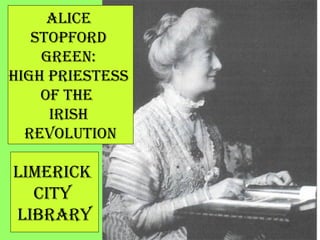
Alice
Stopford
Green:
HiGH prieSteSS
of tHe
iriSH
revolution
limerick
city
librAry
Overview: Links and Intersections
as historian.
as woman.
as African activist / philanthropy
as Irish nationalist
problematic position within Irish history.
Background / Context
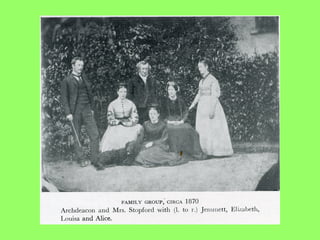
• b. 1847 into a Protestant family in Kells
• Seventh child of Archdeacon Edward
Stopford.
• Access to her father’s library taught herself
Greek, German and metaphysics.
• Aged 16 she went temporarily blind.
Attended lectures in the College of Sciences
in Dublin.
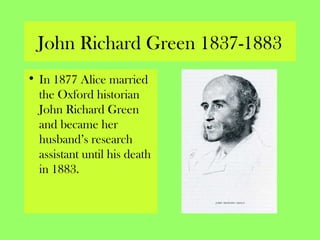
John Richard Green 1837-1883
• In 1877 Alice married
the Oxford historian
John Richard Green
and became her
husband’s research
assistant until his death
in 1883.
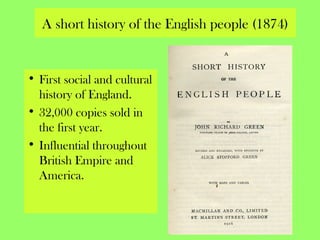
A short history of the English people (1874)
• First social and cultural
history of England.
• 32,000 copies sold in
the first year.
• Influential throughout
British Empire and
America.
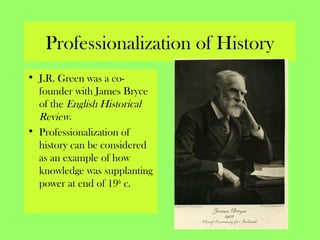
Professionalization of History
• J.R. Green was a co-
founder with James Bryce
of the English Historical
Review.
• Professionalization of
history can be considered
as an example of how
knowledge was supplanting
power at end of 19th
c.
Alice Green’s Network
• As a result of her marriage Alice meets many
leading historians and intellectuals of her
day.
• Gained reputation as an intellectual and
robust conversationalist.
• Her home became a meeting place for
scholars, politicians, social and political
activists.
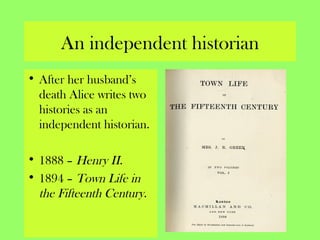
An independent historian
• After her husband’s
death Alice writes two
histories as an
independent historian.
• 1888 – Henry II.
• 1894 – Town Life in
the Fifteenth Century.
A.S. Green as historian
• Reacted against notions of professional
history capable of scientific methodology.
She saw all history as subjective / political.
• Experimental with sources: considering
landscapes, poetry and song, language etc. as
an important part of historical evidence.
The liberal network
• Through her marriage and engagement with
world of letters she built up exceptional
network of influential women and men.
• Networks served this knowledge-power
nexus.
Women’s Issues
• Early writings about women:
– ‘Woman’s place in the world of letters’,
Nineteenth Century, 1897, vol. xli, 244, 964-74.
– Times, 19 May 1897, Letter re: University
Degrees for Women
– ‘Growing bureaucracy and parliamentary
decline’, Nineteenth Century, 1900, vol. xlvii,
279, 839-46.
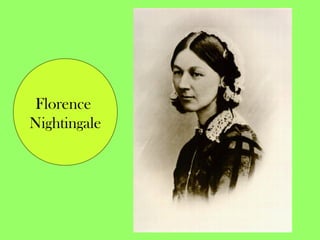
Florence
Nightingale
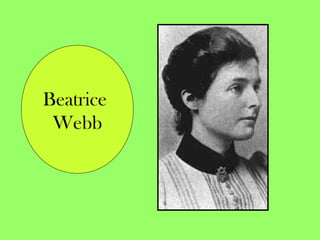
Beatrice
Webb
Green: an advocate of Women’s Rights?
• 1889 – Green was one of the signatories of
‘Appeal against female suffrage’.
• Why did Green initially oppose suffrage?
• How did she conceptualise woman’s place in
society?
Woman’s transcendent role
• Green saw women’s role outside the political
sphere as social reorganisers, as influencing
politics by serving beyond its parameters.
– Her work for Africa and her support for Irish
nationalism became space for realising this
vision.
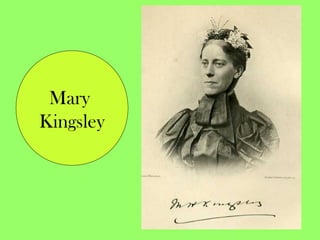
Mary
Kingsley
Mary Kingsley & Alice Green
• From 1895-1900 Mary Kingsley and Alice Green
become closely associated and Kingsley inspires
Green’s interest in West Africa.
• Women’s work as philanthropic endeavour.
• Correspondence held in the National Library of
Ireland.
Re-presenting Africa
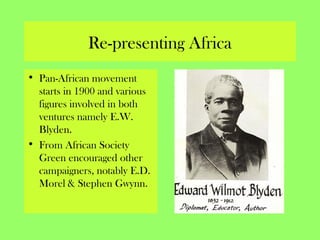
• Pan-African movement
starts in 1900 and various
figures involved in both
ventures namely E.W.
Blyden.
• From African Society
Green encouraged other
campaigners, notably E.D.
Morel & Stephen Gwynn.
The African Society
• Green establishes African Society following death
of Kingsley in 1900.
• On the surface it might be understood as a tool of
empire, amassing knowledge on Africa.
Membership inclusive of many professions
associated with Africa.
• Beneath the surface it might be understood as a
seed bed for anti-colonial interactions.
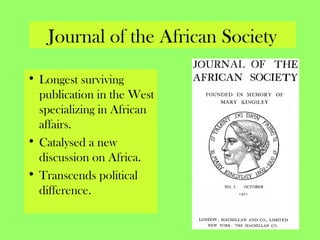
Journal of the African Society
• Longest surviving
publication in the West
specializing in African
affairs.
• Catalysed a new
discussion on Africa.
• Transcends political
difference.
Changing views on Africa
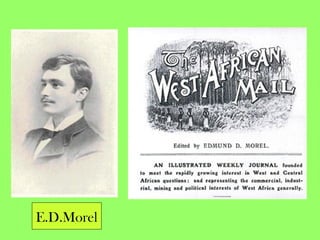
• Finances the setting up of the West African
Mail.
• Invites African chiefs and elders to London.
• Through Africa she tries to transcend
political impotency.
E.D.Morel
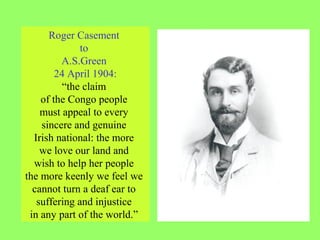
Roger Casement
to
A.S.Green
24 April 1904:
“the claim
of the Congo people
must appeal to every
sincere and genuine
Irish national: the more
we love our land and
wish to help her people
the more keenly we feel we
cannot turn a deaf ear to
suffering and injustice
in any part of the world.”
Alice Green and Irish Nationalism
• Strongly opposed to the Boer War.
• Irish nationalist sympathies encouraged by
her husband, found new impetus through
Gaelic revival and especially Gaelic League
and language renaissance.
• A nation is its past?
Speaking Out on Ireland’s behalf
• ‘It has been the object of English instruction
in Ireland to keep the people in ignorance of
their own history. This evil is intensified
when their ignorance is exploited to depress
them yet further by the repetition of
calumnies which have done political service
for centuries …’
– Freeman’s Journal – 11 March 1905
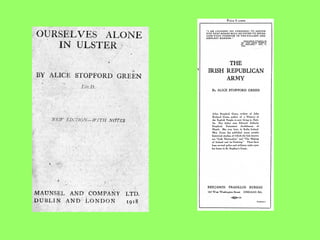
Books on the history of Ireland
• The making of Ireland and its undoing 1200-
1600 (1908)
• Irish Nationality (1911)
• The Old Irish World (1912)
• The Government of Ireland (1921)
• The History of the Irish State to 1014 (1925)
• Studies from Irish History (1926)
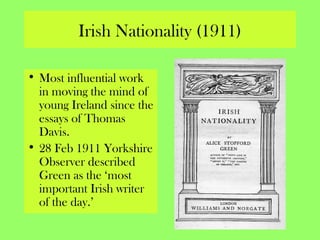
Irish Nationality (1911)
• Most influential work
in moving the mind of
young Ireland since the
essays of Thomas
Davis.
• 28 Feb 1911 Yorkshire
Observer described
Green as the ‘most
important Irish writer
of the day.’
Irish activity
• Irish language revival and promotion of
medieval scholarship.
• Historical Polemics (Graveyard at Durrow,
use of Tara by Lord Aberdeen)
• Cumman Na mBan.
• London Committee of the Irish Volunteers.
• Defence of Roger Casement.
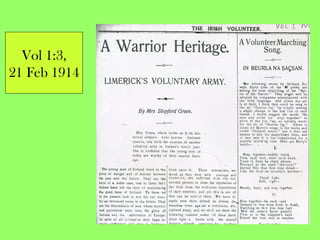
Vol 1:3,
21 Feb 1914
Howth Gun-running
• It was in her home in Grosvenor Road the
decision was taken by Green, Casement,
Childers, Figgis to run guns in to Ireland.
• Green chaired the private committee which
financed the gun-running.
• Royalties from A Short History of the
English People paid for the guns.
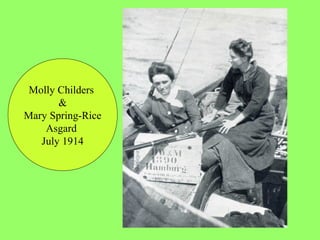
Molly Childers
&
Mary Spring-Rice
Asgard
July 1914
Dedication on the Senate casket
• No real history of Ireland has yet been
written. When the true story is finally
worked out – one not wholly occupied with
the many and insatiable plunderers – it will
give us a noble and reconciling vision of Irish
nationality. Silence and neglect will no longer
hide the fame of honourable men.
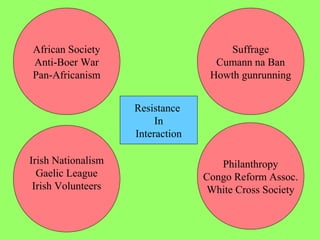
African Society
Anti-Boer War
Pan-Africanism
Suffrage
Cumann na Ban
Howth gunrunning
Irish Nationalism
Gaelic League
Irish Volunteers
Philanthropy
Congo Reform Assoc.
White Cross Society
Resistance
In
Interaction
Why is Green problematic?
• Proximity to the centre of power (Political
and intellectual).
• Association as a Protestant revolutionary.
• Use of history for ‘political’ purposes.
• Strategy to join up resistance.
• Gender.
Acknowledgements
• Rachel Barrett for her research assistance.
• Staff of the Limerick City Library, and
particularly Mike Maguire.
• Disclaimer: the views expressed in this
lecture are not necessarily the views of the
library!

Alice Stopford Green

  • 1.
  • 2.
    Overview: Links andIntersections as historian. as woman. as African activist / philanthropy as Irish nationalist problematic position within Irish history.
  • 3.
    Background / Context •b. 1847 into a Protestant family in Kells • Seventh child of Archdeacon Edward Stopford. • Access to her father’s library taught herself Greek, German and metaphysics. • Aged 16 she went temporarily blind. Attended lectures in the College of Sciences in Dublin.
  • 5.
    John Richard Green1837-1883 • In 1877 Alice married the Oxford historian John Richard Green and became her husband’s research assistant until his death in 1883.
  • 6.
    A short historyof the English people (1874) • First social and cultural history of England. • 32,000 copies sold in the first year. • Influential throughout British Empire and America.
  • 7.
    Professionalization of History •J.R. Green was a co- founder with James Bryce of the English Historical Review. • Professionalization of history can be considered as an example of how knowledge was supplanting power at end of 19th c.
  • 8.
    Alice Green’s Network •As a result of her marriage Alice meets many leading historians and intellectuals of her day. • Gained reputation as an intellectual and robust conversationalist. • Her home became a meeting place for scholars, politicians, social and political activists.
  • 9.
    An independent historian •After her husband’s death Alice writes two histories as an independent historian. • 1888 – Henry II. • 1894 – Town Life in the Fifteenth Century.
  • 10.
    A.S. Green ashistorian • Reacted against notions of professional history capable of scientific methodology. She saw all history as subjective / political. • Experimental with sources: considering landscapes, poetry and song, language etc. as an important part of historical evidence.
  • 11.
    The liberal network •Through her marriage and engagement with world of letters she built up exceptional network of influential women and men. • Networks served this knowledge-power nexus.
  • 12.
    Women’s Issues • Earlywritings about women: – ‘Woman’s place in the world of letters’, Nineteenth Century, 1897, vol. xli, 244, 964-74. – Times, 19 May 1897, Letter re: University Degrees for Women – ‘Growing bureaucracy and parliamentary decline’, Nineteenth Century, 1900, vol. xlvii, 279, 839-46.
  • 13.
  • 14.
  • 15.
    Green: an advocateof Women’s Rights? • 1889 – Green was one of the signatories of ‘Appeal against female suffrage’. • Why did Green initially oppose suffrage? • How did she conceptualise woman’s place in society?
  • 16.
    Woman’s transcendent role •Green saw women’s role outside the political sphere as social reorganisers, as influencing politics by serving beyond its parameters. – Her work for Africa and her support for Irish nationalism became space for realising this vision.
  • 17.
  • 18.
    Mary Kingsley &Alice Green • From 1895-1900 Mary Kingsley and Alice Green become closely associated and Kingsley inspires Green’s interest in West Africa. • Women’s work as philanthropic endeavour. • Correspondence held in the National Library of Ireland.
  • 19.
    Re-presenting Africa • Pan-Africanmovement starts in 1900 and various figures involved in both ventures namely E.W. Blyden. • From African Society Green encouraged other campaigners, notably E.D. Morel & Stephen Gwynn.
  • 20.
    The African Society •Green establishes African Society following death of Kingsley in 1900. • On the surface it might be understood as a tool of empire, amassing knowledge on Africa. Membership inclusive of many professions associated with Africa. • Beneath the surface it might be understood as a seed bed for anti-colonial interactions.
  • 21.
    Journal of theAfrican Society • Longest surviving publication in the West specializing in African affairs. • Catalysed a new discussion on Africa. • Transcends political difference.
  • 22.
    Changing views onAfrica • Finances the setting up of the West African Mail. • Invites African chiefs and elders to London. • Through Africa she tries to transcend political impotency.
  • 23.
  • 24.
    Roger Casement to A.S.Green 24 April1904: “the claim of the Congo people must appeal to every sincere and genuine Irish national: the more we love our land and wish to help her people the more keenly we feel we cannot turn a deaf ear to suffering and injustice in any part of the world.”
  • 25.
    Alice Green andIrish Nationalism • Strongly opposed to the Boer War. • Irish nationalist sympathies encouraged by her husband, found new impetus through Gaelic revival and especially Gaelic League and language renaissance. • A nation is its past?
  • 26.
    Speaking Out onIreland’s behalf • ‘It has been the object of English instruction in Ireland to keep the people in ignorance of their own history. This evil is intensified when their ignorance is exploited to depress them yet further by the repetition of calumnies which have done political service for centuries …’ – Freeman’s Journal – 11 March 1905
  • 27.
    Books on thehistory of Ireland • The making of Ireland and its undoing 1200- 1600 (1908) • Irish Nationality (1911) • The Old Irish World (1912) • The Government of Ireland (1921) • The History of the Irish State to 1014 (1925) • Studies from Irish History (1926)
  • 28.
    Irish Nationality (1911) •Most influential work in moving the mind of young Ireland since the essays of Thomas Davis. • 28 Feb 1911 Yorkshire Observer described Green as the ‘most important Irish writer of the day.’
  • 29.
    Irish activity • Irishlanguage revival and promotion of medieval scholarship. • Historical Polemics (Graveyard at Durrow, use of Tara by Lord Aberdeen) • Cumman Na mBan. • London Committee of the Irish Volunteers. • Defence of Roger Casement.
  • 30.
  • 31.
    Howth Gun-running • Itwas in her home in Grosvenor Road the decision was taken by Green, Casement, Childers, Figgis to run guns in to Ireland. • Green chaired the private committee which financed the gun-running. • Royalties from A Short History of the English People paid for the guns.
  • 32.
  • 34.
    Dedication on theSenate casket • No real history of Ireland has yet been written. When the true story is finally worked out – one not wholly occupied with the many and insatiable plunderers – it will give us a noble and reconciling vision of Irish nationality. Silence and neglect will no longer hide the fame of honourable men.
  • 35.
    African Society Anti-Boer War Pan-Africanism Suffrage Cumannna Ban Howth gunrunning Irish Nationalism Gaelic League Irish Volunteers Philanthropy Congo Reform Assoc. White Cross Society Resistance In Interaction
  • 36.
    Why is Greenproblematic? • Proximity to the centre of power (Political and intellectual). • Association as a Protestant revolutionary. • Use of history for ‘political’ purposes. • Strategy to join up resistance. • Gender.
  • 37.
    Acknowledgements • Rachel Barrettfor her research assistance. • Staff of the Limerick City Library, and particularly Mike Maguire. • Disclaimer: the views expressed in this lecture are not necessarily the views of the library!