Conservation 101:Handling and Storing Objects
What is conservation?Who are conservators?con·ser·va·tion– the act of conserving; PREVENTION OF INJURY, DECAY, WASTE, OR LOSScon·ser·va·tor–  a person who conserves or preserves; preserver; PROTECTOR.  A PERSON WHO repairs, restores, or MAINTAINS THE CONDITION OF OBJECTS, as paintings or sculptures in an art museum, or books in a library Few museums or living history sites have conservators on staff. Therefore, the first line of defense to prevent or suspend damage to artifacts are the curators, collections managers, interpreters or any other person on staff who comes into proximity of the collection.  Most of the damage caused to works of art is preventable, and good handling and storage techniques can make a big difference in the preservation of a collection.In essence….. Conservation begins with YOU!
Handling ObjectsIn terms of conservation, the biggest causes of damage to objects (agents of deterioration) are: light, temperature, humidity, contaminants, bugs, inherent vice, and….. humans.A good Collections Management Policy will have guidelines on how to handle and store objects. Any person that will be responsible for handling objects in a collection should have proper training before moving any object.
Things to ConsiderBefore Handling an ObjectIs it safe to move the object?Could the object be dangerous to you?Could you be dangerous to the object?Where are you going?Will there be room for the object when you get there?Is everything out of your pathway?3.	What is the best way to pick it up?Where are weak points that could break?Is the surface stable?4.	How many people will it take to move it?
Safe Handling ProceduresTreat every item like it is the only one in existence.Never eat, drink, or smoke around objects.Make sure there is plenty of room to move.Using both hands, move only one object at a time, slowly and thoughtfully. If there is more than one part to an object, move them separately.Identify the strongest part of the object (often the base or center of gravity) and hold it at this point. Do not pick an object up by handles, rims or protrusions as these are often the weakest parts.Stabilize loose components that cannot be removed.Do not push or pull an object across a surface.Do use carts and/or trays with padding where appropriate.Be sure to update all records to reflect the object’s new location, and keep an ID or accession number with the object at all times.WASH HANDS AND WEAR THE RIGHT GLOVES FOR THE JOB!
Handling Materials by TypePaper  and photographs –  Carry paper or photos flat on a support sufficient to hold the weight and size. Watch for static when removing items from a plastic sleeve.Textiles – If fragile, carry textiles flat on a support sufficient to hold the weight and size. If large and in good condition, gently roll on an archival tube and use two people to move the roll.Wood (Furniture) – Secure any drawers or doors with cotton twill tape. It is usually safest to pick up furniture by lowest horizontal structural area. Use as many people as necessary. Do not lift by handles or arms. Do not drag across any surface. Use a dolly or “truck” if possible.
Handling Materials by Type (continued)Paintings – Small paintings can be carried with one hand on the side, one hand underneath. Large paintings should be carried by grasping frame on either side.Metal – Use carts or dollies to move heavy items.  Lift the main body of the piece rather than any protrusions.Glass and Ceramics – Use nitrile gloves for grip.  Carry by the body of the object, not handles. Leather – Move on a support if possible. Consider stress points or decorative elements before moving something large like a saddle.
Basics of Storing ObjectsKnow your collection.Know your space.Know the dangers.
Know Your CollectionWhat types of materials are in your collection?Metal, paintings, photographs, paper, wood, and other organics such as leather or ivory often require different storage materials, techniques, and environments.
Acceptable Temperature LevelsIn areas where human comfort is a factor, it is generally acceptable to keep the thermostat at temperatures of 64-68° F (18-20° C).  If humans don’t inhabit the storage space, temperatures can be kept at much lower temperatures as long as the temperatures are above freezing and the proper humidity can be maintained. Temperatures should not exceed 75° (24° C).If the temperature must be changed in a storage facility, it is recommended that the temperature be altered no more than 2° per hour to minimize damage to objects and collections.
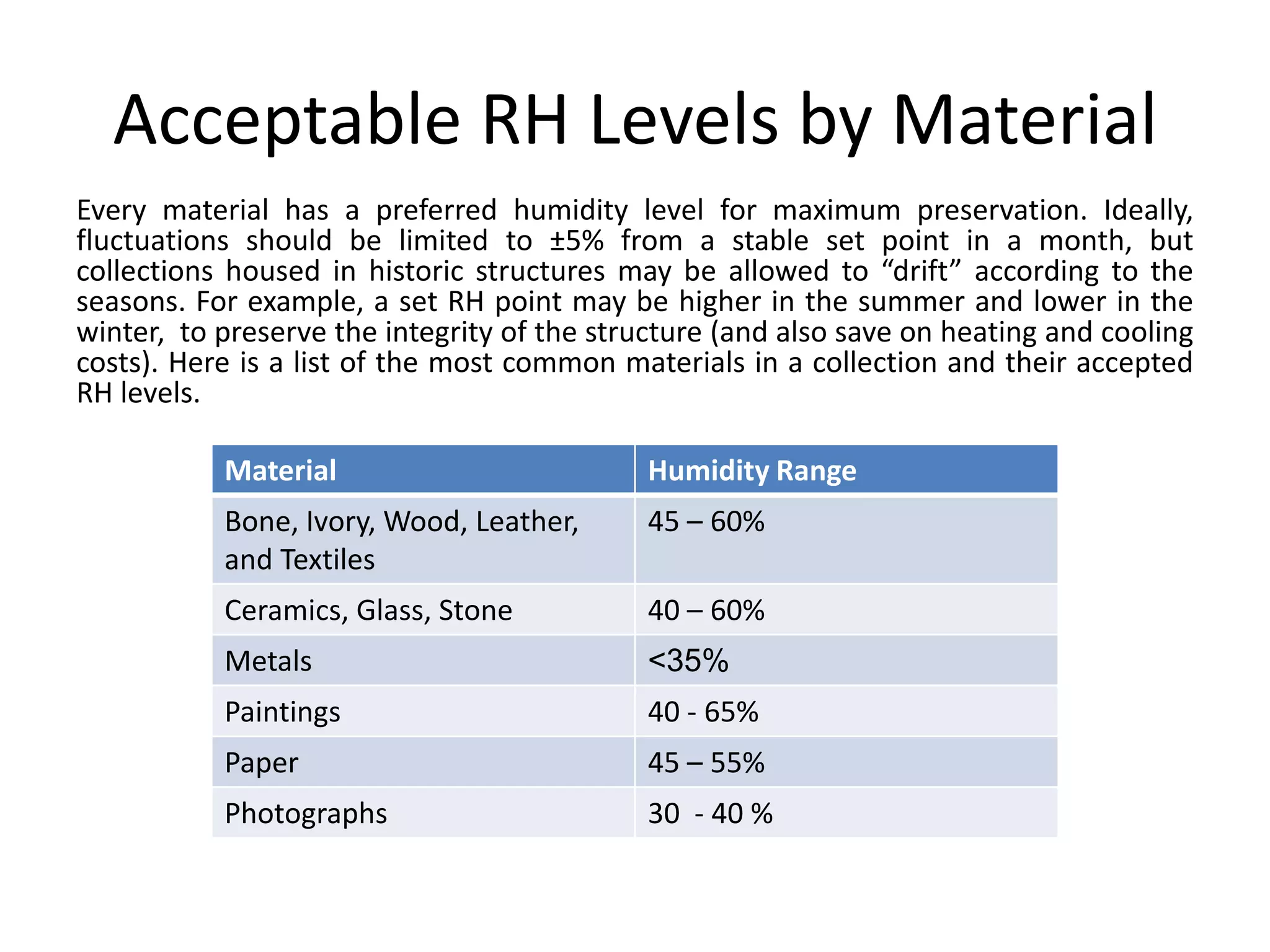
Acceptable RH Levels by MaterialEvery material has a preferred humidity level for maximum preservation. Ideally, fluctuations should be limited to ±5% from a stable set point in a month, but collections housed in historic structures may be allowed to “drift” according to the seasons. For example, a set RH point may be higher in the summer and lower in the winter, to preserve the integrity of the structure (and also save on heating and cooling costs). Here is a list of the most common materials in a collection and their accepted RH levels.
Know Your SpaceWhere is your storage area located?How much stuff can you hold?What environmental factors can you control?Can you monitor the environment?
Basic Storage RulesKeep all items at least four inches off the floor.Steel shelving lined with polyethylene foam is the most recommended storage system. Use polyethylene foam as shelf liner to protect objects from shelving materials and to watch for any deterioration activity.Try to control agents of deterioration (light, temperature, RH, bugs, and humans).No potted plants, food, drinks, or smoking in the storage area.Keep traffic to a minimum to avoid misplacement or breakage of objects.Avoid storing sensitive materials in areas with large fluctuations in the environment, i.e. exterior walls, or in attics and basements.Every item and it’s container should have an identification number.Every item should be on an updated inventory list.
Proper Storage Materials for Every CollectionAcid-free boxes, folders, labels, envelopes, paper, and matboardBuffered and unbuffered tissue paperPolyethylene foam, bags, enclosuresCotton or polyester battingPaper or linen tapes, cotton twill tapeWashed muslins
Proper Storage TechniquesArchaeological Specimens There are generally two types of storage: vertical or horizontal stacking . Place items in Tyvek bags with interior ID card and write ID markings on the exterior of the bag. Place the bags in numerical order either vertically in a single layer box, or horizontally in stacking trays. If using stacking trays, place a padding layer of polyethylene foam between them. Be sure to list the contents on the outside of the box.Paper Paper is best stored flat in piles less than 1” thick. Only store items vertically if they are in good shape.Paper needs to have a support for transport or storage. Acid-free matboard, folders, and paper can provide the support necessary depending on the size, weight, and nature of the paper object.TextilesTextiles are best stored flat, but that is impractical for large items.If it must be folded, try not to fold in common or decorated areas and interleave the folds with tissue paper. Use the biggest manageable box. Set a schedule to refold at a later date.When rolling an item, use tissue paper a little larger than the textile and roll a bit onto  the support to guide the textile, continuing to roll the textile within the paper. Use a washed muslin cover tied in cotton twill tape to protect from dust. Label the exterior with a tag.Stuff sleeves or other cavities with tissue paper to avoid creases.
Proper Storage Techniques (continued)PaintingsThe best storage for paintings is on a wall.Framed paintings can be stacked vertically with thick foam or matboard interleaved between the frames.Only store a painting flat if it has problem elements such as flaking paint.Adding stiff backing to a painting can help protect it from punctures.WoodProtect feet and legs from storage surfaces.Place large or heavy objects on lower shelves.Don’t stack objects or store items in the drawers of furniture.
Proper Storage Techniques (continued)MetalTry to keep all metal objects together and away from water-absorbing materials like wood or paper.Large items can be draped with polyethylene to offer protection from dust or water leaks.Steel shelving is preferred because it is stronger and does not off-gas.Glass and CeramicsStore objects in a padded container using tissue paper or foam. Oversized objects can be stored on shelves as long as they have stabilized supports. Store lids and bases separately.Protect items on shelves from vibration or accidental bumping by using adequate padding and moving them to the back of the shelves. Cover open items on a shelf with polyethylene. Try not to stack plates or bowls. If space is a concern, interleave the dishes with foam or white cotton fabric. Keep broken pieces packed together, but protected to avoid abrading the edges.
Proper Storage Techniques (continued)PhotographsPhotos should be boxed to protect from light.Enclosures like envelopes or folders should pass PAT (Photographic Activity Test). Check with manufacturers for this rating.Only use plastic enclosures if you can maintain RH below 70%.LeatherIt is best to give each item it’s own container as it is almost impossible to know what processes or chemicals were used to process the leather.Items often need custom supports.Try not to fold leather. Use tissue paper in creased areas.Large items like robes or hides can be rolled if they are in good condition.
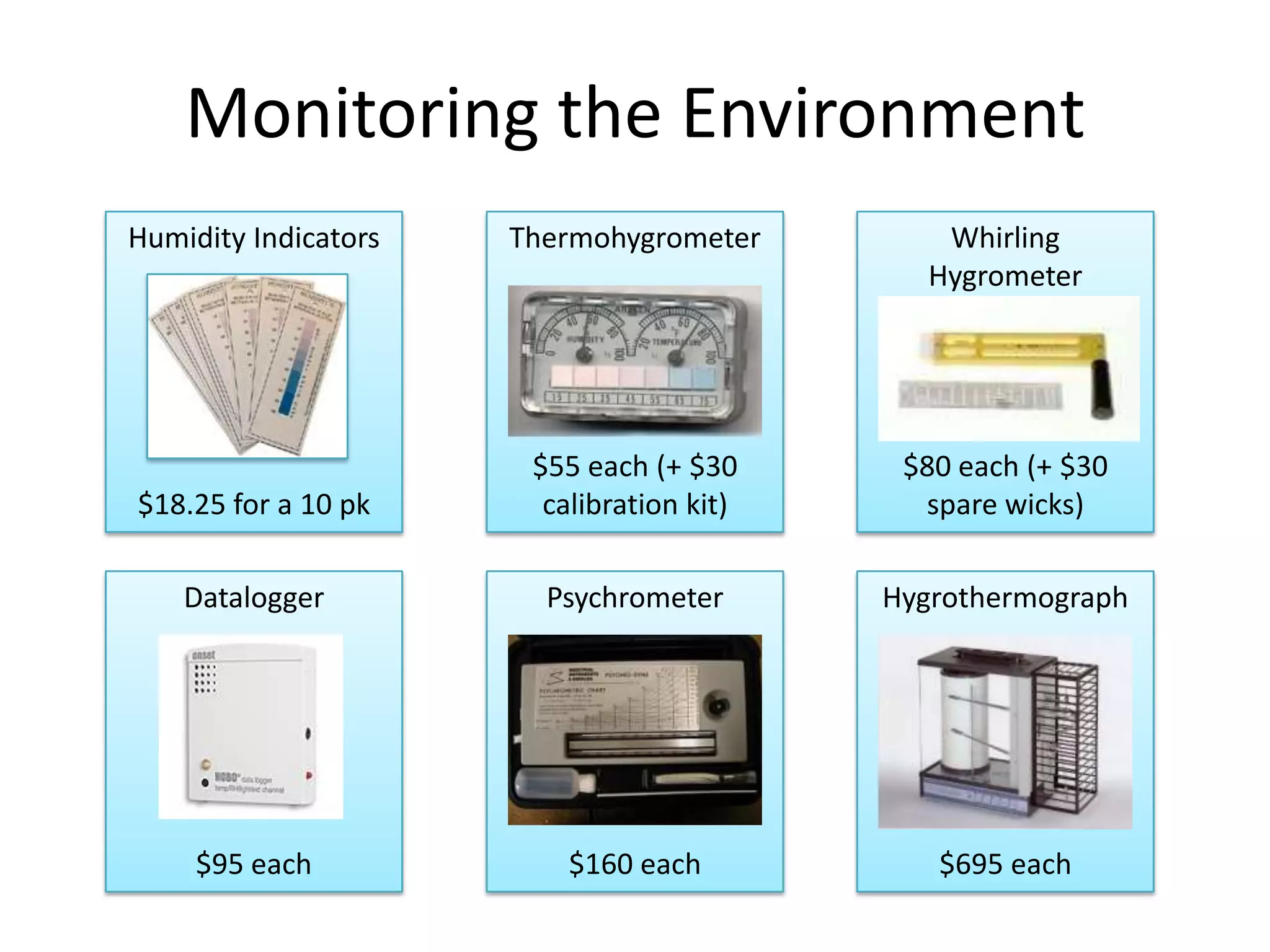
Monitoring the EnvironmentThermohygrometer$55 each (+ $30 calibration kit)Whirling Hygrometer$80 each (+ $30 spare wicks)Humidity Indicators$18.25 for a 10 pkDatalogger$95 eachPsychrometer$160 eachHygrothermograph$695 each
Tips for Regulating EnvironmentGet locking thermostats that prevent visitors/staff from altering temperatures.Keep doors and windows closed.Change filters monthly (or more) in the collection area.If fluorescent lights are used, install plastic filming over the bulbs or order new lights with UV block (Verilux).Install UV filtering film, shades or drapes on windows.To deal with bug infestations, put out bug traps to collect specimens that are endangering the collection.
Know the DangersWhat types of problems does your collection most encounter? What natural disasters are common in your area, i.e. tornadoes, hurricanes, earthquakes?What other potential dangers are in proximity to the site, i.e. airports, railroad lines, chemical plants?What can you prevent?What can you do to be prepared for a disaster?
Disaster PreparednessA Disaster Preparedness Plan gives essential written instructions on what to do with visitors and collections in case of: fire, flood, inclement weather, earthquake, or any other destructive event.Disaster Preparedness should be an important part of any Collections Management Plan.The main goal of a Disaster Preparedness Plan is to save lives, preserve collections, and save money on expensive clean-up materials.
Some Basics of a Disaster Preparedness PlanStaff/Visitor Evacuation ProceduresEmergency NumbersList of Contacts and Vendors to help with the clean-upLocations of building, fire extinguishers, first aid kits, hazardous materials, and important artifacts and filesList of materials and their locations needed for clean-upBasic directions for staff/volunteers on how to handle the following situations:Fire				- FloodSevere Storms			- Hazardous MaterialsTornado Warning			- ExplosionWinter Storm				- EarthquakeUtility FailureThe better the plan, the better the chance of preserving the site and collection!Heritage Preservation has a comprehensive Risk Evaluation and Planning Program at www.heritagepreservation.org/REPP.
Bottom LineUse common sense and tried-and-true guidelines when deciding how to handle or store an object.There are plenty of preventative measures that require little or no money to initiate. If you don’t know….. ASK! We all have to do it from time to time.The #1 rule in conservation – Do no harm. Beyond that, do the best you can!
SourcesMuseum Handbook: Part I, Museum Collections. [Washington, D.C.]: U.S. Dept. of the Interior, National Park Service, 2007. Print.Museum Handbook: Part I, Museum Collections, Appendices. [Washington, D.C.]: U.S. Dept. of the Interior, National Park Service, 2007. Print.www.heritagepreservation.org

Alhfam 2010 handling and storing objects

  • 1.
  • 2.
    What is conservation?Whoare conservators?con·ser·va·tion– the act of conserving; PREVENTION OF INJURY, DECAY, WASTE, OR LOSScon·ser·va·tor– a person who conserves or preserves; preserver; PROTECTOR. A PERSON WHO repairs, restores, or MAINTAINS THE CONDITION OF OBJECTS, as paintings or sculptures in an art museum, or books in a library Few museums or living history sites have conservators on staff. Therefore, the first line of defense to prevent or suspend damage to artifacts are the curators, collections managers, interpreters or any other person on staff who comes into proximity of the collection. Most of the damage caused to works of art is preventable, and good handling and storage techniques can make a big difference in the preservation of a collection.In essence….. Conservation begins with YOU!
  • 3.
    Handling ObjectsIn termsof conservation, the biggest causes of damage to objects (agents of deterioration) are: light, temperature, humidity, contaminants, bugs, inherent vice, and….. humans.A good Collections Management Policy will have guidelines on how to handle and store objects. Any person that will be responsible for handling objects in a collection should have proper training before moving any object.
  • 4.
    Things to ConsiderBeforeHandling an ObjectIs it safe to move the object?Could the object be dangerous to you?Could you be dangerous to the object?Where are you going?Will there be room for the object when you get there?Is everything out of your pathway?3. What is the best way to pick it up?Where are weak points that could break?Is the surface stable?4. How many people will it take to move it?
  • 5.
    Safe Handling ProceduresTreatevery item like it is the only one in existence.Never eat, drink, or smoke around objects.Make sure there is plenty of room to move.Using both hands, move only one object at a time, slowly and thoughtfully. If there is more than one part to an object, move them separately.Identify the strongest part of the object (often the base or center of gravity) and hold it at this point. Do not pick an object up by handles, rims or protrusions as these are often the weakest parts.Stabilize loose components that cannot be removed.Do not push or pull an object across a surface.Do use carts and/or trays with padding where appropriate.Be sure to update all records to reflect the object’s new location, and keep an ID or accession number with the object at all times.WASH HANDS AND WEAR THE RIGHT GLOVES FOR THE JOB!
  • 6.
    Handling Materials byTypePaper and photographs – Carry paper or photos flat on a support sufficient to hold the weight and size. Watch for static when removing items from a plastic sleeve.Textiles – If fragile, carry textiles flat on a support sufficient to hold the weight and size. If large and in good condition, gently roll on an archival tube and use two people to move the roll.Wood (Furniture) – Secure any drawers or doors with cotton twill tape. It is usually safest to pick up furniture by lowest horizontal structural area. Use as many people as necessary. Do not lift by handles or arms. Do not drag across any surface. Use a dolly or “truck” if possible.
  • 7.
    Handling Materials byType (continued)Paintings – Small paintings can be carried with one hand on the side, one hand underneath. Large paintings should be carried by grasping frame on either side.Metal – Use carts or dollies to move heavy items. Lift the main body of the piece rather than any protrusions.Glass and Ceramics – Use nitrile gloves for grip. Carry by the body of the object, not handles. Leather – Move on a support if possible. Consider stress points or decorative elements before moving something large like a saddle.
  • 8.
    Basics of StoringObjectsKnow your collection.Know your space.Know the dangers.
  • 9.
    Know Your CollectionWhattypes of materials are in your collection?Metal, paintings, photographs, paper, wood, and other organics such as leather or ivory often require different storage materials, techniques, and environments.
  • 10.
    Acceptable Temperature LevelsInareas where human comfort is a factor, it is generally acceptable to keep the thermostat at temperatures of 64-68° F (18-20° C). If humans don’t inhabit the storage space, temperatures can be kept at much lower temperatures as long as the temperatures are above freezing and the proper humidity can be maintained. Temperatures should not exceed 75° (24° C).If the temperature must be changed in a storage facility, it is recommended that the temperature be altered no more than 2° per hour to minimize damage to objects and collections.
  • 11.
    Acceptable RH Levelsby MaterialEvery material has a preferred humidity level for maximum preservation. Ideally, fluctuations should be limited to ±5% from a stable set point in a month, but collections housed in historic structures may be allowed to “drift” according to the seasons. For example, a set RH point may be higher in the summer and lower in the winter, to preserve the integrity of the structure (and also save on heating and cooling costs). Here is a list of the most common materials in a collection and their accepted RH levels.
  • 12.
    Know Your SpaceWhereis your storage area located?How much stuff can you hold?What environmental factors can you control?Can you monitor the environment?
  • 13.
    Basic Storage RulesKeepall items at least four inches off the floor.Steel shelving lined with polyethylene foam is the most recommended storage system. Use polyethylene foam as shelf liner to protect objects from shelving materials and to watch for any deterioration activity.Try to control agents of deterioration (light, temperature, RH, bugs, and humans).No potted plants, food, drinks, or smoking in the storage area.Keep traffic to a minimum to avoid misplacement or breakage of objects.Avoid storing sensitive materials in areas with large fluctuations in the environment, i.e. exterior walls, or in attics and basements.Every item and it’s container should have an identification number.Every item should be on an updated inventory list.
  • 14.
    Proper Storage Materialsfor Every CollectionAcid-free boxes, folders, labels, envelopes, paper, and matboardBuffered and unbuffered tissue paperPolyethylene foam, bags, enclosuresCotton or polyester battingPaper or linen tapes, cotton twill tapeWashed muslins
  • 15.
    Proper Storage TechniquesArchaeologicalSpecimens There are generally two types of storage: vertical or horizontal stacking . Place items in Tyvek bags with interior ID card and write ID markings on the exterior of the bag. Place the bags in numerical order either vertically in a single layer box, or horizontally in stacking trays. If using stacking trays, place a padding layer of polyethylene foam between them. Be sure to list the contents on the outside of the box.Paper Paper is best stored flat in piles less than 1” thick. Only store items vertically if they are in good shape.Paper needs to have a support for transport or storage. Acid-free matboard, folders, and paper can provide the support necessary depending on the size, weight, and nature of the paper object.TextilesTextiles are best stored flat, but that is impractical for large items.If it must be folded, try not to fold in common or decorated areas and interleave the folds with tissue paper. Use the biggest manageable box. Set a schedule to refold at a later date.When rolling an item, use tissue paper a little larger than the textile and roll a bit onto the support to guide the textile, continuing to roll the textile within the paper. Use a washed muslin cover tied in cotton twill tape to protect from dust. Label the exterior with a tag.Stuff sleeves or other cavities with tissue paper to avoid creases.
  • 16.
    Proper Storage Techniques(continued)PaintingsThe best storage for paintings is on a wall.Framed paintings can be stacked vertically with thick foam or matboard interleaved between the frames.Only store a painting flat if it has problem elements such as flaking paint.Adding stiff backing to a painting can help protect it from punctures.WoodProtect feet and legs from storage surfaces.Place large or heavy objects on lower shelves.Don’t stack objects or store items in the drawers of furniture.
  • 17.
    Proper Storage Techniques(continued)MetalTry to keep all metal objects together and away from water-absorbing materials like wood or paper.Large items can be draped with polyethylene to offer protection from dust or water leaks.Steel shelving is preferred because it is stronger and does not off-gas.Glass and CeramicsStore objects in a padded container using tissue paper or foam. Oversized objects can be stored on shelves as long as they have stabilized supports. Store lids and bases separately.Protect items on shelves from vibration or accidental bumping by using adequate padding and moving them to the back of the shelves. Cover open items on a shelf with polyethylene. Try not to stack plates or bowls. If space is a concern, interleave the dishes with foam or white cotton fabric. Keep broken pieces packed together, but protected to avoid abrading the edges.
  • 18.
    Proper Storage Techniques(continued)PhotographsPhotos should be boxed to protect from light.Enclosures like envelopes or folders should pass PAT (Photographic Activity Test). Check with manufacturers for this rating.Only use plastic enclosures if you can maintain RH below 70%.LeatherIt is best to give each item it’s own container as it is almost impossible to know what processes or chemicals were used to process the leather.Items often need custom supports.Try not to fold leather. Use tissue paper in creased areas.Large items like robes or hides can be rolled if they are in good condition.
  • 19.
    Monitoring the EnvironmentThermohygrometer$55each (+ $30 calibration kit)Whirling Hygrometer$80 each (+ $30 spare wicks)Humidity Indicators$18.25 for a 10 pkDatalogger$95 eachPsychrometer$160 eachHygrothermograph$695 each
  • 20.
    Tips for RegulatingEnvironmentGet locking thermostats that prevent visitors/staff from altering temperatures.Keep doors and windows closed.Change filters monthly (or more) in the collection area.If fluorescent lights are used, install plastic filming over the bulbs or order new lights with UV block (Verilux).Install UV filtering film, shades or drapes on windows.To deal with bug infestations, put out bug traps to collect specimens that are endangering the collection.
  • 21.
    Know the DangersWhattypes of problems does your collection most encounter? What natural disasters are common in your area, i.e. tornadoes, hurricanes, earthquakes?What other potential dangers are in proximity to the site, i.e. airports, railroad lines, chemical plants?What can you prevent?What can you do to be prepared for a disaster?
  • 22.
    Disaster PreparednessA DisasterPreparedness Plan gives essential written instructions on what to do with visitors and collections in case of: fire, flood, inclement weather, earthquake, or any other destructive event.Disaster Preparedness should be an important part of any Collections Management Plan.The main goal of a Disaster Preparedness Plan is to save lives, preserve collections, and save money on expensive clean-up materials.
  • 23.
    Some Basics ofa Disaster Preparedness PlanStaff/Visitor Evacuation ProceduresEmergency NumbersList of Contacts and Vendors to help with the clean-upLocations of building, fire extinguishers, first aid kits, hazardous materials, and important artifacts and filesList of materials and their locations needed for clean-upBasic directions for staff/volunteers on how to handle the following situations:Fire - FloodSevere Storms - Hazardous MaterialsTornado Warning - ExplosionWinter Storm - EarthquakeUtility FailureThe better the plan, the better the chance of preserving the site and collection!Heritage Preservation has a comprehensive Risk Evaluation and Planning Program at www.heritagepreservation.org/REPP.
  • 24.
    Bottom LineUse commonsense and tried-and-true guidelines when deciding how to handle or store an object.There are plenty of preventative measures that require little or no money to initiate. If you don’t know….. ASK! We all have to do it from time to time.The #1 rule in conservation – Do no harm. Beyond that, do the best you can!
  • 25.
    SourcesMuseum Handbook: PartI, Museum Collections. [Washington, D.C.]: U.S. Dept. of the Interior, National Park Service, 2007. Print.Museum Handbook: Part I, Museum Collections, Appendices. [Washington, D.C.]: U.S. Dept. of the Interior, National Park Service, 2007. Print.www.heritagepreservation.org

Editor's Notes

  • #5 Could the object be dangerous to you? Sharp edges, contaminants, too heavy. Do you have the right PPE? Use proper lifting techniques to protect your back.Could you be dangerous to the object? Are there weak spots? Could your hair, clothing, or accessories like belts, jewelry or nametag harm the object?
  • #6 Be sure to wear the appropriate gloves for the handling procedure.White Gloves:Are appropriate for most handling procedures.Nitrile Gloves:Best for moving objects with slick surfaces like glass or ceramics, or any surface that could catch on or attract cotton fibers such as fragile paper or veneered wood.Keep your gloves clean, and try not to touch anything but the object you are moving. Be careful not to touch your face or hair as you may transfer oils to an object.
  • #13 In TX we have a saying, “You get what you get and you don’t throw a fit.”Location: upstairs, downstairs, wet area, tight hallways, etc.How much space do you have? Do you have room for flat files or do some things have to go in boxes?Can you control the temperature and humidity? Can you move the condensation lines on your AC units?Can your organization afford monitoring equipment?
  • #15 Acid-free = pH higher than 7
  • #16 Generally use unbuffered paper for textiles.