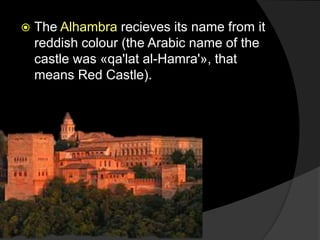
 The Alhambra recieves its name from it
reddish colour (the Arabic name of the
castle was «qa'lat al-Hamra'», that
means Red Castle).
Location
 The Alhambra its on Granada, on top of
the hill al-Sabika, on the left bank of the
river Darro, to the west of the city of
Granada and in front of the
neighbourhoods of the Albaicin and of
the Alcazaba.
 This is an estrategic location, because it
has views of all the city.
Art
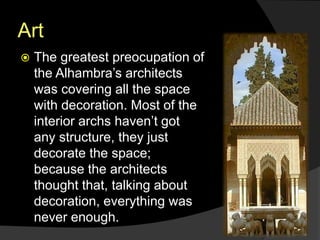
 The greatest preocupation of
the Alhambra’s architects
was covering all the space
with decoration. Most of the
interior archs haven’t got
any structure, they just
decorate the space;
because the architects
thought that, talking about
decoration, everything was
never enough.
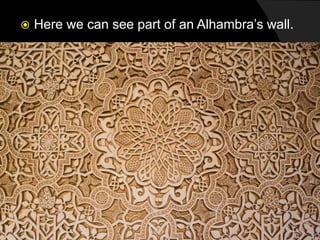
 Here we can see part of an Alhambra’s wall.
Map
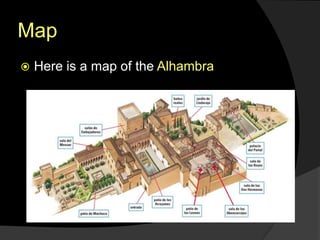
 Here is a map of the Alhambra
Some parts of the Alhambra
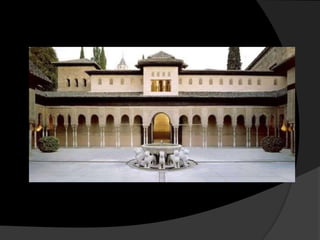
 Court of Lions
o This probably is the most famous part of
the Alhambra.
o It recieves its name because of the
fountain with twelve lions that is inside it.
o Mohammed V ordered its construction
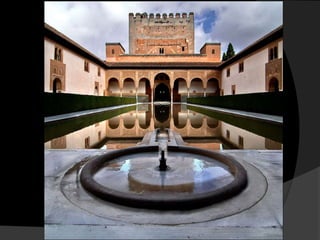
 Court of Myrtles
o It has recieved different names,but this
name is because the two myrtle bushes
that are on it. Other names are Patio of
the Pond or Patio of the Reservoir.
o The central pond is is 34 metres long
and 7,10 meters wide.
o The pond divides the patio and receives
its water from two fountains (one at each
end of the pond).
 Patio of the Wrought Iron Grille
o It’s so known because of the
wrought iron grille that is on the
southern wall since 1655, as if
it were a balcony.
o It was constructed at the same
time than the Emperor’s
Chambers.
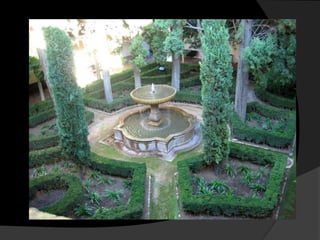
o In the middle of the patio there
is a stone fountain and in the
corners there are hundred-
year-old cypresses.
Bibliography
 For more information you can visit this
page:
 http://www.alhambradegranada.org/en/in
fo/historicalintroduction.asp
Note: on the left side of the web, there are links for more pages
about the Alhambra.

alhambra

  • 2.
     The Alhambrarecieves its name from it reddish colour (the Arabic name of the castle was «qa'lat al-Hamra'», that means Red Castle).
  • 3.
    Location  The Alhambraits on Granada, on top of the hill al-Sabika, on the left bank of the river Darro, to the west of the city of Granada and in front of the neighbourhoods of the Albaicin and of the Alcazaba.  This is an estrategic location, because it has views of all the city.
  • 4.
    Art  The greatestpreocupation of the Alhambra’s architects was covering all the space with decoration. Most of the interior archs haven’t got any structure, they just decorate the space; because the architects thought that, talking about decoration, everything was never enough.
  • 5.
     Here wecan see part of an Alhambra’s wall.
  • 6.
    Map  Here isa map of the Alhambra
  • 7.
    Some parts ofthe Alhambra  Court of Lions o This probably is the most famous part of the Alhambra. o It recieves its name because of the fountain with twelve lions that is inside it. o Mohammed V ordered its construction
  • 9.
     Court ofMyrtles o It has recieved different names,but this name is because the two myrtle bushes that are on it. Other names are Patio of the Pond or Patio of the Reservoir. o The central pond is is 34 metres long and 7,10 meters wide. o The pond divides the patio and receives its water from two fountains (one at each end of the pond).
  • 11.
     Patio ofthe Wrought Iron Grille o It’s so known because of the wrought iron grille that is on the southern wall since 1655, as if it were a balcony. o It was constructed at the same time than the Emperor’s Chambers. o In the middle of the patio there is a stone fountain and in the corners there are hundred- year-old cypresses.
  • 13.
    Bibliography  For moreinformation you can visit this page:  http://www.alhambradegranada.org/en/in fo/historicalintroduction.asp Note: on the left side of the web, there are links for more pages about the Alhambra.