Algonquin North Outfitters
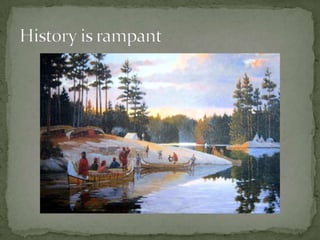
 Portage image: (image from
  http://bilnkit.files.wordpress.com/2011/05/grand-
  portage-mn-voyageurs-camp-painting.jpg – can’t
  insert hyperlink in notes)
 Loon :
  http://www.flickr.com/photos/naturepics1/608292689
  5/
 Great description of the route these photos come from:


 http://www.doe.carleton.ca/~ngt/algonquin/manitou/
 manitou_frames.html

Algonquin

  • 9.
  • 21.
     Portage image:(image from http://bilnkit.files.wordpress.com/2011/05/grand- portage-mn-voyageurs-camp-painting.jpg – can’t insert hyperlink in notes)  Loon : http://www.flickr.com/photos/naturepics1/608292689 5/
  • 22.
     Great descriptionof the route these photos come from:  http://www.doe.carleton.ca/~ngt/algonquin/manitou/ manitou_frames.html

Editor's Notes

  • #3 Toronto, the biggest city in Canada is known for being a cosmopolitan urban centre with great food, great pavement, and buildings. Lots of them.
  • #4 Ottawa, the nation’s capital is frequented by millions each year. Skating on the canal in the winter and strolls through the hallowed halls of parliament are a must. Visitors often spend time at the city’s many museums.
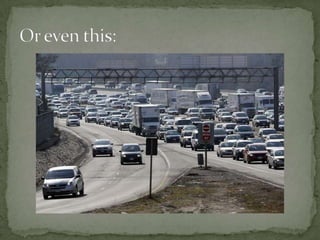
  • #5 When people from outside the province (and often those who live there) think of Ontario issues of dense population come to mind. Famous traffic and smog issues along the 400 series highways dominate the anti-Ontario (anti-Toronto) motif that pervades much of Canada.
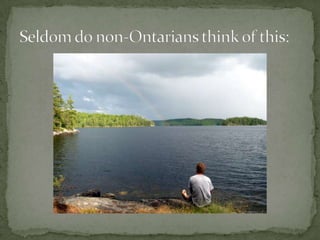
  • #6 But the truth is, like the rest of Canada Ontario is rampant with natural beauty. Much of the province is water and it is home to 1000s of lakes and the gorgeous rock of the Canadian Shield reaches south to create wonderful swimming and camping opportunities.
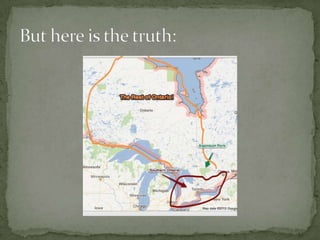
  • #7 With approximately 15 million residents, nearly half of Canada’s population lives in Ontario. However, with a land area over 1 million km2, Ontario is huge. In fact, in Southern Ontario (the area circled in red) is home to over 90% of Ontario’s residents, leaving the rest of the population to inhabit the remaining 900,000 km2. This means that escaping the radar are wonderful, accessible areas of natural beauty often forgotten when we think of Ontario.
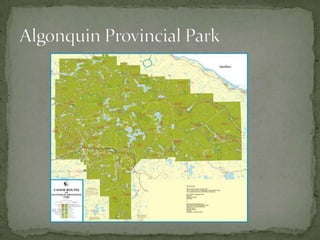
  • #8 Algonquin Park was founded as a protected area in 1893, making it the first provincial park in Canada. Entering government jurisdiction two years before Canada’s first National Park (Banff in 1895), Algonquin serves not only as a monument to the natural world accessible from Canada’s most populated region, it also serves great historical significance.
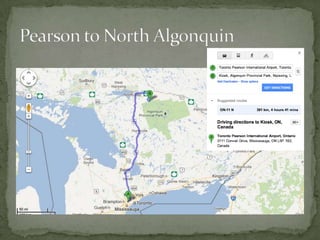
  • #9 The Northern most access to Algonquin, ‘Kiosk’ is less than 400km from Toronto’s bustling Pearson airport, and the most popular access point, ‘Whitney’ only about 300km away. We are going to look at access from Kiosk, because driving an additional 100km to the north avoids the Algonquin bottleneck of canoeists looking for the easiest route.
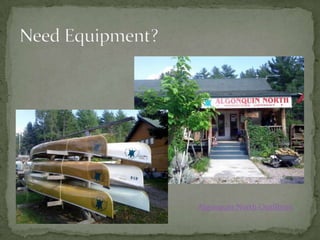
  • #10 At the north end of the Kiosk access road lies Algonquin North Outiftting Company. Here campers can rent canoes, paddles, pfd’s packs – nearly anything you could need for a few days in the bush.
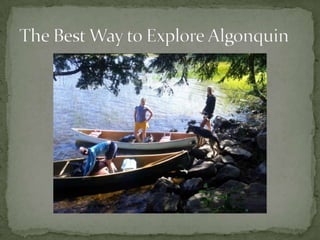
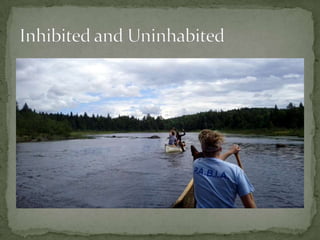
  • #11 Although Algonquin has a variety of camping options, from fully serviced RV sites to cabins, the best way to see the park is by exploring the ‘interior’ by canoe. Away from electrical distraction the pristine beauty of the park is best seen away from road access.
  • #12 Connecting to the land is important, and Algonquin offers this opportunity for millions. Accessible, yet forgotten,it is like travelling back in time.
  • #13 The sense of camaraderie with Canada’s past cannot be denied. Ours is a land whose geography has long lent itself to trade by waterway and travel by canoe.
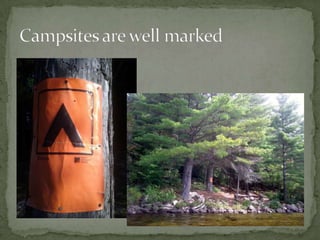
  • #14 Campsites are clearly marked with orange signs depicting a tenting symbol and can be clearly viewed from the water.
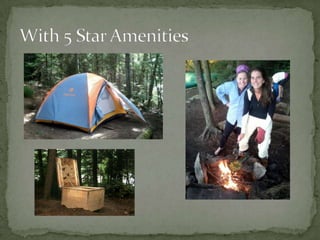
  • #15 Each campsite has flat areas to pitch tents, campfire pits, and treasure chests for human waste, ensuring the woods are not mined with the deposits of visitors past.
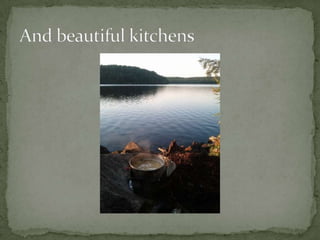
  • #16 Although each site has a fire pit, it is important to remember not to cut down growing trees and to minimize wood burned. Healthy forests rely of decomposing lumber for replenishment. Besides, with a camp stove one discovers that Algonquin offers some of the most beautiful kitchen space in the world.
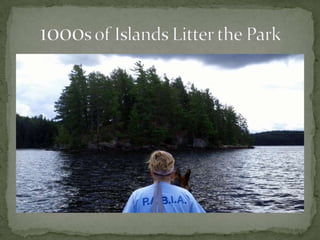
  • #17 Big lakes give way to thousands of islands, many of which offer access to some of the most beautiful campsites in the park.
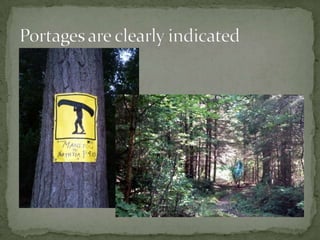
  • #18 Lakes that are inaccessible by waterway are linked by portages, clearly indicated trails that allow you to haul your boats and gear from one lake to another. The ability to pack light, the satisfaction of excursion, and the variety of a walk after a long paddle all add to the attraction.
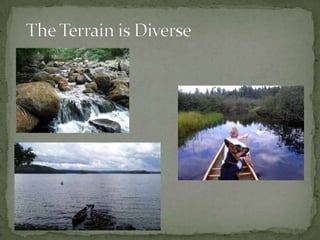
  • #19 But the size of the park offers tremendous variety, with the south populated by deciduous trees and the north largely populated by large pines. The variety of big, clear lakes with smaller winding rivers and moving water promises something for every type of canoeist.Algonquin Park is home to literally hundreds of rivers, streams, and lakes. All are linked either by water or short portages. It is possible to paddles hundreds of kilometres’ through a variety of waterways, experiencing a range of flora, fauna, mosses, and wildlife.
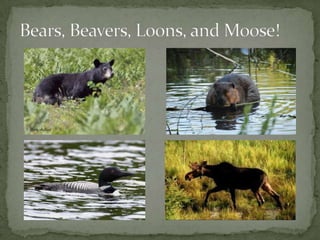
  • #20 The park is peppered with wildlife. Foxes and coyotes, birds of all kinds, bears, beavers, moose, deer – a virtual cornucopia of wildlife that can be seen in their natural home. Algonquin is both a refuge for the disappearing habitat of the animals who live here, and a place where humans and wildlife can exist harmoniously, side by side.
  • #21 A great way to end a trip, Liam’s Poutine on the road out only a couple of kilometers from the put in/take-out. After eating food cooked on a camp stove or over a fire, the deep fried goods taste just a little bit sweeter.
  • #22 Depending on your experience and fitness level, a three day-loop from Kiosk might look like this: Alternatively this loop could be broken into a longer trip extending five or six days.