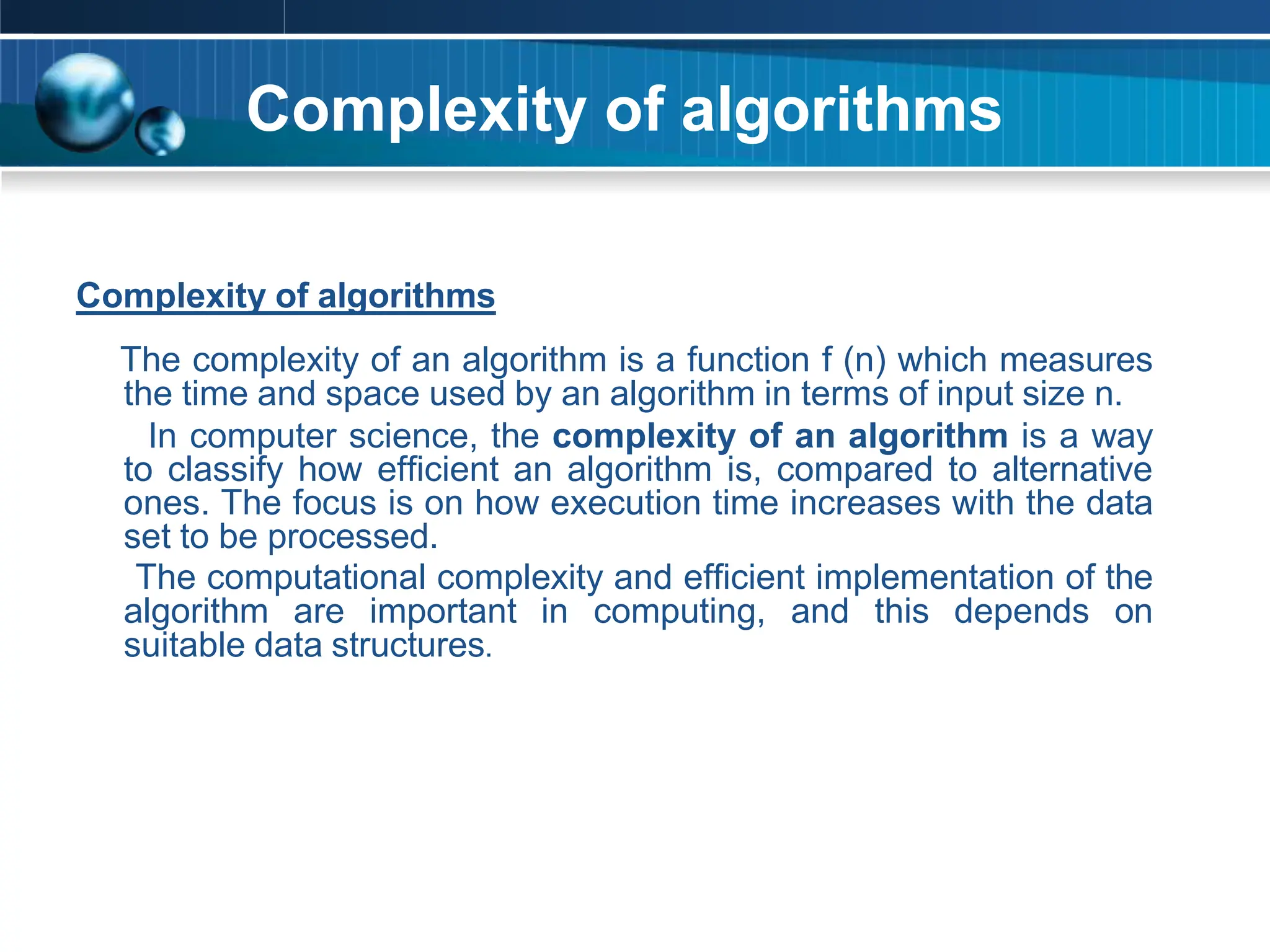
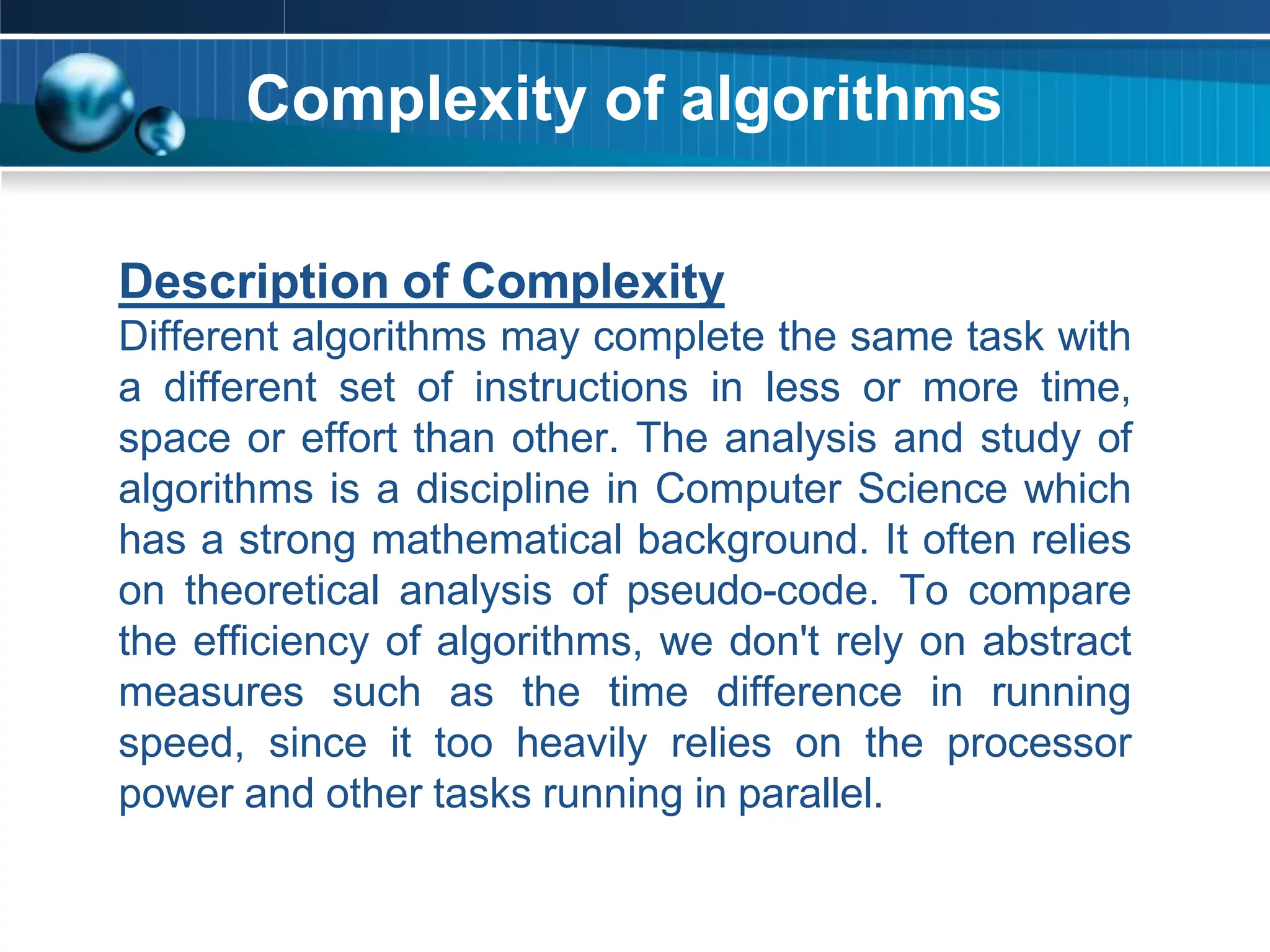
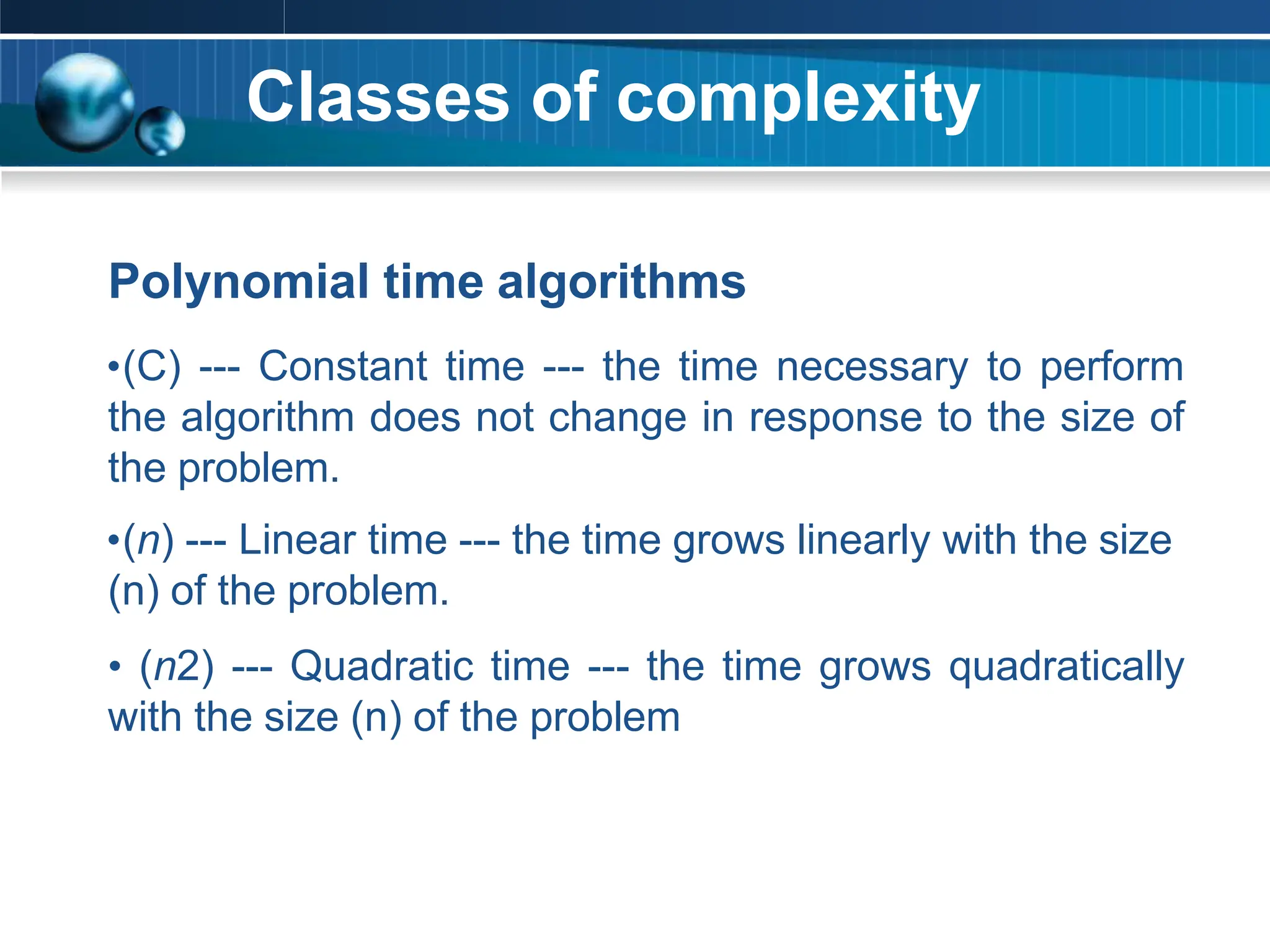
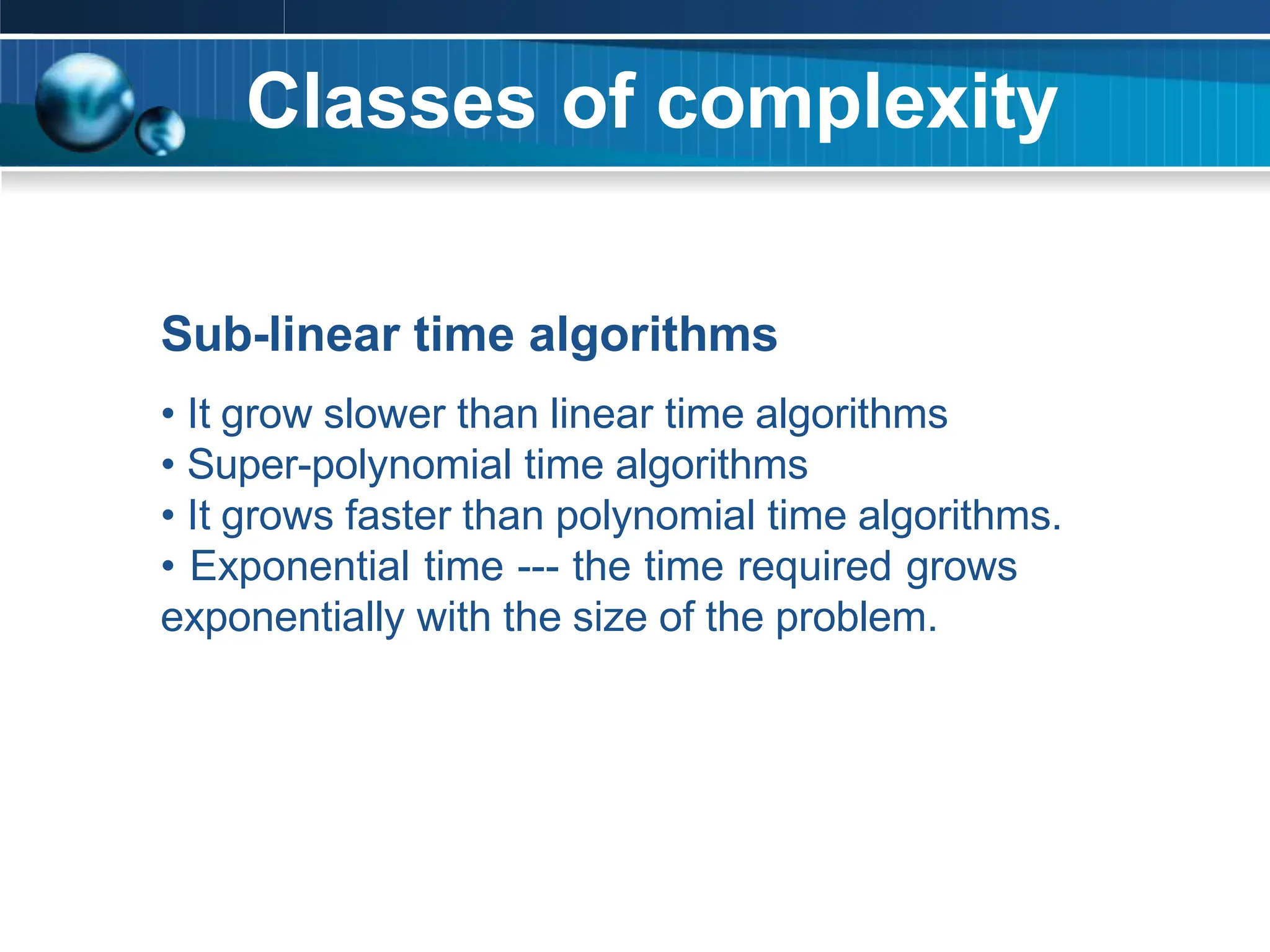
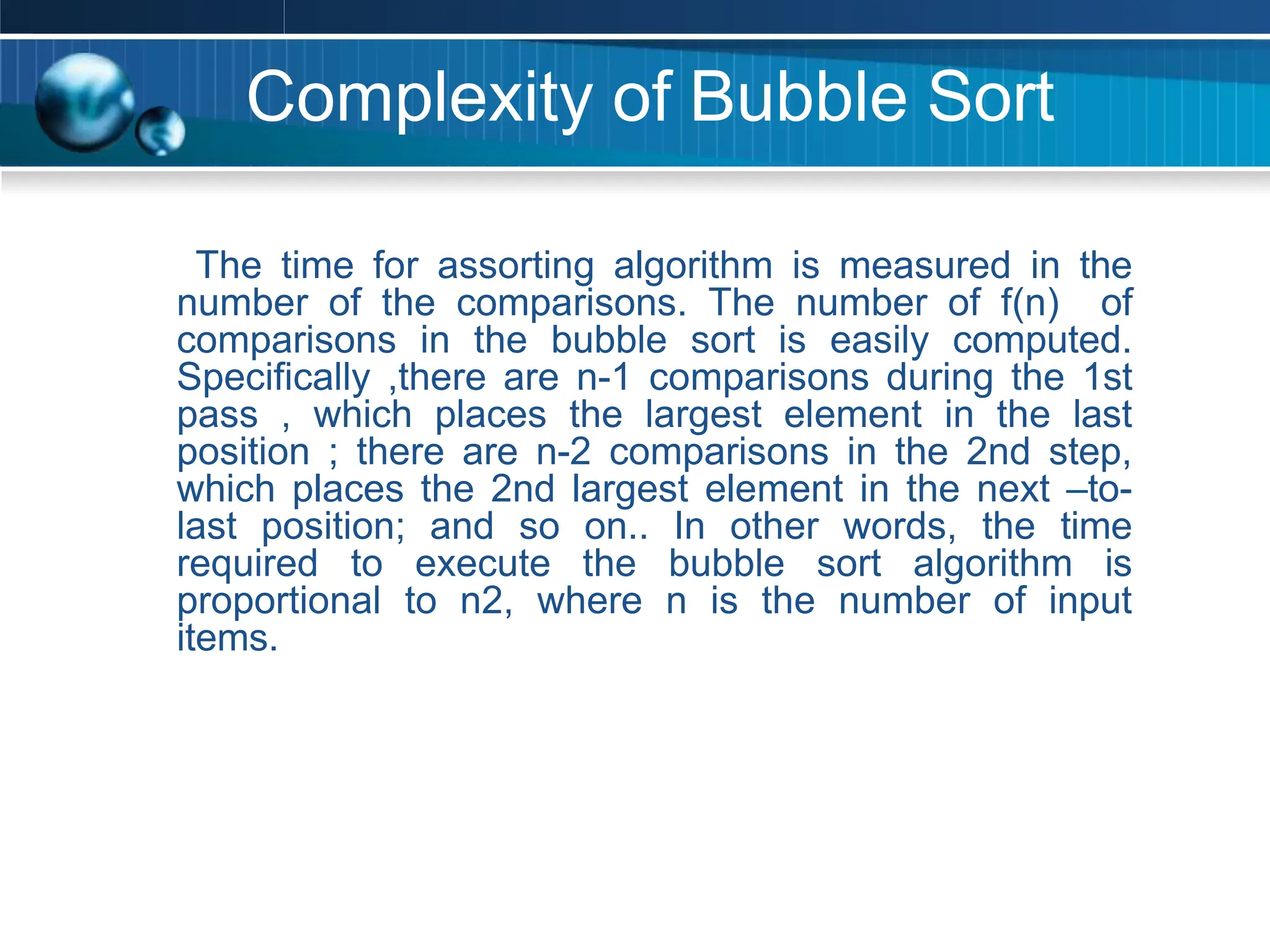
This document discusses the complexity of algorithms and the tradeoff between time and space complexity. It defines algorithm complexity as a function of input size that measures the time and space used. Different algorithms can solve the same problem with varying time and space efficiency. Common complexity classes include constant, linear, quadratic, and exponential time. The document provides examples of analyzing the time complexity of bubble sort and linear search algorithms. It describes how space-time tradeoffs can reduce time complexity by increasing space usage, such as storing pre-computed values. Genetic algorithms are also discussed as a method to efficiently solve large-scale construction time-cost tradeoff problems.
![Example of finding the complexity of an
algorithm
BUBBLE SORT
For ( int I = 0 ; I < 5 ; I ++ )
For ( int j = 0 ; j < 4 ; j ++ )
If (A [ j ] > A [ j + 1 ] ) {
Temp = A [ j ] ;
A [ j ] = A [ j+1 ] ;
A [ j + 1 ] =Temp;
}](https://image.slidesharecdn.com/algocomplexity-240209150413-fb58150c/75/algocomplexity-cost-effective-tradeoff-in-7-2048.jpg)
![Example of finding the complexity of an
algorithm
Linear Search
Int array[10]={10,20,30,40,50,60,70,80,90,100};
Int I,n, Loc=-1;
Cout<<“Enter the value to find “;
Cin>>n;
For(i=0;I<10;I++)
if(array[I]==n)
Loc=I;
If(Loc==-1)
Cout<<“Value not found”;
Else
Cout<<“The value”<<n<<“is found at index “<<Loc;](https://image.slidesharecdn.com/algocomplexity-240209150413-fb58150c/75/algocomplexity-cost-effective-tradeoff-in-9-2048.jpg)


![[DSC Europe 25] Max Talanov - Non digital NNs.pptx](https://cdn.slidesharecdn.com/ss_thumbnails/wif8tr3gtua74qvtopke-non-digital-nns-251205090438-26b0eea6-thumbnail.jpg?width=640&height=640&fit=bounds)

![[DSC Europe 25] Boris Perkovic - Lost in performance.pptx](https://cdn.slidesharecdn.com/ss_thumbnails/uq5hrp7vsuahqkxzifux-1-251204082258-fd2ee09d-thumbnail.jpg?width=640&height=640&fit=bounds)


![[DSC Europe 25] Marija Vlajkovic & Andrea Radonjanin - Integration of AI tool...](https://cdn.slidesharecdn.com/ss_thumbnails/qf1jrglttoc3bm8s3aop-final-integration-of-ai-tools-251208151905-394f3a6a-thumbnail.jpg?width=640&height=640&fit=bounds)


![[DSC Europe 25] Jim Sterne - Adopting Generative AI Capabilities Into the Ent...](https://cdn.slidesharecdn.com/ss_thumbnails/sxhpofuorcagxsaulkmt-3-251204082258-7e66bc48-thumbnail.jpg?width=640&height=640&fit=bounds)
![[DSC Europe 25] Dragana Ilic - AI for Big Data in Astronomy.pptx](https://cdn.slidesharecdn.com/ss_thumbnails/8palya86qaatvjhva1ms-2-dragana-ilic-ai-ilic-251208151906-652b819c-thumbnail.jpg?width=640&height=640&fit=bounds)


![[DSC Europe 25] Andy Cotgreave - Nothing is new in analytics.pptx](https://cdn.slidesharecdn.com/ss_thumbnails/mba4vzcurvoh5lfrd5zw-6-251205194645-341bbbbe-thumbnail.jpg?width=640&height=640&fit=bounds)