ALERTA DENGUE
Support: Brazilian Ministry of Health
What is Alerta Dengue?
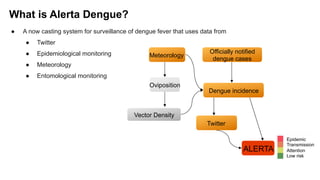
●  A now casting system for surveillance of dengue fever that uses data from
●  Twitter
●  Epidemiological monitoring
●  Meteorology
●  Entomological monitoring
Epidemic
Transmission
Attention
Low risk
Meteorology
Vector Density
Dengue incidence
Oviposition
Officially notified
dengue cases
Twitter
ALERTA
What is Alerta Dengue?
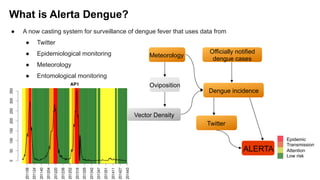
●  A now casting system for surveillance of dengue fever that uses data from
●  Twitter
●  Epidemiological monitoring
●  Meteorology
●  Entomological monitoring
Epidemic
Transmission
Attention
Low risk
Meteorology
Vector Density
Dengue incidence
Oviposition
Officially notified
dengue cases
Twitter
ALERTA
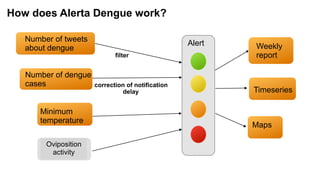
How does Alerta Dengue work?
Number of tweets
about dengue
Number of dengue
cases
Oviposition
activity
Minimum
temperature
Timeseries
Maps
Alert
correction of notification
delay
filter
Weekly
report
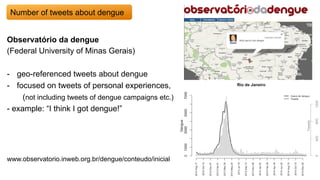
www.observatorio.inweb.org.br/dengue/conteudo/inicial
Observatório da dengue
(Federal University of Minas Gerais)
-  geo-referenced tweets about dengue
-  focused on tweets of personal experiences,
(not including tweets of dengue campaigns etc.)
- example: “I think I got dengue!”
Number of tweets about dengue
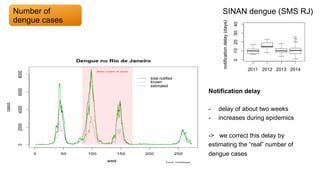
Number of
dengue cases
total notified
known
estimated
week
SINAN dengue (SMS RJ)
notificationdelay(days)
Notification delay
-  delay of about two weeks
-  increases during epidemics
-> we correct this delay by
estimating the “real” number of
dengue cases
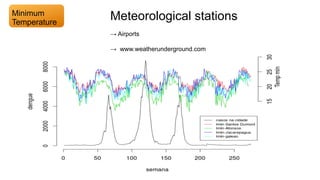
Meteorological stations
→ Airports
→ www.weatherunderground.com
Minimum
Temperature
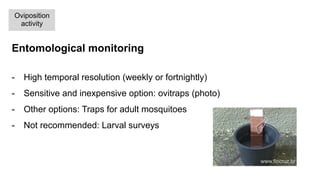
Entomological monitoring
-  High temporal resolution (weekly or fortnightly)
-  Sensitive and inexpensive option: ovitraps (photo)
-  Other options: Traps for adult mosquitoes
-  Not recommended: Larval surveys
Oviposition
activity
www.fiocruz.br
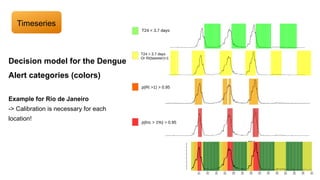
Decision model for the Dengue
Alert categories (colors)
Example for Rio de Janeiro
-> Calibration is necessary for each
location!
T24 < 3.7 days
T24 > 3.7 days
Or Rt(tweeter)>1
p(Rt >1) > 0.95
p(Inc > 1%) > 0.95
Timeseries
Timeseries
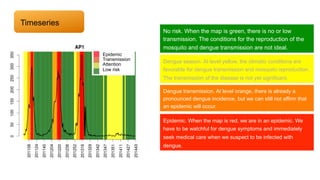
Epidemic
Transmission
Attention
Low risk
No risk. When the map is green, there is no or low
transmission. The conditions for the reproduction of the
mosquito and dengue transmission are not ideal.
Dengue season. At level yellow, the climatic conditions are
favorable for dengue transmission and mosquito reproduction.
The transmission of the disease is not yet significant.
Dengue transmission. At level orange, there is already a
pronounced dengue incidence, but we can still not affirm that
an epidemic will occur.
Epidemic. When the map is red, we are in an epidemic. We
have to be watchful for dengue symptoms and immediately
seek medical care when we suspect to be infected with
dengue.
Example Alerta Dengue Rio
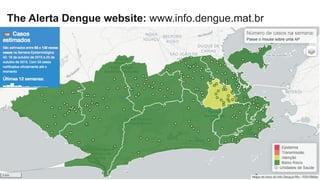
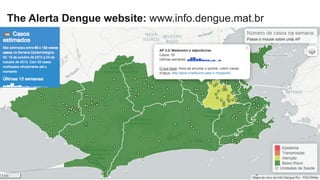
http://info.dengue.mat.br
-  At the moment we use the following data:
-  Twitter
-  Officially notified dengue cases
-  Climate
-  We are planning to include entomological monitoring data
-  Ovitraps
The Alerta Dengue website: www.info.dengue.mat.br
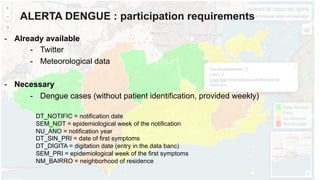
-  Already available
-  Twitter
-  Meteorological data
-  Necessary
-  Dengue cases (without patient identification, provided weekly)
DT_NOTIFIC = notification date
SEM_NOT = epidemiological week of the notification
NU_ANO = notification year
DT_SIN_PRI = date of first symptoms
DT_DIGITA = digitation date (entry in the data banc)
SEM_PRI = epidemiological week of the first symptoms
NM_BAIRRO = neighborhood of residence
ALERTA DENGUE : participation requirements
ALERTA DENGUE
Apoio: Ministério da Saúde

Alerta_Dengue simplified english

  • 1.
  • 2.
    What is AlertaDengue? ●  A now casting system for surveillance of dengue fever that uses data from ●  Twitter ●  Epidemiological monitoring ●  Meteorology ●  Entomological monitoring Epidemic Transmission Attention Low risk Meteorology Vector Density Dengue incidence Oviposition Officially notified dengue cases Twitter ALERTA
  • 3.
    What is AlertaDengue? ●  A now casting system for surveillance of dengue fever that uses data from ●  Twitter ●  Epidemiological monitoring ●  Meteorology ●  Entomological monitoring Epidemic Transmission Attention Low risk Meteorology Vector Density Dengue incidence Oviposition Officially notified dengue cases Twitter ALERTA
  • 4.
    How does AlertaDengue work? Number of tweets about dengue Number of dengue cases Oviposition activity Minimum temperature Timeseries Maps Alert correction of notification delay filter Weekly report
  • 5.
    www.observatorio.inweb.org.br/dengue/conteudo/inicial Observatório da dengue (FederalUniversity of Minas Gerais) -  geo-referenced tweets about dengue -  focused on tweets of personal experiences, (not including tweets of dengue campaigns etc.) - example: “I think I got dengue!” Number of tweets about dengue
  • 6.
    Number of dengue cases totalnotified known estimated week SINAN dengue (SMS RJ) notificationdelay(days) Notification delay -  delay of about two weeks -  increases during epidemics -> we correct this delay by estimating the “real” number of dengue cases
  • 7.
    Meteorological stations → Airports →www.weatherunderground.com Minimum Temperature
  • 8.
    Entomological monitoring -  Hightemporal resolution (weekly or fortnightly) -  Sensitive and inexpensive option: ovitraps (photo) -  Other options: Traps for adult mosquitoes -  Not recommended: Larval surveys Oviposition activity www.fiocruz.br
  • 9.
    Decision model forthe Dengue Alert categories (colors) Example for Rio de Janeiro -> Calibration is necessary for each location! T24 < 3.7 days T24 > 3.7 days Or Rt(tweeter)>1 p(Rt >1) > 0.95 p(Inc > 1%) > 0.95 Timeseries
  • 10.
    Timeseries Epidemic Transmission Attention Low risk No risk.When the map is green, there is no or low transmission. The conditions for the reproduction of the mosquito and dengue transmission are not ideal. Dengue season. At level yellow, the climatic conditions are favorable for dengue transmission and mosquito reproduction. The transmission of the disease is not yet significant. Dengue transmission. At level orange, there is already a pronounced dengue incidence, but we can still not affirm that an epidemic will occur. Epidemic. When the map is red, we are in an epidemic. We have to be watchful for dengue symptoms and immediately seek medical care when we suspect to be infected with dengue.
  • 11.
    Example Alerta DengueRio http://info.dengue.mat.br -  At the moment we use the following data: -  Twitter -  Officially notified dengue cases -  Climate -  We are planning to include entomological monitoring data -  Ovitraps
  • 12.
    The Alerta Denguewebsite: www.info.dengue.mat.br
  • 13.
    The Alerta Denguewebsite: www.info.dengue.mat.br
  • 14.
    -  Already available - Twitter -  Meteorological data -  Necessary -  Dengue cases (without patient identification, provided weekly) DT_NOTIFIC = notification date SEM_NOT = epidemiological week of the notification NU_ANO = notification year DT_SIN_PRI = date of first symptoms DT_DIGITA = digitation date (entry in the data banc) SEM_PRI = epidemiological week of the first symptoms NM_BAIRRO = neighborhood of residence ALERTA DENGUE : participation requirements
  • 15.