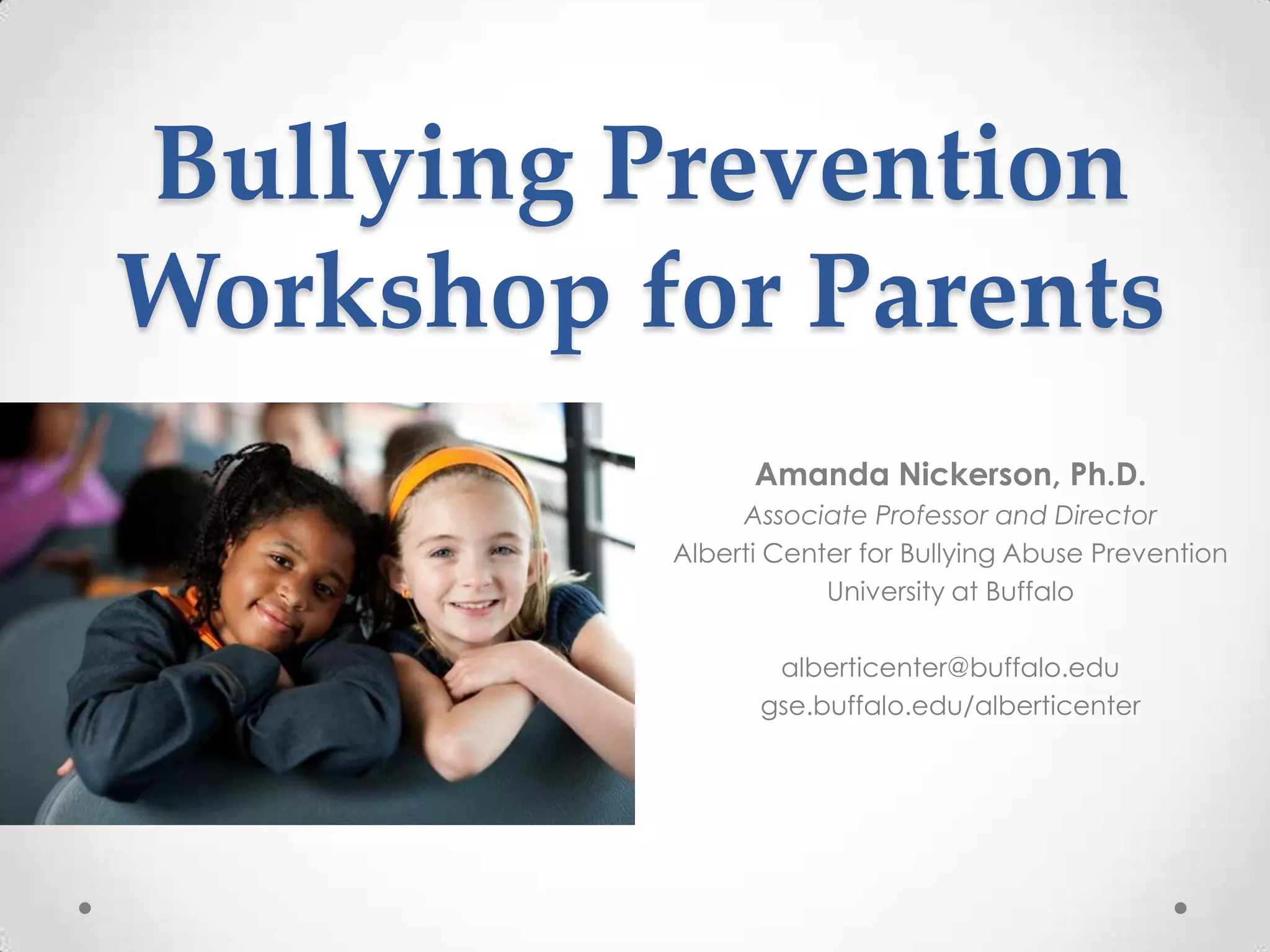
Bullying Prevention
Workshop for Parents
                Amanda Nickerson, Ph.D.
               Associate Professor and Director
          Alberti Center for Bullying Abuse Prevention
                      University at Buffalo

                 alberticenter@buffalo.edu
                gse.buffalo.edu/alberticenter
Key Points of Presentation
• What is Bullying?

• Recognize the Warning Signs

• “Bullyproofing” My Child

• My Child is Being Bullied

• My Child Might Be Bullying Others

• How Do I Get Help?
What is Bullying?
What is Bullying?

Intentional, usually repeated
acts of verbal, physical, or
written aggression by a peer
(or group of peers) operating
from a position of strength or
power with the goal of hurting
the victim physically or
damaging status and/or social
reputation

        Olweus (1978); United States Department of Education (1998)
What are the Different
         Types of Bullying?
• Physical bullying
   o punching, shoving, acts that hurt people

• Verbal bullying
   o name calling, making offensive remarks

• Indirect bullying
   o spreading rumors, excluding, ganging up

• Cyber bullying
   o sending insulting messages, pictures or threats by
     e-mail, text messaging, chat rooms

                      Hinduja & Patchin (2009)
How is Bullying Different
    from Teasing and Conflict?
Bullying: Based on a power
imbalance; intent to cause
psychological or physical harm;
usually repeated


                        Teasing: Fun, good-natured,
                        “give-and-take” between friends
                        to get both parties to laugh


Conflict: A
struggle, dispute, or
misunderstanding between
two equal forces
When and Where
        Does Bullying Occur?
• Pre-K through late high school (and beyond); peaks
  in grades 4-7

• Can happen anywhere, but it is most likely to occur
  in less closely supervised areas (bus, locker
  room, hallways, playground, online)
Is Bullying Different
                     in Boys and Girls?
• Boys
     o More direct, physical bullying
     o Bully more frequently than girls
     o Bully both boys and girls

• Girls
     o More indirect (harder to detect)
     o Often occurs in groups and with girls of same age
     o Cyberbullying slightly more common than for males


Banks (2000); Cook, Williams, Guerra, Kim, & Sadek, (2010); Crick & Grotpeter, (1995); Hinduja & Patchi (2009);
               Hoover & Oliver, (1996); Nansel et al., (2001); Olweus, (2002); Underwood, (2003)
What do we Know about
       Students who Bully?
• Desire for power and control
• Get satisfaction from others’ suffering
• Justify their behavior (“he deserved it”)
• More exposed to physical punishment
• More likely to be depressed
• May have other problem behaviors (alcohol and
  drug use, fighting)


         Batsche & Knoff (1994); Beaver, Perron, & Howard, (2010); Olweus (1993);
                Swearer et al. (in press); Vaughn, Bender, DeLisi, (in press)
Recognize the
Warning Signs
What are Signs that Child
       May be Bullying Others?
•   Refer to others negatively (wimp, loser)
•   Lack empathy
•   Strong need to get his or her own way
•   Hostile/defiant attitude
•   Anger easily
•   Deny involvement or blame others when behavior is
    addressed
What are Characteristics of
     Children who are Bullied?
• Have a position of relative weakness
   o Age, ethnic background, financial status, disability, sexual orientation


• Most are passive and lack assertiveness
   o Do nothing to invite aggression
   o Do not fight back when attached
   o May relate better to adults than peers


• Some provoke others
   o Offend, irritate, tease others
   o Reactive; fight back when attacked


                   Boivin, Poulin, & Vitaro (1994); Hodges & Perry (1999);
                 Olweus (1978, 1993, 2001); Schwartz (2000); Snyder et al. (2003)
What are Kids Bullied About?
• Appearance/body size

• Perceived sexual orientation
• How masculine or feminine they appear to be
• Ability at school (“invisible” disabilities)
• Race/ethnicity
• Money
• Religion


   “If they look different, love different, or walk different”
                           - Kevin Jennings
What are Signs that
            Child May be Bullied
• Unexplained illnesses, cuts/bruises

• Not wanting to go to school or be in social situations

• Any change in behavior
   o Not interested in doing things that he/she used to like doing
   o Withdrawn
What are Consequences for
    Youth who Bully?
• More likely to experience legal or criminal troubles
  as adults
• Poor ability to develop and maintain positive
  relationships in later life


                            Andershed, Kerr, & Stattin (2001); Farrington (2009);
                           Farrington, & Ttofi (2009, 2011); Oliver, Hoover, & Hazler
                                (1994); Olweus (1993); Ttofi & Farrington (2008)
What are Consequences for
      Targets of Bullying?
• Emotional distress
• Loneliness, peer rejection
• Desire to avoid school
• Increased anxiety, depression, suicidal ideation; low
  self-esteem
• In some cases, may respond with extreme violence


    Boivin, Hymel, & Bukowski (1995);
    Boulton & Underwood (1992);
    Crick & Bigbee (1998);
    Egan & Perry (1998);
    Hinduja, & Patchin, (2009);
    Kochenderfer & Ladd (1996);
    Nickerson & Sltater (2009);
    Olweus (1993); Perry et al. (1988)
“Bullyproofing”
   My Child
Be a Positive Role Model
• Talk with and listen to your child (about school,
  peers, interests

• Listen to and validate concerns about friends and
  other students

• Treat others with dignity and respect

• Avoid using derogatory terms toward or about
  others in person and/or electronically

         (View Think Before You Speak video)


                Hymel, Nickerson, & Swearer Education.com
Get and Stay Involved
• Get involved in school, in community, and at home
   o Do so in a developmentally appropriate way (mindful of child’s and
     school’s preference)

• Visit school’s website and read newsletters
• Know the school’s policies in terms of bullying
  prevention and intervention
• Join the PTA and volunteer
• Attend extracurricular and sporting events
   o Support child’s talents and competence
   o Get to know coaches, counselors, and leaders
Teach Children Good Habits
     Early and Consistently
• Have high expectations for behavior and a low
  tolerance for being mean

• Be specific about how specific words and behaviors
  can hurt others

• Teach better ways to respond
  (All feelings are OK –
  but not all behaviors are OK)

• Emphasize the importance
  of being a friend
Bullying, Friendship, and
      Relationships


     Visit gse.buffalo.edu/alberticenter
for other resources and conversation starters
Teach Children to be
    Upstanders, not Bystanders
• Don’t join in… speak up if it is safe to do so

• Band together as a group against bullies

• Tell an adult about the bullying
   o Tattling/ratting = telling an adult to get someone in trouble
   o Telling/reporting = telling an adult because someone’s behavior is unsafe
     or hurtful to another


• Reach out to isolated peers, offer support

• See http://wearethesolution.net
Cyberbullying Prevention
• Teach responsible use of technology
   o Only communicate things that you would be OK
     about your parents seeing
   o Follow rules (no Facebook under age of 13)
   o Beware of anonymous sites like Formspring
   o Use the “off” switch
       • Do not respond to upsetting communications


• Supervise and limit activities (no 24/7)
   o Have computers in common areas (not in
     bedroom)
   o Know child’s password
   o Be friend on Facebook
   o Bring cell phones, computers to parents’ room to
     charge overnight
My Child is
Being Bullied
If Your Child is Being Bullied
           (View From the Mouth of Youth video)

• Listen and empathize
   o “Tell me what happened”
   o “That must have been very scary for you”
   o Thank child for telling you


• Take it seriously
   o Do not minimize of trivialize
If Your Child is Being Bullied
• Work with child to find out more about situation and
  to problem-solve
   o Responses like “just ignore it,” “give him a good whack,” what did you do
     to bother him or her?” won’t help


• Work in partnership with school and with outside
  professionals if needed

• Follow-up
My Child Might Be
 Bullying Others
If Your Child is Bullying Others
• Send clear, firm, and supportive message that the
  behavior is not OK and that you are going to work
  with child to change it (meaningful consequences)

• Try to figure out why your child is bullying
   o   Desire for social power or status?
   o   Temperament issue that needs more adult regulation?
   o   Going along with peers?
   o   Being bullied by others and lashing out?
If Your Child is Bullying Others
• Work with teacher or counselor to plan for change
  o Involve child in developing alternate behaviors or ideas to gain leadership
    and “social status” that don’t involve bullying others


• Provide specific examples (from your experience;
  carefully screened books and media)
How Do I Get Help?
Know that there are
               Resources Available
Local Resources for Families
•   Family Resource Centers (Cleveland Hill 836-7200 Ext. 8363)
•   Catholic Charities – 218-1400
•   Child & Adolescent Treatment Services Intake – 835-780
•   Child & Family Services – 842-750
•   Prevention Focus/Teen Focus – 884-3256
•   Erie County Council for the Prevention of Alcohol & Substance
    Abuse – 831-2298
•   Mental Health Association of Erie County – 886-1242
•   Police (911)

Referrals for Students in Crisis
•   1-800-273-TALK (Suicide Lifeline)
•   1-866-4-U-Trevor (LGBTQ Youth Suicide Hotline)
•   716-834-1144 or 1-877-KIDS-400 (Buffalo Crisis Services Hotline)
Questions?
      Thank you for your attention and interest!


                              To make the best use of our
                              time, please make sure your
                              question is…
                              1. A question, rather than a
                                 statement
                              1. Something I am likely to
                                 be able to answer


For more resources, please visit us at gse.buffalo.edu/alberticenter

Alberti Center Sample Presentation for Parents

  • 1.
    Bullying Prevention Workshop forParents Amanda Nickerson, Ph.D. Associate Professor and Director Alberti Center for Bullying Abuse Prevention University at Buffalo alberticenter@buffalo.edu gse.buffalo.edu/alberticenter
  • 2.
    Key Points ofPresentation • What is Bullying? • Recognize the Warning Signs • “Bullyproofing” My Child • My Child is Being Bullied • My Child Might Be Bullying Others • How Do I Get Help?
  • 3.
  • 4.
    What is Bullying? Intentional,usually repeated acts of verbal, physical, or written aggression by a peer (or group of peers) operating from a position of strength or power with the goal of hurting the victim physically or damaging status and/or social reputation Olweus (1978); United States Department of Education (1998)
  • 5.
    What are theDifferent Types of Bullying? • Physical bullying o punching, shoving, acts that hurt people • Verbal bullying o name calling, making offensive remarks • Indirect bullying o spreading rumors, excluding, ganging up • Cyber bullying o sending insulting messages, pictures or threats by e-mail, text messaging, chat rooms Hinduja & Patchin (2009)
  • 6.
    How is BullyingDifferent from Teasing and Conflict? Bullying: Based on a power imbalance; intent to cause psychological or physical harm; usually repeated Teasing: Fun, good-natured, “give-and-take” between friends to get both parties to laugh Conflict: A struggle, dispute, or misunderstanding between two equal forces
  • 7.
    When and Where Does Bullying Occur? • Pre-K through late high school (and beyond); peaks in grades 4-7 • Can happen anywhere, but it is most likely to occur in less closely supervised areas (bus, locker room, hallways, playground, online)
  • 8.
    Is Bullying Different in Boys and Girls? • Boys o More direct, physical bullying o Bully more frequently than girls o Bully both boys and girls • Girls o More indirect (harder to detect) o Often occurs in groups and with girls of same age o Cyberbullying slightly more common than for males Banks (2000); Cook, Williams, Guerra, Kim, & Sadek, (2010); Crick & Grotpeter, (1995); Hinduja & Patchi (2009); Hoover & Oliver, (1996); Nansel et al., (2001); Olweus, (2002); Underwood, (2003)
  • 9.
    What do weKnow about Students who Bully? • Desire for power and control • Get satisfaction from others’ suffering • Justify their behavior (“he deserved it”) • More exposed to physical punishment • More likely to be depressed • May have other problem behaviors (alcohol and drug use, fighting) Batsche & Knoff (1994); Beaver, Perron, & Howard, (2010); Olweus (1993); Swearer et al. (in press); Vaughn, Bender, DeLisi, (in press)
  • 10.
  • 11.
    What are Signsthat Child May be Bullying Others? • Refer to others negatively (wimp, loser) • Lack empathy • Strong need to get his or her own way • Hostile/defiant attitude • Anger easily • Deny involvement or blame others when behavior is addressed
  • 12.
    What are Characteristicsof Children who are Bullied? • Have a position of relative weakness o Age, ethnic background, financial status, disability, sexual orientation • Most are passive and lack assertiveness o Do nothing to invite aggression o Do not fight back when attached o May relate better to adults than peers • Some provoke others o Offend, irritate, tease others o Reactive; fight back when attacked Boivin, Poulin, & Vitaro (1994); Hodges & Perry (1999); Olweus (1978, 1993, 2001); Schwartz (2000); Snyder et al. (2003)
  • 13.
    What are KidsBullied About? • Appearance/body size • Perceived sexual orientation • How masculine or feminine they appear to be • Ability at school (“invisible” disabilities) • Race/ethnicity • Money • Religion “If they look different, love different, or walk different” - Kevin Jennings
  • 14.
    What are Signsthat Child May be Bullied • Unexplained illnesses, cuts/bruises • Not wanting to go to school or be in social situations • Any change in behavior o Not interested in doing things that he/she used to like doing o Withdrawn
  • 15.
    What are Consequencesfor Youth who Bully? • More likely to experience legal or criminal troubles as adults • Poor ability to develop and maintain positive relationships in later life Andershed, Kerr, & Stattin (2001); Farrington (2009); Farrington, & Ttofi (2009, 2011); Oliver, Hoover, & Hazler (1994); Olweus (1993); Ttofi & Farrington (2008)
  • 16.
    What are Consequencesfor Targets of Bullying? • Emotional distress • Loneliness, peer rejection • Desire to avoid school • Increased anxiety, depression, suicidal ideation; low self-esteem • In some cases, may respond with extreme violence Boivin, Hymel, & Bukowski (1995); Boulton & Underwood (1992); Crick & Bigbee (1998); Egan & Perry (1998); Hinduja, & Patchin, (2009); Kochenderfer & Ladd (1996); Nickerson & Sltater (2009); Olweus (1993); Perry et al. (1988)
  • 17.
  • 18.
    Be a PositiveRole Model • Talk with and listen to your child (about school, peers, interests • Listen to and validate concerns about friends and other students • Treat others with dignity and respect • Avoid using derogatory terms toward or about others in person and/or electronically (View Think Before You Speak video) Hymel, Nickerson, & Swearer Education.com
  • 19.
    Get and StayInvolved • Get involved in school, in community, and at home o Do so in a developmentally appropriate way (mindful of child’s and school’s preference) • Visit school’s website and read newsletters • Know the school’s policies in terms of bullying prevention and intervention • Join the PTA and volunteer • Attend extracurricular and sporting events o Support child’s talents and competence o Get to know coaches, counselors, and leaders
  • 20.
    Teach Children GoodHabits Early and Consistently • Have high expectations for behavior and a low tolerance for being mean • Be specific about how specific words and behaviors can hurt others • Teach better ways to respond (All feelings are OK – but not all behaviors are OK) • Emphasize the importance of being a friend
  • 21.
    Bullying, Friendship, and Relationships Visit gse.buffalo.edu/alberticenter for other resources and conversation starters
  • 22.
    Teach Children tobe Upstanders, not Bystanders • Don’t join in… speak up if it is safe to do so • Band together as a group against bullies • Tell an adult about the bullying o Tattling/ratting = telling an adult to get someone in trouble o Telling/reporting = telling an adult because someone’s behavior is unsafe or hurtful to another • Reach out to isolated peers, offer support • See http://wearethesolution.net
  • 23.
    Cyberbullying Prevention • Teachresponsible use of technology o Only communicate things that you would be OK about your parents seeing o Follow rules (no Facebook under age of 13) o Beware of anonymous sites like Formspring o Use the “off” switch • Do not respond to upsetting communications • Supervise and limit activities (no 24/7) o Have computers in common areas (not in bedroom) o Know child’s password o Be friend on Facebook o Bring cell phones, computers to parents’ room to charge overnight
  • 24.
  • 25.
    If Your Childis Being Bullied (View From the Mouth of Youth video) • Listen and empathize o “Tell me what happened” o “That must have been very scary for you” o Thank child for telling you • Take it seriously o Do not minimize of trivialize
  • 26.
    If Your Childis Being Bullied • Work with child to find out more about situation and to problem-solve o Responses like “just ignore it,” “give him a good whack,” what did you do to bother him or her?” won’t help • Work in partnership with school and with outside professionals if needed • Follow-up
  • 27.
    My Child MightBe Bullying Others
  • 28.
    If Your Childis Bullying Others • Send clear, firm, and supportive message that the behavior is not OK and that you are going to work with child to change it (meaningful consequences) • Try to figure out why your child is bullying o Desire for social power or status? o Temperament issue that needs more adult regulation? o Going along with peers? o Being bullied by others and lashing out?
  • 29.
    If Your Childis Bullying Others • Work with teacher or counselor to plan for change o Involve child in developing alternate behaviors or ideas to gain leadership and “social status” that don’t involve bullying others • Provide specific examples (from your experience; carefully screened books and media)
  • 30.
    How Do IGet Help?
  • 31.
    Know that thereare Resources Available Local Resources for Families • Family Resource Centers (Cleveland Hill 836-7200 Ext. 8363) • Catholic Charities – 218-1400 • Child & Adolescent Treatment Services Intake – 835-780 • Child & Family Services – 842-750 • Prevention Focus/Teen Focus – 884-3256 • Erie County Council for the Prevention of Alcohol & Substance Abuse – 831-2298 • Mental Health Association of Erie County – 886-1242 • Police (911) Referrals for Students in Crisis • 1-800-273-TALK (Suicide Lifeline) • 1-866-4-U-Trevor (LGBTQ Youth Suicide Hotline) • 716-834-1144 or 1-877-KIDS-400 (Buffalo Crisis Services Hotline)
  • 32.
    Questions? Thank you for your attention and interest! To make the best use of our time, please make sure your question is… 1. A question, rather than a statement 1. Something I am likely to be able to answer For more resources, please visit us at gse.buffalo.edu/alberticenter