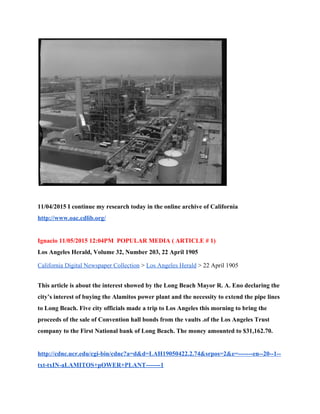
ALAMITOS BAY GROUP 1­Industrial site 
 
WORK JOURNAL ENTRIES: Record your research hours and tasks, and include date for entry 
and all urls, date accessed for all sources­­maps, texts, photos. Remember everything has to be 
traceable. Add an new entry after the previous entry.) 
 
Anell 10/18/15:  
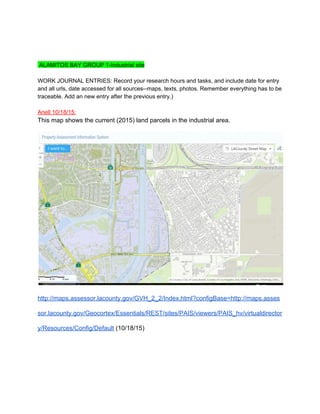
This map shows the current (2015) land parcels in the industrial area. 
 
http://maps.assessor.lacounty.gov/GVH_2_2/Index.html?configBase=http://maps.asses
sor.lacounty.gov/Geocortex/Essentials/REST/sites/PAIS/viewers/PAIS_hv/virtualdirector
y/Resources/Config/Default​ (10/18/15) 


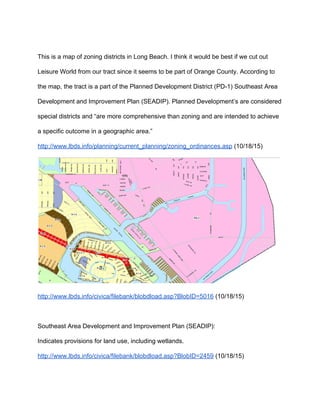
This is a map of zoning districts in Long Beach. I think it would be best if we cut out 
Leisure World from our tract since it seems to be part of Orange County. According to 
the map, the tract is a part of the Planned Development District (PD­1) Southeast Area 
Development and Improvement Plan (SEADIP). Planned Development’s are considered 
special districts and “are more comprehensive than zoning and are intended to achieve 
a specific outcome in a geographic area.” 
http://www.lbds.info/planning/current_planning/zoning_ordinances.asp​ (10/18/15) 
 
http://www.lbds.info/civica/filebank/blobdload.asp?BlobID=5016​ (10/18/15) 
 
Southeast Area Development and Improvement Plan (SEADIP): 
Indicates provisions for land use, including wetlands. 
http://www.lbds.info/civica/filebank/blobdload.asp?BlobID=2459​ (10/18/15) 
 
Anell: 10/19/15 
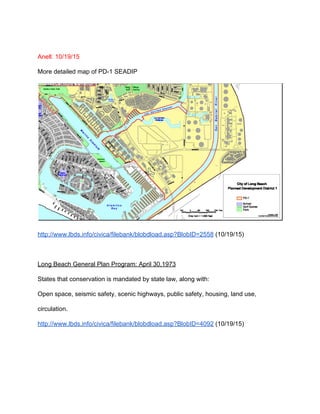
More detailed map of PD­1 SEADIP 
 
http://www.lbds.info/civica/filebank/blobdload.asp?BlobID=2558​ (10/19/15) 
 
Long Beach General Plan Program: April 30,1973 
States that conservation is mandated by state law, along with: 
Open space, seismic safety, scenic highways, public safety, housing, land use, 
circulation. 
http://www.lbds.info/civica/filebank/blobdload.asp?BlobID=4092​ (10/19/15) 


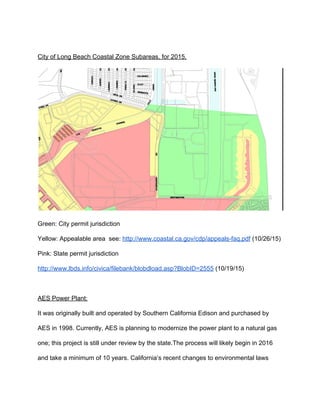
City of Long Beach Coastal Zone Subareas, for 2015. 
 
Green: City permit jurisdiction 
Yellow: Appealable area  see: ​http://www.coastal.ca.gov/cdp/appeals­faq.pdf​ (10/26/15) 
Pink: State permit jurisdiction 
http://www.lbds.info/civica/filebank/blobdload.asp?BlobID=2555​ (10/19/15) 
 
AES Power Plant: 
It was originally built and operated by Southern California Edison and purchased by 
AES in 1998. Currently, AES is planning to modernize the power plant to a natural gas 
one; this project is still under review by the state.The process will likely begin in 2016 
and take a minimum of 10 years. California’s recent changes to environmental laws 
require that power plants drastically reduce the use of ocean water for cooling, which is 
a major factor in the changes that will be made to plant. AES has emphasized that the 
process will not adversely impact the community or the wetlands. 
http://www.aescalifornia.com/facilities/alamitos​ (10/18/15) 
http://www.renewaesalamitos.com/AES­faq.php​ (10/18/15) 


Jessica Dooley 10/21/15 
r 
http://greenvisions.usc.edu/documents/ 
Historic Wetlands along the San Gabriel River 
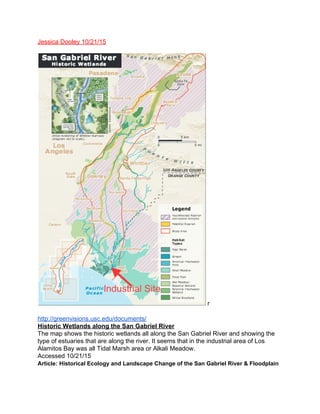
The map shows the historic wetlands all along the San Gabriel River and showing the 
type of estuaries that are along the river. It seems that in the industrial area of Los 
Alamitos Bay was all Tidal Marsh area or Alkali Meadow. 
Accessed 10/21/15  
Article:​ ​Historical Ecology and Landscape Change of the San Gabriel River & Floodplain 
 
 
Sonali Patangay 10/21/15 ( Journal entries 1­4) 
Journal Entry (1): Week 1: 
Environmental Report ( Ceqa reports 2015): Environmental Planning ( 562) 570­6458 
www.lbds.info/planning/environmental.../environmental_reports.asp 
Southeast Area Specific Plan/SEADIP Update 
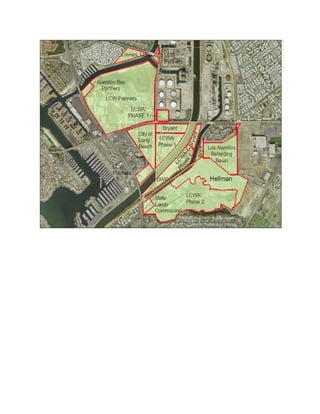
This map shows the current Southeast area specific plan proposal, as it is still 
pending, illustrating the different phases of sub­projects. 
 
http://3.bp.blogspot.com/­UM7Ahmbv7kU/Tnknsk30eYI/AAAAAAAACEU/Y7XYkzg2wj0/s1600/
Los+Cerritos+land+ownership+9­2011.jpg 


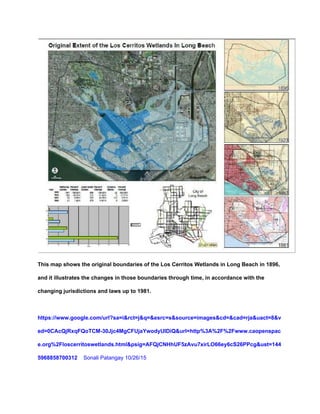
This map shows the original boundaries of the Los Cerritos Wetlands in Long Beach in 1896, 
and it illustrates the changes in those boundaries through time, in accordance with the 
changing jurisdictions and laws up to 1981. 
 
https://www.google.com/url?sa=i&rct=j&q=&esrc=s&source=images&cd=&cad=rja&uact=8&v
ed=0CAcQjRxqFQoTCM­30Jjc4MgCFUjaYwodyUIDiQ&url=http%3A%2F%2Fwww.caopenspac
e.org%2Floscerritoswetlands.html&psig=AFQjCNHhUF5zAvu7xirLO66ey6cS26PPcg&ust=144
5968858700312    ​Sonali Patangay 10/26/15 
 
Status on  ​Southeast Area Specific Plan/SEADIP Update ( EP 562)​ : Pending 
Location: ​On the southeast edge of Long Beach city. This location entails 1,475 acres 
consisting of the area South of 7th street, East of Bellflower Boulevard, East of Long 
Beach Marine Stadium and Alamitos dock, South of Colorado Street. 
Description: ​This project proposes to replace current 1,475 acres PD­1 zoning where a 
specific plan covering 1,466 acres and remove 9 acres from the PD­11 boundaries to 
convert to conventional zoning.Thus, the project seeks to change “the boundaries of 
PD­1 so the two separate areas entail: 1,466 acres within in the boundaries of current 
1,475 acres PD­1 area (specific plan). Area two entails: 9 acres with the current PD­1 
directly west of Marina vista park ( conventional zoning area). Both areas constitute the 
project area”( Ceqa 562:2015). 
Sonali Patangay 10/21/15 ​Journal Entry (2) Week 1 
www.lbds.info/planning/environmental.../environmental_reports.asp 
Environmental Planning ( 562) 570­6458 
Weber Metals Large Press Expansion 
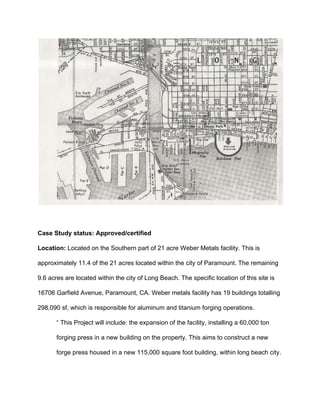
 ​http://longbeachhistory.files.wordpress.com/2011/01/jungle2.jpg​ ​Sonali Patangay 
10/26/15 


Case Study status: Approved/certified 
Location: ​Located on the Southern part of 21 acre Weber Metals facility. This is 
approximately 11.4 of the 21 acres located within the city of Paramount. The remaining 
9.6 acres are located within the city of Long Beach. The specific location of this site is 
16706 Garfield Avenue, Paramount, CA. Weber metals facility has 19 buildings totalling 
298,090 sf, which is responsible for aluminum and titanium forging operations. 
“ This Project will include: the expansion of the facility, installing a 60,000 ton 
forging press in a new building on the property. This aims to construct a new 
forge press housed in a new 115,000 square foot building, within long beach city. 
This will entail an 85 foot deep excavation pit to house the press at a 65 foot high 
main roof to accommodate the height of the press.” 
According to Ceqa report 2015 (562) 570­6458:  
Supporting equipment within, or adjacent to, the forge building would include: 
• Large gas fired furnaces 
• 3 high temperature rotary furnaces for titanium (~1700 degrees)  
• 2 chain drive furnaces for aluminum (~700 degrees)  
• 4 die heating pedestal style furnaces (~700 degrees)  
• 1 die insert heating furnace (~700 degrees)  
• Semi­automated rail bound manipulators  
• Multiple mobile manipulators and fork trucks  
• Cooling systems for oil hydraulic system  
• Quench tank  
• Freezers  
• Die storage and maintenance  
• Overhead cranes  
• Die sand blasting booth with bag house  
• Compressed air system  
• Carbon Dioxide fire suppression system 
 
Sonali Patangay 10/26/15 Journal entry (1) Week 2: 
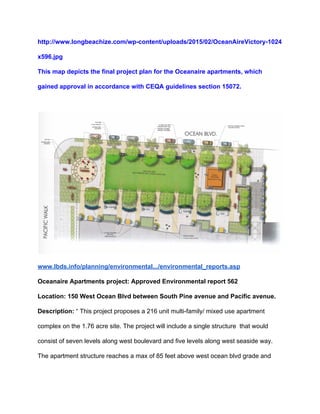
Environmental report (562) Oceanaire apartments Status: approved 
http://www.longbeachize.com/wp­content/uploads/2015/02/OceanAireVictory­1024
x596.jpg 
This map depicts the final project plan for the Oceanaire apartments, which 
gained approval in accordance with CEQA guidelines section 15072. 
 
 
www.lbds.info/planning/environmental.../environmental_reports.asp 
Oceanaire Apartments project: Approved Environmental report 562 
Location: 150 West Ocean Blvd between South Pine avenue and Pacific avenue. 
Description: ​“ This project proposes a 216 unit multi­family/ mixed use apartment 
complex on the 1.76 acre site. The project will include a single structure  that would 
consist of seven levels along west boulevard and five levels along west seaside way. 
The apartment structure reaches a max of 85 feet above west ocean blvd grade and 
106.5 feet above west seaside grade. This includes a mixture of studios, and plus one 
bedrooms”.Per ​CEQA Guidelines ​Section 15072(g)(5), the project site is not listed as a 
hazardous property as designated under Section 65962.5 of the Government Code. 
 
Sonali Patangay 10/26/15 Journal Entry (2) Week 2: 
LB East Division Police Substation Environmental report (562): Status Approved 
www.lbds.info/planning/environmental.../environmental_reports.asp 
Location: ​The proposed East Division Police substation ( here in referenced as the 
“project”). The project is located at 3800 East Willow Street ( between Redondo Avenue 
and Lakewood Blvd) and involves the transfer of the Schroeder Hall property ( owned 
by US Department of defense to the city of Long Beach for relocation on existing East 
Division of police substation and juvenile investigations section). 
“Following a preliminary review of the proposed project, the City of Long Beach determined that the 
improvements are subject to the guidelines and regulations of the California Environmental Quality 
Act (CEQA). The City has determined an Initial Study/Mitigated Negative Declaration (IS/MND) to 
be the appropriate level of environmental analysis under the provisions of CEQA.​ ​As the City is 
seeking a transfer of land under the Base Realignment and Closure (BRAC) program (or a transition 
of surplus military property to civilian uses), the proposed project is also subject to environmental 
review under the National Environmental Policy Act (NEPA)(implementation of which is reviewed 
and approved by the U.S. Department of the Army). NEPA documentation associated with the 
proposed project will be processed by the Department of the Army under separate cover”.​Per 
CEQA Guidelines ​Section 15072(g)(5), the project site is not listed as a 
hazardous property as designated under Section 65962.5 of the Government 
Code. 
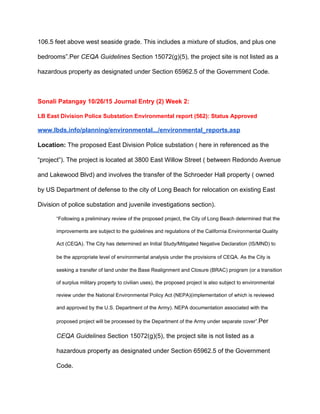
http://www.lbreport.com/images/elb/schro2b.jpg 
 
This is an aerial shot of the Long Beach East Division of the Police Substation, located on 3800 
East Willow Street.This project was approved according to Environmental Report 562, in 
accordance with CEQA 15072. 
 
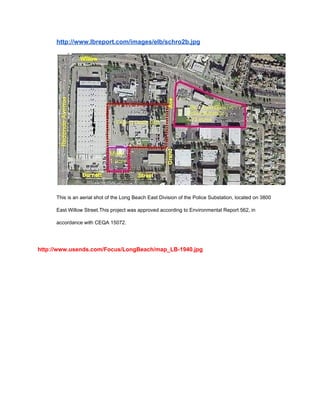
http://www.usends.com/Focus/LongBeach/map_LB­1940.jpg 
 
Sonali Patangay 10/26/15 end of journal entries weeks 1­2. 
Sonali Patangay 10/30/15 Week 3 Journal entries 1­2.  
Journal entry (1) Week 3: 10/31/15 Colorado Lagoon Field trip 
It’s 1pm on saturday, Halloween 2015. I just arrived at the colorado lagoon and it is 
beautiful, the weather is a cool 85 degrees. There is a recreational area for swimming 
and fishing, as well as picnic tables and a playground for families and their children for 
parties and playdates. For the purposes of our field trip today, Dr. Whitcraft is going to 
give us a tour of the lagoon, specifically focusing on the history of the Wetland Marine 
Science education center, which is located on the northeast portion of the lagoon. 
WAMSEC, or the Wetland Marine Science education center, was originally run by the 
Eldorado Center, temporarily. However, the Eldorado Center did not have the funds in 
order to keep the lagoon and it was leased over to the Friends of Colorado Lagoon by 
the city. The friends of Colorado Lagoon, is a nonprofit organization that leases the 
property for $1 annually, while the city of Long Beach pays for the electricity. Historically 
this whole area was all Alamitos Bay, but the Colorado Lagoon sought to expand the 
regional area of Alamitos Bay, as well as the Los Cerritos Wetlands area. The Los 
cerritos Wetlands is owned by what is known as 2 joint powers authority. The Los 
Cerritos wetlands is leased by the Bryant family through the city, and also leased by the 
Hellman family as well, along with the City of Long beach, Seal Beach, and other 
“severed” entities. During the late 1800’s, the Los Cerritos Wetlands, experienced 
salinity changes and ,thus was filled and dredged in 1896.In 1927­1928, the lagoon was 
straightened, which was done for the Olympics.At this time, Naples was almost fully 
created.​ ​Seven years later, Belmont shores, would also be fully constructed as well. 
Sonali Patangay Journal Entry 2 Week 3: Ownership and Development of 
Colorado Lagoon and Administration of the Termino Project. 
In 1931, the lagoon was made to be a tourist site and to this day, it still is. Also 
that same year, the development of this area was finally finished in time for the 
Olympics. This was when they built a new road now called Colorado street. The city 
also built a tide gate ( which made it deeper for diving events). By this era of the 1930’s, 
they trucked sand in from nearby beaches. The area was originally known for being very 
muddy and rocky, and was also used for swimming lessons up until 1960. 
         In 2004, the Office of historic preservation, and the city of Long Beach teamed up 
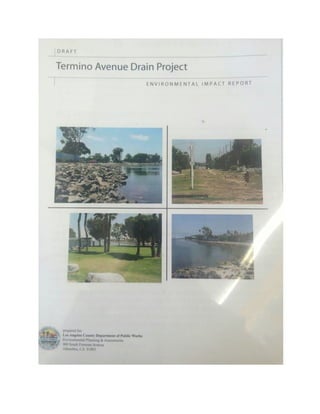
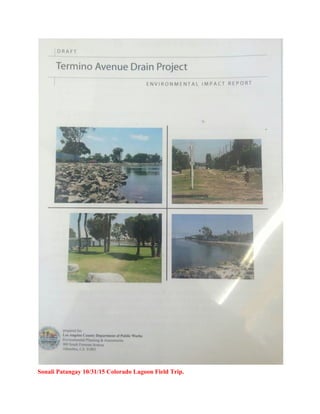
and came up with the idea of the Termino project. The Termino Avenue drain project 
was approved in 2007, according to the LA County public library, Public works volume  
 
 
2. ​Ignacio Garcia 11/4/15 ​So Where did they put the dredge of Long Beach Harbor? 
According to Dr. Whitcraft, there was a  road between Alamitos bay and Marine stadium 
( EP Report 562), and a 10 foot gate was built. In the late 1970’s the city of Long Beach, 
generated a city plan to build a paved freeway in that same area. The wetlands proved 
to be an area of valuable resources and biological variation. The tide gate was first 
created in the 1930’s, the dimensions were 6ft X 8ft, and later reduced to a foot of 
water. This particular tide gate was not cleaned until 2010, muck, debris, as well as 
dead animals and dead bodies emerged. In fact, the tide gate was referred to by locals 
as “ the polio pitt” which was actually just a misnomer altogether. The name depicted its 
stagnant, unsanitary, waveless, and enclosed conditions of the lagoon, which at the 
time was highly contaminated and harbored a plethora of waterborne illnesses. 
Jessica Dooley 11/4/15 In the 1990’s, the city of Long Beach installed two storm 
drains, for which the friends of Colorado Lagoon sued the city for, as this installation 
violated the clean water act. Then the city countersued the Friends of Colorado Lagoon. 
Now Dr. Whitcraft is the President of Colorado Lagoon. In the past, as mentioned 
before, flooding was a huge problem. The city was forced to create a clean water 
project according to ​section 043C of the Termino Avenue Drain Project in accordance 
with the state waterboard: 
1) The city must raise money in order to clean the water ie: increase tidal range, as 
well as increase flushing. Approved by EIR Tidal wetlands 4A. 
2) Build coffer damns ( put at the end of the culvert) drain out, kept big tides out, 
and, pushed out mud. 
3) Final stage: Clean sediment at the bottom of the lagoon and dredge it out 75,000 
cubic centimeters, clean the bottom out for lead contamination. The city also took 
out the bathroom. This is what is known as a ​bioswale­ which refers to the 
process of filtering out the run off. 
 
Sonali Patangay, Ignacio Garcia, and Jessica Dooley 10/31/15 


Sonali Patangay, Ignacio Garcia, and Jessica Dooley 10/31/15 Week 3 journal Entry 1: 
colorado Lagoon field trip 
Sonali Patangay Week (4) Journal (1) 11/8/15 NVIVO (10.1) Basics 
Today I got the opportunity to work in Dr. Brady’s NVIVO lab located on the third 
floor ( D 3069) in the king hall building. I met up with my group Alamitos Bay #1 as well 
as the other group members in Alamitos Bay #2. A student named Trinidad ( ,an 
Associate under Dr. Ngin) gave us a lengthy tutorial on how to use the NVIVO 10.1 
word cloud. Here is what I learned in the NVIVO lab. Cal State LA, is pushing toward 
more integrative learning through community engagement projects, and the NVIVO 
word cloud beautifully collaborates both. 
NVIVO allows us to use qualitative data analysis ( QDA). NVIVO word cloud 10.1 
allows it’s users to do the following: Organize, analyze, and revisualize unstructured 
data.This will be particularly advantageous to my research, as I am having to record 
massive data from a 300 page CEQA report.NVIVO is particularly helpful in finding: 
insights, patterns, and themes within that unstructured data, and thus produces a word 
cloud which allows its users to work collaboratively. What kinds of data can be used 
with NVIVO? Twitter ( Survey monkey), Word excel ( plain text), Adobe pdf ( .mpg, mp4, 
video), jpg.gif ( mp3 audio), IBM SPSS statistics ( endnote, onenote, evennote).  
Sonali Patangay 11/8/15 Journal (2) Week (4) NVIVO 10.1 word cloud Specs 
NVIVO (10.1) word cloud + word tree is a complex, cutting edge, form of 
software, that is used to organize massive data bases.NVIVO looks at the frequency of 
words used in text and produces a flow chart that examines those word choice 
frequencies and lists those words in the form of percentages.NVIVO then constructs a 
word cloud to represent the those word frequencies to organize the data and to see 
what themes pop up the most. The licenses we have for NVIVO are permanent, so the 
data that is put on the word cloud will never be lost. The Charter College of Cal State 
LA,has a subscription for NVIVO at a lower rate for their students, and is available on 
reserve for one quarter. NVIVO word cloud is especially helpful to me as an 
Anthropologist, specifically in the field of ethnography. NVIVO word cloud also helps 
students in the field of sociocultural Anthropology, as it is a form of mixed methods 
research, and thus changes the way in which we do research. 
Ultimately the NVIVO word cloud,will help my group with our final report. NVIVO 
word cloud has been a very useful tool. It has helped us find connections between sea 
level rise and how it will affect the future of the San Gabriel River. Utilizing NVIVO we 
found that previous research on the San Gabriel River, was looking at the long term 
effects of sea level rise. NVIVO thus, helps with word frequency query. The word cloud 
functions as a visual representation, which maps out themes of Sea level rise and the 
San Gabriel river, and does an in depth analysis. Now I have a more concise idea of 
what to write about in my chapter.  
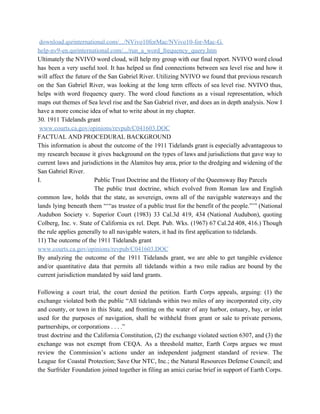
Sonali Patangay Week 8 Journal Entry (1) 1911 Tidelands grant 
 ​www.courts.ca.gov/opinions/revpub/C041603.DOC 
FACTUAL AND PROCEDURAL BACKGROUND 
This information is about the outcome of the 1911 Tidelands grant is especially 
advantageous to my research because it gives background on the types of laws and 
jurisdictions that gave way to current laws and jurisdictions in the Alamitos bay area, prior to the 
dredging and widening of the San Gabriel River. 
I. Public Trust Doctrine and the History of the 
Queensway Bay Parcels 
The public trust doctrine, which evolved from Roman law and English 
common law, holds that the state, as sovereign, owns all of the navigable waterways 
and the lands lying beneath them “‘“as trustee of a public trust for the benefit of the 
people.”’” (​National Audubon Society v. Superior Court​ (1983) 33 Cal.3d 419, 434 
(​National Audubon​), quoting ​Colberg, Inc. v. State of California ex rel. Dept. Pub. Wks. 
(1967) 67 Cal.2d 408, 416.) Though the rule applies generally to all navigable waters, it 
had its first application to tidelands.   
 
Sonali Patangay Week 8 Journal Entry (2): The outcome of the 1911 Tidelands 
grant ​ ​www.courts.ca.gov/opinions/revpub/C041603.DOC 
By analyzing the outcome of the 1911 Tidelands grant, we are able to get tangible evidence and/or 
quantitative data, that permits all tidelands within a two mile radius are bound by the current 
jurisdiction mandated by said land grants. 
 
Following a court trial, the court denied the petition. Earth Corps appeals, arguing: (1) 
the exchange violated both the public “All tidelands within two miles of any incorporated 
city, city and county, or town in this State, and fronting on the water of any harbor, 
estuary, bay, or inlet used for the purposes of navigation, shall be withheld from grant or 
sale to private persons, partnerships, or corporations . . . .” 
trust doctrine and the California Constitution, (2) the exchange violated section 6307, 
and (3) the exchange was not exempt from CEQA. As a threshold matter, Earth Corps 
argues we must review the Commission’s actions under an independent judgment 
standard of review. The League for Coastal Protection; Save Our NTC, Inc.; the Natural 
Resources Defense Council; and the Surfrider Foundation joined together in filing an 
amici curiae brief in support of Earth Corps. We find the Commission’s approval of the 
exchange not supported by the evidence. Therefore, we reverse the trial court’s 
judgment and grant Earth Corps’s petition for writ of mandate. 
Sonali Patangay 11/24/15 Week 9 Journal (1) 1833 Secularization Act 
http://www.nps.gov/goga/learn/historyculture/upload/Chapter­8.pdf 
“This chapter on the secularization and Rancho Era contains sections with a wide 
central California perspective and sections with a narrow San Francisco Peninsula 
perspective. The initial section follows the mission secularization process whereby 
Mission Indians lost legal title to their lands and became a servant class within the 
Hispanic community. The second section describes land grants received by Indian 
people in the San Francisco and Monterey Bay Areas. The third section examines 
various themes pertinent to the San Francisco Bay Area and the larger central 
California area. The fourth section documents secularization at Mission Dolores and the 
family groups of the San Francisco Peninsula Indian community up to 1840. The fifth 
and final section describes the Mission Dolores Indians and the San Francisco 
Peninsula landscape during the early and mid­1840s”​.  
This was a “ partial emancipation policy” that first only included the Monterey 
district. However, it was extended to other districts in 1828, but did not include Mission 
San Rafael or Mission San Francisco Solano on the Northern frontier ( Bancroft 
1886:III:102). 
Sonali Patangay 11/24/15 Week 9 Journal (2) 1833 Secularization Act specifics 
and effects on local jurisdiction and laws and Regulations of 1834 
http://www.nps.gov/goga/learn/historyculture/upload/Chapter­8.pdf 
“On July 2, 1833 southern Mission Prefect Narciso Duran wrote Figueroa with regard to 
the difference of life quality of the Indians who were living at the missions and those 
who were emancipated and living in the pueblo of Los Angeles: I have seen with the 
greatest amazement that [the Indians who dwell in the pueblo of Los Angeles] . . . live 
far more wretched and oppressed than those in the missions. There is not one who has 
a garden of his own, or a yoke of oxen, a horse, or a house fit for a rational being. The 
equality with the white people, which is preached to them, consists in this, that these 
Indians are subject to a white comisionado, and are the only ones who do the menial 
work . . . All in reality are slaves, or servants of white men who know well the manner of 
securing their services by binding them a whole year for an advanced trifle . . . The 
benevolent ideas of the Government will never be realized, because the Indian evinces 
no other ambition than to possess a little more savage license, even though it involved a 
thousand oppressions of servitude (Duran [1833] in Geary 1934:137)”.  
It is apparent that the mission system had not prepared the emancipated Indians 
to live as small landholders or private entrepreneurs. This specific secularization law is 
important because it began the closure of the california missions, and was thus passed 
by congress on August 17, 1833. The law enforces “ the decree of the Congress of 
Mexican secularization of the mission”, that the community become it’s own town and/or 
government. 
Sonali Patangay 11/25/15 Week 9 Journal (2). END of journal entry. 6:59pm 
 
Sonali Patangay 12/2/15 Week 10 Journal (1)  
https://books.google.com/books?id=rCy634h9_oYC&pg=PA8&lpg=PA8&dq=1884
+willmore+city+becomes+long+beach&source=bl&ots=0VP5GIUkFh&sig=3MVkK
mdIpSK5Iz7eYfE2aLdlsGg&hl=en&sa=X&ved=0ahUKEwjL9fvc073JAhVQx2MKHfx
tBVYQ6AEIJTAC#v=onepage&q&f=false 
1884: Willmore city becomes Long Beach ( Background information) 
For decades, the city of Long Beach has been widely recognized for it’s “ natural 
assets and events”, that helped to influence the overall history of the city ( Schipske 
2015:8). Contrary to popular belief, the city had been “ known by many names during 
this period” ( Schipske 2015:8). These names are as follows: Rancho Los Alamitos, Los 
Cerritos, American Colony, Cerritos Colony, Willmore City, the fastest growing city in 
the nation,the willows, queen of the beaches, tent city, the ideal home city, the 
playground of the world, the home of the industry, clam city, the national health resort, 
and the wonder city of the pacific southwest, to name a few. However, the final and 
definitive name that seemed to stick was ​Longbeach.​ The name Longbeach, was 
originally coined by Belle Lowe in 1884, the wife of the town’s postmaster ( appointed by 
President Grover Cleveland 1885), and it is the name we still use today.Consequently, 
this was same time that Willmore city became officially known as the city of Long beach. 
The name was given by Lowe during that year, “ to the land syndicate that was 
attempting to market the area, arguing that it reflected the town’s most popular asset, 
eight plus miles of wide open beach”. The goal, “ Turn this sleepy seaside community 
into a thriving municipality”. After the Spanish took the land from the Tongva Natives ( 
later known as Gabrielinos because of their affiliation with the Missions of San Gabriel 
Arcangel), for which they distributed as land grants. 
Sonali Patangay Week 10 Journal (2) 1884 Willmore city becomes Long Beach 
Continued. Specifics of land grants jurisdiction and Ownership during this era. 
https://books.google.com/books?id=rCy634h9_oYC&pg=PA8&lpg=PA8&dq=1884
+willmore+city+becomes+long+beach&source=bl&ots=0VP5GIUkFh&sig=3MVkK
mdIpSK5Iz7eYfE2aLdlsGg&hl=en&sa=X&ved=0ahUKEwjL9fvc073JAhVQx2MKHfx
tBVYQ6AEIJTAC#v=onepage&q&f=false 
In 1784, Governor Pedro Fages granted all the land between the San Gabriel 
river ( now known as LA), and Santa Ana rivers to Manuel Nieto for his service as a 
Spanish soldier. The size of the land grant was reduced by Governor Diego de Borica, “ 
so as not to infringe upon the area occupied by the Mission San Gabriel” ( Schipske 
2015:9). Nieto tended to the land ( formerly known as Rancho Los Coyotes) where they 
raised: cattle,sheep, and horses. At the time of Nieto’s death, the land was split into the 
following 5 ranchos: Los Coyotes, Los Cerritos, Santa Gertrudes, Las Bolsas, and Los 
Alamitos.  
“ In succession of the real estate transactions, portions of the land within Rancho Los 
Cerritos owned by John Temple were sold to Flint, Bixby and company in 1866, and 
eventually, parts were sold off in lots to settlers and speculators who formed colonies. 
The first of these colonies in Long Beach area was the Los Cerritos Colony tract near 
willow street and Pico Avenue. Settled in 1878 by James A Teal, it was also the site of 
the cerritos school, the first of its kind in the area” ( Schipske 2015:9). 
Sonali Patangay Final Week Last 2 journal entries: Things I did not waste my time on/ 
Lessons learned section: Journal entry (1) What did you learn about your own personal 
strengths and weaknesses in a group?  
At the beginning, I was more of a taskmaster. I recorded and summarized all the data 
from different: laws, jurisdictions, and topographic maps ( CEQA reports, tidelands grant 1911, 
and secularization acts). Now I have become more precise in my research. Now I have more of a 
tendency to analyze and scrutinize my data and question the viability of the sources I’m using. 
I learned how to be more organized and how to become a better leader. I also learned 
how to collaborate better with others. I ultimately learned the most about communication and 
engaged listening. I became more appreciative of my own personal strengths which are: 
organization, punctuality, and detail. The fact that I pay close attention to detail, makes me a 
natural at being a reference checker. I need to work on being more of a devil’s advocate, though. 
Sonali Patangay Final week Journal entry (2) Things I didn’t waste my time on/ Lessons 
learned section: What needs to be improved in the database and where would you direct 
future students in conducting their research? 
In my opinion, the database needs to be more chronologically focused. Students in the 
spring should focus on these specific areas: government documents, public records ie: CEQA 
reports, historical society reports, historical archives, use the way back machine, go to 
VONVON ( a free application for researching  multiple databases, like NVIVO). Students should 
work on checking the validity of our sources. Also another suggestion i would make is use a 
salvage ethnography approach to conducting research, that is record as much data as possible. A 
major issue we found in environmental changes is top­soil loss.The farmland silts rivers in. This 
is not a sustainable runoff fecal material. This runoff from the fecal material is created into feed 
for the animals. 


Randi Dillard 10/26/2015 Journal Entry 1 
http://www.gazettes.com/news/aes­starts­process­to­replace­alamitos­power­plan
t/article_da8a0768­8de5­11e3­8b55­0019bb2963f4.html 
Found this article one how AES is going to replace the old Los Alamitos Power 
Plant. Thought this article may be helpful (not sure ).  
Randi Dillard 10/26/2015 Journal Entry 2 
www.waterboards.ca.gov/losangeles/water_issues/programs/tdml 
this article sheds light the issues with water waste and polluted water. This 
document also mentions some of the permits that had to be in place in order for 
buildings and residential areas to be in place for the protection of the estuary and 
waterways. Furthermore, this document also discloses information about 
restoration.   
 
Jessica Dooley 10/27/15 5:00­6:45pm 
 
https://books.google.com/books?id=e1ouAwAAQBAJ&pg=PA11&lpg=PA11&dq=t
he+straightening+of+the+san+gabriel+river&source=bl&ots=ZhILpHHv97&sig=Bj
1Qau7nhiMGQ1vXWGOyB1VtEKU&hl=en&sa=X&ved=0CB4Q6AEwAGoVChMIzqT
m_PbjyAIVTyqICh2iFQHA#v=onepage&q&f=false 
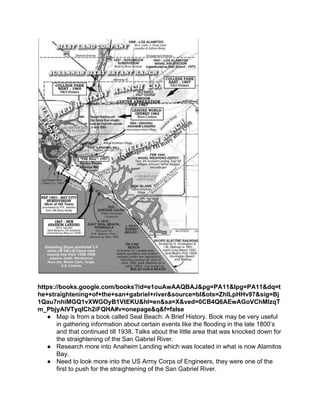
● Map is from a book called Seal Beach: A Brief History. Book may be very useful 
in gathering information about certain events like the flooding in the late 1800’s 
and that continued till 1938. Talks about the little area that was knocked down for 
the straightening of the San Gabriel River.  
● Research more into Anaheim Landing which was located in what is now Alamitos 
Bay. 
● Need to look more into the US Army Corps of Engineers, they were one of the 
first to push for the straightening of the San Gabriel River. 
 
Randi Dillard 10/27/2015 Journal Entry 1 
https://www.opc.ca.gov/webmaster/ftp/project_pages/OTC/engineering%20study/
Chapter_7F_Haynes­Generating­Station.pdf 
 
 
This document gives information on the history of the Los Alamitos Power Plant (AES) 
and who also owns part of the power plant Haynes Generating Station as well as former 
owner Pacific Energy. This document also has about legislation and codes that was put 
into place to help protect the environment but also the community, such as the Clean 
Water Act section 36(b). Furthermore, the document discloses information about 
conceptual design as well as size, location, piping, environmental effect, air emissions 
and permit compliance.   
 
Randi Dillard 10/27/2015 Journal Entry 2 
 
http://www.gswater.com/protecting­our­drinking­water/ 
 
When looking up information on the San Gabriel River in my internet search this web 
site gave some information on the Golden State Water Company and how they assist 
with cross­connection water ways, and I thought that this might be helpful.  
 
Randi Dillard 10/27/2015 Journal Entry 3 
 
http://www.energy.ca.gov/sitingcases/alamitos/ 
 
This site gives information on the site and what the facility entails. Moreover, gives 
information about The California Energy Commission, and the California Environmental 
Quality Act.   
 
 
 ​Anell 10/28/15 
 
Saturday, Oct 24, 2015, 1:00pm:​ I visited the Historical Society of Long Beach (HSLB). 
They were closed because of preparations for a Halloween event, and they will also be 
closed Sat Oct 31 (Halloween day) but I spoke very briefly to Brandon Werts, the gallery 
coordinator and Dr. Kaye Briegel about our project and they let me in to take a look 
around. Brandon brought out 3 aerial photographs from their archives of the the 
industrial area taken in 1941. However, I wasn’t able to gather much info since a $25 
membership fee is required to access their archives. Overall, HSLB would be an 
extremely helpful source. 
 
I researched Dr. Briegel and she is currently the co­director of virtual oral/aural history 
archive at CSULB. She has also published “The Liquidation of Alamitos Land Company,  
1988­2011” which the company printed and also deposited all the records they had 
preserved since 1888 in the Huntington Library. She has also published “The 
Centennial History of the Bixby Land Company, 1896­1996”.  
 
 
Monday, Oct 26, 2015: ​The Port of Long Beach (POLB) has a very detailed timeline of 
events near the port from 1890­2010. However, the POLB website does not contain 
detailed information on Alamitos Bay. For example:  
 
● “​1908​: Applications are filed with the Water Department for a permit to start 
dredging the Cerritos Channel, connecting the Port of Long Beach with the Port 
of Los Angeles.” 
● “​1909: ​June 30 — The sand bar between the ocean and the San Gabriel River 
washes out at high tide, making the ocean entrance to the newly dredged inner 
harbor reality.The Long Beach electorate approves a harbor bond issue for 
$245,000 to purchase water frontage in the inner harbor and cover costs of 
building new piers, wharves and sheds.” 
 
For Randi:  
“1911: The State of California grants the tidelands areas to the City of Long Beach for 
port operations. Tidelands are defined as those lands and water areas along the coast 
of the Pacific Ocean seaward of the ordinary high tide line to a distance of three miles. 
The tidelands are granted to the City of Long Beach in trust for the people of the State. 
The tidelands trust not only restricts the use of the tidelands, but also the use of income 
and revenue generated from businesses and activities conducted on the tidelands. The 
tidelands and tidelands revenues must be used for purposes related to harbor 
commerce, navigation, marine recreation and fisheries.” 
 
● In 1951, there was an amendment to the 1911 Tidelands Grant that allowed use 
of oil revenue from the tidelands on non­harbor activities. 
 
According to this timeline, oil was first discovered in the harbor in ​1936​ and the first oil 
well was established in ​1938. 
http://www.polb.com/about/history/1910.asp 
 
 
Tuesday, Oct 27, 2015, 5:00­6:45 pm:​ Jessica and I met in the library to research the 
articles, maps, and photos relating to the straightening of the San Gabriel River. We 
came across the book “Seal Beach: A Brief History” that contained photographs from 
the late 1860’s of Anaheim Landing (located in what is now Alamitos Bay, near Island 
Village). Anaheim Landing seems to have been a popular beach spot that was 
destroyed by a major flood in the area (more research needs to be done).  
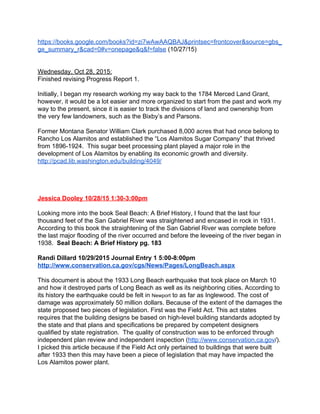
https://books.google.com/books?id=zi7wAwAAQBAJ&printsec=frontcover&source=gbs_
ge_summary_r&cad=0#v=onepage&q&f=false​ (10/27/15) 
 
 
Wednesday, Oct 28, 2015: 
Finished revising Progress Report 1. 
 
Initially, I began my research working my way back to the 1784 Merced Land Grant, 
however, it would be a lot easier and more organized to start from the past and work my 
way to the present, since it is easier to track the divisions of land and ownership from 
the very few landowners, such as the Bixby’s and Parsons. 
 
Former Montana Senator William Clark purchased 8,000 acres that had once belong to 
Rancho Los Alamitos and established the “Los Alamitos Sugar Company” that thrived 
from 1896­1924.  This sugar beet processing plant played a major role in the 
development of Los Alamitos by enabling its economic growth and diversity.  
http://pcad.lib.washington.edu/building/4049/  


Jessica Dooley 10/28/15 1:30­3:00pm 
 
Looking more into the book Seal Beach: A Brief History, I found that the last four 
thousand feet of the San Gabriel River was straightened and encased in rock in 1931. 
According to this book the straightening of the San Gabriel River was complete before 
the last major flooding of the river occurred and before the leveeing of the river began in 
1938.  ​Seal Beach: A Brief History pg. 183 
 
Randi Dillard 10/29/2015 Journal Entry 1 5:00­8:00pm 
http://www.conservation.ca.gov/cgs/News/Pages/LongBeach.aspx 
  
This document is about the 1933 Long Beach earthquake that took place on March 10 
and how it destroyed parts of Long Beach as well as its neighboring cities. According to 
its history the earthquake could be felt in ​Newport​ to as far as Inglewood. The cost of 
damage was approximately 50 million dollars. Because of the extent of the damages the 
state proposed two pieces of legislation. First was the Field Act. This act states 
requires that the building designs be based on high­level building standards adopted by 
the state and that plans and specifications be prepared by competent designers 
qualified by state registration.  The quality of construction was to be enforced through 
independent plan review and independent inspection (​http://www.conservation.ca.gov​/). 
I picked this article because if the Field Act only pertained to buildings that were built 
after 1933 then this may have been a piece of legislation that may have impacted the 
Los Alamitos power plant.   
 
Randi Dillard 11/1/2015 Journal Entry 1 1:00­3:00pm 
http://www.lbwater.org/sites/default/files/file_attach/pdf/LBWD­History­Pre­1945.P
DF  
 
This document is about Long Beach Water Department history pre­1945. This 
document contains history on were the first water company was established, how it was 
established, where it was established and who were the first people to help pipe water 
into Long Beach Township. This document also goes into detail about the Los Alamitos 
Water Company, Los Alamitos Steam Plant, and the Recreation Park Pant. These three 
plants were the first water plants in Long Beach but who also helped piped water in from 
the San Gabriel River into Long Beach.  This is a great article for Los Alamitos 
research.  
 
Randi Dillard 11/1/2015 Journal Entry 2 3:00­4:00pm 
http://www.lbwater.org/sites/default/files/file_attach/pdf/history.pdf 
 
This document provides information about the Long Beach Water Department history 
from 1945 to 2000. In this document provides details about how the Water Department 
was able to help fund and provide materials during WW2. One of the main materials 
that the Water Department would be providing is steel to help make boom cases, trucks 
and other such thing that required steel. Furthermore, this document goes further into 
detail about new boards of commissions and city involvement, and how to protect and 
use the water in Long Beach and other areas such as Los Alamitos for the betterment of 
the cities and communities.  Also the document give a year to year timeline and 
explanation of what occurred during 1945 to 2000.   
 
Randi Dillard 11/1/2015 Journal Entry 3 5:00­7:00pm 
http://www.lbwater.org/sites/default/files/file_attach/pdf/history2012%20smaller%
20version.pdf 
This document covers the history of the Long Beach Water Department from 
2000­2011. This document mostly focuses on the area of Long Beach primarily. This 
document primarily give information on what new projects that occur during these years. 
This document was part of a set of the historical information about the city of long 
beach(not sure if it’s useful).  


Anell 11/4/15: 
 
Researched ownership of Alamitos since the 1784 (some sources cite 1790 as the year 
grant was given) land grant to Jose Manuel Perez Nieto by the Spanish crown, which 
was originally known as Los Coyotes and consisted of 300,000 acres. The grant was 
then reduced to 167,000 acres due to a dispute with Mission San Gabriel, who claimed 
the grant encroached on their lands, however, Los Coyotes was the largest grant given 
by the Spanish Crown. 
 
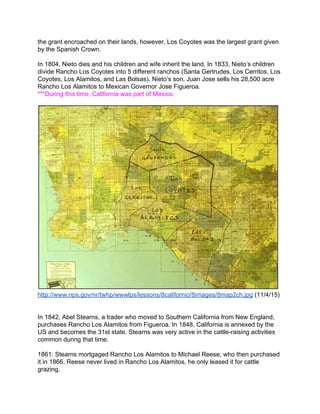
In 1804, Nieto dies and his children and wife inherit the land. In 1833, Nieto’s children 
divide Rancho Los Coyotes into 5 different ranchos (Santa Gertrudes, Los Cerritos, Los 
Coyotes, Los Alamitos, and Las Bolsas). Nieto’s son, Juan Jose sells his 28,500 acre 
Rancho Los Alamitos to Mexican Governor Jose Figueroa.   
***During this time, California was part of Mexico.  
 
 
http://www.nps.gov/nr/twhp/wwwlps/lessons/8californio/8images/8map2ch.jpg​ (11/4/15) 
 
 
In 1842, Abel Stearns, a trader who moved to Southern California from New England, 
purchases Rancho Los Alamitos from Figueroa. In 1848, California is annexed by the 
US and becomes the 31st state. Stearns was very active in the cattle­raising activities 
common during that time. 
 
1861: Stearns mortgaged Rancho Los Alamitos to Michael Reese, who then purchased 
it in 1866. Reese never lived in Rancho Los Alamitos, he only leased it for cattle 
grazing. 
 
1878: “John Bixby leased the ranch from Reese and moved into the deteriorating 
adobe. Thus began what was to be a 90­year occupation of Rancho Los Alamitos by 
the Bixby family. By the early 20th century, this family would be one of the largest 
landowners in the Los Angeles area. John Bixby had traveled from his native state of 
Maine to California to supervise the sheep­raising operation of his cousin Jotham 
Bixby's Rancho Los Cerritos. During the Civil War, cotton was replaced by wool, hence 
the profitability and importance of raising sheep to the newly created state. In 1881, 
John Bixby purchased Rancho Los Alamitos in partnership with I. W. Hellman and J. 
Bixby & Co. (which comprised Jotham Bixby & Flint Bixby & Co.). To make the adobe 
more livable for his wife and young children, John Bixby added many improvements 
before he died suddenly at age 39 in 1887. The ranch was then divided into three parts; 
his wife and two children received the middle section, which included the ranch house 
and gardens, the barns, and the corrals. By 1915, Rancho Los Alamitos was described 
in the following way:   
One of the most beautiful in this section, the buildings being located on the heights 
overlooking the mountains, the valleys and the sea, an ideal spot for a home, the land 
extending six miles along the coast and being in itself a small principality. The old adobe 
house that was built over 100 years ago with walls from three and a half to four feet in 
thickness, has been improved and modernized, and yet retains the appearance and 
necessarily its historical interest that clings to the days when the Spanish dons reigned 
supreme. The other buildings of the ranch are large and in keeping with the progressive 
spirit of the owner.” 
http://www.nps.gov/nr/twhp/wwwlps/lessons/8californio/8facts1.htm​ (11/4/15) 
 
http://www.rancholosalamitos.com/aboutus/ownership.html​ (11/4/15) 


Jessica Dooley 11/4/15 1:00­6:00pm 
 
Although it technically not part of the area we are looking at, we wanted to know what 
happened to the little area that had had to be knocked down to straighten the river. That 
little area happened to be part of Seal Beach and it was called “Joy Zone”. It was 
opened in 1916. It was considered to be the Las Vegas of the 20s. It closed around 
1929 when the Great Depression hit. 
http://orangecountytribune.com/2014/04/04/the­vegas­of­the­20s­seal­beach/ 
http://www.ocregister.com/articles/beach­7236­seal­city.html 
 
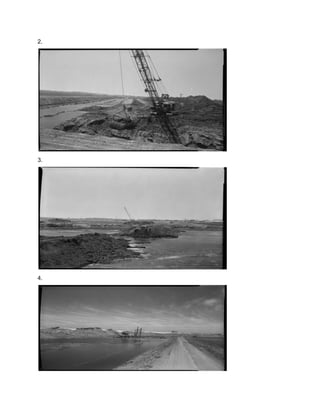
During the time from around 1868, when the San Gabriel River cut a new channel to the 
ocean, to 1931, the outlet migrated down coast around 2800 ft.  
 
Around this time that outlet reached a low bluff and the Los Angeles Gas and Electric 
built a steam electric generating plant in 1925. 
 
During the late 1920s the Flood Control District began the straightening and widening of 
the channel. 
 
1930, there was a certain amount of oil wells that was located in the area adjacent to 
Alamitos Bay and they were damaged due to inundation from flooding 
https://icce­ojs­tamu.tdl.org/icce/index.php/icce/article/viewFile/934/031_Kenyon 
 
 
http://media.proquest.com/media/pq/hnp/doc/389437421/fmt/ai/rep/NONE?hl=straighten
ing%2Cstraightening%2Csan%2Csan%2Cgabriel%2Cgabriel%2Crivers%2Criver%2Cri
vers%2Criver&cit%3Aauth=&cit%3Atitle=FLOOD+CURB+JOB+NEARS+END%3A+EA
RLY+COMPLETION+OF+SAN+GABRIEL+RIVER+...&cit%3Apub=Los+Angeles+Times
+%281923­Current+File%29&cit%3Avol=&cit%3Aiss=&cit%3Apg=A3&cit%3Adate=Dec
+5%2C+1933&ic=true&cit%3Aprod=ProQuest+Historical+Newspapers%3A+Los+Angel
es+Times&_a=ChgyMDE1MTEwNTAyNDQwODYwOToyMDY2MTcSBjEwNjE4MRoKT
05FX1NFQVJDSCIPMTMwLjE4Mi4xODUuMTY2KgU0NzAwMTIJMTYzMTQzMDQyOg
1Eb2N1bWVudEltYWdlQgEwUgZPbmxpbmVaAkZUYgNQRlRqCjE5MzMvMTIvMDVyCj
E5MzMvMTIvMDV6AIIBJlAtMTAwNjQ0Mi0xMDA0My1QRVJQRVRVQUwtbnVsbC0xM
Dc5ODU3kgEGT25saW5lygFSTW96aWxsYS81LjAgKE1hY2ludG9zaDsgSW50ZWwgT
WFjIE9TIFggMTAuMTA7IHJ2OjQxLjApIEdlY2tvLzIwMTAwMTAxIEZpcmVmb3gvNDEu
MNIBFUhpc3RvcmljYWwgTmV3c3BhcGVyc5oCB1ByZVBhaWSqAihPUzpFTVMtUGR
mRG9jVmlld0Jhc2UtZ2V0TWVkaWFVcmxGb3JJdGVtsgImMjAxNTExMDUwMjQ0MDg
2MDk6MjA2NjE3OjE0NDY2OTQ3NzM0Mjm6AiZQLTEwMDY0NDItMTAwNDMtUEVSU
EVUVUFMLW51bGwtMTA3OTg1N8oCD0FydGljbGV8RmVhdHVyZdICAVniAgDyAgA
%3D&_s=3DnRkUudt4AT1i2zA8qPK2f3iUE%3D 
SONALI­ I’m not sure if this will show up because it was in a CSULA database. So if 
you don’t get it text me and I will email you the pdf. 
 
Anell 11/16/15: 
 
Wednesday 11/11/15​: Researched Sugar Beet Processing Plant 
 
The first sugar beet processing plant in Orange County was located in Rancho Los 
Alamitos (in what is now the Los Alamitos Race Track) known as the Los Alamitos 
Sugar Company and opened in 1897. The plant was built and owned by William A. 
Clark and his brother Joaquin R. Clark. The Clark’s purchased 8,000 acres from 
Rancho Los Cerritos and Los Alamitos from Jotham and Llewellyn Bixby; 1,000 acres of 
which were for the factory and the rest designated for the farmers and factory workers 
who leased this land. Initially, the sugar beet processing plant idea came from the 
Bixby’s, however, even though they had enough land to use for sugar beet production, 
they did not have enough to finance the processing plant required to turn the beets into 
refined sugar; so they turned to the Clark’s. William A. Clark was one of the wealthiest 
men in the US at the time, he had made his fortune through copper mining in Montana 
and Arizona, and also became Montana’s first senator.The Clark’s named their 
business organization “The Montana Land Company” for which Monlaco Road in East 
Long Beach is named and their headquarters is where Lakewood’s Water Department 
is located. 
 
“As the Montana Land Company harvested more and more profits, the brothers bought 
the 22­mile Santa Ana and Newport railways, which ran between Newport Beach, Santa 
Ana and Westminster. Eventually, it was expanded to pass through the sugar beet 
factory and connect to San Pedro and Los Angeles. 
The rail line not only enabled the Clark’s to send sugar through Los Angeles to anyplace 
in the United States, but also was instrumental in forming the third transcontinental 
railroad link across the United States — the Los Angeles and Salt Lake City railroad” 
http://www.presstelegram.com/general­news/20140713/long­beach­landmarks­clark­av
enue­named­after­controversial­copper­baron­william­andrews­clark​ (11/11/15) 
 
The sugar beet processing plant closed in 1926 due to plant diseases. After closing, the 
Clark’s decided to ship the sugar beet crop to Holly Company’s Beet Factory in what is 
now Santa Ana.  
“In 1926, droughts, competition from Cuban sugar, low prices, combined with the 
persistent nematode parasite (which was not new but had always been a problem with 
sugar beets, here and throughout the nation) , made it more efficient for the Clark 
family, the owners of the Sugar Factory, and the area’s largest farm (the 8,000 acre 
Montana Ranch) to close the factory and ship their still very substantial sugar beet crop 
to the Holly Company’s Beet factory in Dyer (now Santa Ana), near Dyer and Edinger 
Road.” 
http://localsports.biz/history/2011/05/18/1897­1945­the­los­alamitos­sugar­factory­from­t
he­clarks­to­dr­ross/​ (11/11/15) 
 
The building was then leased to Dr. William J. Ross, a veterinarian who used it to 
process wild horse meat into dog food. 
 
http://www.kcet.org/updaily/socal_focus/commentary/where­we­are/from­sugar­beets­to
­cities­along­the­los­angelesorange­county­border.html​ (11/11/15) 
 
http://cityoflosalamitos.org/?page_id=133​ (11/11/15) 
 
http://pcad.lib.washington.edu/building/4049/​ (11/11/15) 


Jessica Dooley 11/17/15 
 
11/13/15 
 
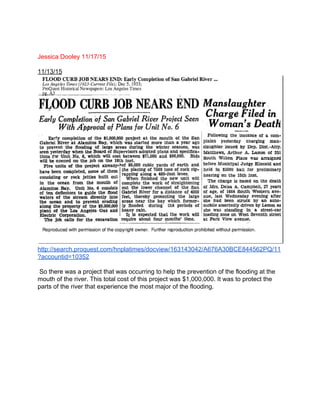
http://search.proquest.com/hnplatimes/docview/163143042/A676A30BCE844562PQ/11
?accountid=10352 
 
 So there was a project that was occurring to help the prevention of the flooding at the 
mouth of the river. This total cost of this project was $1,000,000. It was to protect the 
parts of the river that experience the most major of the flooding.  


Jessica Dooley 12/2/15 


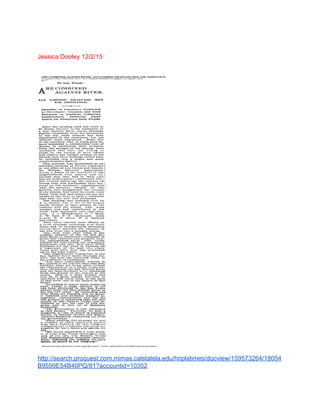
http://search.proquest.com.mimas.calstatela.edu/hnplatimes/docview/159573264/18054
B9599E54B40PQ/81?accountid=10352 
 
 
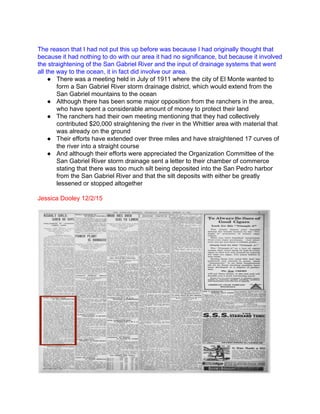
The reason that I had not put this up before was because I had originally thought that 
because it had nothing to do with our area it had no significance, but because it involved 
the straightening of the San Gabriel River and the input of drainage systems that went 
all the way to the ocean, it in fact did involve our area. 
● There was a meeting held in July of 1911 where the city of El Monte wanted to 
form a San Gabriel River storm drainage district, which would extend from the 
San Gabriel mountains to the ocean 
● Although there has been some major opposition from the ranchers in the area, 
who have spent a considerable amount of money to protect their land 
● The ranchers had their own meeting mentioning that they had collectively 
contributed $20,000 straightening the river in the Whittier area with material that 
was already on the ground  
● Their efforts have extended over three miles and have straightened 17 curves of 
the river into a straight course 
● And although their efforts were appreciated the Organization Committee of the 
San Gabriel River storm drainage sent a letter to their chamber of commerce 
stating that there was too much silt being deposited into the San Pedro harbor 
from the San Gabriel River and that the silt deposits with either be greatly 
lessened or stopped altogether 
 
Jessica Dooley 12/2/15 


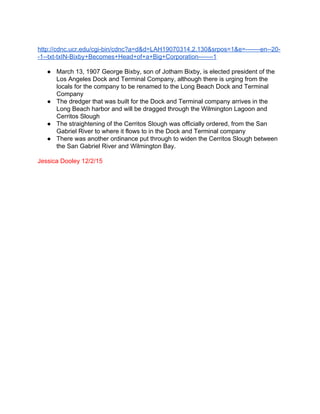
http://cdnc.ucr.edu/cgi­bin/cdnc?a=d&d=LAH19070314.2.130&srpos=1&e=­­­­­­­en­­20­
­1­­txt­txIN­Bixby+Becomes+Head+of+a+Big+Corporation­­­­­­­1 
 
● March 13, 1907 George Bixby, son of Jotham Bixby, is elected president of the 
Los Angeles Dock and Terminal Company, although there is urging from the 
locals for the company to be renamed to the Long Beach Dock and Terminal 
Company 
● The dredger that was built for the Dock and Terminal company arrives in the 
Long Beach harbor and will be dragged through the Wilmington Lagoon and 
Cerritos Slough 
● The straightening of the Cerritos Slough was officially ordered, from the San 
Gabriel River to where it flows to in the Dock and Terminal company  
● There was another ordinance put through to widen the Cerritos Slough between 
the San Gabriel River and Wilmington Bay. 
 
Jessica Dooley 12/2/15 


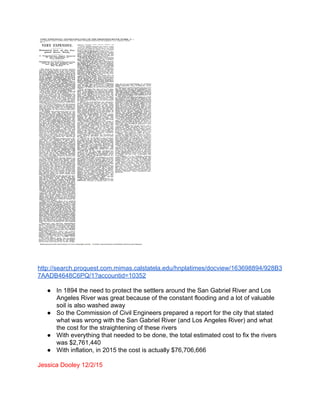
http://search.proquest.com.mimas.calstatela.edu/hnplatimes/docview/163698894/928B3
7AADB4648C6PQ/1?accountid=10352 
 
● In 1894 the need to protect the settlers around the San Gabriel River and Los 
Angeles River was great because of the constant flooding and a lot of valuable 
soil is also washed away 
● So the Commission of Civil Engineers prepared a report for the city that stated 
what was wrong with the San Gabriel River (and Los Angeles River) and what 
the cost for the straightening of these rivers 
● With everything that needed to be done, the total estimated cost to fix the rivers 
was $2,761,440 
● With inflation, in 2015 the cost is actually $76,706,666 
 
Jessica Dooley 12/2/15 


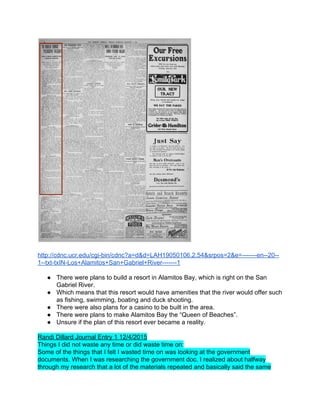
http://cdnc.ucr.edu/cgi­bin/cdnc?a=d&d=LAH19050106.2.54&srpos=2&e=­­­­­­­en­­20­­
1­­txt­txIN­Los+Alamitos+San+Gabriel+River­­­­­­­1 
 
● There were plans to build a resort in Alamitos Bay, which is right on the San 
Gabriel River.  
● Which means that this resort would have amenities that the river would offer such 
as fishing, swimming, boating and duck shooting.  
● There were also plans for a casino to be built in the area.  
● There were plans to make Alamitos Bay the “Queen of Beaches”.  
● Unsure if the plan of this resort ever became a reality.   
 
Randi Dillard Journal Entry 1 12/4/2015 
Things I did not waste any time or did waste time on: 
Some of the things that I felt I wasted time on was looking at the government 
documents. When I was researching the government doc. I realized about halfway 
through my research that a lot of the materials repeated and basically said the same 
things. Once you understand the wording and the abbreviations the documents become 
easier to read and understand. Things that I did not waste time on but wished I had 
focused on were the city web sites. These web sites provided more information about 
the city plans and who were involved with the city planning. These websites also 
provided fun facts and history about the city as well. Furthermore, I also wished that I 
was able to look at the city archives to also gain a better understanding of the area that I 
was working on. These archives would have provided pictures, maps, and city outlines 
and barriers. This where I think that the next group of students should look . I think that 
these websites would be very productive and helpful to the next group.   
 
 
Anell 12/9/15: 
 
Things I Did Not Waste Time On: 
The Natural History Museum’s exhibit “Becoming Los Angeles” references the many 
significant events that led to the development of the city. It covers the major role 
transportation played in the settlement, growth, and the individuals/families involved. 
The museum’s archive likely contains relevant information for this research. 


Word Cloud: 


OTHER MATERIALS: 
 
Ignacio 10/20/15 
Popular media about Los Alamitos Bay  
http://www.lbheritage.org/index.php/newsletters/long­beach­stories/19­secrets­of­alamitos­bay 
Interesting information about the development of the Alamitos Bay peninsula. Development of 
the peninsula was the precursor to the settlement of Naples. 
 
Anell 10/28/15 
Los Alamitos Museum: 11062 Los Alamitos Blvd, Los Alamitos Ca. 90720 (562) 431­8836. 
Likely contains relevant information in their archives, or may simply suggest people of interest. 
 
Anell 11/4/15 
The Rancho Los Alamitos website has a very detailed timeline of  land ownership and 
occupancy from 1784­2011.   
http://www.rancholosalamitos.com/aboutus/ownership.html 


PEOPLE OF INTEREST:  
Ignacio 10/26/15 
 
Long Beach Heritage Executive Director 
Mary Kay Nottage 
P.O. Box 92521 Long Beach, CA 90809 
562­493­7019 ​Primary contact about event and for general information. 
http://www.lbheritage.org/index.php/contact  
Long Beach Heritage focuses primarily on the protection and preservation of homes, commercial 
buildings, and historical districts within the city. The Historical Society concentrates on 
preserving documentation of Long Beach’s past (i.e. photos, records, manuscripts, and 
memorabilia). The Cultural Heritage Commission is composed of Mayor­appointed delegates 
who are authorized to designate historical sites, buildings, or districts within the City. 
Stan Poe and Louise Ivers write most of the articles. 
 
For Stan Poe: maureenpoe@gmail.com
For Louise: livers@csudh.eedu
Anell 10/28/15:
From Historical Society of Long Beach:
4260 Atlantic Avenue, Long Beach Ca. 90807, (562) 424-2220
-​Brandon Werts​, Gallery coordinator (​brandonW@hslb.org​)
- ​Kaye Briegel​, Ph.D., Co-director, Virtual Oral/ Aural History Archive (​kbriegel@csulb.edu​)
Dr. Kaye Briegel is currently a volunteer with the Historical Society of Long Beach. She’s
also published several books , including “The Liquidation of Alamitos Land Company, 1988-
2011” and “A Centennial History of the Bixby Land Company, 1896-1996”.
Anell 11/16/15:
D. J. Waldie​: Author who has published several books on the social history of Southern
California, including “Holy Land: A Suburban Memoir”, which provides a historical background
on the Lakewood area, where he grew up. He is also a contributing editor for the LA Times and
Los Angeles Magazine.
Larry Strawther​: Author of “Seal Beach: A Brief History” and has started the online Los
Alamitos-Rossmoor-Seal Beach History Project.
 
TIMELINE DRAFT: 
 
Sonali : 10/21/15,10/27/15, 10/31/15, 12/2/15 
Jessica: 10/21/15, 10/23 
Ignacio: 10/25/15, 10/26/15, 10/27/15 11/04/2015 
I)​Timeline Draft: 
❖ 1784 
         a) Land Grants from King of Spain 
            1) Rancho Movement (Port Town p.39) 
The area that is now Long Beach was first settled as part of a massive Spanish land grant to soldier 
Manuel Nieto, encompassing the historic 28,000­acre Ranch Los Alamitos and its sister rancho, 
27,000 acre Rancho Los Cerritos. 
www.bluffheights.org/2012/01/a­brief­history­of­long­beach/ 
1833 
 a) Secularization Law 
            1) A way to gain access to the Mission’s land and goods. (Port Town p.50) 
❖  1842 
           a) Ron Abel Stearns buys Rancho Los Alamitos 
★ 1846  
          ​ a) Bear Flag Republic: War with Mexico (Port Town p.59) 
★ 1850 
           ​a) Birth of T­sheet Surveys 
      ​1851 ​congress passes the law is "an act to ascertain and settle private land claims in the state 
of California" aka California land act. 
★ 1854 
a) Sacramento capitol of California (Port Town p.65) 
 
        1861­1862 
Major flooding occurs in the San Gabriel River (Accessed Oct. 21, 2015) 
 
❖ 1864 
           a) Stearns loses Mortgage to Michael Reese 
            ​1866   
Rancho Los Cerritos was sold to Lewellyn Bixby and then managed by his brother   Jotham. The 
Bixby family soon become prominent ranchers and developers of Long Beach and remain even to 
this day.   ​http://www.bluffheights.org/2012/01/a­brief­history­of­long­beach/ 
❖ 1878 
          ​ a) John Bixby leases Rancho Alamitos 
       1880 
Population of the city and county of Los Angeles have doubled during the past decade 
(Accessed Oct. 21, 2015) 
 
1880 
Willmore City town site is laid out (10/17/15) 
 
❖ 1881 
          a) John Bixby purchases Los Alamitos 
b)  Bixby purchases Los Alamitos 
http://www.gondolagetawayinc.com/history.asp​(10/14/15) John Bixby and two partners 
purchase Rancho Los Alamitos for $125,000. Over the next few years the Alamitos 
partners begin developing 5,000 of the 26,393­acre ranch into the Alamitos town site by 
the ocean with farm lots further out. 
http://rancholosalamitos.com/aboutus/ownership.html​ 10.19.15 
1882  
First planned as Willmore City by developer William Willmore, a new town began forming along the 
coast. ​http://www.bluffheights.org/2012/01/a­brief­history­of­long­beach/ 
 ​1884 
a) Wilmore City becomes Long Beach 
1885 –  
Competition between the new Santa Fe Railroad and older southern Pacific Railroad attracted 
hordes of visitors to Long Beach and created a real estate boom. 
http://www.bluffheights.org/2012/01/a­brief­history­of­long­beach/ 
1886 
a)  John Bixby lays out Alamitos Beach Townsite 


1887 
a)  Bixby dies at age 39, wife and children inherits his share of Rancho Los Alamitos (p. 
114) (10/19/15) Each of his partners receives 7,200 acres while his heirs receive the 
central portion, house and barns, and the rancho name. 
http://rancholosalamitos.com/aboutus/ownership.html​ 10.19.15 
 
 
★ 1886­1887 
         ​a)Alamitos Land Co. forms (Port Town p.) 
1888 
a) Long Beach is incorporated as a city, Alamitos Land Company is established. 
b) Original residents of the foiled Willmore City renamed their town Long Beach, after its long, wide 
beaches, and the city became incorporated. 
 
http://www.bluffheights.org/2012/01/a­brief­history­of­long­beach/ 
 
 
        ​1889 
Major flooding occurs (Accessed Oct. 21, 2015) 
        ​1891­1892 
Major flooding enlarges the connection between San Gabriel and Lexington Wash 
(Accessed Oct. 21, 2015) 
          ​1902  
The introduction of the Pacific Electric trolley caused the city to grow both as a resort and 
commercial center. 
http://www.bluffheights.org/2012/01/a­brief­history­of­long­beach/ 
❖ 1903 
         ​a)​ ​Dickson purchases Alamitos Bay Peninsula Subdivided into 500 lots. 
           1) First serious development of Alamitos Bay. 
❖ 1905 
         a)Arthur M. Parsons Purchases tidelands around Alamitos Bay. 
❖ 1906 
San Francisco earthquake drives Parsons to Long Beach to build canals 
● 1907 ( Dec. 7th) 
         ​a) ​Dec. 9 official founding of the Port of LA​​portoflosangeles.org 
❖ 1909 
 a) ​first home built at Savana Walk
http://www.gondolagetawayinc.com/history.asp 
 
1902­1910  
Long Beach was the fastest growing city in the United States. 
http://www.bluffheights.org/2012/01/a­brief­history­of­long­beach/ 
★ 1911 
         ​a)Tidelands Grant (Port Town p.185) 
         b) ​The Port of Long Beach was established.  
         ​http://www.bluffheights.org/2012/01/a­brief­history­of­long­beach/ 
● 1912 
         ​a)Port of LA dredging and widening the main channel ​portoflosangeles.org 
❖ 1913 
        ​a)Port of LA dredging and widening the main channel project helps to build bridges across  
canals.​ ​http://www.gondolagetawayinc.com/history.asp​ (10/25/15) 
        ​1914 
Major flooding occurs (Accessed Oct. 21, 2015)  
❖ 1919 
          ​a)Belmont shore Development begins: Alamitos Bay dredged and shore filled 
            ​1921  
Oil was discovered on Signal Hill and Long Beach flourished with a million­ dollar­per­month 
building boom downtown. 
http://www.bluffheights.org/2012/01/a­brief­history­of­long­beach/ 
➢ 1924 
           ​a)Alamitos yacht club born. 
❏ 1928  
           ​a)Naples Improvement Association established. 
1930’s­1960  
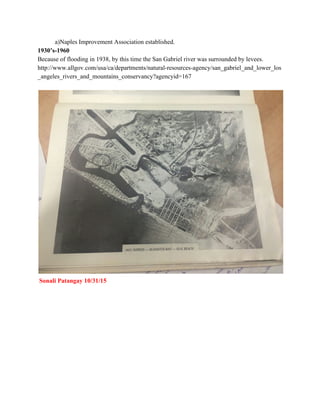
Because of flooding in 1938, by this time the San Gabriel river was surrounded by levees.  
http://www.allgov.com/usa/ca/departments/natural­resources­agency/san_gabriel_and_lower_los
_angeles_rivers_and_mountains_conservancy?agencyid=167 
 
 
 ​Sonali Patangay 10/31/15 
 
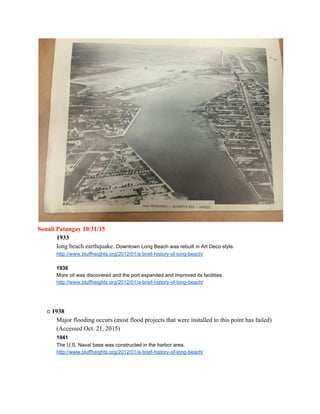
Sonali Patangay 10/31/15 
1933  
long beach earthquake. ​Downtown Long Beach was rebuilt in Art Deco style. 
http://www.bluffheights.org/2012/01/a­brief­history­of­long­beach/ 
 
1936  
More oil was discovered and the port expanded and improved its facilities. 
http://www.bluffheights.org/2012/01/a­brief­history­of­long­beach/ 


        ​1938 
Major flooding occurs (most flood projects that were installed to this point has failed)  
(Accessed Oct. 21, 2015) 
  1941  
The U.S. Naval base was constructed in the harbor area. 
http://www.bluffheights.org/2012/01/a­brief­history­of­long­beach/ 
 
 
❖ 1946 
           ​a) Christmas parade 
1947 
The first and only flight of Howard Hughes’ Spruce Goose, the world’s largest airplane, took off over 
Long Beach Harbor. 
http://www.bluffheights.org/2012/01/a­brief­history­of­long­beach/ 
1949  
California State University Long Beach was founded. 
http://www.bluffheights.org/2012/01/a­brief­history­of­long­beach/ 
➔ 1955­1967 
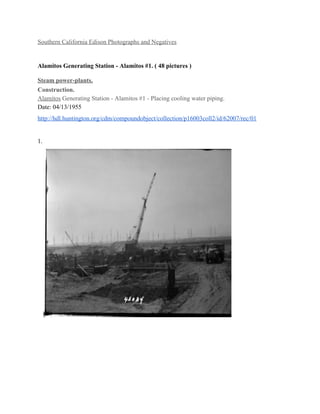
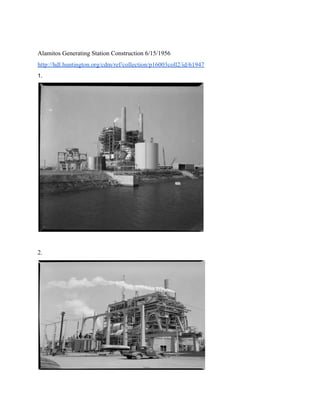
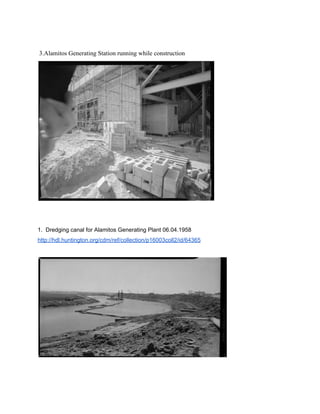
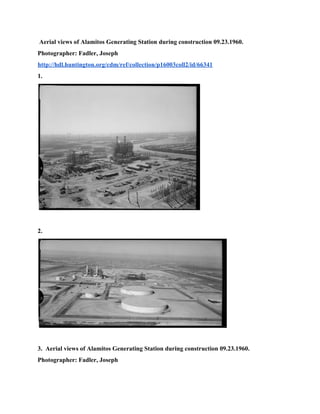
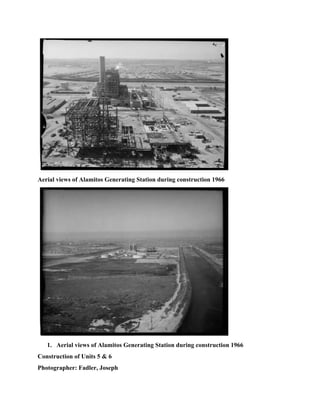
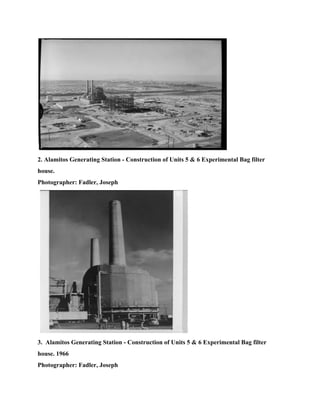
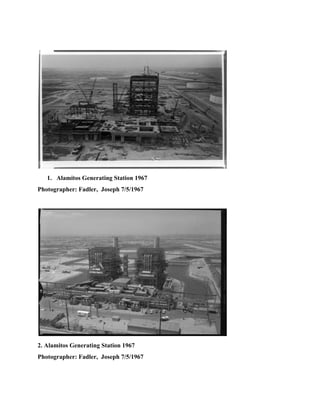
           ​a)  AES Alamitos Power Plant construction 
           b) 1967 ​The city of Long Beach purchased Cunard’s former luxury cruise liner, the Queen Mary, to 
be docked in Long Beach Harbor as a major tourism attraction and hotel. 
http://www.bluffheights.org/2012/01/a­brief­history­of­long­beach/ 
 
_____​1972_​____ 
            ​a)California Coastal Commission created 
● 1973 
      ​1974 ­The State Coastal Commission turned over control of downtown redevelopment to the 
city.  ​http://www.bluffheights.org/2012/01/a­brief­history­of­long­beach/ 
 
1976 – The city embarked on a multi­billion dollar redevelopment program to continue through the 
year 2000. ​http://www.bluffheights.org/2012/01/a­brief­history­of­long­beach/ 
 
1978 – The Long Beach Convention & Entertainment Center opened, adjacent to the Long Beach 
arena. ​http://www.bluffheights.org/2012/01/a­brief­history­of­long­beach/ 
 
1982 – Shoreline Village, the Downtown Shoreline Marina and Shoreline Park opened. 
http://www.bluffheights.org/2012/01/a­brief­history­of­long­beach/ 
 
1983 – The Spruce Goose was moved from its hidden hangar to be exhibited in the world’s largest 
geodesic dome adjacent to the Queen Mary. 
http://www.bluffheights.org/2012/01/a­brief­history­of­long­beach/ 
 
1984 – Long Beach was the site for four Olympic events during the Los Angeles Olympics– 
yachting, volleyball, fencing and archery. 
http://www.bluffheights.org/2012/01/a­brief­history­of­long­beach/ 
 
1988 – Long Beach celebrated its Centennial. 
http://www.bluffheights.org/2012/01/a­brief­history­of­long­beach/ 
 
1989 – The Greater Los Angeles World Trade Center in Long Beach opened. 
http://www.bluffheights.org/2012/01/a­brief­history­of­long­beach/ 
 
1990 – The Long Beach to Los Angeles Metro Blue Line, the first link in the Los Angeles Metro 
Rail project, started service. ​http://www.bluffheights.org/2012/01/a­brief­history­of­long­beach/ 
 
1992 – Construction began on an expansion to the Long Beach Convention & Entertainment 
Center to triple the size of its exhibit facilities. The Spruce goose is moved to McMinnville, Oregon 
to become the centerpiece for the Air Venture Museum, its dome is “converted” to use as movie 
studio by Warner Bros.Pine Square, Southern California’s second­largest movie theater complex 
with 16 screens, shops and restaurants opened December 
18.​http://www.bluffheights.org/2012/01/a­brief­history­of­long­beach/ 
 
● 1994 
a) ​Southern California Edison built and operated the Alamitos plant until 1994, State legislature 
required it to sell generating plants as part of deregulation.   
b) Completion of the Long Beach Convention & Entertainment Center expansion, tripling the existing exhibit 
space to 334,000 square feet.​http://www.bluffheights.org/2012/01/a­brief­history­of­long­beach/ 
1995​ – Groundbreaking is held on the $100 million, 120,000­square­foot Aquarium of the Pacific, the largest 
such project ever in Southern California and the centerpiece of a $650 million renovation of the Long Beach 
waterfront. ​http://www.bluffheights.org/2012/01/a­brief­history­of­long­beach/ 
 
1996​ – The historic Queen Mary celebrates the 60th anniversary of its 1936 maiden voyage from 
Southampton, England, to New York City;Long Beach breaks ground on Rainbow Harbor, the centerpiece of 
the city’s $650 million Queensway Bay waterfront development 
project.​http://www.bluffheights.org/2012/01/a­brief­history­of­long­beach/ 
 
1997 – ​The Queen Mary celebrates 30 years in Long Beach as a first­class hotel and popular Southern 
California attraction.​Southern California Edison  sold 10 of its gas­fired power plants, including its 
Huntington Beach units, for $1.1 billion in one of the largest asset sales by a utility. 
A. AES purchased three generating plants­­the Alamitos station in Long Beach, the one in 
Huntington Beach and one in Redondo Beach­­for $781 million. 
 
 
http://www.bluffheights.org/2012/01/a­brief­history­of­long­beach/ 
 
1998 – ​The Long Beach Aquarium of the Pacific opened. Through dozens of breathtaking exhibits, you’ll 
meet more than 10,000 of this ocean’s inhabitants, representing 550 different 
species.​http://www.bluffheights.org/2012/01/a­brief­history­of­long­beach/ 
 
1999 – ​The Long Beach Town Centre opened offering entertainment and shopping for the entire 
family.​http://www.bluffheights.org/2012/01/a­brief­history­of­long­beach/ 
 
2002 – ​CityPlace, a shopping center which replaced Long Beach Plaza opened. Nordstrom’s­Rack, Wal 
Mart and Ross Dress For Less are a few of the stores featured at CityPlace; JetBlue flies into Long Beach 
Airport May 1.​http://www.bluffheights.org/2012/01/a­brief­history­of­long­beach/ 
 
2003 – ​Carnival Cruise lines opened a terminal adjacent to the Queen Mary and becomes the first cruise 
line to operate in Long Beach; The Pike at Rainbow Harbor Entertainment Complex 
opens.​http://www.bluffheights.org/2012/01/a­brief­history­of­long­beach/ 
 
2004 – ​The Long Beach Aquatic Festival features the US Olympic Team Trails­Swimming, the most 
successful Trials ever in both ​records broken ​and 
attendance​.​http://www.bluffheights.org/2012/01/a­brief­history­of­long­beach/ 
 
 
2004 Office of Historic preservation, #1014 California historic registered landmarks, City 
of Long Beach OHP.Parks.ca.gov 
2007 – ​Long Beach is the host city for the “overall finish” of the AMGEN Tour of California                                   
professional bicycle race. Eighteen international teams compete in this “Tour de France style”                         
cross country race that covers more than 650 miles of scenic California roadways. 
For additional information on Long Beach facts & history: 
http://www.longbeach.gov/about/facts.asp 
Or you can contact the Long Beach Area Convention & Visitors Bureau, the private, non­profit                             
marketing organization promoting conventions and tourism into the Long Beach area.                     
(http://www.visitlongbeach.com) ​LBACVB, One World Trade Center, Suite 300, Long Beach, CA                     
90831­0300. 562/436­3645. 
 
 
2015  
a.  Power plant explosion in Long Beach.   


Sonali Patangay 10/31/15 Colorado Lagoon Field Trip. 
 A) To clean, raise money, increase tidal range, increased flushing. 
    B) Built Coffer damns ( put at end of Culver), drain out, kept big tides out, pushed out 
mud and debris. 
   C) Final stage: clean sediment at bottom of lagoon.Dredged out 75,000 cubic centimeters 
at the bottom, cleaned out for lead contamination.Took out bathrooms, Bioswale­ Filters 
out run off , plants remove fertilizers.EIR Colorado lagoon city looks for funding.Colorado 
lagoon open channel project.​SonaliPatangay10/31/15 
2013  


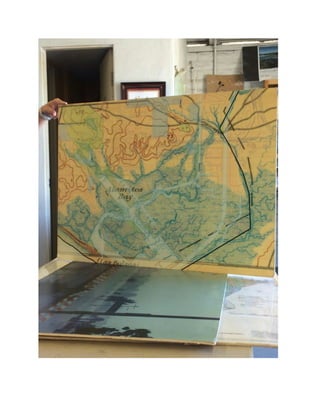
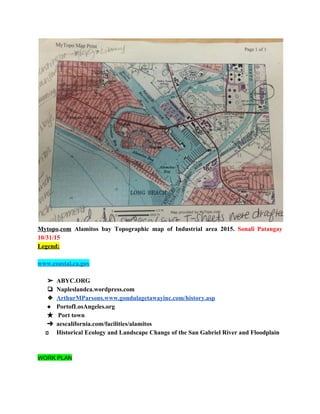
Mytopo​.​com Alamitos bay Topographic map of Industrial area 2015. ​Sonali Patangay                     
10/31/15 
Legend: 
 
www.coastal.ca.gov 
 
➢ ABYC.ORG 
❏ Napleslandca.wordpress.com 
❖ ArthurMParsons.www.gondulagetawayinc.com/history.asp 
● PortofLosAngeles.org 
★  Port town 
➔ aescalifornia.com/facilities/alamitos 
      Historical Ecology and Landscape Change of the San Gabriel River and Floodplain 
 
   
WORK PLAN 
  
Sonali: 10/1415 
 
(I.) Team leader​:​ Sonali Patangay(P1)​ ​( Map specialist :1)​ ​Jurisdictions​ ​and laws 
discovered to have had an effect​.​                         ​Week 1​: Decipher the CEQA reports and 
current jurisdiction. 
                   ​Week 2: ​Executive summary 
(II.) Assistant: Anell Tercero (P2) ( Map specialist:2) ​Ownership​:​ ​Tracts, Parcels, 
zoning, and zoning changes for the tract.​            ​Week 1: ​Parcels and zoning 
                          ​Week 2: ​Zoning Changes 
(III.) Public Media: Randi Dillard (P3) ( Public Records)​ ​Annotated bibliographies, 
including LCP, city plans, foundation plans. ​Week 1: ​Foundation plans 
                                                                      ​Week 2: ​City plans 
(IV.) Popular Media: Jessica Dooley (P4) ( Popular Press coverage);​ ​Popular Media 
search.                                                         ​Week 1: Popular Press coverage  
                 Week 2: Word Cloud ( Alamitos Bay) 
(V.) Popular Media: Ignacio (P5) (Timeline specialist​)​ ​Organized chronologically 
NVIVO wordcloud, constructing timeline for Alamitos Bay #1.  
 ​Week 1:  creating progress report Timeline (1.) 1784­1906 
 Week 2: Timeline (2.)​ ​1906­​Present. 


Ignacio 10/27/2015 ­  10/28/2015  
Journal report week 4:  
Group Report # 1: 
ALAMITOS BAY GROUP 1 
TEAM PROGRESS REPORT 10/27/15 
PERIODS COVERED FROM 09/25/15 ­10/27/2015 
TEAM MEMBERS: SONALY PATANGAY, ANELL TERCERO, 
IGNACIO GARCIA G., JESSICA DOOLEY AND RANDY DILLARD 
  
Summary of the current state of Alamitos Bay 1 project: 
  
× Our goal is to have assembled a body of solid empirical social evidence for the history of                                   
the Long Beach Industrial Zone tract by doing research investigating key social issues and events                             
surrounding the construction in the Industrial Zone Area, particularly the straightening of the San                           
Gabriel River and the construction of the power plant.   
  
§ The team has completed the selection of contemporary maps of the industrial area, indicating                             
zoning and parcels. 
  
§ Group created general timeline, it is working also on gathering material for the Archive of                               
Popular and Citizen Media, and for the Persons of Interest section. 
  
§ Group focused on researching online databases to locate maps showing zoning changes of                           
industrial area, making own maps, producing notes, and looking for photos.  
  
§ Group members are still in the process of researching historical city planning documents to                             
figure out ownership of the Industrial area in the past. 
  
§ Group continues in the process of research for sources of information in public records. Group                               
researched the CEQA Report. 
  
§ ​Assistant Team Leader Anell Tercero visited Alamitos Bay and the Historical Society of Long                             
Beach, but was not able to access archives. She spoke briefly with two potential interviewees;                             
gallery coordinator Brandon Werts and Dr. Kaye Briegel, who is co­director of Virtual                         
Oral/Aural History Archive at CSULB.  
  
×        ​Team member’s duties evaluation: 
  
Group will be meeting regularly outside of class to discuss each individual’s progress and to                             
verify that everyone is gathering the necessary information and sources. 
All group members are working diligently to gather concrete data.  
 
×      ​  Period Summary: 
  
The total work hours for the period is approximately 323*. 
During this period the team focused most of its time doing research and planning, 
Literary searches, establishment of goals and initial selection of material. 
  
§  ​Sonali:​ 88hrs. 
Sonali has work actively researching the CEQA report and made four work entries citing urls                             
and abstracts: 
Long Beach East Division police substation construction approval. 
Los Cerritos Wetlands and Oceanaire Apartment Development in accordance with CEQA 562.                       
Sonali has also been writing the work draft plan on google docs and preparing the final work 
  
§ ​Anell: Anell: 60hrs. Started with gathering the most current maps available that show zoning                             
districts and land parcels in the industrial area. The maps indicate that our tract is part of the                                   
Planned Development District (PD­1) Southeast Area Development and Improvement Plan,                   
which are considered special districts. She visited Historical Society of Long Beach and met two                             
potential interviewees, Dr. Kaye Briegel and Brandon Werts. Currently she is gathering                       
information (maps, photos) of the tract prior to the construction of the power plant and the                               
straightening of the San Gabriel River. 
  
§ ​Jessica: 60hrs. As Popular Media Specialist has collaborated working on the timeline                         
improvement, researched maps of the wetlands in the Alamitos area. Jessica also has been                           
researching on popular press coverage and citizen media for the Popular Media Archive. 
  
§ ​Randy: 50hrs. Has been working in researching public records over the replacement of the                             
Alamitos power plant. Also, Randy is collaborating in researching articles regarding water                       
pollution and water waste and documents from city planning department, such legislation and                         
codes placed to protect the environment. 
  
§  ​Ignacio:​  65hrs. 
As Media Specialist Ignacio has been work also in several tasks; 
He has been improving the timeline constantly with entries, and researching websites related to                           
it. He has conducted research over the Long Beach Heritage foundation. 
Started the Archive of Popular Media and section of Persons of Interest as possible interviewees,                             
also started a bibliography section for project. Ignacio is also the author of this report. Ignacio is                                 
actively looking for photos of the before, during and after the construction of the Alamitos power                               
plant. 
  
Group unexpected beginning: 
  
×         The proportion of the project accomplished is about 35­40%. 
  
× The most significant achievement of the group during this period was the consolidation of                             
the members as a group and gathering the most contemporary data relating to our tract. We                               
continue to research historical data and sources to identify how the construction of the power                             
plant and the straightening of the San Gabriel River drastically changed the area surrounding it                             
and what the main issues were. Since one of the team members began working on the project 2                                   
weeks after we had started (due to illness), that showed difficulty from our part to be up to date                                     
with the project goals.  
  
 Notes: 
*  Total does not include class readings. 
 
Anell, Ignacio, Sonali 11/02/15 ­ 11/03/15 
 
I’m continuing searching data for Alamitos bay / Long Beach industrial zone. 
I found the ​Southern California Edison Photographs and Negatives collection of the 
construction of the area in the Huntington Digital Library about the Alamitos Generating 
Station during years 1955 ­ present​.​ ​Aerial photos of Alamitos Generating Station.​ ​Aerial 
views of Alamitos Generating Station during construction.​ ​Alamitos Steam Station. 
 
http://hdl.huntington.org/cdm/search/searchterm/Alamitos%20Generating%20Station/mode/exa
ct/order/date 
About the collection    
Southern California Edison Photographs and Negatives 
This database contains 70,000 scanned images from the photographic archive of Southern 
California Edison (SCE). Spanning the years 1887 through 1975 (with the majority of images 
from the 1880s­1950s), the archive records key hydroelectric and other projects across the 15 
central, coastal and southern California counties served by SCE, the largest electric utility in 
California. Aside from documenting 28 major Edison projects and the company’s vast 
infrastructural network, the archive also depicts employee gatherings, streetscapes, billboards, 
agricultural and other industries, exhibitions, small businesses, sports and recreational facilities, 
electrical appliances, education and promotional efforts, advertisements, suburban development, 
and a host of other topics. In short, the archive offers a twentieth century vision of better living 
through electrification.  
SCE employed many photographers to record its myriad activities. The four photographers most 
prominently represented include: G. Haven Bishop (active ca. 1905­1939), Doug White (active 
1940­1954), and Joe Fadler and Art Adams (both active 1950s­early 1970s). The archive also 
contains photographs created for, and collected by, SCE’s predecessor companies, including 
Edison Electric, Henry Huntington’s Pacific Light & Power Co., Mt. Whitney Power & Electric 
Co., and California Electric Power Co., among others. 
The database also includes images used to illustrate Iron Men and Copper Wires and The Story 
of Big Creek, books chronicling SCE’s history. Illustrations for both books can be searched 
using the “Physical Sub Collection” field in advance search. Note: Images published in these two 
books that are not the property of SCE are not included in the database. 
  
Please Note: Records have been migrated from a legacy database and have not been checked for 
accuracy. 
  
For additional information about the archive and its contents, please contact Jennifer Watts, 
Curator of Photographs, The Huntington Library (jwatts@huntington.org). Information on the 
business records of Southern California Edison is available in the Huntington Manuscript 
Department and via the finding aid posted on the ​Online Archive of California​. 


Southern California Edison Photographs and Negatives 
Alamitos Generating Station ­ Alamitos #1. ( 48 pictures ) 
Steam power­plants. 
Construction. 
Alamitos​ ​Generating​ ​Station​ ​­​ ​Alamitos​ ​#1​ ​­​ ​Placing​ ​cooling​ ​water​ ​piping​. 
Date: 04/13/1955 
http://hdl.huntington.org/cdm/compoundobject/collection/p16003coll2/id/62007/rec/01 
 
1. 


Alamitos Generating Station Construction 6/15/1956 
http://hdl.huntington.org/cdm/ref/collection/p16003coll2/id/61947 
1. 
 
 
2.  
 
   
 3.Alamitos Generating Station running while construction  


1.  Dredging canal for Alamitos Generating Plant 06.04.1958 
http://hdl.huntington.org/cdm/ref/collection/p16003coll2/id/64365 


2. 
 
3. 
 
4. 
 
 ​Aerial views of Alamitos Generating Station during construction 09.23.1960. 
Photographer: Fadler, Joseph 
http://hdl.huntington.org/cdm/ref/collection/p16003coll2/id/66341 
1. 
 
 
2. 
 
 
3. ​ ​Aerial views of Alamitos Generating Station during construction 09.23.1960. 
Photographer: Fadler, Joseph 
   
Aerial views of Alamitos Generating Station during construction 1966 
   
1. Aerial views of Alamitos Generating Station during construction 1966 
Construction of Units 5 & 6 
Photographer: Fadler, Joseph 
 
2. Alamitos Generating Station ­ Construction of Units 5 & 6 Experimental Bag filter 
house. 
Photographer: Fadler, Joseph 
   
3.  Alamitos Generating Station ­ Construction of Units 5 & 6 Experimental Bag filter 
house. 1966 
Photographer: Fadler, Joseph 
 
 
1. Alamitos Generating Station 1967 
Photographer: Fadler,  Joseph 7/5/1967 
 
 
2. Alamitos Generating Station 1967 
Photographer: Fadler,  Joseph 7/5/1967 
 
 
11/04/2015 I continue my research today in the online archive of California 
http://www.oac.cdlib.org/   
 
Ignacio 11/05/2015 12:04PM  POPULAR MEDIA ( ARTICLE # 1) 
Los Angeles Herald, Volume 32, Number 203, 22 April 1905  
California Digital Newspaper Collection​ >​ ​Los Angeles Herald​ > 22 April 1905  
 
This article is about the interest showed by the Long Beach Mayor R. A. Eno declaring the 
city’s interest of buying the Alamitos power plant and the necessity to extend the pipe lines 
to Long Beach. Five city officials made a trip to Los Angeles this morning to bring the 
proceeds of the sale of Convention hall bonds from the vaults .of the Los Angeles Trust 
company to the First National bank of Long Beach. The money amounted to $31,162.70. 
 
http://cdnc.ucr.edu/cgi­bin/cdnc?a=d&d=LAH19050422.2.74&srpos=2&e=­­­­­­­en­­20­­1­­
txt­txIN­aLAMITOS+pOWER+PLANT­­­­­­­1 
Ignacio 11/05/2015 12:04PM  POPULAR MEDIA ( ARTICLE #2) 
California Digital Newspaper Collection​,​ Desert Sun​,  26 April 1973  
 
Today I have started my research in several websites and while I was looking for historical 
articles in popular media about the Alamitos Power Plant and the Cerritos Wetlands I’ve 
found in the CSNC ( California Digital Newspaper Collection) an article from The Desert 
Sun ( 05/26/1973) about the Edison’s plant Honored with the 1973 Environmental 
Protection Award from “Power Magazine” an industrial publication. This nationally 
recognized award was given because of the Edison Alamitos Generating Plant role in 
protecting water and air. Edison’s was selected for the electric utility’s work in controlling 
the emissions of nitrogen oxides in fuel gases (NOX)  at the generating station.  
 
http://cdnc.ucr.edu/cgi­bin/cdnc?a=d&d=DS19730426.2.91&srpos=1&e=­­­­­­­en­­20­­1­­tx
t­txIN­aLAMITOS+POWER+PLANT­­­­­­­1 
 
Ignacio 11/09/2015 12:04PM  POPULAR MEDIA ( ARTICLE # 1) 
 
Today Monday 9th, November 2015  I started my research again in The California 
newspaper collection website, the one who is giving me most of my results in the research. I 
have been founding popular media about, a sugar plantation in the industrial area (agregar 
link  
 
California Digital Newspaper Collection​,​ Pacific Rural Press​, 2 April 1898 
Pacific Rural Press, Volume 55, Number 14, 2 April 1898 
http://cdnc.ucr.edu/cgi­bin/cdnc?a=d&d=PRP18980402.2.2&srpos=5&e=­­­­­­­en­­20­­1­­tx
t­txIN­aLAMITOS+POWER+PLANT­­­­­­­1 
 
 
This article is about the improvements works on the valley irrigation system and the 
construction of a dam with the purpose of make waste water from the Alamo Power Plant 
available for irrigation of land In the Mesquite Lake district. 
 
Ignacio 11/09/2015  POPULAR MEDIA ( ARTICLE # 2) 
California Digital Newspaper Collection​ >​ ​Imperial Valley Press​ > 2 April 1910    
Imperial Valley Press, Volume , Number 52, 2 April 1910 
(Alamitos Power Plant) 
UTILIZING WASTE WATER 
Dam on the Alamo to Conserve Waste from the Power Plant for irrigation of the Mesquite 
Lake Region. 
One of the important works of improvement on the valley irrigation system delayed by the 
efforts of HOA2 Duncan and others to set aside the appointment of a receiver for the 
California Development Company Is the dam on the Alamo, designed to make waste water 
from the power canal and the Sharp's heading WOflteWfly available for irrigation of land 
In the Mesquite Lake district. The site' of the dam is about three miles west of Holtville and 
about a mile north of Meloland, and the structure is to be an earth dam with n sheet piling 
core and concrete waste and head gates, 33 feet high. The capacity of the waste way is 700 
second feet. 
The Alamo dam is to serve the district now irrigated by the Rose, Redwood and Rubber 
canals, an area of lti.ooo acres, and will relieve the Alamitos and Ash to that extent. About 
half the work has been done, and if the writ of prohibition had not stop lied operations, the 
dam would have been completed in thirty days and the power canal restored to use. The 
power canal is out of use because the discharge of waste water into the Alamo would 
interfere with work on the dam unless an expensive by­pass were constructed to carry the 
water around the dam site. The cost of the dam is estimated at $40,000. 
 
http://cdnc.ucr.edu/cgi­bin/cdnc?a=d&d=IVP19100402.2.45&srpos=4&e=­­­­­­­en­­20­­1­­t
xt­txIN­aLAMITOS+POWER+PLANT­­­­­­­1 
 
Ignacio 11/09/2015  POPULAR MEDIA ( ARTICLE # 3) 
Steam Plant Unit Added at Alamitos 
Format: News Item 
Year: 1962 
Published in: Los Angeles Times (1923­Current File) (10 June 1962), page M6 
Source: Times Mirror Company 
 
This article is about the completion of the fourth generating unit of the Alamitos Steam­ 
Electric generating station which has made the Alamitos Station the largest single power 
producer in Southern Edison Co.'s system. 
 
"Steam Plant Unit Added at Alamitos." ​Los Angeles Times (1923­Current File)​, (1962): M6 
http://search.proquest.com.libproxy.csun.edu/docview/168065343?accountid=7285 
 
Ignacio 11/09/2015  POPULAR MEDIA ( ARTICLE # 4 ) 
 
By:​Andrew Edwards 
Format: News Item 
Year: 2014 
Published in: Press ­ Telegram (11 May 2014) 
Source: Los Angeles Newspaper Group 
 
This is a press release after AES Corp. Seeking Approval for Alamitos Energy Center 
 in East Long Beach. California law requires the state's utilities get one­third of the state's 
total electricity supply from renewable sources such as solar and wind by 2020.  
 
Full text 
  
Ignacio 11/11/15 Popular Media ( ARTICLE # 1 ) 
 
Today I wave focus my research not on the historical perspective but in the actual work 
that institutions such Tidal Influence ( ​www.tidalinfluence.com​ )  are doing in the effort to 
conserve and restore the environments of the San Gabriel River Estuary.  Tidal Influence  
is working in conservation missions with the same approach to work in different locations 
with similar stories. 
 
Tidal Influence team leads wetlands restoration primarily through the Los Cerritos 
Wetlands Stewardship Program and Friends of Colorado Lagoon. The programs are 
community based restoration  approach with the goal of public environmental education 
on the restoration efforts in these natural areas. Monthly events are hosted at Los Cerritos 
Wetlands and Colorado Lagoon.  
 
The coastal wetlands  has been identified by activist and government officials as one of the 
most important coastal conservation program, because it the large scale restoration and 
conservation  in Southern California. 
 
http://www.aescalifornia.com/facilities/alamitos 
 
Los Cerritos Wetlands programs is sustained also for conservation partners such as: 
 
Aquarium of the Pacific 
California Native Plant Society 
California Coastal Commision. 
El Dorado Audubon 
Coastal Conservancy 
County of Los Angeles 
City of Long Beach 
City of Seal Beach  
Signal Hill Petroleum 
Los Cerritos Wetlands Land Trust 
U.S Fish & Wildlife Service 
River and Mountains Conservancy 
 
Ignacio 11/20/15 Popular Media ( ARTICLE # 1 ) 
 
After several days in research silence due to other university obligations and 
responsibilities I began doing research again  on the California Digital Newspaper 
Collection were I found this interesting article about the creation of The Long Beach and 
Alamitos 
 
Los Angeles Herald, Number 249, 6 June 1901 
 
California Digital Newspaper Collection​, ​Los Angeles Herald​, 6 June 1901 
 
http://cdnc.ucr.edu/cgi­bin/cdnc?a=d&d=LAH19010606.2.157&srpos=11&e=­­­­­­­en
­­20­­1­­txt­txIN­aLAMITOS+POWER+PLANT­­­­­­­1 
 
This article is about the The Long Beach and Alamitos Gas. and a issue of  a certificate of 
the creation of a bonded indebtedness in the amount of $100,000. to be evidenced by 200 
bonds of $500 each. The bonds are to run for nineteen and a half years and to bear interest 
at the rate of 5 per cent per annum. The indebtedness was voted for the purpose of 
obtaining funds for the development of the company's plant and equipment. The United 
Electric, Gas and Power company, at a meeting of its stockholders, passed a resolution to 
guarantee the payment of the bonded indebtedness of $100,000, to be created by the Long 
Beach and Alamitos Gas, Electric and Power company, and a certificate of such guarantee 
was yesterday filed in the county clerk's office. 
 
Ignacio 11/20/15 Popular Media ( ARTICLE # 2 ) 
 
Edison Plans Huge Addition to Alamitos  
Los Angeles Times (1923­Current File); Jul 26, 1963;  
ProQuest Historical Newspapers: Los Angeles Times pg. C10 
 
Southern California Edison is looking for permission to build a 488,500­kilowatt capacity 
generator plant, the biggest in the utility system.  The plant would be built as an addition  
of the alamitos power plant. 
 
http://search.proquest.com.libproxy.csun.edu/docview/168386836?accountid=7285 
 
Ignacio 11/21/15 Popular Media ( ARTICLE # 1 ) 
 
Steam Plant Unit Added at Alamitos  
Los Angeles Times (1923­Current File)​ Los Angeles, Calif, 10 June 1962: M6 
 
Completion of a fourth generating unit has made the Alamitos steam­electric generating station 
the largest single power producer in Southern Edison Co.'s system. 
 
http://search.proquest.com.libproxy.csun.edu/docview/168065343/abstract?accountid=7285 
 
Ignacio 11/21/15 Popular Media ( ARTICLE # 2 ) 
 
Chambers, A. (1997). Edison to divest 12 California plants. Power Engineering, 101(3), 10. 
 
A plan has been approved by Edison International and Southern California Edison to auction 
12 power plants in SCE's service territory ­ 100% of the utility's natural gas and oil­fired 
generation assets. 
 
http://libproxy.csun.edu/login?url=http://search.proquest.com.libproxy.csun.edu/docview/221
068989?accountid=7285 
 
 
Ignacio 11/21/15 Popular Media ( ARTICLE # 3 ) 
 
AES EXTRACTS TOP PERFORMANCE FROM DIVERSE ASSET BASE 
Power Engineering, volume 108 issue 11 (31 October 2004), pages 216­216 
 
http://libproxy.csun.edu/login?url=http://search.proquest.com.libproxy.csun.edu/docview/221
026962?accountid=7285 
 
AES Corp operates the world's largest fleet of coal­fired circulating fluidized bed boilers (more 
than 1700 MW), several fossil power stations divested from utilities, power stations that are still 
part of a utility, new gas­fired combined­cycle facilities, and plants fueled largely by opportunity 
fuels like petroleum coke and biomass. So­called merchant power companies are transforming 
themselves from project development organizations into disciplined operating companies. For 
AES, this transformation is occurring while retaining a unique corporate culture that stresses 
environmental responsibility and assets run by leaders with independent business­owner 
attitudes 
 
 
Ignacio 11/21/15 Popular Media ( ARTICLE # 4 ) 
 
Southern California Edison sold at Premium  
 
http://libproxy.csun.edu/login?url=http://search.proquest.com.libproxy.csun.edu/docview/221
018046?accountid=7285 
 
SCE has sold at least of its 12 gas­fired­generation plants, subject to regulatory approval. 
Total price for all the 12 plants is approximately $1.9 billion, well exceeding the book value of 
$569 million. The plant have a total generating power capacity of 9,562 mw. 
 
Ignacio 11/21/15 Popular Media ( ARTICLE # 5 ) 
 
AES Corp, Annual 10k Report 2002 
 
http://search.proquest.com.libproxy.csun.edu/docview/190629943?pq­origsite=summon 
 
 
In the Annual report is announced the stepping down of the AES chairman after 21 years of 
service and the goals for the company recovery. 


Ignacio 12/02/2015 LOS ALAMITOS SUGARIE POPULAR MEDIA (ARTICLE # 1) 
California Digital Newspaper Collection​ ​Pacific Rural Press​ 2 April 1898 
Pacific Rural Press, Volume 55, Number 14, 2 April 1898 
 
http://cdnc.ucr.edu/cgi­bin/cdnc?a=d&d=PRP18980402.2.2&srpos=5&e=­­­­­­­en­­20­­1­­txt­txI
N­aLAMITOS+POWER+PLANT­­­­­­­1 
 
Outside view of the Alamitos sugarie in Orange county, California, and some facts about its 
proprietor and builder of the Alamitos factory, whose portrait is appended. 
 Mr. E. H. Dyer of Alvarado. 
 
Ignacio 12/02/2015 LOS ALAMITOS SUGARIE POPULAR MEDIA (ARTICLE # 2) 
 
California Digital Newspaper Collection​, ​Los Angeles Herald​, 17 September 1897 
Los Angeles Herald, Volume 26, Number 352, 17 September 1897 
 
Chamber of Commerce Visits the Sugar Factory  
 
A party of 448 people among them, officers, directors and members of the chamber of 
commerce visited the plant of that corporation at Los Alamitos yesterday afternoon.  
 
http://cdnc.ucr.edu/cgi­bin/cdnc?a=d&d=LAH18970917.2.128&srpos=6&e=­­­­­­­en­­20­­1­­txt­t
xIN­aLAMITOS+POWER+PLANT­­­­­­­1 
 
 
Ignacio 12/02/2015 LOS ALAMITOS SUGARIE POPULAR MEDIA (ARTICLE # 3) 
 
California Digital Newspaper Collection​ ​Pacific Rural Press​ 1 October 1910 
Pacific Rural Press, Volume 80, Number 14, 1 October 1910 
 
The United States Department of Agriculture recognizes the importance of the sugar plant.for 
their continued success since established at Alvarado, CA in 1907 
 
http://cdnc.ucr.edu/cgi­bin/cdnc?a=d&d=PRP19101001.2.2&srpos=14&e=­­­­­­­en­­20­­1­­txt­txI
N­aLAMITOS+POWER+PLANT­­­­­­­1 
 
 
Ignacio 12/07/2015 LOS ALAMITOS POWER PLANT POPULAR MEDIA (ARTICLE # 1) 
 
California Digital Newspaper Collection​, ​Los Angeles Herald​, 14 March 1907 
Los Angeles Herald, Volume 34, Number 164, 14 March 1907 
 
An explosion occurred during the night of March 13, shortly after midnight.  


The damage is estimated at about $800.00 
 
http://cdnc.ucr.edu/cgi­bin/cdnc?a=d&d=LAH19070314.2.133&e=­­­­­­­en­­20­­1­­txt­txIN­Bi
xby+Becomes+Head+of+a+Big+Corporation­­­­­­­1 
 
Ignacio 12/07/15 Popular Media ( ARTICLE # 2 ) 
 
AES Corp. seeking approval for Alamitos Energy Center in east Long Beach 
 
Source: SyndGate Media Inc 
Energy Monitor Worldwide 12 May 2014 
 
Power company AES Corp. anticipates its plans to build a replacement power plant in east 
Long Beach will require a two­year review process before the construction ­­ itself expected 
to take more than a decade ­­ can begin. 
 
"AES Corp. seeking approval for Alamitos Energy Center in east Long Beach." Energy 
Monitor Worldwide [Amman, Jordan] 12 May 2014. General OneFile. Web. 7 Dec. 2015. 
 
http://libproxy.csun.edu/login?url=http://go.galegroup.com/ps/i.do?id=GALE%7CA377008043
&v=2.1&u=csunorthridge&it=r&p=&sw=w&asid=5de34e557483764a6895b1b1fde17fd5 
 
Ignacio 12/07/15 Popular Media ( ARTICLE # 3 ) 
 
Source: Energy Monitor Worldwide (Amman, Jordan). (May 12, 2014) 
SNL Energy Power Daily (14 March 2014) 
  
AES Corp. subsidiary AES Southland plans to build four 3­on­1 combined­cycle gas­turbine 
power blocks consisting of 12 gas­fired combustion­turbine generators, 12 heat recovery 
steam generators, four steam turbine generators, four air­cooled condensers, and related 
ancillary equipment. 
 
AES Corp. seeking approval for Alamitos Energy Center in east Long Beach." Energy Monitor 
Worldwide [Amman, Jordan] 12 May 2014. General OneFile. Web. 7 Dec. 2015. 
 
URL 
http://libproxy.csun.edu/login?url=http://go.galegroup.com/ps/i.do?id=GALE%7CA377008043
&v=2.1&u=csunorthridge&it=r&p=&sw=w&asid=5de34e557483764a6895b1b1fde17fd5 
 
Ignacio 12/07/15 Popular Media ( ARTICLE # 4 ) 
 
Wall Street Journal, 9 July, 1987 
Source: Dow Jones & Company Inc 
 
Catalyst Energy Buys Alamito Class B Stock from Minority Holders 
Catalyst, which owns and operates electric and thermal energy plants, said it bought out the 
minority holders with which it jointly acquired Alamito in June 1986. The minority holders were 
Bear, Stearns & Co., Donaldson, Lufkin & Jenrette Securities Corp., Mabon Nugent & Co. and a 
Donaldson Lufkin employee. The Donaldson employee also will receive payment stemming from 
appreciation rights for shares to which he would have been entitled. 
Catalyst energy buys alamito class B stock from minority holders. (1987, Jul 09). ​Wall
Street Journal​Retrieved from
http://search.proquest.com/docview/398020951?accountid=7285 
Ignacio 12/07/15 Popular Media ( ARTICLE # 5 ) 
New York Times (10 April 1986), page D.1  
Special to the New York Times PAULINE YOSHIHASHI 
 
Stocks and Bonds 
 
Alamito announced that Tucson Electric would not honor its 12­year contract with the wholesaler 
beyond 1989, citing ''important fundamental disputes.'' Megawatt contends in its suit that the 
announcement was made to disrupt the financing packages arranged by competing bidders, 
thereby giving an edge to Tucson Electric's former executives. Despite Alamito's agreement with 
Osceola, both Megawatt and Homans McGraw say their offers are still outstanding. 
 
http://libproxy.csun.edu/login?url=http://search.proquest.com.libproxy.csun.edu/docview/425
838756?accountid=7285 
 
Ignacio 12/07/15 Popular Media ( ARTICLE # 6 ) 
 
Platts Utility Environment Report 
April 5, 2002 
 
Two of AES Pacific's southern California power plants, Alamitos and Redondo Beach, produced 
76% of all NOx emissions that exceeded individual facility allocations in 2000. Because AES 
Pacific was unable to acquire the needed credits, the two plants were shut down causing an 
outcry from the California Public Utilities Commission because of the need for the power. 
 
Scaqmd audit show effect of calif. energy crisis on nox credit prices. (2002). McGraw ­ Hill's Utility 
Environment Report, 6. 
 
http://www.lexisnexis.com.libproxy.csun.edu/hottopics/lnacademic/?verb=sr&csi=11626&sr=
HEADLINE(SCAQMD+AUDIT+SHOW+EFFECT+OF+CALIF.+ENERGY+CRISIS+ON+NOx+CRED
IT+PRICES)%2BAND%2BDATE%2BIS%2B2002 
 
Ignacio 12/07/15 Popular Media ( ARTICLE # 7 ) 
 
Business Editors. Business Wire New York, 14 Dec 2000 
 
AES Alamitos Reaches Agreement with the South Coast Air Quality Management District; 
Settlement Reconciles Past Allegations and Allows Future Operation  
Stuart Ryan, Executive Vice President of AES, stated, "The dramatic increase in demand 
for electric energy placed us in a bind regarding the nitrogen oxide emission allowances 
that were available to us. By closely working with the District, we have found a fair way to 
respond to this emergency situation. This was a very difficult situation all around. The 
District's mission is to protect the quality of the air that people breathe. It is an admirable 
mission and one that AES strongly supports. At the same time, AES's generating 
facilities are important to the state of California during its dire need for electricity. We are 
pleased with this resolution that addresses air quality concerns by the installation of 
SCR, while allowing our plant to continue to run to meet southern California's electricity 
needs."  AES Southland also will cause SCR to be installed on four additional units at 
AES Redondo Beach and AES Huntington Beach. 
 
http://libproxy.csun.edu/login?url=http://search.proquest.com.libproxy.csun.edu/docview
/445835122?accountid=7285 
 
Editors, B. (2000, Dec 14). AES alamitos reaches agreement with the south coast air 
quality management district; settlement reconciles past allegations and allows future 
operation. Business Wire Retrieved from 
http://search.proquest.com/docview/445835122?accountid=7285 
 
Ignacio 12/07/15 Popular Media ( ARTICLE # 8 ) 
 
Water problem may have power source 
Russell, Wendy Thomas. Press ­ Telegram Long Beach, Ca 01 Nov 2006 
 
LONG BEACH ­ In their quest to find an explanation for the sewage­tainted waters that closed 
Marine Stadium and Mother's Beach for nearly a month, city officials have begun to consider 
a startling theory that could give credit for clean water to a power plant on Studebaker Road. 
The theory, first posed by Water Department General Manager Kevin Wattier, is that the 
bacterial counts in Marine Stadium skyrocketed in late September ­ and remained high for 
more than three weeks ­ as a direct result of the Alamitos Power Plant shutting down five of 
its six units earlier that month. 
The AES facility, a 2,123­megawatt steam plant located at 690 N. Studebaker Road, is one of 
two power plants that operate on the city's Eastside. The other is the Los Angeles 
Department of Water and Power Haynes Generating Station, a public facility that pulls water 
from the bay in a similar fashion to AES'. 
Russell, W. T. (2006, Nov 01). Water problem may have power source. Press ­ Telegram 
Retrieved from ​http://search.proquest.com/docview/382058253?accountid=7285 
 
 
Ignacio 12/02/2015 LOS ALAMITOS SUGARIE POPULAR MEDIA (ARTICLE # 9) 
California Digital Newspaper Collection Los Angeles Herald, 2 January 1898 
Los Angeles Herald, Volume 25, Number 94, 2 January 1898 
 
 Los Alamitos Sugar company has completed its plant, and a brief description of the 
building is as follows: The main building is 260 x 66 feet, of brick, supported on steel 
frames with solid cement foundations extending many feet underground. The annex or 
boiler house is 196 x 72 feet, with a capacity for 20 boilers ot 300 horse power. 
 
http://cdnc.ucr.edu/cgi­bin/cdnc?a=d&d=LAH18980102.2.231.5&e=­­­­­­­en­­20­­1­­txt­txIN­aLA
MITOS+POWER+PLANT­­­­­­­1 
 
 
Ignacio 12/07/15 Popular Media ( ARTICLE # 10 ) 
 
California Digital Newspaper Collection​, ​Los Angeles Herald​ , 10 January 1917 
Los Angeles Herald, Number 60, 10 January 1917 
 
Man Touches Wire and Is Electrocuted 
Electrocuted when his hand came in contact with the high voltage wires of the electric 
power plant in the California Food Product company plant at Zinc station, near Long 
Beach, Ward Haskins, an electrician, was instantly killed today. 
http://cdnc.ucr.edu/cgi­bin/cdnc?a=d&d=LAH19170110.2.44&srpos=13&e=­­­­­­­en­­20­L
AH­1­­txt­txIN­Long+Beach+POWER+PLANT­­­­­­­ 
 
Ignacio 12/07/15 Popular Media ( ARTICLE # 11 ) 
 
Enlargement of Harbor Power Plant Approved 
 
California Digital Newspaper Collection​, ​Los Angeles Herald​ , 31 October 1912 
Los Angeles Herald, Number 26, 31 October 1912 
 
LONG BEACH. Oct. 31.—Immediate enlargement of the Edison power plant on the inner 
harbor, as announced yesterday by Assistant General Manager Balia of the Southern 
California Edison company, has met with the approval of the city. An order for a third unit 
of power in addition to one already constructed and one nearing completion was given 
yesterday and the combined capacity of the plant will be 64,000 horsepower and Its value 
will be $3,000,000. 
 
Ignacio Garcia Glucklich last entry 12/09/2015 
 
During the project I had many worries about my process of research, due to the lack of 
results.  My general feeling was that I was doing research in the wrong sites and I was 
wasting research time. I discovered that it was all part of the research process, that actually 
“not knowing” took me to finding. I found that all the beginning research process start like 
that 
I bean founding information on popular media when I got access to key websites such 
CSUN OVIATT online library and it powerful ONE SEARCH searching tool that allowed 
me to have access to most of the Library’s article databases and the library catalogue​. 
In sites such, Business Editors, The New York Times, California Digital Newspaper 
Collection, Los Angeles Herald, Rural Press, Power Engineering, Edison among many 
others was where found all my information. It was a surprise to me that CSULA online 
library is has a good research database, I wasn’t able to find much. 
Things changed and I got plenty articles and I feel that the class would have last longer the 
results definitely would be bigger.   
At the end it was a pleasure work on this project, I have learned so much, from estuaries to 
politics. The project is very intense.   
 
 
GROUP ANNOTATED  BIBLIOGRAPHY  


1. Eric D. Stein, Shawna Dark, Travis Longcore, Nicholas Hall, Michael Beland, Robin                         
Grossinger, Jason Casanova, and Martha Sutula. 2007. ​Historical Ecology and Landscape                     
of the San Gabriel River and Floodplain.  ​SCCWRP Technical Report 499. 
  
This report talks about how California has recently begun to be very active in the management,                               
restoration and protection of what is left of our historic wetlands. And to do that there needed to                                   
be some delving into historical ecology to understand what contributed to declines in the past to                               
help prevention of declines in the present. This would help with restoration and preservation. I                             
was mainly interested in the historical maps to see where the estuaries used to be to pinpoint                                 
what used to be there before there was a power plant in the area. 


2. Larry Strawther. 2014. ​Seal Beach: A Brief History​. The History Press 
  
  This book is for the most part about the history of Seal Beach, but it runs very close to                                     
our area of research so I thought it would have some useful information and it did. First it had                                     
some useful maps that showed where the flooding took place on the San Gabriel River from the                                 
late 1800’s to 1938 when the flooding was controlled. And even better we found that when                               
looking more into the book Seal Beach: A Brief History, we found that the last four thousand                                 
feet of the San Gabriel River was straightened and encased in rock in 1931. According to this                                 
book the straightening of the San Gabriel River was complete before the last major flooding of                               
the river occurred and before the leveeing of the river began in 1938. 
  
  
3. OC Tribune Staff. 2014. ​The Vegas of the 20’s: Seal Beach​. Retrieved November 4, 2015,                               
from​ ​http://orangecountytribune.com/2014/04/04/the­vegas­of­the­20s­seal­beach/ 
  
        ​4.  Although this was not the area we were looking at this was the little community at                               
the bottom of the San Gabriel River that needed to be gone in order for the straightening of the                                     
river to be complete. This area was known as “Joy Zone Amusement Park”. It was opened in                                 
1916 and was considered to be the Las Vegas of the 1920’s. Unfortunately with the great                               
depression it began to decline in popularity. Although on the other side of it (Anaheim Landing)                               
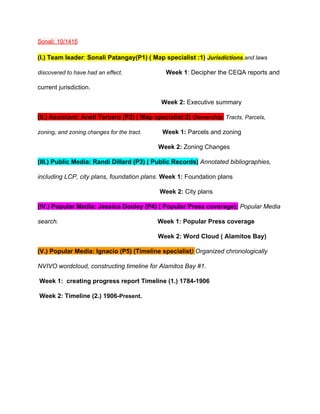
because prohibition, there was also a port that was good drop off spot of bootlegged alcohol. 
  
  
5. Colleen Fliedner. 2006. ​Seal Beach​. Retrieved November 4, 2015, from                     
http://www.ocregister.com/articles/beach­7236­seal­city.html 
  
  Again talking about “Joy Zone” and how it was quite popular, especially with Hollywood                           
crowd. Although 1929, with the stock market crash and the ensuing Great Depression it was no                               
longer able to stay open. Many building had ended up falling into disrepair and the roller coaster                                 
then burning down. Then in 1944 the Naval Base took over part of it house ammunition 
  
  
6. Edgar C. Kenyon, Jr. 1950. ​History of Ocean Outlets, Los Angeles County Flood Control                             
District. Retrieved November 4, 2015, from           
https://icce­ojs­tamu.tdl.org/icce/index.php/icce/article/viewFile/934/031_Kenyon 
  
  During the time from around 1868, when the San Gabriel River cut a new channel to the                                 
ocean, to 1931, the outlet migrated down coast around 2800 ft. 
Around this time that outlet reached a low bluff and the Los Angeles Gas and Electric built a                                   
steam electric generating plant in 1925. 
During the late 1920s the Flood Control District began the straightening and widening of the                             
channel. In 1930, there was a certain amount of oil wells that was located in the area adjacent to                                     
Alamitos Bay and they were damaged due to inundation from flooding. 
  
7. ​Flood Curb Job Nears End: Early Completion of San Gabriel River Seen With Approval of                               
Plans for Unit No. 6​. 1933. Los Angeles Times, pg. A3. Retrieved November 13, 2015, from                               
http://search.proquest.com/hnplatimes/docview/163143042/A676A30BCE844562PQ/11?acc
ountid=10352 
  
There was a project that was occurring to help the prevention of the flooding at the mouth of the                                     
river. This total cost of this project was $1,000,000. It was to protect the parts of the river that                                     
experience the most major of the flooding. 


Are Combined Against River: San Gabriel Drainage Men Ask Assistance; Chamber of                       
Commerce Petitioned to Investigate Situation and Send Telegram to Southern California                     
Congressmen, Indorsing Stand Taken for Protection from Floods​. 1911. Los Angeles Times,                       
pg.17. Retrieved December 2, 2015, from           
http://search.proquest.com.mimas.calstatela.edu/hnplatimes/docview/159573264/471475216588
4B2EPQ/7?accountid=10352 
There was a meeting held in July of 1911 where the city of El Monte wanted to form a San                                       
Gabriel River storm drainage district, which would extend from the San Gabriel mountains to the                             
ocean. There has been some major opposition from the ranchers in the area though, as they have                                 
spent a considerable amount of money to protect their land. The ranchers had their own meeting                               
mentioning that they had collectively contributed $20,000 straightening the river in the Whittier                         
area with material that was already on the ground. Their efforts have extended over three miles                               
and have straightened 17 curves of the river into a straight course. And although their efforts                               
were appreciated the Organization Committee of the San Gabriel River storm drainage sent a                           
letter to their chamber of commerce stating that there was too much silt being deposited into the                                 
San Pedro harbor from the San Gabriel River and that the silt deposits with either be greatly                                 
lessened or stopped altogether. 
  
Very Expensive: Estimated Cost of the Proposed River Work. A Comprehensive Report                       
Prepared by the Commission of Civil Engineers. The Result of a Careful Survey of the Beds of                                 
the Los Angeles and San Gabriel Rivers­­A Big Project. 1894. Los Angeles Times, pg. 5.                             
Retrieved December 2, 2015, from         
http://search.proquest.com.mimas.calstatela.edu/hnplatimes/docview/163698894/7E3B11E
FD88148E8PQ/2?accountid=10352 
In 1894 the need to protect the settlers around the San Gabriel River and Los Angeles River was                                   
great because of the constant flooding and a lot of valuable soil is also washed away. So the                                   
Commission of Civil Engineers prepared a report for the city that stated what was wrong with the                                 
San Gabriel River (and Los Angeles River) and what the cost for the straightening of these                               
rivers. With everything that needed to be done, the total estimated cost to fix the rivers was                                 
$2,761,440. With inflation, in 2015 the cost is actually $76,706,666. 


8. Bixby Becomes Head of Big Corporation​. 1907. Los Angeles Herald, pg. 9. Retrieved                           
December 2, 2015, from       
http://cdnc.ucr.edu/cgi­bin/cdnc?a=d&d=LAH19070314.2.130&srpos=1&e=­­­­­­­en­­20­­1­­txt
­txIN­Bixby+Becomes+the+Big+Head+of+Corporation­­­­­­­1 
March 13, 1907 George Bixby, son of Jotham Bixby, is elected president of the Los Angeles                               
Dock and Terminal Company, although there is urging from the locals for the company to be                               
renamed to the Long Beach Dock and Terminal Company. The dredger that was built for the                               
Dock and Terminal Company arrives in the Long Beach harbor and will be dragged through the                               
Wilmington Lagoon and Cerritos Slough. The straightening of the Cerritos Slough was officially                         
ordered, from the San Gabriel River to where it flows to in the Dock and Terminal Company.                                 
There was another ordinance put through to widen the Cerritos Slough between the San Gabriel                             
River and Wilmington Bay. 
  
9. To Build Large Pleasure Resort: Plan to Make Alamitos Bay Queen of Beaches​. 1905. Los                               
Angeles Herald, pg. 4. Retrieved December 2, 2015, from                 
http://cdnc.ucr.edu/cgi­bin/cdnc?a=d&d=LAH19050106.2.54&srpos=2&e=­­­­­­­en­­20­­1­­txt­t
xIN­Los+Alamitos+San+Gabriel+River­­­­­­­1 
There were plans to build a resort in Alamitos Bay, which is right on the San Gabriel River.                                   
Which means that this resort would have amenities that the river would offer such as fishing,                               
swimming, boating and duck shooting. There were also plans for a casino to be built in the area.                                   
There were plans to make Alamitos Bay the “Queen of Beaches”. Unsure if the plan of this resort                                   
ever became a reality.   
  
10.​ Long Beach Development Services: 
http://www.lbds.info/ 
http://www.lbds.info/planning/current_planning/zoning_ordinances.asp​ (10/18/15) 
This site has been very useful in attaining current maps showing land parcels and zoning in                               
Alamitos Bay and the Long Beach general plan. It also contains information regarding                         
developmental policies and laws. The information here is useful for current or future changes                           
that are or will be implemented in Alamitos Bay; not necessarily for attaining historical/previous                           
maps. It also contains links to several laws or acts that were passed, for example California                               
Environmental Quality Act (CEQA). 
  
11. Rancho Los Alamitos website: 
http://www.rancholosalamitos.com/aboutus/ownership.html​ (11/4/15) 
The Rancho Alamitos website contains a very detailed overall history and timeline of the major                             
events, such as changes in ownership and occupancy in Alamitos Bay since the land grant given                               
to Nieto by the Spanish crown through the purchase and development of the area by John Bixby. 
  
12. National Parks Services website: 
http://www.nps.gov/nr/twhp/wwwlps/lessons/8californio/8facts1.htm​ (11/4/15) 
Here, we find a historical timeline that incorporates a few more details regarding ownership and 
occupancy of Alamitos Bay that were not mentioned in the Rancho Los Alamitos website, for 
example the purchase of Rancho Los Alamitos by Michael Reese after Abel Stearns. 
  
  
13. Huntington Digital Library: 
http://hdl.huntington.org/ 
The Alamitos Land Company deposited all the records they had preserved since 1888 in the                             
Huntington Library. The digital library contains many documents and images (maps, pictures)                       
relating to the development of the Alamitos Bay area. 
  
14. Online Archive of California: 
http://www.oac.cdlib.org/ 
Contains several maps from land cases from the late 1800’s in the Alamitos Bay and also links to                                   
other archives, such as UCLA and Huntington Library. Might be more useful to gather                           
documents pertaining to land grant cases after the 1851 Act to Ascertain and Settle Private Land                               
Claims in the State of California passed by congress. 
  
15. Los Cerritos Wetland Authority: 
http://lcwetlands.org/ 
Up to date information about relevant issues surrounding the conservation of the Los Cerritos                           
Wetlands and their efforts to purchase private wetlands, for example those owned by Isaias W.                             
Hellman in Seal Beach. 
  
16. State Coastal Conservancy: 
http://scc.ca.gov/ 
Contains many documents from local and state agencies attempting to preserve the Los Cerritos                           
Wetlands and also detailed information along with maps, about ownership of the wetlands and its                             
surrounding areas. 
  
17. Long Beach Public Library Digital Archives: 
http://encore.lbpl.org/iii/cpro/app 
The archive contains hundreds of detailed aerial photographs, some dating as far back as 1921,                             
of the Alamitos Bay area. However, very few maps were found. 
  
18. The Los Alamitos­Rossmoor­Seal Beach History Project: 
http://localsports.biz/history/ 
Very helpful site, contains detailed historical information about the Alamitos Bay area overall.                         
There are also many lists of helpful historical books on Alamitos Bay and Seal Beach. 
  
 
19. These books by Dr. Kaye Briegel may also be helpful 
The Liquidation of Alamitos Land Company, 1988­2011 (the company printed it, along with the                           
history of their first century, and deposited all of the records they had preserved since 1888 at the                                   
Huntington Library). 
A Centennial History of the Bixby Land Company, 1896­1996 
  
20. Environmental Report ( Ceqa reports 2015): Environmental Planning ( 562) 570­6458 
www.lbds.info/planning/environmental.../environmental_reports.asp 
Southeast Area Specific Plan/SEADIP Update 
This map shows the current Southeast area specific plan proposal, as it is still pending,                             
illustrating the different phases of sub­projects. 
  
21.​http://3.bp.blogspot.com/­UM7Ahmbv7kU/Tnknsk30eYI/AAAAAAAACEU/Y7XYkzg2wj0/
s1600/Los+Cerritos+land+ownership+9­2011.jpg 
This map shows the original boundaries of the ​Los Cerritos Wetlands in Long Beach in 1896,                               
and it illustrates the changes in those boundaries through time, in accordance with the changing                             
jurisdictions and laws up to 1981. 
  
22.​https://www.google.com/url?sa=i&rct=j&q=&esrc=s&source=images&cd=&cad=rja&uact=8
&ved=0CAcQjRxqFQoTCM­30Jjc4MgCFUjaYwodyUIDiQ&url=http%3A%2F%2Fwww.caop
enspace.org%2Floscerritoswetlands.html&psig=AFQjCNHhUF5zAvu7xirLO66ey6cS26PPcg&
ust=1445968858700312   
 10/26/15 
  
23. Status on Southeast Area Specific Plan/SEADIP Update (EP 562): Pending 
Location: On the southeast edge of Long Beach city. This location entails 1,475 acres consisting                             
of the area south of 7th street, East of Bellflower Boulevard, East of Long Beach Marine                               
Stadium and Alamitos dock, South of Colorado Street. 
Description: This project proposes to replace current 1,475 acres PD­1 zoning where a specific                           
plan covering 1,466 acres and remove 9 acres from the PD­11 boundaries to convert to                             
conventional zoning. Thus, the project seeks to change “the boundaries of PD­1 so the two                             
separate areas entail: 1,466 acres within in the boundaries of current 1,475 acres PD­1 area                             
(specific plan). Area two entails: 9 acres with the current PD­1 directly west of Marina vista park                                 
(conventional zoning area). Both areas constitute the project area”( Ceqa 562:2015). 
4) ​www.lbds.info/planning/environmental.../environmental_reports.asp 
24. Environmental Planning (562) 570­6458 
Weber Metals Large Press Expansion 
 http://longbeachhistory.files.wordpress.com/2011/01/jungle2.jpg 
  
Case Study status: Approved/certified 
Location: Located on the Southern part of 21 acre Weber Metals facility. This is approximately                             
11.4 of the 21 acres located within the city of Paramount. The remaining 9.6 acres are located                                 
within the city of Long Beach. The specific location of this site is 16706 Garfield Avenue,                               
Paramount, CA. Weber metals facility has 19 buildings totaling 298,090 sf, which is responsible                           
for aluminum and titanium forging operations. 
“This Project will include: the expansion of the facility, installing a 60,000 ton forging press in a                                 
new building on the property. This aims to construct a new forge press housed in a new 115,000                                   
square foot building, within long beach city. This will entail an 85 foot deep excavation pit to                                 
house the press at a 65 foot high main roof to accommodate the height of the press.” 
 
25) ​Environmental report (562) Oceanaire apartments Status: approved 
http://www.longbeachize.com/wp­content/uploads/2015/02/OceanAireVictory­1024x596.jpg 
This map depicts the final project plan for the Oceanaire apartments, which gained approval in                             
accordance with CEQA guidelines section 15072. 
  
26. www.lbds.info/planning/environmental.../environmental_reports.asp 
Oceanaire Apartments project: Approved Environmental report 562 
Location: 150 West Ocean Blvd between South Pine avenue and Pacific avenue. 
Description: “This project proposes a 216 unit multi­family/ mixed use apartment complex on                         
the 1.76 acre site. The project will include a single structure that would consist of seven levels                                 
along west boulevard and five levels along west seaside way. The apartment structure reaches a                             
max of 85 feet above West Ocean Blvd. grade and 106.5 feet above west seaside grade. This                                 
includes a mixture of studios, and plus one bedrooms”. Per CEQA Guidelines Section 15072(g)                           
(5), the project site is not listed as a hazardous property as designated under Section 65962.5 of                                 
the Government Code. 
 
27. ​LB East Division Police Substation Environmental report (562): Status Approved 
www.lbds.info/planning/environmental.../environmental_reports.asp 
Location: The proposed East Division Police substation (here in referenced as the “project”). The                           
project is located at 3800 East Willow Street (between Redondo Avenue and Lakewood Blvd)                           
and involves the transfer of the Schroeder Hall property (owned by US Department of defense to                               
the city of Long Beach for relocation on existing East Division of police substation and juvenile                               
investigations section). 
“Following a preliminary review of the proposed project, the City of Long Beach determined                           
that the improvements are subject to the guidelines and regulations of the California                         
Environmental Quality Act (CEQA). The City has determined an Initial Study/Mitigated                     
Negative Declaration (IS/MND) to be the appropriate level of environmental analysis under the                         
provisions of CEQA”. 
 
28.Colorado Lagoon Field trip 
www.coloradolagoon.org/ 
For the purposes of our field trip today, Dr. Whitcraft is going to give us a tour of the lagoon,                                       
specifically focusing on the history of the Wetland Marine Science education center, which is                           
located on the northeast portion of the lagoon. WAMSEC, or the Wetland Marine Science                           
education center, was originally run by the Eldorado Center, temporarily. However, the Eldorado                         
Center did not have the funds in order to keep the lagoon and it was leased over to the Friends of                                         
Colorado Lagoon by the city. The friends of Colorado Lagoon, is a nonprofit organization that                             
leases the property for $1 annually, while the city of Long Beach pays for the electricity.                               
Historically this whole area was all Alamitos Bay, but the Colorado Lagoon sought to expand the                               
regional area of Alamitos Bay, as well as the Los Cerritos Wetlands area. The Los Cerritos                               
Wetlands is owned by what is known as 2 joint powers authority. The Los Cerritos wetlands is                                 
leased by the Bryant family through the city, and also leased by the Hellman family as well,                                 
along with the City of Long beach, Seal Beach, and other “severed” entities. During the late                               
1800’s, the Los Cerritos Wetlands, experienced salinity changes and, thus was filled and dredged                           
in 1896.In 1927­1928, the lagoon was straightened, which was done for the Olympics. At this                             
time, Naples was almost fully created. Seven years later, Belmont shores, would also be fully                             
constructed as well. 
29 Ownership and Development of Colorado Lagoon and Administration of the Termino drain                         
Project. 
www.ladpw.org/pdd/reports/Termino_EIR08_Final.pdf 
dpw.lacounty.gov/.../in... 
Los Angeles County Department of Public Works 
  In 1931, the lagoon was made to be a tourist site and to this day, it still is. Also that same                                         
year, the development of this area was finally finished in time for the Olympics. This was when                                 
they built a new road now called Colorado street. The city also built a tide gate (which made it                                     
deeper for diving events). By this era of the 1930’s, they trucked sand in from nearby beaches.                                 
The area was originally known for being very muddy and rocky, and was also used for                               
swimming lessons up until 1960. 
  In 2004, the Office of historic preservation, and the city of Long Beach teamed up and                               
came up with the idea of the Termino project. The Termino Avenue drain project was approved                               
in 2007, according to the LA County public library, Public works volume 2. 
30.  NVIVO Word Cloud 
 ​download.qsrinternational.com/.../NVivo10forMac/NVivo10­for­Mac­G. 
help­nv9­en.qsrinternational.com/.../run_a_word_frequency_query.htm 
Ultimately the NVIVO word cloud, will help my group with our final report. NVIVO word cloud                               
has been a very useful tool. It has helped us find connections between sea level rise and how it                                     
will affect the future of the San Gabriel River. Utilizing NVIVO we found that previous research                               
on the San Gabriel River, was looking at the long term effects of sea level rise. NVIVO thus,                                   
helps with word frequency query. The word cloud functions as a visual representation, which                           
maps out themes of Sea level rise and the San Gabriel river, and does an in depth analysis. Now I                                       
have a more concise idea of what to write about in my chapter. 
30. 1911 Tidelands grant 
 ​www.courts.ca.gov/opinions/revpub/C041603.DOC 
FACTUAL AND PROCEDURAL BACKGROUND 
This information is about the outcome of the 1911 Tidelands grant is especially advantageous to                             
my research because it gives background on the types of laws and jurisdictions that gave way to                                 
current laws and jurisdictions in the Alamitos bay area, prior to the dredging and widening of the                                 
San Gabriel River. 
I.  Public Trust Doctrine and the History of the Queensway Bay Parcels 
  The public trust doctrine, which evolved from Roman law and English                     
common law, holds that the state, as sovereign, owns all of the navigable waterways and the                               
lands lying beneath them “‘“as trustee of a public trust for the benefit of the people.”’” (National                                 
Audubon Society v. Superior Court (1983) 33 Cal.3d 419, 434 (National Audubon), quoting                         
Colberg, Inc. v. State of California ex rel. Dept. Pub. Wks. (1967) 67 Cal.2d 408, 416.) Though                                 
the rule applies generally to all navigable waters, it had its first application to tidelands.  
11) The outcome of the 1911 Tidelands grant  
www.courts.ca.gov/opinions/revpub/C041603.DOC 
By analyzing the outcome of the 1911 Tidelands grant, we are able to get tangible evidence                               
and/or quantitative data that permits all tidelands within a two mile radius are bound by the                               
current jurisdiction mandated by said land grants. 
  
Following a court trial, the court denied the petition. Earth Corps appeals, arguing: (1) the                             
exchange violated both the public “All tidelands within two miles of any incorporated city, city                             
and county, or town in this State, and fronting on the water of any harbor, estuary, bay, or inlet                                     
used for the purposes of navigation, shall be withheld from grant or sale to private persons,                               
partnerships, or corporations . . . .” 
trust doctrine and the California Constitution, (2) the exchange violated section 6307, and (3) the                             
exchange was not exempt from CEQA. As a threshold matter, Earth Corps argues we must                             
review the Commission’s actions under an independent judgment standard of review. The                       
League for Coastal Protection; Save Our NTC, Inc.; the Natural Resources Defense Council; and                           
the Surfrider Foundation joined together in filing an amici curiae brief in support of Earth Corps.                               
We find the Commission’s approval of the exchange not supported by the evidence. Therefore,                           
we reverse the trial court’s judgment and grant Earth Corps’s petition for writ of mandate. 
31 1833 Secularization Act 
http://www.nps.gov/goga/learn/historyculture/upload/Chapter­8.pdf 
“This chapter on the secularization and Rancho Era contains sections with a wide central                           
California perspective and sections with a narrow San Francisco Peninsula perspective. The                       
initial section follows the mission secularization process whereby Mission Indians lost legal title                         
to their lands and became a servant class within the Hispanic community. The second section                             
describes land grants received by Indian people in the San Francisco and Monterey Bay Areas.                             
The third section examines various themes pertinent to the San Francisco Bay Area and the                             
larger central California area. The fourth section documents secularization at Mission Dolores                       
and the family groups of the San Francisco Peninsula Indian community up to 1840. The fifth                               
and final section describes the Mission Dolores Indians and the San Francisco Peninsula                         
landscape during the early and mid­1840s”. 
  This was a “partial emancipation policy” that first only included the                     
Monterey district. However, it was extended to other districts in 1828, but did not include                             
Mission San Rafael or Mission San Francisco Solano on the Northern frontier (Bancroft                         
1886:III:102). 
 
32. 1833 Secularization Act specifics and effects on local jurisdiction and laws and Regulations                           
of 1834 
http://www.nps.gov/goga/learn/historyculture/upload/Chapter­8.pdf 
“On July 2, 1833 southern Mission Prefect Narciso Duran wrote Figueroa with regard to the                             
difference of life quality of the Indians who were living at the missions and those who were                                 
emancipated and living in the pueblo of Los Angeles: I have seen with the greatest amazement                               
that [the Indians who dwell in the pueblo of Los Angeles] . . . live far more wretched and                                     
oppressed than those in the missions. There is not one who has a garden of his own, or a yoke of                                         
oxen, a horse, or a house fit for a rational being. The equality with the white people, which is                                     
preached to them, consists in this, that these Indians are subject to a white comisionado, and are                                 
the only ones who do the menial work . . . All in reality are slaves, or servants of white men who                                           
know well the manner of securing their services by binding them a whole year for an advanced                                 
trifle . . . The benevolent ideas of the Government will never be realized, because the Indian                                 
evinces no other ambition than to possess a little more savage license, even though it involved a                                 
thousand oppressions of servitude (Duran [1833] in Geary 1934:137)”. 
 
33. 
https://books.google.com/books?id=rCy634h9_oYC&pg=PA8&lpg=PA8&dq=1884+willmore+c
ity+becomes+long+beach&source=bl&ots=0VP5GIUkFh&sig=3MVkKmdIpSK5Iz7eYfE2aLdl
sGg&hl=en&sa=X&ved=0ahUKEwjL9fvc073JAhVQx2MKHfxtBVYQ6AEIJTAC#v=onepage
&q&f=false 
  
34. 1884: Willmore city becomes Long Beach ( Background information) 
  For decades, the city of Long Beach has been widely recognized for its “                           
natural assets and events”, that helped to influence the overall history of the city ( Schipske                               
2015:8). Contrary to popular belief, the city had been “known by many names during this                             
period” (Schipske 2015:8). These names are as follows: Rancho Los Alamitos, Los Cerritos,                         
American Colony, Cerritos Colony, Willmore City, the fastest growing city in the nation, the                           
willows, queen of the beaches, tent city, the ideal home city, the playground of the world, the                                 
home of the industry, clam city, the national health resort, and the wonder city of the pacific                                 
southwest, to name a few. However, the final and definitive name that seemed to stick was Long                                 
beach. The name Long beach, was originally coined by Belle Lowe in 1884, the wife of the                                 
town’s postmaster (appointed by President Grover Cleveland 1885), and it is the name we still                             
use today. Consequently, this was same time that Willmore city became officially known as the                             
city of Long Beach. The name was given by Lowe during that year, “ to the land syndicate that                                     
was attempting to market the area, arguing that it reflected the town’s most popular asset, eight                               
plus miles of wide open beach”. The goal, “Turn this sleepy seaside community into a thriving                               
municipality”. After the Spanish took the land from the Tongva Natives (later known as                           
Gabrielinos because of their affiliation with the Missions of San Gabriel Arcangel), for which                           
they distributed as land grants. 
  
35. 1884 Willmore city becomes Long Beach Continued. Specifics of land grants jurisdiction                         
and Ownership during this era. 
https://books.google.com/books?id=rCy634h9_oYC&pg=PA8&lpg=PA8&dq=1884+willmore+c
ity+becomes+long+beach&source=bl&ots=0VP5GIUkFh&sig=3MVkKmdIpSK5Iz7eYfE2aLdl
sGg&hl=en&sa=X&ved=0ahUKEwjL9fvc073JAhVQx2MKHfxtBVYQ6AEIJTAC#v=onepage
&q&f=false 
  In 1784, Governor Pedro Fages granted all the land between the San                       
Gabriel river ( now known as LA), and Santa Ana rivers to Manuel Nieto for his service as a                                     
Spanish soldier. The size of the land grant was reduced by Governor Diego de Borica, “ so as not                                     
to infringe upon the area occupied by the Mission San Gabriel” ( Schipske 2015:9). Nieto tended                               
to the land ( formerly known as Rancho Los Coyotes) where they raised: cattle,sheep, and                             
horses. At the time of Nieto’s death, the land was split into the following 5 ranchos: Los                                 
Coyotes, Los Cerritos, Santa Gertrudes, Las Bolsas, and Los Alamitos. 
“ In succession of the real estate transactions, portions of the land within Rancho Los Cerritos                               
owned by John Temple were sold to Flint, Bixby and company in 1866, and eventually, parts                               
were sold off in lots to settlers and speculators who formed colonies. The first of these colonies                                 
in Long Beach area was the Los Cerritos Colony tract near willow street and Pico Avenue.                               
Settled in 1878 by James A Teal, it was also the site of the cerritos school, the first of its kind in                                           
the area” ( Schipske 2015:9). 
  
  
36. Eric D. Stein, Shawna Dark, Travis Longcore, Nicholas Hall, Michael Beland, Robin                         
Grossinger, Jason Casanova, and Martha Sutula. 2007. ​Historical Ecology and Landscape                     
of the San Gabriel River and Floodplain.  ​SCCWRP Technical Report 499. 
  
This report talks about how California has recently begun to be very active in the management,                               
restoration and protection of what is left of our historic wetlands. And to do that there needed to                                   
be some delving into historical ecology to understand what contributed to declines in the past to                               
help prevention of declines in the present. This would help with restoration and preservation. I                             
was mainly interested in the historical maps to see where the estuaries used to be to pinpoint                                 
what used to be there before there was a power plant in the area. 
  
37. Larry Strawther. 2014. ​Seal Beach: A Brief History​. The History Press 
  
  This book is for the most part about the history of Seal Beach, but it runs very close to                                     
our area of research so I thought it would have some useful information and it did. First it had                                     
some useful maps that showed where the flooding took place on the San Gabriel River from the                                 
late 1800’s to 1938 when the flooding was controlled. And even better we found that when                               
looking more into the book Seal Beach: A Brief History, we found that the last four thousand                                 
feet of the San Gabriel River was straightened and encased in rock in 1931. According to this                                 
book the straightening of the San Gabriel River was complete before the last major flooding of                               
the river occurred and before the leveeing of the river began in 1938. 
  
  
38. OC Tribune Staff. 2014. ​The Vegas of the 20’s: Seal Beach​. Retrieved November 4,                             
2015, from​ ​http://orangecountytribune.com/2014/04/04/the­vegas­of­the­20s­seal­beach/ 
  
  Although this was not the area we were looking at this was the little community at the                                 
bottom of the San Gabriel River that needed to be gone in order for the straightening of the river                                     
to be complete. This area was known as “Joy Zone Amusement Park”. It was opened in 1916 and                                   
was considered to be the Las Vegas of the 1920’s. Unfortunately with the great depression it                               
began to decline in popularity. Although on the other side of it (Anaheim Landing) because                             
prohibition, there was also a port that was good drop off spot of bootlegged alcohol. 
  
  
39. Colleen Fliedner. 2006. ​Seal Beach​. Retrieved November 4, 2015, from                     
http://www.ocregister.com/articles/beach­7236­seal­city.html 
  
  Again talking about “Joy Zone” and how it was quite popular, especially with Hollywood                           
crowd. Although 1929, with the stock market crash and the ensuing Great Depression it was no                               
longer able to stay open. Many building had ended up falling into disrepair and the roller coaster                                 
then burning down. Then in 1944 the Naval Base took over part of it house ammunition 
  
  
40. Edgar C. Kenyon, Jr. 1950. ​History of Ocean Outlets, Los Angeles County Flood Control                             
District. Retrieved November 4, 2015, from           
https://icce­ojs­tamu.tdl.org/icce/index.php/icce/article/viewFile/934/031_Kenyon 
  
  During the time from around 1868, when the San Gabriel River cut a new channel to the                                 
ocean, to 1931, the outlet migrated down coast around 2800 ft. 
Around this time that outlet reached a low bluff and the Los Angeles Gas and Electric built a                                   
steam electric generating plant in 1925. 
During the late 1920s the Flood Control District began the straightening and widening of the                             
channel. In 1930, there was a certain amount of oil wells that was located in the area adjacent to                                     
Alamitos Bay and they were damaged due to inundation from flooding. 
  
  
41. Flood Curb Job Nears End: Early Completion of San Gabriel River Seen With Approval                             
of Plans for Unit No. 6​. 1933. Los Angeles Times, pg. A3. Retrieved November 13, 2015,                               
from 
http://search.proquest.com/hnplatimes/docview/163143042/A676A30BCE844562PQ/11?acc
ountid=10352 
  
There was a project that was occurring to help the prevention of the flooding at the mouth of the                                     
river. This total cost of this project was $1,000,000. It was to protect the parts of the river that                                     
experience the most major of the flooding. 
Are Combined Against River: San Gabriel Drainage Men Ask Assistance; Chamber of                       
Commerce Petitioned to Investigate Situation and Send Telegram to Southern California                     
Congressmen, Indorsing Stand Taken for Protection from Floods​. 1911. Los Angeles Times,                       
pg.17. Retrieved December 2, 2015, from           
http://search.proquest.com.mimas.calstatela.edu/hnplatimes/docview/159573264/471475216588
4B2EPQ/7?accountid=10352 
There was a meeting held in July of 1911 where the city of El Monte wanted to form a San                                       
Gabriel River storm drainage district, which would extend from the San Gabriel mountains to the                             
ocean. There has been some major opposition from the ranchers in the area though, as they have                                 
spent a considerable amount of money to protect their land. The ranchers had their own meeting                               
mentioning that they had collectively contributed $20,000 straightening the river in the Whittier                         
area with material that was already on the ground. Their efforts have extended over three miles                               
and have straightened 17 curves of the river into a straight course. And although their efforts                               
were appreciated the Organization Committee of the San Gabriel River storm drainage sent a                           
letter to their chamber of commerce stating that there was too much silt being deposited into the                                 
San Pedro harbor from the San Gabriel River and that the silt deposits with either be greatly                                 
lessened or stopped altogether. 
  
43. Very Expensive: Estimated Cost of the Proposed River Work. A Comprehensive Report                         
Prepared by the Commission of Civil Engineers. The Result of a Careful Survey of the Beds of                                 
the Los Angeles and San Gabriel Rivers­­A Big Project. 1894. Los Angeles Times, pg. 5.                             
Retrieved December 2, 2015, from         
http://search.proquest.com.mimas.calstatela.edu/hnplatimes/docview/163698894/7E3B11E
FD88148E8PQ/2?accountid=10352 
In 1894 the need to protect the settlers around the San Gabriel River and Los Angeles River was                                   
great because of the constant flooding and a lot of valuable soil is also washed away. So the                                   
Commission of Civil Engineers prepared a report for the city that stated what was wrong with the                                 
San Gabriel River (and Los Angeles River) and what the cost for the straightening of these                               
rivers. With everything that needed to be done, the total estimated cost to fix the rivers was                                 
$2,761,440. With inflation, in 2015 the cost is actually $76,706,666. 
 
44. Bixby Becomes Head of Big Corporation​. 1907. Los Angeles Herald, pg. 9. Retrieved                           
December 2, 2015, from       
http://cdnc.ucr.edu/cgi­bin/cdnc?a=d&d=LAH19070314.2.130&srpos=1&e=­­­­­­­en­­20­­1­­txt
­txIN­Bixby+Becomes+the+Big+Head+of+Corporation­­­­­­­1 
March 13, 1907 George Bixby, son of Jotham Bixby, is elected president of the Los Angeles                               
Dock and Terminal Company, although there is urging from the locals for the company to be                               
renamed to the Long Beach Dock and Terminal Company. The dredger that was built for the                               
Dock and Terminal Company arrives in the Long Beach harbor and will be dragged through the                               
Wilmington Lagoon and Cerritos Slough. The straightening of the Cerritos Slough was officially                         
ordered, from the San Gabriel River to where it flows to in the Dock and Terminal Company.                                 
There was another ordinance put through to widen the Cerritos Slough between the San Gabriel                             
River and Wilmington Bay. 
  
45. To Build Large Pleasure Resort: Plan to Make Alamitos Bay Queen of Beaches​. 1905. Los                               
Angeles Herald, pg. 4. Retrieved December 2, 2015, from                 
http://cdnc.ucr.edu/cgi­bin/cdnc?a=d&d=LAH19050106.2.54&srpos=2&e=­­­­­­­en­­20­­1­­txt­t
xIN­Los+Alamitos+San+Gabriel+River­­­­­­­1 
There were plans to build a resort in Alamitos Bay, which is right on the San Gabriel River.                                   
Which means that this resort would have amenities that the river would offer such as fishing,                               
swimming, boating and duck shooting. There were also plans for a casino to be built in the area.                                   
There were plans to make Alamitos Bay the “Queen of Beaches”. Unsure if the plan of this resort                                   
ever became a reality.   
46.​http://www.gazettes.com/news/aes­starts­process­to­replace­alamitos­power­plant/article_da8
a0768­8de5­11e3­8b55­0019bb2963f4.html​ Web. 26 October 2015   
Found this article one how AES is going to replace the old Los Alamitos Power Plant.                               
The reason that the city feel that this power plant should be replaced because the city has found a                                     
new way too cool the water that flows into the power plant. Also environmentalist have found                               
evidence that this power plant is destroying the ecosystem and the marine environment.                         
Furthermore, with the power plant gone then the ecosystem and marine environment can heal                           
and the old vegetation and animals would return making it a better environment for the organism                               
and animals that occupy the area but it would be a wonderful learning experience and                             
opportunity for the surrounding community as well. According to the city planning the plant will                             
no longer operate in the year 2020 and is trying to find a more helpful and useful way of cooling                                       
the water instead of using the water from the pacific ocean. This article also states that the power                                   
plant conversion to air­cooled power plants is being required by the state Water Resources                           
Control Board as a water quality measure, because other power plants have adopted this method                             
in some form or fashion. (Thought this article may be helpful)   
47.​www.waterboards.ca.gov/losangeles/water_issues/programs/tdml​ Web. 26 October 2015 
This article sheds light the issues with water waste and polluted water. According to this article                                 
water pollution is a big issues for the environment and for the community. In this document it is                                   
said that that chemicals that are being released from the power plant has materials that cannot be                                 
cleaned or filtered in a proper manner and is beginning to find its way into the drinking water                                   
source, but also is eliminating some of the organisms that are naturally found in the estuary and                                 
ocean and not enough is being done to stop this type of pollution from happening. This document                                 
also mentions some of the permits that had to be in place in order for buildings and residential                                   
areas to be in place for the protection of the estuary and waterways. With some of the permits                                   
that were used have been found to not really protect the estuaries and waterways but completely                               
have the opposite effect. In other words these permits were said to have been to protect the                                 
environment but really they were used to help build in areas where the environment would be                               
affected but thought that no real loss would happen. Furthermore, this document also discloses                           
information about restoration.   
48.​https://www.opc.ca.gov/webmaster/ftp/project_pages/OTC/engineering%20study/Chapter_7F
_Haynes­Generating­Station.pdf​  Web. 27 October 2015   
  This document gives information on the history of the Los Alamitos Power Plant (AES)                           
and who also owns part of the power plant Haynes Generating Station as well as former owner                                 
Pacific Energy. According to this document the AES power plant was built in 1964 and was built                                 
to provide more energy to the new and growing cities in and around the Long Beach area. The                                   
history of this plant also includes a time of how Edison played a major role in the AES power                                     
plant because it was first owned by Edison and then taken over by AES. In this time it also                                     
discussed where the first Edison plant was placed and how it moved along Southern California                             
providing energy and electricity to the cities. The time line starts in Los Angles, and moves                               
about to every county in Southern California and the history of each county that it has made an                                   
impact on. This document also has about legislation and codes that was put into place to help                                 
protect the environment but also the community, such as the Clean Water Act section 36(b).                             
Furthermore, the document discloses information about conceptual design as well as size,                       
location, piping, environmental effect, air emissions and permit compliance.   
48.​http://www.gswater.com/protecting­our­drinking­water/​ Web. 27 October 2015   
When looking up information on the San Gabriel River in my internet search this web site gave                                 
some information on the Golden State Water Company and how they assist with                         
cross­connection water ways, and I thought that this might be helpful. 
49.​http://www.energy.ca.gov/sitingcases/alamitos/​  Web. 27 October 2015   
This site gives information on the site and what the facility entails. Moreover, gives information                             
about The California Energy Commission, and the California Environmental Quality Act. 
50. ​ ​http://www.conservation.ca.gov/cgs/News/Pages/LongBeach.aspx​  Web. 27 October 2015   
This document is about the 1933 Long Beach earthquake that took place on March 10 and how it                                   
destroyed parts of Long Beach as well as its neighboring cities. According to its history the                               
earthquake could be felt in Newport to as far as Inglewood. Not only did the 1933 Earthquake                                 
damage other cities that border Long Beach but the damage in Long Beach was so costly that                                 
some parts of the city was not able to rebuild and the government had to help assist with the                                     
damage cost to rebuild parts of the city. The cost of damage was approximately 50 million                               
dollars. Because of the extent of the damages the state proposed two pieces of legislation. First                               
was the Field Act. This act states requires that the building designs be based on high­level                               
building standards adopted by the state and that plans and specifications be prepared by                           
competent designers qualified by state registration. The quality of construction was to be                         
enforced through independent plan review and independent inspection               
(http://www.conservation.ca.gov/). I picked this article because if the Field Act only pertained to                         
buildings that were built after 1933 then this may have been a piece of legislation that may have                                   
impacted the Los Alamitos power plant.   
51.​http://www.lbwater.org/sites/default/files/file_attach/pdf/LBWD­History­Pre­1945.PDF 
Web. 1 November 2015 
This document is about Long Beach Water Department history pre­1945. This document                         
contains history on were the first water company was established, how it was established, where                             
it was established and who were the first people to help pipe water into Long Beach Township.                                 
This document also contains information about land ownership exchanges. Within these titles of                         
transfers it also mentions how much was given for the property and how big the property was for                                   
a certain amount of money. Furthermore, the document also discuss how and when the first                             
power plant was need and what time period did it take place. In this article it also give                                   
information on how land was given to their children and how it was passed down to the next                                   
generation and what that generation had accomplished with the lands that were given. This                           
document also goes into detail about the Los Alamitos Water Company, Los Alamitos Steam                           
Plant, and the Recreation Park Pant and how these plants were the foundation to providing water                               
and electricity to its residents. These three plants were the first water plants in Long Beach but                                 
who also helped piped water in from the San Gabriel River into Long Beach. This is a great                                   
article for Los Alamitos research. 
52.​http://www.lbwater.org/sites/default/files/file_attach/pdf/history.pdf​ Web. 1 November 2015  
This document provides information about the Long Beach Water Department history from                         
1945 to 2000. In this document provides details about how the Water Department was able to                               
help fund and provide materials during WW2. One of the main materials that the Water                             
Department would be providing is steel to help make boom cases, trucks and other such thing                               
that required steel. This document also mention how in this time the power plant was the number                                 
1 means of financial gains and support for many women and men. This article also talks about                                 
how it hired many women to work for the company and how it allowed women in this time to                                     
contribute to the war but also to society and was seen as a time of strength and power that was                                       
need for our country to succeed in the war. Furthermore, this document goes further into detail                               
about new boards of commissions and city involvement, and how to protect and use the water in                                 
Long Beach and other areas such as Los Alamitos for the betterment of the cities and                               
communities. Also the document give a year to year timeline and explanation of what occurred                             
during 1945 to 2000.   
53.​http://www.lbwater.org/sites/default/files/file_attach/pdf/history2012%20smaller%20version.
pdf​ Web. 1 November 2015   
This document covers the history of the Long Beach Water Department from 2000­2011. This                           
document discuss the new plans for the Long Beach Water Department and how it plans to                               
operate in the future and make a better impact on the community and environment around the                               
area. Within this document it provides information on how it will teach the new generation to be                                 
more efficient and knowledgeable of the environment and the communities that they provide a                           
resource to. In this article the Long Beach Water Department tell how they plan on making a                                 
more eco friendly facility so that they can cut down on air pollution and water waste so that the                                     
marine environments will not suffer at the expense of old technology. This document mostly                           
focuses on the area of Long Beach primarily. This document primarily give information on what                             
new projects that occur during these years. Some of the new projects that the Long Beach Water                                 
Department will working is converting the old cool through water system to a new and better                               
method that does not need the use of water any longer and is safer for the environment and the                                     
marine habitats as well. This document was part of a set of the historical information about the                                 
city of Long Beach (not sure if it’s useful). 
54.​http://www.nmfs.noaa.gov/pr/pdfs/permits/capowerplants_lbgs.pdf​ ​Web. 4 November 2015   
This document give the history of the Long Beach Power Plant. This document states that the                               
history of the power plant has been in operation since 1977. The site has a history of power                                   
plants for almost the last 100 years. The intake structure of the plant consists of a single area                                   
within the Cerritos Channel in the Port of Long Beach along with two individual pipes serving                               
the two steam units at the site; and also stating that the pipes are at an approximate depth of 64                                       
feet and flow directly into rotating cleansing screens and then continue on to the condensers in                               
the plant. The outfall structure is a single pipe located in Cerritos Channel of the Long Beach                                 
Harbor at an approximate depth of 35 feet. The document also talks about temperature and                             
structure of the power plant. This document states that the temperature differential of the water                             
from the intake structure to the outfall structure is approximately 20 degrees. Furthermore, the                           
document elaborates on the building and other permits that are needed to keep the facility                             
running. The document states that the LBGS NPDES permit with the Regional Water Quality                           
Control Board (RWQCB) allows a maximum combined discharge volume of 526 MGD of                         
once­through cooling water. 
55.​http://www.swrcb.ca.gov/water_issues/programs/ocean/cwa316/docs/cwa316_may08/scope_
doc031808.pdf​ Web. 4 November 2015   
Water Quality Control Policy on the Use of Coastal and Estuarine Waters For Power Plant                             
Cooling: article is about the annually, thermal electric power plants take in billions of gallons of                               
water for cooling and, in the process, impinge and entrain enormous numbers of fish and aquatic                               
organisms. This background also states how and what it effects are on the community and the                               
environment. Furthermore, in the background information states that in California alone, it is                         
estimated that coastal and estuarine power plants impinge 9 million and entrain 79 billion fish                             
and other organisms on an annual basis. With this information it shows how power plants are                               
destroying the ecosystem and the environment. The Clean Water Act of 1972 is another                           
important aspect that this article goes over in detail and the article discusses the required                             
location, design, construction, and capacity of cooling water intake structures reflect the best                         
technology for minimizing adverse environmental impact. This article also talks about the goals                         
and proposed projects that they see in the near future and how they plan on accomplishing these                                 
goals for the sake of the environment and the nearby communities. Then the article further                             
explains the impact the power plant has on the environment. 
56.​http://www.waterboards.ca.gov/losangeles/water_issues/programs/regional_program/Water_
Quality_and_Watersheds/los_cerritos_channel/Los_Cerritos_Watershed.pdf Web. 7 November       
2015   
This small article provides information on the minor hydraulic connection between the lower                           
San Gabriel River and Los Cerritos Channel due to the location of a power plant intake with the                                   
Long Beach Marina; and the discharge from this facility is into the San Gabriel River estuary.                               
Along with this information there is a map provided along the side so that area of interest can be                                     
seen and found. This document also provides information about the significant issues and                         
beneficial uses in watershed. In the article some of the benefits that are discussed is Contact &                                 
noncontact, wildlife habitat, water recreation and, industrial service supply. Also some                     
navigation intermittent uses such as, commercial and sport fishing, noncontact water estuarine                       
habitat, recreation marine habitat and warm water habitat along with wildlife habitat preservation                         
of rare and endangered species. 


AlamitosBay--Group1