1. Remote Environment
Economic Factors
• Concern the nature and direction of economy in
which a firm operates
• Types of factors
• General availability of credit
• Level of disposable income
• Propensity of people to spend
• Prime interest rates
• Inflation rates
• Trends in growth of gross national product
Social Factors
• Beliefs, values, opinions, and lifestyles
of people
• Recent social trends
• Entry of large numbers of women into labor
market
• Accelerating interest of consumers and
employees in quality-of-life issues
• Shift in age distribution of population
Political Factors
• Define legal and regulatory parameters
within which firms must operate
• Types of factors
– Free-trade agreements
– Antitrust laws
– Tax programs
– Minimum wage legislation
– Pollution and pricing policies
– Administrative jawboning
Technological Factors
• Focus on technological changes affecting
industry
• Types of changes
• New products
• Improvements in existing products
• Manufacturing and marketing techniques
• Role of technological forecasting
• Foresees advancements and estimating their impact
on organization’s operations
• Alerts managers to impending challenges and
promising opportunities
Ecological Factors
• Ecology refers to the relationships among
human beings and other living things and air,
soil, and water
• Current concerns
• Global warming
• Loss of habitat and biodiversity
• Air, water, and land pollution
• Responsibilities of firms
• Eliminating toxic by-products of current manufacturing
processes
• Cleaning up prior environmental damage
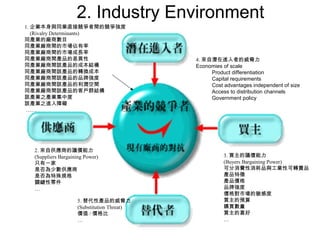
1. 企業本身與同業直接競爭者間的競爭強度
(Rivalry Determinants)
同產業的廠商數目
同產業廠商間的市場佔有率
同產業廠商間的市場成長率
同產業廠商間產品的差異性
同產業廠商間該產品的成本結構
同產業廠商間該產品的轉換成本
同產業廠商間該產品的品牌強度
同產業廠商間該產品的利潤空間
同產業廠商間該產品的客戶群結構
該產業之產業集中度
該產業之進入障礙
……
2. 來自供應商的議價能力
(Suppliers Bargaining Power)
只有一家
是否為少數供應商
是否為特殊規格
關鍵性零件
…
3. 買主的議價能力
(Buyers Bargaining Power)
可分消費性消耗品與工業性可轉賣品
產品特徵
產品價格
品牌強度
價格對市場的敏感度
買主的預算
購買數量
買主的喜好
…
4. 來自潛在進入者的威脅力
Economies of scale
Product differentiation
Capital requirements
Cost advantages independent of size
Access to distribution channels
Government policy
5. 替代性產品的威脅力
(Substitution Threat)
價值 / 價格比
…
2. Industry Environment
Competitive Force: Threat of Entry
• Seriousness of threat depends on
• Barriers to entry
• Reaction of existing firms
• Barriers to entry
• Product differentiation
• Capital requirements
• Cost advantages
• Access to distribution channels
• Government policy
Competitive Force: Suppliers
• A supplier group is powerful if:
• It is dominated by a few companies and is more
concentrated than industry it sells to
• Its product is unique, or differentiated, or has built
up switching costs
• It is not obliged to contend with other products for
sale to industry
• It poses a threat of integrating forward into
industry’s business
• Industry is not an important customer of supplier
group
Competitive Force: Buyers
• A buyer group is powerful if:
• It is concentrated or purchases in large volume
• Products purchased from industry are standard or
undifferentiated
• Products purchased from industry form a component
of its product, representing a significant fraction of its
cost
• It earns low profits, creating incentives to lower its
costs
• Industry’s product is unimportant to quality of buyers’
products or services
• Industry’s product does not save buyer money
• Buyer poses credible threat of integrating backward
Competitive Force: Substitute Products
• Relevance of substitutes
• By placing a ceiling on prices charged, they limit profit
potential of an industry
• Substitutes deserving the most attention are
those
• Subject to trends improving their price-performance
trade-off with the industry’s product
• Produced by industries earning high profit
What Causes Rivalry to be Intense?
競爭力越高 , 利潤被瓜分的越多
• Numerous competitors or they are roughly
equal in size and power
• Slow growth in industry
• Product lacks differentiation or switching costs
• High fixed costs or perishable product
• Capacity normally augmented in large
increments
• High exit barriers
• Rivals are diverse in strategies, origins, and
“personalities”
3. Operating Environment
The operating environment comprises factors in the
competitive situation that affect a firm’s success in
acquiring needed resources or in profitably
marketing its goods and services
Factors in the Operating Environment
• Firm’s competitive position
• The composition of its customers
• Its reputation among suppliers and creditors
• Its ability to attract capable employees
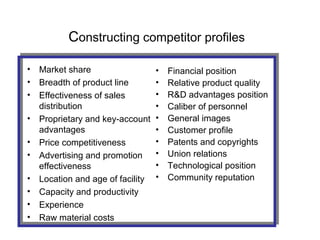
Constructing competitor profiles
• Market share
• Breadth of product line
• Effectiveness of sales
distribution
• Proprietary and key-account
advantages
• Price competitiveness
• Advertising and promotion
effectiveness
• Location and age of facility
• Capacity and productivity
• Experience
• Raw material costs
• Financial position
• Relative product quality
• R&D advantages position
• Caliber of personnel
• General images
• Customer profile
• Patents and copyrights
• Union relations
• Technological position
• Community reputation
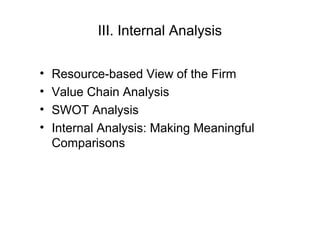
III. Internal Analysis
• Resource-based View of the Firm
• Value Chain Analysis
• SWOT Analysis
• Internal Analysis: Making Meaningful
Comparisons
What is the Resource-based View of the Firm?
Firms differ in fundamental ways because
each firm possesses a unique “bundle” of
resources – tangible and intangible assets
and organizational capabilities to make use
of those assets.
The Three Basic Resources
• Tangible assets
• Easiest to identify and often found on a firm’s balance sheet
• Include physical and financial assets
• Examples: production facilities, raw materials, financial resources
• Intangible assets
• Cannot be seen or touched
• Often very critical in creating competitive advantage
• Examples: brand names, company reputation, company morale
• Organizational capabilities
• Involve skills – ability to combine assets, people, and processes –
used to transform inputs into outputs
What Makes a Resource Valuable?
• Competitive superiority:
Does the resource help
fulfill a customer’s need
better than those of the
firm’s competitors?
• Resource scarcity: Is
the resource in short
supply?
• Inimitability: Is the
resource easily copied or
acquired?
• Appropriability: Who
actually gets the profit
created by a resource?
• Durability: How rapidly
will the resource
depreciate?
• Substitutability? Are
other alternatives
available?
Isolating Mechanisms
• Physically unique resources
• Resources virtually impossible to imitate
• E.g., one-of-a-kind real estate location, mineral rights,
patents
• Path-dependent resources
– Resources that must be created over time in a manner that
is often expensive and difficult to accelerate
– E.g., Dell Computer’s system of direct sales of customized
PCs via the Internet, Coca-Cola’s brand name, Gerber
Baby Food’s reputation for quality
Isolating Mechanisms
• Causal ambiguity
• Situations where it is difficult for competitors to
understand how a firm has created its advantage
• E.g., Southwest Airlines’ approach
• Same plane, routes, gate procedures, number of
attendants
• Culture of fun, family, and frugal yet focused service
• Economic deterrence
• Involves large capital investments in capacity to
produce products or services in a given market that are
scale sensitive
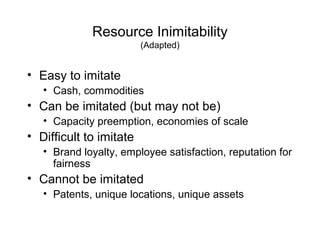
Resource Inimitability
(Adapted)
• Easy to imitate
• Cash, commodities
• Can be imitated (but may not be)
• Capacity preemption, economies of scale
• Difficult to imitate
• Brand loyalty, employee satisfaction, reputation for
fairness
• Cannot be imitated
• Patents, unique locations, unique assets
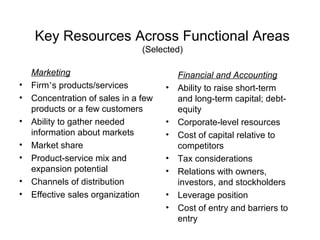
Key Resources Across Functional Areas
(Selected)
Marketing
• Firm’s products/services
• Concentration of sales in a few
products or a few customers
• Ability to gather needed
information about markets
• Market share
• Product-service mix and
expansion potential
• Channels of distribution
• Effective sales organization
Financial and Accounting
• Ability to raise short-term
and long-term capital; debt-
equity
• Corporate-level resources
• Cost of capital relative to
competitors
• Tax considerations
• Relations with owners,
investors, and stockholders
• Leverage position
• Cost of entry and barriers to
entry
(contd.)
Production, Operations,
Technical
• Raw materials cost and
availability, supplier
relationships
• Inventory control systems
• Location, layout, and use of
facilities
• Economies of scale
• Technical efficiency of facilities
• Effectiveness of subcontracting
use
• Degree of vertical integration
Personnel
• Management personnel
• Employees’ skills and morale
• Labor relations costs
compared to competitors
• Efficiency and effectiveness of
personnel policies
• Effectiveness of incentives
used to motivate performance
• Ability to level peaks and
valleys of employment
(contd.)
Quality Management
• Relationships with suppliers,
customers
• Internal practices to enhance
quality of products and
services
• Procedures for monitoring
quality
Information Systems
• Timeliness and accuracy of
information about sales,
operations, cash, and
suppliers
• Relevance of information for
tactical decisions
• Information to manage quality
issues, customer service
• Ability of people to use
information provided
(contd.)
Organization and General Management
• Organizational structure
• Firm’s image and prestige
• Firm’s record in achieving objectives
• Organization of communication system
• Organizational climate and culture
• Use of systematic procedures in decision making
• Top management skills, capabilities, and interest
• Strategic planning system
• Intra-organizational synergy
What is a Value Chain?
The term value chain describes
a way of looking at a business
as a chain of activities that
transform inputs into outputs
that customers value
技術
 
產品設
計
製造 行銷 通路 服務廣告

Akashdeepsinghjandu9

  • 1.
    1. Remote Environment EconomicFactors • Concern the nature and direction of economy in which a firm operates • Types of factors • General availability of credit • Level of disposable income • Propensity of people to spend • Prime interest rates • Inflation rates • Trends in growth of gross national product
  • 2.
    Social Factors • Beliefs,values, opinions, and lifestyles of people • Recent social trends • Entry of large numbers of women into labor market • Accelerating interest of consumers and employees in quality-of-life issues • Shift in age distribution of population
  • 3.
    Political Factors • Definelegal and regulatory parameters within which firms must operate • Types of factors – Free-trade agreements – Antitrust laws – Tax programs – Minimum wage legislation – Pollution and pricing policies – Administrative jawboning
  • 4.
    Technological Factors • Focuson technological changes affecting industry • Types of changes • New products • Improvements in existing products • Manufacturing and marketing techniques • Role of technological forecasting • Foresees advancements and estimating their impact on organization’s operations • Alerts managers to impending challenges and promising opportunities
  • 5.
    Ecological Factors • Ecologyrefers to the relationships among human beings and other living things and air, soil, and water • Current concerns • Global warming • Loss of habitat and biodiversity • Air, water, and land pollution • Responsibilities of firms • Eliminating toxic by-products of current manufacturing processes • Cleaning up prior environmental damage
  • 6.
    1. 企業本身與同業直接競爭者間的競爭強度 (Rivalry Determinants) 同產業的廠商數目 同產業廠商間的市場佔有率 同產業廠商間的市場成長率 同產業廠商間產品的差異性 同產業廠商間該產品的成本結構 同產業廠商間該產品的轉換成本 同產業廠商間該產品的品牌強度 同產業廠商間該產品的利潤空間 同產業廠商間該產品的客戶群結構 該產業之產業集中度 該產業之進入障礙 …… 2.來自供應商的議價能力 (Suppliers Bargaining Power) 只有一家 是否為少數供應商 是否為特殊規格 關鍵性零件 … 3. 買主的議價能力 (Buyers Bargaining Power) 可分消費性消耗品與工業性可轉賣品 產品特徵 產品價格 品牌強度 價格對市場的敏感度 買主的預算 購買數量 買主的喜好 … 4. 來自潛在進入者的威脅力 Economies of scale Product differentiation Capital requirements Cost advantages independent of size Access to distribution channels Government policy 5. 替代性產品的威脅力 (Substitution Threat) 價值 / 價格比 … 2. Industry Environment
  • 7.
    Competitive Force: Threatof Entry • Seriousness of threat depends on • Barriers to entry • Reaction of existing firms • Barriers to entry • Product differentiation • Capital requirements • Cost advantages • Access to distribution channels • Government policy
  • 8.
    Competitive Force: Suppliers •A supplier group is powerful if: • It is dominated by a few companies and is more concentrated than industry it sells to • Its product is unique, or differentiated, or has built up switching costs • It is not obliged to contend with other products for sale to industry • It poses a threat of integrating forward into industry’s business • Industry is not an important customer of supplier group
  • 9.
    Competitive Force: Buyers •A buyer group is powerful if: • It is concentrated or purchases in large volume • Products purchased from industry are standard or undifferentiated • Products purchased from industry form a component of its product, representing a significant fraction of its cost • It earns low profits, creating incentives to lower its costs • Industry’s product is unimportant to quality of buyers’ products or services • Industry’s product does not save buyer money • Buyer poses credible threat of integrating backward
  • 10.
    Competitive Force: SubstituteProducts • Relevance of substitutes • By placing a ceiling on prices charged, they limit profit potential of an industry • Substitutes deserving the most attention are those • Subject to trends improving their price-performance trade-off with the industry’s product • Produced by industries earning high profit
  • 11.
    What Causes Rivalryto be Intense? 競爭力越高 , 利潤被瓜分的越多 • Numerous competitors or they are roughly equal in size and power • Slow growth in industry • Product lacks differentiation or switching costs • High fixed costs or perishable product • Capacity normally augmented in large increments • High exit barriers • Rivals are diverse in strategies, origins, and “personalities”
  • 12.
    3. Operating Environment Theoperating environment comprises factors in the competitive situation that affect a firm’s success in acquiring needed resources or in profitably marketing its goods and services
  • 13.
    Factors in theOperating Environment • Firm’s competitive position • The composition of its customers • Its reputation among suppliers and creditors • Its ability to attract capable employees
  • 14.
    Constructing competitor profiles •Market share • Breadth of product line • Effectiveness of sales distribution • Proprietary and key-account advantages • Price competitiveness • Advertising and promotion effectiveness • Location and age of facility • Capacity and productivity • Experience • Raw material costs • Financial position • Relative product quality • R&D advantages position • Caliber of personnel • General images • Customer profile • Patents and copyrights • Union relations • Technological position • Community reputation
  • 15.
    III. Internal Analysis •Resource-based View of the Firm • Value Chain Analysis • SWOT Analysis • Internal Analysis: Making Meaningful Comparisons
  • 16.
    What is theResource-based View of the Firm? Firms differ in fundamental ways because each firm possesses a unique “bundle” of resources – tangible and intangible assets and organizational capabilities to make use of those assets.
  • 17.
    The Three BasicResources • Tangible assets • Easiest to identify and often found on a firm’s balance sheet • Include physical and financial assets • Examples: production facilities, raw materials, financial resources • Intangible assets • Cannot be seen or touched • Often very critical in creating competitive advantage • Examples: brand names, company reputation, company morale • Organizational capabilities • Involve skills – ability to combine assets, people, and processes – used to transform inputs into outputs
  • 18.
    What Makes aResource Valuable? • Competitive superiority: Does the resource help fulfill a customer’s need better than those of the firm’s competitors? • Resource scarcity: Is the resource in short supply? • Inimitability: Is the resource easily copied or acquired? • Appropriability: Who actually gets the profit created by a resource? • Durability: How rapidly will the resource depreciate? • Substitutability? Are other alternatives available?
  • 19.
    Isolating Mechanisms • Physicallyunique resources • Resources virtually impossible to imitate • E.g., one-of-a-kind real estate location, mineral rights, patents • Path-dependent resources – Resources that must be created over time in a manner that is often expensive and difficult to accelerate – E.g., Dell Computer’s system of direct sales of customized PCs via the Internet, Coca-Cola’s brand name, Gerber Baby Food’s reputation for quality
  • 20.
    Isolating Mechanisms • Causalambiguity • Situations where it is difficult for competitors to understand how a firm has created its advantage • E.g., Southwest Airlines’ approach • Same plane, routes, gate procedures, number of attendants • Culture of fun, family, and frugal yet focused service • Economic deterrence • Involves large capital investments in capacity to produce products or services in a given market that are scale sensitive
  • 21.
    Resource Inimitability (Adapted) • Easyto imitate • Cash, commodities • Can be imitated (but may not be) • Capacity preemption, economies of scale • Difficult to imitate • Brand loyalty, employee satisfaction, reputation for fairness • Cannot be imitated • Patents, unique locations, unique assets
  • 22.
    Key Resources AcrossFunctional Areas (Selected) Marketing • Firm’s products/services • Concentration of sales in a few products or a few customers • Ability to gather needed information about markets • Market share • Product-service mix and expansion potential • Channels of distribution • Effective sales organization Financial and Accounting • Ability to raise short-term and long-term capital; debt- equity • Corporate-level resources • Cost of capital relative to competitors • Tax considerations • Relations with owners, investors, and stockholders • Leverage position • Cost of entry and barriers to entry
  • 23.
    (contd.) Production, Operations, Technical • Rawmaterials cost and availability, supplier relationships • Inventory control systems • Location, layout, and use of facilities • Economies of scale • Technical efficiency of facilities • Effectiveness of subcontracting use • Degree of vertical integration Personnel • Management personnel • Employees’ skills and morale • Labor relations costs compared to competitors • Efficiency and effectiveness of personnel policies • Effectiveness of incentives used to motivate performance • Ability to level peaks and valleys of employment
  • 24.
    (contd.) Quality Management • Relationshipswith suppliers, customers • Internal practices to enhance quality of products and services • Procedures for monitoring quality Information Systems • Timeliness and accuracy of information about sales, operations, cash, and suppliers • Relevance of information for tactical decisions • Information to manage quality issues, customer service • Ability of people to use information provided
  • 25.
    (contd.) Organization and GeneralManagement • Organizational structure • Firm’s image and prestige • Firm’s record in achieving objectives • Organization of communication system • Organizational climate and culture • Use of systematic procedures in decision making • Top management skills, capabilities, and interest • Strategic planning system • Intra-organizational synergy
  • 26.
    What is aValue Chain? The term value chain describes a way of looking at a business as a chain of activities that transform inputs into outputs that customers value
  • 27.