Inventory Management and Logistics
Costs in Global Sourcing Processes
GROUP 8
ABHIJEET DASH UM14001
ASHISH DWIVEDI UM14016
KRITI GANDHI UM14030
SHUBHAM MEHRA UM14053
NITGYA MEHTA UM14091
Insights – International Purchasing
 Global sourcing is a procurement strategy that aims to take advantage of global efficiencies
for the delivery of goods and services. For MNCs, it has become a strategic sourcing in today’s
competitive setting.
 Some popular examples of globally sourced goods and services are: labor-intensive goods
produced in China at low production cost, BPOs staffed with low cost English proficient people
in India, and IT (software and hardware) tasks performed by Indian and Eastern European low
cost programmer.
 However, the scope and definition of global sourcing is not limited to low cost nations.
Global sourcing is a ‘strategic business philosophy’ that
coordinates the world’s most cost effective production and
operation inputs such as men, materials, machines,
technology, suppliers, engineering and other required
facilities.
Challenges to Global Sourcing
 Sustainability: Today, chief procurement officers face an increasingly complex
landscape dominated by legal issues, sustainability concerns, and regulatory and
ethical considerations that could impact not only their company’s bottom line, but
also its brand and public image.
 Globalization: By 2025, global companies will have procurement managers based
in China, India to source materials and services not only for their operations in that
country, but for the entire organization. To handle this task capably, procurement
teams need to start developing expertise in local emerging market sourcing in
China, Brazil, Russia and India, as well as other developing economies.
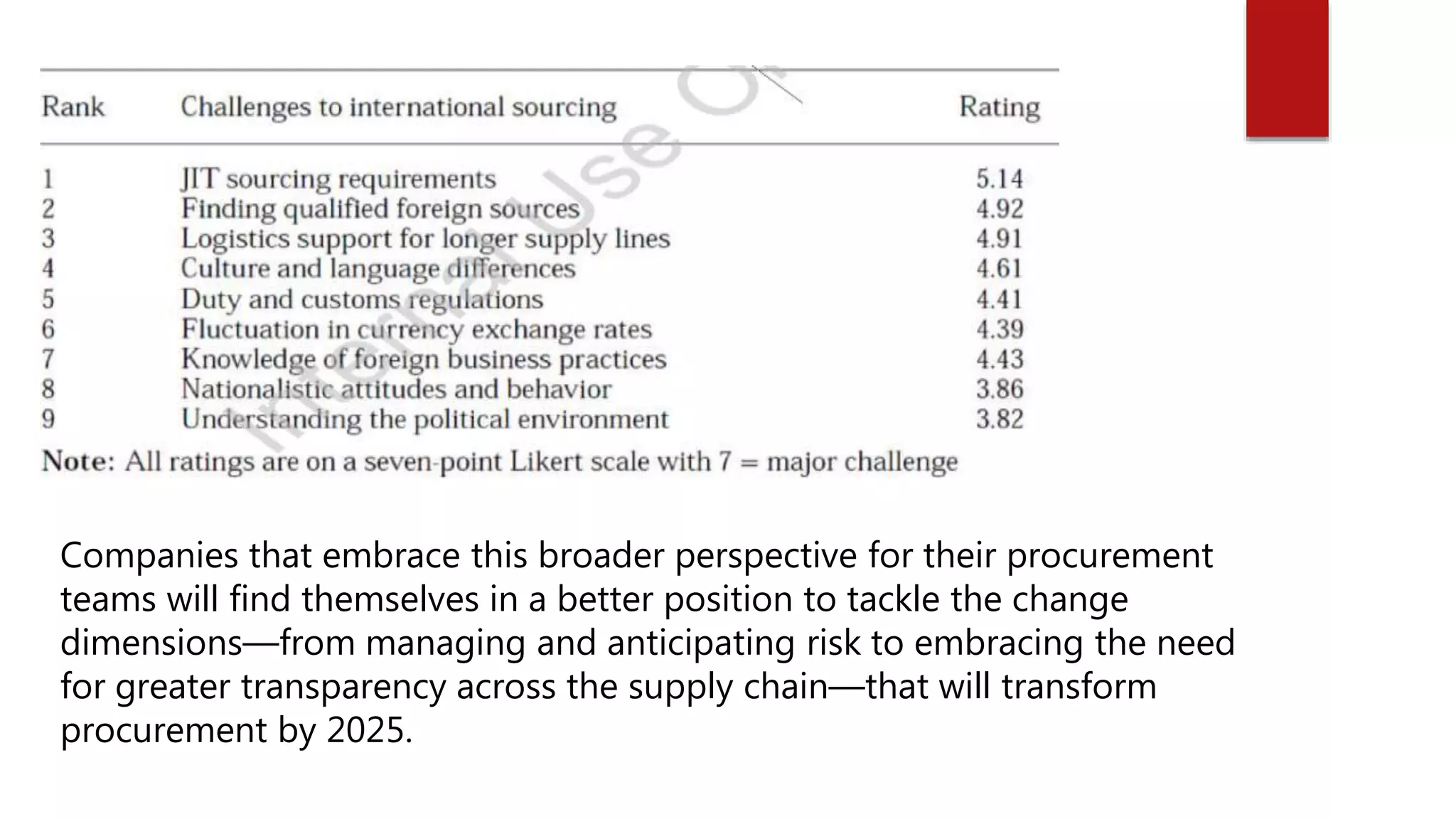
Companies that embrace this broader perspective for their procurement
teams will find themselves in a better position to tackle the change
dimensions—from managing and anticipating risk to embracing the need
for greater transparency across the supply chain—that will transform
procurement by 2025.
Factors influencing Global Sourcing
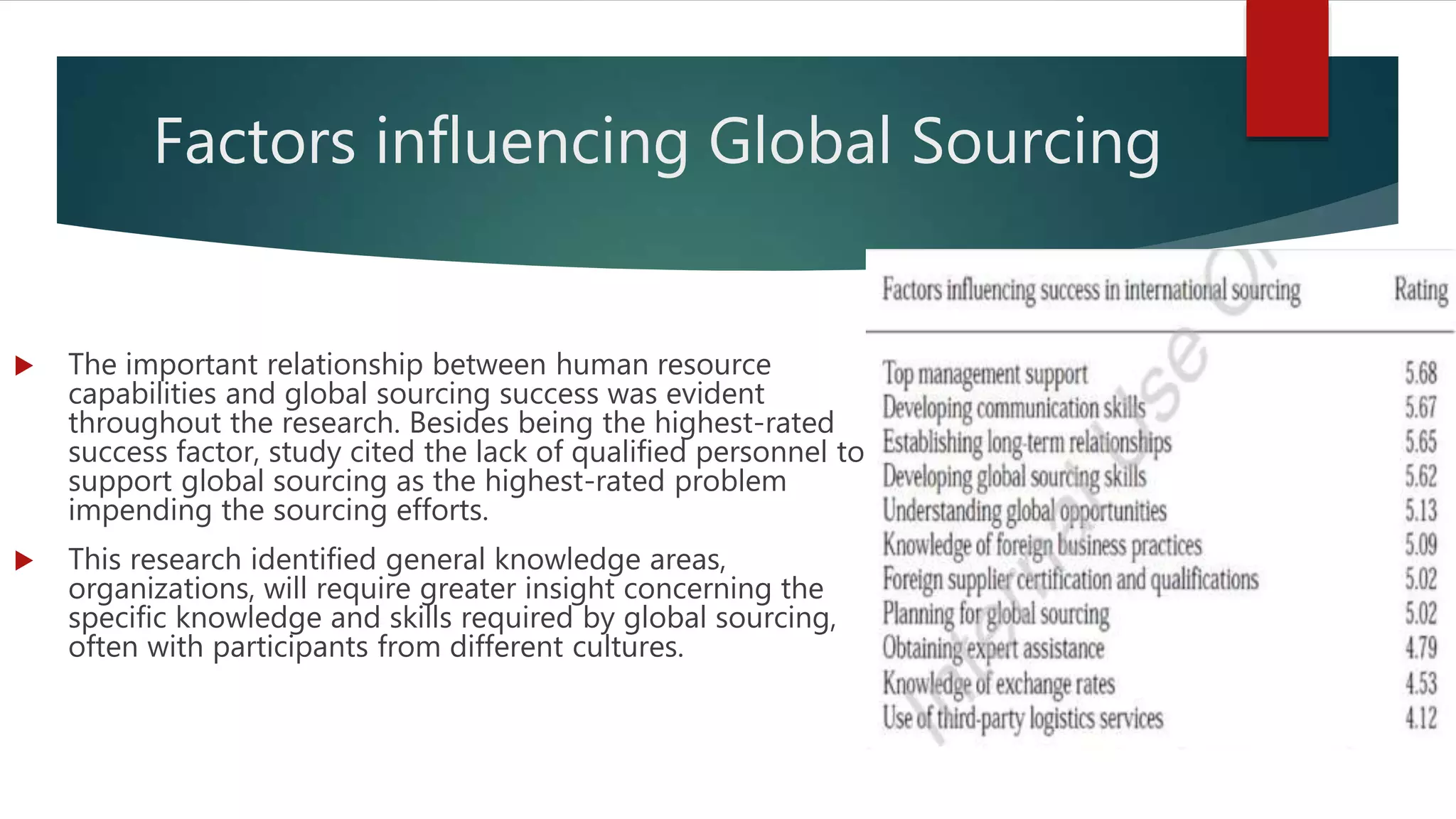
 The important relationship between human resource
capabilities and global sourcing success was evident
throughout the research. Besides being the highest-rated
success factor, study cited the lack of qualified personnel to
support global sourcing as the highest-rated problem
impending the sourcing efforts.
 This research identified general knowledge areas,
organizations, will require greater insight concerning the
specific knowledge and skills required by global sourcing,
often with participants from different cultures.
Cross Country Comparison
 From a macro perspective, in examining the relationship between inventory and
aggregate output in Canada, France, Germany, Italy, Japan, the UK and the USA, the
study finds little correlation between the two – except in the case of Japan.
 In developing countries inventories are used to buffer for poor infrastructure and
greater uncertainty.
Why China is becoming attractive hub for manufacturing ?
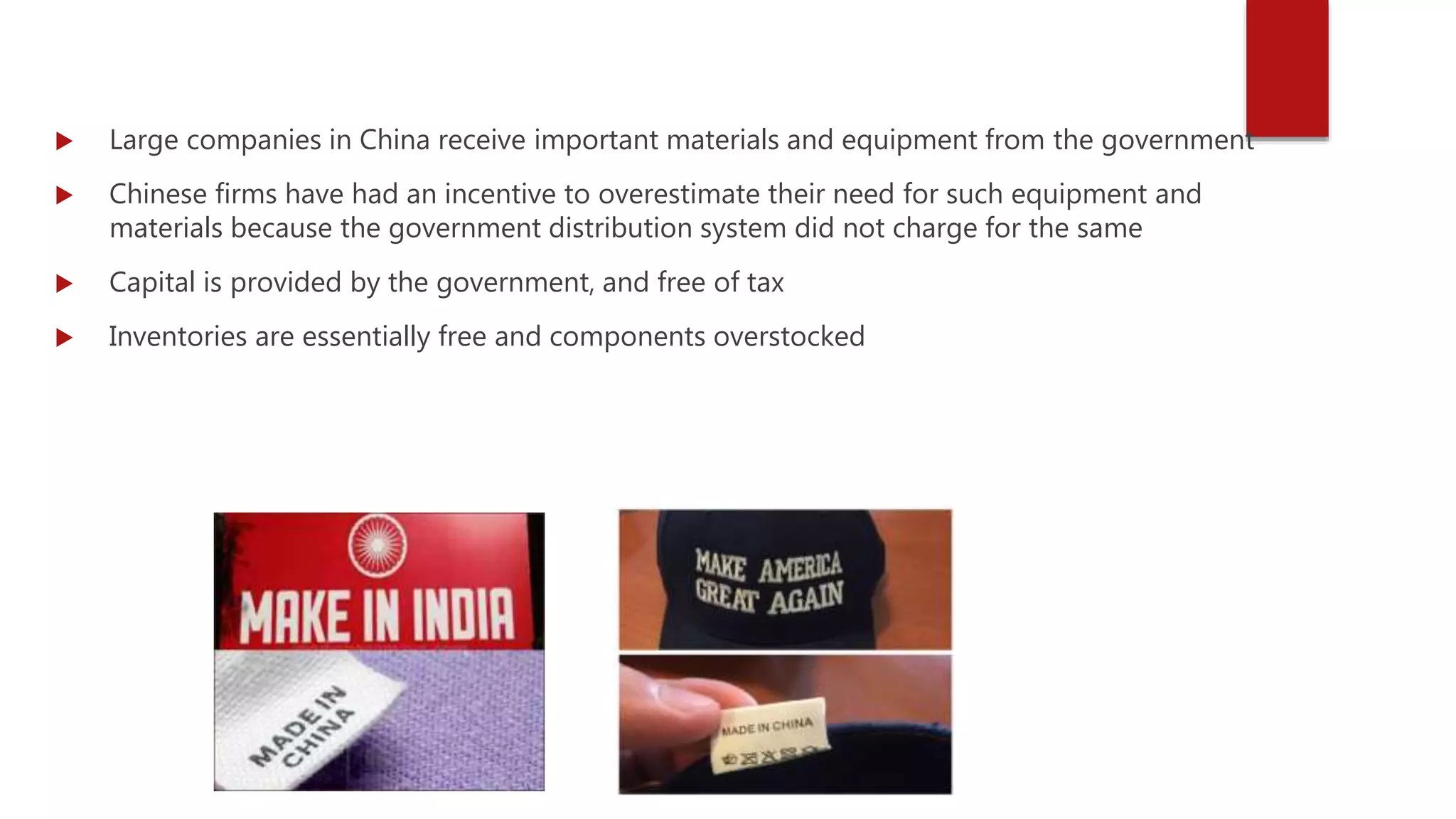
 Large companies in China receive important materials and equipment from the government
 Chinese firms have had an incentive to overestimate their need for such equipment and
materials because the government distribution system did not charge for the same
 Capital is provided by the government, and free of tax
 Inventories are essentially free and components overstocked
Regional trade pacts
Pacts benefitting both the sides
Changes in international regulations
Changes in customs Slowing down of the process
Impact of exchange rate fluctuations
Customer service Financial result
Volatility of freight rates
Determine the perfect modal mix Point of sourcing
Role of investment
Improving logistics performance Providing multiple options
Through analysis of emerging markets
Multi country approach Weighted preference of low cost countries
Examine the logistics facilities available in a region
Efficiency of the transportation facilities wrt world standards Comparison among various modes of transportation
PERSPECTIVES
Managerial Perspectives
Forecasting
and
Quantitative
techniques
Logistics
Freight
Forwarders
Third Party
Players
Evaluation
Framework
Relation
between
countries
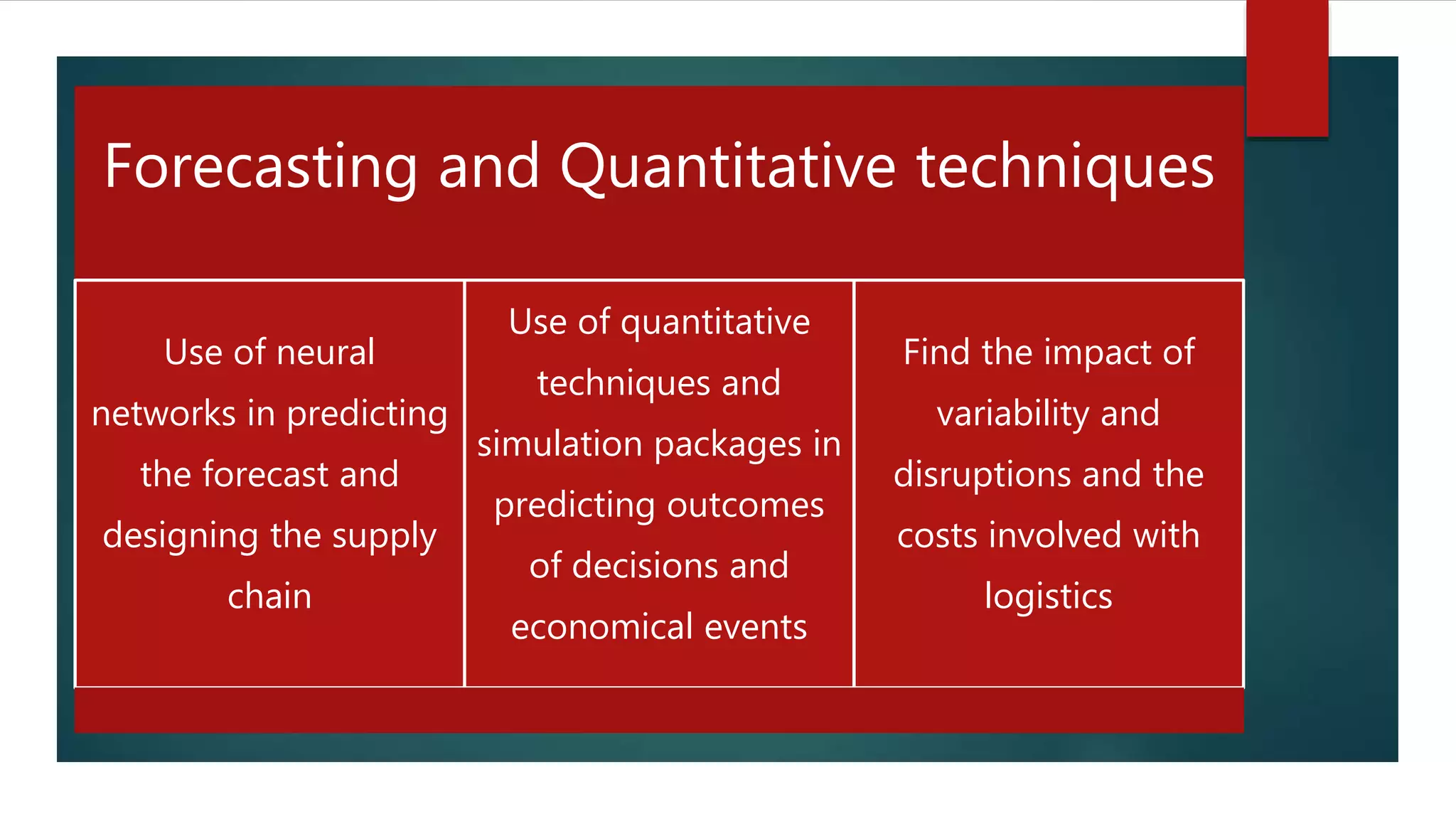
Forecasting and Quantitative techniques
Use of neural
networks in predicting
the forecast and
designing the supply
chain
Use of quantitative
techniques and
simulation packages in
predicting outcomes
of decisions and
economical events
Find the impact of
variability and
disruptions and the
costs involved with
logistics
Logistics
Establish the
optimum inter
modal mix
considering the
implications of
various modes
Facility location
decision
dependent on
logistics
availability both
globally and
locally
Develop a
framework to
determine the
preferred network
Logistical
friendliness or
unfriendliness
among countries
Freight Forwarders
Expertise in
international
shipping (e.g. –
customs)
Service is the
primary
consideration
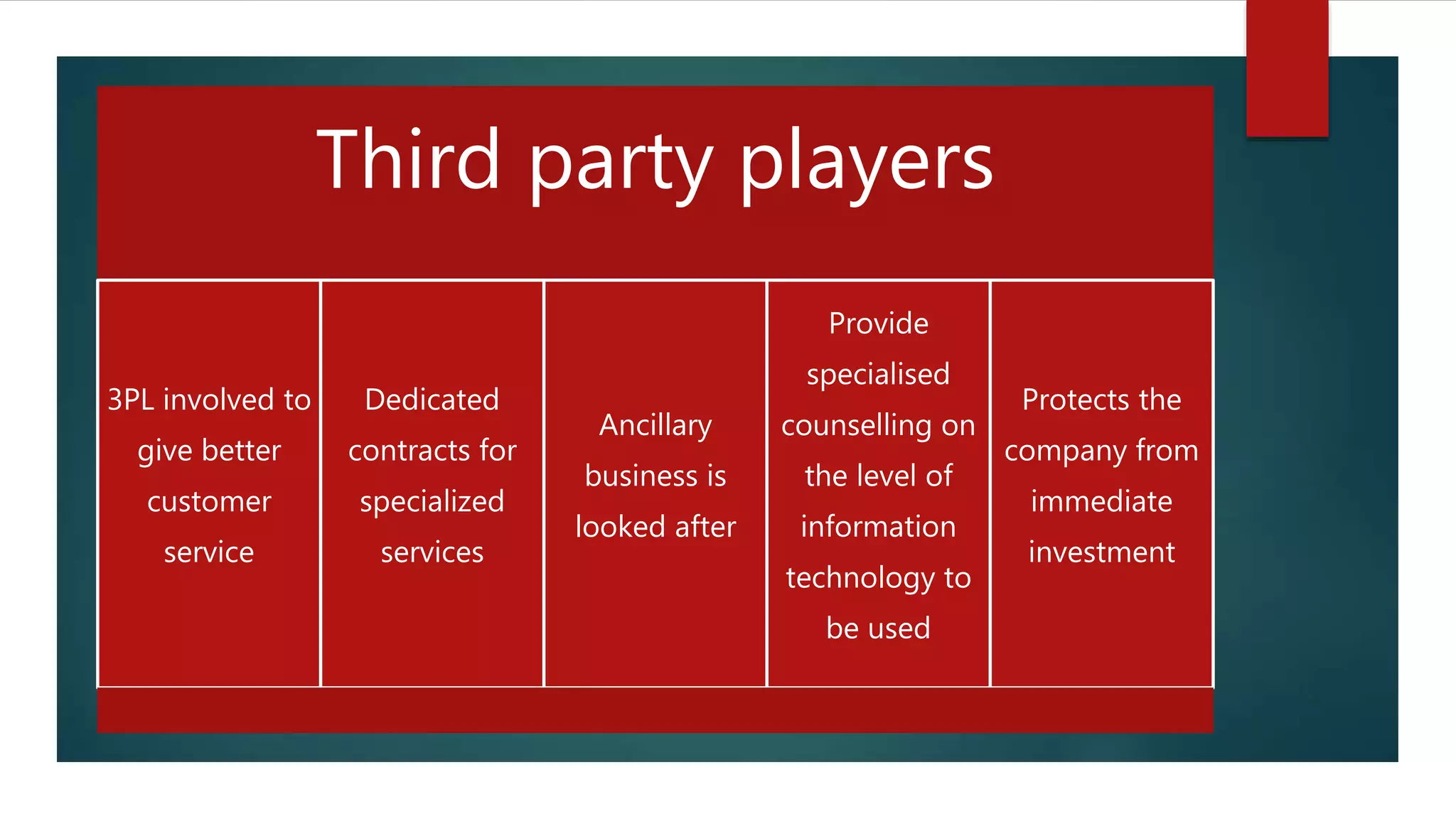
Third party players
3PL involved to
give better
customer
service
Dedicated
contracts for
specialized
services
Ancillary
business is
looked after
Provide
specialised
counselling on
the level of
information
technology to
be used
Protects the
company from
immediate
investment
EVALUATIONFRAMEWORK
Relation between countries
Examine the socio-
psychological or behavioural
dimension of relations
between various countries,
mutually engaged in
international distribution
Examine the aspects of
logistics in less developed
countries
(LDC)
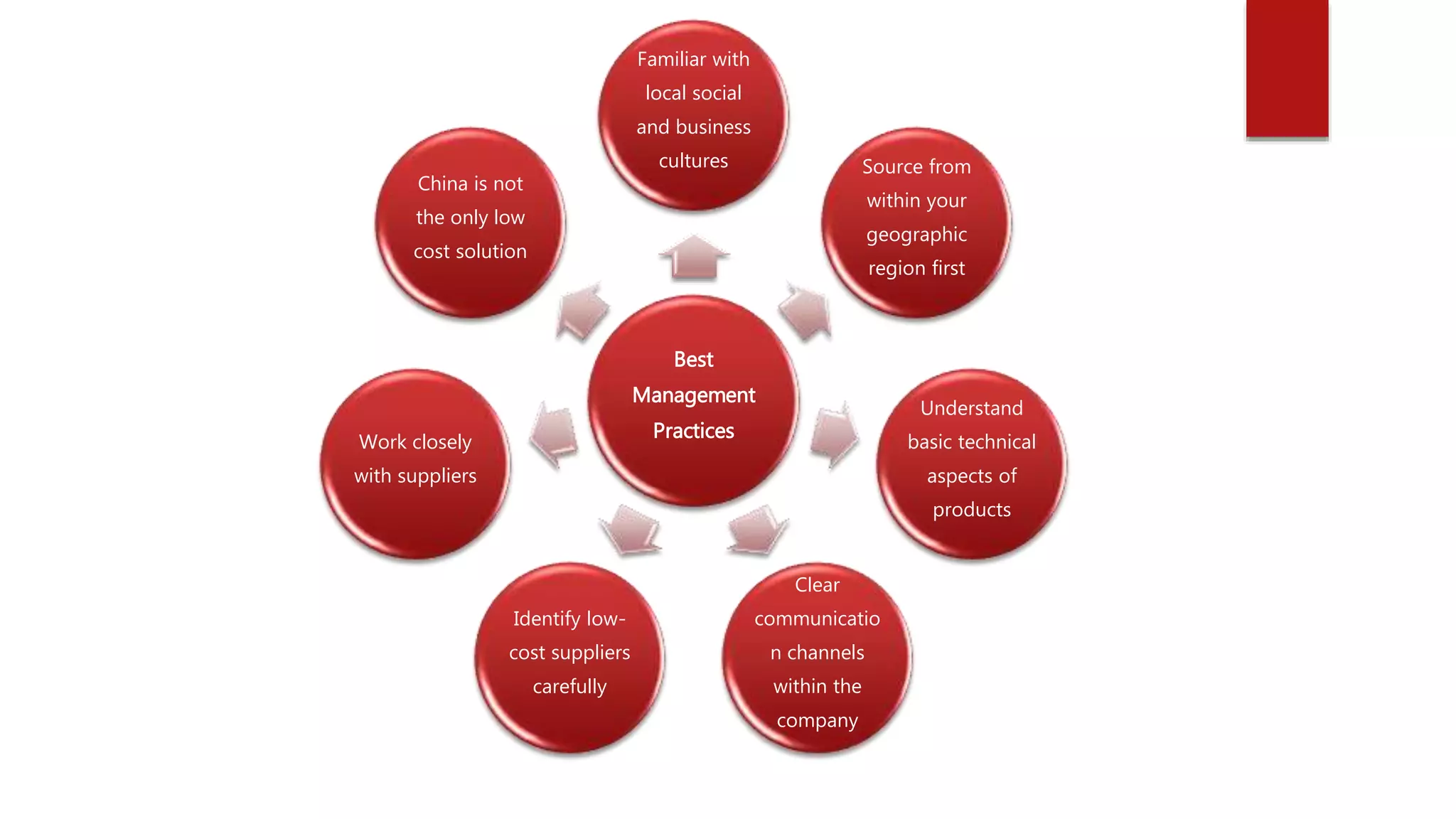
Best
Management
Practices
Familiar with
local social
and business
cultures Source from
within your
geographic
region first
Understand
basic technical
aspects of
products
Clear
communicatio
n channels
within the
company
Identify low-
cost suppliers
carefully
Work closely
with suppliers
China is not
the only low
cost solution
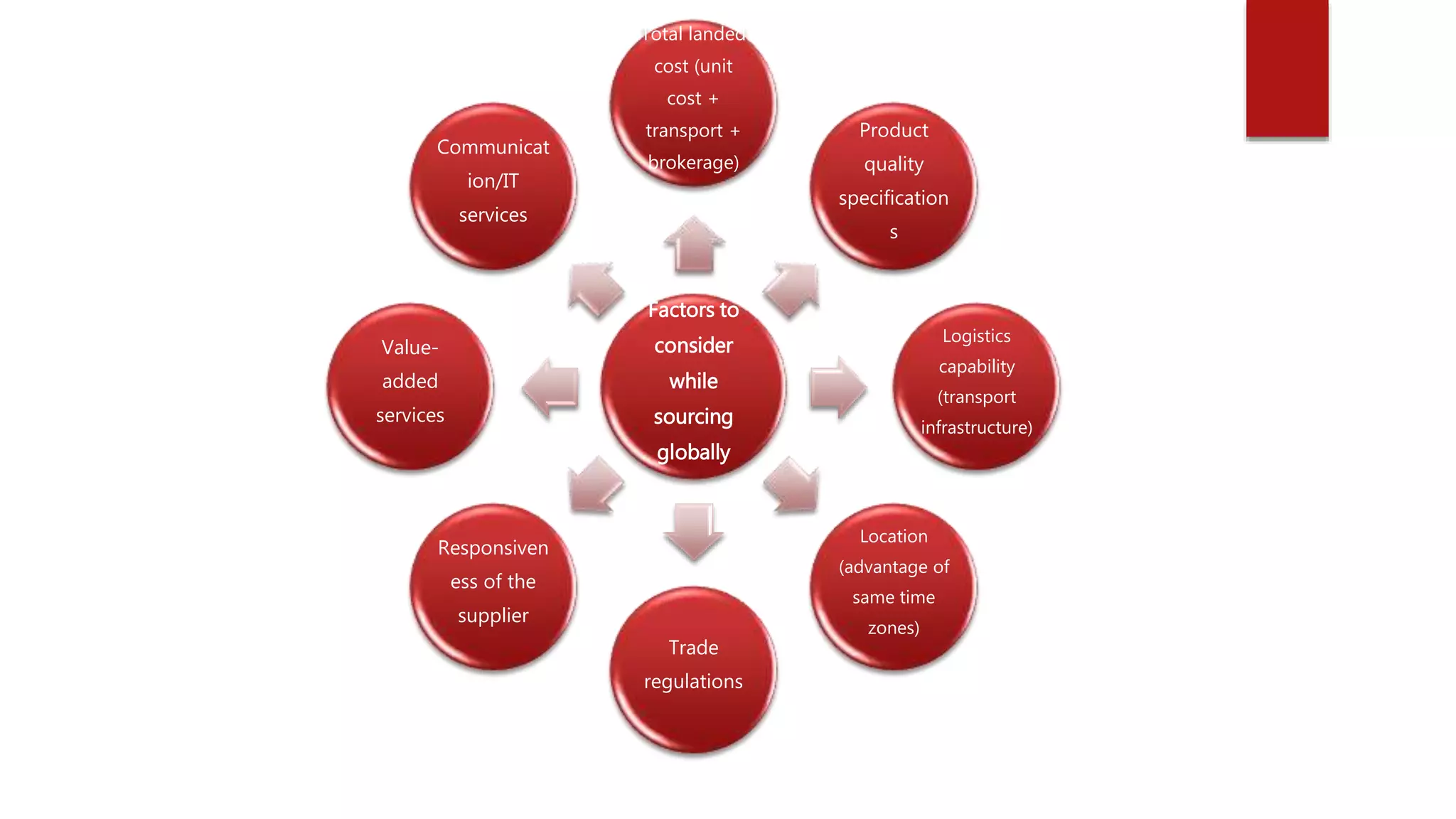
Factors to
consider
while
sourcing
globally
Total landed
cost (unit
cost +
transport +
brokerage)
Product
quality
specification
s
Logistics
capability
(transport
infrastructure)
Location
(advantage of
same time
zones)
Trade
regulations
Responsiven
ess of the
supplier
Value-
added
services
Communicat
ion/IT
services
Advantages & Disadvantages of Sourcing Globally
ADVANTAGES:
 Cheap manpower
 Access to raw materials
 Access to distinctive
capabilities
 Increase in productivity
 Scalability
DISADVANTAGES:
 Quality problems
 Loss of intellectual uniqueness
due to globalization
 Job loss in case of movement
to another nation
Global Sourcing, Outsourcing & Offshoring
Global Sourcing
• Aimed at exploiting global
efficiencies in production
• Tapping into skills
unavailable domestically
• Alternate supplier sources
to stimulate competition
• Increased total supply
capacity
• Low cost
Outsourcing
• Process of contracting a
business function to
someone else
• Specialized skills
• Risk sharing
• Labour flexibility
• Reduced operational &
recruitment costs
• Focus on core
competencies
Offshoring
• Basing some of a
company's processes or
services overseas
• Lower costs
• Better availability of skilled
people
• Faster work due to global
talent pool
• Exploiting time difference
Ever changing
customer needs &
reverse logistics
On time delivery
Infrastructure
limitations
End to end visibility
(security concerns)
Capacity issues
Challenges faced by Global Logistics
Total Cost of Ownership
It is a financial estimate intended to help buyers and owners determine the direct and
indirect costs of a product or system.
 For manufacturing, as TCO is typically compared with doing business overseas, it goes
beyond the initial manufacturing cycle time and cost to make parts.
 TCO includes a variety of cost of doing business items, for example,
 ship and re-ship,
 opportunity costs,
 Incentives and other variables including
 tax credits,
 common language,
 expedited delivery,
 customer-oriented supplier visits etc.
TCO
Material Cost
Freight Cost
Internal Processing
Expenditures
Allocated
Overheads
Elements of Total Cost of Ownership
Management and
administration
Delivery of materials
Servicing of
equipment
Communication
with suppliers
Price of materials,
including delivery
charges
Dynamic patterns Quality related costs
Contingency Model
Product
Sourcing
Strategy
Organization
Country
Logistic
Strategy
TCO
Contingency model is useful for predicting sourcing strategies for maximum performance based on product,
organization and location
Product
• Salient Features:
• Asset Specificity (The degree to which
materials are made only to fill the
order of the buyer)
• Material Cost
• The type of product will influence the
sourcing decisions. For example unspecific
assets, such as commodities and very
s p e c i f i c g o o d s , s u c h a s b o o k s .
• A publishing firm (high asset specificity and
low materials cost) would have different
options as opposed to one involved with the
extraction of copper (low asset specificity and
high materials cost)
Organization
• Features :
1. Manage the operation
efficiently
2. be innovative
3. invest in R&D
• Operational effectiveness affects the
choice of sourcing decisions
• Innovativeness of a firm affects its
ability to cope with the changing
dynamic environment, and indirectly
profitability
• R&D is an indicator of the firm’s
importance on in its internal system.
Country
• Important country conditions:
1. Foreign exchange
volatility
2. Tariffs
• The product and organizational
influences have to match with
the country conditions globally
Contingency Model
Sourcing Strategies
Product Influences
• Higher specificity and customized
products are more likely to be
sourced internationally.
• Products with high material and
input cost need strong internal
supplier network and are less likely
to be sourced internationally.
Organization Influences
• Efficient firms with Low MRO cost
and admin cost less likely to source
internationally
• Innovativeness and R&D intention
vary directly and indirectly with
external and international sourcing
respectively.
Country Influences
• Stable exchange rates – more likely
to source internationally(Low
exchange rate risk)
• Low tariff rates - more likely to
source internationally
• Foreign country’s infrastructure ,
transportation, communication
robust - more likely to source
internationally
Logistics Strategies
 Involve degree of communication with the firm, reliability of the delivery of materials, and level of
integration of the logistics function with the firm.
Product Influences
• Higher specificity and material cost
require more collaboration with the
supplier – robust communication,
transportation network and timely
delivery.
Organization Influences
• Efficient firms with Low MRO cost
and admin cost more likely to use
good supplier communication ,
integrated transport and reliable
delivery.
• Innovativeness and R&D intention
vary directly with good supplier
communication , integrated
Country Influences
• Stable exchange rates and low
tariffs means more trade  require
efficient supplier network and
robust logistics
• Foreign country’s infrastructure ,
transportation, communication
robust – JIT is feasible
TCO and Financial Performance
 TCO quantifies the cost of materials , inclusive of the benefits of an efficient sourcing and
logistics strategy or the detriments of the same.
Total cost of Ownership
Country
Characteristics
Product
characteristics
Organizational
charac.
Sourcing
and Logistics
Strategy
Managerial Implications
 Assists managers in supply chain decision making – diversification, plant location
 Examining the feasibility of a country becoming an export hub based on tariff structure
and exchange rate between the host and the destination country.
 Global sourcing decisions’ prediction and which countries would be more open to
 Figure out efficient logistics strategy in terms of communication, transportation and
delivery.
 Organization’s self evaluation in terms of readiness for global sourcing
 Logistics strategy must complement sourcing strategy to reduce total cost of ownership of
the supply chain.
 Diversification decisions – if the firm is inexperience in global sourcing – focus on product
specificity with local supplier network but with low material cost
THANK YOU…

Global sourcing

  • 1.
    Inventory Management andLogistics Costs in Global Sourcing Processes GROUP 8 ABHIJEET DASH UM14001 ASHISH DWIVEDI UM14016 KRITI GANDHI UM14030 SHUBHAM MEHRA UM14053 NITGYA MEHTA UM14091
  • 2.
    Insights – InternationalPurchasing  Global sourcing is a procurement strategy that aims to take advantage of global efficiencies for the delivery of goods and services. For MNCs, it has become a strategic sourcing in today’s competitive setting.  Some popular examples of globally sourced goods and services are: labor-intensive goods produced in China at low production cost, BPOs staffed with low cost English proficient people in India, and IT (software and hardware) tasks performed by Indian and Eastern European low cost programmer.  However, the scope and definition of global sourcing is not limited to low cost nations.
  • 3.
    Global sourcing isa ‘strategic business philosophy’ that coordinates the world’s most cost effective production and operation inputs such as men, materials, machines, technology, suppliers, engineering and other required facilities.
  • 4.
    Challenges to GlobalSourcing  Sustainability: Today, chief procurement officers face an increasingly complex landscape dominated by legal issues, sustainability concerns, and regulatory and ethical considerations that could impact not only their company’s bottom line, but also its brand and public image.  Globalization: By 2025, global companies will have procurement managers based in China, India to source materials and services not only for their operations in that country, but for the entire organization. To handle this task capably, procurement teams need to start developing expertise in local emerging market sourcing in China, Brazil, Russia and India, as well as other developing economies.
  • 5.
    Companies that embracethis broader perspective for their procurement teams will find themselves in a better position to tackle the change dimensions—from managing and anticipating risk to embracing the need for greater transparency across the supply chain—that will transform procurement by 2025.
  • 6.
    Factors influencing GlobalSourcing  The important relationship between human resource capabilities and global sourcing success was evident throughout the research. Besides being the highest-rated success factor, study cited the lack of qualified personnel to support global sourcing as the highest-rated problem impending the sourcing efforts.  This research identified general knowledge areas, organizations, will require greater insight concerning the specific knowledge and skills required by global sourcing, often with participants from different cultures.
  • 7.
    Cross Country Comparison From a macro perspective, in examining the relationship between inventory and aggregate output in Canada, France, Germany, Italy, Japan, the UK and the USA, the study finds little correlation between the two – except in the case of Japan.  In developing countries inventories are used to buffer for poor infrastructure and greater uncertainty. Why China is becoming attractive hub for manufacturing ?
  • 8.
     Large companiesin China receive important materials and equipment from the government  Chinese firms have had an incentive to overestimate their need for such equipment and materials because the government distribution system did not charge for the same  Capital is provided by the government, and free of tax  Inventories are essentially free and components overstocked
  • 9.
    Regional trade pacts Pactsbenefitting both the sides Changes in international regulations Changes in customs Slowing down of the process Impact of exchange rate fluctuations Customer service Financial result Volatility of freight rates Determine the perfect modal mix Point of sourcing Role of investment Improving logistics performance Providing multiple options Through analysis of emerging markets Multi country approach Weighted preference of low cost countries Examine the logistics facilities available in a region Efficiency of the transportation facilities wrt world standards Comparison among various modes of transportation PERSPECTIVES
  • 11.
  • 12.
    Forecasting and Quantitativetechniques Use of neural networks in predicting the forecast and designing the supply chain Use of quantitative techniques and simulation packages in predicting outcomes of decisions and economical events Find the impact of variability and disruptions and the costs involved with logistics
  • 13.
    Logistics Establish the optimum inter modalmix considering the implications of various modes Facility location decision dependent on logistics availability both globally and locally Develop a framework to determine the preferred network Logistical friendliness or unfriendliness among countries
  • 14.
    Freight Forwarders Expertise in international shipping(e.g. – customs) Service is the primary consideration
  • 15.
    Third party players 3PLinvolved to give better customer service Dedicated contracts for specialized services Ancillary business is looked after Provide specialised counselling on the level of information technology to be used Protects the company from immediate investment
  • 16.
  • 17.
    Relation between countries Examinethe socio- psychological or behavioural dimension of relations between various countries, mutually engaged in international distribution Examine the aspects of logistics in less developed countries (LDC)
  • 18.
    Best Management Practices Familiar with local social andbusiness cultures Source from within your geographic region first Understand basic technical aspects of products Clear communicatio n channels within the company Identify low- cost suppliers carefully Work closely with suppliers China is not the only low cost solution
  • 19.
    Factors to consider while sourcing globally Total landed cost(unit cost + transport + brokerage) Product quality specification s Logistics capability (transport infrastructure) Location (advantage of same time zones) Trade regulations Responsiven ess of the supplier Value- added services Communicat ion/IT services
  • 20.
    Advantages & Disadvantagesof Sourcing Globally ADVANTAGES:  Cheap manpower  Access to raw materials  Access to distinctive capabilities  Increase in productivity  Scalability DISADVANTAGES:  Quality problems  Loss of intellectual uniqueness due to globalization  Job loss in case of movement to another nation
  • 21.
    Global Sourcing, Outsourcing& Offshoring Global Sourcing • Aimed at exploiting global efficiencies in production • Tapping into skills unavailable domestically • Alternate supplier sources to stimulate competition • Increased total supply capacity • Low cost Outsourcing • Process of contracting a business function to someone else • Specialized skills • Risk sharing • Labour flexibility • Reduced operational & recruitment costs • Focus on core competencies Offshoring • Basing some of a company's processes or services overseas • Lower costs • Better availability of skilled people • Faster work due to global talent pool • Exploiting time difference
  • 22.
    Ever changing customer needs& reverse logistics On time delivery Infrastructure limitations End to end visibility (security concerns) Capacity issues Challenges faced by Global Logistics
  • 23.
    Total Cost ofOwnership It is a financial estimate intended to help buyers and owners determine the direct and indirect costs of a product or system.  For manufacturing, as TCO is typically compared with doing business overseas, it goes beyond the initial manufacturing cycle time and cost to make parts.  TCO includes a variety of cost of doing business items, for example,  ship and re-ship,  opportunity costs,  Incentives and other variables including  tax credits,  common language,  expedited delivery,  customer-oriented supplier visits etc. TCO Material Cost Freight Cost Internal Processing Expenditures Allocated Overheads
  • 24.
    Elements of TotalCost of Ownership Management and administration Delivery of materials Servicing of equipment Communication with suppliers Price of materials, including delivery charges Dynamic patterns Quality related costs
  • 25.
    Contingency Model Product Sourcing Strategy Organization Country Logistic Strategy TCO Contingency modelis useful for predicting sourcing strategies for maximum performance based on product, organization and location
  • 26.
    Product • Salient Features: •Asset Specificity (The degree to which materials are made only to fill the order of the buyer) • Material Cost • The type of product will influence the sourcing decisions. For example unspecific assets, such as commodities and very s p e c i f i c g o o d s , s u c h a s b o o k s . • A publishing firm (high asset specificity and low materials cost) would have different options as opposed to one involved with the extraction of copper (low asset specificity and high materials cost) Organization • Features : 1. Manage the operation efficiently 2. be innovative 3. invest in R&D • Operational effectiveness affects the choice of sourcing decisions • Innovativeness of a firm affects its ability to cope with the changing dynamic environment, and indirectly profitability • R&D is an indicator of the firm’s importance on in its internal system. Country • Important country conditions: 1. Foreign exchange volatility 2. Tariffs • The product and organizational influences have to match with the country conditions globally Contingency Model
  • 27.
    Sourcing Strategies Product Influences •Higher specificity and customized products are more likely to be sourced internationally. • Products with high material and input cost need strong internal supplier network and are less likely to be sourced internationally. Organization Influences • Efficient firms with Low MRO cost and admin cost less likely to source internationally • Innovativeness and R&D intention vary directly and indirectly with external and international sourcing respectively. Country Influences • Stable exchange rates – more likely to source internationally(Low exchange rate risk) • Low tariff rates - more likely to source internationally • Foreign country’s infrastructure , transportation, communication robust - more likely to source internationally
  • 28.
    Logistics Strategies  Involvedegree of communication with the firm, reliability of the delivery of materials, and level of integration of the logistics function with the firm. Product Influences • Higher specificity and material cost require more collaboration with the supplier – robust communication, transportation network and timely delivery. Organization Influences • Efficient firms with Low MRO cost and admin cost more likely to use good supplier communication , integrated transport and reliable delivery. • Innovativeness and R&D intention vary directly with good supplier communication , integrated Country Influences • Stable exchange rates and low tariffs means more trade  require efficient supplier network and robust logistics • Foreign country’s infrastructure , transportation, communication robust – JIT is feasible
  • 29.
    TCO and FinancialPerformance  TCO quantifies the cost of materials , inclusive of the benefits of an efficient sourcing and logistics strategy or the detriments of the same. Total cost of Ownership Country Characteristics Product characteristics Organizational charac. Sourcing and Logistics Strategy
  • 30.
    Managerial Implications  Assistsmanagers in supply chain decision making – diversification, plant location  Examining the feasibility of a country becoming an export hub based on tariff structure and exchange rate between the host and the destination country.  Global sourcing decisions’ prediction and which countries would be more open to  Figure out efficient logistics strategy in terms of communication, transportation and delivery.  Organization’s self evaluation in terms of readiness for global sourcing  Logistics strategy must complement sourcing strategy to reduce total cost of ownership of the supply chain.  Diversification decisions – if the firm is inexperience in global sourcing – focus on product specificity with local supplier network but with low material cost
  • 31.