AIRWAY
MANAGEMENT
PRESENTER; IRENE MASWI
1
TABLE OF CONTENTS
01 INTRODUCTION
02 AIRWAY OBSTRUCTION
03 AIRWAY ASSESSMENT
04 AIRWAY MANAGEMENT
05 SUMMARY
06 REFERENCES
2
INTRODUCTION
01
3
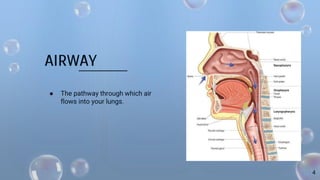
AIRWAY
● The pathway through which air
flows into your lungs.
4
AIRWAY OBSTRUCTION
02
5
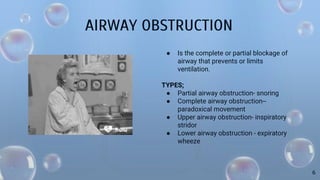
AIRWAY OBSTRUCTION
● Is the complete or partial blockage of
airway that prevents or limits
ventilation.
TYPES;
● Partial airway obstruction- snoring
● Complete airway obstruction--
paradoxical movement
● Upper airway obstruction- inspiratory
stridor
● Lower airway obstruction - expiratory
wheeze
6
AIRWAY ASSESSMENT
03
7
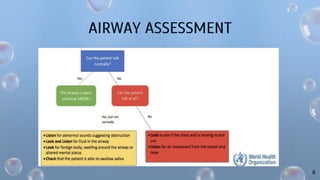
AIRWAY ASSESSMENT
8
AIRWAY
PATENT AIRWAY
PROTECTED AIRWAY
● Talking or crying
patient
● No intervention needed
● Presence of gag reflex
( unconscious
patients)
● Definitive airway in
place
● Maneuvers
● Stridor
● Snoring
● Secretions
COMPROMISED AIRWAY
9
AIRWAY MANAGEMENT
04
10
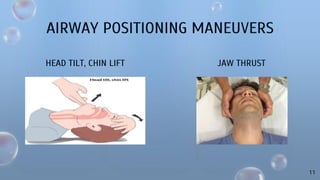
AIRWAY POSITIONING MANEUVERS
HEAD TILT, CHIN LIFT JAW THRUST
11
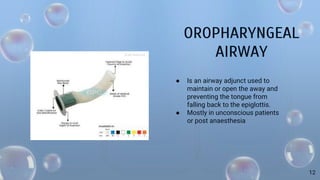
OROPHARYNGEAL
AIRWAY
● Is an airway adjunct used to
maintain or open the away and
preventing the tongue from
falling back to the epiglottis.
● Mostly in unconscious patients
or post anaesthesia
12
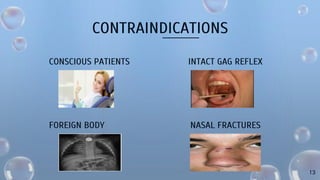
CONTRAINDICATIONS
CONSCIOUS PATIENTS
FOREIGN BODY
INTACT GAG REFLEX
NASAL FRACTURES
13
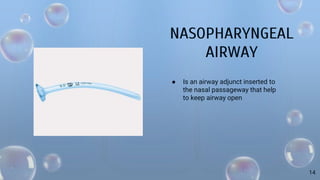
NASOPHARYNGEAL
AIRWAY
● Is an airway adjunct inserted to
the nasal passageway that help
to keep airway open
14
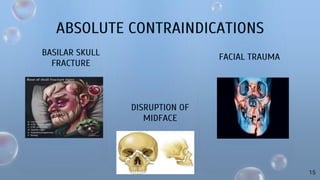
ABSOLUTE CONTRAINDICATIONS
BASILAR SKULL
FRACTURE
DISRUPTION OF
MIDFACE
FACIAL TRAUMA
15
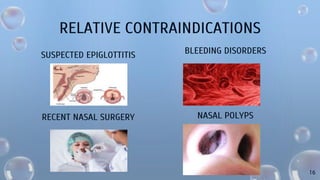
RELATIVE CONTRAINDICATIONS
SUSPECTED EPIGLOTTITIS
RECENT NASAL SURGERY
BLEEDING DISORDERS
NASAL POLYPS
16
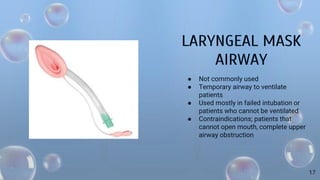
LARYNGEAL MASK
AIRWAY
● Not commonly used
● Temporary airway to ventilate
patients
● Used mostly in failed intubation or
patients who cannot be ventilated
● Contraindications; patients that
cannot open mouth, complete upper
airway obstruction
17
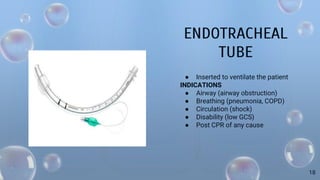
ENDOTRACHEAL
TUBE
● Inserted to ventilate the patient
INDICATIONS
● Airway (airway obstruction)
● Breathing (pneumonia, COPD)
● Circulation (shock)
● Disability (low GCS)
● Post CPR of any cause
18
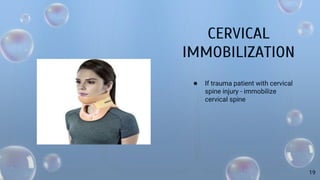
CERVICAL
IMMOBILIZATION
● If trauma patient with cervical
spine injury - immobilize
cervical spine
19
20
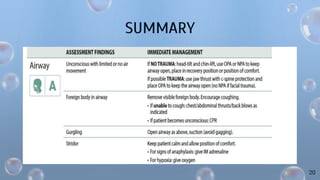
SUMMARY
REFERENCES
1. BASIC PRINCIPLES OF EMERGENCY MEDICINE Second edition. Prof.
Hendry Sawe
2. https://cdn.who.int/media/docs/default-source/documents/bec-abcde-
approach.pptx?sfvrsn=a37650c3_2
3. https://youtu.be/FCfLG63HYJo?si=kKH5r93-4D8E7mKG
4. https://youtu.be/Lurq9DroJag?si=nuOfIrW4rYtIMACi
ILLUSTRATIONS
1. https://youtube.com/shorts/SZoQWRHRViE?si=KQhLEPqhWEzkUkgT
2. https://youtu.be/T4qNgi4Vrvo?si=qx4rckVFpOz2UWui
3. https://youtu.be/oeoAze-CHng?si=1aCU6QUfV0dama53
4. https://youtube.com/shorts/BNoCJzkH-ug?si=H3Hno0fJP8oPArnN
21
22
THANKS FOR LISTENING

AIRWAY MANAGEMENT .pptx