30/08/2023
AI/ML role in product enhancement vision
By: Sakshi Goel
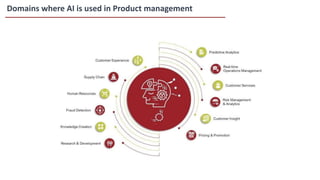
Domains where AI is used in Product management
Product management and AI (Stats)
•According to study by IBM, 21% of product managers use AI everyday.
•The transition to machine learning will be 100x harder than the transition to mobile apps
•AI and B2B product management is prevalent in future.
•Product managers (PMs) of every stripe need to understand the powerful influence of AI to
both stay competitive in their product role and ensure that their companies maintain a
competitive advantage.
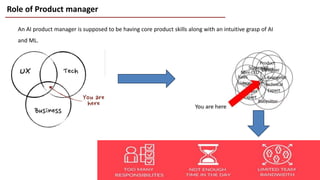
Role of Product manager
An AI product manager is supposed to be having core product skills along with an intuitive grasp of AI
and ML.
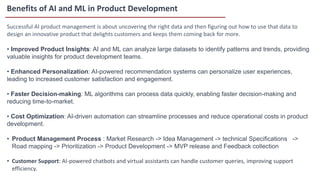
Benefits of AI and ML in Product Development
Successful AI product management is about uncovering the right data and then figuring out how to use that data to
design an innovative product that delights customers and keeps them coming back for more.
• Improved Product Insights: AI and ML can analyze large datasets to identify patterns and trends, providing
valuable insights for product development teams.
• Enhanced Personalization: AI-powered recommendation systems can personalize user experiences,
leading to increased customer satisfaction and engagement.
• Faster Decision-making: ML algorithms can process data quickly, enabling faster decision-making and
reducing time-to-market.
• Cost Optimization: AI-driven automation can streamline processes and reduce operational costs in product
development.
• Product Management Process : Market Research -> Idea Management -> technical Specifications ->
Road mapping -> Prioritization -> Product Development -> MVP release and Feedback collection
• Customer Support: AI-powered chatbots and virtual assistants can handle customer queries, improving support
efficiency.
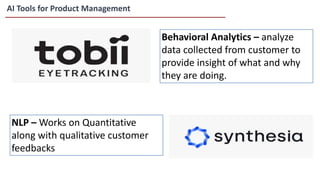
AI Tools for Product Management
Behavioral Analytics – analyze
data collected from customer to
provide insight of what and why
they are doing.
NLP – Works on Quantitative
along with qualitative customer
feedbacks
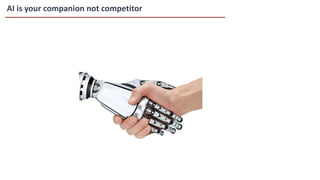
AI is your companion not competitor
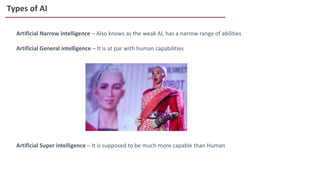
Types of AI
Artificial Narrow intelligence – Also knows as the weak AI, has a narrow range of abilities
Artificial General intelligence – It is at par with human capabilities
Artificial Super intelligence – It is supposed to be much more capable than Human
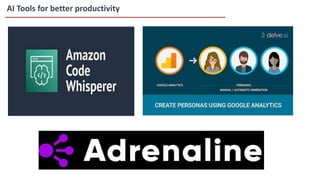
AI Tools for better productivity
Health and Wellness industry future
The wellness market is booming. Consumers intend to keep spending more on products
that improve their health and fitness. Six categories where major focus will be based in
future as per study by McKinsey:
• Health
• Fitness
• Nutrition
• Appearance
• Sleep
• Mindfulness
Conclusion
it's also important to approach AI and ML adoption thoughtfully and responsibly. Consider the
following steps:
• Education
• Data Strategy
• Ethical Considerations
• Start Small
• Stay updated
Thank you

AI&ML-Role-In-Product Development.pptx

  • 1.
    30/08/2023 AI/ML role inproduct enhancement vision By: Sakshi Goel
  • 2.
    Domains where AIis used in Product management
  • 3.
    Product management andAI (Stats) •According to study by IBM, 21% of product managers use AI everyday. •The transition to machine learning will be 100x harder than the transition to mobile apps •AI and B2B product management is prevalent in future. •Product managers (PMs) of every stripe need to understand the powerful influence of AI to both stay competitive in their product role and ensure that their companies maintain a competitive advantage.
  • 4.
    Role of Productmanager An AI product manager is supposed to be having core product skills along with an intuitive grasp of AI and ML.
  • 5.
    Benefits of AIand ML in Product Development Successful AI product management is about uncovering the right data and then figuring out how to use that data to design an innovative product that delights customers and keeps them coming back for more. • Improved Product Insights: AI and ML can analyze large datasets to identify patterns and trends, providing valuable insights for product development teams. • Enhanced Personalization: AI-powered recommendation systems can personalize user experiences, leading to increased customer satisfaction and engagement. • Faster Decision-making: ML algorithms can process data quickly, enabling faster decision-making and reducing time-to-market. • Cost Optimization: AI-driven automation can streamline processes and reduce operational costs in product development. • Product Management Process : Market Research -> Idea Management -> technical Specifications -> Road mapping -> Prioritization -> Product Development -> MVP release and Feedback collection • Customer Support: AI-powered chatbots and virtual assistants can handle customer queries, improving support efficiency.
  • 6.
    AI Tools forProduct Management Behavioral Analytics – analyze data collected from customer to provide insight of what and why they are doing. NLP – Works on Quantitative along with qualitative customer feedbacks
  • 7.
    AI is yourcompanion not competitor
  • 8.
    Types of AI ArtificialNarrow intelligence – Also knows as the weak AI, has a narrow range of abilities Artificial General intelligence – It is at par with human capabilities Artificial Super intelligence – It is supposed to be much more capable than Human
  • 9.
    AI Tools forbetter productivity
  • 10.
    Health and Wellnessindustry future The wellness market is booming. Consumers intend to keep spending more on products that improve their health and fitness. Six categories where major focus will be based in future as per study by McKinsey: • Health • Fitness • Nutrition • Appearance • Sleep • Mindfulness
  • 11.
    Conclusion it's also importantto approach AI and ML adoption thoughtfully and responsibly. Consider the following steps: • Education • Data Strategy • Ethical Considerations • Start Small • Stay updated
  • 12.