11th International AIDS Impact Conference
Barcelona, Spain
Tuesday, October 1, 2013

The research justification for HIV
prevention programming for lesbian and
bisexual females
Michele L. Ybarra MPH PhD, Center for Innovative Public Health
Research
Kimberly J. Mitchell PhD, Crimes against Children Research
Center, University of New Hampshire
* Thank you for your interest in this presentation. Please note that analyses
included herein are preliminary. More recent, finalized analyses may be available
by contacting CiPHR for further information.
Acknowledgements
The project described was supported by Award Number
R01 HD057191 from the National Institute of Child
Health and Human Development. The content is solely
the responsibility of the authors and does not necessarily
represent the official views of the National Institute of Child
Health and Human Development or the National Institutes
of Health.
We would like to thank the entire Study team from the
Center for Innovative Public Health Research, the
University of New Hampshire, the Gay Lesbian Straight
Education Network (GLSEN), Latrobe University, and
Harris Interactive, who contributed to the planning and
implementation of the study. We thank the study
participants for their time and willingness to participate in
this study.
Study motivation
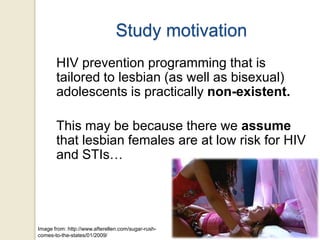
HIV prevention programming that is
tailored to lesbian (as well as bisexual)
adolescents is practically non-existent.
This may be because there we assume
that lesbian females are at low risk for HIV
and STIs…

Image from: http://www.afterellen.com/sugar-rushcomes-to-the-states/01/2009/
Study motivation
Data from regional studies suggest,
however, that adolescent females who
self-identify as lesbian (or queer) are
more likely to:
Get pregnant,
 Engage in anal sex, and
 Engage in inconsistent condom use


compared to heterosexual adolescent
females.
Saewyc EM, Bearinger LH, Blum RW, Resnick MD. Sexual intercourse, abuse and pregnancy among
adolescent women: does sexual orientation make a difference? Fam Plann Perspect. 1999 MayJun;31(3):127-31.
Herrick AL, Matthews AK, Garofalo R. Health risk behaviors in an urban sample of young women who have
sex with women. J Lesbian Stud. 2010;14(1):80-92. doi: 10.1080/10894160903060440.
Stevens PE, Hall JM. Sexuality and safer sex: the issues for lesbians and bisexual women. J Obstet
Study motivation
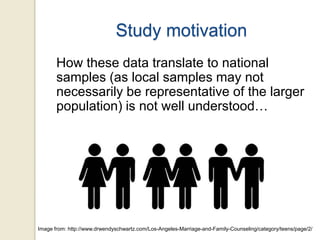
How these data translate to national
samples (as local samples may not
necessarily be representative of the larger
population) is not well understood…

Image from: http://www.drwendyschwartz.com/Los-Angeles-Marriage-and-Family-Counseling/category/teens/page/2/
Teen Health and Technology
survey methodology







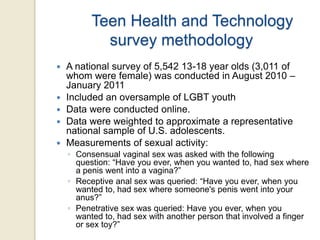
A national survey of 5,542 13-18 year olds (3,011 of
whom were female) was conducted in August 2010 –
January 2011
Included an oversample of LGBT youth
Data were conducted online.
Data were weighted to approximate a representative
national sample of U.S. adolescents.
Measurements of sexual activity:
◦ Consensual vaginal sex was asked with the following
question: “Have you ever, when you wanted to, had sex where
a penis went into a vagina?”
◦ Receptive anal sex was queried: “Have you ever, when you
wanted to, had sex where someone's penis went into your
anus?”
◦ Penetrative sex was queried: Have you ever, when you
wanted to, had sex with another person that involved a finger
or sex toy?”
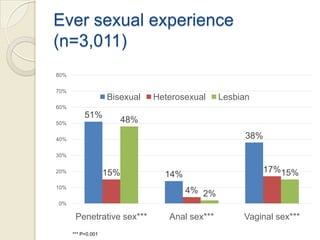
Ever sexual experience
(n=3,011)
80%
70%

Bisexual

Heterosexual

Lesbian

60%

51%

48%

50%

38%

40%
30%

15%

20%
10%

17%15%

14%
4% 2%

0%

Penetrative sex***
*** P<0.001

Anal sex***

Vaginal sex***
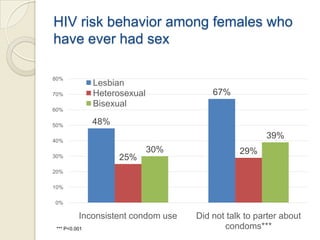
HIV risk behavior among females who
have ever had sex
80%

Lesbian
Heterosexual
Bisexual

70%
60%

67%

48%

50%

39%

40%

25%

30%

30%

29%

20%
10%
0%

Inconsistent condom use
*** P<0.001

Did not talk to parter about
condoms***
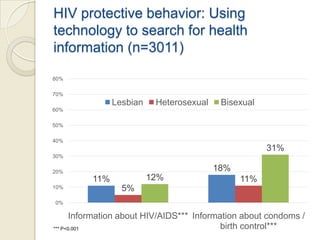
HIV protective behavior: Using
technology to search for health
information (n=3011)
80%
70%

Lesbian

Heterosexual

Bisexual

60%
50%
40%

31%
30%

18%

20%

12%

11%
10%

11%

5%

0%

Information about HIV/AIDS*** Information about condoms /
birth control***
*** P<0.001
Limitations





As with all self-report measures, some youth
respondents may not have accurately disclosed
sensitive topics.
The representativeness of the sample is based
upon the weighting. Findings should be replicated.
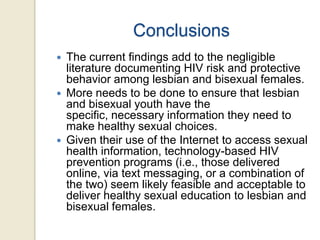
Sexual identity is fluid in adolescence. It is
possible that lifetime rates of sexual activity include
some youth who first self-identified as and
engaged in sexual behavior consistent with a
heterosexual identity; and subsequently identified
as lesbian.
Conclusions






The current findings add to the negligible
literature documenting HIV risk and protective
behavior among lesbian and bisexual females.
More needs to be done to ensure that lesbian
and bisexual youth have the
specific, necessary information they need to
make healthy sexual choices.
Given their use of the Internet to access sexual
health information, technology-based HIV
prevention programs (i.e., those delivered
online, via text messaging, or a combination of
the two) seem likely feasible and acceptable to
deliver healthy sexual education to lesbian and
bisexual females.

The research justification for HIV prevention programming for lesbian and bisexual females

  • 1.
    11th International AIDSImpact Conference Barcelona, Spain Tuesday, October 1, 2013 The research justification for HIV prevention programming for lesbian and bisexual females Michele L. Ybarra MPH PhD, Center for Innovative Public Health Research Kimberly J. Mitchell PhD, Crimes against Children Research Center, University of New Hampshire * Thank you for your interest in this presentation. Please note that analyses included herein are preliminary. More recent, finalized analyses may be available by contacting CiPHR for further information.
  • 2.
    Acknowledgements The project describedwas supported by Award Number R01 HD057191 from the National Institute of Child Health and Human Development. The content is solely the responsibility of the authors and does not necessarily represent the official views of the National Institute of Child Health and Human Development or the National Institutes of Health. We would like to thank the entire Study team from the Center for Innovative Public Health Research, the University of New Hampshire, the Gay Lesbian Straight Education Network (GLSEN), Latrobe University, and Harris Interactive, who contributed to the planning and implementation of the study. We thank the study participants for their time and willingness to participate in this study.
  • 3.
    Study motivation HIV preventionprogramming that is tailored to lesbian (as well as bisexual) adolescents is practically non-existent. This may be because there we assume that lesbian females are at low risk for HIV and STIs… Image from: http://www.afterellen.com/sugar-rushcomes-to-the-states/01/2009/
  • 4.
    Study motivation Data fromregional studies suggest, however, that adolescent females who self-identify as lesbian (or queer) are more likely to: Get pregnant,  Engage in anal sex, and  Engage in inconsistent condom use  compared to heterosexual adolescent females. Saewyc EM, Bearinger LH, Blum RW, Resnick MD. Sexual intercourse, abuse and pregnancy among adolescent women: does sexual orientation make a difference? Fam Plann Perspect. 1999 MayJun;31(3):127-31. Herrick AL, Matthews AK, Garofalo R. Health risk behaviors in an urban sample of young women who have sex with women. J Lesbian Stud. 2010;14(1):80-92. doi: 10.1080/10894160903060440. Stevens PE, Hall JM. Sexuality and safer sex: the issues for lesbians and bisexual women. J Obstet
  • 5.
    Study motivation How thesedata translate to national samples (as local samples may not necessarily be representative of the larger population) is not well understood… Image from: http://www.drwendyschwartz.com/Los-Angeles-Marriage-and-Family-Counseling/category/teens/page/2/
  • 6.
    Teen Health andTechnology survey methodology      A national survey of 5,542 13-18 year olds (3,011 of whom were female) was conducted in August 2010 – January 2011 Included an oversample of LGBT youth Data were conducted online. Data were weighted to approximate a representative national sample of U.S. adolescents. Measurements of sexual activity: ◦ Consensual vaginal sex was asked with the following question: “Have you ever, when you wanted to, had sex where a penis went into a vagina?” ◦ Receptive anal sex was queried: “Have you ever, when you wanted to, had sex where someone's penis went into your anus?” ◦ Penetrative sex was queried: Have you ever, when you wanted to, had sex with another person that involved a finger or sex toy?”
  • 7.
  • 8.
    HIV risk behavioramong females who have ever had sex 80% Lesbian Heterosexual Bisexual 70% 60% 67% 48% 50% 39% 40% 25% 30% 30% 29% 20% 10% 0% Inconsistent condom use *** P<0.001 Did not talk to parter about condoms***
  • 9.
    HIV protective behavior:Using technology to search for health information (n=3011) 80% 70% Lesbian Heterosexual Bisexual 60% 50% 40% 31% 30% 18% 20% 12% 11% 10% 11% 5% 0% Information about HIV/AIDS*** Information about condoms / birth control*** *** P<0.001
  • 10.
    Limitations    As with allself-report measures, some youth respondents may not have accurately disclosed sensitive topics. The representativeness of the sample is based upon the weighting. Findings should be replicated. Sexual identity is fluid in adolescence. It is possible that lifetime rates of sexual activity include some youth who first self-identified as and engaged in sexual behavior consistent with a heterosexual identity; and subsequently identified as lesbian.
  • 11.
    Conclusions    The current findingsadd to the negligible literature documenting HIV risk and protective behavior among lesbian and bisexual females. More needs to be done to ensure that lesbian and bisexual youth have the specific, necessary information they need to make healthy sexual choices. Given their use of the Internet to access sexual health information, technology-based HIV prevention programs (i.e., those delivered online, via text messaging, or a combination of the two) seem likely feasible and acceptable to deliver healthy sexual education to lesbian and bisexual females.

Editor's Notes

  • #9 Inconsistent condom use p=0.11