Female Occupational Crowding and Entrepreneurial 
Outcomes: 
Measurement and Public Policy Implications 
Ruta Aidis, PhD 
Senior Fellow, George Mason University 
Gender-GEDI Project Director, The GEDI Institute 
Ainsley Lloyd 
Research Consultant 
The GEDI Institute 
R. Aidis ICSB Washington DC -Oct 16 - 18, 2014 1
Main topics 
•Women 
•Work 
•Entrepreneurship 
R. Aidis ICSB Washington DC -Oct 16 - 18, 2014 2
Outline 
• Introduction 
• The Why 
• Measuring occupational crowding & results 
• Some interesting pie charts 
• Consequences & implications 
• Limitations & future research 
R. Aidis ICSB Washington DC -Oct 16 - 18, 2014 3
Introduction…..consider… 
Your job is your first business incubator… 
R. Aidis ICSB Washington DC -Oct 16 - 18, 2014 4
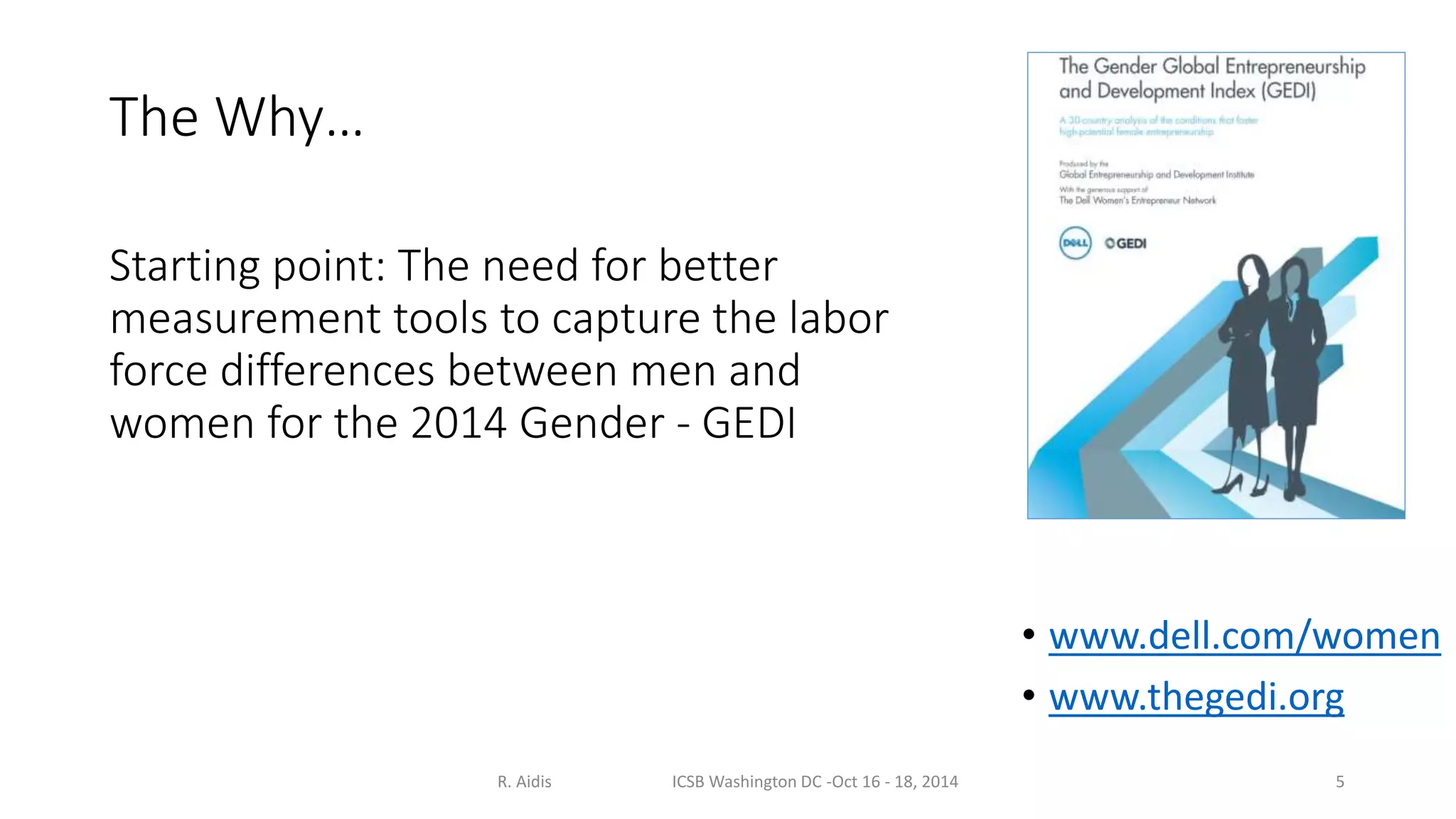
Starting point: The need for better 
measurement tools to capture the labor 
force differences between men and 
women for the 2014 Gender - GEDI 
• www.dell.com/women 
• www.thegedi.org 
R. Aidis ICSB Washington DC -Oct 16 - 18, 2014 
The Why… 
5
Occupational Crowding 
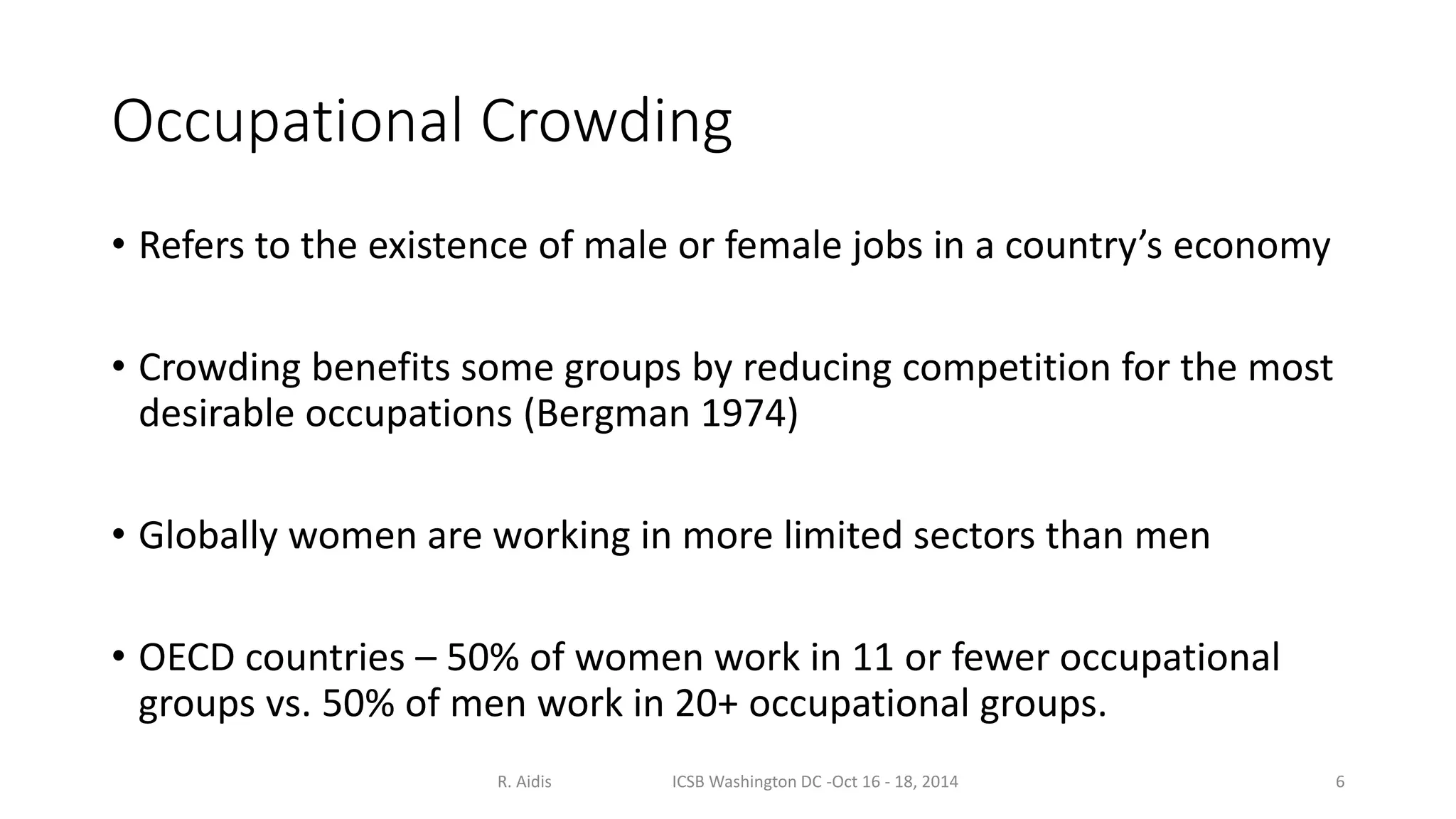
• Refers to the existence of male or female jobs in a country’s economy 
• Crowding benefits some groups by reducing competition for the most 
desirable occupations (Bergman 1974) 
• Globally women are working in more limited sectors than men 
• OECD countries – 50% of women work in 11 or fewer occupational 
groups vs. 50% of men work in 20+ occupational groups. 
R. Aidis ICSB Washington DC -Oct 16 - 18, 2014 6
How to measure gender parity in the labor 
force? 
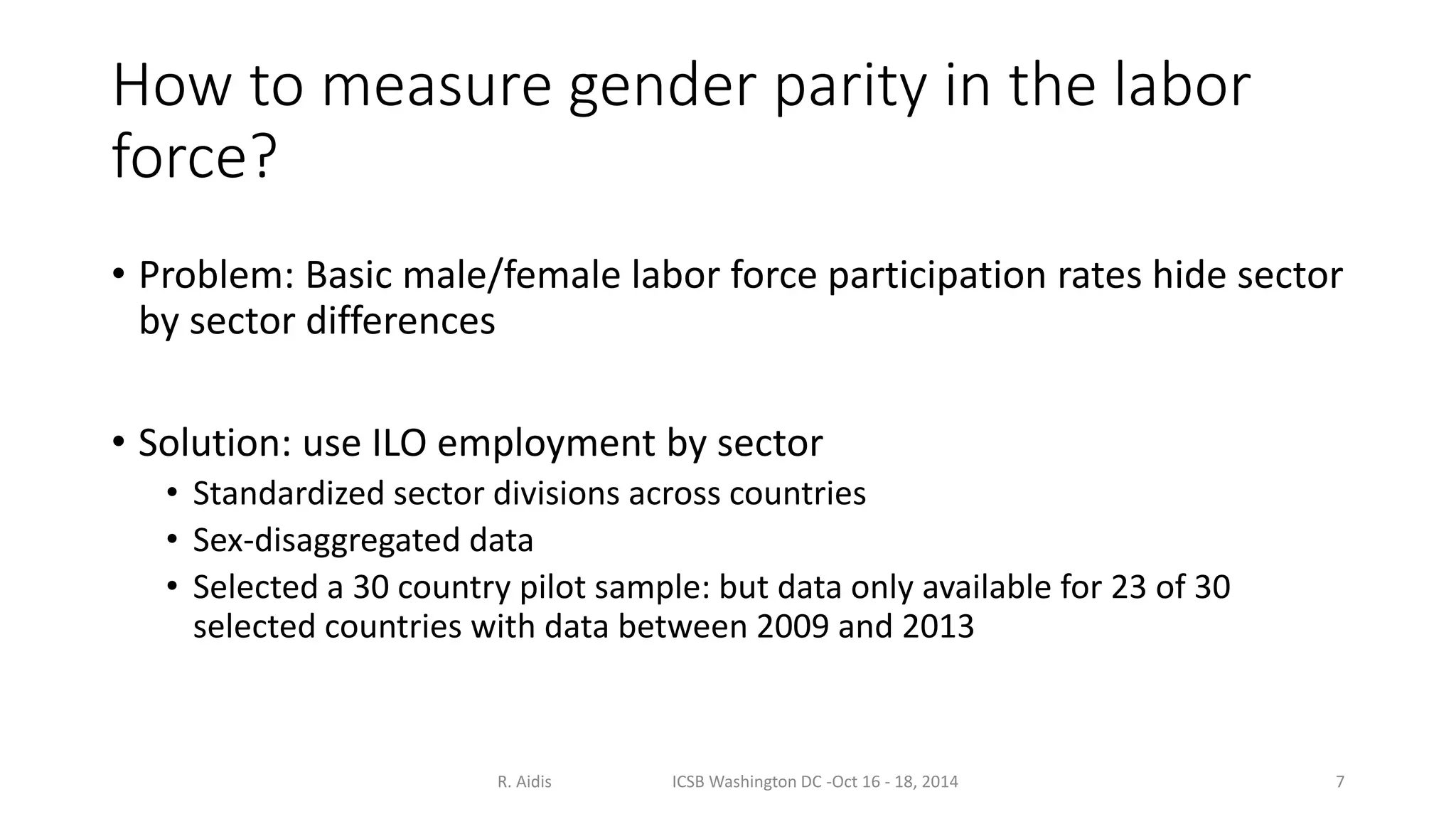
• Problem: Basic male/female labor force participation rates hide sector 
by sector differences 
• Solution: use ILO employment by sector 
• Standardized sector divisions across countries 
• Sex-disaggregated data 
• Selected a 30 country pilot sample: but data only available for 23 of 30 
selected countries with data between 2009 and 2013 
R. Aidis ICSB Washington DC -Oct 16 - 18, 2014 7
Sectors 
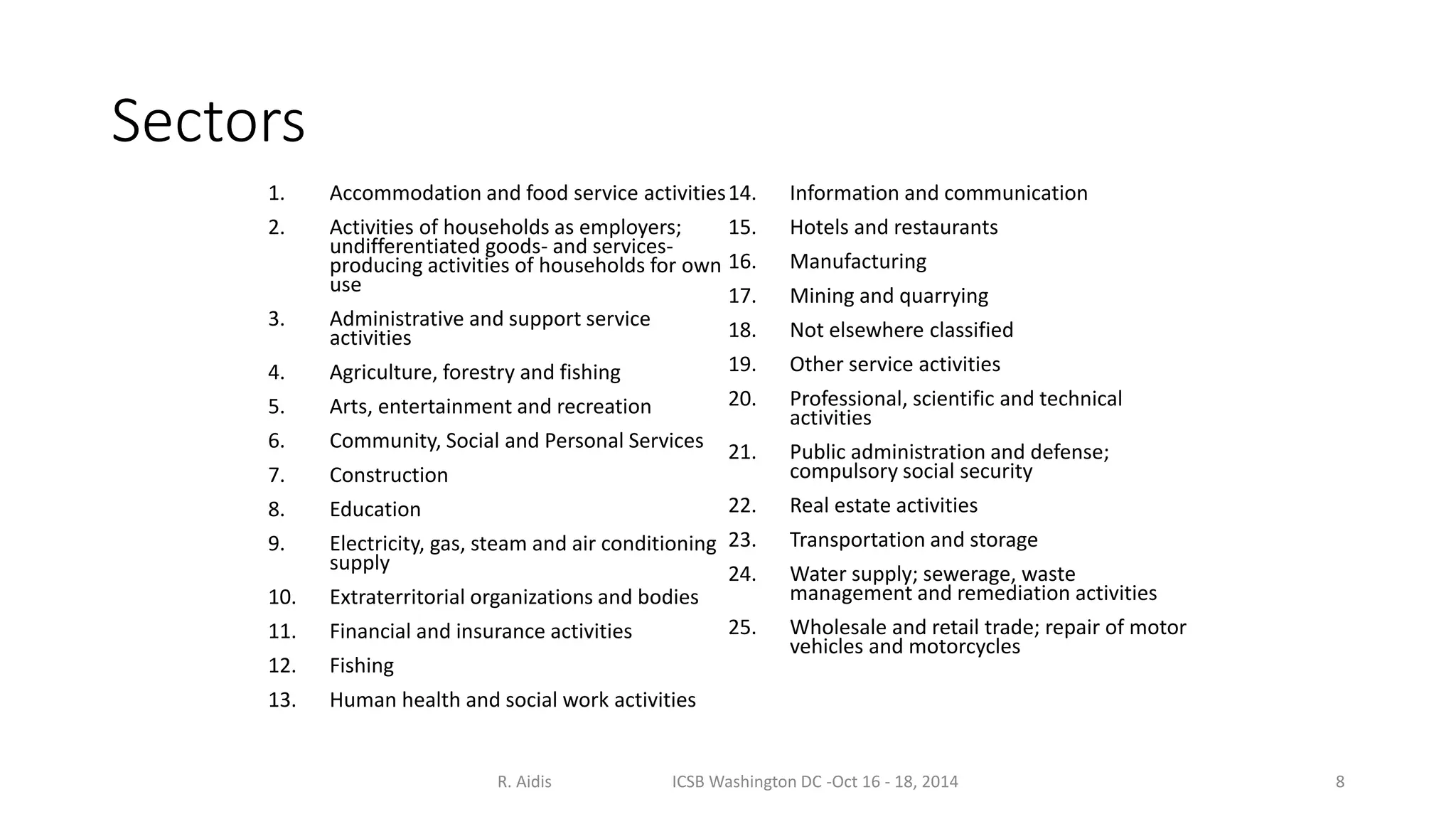
1. Accommodation and food service activities 
2. Activities of households as employers; 
undifferentiated goods- and services-producing 
activities of households for own 
use 
3. Administrative and support service 
activities 
4. Agriculture, forestry and fishing 
5. Arts, entertainment and recreation 
6. Community, Social and Personal Services 
7. Construction 
8. Education 
9. Electricity, gas, steam and air conditioning 
supply 
10. Extraterritorial organizations and bodies 
11. Financial and insurance activities 
12. Fishing 
13. Human health and social work activities 
14. Information and communication 
15. Hotels and restaurants 
16. Manufacturing 
17. Mining and quarrying 
18. Not elsewhere classified 
19. Other service activities 
20. Professional, scientific and technical 
activities 
21. Public administration and defense; 
compulsory social security 
22. Real estate activities 
23. Transportation and storage 
24. Water supply; sewerage, waste 
management and remediation activities 
25. Wholesale and retail trade; repair of motor 
vehicles and motorcycles 
R. Aidis ICSB Washington DC -Oct 16 - 18, 2014 8
Creating a comparable scoring system 
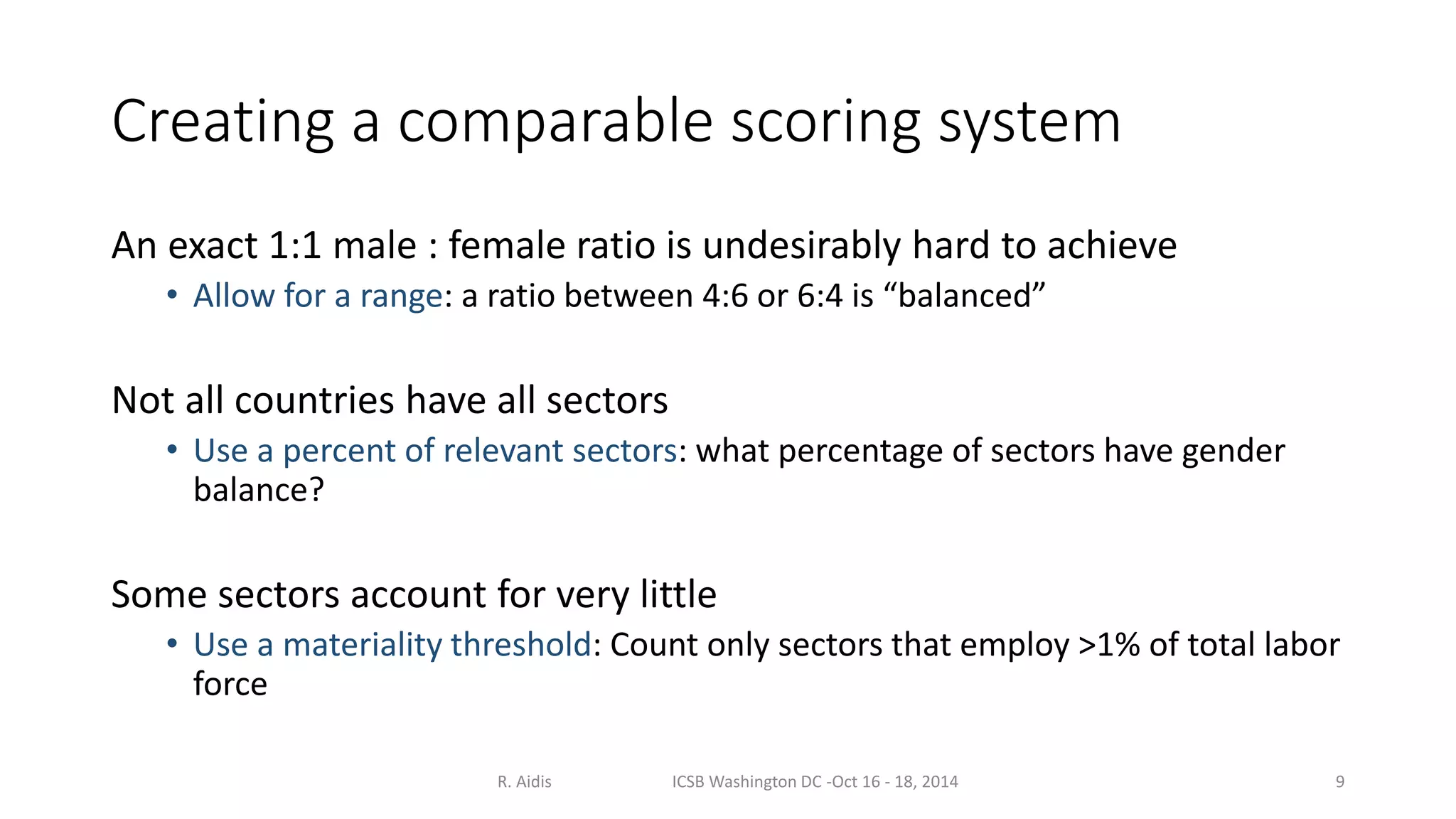
An exact 1:1 male : female ratio is undesirably hard to achieve 
• Allow for a range: a ratio between 4:6 or 6:4 is “balanced” 
Not all countries have all sectors 
• Use a percent of relevant sectors: what percentage of sectors have gender 
balance? 
Some sectors account for very little 
• Use a materiality threshold: Count only sectors that employ >1% of total labor 
force 
R. Aidis ICSB Washington DC -Oct 16 - 18, 2014 9
Pilot study 
• Based on 23 developing, emerging and developed economies 
worldwide; 
• Including six main regions: Latin America, North America, Europe, 
East Asia, South Asia, Africa and MENA countries. 
R. Aidis ICSB Washington DC -Oct 16 - 18, 2014 10
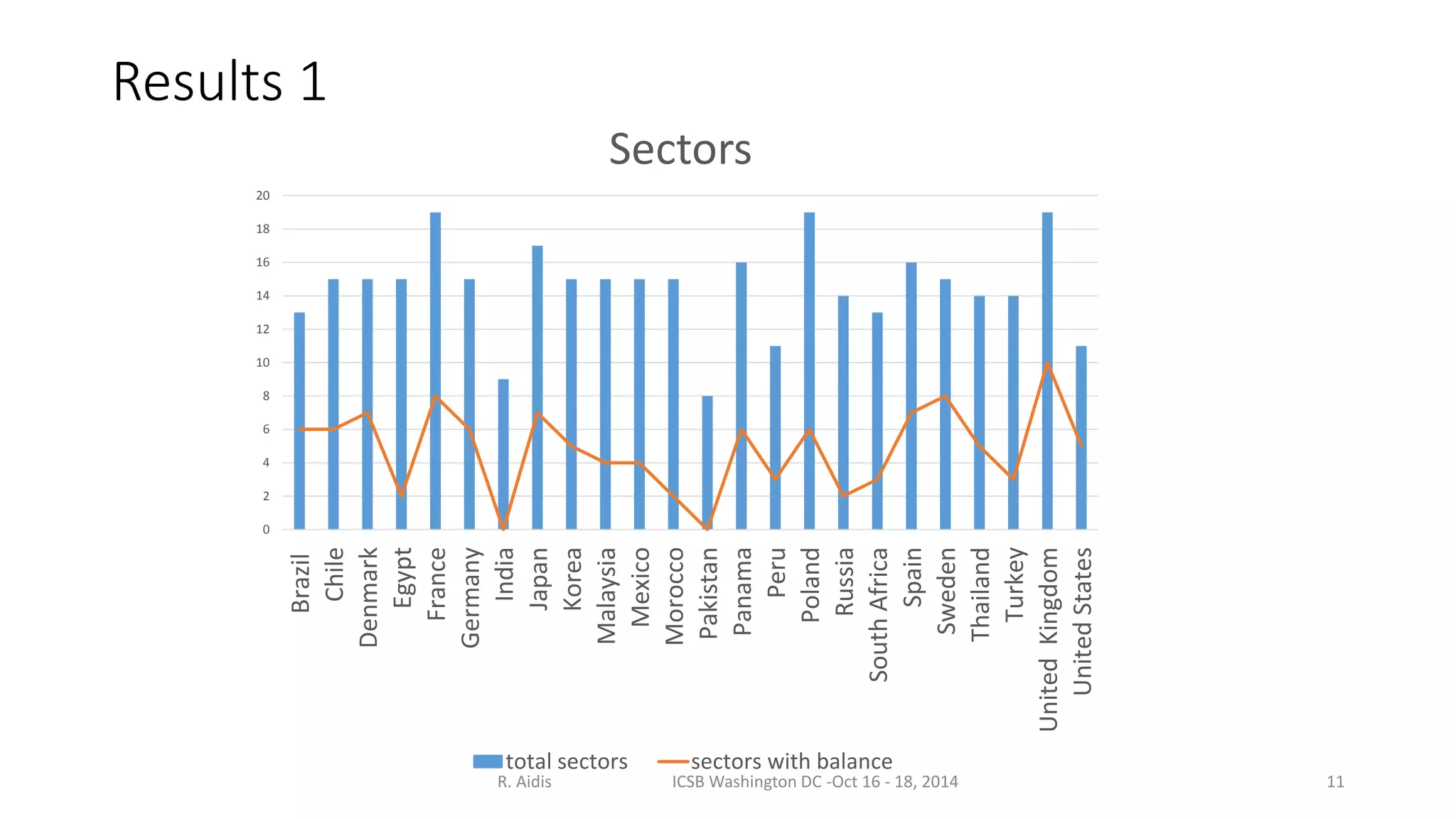
Results 1 
20 
18 
16 
14 
12 
10 
8 
6 
4 
2 
0 
Brazil 
Chile 
Denmark 
Egypt 
France 
Germany 
India 
Japan 
Korea 
Malaysia 
Mexico 
Morocco 
Pakistan 
Panama 
Peru 
Poland 
Russia 
South Africa 
Spain 
Sweden 
Thailand 
Turkey 
United Kingdom 
United States 
Sectors 
total sectors sectors with balance 
R. Aidis ICSB Washington DC -Oct 16 - 18, 2014 11
Results 2 
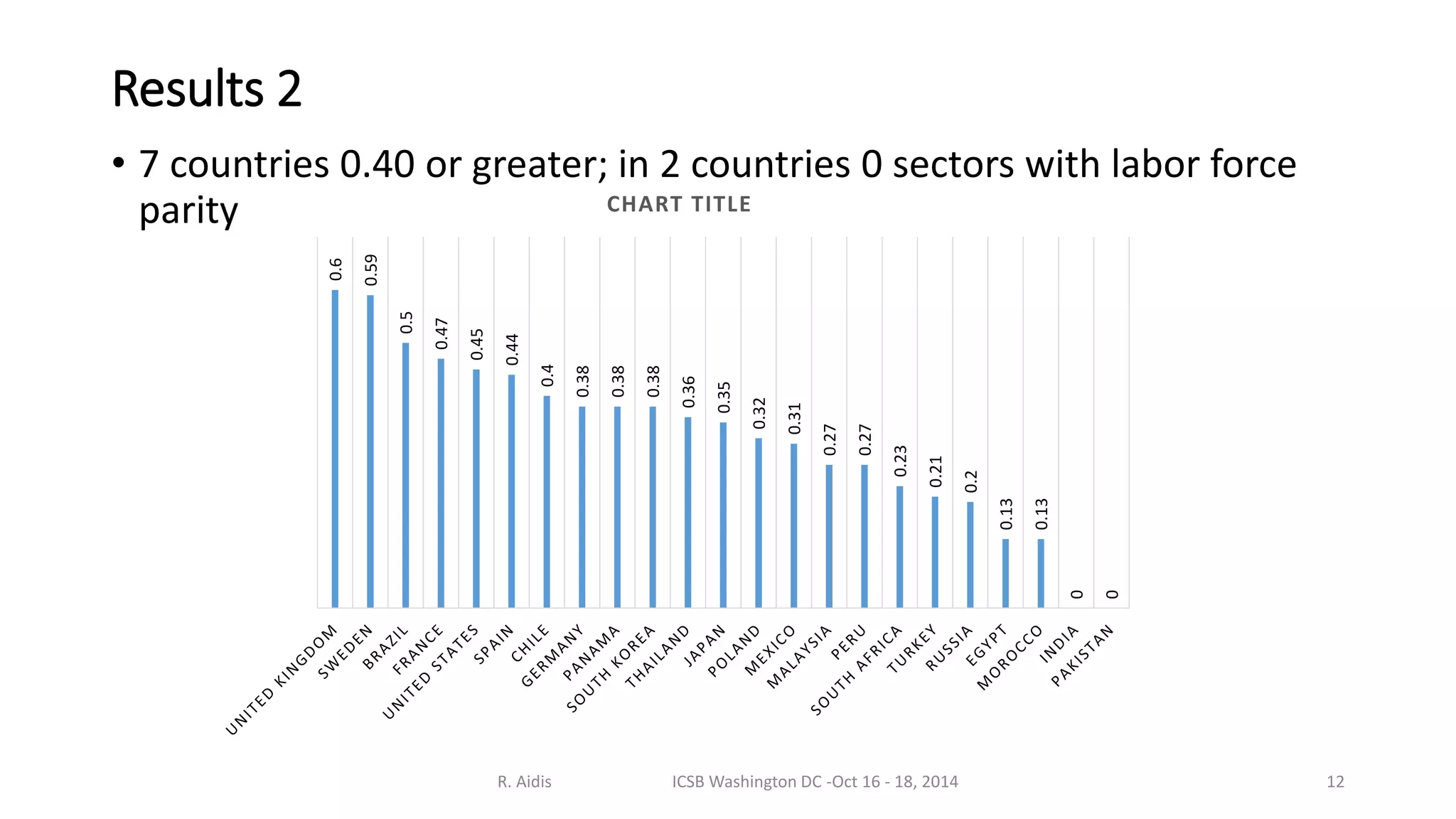
• 7 countries 0.40 or greater; in 2 countries 0 sectors with labor force 
parity 
R. Aidis ICSB Washington DC -Oct 16 - 18, 2014 12 
0.6 
0.59 
0.5 
0.47 
0.45 
0.44 
0.4 
0.38 
0.38 
0.38 
0.36 
0.35 
0.32 
0.31 
0.27 
0.27 
0.23 
0.21 
0.2 
0.13 
0.13 
0 
0 
CHART TITLE
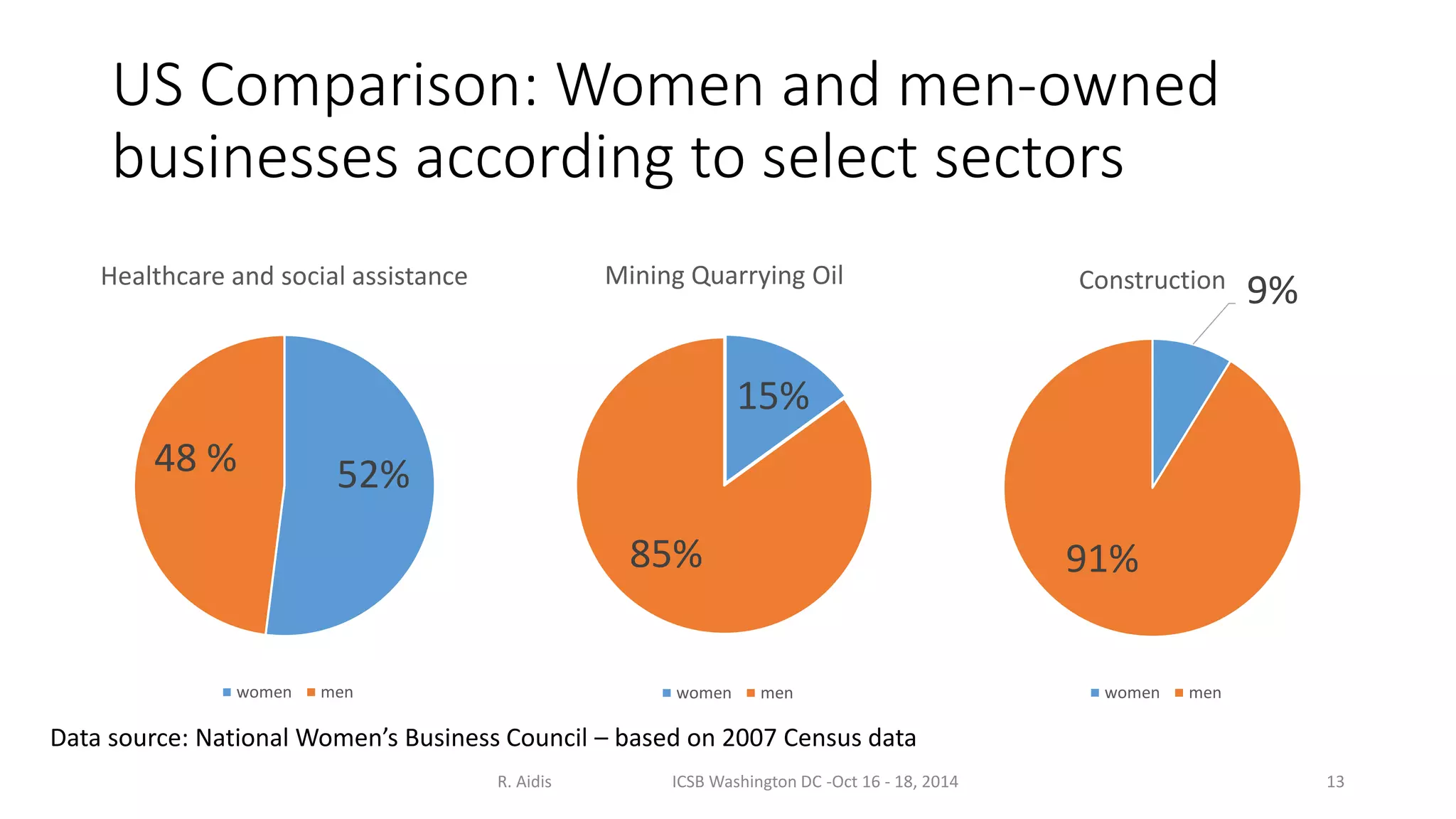
US Comparison: Women and men-owned 
businesses according to select sectors 
Healthcare and social assistance 
48 % 52% 
women men 
Mining Quarrying Oil 
15% 
85% 
women men 
9% 
Construction 
91% 
women men 
Data source: National Women’s Business Council – based on 2007 Census data 
R. Aidis ICSB Washington DC -Oct 16 - 18, 2014 13
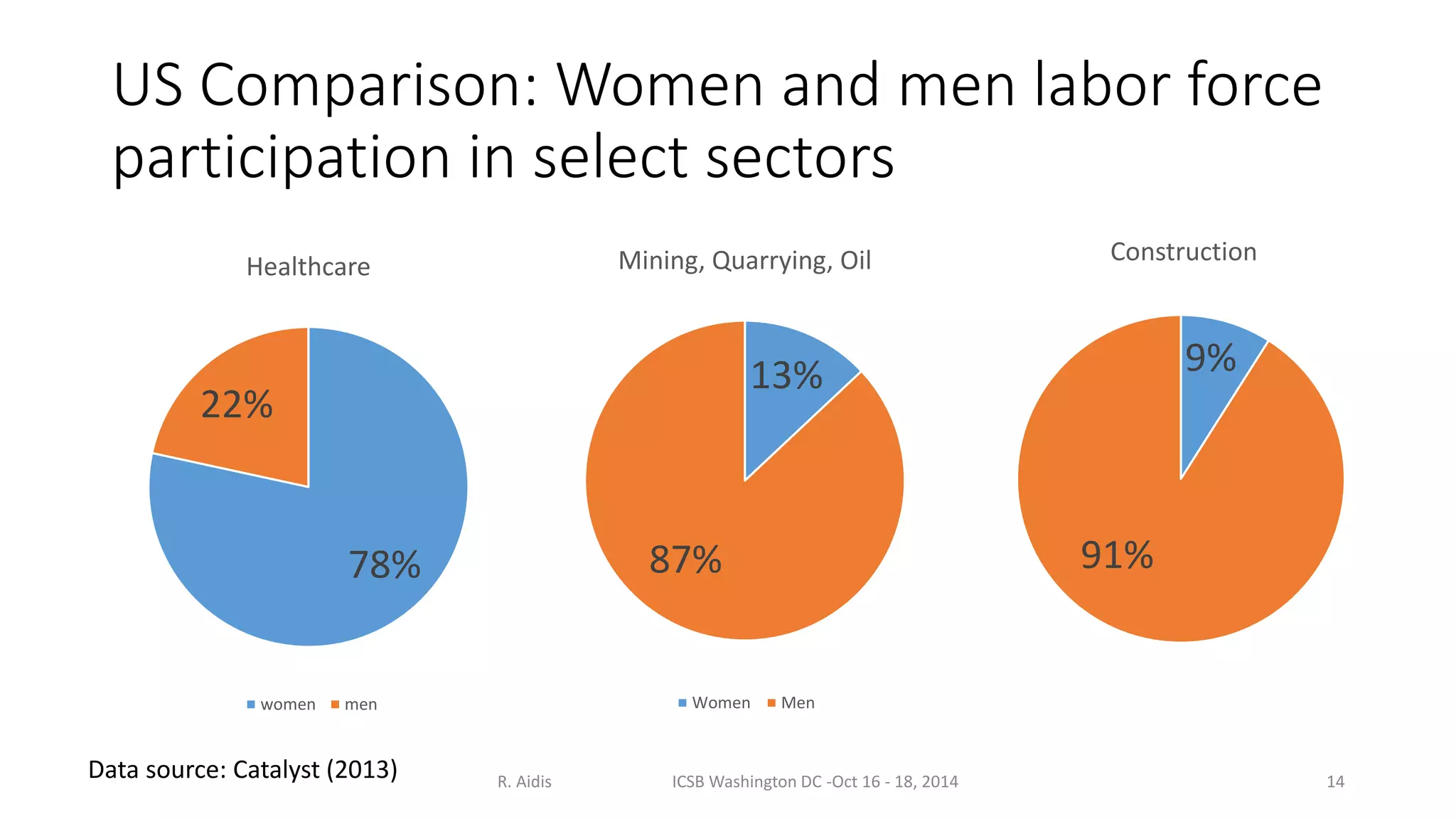
US Comparison: Women and men labor force 
participation in select sectors 
Healthcare 
78% 
22% 
women men 
Mining, Quarrying, Oil 
13% 
87% 
Women Men 
Construction 
9% 
91% 
Data source: Catalyst (2013) R. Aidis ICSB Washington DC -Oct 16 - 18, 2014 14
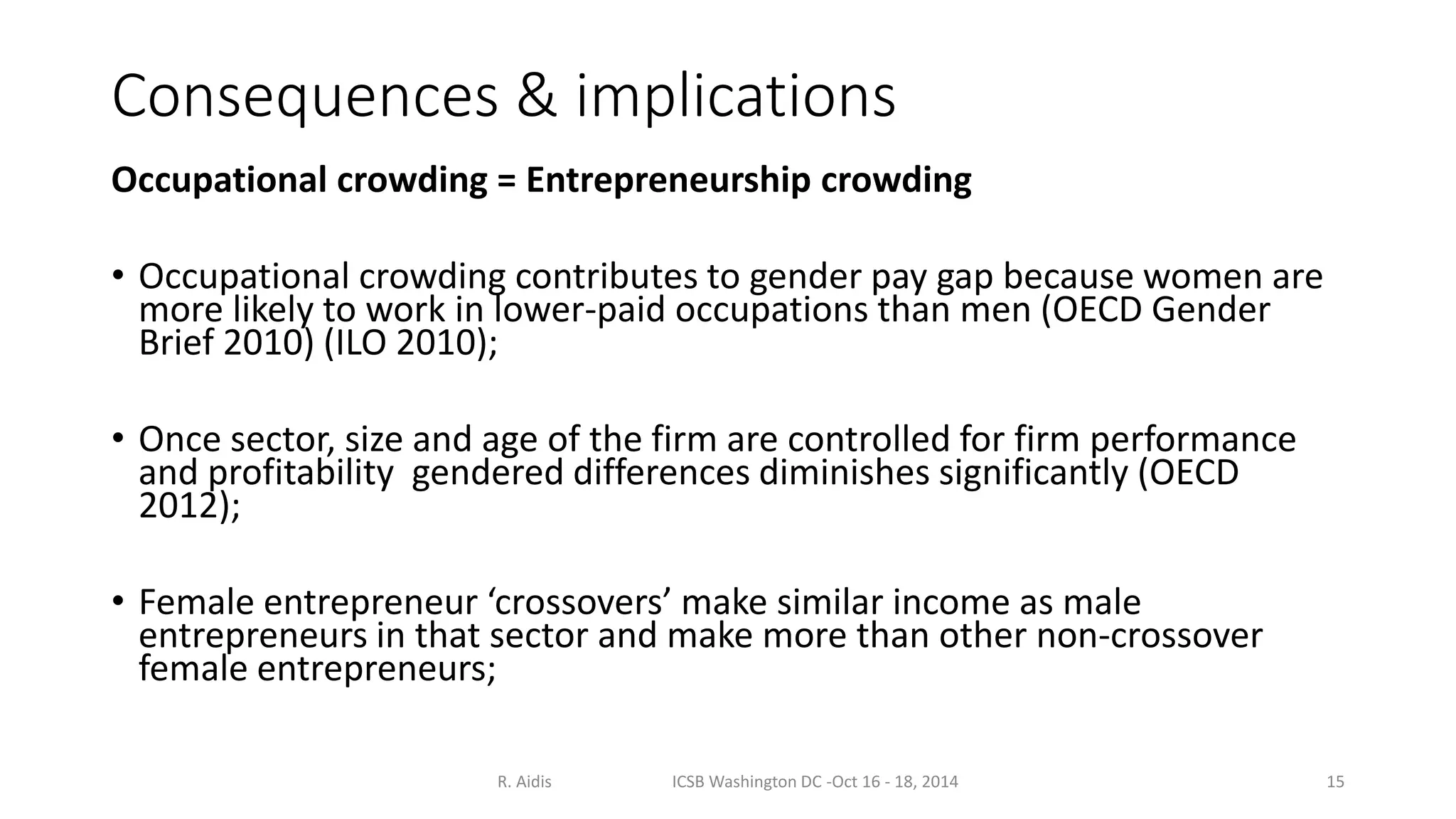
Consequences & implications 
Occupational crowding = Entrepreneurship crowding 
• Occupational crowding contributes to gender pay gap because women are 
more likely to work in lower-paid occupations than men (OECD Gender 
Brief 2010) (ILO 2010); 
• Once sector, size and age of the firm are controlled for firm performance 
and profitability gendered differences diminishes significantly (OECD 
2012); 
• Female entrepreneur ‘crossovers’ make similar income as male 
entrepreneurs in that sector and make more than other non-crossover 
female entrepreneurs; 
R. Aidis ICSB Washington DC -Oct 16 - 18, 2014 15
Limitations 
• ILO sector specifications are too broad 
• Differences exist within a sector 
Further research 
• Adding more countries 
• In depth sector analysis at the country level 
• Occupational crowding occurs before the ‘job’ 
R. Aidis ICSB Washington DC -Oct 16 - 18, 2014 16

Female Occupational Crowding and Entrepreneurial Outcomes: Measurement and Public Policy Implications

  • 1.
    Female Occupational Crowdingand Entrepreneurial Outcomes: Measurement and Public Policy Implications Ruta Aidis, PhD Senior Fellow, George Mason University Gender-GEDI Project Director, The GEDI Institute Ainsley Lloyd Research Consultant The GEDI Institute R. Aidis ICSB Washington DC -Oct 16 - 18, 2014 1
  • 2.
    Main topics •Women •Work •Entrepreneurship R. Aidis ICSB Washington DC -Oct 16 - 18, 2014 2
  • 3.
    Outline • Introduction • The Why • Measuring occupational crowding & results • Some interesting pie charts • Consequences & implications • Limitations & future research R. Aidis ICSB Washington DC -Oct 16 - 18, 2014 3
  • 4.
    Introduction…..consider… Your jobis your first business incubator… R. Aidis ICSB Washington DC -Oct 16 - 18, 2014 4
  • 5.
    Starting point: Theneed for better measurement tools to capture the labor force differences between men and women for the 2014 Gender - GEDI • www.dell.com/women • www.thegedi.org R. Aidis ICSB Washington DC -Oct 16 - 18, 2014 The Why… 5
  • 6.
    Occupational Crowding •Refers to the existence of male or female jobs in a country’s economy • Crowding benefits some groups by reducing competition for the most desirable occupations (Bergman 1974) • Globally women are working in more limited sectors than men • OECD countries – 50% of women work in 11 or fewer occupational groups vs. 50% of men work in 20+ occupational groups. R. Aidis ICSB Washington DC -Oct 16 - 18, 2014 6
  • 7.
    How to measuregender parity in the labor force? • Problem: Basic male/female labor force participation rates hide sector by sector differences • Solution: use ILO employment by sector • Standardized sector divisions across countries • Sex-disaggregated data • Selected a 30 country pilot sample: but data only available for 23 of 30 selected countries with data between 2009 and 2013 R. Aidis ICSB Washington DC -Oct 16 - 18, 2014 7
  • 8.
    Sectors 1. Accommodationand food service activities 2. Activities of households as employers; undifferentiated goods- and services-producing activities of households for own use 3. Administrative and support service activities 4. Agriculture, forestry and fishing 5. Arts, entertainment and recreation 6. Community, Social and Personal Services 7. Construction 8. Education 9. Electricity, gas, steam and air conditioning supply 10. Extraterritorial organizations and bodies 11. Financial and insurance activities 12. Fishing 13. Human health and social work activities 14. Information and communication 15. Hotels and restaurants 16. Manufacturing 17. Mining and quarrying 18. Not elsewhere classified 19. Other service activities 20. Professional, scientific and technical activities 21. Public administration and defense; compulsory social security 22. Real estate activities 23. Transportation and storage 24. Water supply; sewerage, waste management and remediation activities 25. Wholesale and retail trade; repair of motor vehicles and motorcycles R. Aidis ICSB Washington DC -Oct 16 - 18, 2014 8
  • 9.
    Creating a comparablescoring system An exact 1:1 male : female ratio is undesirably hard to achieve • Allow for a range: a ratio between 4:6 or 6:4 is “balanced” Not all countries have all sectors • Use a percent of relevant sectors: what percentage of sectors have gender balance? Some sectors account for very little • Use a materiality threshold: Count only sectors that employ >1% of total labor force R. Aidis ICSB Washington DC -Oct 16 - 18, 2014 9
  • 10.
    Pilot study •Based on 23 developing, emerging and developed economies worldwide; • Including six main regions: Latin America, North America, Europe, East Asia, South Asia, Africa and MENA countries. R. Aidis ICSB Washington DC -Oct 16 - 18, 2014 10
  • 11.
    Results 1 20 18 16 14 12 10 8 6 4 2 0 Brazil Chile Denmark Egypt France Germany India Japan Korea Malaysia Mexico Morocco Pakistan Panama Peru Poland Russia South Africa Spain Sweden Thailand Turkey United Kingdom United States Sectors total sectors sectors with balance R. Aidis ICSB Washington DC -Oct 16 - 18, 2014 11
  • 12.
    Results 2 •7 countries 0.40 or greater; in 2 countries 0 sectors with labor force parity R. Aidis ICSB Washington DC -Oct 16 - 18, 2014 12 0.6 0.59 0.5 0.47 0.45 0.44 0.4 0.38 0.38 0.38 0.36 0.35 0.32 0.31 0.27 0.27 0.23 0.21 0.2 0.13 0.13 0 0 CHART TITLE
  • 13.
    US Comparison: Womenand men-owned businesses according to select sectors Healthcare and social assistance 48 % 52% women men Mining Quarrying Oil 15% 85% women men 9% Construction 91% women men Data source: National Women’s Business Council – based on 2007 Census data R. Aidis ICSB Washington DC -Oct 16 - 18, 2014 13
  • 14.
    US Comparison: Womenand men labor force participation in select sectors Healthcare 78% 22% women men Mining, Quarrying, Oil 13% 87% Women Men Construction 9% 91% Data source: Catalyst (2013) R. Aidis ICSB Washington DC -Oct 16 - 18, 2014 14
  • 15.
    Consequences & implications Occupational crowding = Entrepreneurship crowding • Occupational crowding contributes to gender pay gap because women are more likely to work in lower-paid occupations than men (OECD Gender Brief 2010) (ILO 2010); • Once sector, size and age of the firm are controlled for firm performance and profitability gendered differences diminishes significantly (OECD 2012); • Female entrepreneur ‘crossovers’ make similar income as male entrepreneurs in that sector and make more than other non-crossover female entrepreneurs; R. Aidis ICSB Washington DC -Oct 16 - 18, 2014 15
  • 16.
    Limitations • ILOsector specifications are too broad • Differences exist within a sector Further research • Adding more countries • In depth sector analysis at the country level • Occupational crowding occurs before the ‘job’ R. Aidis ICSB Washington DC -Oct 16 - 18, 2014 16