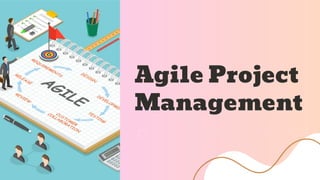
Agile Project
Management
This presentation will provide an overview of Agile project management,
including the Agile manifesto and principles, Scrum and Kanban
frameworks, project planning and estimation, tracking and reporting, as
well as the benefits and challenges. We will also discuss certification and
conclude with key takeaways.
Overview
What is Agile Methodology?
Agile is an iterative approach to project management that
focuses on flexibility and adaptability. It emphasizes
collaboration, customer satisfaction, and delivering
incremental value. Agile methodologies include Scrum,
Kanban, Lean, and XP.
Agile Manifesto and Principles
The Agile manifesto values individuals and interactions,
working software, customer collaboration, and
responding to change. Its principles emphasize customer
satisfaction, continuous delivery, and the importance of
self-organizing teams.
Scrum Framework
Scrum is a popular Agile framework that uses short
iterations called sprints to deliver value. It includes roles
like the Scrum Master, Product Owner, and Development
Team, as well as ceremonies like daily stand-ups, sprint
planning, reviews, and retrospectives.
Kanban is an Agile framework that aims to visualize and
optimize workflow. It utilizes a Kanban board with
columns representing different stages of work. Tasks are
moved across the board, providing transparency and
enabling process improvement.
Kanban Framework
Agile Project Planning and
Estimation
User Story Mapping
Create a visual representation of user stories to prioritize
and plan project activities.
Relative Estimation
Assign story points or t-shirt sizes to estimate the effort
required for each user story.
Release Planning
Define the scope, prioritize features, and determine the
release schedule for the project.
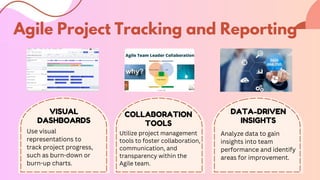
Use visual
representations to
track project progress,
such as burn-down or
burn-up charts.
VISUAL
DASHBOARDS
Utilize project management
tools to foster collaboration,
communication, and
transparency within the
Agile team.
COLLABORATION
TOOLS
Analyze data to gain
insights into team
performance and identify
areas for improvement.
DATA-DRIVEN
INSIGHTS
Agile Project Tracking and Reporting
• Improved customer satisfaction through early and
frequent delivery
• Flexibility to adapt to changing requirements
• Enhanced collaboration and communication among team
members
Benefits and Challenges of Agile
Project Management
• Managing stakeholder expectations
• Ensuring team members have the necessary skills and
training
• Adapting to organizational culture
• Benefits
• Challenges
Various Agile certifications, such as Certified ScrumMaster
(CSM), Professional Scrum Master (PSM), and Kanban
Management Professional (KMP), can enhance your
knowledge and credibility in Agile project management.
Certification courses offer in-depth training and practical
experience.
Certification
Agile project management provides a flexible and
iterative approach to delivering value and maximizing
customer satisfaction. Understanding Agile
methodologies, frameworks, and best practices is
crucial for successful project management in fast-paced
and ever-changing environments.
Conclusion
8287142095

Agile-Project-Management1.pptx

  • 1.
  • 2.
    This presentation willprovide an overview of Agile project management, including the Agile manifesto and principles, Scrum and Kanban frameworks, project planning and estimation, tracking and reporting, as well as the benefits and challenges. We will also discuss certification and conclude with key takeaways. Overview
  • 3.
    What is AgileMethodology? Agile is an iterative approach to project management that focuses on flexibility and adaptability. It emphasizes collaboration, customer satisfaction, and delivering incremental value. Agile methodologies include Scrum, Kanban, Lean, and XP.
  • 4.
    Agile Manifesto andPrinciples The Agile manifesto values individuals and interactions, working software, customer collaboration, and responding to change. Its principles emphasize customer satisfaction, continuous delivery, and the importance of self-organizing teams.
  • 5.
    Scrum Framework Scrum isa popular Agile framework that uses short iterations called sprints to deliver value. It includes roles like the Scrum Master, Product Owner, and Development Team, as well as ceremonies like daily stand-ups, sprint planning, reviews, and retrospectives.
  • 6.
    Kanban is anAgile framework that aims to visualize and optimize workflow. It utilizes a Kanban board with columns representing different stages of work. Tasks are moved across the board, providing transparency and enabling process improvement. Kanban Framework
  • 7.
    Agile Project Planningand Estimation User Story Mapping Create a visual representation of user stories to prioritize and plan project activities. Relative Estimation Assign story points or t-shirt sizes to estimate the effort required for each user story. Release Planning Define the scope, prioritize features, and determine the release schedule for the project.
  • 8.
    Use visual representations to trackproject progress, such as burn-down or burn-up charts. VISUAL DASHBOARDS Utilize project management tools to foster collaboration, communication, and transparency within the Agile team. COLLABORATION TOOLS Analyze data to gain insights into team performance and identify areas for improvement. DATA-DRIVEN INSIGHTS Agile Project Tracking and Reporting
  • 9.
    • Improved customersatisfaction through early and frequent delivery • Flexibility to adapt to changing requirements • Enhanced collaboration and communication among team members Benefits and Challenges of Agile Project Management • Managing stakeholder expectations • Ensuring team members have the necessary skills and training • Adapting to organizational culture • Benefits • Challenges
  • 10.
    Various Agile certifications,such as Certified ScrumMaster (CSM), Professional Scrum Master (PSM), and Kanban Management Professional (KMP), can enhance your knowledge and credibility in Agile project management. Certification courses offer in-depth training and practical experience. Certification
  • 11.
    Agile project managementprovides a flexible and iterative approach to delivering value and maximizing customer satisfaction. Understanding Agile methodologies, frameworks, and best practices is crucial for successful project management in fast-paced and ever-changing environments. Conclusion
  • 12.