www.egagile.com | 800.354.2773
Agile Consulting Services
Agile Expectations
Creating Organizational Alignment – Agile Maine Day 4/26/2019
Dave Moran – Agile Coach
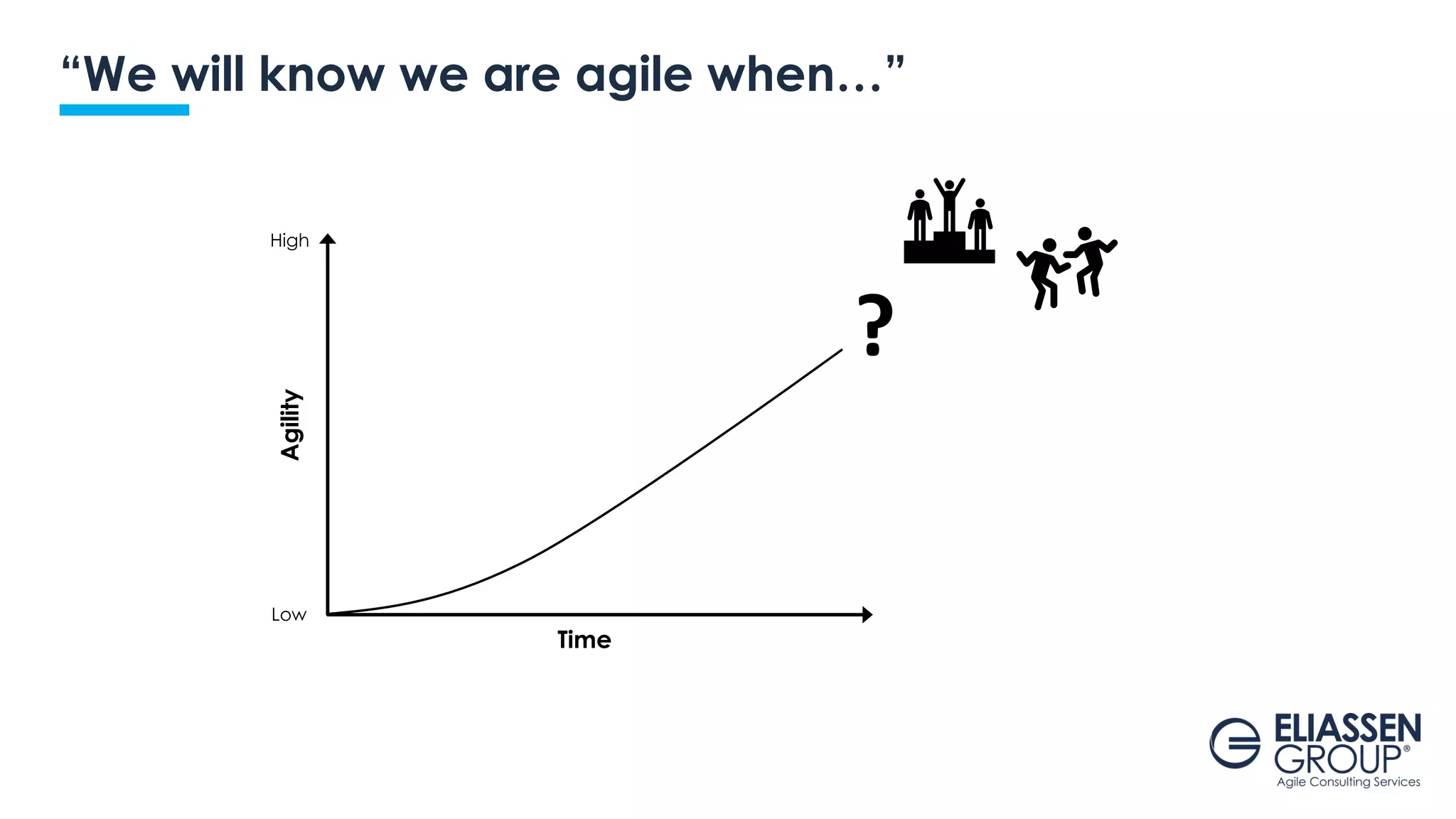
“We will know we are agile when…”
Agility
Time
Low
High
?
TROUBLE IN PARADISE
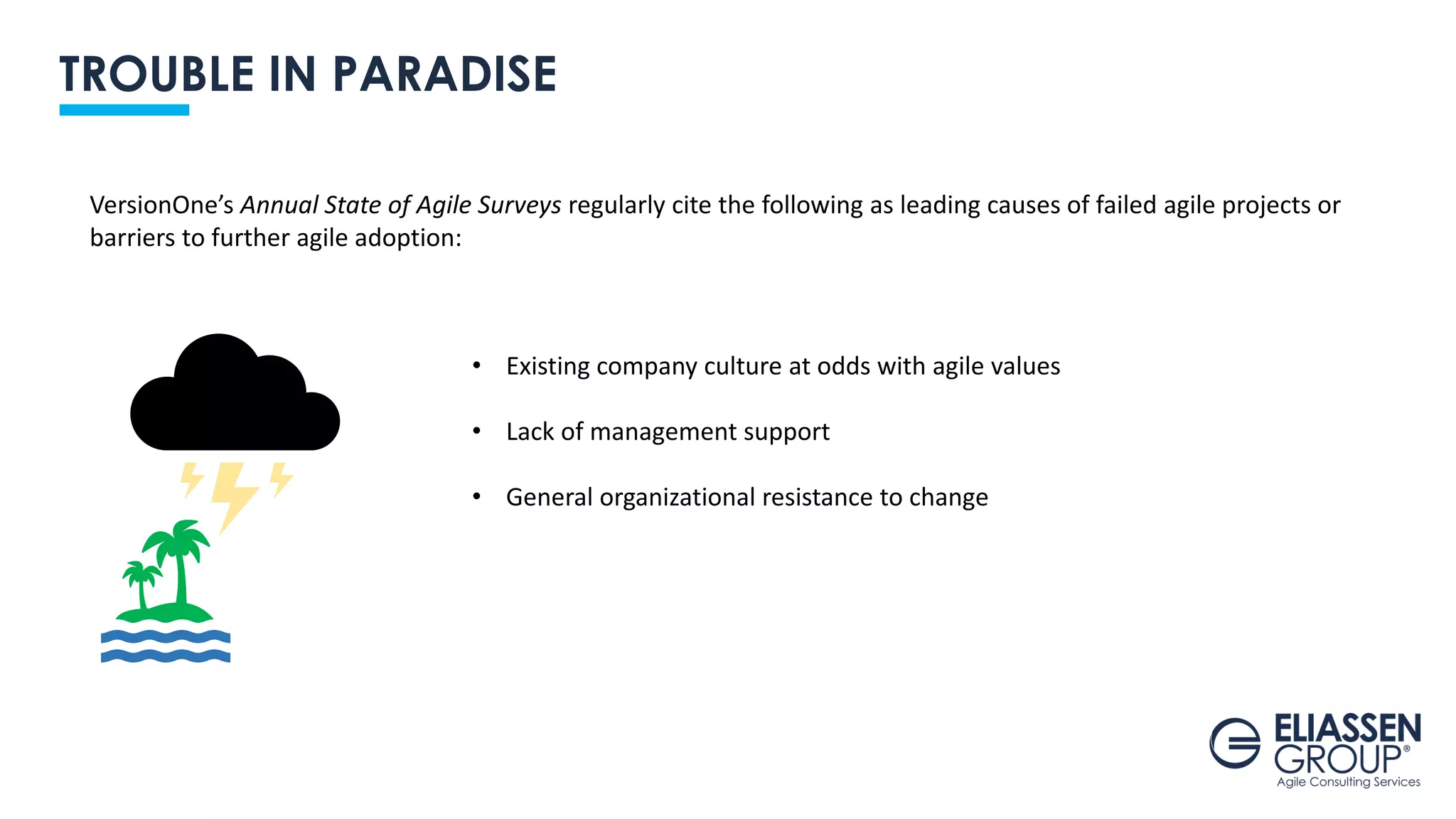
VersionOne’s Annual State of Agile Surveys regularly cite the following as leading causes of failed agile projects or
barriers to further agile adoption:
• Existing company culture at odds with agile values
• Lack of management support
• General organizational resistance to change
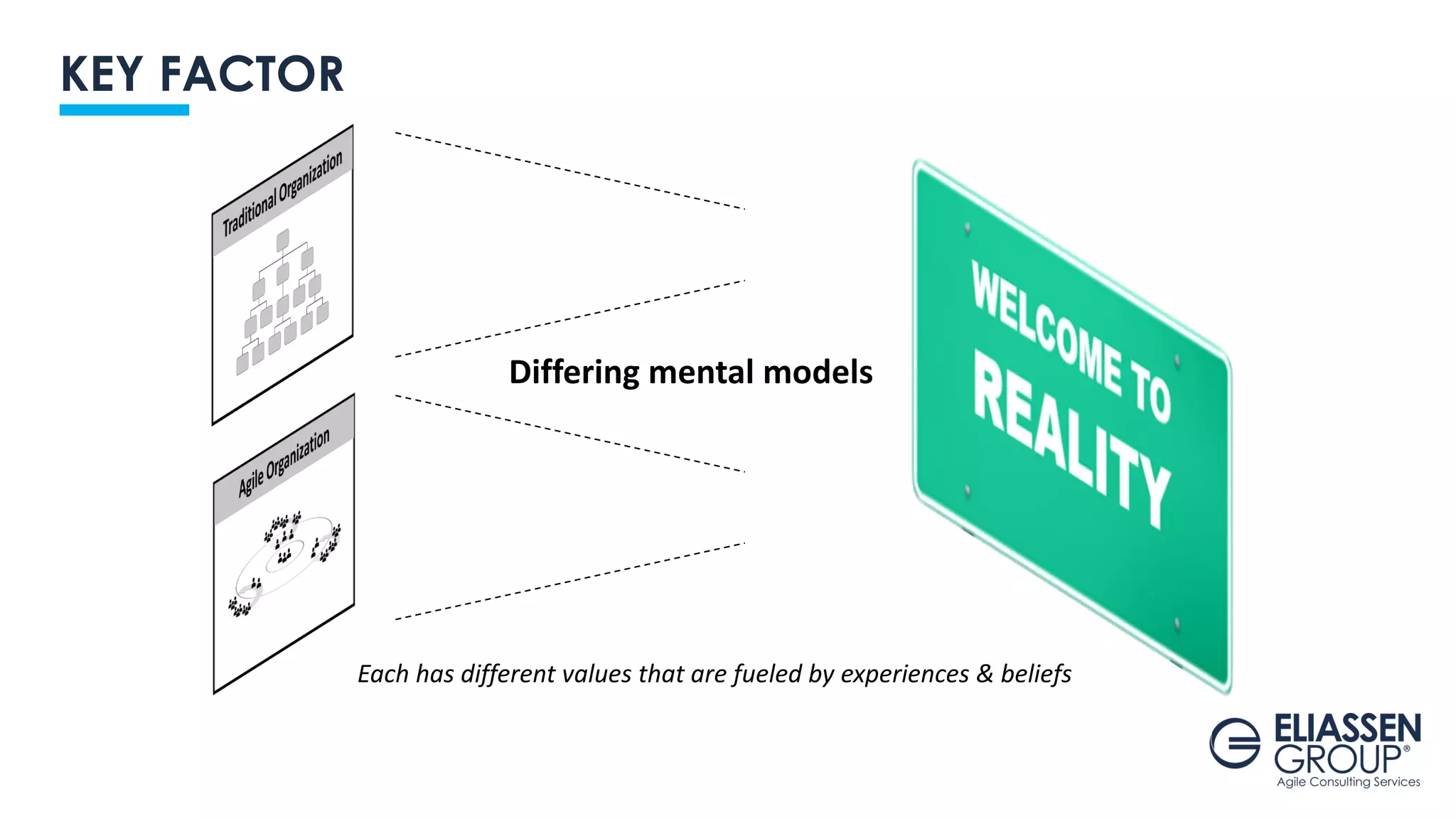
KEY FACTOR
Each has different values that are fueled by experiences & beliefs
Differing mental models
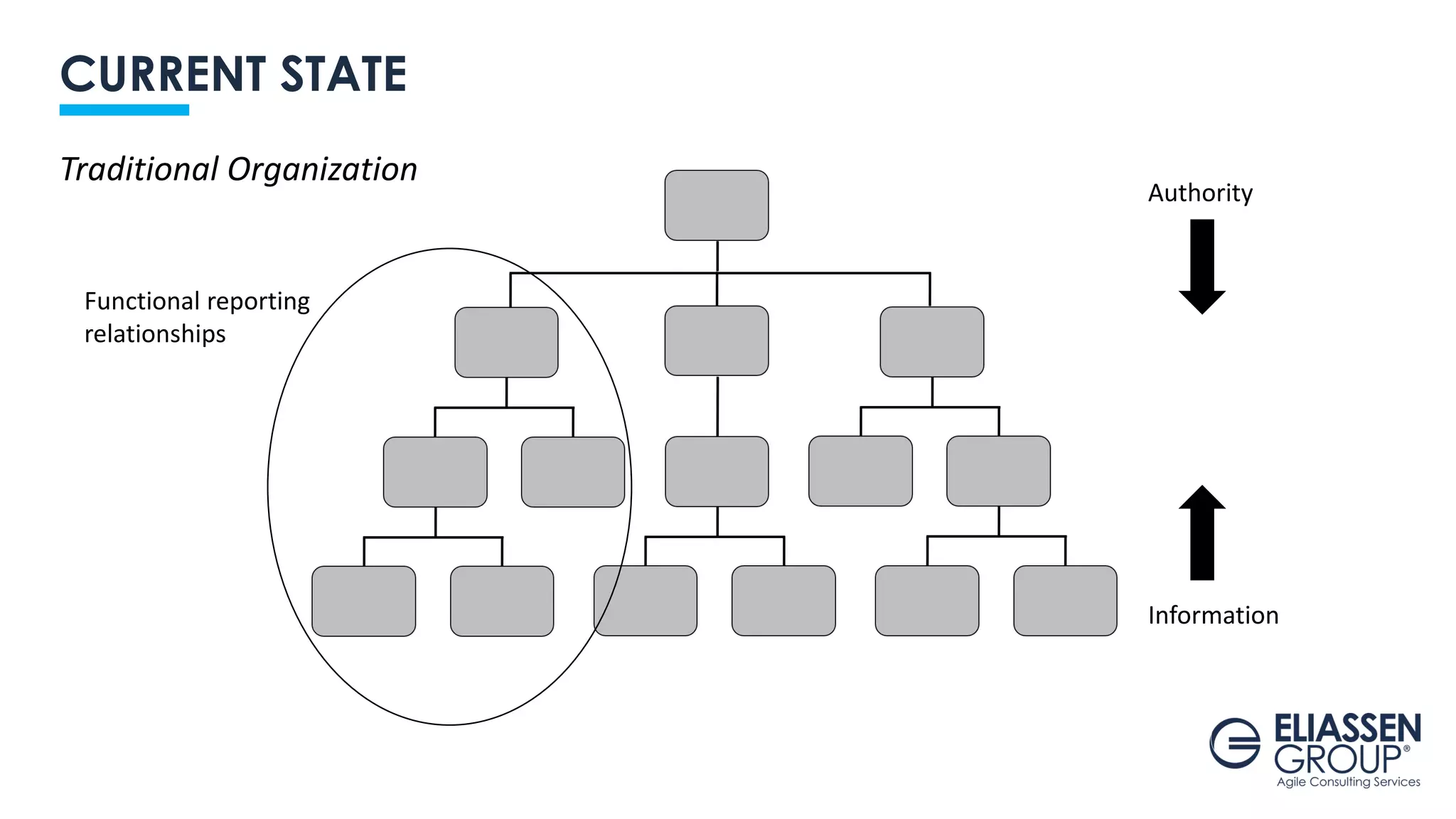
CURRENT STATE
Functional reporting
relationships
Authority
Information
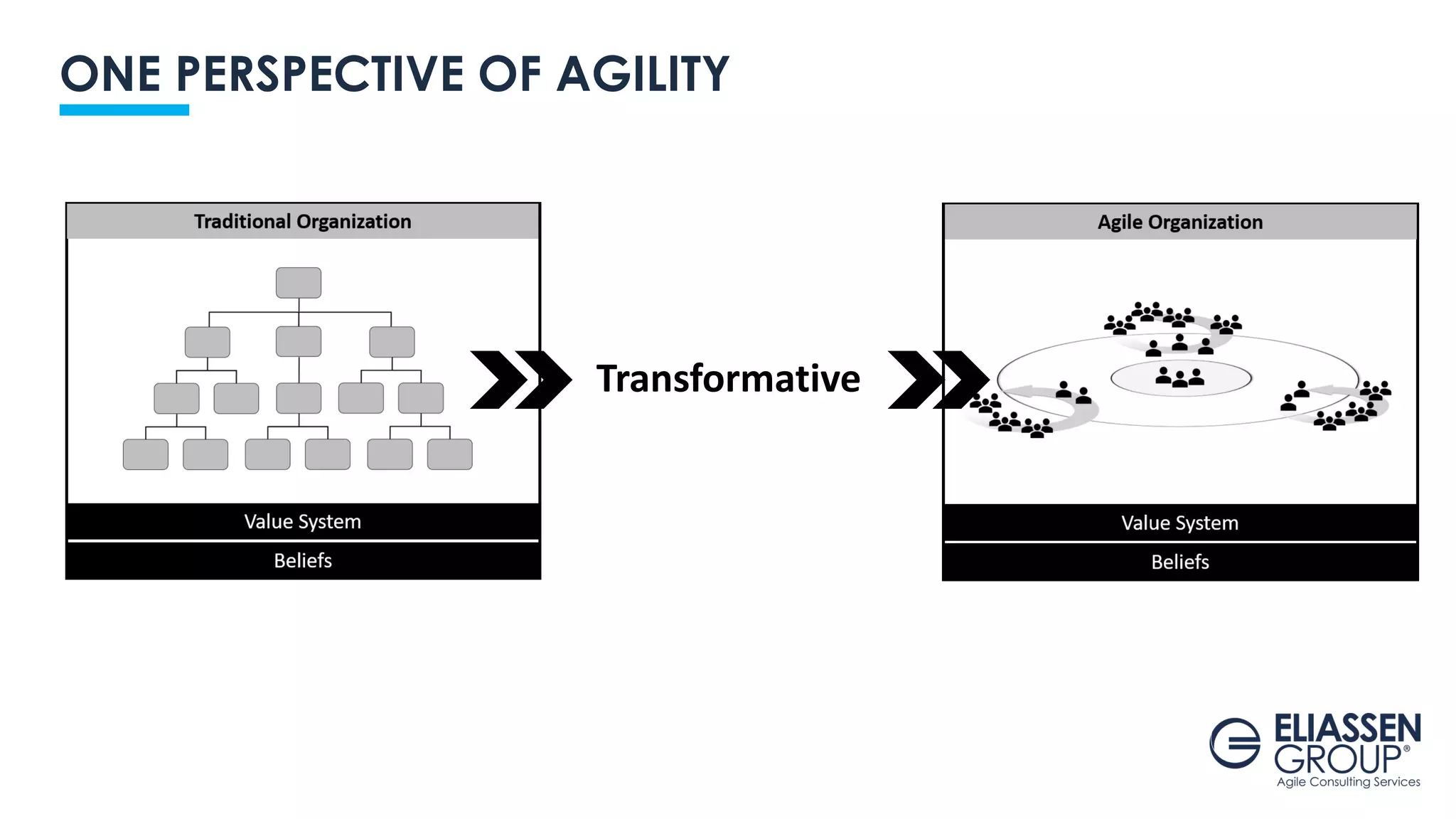
Traditional Organization
ONE PERSPECTIVE OF AGILITY
Transformative
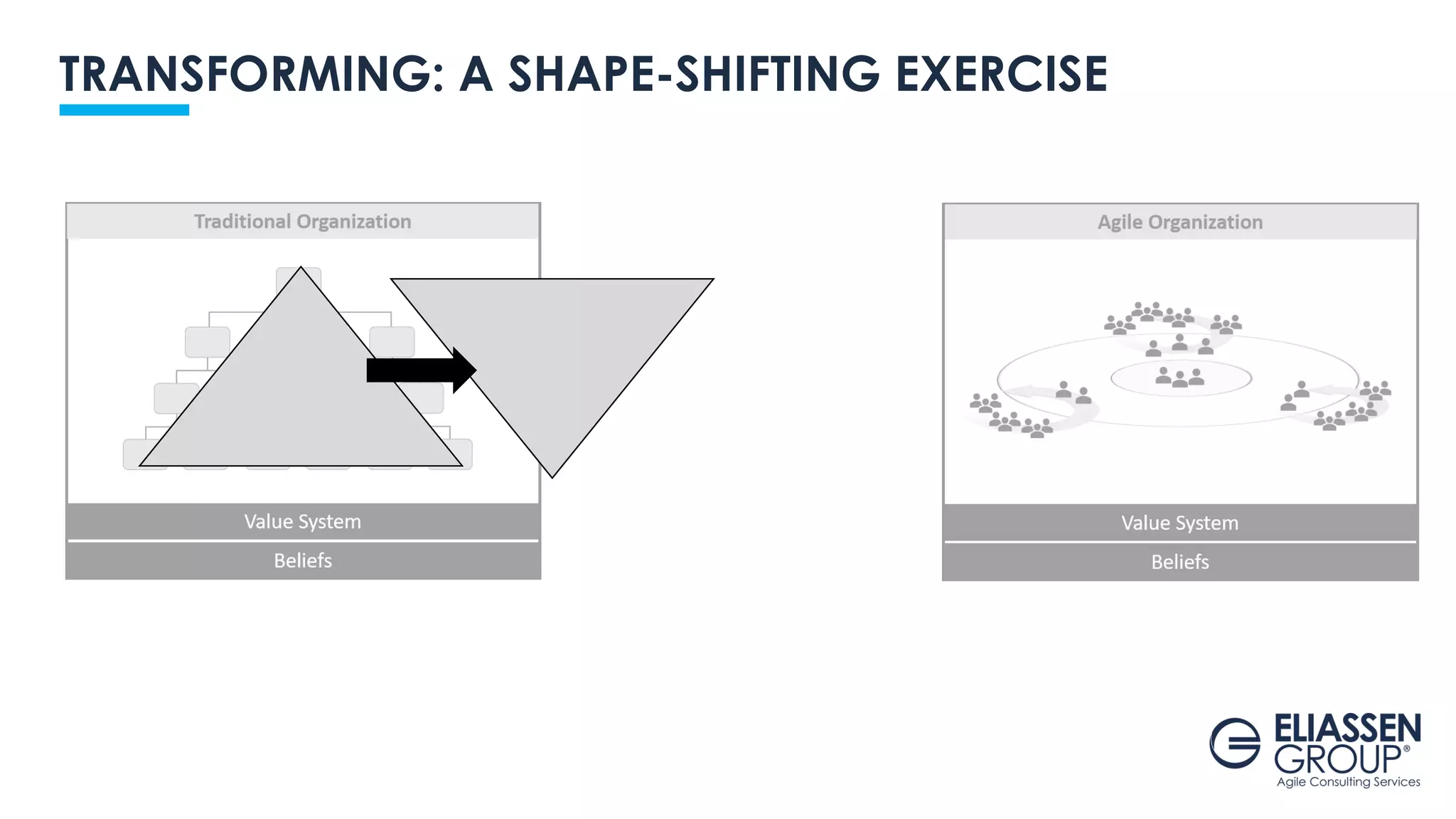
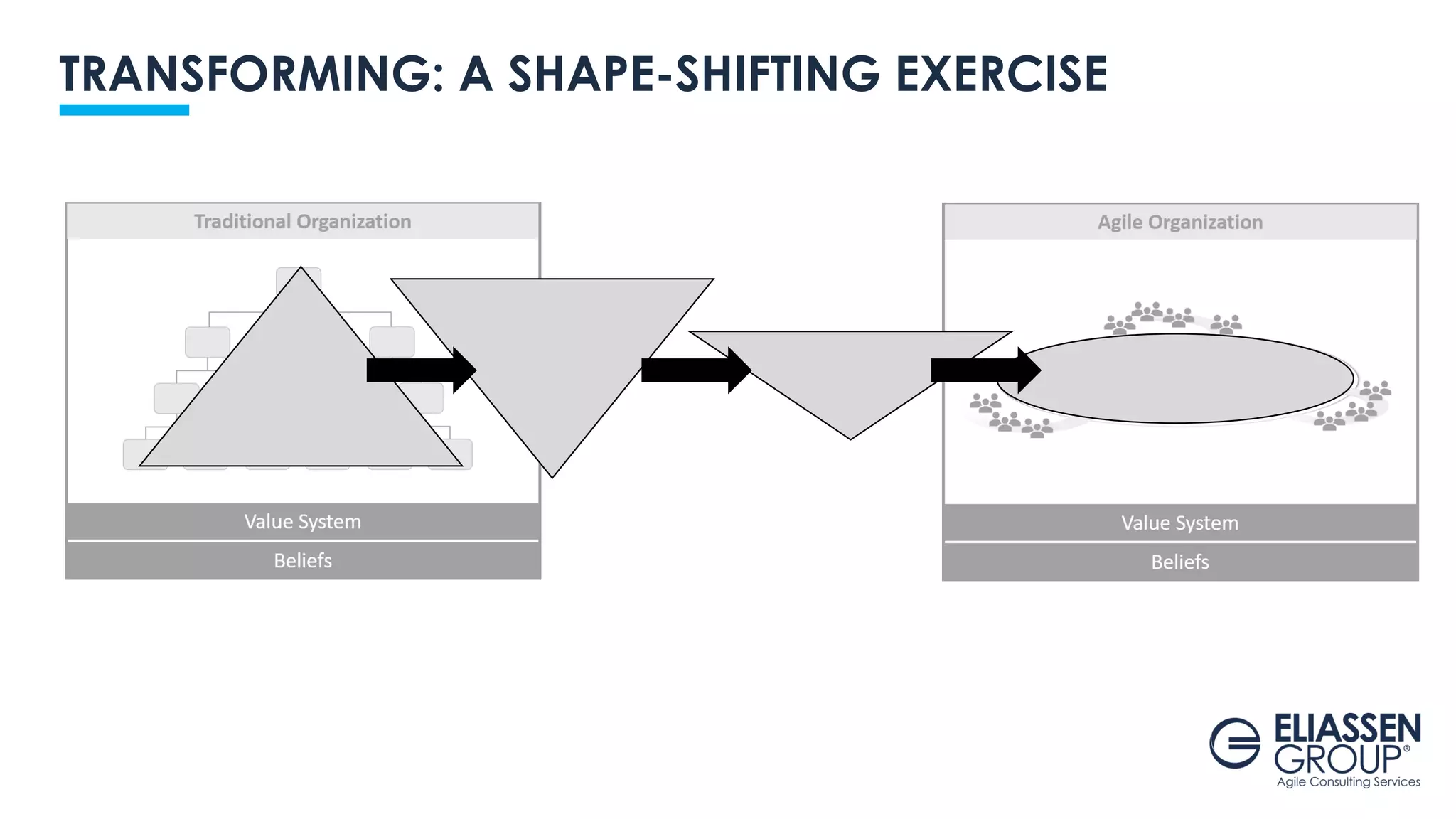
TRANSFORMING: A SHAPE-SHIFTING EXERCISE
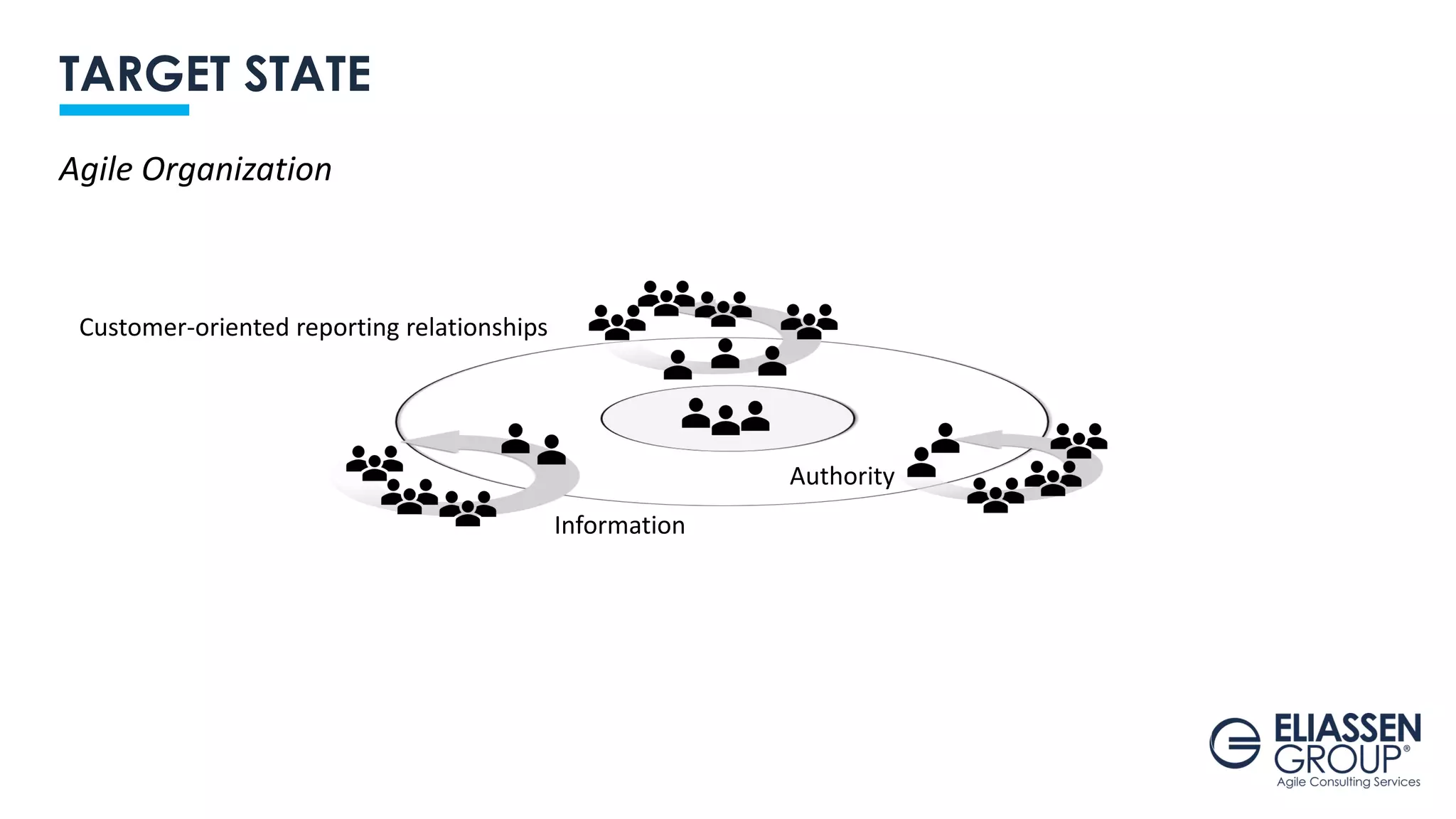
TARGET STATE
Customer-oriented reporting relationships
Authority
Information
Agile Organization
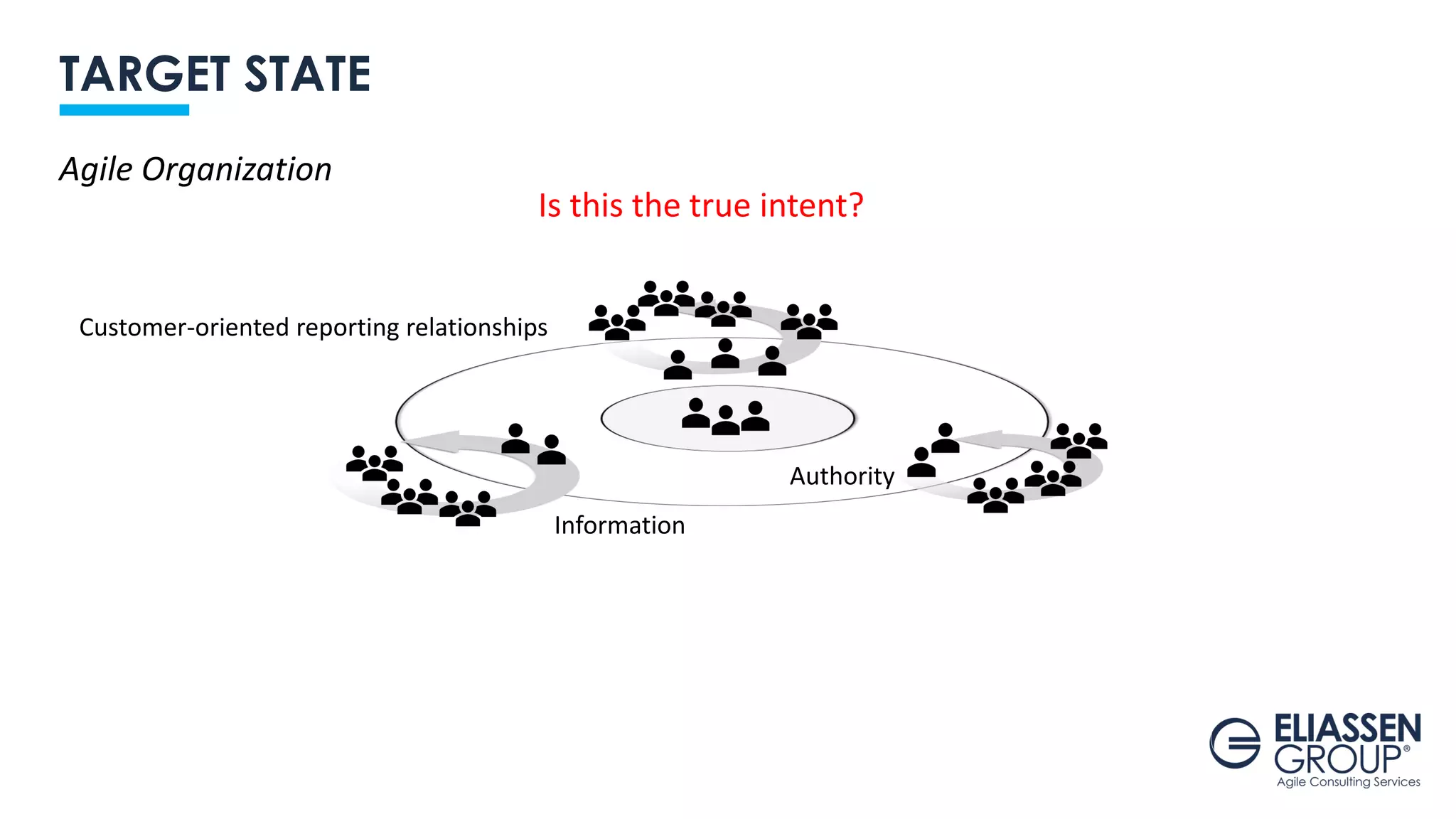
TARGET STATE
Customer-oriented reporting relationships
Authority
Information
Agile Organization
Is this the true intent?
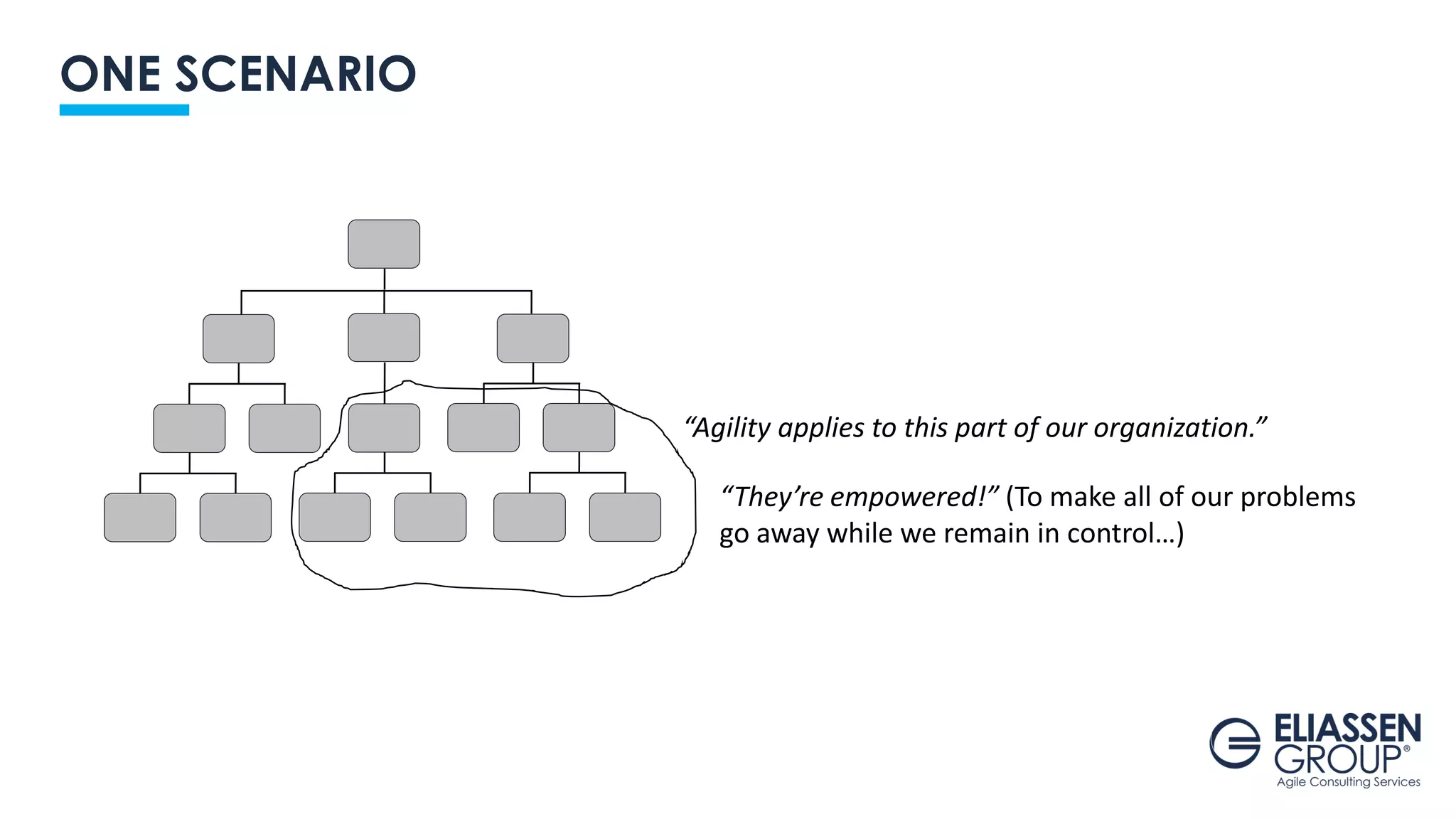
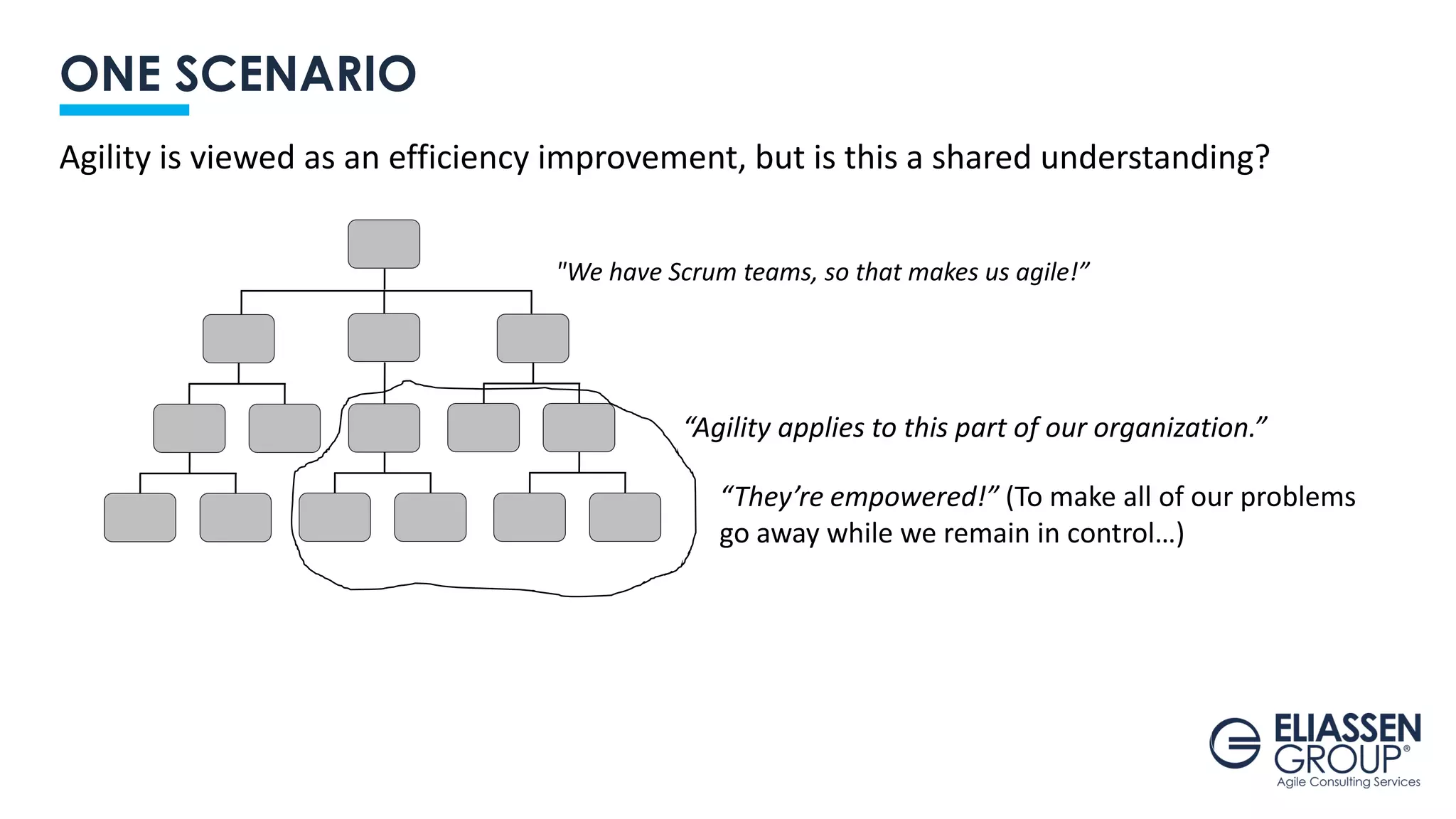
ONE SCENARIO
“Agility applies to this part of our organization.”
“They’re empowered!” (To make all of our problems
go away while we remain in control…)
ONE SCENARIO
“Agility applies to this part of our organization.”
“They’re empowered!” (To make all of our problems
go away while we remain in control…)
Agility is viewed as an efficiency improvement, but is this a shared understanding?
"We have Scrum teams, so that makes us agile!”
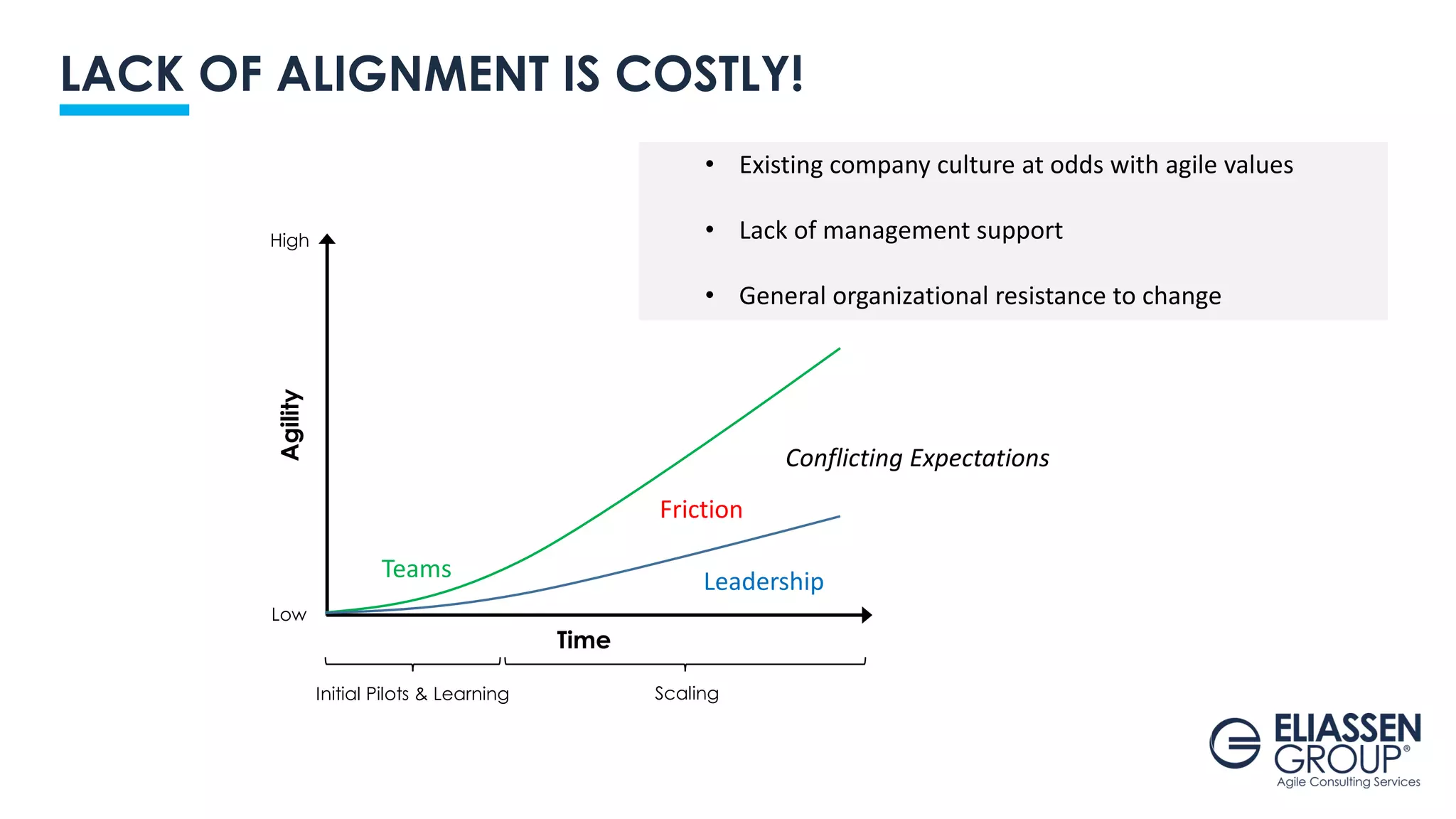
Initial Pilots & Learning Scaling
Teams Leadership
Time
LACK OF ALIGNMENT IS COSTLY!
Low
High
Agility
Friction
Conflicting Expectations
• Existing company culture at odds with agile values
• Lack of management support
• General organizational resistance to change
MANAGING EXPECTATIONS
What is an expectation?
MANAGING EXPECTATIONS
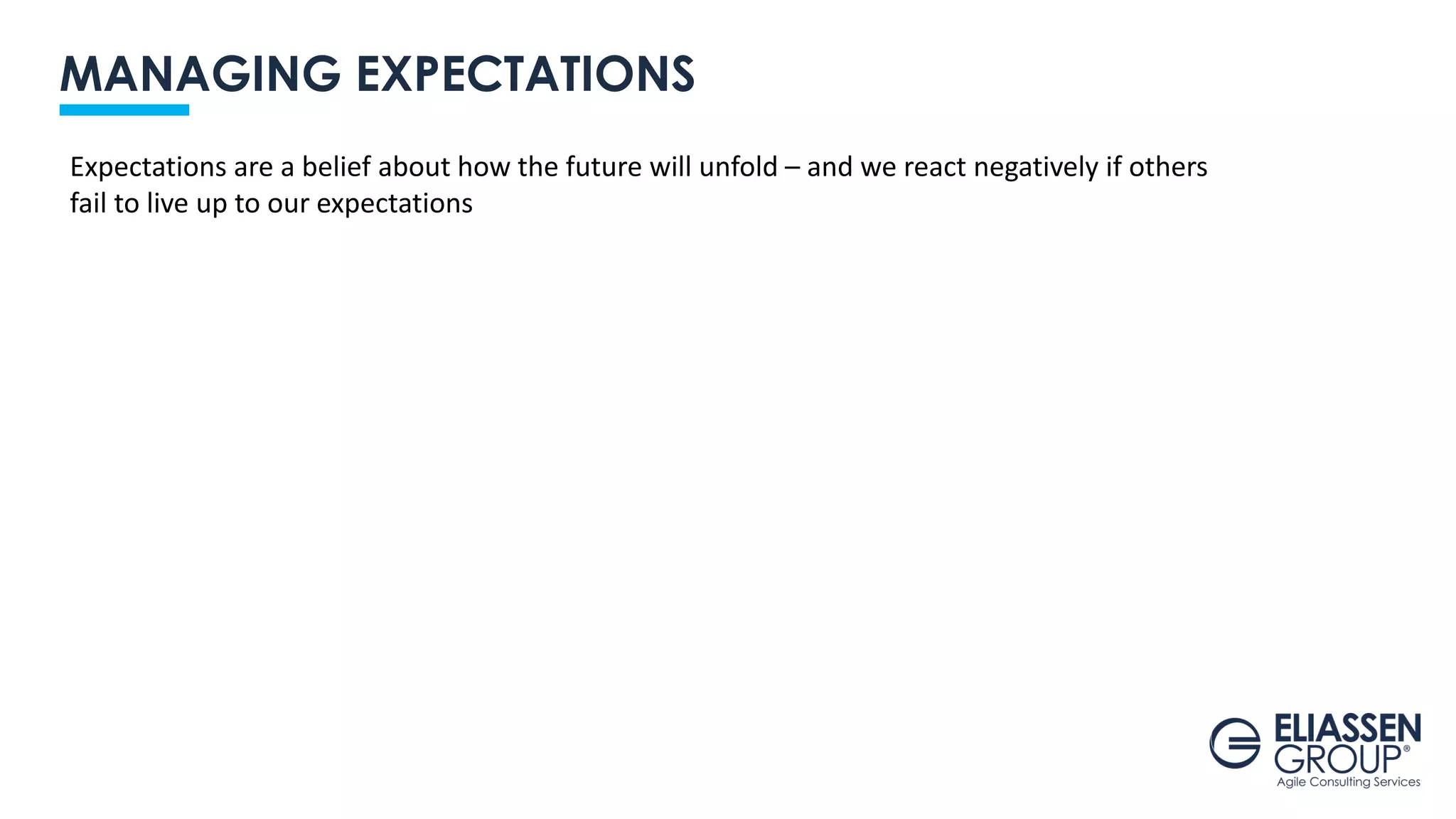
Expectations are a belief about how the future will unfold – and we react negatively if others
fail to live up to our expectations
MANAGING EXPECTATIONS
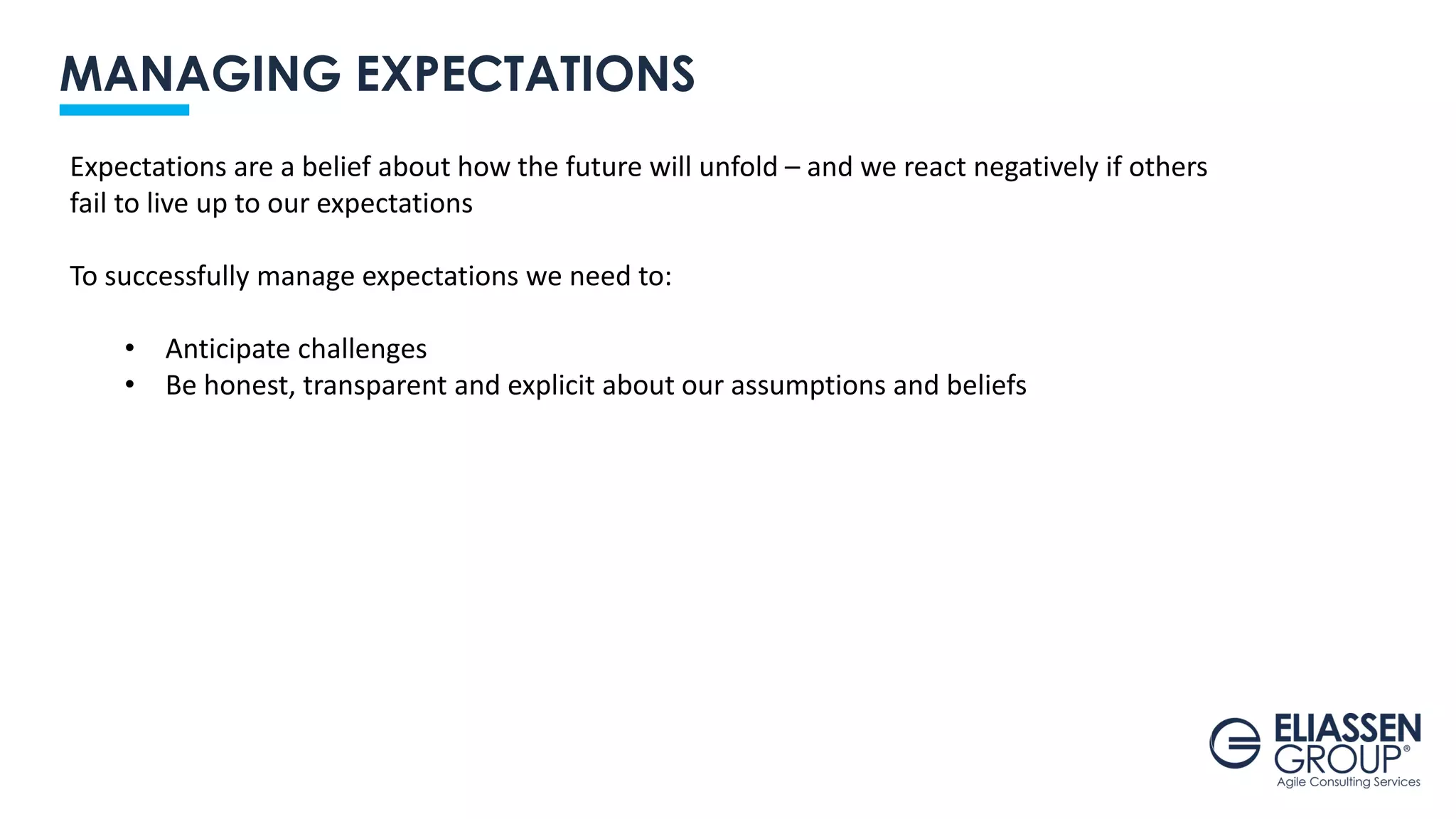
Expectations are a belief about how the future will unfold – and we react negatively if others
fail to live up to our expectations
To successfully manage expectations we need to:
• Anticipate challenges
• Be honest, transparent and explicit about our assumptions and beliefs
MANAGING EXPECTATIONS
Expectations are a belief about what the future will hold – and we react negatively if others
fail to live up to our expectations
To successfully manage expectations we need to:
• Anticipate challenges
• Be honest, transparent and explicit about our assumptions and beliefs
“If you don’t manage expectations, expect to fail.” – Mike Cohn
https://mtngo.at/1705
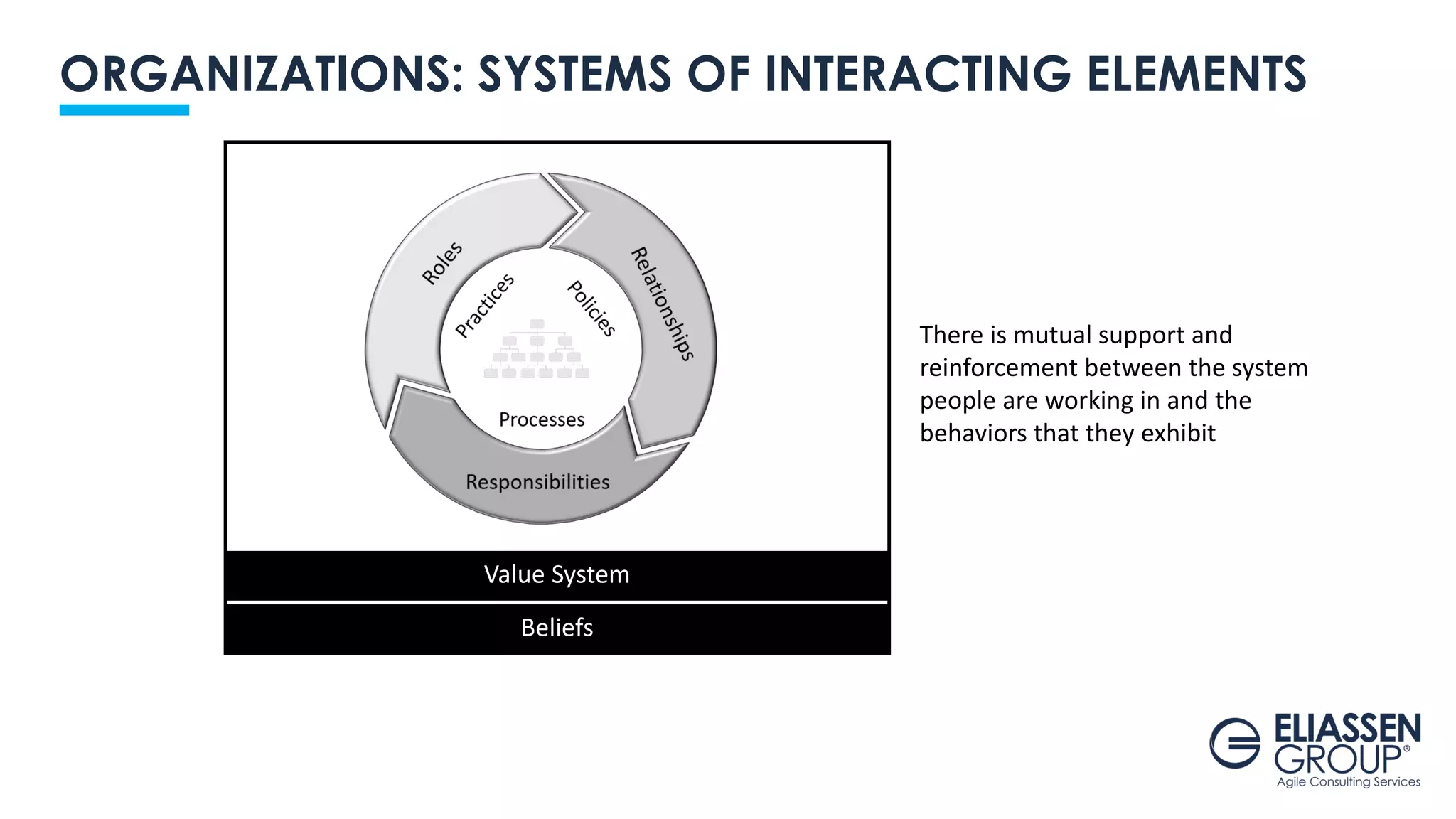
ORGANIZATIONS: SYSTEMS OF INTERACTING ELEMENTS
Value System
Beliefs
There is mutual support and
reinforcement between the system
people are working in and the
behaviors that they exhibit
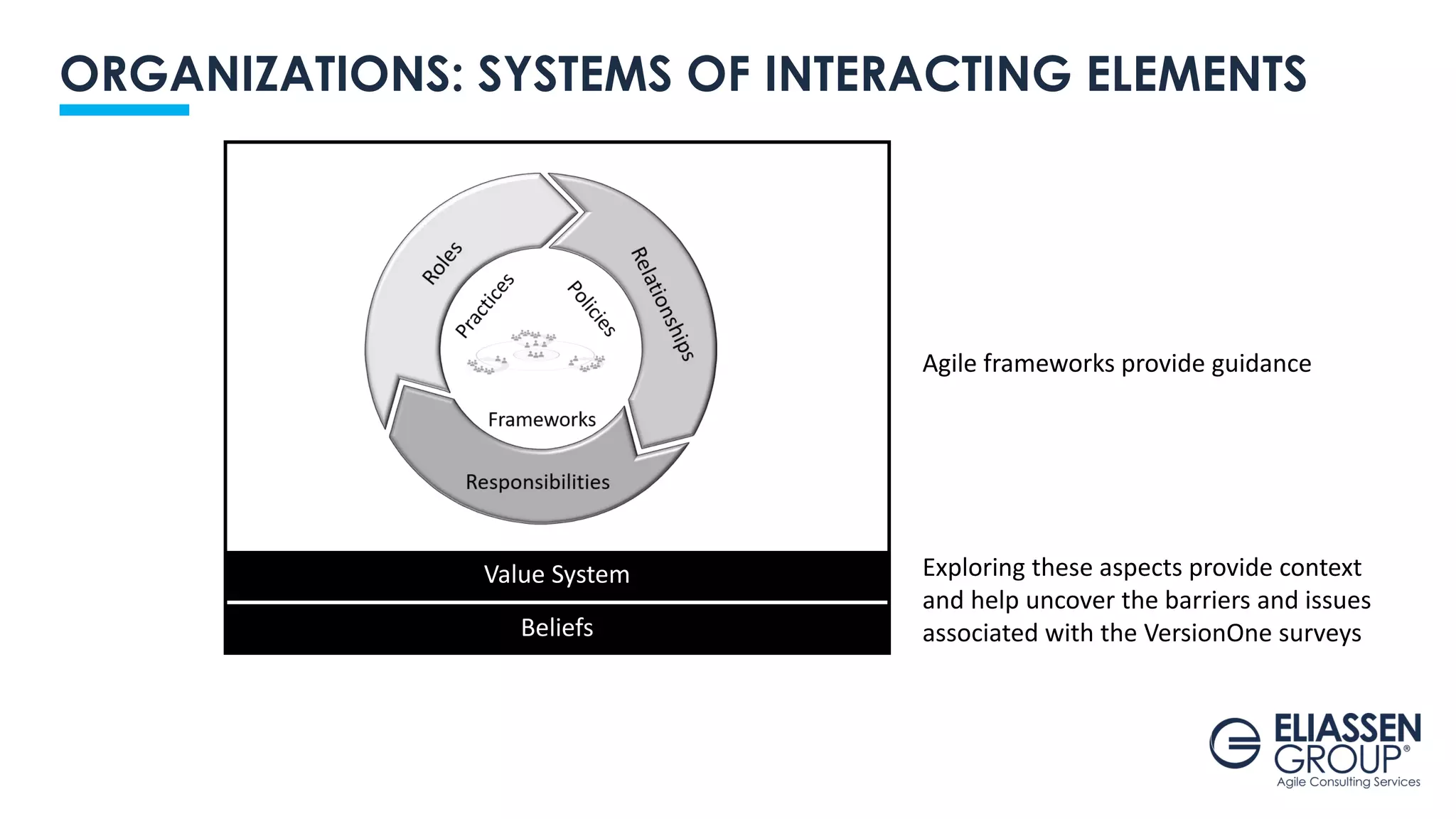
ORGANIZATIONS: SYSTEMS OF INTERACTING ELEMENTS
Value System
Beliefs
Agile frameworks provide guidance
Exploring these aspects provide context
and help uncover the barriers and issues
associated with the VersionOne surveys
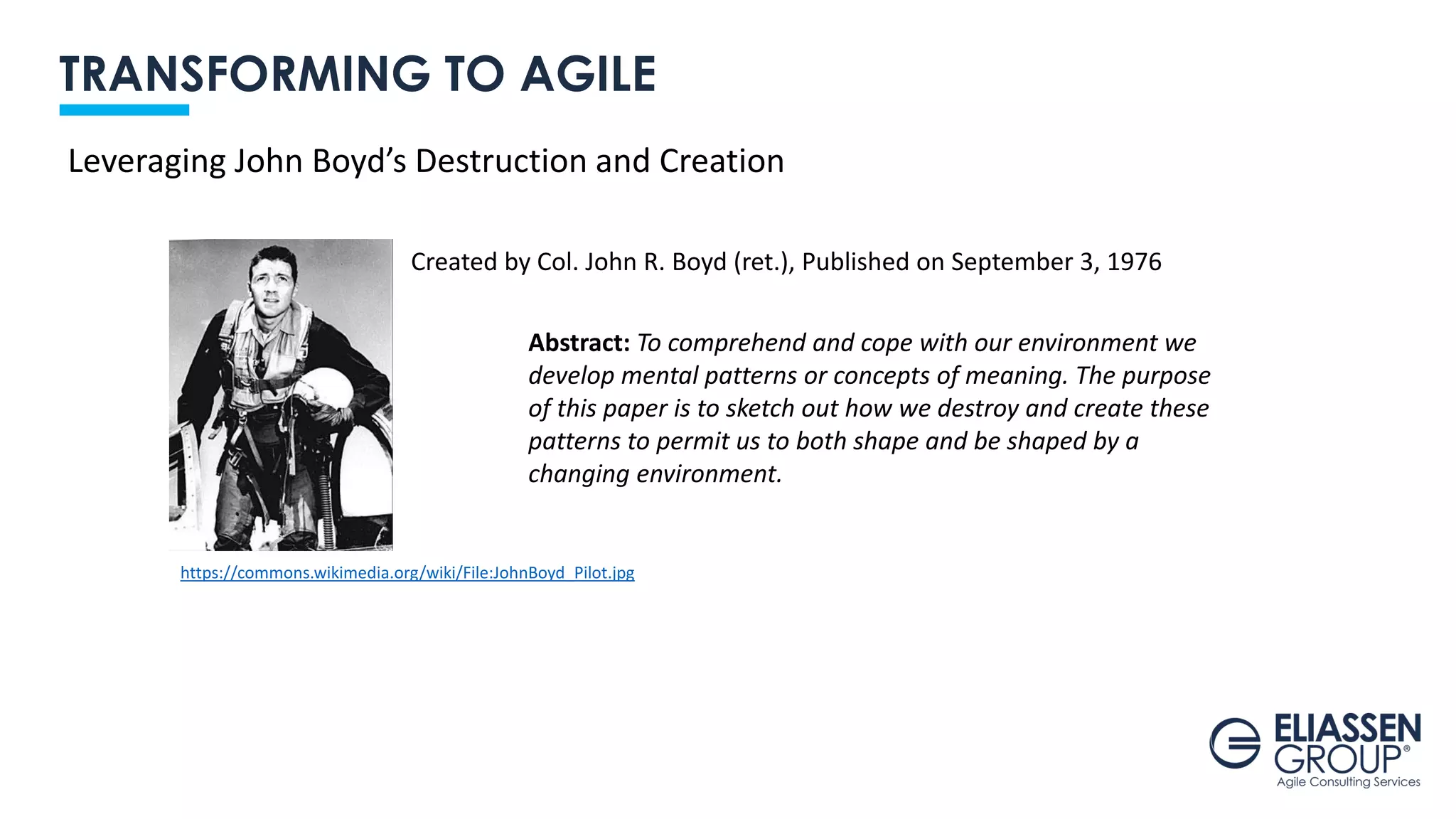
TRANSFORMING TO AGILE
Created by Col. John R. Boyd (ret.), Published on September 3, 1976
Leveraging John Boyd’s Destruction and Creation
https://commons.wikimedia.org/wiki/File:JohnBoyd_Pilot.jpg
Abstract: To comprehend and cope with our environment we
develop mental patterns or concepts of meaning. The purpose
of this paper is to sketch out how we destroy and create these
patterns to permit us to both shape and be shaped by a
changing environment.
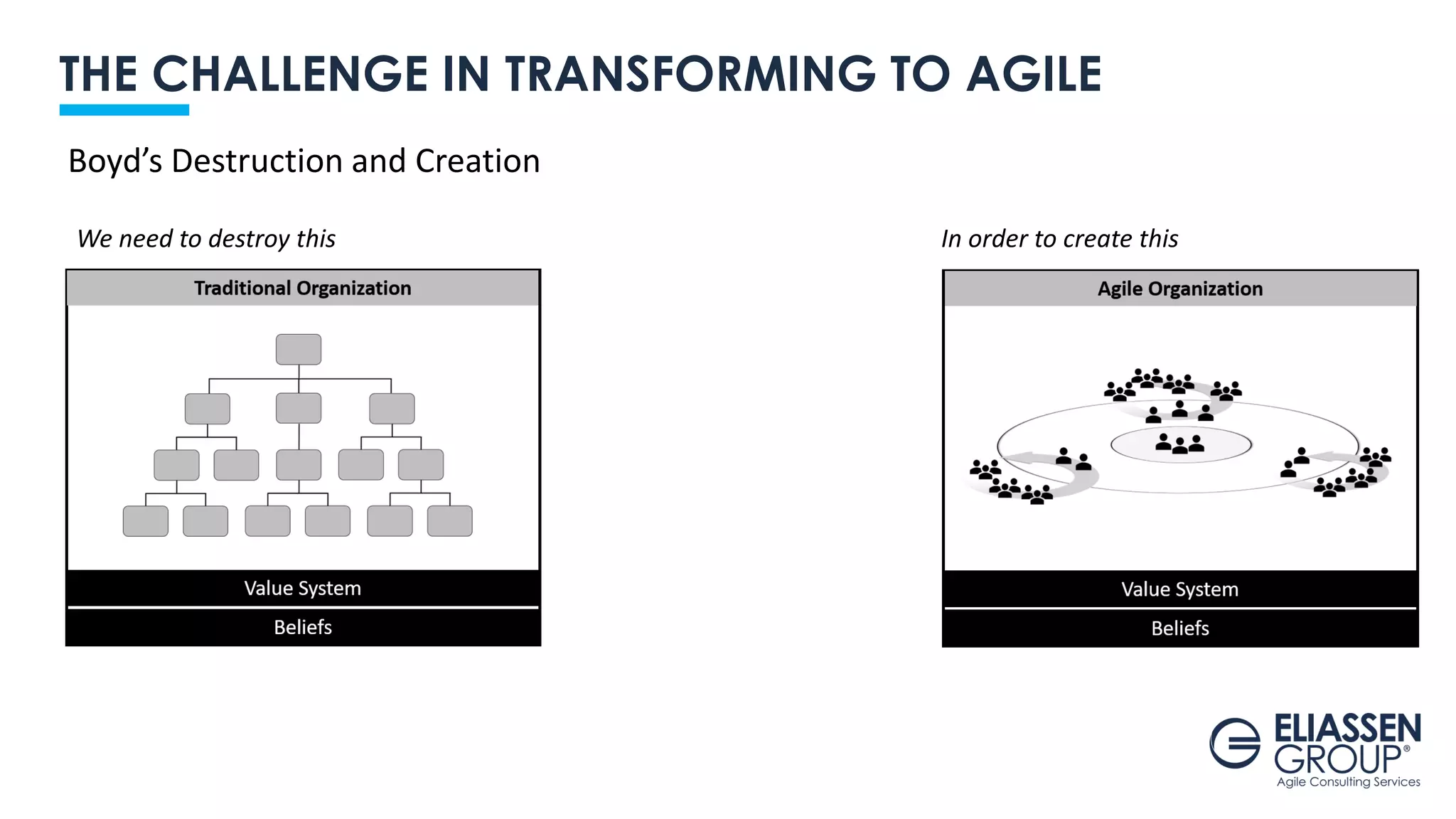
THE CHALLENGE IN TRANSFORMING TO AGILE
We need to destroy this In order to create this
Boyd’s Destruction and Creation
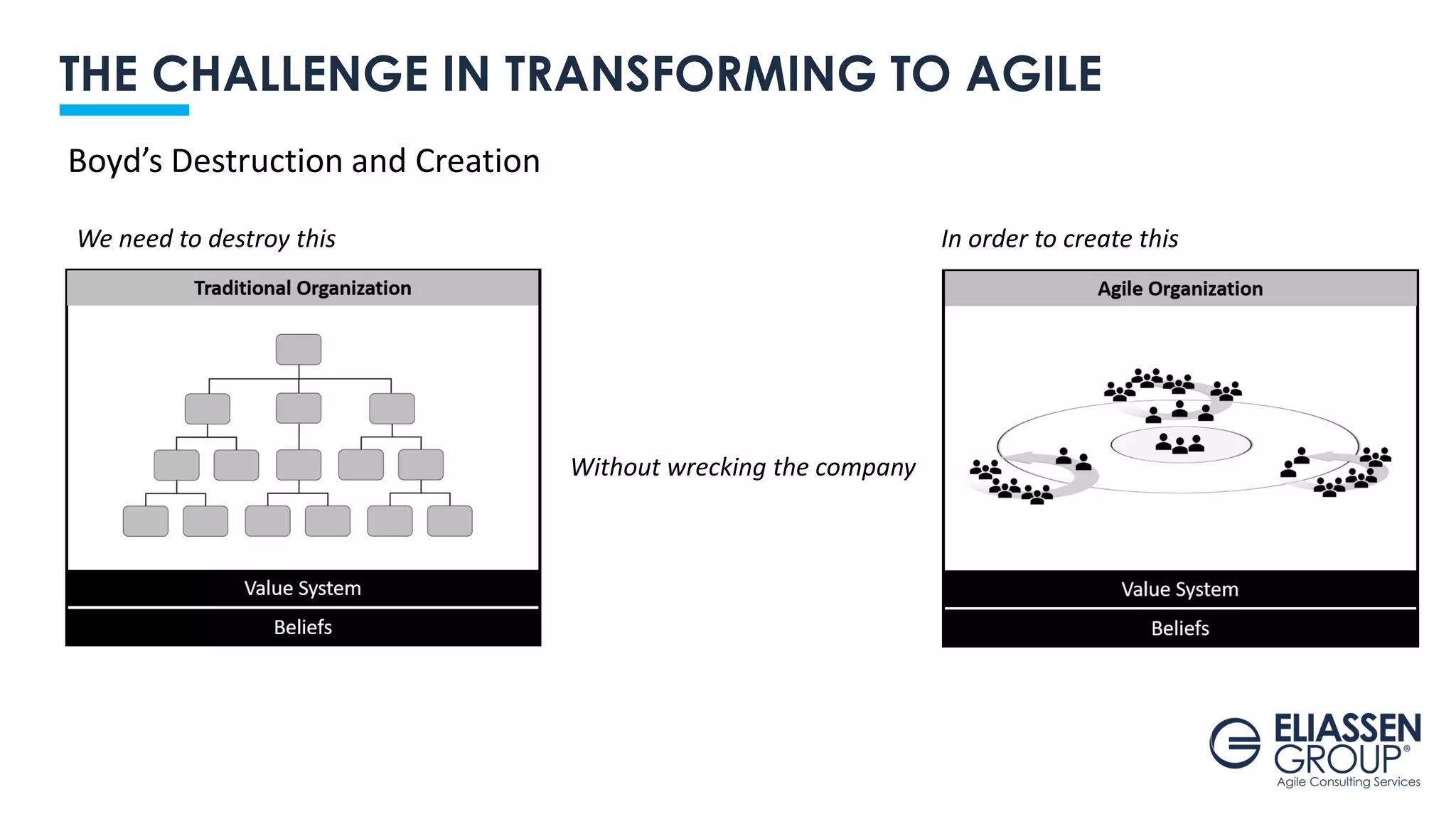
THE CHALLENGE IN TRANSFORMING TO AGILE
We need to destroy this In order to create this
Without wrecking the company
Boyd’s Destruction and Creation
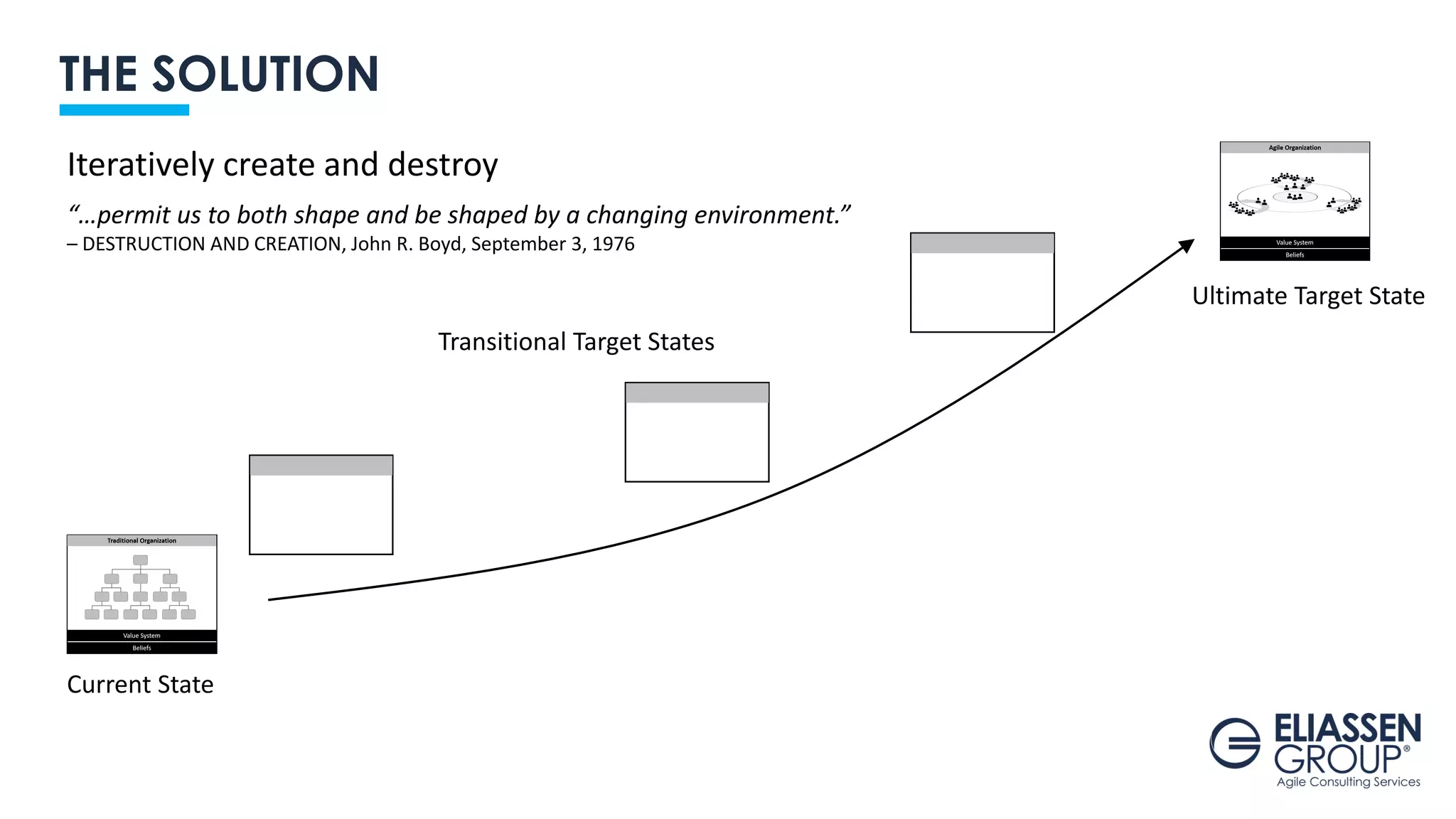
THE SOLUTION
Iteratively create and destroy
“…permit us to both shape and be shaped by a changing environment.”
– DESTRUCTION AND CREATION, John R. Boyd, September 3, 1976
Ultimate Target State
Current State
Transitional Target States
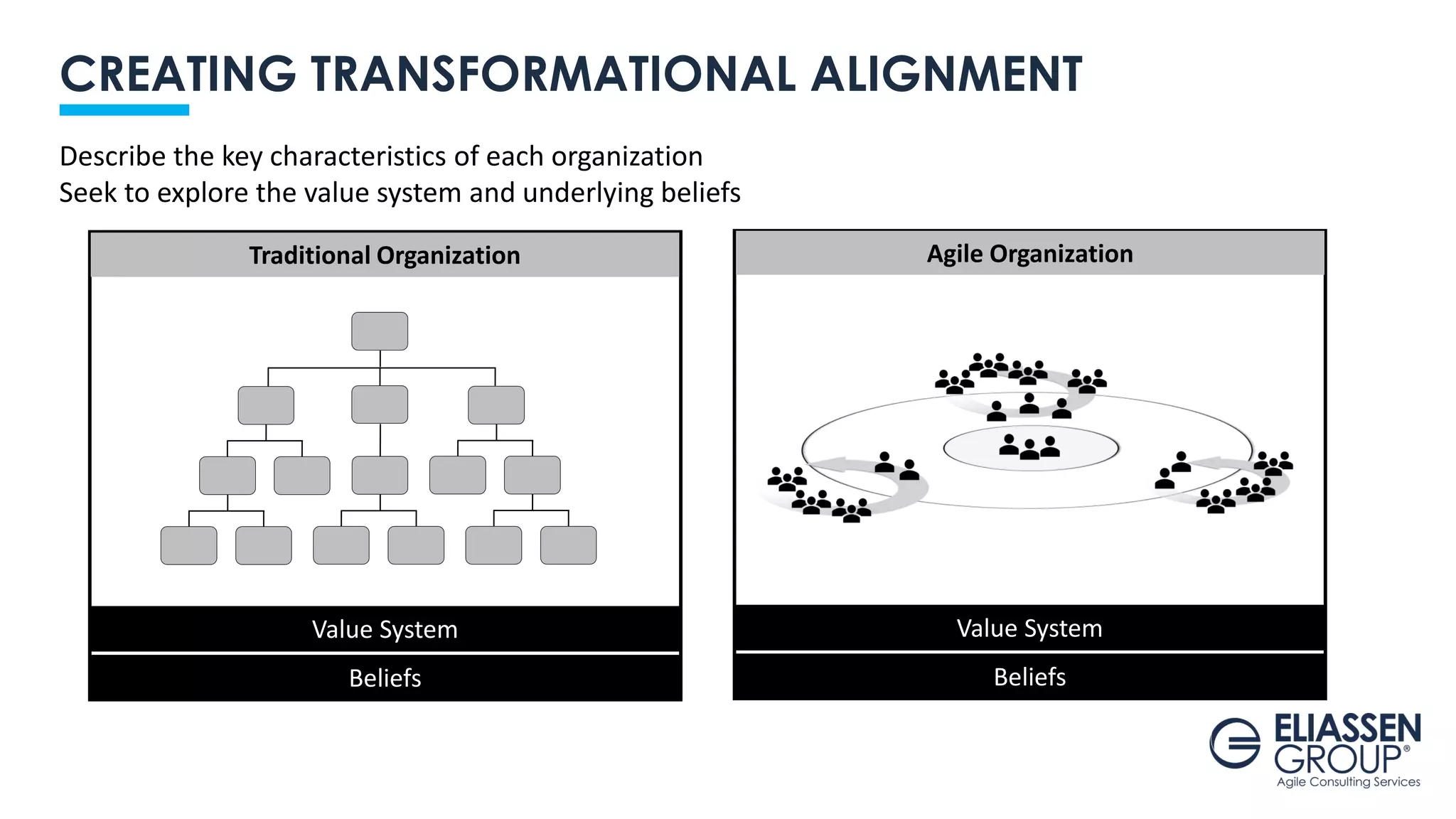
CREATING TRANSFORMATIONAL ALIGNMENT
Value System
Beliefs
Traditional Organization
Value System
Beliefs
Agile Organization
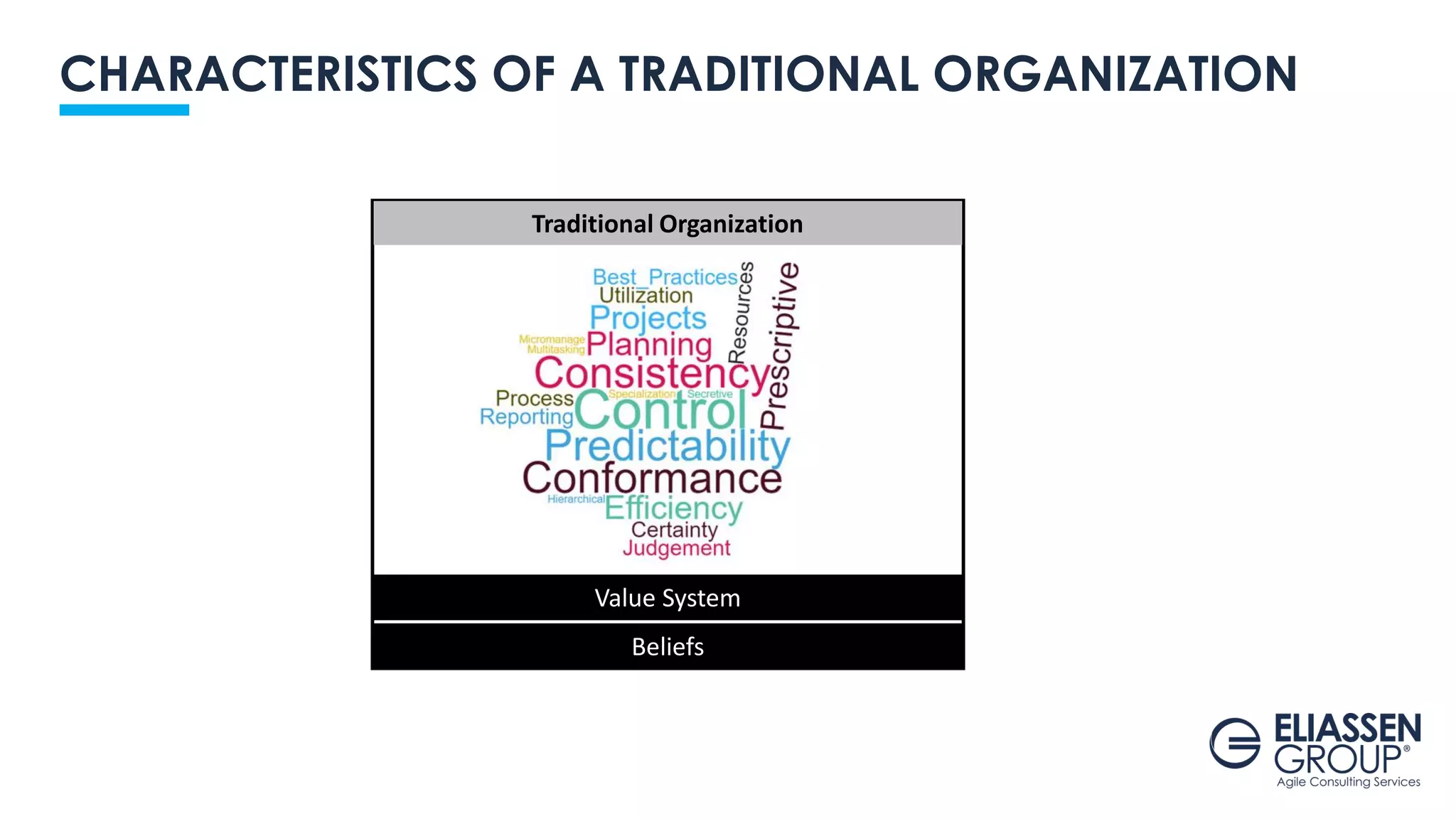
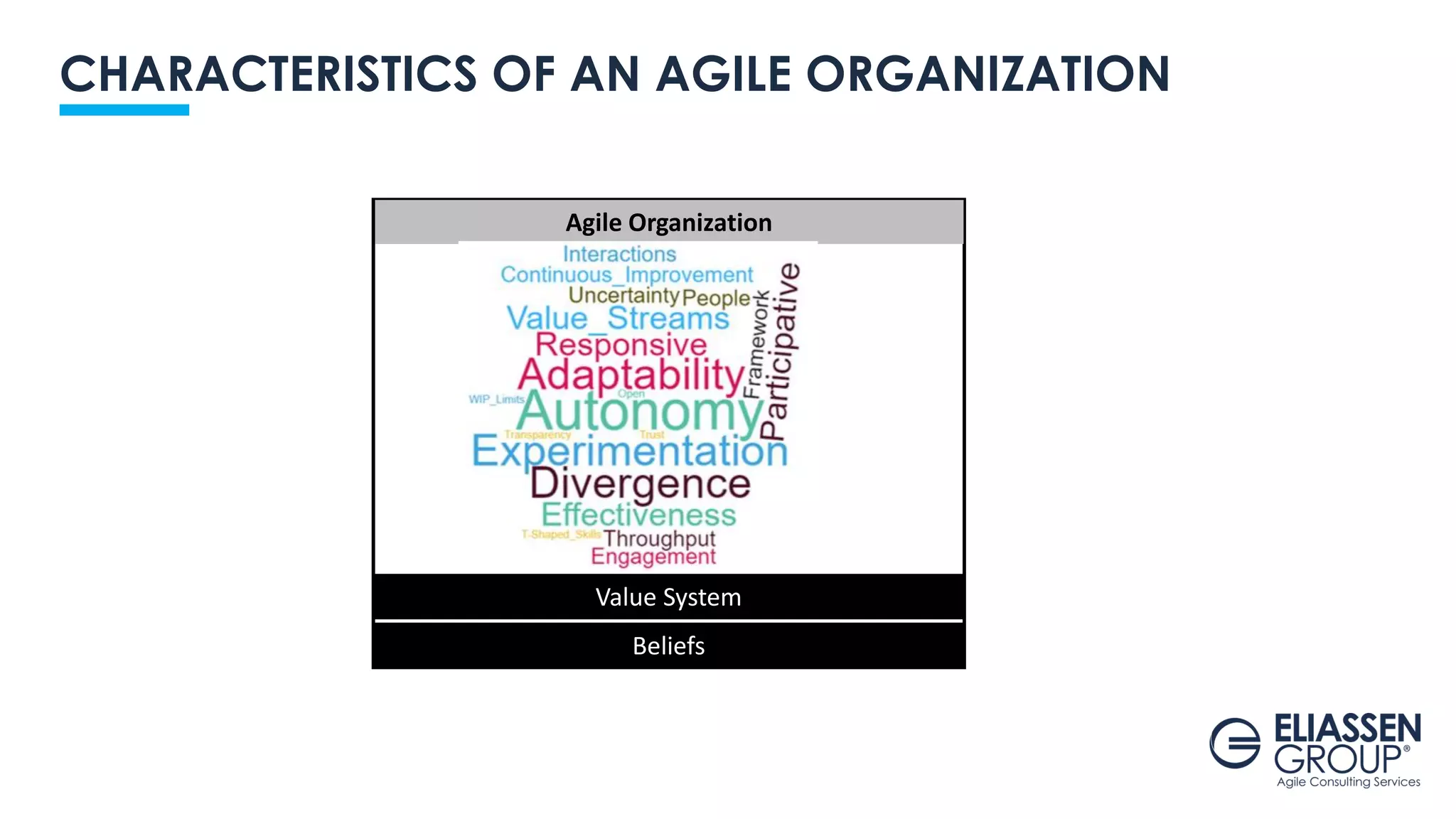
Describe the key characteristics of each organization
Seek to explore the value system and underlying beliefs
Value System
Beliefs
Traditional Organization
CHARACTERISTICS OF A TRADITIONAL ORGANIZATION
CHARACTERISTICS OF AN AGILE ORGANIZATION
Value System
Beliefs
Agile Organization
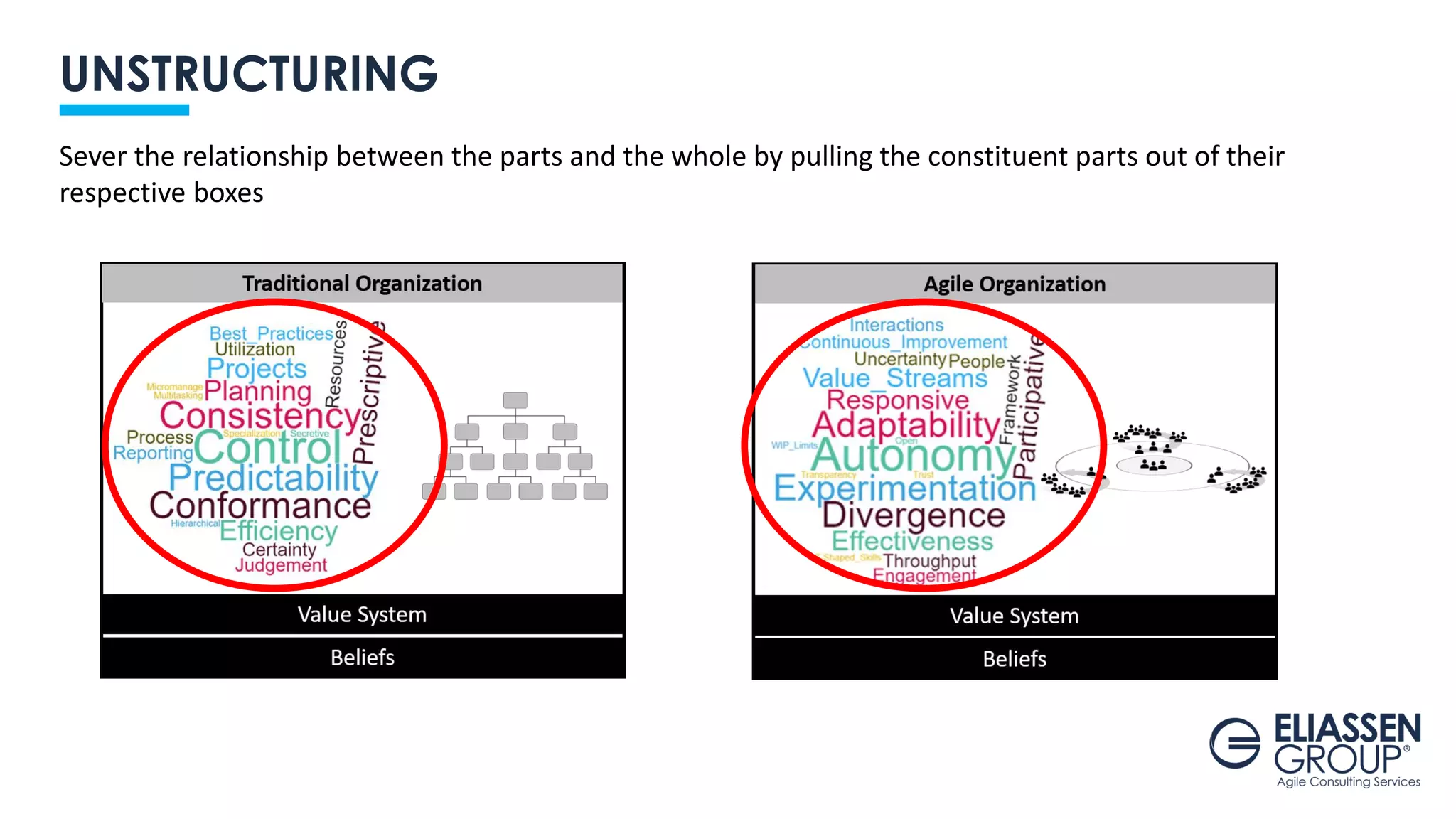
UNSTRUCTURING
Sever the relationship between the parts and the whole by pulling the constituent parts out of their
respective boxes
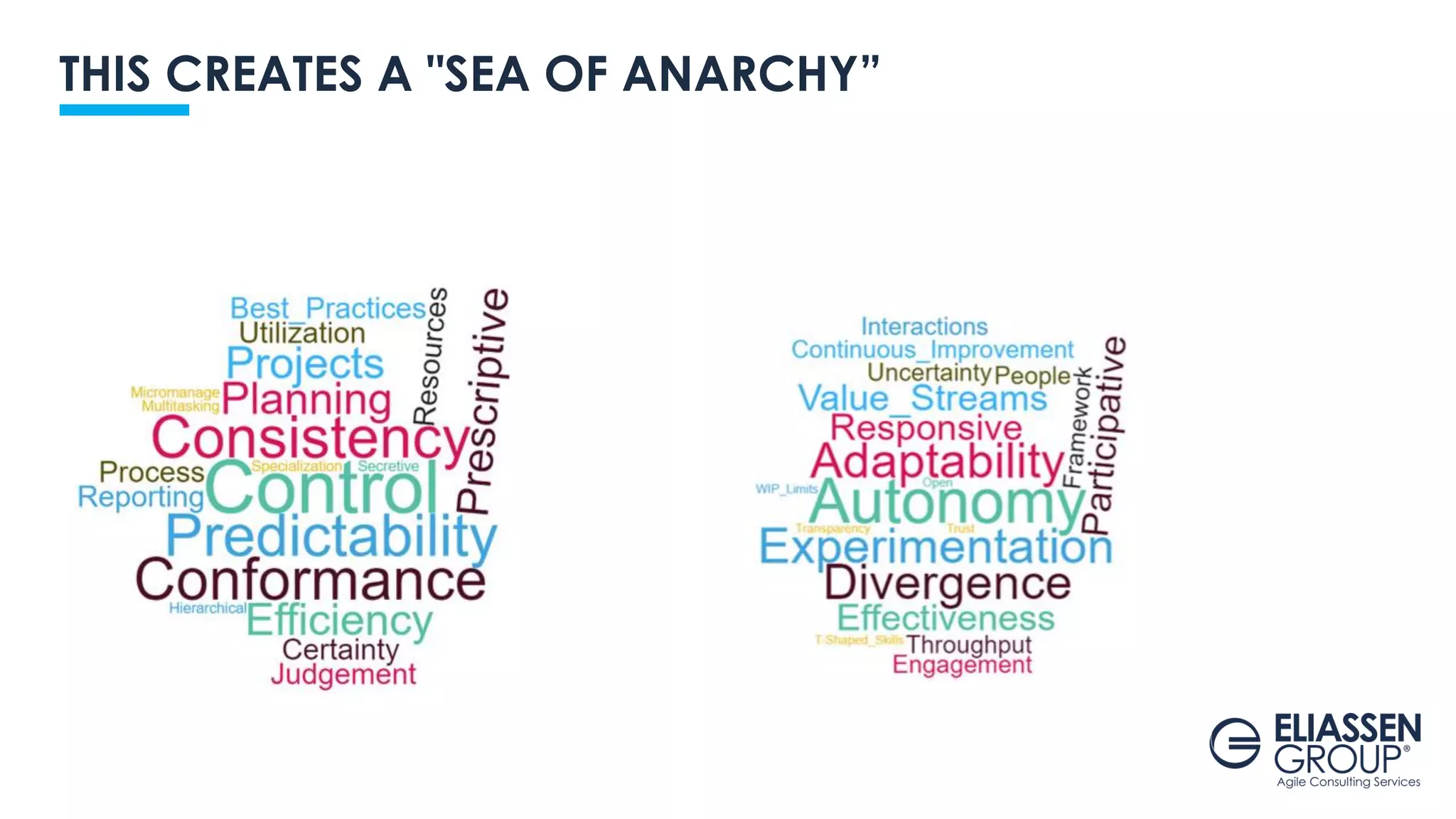
THIS CREATES A "SEA OF ANARCHY”
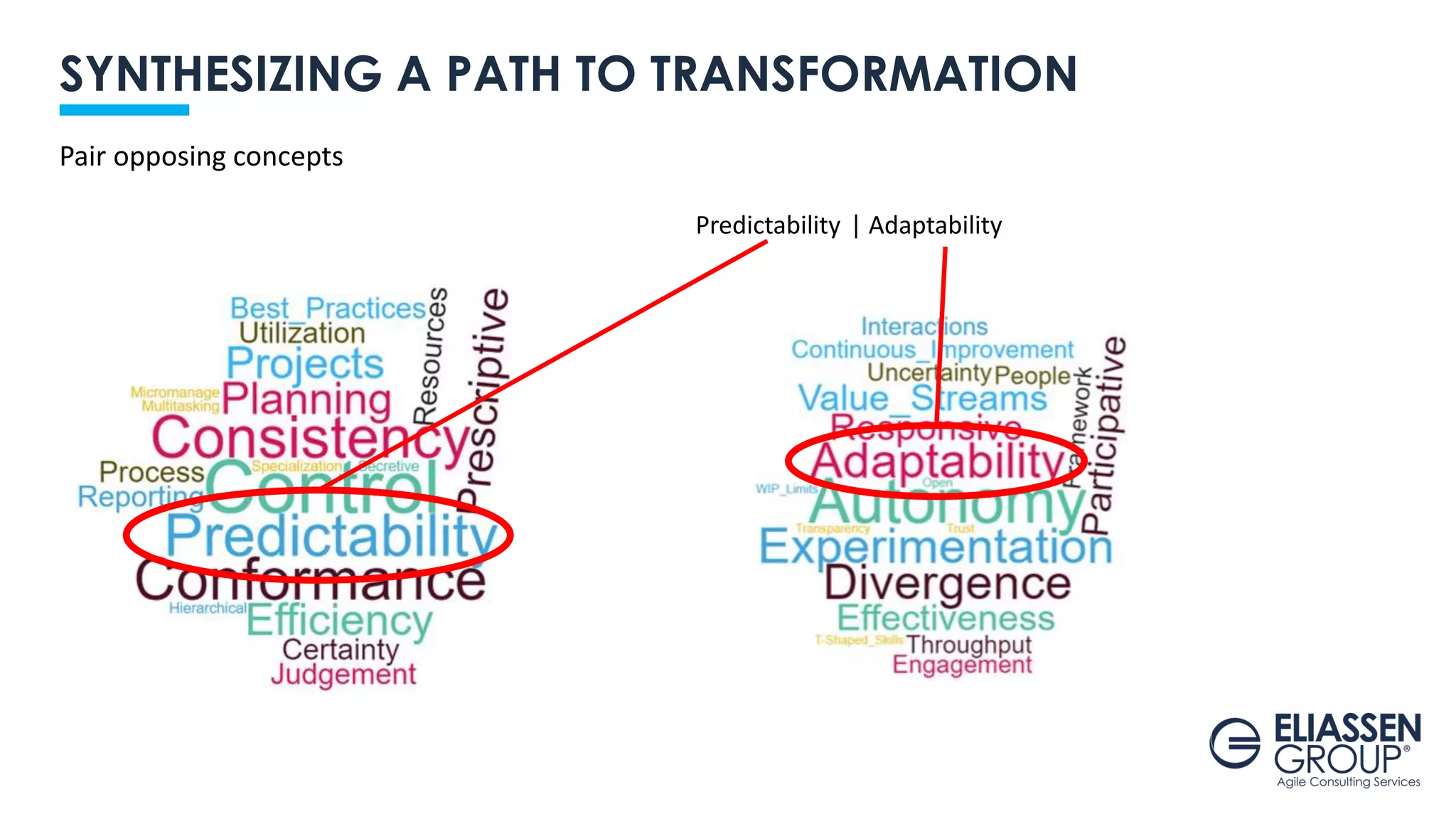
SYNTHESIZING A PATH TO TRANSFORMATION
Pair opposing concepts
Predictability | Adaptability
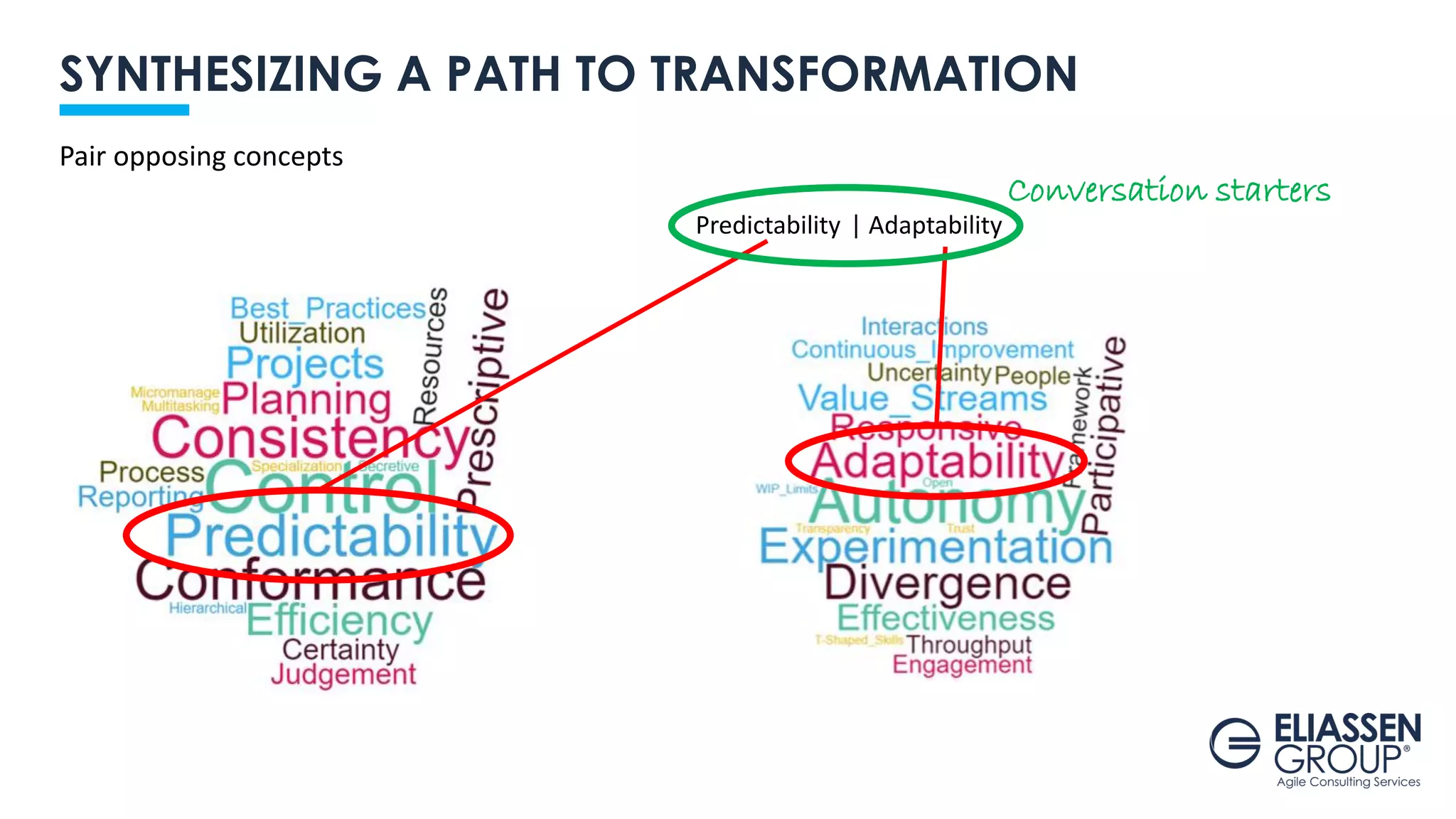
SYNTHESIZING A PATH TO TRANSFORMATION
Pair opposing concepts
Predictability | Adaptability
Conversation starters
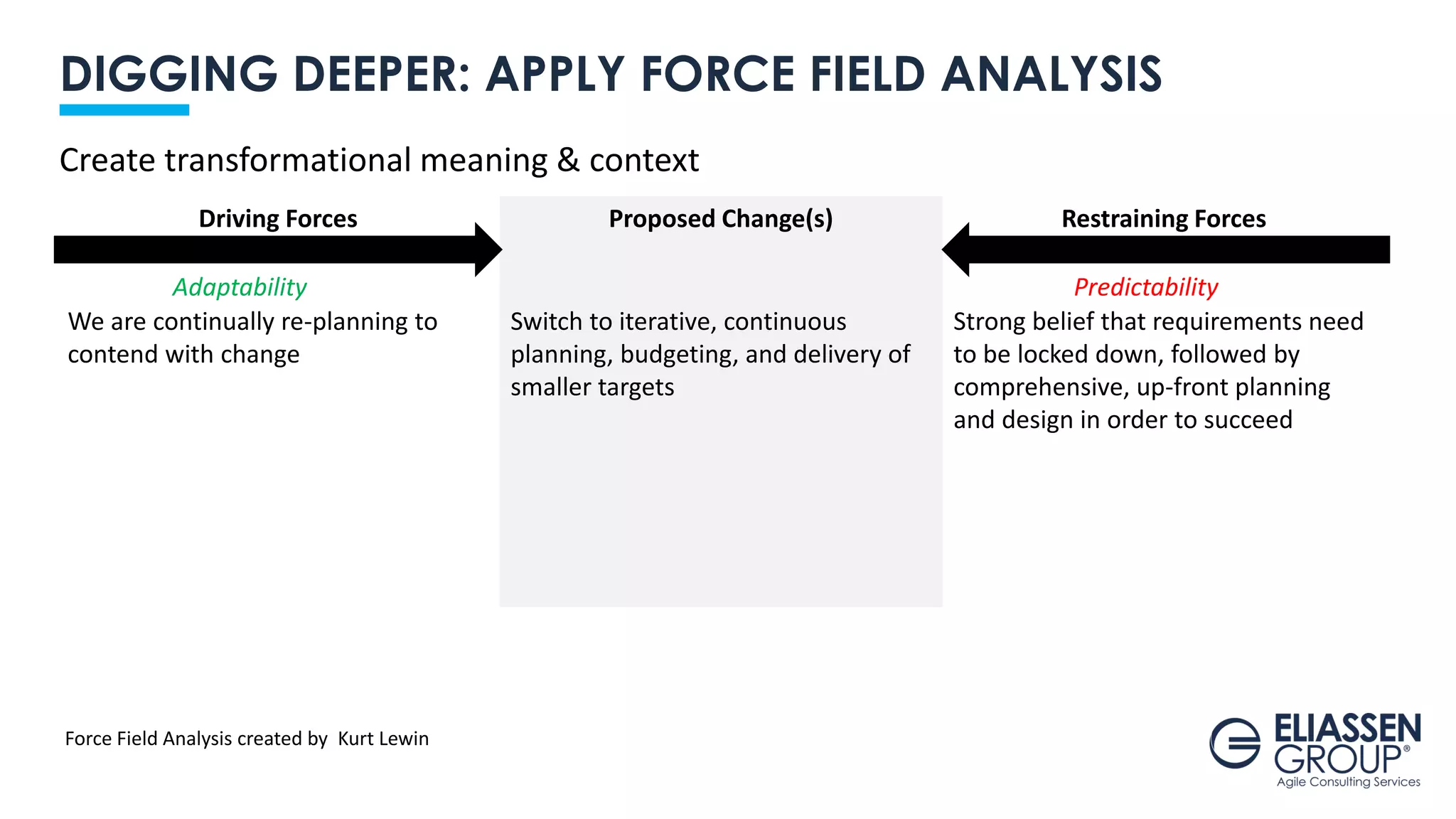
DIGGING DEEPER: APPLY FORCE FIELD ANALYSIS
Create transformational meaning & context
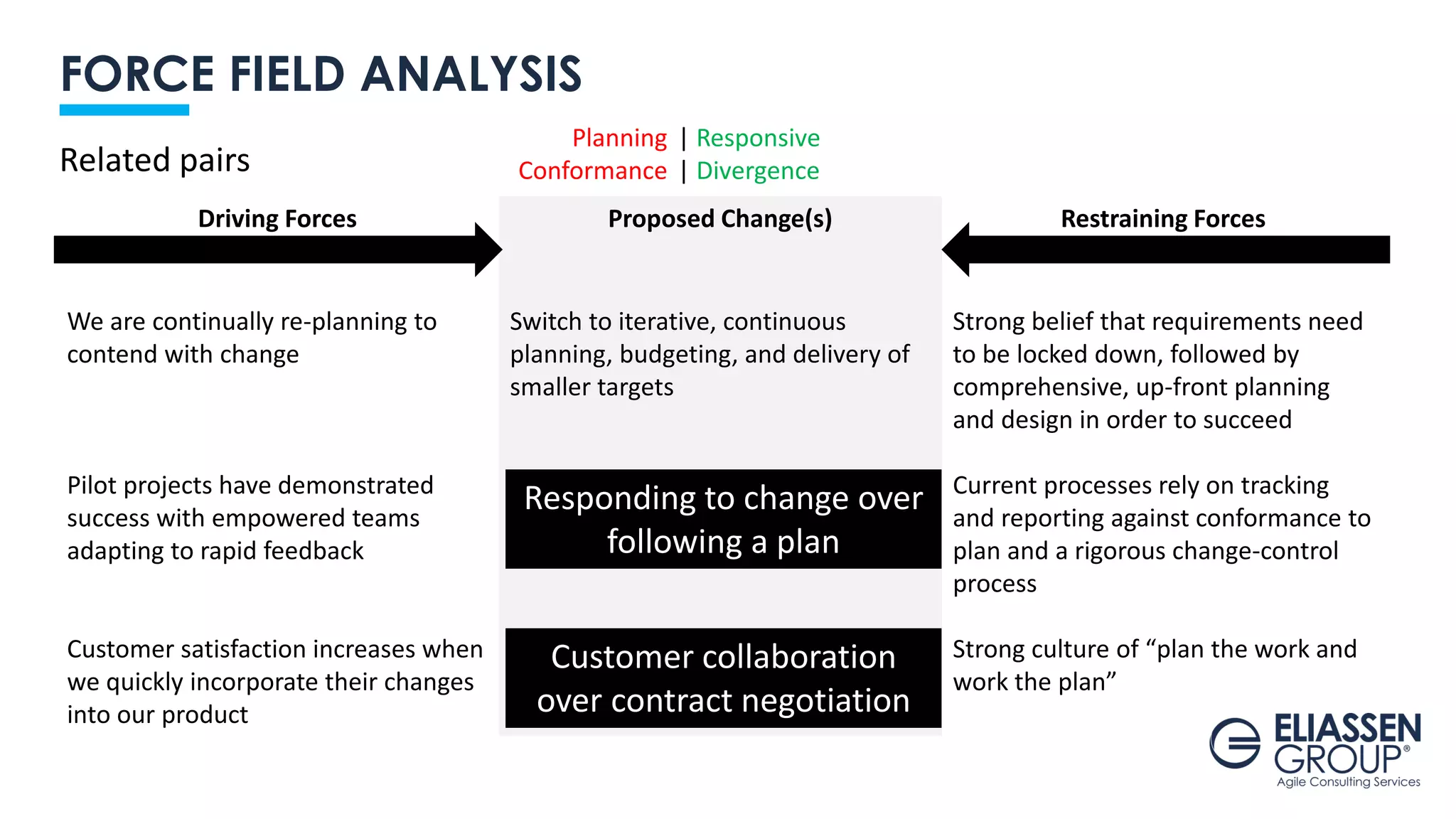
Driving Forces Proposed Change(s) Restraining Forces
We are continually re-planning to
contend with change
Switch to iterative, continuous
planning, budgeting, and delivery of
smaller targets
Strong belief that requirements need
to be locked down, followed by
comprehensive, up-front planning
and design in order to succeed
PredictabilityAdaptability
Force Field Analysis created by Kurt Lewin
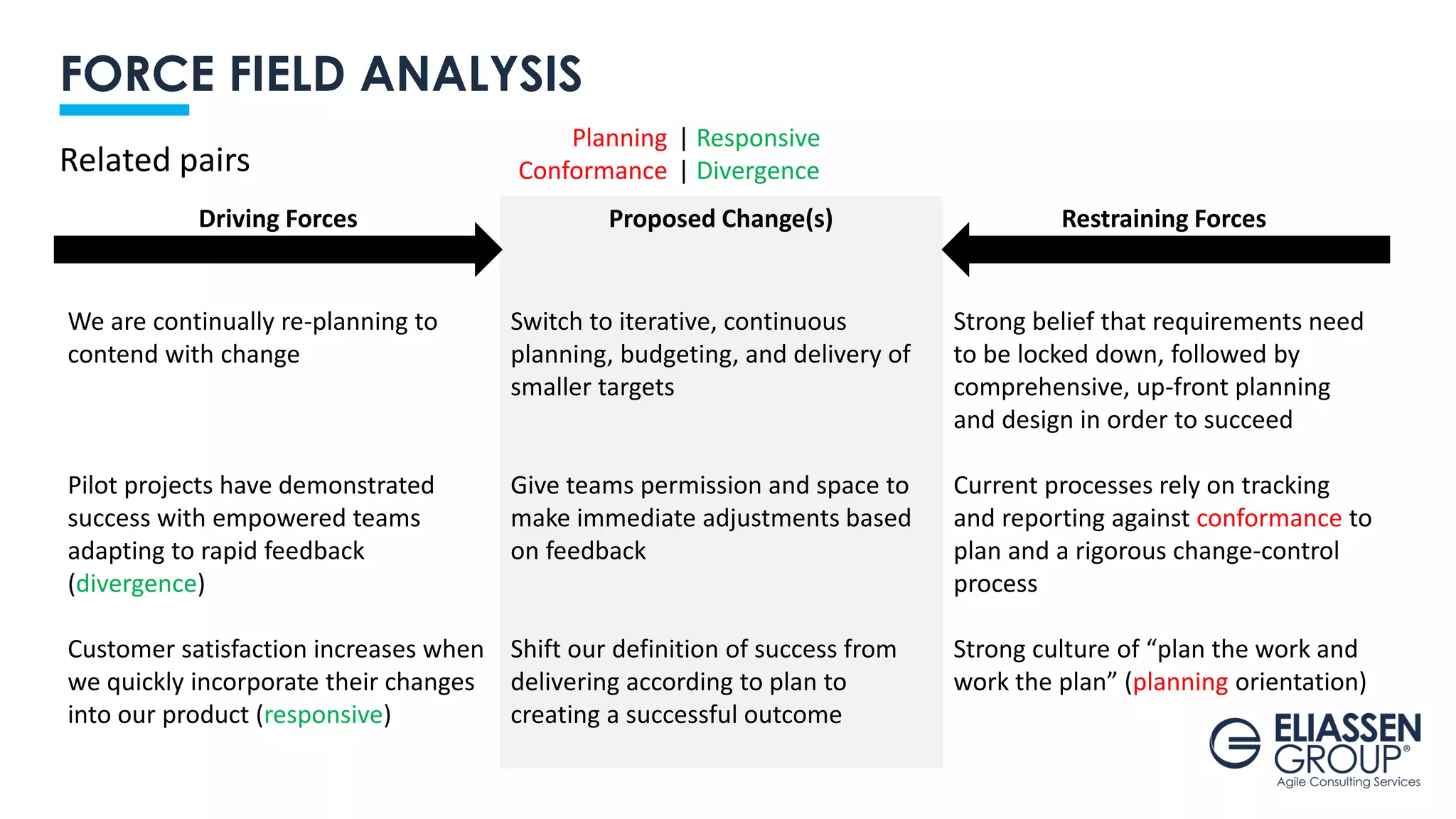
FORCE FIELD ANALYSIS
Driving Forces Proposed Change(s) Restraining Forces
We are continually re-planning to
contend with change
Pilot projects have demonstrated
success with empowered teams
adapting to rapid feedback
(divergence)
Customer satisfaction increases when
we quickly incorporate their changes
into our product (responsive)
Switch to iterative, continuous
planning, budgeting, and delivery of
smaller targets
Give teams permission and space to
make immediate adjustments based
on feedback
Shift our definition of success from
delivering according to plan to
creating a successful outcome
Strong belief that requirements need
to be locked down, followed by
comprehensive, up-front planning
and design in order to succeed
Current processes rely on tracking
and reporting against conformance to
plan and a rigorous change-control
process
Strong culture of “plan the work and
work the plan” (planning orientation)
Related pairs
Planning
Conformance
| Responsive
| Divergence
FORCE FIELD ANALYSIS
Related pairs
Planning
Conformance
| Responsive
| Divergence
Driving Forces Proposed Change(s) Restraining Forces
We are continually re-planning to
contend with change
Pilot projects have demonstrated
success with empowered teams
adapting to rapid feedback
Customer satisfaction increases when
we quickly incorporate their changes
into our product
Switch to iterative, continuous
planning, budgeting, and delivery of
smaller targets
Allow teams to make immediate
adjustments based on feedback
Plan, budget, and deliver against
smaller targets while doing the above
Strong belief that requirements need
to be locked down, followed by
comprehensive, up-front planning
and design in order to succeed
Current processes rely on tracking
and reporting against conformance to
plan and a rigorous change-control
process
Strong culture of “plan the work and
work the plan”
Responding to change over
following a plan
Customer collaboration
over contract negotiation
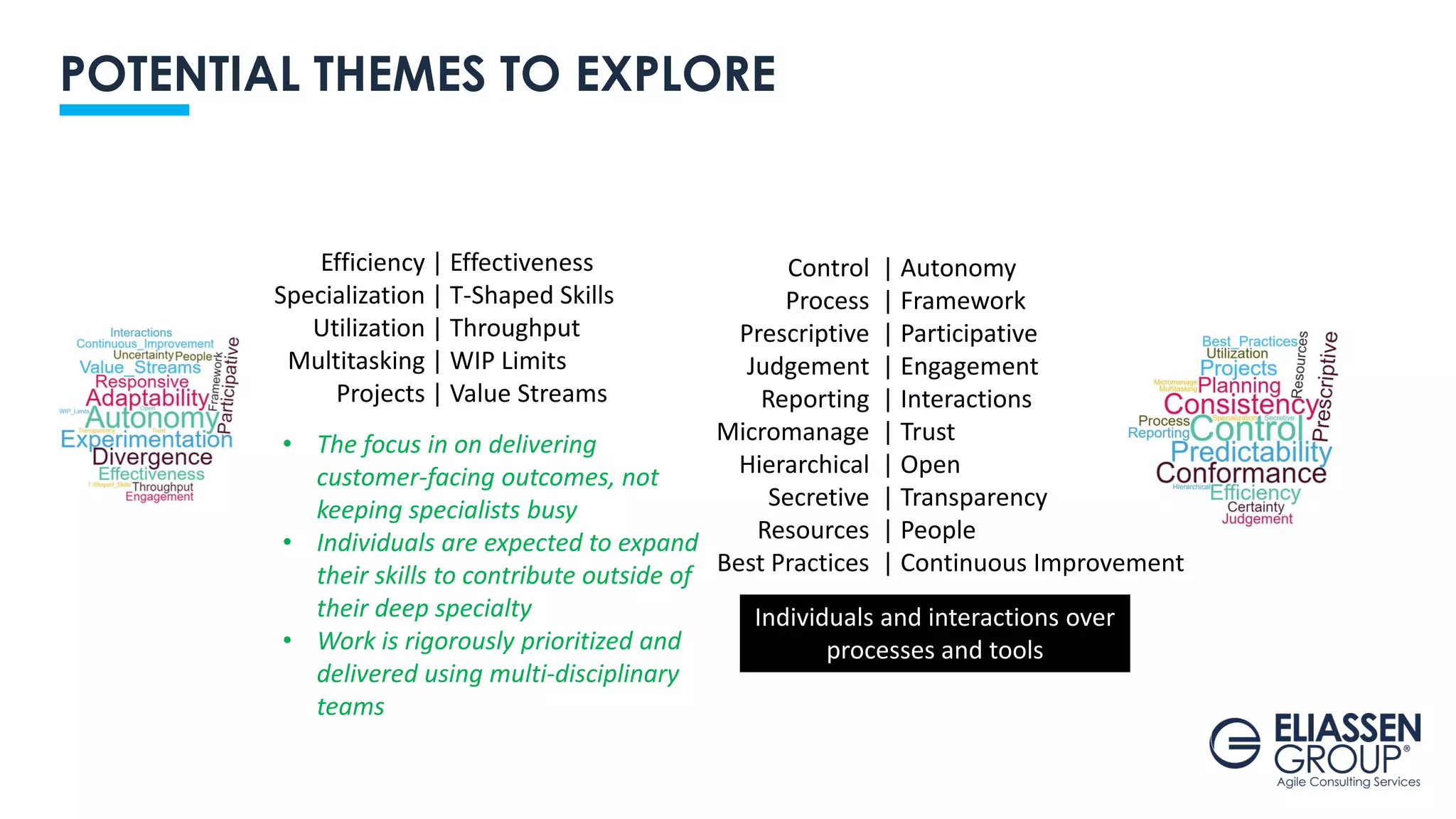
POTENTIAL THEMES TO EXPLORE
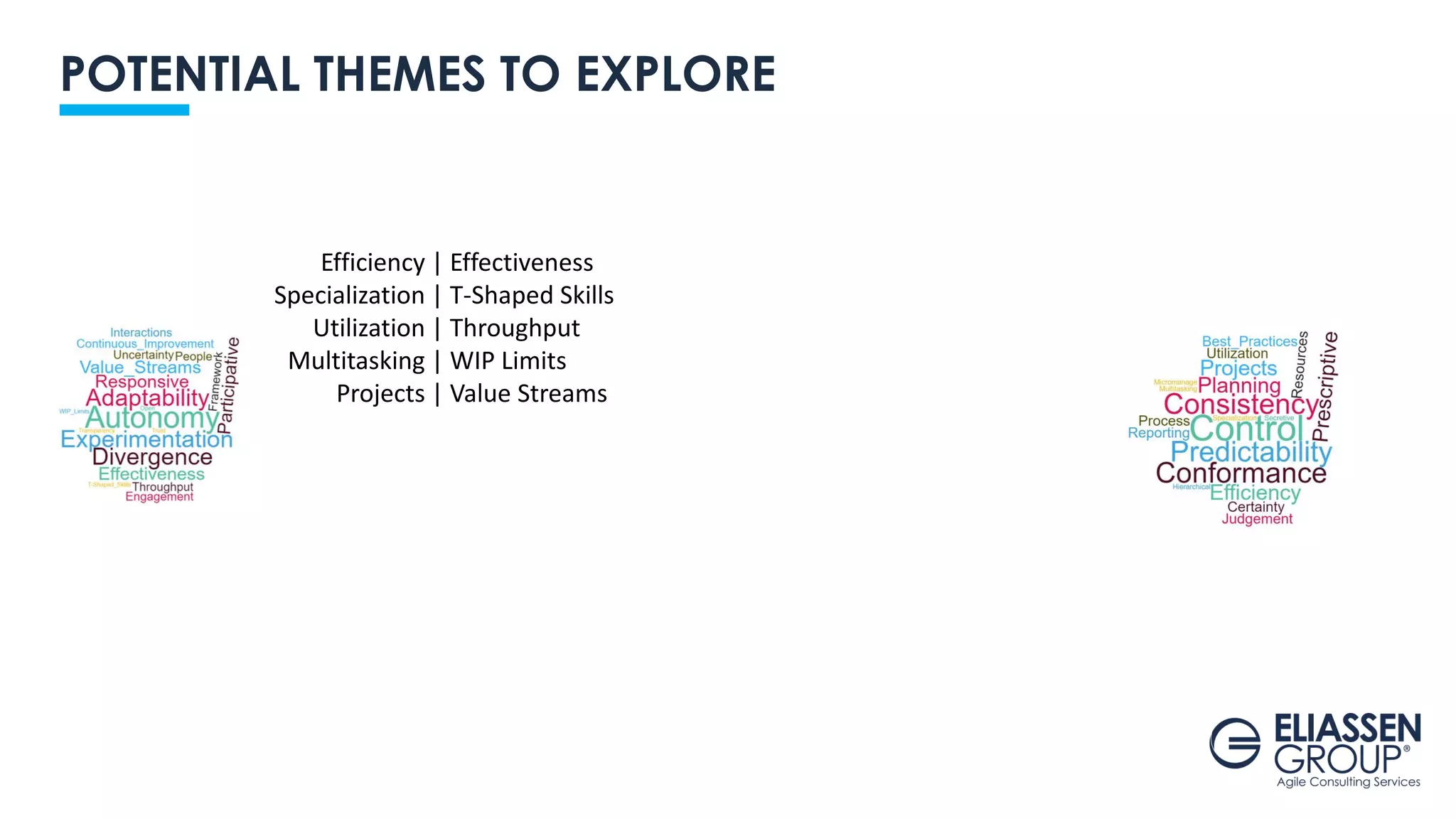
Efficiency
Specialization
Utilization
Multitasking
Projects
| Effectiveness
| T-Shaped Skills
| Throughput
| WIP Limits
| Value Streams
POTENTIAL THEMES TO EXPLORE
Efficiency
Specialization
Utilization
Multitasking
Projects
| Effectiveness
| T-Shaped Skills
| Throughput
| WIP Limits
| Value Streams
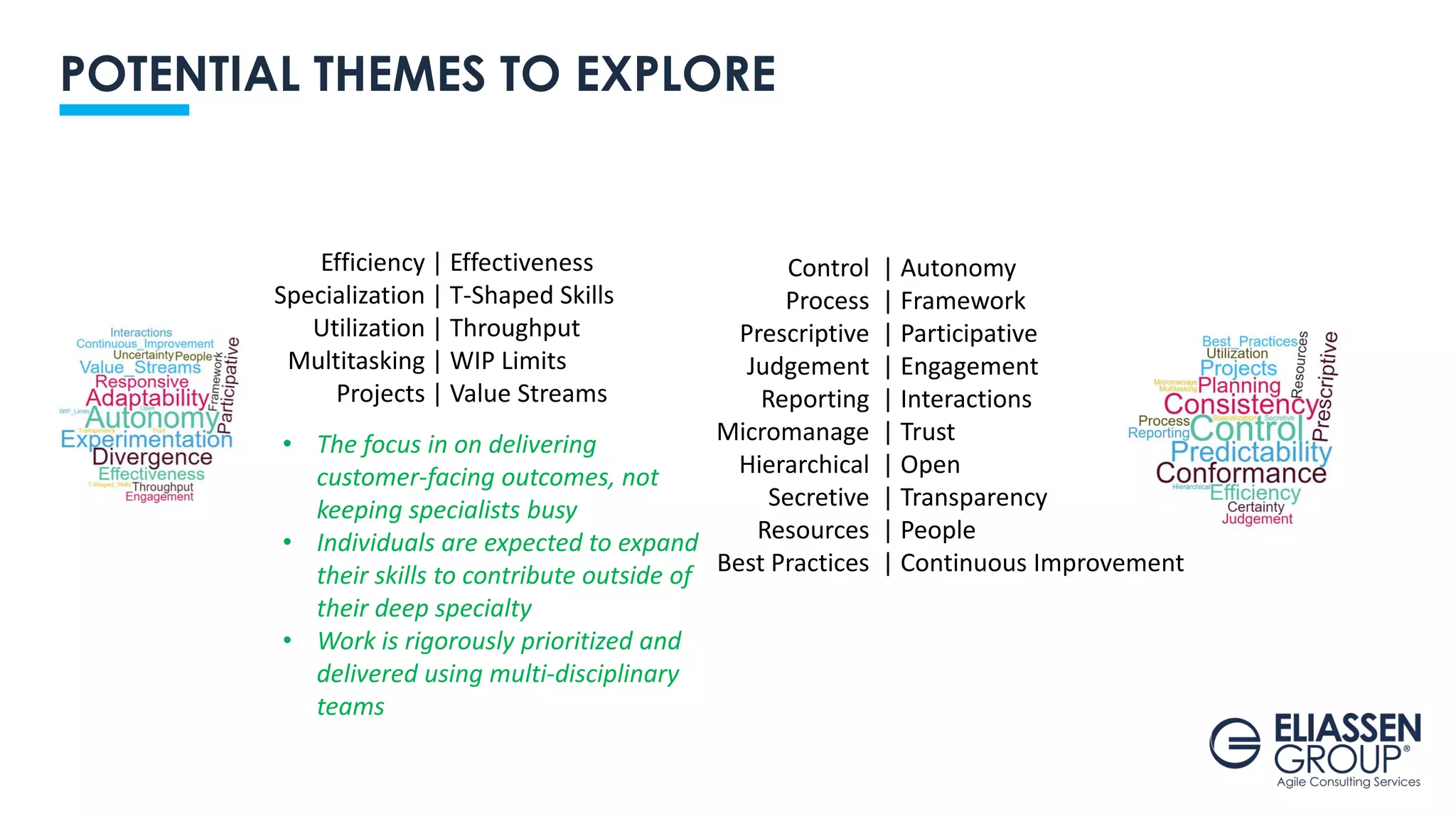
• The focus in on delivering
customer-facing outcomes, not
keeping specialists busy
• Individuals are expected to expand
their skills to contribute outside of
their deep specialty
• Work is rigorously prioritized and
delivered using multi-disciplinary
teams
POTENTIAL THEMES TO EXPLORE
Efficiency
Specialization
Utilization
Multitasking
Projects
| Effectiveness
| T-Shaped Skills
| Throughput
| WIP Limits
| Value Streams
Control
Process
Prescriptive
Judgement
Reporting
Micromanage
Hierarchical
Secretive
Resources
Best Practices
| Autonomy
| Framework
| Participative
| Engagement
| Interactions
| Trust
| Open
| Transparency
| People
| Continuous Improvement
• The focus in on delivering
customer-facing outcomes, not
keeping specialists busy
• Individuals are expected to expand
their skills to contribute outside of
their deep specialty
• Work is rigorously prioritized and
delivered using multi-disciplinary
teams
POTENTIAL THEMES TO EXPLORE
Efficiency
Specialization
Utilization
Multitasking
Projects
| Effectiveness
| T-Shaped Skills
| Throughput
| WIP Limits
| Value Streams
Control
Process
Prescriptive
Judgement
Reporting
Micromanage
Hierarchical
Secretive
Resources
Best Practices
| Autonomy
| Framework
| Participative
| Engagement
| Interactions
| Trust
| Open
| Transparency
| People
| Continuous Improvement
Individuals and interactions over
processes and tools
• The focus in on delivering
customer-facing outcomes, not
keeping specialists busy
• Individuals are expected to expand
their skills to contribute outside of
their deep specialty
• Work is rigorously prioritized and
delivered using multi-disciplinary
teams
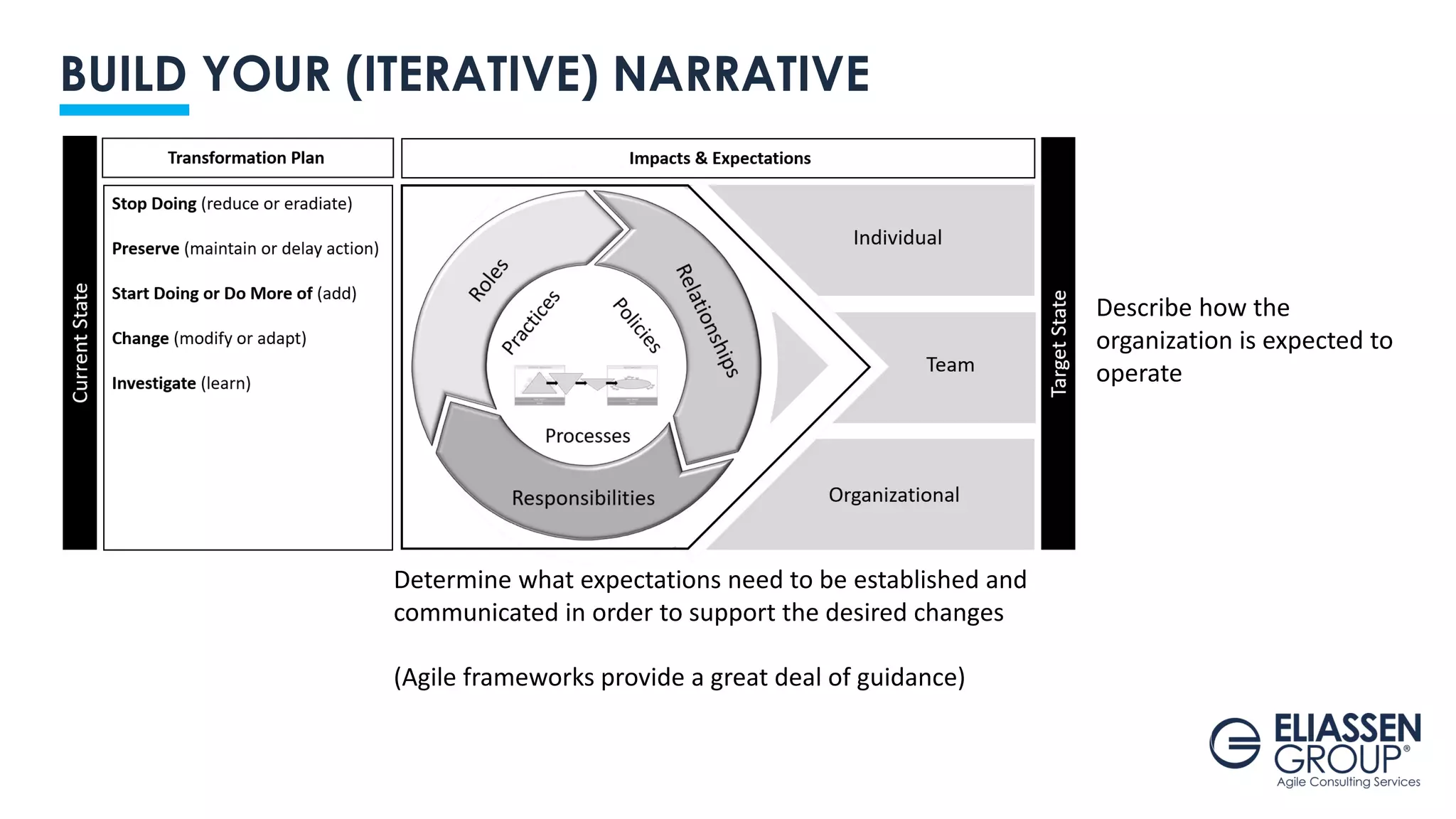
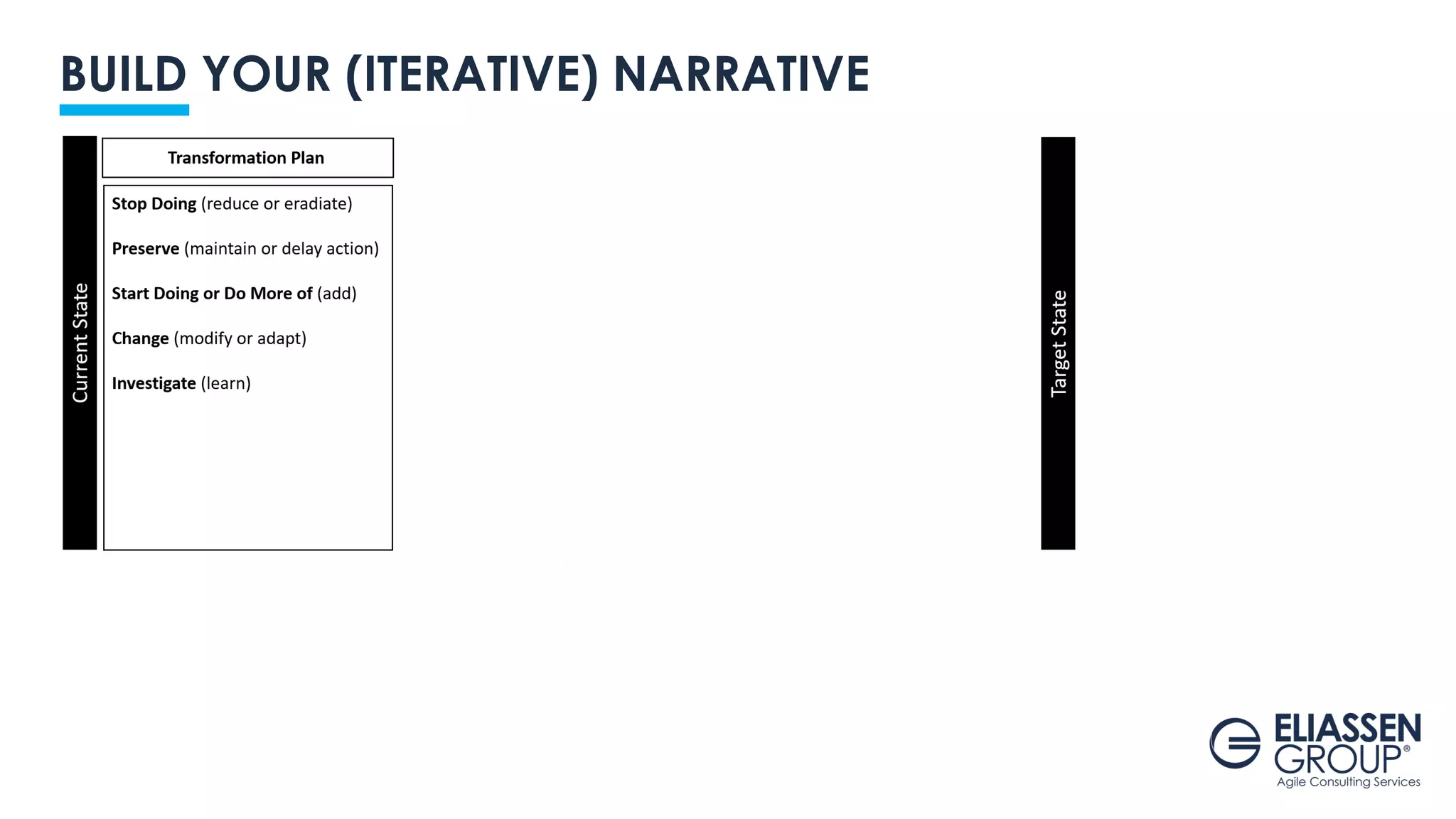
BUILD YOUR (ITERATIVE) NARRATIVE
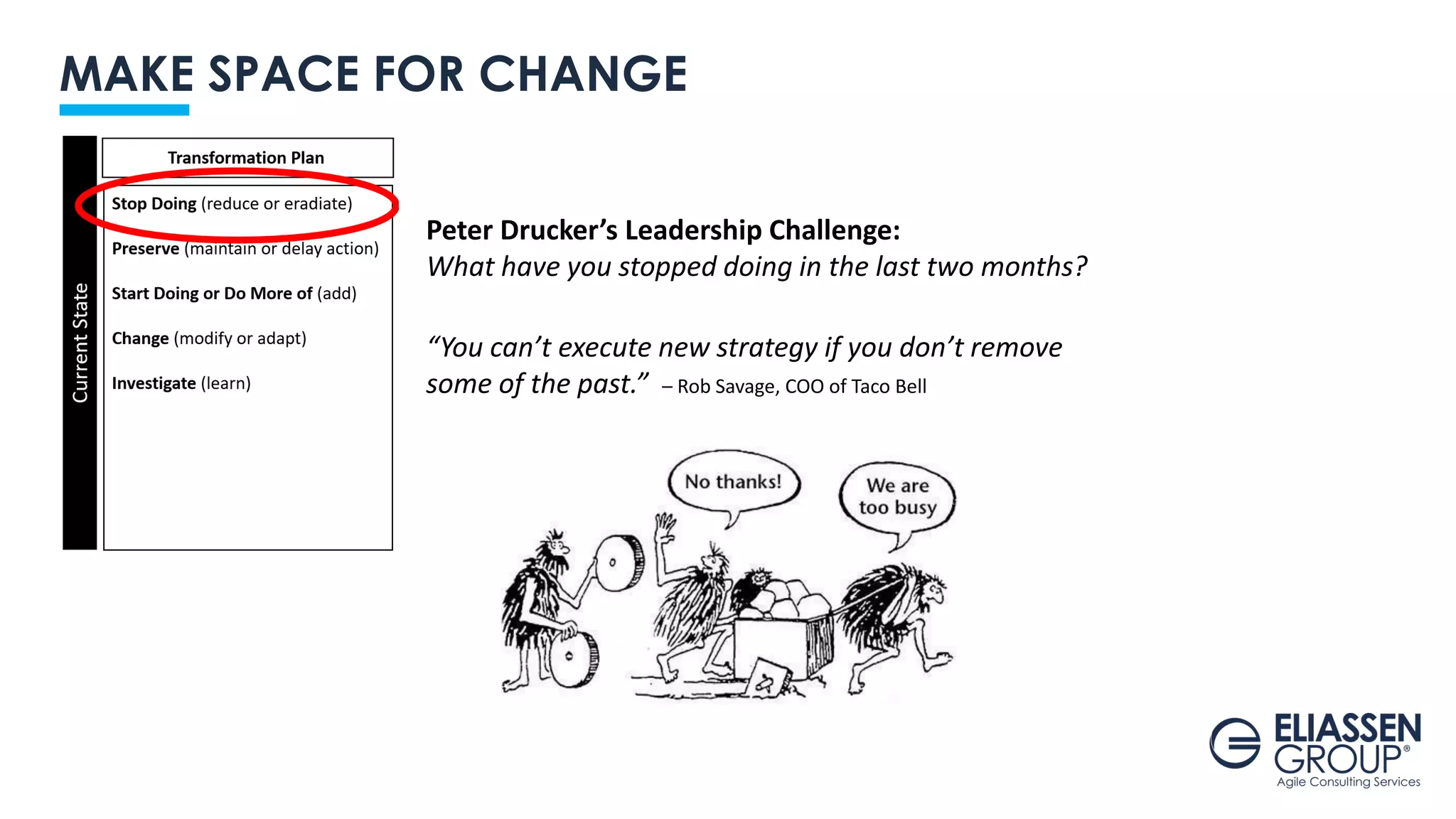
MAKE SPACE FOR CHANGE
Peter Drucker’s Leadership Challenge:
What have you stopped doing in the last two months?
“You can’t execute new strategy if you don’t remove
some of the past.” – Rob Savage, COO of Taco Bell
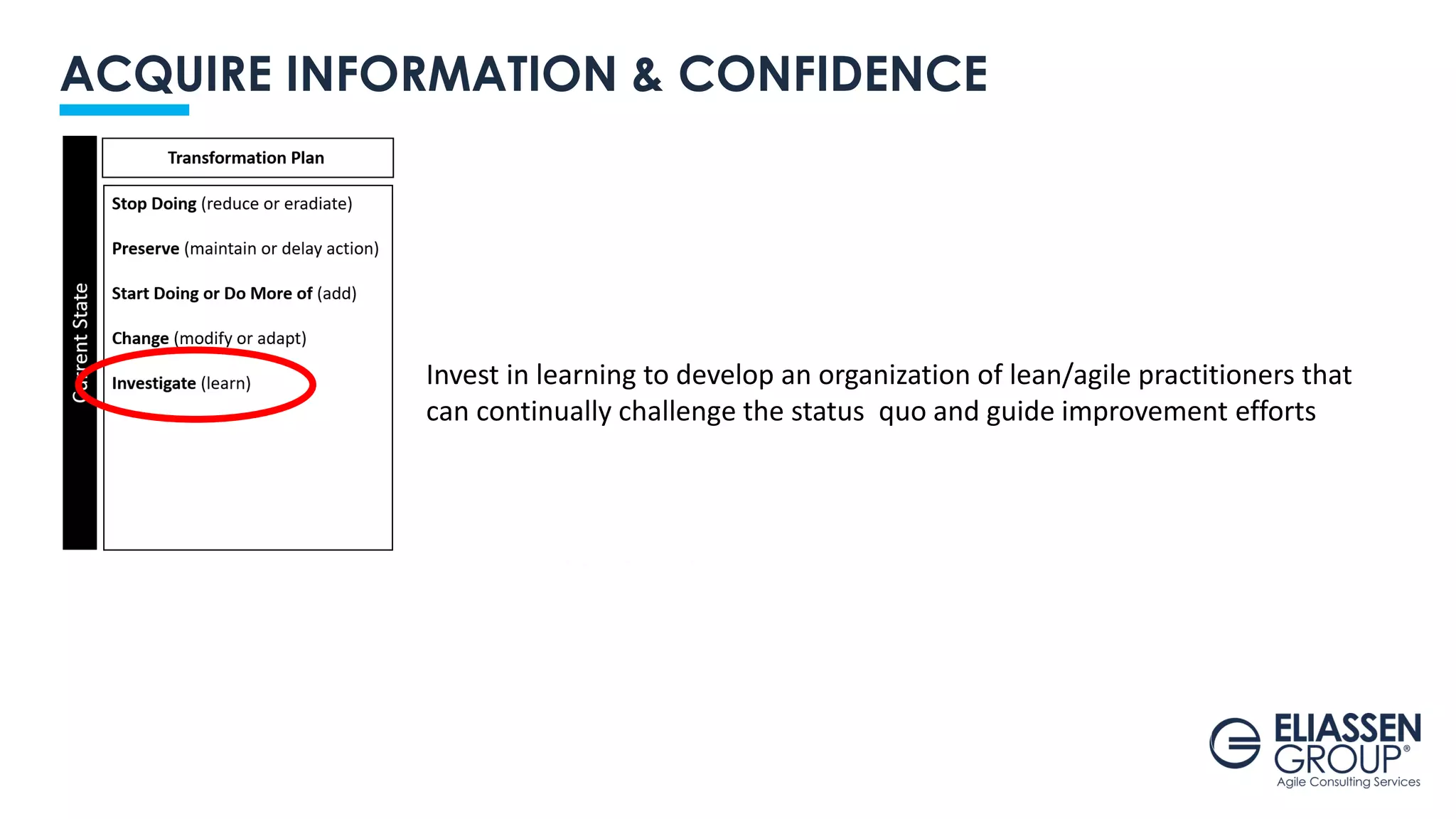
ACQUIRE INFORMATION & CONFIDENCE
Invest in learning to develop an organization of lean/agile practitioners that
can continually challenge the status quo and guide improvement efforts
BUILD YOUR (ITERATIVE) NARRATIVE
Describe how the
organization is expected to
operate
Determine what expectations need to be established and
communicated in order to support the desired changes
(Agile frameworks provide a great deal of guidance)
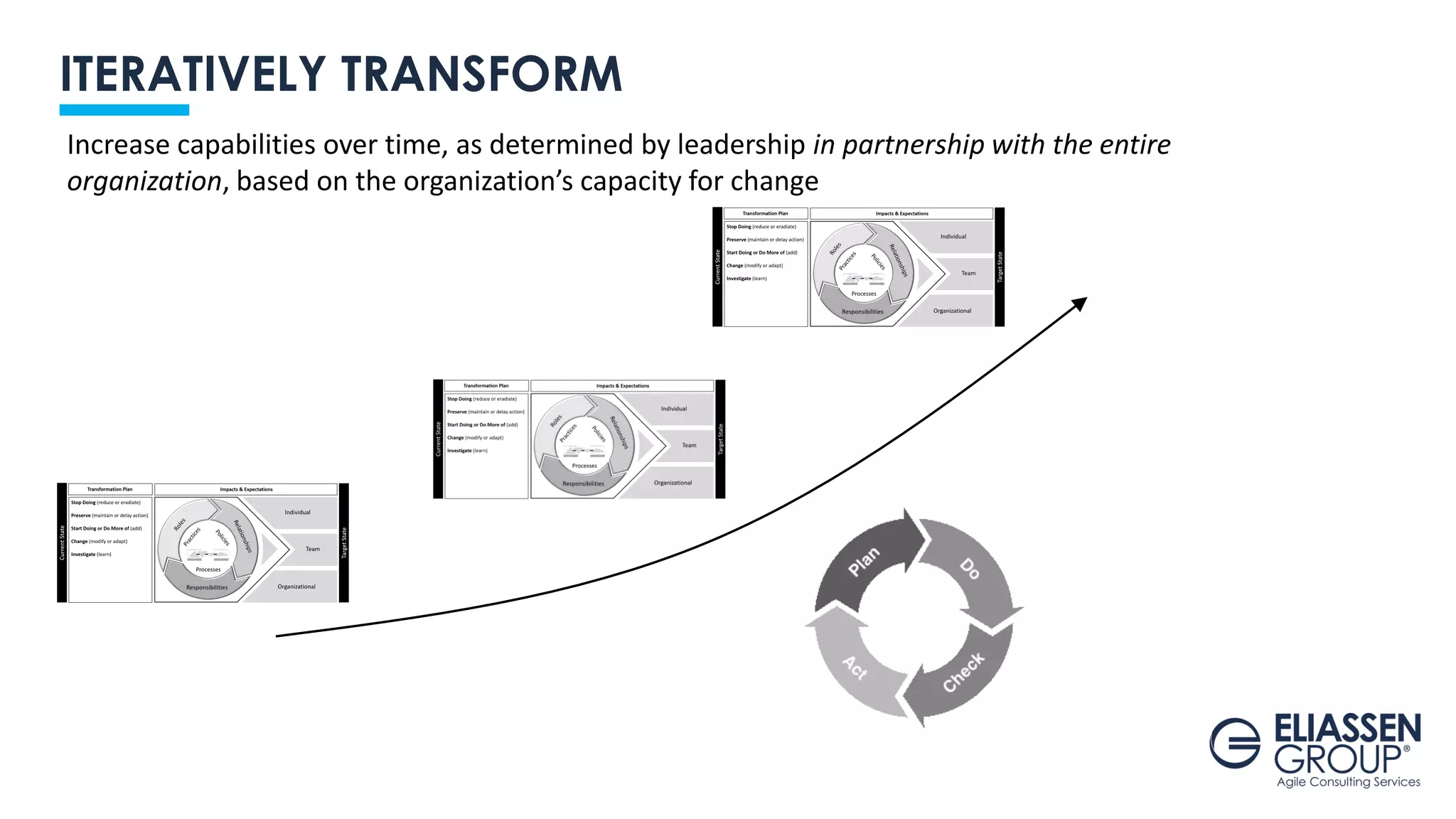
ITERATIVELY TRANSFORM
Increase capabilities over time, as determined by leadership in partnership with the entire
organization, based on the organization’s capacity for change
CLOSING THOUGHT
“Change your thoughts and you can change the world.”
– Norman Vincent Peale

Agile Expectations

  • 1.
    www.egagile.com | 800.354.2773 AgileConsulting Services Agile Expectations Creating Organizational Alignment – Agile Maine Day 4/26/2019 Dave Moran – Agile Coach
  • 2.
    “We will knowwe are agile when…” Agility Time Low High ?
  • 3.
    TROUBLE IN PARADISE VersionOne’sAnnual State of Agile Surveys regularly cite the following as leading causes of failed agile projects or barriers to further agile adoption: • Existing company culture at odds with agile values • Lack of management support • General organizational resistance to change
  • 4.
    KEY FACTOR Each hasdifferent values that are fueled by experiences & beliefs Differing mental models
  • 5.
  • 6.
    ONE PERSPECTIVE OFAGILITY Transformative
  • 7.
  • 8.
  • 9.
    TARGET STATE Customer-oriented reportingrelationships Authority Information Agile Organization
  • 10.
    TARGET STATE Customer-oriented reportingrelationships Authority Information Agile Organization Is this the true intent?
  • 11.
    ONE SCENARIO “Agility appliesto this part of our organization.” “They’re empowered!” (To make all of our problems go away while we remain in control…)
  • 12.
    ONE SCENARIO “Agility appliesto this part of our organization.” “They’re empowered!” (To make all of our problems go away while we remain in control…) Agility is viewed as an efficiency improvement, but is this a shared understanding? "We have Scrum teams, so that makes us agile!”
  • 13.
    Initial Pilots &Learning Scaling Teams Leadership Time LACK OF ALIGNMENT IS COSTLY! Low High Agility Friction Conflicting Expectations • Existing company culture at odds with agile values • Lack of management support • General organizational resistance to change
  • 14.
  • 15.
    MANAGING EXPECTATIONS Expectations area belief about how the future will unfold – and we react negatively if others fail to live up to our expectations
  • 16.
    MANAGING EXPECTATIONS Expectations area belief about how the future will unfold – and we react negatively if others fail to live up to our expectations To successfully manage expectations we need to: • Anticipate challenges • Be honest, transparent and explicit about our assumptions and beliefs
  • 17.
    MANAGING EXPECTATIONS Expectations area belief about what the future will hold – and we react negatively if others fail to live up to our expectations To successfully manage expectations we need to: • Anticipate challenges • Be honest, transparent and explicit about our assumptions and beliefs “If you don’t manage expectations, expect to fail.” – Mike Cohn https://mtngo.at/1705
  • 18.
    ORGANIZATIONS: SYSTEMS OFINTERACTING ELEMENTS Value System Beliefs There is mutual support and reinforcement between the system people are working in and the behaviors that they exhibit
  • 19.
    ORGANIZATIONS: SYSTEMS OFINTERACTING ELEMENTS Value System Beliefs Agile frameworks provide guidance Exploring these aspects provide context and help uncover the barriers and issues associated with the VersionOne surveys
  • 20.
    TRANSFORMING TO AGILE Createdby Col. John R. Boyd (ret.), Published on September 3, 1976 Leveraging John Boyd’s Destruction and Creation https://commons.wikimedia.org/wiki/File:JohnBoyd_Pilot.jpg Abstract: To comprehend and cope with our environment we develop mental patterns or concepts of meaning. The purpose of this paper is to sketch out how we destroy and create these patterns to permit us to both shape and be shaped by a changing environment.
  • 21.
    THE CHALLENGE INTRANSFORMING TO AGILE We need to destroy this In order to create this Boyd’s Destruction and Creation
  • 22.
    THE CHALLENGE INTRANSFORMING TO AGILE We need to destroy this In order to create this Without wrecking the company Boyd’s Destruction and Creation
  • 23.
    THE SOLUTION Iteratively createand destroy “…permit us to both shape and be shaped by a changing environment.” – DESTRUCTION AND CREATION, John R. Boyd, September 3, 1976 Ultimate Target State Current State Transitional Target States
  • 24.
    CREATING TRANSFORMATIONAL ALIGNMENT ValueSystem Beliefs Traditional Organization Value System Beliefs Agile Organization Describe the key characteristics of each organization Seek to explore the value system and underlying beliefs
  • 25.
  • 26.
    CHARACTERISTICS OF ANAGILE ORGANIZATION Value System Beliefs Agile Organization
  • 27.
    UNSTRUCTURING Sever the relationshipbetween the parts and the whole by pulling the constituent parts out of their respective boxes
  • 28.
    THIS CREATES A"SEA OF ANARCHY”
  • 29.
    SYNTHESIZING A PATHTO TRANSFORMATION Pair opposing concepts Predictability | Adaptability
  • 30.
    SYNTHESIZING A PATHTO TRANSFORMATION Pair opposing concepts Predictability | Adaptability Conversation starters
  • 31.
    DIGGING DEEPER: APPLYFORCE FIELD ANALYSIS Create transformational meaning & context Driving Forces Proposed Change(s) Restraining Forces We are continually re-planning to contend with change Switch to iterative, continuous planning, budgeting, and delivery of smaller targets Strong belief that requirements need to be locked down, followed by comprehensive, up-front planning and design in order to succeed PredictabilityAdaptability Force Field Analysis created by Kurt Lewin
  • 32.
    FORCE FIELD ANALYSIS DrivingForces Proposed Change(s) Restraining Forces We are continually re-planning to contend with change Pilot projects have demonstrated success with empowered teams adapting to rapid feedback (divergence) Customer satisfaction increases when we quickly incorporate their changes into our product (responsive) Switch to iterative, continuous planning, budgeting, and delivery of smaller targets Give teams permission and space to make immediate adjustments based on feedback Shift our definition of success from delivering according to plan to creating a successful outcome Strong belief that requirements need to be locked down, followed by comprehensive, up-front planning and design in order to succeed Current processes rely on tracking and reporting against conformance to plan and a rigorous change-control process Strong culture of “plan the work and work the plan” (planning orientation) Related pairs Planning Conformance | Responsive | Divergence
  • 33.
    FORCE FIELD ANALYSIS Relatedpairs Planning Conformance | Responsive | Divergence Driving Forces Proposed Change(s) Restraining Forces We are continually re-planning to contend with change Pilot projects have demonstrated success with empowered teams adapting to rapid feedback Customer satisfaction increases when we quickly incorporate their changes into our product Switch to iterative, continuous planning, budgeting, and delivery of smaller targets Allow teams to make immediate adjustments based on feedback Plan, budget, and deliver against smaller targets while doing the above Strong belief that requirements need to be locked down, followed by comprehensive, up-front planning and design in order to succeed Current processes rely on tracking and reporting against conformance to plan and a rigorous change-control process Strong culture of “plan the work and work the plan” Responding to change over following a plan Customer collaboration over contract negotiation
  • 34.
    POTENTIAL THEMES TOEXPLORE Efficiency Specialization Utilization Multitasking Projects | Effectiveness | T-Shaped Skills | Throughput | WIP Limits | Value Streams
  • 35.
    POTENTIAL THEMES TOEXPLORE Efficiency Specialization Utilization Multitasking Projects | Effectiveness | T-Shaped Skills | Throughput | WIP Limits | Value Streams • The focus in on delivering customer-facing outcomes, not keeping specialists busy • Individuals are expected to expand their skills to contribute outside of their deep specialty • Work is rigorously prioritized and delivered using multi-disciplinary teams
  • 36.
    POTENTIAL THEMES TOEXPLORE Efficiency Specialization Utilization Multitasking Projects | Effectiveness | T-Shaped Skills | Throughput | WIP Limits | Value Streams Control Process Prescriptive Judgement Reporting Micromanage Hierarchical Secretive Resources Best Practices | Autonomy | Framework | Participative | Engagement | Interactions | Trust | Open | Transparency | People | Continuous Improvement • The focus in on delivering customer-facing outcomes, not keeping specialists busy • Individuals are expected to expand their skills to contribute outside of their deep specialty • Work is rigorously prioritized and delivered using multi-disciplinary teams
  • 37.
    POTENTIAL THEMES TOEXPLORE Efficiency Specialization Utilization Multitasking Projects | Effectiveness | T-Shaped Skills | Throughput | WIP Limits | Value Streams Control Process Prescriptive Judgement Reporting Micromanage Hierarchical Secretive Resources Best Practices | Autonomy | Framework | Participative | Engagement | Interactions | Trust | Open | Transparency | People | Continuous Improvement Individuals and interactions over processes and tools • The focus in on delivering customer-facing outcomes, not keeping specialists busy • Individuals are expected to expand their skills to contribute outside of their deep specialty • Work is rigorously prioritized and delivered using multi-disciplinary teams
  • 38.
  • 39.
    MAKE SPACE FORCHANGE Peter Drucker’s Leadership Challenge: What have you stopped doing in the last two months? “You can’t execute new strategy if you don’t remove some of the past.” – Rob Savage, COO of Taco Bell
  • 40.
    ACQUIRE INFORMATION &CONFIDENCE Invest in learning to develop an organization of lean/agile practitioners that can continually challenge the status quo and guide improvement efforts
  • 41.
    BUILD YOUR (ITERATIVE)NARRATIVE Describe how the organization is expected to operate Determine what expectations need to be established and communicated in order to support the desired changes (Agile frameworks provide a great deal of guidance)
  • 42.
    ITERATIVELY TRANSFORM Increase capabilitiesover time, as determined by leadership in partnership with the entire organization, based on the organization’s capacity for change
  • 43.
    CLOSING THOUGHT “Change yourthoughts and you can change the world.” – Norman Vincent Peale