Agent management LIFE CYCLE &  LOG STRUCTURE YUOSEF M. RADI Research for CS 652 Dr. FATHI AL-BORAEI
Outline Introduction. Agent management. Life cycle. Mobile agent life state log structure. Storage method. Proposal . Question. Reference.
Introduction An agent is created on a certain agent server and it will run autonomously. Each agent has a life cycle, and each agent has several different life states during entire lifetime.
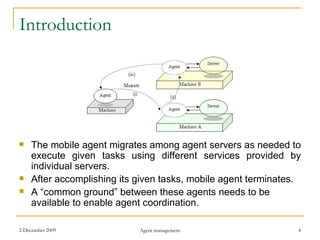
Introduction The mobile agent migrates among agent servers as needed to execute given tasks using different services provided by individual servers. After accomplishing its given tasks, mobile agent terminates. A “common ground” between these agents needs to be available to enable agent coordination.
Outline Introduction. Agent management system. Agent Platform. FIBA standard. Grasshopper standard. Life cycle. Mobile agent life state log structure. Storage method. Proposal . Question. Reference.
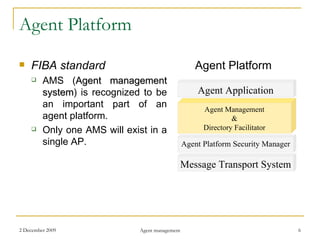
Agent Platform FIBA standard AMS ( Agent management system )  is recognized to be an important part of an agent platform. Only one AMS will exist in a single AP. Agent Platform Message Transport System Agent Platform Security Manager Agent Management & Directory Facilitator Agent Application
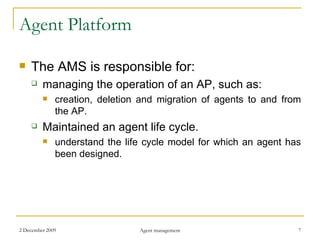
Agent Platform The AMS is responsible for: managing the operation of an AP, such as: creation, deletion and migration of agents to and from the AP. Maintained an agent life cycle.  understand the life cycle model for which an agent has been designed.
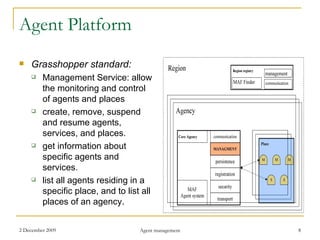
Agent Platform Grasshopper standard: Management Service: allow the monitoring and control of agents and places create, remove, suspend and resume agents, services, and places. get information about specific agents and services. list all agents residing in a specific place, and to list all places of an agency.
Outline Introduction. Agent management. Life cycle. Life cycle definition. Life cycle in different technology. Life cycle model. Life cycle states. Mobile agent life state log structure. Storage method. Proposal . Question. Reference.
Life cycle definition  An agent life cycle can be defined as:  A series of stages through which an agent passes during its lifetime. An agent’s state can be used to provide coordination mechanisms with useful status information.
Life cycle in different technology FIPA agents can be in one of the following states: Initiated. After creation, the agent is said to be in the initiated state. Active. After invoking the agent, it is active. The central state of a FIPA agent is the so-called active state. After moving into another state, agents always return to the active state before additional state transitions are possible. Transit. the move function failed on the original AP. the agent was successfully started on the destination AP Suspended.
Life cycle in different technology Pathfinder model consists of the following states and transitions between them: Stopped. Running. Suspended. Aborted. Completed.
Life cycle in different technology MASIF includes the following functions: Creation. Termination. Suspension. Transfer. Resumption.
Life cycle model Life cycle model as presented in the following research paper: Supporting Life Cycle Coordination in Open Agent Systems
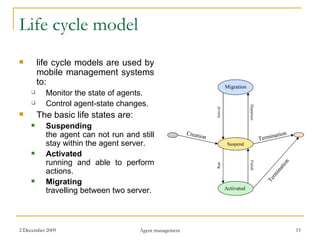
Life cycle model life cycle models are used by mobile management systems to: Monitor the state of agents. Control agent-state changes. The basic life states are: Suspending the agent can not run and still stay within the agent server. Activated running and able to perform actions. Migrating travelling between two server. Migration Suspend Activated Creation Termination Arrival Departure Run Finish Termination
Life cycle model From an agent’s perspective, the most important state is the active state, in which it can perform its tasks. From a management perspective, the suspended state is the most important state. Why? A management system can perform actions on the agent without interfering with its tasks. Security chicks on agent when it’s arrive to see if agent are carrying stolen or harm data.
Outline Introduction. Agent management. Life cycle. Mobile agent life state log structure. Storage method. Proposal . Question. Reference.
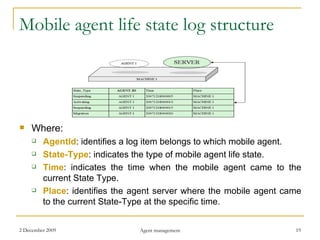
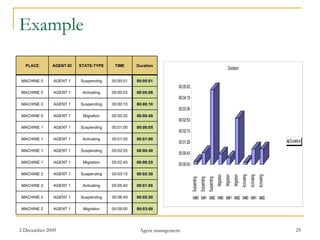
Mobile agent life state log structure During its life cycle, a mobile agent may go through many states, In order to improve the mobile agent management, we have to record these states. The mobile agent life state log structure is described as a four-items: Life_State_Log_Structure= (Agentld, State-Type, Time, Place)
Mobile agent life state log structure Where: Agentld : identifies a log item belongs to which mobile agent. State-Type : indicates the type of mobile agent life state. Time : indicates the time when the mobile agent came to the current State Type. Place : identifies the agent server where the mobile agent came to the current State-Type at the specific time.
Outline Introduction. Agent management. Life cycle. Mobile agent life state log structure. Storage method. Proposal . Question. Reference.
Storage method Agent life state log structure storage methods as discussed in the following research paper: Mobile Agent Life State Management
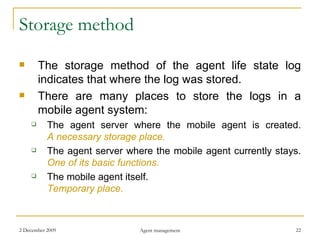
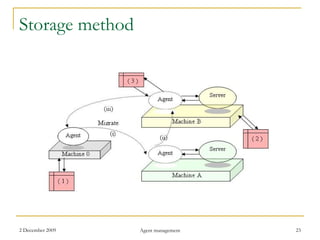
Storage method The storage method of the agent life state log indicates that where the log was stored. There are many places to store the logs in a mobile agent system: The agent server where the mobile agent is created. A necessary storage place. The agent server where the mobile agent currently stays. One of its basic functions. The mobile agent itself. Temporary place.
Storage method
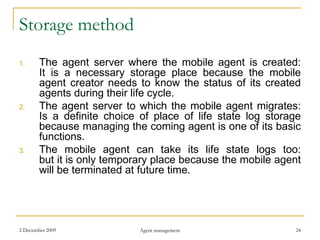
Storage method The agent server where the mobile agent is created: It is a necessary storage place because the mobile agent creator needs to know the status of its created agents during their life cycle. The agent server to which the mobile agent migrates: Is a definite choice of place of life state log storage because managing the coming agent is one of its basic functions. The mobile agent can take its life state logs too: but it is only temporary place because the mobile agent will be terminated at future time.
Outline Introduction. Agent management. Life cycle. Mobile agent life state log structure. Storage method. Proposal . Question. Reference.
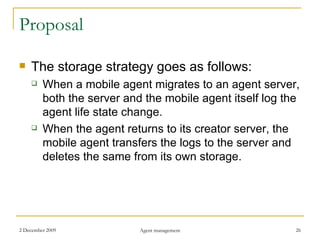
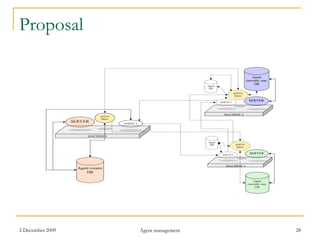
Proposal  The storage strategy goes as follows: When a mobile agent migrates to an agent server, both the server and the mobile agent itself log the agent life state change. When the agent returns to its creator server, the mobile agent transfers the logs to the server and deletes the same from its own storage.
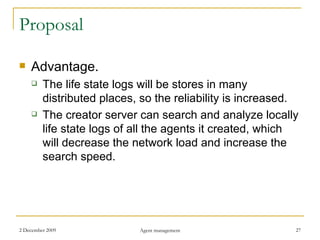
Proposal  Advantage. The life state logs will be stores in many distributed places, so the reliability is increased. The creator server can search and analyze locally life state logs of all the agents it created, which will decrease the network load and increase the search speed.
Proposal
Example 00:03:00 00:09:00 Migration AGENT 1 MACHINE 2 00:02:20 00:06:40 Suspending AGENT 1 MACHINE 2 00:01:00 00:05:40 Activating AGENT 1 MACHINE 2 00:02:30 00:03:10 Suspending AGENT 1 MACHINE 2 00:00:25 00:02:45 Migration AGENT 1 MACHINE 1 00:00:40 00:02:05 Suspending AGENT 1 MACHINE 1 00:01:00 00:01:05 Activating AGENT 1 MACHINE 1 00:00:05 00:01:00 Suspending AGENT 1 MACHINE 1 00:00:40 00:00:20 Migration AGENT 1 MACHINE 0 00:00:10 00:00:10 Suspending AGENT 1 MACHINE 0 00:00:08 00:00:02 Activating AGENT 1 MACHINE 0 00:00:01 00:00:01 Suspending AGENT 1 MACHINE 0 Duration TIME STATE-TYPE AGENT-ID PLACE
Outline Introduction. Agent management. Life cycle. Mobile agent life state log structure. Storage method. Proposal . Question. Reference.
Question Question Objective Comments
Outline Introduction. Agent management. Life cycle. Mobile agent life state log structure. Storage method. Proposal . Question. Reference.
Reference Mobile Agent Life State Management. Managing Agent Life Cycles in Open Distributed Systems Supporting Life Cycle Coordination in Open Agent Systems Design and implementation of a FIPA compliant. Grasshopper A Universal Agent.

Agent Management 652

  • 1.
    Agent management LIFECYCLE & LOG STRUCTURE YUOSEF M. RADI Research for CS 652 Dr. FATHI AL-BORAEI
  • 2.
    Outline Introduction. Agentmanagement. Life cycle. Mobile agent life state log structure. Storage method. Proposal . Question. Reference.
  • 3.
    Introduction An agentis created on a certain agent server and it will run autonomously. Each agent has a life cycle, and each agent has several different life states during entire lifetime.
  • 4.
    Introduction The mobileagent migrates among agent servers as needed to execute given tasks using different services provided by individual servers. After accomplishing its given tasks, mobile agent terminates. A “common ground” between these agents needs to be available to enable agent coordination.
  • 5.
    Outline Introduction. Agentmanagement system. Agent Platform. FIBA standard. Grasshopper standard. Life cycle. Mobile agent life state log structure. Storage method. Proposal . Question. Reference.
  • 6.
    Agent Platform FIBAstandard AMS ( Agent management system ) is recognized to be an important part of an agent platform. Only one AMS will exist in a single AP. Agent Platform Message Transport System Agent Platform Security Manager Agent Management & Directory Facilitator Agent Application
  • 7.
    Agent Platform TheAMS is responsible for: managing the operation of an AP, such as: creation, deletion and migration of agents to and from the AP. Maintained an agent life cycle. understand the life cycle model for which an agent has been designed.
  • 8.
    Agent Platform Grasshopperstandard: Management Service: allow the monitoring and control of agents and places create, remove, suspend and resume agents, services, and places. get information about specific agents and services. list all agents residing in a specific place, and to list all places of an agency.
  • 9.
    Outline Introduction. Agentmanagement. Life cycle. Life cycle definition. Life cycle in different technology. Life cycle model. Life cycle states. Mobile agent life state log structure. Storage method. Proposal . Question. Reference.
  • 10.
    Life cycle definition An agent life cycle can be defined as: A series of stages through which an agent passes during its lifetime. An agent’s state can be used to provide coordination mechanisms with useful status information.
  • 11.
    Life cycle indifferent technology FIPA agents can be in one of the following states: Initiated. After creation, the agent is said to be in the initiated state. Active. After invoking the agent, it is active. The central state of a FIPA agent is the so-called active state. After moving into another state, agents always return to the active state before additional state transitions are possible. Transit. the move function failed on the original AP. the agent was successfully started on the destination AP Suspended.
  • 12.
    Life cycle indifferent technology Pathfinder model consists of the following states and transitions between them: Stopped. Running. Suspended. Aborted. Completed.
  • 13.
    Life cycle indifferent technology MASIF includes the following functions: Creation. Termination. Suspension. Transfer. Resumption.
  • 14.
    Life cycle modelLife cycle model as presented in the following research paper: Supporting Life Cycle Coordination in Open Agent Systems
  • 15.
    Life cycle modellife cycle models are used by mobile management systems to: Monitor the state of agents. Control agent-state changes. The basic life states are: Suspending the agent can not run and still stay within the agent server. Activated running and able to perform actions. Migrating travelling between two server. Migration Suspend Activated Creation Termination Arrival Departure Run Finish Termination
  • 16.
    Life cycle modelFrom an agent’s perspective, the most important state is the active state, in which it can perform its tasks. From a management perspective, the suspended state is the most important state. Why? A management system can perform actions on the agent without interfering with its tasks. Security chicks on agent when it’s arrive to see if agent are carrying stolen or harm data.
  • 17.
    Outline Introduction. Agentmanagement. Life cycle. Mobile agent life state log structure. Storage method. Proposal . Question. Reference.
  • 18.
    Mobile agent lifestate log structure During its life cycle, a mobile agent may go through many states, In order to improve the mobile agent management, we have to record these states. The mobile agent life state log structure is described as a four-items: Life_State_Log_Structure= (Agentld, State-Type, Time, Place)
  • 19.
    Mobile agent lifestate log structure Where: Agentld : identifies a log item belongs to which mobile agent. State-Type : indicates the type of mobile agent life state. Time : indicates the time when the mobile agent came to the current State Type. Place : identifies the agent server where the mobile agent came to the current State-Type at the specific time.
  • 20.
    Outline Introduction. Agentmanagement. Life cycle. Mobile agent life state log structure. Storage method. Proposal . Question. Reference.
  • 21.
    Storage method Agentlife state log structure storage methods as discussed in the following research paper: Mobile Agent Life State Management
  • 22.
    Storage method Thestorage method of the agent life state log indicates that where the log was stored. There are many places to store the logs in a mobile agent system: The agent server where the mobile agent is created. A necessary storage place. The agent server where the mobile agent currently stays. One of its basic functions. The mobile agent itself. Temporary place.
  • 23.
  • 24.
    Storage method Theagent server where the mobile agent is created: It is a necessary storage place because the mobile agent creator needs to know the status of its created agents during their life cycle. The agent server to which the mobile agent migrates: Is a definite choice of place of life state log storage because managing the coming agent is one of its basic functions. The mobile agent can take its life state logs too: but it is only temporary place because the mobile agent will be terminated at future time.
  • 25.
    Outline Introduction. Agentmanagement. Life cycle. Mobile agent life state log structure. Storage method. Proposal . Question. Reference.
  • 26.
    Proposal Thestorage strategy goes as follows: When a mobile agent migrates to an agent server, both the server and the mobile agent itself log the agent life state change. When the agent returns to its creator server, the mobile agent transfers the logs to the server and deletes the same from its own storage.
  • 27.
    Proposal Advantage.The life state logs will be stores in many distributed places, so the reliability is increased. The creator server can search and analyze locally life state logs of all the agents it created, which will decrease the network load and increase the search speed.
  • 28.
  • 29.
    Example 00:03:00 00:09:00Migration AGENT 1 MACHINE 2 00:02:20 00:06:40 Suspending AGENT 1 MACHINE 2 00:01:00 00:05:40 Activating AGENT 1 MACHINE 2 00:02:30 00:03:10 Suspending AGENT 1 MACHINE 2 00:00:25 00:02:45 Migration AGENT 1 MACHINE 1 00:00:40 00:02:05 Suspending AGENT 1 MACHINE 1 00:01:00 00:01:05 Activating AGENT 1 MACHINE 1 00:00:05 00:01:00 Suspending AGENT 1 MACHINE 1 00:00:40 00:00:20 Migration AGENT 1 MACHINE 0 00:00:10 00:00:10 Suspending AGENT 1 MACHINE 0 00:00:08 00:00:02 Activating AGENT 1 MACHINE 0 00:00:01 00:00:01 Suspending AGENT 1 MACHINE 0 Duration TIME STATE-TYPE AGENT-ID PLACE
  • 30.
    Outline Introduction. Agentmanagement. Life cycle. Mobile agent life state log structure. Storage method. Proposal . Question. Reference.
  • 31.
  • 32.
    Outline Introduction. Agentmanagement. Life cycle. Mobile agent life state log structure. Storage method. Proposal . Question. Reference.
  • 33.
    Reference Mobile AgentLife State Management. Managing Agent Life Cycles in Open Distributed Systems Supporting Life Cycle Coordination in Open Agent Systems Design and implementation of a FIPA compliant. Grasshopper A Universal Agent.