Risk management
instruments to mobilize
private finance
Outline
 The implications of risk
 The different types of risk
 Risk mitigation instruments
 Risk coverage gaps
 AfDB experience
3
The implications of risk
• Risk is the most important factor which prevents
projects from finding financial investors;
• Risk is the most important factor which prevents
investors from raising the returns investors
demand;
• Higher financial returns are required to cover
higher risks;
• Risk and risk perceptions vary from project to
project, technology to technology, industry to
industry, and country to country;
• Low carbon/ climate resilient (green/clean
investments) can suffer higher risk perceptions
due to their dependence on public policy and,
often, relative immaturity of technologies,
markets, and industries;
(Reference: CPI, 2013)
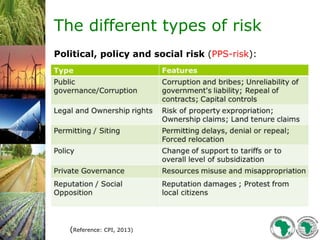
Political, policy and social risk (PPS-risk):
(Reference: CPI, 2013)
The different types of risk
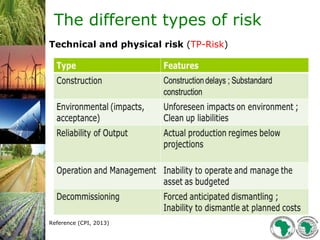
Technical and physical risk (TP-Risk)
Reference (CPI, 2013)
The different types of risk
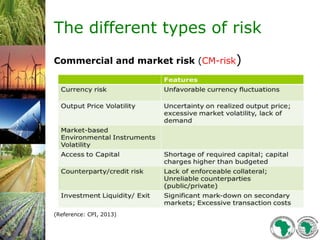
Commercial and market risk (CM-risk)
(Reference: CPI, 2013)
The different types of risk – I am not
convinced by this category – suggest you drop this slide
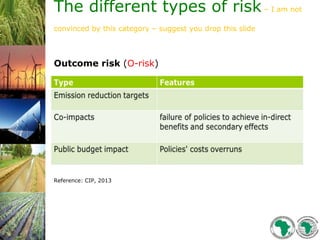
Outcome risk (O-risk)
Reference: CIP, 2013
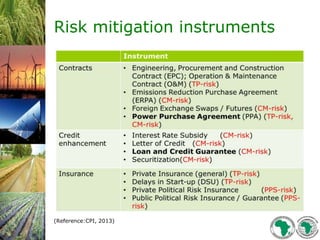
Risk mitigation instruments
(Reference:CPI, 2013)
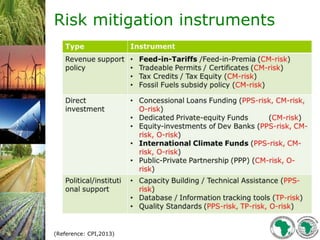
Risk mitigation instruments
(Reference: CPI,2013)
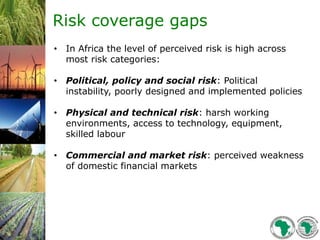
Risk coverage gaps
• In Africa the level of perceived risk is high across
most risk categories:
• Political, policy and social risk: Political
instability, poorly designed and implemented policies
• Physical and technical risk: harsh working
environments, access to technology, equipment,
skilled labour
• Commercial and market risk: perceived weakness
of domestic financial markets
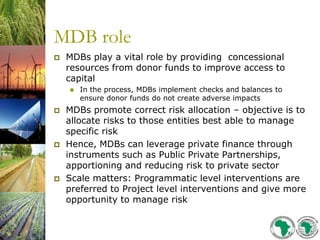
MDB role
 MDBs play a vital role by providing concessional
resources from donor funds to improve access to
capital
 In the process, MDBs implement checks and balances to
ensure donor funds do not create adverse impacts
 MDBs promote correct risk allocation – objective is to
allocate risks to those entities best able to manage
specific risk
 Hence, MDBs can leverage private finance through
instruments such as Public Private Partnerships,
apportioning and reducing risk to private sector
 Scale matters: Programmatic level interventions are
preferred to Project level interventions and give more
opportunity to manage risk
AfDB experience
• For large scale projects, risk transfer approach is
adopted most frequently (instruments include loan
guarantees, political risk insurance and public co-
investments);
• Targeted lines of credit and the Sustainable Energy
Fund for Africa (SEFA) provide examples of how
small-to-medium scale green projects can be
supported and new sources of capital attracted;
• Other programmatic instruments being deployed
include providing concessionary finance linked with
technical assistance, to commercial banks to
incentivize them to lend to renewable energy and
energy efficiency opportunities, especially small to
medium scale opportunities. (e.g Bank is in
discussion with two Nigerian banks to extend lines of
credit - which blend concessional climate finance - to
incentivize the banks to take on additional risk)
Case study 1: Morocco’s Ouarzazate I
Concentrated Solar Power (CSP) Project
($1.3B)
Strong public support
• A favorable regulatory and renewable energy policy framework
established to encourage private sector engagement
• A specialized entity (MASEN) set-up to manage CSP projects.
• A purchasing power agreement drawn up between MASEN and the
Power Utility.
Significant IFI contribution
IFIs provided significant concessional financing, which contributed to
driving down the levelized cost of energy by approximately a quarter. The
IFI financing also included resources from climate funds (CTF). In
addition, IFIs provided institutional and specialized technical
support.
Well-designed public private partnership
MASEN’s role in the public-private partnership is innovative: It acts as
both equity investor and power purchaser (off-taker) and thus has the
ability to align public and private objectives. The risk allocation is also
appropriate: the private developer bears construction and operational risk
while the Government of Morocco bears electricity market (revenue) risk.
Case study: Menengai Geothermal
Development Project
 Kenya recognized that investors are reluctant to take geothermal exploration
risk (and in the event investors take the risk the tariff becomes high). Hence,
considering the country’s well-developed energy policy, including feed-in
tariffs, Kenya established the Geothermal Development Company (GDC)
which is responsible for the developing geothermal fields, in specific steam
production – which the private sector will subsequently use to produce
electricity.
 For GDC’s development of the Menengai Field, the government of Kenya
provided USD 247 m while the African Development Fund provided USD
125m blended with USD 25m from the Scaling-up Renewable Energy
Program – one of the Climate Investment Funds – alongside other IFI
funding (AFD USD 72 m, EIB USD 38 m, IDA being finalized).
 This investment in drilling and steam production laid the foundation for
private sector investment in (Independent Power Producers) IPPs. The
procurement for the IPP projects (capacity of approximately 400 MW) is
currently underway.
 Going forward, in 2014, as the IPPs are established, African Development
Fund Partial Risk Guarantees of approximately USD 100 m are also
envisaged to provide investors with comfort on the steam supply by GDC to
the IPPs under the aegis of the steam supply agreements.
Thank you
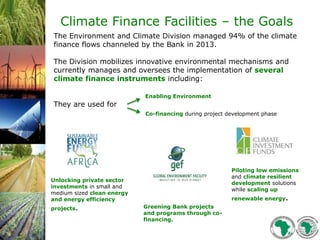
The Environment and Climate Division managed 94% of the climate
finance flows channeled by the Bank in 2013.
The Division mobilizes innovative environmental mechanisms and
currently manages and oversees the implementation of several
climate finance instruments including:
Enabling Environment
They are used for
Unlocking private sector
investments in small and
medium sized clean energy
and energy efficiency
projects. Greening Bank projects
and programs through co-
financing.
Piloting low emissions
and climate resilient
development solutions
while scaling up
renewable energy.
Co-financing during project development phase
Climate Finance Facilities – the Goals
Sustainable Energy Fund for
Africa ( SEFA)
SEFA is an AfDB-managed Multi-donor Trust Fund (~USD 75m) designed
to unlock private sector investments in Renewable Energy (RE) and
Energy Efficiency (EE) projects.
Key features:
 Pan-African mandate with no regional or technology constraints
 Promotion of private sector participation (IPPs or PPPs)
 Targeting the missing-middle (small / medium sized projects USD 10 –
200m)
 Early stage advisory to project developers to bring projects to
bankability
 Strong origination and due diligence capacity anchored in dedicated
team
 Ability to support upstream activities (policy, regulatory, capacity,
knowledge)
Through 3 areas of focus / financing
• Project preparation – TA grants & in-house (Secretariat) advisory
• Equity investments – through PE Fund (AREF managed by Berkeley
Energy)
• Enabling environment – TA grants & in-house (Secretariat) advisory
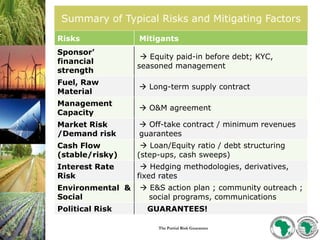
Risks Mitigants
Sponsor’
financial
strength
 Equity paid-in before debt; KYC,
seasoned management
Fuel, Raw
Material
 Long-term supply contract
Management
Capacity
 O&M agreement
Market Risk
/Demand risk
 Off-take contract / minimum revenues
guarantees
Cash Flow
(stable/risky)
 Loan/Equity ratio / debt structuring
(step-ups, cash sweeps)
Interest Rate
Risk
 Hedging methodologies, derivatives,
fixed rates
Environmental &
Social
 E&S action plan ; community outreach ;
social programs, communications
Political Risk GUARANTEES!
Summary of Typical Risks and Mitigating Factors
The Partial Risk Guarantee
19
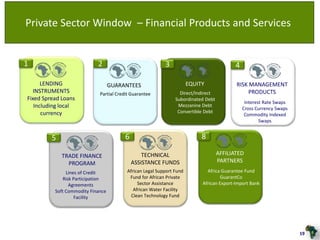
AFFILIATED
PARTNERS
Direct/Indirect
Subordinated Debt
Mezzanine Debt
Convertible Debt
EQUITY
Africa Guarantee Fund
GuarantCo
African Export-Import Bank
LENDING
INSTRUMENTS
Fixed Spread Loans
Including local
currency
Partial Credit Guarantee
GUARANTEES
Interest Rate Swaps
Cross Currency Swaps
Commodity Indexed
Swaps
RISK MANAGEMENT
PRODUCTS
Lines of Credit
Risk Participation
Agreements
Soft Commodity Finance
Facility
TRADE FINANCE
PROGRAM
TECHNICAL
ASSISTANCE FUNDS
African Legal Support Fund
Fund for African Private
Sector Assistance
African Water Facility
Clean Technology Fund
1 2 3 4
8
6
5
Private Sector Window – Financial Products and Services

afdb_presentation.pptx

  • 1.
    Risk management instruments tomobilize private finance
  • 2.
    Outline  The implicationsof risk  The different types of risk  Risk mitigation instruments  Risk coverage gaps  AfDB experience
  • 3.
    3 The implications ofrisk • Risk is the most important factor which prevents projects from finding financial investors; • Risk is the most important factor which prevents investors from raising the returns investors demand; • Higher financial returns are required to cover higher risks; • Risk and risk perceptions vary from project to project, technology to technology, industry to industry, and country to country; • Low carbon/ climate resilient (green/clean investments) can suffer higher risk perceptions due to their dependence on public policy and, often, relative immaturity of technologies, markets, and industries; (Reference: CPI, 2013)
  • 4.
    Political, policy andsocial risk (PPS-risk): (Reference: CPI, 2013) The different types of risk
  • 5.
    The different typesof risk Technical and physical risk (TP-Risk) Reference (CPI, 2013)
  • 6.
    The different typesof risk Commercial and market risk (CM-risk) (Reference: CPI, 2013)
  • 7.
    The different typesof risk – I am not convinced by this category – suggest you drop this slide Outcome risk (O-risk) Reference: CIP, 2013
  • 8.
  • 9.
  • 10.
    Risk coverage gaps •In Africa the level of perceived risk is high across most risk categories: • Political, policy and social risk: Political instability, poorly designed and implemented policies • Physical and technical risk: harsh working environments, access to technology, equipment, skilled labour • Commercial and market risk: perceived weakness of domestic financial markets
  • 11.
    MDB role  MDBsplay a vital role by providing concessional resources from donor funds to improve access to capital  In the process, MDBs implement checks and balances to ensure donor funds do not create adverse impacts  MDBs promote correct risk allocation – objective is to allocate risks to those entities best able to manage specific risk  Hence, MDBs can leverage private finance through instruments such as Public Private Partnerships, apportioning and reducing risk to private sector  Scale matters: Programmatic level interventions are preferred to Project level interventions and give more opportunity to manage risk
  • 12.
    AfDB experience • Forlarge scale projects, risk transfer approach is adopted most frequently (instruments include loan guarantees, political risk insurance and public co- investments); • Targeted lines of credit and the Sustainable Energy Fund for Africa (SEFA) provide examples of how small-to-medium scale green projects can be supported and new sources of capital attracted; • Other programmatic instruments being deployed include providing concessionary finance linked with technical assistance, to commercial banks to incentivize them to lend to renewable energy and energy efficiency opportunities, especially small to medium scale opportunities. (e.g Bank is in discussion with two Nigerian banks to extend lines of credit - which blend concessional climate finance - to incentivize the banks to take on additional risk)
  • 13.
    Case study 1:Morocco’s Ouarzazate I Concentrated Solar Power (CSP) Project ($1.3B) Strong public support • A favorable regulatory and renewable energy policy framework established to encourage private sector engagement • A specialized entity (MASEN) set-up to manage CSP projects. • A purchasing power agreement drawn up between MASEN and the Power Utility. Significant IFI contribution IFIs provided significant concessional financing, which contributed to driving down the levelized cost of energy by approximately a quarter. The IFI financing also included resources from climate funds (CTF). In addition, IFIs provided institutional and specialized technical support. Well-designed public private partnership MASEN’s role in the public-private partnership is innovative: It acts as both equity investor and power purchaser (off-taker) and thus has the ability to align public and private objectives. The risk allocation is also appropriate: the private developer bears construction and operational risk while the Government of Morocco bears electricity market (revenue) risk.
  • 14.
    Case study: MenengaiGeothermal Development Project  Kenya recognized that investors are reluctant to take geothermal exploration risk (and in the event investors take the risk the tariff becomes high). Hence, considering the country’s well-developed energy policy, including feed-in tariffs, Kenya established the Geothermal Development Company (GDC) which is responsible for the developing geothermal fields, in specific steam production – which the private sector will subsequently use to produce electricity.  For GDC’s development of the Menengai Field, the government of Kenya provided USD 247 m while the African Development Fund provided USD 125m blended with USD 25m from the Scaling-up Renewable Energy Program – one of the Climate Investment Funds – alongside other IFI funding (AFD USD 72 m, EIB USD 38 m, IDA being finalized).  This investment in drilling and steam production laid the foundation for private sector investment in (Independent Power Producers) IPPs. The procurement for the IPP projects (capacity of approximately 400 MW) is currently underway.  Going forward, in 2014, as the IPPs are established, African Development Fund Partial Risk Guarantees of approximately USD 100 m are also envisaged to provide investors with comfort on the steam supply by GDC to the IPPs under the aegis of the steam supply agreements.
  • 15.
  • 16.
    The Environment andClimate Division managed 94% of the climate finance flows channeled by the Bank in 2013. The Division mobilizes innovative environmental mechanisms and currently manages and oversees the implementation of several climate finance instruments including: Enabling Environment They are used for Unlocking private sector investments in small and medium sized clean energy and energy efficiency projects. Greening Bank projects and programs through co- financing. Piloting low emissions and climate resilient development solutions while scaling up renewable energy. Co-financing during project development phase Climate Finance Facilities – the Goals
  • 17.
    Sustainable Energy Fundfor Africa ( SEFA) SEFA is an AfDB-managed Multi-donor Trust Fund (~USD 75m) designed to unlock private sector investments in Renewable Energy (RE) and Energy Efficiency (EE) projects. Key features:  Pan-African mandate with no regional or technology constraints  Promotion of private sector participation (IPPs or PPPs)  Targeting the missing-middle (small / medium sized projects USD 10 – 200m)  Early stage advisory to project developers to bring projects to bankability  Strong origination and due diligence capacity anchored in dedicated team  Ability to support upstream activities (policy, regulatory, capacity, knowledge) Through 3 areas of focus / financing • Project preparation – TA grants & in-house (Secretariat) advisory • Equity investments – through PE Fund (AREF managed by Berkeley Energy) • Enabling environment – TA grants & in-house (Secretariat) advisory
  • 18.
    Risks Mitigants Sponsor’ financial strength  Equitypaid-in before debt; KYC, seasoned management Fuel, Raw Material  Long-term supply contract Management Capacity  O&M agreement Market Risk /Demand risk  Off-take contract / minimum revenues guarantees Cash Flow (stable/risky)  Loan/Equity ratio / debt structuring (step-ups, cash sweeps) Interest Rate Risk  Hedging methodologies, derivatives, fixed rates Environmental & Social  E&S action plan ; community outreach ; social programs, communications Political Risk GUARANTEES! Summary of Typical Risks and Mitigating Factors The Partial Risk Guarantee
  • 19.
    19 AFFILIATED PARTNERS Direct/Indirect Subordinated Debt Mezzanine Debt ConvertibleDebt EQUITY Africa Guarantee Fund GuarantCo African Export-Import Bank LENDING INSTRUMENTS Fixed Spread Loans Including local currency Partial Credit Guarantee GUARANTEES Interest Rate Swaps Cross Currency Swaps Commodity Indexed Swaps RISK MANAGEMENT PRODUCTS Lines of Credit Risk Participation Agreements Soft Commodity Finance Facility TRADE FINANCE PROGRAM TECHNICAL ASSISTANCE FUNDS African Legal Support Fund Fund for African Private Sector Assistance African Water Facility Clean Technology Fund 1 2 3 4 8 6 5 Private Sector Window – Financial Products and Services

Editor's Notes

  • #4  Definition of risk: “The chance that an investment's actual return will be different than expected. Risk includes the possibility of losing some or all of the original investment” Variations in project risk explains much of the difference in financing cost
  • #5 Additional risk for green investments Permitting/siting: some technologies (wind, concentrated solar, hydro) are highly site specific Policy: High reliance on public support for technologies not yet commercially mature Reputation/Social opposition: some technologies (wind, hydro) face high social opposition
  • #6 Additional risk for green investments Environmental (impacts/acceptance) – uncertainty due to novelty of most RE technologies Realiability of output – increased risk due to natural variability, inetremittency …
  • #7 Additional risk for green investments Output price volatility– high risk due to long horizon of investments and lack of commercial maturity; Market based environmental instruments volatility – uncertainty on realized GHG/pollutant externalityproces, excessive market volatility Investment liquidity/exit – niche and specialized market; lack of dedicated investors/markets Volatility in policy driven asset prices e
  • #8  Additional risk for green investments Co-impacts – secondary targets of Green Growth/creation of local job-industries /energy security Public budget impact – production support policies spur excessive growth that inflates policies’ cost
  • #9 Description of instruments the Bank has implemented some of them in the case studies which follow: Power Purchase Agreement: Provider: Public/Private Risk type: Technical, Physical Risk Description: A Power Purchase Agreement is a legal contract between an electricity generator (provider) and a power purchaser (typically a utility). It is used to cover uncertainty of the seller related to expected revenues of the project (which hamper its viability), or when the purchaser wants to secure supply of power at a predefined price (to know of any potential constraints for budget in advance). Loan and Credit Guarantee Provider: Public/Private Risk type: Commercial, Market Risk Description: Loan Guarantees - Contractual obligation by which a guarantor assumes the responsibility of assuring payment or fulfillment of a borrower’s debt or obligation, in case of default. Loan guarantees can refer to a private agreement with a bank, or to an agreement in which the government is the guarantor of the debt’s obligation. They can be direct, to intermediaries that provide finance directly to project developers, or counter-guarantees, to intermediaries that issue guarantees for the benefit of lending institutions. Partial Credit Guarantees - Provided by Development Financial Institutions (both multilateral and some bilateral) at commercial rates to cover private lenders against the risk of debt service default by government or public (and recently private) sector borrowers, versus the payment of a guarantee-fee. “Partial” is intended for a guarantee coverage amount lower than 100% of the principal and/or interest. PCGs can be used for any commercial debt instruments (loans, bonds) provided by any private institution, and are flexible with regards to the balance of risk sharing of the borrower’s credit.
  • #10 Description of instruments the Bank has implemented some of them in the case studies which follow: Feed-in-Tariffs Provider: Public Risk type: Commercial, Market Risk Description: FiT are policies that provide price certainty and long-term contracts to energy producers in order to help investment in renewable energy. Usually FiTs are accompanied by a "tariff digression” mechanism that decreases the tariff over time. FiP are composed of both a premium (like FiT) and the market value of electricity, exposed to market fluctuations. Risks related to market fluctuations are thus only partially addressed. Concessional loan Provider: Public Risk type: Commercial, Market Risk Description: In a concessional loan, while the principal loan amount needs to be paid back, the interest rate payments are still significantly reduced and can include a longer repayment period or even a gracing period International climate funds Provider: Public Risk type: Commercial, Market Risk Description: International Climate Funds are operating entities whose mission is to finance projects, programs, and policies, mainly in developing countries, related to global climate change mitigation and adaptation. Public Private Partnership Provider: Public/Private Risk type: Commercial, Market Risk Description: A Public-Private Partnership is a contractual agreement between a public agency and a private sector entity for the execution of a project, service, or facility for the use of the general public. Public-Private Partnerships provide for the sharing of resources (skills and assets), risks, and rewards between the public and the private sector
  • #19 The overall “riskiness” of a business enterprise is the result of a variety of components.