Ben Yangin Yoon
Rutgers Business School
Isabel Martínez Conesa
University of Murcia
Emiliano Ruiz Barbadillo
University of Cádiz
Auditor’s Independence and the Level of Materiality
Contabilidad, Gestión y Agenda 2030
Background – materiality level
• Materiality in auditing
- Monetary amount criteria deciding the material information
- Material vs. Immaterial (ISA 1)
- No simple or mechanical rules when deciding the materiality level
- Consider the quantitative factors and the qualitative factors (ISA 320, The
Guide to Quality Audit of Spain)
- Little have known about how auditors calculate materiality, being
materiality a fundamental parameter for the assurance intended.
- Materiality has been and continues to be a relevant topic for auditors.
Background – auditor’s independence
• Auditor’s independence
- Auditing is highly judgmental process.
- The auditing standards cannot articulate every detailed procedure.
- Auditor’s independence is a key element for the high audit quality.
• Measuring auditor’s independence in the prior literature
- It is difficult to measure the level of auditor’s independence
- Researchers use 1) type of audit opinions, 2) accruals, 3) meeting or
beating the analysts forecast, etc.
Objective – materiality and auditor’s
independence
‘‘Numbers Game’’ Speech:
“Some companies misuse the concept of materiality. They intentionally record errors within a defined
percentage ceiling. They then try to excuse that fib by arguing that the effect on the bottom line is too small
to matter. If that’s the case, why do they work so hard to create these errors? Maybe because the effect can
matter, especially if it picks up that last penny of the consensus estimate. When either management or the
outside auditors are questioned about these clear violations of GAAP, they answer sheepishly ... ‘‘It doesn’t
matter. It’s immaterial.’’
Securities and Exchange Chairman
Arthur Levitt, 1998
we attempt to highlight the implication of certain factors subrogate of the
independence with regard to making decisions pertaining to the value of materiality.
Prior Literature
• Materiality level in auditing. No public data
- Positive association between the materiality level and the reporting
liability (Choudhary et al. 2019)
- Lower materiality level when small absolute ROA (Blokdijk et al. 2003)
- Lower materiality level with external debt financing or inside shareholding
(Amiram et al. 2017)
- Higher materiality level with new clients; more modified opinion with
lower materiality level (Yoon et al. 2020)
Prior Literature
• Measuring Auditor’s independence as audit quality
Telapagul and Lin (2014): classified 4 factors can threaten auditor independence:
audit fees, non audit fees, audit tenure and special affiliations.
- Researchers use various proxy variables
- Type of audit opinions CLEAN (Krishnan and Krishnan 1996; Craswell et al. 2002;
Carey and Simnett 2006; Lim and Tan 2008; Robinson 2008; Li 2009; Hope and Langli
2010; Blay and Geiger 2013)
- Accruals (Reynolds and Francis 2000; Chung and Kallapur 2003; Hunt and Lulseged,
2007)
- Meeting or beating the analyst forecast (Menon and Williams 2004; Carey and
Simnett 2006; Davis et al. 2009)
Hypothesis development
• Materiality and audit quality
- NEGATIVE: High materiality level with low audit quality (Choudhary et al. 2019)
• Audit fees and audit quality (auditor independence). 2 opposite association:
- NEGATIVE: High audit fees are related to the low audit quality (Ruiz‐Barbadillo et al. 2009; Choi et al. 2010;
Asthana and Boone 2012; Keune and Johnstone 2012; Blay and Geiger 2013; Hribar et al. 2014; Tepalagul and Lin 2015)
- POSITIVE: High audit fees are related to the high audit quality: additional risk premium (Blankley et
al. 2012; Lobo and Zhao, 2013; Eshleman and Guo 2014)
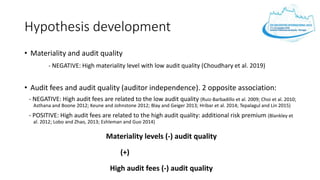
Materiality levels (-) audit quality
(+)
High audit fees (-) audit quality
Hypothesis development
MATERIALITY = function (economic dependence variables)
- Audit fees : LOG_AUDIT_FEE
- Abnormal audit fees or non expected audit fees (residual of model of audit fees of Simunic 1980)
UNEXPD_AUDIT_FEE
- Future audit fees (log sum audit fees follow two years) LOG_FUTURE_AUDIT_FEE
- Client importance (audit fee client / total audit fees) FEE_PORTION
we expect: more economic dependence, more materiality level
Materiality is a proxy of auditor independence
Hypothesis 1:
Economic Dependence have a positive association with materiality level
Hypothesis development
• Auditor independence and audit tenure
- Familiarity with clients can reduce the auditor independence.
- Audit tenure and audit quality.
- Low audit quality in the initial years with new clients (Johnson et al. 2002; Carcello and
Nagy 2004)
- Audit quality becomes low when the same auditor continues audits (Deis and
Giroux 1992; Carey and Simnett 2006; Davis et al. 2009).
• Hypothesis 2
Materiality levels are moderated by the audit tenure.
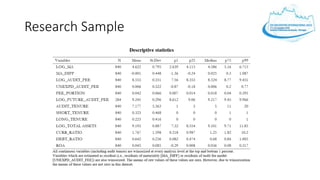
Research Sample
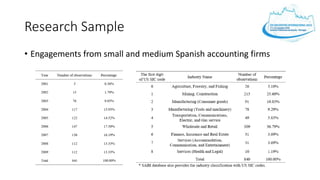
• Engagements from small and medium Spanish accounting firms
Research Sample
Materiality estimation model
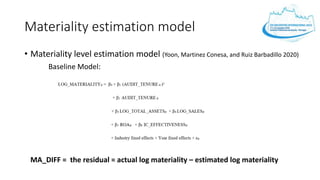
• Materiality level estimation model (Yoon, Martinez Conesa, and Ruiz Barbadillo 2020)
Baseline Model:
MA_DIFF = the residual = actual log materiality – estimated log materiality
Main results
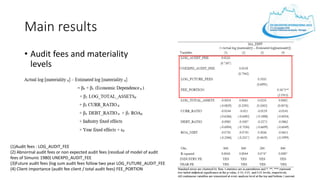
• Audit fees and materiality
levels
(1)Audit fees : LOG_AUDIT_FEE
(2) Abnormal audit fees or non expected audit fees (residual of model of audit
fees of Simunic 1980) UNEXPD_AUDIT_FEE
(3)Future audit fees (log sum audit fees follow two year LOG_FUTURE_AUDIT_FEE
(4) Client importance (audit fee client / total audit fees) FEE_PORTION
Main results
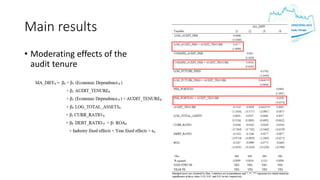
• Moderating effects of the
audit tenure
Main results
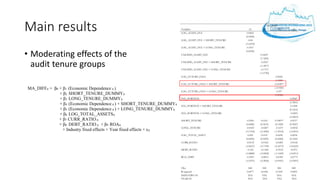
• Moderating effects of the
audit tenure groups
MA_DIFF
Variables (1) (2) (3) (4)
LOG_AUDIT_FEE 0.0602
(0.5498)
LOG_AUDIT_FEE × SHORT_TENURE -0.06
(-0.4335)
LOG_AUDIT_FEE × LONG_TENURE 0.1057
(0.6926)
UNEXPD_AUDIT_FEE 0.1823*
(1.7205)
UNEXPD_AUDIT_FEE × SHORT_TENURE -0.2367
(-1.5877)
UNEXPD_AUDIT_FEE × LONG_TENURE -0.1713
(-1.0720)
LOG_FUTURE_FEES 0.2024
(1.0589
LOG_FUTURE_FEES × SHORT_TENURE -0.5549**
(-2.1026)
LOG_FUTURE_FEES × LONG_TENURE 0.337
(1.2328)
FEE_PORTION 0.5586*
(1.9261)
FEE_PORTION × SHORT_TENURE 0.1308
(0.1616)
FEE_PORTION × LONG_TENURE -0.2243
(-0.2063)
SHORT_TENURE 0.5304 0.0161 5.1985** 0.0157
(0.4486) (0.3615) (2.1429) (0.3027)
LONG_TENURE -0.9433 -0.0207 -3.1679 -0.0032
(-0.7100) (-0.3200) (-1.2512) (-0.0431)
LOG_TOTAL_ASSET 0.002 0.0147 0.0438 0.0034
(0.0696) (0.5259) (0.6284) (0.1241)
CURR_RATIO -0.0153 -0.0164 -0.0283 -0.0146
(-0.6657) (-0.7159) (-0.4573) (-0.6223)
DEBT_RATIO -0.125 -0.1184 -0.3914 -0.097)
(-0.8880) (-0.8402) (-1.1609) (-0.6911)
ROA_NIBT -0.1091 -0.0812 -0.0345 -0.0773
(-0.3531) (-0.2664) (-0.0551) (-0.2501)
Obs. 840 840 284 840
R-squared 0.0077 0.0108 0.1203 0.0095
INDUSTRY FE YES YES YES YES
YEAR FE YES YES YES YES
MA_DIFFit = β0 + β1 (Economic Dependence it )
+ β2 SHORT_TENURE_DUMMYit
+ β3 LONG_TENURE_DUMMYit
+ β4 (Economic Dependence it ) × SHORT_TENURE_DUMMYit
+ β5 (Economic Dependence it ) × LONG_TENURE_DUMMYit
+ β6 LOG_TOTAL_ASSETSit
+ β7 CURR_RATIO it
+ β8 DEBT_RATIO it + β9 ROAit
+ Industry fixed effects + Year fixed effects + εit
Conclusion and discussion
• In general, auditors remain independent regardless of the audit fee levels.
- Auditors do not change the materiality level regardless of the audit fees.
- Only the importance of clients has statistical significance in our analysis.
• This study propose a new method in order to measure the level of auditor
independence.
Thank you

Aeca materiality auditor independence 2020

  • 1.
    Ben Yangin Yoon RutgersBusiness School Isabel Martínez Conesa University of Murcia Emiliano Ruiz Barbadillo University of Cádiz Auditor’s Independence and the Level of Materiality Contabilidad, Gestión y Agenda 2030
  • 2.
    Background – materialitylevel • Materiality in auditing - Monetary amount criteria deciding the material information - Material vs. Immaterial (ISA 1) - No simple or mechanical rules when deciding the materiality level - Consider the quantitative factors and the qualitative factors (ISA 320, The Guide to Quality Audit of Spain) - Little have known about how auditors calculate materiality, being materiality a fundamental parameter for the assurance intended. - Materiality has been and continues to be a relevant topic for auditors.
  • 3.
    Background – auditor’sindependence • Auditor’s independence - Auditing is highly judgmental process. - The auditing standards cannot articulate every detailed procedure. - Auditor’s independence is a key element for the high audit quality. • Measuring auditor’s independence in the prior literature - It is difficult to measure the level of auditor’s independence - Researchers use 1) type of audit opinions, 2) accruals, 3) meeting or beating the analysts forecast, etc.
  • 4.
    Objective – materialityand auditor’s independence ‘‘Numbers Game’’ Speech: “Some companies misuse the concept of materiality. They intentionally record errors within a defined percentage ceiling. They then try to excuse that fib by arguing that the effect on the bottom line is too small to matter. If that’s the case, why do they work so hard to create these errors? Maybe because the effect can matter, especially if it picks up that last penny of the consensus estimate. When either management or the outside auditors are questioned about these clear violations of GAAP, they answer sheepishly ... ‘‘It doesn’t matter. It’s immaterial.’’ Securities and Exchange Chairman Arthur Levitt, 1998 we attempt to highlight the implication of certain factors subrogate of the independence with regard to making decisions pertaining to the value of materiality.
  • 5.
    Prior Literature • Materialitylevel in auditing. No public data - Positive association between the materiality level and the reporting liability (Choudhary et al. 2019) - Lower materiality level when small absolute ROA (Blokdijk et al. 2003) - Lower materiality level with external debt financing or inside shareholding (Amiram et al. 2017) - Higher materiality level with new clients; more modified opinion with lower materiality level (Yoon et al. 2020)
  • 6.
    Prior Literature • MeasuringAuditor’s independence as audit quality Telapagul and Lin (2014): classified 4 factors can threaten auditor independence: audit fees, non audit fees, audit tenure and special affiliations. - Researchers use various proxy variables - Type of audit opinions CLEAN (Krishnan and Krishnan 1996; Craswell et al. 2002; Carey and Simnett 2006; Lim and Tan 2008; Robinson 2008; Li 2009; Hope and Langli 2010; Blay and Geiger 2013) - Accruals (Reynolds and Francis 2000; Chung and Kallapur 2003; Hunt and Lulseged, 2007) - Meeting or beating the analyst forecast (Menon and Williams 2004; Carey and Simnett 2006; Davis et al. 2009)
  • 7.
    Hypothesis development • Materialityand audit quality - NEGATIVE: High materiality level with low audit quality (Choudhary et al. 2019) • Audit fees and audit quality (auditor independence). 2 opposite association: - NEGATIVE: High audit fees are related to the low audit quality (Ruiz‐Barbadillo et al. 2009; Choi et al. 2010; Asthana and Boone 2012; Keune and Johnstone 2012; Blay and Geiger 2013; Hribar et al. 2014; Tepalagul and Lin 2015) - POSITIVE: High audit fees are related to the high audit quality: additional risk premium (Blankley et al. 2012; Lobo and Zhao, 2013; Eshleman and Guo 2014) Materiality levels (-) audit quality (+) High audit fees (-) audit quality
  • 8.
    Hypothesis development MATERIALITY =function (economic dependence variables) - Audit fees : LOG_AUDIT_FEE - Abnormal audit fees or non expected audit fees (residual of model of audit fees of Simunic 1980) UNEXPD_AUDIT_FEE - Future audit fees (log sum audit fees follow two years) LOG_FUTURE_AUDIT_FEE - Client importance (audit fee client / total audit fees) FEE_PORTION we expect: more economic dependence, more materiality level Materiality is a proxy of auditor independence Hypothesis 1: Economic Dependence have a positive association with materiality level
  • 9.
    Hypothesis development • Auditorindependence and audit tenure - Familiarity with clients can reduce the auditor independence. - Audit tenure and audit quality. - Low audit quality in the initial years with new clients (Johnson et al. 2002; Carcello and Nagy 2004) - Audit quality becomes low when the same auditor continues audits (Deis and Giroux 1992; Carey and Simnett 2006; Davis et al. 2009). • Hypothesis 2 Materiality levels are moderated by the audit tenure.
  • 10.
    Research Sample • Engagementsfrom small and medium Spanish accounting firms
  • 11.
  • 12.
    Materiality estimation model •Materiality level estimation model (Yoon, Martinez Conesa, and Ruiz Barbadillo 2020) Baseline Model: MA_DIFF = the residual = actual log materiality – estimated log materiality
  • 13.
    Main results • Auditfees and materiality levels (1)Audit fees : LOG_AUDIT_FEE (2) Abnormal audit fees or non expected audit fees (residual of model of audit fees of Simunic 1980) UNEXPD_AUDIT_FEE (3)Future audit fees (log sum audit fees follow two year LOG_FUTURE_AUDIT_FEE (4) Client importance (audit fee client / total audit fees) FEE_PORTION
  • 14.
    Main results • Moderatingeffects of the audit tenure
  • 15.
    Main results • Moderatingeffects of the audit tenure groups MA_DIFF Variables (1) (2) (3) (4) LOG_AUDIT_FEE 0.0602 (0.5498) LOG_AUDIT_FEE × SHORT_TENURE -0.06 (-0.4335) LOG_AUDIT_FEE × LONG_TENURE 0.1057 (0.6926) UNEXPD_AUDIT_FEE 0.1823* (1.7205) UNEXPD_AUDIT_FEE × SHORT_TENURE -0.2367 (-1.5877) UNEXPD_AUDIT_FEE × LONG_TENURE -0.1713 (-1.0720) LOG_FUTURE_FEES 0.2024 (1.0589 LOG_FUTURE_FEES × SHORT_TENURE -0.5549** (-2.1026) LOG_FUTURE_FEES × LONG_TENURE 0.337 (1.2328) FEE_PORTION 0.5586* (1.9261) FEE_PORTION × SHORT_TENURE 0.1308 (0.1616) FEE_PORTION × LONG_TENURE -0.2243 (-0.2063) SHORT_TENURE 0.5304 0.0161 5.1985** 0.0157 (0.4486) (0.3615) (2.1429) (0.3027) LONG_TENURE -0.9433 -0.0207 -3.1679 -0.0032 (-0.7100) (-0.3200) (-1.2512) (-0.0431) LOG_TOTAL_ASSET 0.002 0.0147 0.0438 0.0034 (0.0696) (0.5259) (0.6284) (0.1241) CURR_RATIO -0.0153 -0.0164 -0.0283 -0.0146 (-0.6657) (-0.7159) (-0.4573) (-0.6223) DEBT_RATIO -0.125 -0.1184 -0.3914 -0.097) (-0.8880) (-0.8402) (-1.1609) (-0.6911) ROA_NIBT -0.1091 -0.0812 -0.0345 -0.0773 (-0.3531) (-0.2664) (-0.0551) (-0.2501) Obs. 840 840 284 840 R-squared 0.0077 0.0108 0.1203 0.0095 INDUSTRY FE YES YES YES YES YEAR FE YES YES YES YES MA_DIFFit = β0 + β1 (Economic Dependence it ) + β2 SHORT_TENURE_DUMMYit + β3 LONG_TENURE_DUMMYit + β4 (Economic Dependence it ) × SHORT_TENURE_DUMMYit + β5 (Economic Dependence it ) × LONG_TENURE_DUMMYit + β6 LOG_TOTAL_ASSETSit + β7 CURR_RATIO it + β8 DEBT_RATIO it + β9 ROAit + Industry fixed effects + Year fixed effects + εit
  • 16.
    Conclusion and discussion •In general, auditors remain independent regardless of the audit fee levels. - Auditors do not change the materiality level regardless of the audit fees. - Only the importance of clients has statistical significance in our analysis. • This study propose a new method in order to measure the level of auditor independence.
  • 17.

Editor's Notes

  • #5 la materialidad podría explicar como problema de DEPENDENCIA ECONÓMICA: En ocasiones los auditores pueden reducir su independencia con el objetivo de mantener rentas económicas en el tiempo. Si el auditor tiene un conflicto con el gerente para tratar de enmascarar / manipular un error, es probable que el gerente amenace al auditor con la pérdida del trabajo, por lo que si el auditor recibe rentas económicas altas, estará dispuesto a enmascarar el error elevando su valoración de la materialidad. Este es el aporte del estudio, por lo que debemos colocar el concepto de materialidad en una decisión problemática en la que gerente y auditor pueden tener conflictos, efectos de retención de clientes, incentivos y riesgos comerciales del cliente en las decisiones de los auditores con respecto a si aceptar las prácticas agresivas de presentación de informes de los clientes y donde el gerente pueda amenazar al auditor con la pérdida del contrato. Debemos enfocarnos en las rentas económicas, y como la dependencia económica varía en diferentes momentos de la relación contractual. Por ello también tenemos en cuenta la evolución de la materialidad a lo largo del contrato y como ello afecta a la independencia
  • #8 Nuestra hipótesis básica es que los honorarios podrían ser subrrogados de dependencia económica de la firma y por tanto poner en compromiso la independencia del auditor cuando ante una discrepancia, el cliente puede amenazar con la pérdida del contrato. Pero los honorarios también se interpretan como mejoraras en la calidad de la auditoría. Encontramos dos asociaciones contrarias entre honorarios y independencia del auditor: 1.- NEGATIVA: Dependencia económica por la que honorarios altos comprometen la independencia del auditor. BAJA CALIDAD DE LA AUDITORÍA 2- POSTITIVA Honorarios altos representan una prima de riesgo adicional. ALTA CALIDAD DE LA AUDITORÍA La relación entre materialidad y calidad de la auditoría siempre es negativa Por ello en los casos de falta de calidad podremos encontrar una relación positiva entre los niveles de materialidad y altos honorarios Por ello podemos establecer una relación a tres:
  • #9  En resumen, esperamos que la dependencia económica tenga una asociación positiva con el nivel de materialidad. Esta sería nuestra primera hipótesis que nos ha costado redactar
  • #10 Partimos de la hipótesis de que la dependencia económica no es constante a lo largo del tiempo. A corto plazo los auditores deben recuperar los costes de arranque para desarrollar la auditoría. Cuando hayan cubierto estos costes resultarán menos dependientes desde el pv económico. Por eso planteamos que la materialidad es una variable que tiende a reducirse a lo largo del tiempo.