Advocacy Sessions 2013
5th April 2013
What is Advocacy?

• Speaking on behalf of oneself or another to get something done
• Believing in what you speak for
• Standing up for something you believe in
• Make sure people's rights are taken care of
What Advocacy is not
about
• Being a friend or counsellor.
• Persuading/Forcing others to agree with you.
• Deciding what is in the person's best interests.
• Complaining
• Campaigning - although it may highlight problems and
 gaps in particular service.
• Providing social support - for example managing
 someone's financial affairs or organizing transport or
 shopping.
Types of Advocacy
1.Mass Advocacy
2.Ideological Advocacy
3.Advocacy for Social Justice
4.Health Advocacy
5.Environmental Advocacy
6.Citizen Advocacy
7.Crisis Advocacy
8.Animal Rights Advocacy
9.And MANY MORE
Who can advocate?


         YOU
It does not need to be your idea. It can be an idea you believe
and would like to share about.
Examples

•Earth Day
•Kyoto Protocol
•Global Zero
•Health Promotion Board's 'I Quit'
Common Understanding
1.Respect each other's views and opinions
2.There is room for disagreement
3.Behave appropriately
4.Support the noble causes and ideas
5.By the idea, not the person
6.No topic is boring
7.Sensitive about cultural issues
8.No stereotyping
9.Ultimately here to spread the message of justice, righteousness
  and goodness
The Atmosphere

1.Audience involvement
2.Sharing of thoughts and ideas
3.Supportive regardless of race, language,
 religion or age
“All disadvantaged persons need advocacy,
  privileged people get it without looking.”
Change
The power of the people
• Easy to see power in the hands of the
  few
• Yet it is the masses who have the
  most at stake
• History is full of lessons
• Where common people have inspired
  and executed change
• Response to unfulfilled needs
• - Hunger, injustice
• Abstract concepts
• - Liberty, Equality
• Moral standing
• - The right thing to do
2 Examples


• Specific example -Public opinion during the
  Vietnam War
• General example -Revolutions
Second War of Indochina
• One of the cold war
  “hot spots”

• American
  intervention from
  1960s-mid 1970s

• Unlimited media
  coverage
                                                  Retrieved 2nd February 2013 from
                        http://upload.wikimedia.org/wikipedia/commons/7/76/Bruce_Crandall%27s_UH-1D.jpg
Progression of war

• By 1970, only 36% of
  Americans were
  supportive of the war

• Hundreds of thousands
  took to the streets to
  protest

• Musicians, students, even
  veterans

                                               Retrieved 2nd February 2013 from
                              http://upload.wikimedia.org/wikipedia/commons/0/03/Vietnamdem.jpg
Some videos

• http://www.youtube.com/watch?v=KII2y2QVprQ
• 18:30-18:50
• http://www.youtube.com/watch?v=V-lr8Y7M1lE
• 17:40-20:07
Not all was well
•   Kent State University shootings

•   Confrontation between Ohio National
    Guard and demonstrating students

•   4 dead, 9 injured

•   4 million students went on strike in
    response

•   Affected hundreds of universities,
                                                             Retrieved 2nd February 2013 from

    colleges, and high schools             http://upload.wikimedia.org/wikipedia/en/6/65/Kent_State_massacre.jpg
After

• Influenced US withdrawal from Vietnam
• Nixon’s promise
• Thus, demonstrations by the masses ->
  Change in government policy
• The price some paid
Revolution
• Previous example happened in a country
  where free speech is allowed
• Still possible to incite change in oppressive
  environments
• Defined as “a forcible overthrow of a
  government or social order, in favour of
  a new system.”
Conclusion

• A voice loud enough cannot be ignored
• A force strong enough cannot be crushed
• A heart that believes, triumphs
• http://www.youtube.com/watch?v=WibmcsEGLKo
Global Warming
 Johanna Lim Ziyun, S1-09
What is global warming?
•   Global Warming is the increase of Earth's average surface
    temperature due to effect of greenhouse gases, such as carbon
    dioxide emissions from burning fossil fuels or from deforestation,
    which trap heat that would otherwise escape from Earth. This is a type
    of greenhouse effect.

•   Global Warming is a serious situation and it has to be treated
    immediately as the Earth’s ozone layer is depleting and our
    surroundings are getter hotter and hotter.
Effects of Global Warming
 • Ocean circulation disrupted, disrupting and having unknown effects on
     world climate.

 •   Higher sea level leading to flooding of low-lying lands and deaths and
     disease from flood and evacuation.

 •   Deserts get drier leaving to increased desertification.

 •   Water shortages in already water-scarce areas.

 •   Increased disease in humans and animals.

 •   Increased deaths from heat waves.

 •   Extinction of additional species of animals and plants.
Why is it happening?
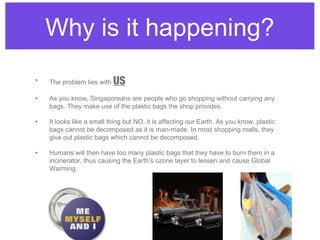
•   The problem lies with   US
•   As you know, Singaporeans are people who go shopping without carrying any
    bags. They make use of the plastic bags the shop provides.

•   It looks like a small thing but NO, it is affecting our Earth. As you know, plastic
    bags cannot be decomposed as it is man-made. In most shopping malls, they
    give out plastic bags which cannot be decomposed.

•   Humans will then have too many plastic bags that they have to burn them in a
    incinerator, thus causing the Earth’s ozone layer to lessen and cause Global
    Warming.
How do we improve it?
•   Use less energy, or use alternative, nonpolluting energy sources like
    solar and wind power. At home, this translates to saving electricity by
    using energy-efficient appliances and compact fluorescent light bulbs.

•   Plant trees as trees produce oxygen

•   Conserve Water

•   Reduce, reuse and recycle!
Fun Facts
Every single day, 70 million tons of carbon dioxide are released into our world’s atmosphere.
That’s 1.4 billion pounds – yesterday, today, tomorrow, and every single day.

1.The warmest years on record have been in the past 10 out of 12 years. Since record-keeping
began in 1880, the planet’s 10 hottest years were all in your lifetime, between 1997 and 2008.

2.2008 saw the second-lowest summer Arctic sea ice ever recorded since satellites began keeping
track in 1979, at 1.74 million square miles.This is 860,000 square miles below the average
minimum seen in the summers from 1979 to 2000. (Summer 2007 saw the lowest levels ever
recorded, at 1.65 million square miles).

3.Ships for the first time can sail along the Northwest Passage above North America. Once a
fabled passageway, melting Arctic ice from global warming has let this route become a reality for
the first time in over 100 years.

4.Arctic summers could be ice-free by 2040 or sooner, decades ahead of previous estimates. As
this ice “mirror” that reflects sunlight back into space disappears, the effects of global warming
will increase as the oceans absorb more of the sun’s heat. This melting ice will cause polar bears
and other species to lose their icy habitat and eventually become extinct.
Food for Thought
• How can we stop global warming? (other than
  the ways mentioned)
• How do we persuade everyone to follow this
  correct way?
• How can we apply these ways in our daily
  lives?
• What are your views and opinions towards
  Global Warming?
Sources

•   Images from Google Images

•   http://greenliving.nationalgeographic.com/top-ways-stop-global-

•   http://miracle-kids.net/en/basic/basic01-1.html

•   http://www.nmsea.org/Curriculum/Primer/Global_Warming/fo

•   http://library.thinkquest.org/11013/effects.html
Thank You For Your Kind
       Attention!
Food
Waste
Singapore generated 570m kg of food waste in
2008, according to the National Environment
Agency.

In the same year, International Enterprise
Singapore showed that Singapore’s net food
imports amounted to 3 030m kg.

The percentage of food waste was almost 19%.

The population then was 4.84 million (1.05m foreign
workers).

Average food waste was 118 kg per person per
year.
Global food waste in 2011

Food waste kg per capita (kg / year)
Singapore: 132 (2011)
(Corrected figure: 135)

Hong Kong:
183 (2012)
Kuala Lumpur:
230
Bangkok: 162
Guangzhou: 170
Taiwan: 128
Japan: 180
South Korea: 106
Singapore's approach
South Korea's approach
Hong Kong's approach


Donated to food banks

Social enterprises

Compost

Biogas
Discussion


Citizens

SST
End of Presentation
Thank you for your attendance and support!
The Challenge
To start a small movement in our school!


What is it about:
Get people to be more considerate!


How:


Starting a culture of clearing every single grain on our plates before returning and
   then rinsing it

Advocacy presentation 05_04_2013

  • 1.
  • 2.
    What is Advocacy? •Speaking on behalf of oneself or another to get something done • Believing in what you speak for • Standing up for something you believe in • Make sure people's rights are taken care of
  • 3.
    What Advocacy isnot about • Being a friend or counsellor. • Persuading/Forcing others to agree with you. • Deciding what is in the person's best interests. • Complaining • Campaigning - although it may highlight problems and gaps in particular service. • Providing social support - for example managing someone's financial affairs or organizing transport or shopping.
  • 4.
    Types of Advocacy 1.MassAdvocacy 2.Ideological Advocacy 3.Advocacy for Social Justice 4.Health Advocacy 5.Environmental Advocacy 6.Citizen Advocacy 7.Crisis Advocacy 8.Animal Rights Advocacy 9.And MANY MORE
  • 5.
    Who can advocate? YOU It does not need to be your idea. It can be an idea you believe and would like to share about.
  • 6.
    Examples •Earth Day •Kyoto Protocol •GlobalZero •Health Promotion Board's 'I Quit'
  • 7.
    Common Understanding 1.Respect eachother's views and opinions 2.There is room for disagreement 3.Behave appropriately 4.Support the noble causes and ideas 5.By the idea, not the person 6.No topic is boring 7.Sensitive about cultural issues 8.No stereotyping 9.Ultimately here to spread the message of justice, righteousness and goodness
  • 8.
    The Atmosphere 1.Audience involvement 2.Sharingof thoughts and ideas 3.Supportive regardless of race, language, religion or age
  • 9.
    “All disadvantaged personsneed advocacy, privileged people get it without looking.”
  • 10.
  • 11.
    • Easy tosee power in the hands of the few • Yet it is the masses who have the most at stake • History is full of lessons • Where common people have inspired and executed change
  • 12.
    • Response tounfulfilled needs • - Hunger, injustice • Abstract concepts • - Liberty, Equality • Moral standing • - The right thing to do
  • 13.
    2 Examples • Specificexample -Public opinion during the Vietnam War • General example -Revolutions
  • 14.
    Second War ofIndochina • One of the cold war “hot spots” • American intervention from 1960s-mid 1970s • Unlimited media coverage Retrieved 2nd February 2013 from http://upload.wikimedia.org/wikipedia/commons/7/76/Bruce_Crandall%27s_UH-1D.jpg
  • 15.
    Progression of war •By 1970, only 36% of Americans were supportive of the war • Hundreds of thousands took to the streets to protest • Musicians, students, even veterans Retrieved 2nd February 2013 from http://upload.wikimedia.org/wikipedia/commons/0/03/Vietnamdem.jpg
  • 16.
    Some videos • http://www.youtube.com/watch?v=KII2y2QVprQ •18:30-18:50 • http://www.youtube.com/watch?v=V-lr8Y7M1lE • 17:40-20:07
  • 17.
    Not all waswell • Kent State University shootings • Confrontation between Ohio National Guard and demonstrating students • 4 dead, 9 injured • 4 million students went on strike in response • Affected hundreds of universities, Retrieved 2nd February 2013 from colleges, and high schools http://upload.wikimedia.org/wikipedia/en/6/65/Kent_State_massacre.jpg
  • 18.
    After • Influenced USwithdrawal from Vietnam • Nixon’s promise • Thus, demonstrations by the masses -> Change in government policy • The price some paid
  • 19.
    Revolution • Previous examplehappened in a country where free speech is allowed • Still possible to incite change in oppressive environments • Defined as “a forcible overthrow of a government or social order, in favour of a new system.”
  • 20.
    Conclusion • A voiceloud enough cannot be ignored • A force strong enough cannot be crushed • A heart that believes, triumphs • http://www.youtube.com/watch?v=WibmcsEGLKo
  • 21.
    Global Warming JohannaLim Ziyun, S1-09
  • 22.
    What is globalwarming? • Global Warming is the increase of Earth's average surface temperature due to effect of greenhouse gases, such as carbon dioxide emissions from burning fossil fuels or from deforestation, which trap heat that would otherwise escape from Earth. This is a type of greenhouse effect. • Global Warming is a serious situation and it has to be treated immediately as the Earth’s ozone layer is depleting and our surroundings are getter hotter and hotter.
  • 23.
    Effects of GlobalWarming • Ocean circulation disrupted, disrupting and having unknown effects on world climate. • Higher sea level leading to flooding of low-lying lands and deaths and disease from flood and evacuation. • Deserts get drier leaving to increased desertification. • Water shortages in already water-scarce areas. • Increased disease in humans and animals. • Increased deaths from heat waves. • Extinction of additional species of animals and plants.
  • 24.
    Why is ithappening? • The problem lies with US • As you know, Singaporeans are people who go shopping without carrying any bags. They make use of the plastic bags the shop provides. • It looks like a small thing but NO, it is affecting our Earth. As you know, plastic bags cannot be decomposed as it is man-made. In most shopping malls, they give out plastic bags which cannot be decomposed. • Humans will then have too many plastic bags that they have to burn them in a incinerator, thus causing the Earth’s ozone layer to lessen and cause Global Warming.
  • 25.
    How do weimprove it? • Use less energy, or use alternative, nonpolluting energy sources like solar and wind power. At home, this translates to saving electricity by using energy-efficient appliances and compact fluorescent light bulbs. • Plant trees as trees produce oxygen • Conserve Water • Reduce, reuse and recycle!
  • 26.
    Fun Facts Every singleday, 70 million tons of carbon dioxide are released into our world’s atmosphere. That’s 1.4 billion pounds – yesterday, today, tomorrow, and every single day. 1.The warmest years on record have been in the past 10 out of 12 years. Since record-keeping began in 1880, the planet’s 10 hottest years were all in your lifetime, between 1997 and 2008. 2.2008 saw the second-lowest summer Arctic sea ice ever recorded since satellites began keeping track in 1979, at 1.74 million square miles.This is 860,000 square miles below the average minimum seen in the summers from 1979 to 2000. (Summer 2007 saw the lowest levels ever recorded, at 1.65 million square miles). 3.Ships for the first time can sail along the Northwest Passage above North America. Once a fabled passageway, melting Arctic ice from global warming has let this route become a reality for the first time in over 100 years. 4.Arctic summers could be ice-free by 2040 or sooner, decades ahead of previous estimates. As this ice “mirror” that reflects sunlight back into space disappears, the effects of global warming will increase as the oceans absorb more of the sun’s heat. This melting ice will cause polar bears and other species to lose their icy habitat and eventually become extinct.
  • 27.
    Food for Thought •How can we stop global warming? (other than the ways mentioned) • How do we persuade everyone to follow this correct way? • How can we apply these ways in our daily lives? • What are your views and opinions towards Global Warming?
  • 28.
    Sources • Images from Google Images • http://greenliving.nationalgeographic.com/top-ways-stop-global- • http://miracle-kids.net/en/basic/basic01-1.html • http://www.nmsea.org/Curriculum/Primer/Global_Warming/fo • http://library.thinkquest.org/11013/effects.html
  • 29.
    Thank You ForYour Kind Attention!
  • 30.
  • 32.
    Singapore generated 570mkg of food waste in 2008, according to the National Environment Agency. In the same year, International Enterprise Singapore showed that Singapore’s net food imports amounted to 3 030m kg. The percentage of food waste was almost 19%. The population then was 4.84 million (1.05m foreign workers). Average food waste was 118 kg per person per year.
  • 33.
    Global food wastein 2011 Food waste kg per capita (kg / year) Singapore: 132 (2011) (Corrected figure: 135) Hong Kong: 183 (2012) Kuala Lumpur: 230 Bangkok: 162 Guangzhou: 170 Taiwan: 128 Japan: 180 South Korea: 106
  • 35.
  • 36.
  • 37.
    Hong Kong's approach Donatedto food banks Social enterprises Compost Biogas
  • 38.
  • 40.
    End of Presentation Thankyou for your attendance and support!
  • 41.
    The Challenge To starta small movement in our school! What is it about: Get people to be more considerate! How: Starting a culture of clearing every single grain on our plates before returning and then rinsing it