Advertising  and  Managing the client-agency relationship
Welcome to Advertising communication learning session .
We will discuss Advertising communication and the components of advertising .
Thanks for keeping your mobile phones in silent mode.
Objectives Understand the relationship between an advertiser and the agency What happens after a client chooses an agency Agency compensation – different methods of paying the agency
Objectives Running the relationship – the meetings Looking at the advertising budget
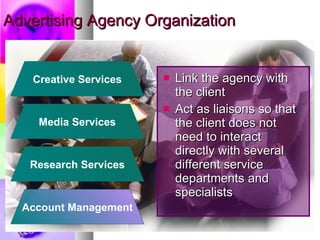
Advertising Agency Organization Link the agency with the client Act as liaisons so that the client does not need to interact directly with several different service departments and specialists Creative Services Account Management Media Services Research Services
Ad-Investment Consistent investment spending is the key factor underlying successful advertising.
Arguments for Investing in Advertising Investment in advertising requires that incremental revenue > advertising expense
Arguments for Disinvesting in Advertising Decreased expenses in advertising mean increased profits (everything else held equal)
Investment   in the Brand Equity Bank “ S trong  advertising represents a deposit in the brand equity bank.” Strong - that is, different, unique, clever, memorable
Advertising Functions Informing Persuading Reminding Adding Value Assisting Other Company Efforts
Advertising Functions Makes consumers  aware ,  educates  them about the features and benefits, and facilitates the create the creation of positive  brand images Facilitates the introduction of new brands and increases demand for existing brands Performs another information role by teaching new uses for existing brands (Usage expansion advertising) Informing
Advertising Functions Persuades customers to try advertised products and services Primary demand- creating demand for an entire product category Secondary demand- the demand for a specific company’s brand Persuading
Advertising Functions Keeps a company’s brand fresh in the consumer’s memory Influences  brand switching  by reminding consumers who have not recently purchased a brand that the brand is available and that it possesses favorable attributes Reminding
Advertising Functions Three basic ways by which companies can add value  innovating improving quality altering consumer perceptions Advertising adds value to brands by influencing consumers’ perceptions Adding Value
Setting The Terms After choosing an agency Need to define what the clients objectives are in detail. Need to look at method of payment
Setting The Terms Agency and client need clear understanding on many issues Draw up a contract See Box 3.1 on page 27 Note that contract is usually of most importance when things go wrong.
Setting The Terms Of importance to the client is meeting the objectives they have set for the campaign
Setting Advertising Objectives Expression of management consensus Guides the budgeting, message, and media aspects of advertising strategy Provide standards against with results can be measured
Setting Good Advertising Objectives Include a precise statement of who, what, and when Be quantitative and measurable Specify the amount of change Be realistic Be internally consistent Be clear and put it in writing
Sales Volume as  an Advertising Objective Traditional View Sales volume is the consequence of a host factors in addition to advertising Effect of advertising is delayed
Sales Volume as  an Advertising Objective Heretical View Advertising’s purpose is to generate sales Sales measures are “vaguely right”
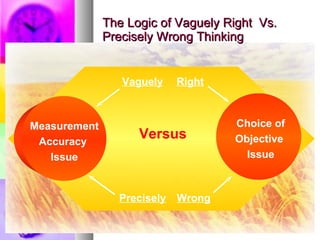
The Logic of Vaguely Right  Vs. Precisely Wrong Thinking Versus Measurement Accuracy  Issue Vaguely Precisely Choice of Objective  Issue Right Wrong
Setting The Terms Of most import to the agency is how they will get paid. Client wants to get the most bang for its buck Agency must ensure that their responsibilities are clearly laid out in the contract
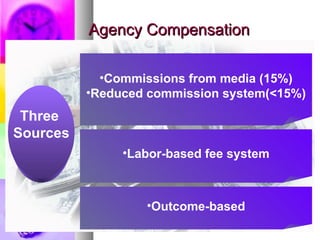
Agency Compensation Commissions from media (15%) Reduced commission system(<15%) Labor-based fee system Outcome-based Three  Sources
Commission Issues Its absolute level Whether it should vary with different media, levels of spending How to apply non-media items  - eg. Production costs
Commission Issues Key problems Distorts an agency’s advice - using TV campaigns – can reduce the creative work needed per commercial Very profitable for the agency
Fees Time-based fee systems Agency is paid for work done on clients behalf. Every option is given equal weight in recommendations.
Fee problems Requires effective and efficient time-sheet system Agency and client need to agree on rate of each member of team. The creative teams time is most valuable.
Menu System/work-unit pricing Cost-per-task basis Main virtue is transparent price structure Tight cost controls Meshes well with cost accounting
Menu System/work-unit pricing problems Does not allow for the synergy Client can shop around for best price Does not deal with quality
Result Based Payment Usually combined with other approach Allows agency to earn a bonus for above target performance.
Result Based Payment Problems Developing attainable targets Measuring progress Will discuss in chapter 8
The creative fee Two part charging system 1) Monthly fee - based on proportion of work of individual assigned to account 2) Determined value for the creative idea
Running the relationship Agency will need to learn everything Visits to offices/factories Conversations Review available market research Getting to know each other’s teams
Structuring contact Primary contact is the account manager Responsible for smooth running of account Effective use of agency resources on behalf of client *large agencies can be 2 or 3 levels
Structuring contact Client side is the marketing director Responsible for the advertising Marketing mix *large companies may have specialist advertising or communications directors
Formalizing contacts Day-to-day contact Meetings could be weekly, biweekly, monthly Discuss new work or progress etc… Major meetings New briefs for major campaigns Presentation of new campaign proposals, Research debriefs…..
The advertising Budget How do you decide how much to spend ? What do you spend it on? Establishing budgets is difficult Practice lags behind theory
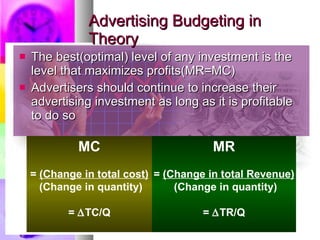
Advertising Budgeting in Theory The best(optimal) level of any investment is the level that maximizes profits(MR=MC) Advertisers should continue to increase their advertising investment as long as it is profitable to do so MC =  (Change in total cost) (Change in quantity)  =   TC/Q MR =  (Change in total Revenue) (Change in quantity)  =   TR/Q
Budgeting Considerations  in Practice What is the Ad objective? How much are competitors spending? How much money is available?
Budgeting Methods Percent-of-Sales Budgeting Objective-and-Task Method Competitive Parity Method  (match competitors method) Affordability Method
Percentage-of-Sales Budgeting A company sets a brand’s advertising budget by simply establishing the budget as a fixed percentage of past or anticipated sales volume Criticized as being illogical Sales= f (Advertising) (o) Advertising= f (Sales) (x)
Objective-and-Task Method The most sensible and defendable advertising budgeting method Specify what role they expect advertising to play for a brand and then set the budget accordingly
The Competitive Parity Method Sets the ad budget by basically following what competitors are doing
Affordability Method Only the funds that remain after budgeting for everything else are spent on advertising Only the most unsophisticated and impoverished firms However, affordability and competitive considerations influence the budgeting decisions of all companies
Summary Working with an agency should be a professional business relationship and structured accordingly. This requires a formal contract, with especial attention paid to the thorny question of how the agency will be remunerated for its efforts. The contract should also cover a range of other details.
Summary The agency will aim to tailor its account team to fit with the client’s structure, with the main contacts going through the account management team and the client marketing departments of the agency.
Summary The relationship will – inevitably – revolve around a series of meetings, which need to be call reported to provide a record of the decisions taken.  The budget will be central to the relationship. Setting a budget is difficult, but the difficulties are often avoided by using simple rules of thumb.

Advertising communication and Agency

  • 1.
    Advertising and Managing the client-agency relationship
  • 2.
    Welcome to Advertisingcommunication learning session .
  • 3.
    We will discussAdvertising communication and the components of advertising .
  • 4.
    Thanks for keepingyour mobile phones in silent mode.
  • 5.
    Objectives Understand therelationship between an advertiser and the agency What happens after a client chooses an agency Agency compensation – different methods of paying the agency
  • 6.
    Objectives Running therelationship – the meetings Looking at the advertising budget
  • 7.
    Advertising Agency OrganizationLink the agency with the client Act as liaisons so that the client does not need to interact directly with several different service departments and specialists Creative Services Account Management Media Services Research Services
  • 8.
    Ad-Investment Consistent investmentspending is the key factor underlying successful advertising.
  • 9.
    Arguments for Investingin Advertising Investment in advertising requires that incremental revenue > advertising expense
  • 10.
    Arguments for Disinvestingin Advertising Decreased expenses in advertising mean increased profits (everything else held equal)
  • 11.
    Investment in the Brand Equity Bank “ S trong advertising represents a deposit in the brand equity bank.” Strong - that is, different, unique, clever, memorable
  • 12.
    Advertising Functions InformingPersuading Reminding Adding Value Assisting Other Company Efforts
  • 13.
    Advertising Functions Makesconsumers aware , educates them about the features and benefits, and facilitates the create the creation of positive brand images Facilitates the introduction of new brands and increases demand for existing brands Performs another information role by teaching new uses for existing brands (Usage expansion advertising) Informing
  • 14.
    Advertising Functions Persuadescustomers to try advertised products and services Primary demand- creating demand for an entire product category Secondary demand- the demand for a specific company’s brand Persuading
  • 15.
    Advertising Functions Keepsa company’s brand fresh in the consumer’s memory Influences brand switching by reminding consumers who have not recently purchased a brand that the brand is available and that it possesses favorable attributes Reminding
  • 16.
    Advertising Functions Threebasic ways by which companies can add value innovating improving quality altering consumer perceptions Advertising adds value to brands by influencing consumers’ perceptions Adding Value
  • 17.
    Setting The TermsAfter choosing an agency Need to define what the clients objectives are in detail. Need to look at method of payment
  • 18.
    Setting The TermsAgency and client need clear understanding on many issues Draw up a contract See Box 3.1 on page 27 Note that contract is usually of most importance when things go wrong.
  • 19.
    Setting The TermsOf importance to the client is meeting the objectives they have set for the campaign
  • 20.
    Setting Advertising ObjectivesExpression of management consensus Guides the budgeting, message, and media aspects of advertising strategy Provide standards against with results can be measured
  • 21.
    Setting Good AdvertisingObjectives Include a precise statement of who, what, and when Be quantitative and measurable Specify the amount of change Be realistic Be internally consistent Be clear and put it in writing
  • 22.
    Sales Volume as an Advertising Objective Traditional View Sales volume is the consequence of a host factors in addition to advertising Effect of advertising is delayed
  • 23.
    Sales Volume as an Advertising Objective Heretical View Advertising’s purpose is to generate sales Sales measures are “vaguely right”
  • 24.
    The Logic ofVaguely Right Vs. Precisely Wrong Thinking Versus Measurement Accuracy Issue Vaguely Precisely Choice of Objective Issue Right Wrong
  • 25.
    Setting The TermsOf most import to the agency is how they will get paid. Client wants to get the most bang for its buck Agency must ensure that their responsibilities are clearly laid out in the contract
  • 26.
    Agency Compensation Commissionsfrom media (15%) Reduced commission system(<15%) Labor-based fee system Outcome-based Three Sources
  • 27.
    Commission Issues Itsabsolute level Whether it should vary with different media, levels of spending How to apply non-media items - eg. Production costs
  • 28.
    Commission Issues Keyproblems Distorts an agency’s advice - using TV campaigns – can reduce the creative work needed per commercial Very profitable for the agency
  • 29.
    Fees Time-based feesystems Agency is paid for work done on clients behalf. Every option is given equal weight in recommendations.
  • 30.
    Fee problems Requireseffective and efficient time-sheet system Agency and client need to agree on rate of each member of team. The creative teams time is most valuable.
  • 31.
    Menu System/work-unit pricingCost-per-task basis Main virtue is transparent price structure Tight cost controls Meshes well with cost accounting
  • 32.
    Menu System/work-unit pricingproblems Does not allow for the synergy Client can shop around for best price Does not deal with quality
  • 33.
    Result Based PaymentUsually combined with other approach Allows agency to earn a bonus for above target performance.
  • 34.
    Result Based PaymentProblems Developing attainable targets Measuring progress Will discuss in chapter 8
  • 35.
    The creative feeTwo part charging system 1) Monthly fee - based on proportion of work of individual assigned to account 2) Determined value for the creative idea
  • 36.
    Running the relationshipAgency will need to learn everything Visits to offices/factories Conversations Review available market research Getting to know each other’s teams
  • 37.
    Structuring contact Primarycontact is the account manager Responsible for smooth running of account Effective use of agency resources on behalf of client *large agencies can be 2 or 3 levels
  • 38.
    Structuring contact Clientside is the marketing director Responsible for the advertising Marketing mix *large companies may have specialist advertising or communications directors
  • 39.
    Formalizing contacts Day-to-daycontact Meetings could be weekly, biweekly, monthly Discuss new work or progress etc… Major meetings New briefs for major campaigns Presentation of new campaign proposals, Research debriefs…..
  • 40.
    The advertising BudgetHow do you decide how much to spend ? What do you spend it on? Establishing budgets is difficult Practice lags behind theory
  • 41.
    Advertising Budgeting inTheory The best(optimal) level of any investment is the level that maximizes profits(MR=MC) Advertisers should continue to increase their advertising investment as long as it is profitable to do so MC = (Change in total cost) (Change in quantity) =  TC/Q MR = (Change in total Revenue) (Change in quantity) =  TR/Q
  • 42.
    Budgeting Considerations in Practice What is the Ad objective? How much are competitors spending? How much money is available?
  • 43.
    Budgeting Methods Percent-of-SalesBudgeting Objective-and-Task Method Competitive Parity Method (match competitors method) Affordability Method
  • 44.
    Percentage-of-Sales Budgeting Acompany sets a brand’s advertising budget by simply establishing the budget as a fixed percentage of past or anticipated sales volume Criticized as being illogical Sales= f (Advertising) (o) Advertising= f (Sales) (x)
  • 45.
    Objective-and-Task Method Themost sensible and defendable advertising budgeting method Specify what role they expect advertising to play for a brand and then set the budget accordingly
  • 46.
    The Competitive ParityMethod Sets the ad budget by basically following what competitors are doing
  • 47.
    Affordability Method Onlythe funds that remain after budgeting for everything else are spent on advertising Only the most unsophisticated and impoverished firms However, affordability and competitive considerations influence the budgeting decisions of all companies
  • 48.
    Summary Working withan agency should be a professional business relationship and structured accordingly. This requires a formal contract, with especial attention paid to the thorny question of how the agency will be remunerated for its efforts. The contract should also cover a range of other details.
  • 49.
    Summary The agencywill aim to tailor its account team to fit with the client’s structure, with the main contacts going through the account management team and the client marketing departments of the agency.
  • 50.
    Summary The relationshipwill – inevitably – revolve around a series of meetings, which need to be call reported to provide a record of the decisions taken. The budget will be central to the relationship. Setting a budget is difficult, but the difficulties are often avoided by using simple rules of thumb.