Adverbs
Adverbs
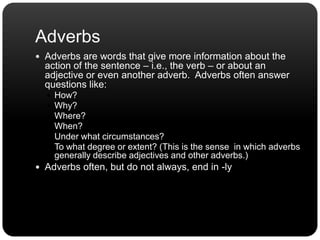
 Adverbs are words that give more information about the
action of the sentence – i.e., the verb – or about an
adjective or even another adverb. Adverbs often answer
questions like:
 How?
 Why?
 Where?
 When?
 Under what circumstances?
 To what degree or extent? (This is the sense in which adverbs
generally describe adjectives and other adverbs.)
 Adverbs often, but do not always, end in -ly
Adverbs (2)
 “I began to weep bitterly because no one was found
worthy to open the scroll or to look into it.” (Rev 5:4
NRSV)
 How was John weeping?
 “I know you are enduring patiently and bearing up for
my name's sake.” (Rev 2:3 ESV)
 How are the believers enduring?
 “When the disciples heard this, they were greatly
astonished.” (Matt 19:25 NIV)
 To what extent were the disciples astonished?
Adverbs (3)
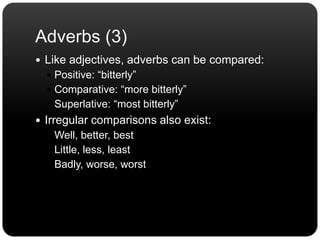
 Like adjectives, adverbs can be compared:
 Positive: “bitterly”
 Comparative: “more bitterly”
 Superlative: “most bitterly”
 Irregular comparisons also exist:
 Well, better, best
 Little, less, least
 Badly, worse, worst
Caution: When adverbs look like
prepositions
 “And when he had looked around at
everything, as it was already late, he went out to
Bethany with the twelve.” (Mark 11:11).
 “Around” is often used as a preposition, as in “I
heard the voice of many angels around the throne”
(Rev 5:11 NASU). In Mk 11:11, however, “around”
describes the action of “looking” – Where did Jesus
look?

Adverbs

  • 1.
  • 2.
    Adverbs  Adverbs arewords that give more information about the action of the sentence – i.e., the verb – or about an adjective or even another adverb. Adverbs often answer questions like:  How?  Why?  Where?  When?  Under what circumstances?  To what degree or extent? (This is the sense in which adverbs generally describe adjectives and other adverbs.)  Adverbs often, but do not always, end in -ly
  • 3.
    Adverbs (2)  “Ibegan to weep bitterly because no one was found worthy to open the scroll or to look into it.” (Rev 5:4 NRSV)  How was John weeping?  “I know you are enduring patiently and bearing up for my name's sake.” (Rev 2:3 ESV)  How are the believers enduring?  “When the disciples heard this, they were greatly astonished.” (Matt 19:25 NIV)  To what extent were the disciples astonished?
  • 4.
    Adverbs (3)  Likeadjectives, adverbs can be compared:  Positive: “bitterly”  Comparative: “more bitterly”  Superlative: “most bitterly”  Irregular comparisons also exist:  Well, better, best  Little, less, least  Badly, worse, worst
  • 5.
    Caution: When adverbslook like prepositions  “And when he had looked around at everything, as it was already late, he went out to Bethany with the twelve.” (Mark 11:11).  “Around” is often used as a preposition, as in “I heard the voice of many angels around the throne” (Rev 5:11 NASU). In Mk 11:11, however, “around” describes the action of “looking” – Where did Jesus look?