Partnership Liquidation
Winding up process includes the transactions necessary to liquidate the partnership, such as the
collection of receivables, including any receivables from partners, conversion of the noncash
assets to cash, payment of the partnership’s obligations, and the distribution of any remaining
net balance to the partners, in cash according to their capital interests.
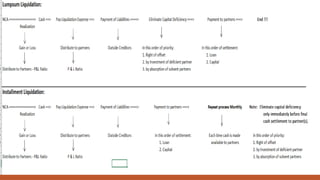
Lump-sum liquidation – relatively short period of time
Installment liquidation – over a period of several years
Realization – conversion of assets into cash
Liquidation – payment of claims
Basic Procedures in Liquidation
1. Sharing Gains and Losses – the books should be adjusted and has closed the net profit or loss
for the period in the manner they have agreed in the partnership agreement.
2. Advance Planning when the Partnership is formed – to eliminate the deficit, the partners who
do not have deficit balances must absorb it.
3. Rule of Set-off – Partnership Loans (Receivable) to the Partners – the partnership receivable
should be subtracted from the partner’s capital account.
4. Rule of Set-off – Partner Loans (Payable) to the Partnership – the loan may or may not rank on
an equal level with other partnership liabilities as to priority. The following priority system
occurs under this assumption:
◦ Amounts owed to creditors other than partners
◦ Amounts owed to partners other than for capital and profits
◦ Amounts owed to partners as capital
◦ Amounts owed to partners as profits not currently closed to partners’ capital accounts.
Basic Procedures in Liquidation
5. Liquidation expenses – certain costs incurred during the liquidation process should be treated as a
reduction of the proceeds from the sale of noncash assets such as costs to complete inventory, sales
commission and shipping costs related to disposal of inventory, escrow and title transfer fees associated
with the sale of real property, and costs of removing equipment. Other liquidation costs should be treated
as expenses.
6. Marshalling of Assets – contribution of personal assets to a liquidating partnership illustrates the
characteristics of unlimited liability. The order of priority concerning the availability of the assets for each
class of creditors is as follows:
A. Partnership assets – (1) Partnership creditors and (2) Personal creditors
B. Personal assets – (1) Personal creditors, (2) Partnership creditors, (3) Amounts owed to partners by way of
contribution.
Solvent = Personal assets > Personal liabilities
Insolvent = Personal assets < Personal liabilities
7. Distribution of Cash or Other Assets to Partners – the fair value of the distributed asset is then charged
against the proper capital account.
Types of Liquidation
1. Lump-sum (simple or total) liquidation – no distributions are made to the partners until the
realization process is completed when the full amount of the realization gain or loss is known.
2. Installment liquidation – distributions are made to some or all of the partners as cash become
available.
Procedures in Lump-sum Liquidation
1. Realization and distribution of gain or loss to all partners on the basis of profit and loss ratio.
2. Payment of liquidation expenses, if any.
3. Payment of liabilities to third parties.
4. Elimination of capital deficiencies. (1) Offset on the loan balance, (2) If partner is solvent
(Personal Asset > Personal Liabilities), then additional investment, (3) If partner is insolvent
(Personal Liabilities > Personal Assets), the remaining partners will absorb the capital deficiency.
5. Payment to partners. (1) Loan accounts, (2) Capital accounts
Basic Principles in Installment Liquidation
1. Distribute no cash to the partners until all liabilities and actual liquidation expenses have been
paid.
2. Distribute cash using schedule of cash/safe payments – anticipates the two worst-case
scenario:
a. Assume a total loss on all remaining noncash assets, and provide all possible losses including potential
liquidation costs and unrecorded liabilities.
b. Assume that partners with a potential capital deficit will be unable to pay anything to the partnership
(personally insolvent).
Cash Payment Priority Program (CPPP)
A cash distribution plan has the advantage of informing the partners at the beginning of the
liquidation process when they will receive cash in relation to the other partners.
Ranking the Partners:
Maximum Loss Absorbable – total interest (equity) account balances before liquidation
represent the equities of the partners in the partnership (capital account + loan) then divide it
by the profit and loss ratio.
1. Distribute to highest-ranking partner
2. Distribute next highest-ranking partner(s).
(Capital + Loan) / P&L Ratio
Vulnerable partner – a partner with the lowest absorption abilities.
Limitations of the Cash Priority Program
1. The program is operable only after outside creditors have been paid in full
2. The program reflects only the order in which cash distributions to the partners will be made if
cash is available to distribute to the partners.
3. The sequence of distributing cash in the program coincides with the sequence that would
result if cash were distributed using the schedule of safe payments.
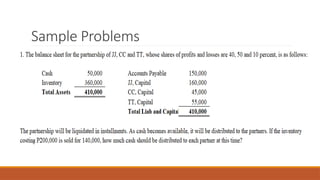
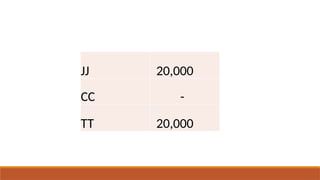
Sample Problems
JJ 20,000
CC -
TT 20,000

Advanced Partnership-Liquidation.pptx

  • 1.
  • 2.
    Partnership Liquidation Winding upprocess includes the transactions necessary to liquidate the partnership, such as the collection of receivables, including any receivables from partners, conversion of the noncash assets to cash, payment of the partnership’s obligations, and the distribution of any remaining net balance to the partners, in cash according to their capital interests. Lump-sum liquidation – relatively short period of time Installment liquidation – over a period of several years Realization – conversion of assets into cash Liquidation – payment of claims
  • 3.
    Basic Procedures inLiquidation 1. Sharing Gains and Losses – the books should be adjusted and has closed the net profit or loss for the period in the manner they have agreed in the partnership agreement. 2. Advance Planning when the Partnership is formed – to eliminate the deficit, the partners who do not have deficit balances must absorb it. 3. Rule of Set-off – Partnership Loans (Receivable) to the Partners – the partnership receivable should be subtracted from the partner’s capital account. 4. Rule of Set-off – Partner Loans (Payable) to the Partnership – the loan may or may not rank on an equal level with other partnership liabilities as to priority. The following priority system occurs under this assumption: ◦ Amounts owed to creditors other than partners ◦ Amounts owed to partners other than for capital and profits ◦ Amounts owed to partners as capital ◦ Amounts owed to partners as profits not currently closed to partners’ capital accounts.
  • 4.
    Basic Procedures inLiquidation 5. Liquidation expenses – certain costs incurred during the liquidation process should be treated as a reduction of the proceeds from the sale of noncash assets such as costs to complete inventory, sales commission and shipping costs related to disposal of inventory, escrow and title transfer fees associated with the sale of real property, and costs of removing equipment. Other liquidation costs should be treated as expenses. 6. Marshalling of Assets – contribution of personal assets to a liquidating partnership illustrates the characteristics of unlimited liability. The order of priority concerning the availability of the assets for each class of creditors is as follows: A. Partnership assets – (1) Partnership creditors and (2) Personal creditors B. Personal assets – (1) Personal creditors, (2) Partnership creditors, (3) Amounts owed to partners by way of contribution. Solvent = Personal assets > Personal liabilities Insolvent = Personal assets < Personal liabilities 7. Distribution of Cash or Other Assets to Partners – the fair value of the distributed asset is then charged against the proper capital account.
  • 5.
    Types of Liquidation 1.Lump-sum (simple or total) liquidation – no distributions are made to the partners until the realization process is completed when the full amount of the realization gain or loss is known. 2. Installment liquidation – distributions are made to some or all of the partners as cash become available.
  • 6.
    Procedures in Lump-sumLiquidation 1. Realization and distribution of gain or loss to all partners on the basis of profit and loss ratio. 2. Payment of liquidation expenses, if any. 3. Payment of liabilities to third parties. 4. Elimination of capital deficiencies. (1) Offset on the loan balance, (2) If partner is solvent (Personal Asset > Personal Liabilities), then additional investment, (3) If partner is insolvent (Personal Liabilities > Personal Assets), the remaining partners will absorb the capital deficiency. 5. Payment to partners. (1) Loan accounts, (2) Capital accounts
  • 7.
    Basic Principles inInstallment Liquidation 1. Distribute no cash to the partners until all liabilities and actual liquidation expenses have been paid. 2. Distribute cash using schedule of cash/safe payments – anticipates the two worst-case scenario: a. Assume a total loss on all remaining noncash assets, and provide all possible losses including potential liquidation costs and unrecorded liabilities. b. Assume that partners with a potential capital deficit will be unable to pay anything to the partnership (personally insolvent).
  • 9.
    Cash Payment PriorityProgram (CPPP) A cash distribution plan has the advantage of informing the partners at the beginning of the liquidation process when they will receive cash in relation to the other partners. Ranking the Partners: Maximum Loss Absorbable – total interest (equity) account balances before liquidation represent the equities of the partners in the partnership (capital account + loan) then divide it by the profit and loss ratio. 1. Distribute to highest-ranking partner 2. Distribute next highest-ranking partner(s). (Capital + Loan) / P&L Ratio Vulnerable partner – a partner with the lowest absorption abilities.
  • 10.
    Limitations of theCash Priority Program 1. The program is operable only after outside creditors have been paid in full 2. The program reflects only the order in which cash distributions to the partners will be made if cash is available to distribute to the partners. 3. The sequence of distributing cash in the program coincides with the sequence that would result if cash were distributed using the schedule of safe payments.
  • 11.
  • 12.