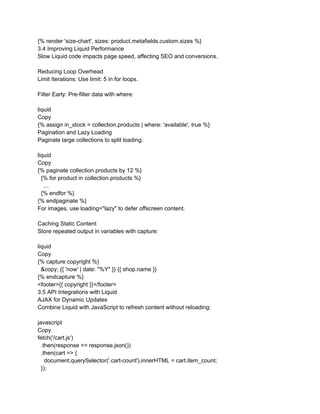
Advanced Liquid Coding Techniques for Custom Shopify Development Services.pdf
Learn how outsourcing Shopify development can propel your eCommerce business. CartCoders offers insights on leveraging expert developers to enhance scalability, reduce costs, and focus on core business strategies.
Advanced Liquid Coding Techniques for Custom Shopify Development Services.pdf
1.
Advanced Liquid CodingTechniques for
Custom Shopify Development Services
Shopify’s Liquid templating language is the backbone of theme customization, enabling
developers to create tailored shopping experiences. For businesses seeking Custom Shopify
Development Services, mastering advanced Liquid techniques is critical to building scalable,
dynamic, and efficient stores. This guide dives into high-level strategies for working with Liquid,
from metafields to performance tuning, equipping developers with actionable insights for
complex projects.
Introduction to Liquid in Shopify Development
What is Liquid?
Liquid is an open-source language developed by Shopify. It acts as a bridge between static
HTML and dynamic data stored in Shopify’s backend. Unlike traditional programming
languages, Liquid focuses on rendering content conditionally, iterating through datasets (like
products or collections), and integrating merchant-controlled settings into themes.
Why Advanced Liquid Skills Matter
While basic Liquid knowledge allows for simple theme tweaks, advanced techniques unlock the
full potential of Custom Shopify Development Services. Complex projects often require:
Dynamic content rendering without plugins.
Custom filters for product catalogs.
2.
Efficient data handlingto reduce page load times.
Deeper integration with Shopify’s APIs.
By refining Liquid expertise, developers can deliver faster, more flexible solutions that align with
unique business needs.
Liquid Basics: A Quick Refresher
Before diving into advanced methods, let’s revisit core Liquid concepts for developers familiar
with the fundamentals:
Syntax & Core Tags
Output Tags: {{ }} prints variables (e.g., {{ product.title }}).
Logic Tags: {% %} controls flow (e.g., {% if product.available %}).
Filters: Modify output (e.g., {{ product.price | money }}).
Variables & Global Objects
Shopify provides predefined objects like product, collection, and cart, which store data
accessible across templates. For example:
liquid
Copy
{% for item in cart.items %}
{{ item.title }} - {{ item.price | money }}
{% endfor %}
Control Flow Structures
Conditionals: {% if %}, {% unless %}, {% else %}.
Loops: {% for %}, {% break %}, {% continue %}.
3. Advanced Liquid Techniques for Custom Development3
3.
3.1 Dynamic Contentwith Metafields
Metafields extend Shopify’s default data model, letting merchants store custom data (e.g.,
product specs, promotional tags).
Accessing Metafields in Liquid
Metafields are accessed via namespaces. For example, to display a custom product field:
liquid
Copy
{{ product.metafields.custom.specification }}
Best Practices:
Use consistent namespaces (e.g., custom, global) for organization.
Avoid overloading metafields with redundant data.
Conditional Templates Based on Metafields
Create unique product layouts by checking metafield values:
liquid
Copy
{% if product.metafields.custom.is_featured %}
{% render 'featured-product-template' %}
{% else %}
{% render 'standard-product-template' %}
{% endif %}
4.
Custom Collection Filtering
Metafieldscan power filters beyond Shopify’s default options. For instance, to filter products by
material type:
liquid
Copy
{% assign materials = collection.products | map: 'metafields.custom.material' | uniq %}
{% for material in materials %}
<a href="?filter={{ material }}">{{ material }}</a>
{% endfor %}
3.2 Custom Sections and Blocks
Sections are reusable modules (e.g., headers, banners) editable via Shopify’s Theme Editor.
Theme Architecture Basics
Sections: Defined in /sections/ directory.
Blocks: Nested elements within sections (e.g., slides in a carousel).
Building Modular Sections
Create a configurable hero banner:
liquid
Copy
{% schema %}
{
"name": "Hero Banner",
"settings": [
{
"type": "text",
"id": "heading",
"label": "Banner Heading"
}
],
"blocks": [
{
"type": "button",
"name": "CTA Button",
"settings": [
{
"type": "text",
"id": "label",
"label": "Button Text"
}
]
5.
}
]
}
{% endschema %}
Merchantscan add multiple CTA buttons via the Theme Editor without coding.
Maximizing Block Flexibility
Use max_blocks to limit block numbers and prevent layout breaks:
liquid
Copy
{% schema %}
{
"name": "Image Gallery",
"blocks": [
{
"type": "image",
"name": "Image Slide",
"settings": [...]
}
],
"max_blocks": 5
}
{% endschema %}
3.3 Snippets for Reusable Code
Snippets (/snippets/) store reusable code fragments, reducing redundancy.
Organizing Code with Includes
Move complex logic into snippets for cleaner templates:
liquid
Copy
{% comment %} In product-template.liquid {% endcomment %}
{% render 'product-details', product: product %}
liquid
Copy
{% comment %} In product-details.liquid {% endcomment %}
<h2>{{ product.title }}</h2>
<p>{{ product.description }}</p>
Passing Variables to Snippets
Use with or for to inject dynamic data:
liquid
Copy
Shopify Storefront API+ Liquid
Fetch data via GraphQL and render it with Liquid:
liquid
Copy
{% assign productHandle = 'my-product' %}
{% capture query %}
query {
productByHandle(handle: "{{ productHandle }}") {
title
}
}
{% endcapture %}
{% assign result = query | shopify %}
4. Best Practices and Common Mistakes in Liquid Development
Mastering Liquid requires more than just understanding syntax—it demands disciplined coding
habits and awareness of potential pitfalls. Below, we break down critical best practices and
frequent errors to avoid when building Custom Shopify Development Services.
4.1 Code Organization and Maintenance
a. Modular Architecture
8.
Problem: Large, monolithictemplate files become unmanageable.
Solution: Break templates into smaller, purpose-driven sections and snippets.
Example: Store headers/footers in snippets (e.g., header.liquid, footer.liquid) and reuse them
across templates.
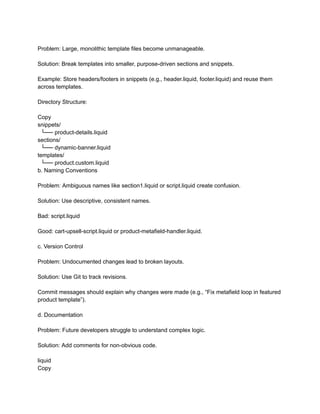
Directory Structure:
Copy
snippets/
└── product-details.liquid
sections/
└── dynamic-banner.liquid
templates/
└── product.custom.liquid
b. Naming Conventions
Problem: Ambiguous names like section1.liquid or script.liquid create confusion.
Solution: Use descriptive, consistent names.
Bad: script.liquid
Good: cart-upsell-script.liquid or product-metafield-handler.liquid.
c. Version Control
Problem: Undocumented changes lead to broken layouts.
Solution: Use Git to track revisions.
Commit messages should explain why changes were made (e.g., “Fix metafield loop in featured
product template”).
d. Documentation
Problem: Future developers struggle to understand complex logic.
Solution: Add comments for non-obvious code.
liquid
Copy
9.
{% comment %}
Purpose:Fetches custom product badges from metafields.
Usage: Include in product-grid-item.liquid.
{% endcomment %}
{% if product.metafields.custom.badge %}
<span class="badge">{{ product.metafields.custom.badge }}</span>
{% endif %}
Common Mistakes:
Overloading a single template with multiple features.
Failing to delete unused snippets or sections.
4.2 Security and Data Handling
a. Input Sanitization
Problem: Rendering unescaped user input risks XSS attacks.
Solution: Always escape dynamic content.
Bad: {{ user_generated_content }}
Good: {{ user_generated_content | escape }}
b. API Key Exposure
Problem: Hardcoding API keys in Liquid files.
Solution: Store sensitive data in Shopify’s environment variables.
Use Shopify.config or settings_schema.json for public keys.
c. Data Validation
Problem: Assuming metafields or API responses are properly formatted.
Solution: Validate data before rendering.
liquid
Copy
{% if product.metafields.custom.rating.value > 0 %}
<div class="rating">{{ product.metafields.custom.rating.value }}</div>
{% endif %}
d. Permission Checks
10.
Problem: Displaying admin-onlycontent to customers.
Solution: Use {% if request.design_mode %} to hide debug tools or internal notes.
Common Mistakes:
Trusting third-party snippet code without review.
Using | strip_html instead of | escape for sanitization.
4.3 Performance and Efficiency
a. Loop Management
Problem: Nested loops slow down page rendering.
Solution:
Replace nested loops with metafield lookups or where filters.
Example:
liquid
Copy
{% assign featuredProducts = collections.all.products | where: 'metafields.custom.is_featured',
'true' %}
{% for product in featuredProducts limit: 5 %}
...
{% endfor %}
b. Asset Optimization
Problem: Uncompressed images or inline CSS/JS bloat page size.
Solution:
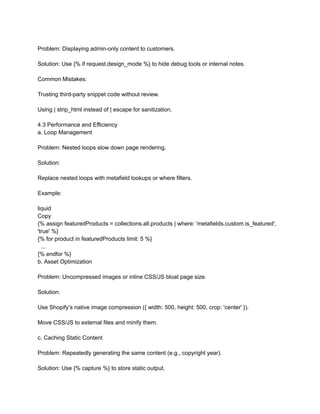
Use Shopify’s native image compression ({ width: 500, height: 500, crop: 'center' }).
Move CSS/JS to external files and minify them.
c. Caching Static Content
Problem: Repeatedly generating the same content (e.g., copyright year).
Solution: Use {% capture %} to store static output.
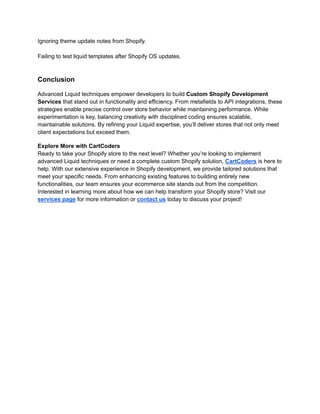
Ignoring theme updatenotes from Shopify.
Failing to test liquid templates after Shopify OS updates.
Conclusion
Advanced Liquid techniques empower developers to build Custom Shopify Development
Services that stand out in functionality and efficiency. From metafields to API integrations, these
strategies enable precise control over store behavior while maintaining performance. While
experimentation is key, balancing creativity with disciplined coding ensures scalable,
maintainable solutions. By refining your Liquid expertise, you’ll deliver stores that not only meet
client expectations but exceed them.
Explore More with CartCoders
Ready to take your Shopify store to the next level? Whether you’re looking to implement
advanced Liquid techniques or need a complete custom Shopify solution, CartCoders is here to
help. With our extensive experience in Shopify development, we provide tailored solutions that
meet your specific needs. From enhancing existing features to building entirely new
functionalities, our team ensures your ecommerce site stands out from the competition.
Interested in learning more about how we can help transform your Shopify store? Visit our
services page for more information or contact us today to discuss your project!


![Custom Collection Filtering
Metafields can power filters beyond Shopify’s default options. For instance, to filter products by
material type:
liquid
Copy
{% assign materials = collection.products | map: 'metafields.custom.material' | uniq %}
{% for material in materials %}
<a href="?filter={{ material }}">{{ material }}</a>
{% endfor %}
3.2 Custom Sections and Blocks
Sections are reusable modules (e.g., headers, banners) editable via Shopify’s Theme Editor.
Theme Architecture Basics
Sections: Defined in /sections/ directory.
Blocks: Nested elements within sections (e.g., slides in a carousel).
Building Modular Sections
Create a configurable hero banner:
liquid
Copy
{% schema %}
{
"name": "Hero Banner",
"settings": [
{
"type": "text",
"id": "heading",
"label": "Banner Heading"
}
],
"blocks": [
{
"type": "button",
"name": "CTA Button",
"settings": [
{
"type": "text",
"id": "label",
"label": "Button Text"
}
]](https://image.slidesharecdn.com/advancedliquidcodingtechniquesforcustomshopifydevelopmentservices-250310123554-04c0878c/85/Advanced-Liquid-Coding-Techniques-for-Custom-Shopify-Development-Services-pdf-4-320.jpg)
![}
]
}
{% endschema %}
Merchants can add multiple CTA buttons via the Theme Editor without coding.
Maximizing Block Flexibility
Use max_blocks to limit block numbers and prevent layout breaks:
liquid
Copy
{% schema %}
{
"name": "Image Gallery",
"blocks": [
{
"type": "image",
"name": "Image Slide",
"settings": [...]
}
],
"max_blocks": 5
}
{% endschema %}
3.3 Snippets for Reusable Code
Snippets (/snippets/) store reusable code fragments, reducing redundancy.
Organizing Code with Includes
Move complex logic into snippets for cleaner templates:
liquid
Copy
{% comment %} In product-template.liquid {% endcomment %}
{% render 'product-details', product: product %}
liquid
Copy
{% comment %} In product-details.liquid {% endcomment %}
<h2>{{ product.title }}</h2>
<p>{{ product.description }}</p>
Passing Variables to Snippets
Use with or for to inject dynamic data:
liquid
Copy](https://image.slidesharecdn.com/advancedliquidcodingtechniquesforcustomshopifydevelopmentservices-250310123554-04c0878c/85/Advanced-Liquid-Coding-Techniques-for-Custom-Shopify-Development-Services-pdf-5-320.jpg)