Advanced Applications of Blockchain Technology Shiho Kim
Advanced Applications of Blockchain Technology Shiho Kim
Advanced Applications of Blockchain Technology Shiho Kim
Advanced Applications of Blockchain Technology Shiho Kim
Advanced Applications of Blockchain Technology Shiho Kim
1.
Advanced Applications ofBlockchain Technology
Shiho Kim download
https://textbookfull.com/product/advanced-applications-of-
blockchain-technology-shiho-kim/
Download full version ebook from https://textbookfull.com
2.
We believe theseproducts will be a great fit for you. Click
the link to download now, or visit textbookfull.com
to discover even more!
Applications of Blockchain Technology in Business:
Challenges and Opportunities Mohsen Attaran
https://textbookfull.com/product/applications-of-blockchain-
technology-in-business-challenges-and-opportunities-mohsen-
attaran/
Decentralized Applications Harnessing Bitcoin s
Blockchain Technology 1st Edition Siraj Raval
https://textbookfull.com/product/decentralized-applications-
harnessing-bitcoin-s-blockchain-technology-1st-edition-siraj-
raval/
Management of Advanced Prostate Cancer Choung Soo Kim
https://textbookfull.com/product/management-of-advanced-prostate-
cancer-choung-soo-kim/
Blockchain Technology in Internet of Things Liehuang
Zhu
https://textbookfull.com/product/blockchain-technology-in-
internet-of-things-liehuang-zhu/
3.
Handbook Of ResearchOn Blockchain Technology Saravanan
Krishnan
https://textbookfull.com/product/handbook-of-research-on-
blockchain-technology-saravanan-krishnan/
Seafood Science Advances in Chemistry Technology and
Applications 1st Edition Se-Kwon Kim
https://textbookfull.com/product/seafood-science-advances-in-
chemistry-technology-and-applications-1st-edition-se-kwon-kim/
Basics of Blockchain: A guide for building literacy in
the economics, technology, and business of blockchain
Bettina Warburg
https://textbookfull.com/product/basics-of-blockchain-a-guide-
for-building-literacy-in-the-economics-technology-and-business-
of-blockchain-bettina-warburg/
Blockchain Technology For Ioe 1st Edition Solanki
https://textbookfull.com/product/blockchain-technology-for-
ioe-1st-edition-solanki/
Analyzing Blockchain in Healthcare: Applicability and
Empirical Evidence of Blockchain Technology in Health
Science 1st Edition Chaudhary
https://textbookfull.com/product/analyzing-blockchain-in-
healthcare-applicability-and-empirical-evidence-of-blockchain-
technology-in-health-science-1st-edition-chaudhary/
4.
Studies in BigData 60
Shiho Kim
Ganesh Chandra Deka Editors
Advanced
Applications
of Blockchain
Technology
5.
Studies in BigData
Volume 60
Series Editor
Janusz Kacprzyk, Polish Academy of Sciences, Warsaw, Poland
6.
The series “Studiesin Big Data” (SBD) publishes new developments and advances
in the various areas of Big Data- quickly and with a high quality. The intent is to
cover the theory, research, development, and applications of Big Data, as embedded
in the fields of engineering, computer science, physics, economics and life sciences.
The books of the series refer to the analysis and understanding of large, complex,
and/or distributed data sets generated from recent digital sources coming from
sensors or other physical instruments as well as simulations, crowd sourcing, social
networks or other internet transactions, such as emails or video click streams and
other. The series contains monographs, lecture notes and edited volumes in Big
Data spanning the areas of computational intelligence including neural networks,
evolutionary computation, soft computing, fuzzy systems, as well as artificial
intelligence, data mining, modern statistics and Operations research, as well as
self-organizing systems. Of particular value to both the contributors and the
readership are the short publication timeframe and the world-wide distribution,
which enable both wide and rapid dissemination of research output.
** Indexing: The books of this series are submitted to ISI Web of Science, DBLP,
Ulrichs, MathSciNet, Current Mathematical Publications, Mathematical Reviews,
Zentralblatt Math: MetaPress and Springerlink.
More information about this series at http://www.springer.com/series/11970
7.
Shiho Kim •Ganesh Chandra Deka
Editors
Advanced Applications
of Blockchain Technology
123
Preface
The initial andthe most popular application of Blockchain was cryptocurrency.
Blockchain technology is likely to revolutionize various domains by providing a
secure and fast end-to-end users’ transaction without the intervention of any trusted
third party or central authorities. Although there are various technical and security
threats associated with Blockchain technology, they can be tackled with the novel
technology, tools, and frameworks. A holistic and coordinated effort between the
government, business, and academia will take Blockchain technology to higher
standards. This edited book having 13 chapters contributed by academia, practi-
tioners, and researchers from reputed universities/organizations from various
countries deliberates upon the different aspects of Blockchain technology.
Chapter “Introduction to Blockchain and IoT” discusses the technical aspects of
Blockchain and IoT. Some of the use cases of the Blockchain technology are also
discussed in this chapter. Chapter “IoT, AI, and Blockchain: Implementation
Perspectives” presents an implementation perspective of AI, IoT, and Blockchain.
Four important Blockchain platforms such as Bitcoin, Ethereum, Hyperledger, and
Stellar are also discussed. Chapter “Blockchain Technologies for IoT” describes the
potential benefits and challenges of using Blockchain technology for IoT applica-
tions and provides some use case, while Chapter “Blockchain Technology Use
Cases” is a list of use cases which could rely on Blockchain and smart contracts, the
most potential application of Blockchain technology. Chapter “Blockchain Meets
Cybersecurity: Security, Privacy, Challenges and Opportunity” reviews the main
IoT security issues associated with the adoption of Blockchain technology. The
chapter also presents a comprehensive overview of blockchain as it relates to IoT
security. Chapter “On the Role of Blockchain Technology in Internet of Things”
deliberates about the private Blockchain in terms of scalability in different IoT
devices. Chapter “Blockchain of Things (BCoT): The Fusion of Blockchain and
IoT Technologies” is a survey on recent research articles and projects/applications
on the implementation of the Blockchain for IoT Security and identifies associated
challenges. Chapter “Blockchain Architecture” is about the issues in designing the
Blockchain application development process and to identify the key participants in
the Blockchain environments.
v
10.
Chapter “Authenticating IoTDevices with Blockchain” is about the privacy and
security concerns of IoT device authentication and authorization flaws in the
heterogeneous deployment. Chapter “Security and Privacy Issues of Blockchain
Technology” discusses the security and the privacy of Blockchain along with their
impact with regard to different trends and applications. The chapter is intended to
discuss key security attacks and the enhancements that will help develop better
Blockchain systems. Chapter “Supply Chain Management in Agriculture Using
Blockchain and IoT” discusses the implementation of a user-friendly Web-based
platform in agricultural supply chain management using Blockchain technology to
enhance agriculture-based product quality. Chapter “Blockchain Technologies and
Artificial Intelligence” is about the capabilities of the intersection of AI and
Blockchain and also discusses the standard definitions, benefits, and challenges of
this alliance. Finally, Chapter “Blockchain Hands on for Developing Genesis Block”
discusses the data processing models which are applicable in the Blockchain
technology.
We hope the reader of the book will be benefited by it’s diverse coverage of
topics on Blockchain and IoT.
New Delhi, India Prof. Shiho Kim
Incheon, Korea (Republic of) Ganesh Chandra Deka
vi Preface
11.
Contents
Introduction to Blockchainand IoT . . . . . . . . . . . . . . . . . . . . . . . . . . . . 1
Priyanka Rathee
The Internet of Things, Artificial Intelligence, and Blockchain:
Implementation Perspectives . . . . . . . . . . . . . . . . . . . . . . . . . . . . . . . . . 15
Ali Mohammad Saghiri, Kamran Gholizadeh HamlAbadi
and Monireh Vahdati
Blockchain Technologies for IoT . . . . . . . . . . . . . . . . . . . . . . . . . . . . . . 55
V. Dedeoglu, R. Jurdak, A. Dorri, R. C. Lunardi, R. A. Michelin,
A. F. Zorzo and S. S. Kanhere
Blockchain Technology Use Cases . . . . . . . . . . . . . . . . . . . . . . . . . . . . . 91
Valentina Gatteschi, Fabrizio Lamberti and Claudio Demartini
Blockchain Meets Cybersecurity: Security, Privacy, Challenges,
and Opportunity . . . . . . . . . . . . . . . . . . . . . . . . . . . . . . . . . . . . . . . . . . 115
Philip Asuquo, Chibueze Ogah, Waleed Hathal and Shihan Bao
On the Role of Blockchain Technology in the Internet of Things . . . . . . 129
Robin Singh Bhadoria, Atharva Nimbalkar and Neetesh Saxena
Blockchain of Things (BCoT): The Fusion of Blockchain
and IoT Technologies . . . . . . . . . . . . . . . . . . . . . . . . . . . . . . . . . . . . . . . 141
Mahdi H. Miraz
Blockchain Architecture . . . . . . . . . . . . . . . . . . . . . . . . . . . . . . . . . . . . . 161
Ali Mohammad Saghiri
Authenticating IoT Devices with Blockchain . . . . . . . . . . . . . . . . . . . . . 177
Asutosh Kumar Biswal, Prasenjit Maiti, Sodyam Bebarta,
Bibhudatta Sahoo and Ashok Kumar Turuk
vii
About the Editors
ShihoKim is Professor at the College of Engineering, Yonsei University. He
completed his M.S. and Ph.D. at the Department of Electrical Engineering, KAIST
and he has more than 15 years of teaching experience. His research interests include
intelligent vehicles, virtual reality, reinforcement learning, sensors for wireless
environmental monitoring, thermoelectric sensors, thermoelectric power generators,
and energy harvesting techniques. He has received the Korean Prime Minister and
Presidential award in the International Robot Contest in 2008 and 2010 respec-
tively. He was founder and Head Director of the Research Center for Advanced
Hybrid Electric Vehicle Energy Recovery Systems (RAVERS) from 2009 to 2010.
He was Chair of Vehicle Electronics Research Group from 2013 to 2014 and IEEE
Solid-State Circuit Society Seoul Chapter from 2013 to 2015. Currently, he is
Vice-chair of the Korean Institute of Next Generation Computing and has been an
IEEE VR standard Advisory Board member since 2018. He has filed numerous
patents in his area of research.
Ganesh Chandra Deka is currently Deputy Director (Training) at Regional
Directorate of Skill Development & Entrepreneurship, North Eastern Region,
Assam under Directorate General of Training, Ministry of Skill Development and
Entrepreneurship, Government of India, New Delhi, India.
His research interests include e-Governance, Big Data Analytics, NoSQL
Databases and Vocational Education and Training. He has authored 2 books on
Cloud Computing published by LAP Lambert, Germany. He is the Co-author for 4
books on Fundamentals of Computer Science (3 books published by Moni Manik
Prakashan, Guwahati, Assam, India and 1 IGI Global, USA). As of now he has
edited 14 books (5 IGI Global, USA, 6 CRC Press, USA, 2 Elsevier & Springer 1)
on Bigdata, NoSQL, Blockchain Technology and Cloud Computing in general and
authored 10 Book Chapters.
ix
14.
He has publishedaround 47 research papers in various National and IEEE
International conferences. He has organized 08 IEEE International Conferences as
Technical Chair in India. He is the Member of the editorial board and reviewer for
various Journals and International conferences, IEEE, the Institution of Electronics
and Telecommunication Engineers, India and Associate Member, the Institution of
Engineers, India.
x About the Editors
2 P. Rathee
1.1Background and Motivation
First, we need to understand two basic terms. One is bitcoin and another one is
blockchain. The digital coin is called bitcoin. It is money which is digital. The
blockchain is a technology which helps the transmission of digital coins or assets
from one person to another person. It is very important to note that bitcoin is different
from the blockchain. Now after understanding the basic meaning of bitcoin and
blockchain, what are the problems a blockchain attempts to solve? One problem
is money transfer. I will be explaining it conceptually. In this section, I’m going
to focus on concept rather than implementation details. For example, a person A
wants to transfer money to person B. It is usually performed with the help of a third
trusted party. The working of blockchain is described as follows: A sends the money
to the third party and the third party identifies the B as the right person/account
to transfer. This took 3–4 days typically. What blockchain does here? Blockchain
avoids involving the third party and therefore perform the action faster and cheaper
than the traditional method.
Internet of Things
The IoT is merely not a concept these days. It is the necessity of time in everyday
life. The “smartphone” is the most familiar application of IoT in the day-to-day life.
The application of IoT is not limited to smart homes. It is ranging from industrial
and commercial sectors to agriculture, public safety, and the health sector. The IoT
can also be considered as “Internet of Everything (IoE)” because of a wide range
of real-life applications of IoT. In IoT, there is a network of multiple devices which
communicate with each other without direct human intervention. It facilitates quick
transfer of data in an efficient manner. The IoT-enabled devices leads to operational
improvements in terms of efficiency, performance, and safety. The IoT can also be
thought of as a one unit global network. The implementation of IoT applications also
projects the revenue and growth in the IoT market. The IoT consists of intelligent
devices or machines which communicate to other devices, things, machines objects,
or infrastructure. Things in IoT referred to objects of physical as well as a virtual
world have the capacity to integrate within the communication network.
1.2 History of Blockchain
Underline theme of blockchain is not a new concept. In fact, it has been inspired by
the timestamp ordering algorithm of the 90s which was used to prevent tampering of
documents. The same thing has been extended for the purpose of ledgers and trans-
actions in order to facilitate secure payment mechanisms. Blockchain was invented
in a paper published by Satoshi Nakamoto in the year 2008. Since then various pro-
grammers, cryptographers, and scientists have worked on this concept of blockchain
to produce a cryptocurrency network called the bitcoin. The major design goal and
17.
Introduction to Blockchainand IoT 3
the purpose of the blockchain were to solve two major problems. The first is to solve
the double spending problem and second was to eliminate the need of central trusted
third party.
2 Technical Aspects of Blockchain Technology
The blockchain is a chain of blocks that contain information. Originally, this tech-
nique was introduced in 1991 by the group of researchers and was originally meant
for digital documents timestamp so it is not possible to backdate the documents or
to tamper them. However, it was not in proper use until it was used and adapted by
Satoshi Nakamoto in the year 2009 in order to create a digital cryptocurrency bitcoin
[1].
2.1 Concept and Working of a Blockchain
The blockchain is a collection of blocks, which is totally open and public to everyone.
The open ledger in the blockchain is distributed in nature. The important feature of
blockchain is that once the data is recorded into the ledger, then that data can’t be
erased. How does the blockchain work? Every block present in the chain consists
of the data, hash to that particular data and the previous hash. The data recorded in
the blockchain depends on the type of the blockchain. If the blockchain is related
to bitcoins, it will store data for transactions, the information about the sender and
receiver and the number of bitcoins present in the network. Each block in the chain is
having a hash value that can be compared with the fingerprints. As the new block is
created, the hash of that particular block will also be generated. The hash of the block
will be changed with the modifications made in the block. Therefore, the hash value
is a very important factor while making modifications in the block. If the hash value
of any block will be changed, then it will not be considered to be in the same block.
Other than the hash of the current block, the block also holds the hash of the previous
block. This helps to make a chain by linking the current block to the previous block.
These features of a block in the chain makes blockchain more secure.
Consider an example of a chain having three blocks. As shown in Fig. 1, every
block consists of the hash value of the current block and the previous block. In the
figure the block number 2 is pointing toward the block number 1, block number 3 is
connected to block number 2 using the previous hash. The previous hash of the first
block is 0000 because it a special block which is not pointing back to any block. This
block is known as the Genesis block. Now suppose somebody wants to tamper block
number 2. With the tampering of the block, the hash value of that block will also be
changed. In that case, the third block and the following blocks connected in the chain
will stand invalid because there is no valid hash present at that moment. Therefore,
changing one block in the chain will result in invalidating all the following blocks
18.
4 P. Rathee
Hash:1P5F Hash: 2Q6R Hash: 3D2L
Previous hash: 1P5F Previous hash: 2Q6R
Previous hash: 0000
1 2 3
Genesis block
Fig. 1 Blockchain structure
in the chain. In order to make it valid, the hacker needs to change the hash value of
all the following blocks. Though it a good idea to make the blockchain secure it is
not sufficient to stop tampering. With the advancement in computer technologies,
hundreds or thousands of hash values can be calculated per second. Anyone can
change the hash of the current block and the following hash using the computational
technologies. In that case, those blocks will be valid even after tempering. Therefore,
in order to make it less serious, the blockchain introduces a concept known as proof
of work.
Using the technique of proof of work, the creation of the new block gets slow down
up to some extent. In this case of bitcoin, the calculation of proof of work requires
nearly 10 min in order to add the new block in the chain. This technique enhanced
the security in the blockchain. Because if someone will try to tamper with any block
in the chain then he has to recalculate the proof of work for all the following blocks
which are quite difficult. Therefore, the collective use of hashing technique and the
proof of work mechanism make the blockchain more secure.
One of the major advantages of blockchain is its distributed nature, which makes
blockchain secure themselves. Rather than the centralized system of managing the
chain, blockchain uses peer-to-peer network. As the blockchain is open and public,
anyone can join the network. After joining the network, the participant will be get-
ting the complete copy of the chain. The node can verify using that copy whether
everything is happening in order or not. Now if somebody creates a new block, then
what happens? The block will be sent to everyone present in the network. Each node
will verify that block in order to ensure that the block is genuine or tempered. After
verification, the new block that is created recently and verified will be added by each
node in their copy of the chain. Then an agreement is created by all the nodes in the
network. They make a consensus on which block is valid and which is not. If the
block is valid, it will be added in the chain. If the block is tempered with, then it will
be rejected by all the nodes. Therefore, in order to temper with one block, one has to
temper with all the blocks present in the chain, recalculate the has and the proof of
work for all the blocks. After doing that, only the tempered block will be accepted by
others present in the network, which is nearly impossible to perform. That is why the
combination of hash and proof of work is quite a secure mechanism for blockchain
[2].
The blockchains are evolving day by day. The smart contracts are the most recent
development of the blockchain. The smart contacts are used to transfer coins among
19.
Introduction to Blockchainand IoT 5
the nodes in the network automatically on the basis of some conditions and are
recorded in the blockchain. The blockchain technology is creating interest for many
users these days. Other than the transfer of bitcoin, this technology can also be used
in other sectors as well, like managing medical records, tax collection, digital notary
creation, etc.
2.2 Principle of Blockchain Technology
This section will be discussing the principle of blockchain technology. Now let’s
see how the problem of money transfer is being addressed by blockchain. The first
principle related to a blockchain is an open ledger. This concept is explained with
the help of an example. Suppose there is a network connected by four people who
are interested in transferring money to each other. Suppose A is the genesis node and
currently has $10. Let’s focus on the concept of an open ledger and its implementation
in blockchain technology. Suppose the person A wants to transfer money to B, let
us say he wants to transfer $5 to B. Now what will happen in the blockchain. In
the existing blockchain, one more transaction will be added which depicts that A
sends $5 to B. After this transaction, now B wants to transfer $3 to D. similarly there
will be existing ledger and the new transaction will be clubbed in the existing chain.
On the same line, if D wants to transfer $1 to C, the new transaction will be added
to the existing chain. That means anyone can add its transaction to the ledger. This
concept is known as an open ledger. The chain of the transaction is kept on adding the
new blocks, therefore it is known as the blockchain. This chain is open and public
to everyone present in the network. That means each and everyone present in the
network can trace the movement of money in the network, how much money others
are having in their wallet. It can also be decided by everyone in the network whether
the transaction is valid or not. For example, at this moment if A wants to transfer $12
to C, then it is not a valid transaction. Because A started with $10 and had already
sent $5 to B. Then, in this case, A is left with only $5 in its wallet. So it can’t initiate a
transaction of $10. Therefore, it can easily find out that this is not a valid transaction.
This transaction will not be the part of a chain and will not be clubbed in the open
ledger (Fig. 2).
The distributed ledger is the second principle of the blockchain. One of the
major goals of blockchain chain technology is to get rid of the centralized system.
Therefore, distributed ledger is another principle of the blockchain. The open ledger
will be distributed among all nodes in the network. That means everyone in the
network will be having their copy of open ledger. It means there is no need to have
a centralized place to store the open ledger as everyone will keep it in their personal
space. But again it may arise some problem. All the copies of the ledger present in
the network must be synchronized so that all the participants can watch the same
version of the open ledger.
The solution of this problem leads to the emergence of the third principle of
blockchain, i.e., synchronized ledger. How the nodes in the distributed environment
20.
6 P. Rathee
Fig.2 Open ledger
A=$10
A→B $5
B→D $3
D→C $1
A
B
D
C
$5
$3
$1
of storing open ledger can be synchronized? Suppose B is willing to transfer $5 to
C. Then B will broadcast this intended transaction in the network. Everyone present
in the network can immediately notice that B wants to transfer $5 to C. Till now,
it is an invalidated transaction. It is not yet approved and will not be added into
the open ledger. Here comes the concept of miners. The special node holding the
ledger is called miner. Suppose A and D are miners for this case. Following are the
functions to be performed by miners. There will be the competition among miners at
this moment that who will validate this transaction first in order to add it in the open
ledger. The miner winning the competition by validating the transaction first will
be rewarded financially in the form of bitcoin. In order to win the competition that
means to validate and add the transaction in the open ledger first, the miners have to
perform two things: initially, the transaction needs to be validated. As the ledger is
open and public. Anyone present in the network can immediately calculate whether
the initiated transaction is valid or not. The second task the miner has to do is finding
the special key. This key will assist the miner to find the previous transaction and to
lock the current transaction. The miner has to invest more time and computational
power because searching the key is completely random. The miner will do it by hit
and trial method by guessing the new keys repeatedly until it will find the correct
match of the key. The miner finishing this task first will get the financial reward.
Now how the distributed ledgers will be synchronized in the network. The miner
getting the key first will edit the transaction to its own ledger. Say A wins the compe-
tition and edits its ledger first. Now A will broadcast and publish this modified ledger
to the network. This will save the time of other participants and they will directly
append the changes in their ledger. The solution and the key will be published in the
network. The other participants can use the key and solution to edit their ledgers.
21.
Introduction to Blockchainand IoT 7
2.3 Distributed Power
The Blockchain is nothing but a group of blocks or a chain of blocks. Each block is
going to contain some data and in the context of the blockchain, that data is a ledger
or a transaction. Let’s say at time T = 0 is the time when the first block was added to
the blockchain system and this block which was added at T = 0 is called the Genesis
block. Each block of the blockchain also linked to other blocks via linkages to the
previous blocks. So in other words, each block of the blockchain has a reference to its
previous block. This is how each block of the blockchain is connected to each other.
One of the major architectural aspects of blockchain is that blocks are distributed
across the P2P network. The P2P is a network wherein each node of the network is
connected to every other node of the network. These are the nodes, which also help to
store the blocks as well as to do some mining process on the blocks as per the criteria
which are mentioned in the blockchain algorithm. This arrangement with which the
blocks and the ledgers are distributed across the various nodes of the network is also
called as distributed ledger technology or DLT. The DLT is also abbreviated as an
alternative name of blockchain in order to make it more generic.
2.4 Security
The blockchain is one of the most fundamental technologies underpinning. One area
where the number of people getting excited to use blockchain is identity. Identity is a
very important concept at the basis of any security puzzle because if you know who
you are talking to, where they are coming from, then you can trust them. Blockchain
with its replicated storage and its decentralized management offers some exciting
possibilities for storing and providing access to identities which can then be used in
bigger transactions [3].
2.5 Transparency
One of the core philosophies of blockchain is transparency or visibility. So there is
open ledger for all to see what happened. Deterrence is a useful way of stopping
bad things from happening. If people know that the record of what they are doing is
going to be laid bare to be checked later to be verified, they often just won’t do the
bad things in the first place. It is not worth if the risk of getting caught is too high. So
in principle, this openness and transparency is a great way of taking out some of the
security problems and some requirements from technology from blockchain-based
systems.
22.
8 P. Rathee
2.6Privacy
Not everything should be laid open for everybody to see. The details of a transaction
may be private between the people who did it for very good reason. So getting the
balance of openness and transparency with other reasonable expectations of privacy
and secrecy is trick one.
2.7 Smart Contract
Another core technology associated with blockchain is called smart contract. These
are little pieces of code that can execute automatically without any interference from
external systems. These are basically set up and if something happens in the future
then the other thing should happen as a consequence. For example, if I sell something
at a certain price, the money should automatically move and I don’t need to get in the
way of that. In terms of insurance if an event happens which triggers my insurance
automatically get paid.
3 Blockchain and IoT Implications
3.1 Economic Implication
Blockchain technology has relevance for all areas but because of its nature as a secure
value exchange protocol, the most readily identifiable ones are within finance, busi-
ness, and economy. As with other areas, the blockchain has the capacity to decen-
tralize economic activity creating a distributed peer-to-peer networks of exchange.
It greatly expands the scope and extent of economic markets and finances within
the ongoing developments of economic globalization were in the process of massive
scaling up of the global economy of exchange. The blockchain has many applications
for enabling the global economy of exchange including its capacity to establish prop-
erty rights where previously there were none in enabling supply chain provenance
in business collaborations in the industry. The components in enabling economic
exchange are
1. Property rights: The first component in enabling economic exchange in develop-
ments is the capacity to define and enforce property rights. Traditional top-down
attempts have been costly to implement on large scale and have been unsuccess-
ful at increasing global property rights. A bottom-up approach instead follows a
process wherein claims are made by individuals verified by those affected aggre-
gated by the community and then brought to the legal authority. The blockchain
23.
Introduction to Blockchainand IoT 9
user monitored digital registry is a kind of tool that allows communities to serve
themselves in the face of unresponsive governments.
2. Supply chains: These are one of the primary areas of blockchain which has found
application and is largely due to the fact that they involve many different organi-
zations. Here it works to improve collaborations by creating a single database and
source of truth. It can reduce fraud and corruption, automate a manual process,
and control for issues of authentication. With blockchain technology, one can
get a much more granular view of the complete supply chain. The things can be
recorded like all of the manufacturing data for an aircraft assembly where all of
the elements or the subsystems have been in its journey from the original man-
ufacturer all the way through to integration into the final aircraft. The hashing
and time stamping capacity of the blockchain means we can record exactly who
does what with asset over the life cycle with all the parties having access to and
being able to trust this data. Currently, the supply chain for many organizations is
very complex in pack given the fact that they have many tiers to them with many
different parties involved. It is difficult to find the issue that where it came from
when something went wrong. With the blockchain registry, this information can
be known almost immediately. Therefore, the whole supply chain management
becomes much more effective and transparent using blockchain.
3. Finance: The application of blockchain technology to finance are many. A new
model of venture capital in the form of initial coin offerings to prediction markets.
By adding a layer of automated trust and building market platforms, blockchain
technology offers the real possibility.
3.2 Technological Implications
While moving into the world of connectivity and networks, a new technology
paradigm is emerging. It is called the internet of things. The technology paradigm of
the industrial age was one of the machines, standalone mechanized systems. They
were physical in nature, monofunctional, and mechanized. It is a world where indi-
vidual component technologies are instrumented and connected into large networks
devices that can communicate peer–peer, adapt, and self-organized around the end
users needs. So as to deliver a seamless service, the best illustration of this is a
smart city where different systems no longer exist in silos but are interconnected
and organized around end users needs through information networks. The internet of
things is a journey that we are just beginning on over the course of the next decades.
Billions of devices will come online. The amount of data the internet has to han-
dle will grow massively as a vast network of devices and machines continuously
communicate with each other to coordinate production processes for transport and
logistics for construction, climate control, etc. This requires an IT infrastructure that
goes far beyond the existing capacities of the internet in terms of dealing with the
massive amount of secure data, secure communication transactions and automated
micro exchanges of value. The role of blockchain is already discussed above in these
24.
10 P. Rathee
areas.The combination of IoT and blockchain seems to be a very efficient technology
in every field. Blockchain networks could provide a robust and decentralized system
for handling these issues on the micro level of individual devices and machines.
The internet of things going to need micropayments systems where devices can pay
automatically on demand based on the resources they consumed [4].
3.3 Social Implication of Blockchain and IoT
There are various social implications of blockchain and IoT. Some of them are
illustrated as follows:
Personal responsibility: It puts the responsibility of an individual solely in their
hands. You can no longer offload responsibility if you live in a completely open
environment. If you lose your private key, your money is gone.
Spreading of value distribution: One is also spreading the value of distribution if
one takes note of a few hacks in exchange. The system can’t be broken. The whole
things can’t be taken down by taking a single part of it. Only can be done is the value
distribution existing in the network. All of the data or value is held at the end nodes.
Service in transit: People who try to build on top of the network focus on actually
providing service through transit. The money is transmitting, and never held by one
node. The data is transformed and moved it somewhere else.
Large-scale agreement of information: As opposed to the client–server model, data
on one application may doesn’t correspond to the same redundant data on another
application. So when you have things like a consortium of banks, you have to have
a lot of middlemen which have to keep track of a lot of auditing. The blockchain
solves this problem in order to make the payment and money transfer system by
making it completely automated. As the blockchain technology is decentralized, so
the problem of the middleman is also got solve by using blockchain. And apart from
it, the IoT provides the interconnection of all the devices and blockchain provides
the decentralized property. Therefore, the combination of two makes it convenient
for the agreement of information on a large scale.
4 Blockchain Use Cases for IoT
4.1 Healthcare Industry
This section will illustrate how emerging technologies can be leveraged by the health-
care industry to capture, manage, and analyze patient details. The data sent by the
patient is recorded and presented to the doctors through IoT application. The doctor
can record the patient’s medical history and store it in a blockchain. Thereby pro-
viding immutability to the patient’s medical record. In the end states, doctors will
25.
Introduction to Blockchainand IoT 11
be able to share patient’s record with other doctors with explicit authorization from
the patient. The patient can be charged for storing and sharing medical records. This
could lead to the creation of a thriving e-commerce platform. The application and
all its components are hosted on the cloud. One cloud is IBM blue-mix cloud. There
are several other clouds also available. Anyone of them can be used.
4.2 Public Safety—Secure Communication for Critical
Incidences
This section will be explaining the public-key infrastructure (PKI) for IoT. What is
the role of PKI in IoT? PKI serves to support building and maintaining trust in the IoT
ecosystem. Aligning with traditional information security principles, the first role we
are looking for PKI is authentication, authenticating devices to the cloud services
between users and devices and from things to things. It is also an open standard for
interoperability. Privacy is the major concern for all the devices and applications
available online. Encrypting communications to and from these devices is essential.
Applying PKI affords some basic and essential mechanisms ensuring the privacy of
communications using encryption. The integrity of data is a very important factor
to be considered during communication. With the introduction of IoT, the devices
got automated and capable of taking decisions without the interference of human.
In such situations, both the risk and the value are related directly to the integrity
of data. The example of PKI implementation is cellular signal amplifier devices—
spider cloud wireless. Spider cloud node sits within a warehouse or office building to
build a system that extends mobile coverage. During manufacturing, publicly trusted
certificates are embedded into a trusted platform module which enables a secure boot
process, mutual authentication, and encrypted communication with the spider cloud
appliances. They accomplish this leverage in Globalsign’s M/SSL platform and APIs
to provision certificates during manufacturing and also during the system life cycle
to reissue and renew the certificates. The next example is networking appliances—
Nepara. Back in 2008, they became the first company to use a fully vetted X.509
digital certificate for networking gear which they managed over HTTPs. They choose
to use PKI to solve their problems of identifying the device and encrypting the
connection. To implement this, each appliance has its own unique fully qualified
domain name. They use the API to import CERT on each device. It was important
to include the certificates with each appliance so that the end user organization
wouldn’t have to obtain a certificate themselves or use a self-signed certificate. They
also choose to use publically trusted certificates so as administrators would be shown
trust indicators when accessing the devices with browsers rather than the self-signed
certificates, which they have to use for beta deployments.
26.
12 P. Rathee
Homeowner Renter
Access management and security
Lighting and temperature control
Rent “add-on” rooms &devices
Fig. 3 DApp functionalities
4.3 Smart Homes
This use case study will discuss how homeowners can control and share their smart
homes. Today, platforms like Airbnb own our personal data and have high fees
while public listing less trust and security. NKN and IoTeX blockchain technology
addresses these issues and offers a new decentralized alternative to short-term home
rentals. They integrate lightweight IoT devices to the blockchain-smart locks, ther-
mostats, and lights. They developed a DApp running on NKN’s peer-to-peer network
and IoTeX’s smart contract platform. It lets the user control and authorizes access to
their smart homes in fully P2P fashion. It is the first step towards the “Airbnb of the
future”. Homeowners can securely authorize access to their smart homes. Authorize
guests can seamlessly control lights, thermostats, and other connected devices. They
can even unlock add-on rooms or equipment closets in real time through a conve-
nient mobile application. With blockchain, homeowners can enjoy full control of
their smart homes and data while offering renters the same convenience and a cus-
tom rental experience. To bring it to a full circle, access can be securely shared with
multiple people, and all terms between parties are enforced by smart contracts. The
collaboration shows the possibilities of blockchain and IoT technologies (Fig. 3).
4.4 Supply Chain Management—Smart Supply Contracts
In this section, the impact of smart contacts on the supply chain will be elaborated.
Let’s imagine you decide to purchase a new computer. However, in this case, let’s
imagine you are also concerned about the working conditions in the factory where
the computer was assembled. You may have a concern about the quality of a specific
component inside the computer. Right now, there is no easy way to check from where
your computer came and how it got made. The complex web of relationships that
provide the materials, manufacture the components, assemble the parts, and deliver
the computer to market is known as the supply chain. Hundreds of years ago sup-
ply chains were fairly simple. Miners and farmers provided natural resources to a
skilled craftsman like blacksmiths and tailors who then created and sold finished
products. Today’s supply chains are much more complicated, fragmented, and dif-
ficult to understand. Hundreds or even thousands of suppliers all around the world
contribute to make and ship the computer you purchased. Most of the time various
27.
Introduction to Blockchainand IoT 13
companies don’t know about each other. As a consumer, you don’t know anything
about how, where, when, what, under what conditions your computer was made. This
is not just a problem for consumers. Today’s supply chain is so complex that even
Apple, Dell, or HP has difficulty in tracking that how their computers get made.
Smart contracts could make supply chain management simpler and more trans-
parent. The idea is to create a single source of information about products in a supply
chain in a global ledger. Each component would have its own entry on the blockchain
that gets tracked over time. Both companies could then update the status of a com-
ponent in real time. The end result is once you receive your computer, you could
track every component back to its manufacturer. Theoretically, you could trace the
supply chain all the way back to the mines where the raw materials came from.
Companies can also use the blockchain supply chain as a single source of truth for
their products. They can manage and monitor risks within the supply chain ensuring
the quality of delivered parts and track delivery status. Additionally, companies can
use smart contracts to manage and pay for supply chains autonomously. For exam-
ple, a chip manufacturer could be paid immediately upon testing of each individual
chip at the assembly facility. This would reduce the need for large contracts invoices
and the back-and-forth of refund requests for faulty components. Those same smart
contracts could assist with shipping and logistics, tracking valuable products as they
travel around the world. Using blockchain companies can finally have a complete
picture of their products at every stage in the supply chain bringing transparency to
the production process while reducing the cost of manufactured goods.
5 Key Challenges for Block Chain and IoT
5.1 Operational
The IoT and blockchain technologies are connecting several devices working on sev-
eral platforms. The devices communicating with each other might face the problem
of compatibility with each other. In order to make these technologies operational
efficiently, we need a common platform for all the devices and inbuilt technologies
[5].
5.2 Technical
The major technical issues of blockchain and IoT technology are scalability, security,
and storage requirement. The issue of security has already been discussed in detail.
So coming to the issue of scalability which means that the capacity to process a
transaction on the blockchain is limited. In the case of financial transactions, there
happens several thousands of transaction per second. This means that in blockchain
28.
14 P. Rathee
wehave some constraints of security, scalability, and storage capacity. Thought the
researchers are working on these issues and improving day by day.
5.3 Legal and Compliance Issue
Though it is very excited to have new technology on board, the internet lacks the
ability to currently connect back to the real world in the way that machine-to-machine
world as presented by the internet of things. Internet of things is not just the internet
of things, it is the internet of behavior, and internet of life. What are some ethical
concerns that people are thinking about are quality control and accountability? Ulti-
mately, one wants to know where who do we go to when someone breached a legal
parameter and it is getting quite difficult. Another issue is the repository of informa-
tion that will be created. What will be the criteria of identity when we as a lawyer
think about how to protect personal data. This is a legal and ethical concern how to
put that in a framework and monitor and govern that.
6 Conclusion
In this chapter, we discussed the concept of blockchain, how does blockchain works?
The various technical aspects of blockchain were described including the principles
of blockchain, distributive power, security, privacy, and smart contracts. After that,
the implications of blockchain and IoT in terms of economic, technological, social
and political were elaborated. Initially, blockchain was used for transferring bitcoins
but later it was applied to various other sectors like medical records management,
tax collection, etc. So some of the use cases of this technology are also given in the
chapter. As the new technology is emerging so there will be various issues related
to technology. So, the key challenges to the blockchain and IoT technology are
explained in the chapter.
References
1. Banafa, A.: IoT and blockchain convergence: benefits and challenges. IEEE Internet of Things
(2017)
2. Khan, M.A., Salah, K.: IoT security: review, blockchain solutions, and open challenges. Futur.
Gener. Comput. Syst. 82, 395–411 (2018)
3. Banafa, A.: IoT standardization and implementation challenges. IEEE. Org Newsletter (2014)
4. Serrano, M., Soldatos, J.: IoT is more than just connecting devices: the open IoT stack explained
(2015)
5. Somov, A., Giaffreda, R.: Powering IoT devices: technologies and opportunities. Newsletter
(2014)
16 A. M.Saghiri et al.
Fig. 1 Number of connected devices [2]
that, by 2020, 100% of its products will be available on the Internet [1]. Figure 1
shows that the number of connected devices has surpassed the human population and
continues to rise.
In this chapter, we focus on the implementation perspective in three fields:
blockchain technology, AI, and the IoT. The rest of the chapter is organized as fol-
lows. Section 2 discusses the implementation perspective of blockchain platforms. In
Sects. 3 and 4, some important IoT and AI platforms for implementation are studied.
A hybrid system based on IoT, AI, and Blockchain is explained in Sect. 5. Finally,
the conclusions and future work are given in Sect. 6.
2 Blockchain Implementation Perspective
Blockchaintechnologycanbeusedtodesignadecentralizedsystemfortracking,doc-
umenting, and facilitating transactions. In this section, we study the most important
platforms for implementing the blockchain. There are many solutions for blockchain-
based applications in the literature. In this section, we survey eight well-known solu-
tions.
2.1 Bitcoin
Bitcoin, which was first registered in 2008, refers to a collection of concepts and
technologies which establishes the basis for a digital money ecosystem [3]. Bitcoin
users communicate with each other by utilizing a special form of peer-to-peer pro-
tocol primarily via the Internet. The Bitcoin protocol stack, which is available as
31.
The Internet ofThings, Artificial Intelligence, and Blockchain… 17
Fig.
2
Bitcoin
overview
[4].
Source
Mastering
Bitcoin
Programming
the
Open
Blockchain
32.
18 A. M.Saghiri et al.
open-source software, can be used on a wide range of computing devices such as
laptops and smartphones, which can lead to easier and greater Bitcoin accessibility.
Some well-known features of Bitcoin are given as follows [4]:
• A decentralized peer-to-peer network (the Bitcoin protocol),
• A public transaction ledger (the blockchain),
• A set of rules used for validating independent transaction validation and issuing
the currency (consensus rules), and
• A mechanism for obtaining a global decentralized consensus on the valid
blockchain (proof-of-work algorithm).
In order to develop an application based on Bitcoin, some of the best libraries and
programming languages are mentioned in [4] (Fig. 2).
2.2 Ethereum
Ethereum is considered to be a trusted computational platform, along with a native
currency, which is established on top of a decentralized peer-to-peer network. Any
digital content which can be controlled by someone may be saved in an Ethereum
smart contract, which is then transferred between peers without requiring a third
party or middleman, such as a bank, exchange, or central government [5]. The data
stored in smart contracts are safe and easy to access, although the cost and structure
of the store are more related to metadata-related applications because saving real data
is too expensive. Figure 3 presents an architecture for the entire Ethereum ecosystem
on a network. The Ethereum Virtual Machine is mostly utilized for directing smart
contracts, as well as establishing a consensus among all participants [6].
In the Ethereum ecosystem, the following play important roles:
• Whisper: Ethereum has its own messaging protocol called Whisper. Whisper is
a decentralized chat mechanism on the Ethereum platform which operates on a
peer-to-peer protocol.
Fig. 3 Ethereum ecosystem [6]
"And you havebeen far," said Constance, gazing at her with
inquiring looks; "for your gown is wet with dew--and torn
moreover!"
"And my feet too with the brambles," answered Iola, sitting down,
and uncovering her fair delicate feet and ancles. "My path has been
almost as rough and thorny as that of the world, Constance. See
how they have scratched me."
"But what did he say? What advice have you obtained?"
demanded Constance, looking with no very serious commiseration at
the scratches which streaked the pure white skin of her cousin.
"You don't pity me," said Iola, laughing. "You are a cruel girl."
"If the wounds of the world are not more serious than these, you
will not deserve much pity," answered Constance. "I am anxious
about graver things, Iola; but you are so light."
"Well, well, I will tell you," answered Iola. "Let me but put on
these slippers, and get a little breath; for my heart has been beating
somewhat more than needful. What counsel has he given, do you
ask? How do you know that it was a man at all?--Well, I will own. It
was a man, but an old one, Constance; and now I will tell you what
he said. He said that a marriage contracted between infants was not
lawful. That it was a corrupt custom which could not be justified, for
that a reasonable consent was needful to make a marriage valid,
consequently, that I am not bound at all by acts to which I gave no
consent--the acts of others, not my own. He says moreover that
religion itself forbids me to promise what I cannot perform."
Constance gazed at her with wonder and surprise. The view thus
suddenly presented to her was so strange, so new, so contrary to
the received notions and opinions of the time, that, at first, all
seemed mist and darkness to her.
35.
"This is extraordinaryindeed!" she exclaimed. "This is
extraordinary indeed! Who can it be, Iola, who thus ventures to set
at defiance not merely the opinions of the world at large, but that of
lawyers and fathers of the church, who have always held such
contracts binding?"
"He says that it is not so," answered Iola. "He gave me many
instances in which such contracts, especially between princes and
high nobles, have been set at nought, where the church has treated
them as things of no value, and lawyers have passed them over with
little reverence. But I could tell you more extraordinary things than
this, Constance. Men are beginning in this world to look with keen
and searching eyes into these received opinions which you talk of,
and to ask if they are founded on justice and right, or on ignorance,
superstition, and craft. Light is streaming in upon darkness; and
there is a day rising, of which I see the dawn, though I may never
see the noon."
"I can understand nothing of all this," said Constance. "Dearest
Iola, I think your wits must have been shaken by all you have
undergone. You speak so wildly and so strangely."
"Nay, nay," said Iola. "I am as calm as you are; and these ideas
which I give you, under the promise you have made, never to reveal
one word that I tell you, I have long held and shall ever continue to
hold."
"I have never had any hint of them before. I have never seen any
sign of them," replied Constance; "and yet we have been like sisters
from our infancy."
"During the last year, Constance," asked Iola, in a grave and
solemn tone, "have you ever seen me kneel down to worship picture
of saint, or of virgin, relic, statue, or crucifix?"
Constance put her hand upon her forehead, and gazed at her
cousin with a look of bewildered dismay. "I do not know that I
36.
have," she said,after a moment's thought; "but I have seen you tell
your beads. I have known you confess and receive absolution."
"I have told my beads, Constance," said her cousin; "and at every
bead I have said a prayer; but it has been to God the Father,
through Christ the Saviour, and I have ever prayed for direction in
the right. I have confessed, because there can be no harm in
confessing my sins to the ear of a priest as well as to the ear of God;
and, if he has pretended to absolve me from sins which God alone
can absolve, it is his fault and not mine. I have thought myself little
benefitted thereby."
Constance started up, exclaiming, "I will go and pray for you, Iola.
I will go and pray for you!"
"Stay yet a while, dear cousin; and then gladly will I ask your
prayers," said Iola; "but let them, dear Constance, be addressed to
God alone, and not to saints or martyrs. You will ask why. I will show
you in a moment. God has himself forbidden it. Look here;" and she
drew a small closely written book from her bosom. "This, Constance,
is the word of God," she continued, "the book from which priests,
and bishops, and popes, pretend to derive their religion. Look what
are its injunctions here."
Timidly and stealthily, as if she were committing an act of very
doubtful propriety, Constance looked over her cousin's shoulder to
the page which Iola held open in the book, and read on with eager
and attentive eyes.
"Does it say so?" she asked at length. "Does it say so? What can
this mean, Iola? Why should they so deceive us?"
"That I cannot tell," answered Iola; "for no good purpose,
doubtless; but that matters little. It is sufficient for me to know that
they do deceive us; and, in a matter that concerns my soul's
salvation, I will not be deceived. We spoke just before I went,
Constance, of mental reservation. You own--you know, that it is
37.
neither more norless than deceit. It is promising without
performing, clothing a lie in the garb of truth. What does not follow
from such duplicity! Will not they who cheat us, and make a
profession of cheating, in one thing, cheat us in many?--Will they not
cheat us in all? Often have I thought, before I saw this book, that it
was strange man should have the power to forgive sins. We are told
that our sins are against God and against man. If against man, the
only one who has power to forgive them is the man whom we have
offended; if against God, then God only has the power. But all sins
are against God, for they are all a violation of his law, and therefore
he only can remit them perfectly."
"But he may depute the power to his priests," said Constance.
"What, the Almighty, all-seeing God, depute his power to blind
impotent mortals!" exclaimed Iola. "What, depute his power of
pardoning me to a drunken, luxurious, sinful priest! You may say
that such a man has not the power, and that absolution from him is
of no avail. But if you do, dear cousin, you are a heretic; for we are
told that it is of avail. But what must be their idea of the great
Searcher of all hearts, who believe that he has need of such
instruments, chooses them, or uses them. Such is not the picture of
Him given in this book. Here, God is God; the Saviour, man and God;
the Holy Spirit, the comforter and guide of man from God. There is
no other intercessor between man and God but the one, who is man
and God, no other guide but the Spirit, proceeding from both Father
and Saviour, no other atonement but the death of Christ, no other
sacrifice but his."
"I am bewildered," said Constance, bending her head down to her
hands and covering her eyes in thought. The next moment, however,
she looked up, asking, "Then why do the clergy forbid us to read this
book, if it teaches so to know God?"
"Because it is that which condemns them," answered Iola; "they
profess that the religion they teach is founded upon this book, and
38.
in this bookI find the frequent command of God, to search the
scriptures. The priests say, I must not search them. Then, either
they are not from God, because they contradict him; or the book is
not from God, because it contradicts them. Now in this book I find
innumerable proofs that it is from God; and they themselves declare
it to be so. They are self-condemned to any one who opens it; and
therefore have they sealed it, lest men should read and know them
for what they are."
"And yet," said Constance, "who was so eager as you to save the
good bishop of Ely--who rejoiced so much at his escape?"
"I say not that there are no good men amongst them, dear
Constance," replied her cousin; "for I believe that there are many;
but all human beings have their weaknesses. I believe doctor Morton
to be a good man; but of course he teaches nothing but the
doctrines of the church to which he belongs--he dare teach nothing
else; for who would venture to incur, not only the loss of every
worldly good, but death itself--a burning and a terrible death--when
perhaps he thinks he can do as much good, by following the ways of
those who went before him, as by any other path?"
"But truth is beautiful," said Constance; "and would a good man
teach falsehood, when the very book of his religion shows him that it
is so?"
"Did he ever read that book? Did he ever study it?" asked Iola.
"Did he ever examine its pages closely, seeking no gloss or comment
of those who would pervert it, but merely asking the aid of the Holy
Spirit? Many a man is unwilling to examine too closely, when all his
earthly happiness depends upon his shutting his eyes. Many a man
is too timid to stand by his own judgment, however right, when
there are a multitude of decisions, however corrupt, against him."
"But perhaps," said Constance, "the book may be so obscure and
difficult, that it cannot be understood without an interpretation."
39.
"It is clearand simple as the unclouded sky," replied Iola; "as
easy as the words which we address to babes. It was given to, and
transmitted by, unlettered fishermen. It made all clear that was dark,
and removed every cloud and every shadow. This book contains but
one mystery, instead of the thousands which they teach us; and that
mystery is explained, so that we cannot but believe even while we
do not comprehend."
"But what does it teach, then?" asked Constance.
"It teaches that we are to worship God alone," answered Iola. "It
teaches that to bow down before any creature, statue, or image, is
to offend the Creator, and is idolatry against God. It teaches that
there is no mediator, no intercessor but one, Christ, and that the
office of saints and martyrs is to praise God, not to intercede for
mortals. It teaches that the only atonement, the only sacrifice
needful to expiate the sins of the whole world, was that of Christ;
that it was complete, full, and sufficient, and that to look to any
other for pardon, is to rob God of his glory. It teaches that man can
be pardoned by God alone, and will be pardoned through faith in
Christ. It teaches, moreover, that, if any man keeps the whole law of
God, even to the smallest point, he has done no more than he is
bound to do, and therefore that his good works have no power to
save him from the original curse--how much loss to help or to save
any other. It teaches too, dear cousin, that repentance is needful to
every one--the deep, heartfelt, sincere repentance of the spirit; but
that, to seek, by inflicting pains upon our body, to atone for the evils
we have committed, is to rest upon a broken reed, to presume upon
our own strength, and to deny the efficacy of God's mercy in Christ."
Constance listened with deep attention, till her cousin had done.
"I would fain read that book," she said, in a hesitating tone; "but
the priests have always forbidden it."
40.
"God says, 'readit!'" said Iola. "Who shall set up the words of
man against the words of God?"
"Will you lend it to me, then?" asked Constance, timidly.
"Oh, joyfully," answered Iola; "but it must be upon one condition,
dear Constance. I have bound you, by a promise, never to repeat
anything I say to you. I must now have another promise, never to
let any eye but your own see this little volume. When you read it,
lock the door. When you have done, hide it where no one can find it.
I need give you no motive, dear Constance," she added, throwing
her arm round her neck, and gazing affectionately into her eyes;
"but yet let me remind you, that my life is at stake, that the least
imprudence, the least indiscretion would give me over to a death by
fire; for they hold those who worship God as God himself has taught
to be heretics. We are not called upon either to be teachers or
martyrs. We may be permitted to hold on our own way, without
offending others, so long as we worship not things of stick and
stone; but, should it be discovered what my real thoughts are, that
moment I should be dragged before those who would force me to
declare them. I would never renounce my opinions or deny my
belief; and the only fate before me would be death."
"God forbid!" said Constance earnestly. "God forbid I will be very
careful, Iola--more careful than if my own life was at stake."
"I know you will, sweet sister," replied Iola, putting the book into
her hands. "Read it, Constance, read it and judge for yourself. Try to
cast from your mind everything you have heard on religion not
contained in this book; and, if you do that, this book will as certainly
lead you right as there is truth in Heaven."
Constance took it, and retired to her own chamber, where she sat
down for a few moments' thought. Her first meditation, however,
was not of the book, but of Iola.
41.
Was this thesame creature, she thought, whom she had known
from infancy--sweet, gay, playful Iola? Was this she whose heart she
used to think the lightest in the world, whose deepest meditations
seemed to break off in a sportive jest? At first it seemed strange,
almost impossible. But yet, when she called memory to her aid, and
recollected many of the circumstances of the past, especially during
the last two years, she saw that it might well be. She felt that her
own graver and somewhat slower spirit might not reach those
depths of thought into which Iola's seemed to plunge with bold and
fearless courage. She remembered many a gay speech, many a half-
reply which had appeared all sportiveness, but which, when
examined and pondered, proved to be full of mind and matter.
"Yes," she said, at length. "I have loved her, but not esteemed her
enough. I have known her well, but not the depths. She is all that I
thought her; but she is more. Yet it was not she deceived me, but
myself. She hid nothing; but my eye was too dim to penetrate even
the light veil with which her happy nature covered her strong mind.
It is strange, what an awe I feel in looking at this little volume!" and
she gazed at it, as it lay upon her knee. "It must be that I have so
often heard that we ought not to read it, that I have yielded my
judgment to mere assertions. Yet I have heard the very men who
bade me forbear call it the word of God. I will read it. That word
must be a comfort and blessing. But I will pray first;" and kneeling
down she began, "Oh, blessed Saint Clare--"
But then she suddenly stopped, and meditated for a moment, still
kneeling. She seemed puzzled how to frame her appeal. At length,
however, she bowed her head upon her hands, and repeated in
English the Lord's prayer. She added nothing more, but, rising from
her knees, unclasped the book, drew the lamp nearer, and began to
read.
The clock struck four, and found her reading still.
42.
CHAPTER XXX.
One byone, the guests assembled in the hall of Chidlow castle,
for the first meal of the day which, as the reader well knows, was in
those days a very substantial affair. People in high station usually
dined, as it was called, at a very early hour; for, in all the mutations
of fashion, nothing has changed more than the dinner hour in
Europe. The labouring classes indeed, of all countries, consulting
health and convenience alone, have varied very little. It was then
about the hour of ten, when two or three of the guests appeared in
the hall. Then came the lord of the castle himself, with his sister, the
abbess, on his arm. Sir William Arden and two or three other guests
followed; then Lord Fulmer and some others, then Chartley, then Sir
Edward Hungerford.
A great change had come over Lord Fulmer's aspect. He was
calm, though very grave, courteous and attentive to all, though
somewhat absent in his manner, and falling into frequent fits of
thought. Even to Chartley, whose demeanour was perfectly
unchanged, he showed himself polite, though cold, conversed with
him once or twice across the table, and by no allusion whatsoever
approaching the subject of their rencounter in the morning. The
meal passed off cheerfully, with most of those present; and, after it
was over, the party in general separated to prepare for the sports
and occupations of the day.
"Now, gentlemen," said Lord Calverly; "all who are disciples of St.
Hubert, prepare your horses; for, though the month of May is not
come, I am determined we will force a buck before the day is over.
43.
My good sister,here, notwithstanding holy vows and pious
meditations, loves well to see a falcon fly or a dog run; and she will
accompany us on her mule. Take care that she does not outride us
all; for the best barb in my stables, except at the full gallop, will
hardly outrun that mule of hers."
These words were followed by much hurrying away from the
room; and, in the moment of confusion, Lord Fulmer lightly touched
Chartley's arm, saying in a low tone--
"My lord, before we set out, I have a word or two for your private
ear, if I may crave audience."
"Assuredly!" replied Chartley. "You can take it, my lord, when you
think fit."
"Then I will join you in your apartments, as soon as I am booted,"
answered Fulmer.
In somewhat less than five minutes, after Chartley had reached
his own chamber, he was joined by Fulmer prepared for the chase.
As usual, where men have a resolute inclination to cut each others'
throats, all sorts of ceremonious courtesy took place between them;
and, after Fulmer was seated, he leaned across the table, saying:
"I have come, my Lord Chartley, to speak to you both of the past
and the future. As for the past, I have had time to think, not only of
what occurred between us this morning, but of my own conduct
towards you; and I do not scruple to avow that I feel I have been
wrong."
"Then, think of it no more, my good lord," replied Chartley,
holding out his hand to him frankly; but Lord Fulmer did not take it.
"I have not yet done," he said. "I have owned that I was wrong,
that I behaved uncourteously and rashly, both last night and to-day,
under the influence of strongly moved passion, which has now
44.
passed away. Iapologize for it, and pray you to accept my excuse.
So much for the past; and now for the future, my lord. I trust I shall
not forget myself again; but thus are we circumstanced. You have
become acquainted with a lady contracted to me; you have had an
opportunity of rendering her service; and I have no doubt did so in
the kindest and most courteous manner. I mean not to say that you
have done aught that is wrong, or that, knowing she was pledged to
be my wife, you have striven to win her from me; but unwittingly,
perhaps, you have learned to love her yourself, and deprived me of a
share of her affections. Deny it not; for it is evident."
He paused for an instant, as if the words he spoke were very
bitter to himself; and Chartley remained perfectly silent, with his
eyes fixed upon a spot on the table, as if waiting to hear what this
commencement would lead to.
"Now, my lord," continued Fulmer, with a sigh, "to my mind, two
men cannot love one woman and both live. Such is the case with
you and me. I grant that you have as much right to love her as I
have. I am willing to look upon it as if we were merely two rivals for
the same hand; but still I say, there is but one way of terminating
that rivalry; for her faith is already plighted to me, and therefore the
question cannot and must not be submitted to her decision."
"I understand your meaning, my good lord," said Chartley, seeing
that he paused, "and think that your view is wrong--"
"Hear me out," said Fulmer, interrupting him. "I have yet a few
words more to say. My views can never be changed. They are based
upon my own nature. I cannot live, Lord Chartley, in doubt or
jealousy. I cannot live unloved by her I love. I cast myself upon your
generosity then, to yield me compensation for an injury, even
unintentional, in such a manner as will in no degree compromise the
fair name of her who is to be my wife or yours."
45.
"Upon my life,my noble lord," replied Chartley, in his usual frank
tone, "I do not think the right way for me to win her would be to cut
your throat, nor for you to cut mine."
"Perhaps not," replied Lord Fulmer; "but so it must be; for it is the
only way open to us."
"I think not," answered Chartley. "If I understand right, the Lady
Iola is formally and fully contracted to you. I will not deny, Lord
Fulmer, that this was painful news to me; but, I knew it was an ill
without remedy; and I never even dreamed, from that moment, of
seeking to win one thought of the lady, from her promised--her
affianced husband. So help me, Heaven, I would never have seen
her again willingly. I am not here of my own will, my lord. I am a
prisoner, and would willingly remove myself to any other abode, to
cause no pain or disquiet here. I do not believe, I never have
believed, that there is any occasion for such disquiet. The Lady Iola
may have won my regard; but I have no reason to suppose that I, in
the slightest degree, have won hers. No words of affection have ever
passed between us; no suit has been made on my part, no
acknowledgment on hers. As you have taken a more frank and
courteous tone than you assumed this morning, I will not now
scruple to say how we first met, and explain to you all that can be
explained, without dangerously affecting another. You doubtless
know that I am here under the king's displeasure, for aiding my
good and reverend friend, the bishop of Ely, to escape from the
perils which menaced him. He travelled disguised in my train, till we
arrived at the abbey of St. Clare of Atherston, where he had
appointed a servant to meet him with intelligence of importance. I
sat next the Lady Iola at supper, but parted with her there, and left
the good bishop in the strangers' lodging. Having cause to suspect
that some one had left my train--a servant of Sir Charles Weinants--
for the purpose of giving intimation of the bishop's place of refuge to
those who might apprehend him, I turned my horse in the forest,
bidding my comrades ride on. Various events detained me in the
forest during the whole night."
46.
"But how cameshe in the forest too?" demanded Fulmer, gravely;
for the frankness of Chartley's manner had produced some effect.
"I must pause one moment to consider," replied Chartley,
"whether I can answer that question without a breach of faith to
others.--Yes, I can. The Lady Iola it was who guided the bishop from
the abbey, when it was surrounded and attacked by the king's
soldiery; and, in so doing, her return was cut off."
"But how came that task to fall upon her?" again demanded
Fulmer.
"That, my good lord, I can hardly tell you," answered Chartley;
"for, to say the truth, and the mere truth, I do not rightly know.
There is some secret communication between the abbey and the
wood. Stay, I remember; I have heard the bishop say, that many
years ago, he saved the life of the last Lord Calverly, petitioning for
his pardon, and obtaining it, when he was taken in one of the battles
of those times. This is most probably why the task was assigned to
the lady, and why she undertook it."
Fulmer mused gloomily.
"Perhaps so," he said at length; "but yet, my lord, methinks some
warmer words than mere courtesy must have been used, to induce
the stay of so young and inexperienced a lady, alone in the forest,
for a whole night, with a gay nobleman such as yourself."
"Warmer things, if your lordship likes," cried Chartley, indignantly;
"for, by the Lord that lives, the thing that kept her there was seeing
the houses burning on the abbey green. That was warm enough. For
shame, Lord Fulmer! Have you consorted with people who teach
men to think there is no virtue in woman, no honour in man? But let
me do the lady justice. She was not alone with me. My Arab servant
was with us all the time--followed us close--sat with us in the old
castle hall; and I do not think ten sentences were spoken which he
did not hear. But, my good lord, since such is your humour, I will not
47.
baulk you. Ihave borne this long enough. Be it as you say. Wait but
a few days, to let your conduct of last night pass from men's minds,
and I will afford you cause of quarrel to your heart's content, in
which this lady's name shall bear no share. Then we will void our
differences in the eye of all the world, as soon as I am no longer a
prisoner in ward. There is my hand on it."
Fulmer took it and grasped it tight, with a feeling of rancorous
satisfaction, which he could hardly conceal.
"Then for the present we are friends, my good lord," he said;
"and I will take care that nothing in my manner shall betray our
secret, while waiting your good pleasure."
"As you will," answered Chartley. "Put on what seeming you may
like. I wear no vizard. But hark, there are the horses in the court-
yard; and here comes Sir William Arden, just in time to go with us."
"In order to do what?" asked Sir William Arden, looking from the
one to the other, with an inquiring glance.
"To hunt," replied Chartley. "Are you not going?"
"Oh yes," answered the knight. "Though 'tis somewhat early in
the year. Yet I suppose my good Lord Calverly's bucks are always
fat, so let us to horse."
Descending the stairs of the tower, they speedily reached the
court-yard, and found all prepared for their expedition. The abbess
was already on her mule, Sir Edward Hungerford in the saddle,
looking down the length of his leg and thigh, in evident admiration
of his own fair proportions, Lord Calverly by the side of his horse,
and huntsmen and grooms, a goodly train.
Iola and Constance stood together to witness the departure of the
party, having declined to join the hunt; and Sir William Arden paused
48.
for a momentor two, by the side of the latter, while the rest
mounted their horses.
The morning was fine, the scent lay well upon the dewy ground;
a fat solitary buck had been marked down in a covert, about two
miles off; and he was soon found, and the dogs put upon his steps.
He took straight across the chase, towards some other woods, at the
distance of four or five miles; and it was a beautiful sight to see the
noble beast darting along across the open country, with the dogs in
full cry behind him, and the troop of gay lords and ladies following.
Chartley gave way to all the spirit of the hunter, and galloped on,
sometimes talking to Lord Calverly, or Sir William Arden, and
sometimes to Lord Fulmer. To the latter his manner was courteous
and easy; nor did the slightest embarrassment appear in it, although
he caught the eyes of his elder friend fixed upon him, with a
suspicious expression, whenever any conversation took place
between him and his rival. When the buck was slain, however, and
the morning's sport over, Sir William Arden took the first opportunity
of riding up to his young friend's side, and saying, in a low tone, "I
hope, my lord, you are not going to play the fool."
"Not more than usual, Arden," replied Chartley. "Have I shown by
any signs that the disease is aggravated?"
"Not that I perceive," answered Sir William Arden; "but, just as I
was coming away, that dear little girl said something to me, I could
not very well understand, about quarrels between you and that
young lord there."
"Oh no," replied Chartley. "I will not quarrel with him; quarrels we
have had none since an early hour this morning. A few civil words
only have passed since; and of them more anon. But who comes
here, spurring so sharp to meet us? He seems to have a tabard on."
"Nay, how should I know?" demanded Sir William Arden, almost
sharply; "if it be a herald, I trust he does not come to defy Lord
49.
Calverly in theking's name."
Almost as he spoke, a splendidly dressed pursuivant rode up, and
demanded aloud which was the Lord Fulmer.
"I am he!" replied the young nobleman, spurring forward his
horse. "What want you with me, Master Pursuivant?"
"Merely to bear you his majesty's commands," said the
pursuivant, "to join him at York, where he now lies, without any
delay. Not finding your lordship at the castle, I rode on to seek you,
as the king's commands were urgent; and I must return with you."
Lord Fulmer's countenance fell. "Am I to understand then that I
go as a prisoner?" he demanded.
"Not in the least, my lord," answered the officer. "I believe it is in
order to consult you upon some affairs, that the king sent for your
lordship; but he ordered me strictly to find you out, wherever you
might be, and to return in your lordship's train to York."
"Well then, for York, if it needs must be so," said Lord Fulmer,
with an expression of much discontent upon his face. "I could have
wished the command had come at some other time. Perhaps, I had
better ride on before," he continued, turning to Lord Calverly, "in
order to prepare my people for this unexpected journey."
"Perhaps so, my dear lord," replied the old peer. "We should
always in this world take time and fortune by the forelock, otherwise
we shall never catch them, if they get on in front. I know the king
intends to honour you to the utmost," he added, in a low tone; "so
away at once, and show your zeal and promptness. There is nothing
pleases a king so much as to see diligence in obeying his
commands."
"I would fain speak with you for some moments before I go, my
noble lord," said Fulmer in the same low voice; but the old nobleman
50.
made a signof impatience, saying aloud, "No time for that, no time
for that. You will be back in a day or two at the farthest."
"Then I must write," answered the young man, in a whisper; but,
raising his tone, he added, "Farewell, all gentlemen and ladies who
are likely to be gone before my return. My Lord Chartley, I will not
bid you adieu, as doubtless I shall find you here for some days to
come."
"By my faith, I fear so," answered Chartley, laughing. "His grace
the king, when he has got his grasp upon a man's neck, is not
famous for slackening it, as long as there is any head above; but I
wait his good pleasure in all humility, trusting that you will bring me
good tidings, and use your best eloquence to work my liberation."
"I will, upon my honour," answered Fulmer, earnestly; and then,
turning his horse, he rode away.
CHAPTER XXXI.
There is nothing which should teach man virtue, if not religion,
more than the study of history; not by showing that the result of evil
action is punishment to the ill-doer, for such is frequently not the
case, in this world at least, unless we take into account the moral
suffering which the consciousness of wickedness must produce: but
by showing in the strongest possible light the vanity of human
wishes, the futility of human efforts, when directed in any other
course than that which leads to imperishable happiness hereafter.
We often see the man who lies, and cheats, and grinds the poor, and
51.
deceives the unwary,and wrongs the confiding, obtain the pitiful
yellow dust which has caused so much misery on earth. We see the
grander knave who plots, and fights, and overcomes, and triumphs,
who desolates fertile lands, and sheds the blood of thousands,
obtain power, that phantom which has led statesmen, priests, and
kings, through oceans of fraud, falsehood, and gore. We see them
all passing away like a vain shadow, snatched from the midst of
trickery or strife, of disappointment or success, of prosperity or
adversity, before the cup of joy is tasted, before effort has been
crowned by fruition. A few lines of history, a brief record of censure
or panegyric; then the page is turned, and all is over. The mighty
and the good things last; and the spirits of those who wrought them
are gone on high.
Richard walked in the gallery of the castle at York, his arms
crossed upon his chest, his eyes bent down upon the ground, his
brain busy, rejoining the broken threads of policy; as great a man
perhaps as a bad man can ever be. He was mighty as a soldier,
mighty as a politician, almost sublime in the vast wide-stretching
reach of his subtlety. Through life he had played a game almost
against all odds; and he had won every stake. He had seen those
who stood between him and the light swept away; he had contrived
to remove obstacle after obstacle; he had crushed or aided to crush
all the enemies of his house; he had imposed the silence of death,
or the chains of exile, upon all personal opponents; and he had
often succeeded in the still more perilous strife with the passions
and the feelings of his own heart; for, because he was ambitious,
and all things gave place to ambition, we have no right to conclude
that his heart was without feelings even of a gentle and a kindly
nature. Ambition was the idol, and to it the heart sacrificed its
children.
As he thus walked, a man in a black robe, with a velvet cap upon
his head, which he doffed as soon as he saw the king, entered the
gallery. His step roused Richard from his reverie; and, looking up, he
exclaimed:
52.
"Ha! How isthe queen?"
"No better, I grieve to say, your grace," replied the physician.
"And when no better--worse," replied Richard, thoughtfully,
"because a day nearer the grave. These days, these days, they are
but the fevered pulses of the great malady, which, in the end, slays
us all.--No better?--What is her complaint?"
"'Tis a pining wasting sickness, sire," replied the physician,
"proceeding from the spirits more than the blood. It has consumed
her ever since the death of the prince was announced to her so
rashly, which may have occasioned a curdling of the juices, and
rendered them no longer fit to support life. I grieve to say, the case
is one of serious danger, if her grace cannot be persuaded to take
more nourishment, and to cast off this black melancholy."
"How long may it last?" asked Richard, gravely.
"Not very long," replied the physician; "I trust art may do
something to correct and alleviate; but cure nothing can, unless the
lady use her own powers to overcome this despondency and gloom."
"Well!" said Richard; and, at the same time, he bowed his head as
an indication that the physician might depart.
"It is strange," he thought, as soon as he was alone again. "Not
long since, I should have heard such tidings with a sigh. Ann is
dying, that is clear. How beautiful I remember her--how sweetly
beautiful! Yet weak, very weak. The white and red roses might have
adorned her cheek; but she should not have entwined them in her
marriage bed. I loved her--yes, I loved her well--I love her still,
though her weakness frets me. Yet England must have heirs. The
crown must not become a football at my death, to be kicked from
John de la Pole to Harry of Richmond. At my death! When will that
be, I wonder? Ay, who can say? There hangs the cloud. No eye can
penetrate it. Turn which way we will, fate's thick dark curtain is
53.
around us, andno hand can raise it up; but we must go on till we
touch it. 'Tis well, perchance. Yet did one but know when that hour
of death is to come, how many things might we not do, how many
things might we leave undone. Laborious plans, vast enterprises,
schemes that require long long years to perfect, might all be laid
aside, and our energies fixed upon the period that is ours. We work
in the dark, and half our work is vain. Well, well, time will show; and
our labours must not be imperfect, because we know not the result.
Yes, with this ever-ready fate yawning before me, nought must be
delayed. Ann is dying, that is clear. Had it not been so, perhaps it
might have been necessary to put her from me. Rome is an
indulgent mother; and the sacrifice of a few dozen lollards, together
with some small share of gold, would have found favour for a
divorce. But she is dying, and that at least is spared. My brother's
daughter must be her successor. I will move at Rome for the
dispensation at once. And the lady too? But no fear of her. She is
ready and coming enough. She will have children surely, or she will
belie her father and mother. Heaven, what a progeny of them, while
I had but one son! Who goes there without?"
"'Tis I, sire," replied Sir Richard Ratcliffe; appearing at the door.
"Ah, Ratcliffe, come hither," said the king. "The queen is very ill,
Ratcliffe--dying, her physicians tell me."
"Your Grace must bear Heaven's will patiently," replied the
courtier.
"I will so," answered Richard; "but we must foresee events,
Ratcliffe. The queen is dying. Men will say that I poisoned her; think
you not so, Ratcliffe?"
"It matters little what men say, sire," answered the other, "since
we well know that half they say is false."
"More than half," answered Richard. "Let a man look devout, and
do some seemly acts of charity, till he has made a name for the
54.
trumpet of themultitude, and he may be luxurious, treacherous,
false, avaricious, if he pleases, he shall still have a multitude to
speak his praises to the sky. But let another, for some great object,
do a doubtful deed, though justified perhaps by the end in view, the
whole world will be upon his track, baying like hounds till they have
run him down. Every accident that favours him, every event, the
mere fruit of chance, that he takes advantage of, will be attributed
to design and to his act. No man will die, whom he could wish
removed, but what mankind will say, he poisoned him; no enemy will
fall by the sword of justice, but it will be a murder; no truth will be
told favouring him, but a falsehood will be found in it, and his best
acts and highest purposes will be made mean by the mean
multitude. Well, it matters not. We must keep on our course. While I
hold the truncheon I will rule; and these turbulent nobles shall find
that, slander me as they will, they have a master still. Oh, if Heaven
but grant me life, I will so break their power, and sap their influence,
that the common drudges of the cities, the traders who toil and moil
after their dirty lucre, shall stamp upon the coronets of peers, and
leave them but the name of the power which they have so long
misused. But I must secure my house upon the throne. The queen is
dying, Ratcliffe--I must have heirs, man, heirs."
Ratcliffe smiled meaningly, but replied not; for to mistake his
purposes, while seeming to divine them, was somewhat dangerous
with Richard.
The king remained in thought for a moment or two, and then
enquired, in an altered tone--
"Who is in the castle?"
Ratcliffe looked at him in some surprise; for his question was not
as definite as usual, and Richard went on to say--
"I heard that the princess Mary, of Scotland, had arrived last
night. I sent too for Lord Fulmer. I will not have that marriage go
55.
forward till Iam sure; and, if they dare to disobey me, let them
beware."
"He is not yet arrived, sire," answered Ratcliffe; "but there has
been hardly time. The princess, however, came last night. She went
first to London by sea, it seems, and has since followed your grace
hither. She has just returned to her apartments from visiting the
queen."
"Ha! Has she been there?" said Richard. "That had been better
not; but I will go and see her. Let some one go forward to say I wait
upon her highness. We must have this marriage concluded speedily,
betwixt the Duke of Rothsay and my niece Anne. Then, Harry of
Richmond, thou hast lost a hand; and a Scotch hand is hard, as we
have found sometimes. Go, good Ratcliffe, go to her yourself."
Ratcliffe immediately retired; and, after meditating for a few
minutes longer, Richard followed him. He found two servants waiting
at the door of the room to which he directed his steps, together with
his attached though somewhat unscrupulous friend and counsellor,
Ratcliffe, who had delivered his message and retired from the
presence of the princess. The door was immediately thrown open,
one of the servants saying, in a loud voice, "The king;" and Richard
entered with a calm, quiet, graceful step, as unlike the man which
the perverted statements of his enemies have taught us to imagine
him as possible.
Seated at the farther end of the room, with two or three young
women standing round her, was a lady apparently of some six or
seven and thirty years of age--perhaps older, but she seemed no
more--whose beauty could hardly be said to have been touched by
the hand of time. The expression of her face was mild and
melancholy; but yet there was something high and commanding in it
too. Her dress was very plain, without ornament of any kind; and
the colour was sombre, though not exactly that of mourning. She
rose when the king entered, and took a step forward in front of her
56.
attendants, while Richardhastened on at a quicker pace, and taking
her hand courteously, pressed his lips upon it; after which he led her
back to her chair. The ladies around hurried to bring forward a seat
for the king of England; but he remained standing by the side of the
princess, for a moment or two, inquiring after her health and her
journey. She answered briefly, but with courtesy, saying, that she
had preferred to travel by sea, rather than cross the border, on both
sides of which were turbulent and lawless men.
"I have come, my lord the king," she continued, "with full powers
to negociate and conclude the terms of the treaty already proposed
between your grace and my beloved brother, for the marriage of my
nephew and your niece. You may think it strange that he should
choose a woman for an ambassador; but, as you know, I begged the
office; and as you kindly seconded my views, by the hint contained
in your letter, he was content to trust me."
"I could do no less than give the hint, as knight and gentleman,
when I knew your wishes," replied Richard; "but, to say truth, dear
lady, I almost feared to yield to them. It is nothing new to see
princesses ruling states and guiding negociations; and, from all my
own experience, I should say, that strong must be the head and
resolute the heart which can resist their eloquence, their beauty, and
their gentleness. I always therefore fear to meet a lady as a
diplomatist; but I could not refuse when you laid on me your
commands."
"Yet I fear," said Mary, "that those commands, as you term them,
were somehow made known to my brother or his ministers; for I
find that several messengers were sent to England before I departed
myself; and, the day before I set out, an old servant of mine, John
Radnor, whom I always fancied faithful, and whom your grace knew
right well, left me, with letters or messages, I am told, for England,
which were kept secret from me, and I have never seen him more."
57.
"Nor have I,"said Richard, gravely; "but when we are alone we
will talk farther."
"These are faithful friends," said the princess, looking round to
the young ladies who were with her; but, marking a slight smile
which curled Richard's lip, she added: "If your grace has matters of
secrecy, they shall go. Leave us, girls."
The king and the princess remained perfectly silent till the room
was cleared; but then Richard said:
"We, in high stations, dear lady, never know who are really
faithful friends, till we have tried them long and in many ways. You
said but now, that you fancied this John Radnor was your faithful
servant. Now this surprises me not," he added, in a tone of gallantry,
not unmingled with sarcasm, "for I always looked upon him as mine;
and he, who is my faithful servant, must be yours."
The princess gazed at him for a moment with a look of surprise;
but she then bent her eyes down, saying, "I think I understand your
highness. Was he a spy?"
"Nay, that is a harsh term," answered Richard. "He was not
exactly a spy. Peasants and franklins, when there is a great man in
the neighbourhood, will bring him presents or offerings of no great
worth, on the sweet certainty of receiving something in return more
valuable than that they bring. Thus did John Radnor with
intelligence. When he learned aught that was likely to be well paid,
he brought it to him who was likely to pay him best. But let us speak
of him no more; for his tale-telling mouth is closed in the dull earth.
He was killed by accident, on that very journey of which you speak;
but his letters were brought on by some posts of mine, who followed
close behind him. All the packets that you have sent me, within the
last year, have reached me safely, I believe--those which Radnor
brought, delicately fingered indeed, and those which came by other
hands, either intact, or resealed with greater skill. I have executed
58.
your commands tothe letter, however, without attending to the
recommendations of others, which sometimes accompanied them.
But I grieve to say I have had no success. Many are the inquiries I
have made; but not a vestige, not a trace is to be found."
The princess cast down her eyes, and crushed a bright tear drop
between their jetty fringes. "Nevertheless," she answered, after a
moment's silence, "I will pursue the search myself, though not
doubting either your grace's kindness or your diligence. It is hardly
possible that his companions in arms should not mark the place
where so distinguished a man lies, even by a stone."
"He was indeed," said Richard, "the flower of courtesy and the
pride of knighthood. I remember the good earl well, just before he
went to Denmark, to bring home your brother's bride; and seldom
have I seen one so worthy to live in long remembrance, or to be
mourned by the widowed heart with such enduring grief as your
noble husband, the earl of Arran. Did I know where he lies, I myself
would erect a monument to his memory, although he took part with
the enemies of my house."
While he had been pronouncing this panegyric upon her dead
husband, the eyes of the princess, countess of Arran, had
overflowed with tears; but she answered when he ceased, saying--
"That were indeed generous; and I beseech you show to me
equal generosity in assisting me to pursue my search."
"To the utmost of my power will I aid you," replied Richard,
"although I am sure it must be in vain. Let me, however, ask what
leads you to believe that he still lives?"
"Nay, I believe not," replied the princess. "It is something less
than belief--a doubt, a clinging hope. Perchance, had I seen his dead
corpse, I might have felt somewhat of the same. I might have
fancied that there was warmth about the heart, and tried to bring
back life into its seat, though life was quite extinct. Such is woman's
59.
love, my lord.But you may ask what has nourished even this faint
hope, when twelve long years have passed, and when I received
authentic news of his death in the last skirmish of the war. That
man, John Radnor, swore that he saw him dead upon the field. The
others who were with him, in some sort, corroborated the same
story; but they were not quite so sure. My brother, all his court,
affected to believe that it was true--to have no doubt thereof. But
yet, if they were so thoroughly convinced, why, when they wanted
me to wed another, did they press so eagerly for a divorce at the
court of Rome--a divorce from a dead man! They must, at least,
have doubted. Thus they taught me to doubt; and, ere I yield even
to my king's authority, I must see and inquire for myself. All I ask is,
let me find him living, or find where they buried him. His arms, his
look, must have shown, whoever found the body, that he was no
ordinary man, to be buried with the common herd on the spot where
he fell."
Richard shook his head, saying, "Alas, lady, you know not what a
field of battle is. The blows and bloody wounds, the trampling of the
flying multitude, the horses' hoofs, will often deface every feature,
and leave the dead body no resemblance to the living man; and, as
for arms, there is always hovering round a field of battle a foul flock
of human vultures, ready to despoil the dead, the moment that the
tide of contest ebbs away."
"But this was a mere skirmish," replied the lady.
"I know, I know," said Richard. "He was hurrying across the
country with a few score Lancastrian spears, to join Margaret at
Tewksbury, when he was encountered by Sir Walter Gray, with a
superior force. But think you, had he been alive, no tidings would
have reached you from himself, no message, no letter?"
"That he should have sent none would indeed be strange," replied
the lady; "but you know not, my lord, how I have been watched and
guarded. I know that some of my letters from Denmark were
60.
actually stopped; and,till within the last two years, I have been
almost a prisoner. Nay, more, I find they spread a report that I was
married to the earl of Hamilton, amongst many other strokes of
policy to bend me to their wishes. All these things have made me
doubt. 'Tis true, I cannot fully give way to hope; but yet I perceive
clearly they themselves do not feel sure Arran is dead."
"Well, lady, my best assistance you shall have," answered Richard.
"All sheriffs of counties, and their officers, shall be commanded to
give you aid--ay, and to prosecute the search themselves; and to
monasteries and abbeys you will need no commendation."
"Thanks, gracious prince," replied the lady; and Richard, with an
air of real kindness, answered:
"No thanks are merited, where the pleasure received is far more
than that given. Would I could aid you farther!"
And then, changing the conversation, he added: "You have been
to see my poor unhappy queen, I find. She is sadly ill, poor Anne;
and the physicians give but very little hope."
"She looks ill indeed," replied the princess; "yet, I trust that care
and skilful tending may restore her."
Richard shook his head, and fell into a fit of thought, or seemed
to do so.
"Her heart has received a wound that will never heal," he
answered, at length, with a sigh. "Man's nature resists these things;
but woman's yields. Always a delicate flower, this last storm has
crushed her. Our beautiful boy, our Edward, our only one, to be
snatched from us in this sudden and fearful way! It was enough,
surely it was enough, to break a heart so tender as hers. Alas, lady, I
must not indulge in hope. But this conversation unmans me," he
continued. "I am not fit now to discuss matters of urgent business.
To-night, lady, to-night we will talk of the marriage of your nephew
61.
with my niece.At present, I can think of nothing but my dead boy,
and my dying wife. Farewell, then, farewell for the present. Alas,
poor lady! It has fallen hard upon her;" and, turning sharply away,
he quitted the room, muttering words to himself, as if solely
occupied with the fate of his wife, and the loss of his son.
The moment he had closed the door, however, he took the arm of
Ratcliffe, who was still in waiting, and led him along the corridor,
speaking to him in a low voice.
"We must conclude this matter speedily," he said--"the marriage,
Ratcliffe. I mean the marriage. I will have you go yourself."
"I am ready this moment, sire," answered Ratcliffe. "But tell me
where I am to go, and my foot shall be in the stirrup within half an
hour."
"Where?" exclaimed Richard, in a tone of surprise, "why, to the
sanctuary at Westminster, to be sure. I must have you deal with our
good sister, Elizabeth of Woodville, the queen dowager, and
persuade her to give her girls into my safe custody."
"That were difficult, very difficult, my lord," replied Ratcliffe.
"Not a whit," said Richard. "Be liberal of promises; say that I will
wed her daughters to the noblest in the realm. Tell her, my own child
being dead, my brother's children become objects of love and care,
instead of fear. Assign them liberal pensions--ay, and give the same
unto the queen their mother. Tell her, her kinsmen shall be well
treated and restored to their estates and honours, and contrive to
whisper in the ear of my fair niece Elizabeth, that, were Richard free,
as he soon may be, he would set her on the throne of England. Dost
thou understand me, Ratcliffe?"
"Ay, gracious lord, right well," replied Ratcliffe. "I have never
wanted zeal; and, if zeal can do aught, within ten days the
princesses shall be in your grace's hand."
62.
"Zeal! Thou hastmore than zeal, Ratcliffe," exclaimed Richard.
"Zeal is the gallant horse that bears us on full speed. Wit is the hand
that guides him. Why look'st thou thoughtful, man?"
"I was but thinking, sire," answered Ratcliffe, "that it were well to
send off messengers to the pope. To wed your niece, you must have
a dispensation. Rome has no pity for love's impatience, little
consideration for exigencies of state. 'Twere well to have matters
begun and carried on at once, with that slow court, or we shall have
objections, and at first refusals."
"Refusals!" said Richard, with a bitter smile. "There are still
lollards in England, Ratcliffe; and by St. Paul, if he delay or hesitate,
his triple crown may lose its brightest gem. We are a devout son of
the church, my friend; but still we must be tender to our subjects.
See the bishop of London, when you are there, and bid him cease all
flame and faggot denunciations. Tell him that reasons of state
require us to be tolerant at least for the time, and insinuate that we
intend to pass an act for the relief of men's consciences."
"He will send the news to Rome, sire," said Ratcliffe, with some
hesitation.
"Let him," answered Richard, with a meaning smile; "'tis what I
would have! I would provide something to give up, lest Rome's
demands should be too unreasonable. A little fear, too, is salutary.
So see him, see him, and put the matter as I have said, strongly
enough to create alarm, not strongly enough to give offence. But the
queen and her daughter must be first dealt with. Let me have her
forth from sanctuary, and my wife no longer in the way between us;
and I will pass over papal dispensations, and laugh at Roman
thunders. You have your directions, away."
Thus saying, he turned to the door of his cabinet, round which
several persons were waiting.
63.
"Lord Fulmer hasarrived, your grace, and is waiting below in the
green chamber," said one of the attendants.
"Bring him hither," answered Richard; "and mark me, if any news
come from the coast, give the messengers instant admission;" and
he entered the cabinet.
CHAPTER XXXII.
Richard had seated himself, and taken up a paper from the table,
which he was perusing attentively, when Lord Fulmer entered. He
laid down the letter instantly, however, and gave the young
nobleman the most flattering reception.
"This is kind indeed, my lord," he said, extending his hand to him.
"I did not think the journey could have been performed so quickly. It
shows that you look upon the king's service as paramount indeed,
when you can quit your lady love thus, at a moment's notice, to
render him assistance."
Unwittingly the monarch touched upon a tender point, as the
reader is aware, and Fulmer felt in painfully. A cloud came upon his
brow; and he replied, somewhat coldly, that he was always ready to
serve the king.
"So, so," thought Richard, who was a great master of looks, and a
great observer of them, "this young man is moody. I suppose my
messenger arrived just in time. We must put a stop to this."
64.
Welcome to ourwebsite – the ideal destination for book lovers and
knowledge seekers. With a mission to inspire endlessly, we offer a
vast collection of books, ranging from classic literary works to
specialized publications, self-development books, and children's
literature. Each book is a new journey of discovery, expanding
knowledge and enriching the soul of the reade
Our website is not just a platform for buying books, but a bridge
connecting readers to the timeless values of culture and wisdom. With
an elegant, user-friendly interface and an intelligent search system,
we are committed to providing a quick and convenient shopping
experience. Additionally, our special promotions and home delivery
services ensure that you save time and fully enjoy the joy of reading.
Let us accompany you on the journey of exploring knowledge and
personal growth!
textbookfull.com

![Introduction to Blockchain and IoT 3
the purpose of the blockchain were to solve two major problems. The first is to solve
the double spending problem and second was to eliminate the need of central trusted
third party.
2 Technical Aspects of Blockchain Technology
The blockchain is a chain of blocks that contain information. Originally, this tech-
nique was introduced in 1991 by the group of researchers and was originally meant
for digital documents timestamp so it is not possible to backdate the documents or
to tamper them. However, it was not in proper use until it was used and adapted by
Satoshi Nakamoto in the year 2009 in order to create a digital cryptocurrency bitcoin
[1].
2.1 Concept and Working of a Blockchain
The blockchain is a collection of blocks, which is totally open and public to everyone.
The open ledger in the blockchain is distributed in nature. The important feature of
blockchain is that once the data is recorded into the ledger, then that data can’t be
erased. How does the blockchain work? Every block present in the chain consists
of the data, hash to that particular data and the previous hash. The data recorded in
the blockchain depends on the type of the blockchain. If the blockchain is related
to bitcoins, it will store data for transactions, the information about the sender and
receiver and the number of bitcoins present in the network. Each block in the chain is
having a hash value that can be compared with the fingerprints. As the new block is
created, the hash of that particular block will also be generated. The hash of the block
will be changed with the modifications made in the block. Therefore, the hash value
is a very important factor while making modifications in the block. If the hash value
of any block will be changed, then it will not be considered to be in the same block.
Other than the hash of the current block, the block also holds the hash of the previous
block. This helps to make a chain by linking the current block to the previous block.
These features of a block in the chain makes blockchain more secure.
Consider an example of a chain having three blocks. As shown in Fig. 1, every
block consists of the hash value of the current block and the previous block. In the
figure the block number 2 is pointing toward the block number 1, block number 3 is
connected to block number 2 using the previous hash. The previous hash of the first
block is 0000 because it a special block which is not pointing back to any block. This
block is known as the Genesis block. Now suppose somebody wants to tamper block
number 2. With the tampering of the block, the hash value of that block will also be
changed. In that case, the third block and the following blocks connected in the chain
will stand invalid because there is no valid hash present at that moment. Therefore,
changing one block in the chain will result in invalidating all the following blocks](https://image.slidesharecdn.com/60300-250617084054-c06f83a2/75/Advanced-Applications-of-Blockchain-Technology-Shiho-Kim-17-2048.jpg)
![4 P. Rathee
Hash: 1P5F Hash: 2Q6R Hash: 3D2L
Previous hash: 1P5F Previous hash: 2Q6R
Previous hash: 0000
1 2 3
Genesis block
Fig. 1 Blockchain structure
in the chain. In order to make it valid, the hacker needs to change the hash value of
all the following blocks. Though it a good idea to make the blockchain secure it is
not sufficient to stop tampering. With the advancement in computer technologies,
hundreds or thousands of hash values can be calculated per second. Anyone can
change the hash of the current block and the following hash using the computational
technologies. In that case, those blocks will be valid even after tempering. Therefore,
in order to make it less serious, the blockchain introduces a concept known as proof
of work.
Using the technique of proof of work, the creation of the new block gets slow down
up to some extent. In this case of bitcoin, the calculation of proof of work requires
nearly 10 min in order to add the new block in the chain. This technique enhanced
the security in the blockchain. Because if someone will try to tamper with any block
in the chain then he has to recalculate the proof of work for all the following blocks
which are quite difficult. Therefore, the collective use of hashing technique and the
proof of work mechanism make the blockchain more secure.
One of the major advantages of blockchain is its distributed nature, which makes
blockchain secure themselves. Rather than the centralized system of managing the
chain, blockchain uses peer-to-peer network. As the blockchain is open and public,
anyone can join the network. After joining the network, the participant will be get-
ting the complete copy of the chain. The node can verify using that copy whether
everything is happening in order or not. Now if somebody creates a new block, then
what happens? The block will be sent to everyone present in the network. Each node
will verify that block in order to ensure that the block is genuine or tempered. After
verification, the new block that is created recently and verified will be added by each
node in their copy of the chain. Then an agreement is created by all the nodes in the
network. They make a consensus on which block is valid and which is not. If the
block is valid, it will be added in the chain. If the block is tempered with, then it will
be rejected by all the nodes. Therefore, in order to temper with one block, one has to
temper with all the blocks present in the chain, recalculate the has and the proof of
work for all the blocks. After doing that, only the tempered block will be accepted by
others present in the network, which is nearly impossible to perform. That is why the
combination of hash and proof of work is quite a secure mechanism for blockchain
[2].
The blockchains are evolving day by day. The smart contracts are the most recent
development of the blockchain. The smart contacts are used to transfer coins among](https://image.slidesharecdn.com/60300-250617084054-c06f83a2/75/Advanced-Applications-of-Blockchain-Technology-Shiho-Kim-18-2048.jpg)
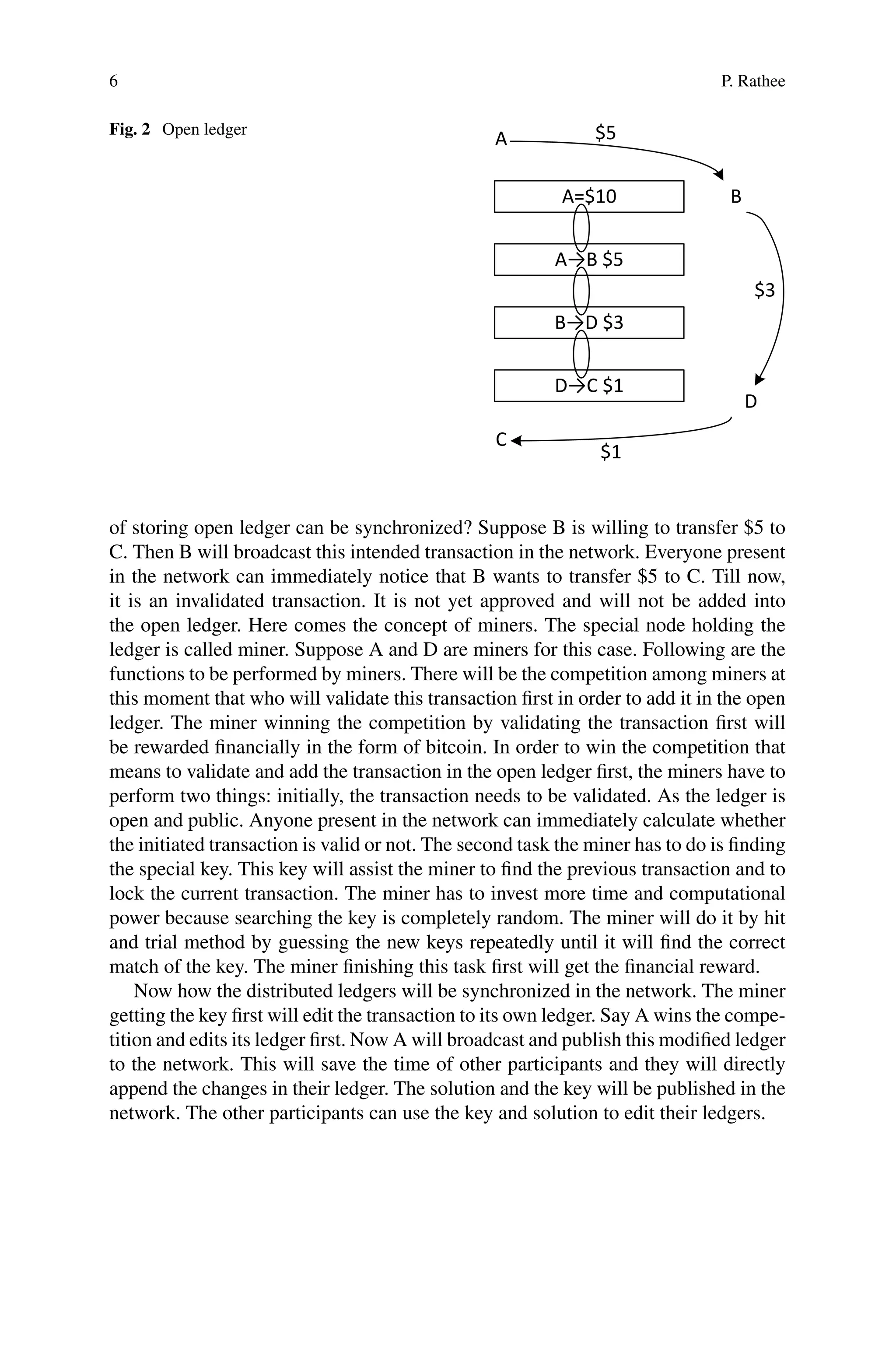
![Introduction to Blockchain and IoT 7
2.3 Distributed Power
The Blockchain is nothing but a group of blocks or a chain of blocks. Each block is
going to contain some data and in the context of the blockchain, that data is a ledger
or a transaction. Let’s say at time T = 0 is the time when the first block was added to
the blockchain system and this block which was added at T = 0 is called the Genesis
block. Each block of the blockchain also linked to other blocks via linkages to the
previous blocks. So in other words, each block of the blockchain has a reference to its
previous block. This is how each block of the blockchain is connected to each other.
One of the major architectural aspects of blockchain is that blocks are distributed
across the P2P network. The P2P is a network wherein each node of the network is
connected to every other node of the network. These are the nodes, which also help to
store the blocks as well as to do some mining process on the blocks as per the criteria
which are mentioned in the blockchain algorithm. This arrangement with which the
blocks and the ledgers are distributed across the various nodes of the network is also
called as distributed ledger technology or DLT. The DLT is also abbreviated as an
alternative name of blockchain in order to make it more generic.
2.4 Security
The blockchain is one of the most fundamental technologies underpinning. One area
where the number of people getting excited to use blockchain is identity. Identity is a
very important concept at the basis of any security puzzle because if you know who
you are talking to, where they are coming from, then you can trust them. Blockchain
with its replicated storage and its decentralized management offers some exciting
possibilities for storing and providing access to identities which can then be used in
bigger transactions [3].
2.5 Transparency
One of the core philosophies of blockchain is transparency or visibility. So there is
open ledger for all to see what happened. Deterrence is a useful way of stopping
bad things from happening. If people know that the record of what they are doing is
going to be laid bare to be checked later to be verified, they often just won’t do the
bad things in the first place. It is not worth if the risk of getting caught is too high. So
in principle, this openness and transparency is a great way of taking out some of the
security problems and some requirements from technology from blockchain-based
systems.](https://image.slidesharecdn.com/60300-250617084054-c06f83a2/75/Advanced-Applications-of-Blockchain-Technology-Shiho-Kim-21-2048.jpg)
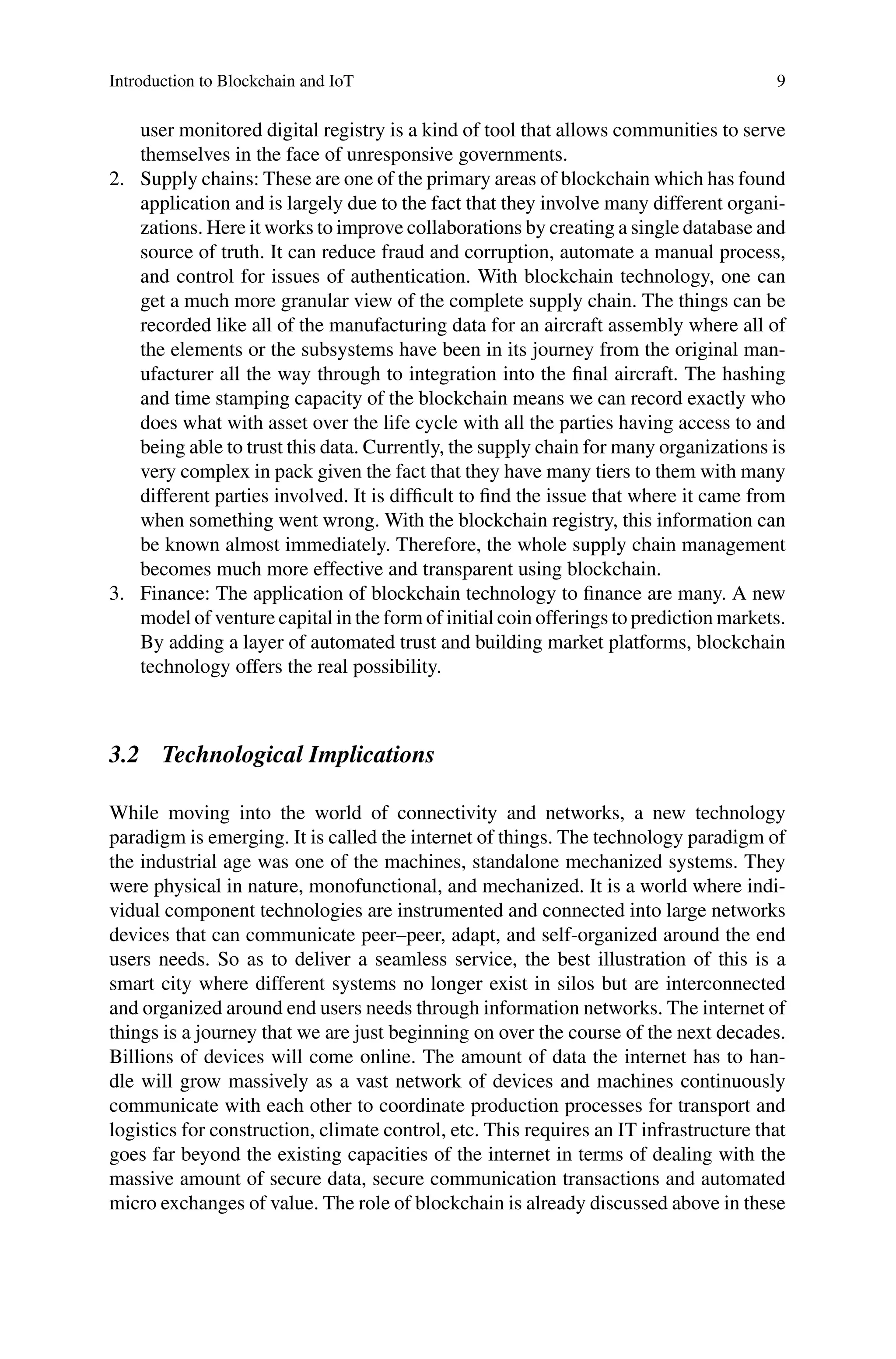
![10 P. Rathee
areas. The combination of IoT and blockchain seems to be a very efficient technology
in every field. Blockchain networks could provide a robust and decentralized system
for handling these issues on the micro level of individual devices and machines.
The internet of things going to need micropayments systems where devices can pay
automatically on demand based on the resources they consumed [4].
3.3 Social Implication of Blockchain and IoT
There are various social implications of blockchain and IoT. Some of them are
illustrated as follows:
Personal responsibility: It puts the responsibility of an individual solely in their
hands. You can no longer offload responsibility if you live in a completely open
environment. If you lose your private key, your money is gone.
Spreading of value distribution: One is also spreading the value of distribution if
one takes note of a few hacks in exchange. The system can’t be broken. The whole
things can’t be taken down by taking a single part of it. Only can be done is the value
distribution existing in the network. All of the data or value is held at the end nodes.
Service in transit: People who try to build on top of the network focus on actually
providing service through transit. The money is transmitting, and never held by one
node. The data is transformed and moved it somewhere else.
Large-scale agreement of information: As opposed to the client–server model, data
on one application may doesn’t correspond to the same redundant data on another
application. So when you have things like a consortium of banks, you have to have
a lot of middlemen which have to keep track of a lot of auditing. The blockchain
solves this problem in order to make the payment and money transfer system by
making it completely automated. As the blockchain technology is decentralized, so
the problem of the middleman is also got solve by using blockchain. And apart from
it, the IoT provides the interconnection of all the devices and blockchain provides
the decentralized property. Therefore, the combination of two makes it convenient
for the agreement of information on a large scale.
4 Blockchain Use Cases for IoT
4.1 Healthcare Industry
This section will illustrate how emerging technologies can be leveraged by the health-
care industry to capture, manage, and analyze patient details. The data sent by the
patient is recorded and presented to the doctors through IoT application. The doctor
can record the patient’s medical history and store it in a blockchain. Thereby pro-
viding immutability to the patient’s medical record. In the end states, doctors will](https://image.slidesharecdn.com/60300-250617084054-c06f83a2/75/Advanced-Applications-of-Blockchain-Technology-Shiho-Kim-24-2048.jpg)
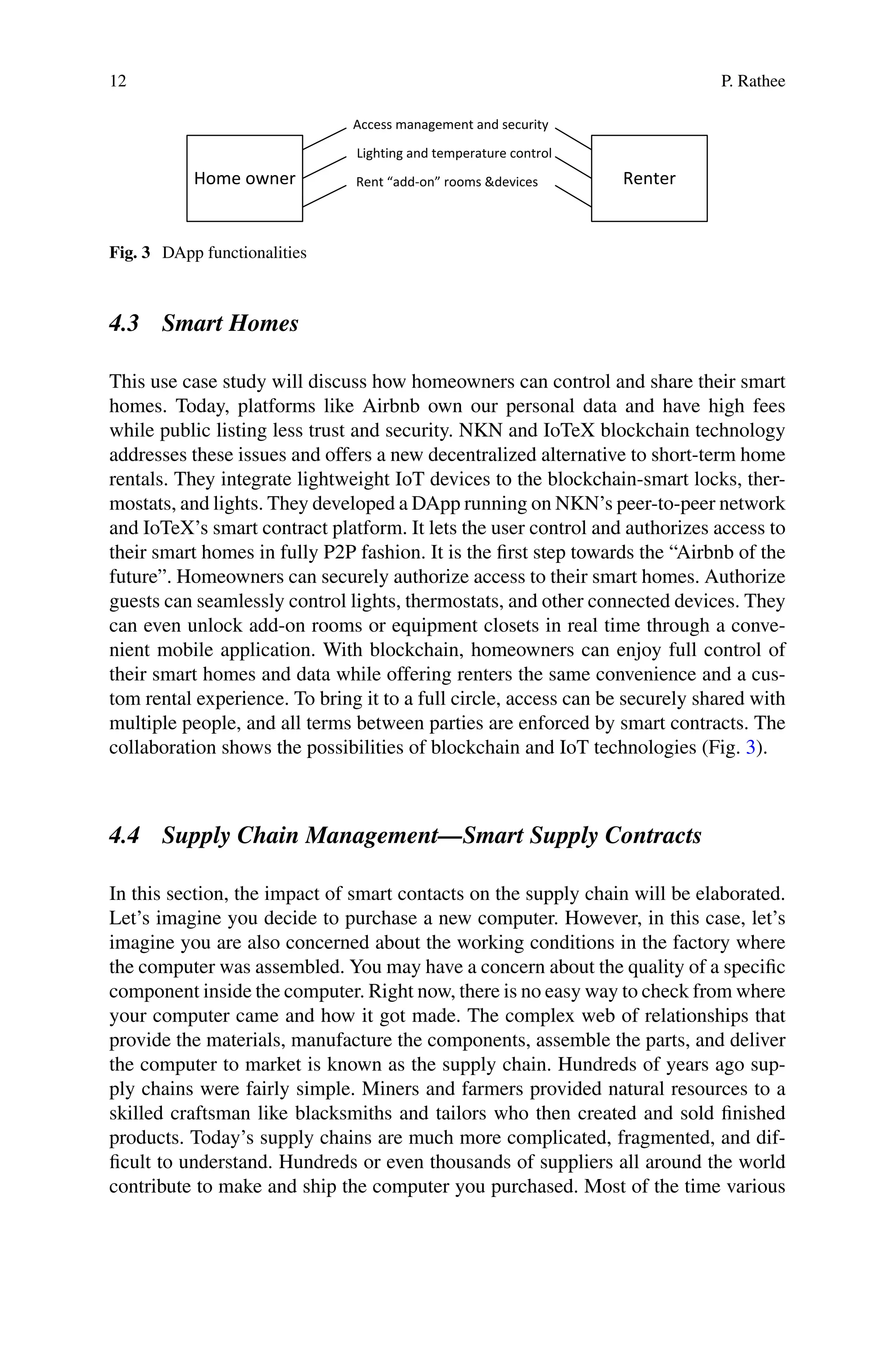
![Introduction to Blockchain and IoT 13
companies don’t know about each other. As a consumer, you don’t know anything
about how, where, when, what, under what conditions your computer was made. This
is not just a problem for consumers. Today’s supply chain is so complex that even
Apple, Dell, or HP has difficulty in tracking that how their computers get made.
Smart contracts could make supply chain management simpler and more trans-
parent. The idea is to create a single source of information about products in a supply
chain in a global ledger. Each component would have its own entry on the blockchain
that gets tracked over time. Both companies could then update the status of a com-
ponent in real time. The end result is once you receive your computer, you could
track every component back to its manufacturer. Theoretically, you could trace the
supply chain all the way back to the mines where the raw materials came from.
Companies can also use the blockchain supply chain as a single source of truth for
their products. They can manage and monitor risks within the supply chain ensuring
the quality of delivered parts and track delivery status. Additionally, companies can
use smart contracts to manage and pay for supply chains autonomously. For exam-
ple, a chip manufacturer could be paid immediately upon testing of each individual
chip at the assembly facility. This would reduce the need for large contracts invoices
and the back-and-forth of refund requests for faulty components. Those same smart
contracts could assist with shipping and logistics, tracking valuable products as they
travel around the world. Using blockchain companies can finally have a complete
picture of their products at every stage in the supply chain bringing transparency to
the production process while reducing the cost of manufactured goods.
5 Key Challenges for Block Chain and IoT
5.1 Operational
The IoT and blockchain technologies are connecting several devices working on sev-
eral platforms. The devices communicating with each other might face the problem
of compatibility with each other. In order to make these technologies operational
efficiently, we need a common platform for all the devices and inbuilt technologies
[5].
5.2 Technical
The major technical issues of blockchain and IoT technology are scalability, security,
and storage requirement. The issue of security has already been discussed in detail.
So coming to the issue of scalability which means that the capacity to process a
transaction on the blockchain is limited. In the case of financial transactions, there
happens several thousands of transaction per second. This means that in blockchain](https://image.slidesharecdn.com/60300-250617084054-c06f83a2/75/Advanced-Applications-of-Blockchain-Technology-Shiho-Kim-27-2048.jpg)
![16 A. M. Saghiri et al.
Fig. 1 Number of connected devices [2]
that, by 2020, 100% of its products will be available on the Internet [1]. Figure 1
shows that the number of connected devices has surpassed the human population and
continues to rise.
In this chapter, we focus on the implementation perspective in three fields:
blockchain technology, AI, and the IoT. The rest of the chapter is organized as fol-
lows. Section 2 discusses the implementation perspective of blockchain platforms. In
Sects. 3 and 4, some important IoT and AI platforms for implementation are studied.
A hybrid system based on IoT, AI, and Blockchain is explained in Sect. 5. Finally,
the conclusions and future work are given in Sect. 6.
2 Blockchain Implementation Perspective
Blockchaintechnologycanbeusedtodesignadecentralizedsystemfortracking,doc-
umenting, and facilitating transactions. In this section, we study the most important
platforms for implementing the blockchain. There are many solutions for blockchain-
based applications in the literature. In this section, we survey eight well-known solu-
tions.
2.1 Bitcoin
Bitcoin, which was first registered in 2008, refers to a collection of concepts and
technologies which establishes the basis for a digital money ecosystem [3]. Bitcoin
users communicate with each other by utilizing a special form of peer-to-peer pro-
tocol primarily via the Internet. The Bitcoin protocol stack, which is available as](https://image.slidesharecdn.com/60300-250617084054-c06f83a2/75/Advanced-Applications-of-Blockchain-Technology-Shiho-Kim-30-2048.jpg)
![The Internet of Things, Artificial Intelligence, and Blockchain… 17
Fig.
2
Bitcoin
overview
[4].
Source
Mastering
Bitcoin
Programming
the
Open
Blockchain](https://image.slidesharecdn.com/60300-250617084054-c06f83a2/75/Advanced-Applications-of-Blockchain-Technology-Shiho-Kim-31-2048.jpg)
![18 A. M. Saghiri et al.
open-source software, can be used on a wide range of computing devices such as
laptops and smartphones, which can lead to easier and greater Bitcoin accessibility.
Some well-known features of Bitcoin are given as follows [4]:
• A decentralized peer-to-peer network (the Bitcoin protocol),
• A public transaction ledger (the blockchain),
• A set of rules used for validating independent transaction validation and issuing
the currency (consensus rules), and
• A mechanism for obtaining a global decentralized consensus on the valid
blockchain (proof-of-work algorithm).
In order to develop an application based on Bitcoin, some of the best libraries and
programming languages are mentioned in [4] (Fig. 2).
2.2 Ethereum
Ethereum is considered to be a trusted computational platform, along with a native
currency, which is established on top of a decentralized peer-to-peer network. Any
digital content which can be controlled by someone may be saved in an Ethereum
smart contract, which is then transferred between peers without requiring a third
party or middleman, such as a bank, exchange, or central government [5]. The data
stored in smart contracts are safe and easy to access, although the cost and structure
of the store are more related to metadata-related applications because saving real data
is too expensive. Figure 3 presents an architecture for the entire Ethereum ecosystem
on a network. The Ethereum Virtual Machine is mostly utilized for directing smart
contracts, as well as establishing a consensus among all participants [6].
In the Ethereum ecosystem, the following play important roles:
• Whisper: Ethereum has its own messaging protocol called Whisper. Whisper is
a decentralized chat mechanism on the Ethereum platform which operates on a
peer-to-peer protocol.
Fig. 3 Ethereum ecosystem [6]](https://image.slidesharecdn.com/60300-250617084054-c06f83a2/75/Advanced-Applications-of-Blockchain-Technology-Shiho-Kim-32-2048.jpg)