Advance OOPS conceptsSangharshAgarwal
AgendaProgrammingProcedural programmingObject oriented programming.Features of OOPOOP conceptsObject oriented programming design principles
ProgrammingProgramming is the craft of transforming requirements into something that computer can execute.
Procedural programmingProgrammer implements requirement by breaking down them to small steps (functional decomposition).Programmer creates the “recipe” that computer can understand and execute.
Procedural programming …..What’s wrong with procedural programming language?When requirements changeIt hard to implement new feature that were not planned in the beginning.Code blocks gets bigger and bigger.Changes in code introduce many bugs.Code gets hard to maintain.
Worst thing is thatRequirement always change
Object oriented programmingBreak down requirements into objects with responsibilities, not into functional steps.Embraces change of requirements.By minimizing changes in code.Lets you think about object hierarchies and interactions instead of program control flow.A completely different programming paradigm.
Why OOPS?To modularize software development, just like any other engineering discipline.To make software projects more manageable and predictable.For better maintainability, since software maintenance costs were more than the development costs.For more re-use code and prevent ‘reinvention of wheel’** every time.**reinventing the wheel is a phrase that means to duplicate a basic method that has already previously been created or optimized by others
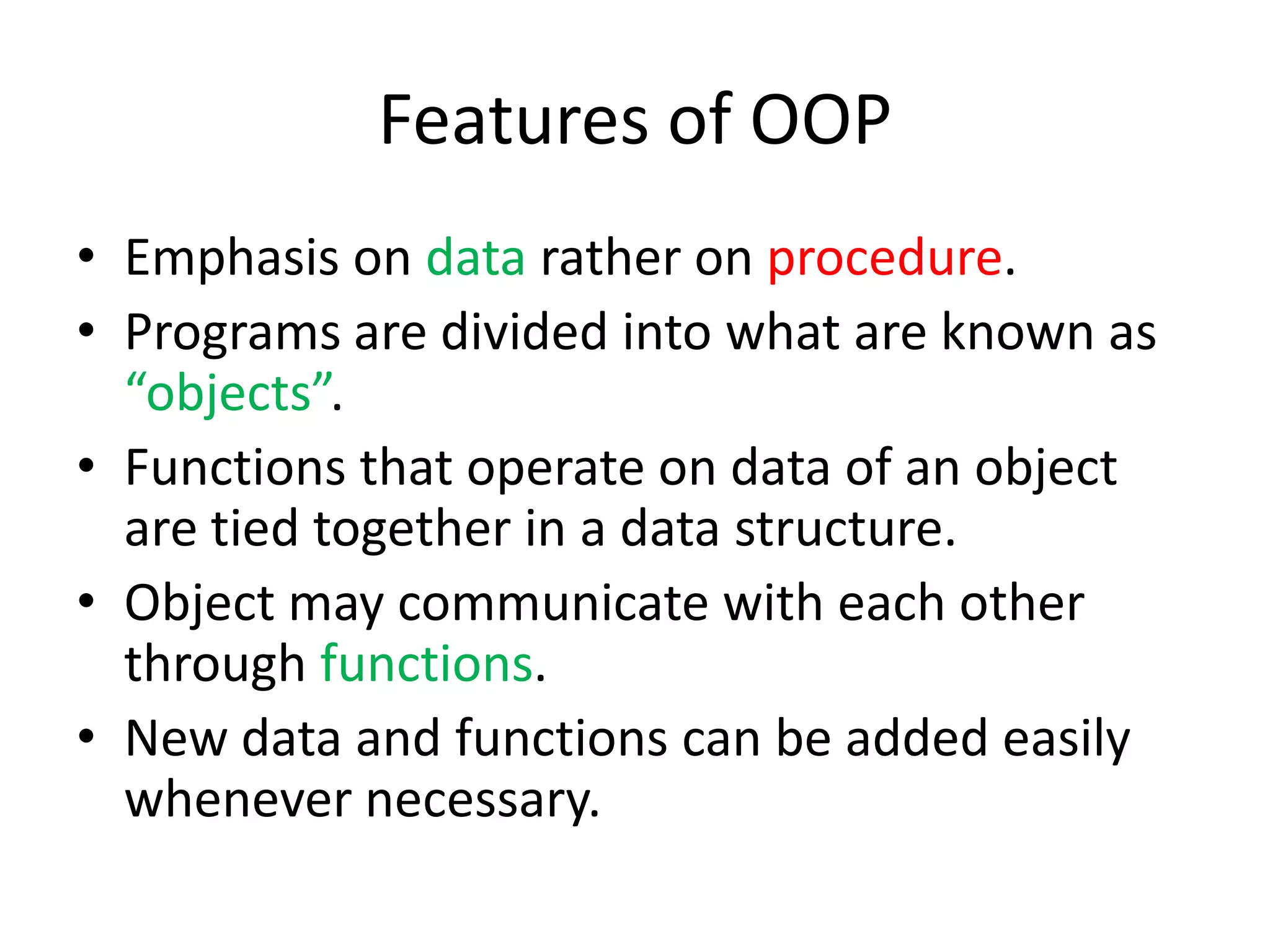
Features of OOPEmphasis on data rather on procedure.Programs are divided into what are known as “objects”.Functions that operate on data of an object are tied together in a data structure.Object may communicate with each other through functions.New data and functions can be added easily whenever necessary.
OOPS ConceptsClasses and ObjectsMessage and MethodsEncapsulationAssociation, Aggregation and CompositionInheritancePolymorphismAbstractionModularityCouplingCohesionInterfaces, Implementation?
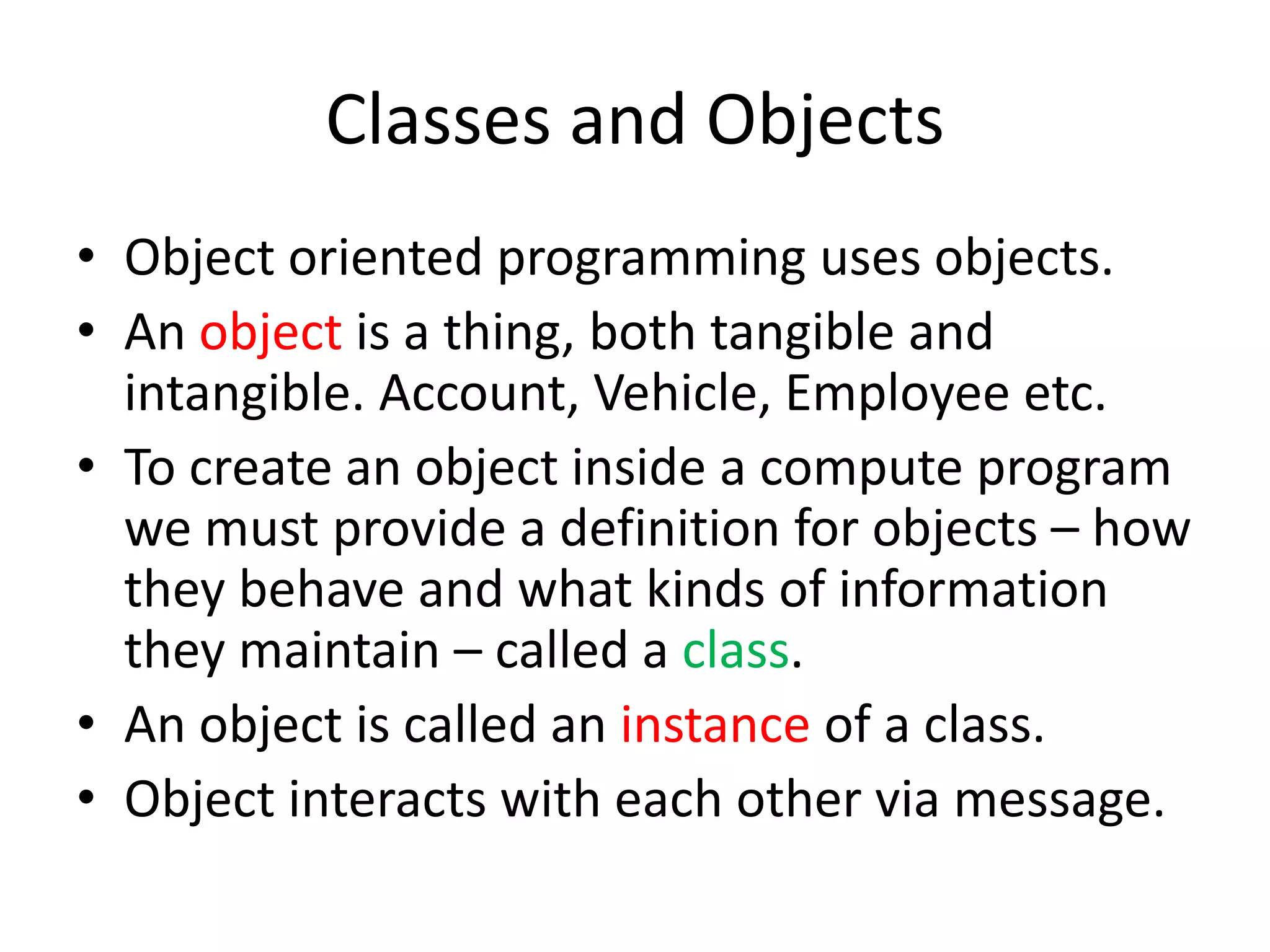
Classes and ObjectsObject oriented programming uses objects.An object is a thing, both tangible and intangible. Account, Vehicle, Employee etc.To create an object inside a compute program we must provide a definition for objects – how they behave and what kinds of information they maintain – called a class.An object is called an instance of a class.Object interacts with each other via message.
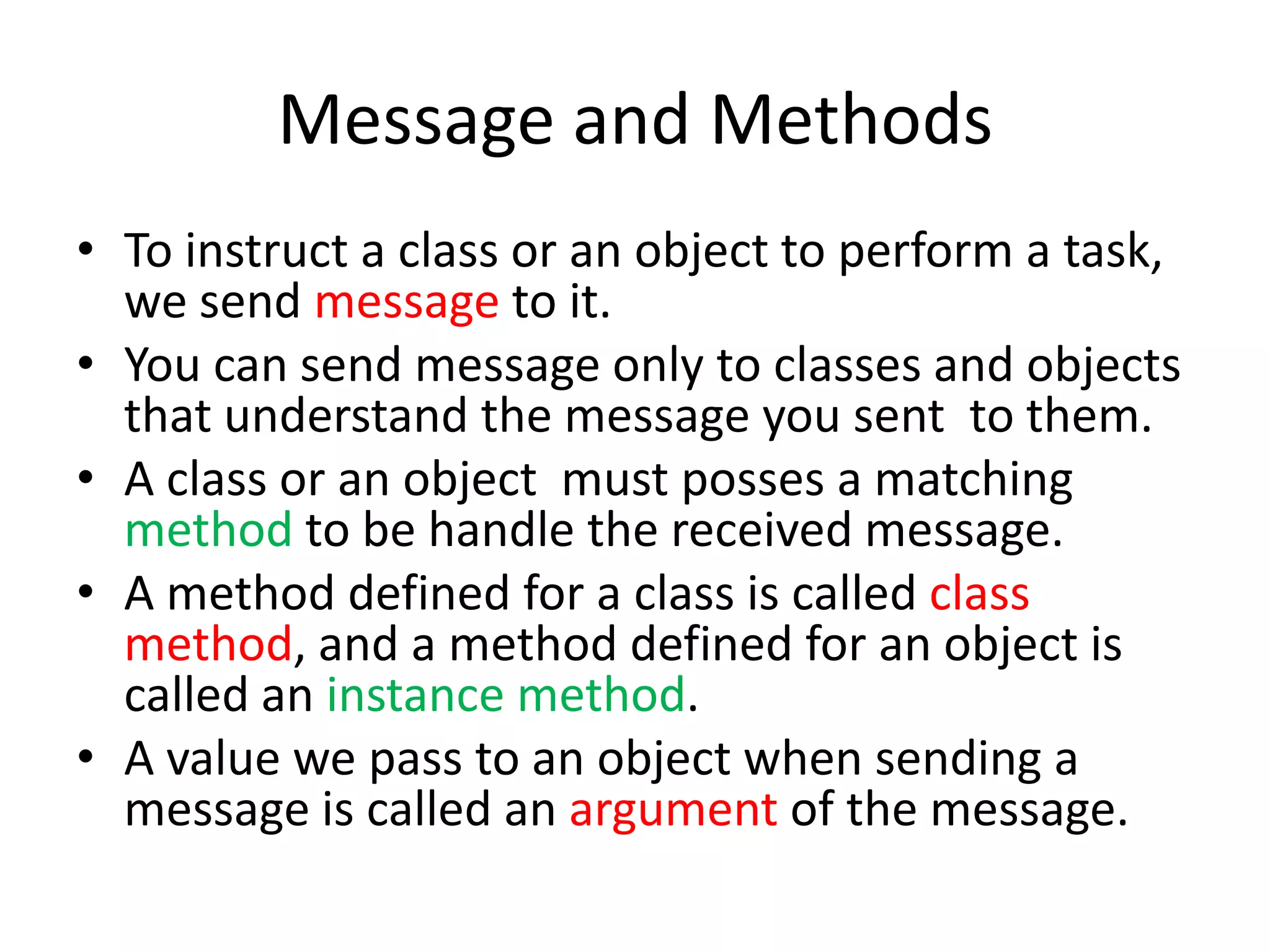
Message and MethodsTo instruct a class or an object to perform a task, we send message to it.You can send message only to classes and objects that understand the message you sent  to them.A class or an object  must posses a matching methodto be handle the received message.A method defined for a class is called class method, and a method defined for an object is called an instance method.A value we pass to an object when sending a message is called an argument of the message.
Message PassingThe process by which an object:Sends data to other objectsAsks the other object to invoke the method.In other words, object talks to each other via messages.
EncapsulationEncapsulation is the integration of data and operations into a class.Encapsulation is hiding the functional details from the object calling it.Can you drive the car?Yes, I can!So, how does acceleration work?Huh?Details encapsulated (hidden) from the driver.
Association, Aggregation and CompositionAssociation -> Whenever two object are related with each other the relationship is called association between objects.Aggregation -> Aggregation is specialized form of association. In aggregation objects have their own life-cycle but there is ownership and child object can not belongs to another parent object. But this is only an ownership not the life-cycle control of child control through parent object. Ex: Student  and teacher, Person and address etc.Composition -> Composition is again specialize form of aggregation and we can call this as a “life and death” relationship. It is a strong type of aggregation. Child object dose not have their life-cycle and if parent object deletes all child object will also be deleted. Ex: House and room
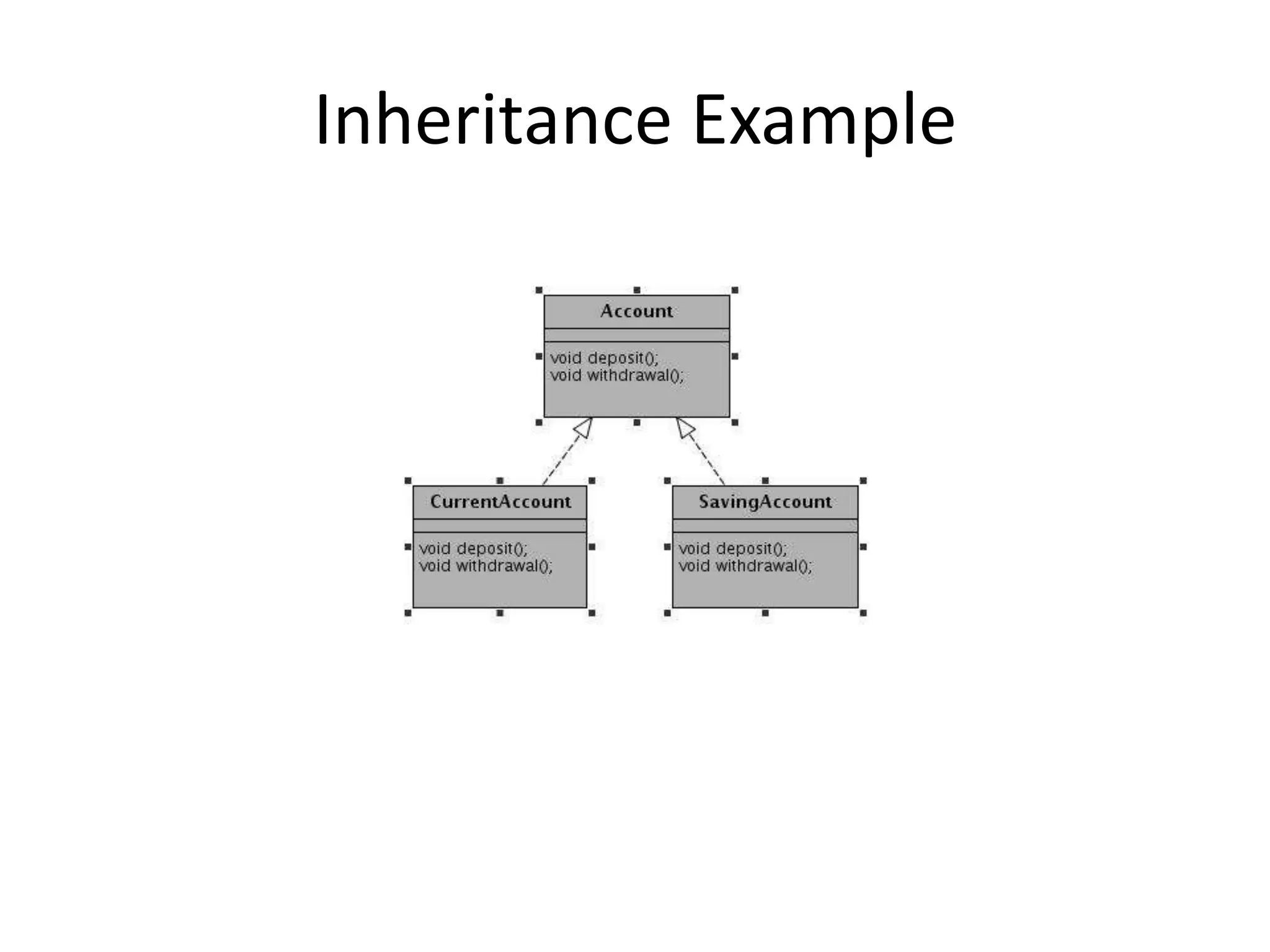
InheritanceInheritance is a mechanism in OOP to design two or more entities that are different but share many common features.Feature common to all classes are defined in  the superclass.The classes that inherit common features from the superclass are called subclasses.
Inheritance Example
Why inheritance?Classes often share capabilities.We want to avoid re-coding these capabilities.Reuse of these would be best toImprove maintainabilityReduce costImprove “real world” modeling.
Why Inheritance? BenefitsNo need to re-invent the wheel.Allow us to build on existing codes without having to copy it, paste it or rewrite it again, etc.To create the subclass, we need to program only the differences between the superclass and subclass that inherits from it.Make class more flexible.
Composition(has-a)/Inheritance(is-a)Prefer composition when not sure about inheritance.Prefer composition when not all the superclass functions were re-used by subclass.Inheritance leads to tight coupling b/w subclass with superclass. Harder to maintain.Inheritance hides some of compilation error which must be exposed.Inheritance is easier to use than composition.Composition make the code maintainable in future, especially when your assumption breaks (Using inheritance).Discussion is incomplete without discussion of Liskov substitution principle.
Composition/Inheritance…..Idea is to think twice while making decision.One has to have proper reason while choosing composition/inheritance.A car has “engine”.A car is a “vechicle”.Discussion?
PolymorphismPolymorphism indicates the meaning of “many forms”.Polymorphism present a method that can have many definitions. Polymorphism is related to “overloading” and “overriding”.Overloading indicates a method can have different definitions by defining different type of parameters.getPrice() : voidgetPrice(string  name) : void
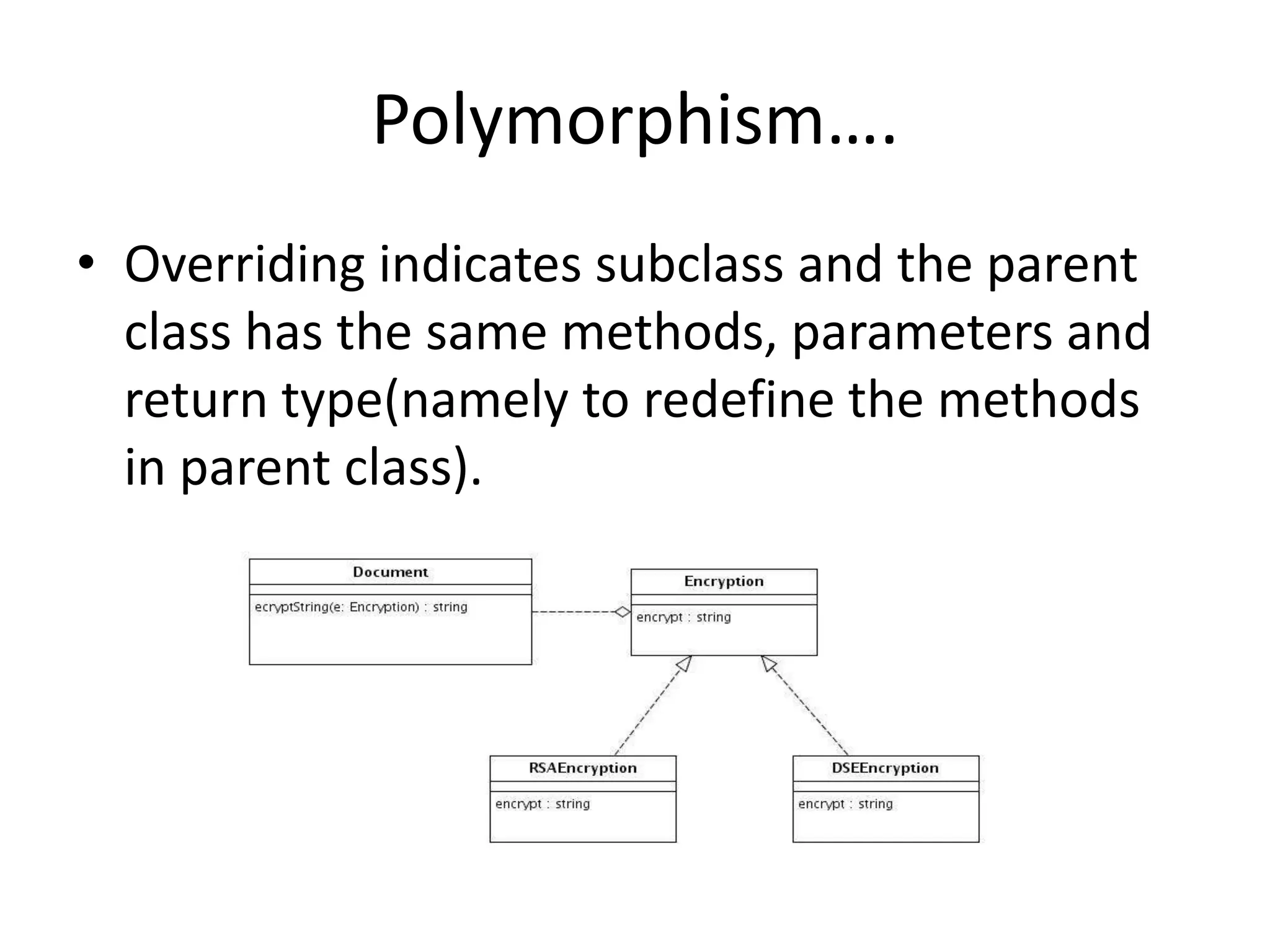
Polymorphism….Overriding indicates subclass and the parent class has the same methods, parameters and return type(namely to redefine the methods in parent class).
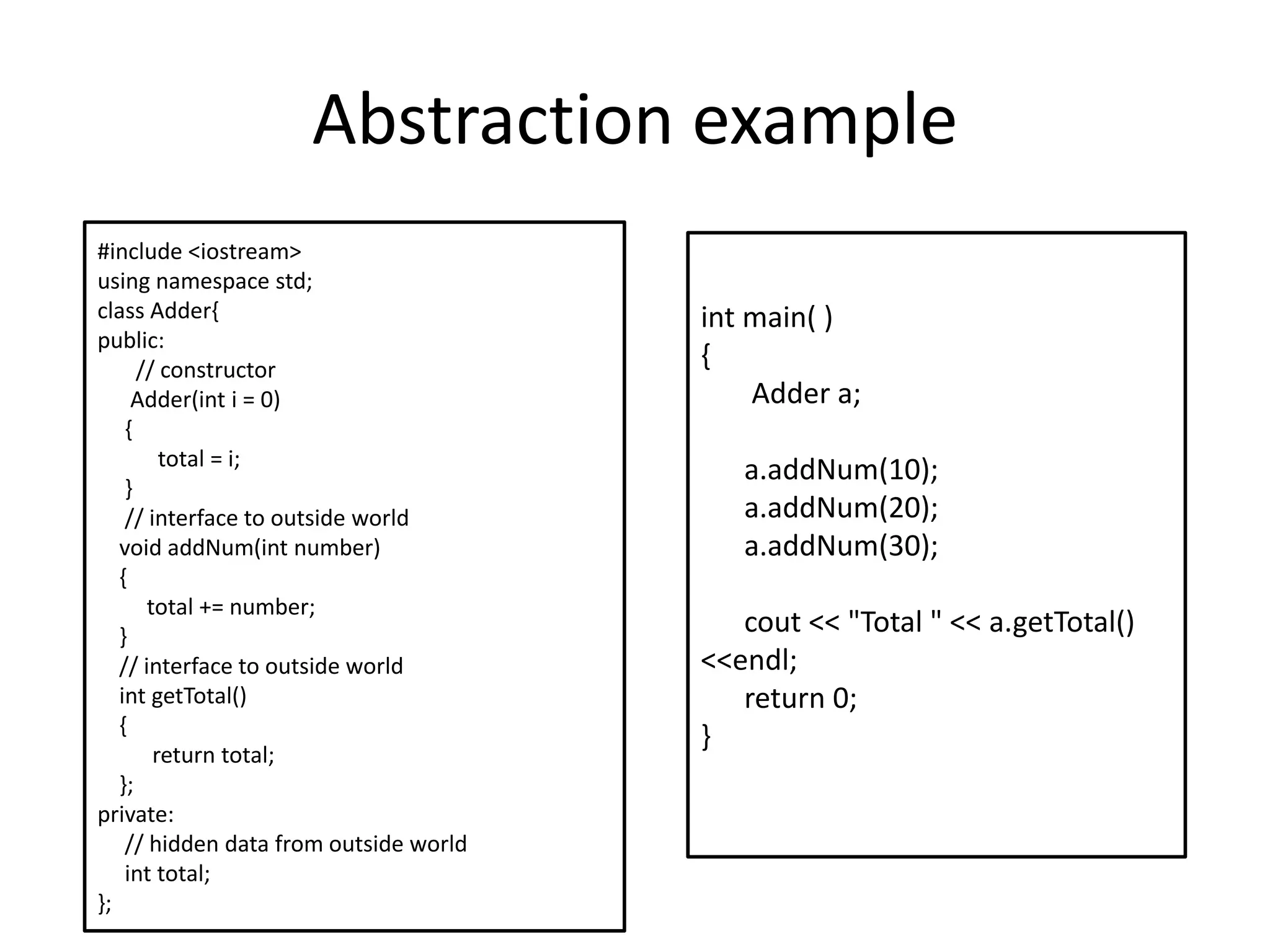
AbstractionAbstraction is the process of modeling only relevant featuresHide unnecessary details which are irrelevant for current for current purpose (and/or user).Reduces complexity and aids understanding.Abstraction provides the freedom to defer implementation decisions by avoiding commitments to details.
Abstraction example#include <iostream>using namespace std;class Adder{public:       // constructor       Adder(int i = 0)     {          total = i;      }     // interface to outside world   void addNum(int number)   {        total += number;   }   // interface to outside world   int getTotal()   {         return total;   };private:    // hidden data from outside world    int total;}; int main( ){       Adder a;a.addNum(10);a.addNum(20);a.addNum(30);cout<< "Total " << a.getTotal() <<endl;     return 0;}
ModularityThe modularity means that the logical components of a large program can each be implemented separately. Different people can work on different classes. Each implementation task is isolated from the others.This has benefits, not just for organizing the implementation, but for fixing problems later.
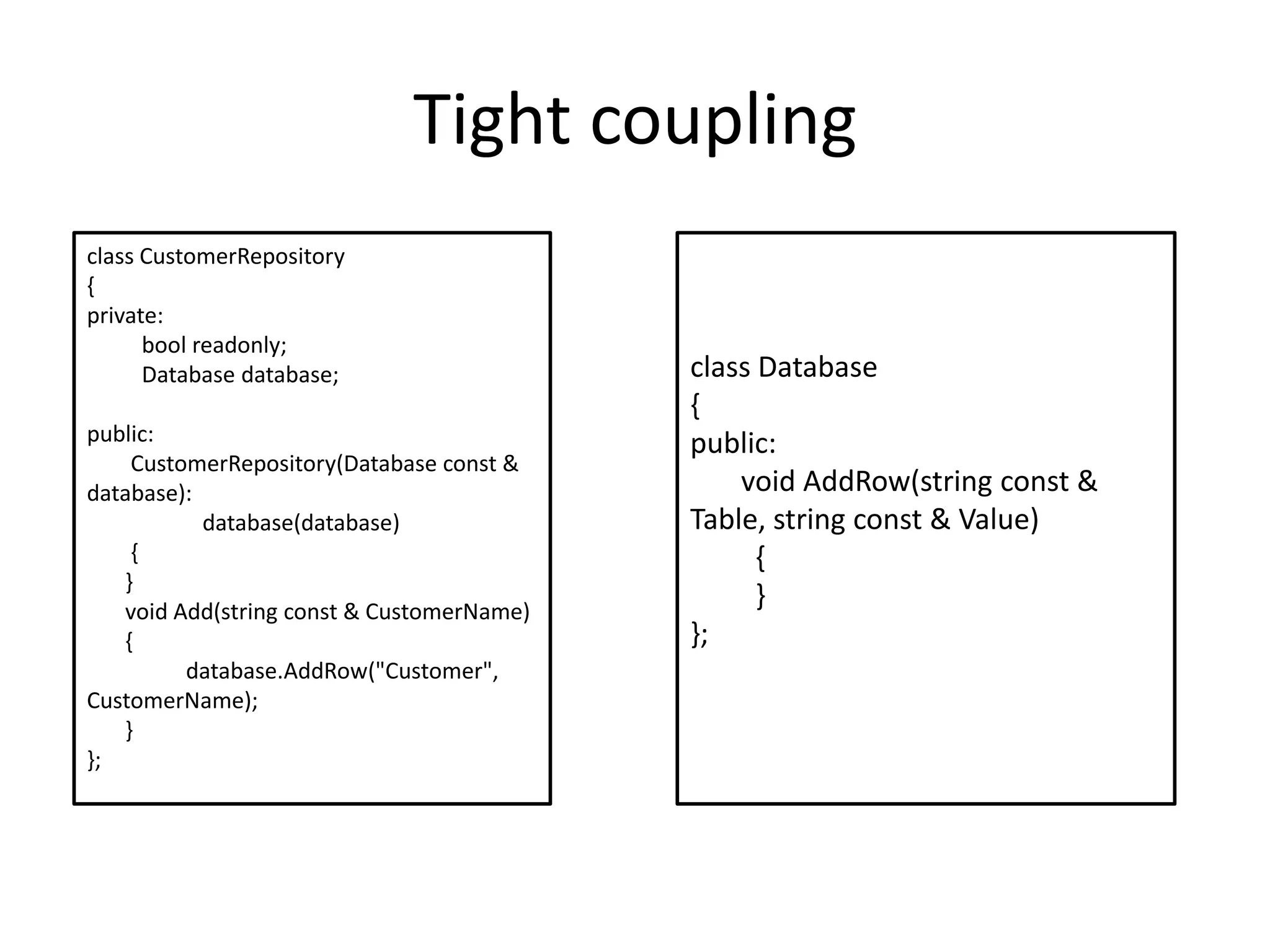
CouplingCoupling defines how dependent one object on another object (that is uses).Coupling is a measure of strength of connection between any two system components. The more any one components knows about other components, the tighter(worse) the coupling is between those components.
Tight couplingclass CustomerRepository{private:boolreadonly;          Database database;public: CustomerRepository(Database const & database):                     database(database)        {       }       void Add(string const & CustomerName)       {database.AddRow("Customer", CustomerName);       }};class Database{public:       void AddRow(string const & Table, string const & Value)         {         }};
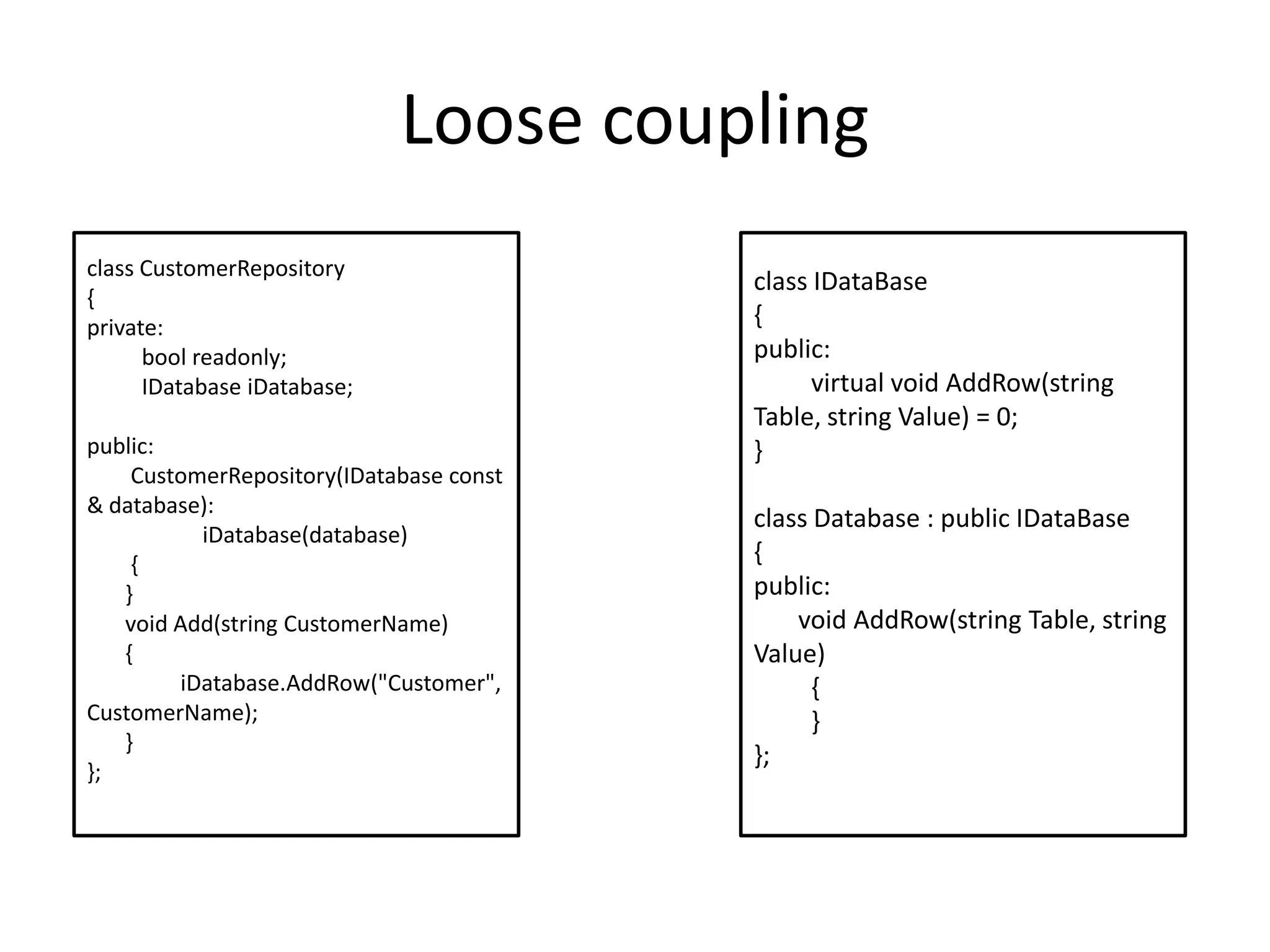
Loose couplingclass CustomerRepository{private:boolreadonly;          IDatabase iDatabase;public:         CustomerRepository(IDatabase const & database):iDatabase(database)        {       }       void Add(string CustomerName)       {iDatabase.AddRow("Customer", CustomerName);       }};class IDataBase{public:         virtual void AddRow(string Table, string Value) = 0;}class Database : public IDataBase{public:       void AddRow(string Table, string Value)         {         }};
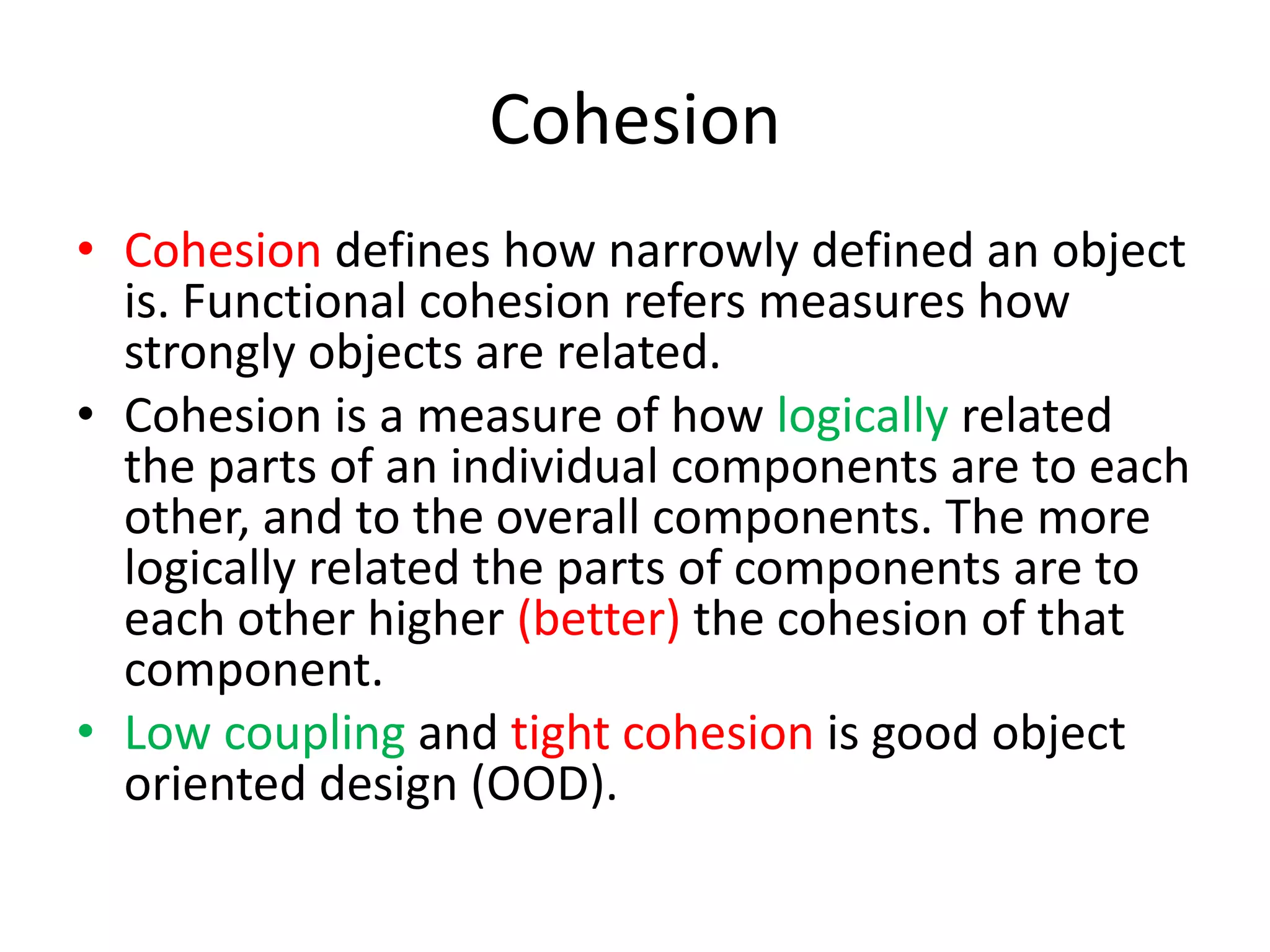
CohesionCohesion defines how narrowly defined an object is. Functional cohesion refers measures how strongly objects are related.Cohesion is a measure of how logically related the parts of an individual components are to each other, and to the overall components. The more logically related the parts of components are to each other higher (better) the cohesion of that component.Low coupling and tight cohesion is good object oriented design (OOD).
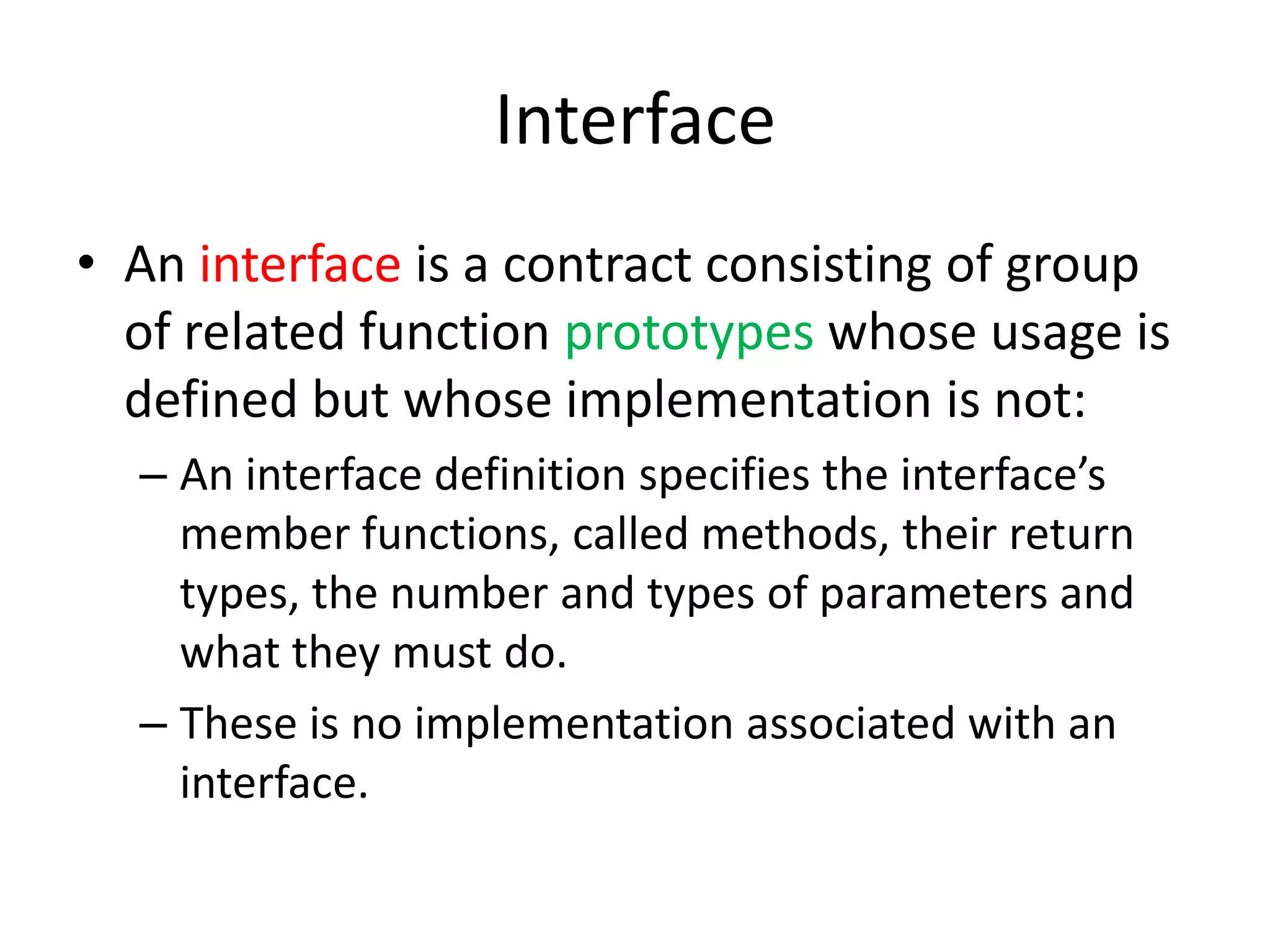
InterfaceAn interface is a contract consisting of group of related function prototypes whose usage is defined but whose implementation is not:An interface definition specifies the interface’s member functions, called methods, their return types, the number and types of parameters and what they must do.These is no implementation associated with an interface.
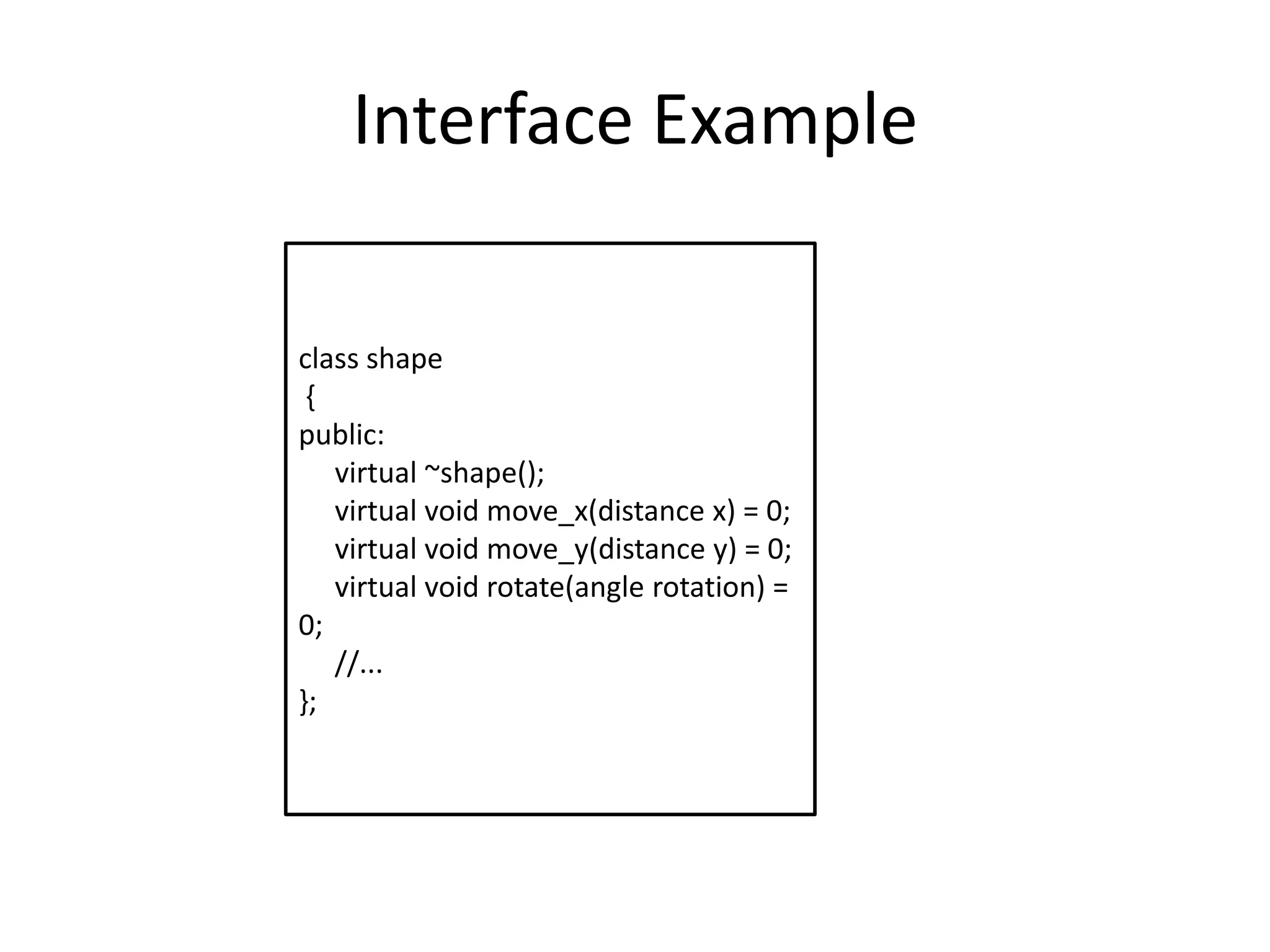
Interface Exampleclass shape {public:      virtual ~shape();     virtual void move_x(distance x) = 0;         virtual void move_y(distance y) = 0;         virtual void rotate(angle rotation) = 0;      //... };
Interface implementationAn interface implementation is the code a programmer supplies to carry out the actions specified in an interface definition.
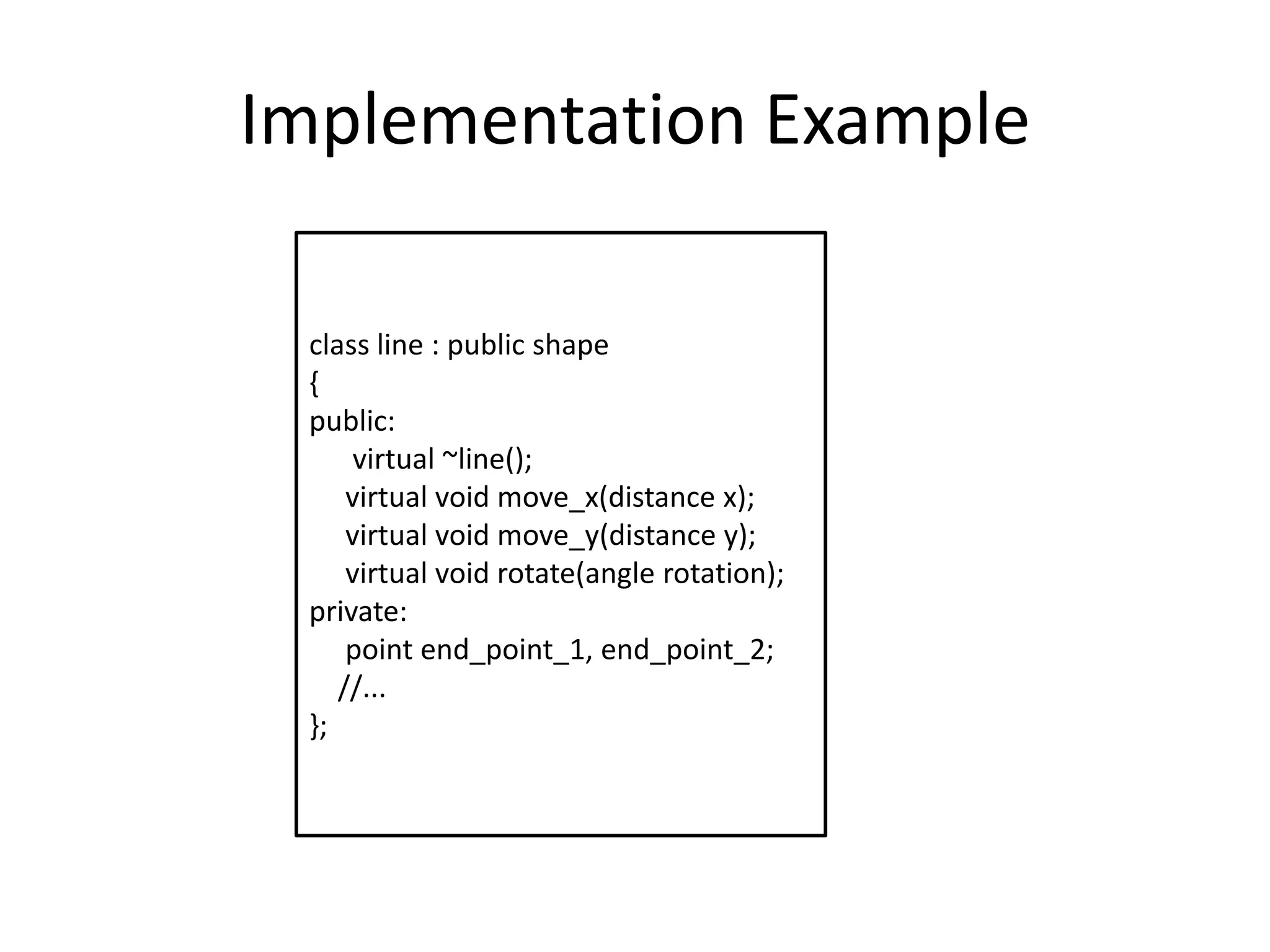
Implementation Exampleclass line : public shape{public:      virtual ~line();     virtual void move_x(distance x);       virtual void move_y(distance y);      virtual void rotate(angle rotation); private:     point end_point_1, end_point_2;       //... };
Interface vs. ImplementationOnly the services the end user needs are represented.Data hiding with use of encapsulationChange in the class implementation should not require change in the class user’s code.Interface is still the sameAlways provide the minimal interface.Use abstract thinking in designing interfacesNo unnecessary stepsImplement the steps in the class implementation
How to determine minimum possible interface?Only what user absolutely needsFewer interfaces are possibleUse polymorphismStarts with hiding everything (private)Only use public interfaces (try not to use public attributes, instead get/set).Design your class from users perspective and what they need (meet the requirements)
Object oriented programming design principlesPrinciples of class design:Single responsibility principle (SRP)Open close principle (OCP)Liskov substitution principle (LSP)Dependency inversion principle (DIP)Interface segregation principle (ISP)Principles of package cohesionReuse release equivalence principle (REP)Common closure principle (CCP)Common reuse principle (CRP)Principles of package couplingAcyclic dependency principle (ADP)Stable dependencies principle (SDP)Stable abstractions principle (SAP)
Single responsibility principleEach responsibility should be a separate class, because each responsibility is an axis of change.A class have one and only one reason to change.
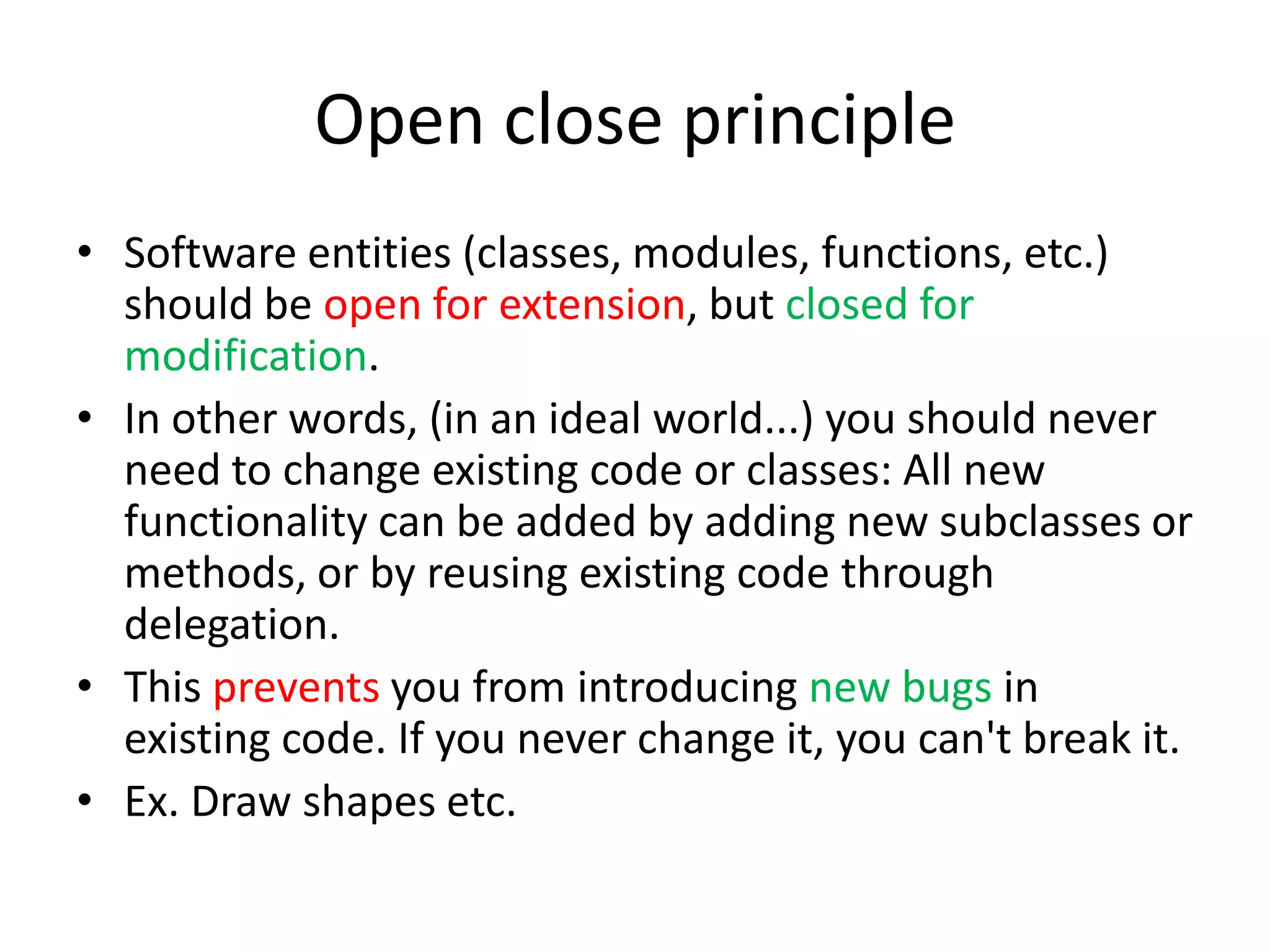
Open close principleSoftware entities (classes, modules, functions, etc.) should be open for extension, but closed for modification.In other words, (in an ideal world...) you should never need to change existing code or classes: All new functionality can be added by adding new subclasses or methods, or by reusing existing code through delegation.This prevents you from introducing new bugs in existing code. If you never change it, you can't break it.Ex. Draw shapes etc.
Open close principle …..When a single change to a program results in a cascade of changes to dependent modules, that program exhibits the undesirable attributes that we have come to associate with “bad” design. The program becomes fragile, rigid, unpredictable and un-reusable. The open-closed principle attacks this in a very straightforward way. It says that you should design modules that never change. When requirements change, you extend the behavior of such modules by adding new code, not by changing old code that already works.
OCP Example//// These functions are implemented elsewhere//void DrawSquare(struct Square*)void DrawCircle(struct Circle*);typedef struct Shape *ShapePointer;void DrawAllShapes(ShapePointer list[], int n){         int i;        for (i=0; i<n; i++)       {              struct Shape* s = list[i];             switch (s->itsType)            {            case square:                   DrawSquare((struct Square*)s);                   break;           case circle:                  DrawCircle((struct Circle*)s);                 break;            }       }}OOD solution to Square/Circle problem.class Shape{public:virtual void Draw() const = 0;};class Square : public Shape{public:virtual void Draw() const;};class Circle : public Shape{public:virtual void Draw() const;};void DrawAllShapes(Set<Shape*>& list){for (Iterator<Shape*>i(list); i; i++)(*i)->Draw();}Procedural solution for square/circle problemenum ShapeType {circle, square};struct Shape{         ShapeType itsType;};struct Circle{         ShapeType itsType;         double itsRadius;         Point itsCenter;};struct Square{         ShapeType itsType;         double itsSide;         Point itsTopLeft;};
Liskov substitution principleFunctions that use pointers or references to base classes must be able to use objects of derived classes without knowing it.What is wanted here is something like the following substitution property: If for each object o1 of type S there is an object o2 of type T such that for all programs P defined in terms of T, the behavior of P is unchanged when o1 is substituted for o2 then S is a subtype of T. Ex. Rectangle and Square etc.
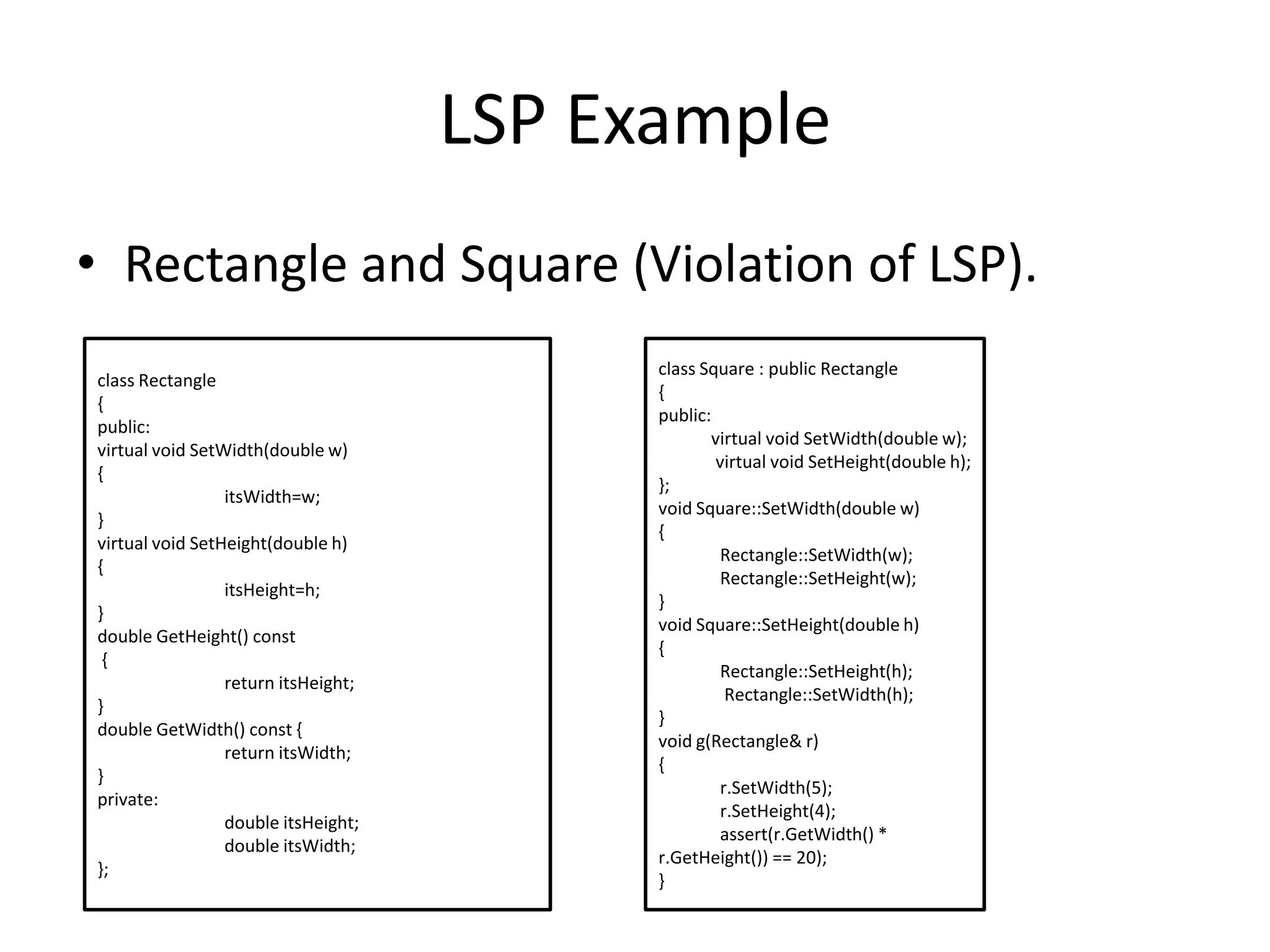
LSP ExampleRectangle and Square (Violation of LSP).class Rectangle{public:virtual void SetWidth(double w) {itsWidth=w;}virtual void SetHeight(double h) {itsHeight=h;}double GetHeight() const {	return itsHeight;}double GetWidth() const {	return itsWidth;} private:	double itsHeight;	double itsWidth;};class Square : public Rectangle{public:            virtual void SetWidth(double w);             virtual void SetHeight(double h);};void Square::SetWidth(double w){              Rectangle::SetWidth(w);              Rectangle::SetHeight(w);}void Square::SetHeight(double h){              Rectangle::SetHeight(h);               Rectangle::SetWidth(h);}void g(Rectangle& r){r.SetWidth(5);r.SetHeight(4);              assert(r.GetWidth() * r.GetHeight()) == 20);}
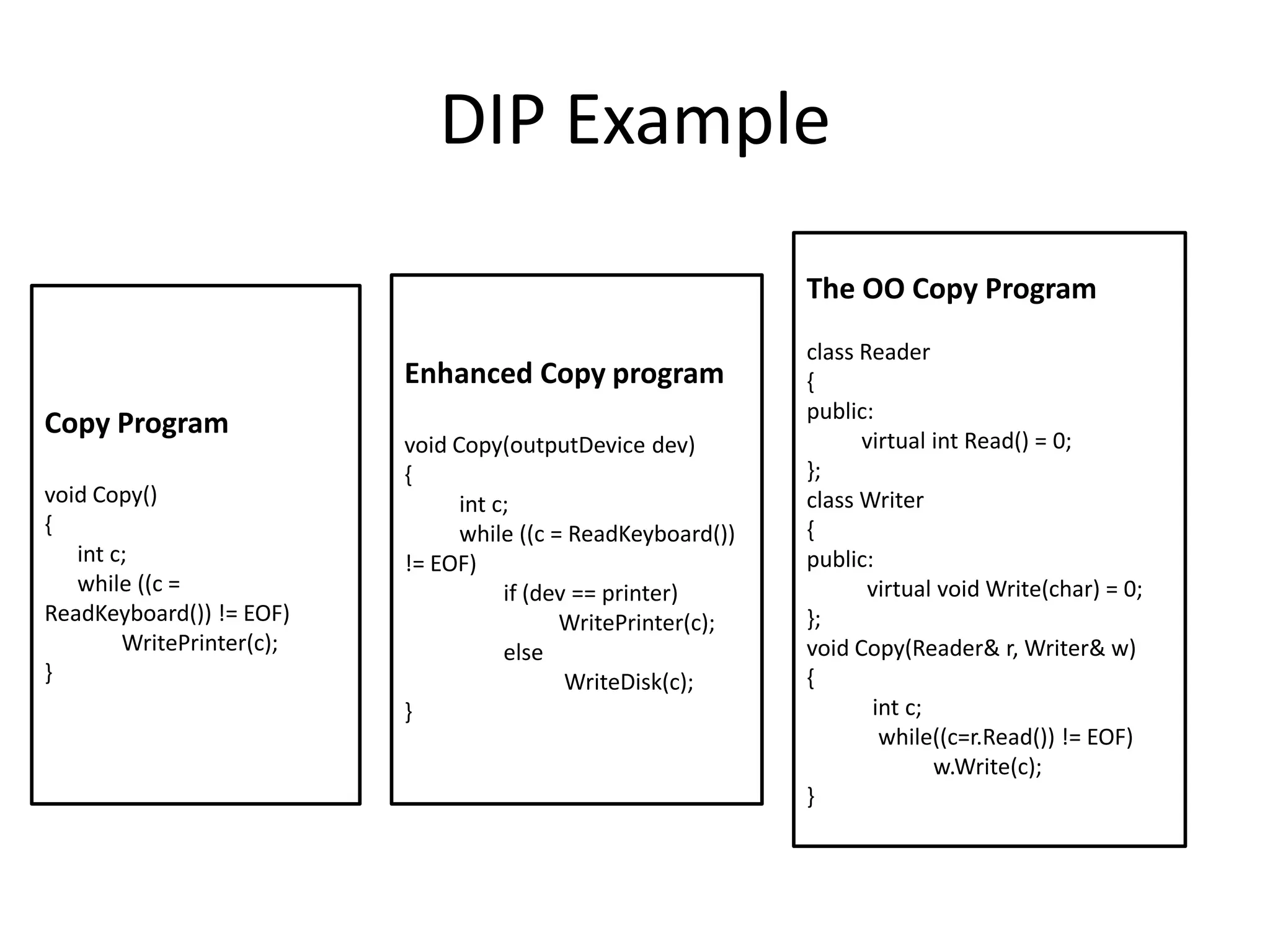
Dependency inversion principleHigh level modules should not depend upon low level modules. Both should depend upon abstractions.Abstractions should not depend upon details. Details should depend upon abstractions.What is bad design?Rigid (Hard to change due to dependencies. Especially since dependencies are transitive.)Fragile (Changes cause unexpected bugs.)Immobile (Difficult to reuse due to implicit dependence on current application code.)
DIP ExampleThe OO Copy Programclass Reader{public:          virtual int Read() = 0;};class Writer{public:           virtual void Write(char) = 0;};void Copy(Reader& r, Writer& w){            int c;             while((c=r.Read()) != EOF)w.Write(c);}Enhanced Copy programvoid Copy(outputDevice dev){          int c;          while ((c = ReadKeyboard()) != EOF)                  if (dev == printer)WritePrinter(c);                  elseWriteDisk(c);}Copy Programvoid Copy(){      int c;      while ((c = ReadKeyboard()) != EOF)WritePrinter(c);}
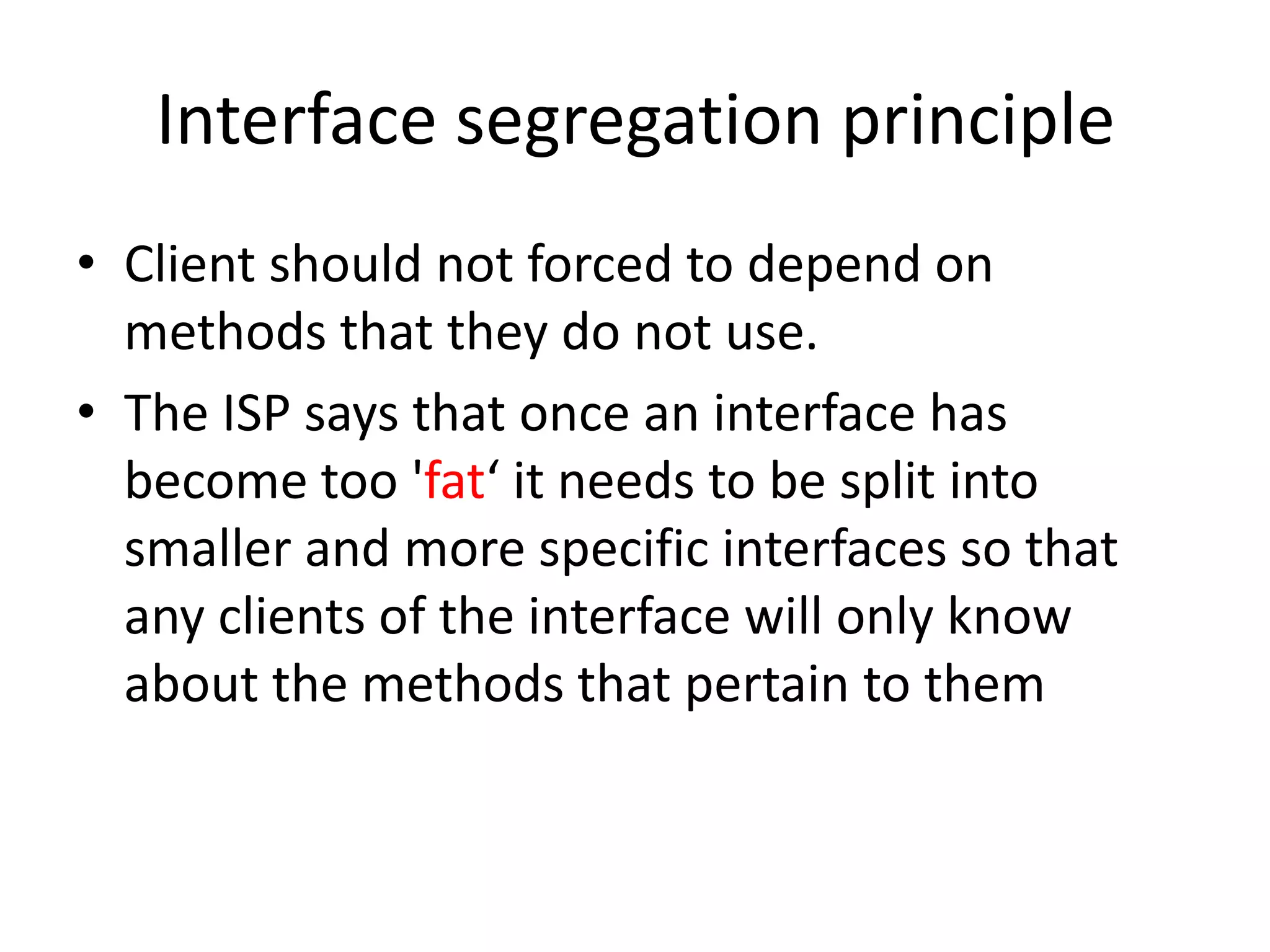
Interface segregation principleClient should not forced to depend on methods that they do not use.The ISP says that once an interface has become too 'fat‘ it needs to be split into smaller and more specific interfaces so that any clients of the interface will only know about the methods that pertain to them
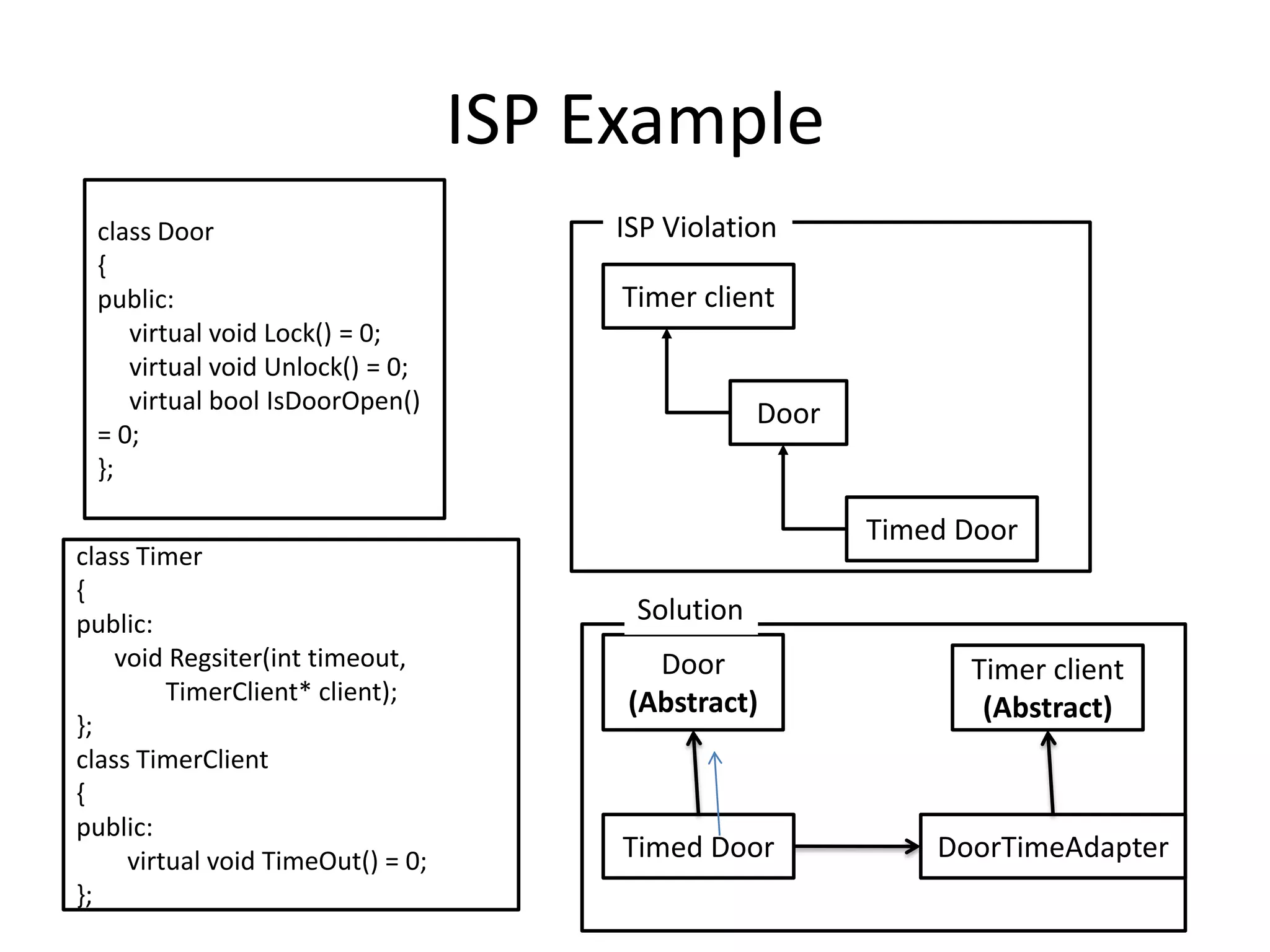
ISP Exampleclass Door{public:     virtual void Lock() = 0;     virtual void Unlock() = 0;     virtual boolIsDoorOpen() = 0;};ISP ViolationTimer clientDoorTimed Doorclass Timer{public:voidRegsiter(int timeout,    TimerClient* client);};class TimerClient{public:        virtual void TimeOut() = 0;};SolutionDoor (Abstract)Timer client(Abstract)Timed DoorDoorTimeAdapter
ReferencesFor more principles visit http://c2.com/cgi/wiki?PrinciplesOfObjectOrientedDesign
Questions?
Thanks!!!Happy Learning!!!

Advance oops concepts

  • 1.
  • 2.
    AgendaProgrammingProcedural programmingObject orientedprogramming.Features of OOPOOP conceptsObject oriented programming design principles
  • 3.
    ProgrammingProgramming is thecraft of transforming requirements into something that computer can execute.
  • 4.
    Procedural programmingProgrammer implementsrequirement by breaking down them to small steps (functional decomposition).Programmer creates the “recipe” that computer can understand and execute.
  • 5.
    Procedural programming …..What’swrong with procedural programming language?When requirements changeIt hard to implement new feature that were not planned in the beginning.Code blocks gets bigger and bigger.Changes in code introduce many bugs.Code gets hard to maintain.
  • 6.
    Worst thing isthatRequirement always change
  • 7.
    Object oriented programmingBreakdown requirements into objects with responsibilities, not into functional steps.Embraces change of requirements.By minimizing changes in code.Lets you think about object hierarchies and interactions instead of program control flow.A completely different programming paradigm.
  • 8.
    Why OOPS?To modularizesoftware development, just like any other engineering discipline.To make software projects more manageable and predictable.For better maintainability, since software maintenance costs were more than the development costs.For more re-use code and prevent ‘reinvention of wheel’** every time.**reinventing the wheel is a phrase that means to duplicate a basic method that has already previously been created or optimized by others
  • 9.
    Features of OOPEmphasison data rather on procedure.Programs are divided into what are known as “objects”.Functions that operate on data of an object are tied together in a data structure.Object may communicate with each other through functions.New data and functions can be added easily whenever necessary.
  • 10.
    OOPS ConceptsClasses andObjectsMessage and MethodsEncapsulationAssociation, Aggregation and CompositionInheritancePolymorphismAbstractionModularityCouplingCohesionInterfaces, Implementation?
  • 11.
    Classes and ObjectsObjectoriented programming uses objects.An object is a thing, both tangible and intangible. Account, Vehicle, Employee etc.To create an object inside a compute program we must provide a definition for objects – how they behave and what kinds of information they maintain – called a class.An object is called an instance of a class.Object interacts with each other via message.
  • 12.
    Message and MethodsToinstruct a class or an object to perform a task, we send message to it.You can send message only to classes and objects that understand the message you sent to them.A class or an object must posses a matching methodto be handle the received message.A method defined for a class is called class method, and a method defined for an object is called an instance method.A value we pass to an object when sending a message is called an argument of the message.
  • 13.
    Message PassingThe processby which an object:Sends data to other objectsAsks the other object to invoke the method.In other words, object talks to each other via messages.
  • 14.
    EncapsulationEncapsulation is theintegration of data and operations into a class.Encapsulation is hiding the functional details from the object calling it.Can you drive the car?Yes, I can!So, how does acceleration work?Huh?Details encapsulated (hidden) from the driver.
  • 15.
    Association, Aggregation andCompositionAssociation -> Whenever two object are related with each other the relationship is called association between objects.Aggregation -> Aggregation is specialized form of association. In aggregation objects have their own life-cycle but there is ownership and child object can not belongs to another parent object. But this is only an ownership not the life-cycle control of child control through parent object. Ex: Student and teacher, Person and address etc.Composition -> Composition is again specialize form of aggregation and we can call this as a “life and death” relationship. It is a strong type of aggregation. Child object dose not have their life-cycle and if parent object deletes all child object will also be deleted. Ex: House and room
  • 16.
    InheritanceInheritance is amechanism in OOP to design two or more entities that are different but share many common features.Feature common to all classes are defined in the superclass.The classes that inherit common features from the superclass are called subclasses.
  • 17.
  • 18.
    Why inheritance?Classes oftenshare capabilities.We want to avoid re-coding these capabilities.Reuse of these would be best toImprove maintainabilityReduce costImprove “real world” modeling.
  • 19.
    Why Inheritance? BenefitsNoneed to re-invent the wheel.Allow us to build on existing codes without having to copy it, paste it or rewrite it again, etc.To create the subclass, we need to program only the differences between the superclass and subclass that inherits from it.Make class more flexible.
  • 20.
    Composition(has-a)/Inheritance(is-a)Prefer composition whennot sure about inheritance.Prefer composition when not all the superclass functions were re-used by subclass.Inheritance leads to tight coupling b/w subclass with superclass. Harder to maintain.Inheritance hides some of compilation error which must be exposed.Inheritance is easier to use than composition.Composition make the code maintainable in future, especially when your assumption breaks (Using inheritance).Discussion is incomplete without discussion of Liskov substitution principle.
  • 21.
    Composition/Inheritance…..Idea is tothink twice while making decision.One has to have proper reason while choosing composition/inheritance.A car has “engine”.A car is a “vechicle”.Discussion?
  • 22.
    PolymorphismPolymorphism indicates themeaning of “many forms”.Polymorphism present a method that can have many definitions. Polymorphism is related to “overloading” and “overriding”.Overloading indicates a method can have different definitions by defining different type of parameters.getPrice() : voidgetPrice(string name) : void
  • 23.
    Polymorphism….Overriding indicates subclassand the parent class has the same methods, parameters and return type(namely to redefine the methods in parent class).
  • 24.
    AbstractionAbstraction is theprocess of modeling only relevant featuresHide unnecessary details which are irrelevant for current for current purpose (and/or user).Reduces complexity and aids understanding.Abstraction provides the freedom to defer implementation decisions by avoiding commitments to details.
  • 25.
    Abstraction example#include <iostream>usingnamespace std;class Adder{public: // constructor Adder(int i = 0) { total = i; } // interface to outside world void addNum(int number) { total += number; } // interface to outside world int getTotal() { return total; };private: // hidden data from outside world int total;}; int main( ){ Adder a;a.addNum(10);a.addNum(20);a.addNum(30);cout<< "Total " << a.getTotal() <<endl; return 0;}
  • 26.
    ModularityThe modularity meansthat the logical components of a large program can each be implemented separately. Different people can work on different classes. Each implementation task is isolated from the others.This has benefits, not just for organizing the implementation, but for fixing problems later.
  • 27.
    CouplingCoupling defines howdependent one object on another object (that is uses).Coupling is a measure of strength of connection between any two system components. The more any one components knows about other components, the tighter(worse) the coupling is between those components.
  • 28.
    Tight couplingclass CustomerRepository{private:boolreadonly; Database database;public: CustomerRepository(Database const & database): database(database) { } void Add(string const & CustomerName) {database.AddRow("Customer", CustomerName); }};class Database{public: void AddRow(string const & Table, string const & Value) { }};
  • 29.
    Loose couplingclass CustomerRepository{private:boolreadonly; IDatabase iDatabase;public: CustomerRepository(IDatabase const & database):iDatabase(database) { } void Add(string CustomerName) {iDatabase.AddRow("Customer", CustomerName); }};class IDataBase{public: virtual void AddRow(string Table, string Value) = 0;}class Database : public IDataBase{public: void AddRow(string Table, string Value) { }};
  • 30.
    CohesionCohesion defines hownarrowly defined an object is. Functional cohesion refers measures how strongly objects are related.Cohesion is a measure of how logically related the parts of an individual components are to each other, and to the overall components. The more logically related the parts of components are to each other higher (better) the cohesion of that component.Low coupling and tight cohesion is good object oriented design (OOD).
  • 31.
    InterfaceAn interface isa contract consisting of group of related function prototypes whose usage is defined but whose implementation is not:An interface definition specifies the interface’s member functions, called methods, their return types, the number and types of parameters and what they must do.These is no implementation associated with an interface.
  • 32.
    Interface Exampleclass shape{public: virtual ~shape(); virtual void move_x(distance x) = 0; virtual void move_y(distance y) = 0; virtual void rotate(angle rotation) = 0; //... };
  • 33.
    Interface implementationAn interfaceimplementation is the code a programmer supplies to carry out the actions specified in an interface definition.
  • 34.
    Implementation Exampleclass line: public shape{public: virtual ~line(); virtual void move_x(distance x); virtual void move_y(distance y); virtual void rotate(angle rotation); private: point end_point_1, end_point_2; //... };
  • 35.
    Interface vs. ImplementationOnlythe services the end user needs are represented.Data hiding with use of encapsulationChange in the class implementation should not require change in the class user’s code.Interface is still the sameAlways provide the minimal interface.Use abstract thinking in designing interfacesNo unnecessary stepsImplement the steps in the class implementation
  • 36.
    How to determineminimum possible interface?Only what user absolutely needsFewer interfaces are possibleUse polymorphismStarts with hiding everything (private)Only use public interfaces (try not to use public attributes, instead get/set).Design your class from users perspective and what they need (meet the requirements)
  • 37.
    Object oriented programmingdesign principlesPrinciples of class design:Single responsibility principle (SRP)Open close principle (OCP)Liskov substitution principle (LSP)Dependency inversion principle (DIP)Interface segregation principle (ISP)Principles of package cohesionReuse release equivalence principle (REP)Common closure principle (CCP)Common reuse principle (CRP)Principles of package couplingAcyclic dependency principle (ADP)Stable dependencies principle (SDP)Stable abstractions principle (SAP)
  • 38.
    Single responsibility principleEachresponsibility should be a separate class, because each responsibility is an axis of change.A class have one and only one reason to change.
  • 39.
    Open close principleSoftwareentities (classes, modules, functions, etc.) should be open for extension, but closed for modification.In other words, (in an ideal world...) you should never need to change existing code or classes: All new functionality can be added by adding new subclasses or methods, or by reusing existing code through delegation.This prevents you from introducing new bugs in existing code. If you never change it, you can't break it.Ex. Draw shapes etc.
  • 40.
    Open close principle…..When a single change to a program results in a cascade of changes to dependent modules, that program exhibits the undesirable attributes that we have come to associate with “bad” design. The program becomes fragile, rigid, unpredictable and un-reusable. The open-closed principle attacks this in a very straightforward way. It says that you should design modules that never change. When requirements change, you extend the behavior of such modules by adding new code, not by changing old code that already works.
  • 41.
    OCP Example//// Thesefunctions are implemented elsewhere//void DrawSquare(struct Square*)void DrawCircle(struct Circle*);typedef struct Shape *ShapePointer;void DrawAllShapes(ShapePointer list[], int n){ int i; for (i=0; i<n; i++) { struct Shape* s = list[i]; switch (s->itsType) { case square: DrawSquare((struct Square*)s); break; case circle: DrawCircle((struct Circle*)s); break; } }}OOD solution to Square/Circle problem.class Shape{public:virtual void Draw() const = 0;};class Square : public Shape{public:virtual void Draw() const;};class Circle : public Shape{public:virtual void Draw() const;};void DrawAllShapes(Set<Shape*>& list){for (Iterator<Shape*>i(list); i; i++)(*i)->Draw();}Procedural solution for square/circle problemenum ShapeType {circle, square};struct Shape{ ShapeType itsType;};struct Circle{ ShapeType itsType; double itsRadius; Point itsCenter;};struct Square{ ShapeType itsType; double itsSide; Point itsTopLeft;};
  • 42.
    Liskov substitution principleFunctionsthat use pointers or references to base classes must be able to use objects of derived classes without knowing it.What is wanted here is something like the following substitution property: If for each object o1 of type S there is an object o2 of type T such that for all programs P defined in terms of T, the behavior of P is unchanged when o1 is substituted for o2 then S is a subtype of T. Ex. Rectangle and Square etc.
  • 43.
    LSP ExampleRectangle andSquare (Violation of LSP).class Rectangle{public:virtual void SetWidth(double w) {itsWidth=w;}virtual void SetHeight(double h) {itsHeight=h;}double GetHeight() const { return itsHeight;}double GetWidth() const { return itsWidth;} private: double itsHeight; double itsWidth;};class Square : public Rectangle{public: virtual void SetWidth(double w); virtual void SetHeight(double h);};void Square::SetWidth(double w){ Rectangle::SetWidth(w); Rectangle::SetHeight(w);}void Square::SetHeight(double h){ Rectangle::SetHeight(h); Rectangle::SetWidth(h);}void g(Rectangle& r){r.SetWidth(5);r.SetHeight(4); assert(r.GetWidth() * r.GetHeight()) == 20);}
  • 44.
    Dependency inversion principleHighlevel modules should not depend upon low level modules. Both should depend upon abstractions.Abstractions should not depend upon details. Details should depend upon abstractions.What is bad design?Rigid (Hard to change due to dependencies. Especially since dependencies are transitive.)Fragile (Changes cause unexpected bugs.)Immobile (Difficult to reuse due to implicit dependence on current application code.)
  • 45.
    DIP ExampleThe OOCopy Programclass Reader{public: virtual int Read() = 0;};class Writer{public: virtual void Write(char) = 0;};void Copy(Reader& r, Writer& w){ int c; while((c=r.Read()) != EOF)w.Write(c);}Enhanced Copy programvoid Copy(outputDevice dev){ int c; while ((c = ReadKeyboard()) != EOF) if (dev == printer)WritePrinter(c); elseWriteDisk(c);}Copy Programvoid Copy(){ int c; while ((c = ReadKeyboard()) != EOF)WritePrinter(c);}
  • 46.
    Interface segregation principleClientshould not forced to depend on methods that they do not use.The ISP says that once an interface has become too 'fat‘ it needs to be split into smaller and more specific interfaces so that any clients of the interface will only know about the methods that pertain to them
  • 47.
    ISP Exampleclass Door{public: virtual void Lock() = 0; virtual void Unlock() = 0; virtual boolIsDoorOpen() = 0;};ISP ViolationTimer clientDoorTimed Doorclass Timer{public:voidRegsiter(int timeout, TimerClient* client);};class TimerClient{public: virtual void TimeOut() = 0;};SolutionDoor (Abstract)Timer client(Abstract)Timed DoorDoorTimeAdapter
  • 48.
    ReferencesFor more principlesvisit http://c2.com/cgi/wiki?PrinciplesOfObjectOrientedDesign
  • 49.
  • 50.