Methods for Removalof Dissolved Solids from
Water
Dr. Devendra Mohan
Professor and Former Head
Department of Civil Engineering
Indian Institute of Technology (Banaras Hindu University)
Varanasi – 221005
2.
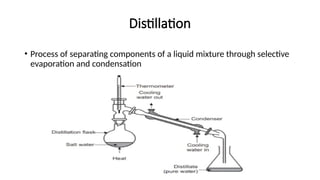
Distillation
• Process ofseparating components of a liquid mixture through selective
evaporation and condensation
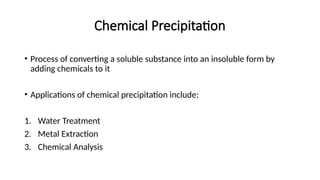
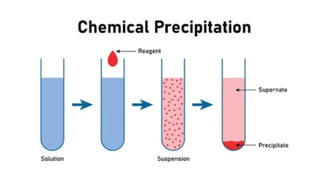
Chemical Precipitation
• Processof converting a soluble substance into an insoluble form by
adding chemicals to it
• Applications of chemical precipitation include:
1. Water Treatment
2. Metal Extraction
3. Chemical Analysis
6.
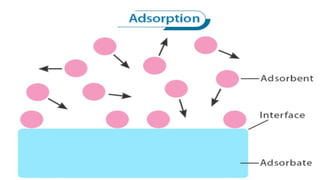
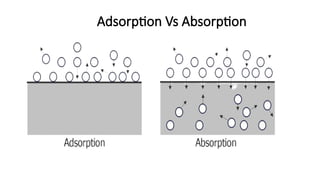
Adsorption
• Adhesion ofatoms, ions or molecules from a gas, liquid or dissolved solid to
surface
• Surface Phenomena
• Adsorbate-ions, atoms, or particles that adhere to surface of adsorbent
• Adsorbent- material that has the ability to attract and hold molecules of a gas,
liquid, or dissolved substance on its surface
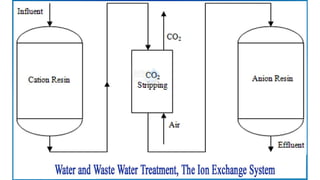
Ion Exchange
• Exchangeof ions of the same charge between an insoluble solid and a
solution in contact with it
• Used in water-softening and other purification and separation processes
11.
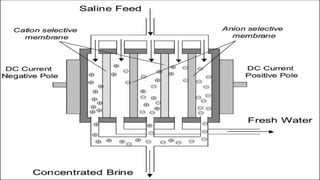
Electrodialysis
• Water treatmentprocess that uses an electric field to move ions through
semipermeable membranes from one solution to another
• Applications:
1. Desalination
2. Drinking water production
3. Food processing
13.
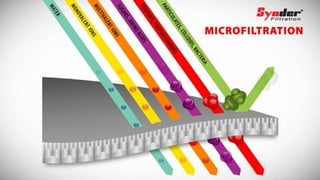
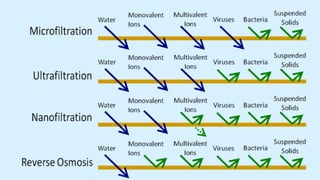
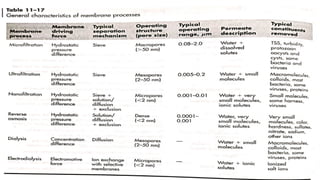
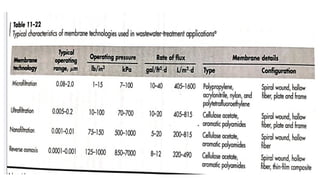
Microfiltration
•Removes large particleslike suspended solids, bacteria, and
some viruses
•Does not remove dissolved substances like salts or small
molecules
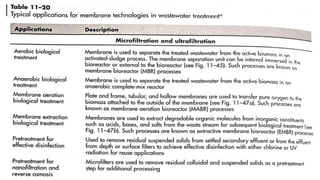
• Applications:
1. Clarification of liquids like beverages.
2. Wastewater treatment (removing bacteria and suspended solids).
3. Pre-treatment for other processes like ultrafiltration or reverse
osmosis.
15.
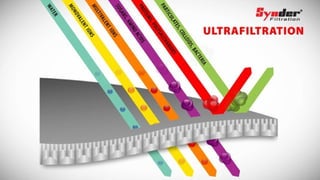
Ultrafiltration
•Removes larger moleculessuch as proteins, colloids, and viruses, as well as
bacteria
•Still allows small molecules like salts, sugars, and smaller organic compounds to
pass through
•Applications:
1. Protein separation in biotechnology and pharmaceuticals.
2. Water purification (removing pathogens).
3. Pretreatment for nanofiltration or reverse osmosis.
17.
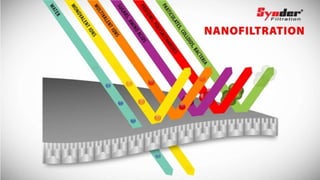
Nanofiltration
•Removes multivalent ions,small organic molecules, and some dissolved salts
•Allows monovalent ions like sodium (Na⁺) and chloride (Cl⁻) to pass through but with
partial rejection
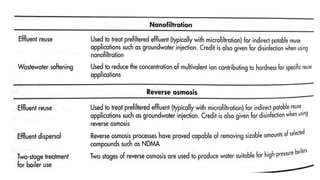
•Applications:
1. Softening water by removing divalent ions like calcium and magnesium
2. Removing color, pesticides, and organic compounds from water
3. Separation processes in food and beverage industries
19.
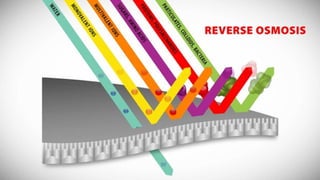
Reverse Osmosis
•Removes almostall dissolved salts, ions, and small molecules,
including monovalent ions like Na⁺ and Cl⁻, as well as organic
compounds
•Capable of producing near-pure water by removing dissolved solids,
bacteria, viruses, and chemicals
•Applications:
1. Desalination of seawater or brackish water
2. Purification of drinking water
3. Industrial water treatment and wastewater recycling
4. Pharmaceutical production and food processing
26.
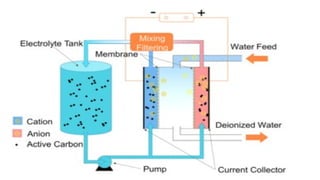
CDI (Capacitive Deionization)
•Electrochemical water treatment process used to remove dissolved
ions from water
• How CDI Works:
1. Ion Migration
2. Electrostatic Adsorption
3. Water Purification
4. Regeneration
28.
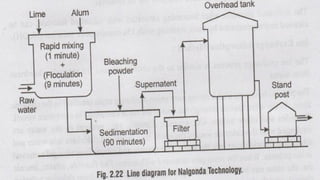
Nalgonda Technique
• Removalof fluoride from water
• Chemicals used in the Nalgonda technique are alum (aluminum sulfate),
lime (calcium oxide), and bleaching powder
30.
Prashanti Technique
• Watertreatment method that uses activated alumina to remove fluoride
from water
• Can be used for both community and domestic defluoridation
31.
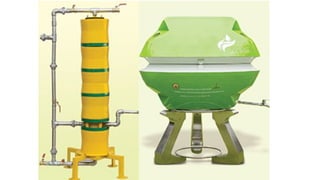
AMRIT
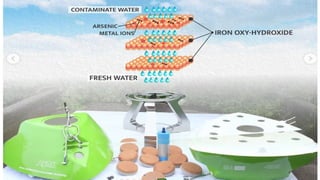
• AMRIT standsfor Arsenic and Metal Removal by Indian Technology
• Technology utilizes nano-scale iron oxy-hydroxide, which selectively
removes arsenic when water passes through it
• AMRIT is applicable for both domestic and community-level water
purification
34.
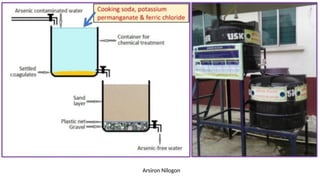
Arsiron Nilogon
• Iron-basedcoagulant specifically designed for the removal of
arsenic from water
• Found effective for both As(III) and As(V) forms of arsenic
• Performance depend on factors such as pH, concentration of
arsenic, and the presence of other ions
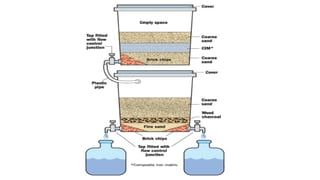
Sono filter
• Waterfiltration system designed to remove arsenic from drinking water
• Filter uses a composite iron matrix, river sand, wood charcoal, and brick
chips to remove up to 98% of arsenic and other contaminants
38.
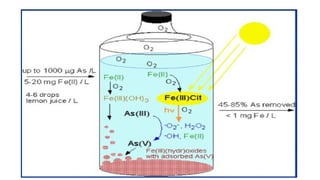
SORAS
• SORAS standsfor Solar Oxidation and Removal of Arsenic
• Process uses solar energy to oxidize arsenic in contaminated water for
removal of arsenic
• Benefits of SORAS :
1. Low-cost
2. Environmentally Friendly
3. Easy to implement in rural areas
40.
Sand coated withiron
• Used for removing arsenic from water
• In this method, a thin layer of iron is coated onto sand particles, which
enhances the adsorption of arsenic when water passes through the filter
41.
Sand coated withmanganese
• Used for removing arsenic from water
• Manganese dioxide coating enhances the ability of the sand to adsorb
arsenic, especially arsenic (III) and arsenic (V), through an oxidation-
adsorption process.