Adolf HitlerAdolf Hitler
Rapporteur: Liu SongshengRapporteur: Liu Songsheng
ContenConten
ts:ts:
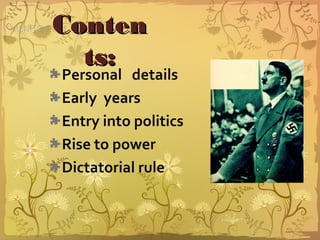
Personal details
Early years
Entry into politics
Rise to power
Dictatorial rule
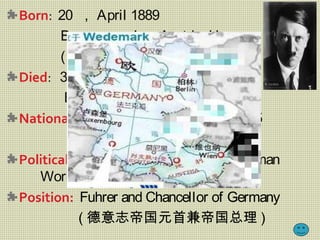
Born: 20 , April 1889
Braunau am Inn, Austria–Hungary
( 奥地利的博劳瑙 )
Died: 30 April 1945 (aged 56)
Berlin, Germany( 德国柏林 )
Nationality : Austrian citizen until 1925
German citizen after 1932
Political party : National Socialist German
Workers' Party ( Nazi )
Position: Fuhrer and Chancellor of Germany
( 德意志帝国元首兼帝国总理 )
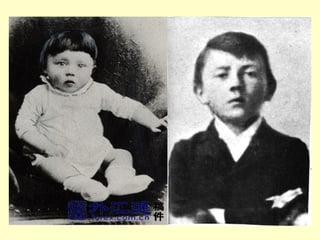
1 、 Childhood and education
Hitler's father worked in the customs bureau
and his mother was a housewife. Hitler had
three siblings( 哥哥姐姐 ) but they all died in
infancy( 幼年 )
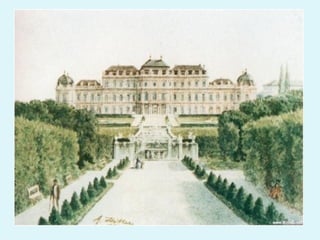
In the primary school, Hitler was an excellent
student ,and he wanted to be an artist because
of his talent for drawing. However, Hitler's
father asked him to follow in his footsteps
,which depressed Hitler and resulted in his poor
performance on study.
After that,Hitler showed no interest in study
however,he was deeply affected by his
historical teacher,who caused Hitler's
obsession( 痴迷 ) with German nationalism
from a young age .
After his father's sudden death on 1903,
Hitler's performance at school
deteriorated( 恶化 ). His mother allowed
him to quit school and go to Vienna( 维也纳
).
2 、 Early adulthood in Vienna and
Munich (慕尼黑)
From 1905, Hitler lived a bohemian( 流浪 ) life in
Vienna,financed by orphan's benefits and support
from his mother.
In this charming city,Hitler took a stroll (闲逛)
everyday and finally decided to study in The
Academy of Fine Arts Vienna( 维也纳艺术学院 ) to
realize his artistic dream. however, it rejected him
twice because of his "unfitness for painting".
After his mother's death in 1907. Hitler worked
as a casual labourer and eventually as a painter,
selling watercolours to support life.
During this time,he also pay attention to his
concerned politics and read a great number of
books on ultranationalism and Anti-Semitism (极
端民族主义和反犹主义)
To evade conscription ( 逃避征兵 )into the
Austrian army and seek more development, in
May 1913, Hitler moved to Munich
3 、 World War I
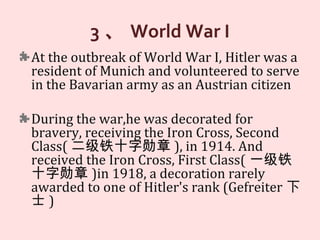
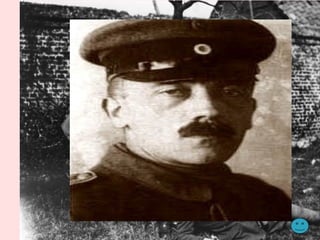
At the outbreak of World War I, Hitler was a
resident of Munich and volunteered to serve
in the Bavarian army as an Austrian citizen
During the war,he was decorated for
bravery, receiving the Iron Cross, Second
Class( 二级铁十字勋章 ), in 1914. And
received the Iron Cross, First Class( 一级铁
十字勋章 )in 1918, a decoration rarely
awarded to one of Hitler's rank (Gefreiter 下
士 )
The war reinforced (加强) his passionate
German patriotism (爱国主义) and he was
shocked by Germany's capitulation (投降)
Like other German nationalists, he believed
that the German army, "undefeated in the
field," had been "stabbed in the back" (背叛
) on the home front by civilian leaders and
Marxists( 马克思主义者 ), later dubbed the
"November criminals".
1 、 Join the DAP(Nazi)
In July 1919 Hitler was appointed to infiltrate
the German Workers' Party (DAP). he became
attracted to the founder Anton Drexler's
antisemitic, nationalist, anti-capitalist, and
anti-Marxist ideas.
Founder invited him to join the DAP for his
oratory skills( 演讲能力 ). On 12 September
1919, Hitler became the party's 55th member
and be leader 2 years later
2 、 Beer Hall Putsch( 啤酒馆政
变 )
Background : After World War
I,Germany faced hard situation of
difficult economic and political unrest.
And sensitive Hitler found that it was a
good chance to grab power to govern
Germany
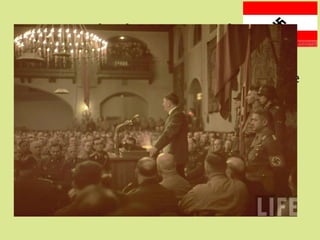
Process : On 8 November 1923,a public
meeting that had been organised by ruler
Kahr in a large beer hall in Munich
Hitler interrupted Kahr's speech and
announced that the national revolution had
begun, declaring the formation of a new
government . Hitler, with handgun drawn,
demanded and got the support of rulers .
however, Kahr and his consorts quickly
withdrew ( 收回 )their support and neither
the army nor the state police joined forces
with him.
The next day, Hitler and his followers
marched from the beer hall to the
Bavarian War Ministry to overthrow( 推
翻 ) the Bavarian government, but police
dispersed them.
Sixteen NSDAP (纳粹) members
and four police officers were killed in the
failed coup.
Results : On 1 April 1923 , Hitler was
sentenced to five years' imprisonment
for high treason( 叛国罪 ).
However,he received friendly treatment
from the guards and had served just
around one year in prison.
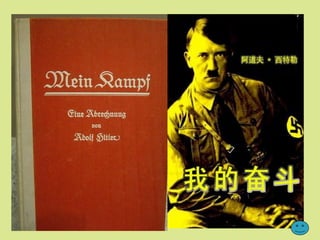
While in prison, Hitler dictated( 口述 ) most
of the first volume off Mein Kamp (My
Struggle ) to his deputy (助手) .The
book, was an autobiography (自传) and
an exposition of his ideology.
The book laid out Hitler's plans for
transforming German society into one
based on race. Some passages implied
genocide (种族灭绝) .
One million copies were sold in 1933,
Hitler's first year in office.
1 、 Reichstag fire (国会纵火案)
On 30 January 1933 , Hitler was named
chancellor( 总理 ).As chancellor, Hitler worked
against attempts by the NSDAP's opponents to
build a majority government.
On 27 February 1933, the Reichstag building was
set on fire. A communist ( 共产主义者 )was found in
incriminating circumstances inside the burning
building.
At Hitler's urging, Activities of the German
Communist Party were suppressed (禁止) , and
some communist party members were arrested.
However , the NSDAP itself was responsible for
starting the fire.
2 、 the Enabling Act (授权法案
)
To achieve full political control despite not having
an absolute majority in parliament (国会) ,
Hitler's government brought the Enabling Act to a
vote.
The act gave Hitler's cabinet( 内阁 ) full legislative
powers( 立法权 ) for a period of four years and
(with certain exceptions) allowed deviations from
the constitution.
Dictatorial rule
On August 2, 1934 , President died
.Hitler thus became head of state as well as
head of government, and was formally
named as Führer und Reichskanzler (leader
and chancellor.From then,authoritarian
system ( 独裁体系 )was established.
In the presidency , many measures were
taken to develop the economy and German
economy out of the shadow of World War I
Besides, Hitler wanted to conquer all of Europe and the world.As a result,he developed
military forces and conquered Austria and Czechoslovakia( 捷克斯洛伐克)
In 1939, Germany declared war against Poland with the intention of capuring it, which
resulted in World War II
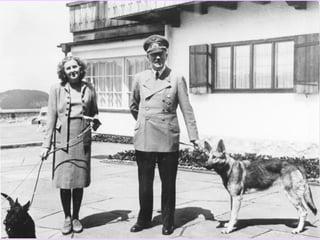
And in the end of the war,Germany was defeated ,and Hitler with his wife committed
suicide on 30 April 1945.
Hitler made all the major military decisions
personally. Historians who have assessed his
performance agree that after a strong start, he
became so inflexible after 1941 that he
squandered( 浪费 ) the military strengths
Germany possessed
Thank You!

Adolf hitler

  • 1.
    Adolf HitlerAdolf Hitler Rapporteur:Liu SongshengRapporteur: Liu Songsheng
  • 2.
    ContenConten ts:ts: Personal details Early years Entryinto politics Rise to power Dictatorial rule
  • 3.
    Born: 20 ,April 1889 Braunau am Inn, Austria–Hungary ( 奥地利的博劳瑙 ) Died: 30 April 1945 (aged 56) Berlin, Germany( 德国柏林 ) Nationality : Austrian citizen until 1925 German citizen after 1932 Political party : National Socialist German Workers' Party ( Nazi ) Position: Fuhrer and Chancellor of Germany ( 德意志帝国元首兼帝国总理 )
  • 4.
    1 、 Childhoodand education Hitler's father worked in the customs bureau and his mother was a housewife. Hitler had three siblings( 哥哥姐姐 ) but they all died in infancy( 幼年 ) In the primary school, Hitler was an excellent student ,and he wanted to be an artist because of his talent for drawing. However, Hitler's father asked him to follow in his footsteps ,which depressed Hitler and resulted in his poor performance on study.
  • 5.
    After that,Hitler showedno interest in study however,he was deeply affected by his historical teacher,who caused Hitler's obsession( 痴迷 ) with German nationalism from a young age . After his father's sudden death on 1903, Hitler's performance at school deteriorated( 恶化 ). His mother allowed him to quit school and go to Vienna( 维也纳 ).
  • 6.
    2 、 Earlyadulthood in Vienna and Munich (慕尼黑) From 1905, Hitler lived a bohemian( 流浪 ) life in Vienna,financed by orphan's benefits and support from his mother. In this charming city,Hitler took a stroll (闲逛) everyday and finally decided to study in The Academy of Fine Arts Vienna( 维也纳艺术学院 ) to realize his artistic dream. however, it rejected him twice because of his "unfitness for painting".
  • 7.
    After his mother'sdeath in 1907. Hitler worked as a casual labourer and eventually as a painter, selling watercolours to support life. During this time,he also pay attention to his concerned politics and read a great number of books on ultranationalism and Anti-Semitism (极 端民族主义和反犹主义) To evade conscription ( 逃避征兵 )into the Austrian army and seek more development, in May 1913, Hitler moved to Munich
  • 8.
    3 、 WorldWar I At the outbreak of World War I, Hitler was a resident of Munich and volunteered to serve in the Bavarian army as an Austrian citizen During the war,he was decorated for bravery, receiving the Iron Cross, Second Class( 二级铁十字勋章 ), in 1914. And received the Iron Cross, First Class( 一级铁 十字勋章 )in 1918, a decoration rarely awarded to one of Hitler's rank (Gefreiter 下 士 )
  • 9.
    The war reinforced(加强) his passionate German patriotism (爱国主义) and he was shocked by Germany's capitulation (投降) Like other German nationalists, he believed that the German army, "undefeated in the field," had been "stabbed in the back" (背叛 ) on the home front by civilian leaders and Marxists( 马克思主义者 ), later dubbed the "November criminals".
  • 10.
    1 、 Jointhe DAP(Nazi) In July 1919 Hitler was appointed to infiltrate the German Workers' Party (DAP). he became attracted to the founder Anton Drexler's antisemitic, nationalist, anti-capitalist, and anti-Marxist ideas. Founder invited him to join the DAP for his oratory skills( 演讲能力 ). On 12 September 1919, Hitler became the party's 55th member and be leader 2 years later
  • 11.
    2 、 BeerHall Putsch( 啤酒馆政 变 ) Background : After World War I,Germany faced hard situation of difficult economic and political unrest. And sensitive Hitler found that it was a good chance to grab power to govern Germany
  • 12.
    Process : On8 November 1923,a public meeting that had been organised by ruler Kahr in a large beer hall in Munich Hitler interrupted Kahr's speech and announced that the national revolution had begun, declaring the formation of a new government . Hitler, with handgun drawn, demanded and got the support of rulers . however, Kahr and his consorts quickly withdrew ( 收回 )their support and neither the army nor the state police joined forces with him.
  • 13.
    The next day,Hitler and his followers marched from the beer hall to the Bavarian War Ministry to overthrow( 推 翻 ) the Bavarian government, but police dispersed them. Sixteen NSDAP (纳粹) members and four police officers were killed in the failed coup.
  • 14.
    Results : On1 April 1923 , Hitler was sentenced to five years' imprisonment for high treason( 叛国罪 ). However,he received friendly treatment from the guards and had served just around one year in prison.
  • 15.
    While in prison,Hitler dictated( 口述 ) most of the first volume off Mein Kamp (My Struggle ) to his deputy (助手) .The book, was an autobiography (自传) and an exposition of his ideology. The book laid out Hitler's plans for transforming German society into one based on race. Some passages implied genocide (种族灭绝) . One million copies were sold in 1933, Hitler's first year in office.
  • 16.
    1 、 Reichstagfire (国会纵火案) On 30 January 1933 , Hitler was named chancellor( 总理 ).As chancellor, Hitler worked against attempts by the NSDAP's opponents to build a majority government. On 27 February 1933, the Reichstag building was set on fire. A communist ( 共产主义者 )was found in incriminating circumstances inside the burning building. At Hitler's urging, Activities of the German Communist Party were suppressed (禁止) , and some communist party members were arrested. However , the NSDAP itself was responsible for starting the fire.
  • 17.
    2 、 theEnabling Act (授权法案 ) To achieve full political control despite not having an absolute majority in parliament (国会) , Hitler's government brought the Enabling Act to a vote. The act gave Hitler's cabinet( 内阁 ) full legislative powers( 立法权 ) for a period of four years and (with certain exceptions) allowed deviations from the constitution.
  • 18.
    Dictatorial rule On August2, 1934 , President died .Hitler thus became head of state as well as head of government, and was formally named as Führer und Reichskanzler (leader and chancellor.From then,authoritarian system ( 独裁体系 )was established. In the presidency , many measures were taken to develop the economy and German economy out of the shadow of World War I
  • 19.
    Besides, Hitler wantedto conquer all of Europe and the world.As a result,he developed military forces and conquered Austria and Czechoslovakia( 捷克斯洛伐克) In 1939, Germany declared war against Poland with the intention of capuring it, which resulted in World War II And in the end of the war,Germany was defeated ,and Hitler with his wife committed suicide on 30 April 1945.
  • 20.
    Hitler made allthe major military decisions personally. Historians who have assessed his performance agree that after a strong start, he became so inflexible after 1941 that he squandered( 浪费 ) the military strengths Germany possessed
  • 21.