A Project Report Submitted
In Partial Fulfillment of the Requirement for the Degree of
Bachelor of Public Administration
A STUDY ON
ADMINISTRATIVE THEORY
Submitted to: Submitted by:
Mrs. Munu Pokharel
Asst. Professor
Organization Theory
Shreya Bhattarai
BPA 1st semester
ACKNOWLEDGEMENT
I would like to express my special thanks of gratitude to my respected
teacher Mrs. Munu Pokharel, who gave me this opportunity to do this
wonderful project assignment of Organization Theory on the topic
‘Administrative Theory’, which also helped me in doing a lot of research and
I came to know about so many new things. I am really thankful to her.
Secondly I would also like to thank my friends who helped me a lot in
finalizing this project within the limited time frame.
Shreya Bhattarai
BPA 1ST SEMESTER
Flat Organizational Structure
By: SYNERGIC [Rakshita Timsina Bidisha Bhattarai Rashmi Tamang Shreya Bhattarai]
CONTENTS
• Meaning of Administrative Theory
• Henry Fayol’s 14 principles of management
• Advantages of Administrative Theory
• Disadvantages of Administrative Theory
• Conclusion
Meaning
Developed by: French industrialist and mining Engineer, Henry Fayol.
This theory is widely known as 14 principles of management.
The theory covers a wide range of topics including organization
structure, decision-making leadership, communication, motivation, and
planning.
This theory focuses on how and what managers should do in their jobs.
It clearly explains a formal administrative structure with a clear division
of labor, delegation of power and authority, and so on.
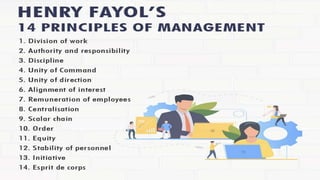
14 principles of management
 Division of work
 Authority and responsibility
 Discipline
 Unity of command
 Unity of direction
 Centralization
 Remuneration
 Collective Interest Over Individual Interest
 Scalar Chain
 Order
 Equity
 Stability of tenure
 Initiative
 Esprit de corps
ADVANTAGES
> Clear hierarchy
> Efficiency
> control
> Focus on objectives
DISADVANTAGES
> Bureaucracy
> Inflexibility
> Ignoring human factors
> Limited applicability to Non-profit
organizations
In conclusion , administrative theory provides a
comprehensive and systematic approach to managing
organizations and helps managers & leaders to informed
decision & to effectively address the challenge and
oppourtinity they face in a rapidly changing business
environment .
CONCLUSION
REFERENCES
 Wikipedia - https://en.wikipedia.org/wiki/administrative theory
#:~:text=A%20flat%20organ ization%20 (also%20known
,management%20between%20staff%20and%20executives.
 Penpoin - https://penpoin.com/administrative approach/
 The Business Professor - https://thebusinessprofessor.com/en_US/management-
leadership-administrative-apporach/features of administrative approach -definition
 Forbes - https://www.forbes.com/sites/jacobmorgan/2015/07/13/the-5-types-of-
organizational-administrative contribution-part-3-administration-
organizations/?sh=36a8ef076caa
THANK YOU :)
Any
Questions
?

administration theory.pptx

  • 1.
    A Project ReportSubmitted In Partial Fulfillment of the Requirement for the Degree of Bachelor of Public Administration A STUDY ON ADMINISTRATIVE THEORY Submitted to: Submitted by: Mrs. Munu Pokharel Asst. Professor Organization Theory Shreya Bhattarai BPA 1st semester
  • 2.
    ACKNOWLEDGEMENT I would liketo express my special thanks of gratitude to my respected teacher Mrs. Munu Pokharel, who gave me this opportunity to do this wonderful project assignment of Organization Theory on the topic ‘Administrative Theory’, which also helped me in doing a lot of research and I came to know about so many new things. I am really thankful to her. Secondly I would also like to thank my friends who helped me a lot in finalizing this project within the limited time frame. Shreya Bhattarai BPA 1ST SEMESTER
  • 3.
    Flat Organizational Structure By:SYNERGIC [Rakshita Timsina Bidisha Bhattarai Rashmi Tamang Shreya Bhattarai]
  • 4.
    CONTENTS • Meaning ofAdministrative Theory • Henry Fayol’s 14 principles of management • Advantages of Administrative Theory • Disadvantages of Administrative Theory • Conclusion
  • 5.
    Meaning Developed by: Frenchindustrialist and mining Engineer, Henry Fayol. This theory is widely known as 14 principles of management. The theory covers a wide range of topics including organization structure, decision-making leadership, communication, motivation, and planning. This theory focuses on how and what managers should do in their jobs. It clearly explains a formal administrative structure with a clear division of labor, delegation of power and authority, and so on.
  • 6.
    14 principles ofmanagement  Division of work  Authority and responsibility  Discipline  Unity of command  Unity of direction  Centralization  Remuneration  Collective Interest Over Individual Interest  Scalar Chain  Order  Equity  Stability of tenure  Initiative  Esprit de corps
  • 7.
    ADVANTAGES > Clear hierarchy >Efficiency > control > Focus on objectives
  • 8.
    DISADVANTAGES > Bureaucracy > Inflexibility >Ignoring human factors > Limited applicability to Non-profit organizations
  • 9.
    In conclusion ,administrative theory provides a comprehensive and systematic approach to managing organizations and helps managers & leaders to informed decision & to effectively address the challenge and oppourtinity they face in a rapidly changing business environment . CONCLUSION
  • 10.
    REFERENCES  Wikipedia -https://en.wikipedia.org/wiki/administrative theory #:~:text=A%20flat%20organ ization%20 (also%20known ,management%20between%20staff%20and%20executives.  Penpoin - https://penpoin.com/administrative approach/  The Business Professor - https://thebusinessprofessor.com/en_US/management- leadership-administrative-apporach/features of administrative approach -definition  Forbes - https://www.forbes.com/sites/jacobmorgan/2015/07/13/the-5-types-of- organizational-administrative contribution-part-3-administration- organizations/?sh=36a8ef076caa
  • 11.
  • 12.