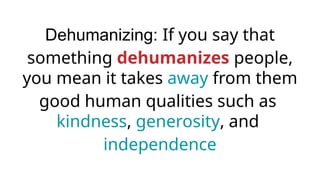
Dehumanizing: If yousay that
something dehumanizes people,
you mean it takes away from them
good human qualities such as
kindness, generosity, and
independence
3.
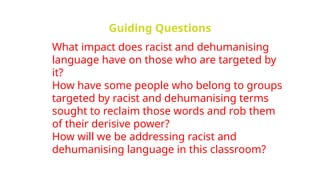
Guiding Questions
● Whatimpact does racist and dehumanising
language have on those who are targeted by
it?
● How have some people who belong to groups
targeted by racist and dehumanising terms
sought to reclaim those words and rob them
of their derisive power?
● How will we be addressing racist and
dehumanising language in this classroom?
4.
In your journal,respond to the following prompts:
A famous children’s nursery rhyme states ‘Sticks and stones may
break my bones, but words will never hurt me’.
1. What do you think this means?
2. How do you agree with its message?
3. Is there any evidence in society that words can
hurt?
4. Have you ever been hurt by words?
Reflect on the Power of Words
5.
In your journal,respond to the following questions:
1. What types of places do people encounter racist
terms?
2. “But I didn’t mean it in a bad way”, “I heard it in a
song so I’,m just repeating the lyrics”. Do either of
these 2 scenarios make it ok to use a term that
someone could consider to be racist?
Reflect on Situations and Contexts
6.
Explore the Impactof Racist and Dehumanising
Language
Excerpt from journalist and filmmaker Sarfraz
Manzoor’s memoir ‘Greetings from Bury Park’
7.
1. What actsof racism that Sarfraz Manzoor and Rupinder had to deal with?
○ How might this have impacted the way they felt about their environment?
2. Manzoor describes a racist incident in which a teacher, discussing how words
can be abbreviated, uses the P-word against him in class.
○ How might it have felt to be singled out by the teacher and subjected to a
racist slur?
○ Why is it significant that this occurred within school?
3. After describing the two painful memories from his school days, Manzoor
writes: ‘It is not easy to convey the impact of such incidents.’
○ What does he mean?
○ What are the different ways such experiences might shape the way people
think about themselves, others, and the choices they make?
Reflect on ‘Greetings from Bury Park’
8.
Listen to SalenaGodden’s Poem ‘The N-Word’
Listen to Salena Godden’s Poem ‘The N-Word’ 26.47
and 28.19
9.
○ What didthe poet do that stood out to you?
○ How did it make you feel?
1. What does the poem suggest about the impact of racist
language on those who are targeted by it? Why do you think
Salena Godden wrote the poem?
○ What message did she want to send?
○ What lessons can we learn from it?
2. How, if at all, has the poem impacted your views on racist
and language?
10.
● I camein thinking/feeling …
● I am leaving thinking/feeling ...
Reflect on the Lesson
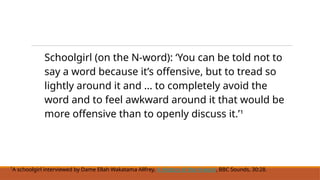
Schoolgirl (on theN-word): ‘You can be told not to
say a word because it’s offensive, but to tread so
lightly around it and ... to completely avoid the
word and to feel awkward around it that would be
more offensive than to openly discuss it.’¹
¹A schoolgirl interviewed by Dame Ellah Wakatama Allfrey, A History of the N-word, BBC Sounds, 30:28.
15.
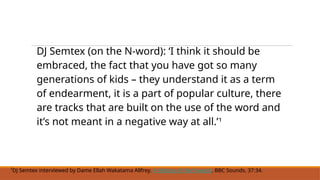
DJ Semtex (onthe N-word): ‘I think it should be
embraced, the fact that you have got so many
generations of kids – they understand it as a term
of endearment, it is a part of popular culture, there
are tracks that are built on the use of the word and
it’s not meant in a negative way at all.’¹
¹DJ Semtex interviewed by Dame Ellah Wakatama Allfrey, A History of the N-word, BBC Sounds, 37:34.
16.
Author Bernadine Everisto(on the N-word): ‘You
could say that what these hip-hop artists and so on
are doing is reclaiming the word and neutralising its
toxicity, if you like, but I don’t think we’re there yet …
I wonder if it’s because the history of the word [the
N-word] is so deep that we just can not get rid of all
its implications.’¹
¹Bernadine Everisto interviewed by Dame Ellah Wakatama Allfrey, A History of the N-word, BBC Sounds, 42:11.
17.
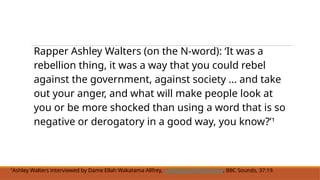
Rapper Ashley Walters(on the N-word): ‘It was a
rebellion thing, it was a way that you could rebel
against the government, against society ... and take
out your anger, and what will make people look at
you or be more shocked than using a word that is so
negative or derogatory in a good way, you know?’¹
¹Ashley Walters interviewed by Dame Ellah Wakatama Allfrey, A History of the N-word, BBC Sounds, 37:19.
18.
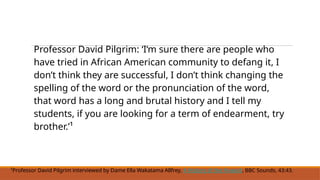
Professor David Pilgrim:‘I‘m sure there are people who
have tried in African American community to defang it, I
don’t think they are successful, I don’t think changing the
spelling of the word or the pronunciation of the word,
that word has a long and brutal history and I tell my
students, if you are looking for a term of endearment, try
brother.’¹
¹Professor David Pilgrim interviewed by Dame Ella Wakatama Allfrey, A History of the N-word, BBC Sounds, 43:43.
19.
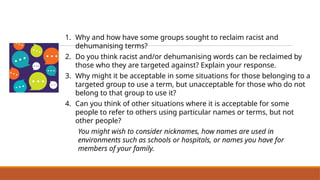
1. Why andhow have some groups sought to reclaim racist and
dehumanising terms?
2. Do you think racist and/or dehumanising words can be reclaimed by
those who they are targeted against? Explain your response.
3. Why might it be acceptable in some situations for those belonging to a
targeted group to use a term, but unacceptable for those who do not
belong to that group to use it?
4. Can you think of other situations where it is acceptable for some
people to refer to others using particular names or terms, but not
other people?
You might wish to consider nicknames, how names are used in
environments such as schools or hospitals, or names you have for
members of your family.
Discuss Different Perspectives Concerning
Racist and Dehumanising Language
20.
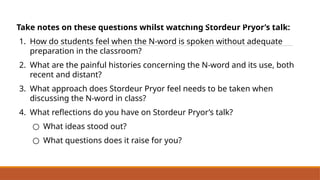
Take notes onthese questions whilst watching Stordeur Pryor’s talk:
1. How do students feel when the N-word is spoken without adequate
preparation in the classroom?
2. What are the painful histories concerning the N-word and its use, both
recent and distant?
3. What approach does Stordeur Pryor feel needs to be taken when
discussing the N-word in class?
4. What reflections do you have on Stordeur Pryor’s talk?
○ What ideas stood out?
○ What questions does it raise for you?
Dr Elizabeth Stordeur Pryor:
Why It’s So Hard to Talk About the ‘N’ Word
1. How mightstudents of color feel when racist language is
used in the classroom?
2. What are the painful histories concerning the N-word
and its use, both recent and distant?
3. What reflections do you have on Stordeur Pryor’s talk?
○ What ideas stood out?
○ What questions does it raise for you?
Discuss Dr Elizabeth Stordeur Pryor’s Talk
‘Why It’s So Hard to Talk About the ‘N’ Word’
23.
If words likethe N-word are encountered in a text, they
will not be spoken out loud. Instead, substitutions for such
terms, such as ‘the N-word’ will be used. This is to ensure
that everyone feels safe in the classroom environment and
no one is triggered by a racist and dehumanising term.
Our Class Approach to Racist and
Dehumanising Terms
24.
1. How willwe be addressing racist and
dehumanising language in this classroom?
2. What procedures, in addition to word
substitutions, would you like to have in place?
3. What, if anything, do you feel needs to be
considered?
Discuss Our Class Approach to Racist and
Dehumanising Terms
25.
● I camein thinking/feeling …
● I am leaving thinking/feeling ...
Reflect on the Lesson
Editor's Notes
#4 Debrief the questions as a class, but ensure that students do not need to share any answers if they do not feel comfortable doing so.
#5 Then, invite students to independently consider the questions before sharing their thoughts with the class. Make it clear that you are discussing terms in general and not asking them to list racist and dehumanising language.
Ensure that by the end of the discussion students have identified how racist and dehumanising terms are used to both express abuse and camaraderie, and are encountered in education, particularly in English and history lessons, and in popular culture, such as films and music.
#6 Inform students that they will explore the impact of racist and dehumanising language on those who are targeted by it. First, they will read and discuss an excerpt from journalist and filmmaker Sarfraz Manzoor’s memoir, Greetings from Bury Park, in which he describes his struggles with racism, identity and belonging in his Luton community.
Note: This text contains the P-word. It is important to read it before deciding whether or not to share it with your students. If the excerpt is read in class, we advise against saying the P-word out loud. Teachers and/or students could instead substitute the word with ‘P’ or ‘the P-word’.
Read the text out loud to students or use a reading aloud strategy, being mindful of where the P-word occurs and outlining a strategy of how you expect students to engage with it.
#7 Then, ask your students to respond to the questions in groups or pairs before discussing them briefly as a class.
#8 Next, if appropriate, share the recording of Salena Godden reading her poem ‘The N-word’ with your students. The recording can be found in the journalist Dame Ellah Wakatama Allfrey’s BBC Radio broadcast, A History of the N-word between 26.47 and 28.19. You may wish to play the poem twice. Once before showing students the questions and once again, after.
Note: This poem contains the N-word. It is important to listen to it before you decide whether or not to share it with your students. When discussing the poem, we advise against saying the N-word out loud. Teachers and/or students could instead substitute the word with ‘N’ or ‘the N-word’.
#9 Then, invite students to respond to the questions before discussing them as a class.
#10 Finally, give your students an opportunity to privately share their thoughts/feelings with you on the content covered in an Exit Card, using the prompts.
#12 Explain to students that they will continue their exploration of how to address racist and dehumanising terms. First, invite students to respond to the prompt in their journals before leading a short class discussion.
#13 Next, explain to students that although racist and dehumanising language is regarded as deeply problematic when used as a form of abuse, some people who belong to the groups targeted by such language have sought to use it on their own terms, reclaiming it as a means of reducing its power. Some racist terms are thus used by some to express friendship and familiarity towards others who belong to the same group. This has created a debate about who can and can not use language and whether harmful terms can actually be reclaimed.
Explain to students that they will be reading different perspectives concerning the N-word and the P-word, reminding them of upholding the norms of the classroom contract and requesting that they only use the substitutions when discussing these phrases.
Share the following perspectives with students. You might choose to have students silently read and engage with each of the perspectives using either the gallery walk teaching strategy or the big paper teaching strategy.
#19 Then, invite students to consider the questions in a Think, Pair, Share or groups before leading a short class discussion.
#20 Next, tell students that they will watch Dr Elizabeth Stordeur Pryor’s talk Why It’s So Difficult to Talk About the ‘N’ Word, in which the historian, drawing from personal experience, ‘leads a thoughtful and history-backed examination of one of the most divisive words in the English language: the N-word’.
Before you show the video, share the questions with students and encourage them to take notes while watching the video, pausing the video when you think it is appropriate.
#21 Play Dr Elizabeth Stordeur Pryor’s talk Why It’s So Difficult to Talk About the ‘N’ Word.
If you do not have time to watch all of the video, watch from 11.03, but be sure to explain that Stordeur Pryor begins the talk by telling a story about when the N-word was first stated in her classroom, and that she uses the term ‘point of encounter’ to describe the moment that people come face to face with the N-word.
#22 After watching the video, give students some time to independently complete their responses to the questions before leading a short class discussion.
#23 Next, inform students of how racist and dehumanising terms will be approached in your classroom.
It might also be important to state that this is the rule for inside the classroom and that you are not telling students who belong to the groups targeted by racist and dehumanising language that they can not say the word outside the classroom. If necessary, you might also want to make it clear that it is never acceptable, inside or outside the classroom, for students who do not belong to the groups targeted to use a racist and dehumanising term.
#24 Once you have outlined the class approach, discuss the questions with the class to ensure they understand this approach and so they can share any additional procedures they would like in place.
You might wish to collect students’ ideas and add them to the classroom contract and/or to your class approach on encountering racist and dehumanising terms.
#25 Finally, give your students an opportunity to privately share their thoughts on the content covered in an Exit Card. You might choose to use the same prompts as previously to continue to track students’ feelings on this sensitive topic.



![Author Bernadine Everisto (on the N-word): ‘You
could say that what these hip-hop artists and so on
are doing is reclaiming the word and neutralising its
toxicity, if you like, but I don’t think we’re there yet …
I wonder if it’s because the history of the word [the
N-word] is so deep that we just can not get rid of all
its implications.’¹
¹Bernadine Everisto interviewed by Dame Ellah Wakatama Allfrey, A History of the N-word, BBC Sounds, 42:11.](https://image.slidesharecdn.com/addressingracistanddehumanisinglanguageautosaved-250307132742-b9d9ba5f/85/Addressing-Racist-and-Dehumanising-Language-Autosaved-pptx-16-320.jpg)