Activity to Explore How Change Can Happen
Purpose of activity:
● To illustrate three different ways that change can happen.
● To illustrate how Everyday Democracy’s dialogue process helps various parts of the
community work together.
Materials needed:
• Chart paper
• Markers
• Tape
Activity:
1. Ask the group: “When there is an important public issue, how does change happen?” You
may want to give an example using some current issue, such as immigration, gun violence,
gang activity, etc. Give participants a chance to answer this question, but then move fairly
quickly to the diagram – don’t get bogged down in a long discussion.
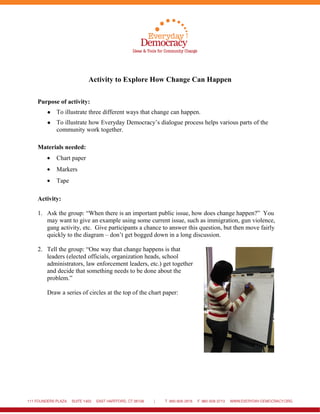
2. Tell the group: “One way that change happens is that
leaders (elected officials, organization heads, school
administrators, law enforcement leaders, etc.) get together
and decide that something needs to be done about the
problem.”
Draw a series of circles at the top of the chart paper:
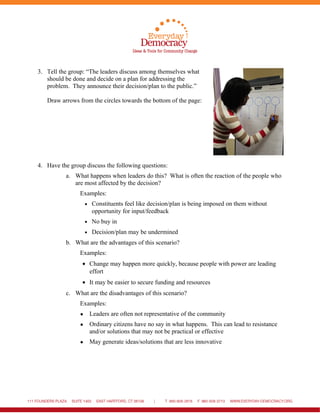
3. Tell the group: “The leaders discuss among themselves what
should be done and decide on a plan for addressing the
problem. They announce their decision/plan to the public.”
Draw arrows from the circles towards the bottom of the page:
4. Have the group discuss the following questions:
a. What happens when leaders do this? What is often the reaction of the people who
are most affected by the decision?
Examples:
• Constituents feel like decision/plan is being imposed on them without
opportunity for input/feedback
• No buy in
• Decision/plan may be undermined
b. What are the advantages of this scenario?
Examples:
• Change may happen more quickly, because people with power are leading
effort
• It may be easier to secure funding and resources
c. What are the disadvantages of this scenario?
Examples:
● Leaders are often not representative of the community
● Ordinary citizens have no say in what happens. This can lead to resistance
and/or solutions that may not be practical or effective
● May generate ideas/solutions that are less innovative
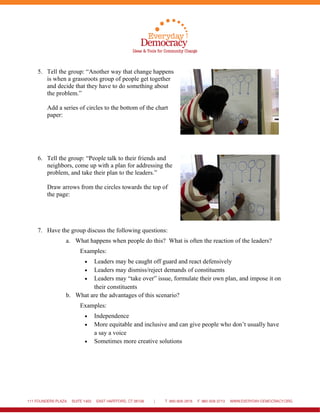
5. Tell the group: “Another way that change happens
is when a grassroots group of people get together
and decide that they have to do something about
the problem.”
Add a series of circles to the bottom of the chart
paper:
6. Tell the group: “People talk to their friends and
neighbors, come up with a plan for addressing the
problem, and take their plan to the leaders.”
Draw arrows from the circles towards the top of
the page:
7. Have the group discuss the following questions:
a. What happens when people do this? What is often the reaction of the leaders?
Examples:
• Leaders may be caught off guard and react defensively
• Leaders may dismiss/reject demands of constituents
• Leaders may “take over” issue, formulate their own plan, and impose it on
their constituents
b. What are the advantages of this scenario?
Examples:
• Independence
• More equitable and inclusive and can give people who don’t usually have
a say a voice
• Sometimes more creative solutions
c. What are the disadvantages of this scenario?
Examples:
● Leaders often control resources and hold most of the power, so people
lack power to implement ideas
● Takes a lot of time and energy to organize and mobilize large groups of
people around an issue (this can also be true for the Everyday Democracy
kind of process)
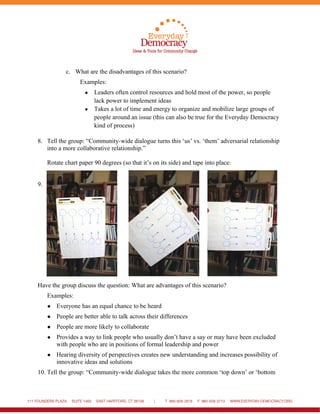
8. Tell the group: “Community-wide dialogue turns this ‘us’ vs. ‘them’ adversarial relationship
into a more collaborative relationship.”
Rotate chart paper 90 degrees (so that it’s on its side) and tape into place:
9.
Have the group discuss the question: What are advantages of this scenario?
Examples:
● Everyone has an equal chance to be heard
● People are better able to talk across their differences
● People are more likely to collaborate
● Provides a way to link people who usually don’t have a say or may have been excluded
with people who are in positions of formal leadership and power
● Hearing diversity of perspectives creates new understanding and increases possibility of
innovative ideas and solutions
10. Tell the group: “Community-wide dialogue takes the more common ‘top down’ or ‘bottom
up’ way that change usually happens and turns it on its side, making it easier for people to
talk and work together collaboratively.”
11. Discuss the following questions as a group (optional):
● What do people in power often look like?
● Who is most likely to hold the power? The resources?
● What do people who have less power often look like?
● How does the relationship between those with power and those with less power reinforce
structural/institutional racism?
● How does a community-wide dialogue process address structural/institutional racism?
up’ way that change usually happens and turns it on its side, making it easier for people to
talk and work together collaboratively.”
11. Discuss the following questions as a group (optional):
● What do people in power often look like?
● Who is most likely to hold the power? The resources?
● What do people who have less power often look like?
● How does the relationship between those with power and those with less power reinforce
structural/institutional racism?
● How does a community-wide dialogue process address structural/institutional racism?

Activity to Explore How Change Can Happen

  • 1.
    Activity to ExploreHow Change Can Happen Purpose of activity: ● To illustrate three different ways that change can happen. ● To illustrate how Everyday Democracy’s dialogue process helps various parts of the community work together. Materials needed: • Chart paper • Markers • Tape Activity: 1. Ask the group: “When there is an important public issue, how does change happen?” You may want to give an example using some current issue, such as immigration, gun violence, gang activity, etc. Give participants a chance to answer this question, but then move fairly quickly to the diagram – don’t get bogged down in a long discussion. 2. Tell the group: “One way that change happens is that leaders (elected officials, organization heads, school administrators, law enforcement leaders, etc.) get together and decide that something needs to be done about the problem.” Draw a series of circles at the top of the chart paper:
  • 2.
    3. Tell thegroup: “The leaders discuss among themselves what should be done and decide on a plan for addressing the problem. They announce their decision/plan to the public.” Draw arrows from the circles towards the bottom of the page: 4. Have the group discuss the following questions: a. What happens when leaders do this? What is often the reaction of the people who are most affected by the decision? Examples: • Constituents feel like decision/plan is being imposed on them without opportunity for input/feedback • No buy in • Decision/plan may be undermined b. What are the advantages of this scenario? Examples: • Change may happen more quickly, because people with power are leading effort • It may be easier to secure funding and resources c. What are the disadvantages of this scenario? Examples: ● Leaders are often not representative of the community ● Ordinary citizens have no say in what happens. This can lead to resistance and/or solutions that may not be practical or effective ● May generate ideas/solutions that are less innovative
  • 3.
    5. Tell thegroup: “Another way that change happens is when a grassroots group of people get together and decide that they have to do something about the problem.” Add a series of circles to the bottom of the chart paper: 6. Tell the group: “People talk to their friends and neighbors, come up with a plan for addressing the problem, and take their plan to the leaders.” Draw arrows from the circles towards the top of the page: 7. Have the group discuss the following questions: a. What happens when people do this? What is often the reaction of the leaders? Examples: • Leaders may be caught off guard and react defensively • Leaders may dismiss/reject demands of constituents • Leaders may “take over” issue, formulate their own plan, and impose it on their constituents b. What are the advantages of this scenario? Examples: • Independence • More equitable and inclusive and can give people who don’t usually have a say a voice • Sometimes more creative solutions
  • 4.
    c. What arethe disadvantages of this scenario? Examples: ● Leaders often control resources and hold most of the power, so people lack power to implement ideas ● Takes a lot of time and energy to organize and mobilize large groups of people around an issue (this can also be true for the Everyday Democracy kind of process) 8. Tell the group: “Community-wide dialogue turns this ‘us’ vs. ‘them’ adversarial relationship into a more collaborative relationship.” Rotate chart paper 90 degrees (so that it’s on its side) and tape into place: 9. Have the group discuss the question: What are advantages of this scenario? Examples: ● Everyone has an equal chance to be heard ● People are better able to talk across their differences ● People are more likely to collaborate ● Provides a way to link people who usually don’t have a say or may have been excluded with people who are in positions of formal leadership and power ● Hearing diversity of perspectives creates new understanding and increases possibility of innovative ideas and solutions 10. Tell the group: “Community-wide dialogue takes the more common ‘top down’ or ‘bottom
  • 5.
    up’ way thatchange usually happens and turns it on its side, making it easier for people to talk and work together collaboratively.” 11. Discuss the following questions as a group (optional): ● What do people in power often look like? ● Who is most likely to hold the power? The resources? ● What do people who have less power often look like? ● How does the relationship between those with power and those with less power reinforce structural/institutional racism? ● How does a community-wide dialogue process address structural/institutional racism?
  • 6.
    up’ way thatchange usually happens and turns it on its side, making it easier for people to talk and work together collaboratively.” 11. Discuss the following questions as a group (optional): ● What do people in power often look like? ● Who is most likely to hold the power? The resources? ● What do people who have less power often look like? ● How does the relationship between those with power and those with less power reinforce structural/institutional racism? ● How does a community-wide dialogue process address structural/institutional racism?