International Journal on Cybernetics & Informatics (IJCI) Vol.13, No.6, December2024
Bibhu Dash et al: NLAICSE, NLAII, IOTSEC, AIMDS 2024
pp. 93-117, 2024. IJCI – 2024 DOI:10.5121/ijci.2024.130607
ACTIONABLE PATTERN DISCOVERY FOR EMOTION
DETECTION IN BIGDATA IN EDUCATION AND
BUSINESS
Angelina Tzacheva1
and Sanchari Chatterjee2
1
Computer Science and Information Technology College of Computing and
Engineering, WestCliff University,Irvine, CA 92614,
2
Department of Computer Science, University of North Carolina at Charlotte,
Charlotte, NC, 28223
ABSTRACT
Action Rules are rule based systems that extract actionable patterns which are hidden in big volumes of
data generated from Education sector, Business field, Medical domain and Social Media, in a single day. In
the technological world of big data, massive amounts of data are collected by organizations, including in
major domains like financial, medical, social media and Internet of Things(IoT). Mining this data can
provide a lot of meaningful insights on how to improve user experience in multiple domain. Users need
recommendations on actions they can undertake to increase their profit or accomplish their goals, this
recommendations are provided by Actionable patterns. For example: How to improve student learning;
how to increase business profitability; how to improve user experience in social media; and how to heal
patients and assist hospital administrators. Action Rules provide actionable suggestions on how to change
the state of an object from an existing state to a desired state for the benefit of the user. The traditional
Action Rules extraction models, which analyze the data in a non distributed fashion, does not perform well
when dealing larger datasets. In this work we are concentrating on the vertical data splitting strategy using
information granules and creating the data partitioning more logically instead of splitting the data
randomly and also generating meta actions after the vertical split. Information granules form basic entities
in the world of Granular Computing(GrC), which represents meaningful smaller units derived from a
larger complex information system. We introduced Modified Hybrid Action rule method with Partition
Threshold Rho. Modified Hybrid Action rule mining approach combines both these frameworks and
generates complete set of Action Rules, which further improves the computational performance with large
datasets.
KEYWORDS
Emotion Detection, Meta Action, Information granules.
1. INTRODUCTION
In this modern world of data, data mining focuses on various techniques to extract some
surprising, very interesting, and unknown knowledge patterns from massive data. Extracting these
data is useful in multiple domains, this allows the different fields to generate a valuable data
which can be used to analyze the user patterns. These techniques embrace the relationship of data
objects with other objects (Clustering) or classes (Classification) to unwrap useful patterns in the
data. It is now highly recommended to use data mining to achieve better results and higher profits
[1]. Rule-based learning is a simple data mining method that identifies, learns, or develops ’rules’
to store, operate, or apply. Association Rules and Decision Trees are fragments of rule-based
methods that generate rules to associate patterns and classify data, respectively. In general, we
International Journal on Cybernetics & Informatics (IJCI) Vol.13, No.6, December2024
94
constitute rules as given in Equation 1, where the antecedent is a conjunction of conditions, and
the consequent is the resulting pattern in the given data for the given conditions in antecedent.
condition(s) → result(s) (1)
Action rule is the process of knowledge extraction developed in context to advocate possible
transitions for an individual to move from one state(negative) to another state (positive). For
example, recommending the business to improve customer satisfaction [2] and sentiment analysis
on Twitter [3]. Action rules follow the representation, similar to Equation 1, as given in Equation
2, where Ψ represents a conjunction of stable features, (α → β) represents a conjunction of
changes in values of flexible features and (θ → φ) represents desired change in decision action
which is beneficial to the user.
[(Ψ) ∧ (α → β)] → (θ → φ) (2)
Action Rules recommending Actionable pattern are prone to acquire definite form of cost to the
user [4], [5]. Cost for actions in Action Rules include time, energy, money, or human resources.
Actions being recommended can cause both positive(benefits) and negative(loses) effects for
users [6]. Thus, Action Rules recommendations system should take on low cost to the users to
make them plausible actions. The existing approaches [7–10] do not consider the cost
effectiveness for recommendations. In [4] [11], the concept of cost of the Action Rules is
introduced and refined. Searching for the low cost Action Rules from huge dataset can really be
very time-consuming and will require a distributed and scalable approach for extracting them in a
practicable timeframe.
Distributed Processing frameworks like Hadoop [12] and Spark [13] have been introduced to
make data mining and big data processing faster and easier. The data processing work is
distributed among the multiple nodes, each of which on their part of the data performs
computations, by these frameworks. In this work, we use Apache Spark [13] framework for
implementing a scalable solution to the proposed Action Graph method, and make it suitable for
big data. Spark provides APIs such as GraphX [14] for a productive parallel processing in large
graphs.
In this paper, we propose an extension to our previous work on distributed actionable pattern
mining with Spark [15]. We extract actions rules from the business and survey datasets, that help
to obtain better, desirable outcome for future. We focus on hierarchically structured recommender
system to improve the efficiency of a company’s growth engine. The NPS dataset used for this
research contains answers to a set of questionnaire sent to a randomly chosen groups of
customers. It covers 34 companies called clients. The purpose of the questionnaire is to check
customer satisfaction in using services of these companies which have repair shops all involved in
a similar type of business (fixing heavy equipment). Authors [16] present the concept of semantic
similarity between companies. More semantically similar the companies are, the knowledge
extracted from their joined NPS datasets has higher accuracy and coverage.
Action Rule Mining literature consists of two major frameworks namely: Rule-Based approach
and Object-Based approach. In this work we focus on Hybrid Action Rule mining method, which
combines the above two frameworks with the advantage of scalability with large datasets.
Primarily, we emphasis on Opinion Mining from Text to suggest Actionable Recommendations.
The Actionable Patterns may suggest ways to alter the user’s sentiment or emotion to a more
positive or desirable state. We extract action rules from business data and student survey data. In
this work we propose a new Modified Hybrid Action Rule [17] mining approach that improves
the computational performance, which combines the above two frameworks with the advantage of
International Journal on Cybernetics & Informatics (IJCI) Vol.13, No.6, December2024
95
scalability with large datasets. We propose a new Threshold Rho - which allows the user to
choose the number of data partitions. This yields Faster Scalable processing. We are applying the
method to Student Survey Data, however this method can be used for Improving Customer
Satisfaction as well. We also aim to suggest ways to improve the Teaching Methods and Student
Learning and how to change detractors to promoters in business . We implement and test our
system in Scalable Environment with BigData using the Apache Spark platform.
2. RELATED WORK
Data Science plays a pivotal role in shaping the modern world, [18] paper focus on understanding
its evolution, addressing challenges, and anticipating future trends which are crucial for
researchers, practitioners, and policymakers alike. Text mining can help identify patterns, trends,
and relationships in text data that would be difficult or impossible to identify through manual
analysis. The paper [19] demonstrates the systematic review on text mining techniques and their
applications in identifying new research trends.Natural Language Processing represents a cutting-
edge technological paradigm with transformative implications for legal documentation. The paper
[20] navigates the potential implications of employing NLP for legal documentation, emphasizing
its role in improving access to justice, bridging linguistic gaps, and fostering inclusivity within
the legal system.
The authors of the paper [21] provides an overview of a user-friendly NPS based Recommender
System for driving business revenue. This technique hierarchically designed recommender system
for improving NPS of clients that is driven mainly by action rules and meta-actions. The paper
presents the main techniques used to build the data-driven system, including data mining and
machine learning techniques, such as action rules and meta actions, hierarchical clustering, as
well as visualization design. The system implements domain specific sentiment analysis
performed on comments collected within telephone surveys with end customers.AI and Machine
Learning integration with AWS Sage Maker: provides a comprehensive exploration of the current
landscape and forward-looking possibilities in integrating artificial intelligence (AI) and machine
learning (ML) using Amazon Web Services (AWS) SageMaker. The paper [22] adeptly navigates
through the overview of AWS SageMaker, shedding light on its capabilities and features.
Authors in this paper [23], try to reduce those negative side effects by extracting personalized
action rules. They propose three object-grouping schemes with regards to same negative side
effects to extract personalized action rules for each object group. The Authors Kuang and et.al in
their paper [24] propose a new strategy to improve NPS (Net Promoter Score) of certain
companies called HAMIS. Those companies are involved in heavy equipment repair in the US
and Canada.The authors of paper [16] present preliminary results of a flexible hierarchically
structured recommender system for improving NPS of a company in a global competitive market.
Clients are compare in terms of the similarity of their knowledge concerning the meaning of three
concepts: promoter, passive, and detractor. The questionnaire sent to the customers allows them to
enter statements in the text format explaining their ratings. Information included in these
statements helps us to find triggers for action rules. The triggers are also called meta-actions [25],
[26]. Kuang and Ras talk about building a recommender system in their paper [27] which is
driven by action rules and meta actions for providing proper suggestions to improve revenue of a
group of clients (companies) involved with similar businesses. They collect feedback from
customers and use them as their dataset. The paper proposes a strategy to classify and organize
meta-actions in such a way that they can be applied most efficiently to achieve desired goal. In
their previous work, [16] they propose and implement the method of mining meta-actions from
customers’ reviews in text format.
International Journal on Cybernetics & Informatics (IJCI) Vol.13, No.6, December2024
96
Recently various domains like medicine [28], education [29], and business [30] started adopting
data science research in their respective problems. Many research studies have focused on using
the copious real world datasets for healthcare applications and decision making using such
knowledge extraction and data mining techniques [31]. For example, in context to hospital
readmission, researchers and scientists created a machine learning model to predict patient
readmissions by considering some basic patient admission characteristics and their billing codes
[32]. Some emphasis on predicting the liklihood of patient readmitting to the hospital, modelled
as risk prediction, using Support Vector Machines,Neural Networks, and Random Forests [33].
Similarly, there is a study on using logistic regression to measure the relationship between early
readmission and diabetes [34], and a study on using a classic data mining technique like Support
Vector Machine to predict readmission [35] using other features such as patient
demographics,admission type, disease type, and clinical procedures undertaken. There is an
interesting study that came into focus in the recent years related to designing a personalized
procedure graphs,that gives a probability on patient’s future procedure and recommend hospitals
in making decisions for a patient [36,37].Ras and Tzacheva [4] introduced the concept of cost and
feasibility of Action Rules as an interesting measure. They proposed a graph based method for
extracting plausible and low cost Action Rules. Ras and Tzacheva [4] proposed a heuristic search
of new low cost Action Rules, where objects supporting the new set of rules also supports the
existing rule set but the cost of reclassifying them is much lower for the new rules. Later,
Tzacheva and Tsay [11] proposed a tree based method for extracting low cost Action Rules.Some
research, apart from Action Rules has been done on extracting Actionable knowledge. For
example, Yang, et.al [38] considered Customer Attrition in Customer Relationship Management
(CRM) in telecommunications industry and the cost complexities involved in gaining profit to all
customers. They proposed a method that extractlow cost Actionable patterns for converting
undesired customers to loyal ones while improving the net profit of all customers. Karim and
Rahman [39] proposed another method to extract cost effective actionable patterns for customer
attrition problem in post processing steps of Decision Tree and Naive Bayes classifiers. Su, et.al
[5] proposed a method to consider positive benefits that occurs by following an Action Rule apart
from all costs that incur from the same rule. Cui, et.al [40] proposed to extract optimal actionable
plans during post processes of Additive Tree Model (ATM) classifier. These actionable patterns
can actually change the given input to a desired one with a minimum cost. Hu, et.al [41] proposed
an integrated framework to gather the cost minimal actions sets to provide support for social
projects stakeholders inorder to control risks involved in risk analysis and project planning
phases. Lately, Hu, et.al [42] developed an ensemble framework and cost sensitive method to
predict software project risk predictions and conducted large scale analysis over 60 models 327
real world project samples.
Due to the advent of big data, some research [26], [15], [43] started applying distributed
computing frameworks like MapReduce [12] and Spark [13], recently have been done to extract
actionable recommendation completely in a clustered setup. Bagavathi [26] proposed a method to
distribute the data in random to multiple sites, combining results from all sites and taking average
on parameters like Support and Confidence. Bagavathi [15] handle the load balancing by
uniformly distributing the data into partitions based on the decision attribute. Authors [43]
introduces a new method of projecting the database into smaller chunks, for handling data with
large number of attributes, and extract action rules from them effectively.
International Journal on Cybernetics & Informatics (IJCI) Vol.13, No.6, December2024
97
Table 1. Example Decision System T
X A B C D
x1 Y N N D1
x2 Y H Y D2
x3 Y H Y D1
x4 N N N D2
x5 N H N D1
x6 N N Y D2
x7 N H Y D2
x8 N H N D1
In this work, we prefer to use rule based systems inorder to recommend various steps to improve
User’s emotions including Student Surveys and Customer’s Net Promoter Score (NPS) for
businesses . Rule based systems are one of the most commonly used machine learning methods
like regression, classification and association [44] because it is simple to understand and easy to
use. Action rules are such rule based systems that designed to recommend actionable insights, for
example recommendations for businesses to gain profit by finding interesting actionable patterns
in the data [45]. In the literature, action rules are extracted using two different methods. First
method is a rule based approach, in which first the intermediate classification rules are extracted
using efficient rule generation algorithms such as LERS or ERID. From these extracted rules,
action rules are generated with systems like DEAR [7], which extracts Action Rules from two
classification rules, or ARAS [8], which extracts Action Rules using a single classification rule.
Second method is object-based approaches, in which the Action Rules are extracted directly from
the given decision table without involving any intermediary steps. Systems ARED [10] and
Association Action Rules [9] works in the object-based approach. Algorithms, except association
action rules, runs much faster with the aim of extracting rules that provides maximum benefits to
the user and extracts only limited recommendations.
In this work we propose a Modified Hybrid Action Rule mining approach with Additional
Threshold Rho- for the Number of Partitions which further improves the computational
performance from our previous method that has only one threshold [17]. This allows for Faster
and more Scalable processing. We will apply our method to the Student Survey Data, and NPS
business data however this method can be used for healthcare data as well. We are focusing on
our work to suggest ways to improve the Teaching and Student Learning methods and also how to
improve Customer Satisfaction, like the status change from detractors (Customers with Negative
Emotions) to promoters (Customers with Positive Emotions) in business. We implement and test
our system in Scalable Environment with BigData using the Apache Spark platform.
3. BACKGROUND
In this section, we give some basic idea about Decision system, Action Rules, Spark and GraphX
frameworks to understand out methodology.
3.1. Decision System
Consider a decision system given in Table 1. Information System can be represented as T =
(X,A,V) where,
X is a nonempty, finite set of objects: X = {x1,x2,x3,x4,x5,x6,x7,x8}
International Journal on Cybernetics & Informatics (IJCI) Vol.13, No.6, December2024
98
A is a nonempty, finite set of attributes: A = A,B,C,D andVi is the domain of attribute a which
represents a set of values for attribute i|i∈A. For example, VB = N,H.
An information system becomes Decision system, if A = ASt∪AFl∪d, where D is a decision
attribute. The user chooses the attribute d if they wants to extract desired action from di : i∈Vd.
AStis a set of Stable Attributes and AFlis a set of Flexible Attributes. For example, ZIPCODE is a
Stable Attribute and User Ratings can be a Flexible Attribute.Let us assume from Table 1 that C
∈ASt. A, B ∈AFland D ∈d. and the decision maker desires Action Rules that triggers the decision
attribute change from D1 to D2 throughout this paper for examples.
3.2.Information System
Consider a information system given in table 2. Information system can be represented asZ =
(X,M,V )where,X is set of objects {x1,x2,x3,x4,x5,x6,x7,x8} in the system;M is non-empty finite set of
attributes {A,B,C,E,F,G,D};V is the domain of attributes in M, for instance the domain of attribute
B in the system Z is {B1,B2,B3}.
Table 2. Information System Z
X A B C E F G D
x1 A1 B1 C1 E1 F2 G1 D1
x2 A2 B1 C2 E2 F2 G2 D3
x3 A3 B1 C1 E2 F2 G3 D2
x4 A1 B1 C2 E2 F2 G1 D2
x5 A1 B2 C1 E3 F2 G1 D2
x6 A2 B1 C1 E2 F3 G1 D2
x7 A2 B3 C2 E2 F2 G2 D2
x8 A2 B1 C1 E3 F2 G3 D2
The information system in table 2 becomes a Decision System if the attributes M are classified
into flexible attributes Mfl, stable attributes Mstand decision attributes d, M = (Mst,Mfl,{d}).
From table 2 Mst= {A,B,C},Mfl= {E,F,G}, and d = D.
3.3.Action Rules
In this subsection, we give definitions of action terms, action rules and the properties of action
rules [45]
Let T = (X,A ∪d,V) be a decision system, where d is a decision attribute and V = ∪Vi : i∈A.
Action terms can be given by the expression of (m,m1 → m2), where m ∈Aand m1,m2 ∈Vm. m1 = m2
if m ∈ASt. In that case, we can simplify the expression as (m,m1) or (m = m1). Whereas,m1 6= m2 if
m ∈AFl
Action Rules can take the form of t1 ∩ t2 ∩ .... ∩ tn, where tiis an atomic action or action term and
the Action Rule is a conjunction of action terms to achieve the desired action based on attribute
D. Example Action Rule is given below: (a,a1 → a2).(b,b1 → b2) −→ (D,D1 → D2)
Properties of Action Rules Action Rules are considered interesting based on the metrics such as
Support, Confidence, Coverage and Utility. Higher these values, more interesting they are to the
end user.
International Journal on Cybernetics & Informatics (IJCI) Vol.13, No.6, December2024
99
Consider an action rule R of form:
(Y1 → Y2) −→ (Z1 → Z2) where,
Y is the condition part of R; is the decision part of R
Y1 is a set of all left side action terms in the condition part of R
Y2 is a set of all right side action terms in the condition part of R
Z1 is the decision attribute value on left side
Z2 is the decision attribute value on right side
In [45], the support and confidence of an action rule R is given as
Later, Tzacheva et.al [11] proposed a new set of formula for the calculation of Support and
Confidence of Action Rules. Their idea is to reduce the complexities in searching data several
times for Support and Confidence of an Action Rule. The new formula are given
Tzacheva et. al [11] also introduced a concept of utility for Action Rules. Utility of Action Rules
takes a following form. For most of cases Utility of Action Rules equals the Old Confidence of
the same Action Rule.
Coverage of an Action Rule means that how many decision from values, from the entire decision
system S, are being fully covered by all extracted Action Rules. In other words, using the
extracted Action Rules, Coverage defines how many data records in the decision system can
successfully transfers from Z1 to Z2
3.4. Cost of Action Rules
Generally, there is a cost associated with changing an attribute value from one class to another
class- the more desirable one. The cost is a subjective measure, in a sense that domain knowledge
from the experts or user in the field is necessary in order to determine the costs associated with
taking the actions. Costs could be moral,monetary, or a combination of the two. For
example,changing the marital status from ’married’ to ’divorced’ has a moral cost; whereas
,lowering the interest percent rate for a customer is a monetary cost for the bank; in addition to
any monetary costs which may be incurred in the process. Feasibility is an objective measure, i.e.
domain independent.According to the cost of actions associated with the classification part of the
action rules, a business user may be unable or unwilling to proceed with them.The definition of
cost was introduced by Tzacheva and Ras [4] as follows:
Assume that S = (X,A,V ) is an information system. Let Y ⊆X, b ∈A is a flexible attribute in S and
v1,v2 ∈Vbare its two values. By ℘S(b,v1 → v2) we mean a number from (0,ω] which describes the
average cost of changing the attribute value v1 to v2 for any of the qualifying objects in Y . These
numbers are provided by experts. Object x ∈Y qualifies for the change from v1 to v2, if b(x) = v1. If
the above change is not feasible, then we write ℘S(b,v1 → v2) = ω. Also, if ℘S(b,v1 → v2) < ℘S(b,v3
International Journal on Cybernetics & Informatics (IJCI) Vol.13, No.6, December2024
100
→ v4), then we say thatthe change of values from v1 to v2 is more feasible than the change from v3
to v4. Assume an action rule rof the form:
(b1,v1 → w1) ∧ (b2,v2 → w2) ∧... ∧ (bp,vp→ wp) ⇒ (d,k1 → k2)
Table 3. Meta-actions Influence Matrix for S
a b d
M1, M2, M3 (b1 → b2) (d1 → d2)
M1, M3, M4 (a2) (b2 → b3)
M5 (a1) (b2 → b1) (d2 → d1)
M2, M4 (b2 → b3) (d1 → d2)
M1, M5, M6 (b1 → b3) (d1 → d2)
If the sum of the costs of the terms on the left hand side of the action rule is smaller than thecost
on the right hand side, then we say that the rule r is feasible.
3.5.Meta Action
As an action rule can be seen as a set of atomic actions that need to be made happen for achieving
the expected result, meta-actions are the actual solutions that should be executed to trigger the
corresponding atomic actions, Table 3 below shows an example of influence matrix which
describes the relationships between the meta-actions and atomic actions influenced by them.
3.6. Spark
Spark [13] is a framework that is quite similar to MapReduce [12] to process large quantity of
data in a parallel fashion. Spark introduces a distributed memory abstraction strategy called
Resilient Distributed Datasets(RDD) that can perform in-memory computations on nodes
distributed in a cluster. Results of each operation are then stored in memory itself, which can be
accessed for future processes and analyses, which in-turn creates another RDD. Thus, Spark cuts-
off the larger number of disk accesses for storing intermediate outputs like in Hadoop
MapReduce. Spark functions in two stages: 1. Transformation, 2. Action. During the
Transformation stage, computations are made on data splits and results are stored in the worker
nodes memory as RDD. While the Action stage on an RDD collect results from all the workers
and send it to the driver node or save the results to a storage unit. With RDDs Spark helps
machine learning algorithms to skip innumerable disk access during iterations.
4. DATASET DESCRIPTION
To test our methods, we use two datasets: Student Survey Data [17], and the Net Promoter Score
dataset data [21].Student survey data aims to evaluate student emotions and overall satisfaction
with course teaching methods and group work experience. The survey is designed to get
meaningful insights on students’ feelings towards the Active Learning methods and other factors
that can help students in their learning process. The data is collected in the courses which
implement the Active Learning methods and teaching style. This survey dataset contains 50
attributes. The original data contains 549 instances and 59 attributes. Data is collected in classes
employing Active Learning methods to assess student opinions about their learning experience in
the years 2019, 2020. The data size on disk is 59 Kilobytes. For scalability purpose to test the
performance of our proposed method with BigData, we replicate the original Student Survey Data
100 times. The replicated dataset has a total of 54900 instances. Size on disk is 5.815
International Journal on Cybernetics & Informatics (IJCI) Vol.13, No.6, December2024
101
Megabytes.We also used a sample of Net Promoter Score dataset [21] for our experiments. The
NPS (Net Promoter Score) dataset is collected customer feedback data related to heavy equipment
repair. The entire dataset consists of 38 companies, located in multiple sites across the whole
United States as well as several parts of Canada. Overall, there are about 340,000 customers
surveyed in the database over time span of 2011-2015. Customers were randomly selected to
answer a questionnaire which was specifically designed to collect information relevant to NPS
(structured into so-called ”benchmarks”). All the responses from customers were saved into
database with each question (benchmark) as one feature in the dataset. Benchmarks include
numerical scores (0-10) on certain aspects of service:e.g. if job done correctly, are you satisfied
with the job, likelihood to refer, etc. The dataset also contains customer details (name, contact,
etc.) and service details (company, invoice, type of equipment repaired, etc.). The decision
attribute in the dataset is PromoterStatuswhich labels each customer as either promoter,passiveor
detractor. The decision problem here is to improve customer satisfaction / loyalty as measured by
Net Promoter Score. The goal of applying action rules to solve the problem is to find minimal sets
of actions so that to ”reclassify” customer from ”Detractor” to ”Promoter” and the same improve
NPS.For our experiments, we used survey given by customers for 2 companies over the year of
2015. We have used 17-california and 30-35 datasets for our method. Each of NPS data consists
of around 1500 unique surveys from multiple customers with around 25 unique questions. The
original data for 17-california contains 547 instances and 23 attributes and the dataset for
company 30-35 contains 3335 instances and 23 attributes.
5. METHODOLOGY
In our paper, we propose Action Rule extraction techniques to generate action rules. graphbased
method to search for optimal low cost Action Rules.In this section, the algorithm for Action Rules
are described wisely.
5.1.Distributed Action Rules Extraction Algorithm
In this work,for the extraction technique we focused on distributed Association Action Rules [43]
in order to extract the actionable knowledge from big data using Spark framework. Association
Action Rules method is not appropriate for big data due to high dimensional data and lacks
efficiency in run time. By using the vertical data partitioning technique as proposed in [43], we
create partitions of data sets by splitting the data according by attributes in a high dimension data.
We perform Association Action Rule extraction algorithm on each partitions of data in parallel,
which allows much faster computational time for Association Action Rules extraction in Cloud
platforms.Association Action Rules algorithm is quite similar to Association Rules extraction
algorithm with the A-priori method [46]. Association Rules find patterns that occur most
frequently together in the given data set. The most popular algorithm for extracting Association
Rules is Apriori algorithm [47]. Apriori algorithm starts with 2 element pattern and continuesn
iterations until it finds the n element patterns, where n is the number of attribute in the given data
set. Sample Association rule, that means when a pattern a1 ∩ b2 occur together in the data, pattern
c1 ∩ d2 also occurs in the same data, are given below.
International Journal on Cybernetics & Informatics (IJCI) Vol.13, No.6, December2024
102
Fig.1. Example Vertical Data Distribution for Table 1
Figure 1 presents an example vertical data partitioning with the sample Decision system in Table
1. The actionable knowledge extraction algorithm runs separately on each data partition, does
transformations like map(), flatmap() functions and combine results with join() and groupBy()
operations. We later combine action rules from different partitions to get the final set of action
rules.
5.2. Vertical Split - Data Distribution for Scalable Association Action Rules
Authors Bagavathi et al. [43] in method 2 propose the extraction of Action Rules basically by
splitting the data in vertical order, which is in contrast to traditional horizontal split, which is
performed by parallel processing systems. This method follow Association Action Rules [9]
which is based on iterative method to extract all the possible action rules.To overcome the
expense and computational complexity , the authors in [43] proposed vertical data split method
for parallel processing along with faster computation. In this method, the data is split in vertical
order into 2 or more partitions, with each partition having only a small subset of larger attributes.
Fig. 1explains the example of Data partitioning using Vertical Data Distribution in Distributed
Action rules extraction algorithm,the first section of methodology.
5.3.Hybrid Action Rule Mining
There is a disadvantage of computing preexisting decision rules in generating the Action Rule by
Rule-Based method using LERS [48] .The process requires complete set of attributes which is
difficult to implement in distributed cloud environment.We can implement the Object-Based
method in distributed cloud environment by splitting the data vertically[43], where subsets of the
attributes are taken for scalability. However, since this method is iterative it takes longer time to
process huge datasets.
This approach-Hybrid Action Rule mining [49] combines the Rule-Based and ObjectBased
methods to generate complete set of Action Rules. It provides better performance and scalability
for large datasets,incompare to Iterative Association Action Rule approach. The pseudocode of
the algorithm is given bellow in the Fig. 2.
International Journal on Cybernetics & Informatics (IJCI) Vol.13, No.6, December2024
103
Fig.2. Hybrid Action Rule Mining Algorithm.
The Algorithm approaches with the Information System as follows. The information system in
table 2 contains the following attributes: flexible Pfl, stable Pstand decision d, P = (Pst,Pfl,{d}).
From table 2 Pst= {A,B,C},Pfl= {E,F,G}, and d = D.
The following example re-directs the decision attribute D from d2 → d1. The algorithm Fig. 2. to
extract the classification rules that are certain initially uses the LERS method and then generates
Action Rule schema as given in the following equations “ 3” ,“ 4”.
[B1 ∧ C1 ∧ (F,→ F1) ∧ (G,→ G1)] → (D,D2 → D1).(3)
[(E,→ E1)] → (D,D2 → D1).(4)
[B1 ∧ C1 ∧ (F,→ F1) ∧ (G,G3 → G1)] → (D,D2 → D1).(5)
The algorithm then creates sub-table for each of the Action Schema. For example “ 3”, generates
the following sub-table shown in table 4.The Hybrid Action Rule Mining Algorithm involves the
Association Action Rule extraction algorithm in parallel on each of the sub-tables. The algorithm
generates the following Action Rules Equation “ 5” based on the sub-table shown in table 4.
Table 4. Subtable for Action Rule Schema
X B C F G D
x1 B1 C1 F2 G1 D1
x3 B1 C1 F2 G3 D2
x6 B1 C1 F3 G1 D2
x8 B1 C1 F2 G3 D2
This Hybrid Action Rule algorithm is implemented in Spark [50] and runs separately on each of
the sub-table and performs the transformations like map(), flatmap(), join(). The method of this
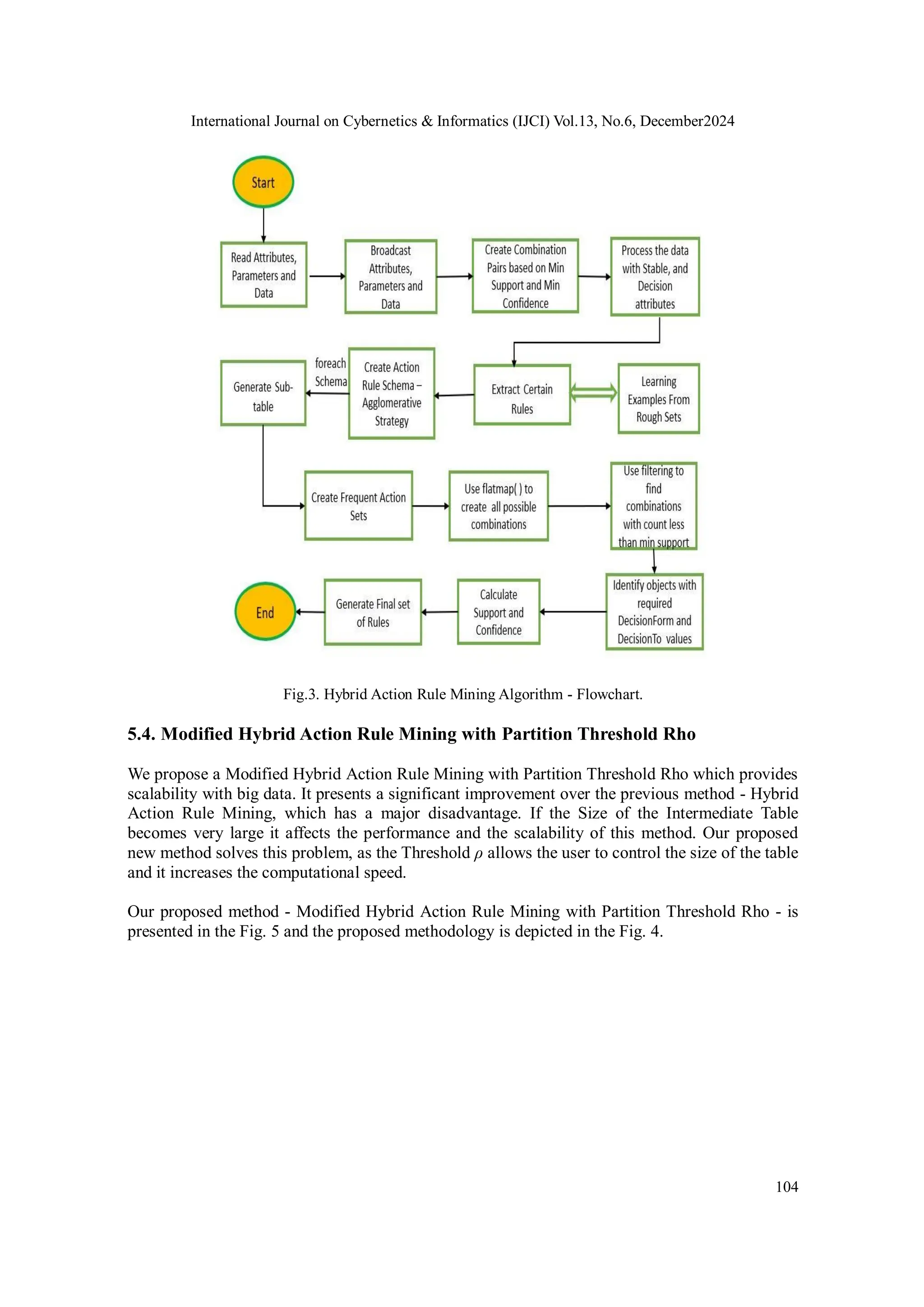
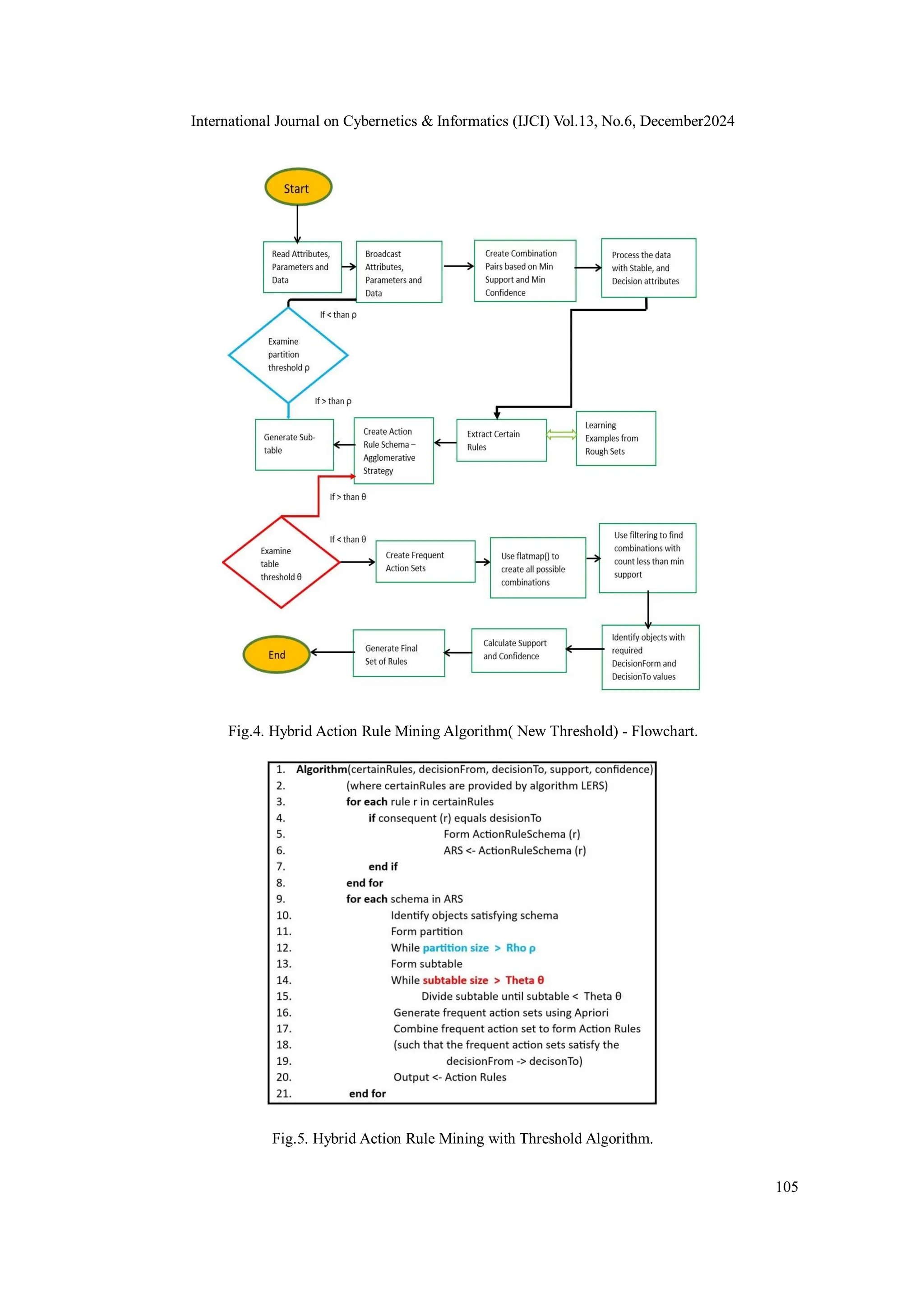
algorithm is shown in Fig. 3. Our new Threshold algorithm method Fig. 4
International Journal on Cybernetics & Informatics (IJCI) Vol.13, No.6, December2024
104
Fig.3. Hybrid Action Rule Mining Algorithm - Flowchart.
5.4. Modified Hybrid Action Rule Mining with Partition Threshold Rho
We propose a Modified Hybrid Action Rule Mining with Partition Threshold Rho which provides
scalability with big data. It presents a significant improvement over the previous method - Hybrid
Action Rule Mining, which has a major disadvantage. If the Size of the Intermediate Table
becomes very large it affects the performance and the scalability of this method. Our proposed
new method solves this problem, as the Threshold ρ allows the user to control the size of the table
and it increases the computational speed.
Our proposed method - Modified Hybrid Action Rule Mining with Partition Threshold Rho - is
presented in the Fig. 5 and the proposed methodology is depicted in the Fig. 4.
International Journal on Cybernetics & Informatics (IJCI) Vol.13, No.6, December2024
105
Fig.4. Hybrid Action Rule Mining Algorithm( New Threshold) - Flowchart.
Fig.5. Hybrid Action Rule Mining with Threshold Algorithm.
International Journal on Cybernetics & Informatics (IJCI) Vol.13, No.6, December2024
106
5.5.Vertical Data Distribution Method with Meta Action
Meta-actions, are a tabular format to trigger action rules discovered from user data. Metaactions
are the actions that need to be executed in order to trigger corresponding [51] and it can be one or
more than one set to invoke action rules in our method a set of meta actions triggered the
generation of action rules.
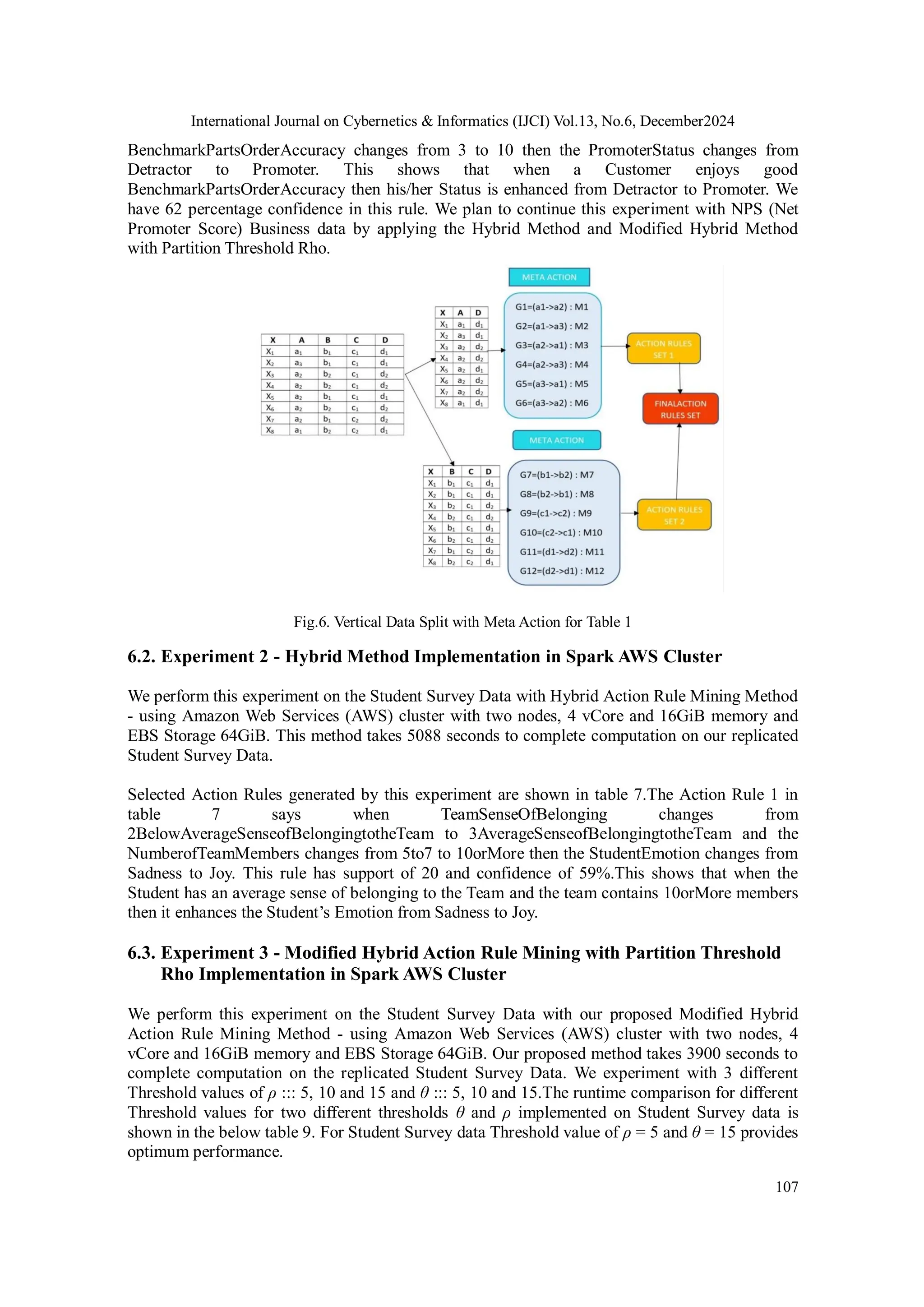
In our paper, we present a approach for partitioning the given data using information granules. We
give a new algorithm to generate meta action as the intermediate state before extraction of all
Action Rules, based on the algorithm proposed in [52] and [9]. We test how fast our new method
works with two different data sets one with the NPS dataset and the other is Student Survey
dataset and compared to our previous distributed Action Rule extraction algorithms. A brief
description about our vertical data distribution process with meta- actions has been given in
Figure 6. We check validity of the new data distribution method by comparing number of Action
Rules generated by our method and rule coverage of Action Rules from system with classical
Association Action Rules [9] on a single machine and SARGS [15] systems.
6. EXPERIMENTS AND RESULTS
In this work we use, student survey data which focus on student emotions. We applied the data in
all the three experiments and compared the Computational time. We also used a sample of NPS
(Net Promoter Score) data [21] for our experiments that aims to evaluate Promoter Status. We
applied NPS (Net Promoter Score) data for Vertical Split - Data Distribution method only. See
section IV. Dataset Description.
We compare our proposed method with the Vertical Split - Data Distribution for Scalable
Association Action Rules method and Hybrid Action Rule mining method. We achieve faster
computational time through our new proposed method for Student Survey method.
6.1. Experiment 1 - Vertical Data Split Method Implementation in Spark AWS
Cluster
We perform this experiment on the Student Survey Data - using Amazon Web Services (AWS)
cluster with two nodes, 4 vCore and 16GiB memory and EBS Storage 64GiB. For very large data
this method requires additional resources. We find we must provide extra 32 Gigabytes of
memory to complete computation on the replicated data in 2400 seconds. Otherwise, the method
receives OutOfMemory Exception with our replicated Student Survey Data. This occurs because
of iterative nature of the algorithm with large data that causes computational overhead and
requires extra hardware memory resources to work successfully. This method only works for
Association Action Rules because it considers only subset of the attributes.
Selected Action Rules generated by this experiment are shown in table 5.
The Action Rule 1 says that when GroupAssignmentBenefit changes from SharedKnowledge to
SocialLearning and LikeTeamWork changes from 1Don’t to 5VeryMuch and
TeamMemberResponsibility changes from HelpfulMembers to ResponsibleMembers then the
StudentEmotion changes from Sadness to Joy. This shows that when the Student likes TeamWork
and the group contains Responsible TeamMembers and benefits from GroupAssignment then it
enhances the Student’s Emotion from Sadness to Joy.We experiment with NPS (Net Promoter
Score) Business data and extract Action Rules from it using the Verticle Data Split Method.
Sample results are shown in table 6. The Action Rule 1 says that when
International Journal on Cybernetics & Informatics (IJCI) Vol.13, No.6, December2024
107
BenchmarkPartsOrderAccuracy changes from 3 to 10 then the PromoterStatus changes from
Detractor to Promoter. This shows that when a Customer enjoys good
BenchmarkPartsOrderAccuracy then his/her Status is enhanced from Detractor to Promoter. We
have 62 percentage confidence in this rule. We plan to continue this experiment with NPS (Net
Promoter Score) Business data by applying the Hybrid Method and Modified Hybrid Method
with Partition Threshold Rho.
Fig.6. Vertical Data Split with Meta Action for Table 1
6.2. Experiment 2 - Hybrid Method Implementation in Spark AWS Cluster
We perform this experiment on the Student Survey Data with Hybrid Action Rule Mining Method
- using Amazon Web Services (AWS) cluster with two nodes, 4 vCore and 16GiB memory and
EBS Storage 64GiB. This method takes 5088 seconds to complete computation on our replicated
Student Survey Data.
Selected Action Rules generated by this experiment are shown in table 7.The Action Rule 1 in
table 7 says when TeamSenseOfBelonging changes from
2BelowAverageSenseofBelongingtotheTeam to 3AverageSenseofBelongingtotheTeam and the
NumberofTeamMembers changes from 5to7 to 10orMore then the StudentEmotion changes from
Sadness to Joy. This rule has support of 20 and confidence of 59%.This shows that when the
Student has an average sense of belonging to the Team and the team contains 10orMore members
then it enhances the Student’s Emotion from Sadness to Joy.
6.3. Experiment 3 - Modified Hybrid Action Rule Mining with Partition Threshold
Rho Implementation in Spark AWS Cluster
We perform this experiment on the Student Survey Data with our proposed Modified Hybrid
Action Rule Mining Method - using Amazon Web Services (AWS) cluster with two nodes, 4
vCore and 16GiB memory and EBS Storage 64GiB. Our proposed method takes 3900 seconds to
complete computation on the replicated Student Survey Data. We experiment with 3 different
Threshold values of ρ ::: 5, 10 and 15 and θ ::: 5, 10 and 15.The runtime comparison for different
Threshold values for two different thresholds θ and ρ implemented on Student Survey data is
shown in the below table 9. For Student Survey data Threshold value of ρ = 5 and θ = 15 provides
optimum performance.
International Journal on Cybernetics & Informatics (IJCI) Vol.13, No.6, December2024
108
Selected Action Rules generated by this method are shown in 8. The Action Rule 1 in table 8 says
when TeamFormation changes from 2BelowAverage to 4Perfect and the NumberofTeamMembers
changes from 5to7 to 8to10 then the StudentEmotion changes from Sadness to Joy. This rule has
support of 21 and confidence of 62%. This shows how having a good team and increased number
of Team Members enhances a Student’s Emotion from Sadness to Joy.
6.4. Runtime Comparison of the above 3 implementations with respect to Student
Survey Data in Spark AWS Cluster
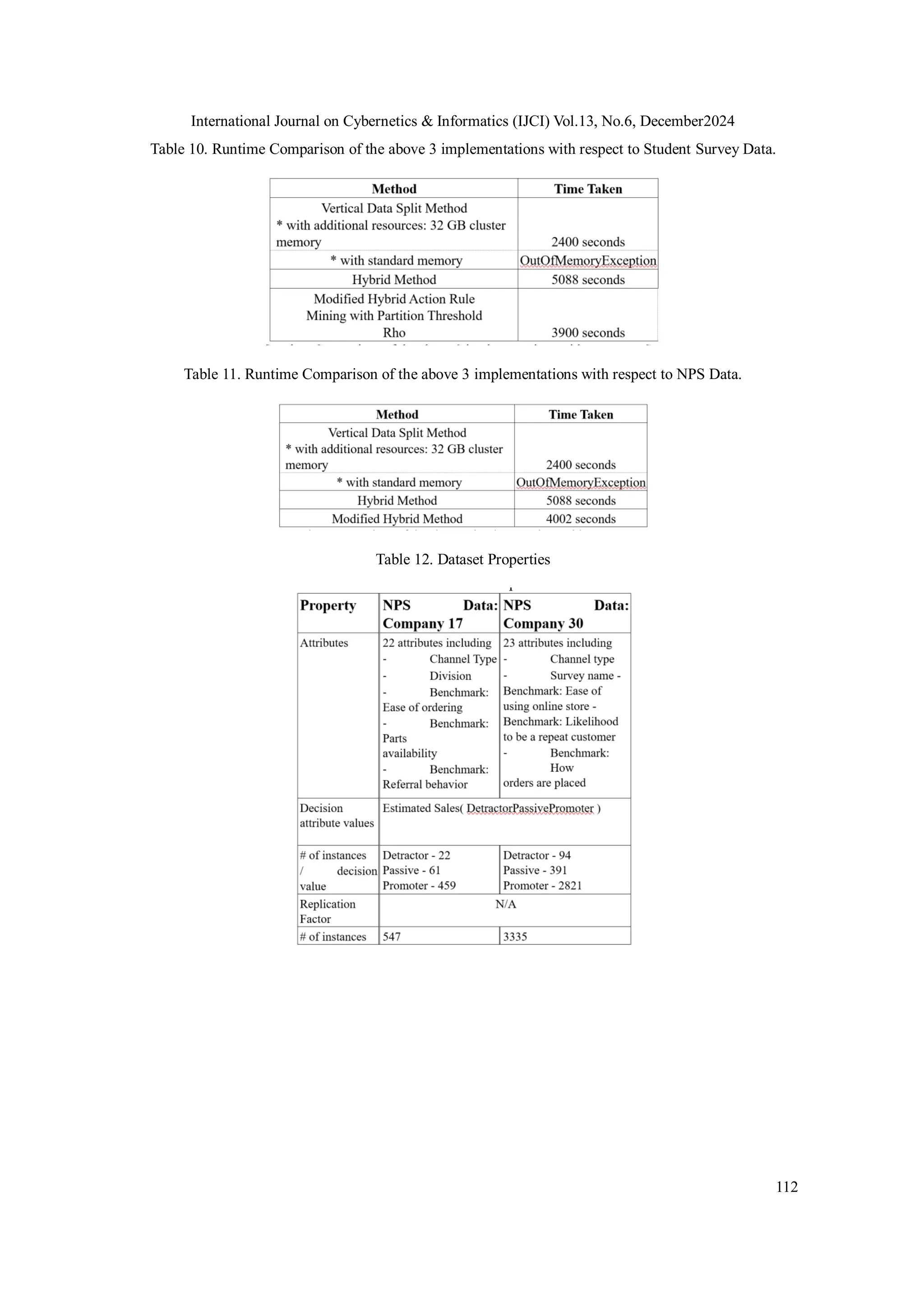
We compare the execution runtime of the above described implementations:Vertical Data Split
Method in Spark AWS Cluster, Hybrid Method Implementation in Spark AWS Cluster and Hybrid
Method with Threshold Implementation in Spark AWS Cluster. The runtimes are given in below
table 10.Our proposed Hybrid Method with Threshold (Modified Hybrid Method with threshold
rho) shows improved performance over the previous Hybrid Method, and shows the best
performance with standard memory.
6.5. Experiment 4 - Vertical Data Split generating Meta Action with NPS Data
To test our methods, we use dataset: the Net Promoter Score data [53].We used a sample of Net
Promoter Score dataset [53] for our experiments. The NPS (Net Promoter Score) dataset is
collected customer feedback data related to heavy equipment repair. The entire dataset consists of
38 companies, located in multiple sites across the whole United States as well as several parts of
Canada. Overall, there are about 340,000 customers surveyed in the database over time span of
2011-2015. Customers were randomly selected to answer a questionnaire which was specifically
designed to collect information relevant to NPS (structured into so-called ”benchmarks”). All the
responses from customers were saved into database with each question (benchmark) as one
feature in the dataset. Benchmarks include numerical scores (0-10) on certain aspects of
service:e.g. if job done correctly, are you satisfied with the job, likelihood to refer, etc. The
dataset also contains customer details (name, contact, etc.) and service details (company, invoice,
type of equipment repaired, etc.). The decision attribute in the dataset is PromoterStatuswhich
labels each customer as either promoter,passiveor detractor. The decision problem here is to
improve customer satisfaction / loyalty as measured by Net Promoter Score. The goal of applying
action rules to solve the problem is to find minimal sets of actions so that to ”reclassify” customer
from ”Detractor” to ”Promoter” and the same improve NPS. For our experiments, we used survey
given by customers for 4 companies over the year of 2015. Each of NPS data consists of around
1500 unique surveys from multiple customers with around 25 unique questions. Table 12 gives an
overview of some properties of all datasets that we used to test our methods.
Table 13 show parameters that we set for each dataset to collect Action Rules. For all,Net
Promoter Score data, we choose Promoter Status as a decision attribute and we collect Action
Rules to convert Detractors to Promoters of a company from a list of surveys that the customers
have participated in.
Due to space limitation, we show the Action Rules extracted using our methods in different
tables: Table 14, Table 15, Table 16 and Table 17. In These Action Rules provide actionable
recommendations to users who wants to achieve the desired decision action. Table 13 are example
recommendations given by our system for the appropriate parameters for the above tables . We
give example Action Rules for all NPS datasets: in Table 14, Table 15, Table 16 and Table 17. In
all cases, we consider that the user wants to convert a user’s Promoter Status from Detractor to
Promoter with parameters given in Table 13. For example, consider ARN2 which recommends that
if the company can improve user’s ratings on Completion of repair correctly from 5 points to 10
points and improve user’s ratings on Technician communication from 3 points to 9 points, the
International Journal on Cybernetics & Informatics (IJCI) Vol.13, No.6, December2024
109
company can convert some Detractors to Promoters with support of 2.0 and confidence of
90.0%.Meta Actions are provided by experts, but we have some probable predictions of Meta
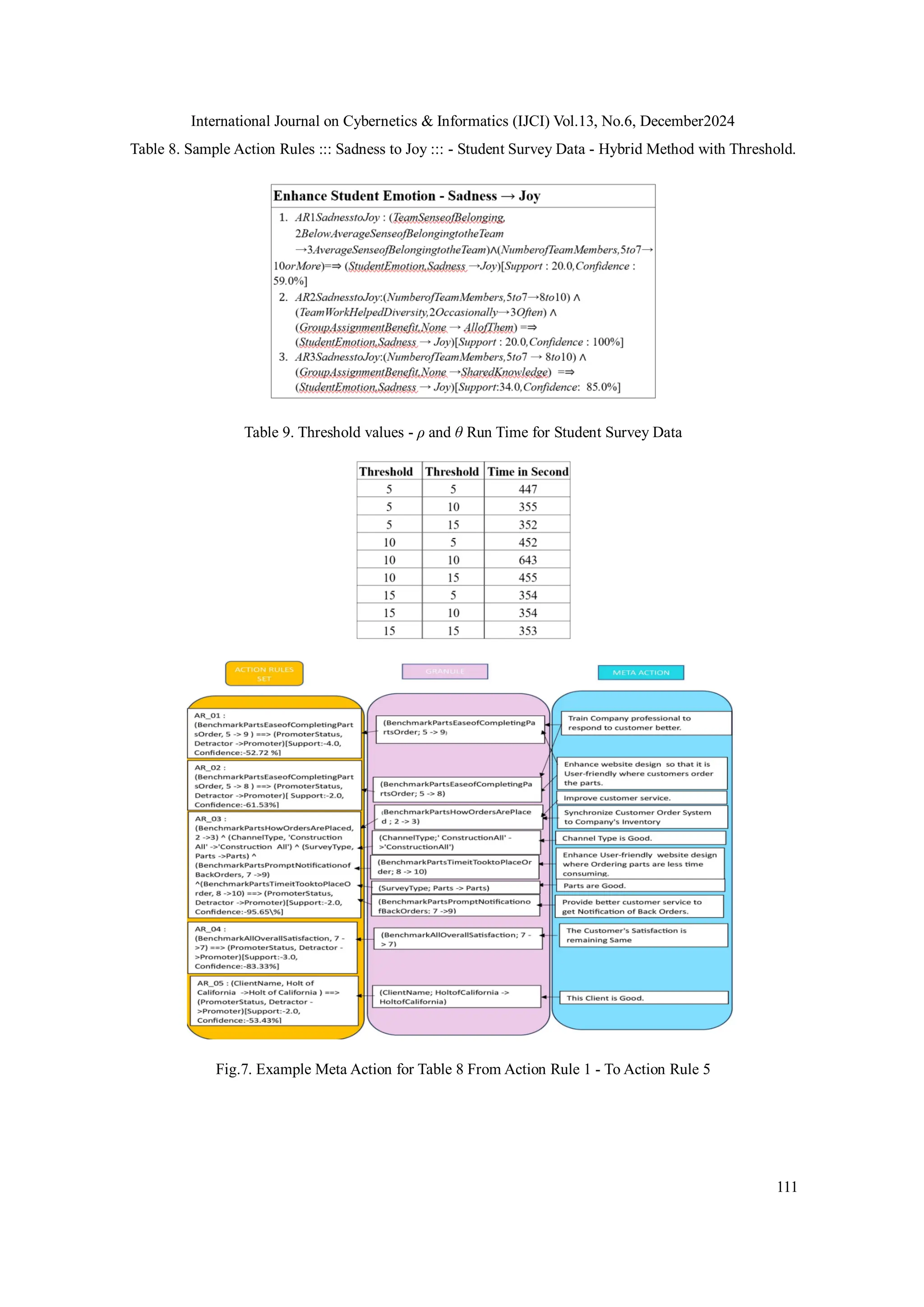
Actions. In Figure 7, we are showing the Meta Action for a particular Action Rule. Each Meta
Action corresponds to a particular Action Rule. Each figure represents the Action Rule table it
belongs to. For example figure 7 belongs to Table 14.
7. CONCLUSION
The ultra-connected world is generating massive volumes of data stored in a computer database
and cloud environment. These huge large datasets need to be analyzed in order to extract useful
knowledge and present it to decision makers for further use. Most of the decision makers
encounter a large number of decision rules resulted from action rules mining. Moreover, the
volume of datasets brings a new challenges to extract patterns such as high cost of computing; or
unreasonable time to extract the relevant rules. However emotion analysis has been attracting
researcher’s attention. The expansion of social media, online surveys, customer surveys, blogs,
industrial and educational data generates large amounts of data. Hidden in the data are valuable
insights on people’s opinions and their emotions. We are searching for emotions in data - this can
applied to Student Surveys as well Customer Satisfactions opinions such as the NPS (Net
Promoter Score) data. Our proposed method - Modified Hybrid Action Rule Mining with
Partition Threshold Rho to Student Survey Dataset and NPS (Net Promoter Score) business
Dataset. In our results we suggest ways of improving Customer Emotions that may be a Student
or may be a Business person. The Student Survey data contains student opinions regarding the
use of Active Learning methods, Teamwork and class experiences. The NPS data contains the
customer opinion regarding their service experience with the business. The discovered Action
Rules help to enhance the user Emotion from Negative to Positive and from Neutral to Positive.
Today, a completely automated and accurate solution is yet to be found. At the same time, there is
still a great demand in industry domains for such systems, because every business wants to know
how customers perceive their products and services.
8. FUTURE WORK
Our proposed method improves the processing time. However, the quality of rules may decrease.
In the future, we plan to use Correlation of Attributes and run classical Clustering Algorithm. This
obtains optimal Vertical Partitioning which is flexible. We plan to apply Agglomerative strategy
to change levels of vertical partitions. We also plan to examine the Quality of the Action Rules
using F-Score.
International Journal on Cybernetics & Informatics (IJCI) Vol.13, No.6, December2024
110
Table 5. Sample Action Rules ::: Sadness to Joy ::: - Student Survey Data - Vertical Data Split Method.
Enhance Student Emotion - Sadness → Joy
1. AR1SadnesstoJoy: (GroupAssignmentBenefit,
SharedKnowledge→ SocialLearning) ∧ (LikeTeamWork,1Don0
t → 5V eryMuch) ∧
(TeamMemberResponsibility,
HelpfulMembers→ ResponsibleMembers) =⇒ (StudentEmotion,Sadness→ Joy)[Support :
100.0,Confidence : 75.0%]
2. AR2SadnesstoJoy:
(GroupAssignmentBenefit,None
→ None) ∧ (LikeTeamWork,3Somewhat → 5V eryMuch) ∧ (TeamMemberResponsibility,
TechnicallyIneffectiveMembers→
FriendlyMembers)
=⇒ (StudentEmotion,Sadness→ Joy)[Support : 100.0,Confidence : 50.0%]
3. AR3SadnesstoJoy:
(NumberofTeamMembers,8to10
→ 10orMore) ∧ (LikeTeamWork,3Somewhat →
5V eryMuch)∧(GroupAssignmentBenefit,None→
SocialLearning)
=⇒ (StudentEmotion,Sadness→ Joy)[Support : 100.0,Confidence : 16.6%]
Table 6. Sample Action Rules ::: Detractor to Promoter ::: - NPS (Net Promoter Score) Business data
Vertical Data Split Method
Table 7. Sample Action Rules ::: Sadness to Joy ::: - Student Survey Data - Hybrid Method.
Enhance Student Emotion - Sadness → Joy
1. AR1SadnesstoJoy:(TeamFormation,2BelowAverage
→ 4Perfect) ∧ (NumberofTeamMembers,5to7 →8to10)=⇒
(StudentEmotion,Sadness→Joy)[Support : 21.0,Confidence : 62.0%]
2. AR2SadnesstoJoy:(LikeTeamWork,1Don’
t→3Somewhat)
=⇒(StudentEmotion,Sadness→Joy)[Support:21.0,Confidence :
91.0%]
3. AR3SadnesstoJoy:(NumberofTeamMembers,5to7 → 8to10)
∧ (GroupAssignmentBenefit,None→SocialLearning)
=⇒ (StudentEmotion,Sadness→ Joy)[Support :34.0,Confidence :
85.0%]
Enhance Customer Emotion - Detractor → Promoter
1. AR1DetractortoPromoter:(BenchmarkPartsOrderAccuracy,3→
10)=⇒ (PromoterStatus,Detractor →Promoter)[Support :2.0, Confidence :
62.19%]
2. AR2DetractortoPromoter:(BenchmarkPartsHowOrdersArePlaced,2
→ 4) ∧ (BenchmarkPartsOrderAccuracy,3 → 10)=⇒ (PromoterStatus,
Detractor→Promoter)[Support : 2.0,Confidence : 100.00%]
3. AR3DetractortoPromoter:(BenchmarkPartsPartsAvailability,4→9)
∧ (Division,WagnerHeavyEquipment −Parts → WagnerHeavyEquipment −
Parts) =⇒ (PromoterStatus,Detractor →Promoter)[Support :
2.0,Confidence : 79.48%]
International Journal on Cybernetics & Informatics (IJCI) Vol.13, No.6, December2024
111
Table 8. Sample Action Rules ::: Sadness to Joy ::: - Student Survey Data - Hybrid Method with Threshold.
Table 9. Threshold values - ρ and θ Run Time for Student Survey Data
Fig.7. Example Meta Action for Table 8 From Action Rule 1 - To Action Rule 5
International Journal on Cybernetics & Informatics (IJCI) Vol.13, No.6, December2024
112
Table 10. Runtime Comparison of the above 3 implementations with respect to Student Survey Data.
Table 11. Runtime Comparison of the above 3 implementations with respect to NPS Data.
Table 12. Dataset Properties
International Journal on Cybernetics & Informatics (IJCI) Vol.13, No.6, December2024
113
Table 13. Parameters used in all Action Rule discovery algorithms
Property NPS Data
Stable attributes Survey name
Survey type
Division
Channel type
Client name
Required decision action Promoter status
Detractor →
Promoter
Minimum Support α and
Confidence β
2, 80%
Table 14. Action Rules of NPS datasets:17 California part1ActionRules
Table 15. Action Rules of NPS datasets: 17 California part2ActionRules
17 California part1ActionRules
ARN1 : (BenchmarkPartsEaseofCompletingPartsOrder,5 → 9) =⇒ (PromoterStatus,Detractor→
Promoter)[Support : −4.0,Confidence : −52.72727272727272%]
ARN2 : (BenchmarkPartsEaseofCompletingPartsOrder,5 → 8) =⇒ (PromoterStatus,Detractor→
Promoter)[Support : −2.0,Confidence : −61.53846153846154%]
ARN3 : (BenchmarkPartsHowOrdersArePlaced,2 → 3) ∧ (ChannelType,0
ConstructionAll0
→0
ConstructionAll0
)∧(SurveyType,Parts→ Parts)∧(BenchmarkPartsPromptNotificationofBackOrders,
9) ∧ (BenchmarkPartsTimeitTooktoPlaceOrder,8 → 10) =⇒ (PromoterStatus,Detractor→
Promoter)[Support : −2.0,Confidence : −95.65217391304348%]
ARN4 : (BenchmarkAllOverallSatisfaction,7 → 7) =⇒ (PromoterStatus,Detractor→
Promoter)[Support : −3.0,Confidence : −83.33333333333332%]
ARN5 : (ClientName,HoltofCalifornia→ HoltofCalifornia) =⇒ (PromoterStatus,Detractor→
Promoter)[Support : −2.0,Confidence : −53.437453193720129%]
17 California part2ActionRules
International Journal on Cybernetics & Informatics (IJCI) Vol.13, No.6, December2024
114
Table 16. Action Rules of NPS datasets:NPS action rules 30 35 part1ActionRules
NPS action rules 30 35 part1ActionRules
Table 17. Action Rules of NPS datasets:NPS action rules 30 35 part2ActionRules
REFERENCES
[1] M. Khder, I. Abu-AlSondos, and Y. Bahar, “The impact of implementing data mining in business
intelligence,” International Journal of Entrepreneurship, vol. 25, pp. 1–9, 05 2021.
[2] J. Kuang, A. Daniel, J. Johnston, and Z. W. Ras, “Hierarchically structured recommender systemfor
improving nps of a company,” in International Conference on Rough Sets and Current Trends in
Computing. Springer, 2014, pp. 347–357.
[3] J. Ranganathan, A. S. Irudayaraj, A. Bagavathi, and A. A. Tzacheva, “Actionable pattern discovery
forsentiment analysis on twitter data in clustered environment,” Journal of Intelligent & Fuzzy
Systems, no. Preprint, pp. 1–15, 2018.
[4] Z. W. Ra´s and A. A. Tzacheva, “In search for action rules of the lowest cost,” in Monitoring,
Security, and Rescue Techniques in Multiagent Systems. Springer, 2005, pp. 261–272.
[5] P. Su, D. Li, and K. Su, “An expected utility-based approach for mining action rules,” in
Proceedings of the ACM SIGKDD Workshop on Intelligence and Security Informatics, ser. ISI-KDD
’12. New York, NY, USA: ACM, 2012, pp. 9:1–9:4. [Online]. Available:
http://doi.acm.org/10.1145/2331791.2331800
[6] A. Tzacheva and Z. Ras, “Action rules mining.” Int. J. Intell. Syst., vol. 20, pp. 719–736, 01 2005.
[7] L.-S. Tsay* and Z. W. Ra´s, “Action rules discovery: system dear2, method and experiments,”
Journal of Experimental & Theoretical Artificial Intelligence, vol. 17, no. 1-2, pp. 119–128, 2005.
[8] Z. W. Ra´s, E. Wyrzykowska, and H. Wasyluk, “Aras: Action rules discovery based on
agglomerativestrategy,” in International Workshop on Mining Complex Data. Springer, 2007,
pp. 196–208.
[9] Z. W. Ras, A. Dardzinska, L.-S. Tsay, and H. Wasyluk, “Association action rules,” in Data Mining
Workshops, 2008. ICDMW’08. IEEE International Conference on. IEEE, 2008, pp. 283–290.
NPS action rules 30 35 part2ActionRules
ARN16 : (BenchmarkAllOverallSatisfaction,1 → 10) ∧ (Division,WagnerHeavyEquipment− Parts →
WagnerHeavyEquipment− Parts) =⇒ (PromoterStatus,Detractor→ Promoter)[Support : −5.0,Confidence :
−63.74946374946375%]
ARN17 : (BenchmarkAllOverallSatisfaction,5 → 9) ∧ (BenchmarkPartsTimeitTooktoPlaceOrder,9 →
10) =⇒ (PromoterStatus,Detractor→ Promoter)[Support : −4.0,Confidence : −73.17180616740089%]
ARN18 : (BenchmarkAllLikelihoodtobeRepeatCustomer,5 → 7) =⇒ (PromoterStatus,Detractor→
Promoter)[Support : −4.0,Confidence : −85.35866261398176%]
ARN19 : (BenchmarkAllDealerCommunication,1 → 9)∧(BenchmarkAllLikelihoodtobeRepeatCustomer,3
8) =⇒ (PromoterStatus,Detractor→ Promoter)[Support : −4.0,Confidence : −96.342962962962955%]
ARN20 : (BenchmarkPartsHowOrdersArePlaced,2− >3) ∧ (BenchmarkPartsPartsAvailability,8− >
9) =⇒ (PromoterStatus,Detractor→ Promoter)[Support : −4.0,Confidence : −73.17180616740089%]
International Journal on Cybernetics & Informatics (IJCI) Vol.13, No.6, December2024
115
[10] S. Im and Z. W. Ra´s, “Action rule extraction from a decision table: Ared,” in International
Symposium on Methodologies for Intelligent Systems. Springer, 2008, pp. 160–168.
[11] S. R. A.A. Tzacheva, C.C. Sankar and R. Shankar, “Support confidence and utility of action
rulestriggered by meta-actions,” in proceedings of 2016 IEEE International Conference on
Knowledge Engineering and Applications, ser. ICKEA 2016. IEEE Computer Society, 2016.
[12] J. Dean and S. Ghemawat, “Mapreduce: simplified data processing on large clusters,”
Communications of the ACM, vol. 51, no. 1, pp. 107–113, 2008.
[13] M. Zaharia, M. Chowdhury, T. Das, A. Dave, J. Ma, M. McCauley, M. J. Franklin, S. Shenker, andI.
Stoica, “Resilient distributed datasets: A fault-tolerant abstraction for in-memory cluster
computing,” in Proceedings of the 9th USENIX Conference on Networked Systems Design and
Implementation, ser. NSDI’12. Berkeley, CA, USA: USENIX Association, 2012, pp. 2–2.
[14] J. E. Gonzalez, R. S. Xin, A. Dave, D. Crankshaw, M. J. Franklin, and I. Stoica, “Graphx:
Graphprocessing in a distributed dataflow framework.” in OSDI, vol. 14, 2014, pp. 599–613.
[15] A. Bagavathi, P. Mummoju, K. Tarnowska, A. Tzacheva, and Z. Ras, “”sargs method for
distributedactionable pattern mining using spark”,” 12 2017, pp. 4272–4281.
[16] J. Kuang, A. Daniel, J. Johnston, and Z. W. Ra´s, “Hierarchically structured recommender systemfor
improving nps of a company,” in Rough Sets and Current Trends in Computing, C. Cornelis, M.
Kryszkiewicz, D. Slzak, E. M. Ruiz, R. Bello, and L. Shang, Eds.´ Cham: Springer International
Publishing, 2014, pp. 347–357.
[17] A. A. Tzacheva and A. Easwaran, “Modified hybrid scalable action rule mining for emotion
detectionin student survey data,” in International Conference on Data Mining, Big Data, Database
and Data Technologies, 2022, pp. 13–19.
[18] K.K.Ramachandran, “Natural language processing for legal documentation in indian languages,”
International Journal of Business and Data Analytics (IJBDA), vol. 1, pp. 1–15, 01 2024.
[19] S.B.Vinay, “Identifying research trends using text mining techniques: A systematic review,”
International Journal of Data Mining and Knowledge Discovery (IJDMKD), vol. 1, pp. 1–11, 01
2024.
[20] ——, “Natural language processing for legal documentation in indian languages,” International
Journal of Natural Language Processing (IJNLP), vol. 2, pp. 1–11, 01 2024.
[21] Z. W. Ras, K. A. Tarnowska, J. Kuang, L. Daniel, and D. Fowler, “”user friendly nps-based
recommender system for driving business revenue”,” in ”Rough Sets”, 07 2017, pp. 34–48.
[22] S.B.Vinay, “Ai and machine learning integration with awssagemaker: Current trends and
futureprospects,” International Journal of Artificial Intelligence Tools (IJAIT), vol. 1, pp. 1–24, 01
2024.
[23] T. Hakim, K. Jieyan, H. Ayman, and Z. W. Ras, “Personalized action rules for side effects
objectgrouping,” in International Journal of Intelligence Science. Scientific Research, 2013, pp. 24–
33.
[24] J. Kuang, Z. W. Ras, and A. Daniel, “Hierarchical agglomerative method for improving nps,”
inPattern Recognition and Machine Intelligence, M. Kryszkiewicz, S. Bandyopadhyay, H. Rybinski,
and S. K. Pal, Eds. Cham: Springer International Publishing, 2015, pp. 54–64.
[25] Z. W. Ras and A. Dardzinska, “Action rules discovery based on tree classifiers and meta-
actions,”inFoundations of Intelligent Systems, J. Rauch, Z. W. Ras, P. Berka, and T. Elomaa, Eds.
Berlin, Heidelberg: Springer Berlin Heidelberg, 2009, pp. 66–75.
[26] A. A. Tzacheva and Z. W. Ras, “Association action rules and action paths triggered by meta-
actions,”in2010 IEEE International Conference on Granular Computing, 2010, pp. 772–776.
[27] J. Kuang, Z. W. Ras, and A. Daniel, “Personalized meta-action mining for nps improvement,”
inFoundations of Intelligent Systems, F. Esposito, O. Pivert, M.-S. Hacid, Z. W. Ras, and S. Ferilli,
Eds. Cham: Springer International Publishing, 2015, pp. 79–87.
[28] N. Esfandiari, M. R. Babavalian, A.-M. E. Moghadam, and V. K. Tabar, “Knowledge discovery
inmedicine: Current issue and future trend,” Expert Systems with Applications, vol. 41, no. 9, pp.
4434– 4463, 2014.
[29] R. S. Baker and P. S. Inventado, “Educational data mining and learning analytics,” in Learning
analytics. Springer, 2014, pp. 61–75.
[30] G. Shmueli, P. C. Bruce, I. Yahav, N. R. Patel, and K. C. Lichtendahl Jr, Data mining for business
analytics: concepts, techniques, and applications in R. John Wiley & Sons, 2017.
[31] H. C. Koh, G. Tan et al., “Data mining applications in healthcare,” Journal of healthcare
information management, vol. 19, no. 2, p. 65, 2011.
International Journal on Cybernetics & Informatics (IJCI) Vol.13, No.6, December2024
116
[32] D. He, S. C. Mathews, A. N. Kalloo, and S. Hutfless, “Mining high-dimensional administrative
claimsdata to predict early hospital readmissions,” Journal of the American Medical Informatics
Association, vol. 21, no. 2, pp. 272–279, 2014.
[33] B. Zheng, J. Zhang, S. W. Yoon, S. S. Lam, M. Khasawneh, and S. Poranki, “Predictive modelingof
hospital readmissions using metaheuristics and data mining,” Expert Systems with Applications, vol.
42, no. 20, pp. 7110–7120, 2015.
[34] B. Strack, J. P. DeShazo, C. Gennings, J. L. Olmo, S. Ventura, K. J. Cios, and J. N. Clore, “Impact
ofhba1c measurement on hospital readmission rates: analysis of 70,000 clinical database patient
records,” BioMed research international, vol. 2014, 2014.
[35] P. Braga, F. Portela, M. F. Santos, and F. Rua, “Data mining models to predict patient’s
readmissionin intensive care units,” in ICAART 2014-Proceedings of the 6th International
Conference on Agents and Artificial Intelligence, vol. 1. SCITEPRESS, 2014, pp. 604–610.
[36] M. Al-Mardini, A. Hajja, L. Clover, D. Olaleye, Y. Park, J. Paulson, and Y. Xiao, “Reduction
ofhospital readmissions through clustering based actionable knowledge mining,” in Web Intelligence
(WI), 2016 IEEE/WIC/ACM International Conference on. IEEE, 2016, pp. 444–448.
[37] M. Almardini, A. Hajja, Z. W. Ra´s, L. Clover, D. Olaleye, Y. Park, J. Paulson, and Y. Xiao,
“Reduction of readmissions to hospitals based on actionable knowledge discovery and
personalization,” in Beyond Databases, Architectures and Structures. Advanced Technologies for
Data Mining and Knowledge Discovery. Springer, 2015, pp. 39–55.
[38] Q. Yang, J. Yin, C. Ling, and R. Pan, “Extracting actionable knowledge from decision trees,” IEEE
Transactions on Knowledge and data Engineering, vol. 19, no. 1, pp. 43–56, 2007.
[39] M. Karim and R. M. Rahman, “Decision tree and naive bayes algorithm for classification and
generation of actionable knowledge for direct marketing,” Journal of Software Engineering and
Applications, vol. 6, no. 04, p. 196, 2013.
[40] Z. Cui, W. Chen, Y. He, and Y. Chen, “Optimal action extraction for random forests and
boostedtrees,” in Proceedings of the 21th ACM SIGKDD International Conference on Knowledge
Discovery and Data Mining. ACM, 2015, pp. 179–188.
[41] Y. Hu, J. Du, X. Zhang, X. Hao, E. Ngai, M. Fan, and M. Liu, “An integrative framework for
intelligentsoftware project risk planning,” Decision Support Systems, vol. 55, no. 4, pp. 927–937,
2013.
[42] Y. Hu, B. Feng, X. Mo, X. Zhang, E. Ngai, M. Fan, and M. Liu, “Cost-sensitive and ensemble-
basedprediction model for outsourced software project risk prediction,” Decision Support Systems,
vol. 72, pp. 11–23, 2015.
[43] A. Bagavathi, V. Rao, and A. A. Tzacheva, “Data distribution method for scalable actionable pattern
mining,” in Proceedings of the First International Conference on Data Science, E-learning and
Information Systems. ACM, 2018, p. 3.
[44] H. Liu, A. Gegov, and F. Stahl, “Categorization and construction of rule based systems,” in
International Conference on Engineering Applications of Neural Networks. Springer, 2014,
pp. 183–194.
[45] Z. W. Ras and A. Wieczorkowska, “Action-rules: How to increase profit of a company,” in European
Conference on Principles of Data Mining and Knowledge Discovery. Springer, 2000, pp. 587–
592.
[46] M. Hahsler and R. Karpienko, “Visualizing association rules in hierarchical groups,” Journal of
Business Economics, vol. 87, no. 3, pp. 317–335, 2017.
[47] S. Rathee, M. Kaul, and A. Kashyap, “R-apriori: an efficient apriori based algorithm on spark,”
inProceedings of the 8th Workshop on Ph. D. Workshop in Information and Knowledge
Management. ACM, 2015, pp. 27–34.
[48] J. W. Grzymala-Busse, “A new version of the rule induction system lers,” FundamentaInformaticae,
vol. 31, no. 1, pp. 27–39, 1997.
[49] A. Tzacheva and J. Ranganathan, “”pattern discovery from student feedback: Identifying factors
toimprove student emotions in learning”,” vol. 14, no. 12. World Academy of Science, Engineering
and Technology, 2020, pp. 1260 – 1265. [Online]. Available: https://publications.waset.org/vol/168
[50] M. Zaharia, M. Chowdhury, M. J. Franklin, S. Shenker, and I. Stoica, “Spark: Cluster computing
withworking sets,” in Proceedings of the 2Nd USENIX Conference on Hot Topics in Cloud
Computing, ser. HotCloud’10. Berkeley, CA, USA: USENIX Association, 2010, pp. 10–10.
[Online]. Available: http://dl.acm.org/citation.cfm?id=1863103.1863113
International Journal on Cybernetics & Informatics (IJCI) Vol.13, No.6, December2024
117
[51] J. Kuang, Z. W. Ras, and A. Daniel, “Personalized meta-action mining for nps improvement,”
inFoundations of Intelligent Systems, F. Esposito, O. Pivert, M.-S. Hacid, Z. W. Ras, and S. Ferilli,
Eds. Cham: Springer International Publishing, 2015, pp. 79–87.
[52] A. Bagavathi, A. Tripathi, A. A. Tzacheva, and Z. W. Ras, “Actionable pattern mining - a
scalabledata distribution method based on information granules,” in 2018 17th IEEE International
Conference on Machine Learning and Applications (ICMLA), 2018, pp. 32–39.
[53] Z. W. Ras, K. A. Tarnowska, J. Kuang, L. Daniel, and D. Fowler, “User friendly nps-based
recommender system for driving business revenue,” in International Joint Conference on Rough
Sets. Springer, 2017, pp. 34–48.

Actionable Pattern Discovery for Emotion Detection in BigData in Education and Business

  • 1.
    International Journal onCybernetics & Informatics (IJCI) Vol.13, No.6, December2024 Bibhu Dash et al: NLAICSE, NLAII, IOTSEC, AIMDS 2024 pp. 93-117, 2024. IJCI – 2024 DOI:10.5121/ijci.2024.130607 ACTIONABLE PATTERN DISCOVERY FOR EMOTION DETECTION IN BIGDATA IN EDUCATION AND BUSINESS Angelina Tzacheva1 and Sanchari Chatterjee2 1 Computer Science and Information Technology College of Computing and Engineering, WestCliff University,Irvine, CA 92614, 2 Department of Computer Science, University of North Carolina at Charlotte, Charlotte, NC, 28223 ABSTRACT Action Rules are rule based systems that extract actionable patterns which are hidden in big volumes of data generated from Education sector, Business field, Medical domain and Social Media, in a single day. In the technological world of big data, massive amounts of data are collected by organizations, including in major domains like financial, medical, social media and Internet of Things(IoT). Mining this data can provide a lot of meaningful insights on how to improve user experience in multiple domain. Users need recommendations on actions they can undertake to increase their profit or accomplish their goals, this recommendations are provided by Actionable patterns. For example: How to improve student learning; how to increase business profitability; how to improve user experience in social media; and how to heal patients and assist hospital administrators. Action Rules provide actionable suggestions on how to change the state of an object from an existing state to a desired state for the benefit of the user. The traditional Action Rules extraction models, which analyze the data in a non distributed fashion, does not perform well when dealing larger datasets. In this work we are concentrating on the vertical data splitting strategy using information granules and creating the data partitioning more logically instead of splitting the data randomly and also generating meta actions after the vertical split. Information granules form basic entities in the world of Granular Computing(GrC), which represents meaningful smaller units derived from a larger complex information system. We introduced Modified Hybrid Action rule method with Partition Threshold Rho. Modified Hybrid Action rule mining approach combines both these frameworks and generates complete set of Action Rules, which further improves the computational performance with large datasets. KEYWORDS Emotion Detection, Meta Action, Information granules. 1. INTRODUCTION In this modern world of data, data mining focuses on various techniques to extract some surprising, very interesting, and unknown knowledge patterns from massive data. Extracting these data is useful in multiple domains, this allows the different fields to generate a valuable data which can be used to analyze the user patterns. These techniques embrace the relationship of data objects with other objects (Clustering) or classes (Classification) to unwrap useful patterns in the data. It is now highly recommended to use data mining to achieve better results and higher profits [1]. Rule-based learning is a simple data mining method that identifies, learns, or develops ’rules’ to store, operate, or apply. Association Rules and Decision Trees are fragments of rule-based methods that generate rules to associate patterns and classify data, respectively. In general, we
  • 2.
    International Journal onCybernetics & Informatics (IJCI) Vol.13, No.6, December2024 94 constitute rules as given in Equation 1, where the antecedent is a conjunction of conditions, and the consequent is the resulting pattern in the given data for the given conditions in antecedent. condition(s) → result(s) (1) Action rule is the process of knowledge extraction developed in context to advocate possible transitions for an individual to move from one state(negative) to another state (positive). For example, recommending the business to improve customer satisfaction [2] and sentiment analysis on Twitter [3]. Action rules follow the representation, similar to Equation 1, as given in Equation 2, where Ψ represents a conjunction of stable features, (α → β) represents a conjunction of changes in values of flexible features and (θ → φ) represents desired change in decision action which is beneficial to the user. [(Ψ) ∧ (α → β)] → (θ → φ) (2) Action Rules recommending Actionable pattern are prone to acquire definite form of cost to the user [4], [5]. Cost for actions in Action Rules include time, energy, money, or human resources. Actions being recommended can cause both positive(benefits) and negative(loses) effects for users [6]. Thus, Action Rules recommendations system should take on low cost to the users to make them plausible actions. The existing approaches [7–10] do not consider the cost effectiveness for recommendations. In [4] [11], the concept of cost of the Action Rules is introduced and refined. Searching for the low cost Action Rules from huge dataset can really be very time-consuming and will require a distributed and scalable approach for extracting them in a practicable timeframe. Distributed Processing frameworks like Hadoop [12] and Spark [13] have been introduced to make data mining and big data processing faster and easier. The data processing work is distributed among the multiple nodes, each of which on their part of the data performs computations, by these frameworks. In this work, we use Apache Spark [13] framework for implementing a scalable solution to the proposed Action Graph method, and make it suitable for big data. Spark provides APIs such as GraphX [14] for a productive parallel processing in large graphs. In this paper, we propose an extension to our previous work on distributed actionable pattern mining with Spark [15]. We extract actions rules from the business and survey datasets, that help to obtain better, desirable outcome for future. We focus on hierarchically structured recommender system to improve the efficiency of a company’s growth engine. The NPS dataset used for this research contains answers to a set of questionnaire sent to a randomly chosen groups of customers. It covers 34 companies called clients. The purpose of the questionnaire is to check customer satisfaction in using services of these companies which have repair shops all involved in a similar type of business (fixing heavy equipment). Authors [16] present the concept of semantic similarity between companies. More semantically similar the companies are, the knowledge extracted from their joined NPS datasets has higher accuracy and coverage. Action Rule Mining literature consists of two major frameworks namely: Rule-Based approach and Object-Based approach. In this work we focus on Hybrid Action Rule mining method, which combines the above two frameworks with the advantage of scalability with large datasets. Primarily, we emphasis on Opinion Mining from Text to suggest Actionable Recommendations. The Actionable Patterns may suggest ways to alter the user’s sentiment or emotion to a more positive or desirable state. We extract action rules from business data and student survey data. In this work we propose a new Modified Hybrid Action Rule [17] mining approach that improves the computational performance, which combines the above two frameworks with the advantage of
  • 3.
    International Journal onCybernetics & Informatics (IJCI) Vol.13, No.6, December2024 95 scalability with large datasets. We propose a new Threshold Rho - which allows the user to choose the number of data partitions. This yields Faster Scalable processing. We are applying the method to Student Survey Data, however this method can be used for Improving Customer Satisfaction as well. We also aim to suggest ways to improve the Teaching Methods and Student Learning and how to change detractors to promoters in business . We implement and test our system in Scalable Environment with BigData using the Apache Spark platform. 2. RELATED WORK Data Science plays a pivotal role in shaping the modern world, [18] paper focus on understanding its evolution, addressing challenges, and anticipating future trends which are crucial for researchers, practitioners, and policymakers alike. Text mining can help identify patterns, trends, and relationships in text data that would be difficult or impossible to identify through manual analysis. The paper [19] demonstrates the systematic review on text mining techniques and their applications in identifying new research trends.Natural Language Processing represents a cutting- edge technological paradigm with transformative implications for legal documentation. The paper [20] navigates the potential implications of employing NLP for legal documentation, emphasizing its role in improving access to justice, bridging linguistic gaps, and fostering inclusivity within the legal system. The authors of the paper [21] provides an overview of a user-friendly NPS based Recommender System for driving business revenue. This technique hierarchically designed recommender system for improving NPS of clients that is driven mainly by action rules and meta-actions. The paper presents the main techniques used to build the data-driven system, including data mining and machine learning techniques, such as action rules and meta actions, hierarchical clustering, as well as visualization design. The system implements domain specific sentiment analysis performed on comments collected within telephone surveys with end customers.AI and Machine Learning integration with AWS Sage Maker: provides a comprehensive exploration of the current landscape and forward-looking possibilities in integrating artificial intelligence (AI) and machine learning (ML) using Amazon Web Services (AWS) SageMaker. The paper [22] adeptly navigates through the overview of AWS SageMaker, shedding light on its capabilities and features. Authors in this paper [23], try to reduce those negative side effects by extracting personalized action rules. They propose three object-grouping schemes with regards to same negative side effects to extract personalized action rules for each object group. The Authors Kuang and et.al in their paper [24] propose a new strategy to improve NPS (Net Promoter Score) of certain companies called HAMIS. Those companies are involved in heavy equipment repair in the US and Canada.The authors of paper [16] present preliminary results of a flexible hierarchically structured recommender system for improving NPS of a company in a global competitive market. Clients are compare in terms of the similarity of their knowledge concerning the meaning of three concepts: promoter, passive, and detractor. The questionnaire sent to the customers allows them to enter statements in the text format explaining their ratings. Information included in these statements helps us to find triggers for action rules. The triggers are also called meta-actions [25], [26]. Kuang and Ras talk about building a recommender system in their paper [27] which is driven by action rules and meta actions for providing proper suggestions to improve revenue of a group of clients (companies) involved with similar businesses. They collect feedback from customers and use them as their dataset. The paper proposes a strategy to classify and organize meta-actions in such a way that they can be applied most efficiently to achieve desired goal. In their previous work, [16] they propose and implement the method of mining meta-actions from customers’ reviews in text format.
  • 4.
    International Journal onCybernetics & Informatics (IJCI) Vol.13, No.6, December2024 96 Recently various domains like medicine [28], education [29], and business [30] started adopting data science research in their respective problems. Many research studies have focused on using the copious real world datasets for healthcare applications and decision making using such knowledge extraction and data mining techniques [31]. For example, in context to hospital readmission, researchers and scientists created a machine learning model to predict patient readmissions by considering some basic patient admission characteristics and their billing codes [32]. Some emphasis on predicting the liklihood of patient readmitting to the hospital, modelled as risk prediction, using Support Vector Machines,Neural Networks, and Random Forests [33]. Similarly, there is a study on using logistic regression to measure the relationship between early readmission and diabetes [34], and a study on using a classic data mining technique like Support Vector Machine to predict readmission [35] using other features such as patient demographics,admission type, disease type, and clinical procedures undertaken. There is an interesting study that came into focus in the recent years related to designing a personalized procedure graphs,that gives a probability on patient’s future procedure and recommend hospitals in making decisions for a patient [36,37].Ras and Tzacheva [4] introduced the concept of cost and feasibility of Action Rules as an interesting measure. They proposed a graph based method for extracting plausible and low cost Action Rules. Ras and Tzacheva [4] proposed a heuristic search of new low cost Action Rules, where objects supporting the new set of rules also supports the existing rule set but the cost of reclassifying them is much lower for the new rules. Later, Tzacheva and Tsay [11] proposed a tree based method for extracting low cost Action Rules.Some research, apart from Action Rules has been done on extracting Actionable knowledge. For example, Yang, et.al [38] considered Customer Attrition in Customer Relationship Management (CRM) in telecommunications industry and the cost complexities involved in gaining profit to all customers. They proposed a method that extractlow cost Actionable patterns for converting undesired customers to loyal ones while improving the net profit of all customers. Karim and Rahman [39] proposed another method to extract cost effective actionable patterns for customer attrition problem in post processing steps of Decision Tree and Naive Bayes classifiers. Su, et.al [5] proposed a method to consider positive benefits that occurs by following an Action Rule apart from all costs that incur from the same rule. Cui, et.al [40] proposed to extract optimal actionable plans during post processes of Additive Tree Model (ATM) classifier. These actionable patterns can actually change the given input to a desired one with a minimum cost. Hu, et.al [41] proposed an integrated framework to gather the cost minimal actions sets to provide support for social projects stakeholders inorder to control risks involved in risk analysis and project planning phases. Lately, Hu, et.al [42] developed an ensemble framework and cost sensitive method to predict software project risk predictions and conducted large scale analysis over 60 models 327 real world project samples. Due to the advent of big data, some research [26], [15], [43] started applying distributed computing frameworks like MapReduce [12] and Spark [13], recently have been done to extract actionable recommendation completely in a clustered setup. Bagavathi [26] proposed a method to distribute the data in random to multiple sites, combining results from all sites and taking average on parameters like Support and Confidence. Bagavathi [15] handle the load balancing by uniformly distributing the data into partitions based on the decision attribute. Authors [43] introduces a new method of projecting the database into smaller chunks, for handling data with large number of attributes, and extract action rules from them effectively.
  • 5.
    International Journal onCybernetics & Informatics (IJCI) Vol.13, No.6, December2024 97 Table 1. Example Decision System T X A B C D x1 Y N N D1 x2 Y H Y D2 x3 Y H Y D1 x4 N N N D2 x5 N H N D1 x6 N N Y D2 x7 N H Y D2 x8 N H N D1 In this work, we prefer to use rule based systems inorder to recommend various steps to improve User’s emotions including Student Surveys and Customer’s Net Promoter Score (NPS) for businesses . Rule based systems are one of the most commonly used machine learning methods like regression, classification and association [44] because it is simple to understand and easy to use. Action rules are such rule based systems that designed to recommend actionable insights, for example recommendations for businesses to gain profit by finding interesting actionable patterns in the data [45]. In the literature, action rules are extracted using two different methods. First method is a rule based approach, in which first the intermediate classification rules are extracted using efficient rule generation algorithms such as LERS or ERID. From these extracted rules, action rules are generated with systems like DEAR [7], which extracts Action Rules from two classification rules, or ARAS [8], which extracts Action Rules using a single classification rule. Second method is object-based approaches, in which the Action Rules are extracted directly from the given decision table without involving any intermediary steps. Systems ARED [10] and Association Action Rules [9] works in the object-based approach. Algorithms, except association action rules, runs much faster with the aim of extracting rules that provides maximum benefits to the user and extracts only limited recommendations. In this work we propose a Modified Hybrid Action Rule mining approach with Additional Threshold Rho- for the Number of Partitions which further improves the computational performance from our previous method that has only one threshold [17]. This allows for Faster and more Scalable processing. We will apply our method to the Student Survey Data, and NPS business data however this method can be used for healthcare data as well. We are focusing on our work to suggest ways to improve the Teaching and Student Learning methods and also how to improve Customer Satisfaction, like the status change from detractors (Customers with Negative Emotions) to promoters (Customers with Positive Emotions) in business. We implement and test our system in Scalable Environment with BigData using the Apache Spark platform. 3. BACKGROUND In this section, we give some basic idea about Decision system, Action Rules, Spark and GraphX frameworks to understand out methodology. 3.1. Decision System Consider a decision system given in Table 1. Information System can be represented as T = (X,A,V) where, X is a nonempty, finite set of objects: X = {x1,x2,x3,x4,x5,x6,x7,x8}
  • 6.
    International Journal onCybernetics & Informatics (IJCI) Vol.13, No.6, December2024 98 A is a nonempty, finite set of attributes: A = A,B,C,D andVi is the domain of attribute a which represents a set of values for attribute i|i∈A. For example, VB = N,H. An information system becomes Decision system, if A = ASt∪AFl∪d, where D is a decision attribute. The user chooses the attribute d if they wants to extract desired action from di : i∈Vd. AStis a set of Stable Attributes and AFlis a set of Flexible Attributes. For example, ZIPCODE is a Stable Attribute and User Ratings can be a Flexible Attribute.Let us assume from Table 1 that C ∈ASt. A, B ∈AFland D ∈d. and the decision maker desires Action Rules that triggers the decision attribute change from D1 to D2 throughout this paper for examples. 3.2.Information System Consider a information system given in table 2. Information system can be represented asZ = (X,M,V )where,X is set of objects {x1,x2,x3,x4,x5,x6,x7,x8} in the system;M is non-empty finite set of attributes {A,B,C,E,F,G,D};V is the domain of attributes in M, for instance the domain of attribute B in the system Z is {B1,B2,B3}. Table 2. Information System Z X A B C E F G D x1 A1 B1 C1 E1 F2 G1 D1 x2 A2 B1 C2 E2 F2 G2 D3 x3 A3 B1 C1 E2 F2 G3 D2 x4 A1 B1 C2 E2 F2 G1 D2 x5 A1 B2 C1 E3 F2 G1 D2 x6 A2 B1 C1 E2 F3 G1 D2 x7 A2 B3 C2 E2 F2 G2 D2 x8 A2 B1 C1 E3 F2 G3 D2 The information system in table 2 becomes a Decision System if the attributes M are classified into flexible attributes Mfl, stable attributes Mstand decision attributes d, M = (Mst,Mfl,{d}). From table 2 Mst= {A,B,C},Mfl= {E,F,G}, and d = D. 3.3.Action Rules In this subsection, we give definitions of action terms, action rules and the properties of action rules [45] Let T = (X,A ∪d,V) be a decision system, where d is a decision attribute and V = ∪Vi : i∈A. Action terms can be given by the expression of (m,m1 → m2), where m ∈Aand m1,m2 ∈Vm. m1 = m2 if m ∈ASt. In that case, we can simplify the expression as (m,m1) or (m = m1). Whereas,m1 6= m2 if m ∈AFl Action Rules can take the form of t1 ∩ t2 ∩ .... ∩ tn, where tiis an atomic action or action term and the Action Rule is a conjunction of action terms to achieve the desired action based on attribute D. Example Action Rule is given below: (a,a1 → a2).(b,b1 → b2) −→ (D,D1 → D2) Properties of Action Rules Action Rules are considered interesting based on the metrics such as Support, Confidence, Coverage and Utility. Higher these values, more interesting they are to the end user.
  • 7.
    International Journal onCybernetics & Informatics (IJCI) Vol.13, No.6, December2024 99 Consider an action rule R of form: (Y1 → Y2) −→ (Z1 → Z2) where, Y is the condition part of R; is the decision part of R Y1 is a set of all left side action terms in the condition part of R Y2 is a set of all right side action terms in the condition part of R Z1 is the decision attribute value on left side Z2 is the decision attribute value on right side In [45], the support and confidence of an action rule R is given as Later, Tzacheva et.al [11] proposed a new set of formula for the calculation of Support and Confidence of Action Rules. Their idea is to reduce the complexities in searching data several times for Support and Confidence of an Action Rule. The new formula are given Tzacheva et. al [11] also introduced a concept of utility for Action Rules. Utility of Action Rules takes a following form. For most of cases Utility of Action Rules equals the Old Confidence of the same Action Rule. Coverage of an Action Rule means that how many decision from values, from the entire decision system S, are being fully covered by all extracted Action Rules. In other words, using the extracted Action Rules, Coverage defines how many data records in the decision system can successfully transfers from Z1 to Z2 3.4. Cost of Action Rules Generally, there is a cost associated with changing an attribute value from one class to another class- the more desirable one. The cost is a subjective measure, in a sense that domain knowledge from the experts or user in the field is necessary in order to determine the costs associated with taking the actions. Costs could be moral,monetary, or a combination of the two. For example,changing the marital status from ’married’ to ’divorced’ has a moral cost; whereas ,lowering the interest percent rate for a customer is a monetary cost for the bank; in addition to any monetary costs which may be incurred in the process. Feasibility is an objective measure, i.e. domain independent.According to the cost of actions associated with the classification part of the action rules, a business user may be unable or unwilling to proceed with them.The definition of cost was introduced by Tzacheva and Ras [4] as follows: Assume that S = (X,A,V ) is an information system. Let Y ⊆X, b ∈A is a flexible attribute in S and v1,v2 ∈Vbare its two values. By ℘S(b,v1 → v2) we mean a number from (0,ω] which describes the average cost of changing the attribute value v1 to v2 for any of the qualifying objects in Y . These numbers are provided by experts. Object x ∈Y qualifies for the change from v1 to v2, if b(x) = v1. If the above change is not feasible, then we write ℘S(b,v1 → v2) = ω. Also, if ℘S(b,v1 → v2) < ℘S(b,v3
  • 8.
    International Journal onCybernetics & Informatics (IJCI) Vol.13, No.6, December2024 100 → v4), then we say thatthe change of values from v1 to v2 is more feasible than the change from v3 to v4. Assume an action rule rof the form: (b1,v1 → w1) ∧ (b2,v2 → w2) ∧... ∧ (bp,vp→ wp) ⇒ (d,k1 → k2) Table 3. Meta-actions Influence Matrix for S a b d M1, M2, M3 (b1 → b2) (d1 → d2) M1, M3, M4 (a2) (b2 → b3) M5 (a1) (b2 → b1) (d2 → d1) M2, M4 (b2 → b3) (d1 → d2) M1, M5, M6 (b1 → b3) (d1 → d2) If the sum of the costs of the terms on the left hand side of the action rule is smaller than thecost on the right hand side, then we say that the rule r is feasible. 3.5.Meta Action As an action rule can be seen as a set of atomic actions that need to be made happen for achieving the expected result, meta-actions are the actual solutions that should be executed to trigger the corresponding atomic actions, Table 3 below shows an example of influence matrix which describes the relationships between the meta-actions and atomic actions influenced by them. 3.6. Spark Spark [13] is a framework that is quite similar to MapReduce [12] to process large quantity of data in a parallel fashion. Spark introduces a distributed memory abstraction strategy called Resilient Distributed Datasets(RDD) that can perform in-memory computations on nodes distributed in a cluster. Results of each operation are then stored in memory itself, which can be accessed for future processes and analyses, which in-turn creates another RDD. Thus, Spark cuts- off the larger number of disk accesses for storing intermediate outputs like in Hadoop MapReduce. Spark functions in two stages: 1. Transformation, 2. Action. During the Transformation stage, computations are made on data splits and results are stored in the worker nodes memory as RDD. While the Action stage on an RDD collect results from all the workers and send it to the driver node or save the results to a storage unit. With RDDs Spark helps machine learning algorithms to skip innumerable disk access during iterations. 4. DATASET DESCRIPTION To test our methods, we use two datasets: Student Survey Data [17], and the Net Promoter Score dataset data [21].Student survey data aims to evaluate student emotions and overall satisfaction with course teaching methods and group work experience. The survey is designed to get meaningful insights on students’ feelings towards the Active Learning methods and other factors that can help students in their learning process. The data is collected in the courses which implement the Active Learning methods and teaching style. This survey dataset contains 50 attributes. The original data contains 549 instances and 59 attributes. Data is collected in classes employing Active Learning methods to assess student opinions about their learning experience in the years 2019, 2020. The data size on disk is 59 Kilobytes. For scalability purpose to test the performance of our proposed method with BigData, we replicate the original Student Survey Data 100 times. The replicated dataset has a total of 54900 instances. Size on disk is 5.815
  • 9.
    International Journal onCybernetics & Informatics (IJCI) Vol.13, No.6, December2024 101 Megabytes.We also used a sample of Net Promoter Score dataset [21] for our experiments. The NPS (Net Promoter Score) dataset is collected customer feedback data related to heavy equipment repair. The entire dataset consists of 38 companies, located in multiple sites across the whole United States as well as several parts of Canada. Overall, there are about 340,000 customers surveyed in the database over time span of 2011-2015. Customers were randomly selected to answer a questionnaire which was specifically designed to collect information relevant to NPS (structured into so-called ”benchmarks”). All the responses from customers were saved into database with each question (benchmark) as one feature in the dataset. Benchmarks include numerical scores (0-10) on certain aspects of service:e.g. if job done correctly, are you satisfied with the job, likelihood to refer, etc. The dataset also contains customer details (name, contact, etc.) and service details (company, invoice, type of equipment repaired, etc.). The decision attribute in the dataset is PromoterStatuswhich labels each customer as either promoter,passiveor detractor. The decision problem here is to improve customer satisfaction / loyalty as measured by Net Promoter Score. The goal of applying action rules to solve the problem is to find minimal sets of actions so that to ”reclassify” customer from ”Detractor” to ”Promoter” and the same improve NPS.For our experiments, we used survey given by customers for 2 companies over the year of 2015. We have used 17-california and 30-35 datasets for our method. Each of NPS data consists of around 1500 unique surveys from multiple customers with around 25 unique questions. The original data for 17-california contains 547 instances and 23 attributes and the dataset for company 30-35 contains 3335 instances and 23 attributes. 5. METHODOLOGY In our paper, we propose Action Rule extraction techniques to generate action rules. graphbased method to search for optimal low cost Action Rules.In this section, the algorithm for Action Rules are described wisely. 5.1.Distributed Action Rules Extraction Algorithm In this work,for the extraction technique we focused on distributed Association Action Rules [43] in order to extract the actionable knowledge from big data using Spark framework. Association Action Rules method is not appropriate for big data due to high dimensional data and lacks efficiency in run time. By using the vertical data partitioning technique as proposed in [43], we create partitions of data sets by splitting the data according by attributes in a high dimension data. We perform Association Action Rule extraction algorithm on each partitions of data in parallel, which allows much faster computational time for Association Action Rules extraction in Cloud platforms.Association Action Rules algorithm is quite similar to Association Rules extraction algorithm with the A-priori method [46]. Association Rules find patterns that occur most frequently together in the given data set. The most popular algorithm for extracting Association Rules is Apriori algorithm [47]. Apriori algorithm starts with 2 element pattern and continuesn iterations until it finds the n element patterns, where n is the number of attribute in the given data set. Sample Association rule, that means when a pattern a1 ∩ b2 occur together in the data, pattern c1 ∩ d2 also occurs in the same data, are given below.
  • 10.
    International Journal onCybernetics & Informatics (IJCI) Vol.13, No.6, December2024 102 Fig.1. Example Vertical Data Distribution for Table 1 Figure 1 presents an example vertical data partitioning with the sample Decision system in Table 1. The actionable knowledge extraction algorithm runs separately on each data partition, does transformations like map(), flatmap() functions and combine results with join() and groupBy() operations. We later combine action rules from different partitions to get the final set of action rules. 5.2. Vertical Split - Data Distribution for Scalable Association Action Rules Authors Bagavathi et al. [43] in method 2 propose the extraction of Action Rules basically by splitting the data in vertical order, which is in contrast to traditional horizontal split, which is performed by parallel processing systems. This method follow Association Action Rules [9] which is based on iterative method to extract all the possible action rules.To overcome the expense and computational complexity , the authors in [43] proposed vertical data split method for parallel processing along with faster computation. In this method, the data is split in vertical order into 2 or more partitions, with each partition having only a small subset of larger attributes. Fig. 1explains the example of Data partitioning using Vertical Data Distribution in Distributed Action rules extraction algorithm,the first section of methodology. 5.3.Hybrid Action Rule Mining There is a disadvantage of computing preexisting decision rules in generating the Action Rule by Rule-Based method using LERS [48] .The process requires complete set of attributes which is difficult to implement in distributed cloud environment.We can implement the Object-Based method in distributed cloud environment by splitting the data vertically[43], where subsets of the attributes are taken for scalability. However, since this method is iterative it takes longer time to process huge datasets. This approach-Hybrid Action Rule mining [49] combines the Rule-Based and ObjectBased methods to generate complete set of Action Rules. It provides better performance and scalability for large datasets,incompare to Iterative Association Action Rule approach. The pseudocode of the algorithm is given bellow in the Fig. 2.
  • 11.
    International Journal onCybernetics & Informatics (IJCI) Vol.13, No.6, December2024 103 Fig.2. Hybrid Action Rule Mining Algorithm. The Algorithm approaches with the Information System as follows. The information system in table 2 contains the following attributes: flexible Pfl, stable Pstand decision d, P = (Pst,Pfl,{d}). From table 2 Pst= {A,B,C},Pfl= {E,F,G}, and d = D. The following example re-directs the decision attribute D from d2 → d1. The algorithm Fig. 2. to extract the classification rules that are certain initially uses the LERS method and then generates Action Rule schema as given in the following equations “ 3” ,“ 4”. [B1 ∧ C1 ∧ (F,→ F1) ∧ (G,→ G1)] → (D,D2 → D1).(3) [(E,→ E1)] → (D,D2 → D1).(4) [B1 ∧ C1 ∧ (F,→ F1) ∧ (G,G3 → G1)] → (D,D2 → D1).(5) The algorithm then creates sub-table for each of the Action Schema. For example “ 3”, generates the following sub-table shown in table 4.The Hybrid Action Rule Mining Algorithm involves the Association Action Rule extraction algorithm in parallel on each of the sub-tables. The algorithm generates the following Action Rules Equation “ 5” based on the sub-table shown in table 4. Table 4. Subtable for Action Rule Schema X B C F G D x1 B1 C1 F2 G1 D1 x3 B1 C1 F2 G3 D2 x6 B1 C1 F3 G1 D2 x8 B1 C1 F2 G3 D2 This Hybrid Action Rule algorithm is implemented in Spark [50] and runs separately on each of the sub-table and performs the transformations like map(), flatmap(), join(). The method of this algorithm is shown in Fig. 3. Our new Threshold algorithm method Fig. 4
  • 12.
    International Journal onCybernetics & Informatics (IJCI) Vol.13, No.6, December2024 104 Fig.3. Hybrid Action Rule Mining Algorithm - Flowchart. 5.4. Modified Hybrid Action Rule Mining with Partition Threshold Rho We propose a Modified Hybrid Action Rule Mining with Partition Threshold Rho which provides scalability with big data. It presents a significant improvement over the previous method - Hybrid Action Rule Mining, which has a major disadvantage. If the Size of the Intermediate Table becomes very large it affects the performance and the scalability of this method. Our proposed new method solves this problem, as the Threshold ρ allows the user to control the size of the table and it increases the computational speed. Our proposed method - Modified Hybrid Action Rule Mining with Partition Threshold Rho - is presented in the Fig. 5 and the proposed methodology is depicted in the Fig. 4.
  • 13.
    International Journal onCybernetics & Informatics (IJCI) Vol.13, No.6, December2024 105 Fig.4. Hybrid Action Rule Mining Algorithm( New Threshold) - Flowchart. Fig.5. Hybrid Action Rule Mining with Threshold Algorithm.
  • 14.
    International Journal onCybernetics & Informatics (IJCI) Vol.13, No.6, December2024 106 5.5.Vertical Data Distribution Method with Meta Action Meta-actions, are a tabular format to trigger action rules discovered from user data. Metaactions are the actions that need to be executed in order to trigger corresponding [51] and it can be one or more than one set to invoke action rules in our method a set of meta actions triggered the generation of action rules. In our paper, we present a approach for partitioning the given data using information granules. We give a new algorithm to generate meta action as the intermediate state before extraction of all Action Rules, based on the algorithm proposed in [52] and [9]. We test how fast our new method works with two different data sets one with the NPS dataset and the other is Student Survey dataset and compared to our previous distributed Action Rule extraction algorithms. A brief description about our vertical data distribution process with meta- actions has been given in Figure 6. We check validity of the new data distribution method by comparing number of Action Rules generated by our method and rule coverage of Action Rules from system with classical Association Action Rules [9] on a single machine and SARGS [15] systems. 6. EXPERIMENTS AND RESULTS In this work we use, student survey data which focus on student emotions. We applied the data in all the three experiments and compared the Computational time. We also used a sample of NPS (Net Promoter Score) data [21] for our experiments that aims to evaluate Promoter Status. We applied NPS (Net Promoter Score) data for Vertical Split - Data Distribution method only. See section IV. Dataset Description. We compare our proposed method with the Vertical Split - Data Distribution for Scalable Association Action Rules method and Hybrid Action Rule mining method. We achieve faster computational time through our new proposed method for Student Survey method. 6.1. Experiment 1 - Vertical Data Split Method Implementation in Spark AWS Cluster We perform this experiment on the Student Survey Data - using Amazon Web Services (AWS) cluster with two nodes, 4 vCore and 16GiB memory and EBS Storage 64GiB. For very large data this method requires additional resources. We find we must provide extra 32 Gigabytes of memory to complete computation on the replicated data in 2400 seconds. Otherwise, the method receives OutOfMemory Exception with our replicated Student Survey Data. This occurs because of iterative nature of the algorithm with large data that causes computational overhead and requires extra hardware memory resources to work successfully. This method only works for Association Action Rules because it considers only subset of the attributes. Selected Action Rules generated by this experiment are shown in table 5. The Action Rule 1 says that when GroupAssignmentBenefit changes from SharedKnowledge to SocialLearning and LikeTeamWork changes from 1Don’t to 5VeryMuch and TeamMemberResponsibility changes from HelpfulMembers to ResponsibleMembers then the StudentEmotion changes from Sadness to Joy. This shows that when the Student likes TeamWork and the group contains Responsible TeamMembers and benefits from GroupAssignment then it enhances the Student’s Emotion from Sadness to Joy.We experiment with NPS (Net Promoter Score) Business data and extract Action Rules from it using the Verticle Data Split Method. Sample results are shown in table 6. The Action Rule 1 says that when
  • 15.
    International Journal onCybernetics & Informatics (IJCI) Vol.13, No.6, December2024 107 BenchmarkPartsOrderAccuracy changes from 3 to 10 then the PromoterStatus changes from Detractor to Promoter. This shows that when a Customer enjoys good BenchmarkPartsOrderAccuracy then his/her Status is enhanced from Detractor to Promoter. We have 62 percentage confidence in this rule. We plan to continue this experiment with NPS (Net Promoter Score) Business data by applying the Hybrid Method and Modified Hybrid Method with Partition Threshold Rho. Fig.6. Vertical Data Split with Meta Action for Table 1 6.2. Experiment 2 - Hybrid Method Implementation in Spark AWS Cluster We perform this experiment on the Student Survey Data with Hybrid Action Rule Mining Method - using Amazon Web Services (AWS) cluster with two nodes, 4 vCore and 16GiB memory and EBS Storage 64GiB. This method takes 5088 seconds to complete computation on our replicated Student Survey Data. Selected Action Rules generated by this experiment are shown in table 7.The Action Rule 1 in table 7 says when TeamSenseOfBelonging changes from 2BelowAverageSenseofBelongingtotheTeam to 3AverageSenseofBelongingtotheTeam and the NumberofTeamMembers changes from 5to7 to 10orMore then the StudentEmotion changes from Sadness to Joy. This rule has support of 20 and confidence of 59%.This shows that when the Student has an average sense of belonging to the Team and the team contains 10orMore members then it enhances the Student’s Emotion from Sadness to Joy. 6.3. Experiment 3 - Modified Hybrid Action Rule Mining with Partition Threshold Rho Implementation in Spark AWS Cluster We perform this experiment on the Student Survey Data with our proposed Modified Hybrid Action Rule Mining Method - using Amazon Web Services (AWS) cluster with two nodes, 4 vCore and 16GiB memory and EBS Storage 64GiB. Our proposed method takes 3900 seconds to complete computation on the replicated Student Survey Data. We experiment with 3 different Threshold values of ρ ::: 5, 10 and 15 and θ ::: 5, 10 and 15.The runtime comparison for different Threshold values for two different thresholds θ and ρ implemented on Student Survey data is shown in the below table 9. For Student Survey data Threshold value of ρ = 5 and θ = 15 provides optimum performance.
  • 16.
    International Journal onCybernetics & Informatics (IJCI) Vol.13, No.6, December2024 108 Selected Action Rules generated by this method are shown in 8. The Action Rule 1 in table 8 says when TeamFormation changes from 2BelowAverage to 4Perfect and the NumberofTeamMembers changes from 5to7 to 8to10 then the StudentEmotion changes from Sadness to Joy. This rule has support of 21 and confidence of 62%. This shows how having a good team and increased number of Team Members enhances a Student’s Emotion from Sadness to Joy. 6.4. Runtime Comparison of the above 3 implementations with respect to Student Survey Data in Spark AWS Cluster We compare the execution runtime of the above described implementations:Vertical Data Split Method in Spark AWS Cluster, Hybrid Method Implementation in Spark AWS Cluster and Hybrid Method with Threshold Implementation in Spark AWS Cluster. The runtimes are given in below table 10.Our proposed Hybrid Method with Threshold (Modified Hybrid Method with threshold rho) shows improved performance over the previous Hybrid Method, and shows the best performance with standard memory. 6.5. Experiment 4 - Vertical Data Split generating Meta Action with NPS Data To test our methods, we use dataset: the Net Promoter Score data [53].We used a sample of Net Promoter Score dataset [53] for our experiments. The NPS (Net Promoter Score) dataset is collected customer feedback data related to heavy equipment repair. The entire dataset consists of 38 companies, located in multiple sites across the whole United States as well as several parts of Canada. Overall, there are about 340,000 customers surveyed in the database over time span of 2011-2015. Customers were randomly selected to answer a questionnaire which was specifically designed to collect information relevant to NPS (structured into so-called ”benchmarks”). All the responses from customers were saved into database with each question (benchmark) as one feature in the dataset. Benchmarks include numerical scores (0-10) on certain aspects of service:e.g. if job done correctly, are you satisfied with the job, likelihood to refer, etc. The dataset also contains customer details (name, contact, etc.) and service details (company, invoice, type of equipment repaired, etc.). The decision attribute in the dataset is PromoterStatuswhich labels each customer as either promoter,passiveor detractor. The decision problem here is to improve customer satisfaction / loyalty as measured by Net Promoter Score. The goal of applying action rules to solve the problem is to find minimal sets of actions so that to ”reclassify” customer from ”Detractor” to ”Promoter” and the same improve NPS. For our experiments, we used survey given by customers for 4 companies over the year of 2015. Each of NPS data consists of around 1500 unique surveys from multiple customers with around 25 unique questions. Table 12 gives an overview of some properties of all datasets that we used to test our methods. Table 13 show parameters that we set for each dataset to collect Action Rules. For all,Net Promoter Score data, we choose Promoter Status as a decision attribute and we collect Action Rules to convert Detractors to Promoters of a company from a list of surveys that the customers have participated in. Due to space limitation, we show the Action Rules extracted using our methods in different tables: Table 14, Table 15, Table 16 and Table 17. In These Action Rules provide actionable recommendations to users who wants to achieve the desired decision action. Table 13 are example recommendations given by our system for the appropriate parameters for the above tables . We give example Action Rules for all NPS datasets: in Table 14, Table 15, Table 16 and Table 17. In all cases, we consider that the user wants to convert a user’s Promoter Status from Detractor to Promoter with parameters given in Table 13. For example, consider ARN2 which recommends that if the company can improve user’s ratings on Completion of repair correctly from 5 points to 10 points and improve user’s ratings on Technician communication from 3 points to 9 points, the
  • 17.
    International Journal onCybernetics & Informatics (IJCI) Vol.13, No.6, December2024 109 company can convert some Detractors to Promoters with support of 2.0 and confidence of 90.0%.Meta Actions are provided by experts, but we have some probable predictions of Meta Actions. In Figure 7, we are showing the Meta Action for a particular Action Rule. Each Meta Action corresponds to a particular Action Rule. Each figure represents the Action Rule table it belongs to. For example figure 7 belongs to Table 14. 7. CONCLUSION The ultra-connected world is generating massive volumes of data stored in a computer database and cloud environment. These huge large datasets need to be analyzed in order to extract useful knowledge and present it to decision makers for further use. Most of the decision makers encounter a large number of decision rules resulted from action rules mining. Moreover, the volume of datasets brings a new challenges to extract patterns such as high cost of computing; or unreasonable time to extract the relevant rules. However emotion analysis has been attracting researcher’s attention. The expansion of social media, online surveys, customer surveys, blogs, industrial and educational data generates large amounts of data. Hidden in the data are valuable insights on people’s opinions and their emotions. We are searching for emotions in data - this can applied to Student Surveys as well Customer Satisfactions opinions such as the NPS (Net Promoter Score) data. Our proposed method - Modified Hybrid Action Rule Mining with Partition Threshold Rho to Student Survey Dataset and NPS (Net Promoter Score) business Dataset. In our results we suggest ways of improving Customer Emotions that may be a Student or may be a Business person. The Student Survey data contains student opinions regarding the use of Active Learning methods, Teamwork and class experiences. The NPS data contains the customer opinion regarding their service experience with the business. The discovered Action Rules help to enhance the user Emotion from Negative to Positive and from Neutral to Positive. Today, a completely automated and accurate solution is yet to be found. At the same time, there is still a great demand in industry domains for such systems, because every business wants to know how customers perceive their products and services. 8. FUTURE WORK Our proposed method improves the processing time. However, the quality of rules may decrease. In the future, we plan to use Correlation of Attributes and run classical Clustering Algorithm. This obtains optimal Vertical Partitioning which is flexible. We plan to apply Agglomerative strategy to change levels of vertical partitions. We also plan to examine the Quality of the Action Rules using F-Score.
  • 18.
    International Journal onCybernetics & Informatics (IJCI) Vol.13, No.6, December2024 110 Table 5. Sample Action Rules ::: Sadness to Joy ::: - Student Survey Data - Vertical Data Split Method. Enhance Student Emotion - Sadness → Joy 1. AR1SadnesstoJoy: (GroupAssignmentBenefit, SharedKnowledge→ SocialLearning) ∧ (LikeTeamWork,1Don0 t → 5V eryMuch) ∧ (TeamMemberResponsibility, HelpfulMembers→ ResponsibleMembers) =⇒ (StudentEmotion,Sadness→ Joy)[Support : 100.0,Confidence : 75.0%] 2. AR2SadnesstoJoy: (GroupAssignmentBenefit,None → None) ∧ (LikeTeamWork,3Somewhat → 5V eryMuch) ∧ (TeamMemberResponsibility, TechnicallyIneffectiveMembers→ FriendlyMembers) =⇒ (StudentEmotion,Sadness→ Joy)[Support : 100.0,Confidence : 50.0%] 3. AR3SadnesstoJoy: (NumberofTeamMembers,8to10 → 10orMore) ∧ (LikeTeamWork,3Somewhat → 5V eryMuch)∧(GroupAssignmentBenefit,None→ SocialLearning) =⇒ (StudentEmotion,Sadness→ Joy)[Support : 100.0,Confidence : 16.6%] Table 6. Sample Action Rules ::: Detractor to Promoter ::: - NPS (Net Promoter Score) Business data Vertical Data Split Method Table 7. Sample Action Rules ::: Sadness to Joy ::: - Student Survey Data - Hybrid Method. Enhance Student Emotion - Sadness → Joy 1. AR1SadnesstoJoy:(TeamFormation,2BelowAverage → 4Perfect) ∧ (NumberofTeamMembers,5to7 →8to10)=⇒ (StudentEmotion,Sadness→Joy)[Support : 21.0,Confidence : 62.0%] 2. AR2SadnesstoJoy:(LikeTeamWork,1Don’ t→3Somewhat) =⇒(StudentEmotion,Sadness→Joy)[Support:21.0,Confidence : 91.0%] 3. AR3SadnesstoJoy:(NumberofTeamMembers,5to7 → 8to10) ∧ (GroupAssignmentBenefit,None→SocialLearning) =⇒ (StudentEmotion,Sadness→ Joy)[Support :34.0,Confidence : 85.0%] Enhance Customer Emotion - Detractor → Promoter 1. AR1DetractortoPromoter:(BenchmarkPartsOrderAccuracy,3→ 10)=⇒ (PromoterStatus,Detractor →Promoter)[Support :2.0, Confidence : 62.19%] 2. AR2DetractortoPromoter:(BenchmarkPartsHowOrdersArePlaced,2 → 4) ∧ (BenchmarkPartsOrderAccuracy,3 → 10)=⇒ (PromoterStatus, Detractor→Promoter)[Support : 2.0,Confidence : 100.00%] 3. AR3DetractortoPromoter:(BenchmarkPartsPartsAvailability,4→9) ∧ (Division,WagnerHeavyEquipment −Parts → WagnerHeavyEquipment − Parts) =⇒ (PromoterStatus,Detractor →Promoter)[Support : 2.0,Confidence : 79.48%]
  • 19.
    International Journal onCybernetics & Informatics (IJCI) Vol.13, No.6, December2024 111 Table 8. Sample Action Rules ::: Sadness to Joy ::: - Student Survey Data - Hybrid Method with Threshold. Table 9. Threshold values - ρ and θ Run Time for Student Survey Data Fig.7. Example Meta Action for Table 8 From Action Rule 1 - To Action Rule 5
  • 20.
    International Journal onCybernetics & Informatics (IJCI) Vol.13, No.6, December2024 112 Table 10. Runtime Comparison of the above 3 implementations with respect to Student Survey Data. Table 11. Runtime Comparison of the above 3 implementations with respect to NPS Data. Table 12. Dataset Properties
  • 21.
    International Journal onCybernetics & Informatics (IJCI) Vol.13, No.6, December2024 113 Table 13. Parameters used in all Action Rule discovery algorithms Property NPS Data Stable attributes Survey name Survey type Division Channel type Client name Required decision action Promoter status Detractor → Promoter Minimum Support α and Confidence β 2, 80% Table 14. Action Rules of NPS datasets:17 California part1ActionRules Table 15. Action Rules of NPS datasets: 17 California part2ActionRules 17 California part1ActionRules ARN1 : (BenchmarkPartsEaseofCompletingPartsOrder,5 → 9) =⇒ (PromoterStatus,Detractor→ Promoter)[Support : −4.0,Confidence : −52.72727272727272%] ARN2 : (BenchmarkPartsEaseofCompletingPartsOrder,5 → 8) =⇒ (PromoterStatus,Detractor→ Promoter)[Support : −2.0,Confidence : −61.53846153846154%] ARN3 : (BenchmarkPartsHowOrdersArePlaced,2 → 3) ∧ (ChannelType,0 ConstructionAll0 →0 ConstructionAll0 )∧(SurveyType,Parts→ Parts)∧(BenchmarkPartsPromptNotificationofBackOrders, 9) ∧ (BenchmarkPartsTimeitTooktoPlaceOrder,8 → 10) =⇒ (PromoterStatus,Detractor→ Promoter)[Support : −2.0,Confidence : −95.65217391304348%] ARN4 : (BenchmarkAllOverallSatisfaction,7 → 7) =⇒ (PromoterStatus,Detractor→ Promoter)[Support : −3.0,Confidence : −83.33333333333332%] ARN5 : (ClientName,HoltofCalifornia→ HoltofCalifornia) =⇒ (PromoterStatus,Detractor→ Promoter)[Support : −2.0,Confidence : −53.437453193720129%] 17 California part2ActionRules
  • 22.
    International Journal onCybernetics & Informatics (IJCI) Vol.13, No.6, December2024 114 Table 16. Action Rules of NPS datasets:NPS action rules 30 35 part1ActionRules NPS action rules 30 35 part1ActionRules Table 17. Action Rules of NPS datasets:NPS action rules 30 35 part2ActionRules REFERENCES [1] M. Khder, I. Abu-AlSondos, and Y. Bahar, “The impact of implementing data mining in business intelligence,” International Journal of Entrepreneurship, vol. 25, pp. 1–9, 05 2021. [2] J. Kuang, A. Daniel, J. Johnston, and Z. W. Ras, “Hierarchically structured recommender systemfor improving nps of a company,” in International Conference on Rough Sets and Current Trends in Computing. Springer, 2014, pp. 347–357. [3] J. Ranganathan, A. S. Irudayaraj, A. Bagavathi, and A. A. Tzacheva, “Actionable pattern discovery forsentiment analysis on twitter data in clustered environment,” Journal of Intelligent & Fuzzy Systems, no. Preprint, pp. 1–15, 2018. [4] Z. W. Ra´s and A. A. Tzacheva, “In search for action rules of the lowest cost,” in Monitoring, Security, and Rescue Techniques in Multiagent Systems. Springer, 2005, pp. 261–272. [5] P. Su, D. Li, and K. Su, “An expected utility-based approach for mining action rules,” in Proceedings of the ACM SIGKDD Workshop on Intelligence and Security Informatics, ser. ISI-KDD ’12. New York, NY, USA: ACM, 2012, pp. 9:1–9:4. [Online]. Available: http://doi.acm.org/10.1145/2331791.2331800 [6] A. Tzacheva and Z. Ras, “Action rules mining.” Int. J. Intell. Syst., vol. 20, pp. 719–736, 01 2005. [7] L.-S. Tsay* and Z. W. Ra´s, “Action rules discovery: system dear2, method and experiments,” Journal of Experimental & Theoretical Artificial Intelligence, vol. 17, no. 1-2, pp. 119–128, 2005. [8] Z. W. Ra´s, E. Wyrzykowska, and H. Wasyluk, “Aras: Action rules discovery based on agglomerativestrategy,” in International Workshop on Mining Complex Data. Springer, 2007, pp. 196–208. [9] Z. W. Ras, A. Dardzinska, L.-S. Tsay, and H. Wasyluk, “Association action rules,” in Data Mining Workshops, 2008. ICDMW’08. IEEE International Conference on. IEEE, 2008, pp. 283–290. NPS action rules 30 35 part2ActionRules ARN16 : (BenchmarkAllOverallSatisfaction,1 → 10) ∧ (Division,WagnerHeavyEquipment− Parts → WagnerHeavyEquipment− Parts) =⇒ (PromoterStatus,Detractor→ Promoter)[Support : −5.0,Confidence : −63.74946374946375%] ARN17 : (BenchmarkAllOverallSatisfaction,5 → 9) ∧ (BenchmarkPartsTimeitTooktoPlaceOrder,9 → 10) =⇒ (PromoterStatus,Detractor→ Promoter)[Support : −4.0,Confidence : −73.17180616740089%] ARN18 : (BenchmarkAllLikelihoodtobeRepeatCustomer,5 → 7) =⇒ (PromoterStatus,Detractor→ Promoter)[Support : −4.0,Confidence : −85.35866261398176%] ARN19 : (BenchmarkAllDealerCommunication,1 → 9)∧(BenchmarkAllLikelihoodtobeRepeatCustomer,3 8) =⇒ (PromoterStatus,Detractor→ Promoter)[Support : −4.0,Confidence : −96.342962962962955%] ARN20 : (BenchmarkPartsHowOrdersArePlaced,2− >3) ∧ (BenchmarkPartsPartsAvailability,8− > 9) =⇒ (PromoterStatus,Detractor→ Promoter)[Support : −4.0,Confidence : −73.17180616740089%]
  • 23.
    International Journal onCybernetics & Informatics (IJCI) Vol.13, No.6, December2024 115 [10] S. Im and Z. W. Ra´s, “Action rule extraction from a decision table: Ared,” in International Symposium on Methodologies for Intelligent Systems. Springer, 2008, pp. 160–168. [11] S. R. A.A. Tzacheva, C.C. Sankar and R. Shankar, “Support confidence and utility of action rulestriggered by meta-actions,” in proceedings of 2016 IEEE International Conference on Knowledge Engineering and Applications, ser. ICKEA 2016. IEEE Computer Society, 2016. [12] J. Dean and S. Ghemawat, “Mapreduce: simplified data processing on large clusters,” Communications of the ACM, vol. 51, no. 1, pp. 107–113, 2008. [13] M. Zaharia, M. Chowdhury, T. Das, A. Dave, J. Ma, M. McCauley, M. J. Franklin, S. Shenker, andI. Stoica, “Resilient distributed datasets: A fault-tolerant abstraction for in-memory cluster computing,” in Proceedings of the 9th USENIX Conference on Networked Systems Design and Implementation, ser. NSDI’12. Berkeley, CA, USA: USENIX Association, 2012, pp. 2–2. [14] J. E. Gonzalez, R. S. Xin, A. Dave, D. Crankshaw, M. J. Franklin, and I. Stoica, “Graphx: Graphprocessing in a distributed dataflow framework.” in OSDI, vol. 14, 2014, pp. 599–613. [15] A. Bagavathi, P. Mummoju, K. Tarnowska, A. Tzacheva, and Z. Ras, “”sargs method for distributedactionable pattern mining using spark”,” 12 2017, pp. 4272–4281. [16] J. Kuang, A. Daniel, J. Johnston, and Z. W. Ra´s, “Hierarchically structured recommender systemfor improving nps of a company,” in Rough Sets and Current Trends in Computing, C. Cornelis, M. Kryszkiewicz, D. Slzak, E. M. Ruiz, R. Bello, and L. Shang, Eds.´ Cham: Springer International Publishing, 2014, pp. 347–357. [17] A. A. Tzacheva and A. Easwaran, “Modified hybrid scalable action rule mining for emotion detectionin student survey data,” in International Conference on Data Mining, Big Data, Database and Data Technologies, 2022, pp. 13–19. [18] K.K.Ramachandran, “Natural language processing for legal documentation in indian languages,” International Journal of Business and Data Analytics (IJBDA), vol. 1, pp. 1–15, 01 2024. [19] S.B.Vinay, “Identifying research trends using text mining techniques: A systematic review,” International Journal of Data Mining and Knowledge Discovery (IJDMKD), vol. 1, pp. 1–11, 01 2024. [20] ——, “Natural language processing for legal documentation in indian languages,” International Journal of Natural Language Processing (IJNLP), vol. 2, pp. 1–11, 01 2024. [21] Z. W. Ras, K. A. Tarnowska, J. Kuang, L. Daniel, and D. Fowler, “”user friendly nps-based recommender system for driving business revenue”,” in ”Rough Sets”, 07 2017, pp. 34–48. [22] S.B.Vinay, “Ai and machine learning integration with awssagemaker: Current trends and futureprospects,” International Journal of Artificial Intelligence Tools (IJAIT), vol. 1, pp. 1–24, 01 2024. [23] T. Hakim, K. Jieyan, H. Ayman, and Z. W. Ras, “Personalized action rules for side effects objectgrouping,” in International Journal of Intelligence Science. Scientific Research, 2013, pp. 24– 33. [24] J. Kuang, Z. W. Ras, and A. Daniel, “Hierarchical agglomerative method for improving nps,” inPattern Recognition and Machine Intelligence, M. Kryszkiewicz, S. Bandyopadhyay, H. Rybinski, and S. K. Pal, Eds. Cham: Springer International Publishing, 2015, pp. 54–64. [25] Z. W. Ras and A. Dardzinska, “Action rules discovery based on tree classifiers and meta- actions,”inFoundations of Intelligent Systems, J. Rauch, Z. W. Ras, P. Berka, and T. Elomaa, Eds. Berlin, Heidelberg: Springer Berlin Heidelberg, 2009, pp. 66–75. [26] A. A. Tzacheva and Z. W. Ras, “Association action rules and action paths triggered by meta- actions,”in2010 IEEE International Conference on Granular Computing, 2010, pp. 772–776. [27] J. Kuang, Z. W. Ras, and A. Daniel, “Personalized meta-action mining for nps improvement,” inFoundations of Intelligent Systems, F. Esposito, O. Pivert, M.-S. Hacid, Z. W. Ras, and S. Ferilli, Eds. Cham: Springer International Publishing, 2015, pp. 79–87. [28] N. Esfandiari, M. R. Babavalian, A.-M. E. Moghadam, and V. K. Tabar, “Knowledge discovery inmedicine: Current issue and future trend,” Expert Systems with Applications, vol. 41, no. 9, pp. 4434– 4463, 2014. [29] R. S. Baker and P. S. Inventado, “Educational data mining and learning analytics,” in Learning analytics. Springer, 2014, pp. 61–75. [30] G. Shmueli, P. C. Bruce, I. Yahav, N. R. Patel, and K. C. Lichtendahl Jr, Data mining for business analytics: concepts, techniques, and applications in R. John Wiley & Sons, 2017. [31] H. C. Koh, G. Tan et al., “Data mining applications in healthcare,” Journal of healthcare information management, vol. 19, no. 2, p. 65, 2011.
  • 24.
    International Journal onCybernetics & Informatics (IJCI) Vol.13, No.6, December2024 116 [32] D. He, S. C. Mathews, A. N. Kalloo, and S. Hutfless, “Mining high-dimensional administrative claimsdata to predict early hospital readmissions,” Journal of the American Medical Informatics Association, vol. 21, no. 2, pp. 272–279, 2014. [33] B. Zheng, J. Zhang, S. W. Yoon, S. S. Lam, M. Khasawneh, and S. Poranki, “Predictive modelingof hospital readmissions using metaheuristics and data mining,” Expert Systems with Applications, vol. 42, no. 20, pp. 7110–7120, 2015. [34] B. Strack, J. P. DeShazo, C. Gennings, J. L. Olmo, S. Ventura, K. J. Cios, and J. N. Clore, “Impact ofhba1c measurement on hospital readmission rates: analysis of 70,000 clinical database patient records,” BioMed research international, vol. 2014, 2014. [35] P. Braga, F. Portela, M. F. Santos, and F. Rua, “Data mining models to predict patient’s readmissionin intensive care units,” in ICAART 2014-Proceedings of the 6th International Conference on Agents and Artificial Intelligence, vol. 1. SCITEPRESS, 2014, pp. 604–610. [36] M. Al-Mardini, A. Hajja, L. Clover, D. Olaleye, Y. Park, J. Paulson, and Y. Xiao, “Reduction ofhospital readmissions through clustering based actionable knowledge mining,” in Web Intelligence (WI), 2016 IEEE/WIC/ACM International Conference on. IEEE, 2016, pp. 444–448. [37] M. Almardini, A. Hajja, Z. W. Ra´s, L. Clover, D. Olaleye, Y. Park, J. Paulson, and Y. Xiao, “Reduction of readmissions to hospitals based on actionable knowledge discovery and personalization,” in Beyond Databases, Architectures and Structures. Advanced Technologies for Data Mining and Knowledge Discovery. Springer, 2015, pp. 39–55. [38] Q. Yang, J. Yin, C. Ling, and R. Pan, “Extracting actionable knowledge from decision trees,” IEEE Transactions on Knowledge and data Engineering, vol. 19, no. 1, pp. 43–56, 2007. [39] M. Karim and R. M. Rahman, “Decision tree and naive bayes algorithm for classification and generation of actionable knowledge for direct marketing,” Journal of Software Engineering and Applications, vol. 6, no. 04, p. 196, 2013. [40] Z. Cui, W. Chen, Y. He, and Y. Chen, “Optimal action extraction for random forests and boostedtrees,” in Proceedings of the 21th ACM SIGKDD International Conference on Knowledge Discovery and Data Mining. ACM, 2015, pp. 179–188. [41] Y. Hu, J. Du, X. Zhang, X. Hao, E. Ngai, M. Fan, and M. Liu, “An integrative framework for intelligentsoftware project risk planning,” Decision Support Systems, vol. 55, no. 4, pp. 927–937, 2013. [42] Y. Hu, B. Feng, X. Mo, X. Zhang, E. Ngai, M. Fan, and M. Liu, “Cost-sensitive and ensemble- basedprediction model for outsourced software project risk prediction,” Decision Support Systems, vol. 72, pp. 11–23, 2015. [43] A. Bagavathi, V. Rao, and A. A. Tzacheva, “Data distribution method for scalable actionable pattern mining,” in Proceedings of the First International Conference on Data Science, E-learning and Information Systems. ACM, 2018, p. 3. [44] H. Liu, A. Gegov, and F. Stahl, “Categorization and construction of rule based systems,” in International Conference on Engineering Applications of Neural Networks. Springer, 2014, pp. 183–194. [45] Z. W. Ras and A. Wieczorkowska, “Action-rules: How to increase profit of a company,” in European Conference on Principles of Data Mining and Knowledge Discovery. Springer, 2000, pp. 587– 592. [46] M. Hahsler and R. Karpienko, “Visualizing association rules in hierarchical groups,” Journal of Business Economics, vol. 87, no. 3, pp. 317–335, 2017. [47] S. Rathee, M. Kaul, and A. Kashyap, “R-apriori: an efficient apriori based algorithm on spark,” inProceedings of the 8th Workshop on Ph. D. Workshop in Information and Knowledge Management. ACM, 2015, pp. 27–34. [48] J. W. Grzymala-Busse, “A new version of the rule induction system lers,” FundamentaInformaticae, vol. 31, no. 1, pp. 27–39, 1997. [49] A. Tzacheva and J. Ranganathan, “”pattern discovery from student feedback: Identifying factors toimprove student emotions in learning”,” vol. 14, no. 12. World Academy of Science, Engineering and Technology, 2020, pp. 1260 – 1265. [Online]. Available: https://publications.waset.org/vol/168 [50] M. Zaharia, M. Chowdhury, M. J. Franklin, S. Shenker, and I. Stoica, “Spark: Cluster computing withworking sets,” in Proceedings of the 2Nd USENIX Conference on Hot Topics in Cloud Computing, ser. HotCloud’10. Berkeley, CA, USA: USENIX Association, 2010, pp. 10–10. [Online]. Available: http://dl.acm.org/citation.cfm?id=1863103.1863113
  • 25.
    International Journal onCybernetics & Informatics (IJCI) Vol.13, No.6, December2024 117 [51] J. Kuang, Z. W. Ras, and A. Daniel, “Personalized meta-action mining for nps improvement,” inFoundations of Intelligent Systems, F. Esposito, O. Pivert, M.-S. Hacid, Z. W. Ras, and S. Ferilli, Eds. Cham: Springer International Publishing, 2015, pp. 79–87. [52] A. Bagavathi, A. Tripathi, A. A. Tzacheva, and Z. W. Ras, “Actionable pattern mining - a scalabledata distribution method based on information granules,” in 2018 17th IEEE International Conference on Machine Learning and Applications (ICMLA), 2018, pp. 32–39. [53] Z. W. Ras, K. A. Tarnowska, J. Kuang, L. Daniel, and D. Fowler, “User friendly nps-based recommender system for driving business revenue,” in International Joint Conference on Rough Sets. Springer, 2017, pp. 34–48.