Relationship between delocalization and antiaromaticity in 5,5'-
bisindenylidene dications-
Lucas Poliak1, Dr. Nancy S. Mills2
1) Trinity University, BCMB-2015; 2) Trinity University, Department of Chemistry
Background: Previous Work:
The properties of antiaromatic and aromatic species fall in three main categories:
magnetic, energetic and structural. The magnetic properties are based on the existence of a
ring current when the molecule is placed in a magnetic field. The effects of this ring current
for aromatic compounds are demonstrated by proton chemical shifts, nucleus chemical shift
(NICS) and magnetic susceptibility exaltation (MSE, denoted ) values. Paratropic, upfield
shifts are exhibited by antiaromatic compounds. NICS values1 are produced by computing
the chemical shiift of a “ghost atom” one Å above and below the center of each ring.
Larger, positive NICS and MSE values are indicative of an antiaromatic compound. The
plots of magnetic susceptibility exaltation versus NICS shows a linear relationship for both
aromatic and antiaromatic species, with a larger range of values for antiaromatic
compounds, suggesting that antiaromatic species may be a more sensitive probe than
aromatic species in the study of delocalization.
The greater sensitivity of antiaromatic ions, which is evident from the greater range of their
NICS values, suggests that they may be particularly effective in probing patterns of
delocalization in aromaticity. Changing both the point of linkage of indenyl cations and the
point of attachment of substituents changes the localization and thus the antiaromaticity of
the resulting dication, as demonstrated below for the calculated NICS values. Antiaromatic
species tend to avoid delocalization because greater delocalization would mean a less stable
species; ions tend to embrace delocalization because this minimizes charge on each atom.
This tension should allow the study of the effects of different delocalization patterns on the
stability of different antiaromatic species.
Acknowledgements:
•Dr. Nancy Mills’ research groups
•Dr. Aaron Forbes and Dr. Michael Prinsell
•Trinity University
•The National Science Foundation: CHE-1265545
Current Work:
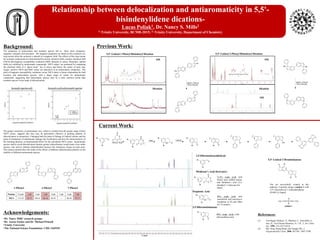
5,5’-Linked 3-Phenyl Bisindenyl Dication5,5’-Linked 1-Phenyl Bisindenyl Dication
References:
(1) Von Ragué Schleyer, P., Maerker, C., Dransfeld, A.,
Jiao, H., Van Eikema Hommes, N. J. R., J. Am. Chem.
Soc. 1996, 118, 6317-6318.
(2) Ma, Ning, Zheng Duan, and Yangjie Wu. J.
Organometallic Chem. 2006, 691 691, 5697-5700.
Postion Unsub 1-ph 2-ph 3-ph 4-ph 5-ph 6-ph 7-ph
NICS 113.25 36.73 842.6 46.34 83.01 -- 86.63 70.37
3,5-Dibromobenzaldehyde
Meldrum’s Acid Derivative
Propionic Acid
3,5 Dibromoindanone
72.4% crude yield with
formic acid, triethyl amine,
and Meldrum’s acid (2,2-
dimethyl-1,3-dioxane-4,6-
dione)
89% crude yield with
acetonitrile and microwave
irradiation at 20 and 10bar
for 35 minutes
89% crude yield with
chlorosulfonic acid.
1-Phenyl 3-Phenyl 7-Phenyl
5,5’-Linked 3-Bromindanone
Not yet successfully created in this
pathway. Currently using a catalyst 1 with
N,N’-dicyclohexyl-1,4-diazabutadiene
(DAB-Cy) ligand.
Dication
SM
Dication
SM SM

ACS Poster Finished-nm-mrp-2

  • 1.
    Relationship between delocalizationand antiaromaticity in 5,5'- bisindenylidene dications- Lucas Poliak1, Dr. Nancy S. Mills2 1) Trinity University, BCMB-2015; 2) Trinity University, Department of Chemistry Background: Previous Work: The properties of antiaromatic and aromatic species fall in three main categories: magnetic, energetic and structural. The magnetic properties are based on the existence of a ring current when the molecule is placed in a magnetic field. The effects of this ring current for aromatic compounds are demonstrated by proton chemical shifts, nucleus chemical shift (NICS) and magnetic susceptibility exaltation (MSE, denoted ) values. Paratropic, upfield shifts are exhibited by antiaromatic compounds. NICS values1 are produced by computing the chemical shiift of a “ghost atom” one Å above and below the center of each ring. Larger, positive NICS and MSE values are indicative of an antiaromatic compound. The plots of magnetic susceptibility exaltation versus NICS shows a linear relationship for both aromatic and antiaromatic species, with a larger range of values for antiaromatic compounds, suggesting that antiaromatic species may be a more sensitive probe than aromatic species in the study of delocalization. The greater sensitivity of antiaromatic ions, which is evident from the greater range of their NICS values, suggests that they may be particularly effective in probing patterns of delocalization in aromaticity. Changing both the point of linkage of indenyl cations and the point of attachment of substituents changes the localization and thus the antiaromaticity of the resulting dication, as demonstrated below for the calculated NICS values. Antiaromatic species tend to avoid delocalization because greater delocalization would mean a less stable species; ions tend to embrace delocalization because this minimizes charge on each atom. This tension should allow the study of the effects of different delocalization patterns on the stability of different antiaromatic species. Acknowledgements: •Dr. Nancy Mills’ research groups •Dr. Aaron Forbes and Dr. Michael Prinsell •Trinity University •The National Science Foundation: CHE-1265545 Current Work: 5,5’-Linked 3-Phenyl Bisindenyl Dication5,5’-Linked 1-Phenyl Bisindenyl Dication References: (1) Von Ragué Schleyer, P., Maerker, C., Dransfeld, A., Jiao, H., Van Eikema Hommes, N. J. R., J. Am. Chem. Soc. 1996, 118, 6317-6318. (2) Ma, Ning, Zheng Duan, and Yangjie Wu. J. Organometallic Chem. 2006, 691 691, 5697-5700. Postion Unsub 1-ph 2-ph 3-ph 4-ph 5-ph 6-ph 7-ph NICS 113.25 36.73 842.6 46.34 83.01 -- 86.63 70.37 3,5-Dibromobenzaldehyde Meldrum’s Acid Derivative Propionic Acid 3,5 Dibromoindanone 72.4% crude yield with formic acid, triethyl amine, and Meldrum’s acid (2,2- dimethyl-1,3-dioxane-4,6- dione) 89% crude yield with acetonitrile and microwave irradiation at 20 and 10bar for 35 minutes 89% crude yield with chlorosulfonic acid. 1-Phenyl 3-Phenyl 7-Phenyl 5,5’-Linked 3-Bromindanone Not yet successfully created in this pathway. Currently using a catalyst 1 with N,N’-dicyclohexyl-1,4-diazabutadiene (DAB-Cy) ligand. Dication SM Dication SM SM