A corporate effort towards
a sustainable business model
A case study from the Norwegian furniture
industry
Nils M. Høgevold
Oslo School of Management, Oslo, Norway
Abstract
Purpose – The purpose of this paper is to describe a corporate effort to implement a sustainable
business model.
Design/methodology/approach – A Norwegian producer of office chairs, selling products across
Europe, is examined in this study. Information has been collected from semi-structured interviews
with top-level management, as well as available internal and external documentation.
Findings – The company’s efforts towards a more sustainable business model can broadly be divided
into factors within the company and factors outside the company. The case study demonstrates how the
carbon footprint on the Earth can be reduced by focusing and influencing factors outside the company’s
own production facilities.
Research limitations/implications – In a highly competitive market, the case study demonstrates
that focusing on the corporate impact of the natural environment can be highly profitable.
Practical implications – The process towards sustainable business operations must be anchored
and supported by the top-level management and owners of the company, and it has to be a long-term
commitment.
Originality/value – The principal contribution from the presented case study is how a more
sustainable business model can be achieved even when the majority major part of the carbon footprint
on the Earth is generated outside the company’s production facilities. The case study illustrates how
already known technologies are used to create a sustainable and profitable business.
Keywords Sustainability, Carbon footprint, Office chair production, Norway, Profit, Furniture industry
Paper type Case study
Introduction
The UN – report IPCC WGI – Fourth Assessment Report (2007) points out that global
warming can lead to dramatic consequences on Earth. The report describes:
.
human and natural drives of climate change;
.
observed climate change;
.
climate processes and attribution; and
.
estimates of expected future climate change.
A consequence of the report is the urgent need for sustainable business operations.
However, as Svensson points out, local practices have to be linked to global
sustainability of business and other practices. This has only to a minor extent been
addressed in previous research.
An important event took place in Copenhagen when political leaders from some
200 countries from around the world came together to meet discuss the challenges
The current issue and full text archive of this journal is available at
www.emeraldinsight.com/0955-534X.htm
EBR
23,4
392
Received September 2010
Revised October 2010
Accepted December 2010
European Business Review
Vol. 23 No. 4, 2011
pp. 392-400
q Emerald Group Publishing Limited
0955-534X
DOI 10.1108/09555341111145771
of climate change (COP15, 2009). Unfortunately this summit did not generate any
explicit commitments to care for the Earth and guide governments. It may look like as
though the business world has to take the lead in solving the climate challenge.
Interestingly, many companies do believe it is necessary to achieve sustainability
across the supply chain (Turner, 2009). Also, a study by A.T. Kearney revealed that
60 percent of firms have adopted sustainable business practices that strengthen brand
names or differentiate their products (Mahler, 2007). The understanding of a brand
today is no longer only linked to the product, but includes how the product is made, who
the suppliers are, and how it is delivered (Mulani, 2009). By investing in people,
ecological impact and local communities, brand value and reputation may increase
(Byrne, 2007).
The interest in sustainable business operations is not a recent topic. The Brundtland
Report (1987) also pointed out the importance of sustainable business models
and concluded that sustainable business operations, their appropriate business models
and their development should meet present requirements without compromising the
ability of future generations to meet their own needs. To our knowledge, research in this
field is not addressing the core requirements of sustainable business operations and
sustainable business models. The objective is to describe a corporate effort to implement a
sustainable business model.
The case study of HÅG
The current case study is based upon HÅG (www.hag.no), which is a Norwegian brand
of office chairs from Scandinavian Business Seating (www.sbseating.no). The data
were collected from internal and external sources as well as semi-structured interviews
with top executives of the company.
The company’s headquarters are located in Oslo, while the production plant is at
Røros. It is a village small town approximately 400 km north of the company’s
headquarters. This is where seat fittings are produced – a production process
consisting of pressing steel, welding, surface treatment and assembling. The office
chairs also contain aluminum, plastic, foam and textile. The assembly of office chairs is
strictly based upon confirmed customer orders.
The assortment of office chairs consists of nine different collections. The current
production is 350,000 office chairs annually with a turnover of 73 million generating a
5 percent profit. The European market outside Norway represents three quarters of the
corporate sales. The sales in export markets are organized in daughter by subsidiary
companies or agents, and distributed through local retailers.
Corporate environmental profile
HÅG’s office chair has chairs have achieved considerable recognition in the market.
For example, its office chairs were selected to be used during for use at the COP15
Climate Conference in 2009. COP15 in Copenhagen expressed a desire to use products
with an explicit environmental profile derived from three requirements:
(1) there should be corporate environmental awareness and consideration
throughout the product’s life cycle;
(2) that the number of hazardous work processes and waste should be minimized; and
(3) that materials used in the products should be recyclable.
Norwegian
furniture
industry
393
HÅG was the first office chair producer worldwide complying to comply with the
environmental product declaration (EPD) on all its products. The calculations of EPD
are based on the guidelines of ISO 14025, which specifies the principles and procedures
for developing an environmental declaration program. The ISO 14025 defines the
elements to include the lifetime assessment for a product. For example, one value
measured in the document is the total amount of carbon dioxide emissions caused by a
product throughout its life cycle, from the extraction of raw materials, through
processing, transport and production, to its use and final disposal. The company was
also the first one in their product category to be granted “The Nordic Ecolabel”, which
evaluates a product’s impact on the environment throughout its whole life cycle. HÅG
chairs were also profiled by the Norwegian environmental organization Bellona as one
of the 101 solutions to the climate crisis, which contains examples demonstrating that
the enabling technologies for significant reductions of the carbon-footprint on Earth
are in fact available today.
These recognitions are the results of the corporate environmental efforts for almost
two decades and the vision, as expressed by the CEO Lars Røiri: “[. . .] to make the
world a better place to sit [. . .]”. It refers to the company’s environmental impact on
Earth as well as the ergonomic design of their office chairs to safeguard the well-being
of the person sitting in the chair and to ensure a correct sitting position, HÅG chairs are
designed to allow constant movement.
The structure of the case study is as follows:
.
HÅG’s impact on the natural environment;
.
the driving forces behind HÅG’s environmental profile and efforts;
.
the impact on purchasing policies; and
.
other aspects such as transportation and an examination of how the marketplace
values a more environmentally friendly product are examined.
The natural environment
After consulting with an external research partner, Ostfold Research, HÅG started in
1994 to apply a life cycle assessment measuring its impact on the natural environment.
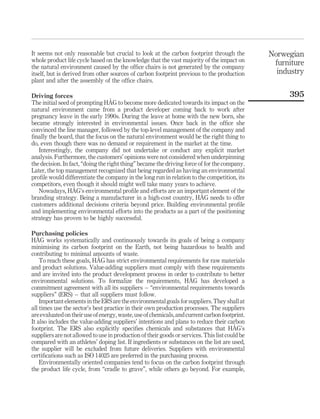
The carbon footprint caused by the company in 2009 is about 15,000 tonnes. The
production plant and sales offices generates only a minor share of 2,500 tonnes, where
95 percent is related to the production of office chairs and the rest to the headquarters,
sales and daughter subsidiary companies.
Subsequently, the raw material producers, the value-adding suppliers, storage and
other intermediaries of the HÅG’s supply chain represent more than 80 percent of the
carbon footprint on Earth. In sum, production, transports and assembly of the office
chairs at Røros represent less than 20 percent as shown in Figure 1.
Figure 1.
HÅG’s carbon footprint
of the total
The total carbon footprint through life - cycle for HÅG products (15,000tonnes)
Source: Adapted from HÅG
EBR
23,4
394
It seems not only reasonable but crucial to look at the carbon footprint through the
whole product life cycle based on the knowledge that the vast majority of the impact on
the natural environment caused by the office chairs is not generated by the company
itself, but is derived from other sources of carbon footprint previous to the production
plant and after the assembly of the office chairs.
Driving forces
The initial seed of prompting HÅG to become more dedicated towards its impact on the
natural environment came from a product developer coming back to work after
pregnancy leave in the early 1990s. During the leave at home with the new born, she
became strongly interested in environmental issues. Once back in the office she
convinced the line manager, followed by the top-level management of the company and
finally the board, that the focus on the natural environment would be the right thing to
do, even though there was no demand or requirement in the market at the time.
Interestingly, the company did not undertake or conduct any explicit market
analysis. Furthermore, the customers’ opinions were not considered when underpinning
the decision. In fact, “doing the right thing” became the driving force of for the company.
Later, the top management recognized that being regarded as having an environmental
profile would differentiate the company in the long run in relation to the competition, its
competitors, even though it should might well take many years to achieve.
Nowadays, HÅG’s environmental profile and efforts are an important element of the
branding strategy. Being a manufacturer in a high-cost country, HÅG needs to offer
customers additional decisions criteria beyond price. Building environmental profile
and implementing environmental efforts into the products as a part of the positioning
strategy has proven to be highly successful.
Purchasing policies
HÅG works systematically and continuously towards its goals of being a company
minimising its carbon footprint on the Earth, not being hazardous to health and
contributing to minimal amounts of waste.
To reach these goals, HÅG has strict environmental requirements for raw materials
and product solutions. Value-adding suppliers must comply with these requirements
and are invited into the product development process in order to contribute to better
environmental solutions. To formalize the requirements, HÅG has developed a
commitment agreement with all its suppliers – “environmental requirements towards
suppliers” (ERS) – that all suppliers must follow.
Important elementsintheERSaretheenvironmentalgoals for suppliers. They shallat
all times use the sector’s best practice in their own production processes. The suppliers
areevaluatedon theiruseofenergy, waste,useofchemicals,andcurrentcarbonfootprint.
It also includes the value-adding suppliers’ intentions and plans to reduce their carbon
footprint. The ERS also explicitly specifies chemicals and substances that HÅG’s
suppliers are not allowed to use in production of their goods or services. This list could be
compared with an athletes’ doping list. If ingredients or substances on the list are used,
the supplier will be excluded from future deliveries. Suppliers with environmental
certifications such as ISO 14025 are preferred in the purchasing process.
Environmentally oriented companies tend to focus on the carbon footprint through
the product life cycle, from “cradle to grave”, while others go beyond. For example,
Norwegian
furniture
industry
395
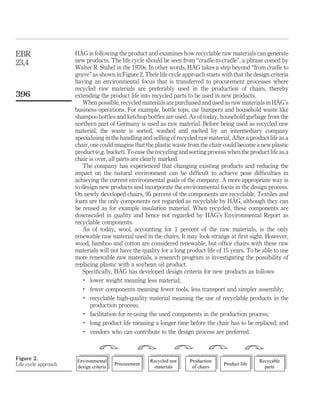
HÅG is following the product and examines how recyclable raw materials can generate
new products. The life cycle should be seen from “cradle-to-cradle”, a phrase coined by
Walter R. Stahel in the 1970s. In other words, HÅG takes a step beyond “from cradle to
grave” as shown in Figure 2. Their life cycle approach starts with that the design criteria
having an environmental focus that is transferred to procurement processes where
recycled raw materials are preferably used in the production of chairs, thereby
extending the product life into recycled parts to be used in new products.
When possible, recycled materials are purchased and used as raw materials in HÅG’s
business operations. For example, bottle tops, car bumpers and household waste like
shampoo bottles and ketchup bottles are used. As of today, household garbage from the
northern part of Germany is used as raw material. Before being used as recycled raw
material, the waste is sorted, washed and melted by an intermediary company
specialising in the handling and selling of recycled raw material. After a product life as a
chair, one could imagine that the plastic waste from the chair could become a new plastic
product (e.g. bucket). To ease the recycling and sorting process when the product life as a
chair is over, all parts are clearly marked.
The company has experienced that changing existing products and reducing the
impact on the natural environment can be difficult to achieve pose difficulties in
achieving the current environmental goals of the company. A more appropriate way is
to design new products and incorporate the environmental focus in the design process.
On newly developed chairs, 95 percent of the components are recyclable. Textiles and
foam are the only components not regarded as recyclable by HÅG, although they can
be reused as for example insulation material. When recycled, these components are
downscaled in quality and hence not regarded by HÅG’s Environmental Report as
recyclable components.
As of today, wool, accounting for 1 percent of the raw materials, is the only
renewable raw material used in the chairs. It may look strange at first sight. However,
wood, bamboo and cotton are considered renewable, but office chairs with these raw
materials will not have the quality for a long product life of 15 years. To be able to use
more renewable raw materials, a research program is investigating the possibility of
replacing plastic with a soybean oil product.
Specifically, HÅG has developed design criteria for new products as follows:
.
lower weight meaning less material;
.
fewer components meaning fewer tools, less transport and simpler assembly;
.
recyclable high-quality material meaning the use of recyclable products in the
production process;
.
facilitation for re-using the used components in the production process;
.
long product life meaning a longer time before the chair has to be replaced; and
.
vendors who can contribute to the design process are preferred.
Figure 2.
Life cycle approach
Environmental
design criteria
Procurement
Recycled raw
materials
Production
of chairs
Product life
Recycable
parts
EBR
23,4
396
Other companies, like the Swedish fast food chain Max, compensate their carbon
footprint with tree-planting (Wagner and Svensson, 2010). HÅG has considered
compensating for their its carbon footprint on the Earth by purchasing climate quotas,
but has decided not to. The reasons for this decision are:
.
The focus on reducing its own carbon footprint could be lost, the management
believing that being open on one’s own carbon footprint and working
systematically on a reduction is a alternative solution.
.
Climate quotas can be bought for a reasonable price in today’s market, but will
probably increase in price in the future. With an increased price, the company
may no longer afford to buy quotas and are no longer climate neutral.
.
Finally, the management feels uncertain about the market mechanisms in the
climate quota market.
Value-adding process
Focusing on environmental issues is a continuous process and under constant revision
and enhancement. Customers also demand neutral documentation about the products.
An environmental report is published annually including HÅG’s:
.
environmental policy;
.
environmental goals;
.
environmental aspects;
.
environmental account; and
.
material consumption.
Eco-management and audit scheme (EMAS) is EU’s voluntary agreement for companies
who wants to improve their environmental effort beyond what is regulated or
demanded. To be trustworthy in the documentation and to seek new competence,
external partners are engaged. For example, Det Norske Veritas (www.dnv.no) is used as
an external auditor for the yearly EMAS. Ostfold Research (www. ostfoldforskning.no),
a Norwegian research foundation focusing on environmental protection and regional
business development, has measured the carbon footprint through the value chain.
Ostfold Research is also used as a source of new competences for further developments
towards sustainable business operation.
As the CEO of HÅG, Lars Røiri expresses:
[. . .]tobeanenvironmentalfriendlycompanyoneneedstobuild asystemandtodocumentwhat
is being done. This is not a communication activity, but a challenge to the whole value chain.
Seen in this aspect, external partners are important in the value-adding process by
documenting and transferring knowledge.
Transportation and intermediaries
The greenhouse gas protocol for HÅG identifies that the biggest sources of the carbon
footprint on the Earth come from the transportation of products from the plant to the
customers, as well as employees traveling in business and going to work. Video
conference equipment has been installed to reduce business travel, and employees are
incurred to be conscious about their travel plans.
Norwegian
furniture
industry
397
The plant is located in an area where the only option for transportation of the
finished goods is by truck. The environmental friendlier railroad was closed several
years ago and the plant is too far from the sea to view this mode of transportation as an
option. Given the fact that trucks are the only alternative, a computer software is used
to optimize the transportation logistics. Fully loaded trucks arriving the plant with raw
materials and parts are returned with products to the customers. The product
packaging and the products are designed for optimal logistics solutions by optimizing
the available space on the truck. Currently, the number of office chairs conveyed by one
truck has doubled compared to before focusing on this issue. As with other vendors,
the transport company chosen is focusing on environmental issues and it is ability to
comply with HÅG’s environmental requirements for suppliers.
Retail practices
HÅG’s distribution channel consists of daughter subsidiary companies or agents in the
different export countries. In the local market, independent retailers are selling to the end
consumer. These independent retailers cannot be controlled by HÅG, and they have less
focus on an environmental perspective. However, HÅG can motivate the retailers to be
environmentally concerned by being a role model and using environmental concepts like
“long service life”, “recycling “ and “carbon footprint” in their dialog with the retailers.
Marketplace
Both in the domestic and international markets the environmental awareness is
increasing. During the first decade and a half, HÅG focused on the natural environment,
but at the time few customers were interested. It is not until the last few years that the
environmental profile and efforts of the company have become an important and
positive element in relation to the competition. Customers are becoming increasingly
aware of the importance of considering the natural environment and are beginning to
require documentation of products’ carbon footprint. Choosing products with a low
carbon footprint helps the customers reach their own environmental goals. In particular,
larger customers are concerned with the environmental impact of the products to be
bought, and choose products with a proven track record of environmentally friendly
production. According to top-level management, the carbon footprint of the products is
one of the criteria in all of the bidding competitions in Norway and is regarded by the
sales organization as an important factor in the decision process in approximately
80 percent of bidding competitions. To further increase the awareness of recycling, fact
sheets follow newly designed products encouraging users to hand back the chairs for
re-circulation and inform by informing them how to disassemble them.
Implications and lessons learned
A number of lessons can be learned from the HÅG case. First, focusing on the corporate
impact of the natural environment can be highly profitable. Customers, especially larger
companies, tend to be less price sensitive when a product with lower carbon footprint is
available. The carbon footprint is becoming an increasingly important criterion in the
decision-making process of purchases.
Second, the process toward sustainable business operations must be anchored and
supported by the top-level management and owners of the company, and it has to be a
long-term commitment. As seen in this case, the development towards sustainable
EBR
23,4
398
business operations has been an ongoing process, and resources have been allocated
over time. Sustainability has been seen as a part of the long-term product development
process. As the CEO of HÅG expresses: “[. . .] this is not about market communication,
but a way of thinking [. . .]”.
Third, the best results occur when analyzing the whole supply chain, focusing not
only on the carbon footprint from the company’s production facilities. In this case, we
have learned the majority of the reductions of HÅG’s derived carbon footprint is
external and from sources upstream or downstream its supply chain.
A final lesson is to emphasize the importance of involving external expertise to
measure improvements and suggest further actions. Customers are increasingly
demanding neutral documentation on their suppliers’ environmental impact. External
and independent documentation is also crucial to evaluate actions taken.
Conclusions and suggestions for the future
The most interesting result from this case study of HÅG is that implementing a
sustainable business model is not only possible, but can also be profitable. With
available technology, it is possible to make substantial improvements and lower carbon
footprint on the Earth. A vision, 20 years ago, of ”doing the right thing” has developed to
an important differentiator for HÅG in today’s competitive market.
Important elements of this successful strategy are to view sustainability not as a
communications task, but as a challenge for all parts of the value chain. Starting with the
design of new products and making sure the environmental design criteria are satisfied,
by involving and requiring more sustainable solutions from vendors, and intermediaries
and motivating and educating retailers and consumers are all proven to be some of the
solutions to a sustainable business operation. One result of this sustainable business
effort is that chairs from HÅG have carbon dioxide emissions of 36-55 kg CO2 during a
life time of 15 years. The best competitors have emission of 100-120 kg CO2.
Interestingly, customers are becoming more environmentally aware and consider
the products environmentally impact in their own purchasing processes. It is reasonable
to believe this development will continue, and the advantages for companies with a
sustainable business model will increase. Probably, more case studies of sustainable
business operations will reveal other solutions. Focus on solutions, not only on
documenting the effects of the carbon footprint, will be contributing to important
knowledge. Hence, a suggestion for future research is to investigate more cases of
sustainable business operations.
References
Brundtland, G.H. (1987), Our Common Future/World Commission on Environment and
Development, Oxford University Press, Oxford.
Byrne, P.M. (2007), “Sustainability and the supply chain”, Logistics Management,
November, pp. 21-2.
COP15 (2009), United Nations Climate Change Conference, Copenhagen, Denmark,
December 7-18.
IPCCWGI – FourthAssessmentReport(2007), “Summary for policymakers”, in Solomon, S., Qin, D.,
Manning, M., Chen, Z., Marquis, M., Averyt, K.B., Tignor, M. and Miller, H.L. (Eds), Climate
Change 2007: The Physical Science Basis, Intergovernmental Panel on Climate Change,
Cambridge University Press, Cambridge, pp. 1-21.
Norwegian
furniture
industry
399
Mahler, D. (2007), “The sustainable supply chain”, Supply Chain Management Review,
November, pp. 59-60.
Mulani, N. (2009), “Sustainability: your role as a supply chain leader”, Logistics Management,
May, p. 23.
Turner, M. (2009), “Going green? Start with sourcing”, Supply Chain Management Review, Vol. 13
No. 3, p. 14.
Wagner, B. and Svensson, G. (2010), “Sustainable supply chain practices: research propositions
for the future”, International Journal of Logistics Economics and Globalization, Vol. 2 No. 2,
pp. 176-85.
Further reading
Ciliberti, F., de Goot, G., de Haan, J. and Pontrandolfo, P. (2009), “Codes to coordinate supply
chains: SMEs’ experiences with SA800”, Supply Chain Management: An International
Journal, Vol. 14 No. 2, pp. 117-27.
COP16 (2010), United Nations Climate Change Conference, Cancun, November 29-December 10.
Hagelarr, G.J.L.F., van der Vorst, J.G.A.L. and Marcelis, W.J. (2004), “Organizing life cycles in
supply chains-linking environmental performance to managerial designs”, Greener
Management International, Vol. 45 No. 27, pp. 27-42.
Markely, M.J. and Davis, L. (2007), “Exploring future competitive advantage through sustainable
supply chains”, International Journal of Physical and Distribution Management, Vol. 37
No. 9, pp. 763-74.
Sims, R.R. and Brinkmann, J. (2003), “Enron ethics (or: culture matters more than codes)”, Journal
of Business Ethics, Vol. 45, pp. 243-56.
Svensson, G. (2007), “Aspects of sustainable supply chain management (SSCM): conceptual
framework and empirical example”, Supply Chain Management: An International Journal,
Vol. 12 No. 4, pp. 262-6.
Svensson, G. (2009), “The transparency of SCM-ethics: conceptual framework and empirical
illustrations”, Supply Chain Management: An International Journal, Vol. 14 No. 4,
pp. 259-69.
Corresponding author
Nils M. Høgevold can be contacted at: Nils.hogevold@mh.no
EBR
23,4
400
To purchase reprints of this article please e-mail: reprints@emeraldinsight.com
Or visit our web site for further details: www.emeraldinsight.com/reprints
Reproduced with permission of the copyright owner. Further reproduction prohibited without permission.

A_corporate_effort_towards_a_supplychain.pdf

  • 1.
    A corporate efforttowards a sustainable business model A case study from the Norwegian furniture industry Nils M. Høgevold Oslo School of Management, Oslo, Norway Abstract Purpose – The purpose of this paper is to describe a corporate effort to implement a sustainable business model. Design/methodology/approach – A Norwegian producer of office chairs, selling products across Europe, is examined in this study. Information has been collected from semi-structured interviews with top-level management, as well as available internal and external documentation. Findings – The company’s efforts towards a more sustainable business model can broadly be divided into factors within the company and factors outside the company. The case study demonstrates how the carbon footprint on the Earth can be reduced by focusing and influencing factors outside the company’s own production facilities. Research limitations/implications – In a highly competitive market, the case study demonstrates that focusing on the corporate impact of the natural environment can be highly profitable. Practical implications – The process towards sustainable business operations must be anchored and supported by the top-level management and owners of the company, and it has to be a long-term commitment. Originality/value – The principal contribution from the presented case study is how a more sustainable business model can be achieved even when the majority major part of the carbon footprint on the Earth is generated outside the company’s production facilities. The case study illustrates how already known technologies are used to create a sustainable and profitable business. Keywords Sustainability, Carbon footprint, Office chair production, Norway, Profit, Furniture industry Paper type Case study Introduction The UN – report IPCC WGI – Fourth Assessment Report (2007) points out that global warming can lead to dramatic consequences on Earth. The report describes: . human and natural drives of climate change; . observed climate change; . climate processes and attribution; and . estimates of expected future climate change. A consequence of the report is the urgent need for sustainable business operations. However, as Svensson points out, local practices have to be linked to global sustainability of business and other practices. This has only to a minor extent been addressed in previous research. An important event took place in Copenhagen when political leaders from some 200 countries from around the world came together to meet discuss the challenges The current issue and full text archive of this journal is available at www.emeraldinsight.com/0955-534X.htm EBR 23,4 392 Received September 2010 Revised October 2010 Accepted December 2010 European Business Review Vol. 23 No. 4, 2011 pp. 392-400 q Emerald Group Publishing Limited 0955-534X DOI 10.1108/09555341111145771
  • 2.
    of climate change(COP15, 2009). Unfortunately this summit did not generate any explicit commitments to care for the Earth and guide governments. It may look like as though the business world has to take the lead in solving the climate challenge. Interestingly, many companies do believe it is necessary to achieve sustainability across the supply chain (Turner, 2009). Also, a study by A.T. Kearney revealed that 60 percent of firms have adopted sustainable business practices that strengthen brand names or differentiate their products (Mahler, 2007). The understanding of a brand today is no longer only linked to the product, but includes how the product is made, who the suppliers are, and how it is delivered (Mulani, 2009). By investing in people, ecological impact and local communities, brand value and reputation may increase (Byrne, 2007). The interest in sustainable business operations is not a recent topic. The Brundtland Report (1987) also pointed out the importance of sustainable business models and concluded that sustainable business operations, their appropriate business models and their development should meet present requirements without compromising the ability of future generations to meet their own needs. To our knowledge, research in this field is not addressing the core requirements of sustainable business operations and sustainable business models. The objective is to describe a corporate effort to implement a sustainable business model. The case study of HÅG The current case study is based upon HÅG (www.hag.no), which is a Norwegian brand of office chairs from Scandinavian Business Seating (www.sbseating.no). The data were collected from internal and external sources as well as semi-structured interviews with top executives of the company. The company’s headquarters are located in Oslo, while the production plant is at Røros. It is a village small town approximately 400 km north of the company’s headquarters. This is where seat fittings are produced – a production process consisting of pressing steel, welding, surface treatment and assembling. The office chairs also contain aluminum, plastic, foam and textile. The assembly of office chairs is strictly based upon confirmed customer orders. The assortment of office chairs consists of nine different collections. The current production is 350,000 office chairs annually with a turnover of 73 million generating a 5 percent profit. The European market outside Norway represents three quarters of the corporate sales. The sales in export markets are organized in daughter by subsidiary companies or agents, and distributed through local retailers. Corporate environmental profile HÅG’s office chair has chairs have achieved considerable recognition in the market. For example, its office chairs were selected to be used during for use at the COP15 Climate Conference in 2009. COP15 in Copenhagen expressed a desire to use products with an explicit environmental profile derived from three requirements: (1) there should be corporate environmental awareness and consideration throughout the product’s life cycle; (2) that the number of hazardous work processes and waste should be minimized; and (3) that materials used in the products should be recyclable. Norwegian furniture industry 393
  • 3.
    HÅG was thefirst office chair producer worldwide complying to comply with the environmental product declaration (EPD) on all its products. The calculations of EPD are based on the guidelines of ISO 14025, which specifies the principles and procedures for developing an environmental declaration program. The ISO 14025 defines the elements to include the lifetime assessment for a product. For example, one value measured in the document is the total amount of carbon dioxide emissions caused by a product throughout its life cycle, from the extraction of raw materials, through processing, transport and production, to its use and final disposal. The company was also the first one in their product category to be granted “The Nordic Ecolabel”, which evaluates a product’s impact on the environment throughout its whole life cycle. HÅG chairs were also profiled by the Norwegian environmental organization Bellona as one of the 101 solutions to the climate crisis, which contains examples demonstrating that the enabling technologies for significant reductions of the carbon-footprint on Earth are in fact available today. These recognitions are the results of the corporate environmental efforts for almost two decades and the vision, as expressed by the CEO Lars Røiri: “[. . .] to make the world a better place to sit [. . .]”. It refers to the company’s environmental impact on Earth as well as the ergonomic design of their office chairs to safeguard the well-being of the person sitting in the chair and to ensure a correct sitting position, HÅG chairs are designed to allow constant movement. The structure of the case study is as follows: . HÅG’s impact on the natural environment; . the driving forces behind HÅG’s environmental profile and efforts; . the impact on purchasing policies; and . other aspects such as transportation and an examination of how the marketplace values a more environmentally friendly product are examined. The natural environment After consulting with an external research partner, Ostfold Research, HÅG started in 1994 to apply a life cycle assessment measuring its impact on the natural environment. The carbon footprint caused by the company in 2009 is about 15,000 tonnes. The production plant and sales offices generates only a minor share of 2,500 tonnes, where 95 percent is related to the production of office chairs and the rest to the headquarters, sales and daughter subsidiary companies. Subsequently, the raw material producers, the value-adding suppliers, storage and other intermediaries of the HÅG’s supply chain represent more than 80 percent of the carbon footprint on Earth. In sum, production, transports and assembly of the office chairs at Røros represent less than 20 percent as shown in Figure 1. Figure 1. HÅG’s carbon footprint of the total The total carbon footprint through life - cycle for HÅG products (15,000tonnes) Source: Adapted from HÅG EBR 23,4 394
  • 4.
    It seems notonly reasonable but crucial to look at the carbon footprint through the whole product life cycle based on the knowledge that the vast majority of the impact on the natural environment caused by the office chairs is not generated by the company itself, but is derived from other sources of carbon footprint previous to the production plant and after the assembly of the office chairs. Driving forces The initial seed of prompting HÅG to become more dedicated towards its impact on the natural environment came from a product developer coming back to work after pregnancy leave in the early 1990s. During the leave at home with the new born, she became strongly interested in environmental issues. Once back in the office she convinced the line manager, followed by the top-level management of the company and finally the board, that the focus on the natural environment would be the right thing to do, even though there was no demand or requirement in the market at the time. Interestingly, the company did not undertake or conduct any explicit market analysis. Furthermore, the customers’ opinions were not considered when underpinning the decision. In fact, “doing the right thing” became the driving force of for the company. Later, the top management recognized that being regarded as having an environmental profile would differentiate the company in the long run in relation to the competition, its competitors, even though it should might well take many years to achieve. Nowadays, HÅG’s environmental profile and efforts are an important element of the branding strategy. Being a manufacturer in a high-cost country, HÅG needs to offer customers additional decisions criteria beyond price. Building environmental profile and implementing environmental efforts into the products as a part of the positioning strategy has proven to be highly successful. Purchasing policies HÅG works systematically and continuously towards its goals of being a company minimising its carbon footprint on the Earth, not being hazardous to health and contributing to minimal amounts of waste. To reach these goals, HÅG has strict environmental requirements for raw materials and product solutions. Value-adding suppliers must comply with these requirements and are invited into the product development process in order to contribute to better environmental solutions. To formalize the requirements, HÅG has developed a commitment agreement with all its suppliers – “environmental requirements towards suppliers” (ERS) – that all suppliers must follow. Important elementsintheERSaretheenvironmentalgoals for suppliers. They shallat all times use the sector’s best practice in their own production processes. The suppliers areevaluatedon theiruseofenergy, waste,useofchemicals,andcurrentcarbonfootprint. It also includes the value-adding suppliers’ intentions and plans to reduce their carbon footprint. The ERS also explicitly specifies chemicals and substances that HÅG’s suppliers are not allowed to use in production of their goods or services. This list could be compared with an athletes’ doping list. If ingredients or substances on the list are used, the supplier will be excluded from future deliveries. Suppliers with environmental certifications such as ISO 14025 are preferred in the purchasing process. Environmentally oriented companies tend to focus on the carbon footprint through the product life cycle, from “cradle to grave”, while others go beyond. For example, Norwegian furniture industry 395
  • 5.
    HÅG is followingthe product and examines how recyclable raw materials can generate new products. The life cycle should be seen from “cradle-to-cradle”, a phrase coined by Walter R. Stahel in the 1970s. In other words, HÅG takes a step beyond “from cradle to grave” as shown in Figure 2. Their life cycle approach starts with that the design criteria having an environmental focus that is transferred to procurement processes where recycled raw materials are preferably used in the production of chairs, thereby extending the product life into recycled parts to be used in new products. When possible, recycled materials are purchased and used as raw materials in HÅG’s business operations. For example, bottle tops, car bumpers and household waste like shampoo bottles and ketchup bottles are used. As of today, household garbage from the northern part of Germany is used as raw material. Before being used as recycled raw material, the waste is sorted, washed and melted by an intermediary company specialising in the handling and selling of recycled raw material. After a product life as a chair, one could imagine that the plastic waste from the chair could become a new plastic product (e.g. bucket). To ease the recycling and sorting process when the product life as a chair is over, all parts are clearly marked. The company has experienced that changing existing products and reducing the impact on the natural environment can be difficult to achieve pose difficulties in achieving the current environmental goals of the company. A more appropriate way is to design new products and incorporate the environmental focus in the design process. On newly developed chairs, 95 percent of the components are recyclable. Textiles and foam are the only components not regarded as recyclable by HÅG, although they can be reused as for example insulation material. When recycled, these components are downscaled in quality and hence not regarded by HÅG’s Environmental Report as recyclable components. As of today, wool, accounting for 1 percent of the raw materials, is the only renewable raw material used in the chairs. It may look strange at first sight. However, wood, bamboo and cotton are considered renewable, but office chairs with these raw materials will not have the quality for a long product life of 15 years. To be able to use more renewable raw materials, a research program is investigating the possibility of replacing plastic with a soybean oil product. Specifically, HÅG has developed design criteria for new products as follows: . lower weight meaning less material; . fewer components meaning fewer tools, less transport and simpler assembly; . recyclable high-quality material meaning the use of recyclable products in the production process; . facilitation for re-using the used components in the production process; . long product life meaning a longer time before the chair has to be replaced; and . vendors who can contribute to the design process are preferred. Figure 2. Life cycle approach Environmental design criteria Procurement Recycled raw materials Production of chairs Product life Recycable parts EBR 23,4 396
  • 6.
    Other companies, likethe Swedish fast food chain Max, compensate their carbon footprint with tree-planting (Wagner and Svensson, 2010). HÅG has considered compensating for their its carbon footprint on the Earth by purchasing climate quotas, but has decided not to. The reasons for this decision are: . The focus on reducing its own carbon footprint could be lost, the management believing that being open on one’s own carbon footprint and working systematically on a reduction is a alternative solution. . Climate quotas can be bought for a reasonable price in today’s market, but will probably increase in price in the future. With an increased price, the company may no longer afford to buy quotas and are no longer climate neutral. . Finally, the management feels uncertain about the market mechanisms in the climate quota market. Value-adding process Focusing on environmental issues is a continuous process and under constant revision and enhancement. Customers also demand neutral documentation about the products. An environmental report is published annually including HÅG’s: . environmental policy; . environmental goals; . environmental aspects; . environmental account; and . material consumption. Eco-management and audit scheme (EMAS) is EU’s voluntary agreement for companies who wants to improve their environmental effort beyond what is regulated or demanded. To be trustworthy in the documentation and to seek new competence, external partners are engaged. For example, Det Norske Veritas (www.dnv.no) is used as an external auditor for the yearly EMAS. Ostfold Research (www. ostfoldforskning.no), a Norwegian research foundation focusing on environmental protection and regional business development, has measured the carbon footprint through the value chain. Ostfold Research is also used as a source of new competences for further developments towards sustainable business operation. As the CEO of HÅG, Lars Røiri expresses: [. . .]tobeanenvironmentalfriendlycompanyoneneedstobuild asystemandtodocumentwhat is being done. This is not a communication activity, but a challenge to the whole value chain. Seen in this aspect, external partners are important in the value-adding process by documenting and transferring knowledge. Transportation and intermediaries The greenhouse gas protocol for HÅG identifies that the biggest sources of the carbon footprint on the Earth come from the transportation of products from the plant to the customers, as well as employees traveling in business and going to work. Video conference equipment has been installed to reduce business travel, and employees are incurred to be conscious about their travel plans. Norwegian furniture industry 397
  • 7.
    The plant islocated in an area where the only option for transportation of the finished goods is by truck. The environmental friendlier railroad was closed several years ago and the plant is too far from the sea to view this mode of transportation as an option. Given the fact that trucks are the only alternative, a computer software is used to optimize the transportation logistics. Fully loaded trucks arriving the plant with raw materials and parts are returned with products to the customers. The product packaging and the products are designed for optimal logistics solutions by optimizing the available space on the truck. Currently, the number of office chairs conveyed by one truck has doubled compared to before focusing on this issue. As with other vendors, the transport company chosen is focusing on environmental issues and it is ability to comply with HÅG’s environmental requirements for suppliers. Retail practices HÅG’s distribution channel consists of daughter subsidiary companies or agents in the different export countries. In the local market, independent retailers are selling to the end consumer. These independent retailers cannot be controlled by HÅG, and they have less focus on an environmental perspective. However, HÅG can motivate the retailers to be environmentally concerned by being a role model and using environmental concepts like “long service life”, “recycling “ and “carbon footprint” in their dialog with the retailers. Marketplace Both in the domestic and international markets the environmental awareness is increasing. During the first decade and a half, HÅG focused on the natural environment, but at the time few customers were interested. It is not until the last few years that the environmental profile and efforts of the company have become an important and positive element in relation to the competition. Customers are becoming increasingly aware of the importance of considering the natural environment and are beginning to require documentation of products’ carbon footprint. Choosing products with a low carbon footprint helps the customers reach their own environmental goals. In particular, larger customers are concerned with the environmental impact of the products to be bought, and choose products with a proven track record of environmentally friendly production. According to top-level management, the carbon footprint of the products is one of the criteria in all of the bidding competitions in Norway and is regarded by the sales organization as an important factor in the decision process in approximately 80 percent of bidding competitions. To further increase the awareness of recycling, fact sheets follow newly designed products encouraging users to hand back the chairs for re-circulation and inform by informing them how to disassemble them. Implications and lessons learned A number of lessons can be learned from the HÅG case. First, focusing on the corporate impact of the natural environment can be highly profitable. Customers, especially larger companies, tend to be less price sensitive when a product with lower carbon footprint is available. The carbon footprint is becoming an increasingly important criterion in the decision-making process of purchases. Second, the process toward sustainable business operations must be anchored and supported by the top-level management and owners of the company, and it has to be a long-term commitment. As seen in this case, the development towards sustainable EBR 23,4 398
  • 8.
    business operations hasbeen an ongoing process, and resources have been allocated over time. Sustainability has been seen as a part of the long-term product development process. As the CEO of HÅG expresses: “[. . .] this is not about market communication, but a way of thinking [. . .]”. Third, the best results occur when analyzing the whole supply chain, focusing not only on the carbon footprint from the company’s production facilities. In this case, we have learned the majority of the reductions of HÅG’s derived carbon footprint is external and from sources upstream or downstream its supply chain. A final lesson is to emphasize the importance of involving external expertise to measure improvements and suggest further actions. Customers are increasingly demanding neutral documentation on their suppliers’ environmental impact. External and independent documentation is also crucial to evaluate actions taken. Conclusions and suggestions for the future The most interesting result from this case study of HÅG is that implementing a sustainable business model is not only possible, but can also be profitable. With available technology, it is possible to make substantial improvements and lower carbon footprint on the Earth. A vision, 20 years ago, of ”doing the right thing” has developed to an important differentiator for HÅG in today’s competitive market. Important elements of this successful strategy are to view sustainability not as a communications task, but as a challenge for all parts of the value chain. Starting with the design of new products and making sure the environmental design criteria are satisfied, by involving and requiring more sustainable solutions from vendors, and intermediaries and motivating and educating retailers and consumers are all proven to be some of the solutions to a sustainable business operation. One result of this sustainable business effort is that chairs from HÅG have carbon dioxide emissions of 36-55 kg CO2 during a life time of 15 years. The best competitors have emission of 100-120 kg CO2. Interestingly, customers are becoming more environmentally aware and consider the products environmentally impact in their own purchasing processes. It is reasonable to believe this development will continue, and the advantages for companies with a sustainable business model will increase. Probably, more case studies of sustainable business operations will reveal other solutions. Focus on solutions, not only on documenting the effects of the carbon footprint, will be contributing to important knowledge. Hence, a suggestion for future research is to investigate more cases of sustainable business operations. References Brundtland, G.H. (1987), Our Common Future/World Commission on Environment and Development, Oxford University Press, Oxford. Byrne, P.M. (2007), “Sustainability and the supply chain”, Logistics Management, November, pp. 21-2. COP15 (2009), United Nations Climate Change Conference, Copenhagen, Denmark, December 7-18. IPCCWGI – FourthAssessmentReport(2007), “Summary for policymakers”, in Solomon, S., Qin, D., Manning, M., Chen, Z., Marquis, M., Averyt, K.B., Tignor, M. and Miller, H.L. (Eds), Climate Change 2007: The Physical Science Basis, Intergovernmental Panel on Climate Change, Cambridge University Press, Cambridge, pp. 1-21. Norwegian furniture industry 399
  • 9.
    Mahler, D. (2007),“The sustainable supply chain”, Supply Chain Management Review, November, pp. 59-60. Mulani, N. (2009), “Sustainability: your role as a supply chain leader”, Logistics Management, May, p. 23. Turner, M. (2009), “Going green? Start with sourcing”, Supply Chain Management Review, Vol. 13 No. 3, p. 14. Wagner, B. and Svensson, G. (2010), “Sustainable supply chain practices: research propositions for the future”, International Journal of Logistics Economics and Globalization, Vol. 2 No. 2, pp. 176-85. Further reading Ciliberti, F., de Goot, G., de Haan, J. and Pontrandolfo, P. (2009), “Codes to coordinate supply chains: SMEs’ experiences with SA800”, Supply Chain Management: An International Journal, Vol. 14 No. 2, pp. 117-27. COP16 (2010), United Nations Climate Change Conference, Cancun, November 29-December 10. Hagelarr, G.J.L.F., van der Vorst, J.G.A.L. and Marcelis, W.J. (2004), “Organizing life cycles in supply chains-linking environmental performance to managerial designs”, Greener Management International, Vol. 45 No. 27, pp. 27-42. Markely, M.J. and Davis, L. (2007), “Exploring future competitive advantage through sustainable supply chains”, International Journal of Physical and Distribution Management, Vol. 37 No. 9, pp. 763-74. Sims, R.R. and Brinkmann, J. (2003), “Enron ethics (or: culture matters more than codes)”, Journal of Business Ethics, Vol. 45, pp. 243-56. Svensson, G. (2007), “Aspects of sustainable supply chain management (SSCM): conceptual framework and empirical example”, Supply Chain Management: An International Journal, Vol. 12 No. 4, pp. 262-6. Svensson, G. (2009), “The transparency of SCM-ethics: conceptual framework and empirical illustrations”, Supply Chain Management: An International Journal, Vol. 14 No. 4, pp. 259-69. Corresponding author Nils M. Høgevold can be contacted at: Nils.hogevold@mh.no EBR 23,4 400 To purchase reprints of this article please e-mail: reprints@emeraldinsight.com Or visit our web site for further details: www.emeraldinsight.com/reprints
  • 10.
    Reproduced with permissionof the copyright owner. Further reproduction prohibited without permission.