Achieving gender equality
in the workplace
Yulia Gershinkova
Junior Professional Officer in Business and Decent Work at the ILO
Office for Italy and San Marino
Rome, 07 Sept 2021
Observatory on Diversity and Inclusion, Global Compact Network Italia
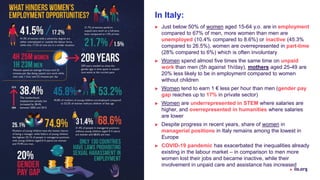
In Italy:
 Just below 50% of women aged 15-64 y.o. are in employment
compared to 67% of men, more women than men are
unemployed (10.4% compared to 8.6%) or inactive (45.3%
compared to 26.5%), women are overrepresented in part-time
(28% compared to 6%) which is often involuntary
 Women spend almost five times the same time on unpaid
work than men (5h against 1h/day), mothers aged 25-49 are
20% less likely to be in employment compared to women
without children
 Women tend to earn 1 € less per hour than men (gender pay
gap reaches up to 17% in private sector)
 Women are underrepresented in STEM where salaries are
higher, and overrepresented in humanities where salaries
are lower
 Despite progress in recent years, share of women in
managerial positions in Italy remains among the lowest in
Europe
 COVID-19 pandemic has exacerbated the inequalities already
existing in the labour market – in comparison to men more
women lost their jobs and became inactive, while their
involvement in unpaid care and assistance has increased
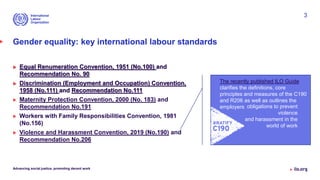
Gender equality: key international labour standards
 Equal Renumeration Convention, 1951 (No.100) and
Recommendation No. 90
 Discrimination (Employment and Occupation) Convention,
1958 (No.111) and Recommendation No.111
 Maternity Protection Convention, 2000 (No. 183) and
Recommendation No.191
 Workers with Family Responsibilities Convention, 1981
(No.156)
 Violence and Harassment Convention, 2019 (No.190) and
Recommendation No.206
Advancing social justice, promoting decent work
3
The recently published ILO Guide
clarifies the definitions, core
principles and measures of the C190
and R206 as well as outlines the
employers obligations to prevent
violence
and harassment in the
world of work
The business case for gender equality and diversity
 An answer to the labour force and talent shortage. Women account
for 50% of labour force, but generate only 37% of the global GDP.
Gender diversity contributes to economic growth in aging countries
and helps companies to win the talent war.
 A corporate performance driver. Economic benefits, increased
competitiveness, enhanced consumer insight, improved corporate
governance, building and cultivating talents.
 Improved decision-making. Positive correlation with financial
performance, creativity and innovation, client orientation and
cooperation with stakeholders.
 Enhanced diversity management. Women use positive leadership
behaviours, including people development, expressing expectations
and rewarding success, role modelling, inspiration, and participative
decision-making
Advancing social justice, promoting decent work
4
What can companies do to promote gender equality in the workplace (1)
Achieving equal pay for equal value:
 Ensuring commitment and leadership from
the top (adoption of policies and practices);
 Social dialogue and collective bargaining
(helps to acquire information, develop
partnership solutions to create inclusive
employment systems and close gender wage
gap);
 Pay equity policy (pay equity committee,
sex-disaggregated pay data collection, job
evaluation, recruitment and selection
policies, and pay adjustments);
 Evaluation of gender pay gap and gender-
neutral job assessment (identification of
skills, qualifications, effort, responsibility and
working conditions of jobs and determination
of wage gaps);
 Pay transparency and reporting (helps to
assess gender discrimination and rectify pay
gaps; negotiate fair remuneration).
Preventing and ending gender-based violence at work:
 Leadership and zero tolerance approach (ensures
serious treatment);
 Workplace policy on violence and harassment
(definition, rights and responsibilities, complaints and
investigative procedures, right to privacy)
 Inclusion of violence and harassment in the
management of OSH (assessment of policies, hazards
and risks, enforcement mechanisms and the prevalence
and nature of complaints)
 Awareness-raising and training activities (tailored to
specific needs and relevant to workplace; tackle particular
harmful practices and improve workplace culture)
 Mitigating impact of domestic violence in the world of
work (measures to support the victims and incorporation
of domestic violence into workplace risk assessments and
policies)
 Addressing unequal gender-based power relations
(tackle gender imbalances and stereotypes)
Advancing social justice, promoting decent work
5
What can companies do to promote gender equality in the workplace (2)
Work-life balance and equal sharing of care responsibilities:
 Maternity protection (in line or above the ILS);
 Prevent direct and indirect discrimination against pregnant
women and workers with family responsibilities (in hiring,
job assignment, and access to training and promotion);
 Paid paternity leave (helps to ease the burden on women,
reduce bias against women and gender stereotypes);
 Smooth return to work after leave (return to office policies,
specific working schedule and communication arrangements);
 Breastfeeding in the workplace (permitting breast pumping or
feeding in or near the workplace, and paid lactation breaks);
 On- or near-site childcare (helps to ensure continuity in
careers for women and removes stigma against male workers
who embrace their roles as fathers);
 Other care responsibilities (extend work/family support
measures to other family members)
 Flexible working arrangements (flexible working schedules,
part time, teleworking, reduction of daily hours of work and of
overtime, etc.)
 Coverage to all workers and families (ensure that no one is
left behind)
Supporting women in business and management:
 Commitment and action of leadership (fosters
a gender-inclusive enterprise culture);
 Diversifying company’s workforce and
executive pipeline (measures to attract and
retain more women and promote female
leadership);
 Focus on communication and transparency
(involve women in consultation, decision-making,
implementation and feedback; report on
challenges and difficulties);
 Supporting women’s entrepreneurship and
economic empowerment (cooperation with other
stakeholders, support to women’s
entrepreneurship)
Advancing social justice, promoting decent work
6
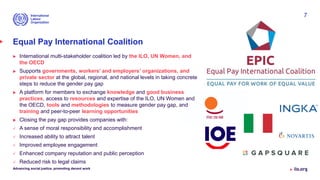
Equal Pay International Coalition
 International multi-stakeholder coalition led by the ILO, UN Women, and
the OECD
 Supports governments, workers’ and employers’ organizations, and
private sector at the global, regional, and national levels in taking concrete
steps to reduce the gender pay gap
 A platform for members to exchange knowledge and good business
practices, access to resources and expertise of the ILO, UN Women and
the OECD, tools and methodologies to measure gender pay gap, and
training and peer-to-peer learning opportunities
 Closing the pay gap provides companies with:
 A sense of moral responsibility and accomplishment
 Increased ability to attract talent
 Improved employee engagement
 Enhanced company reputation and public perception
 Reduced risk to legal claims
Advancing social justice, promoting decent work
7
Sources and tools
 ILO MNE Declaration and its follow up tools, including the ILO Helpdesk for Business
 Normative sources and resources for business on gender equality, including the
products of the recent We Empower project implemented together with the UN Women
and videos (translated in IT)
 ILO complete recourse guide on gender equality in the world of work
 Women in business and management publications (by ACTEMP)
 Q&A on diversity and inclusion
 Information on trainings and webinars on diversity and inclusion, including the recently
started MOOC on business and decent work
 Specific guidelines on diversity and inclusion within the internationally recognized CSR
frameworks (OECD Due Diligence Guidance for Responsible Business Conduct
(including gender lens in HRDD), Gender Dimension of the Guiding Principles on
Business and Human Rights)
Advancing social justice, promoting decent work
8
Thank you for your attention

Achieving gender equality in the workplace - PPT.pdf

  • 1.
    Achieving gender equality inthe workplace Yulia Gershinkova Junior Professional Officer in Business and Decent Work at the ILO Office for Italy and San Marino Rome, 07 Sept 2021 Observatory on Diversity and Inclusion, Global Compact Network Italia
  • 2.
    In Italy:  Justbelow 50% of women aged 15-64 y.o. are in employment compared to 67% of men, more women than men are unemployed (10.4% compared to 8.6%) or inactive (45.3% compared to 26.5%), women are overrepresented in part-time (28% compared to 6%) which is often involuntary  Women spend almost five times the same time on unpaid work than men (5h against 1h/day), mothers aged 25-49 are 20% less likely to be in employment compared to women without children  Women tend to earn 1 € less per hour than men (gender pay gap reaches up to 17% in private sector)  Women are underrepresented in STEM where salaries are higher, and overrepresented in humanities where salaries are lower  Despite progress in recent years, share of women in managerial positions in Italy remains among the lowest in Europe  COVID-19 pandemic has exacerbated the inequalities already existing in the labour market – in comparison to men more women lost their jobs and became inactive, while their involvement in unpaid care and assistance has increased
  • 3.
    Gender equality: keyinternational labour standards  Equal Renumeration Convention, 1951 (No.100) and Recommendation No. 90  Discrimination (Employment and Occupation) Convention, 1958 (No.111) and Recommendation No.111  Maternity Protection Convention, 2000 (No. 183) and Recommendation No.191  Workers with Family Responsibilities Convention, 1981 (No.156)  Violence and Harassment Convention, 2019 (No.190) and Recommendation No.206 Advancing social justice, promoting decent work 3 The recently published ILO Guide clarifies the definitions, core principles and measures of the C190 and R206 as well as outlines the employers obligations to prevent violence and harassment in the world of work
  • 4.
    The business casefor gender equality and diversity  An answer to the labour force and talent shortage. Women account for 50% of labour force, but generate only 37% of the global GDP. Gender diversity contributes to economic growth in aging countries and helps companies to win the talent war.  A corporate performance driver. Economic benefits, increased competitiveness, enhanced consumer insight, improved corporate governance, building and cultivating talents.  Improved decision-making. Positive correlation with financial performance, creativity and innovation, client orientation and cooperation with stakeholders.  Enhanced diversity management. Women use positive leadership behaviours, including people development, expressing expectations and rewarding success, role modelling, inspiration, and participative decision-making Advancing social justice, promoting decent work 4
  • 5.
    What can companiesdo to promote gender equality in the workplace (1) Achieving equal pay for equal value:  Ensuring commitment and leadership from the top (adoption of policies and practices);  Social dialogue and collective bargaining (helps to acquire information, develop partnership solutions to create inclusive employment systems and close gender wage gap);  Pay equity policy (pay equity committee, sex-disaggregated pay data collection, job evaluation, recruitment and selection policies, and pay adjustments);  Evaluation of gender pay gap and gender- neutral job assessment (identification of skills, qualifications, effort, responsibility and working conditions of jobs and determination of wage gaps);  Pay transparency and reporting (helps to assess gender discrimination and rectify pay gaps; negotiate fair remuneration). Preventing and ending gender-based violence at work:  Leadership and zero tolerance approach (ensures serious treatment);  Workplace policy on violence and harassment (definition, rights and responsibilities, complaints and investigative procedures, right to privacy)  Inclusion of violence and harassment in the management of OSH (assessment of policies, hazards and risks, enforcement mechanisms and the prevalence and nature of complaints)  Awareness-raising and training activities (tailored to specific needs and relevant to workplace; tackle particular harmful practices and improve workplace culture)  Mitigating impact of domestic violence in the world of work (measures to support the victims and incorporation of domestic violence into workplace risk assessments and policies)  Addressing unequal gender-based power relations (tackle gender imbalances and stereotypes) Advancing social justice, promoting decent work 5
  • 6.
    What can companiesdo to promote gender equality in the workplace (2) Work-life balance and equal sharing of care responsibilities:  Maternity protection (in line or above the ILS);  Prevent direct and indirect discrimination against pregnant women and workers with family responsibilities (in hiring, job assignment, and access to training and promotion);  Paid paternity leave (helps to ease the burden on women, reduce bias against women and gender stereotypes);  Smooth return to work after leave (return to office policies, specific working schedule and communication arrangements);  Breastfeeding in the workplace (permitting breast pumping or feeding in or near the workplace, and paid lactation breaks);  On- or near-site childcare (helps to ensure continuity in careers for women and removes stigma against male workers who embrace their roles as fathers);  Other care responsibilities (extend work/family support measures to other family members)  Flexible working arrangements (flexible working schedules, part time, teleworking, reduction of daily hours of work and of overtime, etc.)  Coverage to all workers and families (ensure that no one is left behind) Supporting women in business and management:  Commitment and action of leadership (fosters a gender-inclusive enterprise culture);  Diversifying company’s workforce and executive pipeline (measures to attract and retain more women and promote female leadership);  Focus on communication and transparency (involve women in consultation, decision-making, implementation and feedback; report on challenges and difficulties);  Supporting women’s entrepreneurship and economic empowerment (cooperation with other stakeholders, support to women’s entrepreneurship) Advancing social justice, promoting decent work 6
  • 7.
    Equal Pay InternationalCoalition  International multi-stakeholder coalition led by the ILO, UN Women, and the OECD  Supports governments, workers’ and employers’ organizations, and private sector at the global, regional, and national levels in taking concrete steps to reduce the gender pay gap  A platform for members to exchange knowledge and good business practices, access to resources and expertise of the ILO, UN Women and the OECD, tools and methodologies to measure gender pay gap, and training and peer-to-peer learning opportunities  Closing the pay gap provides companies with:  A sense of moral responsibility and accomplishment  Increased ability to attract talent  Improved employee engagement  Enhanced company reputation and public perception  Reduced risk to legal claims Advancing social justice, promoting decent work 7
  • 8.
    Sources and tools ILO MNE Declaration and its follow up tools, including the ILO Helpdesk for Business  Normative sources and resources for business on gender equality, including the products of the recent We Empower project implemented together with the UN Women and videos (translated in IT)  ILO complete recourse guide on gender equality in the world of work  Women in business and management publications (by ACTEMP)  Q&A on diversity and inclusion  Information on trainings and webinars on diversity and inclusion, including the recently started MOOC on business and decent work  Specific guidelines on diversity and inclusion within the internationally recognized CSR frameworks (OECD Due Diligence Guidance for Responsible Business Conduct (including gender lens in HRDD), Gender Dimension of the Guiding Principles on Business and Human Rights) Advancing social justice, promoting decent work 8
  • 9.
    Thank you foryour attention