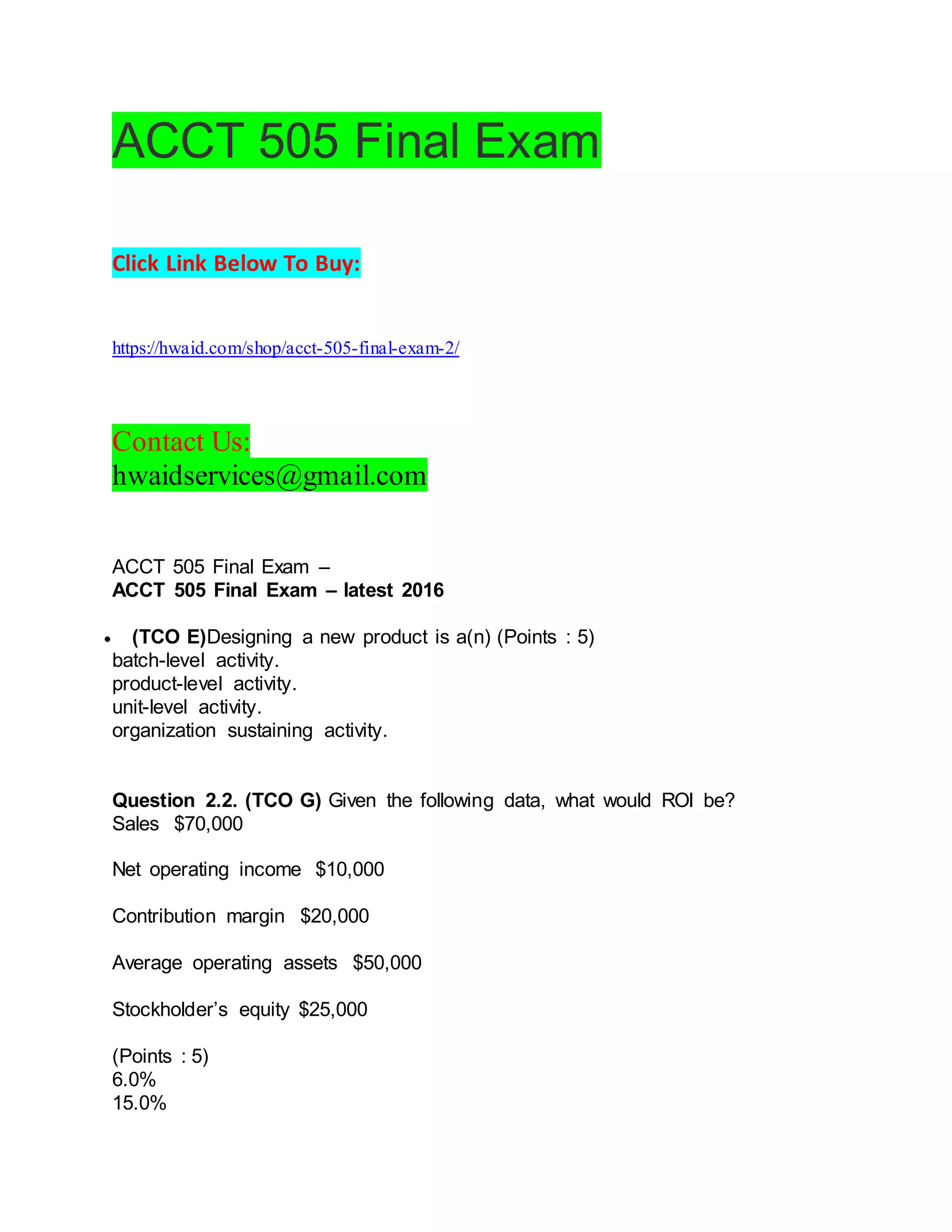
ACCT 505 Final Exam
Click Link Below To Buy:
https://hwaid.com/shop/acct-505-final-exam-2/
Contact Us:
hwaidservices@gmail.com
ACCT 505 Final Exam –
ACCT 505 Final Exam – latest 2016
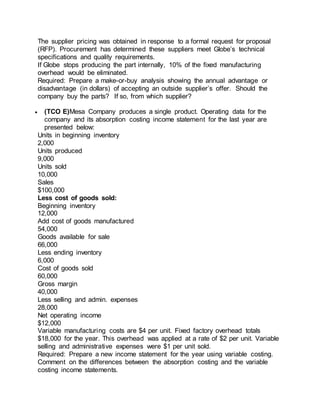
 (TCO E)Designing a new product is a(n) (Points : 5)
batch-level activity.
product-level activity.
unit-level activity.
organization sustaining activity.
Question 2.2. (TCO G) Given the following data, what would ROI be?
Sales $70,000
Net operating income $10,000
Contribution margin $20,000
Average operating assets $50,000
Stockholder’s equity $25,000
(Points : 5)
6.0%
15.0%
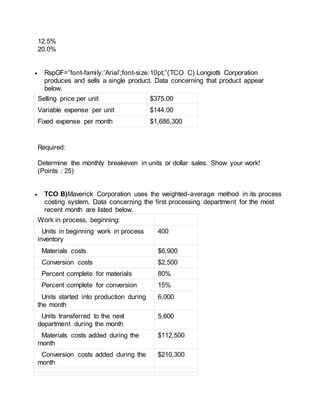
12.5%
20.0%
 RspGF=”font-family:’Arial’;font-size:10pt;”(TCO C) Longiotti Corporation
produces and sells a single product. Data concerning that product appear
below.
Selling price per unit $375.00
Variable expense per unit $144.00
Fixed expense per month $1,686,300
Required:
Determine the monthly breakeven in units or dollar sales. Show your work!
(Points : 25)
 TCO B)Maverick Corporation uses the weighted-average method in its process
costing system. Data concerning the first processing department for the most
recent month are listed below.
Work in process, beginning:
Units in beginning work in process
inventory
400
Materials costs $6,900
Conversion costs $2,500
Percent complete for materials 80%
Percent complete for conversion 15%
Units started into production during
the month
6,000
Units transferred to the next
department during the month
5,600
Materials costs added during the
month
$112,500
Conversion costs added during the
month
$210,300
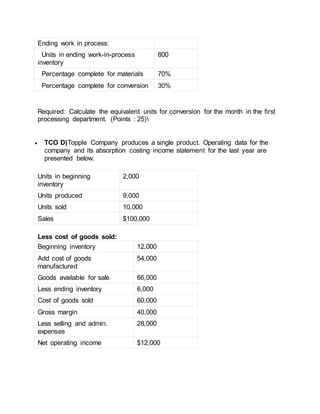
Ending work in process:
Units in ending work-in-process
inventory
800
Percentage complete for materials 70%
Percentage complete for conversion 30%
Required: Calculate the equivalent units for conversion for the month in the first
processing department. (Points : 25)
 TCO D)Topple Company produces a single product. Operating data for the
company and its absorption costing income statement for the last year are
presented below.
Units in beginning
inventory
2,000
Units produced 9,000
Units sold 10,000
Sales $100,000
Less cost of goods sold:
Beginning inventory 12,000
Add cost of goods
manufactured
54,000
Goods available for sale 66,000
Less ending inventory 6,000
Cost of goods sold 60,000
Gross margin 40,000
Less selling and admin.
expenses
28,000
Net operating income $12,000
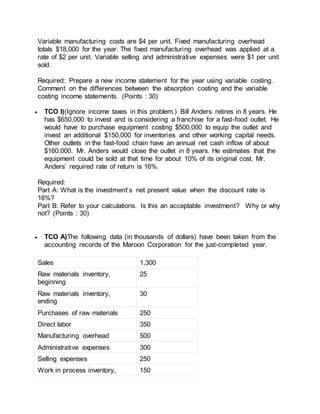
Variable manufacturing costs are $4 per unit. Fixed manufacturing overhead
totals $18,000 for the year. The fixed manufacturing overhead was applied at a
rate of $2 per unit. Variable selling and administrative expenses were $1 per unit
sold.
Required: Prepare a new income statement for the year using variable costing.
Comment on the differences between the absorption costing and the variable
costing income statements. (Points : 30)
 TCO I)(Ignore income taxes in this problem.) Bill Anders retires in 8 years. He
has $650,000 to invest and is considering a franchise for a fast-food outlet. He
would have to purchase equipment costing $500,000 to equip the outlet and
invest an additional $150,000 for inventories and other working capital needs.
Other outlets in the fast-food chain have an annual net cash inflow of about
$160,000. Mr. Anders would close the outlet in 8 years. He estimates that the
equipment could be sold at that time for about 10% of its original cost. Mr.
Anders’ required rate of return is 16%.
Required:
Part A: What is the investment’s net present value when the discount rate is
16%?
Part B: Refer to your calculations. Is this an acceptable investment? Why or why
not? (Points : 30)
 TCO A)The following data (in thousands of dollars) have been taken from the
accounting records of the Maroon Corporation for the just-completed year.
Sales 1,300
Raw materials inventory,
beginning
25
Raw materials inventory,
ending
30
Purchases of raw materials 250
Direct labor 350
Manufacturing overhead 500
Administrative expenses 300
Selling expenses 250
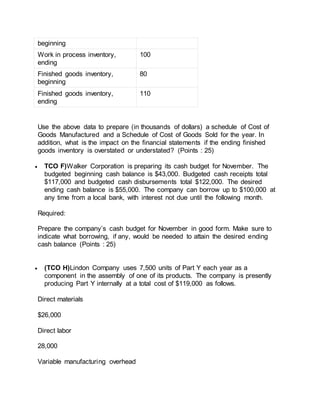
Work in process inventory, 150
beginning
Work in process inventory,
ending
100
Finished goods inventory,
beginning
80
Finished goods inventory,
ending
110
Use the above data to prepare (in thousands of dollars) a schedule of Cost of
Goods Manufactured and a Schedule of Cost of Goods Sold for the year. In
addition, what is the impact on the financial statements if the ending finished
goods inventory is overstated or understated? (Points : 25)
 TCO F)Walker Corporation is preparing its cash budget for November. The
budgeted beginning cash balance is $43,000. Budgeted cash receipts total
$117,000 and budgeted cash disbursements total $122,000. The desired
ending cash balance is $55,000. The company can borrow up to $100,000 at
any time from a local bank, with interest not due until the following month.
Required:
Prepare the company’s cash budget for November in good form. Make sure to
indicate what borrowing, if any, would be needed to attain the desired ending
cash balance (Points : 25)
 (TCO H)Lindon Company uses 7,500 units of Part Y each year as a
component in the assembly of one of its products. The company is presently
producing Part Y internally at a total cost of $119,000 as follows.
Direct materials
$26,000
Direct labor
28,000
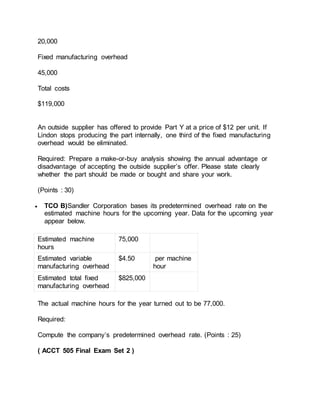
Variable manufacturing overhead
20,000
Fixed manufacturing overhead
45,000
Total costs
$119,000
An outside supplier has offered to provide Part Y at a price of $12 per unit. If
Lindon stops producing the part internally, one third of the fixed manufacturing
overhead would be eliminated.
Required: Prepare a make-or-buy analysis showing the annual advantage or
disadvantage of accepting the outside supplier’s offer. Please state clearly
whether the part should be made or bought and share your work.
(Points : 30)
 TCO B)Sandler Corporation bases its predetermined overhead rate on the
estimated machine hours for the upcoming year. Data for the upcoming year
appear below.
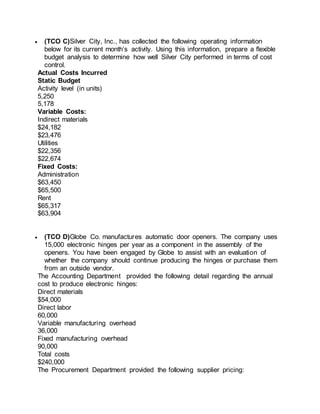
Estimated machine
hours
75,000
Estimated variable
manufacturing overhead
$4.50 per machine
hour
Estimated total fixed
manufacturing overhead
$825,000
The actual machine hours for the year turned out to be 77,000.
Required:
Compute the company’s predetermined overhead rate. (Points : 25)
( ACCT 505 Final Exam Set 2 )
 (TCO C)Silver City, Inc., has collected the following operating information
below for its current month’s activity. Using this information, prepare a flexible
budget analysis to determine how well Silver City performed in terms of cost
control.
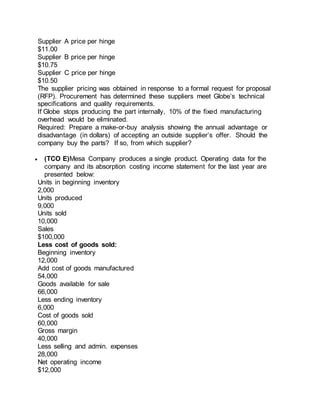
Actual Costs Incurred
Static Budget
Activity level (in units)
5,250
5,178
Variable Costs:
Indirect materials
$24,182
$23,476
Utilities
$22,356
$22,674
Fixed Costs:
Administration
$63,450
$65,500
Rent
$65,317
$63,904
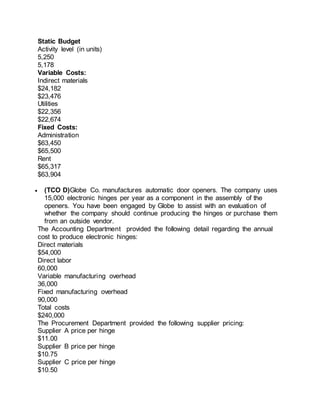
 (TCO D)Globe Co. manufactures automatic door openers. The company uses
15,000 electronic hinges per year as a component in the assembly of the
openers. You have been engaged by Globe to assist with an evaluation of
whether the company should continue producing the hinges or purchase them
from an outside vendor.
The Accounting Department provided the following detail regarding the annual
cost to produce electronic hinges:
Direct materials
$54,000
Direct labor
60,000
Variable manufacturing overhead
36,000
Fixed manufacturing overhead
90,000
Total costs
$240,000
The Procurement Department provided the following supplier pricing:
Supplier A price per hinge
$11.00
Supplier B price per hinge
$10.75
Supplier C price per hinge
$10.50
The supplier pricing was obtained in response to a formal request for proposal
(RFP). Procurement has determined these suppliers meet Globe’s technical
specifications and quality requirements.
If Globe stops producing the part internally, 10% of the fixed manufacturing
overhead would be eliminated.
Required: Prepare a make-or-buy analysis showing the annual advantage or
disadvantage (in dollars) of accepting an outside supplier’s offer. Should the
company buy the parts? If so, from which supplier?
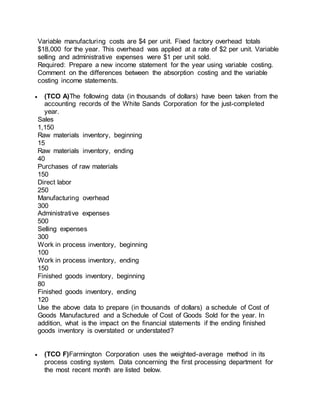
 (TCO E)Mesa Company produces a single product. Operating data for the
company and its absorption costing income statement for the last year are
presented below:
Units in beginning inventory
2,000
Units produced
9,000
Units sold
10,000
Sales
$100,000
Less cost of goods sold:
Beginning inventory
12,000
Add cost of goods manufactured
54,000
Goods available for sale
66,000
Less ending inventory
6,000
Cost of goods sold
60,000
Gross margin
40,000
Less selling and admin. expenses
28,000
Net operating income
$12,000
Variable manufacturing costs are $4 per unit. Fixed factory overhead totals
$18,000 for the year. This overhead was applied at a rate of $2 per unit. Variable
selling and administrative expenses were $1 per unit sold.
Required: Prepare a new income statement for the year using variable costing.
Comment on the differences between the absorption costing and the variable
costing income statements.
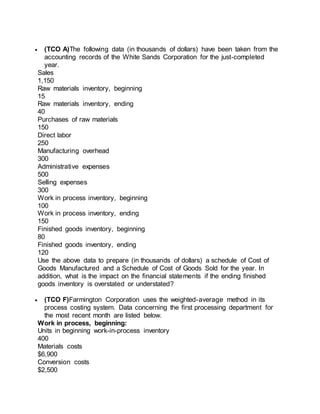
 (TCO A)The following data (in thousands of dollars) have been taken from the
accounting records of the White Sands Corporation for the just-completed
year.
Sales
1,150
Raw materials inventory, beginning
15
Raw materials inventory, ending
40
Purchases of raw materials
150
Direct labor
250
Manufacturing overhead
300
Administrative expenses
500
Selling expenses
300
Work in process inventory, beginning
100
Work in process inventory, ending
150
Finished goods inventory, beginning
80
Finished goods inventory, ending
120
Use the above data to prepare (in thousands of dollars) a schedule of Cost of
Goods Manufactured and a Schedule of Cost of Goods Sold for the year. In
addition, what is the impact on the financial statements if the ending finished
goods inventory is overstated or understated?
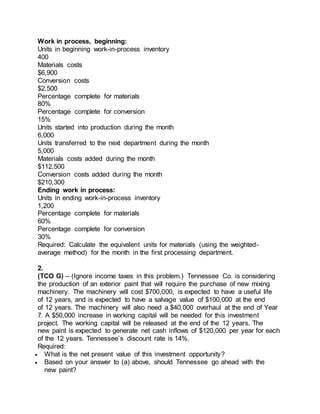
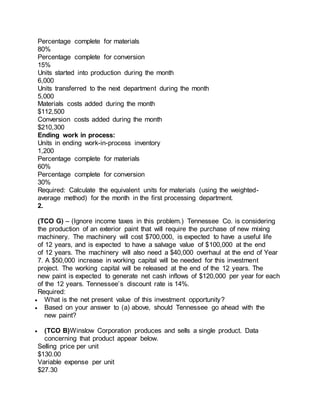
 (TCO F)Farmington Corporation uses the weighted-average method in its
process costing system. Data concerning the first processing department for
the most recent month are listed below.
Work in process, beginning:
Units in beginning work-in-process inventory
400
Materials costs
$6,900
Conversion costs
$2,500
Percentage complete for materials
80%
Percentage complete for conversion
15%
Units started into production during the month
6,000
Units transferred to the next department during the month
5,000
Materials costs added during the month
$112,500
Conversion costs added during the month
$210,300
Ending work in process:
Units in ending work-in-process inventory
1,200
Percentage complete for materials
60%
Percentage complete for conversion
30%
Required: Calculate the equivalent units for materials (using the weighted-
average method) for the month in the first processing department.
2.
(TCO G) – (Ignore income taxes in this problem.) Tennessee Co. is considering
the production of an exterior paint that will require the purchase of new mixing
machinery. The machinery will cost $700,000, is expected to have a useful life
of 12 years, and is expected to have a salvage value of $100,000 at the end
of 12 years. The machinery will also need a $40,000 overhaul at the end of Year
7. A $50,000 increase in working capital will be needed for this investment
project. The working capital will be released at the end of the 12 years. The
new paint is expected to generate net cash inflows of $120,000 per year for each
of the 12 years. Tennessee’s discount rate is 14%.
Required:
 What is the net present value of this investment opportunity?
 Based on your answer to (a) above, should Tennessee go ahead with the
new paint?
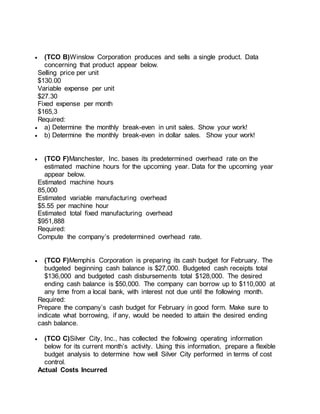
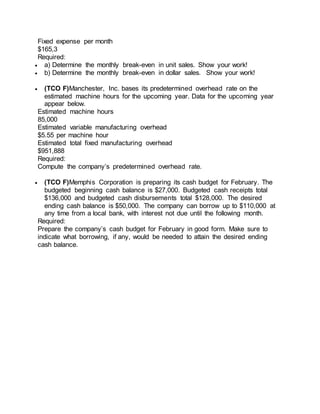
 (TCO B)Winslow Corporation produces and sells a single product. Data
concerning that product appear below.
Selling price per unit
$130.00
Variable expense per unit
$27.30
Fixed expense per month
$165,3
Required:
 a) Determine the monthly break-even in unit sales. Show your work!
 b) Determine the monthly break-even in dollar sales. Show your work!
 (TCO F)Manchester, Inc. bases its predetermined overhead rate on the
estimated machine hours for the upcoming year. Data for the upcoming year
appear below.
Estimated machine hours
85,000
Estimated variable manufacturing overhead
$5.55 per machine hour
Estimated total fixed manufacturing overhead
$951,888
Required:
Compute the company’s predetermined overhead rate.
 (TCO F)Memphis Corporation is preparing its cash budget for February. The
budgeted beginning cash balance is $27,000. Budgeted cash receipts total
$136,000 and budgeted cash disbursements total $128,000. The desired
ending cash balance is $50,000. The company can borrow up to $110,000 at
any time from a local bank, with interest not due until the following month.
Required:
Prepare the company’s cash budget for February in good form. Make sure to
indicate what borrowing, if any, would be needed to attain the desired ending
cash balance.
 (TCO C)Silver City, Inc., has collected the following operating information
below for its current month’s activity. Using this information, prepare a flexible
budget analysis to determine how well Silver City performed in terms of cost
control.
Actual Costs Incurred
Static Budget
Activity level (in units)
5,250
5,178
Variable Costs:
Indirect materials
$24,182
$23,476
Utilities
$22,356
$22,674
Fixed Costs:
Administration
$63,450
$65,500
Rent
$65,317
$63,904
 (TCO D)Globe Co. manufactures automatic door openers. The company uses
15,000 electronic hinges per year as a component in the assembly of the
openers. You have been engaged by Globe to assist with an evaluation of
whether the company should continue producing the hinges or purchase them
from an outside vendor.
The Accounting Department provided the following detail regarding the annual
cost to produce electronic hinges:
Direct materials
$54,000
Direct labor
60,000
Variable manufacturing overhead
36,000
Fixed manufacturing overhead
90,000
Total costs
$240,000
The Procurement Department provided the following supplier pricing:
Supplier A price per hinge
$11.00
Supplier B price per hinge
$10.75
Supplier C price per hinge
$10.50
The supplier pricing was obtained in response to a formal request for proposal
(RFP). Procurement has determined these suppliers meet Globe’s technical
specifications and quality requirements.
If Globe stops producing the part internally, 10% of the fixed manufacturing
overhead would be eliminated.
Required: Prepare a make-or-buy analysis showing the annual advantage or
disadvantage (in dollars) of accepting an outside supplier’s offer. Should the
company buy the parts? If so, from which supplier?
 (TCO E)Mesa Company produces a single product. Operating data for the
company and its absorption costing income statement for the last year are
presented below:
Units in beginning inventory
2,000
Units produced
9,000
Units sold
10,000
Sales
$100,000
Less cost of goods sold:
Beginning inventory
12,000
Add cost of goods manufactured
54,000
Goods available for sale
66,000
Less ending inventory
6,000
Cost of goods sold
60,000
Gross margin
40,000
Less selling and admin. expenses
28,000
Net operating income
$12,000
Variable manufacturing costs are $4 per unit. Fixed factory overhead totals
$18,000 for the year. This overhead was applied at a rate of $2 per unit. Variable
selling and administrative expenses were $1 per unit sold.
Required: Prepare a new income statement for the year using variable costing.
Comment on the differences between the absorption costing and the variable
costing income statements.
 (TCO A)The following data (in thousands of dollars) have been taken from the
accounting records of the White Sands Corporation for the just-completed
year.
Sales
1,150
Raw materials inventory, beginning
15
Raw materials inventory, ending
40
Purchases of raw materials
150
Direct labor
250
Manufacturing overhead
300
Administrative expenses
500
Selling expenses
300
Work in process inventory, beginning
100
Work in process inventory, ending
150
Finished goods inventory, beginning
80
Finished goods inventory, ending
120
Use the above data to prepare (in thousands of dollars) a schedule of Cost of
Goods Manufactured and a Schedule of Cost of Goods Sold for the year. In
addition, what is the impact on the financial statements if the ending finished
goods inventory is overstated or understated?
 (TCO F)Farmington Corporation uses the weighted-average method in its
process costing system. Data concerning the first processing department for
the most recent month are listed below.
Work in process, beginning:
Units in beginning work-in-process inventory
400
Materials costs
$6,900
Conversion costs
$2,500
Percentage complete for materials
80%
Percentage complete for conversion
15%
Units started into production during the month
6,000
Units transferred to the next department during the month
5,000
Materials costs added during the month
$112,500
Conversion costs added during the month
$210,300
Ending work in process:
Units in ending work-in-process inventory
1,200
Percentage complete for materials
60%
Percentage complete for conversion
30%
Required: Calculate the equivalent units for materials (using the weighted-
average method) for the month in the first processing department.
2.
(TCO G) – (Ignore income taxes in this problem.) Tennessee Co. is considering
the production of an exterior paint that will require the purchase of new mixing
machinery. The machinery will cost $700,000, is expected to have a useful life
of 12 years, and is expected to have a salvage value of $100,000 at the end
of 12 years. The machinery will also need a $40,000 overhaul at the end of Year
7. A $50,000 increase in working capital will be needed for this investment
project. The working capital will be released at the end of the 12 years. The
new paint is expected to generate net cash inflows of $120,000 per year for each
of the 12 years. Tennessee’s discount rate is 14%.
Required:
 What is the net present value of this investment opportunity?
 Based on your answer to (a) above, should Tennessee go ahead with the
new paint?
 (TCO B)Winslow Corporation produces and sells a single product. Data
concerning that product appear below.
Selling price per unit
$130.00
Variable expense per unit
$27.30
Fixed expense per month
$165,3
Required:
 a) Determine the monthly break-even in unit sales. Show your work!
 b) Determine the monthly break-even in dollar sales. Show your work!
 (TCO F)Manchester, Inc. bases its predetermined overhead rate on the
estimated machine hours for the upcoming year. Data for the upcoming year
appear below.
Estimated machine hours
85,000
Estimated variable manufacturing overhead
$5.55 per machine hour
Estimated total fixed manufacturing overhead
$951,888
Required:
Compute the company’s predetermined overhead rate.
 (TCO F)Memphis Corporation is preparing its cash budget for February. The
budgeted beginning cash balance is $27,000. Budgeted cash receipts total
$136,000 and budgeted cash disbursements total $128,000. The desired
ending cash balance is $50,000. The company can borrow up to $110,000 at
any time from a local bank, with interest not due until the following month.
Required:
Prepare the company’s cash budget for February in good form. Make sure to
indicate what borrowing, if any, would be needed to attain the desired ending
cash balance.

Acct 505 final exam

  • 1.
    ACCT 505 FinalExam Click Link Below To Buy: https://hwaid.com/shop/acct-505-final-exam-2/ Contact Us: hwaidservices@gmail.com ACCT 505 Final Exam – ACCT 505 Final Exam – latest 2016  (TCO E)Designing a new product is a(n) (Points : 5) batch-level activity. product-level activity. unit-level activity. organization sustaining activity. Question 2.2. (TCO G) Given the following data, what would ROI be? Sales $70,000 Net operating income $10,000 Contribution margin $20,000 Average operating assets $50,000 Stockholder’s equity $25,000 (Points : 5) 6.0% 15.0%
  • 2.
    12.5% 20.0%  RspGF=”font-family:’Arial’;font-size:10pt;”(TCO C)Longiotti Corporation produces and sells a single product. Data concerning that product appear below. Selling price per unit $375.00 Variable expense per unit $144.00 Fixed expense per month $1,686,300 Required: Determine the monthly breakeven in units or dollar sales. Show your work! (Points : 25)  TCO B)Maverick Corporation uses the weighted-average method in its process costing system. Data concerning the first processing department for the most recent month are listed below. Work in process, beginning: Units in beginning work in process inventory 400 Materials costs $6,900 Conversion costs $2,500 Percent complete for materials 80% Percent complete for conversion 15% Units started into production during the month 6,000 Units transferred to the next department during the month 5,600 Materials costs added during the month $112,500 Conversion costs added during the month $210,300
  • 3.
    Ending work inprocess: Units in ending work-in-process inventory 800 Percentage complete for materials 70% Percentage complete for conversion 30% Required: Calculate the equivalent units for conversion for the month in the first processing department. (Points : 25)  TCO D)Topple Company produces a single product. Operating data for the company and its absorption costing income statement for the last year are presented below. Units in beginning inventory 2,000 Units produced 9,000 Units sold 10,000 Sales $100,000 Less cost of goods sold: Beginning inventory 12,000 Add cost of goods manufactured 54,000 Goods available for sale 66,000 Less ending inventory 6,000 Cost of goods sold 60,000 Gross margin 40,000 Less selling and admin. expenses 28,000 Net operating income $12,000
  • 4.
    Variable manufacturing costsare $4 per unit. Fixed manufacturing overhead totals $18,000 for the year. The fixed manufacturing overhead was applied at a rate of $2 per unit. Variable selling and administrative expenses were $1 per unit sold. Required: Prepare a new income statement for the year using variable costing. Comment on the differences between the absorption costing and the variable costing income statements. (Points : 30)  TCO I)(Ignore income taxes in this problem.) Bill Anders retires in 8 years. He has $650,000 to invest and is considering a franchise for a fast-food outlet. He would have to purchase equipment costing $500,000 to equip the outlet and invest an additional $150,000 for inventories and other working capital needs. Other outlets in the fast-food chain have an annual net cash inflow of about $160,000. Mr. Anders would close the outlet in 8 years. He estimates that the equipment could be sold at that time for about 10% of its original cost. Mr. Anders’ required rate of return is 16%. Required: Part A: What is the investment’s net present value when the discount rate is 16%? Part B: Refer to your calculations. Is this an acceptable investment? Why or why not? (Points : 30)  TCO A)The following data (in thousands of dollars) have been taken from the accounting records of the Maroon Corporation for the just-completed year. Sales 1,300 Raw materials inventory, beginning 25 Raw materials inventory, ending 30 Purchases of raw materials 250 Direct labor 350 Manufacturing overhead 500 Administrative expenses 300 Selling expenses 250 Work in process inventory, 150
  • 5.
    beginning Work in processinventory, ending 100 Finished goods inventory, beginning 80 Finished goods inventory, ending 110 Use the above data to prepare (in thousands of dollars) a schedule of Cost of Goods Manufactured and a Schedule of Cost of Goods Sold for the year. In addition, what is the impact on the financial statements if the ending finished goods inventory is overstated or understated? (Points : 25)  TCO F)Walker Corporation is preparing its cash budget for November. The budgeted beginning cash balance is $43,000. Budgeted cash receipts total $117,000 and budgeted cash disbursements total $122,000. The desired ending cash balance is $55,000. The company can borrow up to $100,000 at any time from a local bank, with interest not due until the following month. Required: Prepare the company’s cash budget for November in good form. Make sure to indicate what borrowing, if any, would be needed to attain the desired ending cash balance (Points : 25)  (TCO H)Lindon Company uses 7,500 units of Part Y each year as a component in the assembly of one of its products. The company is presently producing Part Y internally at a total cost of $119,000 as follows. Direct materials $26,000 Direct labor 28,000 Variable manufacturing overhead
  • 6.
    20,000 Fixed manufacturing overhead 45,000 Totalcosts $119,000 An outside supplier has offered to provide Part Y at a price of $12 per unit. If Lindon stops producing the part internally, one third of the fixed manufacturing overhead would be eliminated. Required: Prepare a make-or-buy analysis showing the annual advantage or disadvantage of accepting the outside supplier’s offer. Please state clearly whether the part should be made or bought and share your work. (Points : 30)  TCO B)Sandler Corporation bases its predetermined overhead rate on the estimated machine hours for the upcoming year. Data for the upcoming year appear below. Estimated machine hours 75,000 Estimated variable manufacturing overhead $4.50 per machine hour Estimated total fixed manufacturing overhead $825,000 The actual machine hours for the year turned out to be 77,000. Required: Compute the company’s predetermined overhead rate. (Points : 25) ( ACCT 505 Final Exam Set 2 )
  • 7.
     (TCO C)SilverCity, Inc., has collected the following operating information below for its current month’s activity. Using this information, prepare a flexible budget analysis to determine how well Silver City performed in terms of cost control. Actual Costs Incurred Static Budget Activity level (in units) 5,250 5,178 Variable Costs: Indirect materials $24,182 $23,476 Utilities $22,356 $22,674 Fixed Costs: Administration $63,450 $65,500 Rent $65,317 $63,904  (TCO D)Globe Co. manufactures automatic door openers. The company uses 15,000 electronic hinges per year as a component in the assembly of the openers. You have been engaged by Globe to assist with an evaluation of whether the company should continue producing the hinges or purchase them from an outside vendor. The Accounting Department provided the following detail regarding the annual cost to produce electronic hinges: Direct materials $54,000 Direct labor 60,000 Variable manufacturing overhead 36,000 Fixed manufacturing overhead 90,000 Total costs $240,000 The Procurement Department provided the following supplier pricing:
  • 8.
    Supplier A priceper hinge $11.00 Supplier B price per hinge $10.75 Supplier C price per hinge $10.50 The supplier pricing was obtained in response to a formal request for proposal (RFP). Procurement has determined these suppliers meet Globe’s technical specifications and quality requirements. If Globe stops producing the part internally, 10% of the fixed manufacturing overhead would be eliminated. Required: Prepare a make-or-buy analysis showing the annual advantage or disadvantage (in dollars) of accepting an outside supplier’s offer. Should the company buy the parts? If so, from which supplier?  (TCO E)Mesa Company produces a single product. Operating data for the company and its absorption costing income statement for the last year are presented below: Units in beginning inventory 2,000 Units produced 9,000 Units sold 10,000 Sales $100,000 Less cost of goods sold: Beginning inventory 12,000 Add cost of goods manufactured 54,000 Goods available for sale 66,000 Less ending inventory 6,000 Cost of goods sold 60,000 Gross margin 40,000 Less selling and admin. expenses 28,000 Net operating income $12,000
  • 9.
    Variable manufacturing costsare $4 per unit. Fixed factory overhead totals $18,000 for the year. This overhead was applied at a rate of $2 per unit. Variable selling and administrative expenses were $1 per unit sold. Required: Prepare a new income statement for the year using variable costing. Comment on the differences between the absorption costing and the variable costing income statements.  (TCO A)The following data (in thousands of dollars) have been taken from the accounting records of the White Sands Corporation for the just-completed year. Sales 1,150 Raw materials inventory, beginning 15 Raw materials inventory, ending 40 Purchases of raw materials 150 Direct labor 250 Manufacturing overhead 300 Administrative expenses 500 Selling expenses 300 Work in process inventory, beginning 100 Work in process inventory, ending 150 Finished goods inventory, beginning 80 Finished goods inventory, ending 120 Use the above data to prepare (in thousands of dollars) a schedule of Cost of Goods Manufactured and a Schedule of Cost of Goods Sold for the year. In addition, what is the impact on the financial statements if the ending finished goods inventory is overstated or understated?  (TCO F)Farmington Corporation uses the weighted-average method in its process costing system. Data concerning the first processing department for the most recent month are listed below.
  • 10.
    Work in process,beginning: Units in beginning work-in-process inventory 400 Materials costs $6,900 Conversion costs $2,500 Percentage complete for materials 80% Percentage complete for conversion 15% Units started into production during the month 6,000 Units transferred to the next department during the month 5,000 Materials costs added during the month $112,500 Conversion costs added during the month $210,300 Ending work in process: Units in ending work-in-process inventory 1,200 Percentage complete for materials 60% Percentage complete for conversion 30% Required: Calculate the equivalent units for materials (using the weighted- average method) for the month in the first processing department. 2. (TCO G) – (Ignore income taxes in this problem.) Tennessee Co. is considering the production of an exterior paint that will require the purchase of new mixing machinery. The machinery will cost $700,000, is expected to have a useful life of 12 years, and is expected to have a salvage value of $100,000 at the end of 12 years. The machinery will also need a $40,000 overhaul at the end of Year 7. A $50,000 increase in working capital will be needed for this investment project. The working capital will be released at the end of the 12 years. The new paint is expected to generate net cash inflows of $120,000 per year for each of the 12 years. Tennessee’s discount rate is 14%. Required:  What is the net present value of this investment opportunity?  Based on your answer to (a) above, should Tennessee go ahead with the new paint?
  • 11.
     (TCO B)WinslowCorporation produces and sells a single product. Data concerning that product appear below. Selling price per unit $130.00 Variable expense per unit $27.30 Fixed expense per month $165,3 Required:  a) Determine the monthly break-even in unit sales. Show your work!  b) Determine the monthly break-even in dollar sales. Show your work!  (TCO F)Manchester, Inc. bases its predetermined overhead rate on the estimated machine hours for the upcoming year. Data for the upcoming year appear below. Estimated machine hours 85,000 Estimated variable manufacturing overhead $5.55 per machine hour Estimated total fixed manufacturing overhead $951,888 Required: Compute the company’s predetermined overhead rate.  (TCO F)Memphis Corporation is preparing its cash budget for February. The budgeted beginning cash balance is $27,000. Budgeted cash receipts total $136,000 and budgeted cash disbursements total $128,000. The desired ending cash balance is $50,000. The company can borrow up to $110,000 at any time from a local bank, with interest not due until the following month. Required: Prepare the company’s cash budget for February in good form. Make sure to indicate what borrowing, if any, would be needed to attain the desired ending cash balance.  (TCO C)Silver City, Inc., has collected the following operating information below for its current month’s activity. Using this information, prepare a flexible budget analysis to determine how well Silver City performed in terms of cost control. Actual Costs Incurred
  • 12.
    Static Budget Activity level(in units) 5,250 5,178 Variable Costs: Indirect materials $24,182 $23,476 Utilities $22,356 $22,674 Fixed Costs: Administration $63,450 $65,500 Rent $65,317 $63,904  (TCO D)Globe Co. manufactures automatic door openers. The company uses 15,000 electronic hinges per year as a component in the assembly of the openers. You have been engaged by Globe to assist with an evaluation of whether the company should continue producing the hinges or purchase them from an outside vendor. The Accounting Department provided the following detail regarding the annual cost to produce electronic hinges: Direct materials $54,000 Direct labor 60,000 Variable manufacturing overhead 36,000 Fixed manufacturing overhead 90,000 Total costs $240,000 The Procurement Department provided the following supplier pricing: Supplier A price per hinge $11.00 Supplier B price per hinge $10.75 Supplier C price per hinge $10.50
  • 13.
    The supplier pricingwas obtained in response to a formal request for proposal (RFP). Procurement has determined these suppliers meet Globe’s technical specifications and quality requirements. If Globe stops producing the part internally, 10% of the fixed manufacturing overhead would be eliminated. Required: Prepare a make-or-buy analysis showing the annual advantage or disadvantage (in dollars) of accepting an outside supplier’s offer. Should the company buy the parts? If so, from which supplier?  (TCO E)Mesa Company produces a single product. Operating data for the company and its absorption costing income statement for the last year are presented below: Units in beginning inventory 2,000 Units produced 9,000 Units sold 10,000 Sales $100,000 Less cost of goods sold: Beginning inventory 12,000 Add cost of goods manufactured 54,000 Goods available for sale 66,000 Less ending inventory 6,000 Cost of goods sold 60,000 Gross margin 40,000 Less selling and admin. expenses 28,000 Net operating income $12,000 Variable manufacturing costs are $4 per unit. Fixed factory overhead totals $18,000 for the year. This overhead was applied at a rate of $2 per unit. Variable selling and administrative expenses were $1 per unit sold. Required: Prepare a new income statement for the year using variable costing. Comment on the differences between the absorption costing and the variable costing income statements.
  • 14.
     (TCO A)Thefollowing data (in thousands of dollars) have been taken from the accounting records of the White Sands Corporation for the just-completed year. Sales 1,150 Raw materials inventory, beginning 15 Raw materials inventory, ending 40 Purchases of raw materials 150 Direct labor 250 Manufacturing overhead 300 Administrative expenses 500 Selling expenses 300 Work in process inventory, beginning 100 Work in process inventory, ending 150 Finished goods inventory, beginning 80 Finished goods inventory, ending 120 Use the above data to prepare (in thousands of dollars) a schedule of Cost of Goods Manufactured and a Schedule of Cost of Goods Sold for the year. In addition, what is the impact on the financial statements if the ending finished goods inventory is overstated or understated?  (TCO F)Farmington Corporation uses the weighted-average method in its process costing system. Data concerning the first processing department for the most recent month are listed below. Work in process, beginning: Units in beginning work-in-process inventory 400 Materials costs $6,900 Conversion costs $2,500
  • 15.
    Percentage complete formaterials 80% Percentage complete for conversion 15% Units started into production during the month 6,000 Units transferred to the next department during the month 5,000 Materials costs added during the month $112,500 Conversion costs added during the month $210,300 Ending work in process: Units in ending work-in-process inventory 1,200 Percentage complete for materials 60% Percentage complete for conversion 30% Required: Calculate the equivalent units for materials (using the weighted- average method) for the month in the first processing department. 2. (TCO G) – (Ignore income taxes in this problem.) Tennessee Co. is considering the production of an exterior paint that will require the purchase of new mixing machinery. The machinery will cost $700,000, is expected to have a useful life of 12 years, and is expected to have a salvage value of $100,000 at the end of 12 years. The machinery will also need a $40,000 overhaul at the end of Year 7. A $50,000 increase in working capital will be needed for this investment project. The working capital will be released at the end of the 12 years. The new paint is expected to generate net cash inflows of $120,000 per year for each of the 12 years. Tennessee’s discount rate is 14%. Required:  What is the net present value of this investment opportunity?  Based on your answer to (a) above, should Tennessee go ahead with the new paint?  (TCO B)Winslow Corporation produces and sells a single product. Data concerning that product appear below. Selling price per unit $130.00 Variable expense per unit $27.30
  • 16.
    Fixed expense permonth $165,3 Required:  a) Determine the monthly break-even in unit sales. Show your work!  b) Determine the monthly break-even in dollar sales. Show your work!  (TCO F)Manchester, Inc. bases its predetermined overhead rate on the estimated machine hours for the upcoming year. Data for the upcoming year appear below. Estimated machine hours 85,000 Estimated variable manufacturing overhead $5.55 per machine hour Estimated total fixed manufacturing overhead $951,888 Required: Compute the company’s predetermined overhead rate.  (TCO F)Memphis Corporation is preparing its cash budget for February. The budgeted beginning cash balance is $27,000. Budgeted cash receipts total $136,000 and budgeted cash disbursements total $128,000. The desired ending cash balance is $50,000. The company can borrow up to $110,000 at any time from a local bank, with interest not due until the following month. Required: Prepare the company’s cash budget for February in good form. Make sure to indicate what borrowing, if any, would be needed to attain the desired ending cash balance.