Acoustical Materials
Sound AbsorbingMaterials All building surface
treatments used in construction and used in
creating spaces have the capacity to absorb
sound to a certain degree. under special
conditions many of the sound-absorptive
materials are also being used in sound
insulation. On any surface, sound is either
absorbed or reflected by material. the sound
energy absorbed is partially converted to heat
but most energy transmitted to the other side
of the material, unless such transmission is
retained by a more impervious barrier. A good
sound absorber is an efficient transmitter and
an efficient sound insulator. An effective sound
insulator enclosure, on the other hand will
prevent the transmission of sound from one
side to the other.
Brick
Is modular building block made from
clay. It is used to build load bearing
and non-load bearing walls, as a
lacing (break veneer), and as paving
material. Brick has mass
approximately 130 lbs per cubic ft,
brick attenuates sound very well.
exceptionally high orders of
attenuation can be achieved with two
side-by-side but unconnected brick
walls. Joints must be fully mortared or
otherwise sealed. absorption is
negligible since there is little or no
porosity and the material is rigid.
consequently, brick is a good all-
frequency sound reflector
Concrete
A mixture of portland cement, stone
and sand aggregates, and water, cured
into a hard mass of superior
compressive strength. It is often
reinforced with steel and used for
structural member. Normal weight
concrete has a density of 144 pounds
per cubic foot. Lightweight concrete is
less effective, unless of equal mass per
unit area. like any hard material,
concrete provides virtually no
absorption. there are, however, aerated
concretes that are intentionally porous.
These are, however, aerated concretes
that are intentionally porous. These are
fairly absorptive
COMMON BUILDING MATERIALS
3.
Concrete Masonry Units
Aremodular building blocks made of concrete.
They are usually manufactured with hollow
cores. Normal-weight units can support
considerable loads, lightweight units are
generally used to build non- load bearing
partitions
Glass
Glass is generally a light-transparent
material made of a mixture of silicates, It is
used principally to glaze windows and other
openings that need to be closed, but
without excluding light
Despite its mass (approximately 156 pounds
per cubic foot), glass is a marginal sound
attenuator because it is thin and the mass
per unit area is quite small. Superior
performance is provided by well-separated
double-glazing ard by certain types of
laminated glass. Almost totally reflective in
the higher frequencies, glass resonates and,
through this mechanism, can absorb
appreciable amounts of low-frequency
sound.
COMMON BUILDING MATERIALS
Masonry
Is any of a large variety of stone-like
materials. Acoustical properties vary,
but in the general are comparable to
those of brick, concrete, and concrete
masonry units.
Laminated Glass
Is a sandwich of two or more sheets
of glass with viscoelastic interlayers
that provide damping as the sandwich
is flexed. Certain types of laminated
glass offer substantially better sound
attenuation than an equal than an
equal thickness of monolithic glass.
Wood Decking
one of the several structural materials supported
by beams or trusses to form floors and roofs. It
is often exposed as finished ceiling. Owing to its
relatively low mass (as compared to concrete),
wood decking provides only nominal attenuation
unless ballasted with heavier materials Wood
decks are generally reflective, but unsealed
cracks between the boards have been known to
contribute a fair amount of absorption.
4.
Plywood
is a laminateof several layers of wood veneer. It
is used in wood construction as an
underlayment for floors, as sheathing on studs
or rafters or as finished paneling on walls mainly
because of its density (36 pounds per cubic foot).
plywood is relatively ineffective as a sound
attenuator. However, it is often adequate in
combination with other materials or where high
performance is not required. Thin plywood, if
furred out from a solid wall, is a potent low-
frequency absorber. At higher frequencies,
plywood is quite reflective.
Metal
are any of the family of alloys, but especially
steel, which is cornrnonly used to provide
structural support.
COMMON BUILDING MATERIALS
Wood Paneling
means a relatively thin finish made of
wooden boards and panels. These are
usually attached to furring and thus
kept clear of the wall behind the
paneling. Wood paneling on a wall
generally results in negligible
improvement over the attenuation
provided by basic wall. Wood absorbs
low-frequency sound by resonance
and may lead to serious bass
deficiency in music rooms unless it is
thick and/or well restrained.
5.
THREE BASIC CATEGORIESOF SOUND ABSORBERS
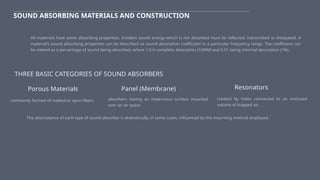
All materiais have some absorbing properties. Incident sound energy which is not absorbed must be reflected, transmitted or dissipated. A
material's sound absorbing properties can be described as sound absorption coefficient in a particular frequency range. The coefficient can
be viewed as a percentage of sound being absorbed, where 1.0 is complete absorption (100%0 and 0.01 being minimal absorption (1%).
SOUND ABSORBING MATERIALS AND CONSTRUCTION
Porous Materials
commonly formed of matted or spun fibers
Panel (Membrane)
absorbers having an impervious surface mounted
over an air space
Resonators
created by holes connected to an enclosed
volume of trapped air.
The absorptance of each type of sound absorber is dramatically, in some cases, influenced by the mounting method employed.
6.
SOUND ABSORBING MATERIALSAND CONSTRUCTION
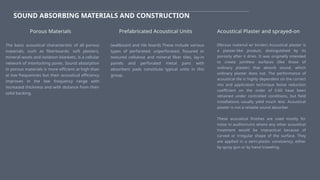
The basic acoustical characteristic of all porous
materials, such as fiberboards, soft plasters,
mineral wools and isolation blankets, is a cellular
network of interlocking pores. Sound absorption
in porous materials is more efficient at high than
at low frequencies but their acoustical efficiency
improves in the low frequency range with
increased thickness and with distance from their
solid backing.
Porous Materials Prefabricated Acoustical Units
(wallboard and tile board) These include various
types of perforated. unperforated, fissured or
textured cellulose and mineral fiber tiles, lay-in
panels and perforated metal pans with
absorbent pads constitute typical units in this
group.
Acoustical Plaster and sprayed-on
(fibrous material w/ binder) Acoustical plaster is
a plaster-like product, distinguished by its
porosity after it dries. It was originally intended
to create jointless surfaces (like those of
ordinary plaster) that absorb sound, which
ordinary plaster does not. The performance of
acoustical tile is highly dependent on the correct
mix and application technique Noise reduction
coefficient on the order of 0.60 have been
obtained under controlled conditions, but field
installations usually yield much less. Acoustical
plaster is not a reliable sound absorber.
These acoustical finishes are used mostly for
noise in auditoriums where any other acoustical
treatment would be impractical because of
curved or irregular shape of the surface. They
are applied in a semi-plastic consisiency, either
by spray gun or by hand troweling.
7.
SOUND ABSORBING MATERIALSAND CONSTRUCTION
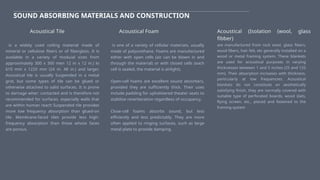
is a widely used ceiling material made of
mineral or cellulose fibers or of fiberglass. It is
available in a variety of moduial sizes from
approximately 300 x 300 men 12 in x 12 in.) lo
610 mm x 1220 mm (24 m. 48 in.) and larger.
Acoustical tile is usually Suspended in a metal
grid, but some types of tile can be glued or
otherwise attached to salid surfaces. It is prone
to darnage wher: contacted and is therefore not
recommended for surfaces. especially walls that
are within human reach Suspended tile provides
more low frequency absorption than glued-on
tile. Membrane-faced tiles provide less high-
frequency absorption than those whose faces
are porous.
Acoustical Tile Acoustical Foam
is one of a variety of cellular materiais, usually
made of polyurethane. Foams are manufactured
either with open cells (air can be blown in and
through the material) or with closed cells (each
cell is sealed, the material is airlight).
Open-cell foams are excellent sound absorbers,
provided they are sufficiently thick. Their uses
include padding for upholstered theater seats to
stabilize reverberation regardless of occupancy.
Close-cell foams absorbs sound, but less
efficiently and less predictably. They are more
often applied to ringing surfaces, such as large
metal plate to provide damping.
Acoustical (Isolation (wool, glass
fibber)
are manufactured from rock wool, glass fibers,
wood fibers, hair felt, etc generally installed on a
wood or metal framing system. These blankets
are used for acoustical purposes in varying
thicknesses between 1 and 5 inches (25 and 125
mm). Their absorption increases with thickness,
particularly at low frequencies. Acoustical
blankets do not constitute an aesthetically
satisfying finish, they are normally covered with
suitable type of perforated boards, wood slats,
flying screen, etc., placed and fastened to the
framing system
8.
SOUND ABSORBING MATERIALSAND CONSTRUCTION
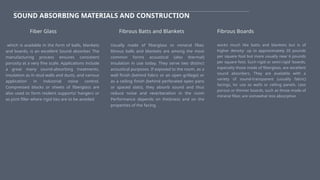
which is available in the form of balls, blankets
and boards, is an excellent Sound absorber. The
manufacturing process ensures consistent
porosity at a very fine scale. Applications include
a great many sound-absorbing treatments,
insulation as in stud walls and ducts, and various
application in industrial noise control.
Compressed blocks or sheets of fiberglass are
also used to form resilent supports/ hangers or
as joint filler where rigid ties are to be avoided
Fiber Glass Fibrous Batts and Blankets
Usually made of fiberglass or mineral fiber,
librous balls and blankets are among the most
common forms acoustical (also thermal)
insulation in use today. They serve two distinct
acoustical purposes. If exposed to the room, as a
wall finish (behind fabric or an open grillage) or
as a ceiling finish (behind perforated open pans
or spaced slats), they absorb sound and thus
reduce noise and reverberation in the room
Performance depends on thickness and on the
properties of the facing.
Fibrous Boards
works much like batts and blankets but is of
higher density- up to approximately 20 pounds
per square foot but more usually near 6 pounds
per square foot. Such rigid or semi-rigid 'boards,
especially those made of fiberglass, are excellent
sound absorbers. They are available with a
variety of sound-transparent (usually fabric)
facings, lor use as walls or ceiling panels. Less
porous or thinner boards, such as those made of
mineral fiber, are somewhat less absorptive.
9.
SOUND ABSORBING MATERIALSAND CONSTRUCTION
is 2 rigid (often structural) material, usually
made of coarse fibers, such as wood fibers,
embedded in a cementitious mix. The fibrous
surface absorbs sound. It exposed to the room,
fibrous planks reduces noise and reverberation
in the room.
Fiber Plank Fibrous Spray
is any of a variety of sprayed-on insulating
material, often specified fur fireproofing
application. Previously made of ashestos fibers,
which are known to be health hazard, most
contemporary sprays contain cellulose or
mineral fibers of various descriptions. Fibrous
spray is inherently porous and therefore
absorptive. However, performance is highly
dependent on thickness and application
technique.
Insulation (Loose)
Loose insulation is similar to fibrous batts and
blankets, except that it can be' blown or dumped
in place. It serves much the same purpose as
batts within a partition; that is, it improves
attenuation through the partition.
10.
Curtains and Fabrics
includea range of textiles that are used on
their own (as curtains; or as covering for
other materials that may or may not be
sound absorbing. Curtains absorb sound if
they are reasonably heavy (at least 500
grams per square meter) and, more
importantly, if their flow resistance is
sufficiently high- to the point of severely
impeding, but not stopping, airflow through
the material.
SOUND ABSORBING MATERIALS AND CONSTRUCTION
carpet
is any of a variety of soft floor finishes made of synthetic materials such as nylon or natural
materials such as wool. It is either glued directly to the floor or installed over an underlayinent of
hairfelt or foam rubber.
In addition to their application as flooring. carpets are being used as versatile acoustical material
because airborne sound and noise within a room, it reduces in some cases almost completely
eliminate impact noises from above, and they eliminate surface noises (shuffling of feet, clicking
of heels, moving of furniture). The use of carpet as sound- absorbing material contributes to the
following:
1. The fiber type has practically no effect on sound absorption.
2. Cut piles provide more absorption than loop pires under otherwise identical conditions
3 Will increased pile height and weight, in cut-pile fabrics, the sound absorption increases
4. In loop pile fabrics when pile weight increases, with the density held constant, sound
absorption improves; when pile weight increases, with the pile constant, sound absorption
increases to a certain level
5. The more permeable backing. the higher the sound absorption
6. Hair, hair jute ad foam rubber pads contribute to higher sound absorption than the less
perineable rubber and urethane-foam pads.
11.
Panel Resonators
are builtwith a membrane such as thin plywood
or linoleum in front of a sealed air space
generally containing absorbent material. The
panel is set in motion by the alternating
pressure of the impinging sound wave.
Wood and Hardwood Panels, gypsum
boards
suspended plaster ceiling, furred-out
plasters, rigid plastic boards, windows,
glazing, wood floors and platforms and
metal plates are of this type of sound
absorption materials. Porous materials
spaced away from their solid backing also
act as vibrating panel absorbers, favorably
contributing to absorption at low
frequencies.
SOUND ABSORBING MATERIALS AND CONSTRUCTION
Panel or Membrane Absorbers
The non-perforated panel, or
membrane absorbers represent the
second group of sound absorbing
materials. impervious material
installed on a solid backing but
separated from it by airspace will act
as panel absorber and wil! vibrate
when struck by sound waves. The
incident sound energy is then
converted to heal. Panels of this son
are efficient low frequency absorbers.
When selected properly, panel
absorbers balance the somewhat
excessive medium and high frequency
absorption of porous absorbers and
room contents.
12.
SOUND ABSORBING MATERIALSAND CONSTRUCTION
Volume or Cavity Resonator (hemholtz Resonators)
The cavity (or Hemholiz) resonators, the third and the last group of sound absorbers, consists of an enclosed body of air confined walls
and connected by a narrow opening (called the neck) to the surrounding space, in which sound travels. The impinging sound causes the
air in the neck to vibrate, and the air mass causes the entire construction to resonate at a particular frequency. By adjusting neck opening
and cavity dimensions, the unit can be tuned to resonate at a desired frequency.
A cavity resonator absorbs the maximum energy in a narrow region of low frequency band. An empty jar or bottle, also act as a cavity
resonator, however, it maximum absorption is confined to a narrow frequency band; that is extremely selective in its absorption.
13.
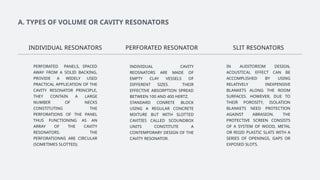
A. TYPES OFVOLUME OR CAVITY RESONATORS
INDIVIDUAL CAVITY
REOSNATORS ARE MADE OF
EMPTY CLAY VESSELS OF
DIFFERENT SIZES. THEIR
EFFECTIVE ABSORPTION SPREAD
BETWEEN 100 AND 400 HERTZ.
STANDARD CONRETE BLOCK
USING A REGULAR CONCRETE
MIXTURE BUT WITH SLOTTED
CAVITIES CALLED SCOUNDBOX
UNITS CONSTITUTE A
CONTEMPORARY DESIGN OF THE
CAVITY RESONATOR.
PERFORATED PANELS, SPACED
AWAY FROM A SOLID BACKING,
PROVIDE A WIDELY USED
PRACTICAL APPLICATION OF THE
CAVITY RESONATOR PRINCIPLE,
THEY CONTAIN A LARGE
NUMBER OF NECKS
CONSTITUTING THE
PERFORATIONS OF THE PANEL
THUS FUNCTIONING AS AN
ARRAY OF THE CAVITY
RESONATORS. THE
PERFORATIONNS ARE CIRCULAR
(SOMETIMES SLOTTED).
INDIVIDUAL RESONATORS SLIT RESONATORS
PERFORATED RESONATOR
IN AUDITORIOM DESIGN,
ACOUSTICAL EFFECT CAN BE
ACCOMPLISHED BY USING
RELATIVELY INEXPENSIVE
BLANKETS ALONG THE ROOM
SURFACES. HOWEVER, DUE TO
THEIR POROSITY, ISOLATION
BLANKETS NEED PROTECTION
AGAINST ABRASION. THE
PROTECTIVE SCREEN CONSISTS
OF A SYSTEM OF WOOD, METAL
OR RIGID PLASTIC SLATS WITH A
SERIES OF OPENINGS, GAPS OR
EXPOSED SLOTS.
14.
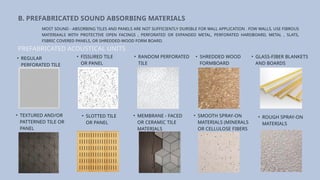
B. PREFABRICATED SOUNDABSORBING MATERIALS
MOST SOUND - ABSORBING TILES AND PANELS ARE NOT SUFFICIENTLY DURSBLE FOR WALL APPLICATION . FOW WALLS, USE FIBROUS
MATERIAALS WITH PROTECTIVE OPEN FACINGS , PERFORATED OR EXPANDED METAL, PERFORATED HARDBOARD, METAL , SLATS,
FSBRIC COVERED PANELS, OR SHREDDED-WOOD FORM BOARD.
PREFABRICATED ACOUSTICAL UNITS
• REGULAR
PERFORATED TILE
• FISSURED TILE
OR PANEL
• RANDOM PERFORATED
TILE
• SHREDDED WOOD
FORMBOARD
• GLASS-FIBER BLANKETS
AND BOARDS
• TEXTURED AND/OR
PATTERNED TILE OR
PANEL
• SLOTTED TILE
OR PANEL
• MEMBRANE - FACED
OR CERAMIC TILE
MATERIALS
• ROUGH SPRAY-ON
MATERIALS
• SMOOTH SPRAY-ON
MATERIALS (MINERALS
OR CELLULOSE FIBERS
15.
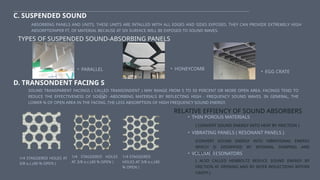
TYPES OF SUSPENDEDSOUND-ABSORBING PANELS
ABSORBING PANELS AND UNITS, THESE UNITS ARE INTALLED WITH ALL EDGES AND SIDES EXPOSED, THEY CAN PROVIDE EXTREMELY HIGH
ABSORPTIONPER FT, OF MATERIAL BECAUSE AT SIX SURFACE WILL BE EXPOSED TO SOUND WAVES.
C. SUSPENDED SOUND
• PARALLEL
1/4 STAGGERED HOLES AT
3/8 o.c.(40 % OPEN )
• HONEYCOMB
• EGG CRATE
D. TRANSONDENT FACING S
SOUND TRANSPARENT FACINGS ( CALLED TRANSONDENT ) MAY RANGE FROM 5 TO 50 PERCENT OR MORE OPEN AREA. FACINGS TEND TO
RESUCE THE EFFECTIVENESS OF SOUND -ABSORBING MATERIALS BY REFLECTING HIGH - FREQUENCY SOUND WAVES. IN GENERAL, THE
LOWER % OF OPEN AREA IN THE FACING ,THE LESS ABSORPTION OF HIGH FREQUENCY SOUND ENERGY.
1/4 STAGGERED HOLES
AT 3/8 o.c.(40 % OPEN )
1/4 STAGGERED
HOLES AT 3/8 o.c.(40
% OPEN )
RELATIVE EFFIENCY OF SOUND ABSORBERS
• THIN POROUS MATERIALS
( CONVERT SOUND ENERGY INTO HEAT BY FRICTION )
• VIBRATING PANELS ( RESONANT PANELS )
(CONVERT SOUND ENERGY INTO VIBRATIONAL ENERGY
WHICH IS DISSIPATED BY INTERNAL DAMPING AND
RADIATION )
• VOLUME RESONATORS
( ALSO CALLED HEMBOLTZ REDUCE SOUND ENERGY BY
FRICTION AT OPENING AND BY INTER REFLECTIONS WITHIN
CAVITY.)
16.
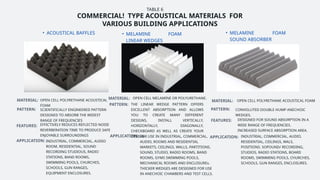
COMMERCIAL! TYPE ACOUSTICALMATERIALS FOR
VARIOUS BUILDING APPLICATIONS
TABLE 6
• ACOUSTICAL BAFFLES • MELAMINE FOAM
LINEAR WEDGES
• MELAMINE FOAM
SOUND ABSORBER
MATERIAL: OPEN CELL POLYRETHANE ACOUSTICAL
FOAM
PATTERN: SCIENTIFICALLY ENGINEERED PATTERN
DESIGNED TO ABSORB THE WIDEST
RANGE OF FREQUENCIES
FEATURES: EFFICTIVELY REDUCES REFLECTED NOISE
REVERBERATION TIME TO PRODUCE SAFE
ENJOYABLE SURROUNDINGS
APPLICATION: INDUSTRIAL, COMMERCIAL, AUDIO
ROOM, RESIDENTIAL, SOUND
RECORDING STUDIOUS, RADIO
STATIONS, BAND ROOMS,
SWIMMING POOLS, CHURCHES,
SCHOOLS, GUN RANGES,
EQUIPMENT ENCLOSURES.
MATERIAL:
PATTERN:
APPLICATION:
OPEN CELL MELAMINE OR POLYURETHANE.
THE LINEAR WEDGE PATTERN OFFERS
EXCELLENT ABSORPTION AND ALLOWS
YOU TO CREATE MANY DIFFERENT
DESIGNS, INSTALL VERTICALLY,
HORIZONTALLY, DIAGONALLY,
CHECKBOARD AS WELL AS CREATE YOUR
DESIGN
FOR USE IN INDUSTRIAL, COMMERCIAL,
AUDIO, ROOMS AND RESIDENTIAL
MARKETS, CEILINGS, WALLS, PARTITIONS,
SOUND, STUDIO, RADIO ROOMS, BAND
ROOMS, GYMS SWIMMING POOLS,
MECHANICAL ROOMS AND ENCLOSUREs.
THICKER WEDGES ARE DESIGNED FOR USE
IN ANECHOIC CHAMBERS AND TEST CELLS.
MATERIAL: OPEN CELL POLYRETHANE ACOUSTICAL FOAM
PATTERN: CONVOLUTED DOUBLE HUMP ANECHOIC
WEDGES.
FEATURES: DESIGNED FOR SOUND ABSORPTION IN A
WIDE RANGE OF FREQUENCIES.
INCREASED SURFACE ABSORPTION AREA.
APPLICATION: INDUSTRIAL, COMMERCIAL, AUDIO,
RESIDENTIAL, CEILINGS, WALS,
POSITIONS. SOPOUND/ RECORDING,
STUDIOS, RADIO STATIONS, BOARD
ROOMS, SWIMMING POOLS, CHURCHES,
SCHOOLS, GUN RANGES, ENCLOSURES.
17.
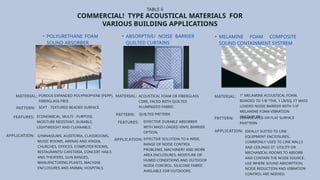
TABLE 6
COMMERCIAL! TYPEACOUSTICAL MATERIALS FOR
VARIOUS BUILDING APPLICATIONS
• POLYURETHANE FOAM
SOUND ABSORBER
• ABSORPTIVE/ NOISE BARRIER
QUILTED CURTAINS
• MELAMINE FOAM COMPOSITE
SOUND CONTAINMENT SYSTREM
MATERIAL:
PATTERN:
FEATURES:
APPLICATION:
POROUS EXPANDED POLYPROPYENE (PEPP),
FIBERGLASS-TREE.
SOFT - TEXTURED BEADED SURFACE
GYMNASIUMS, AUDITORIA, CLASSROOMS,
MUSIC ROOMS, ARENAS AND ATADIA,
CHURCHES, OFFICES, COMPUTER ROOMS,
RESTAURANTS/ CAFETERIA, CONCERT HAILS
AND THEATERS, GUN RANGES,
MANUFACTURING PLANTS, MACHINE
ENCLOSURES AND ANIMAL HOSPITALS.
ECONOMICAL, MULTI - PURPOSE,
MOISTURE RESISTANT, DURABLE,
LIGHTWEIGHT AND CLEANABLE.
MATERIAL:
PATTERN:
ACOUSTICAL FOAM OR FIBERGLASS
CORE, FACED WITH QUILTED
ALUMINIZED FABRIC.
QUILTED PATTERN
FEATURES: EFFECTIVE DURABLE ABSORBER
WITH MASS LOADED VINYL BARRIER
OPTION.
APPLICATION: EFFECTIVE SOLUTION TO A WIDE,
RANGE OF NOISE CONTROL
PROBLEMS. MACHINERY AND WORK
AREA ENCLOSURES, MOISTURE OR
HUMID CONDITIONS AND OUTDOOR
NOISE CONTROL. SILICONE FABRIC
AVAILABLE FOR OUTDOORS.
MATERIAL:
PATTERN:
1" MELAMINE ACOUSTICAL FOAM,
BONDED TO 1/8 “THK, 1 LB/SQ. FT MASS
LOADED NOISE BARRIER WITH 1/4”
MELAMINE FOAM VIBRATION
DECOUPLER
CONVOLUTED OR FLAT SURFACE
PAATTERN
APPLICATION: IDEALLY SUITED TO LINE
EQUIPMENT ENCIOSURES,.
COMMONLY USED TO LINE WALLS
AND CEILINGS O”. UTILITY OR
MECHANICAL ROOMS TO ABSORB
AND CONTAIN THE NOISE SOURCE.
USE WHERE SOUND ABSORPTION,
NOISE REDUCTION AND VIBRATION
CONTROL ARE NEEDED.
18.
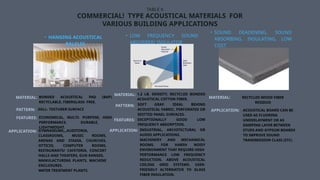
TABLE 6
COMMERCIAL! TYPEACOUSTICAL MATERIALS FOR
VARIOUS BUILDING APPLICATIONS
• HANGING ACOUSTICAL
BALFLES
• LOW FREQUENCY SOUND
ABSORBER/ INSULATOR
MATERIAL: BONDED ACOUSTICAL PAD (BAP).
RECYCLABLE, FIBERGLASS- FREE.
PATTERN:
FEATURES:
APPLICATION:
SOLL- TEXTURER SURFACE
ECONOMICAL, MULTI- PURPOSE, HIGH
PERFORMANCE. DURABLE,
LIGHTWEIGHT.
GYMNASIUMS,,,AUDITORIA,
CLASSROOMS, MUSIC ROOMS,
ARENAS AND STADIA, CHURCHES,
OTTICES, COMPUTER ROOMS,
RESTAURANTS/ CAFETERIA, CONCERT
HALLS AND THEATERS, GUN RANGES,
MANULACTURING PLANTS, MACHINE
ENCLOSURES.
WATER TREATMENT PLANTS.
MATERIAL:
PATTERN:
FEATURES:
APPLICATION:
1.2 LB. DENSITY, RECYCLED BONDED
ACOUSTICAL COTTON FIBER.
• SOUND DEADENING, SOUND
ABSORBING, INSULATING, LOW
COST
MATERIAL:
SOFT GRAY. IDEAL BEHIND
ACOUSTICAL FABRIC, PERFORATED OR
SIOTTED PANEL SURFACES.
EXCEPTIONALLY GOOD LOW
FREQUENCY ABSORPTION.
INDUSTRIAL, ARCHITECTURAL OR
AUDIO APPLICATIONS,
MACHINERY AND MECHANICAL
ROOMS. FOR HARSH NOISY
ENVIRONMENT THAT REQUIRE HIGH
PERTORMANCE LOW FREQUENCY
REDUCTION. ABOVE ACOUSTICAL
CEILING GRID SYSTEMS. USER-
FRIENDLY ALTERNATIVE TO GLASS
FIBER INSULATION.
APPLICATION:
RECYCLED WOOD FIBER
RESIDUO
ACOUSTICAL BOARD CAN BE
USED AS FLUORING
UNDERLAYMENT OR AS
DAMPING LAYER BETWEEN
STUDS AND GYPSUM BOARDS
TO IMPROVE SOUND
TRANSMISSION CLASS (STC)
19.
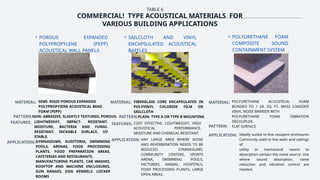
TABLE 6
COMMERCIAL! TYPEACOUSTICAL MATERIALS FOR
VARIOUS BUILDING APPLICATIONS
• POROUS EXPANDED
POLYPROPYLENE (PEPP)
ACOUSTICAL WALL PANELS
• SAILCLOTH AND VINYL
ENCAPSULATED ACOUSTICAL
BAFFLES
• POLYURETHANE FOAM
COMPOSITE SOUND
CONTAINMENT SYSTEM
MATERIAL:
PATTERN:
FEATURES:
APPLICATION:
SEMI- RIGID POROUS EXPANDED
POLYPROPYIENE ACOUSTICAL BEAD
FOAM (PEPP)
NON- ABRASIVE, SLIGHTLY TEXTURED, POROUS.
LIGHTWEIGHT, IMPACT- RESISTANT,
MOISTURE, BACTERIA AND FUNGI-
RESISTANT. TACKABLE SURLACE, UV
STABLE.
GYMNASIUMS, AUDITORIA, SWIMMING
POOLS, ARENAS, FOOD PROCESSING
PLANTS, FOOD PREPARATION AREAS,
CAFETERIAS AND RESTAURANTS,
MANUFACTURING PLANTS, CAR WASHES,
ROOFTOP AND MACHINE ENCLOSURES,
GUN RANGES, DOG KENNELS. LOCKER
ROOMS
MATERIAL: FIBERGLASS CORE ENCAPSULATED IN
POLYVINYL CHLORIDE FILM OR
SAILCLOTH
PATTERN:PLAIN- TYPE A OR TYPE B MOUNTING
FEATURES: COST EFFECTIVE, LIGHTWEIGHT, HIGH
ACOUSTICAL PERFORMANCE,
MOISTURE AND CHEMICAL RESISTANT.
APPLICATION: ANY LARGE AREA WHERE NOISE
AND REVERBERATION NEEDS TO BE
REDUCED. GYMNASIUMS,
COMMUNITY CENTERS, SPORTS
ARENA, SWIMMING POOLS,
FACTORIES, ANIMAL HOSPITALS,
FOOD PROCESSING PLANTS, LARGE
OPEN AREAS.
MATERIAL: POLYURETHANE ACOUSTICAL FOAM
BONDED TO 1 LB. SQ. FT. MASS LOADDED
VINYL NOISE BARRIER WITH
POLYURETHANE FOAM VIBRATION
DECOUPLER.
PATTERN: FLAT SURFACE
APPLICATION: Ideally suited to line ceuipent enclosures
Commonly used to line walls and ceilings
of
utility or mechanical rooms to
absorption contain the noise source. Use
where sound absorption, noise
reduction and vibration control are
needed.
20.
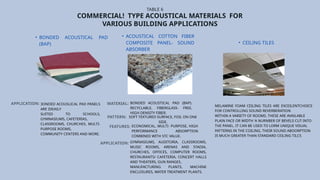
TABLE 6
COMMERCIAL! TYPEACOUSTICAL MATERIALS FOR
VARIOUS BUILDING APPLICATIONS
• BONDED ACOUSTICAL PAD
(BAP)
APPLICATION: 3ONDED ACOUSLICAL PAD PANELS
ARE IDEAILY
SUITED TO SCHOOLS,
GYMNASIUMS, CAFETERIAS,
CLASSROOMS, CHURCHES, MULTI-
PURPOSE ROOMS,
COMMUNITY CENTERS AND MORE.
• ACOUSTICAL COTTON FIBER
COMPOSITE PANEL- SOUND
ABSORBER
MATERIAL: BONDED ACOUSTICAL PAD (BAP).
RECYCLABLE, FIBERGLASS- FREE,
HIGH DENSITY FIBER.
PATTERN: SOFT TEXTURED SURFACE, FOIL ON ONE
SIDE.
FEATURES: ECONOMICAL, MULTI- PURPOSE, HIGH
PERFORMANCE ABSORPTION
COMBINED WITH STC VALUE.
APPLICATION: GYMNASIUMS, AUDITORIA, CLASSROOMS,
MUSIC ROOMS, ARENAS AND STADIA,
CHURCHES, OFFICES, COMPUTER ROOMS,
RESTAURANTS/ CAFETERIA, CONCERT HALLS
AND THEATERS, GUN RANGES,
MANUFACTURING PLANTS, MACHINE
ENCLOSURES, WATER TREATMENT PLANTS.
• CEILING TILES
MELAMINE FOAM CEILING TILES ARE EXCEILENTCHOICE
FOR CONTROLLING SOUND REVERBERATION
WITHIN A VARIETY OF ROOMS. THESE ARE AVAILABLE
PLAIN FACE OR WIDTH 'A NURNBER OF BEVELS CUT INTO
THE PANEL. IT CAN BE USED TO LORM UNIQUE VISUAL
PATTERNS IN THE COILING. THEIR SOUND ABOORPTION
IS MUCH GREATER THAN STANDARD CEILING TILCS
21.
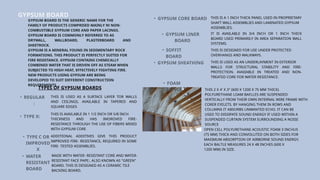
GYPSUM BOARD ISTHE GENERIC NAME FOR THE
FAMILY OF PRODUCTS COMPRISED MAINLY N! NON-
COMBUSTIBLE GYPSUM CORE AND PAPER LACINGS.
GYPSUM BOARD IS COMMONLY REFERRED TO AS
DRYWALL, WALLBOARD, PLASTERBOARD AND
SHEETROCK.
GYPSUM IS A MINERAL FOUND IN SEDIMENTARY ROCK
FORMATIONS. THIS PRODUCT IS PERFECTLY SUITED FOR
FIRE RESISTANCE. GYPSUM CONTAINS CHEMICALLY
COMBINED WATER THAT IS DRIVEN OFF AS STEAM WHEN
SUBJECTED TO HIGH HEAT, EFFECTIVELY FIGHTING FIRE.
NEW PRODUCTS USING GYPSUM ARE BEING
DEVELOPED TO SUIT DIFFERENT CONSTRUCTION
REQUIREMENTS.
GYPSUM BOARD
TYPES OF GYPSUM BOARDS
• REGULAR
:
THIS IS USED AS A SURTACE LAYER TOR WALLS
AND CEILINGS, AVAILABLE IN TAPERED AND
SQUARE EDGES
• TYPE X:
THIS IS AVAILABLE IN 1 1/2 INCH OR 5/8 INCH
THICKNESS AND HAS IMOROVED FIRE-
RESISTANCE THROUGH THE USE OF FIBERS MIXED
WITH GYPSUM CORE
• TYPE C OR
IMPROVED
X
ADDITIONAL ADDITIVES GIVE THIS PRODUCT
IMPROVED FIRE- RESISTANCE, REQUIRED IN SOME
FIRE- TESTED ASSEMBLIES.
• WATER
RESISTANT
BOARD
MADE WITH WATER- RESISTANT CORE AND WATER-
RESISTANT FACE PAPE:, ALSO KNOWN AS "GREEN"
BOARD. THIS IS DESIGNED AS A CERAMIC TILE
BACKING BOARD.
• GYPSUM CORE BOARD THIS IS A 1 INCH THICK PANEL USED IN PROPRIETARY
SHAFT WALL ASSEMBLIES AND LAMINATED GYPSUM
ASSEMBLIES.
• GYPSUM LINER
BOARD
IT IS AVAILABLE IN 3/4 INCH OR 1 INCH THICK
BOARD USED PRIMARILY IN AREA SEPARATION WALL
SYSTEMS.
• SOFFIT
BOARD
THIS IS DESIGNED FOR USE UNDER PROTECTED
OVERHANGS AND WALKWAYS.
• GYPSUM SHEATHING THIS IS USED AS AN UNDERLAYMENT IN EXTERIOR
WALLS FOR STRUCTURAL STABILITY AND FIRE-
PROTECTION. AVAIIABLE IN TREATED AND NON-
TREATED CORE FOR WATER RESISTANCE.
• FOAM
BAFFLE THIS 2 X 4' X 3" (600 X 1200 X 75 MM THICK)
POLYURETHANE LOAM BAFLLES ARE SUSPENDED
VERTICALLY FROM THEIR OWN INTERNAL WIRE FRAME WITH
CORER EYELETS. BY HANGING THEM IN ROWS AND
COLUMNS IT ABSORBS UNWANTED ECHO. IT CAN BE
USED TO DISSIPATE SOUND ENERGY IF USED WITHIN A
SUSPENDED CURTAIN SYSTEM SURROUNDING A NOISE
SOURCE
OPEN CELL POLYURETHANE ACOUSTIC FOAM 3 INCHUS
(75 MM) THICK AND CONVOLUTED ON BOTH SIDES FOR
MAXIMUM ABSORPTION OF AIRBORNE SOUND ENERGY.
EACH BALTLE MEASURES 24 X 48 INCHES (600 X
1200 MM) IN SIZE.
22.
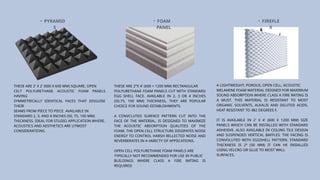
• PYRAMID
S
THESE ARE2' X 2' (600 X 600 MM) SQUARE, OPEN
CELT POLYURETHANE ACOUSTIC FOAM PANELS
HAVING
SYMMETRICALLY IDENTICAL FACES THAT DISGUISE
THEIR
SEAMS FROM PIECE TO PIECE. AVAILABLE IN
STANDARD 2, 3, AND 4 INCHES (50, 75, 100 MM)
THICKNESS. IDEAL FOR STUDIO APPLICATION WHERE.
ACOUSTICS AND AESTHETICS ARE UTMOST
CONSIDERATIONS.
• FOAM
PANEL
THESE ARE 2°X 4' (600 × 1200 MM) RECTANGULAR
POLYURETHANE FOAM PANELS CUT WITH STANDARD
EGG SHELL FACE. AVAILABLE IN 2, 3 OR 4 INCHES
(50,75, 100 MM) THICKNESS, THEY ARE POPULAR
CHOICE FOR SOUND ESTABLISHMENTS.
A CONVCLUTED SURFACE PATTERN CUT INTO THE
FACE OF THE MATERIAL, IS DESIGNED TO MAXIMIZE
THE ACOUSTIC ABSORPTION QUALITIES OF THE
FOAM. THE OPEN CELL STRUCTURE DISSIPATES NOISE
ENERGY TO CONTROL HARSH RELLECTED NOISE AND
REVERBERATES IN A VARICTY OF APPIICATIONS.
OPEN CELL POLYURETHANE FOAM PANELS ARE
TYPICALLY NOT RECOMMENDED FOR USE IN PUBLIC
BUILDINGS WHERE CLASS A FIRE RATING IS
REQUIRED.
• FIREFLE
X
A LIGHTWEIGHT, POROUS, OPEN CELL, ACOUSTIC
MELAMINE FOAM MATERIAL DEIGNED FOR MAXIMUM
SOUND ABSORPTION WHERE CLASS A FIRE RATING IS
A MUST. THIS MATERIAL IS RESISTANT TO MOST
ORGANIC SOLVENTS, ALKALIS AND DILUTED ACIDS.
HEAT RESISTANT TO 482 DEGREES F.
IT IS AVAILABLE IN 2' X 4' (600 X 1200 MM) SIZE
PANELS WHICH CAN BE INSTALLED WITH STANDARD
ADHESIVE. ALSO AVAILABLE IN CEILING TILE DESIGN
AND SUSPENDED VERTICAL BAFFLES. THE FACING IS
CONVOLUTED WITH EGGSHELL PATTERN. STANDARD
THỊCKNESS IS 2ª (50 MM) IT CAN HE INSIALLED
USING VELCRO OR GLUE TO MOST WALL
SURFACES.
23.
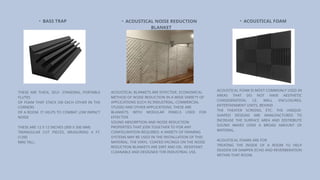
• BASS TRAP
THESEARE THICK, SELF- STANDING, PORTABLE
FLUTES
OF FOAM THAT STACK ON EACH OTHER IN THE
CORNERS
OF A ROOM. IT HELPS TO COMBAT LOW IMPACT
NOISE
THESE ARE 12 X 12 INCHES (300 X 300 MM)
TRIANGULAR CUT PIECES, MEASURING 4 FT.
(1200
MM) TALL.
• ACOUSTICAL NOISE REDUCTION
BLANKET
ACOUSTICAL BLANKETS ARE EFFECTIVE, ECONOMICAL
METHOD OF NOISE REDUCTION IN A WIDE VARIETY OF
APPLICATIONS SUCH AS INDUSTRIAL, COMMERCIAL
STUDIO AND OTHER APPLICATIONS. THESE ARE
BLANKETS WITH MODULAR PANELS USED FOR
EFFECTIVE
SOUND ABSORPTION AND NOISE REDUCTION
PROPERTIES THAT JOIN TOGETHER TO FOR ANY
CONFIGURATION REQUIRED. A VARIETY OF FRAMING
SYSTEMS MAY BE USED IN THE INSTALLATION OF THIS
MATERIAL. THE VINYL- COATED FACINGS ON THE NOISE
REDUCTION BLANKETS ARE DIRT AND OIL- RESISTANT,
CLEANABLE AND DESIGNED TOR INDUSTRIAL USE.
• ACOUSTICAL FOAM
ACOUSTICAL FOAM IS MOST COMMONLY USED IN
AREAS THAT DO NOT HAVE AESTHETIC
CONSIDERATION, I.E. WALL ENCLOSURES,
ENTERTAINMENT UNITS, BEHIND
THE THEATER SCREENS, ETC. THE UNIQUE-
SHAPED DESIGNS ARE MANUFACTURED TO
INCREASE THE SURFACE AREA AND DISTRIBUTE
SOUND WAVES OVER A BROAD AMOUNT OF
MATERIAL.
ACOUSTICAL FOAMS ARE FOR
TREATING THE INSIDE OF A ROOM TO HELP
DEADEN OR DAMPEN ECHO AND REVERBERATION
WITHIN THAT ROOM.
24.
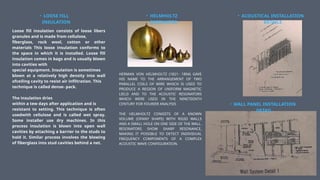
• LOOSE FILL
INSULATION
Loosefill insulation consists of loose libers
granules and is made from cellulose,
fiberglass, rock wool, cotton or other
materials This loose insulation conforms to
the space in which it is installed. Loose fill
insulation comes in bags and is usually blown
into cavities with
special equipment. Insulation is sometimes
blown at a relatively high density into wall
ofceiling cavity to resist air infiltration. This
technique is called dense- pack.
The insulation dries
within a tew days after application and is
resistant to setting. This technique is often
usedwith cellulose and is called wet spray.
Some installer use dry machines. In this
process insulation is blown into open wall
cavities by attaching a barrier to the studs to
hold it. Similar process involves the blowing
of fiberglass into stud cavities behind a net.
• HELMHOLTZ
RESONATOR
HERMAN VON HELMHOLTZ (1821- 1894) GAVE
HIS NAME TO THE ARRANGEMENT OF TWO
PARALLEL COILS OF WIRE WHICH IS USED TO
PRODUCE A REGION OF UNIFORM MAGNETIC
LIELD AND TO THE ACOUSTIC RESONATORS
WHICH WERE USED IN THE NINETEENTH
CENTURY FOR FOURIER ANALYSIS
THE HELMHOLTZ CONSISTS OF A KNOWN
VOLUME (OFANY SHAPE) WITH RIGID WALLS
AND A SMALL HOLE ON ONE SIDE OF THE WALL.
RESONATORS SHOW SHARP RESONANCE,
MAKING IT POSSIBLE TO DETECT INDIVIDUAL
FREQUENCY COMPONENTS OF A COMPLEX
ACOUSTIC WAVE CONFIGURATION.
• ACOUSTICAL INSTALLATION
DETAILS
• WALL PANEL INSTALLATION
DETAIL