John Wiley &Sons, Inc.
Financial Accounting, 4e
Weygandt, Kieso, & Kimmel
Prepared by
Gregory K. Lowry
Mercer University
Marianne Bradford
The University of Tennessee
2.
After studying thischapter, you should be able to:
1 Explain the meaning of generally accepted
accounting principles and identify the key items
of the conceptual framework.
2 Describe the basic objectives of financial
reporting.
3 Discuss the qualitative characteristics of
accounting information and elements of
financial statements.
CHAPTER 7
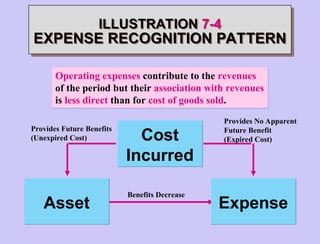
ACCOUNTING PRINCIPLES
3.
4 Identify thebasics assumptions used by
accountants.
5 Identify the basic principles of accounting.
6 Identify the two constraints in accounting.
7 Understand and analyze classified financial
statements.
8 Explain the accounting principles used in
international operations.
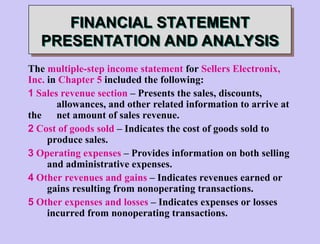
After studying this chapter, you should be able to:
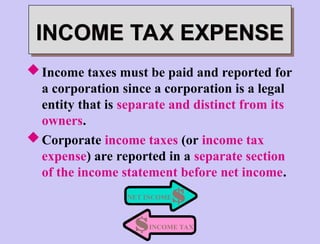
CHAPTER 7
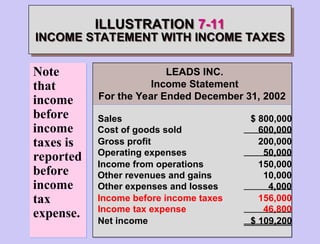
ACCOUNTING PRINCIPLES
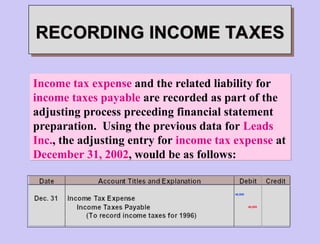
4.
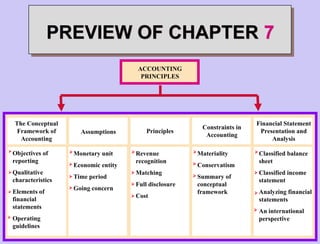
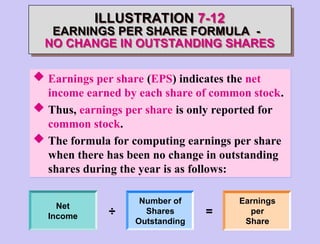
PREVIEW OF CHAPTER7
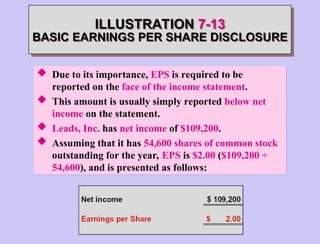
ACCOUNTING
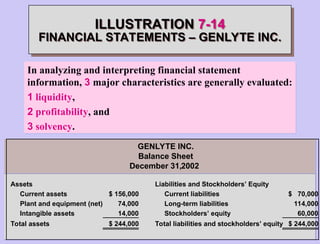
PRINCIPLES
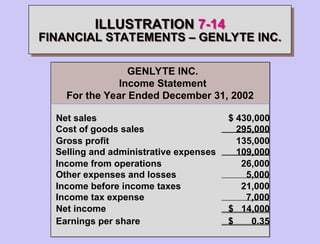
Monetary unit
Economic entity
Time period
Going concern
Assumptions
The Conceptual
Framework of
Accounting
Objectives of
reporting
Qualitative
characteristics
Elements of
financial
statements
Operating
guidelines
Principles
Revenue
recognition
Matching
Full disclosure
Cost
Constraints in
Accounting
Materiality
Conservatism
Summary of
conceptual
framework
Financial Statement
Presentation and
Analysis
Classified balance
sheet
Classified income
statement
Analyzing financial
statements
An international
perspective
5.
THE CONCEPTUAL FRAMEWORK
OFACCOUNTING
Generally accepted accounting principles are a set of
rules and practices that are recognized as a general
guide for financial reporting purposes.
Generally accepted means that these principles must
have substantial authoritative support.
This support usually comes from the Financial
Accounting Standards Board (FASB) and Securities
and Exchange Commission (SEC).
The FASB has the responsibility for developing
accounting principles in the United States.
6.
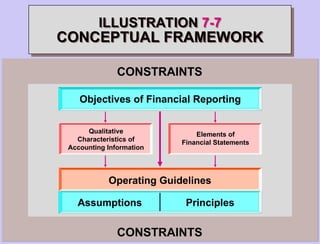
The conceptualframework developed by the
FASB serves as the basis for resolving accounting
and reporting problems.
The conceptual framework consists of:
1 objectives of financial reporting;
2 qualitative characteristics of
accounting information;
3 elements of financial statements; and
4 Operating guidelines (assumptions,
principles, and constraints).
THE CONCEPTUAL FRAMEWORK
OF ACCOUNTING
7.
OBJECTIVES OF
FINANCIAL REPORTING
TheFASB concluded that the objectives of financial
reporting are to provide information that:
1 Is useful to those making investment and credit
decisions.
2 Is helpful in assessing future cash flows.
3 Identifies the economic resources (assets), the claims
to those resources (liabilities), and the changes in
those resources and claims.
8.
The FASBconcluded that the overriding criterion by
which accounting choices should be judged is
decision usefulness.
To be useful, information should possess the
following qualitative characteristics:
1 relevance,
2 reliability, and
3 comparability and consistency.
QUALITATIVE CHARACTERISTICS
OF ACCOUNTING INFORMATION
9.
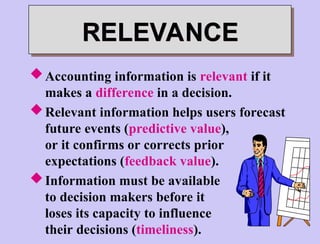
Accounting information isrelevant if it
makes a difference in a decision.
Relevant information helps users forecast
future events (predictive value),
or it confirms or corrects prior
expectations (feedback value).
Information must be available
to decision makers before it
loses its capacity to influence
their decisions (timeliness).
RELEVANCE
10.
RELIABILITY
Reliability ofinformation means that
the information is free of error and
bias; it can be depended on.
To be reliable, accounting information
must be verifiable – we must be able to
prove that it is free of error and bias.
The information must be a faithful
representation of what it purports to be
– it must be factual.
11.
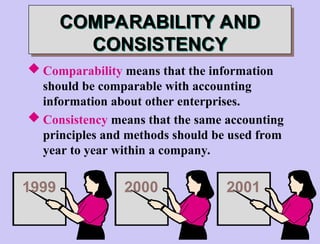
COMPARABILITY AND
CONSISTENCY
Comparabilitymeans that the information
should be comparable with accounting
information about other enterprises.
Consistency means that the same accounting
principles and methods should be used from
year to year within a company.
1999 2000 2001
12.
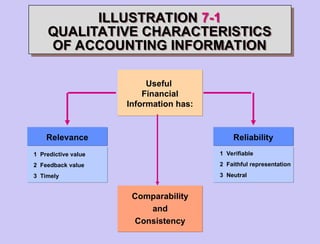
ILLUSTRATION 7-1
QUALITATIVE CHARACTERISTICS
OFACCOUNTING INFORMATION
Relevance
1 Predictive value
2 Feedback value
3 Timely
Reliability
1 Verifiable
2 Faithful representation
3 Neutral
Comparability
and
Consistency
Useful
Financial
Information has:
13.
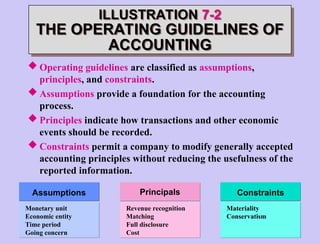
Operating guidelinesare classified as assumptions,
principles, and constraints.
Assumptions provide a foundation for the accounting
process.
Principles indicate how transactions and other economic
events should be recorded.
Constraints permit a company to modify generally accepted
accounting principles without reducing the usefulness of the
reported information.
ILLUSTRATION 7-2
THE OPERATING GUIDELINES OF
ACCOUNTING
Assumptions
Monetary unit
Economic entity
Time period
Going concern
Principals
Revenue recognition
Matching
Full disclosure
Cost
Constraints
Materiality
Conservatism
14.
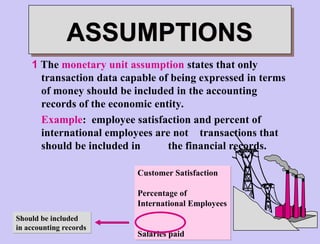
1 The monetaryunit assumption states that only
transaction data capable of being expressed in terms
of money should be included in the accounting
records of the economic entity.
Example: employee satisfaction and percent of
international employees are not transactions that
should be included in the financial records.
ASSUMPTIONS
Customer Satisfaction
Percentage of
International Employees
Salaries paid
Should be included
in accounting records
15.
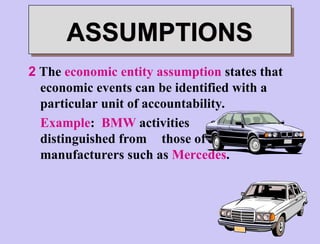
2 The economicentity assumption states that
economic events can be identified with a
particular unit of accountability.
Example: BMW activities can be
distinguished from those of other car
manufacturers such as Mercedes.
ASSUMPTIONS
16.
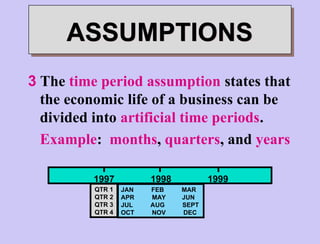
3 The timeperiod assumption states that
the economic life of a business can be
divided into artificial time periods.
Example: months, quarters, and years
ASSUMPTIONS
QTR 1
QTR 2
QTR 3
QTR 4
1997 1998 1999
JAN FEB MAR
APR MAY JUN
JUL AUG SEPT
OCT NOV DEC
17.
4 The goingconcern assumption assumes that the
enterprise will continue in operation long enough
to carry out its existing objectives.
Implications: depreciation and amortization are
used, plant assets recorded at cost instead of
liquidation value, items are labeled as fixed or
long-term.
ASSUMPTIONS
18.
The revenuerecognition
principle dictates that revenue
should be recognized in the
accounting period in which
it is earned.
When a sale is involved,
revenue is recognized at
the point of sale.
PRINCIPLES
REVENUE RECOGNITION
19.
Expense recognitionis traditionally tied to revenue
recognition.
This practice – referred to as the matching principle –
dictates that expenses be matched with revenues in the
period in which efforts are expended to generate revenues.
To understand the various approaches for matching
expenses and revenues on the income statement, it is
necessary to examine the nature of expenses.
1 Expired costs are costs that will generate revenues only
in the current period and are therefore reported as
operating expenses on the income statement.
2 Unexpired costs are costs that will generate revenues in
future accounting periods and are recognized as assets.
PRINCIPLES
MATCHING (EXPENSE RECOGNITION)
20.
Unexpired costs becomeexpenses in 2 ways:
1 Cost of goods sold – Costs carried as
merchandise inventory are expensed as cost
of goods sold in the period in which the sale
occurs – so there is a direct matching of
expenses with revenues.
2 Operating expenses – Unexpired costs
become operating expenses through use or
consumption or through the passage of time.
PRINCIPLES
MATCHING (EXPENSE RECOGNITION)
21.
Cost
Incurred
Asset Expense
ILLUSTRATION 7-4
EXPENSERECOGNITION PATTERN
Operating expenses contribute to the revenues
of the period but their association with revenues
is less direct than for cost of goods sold.
Benefits Decrease
Provides Future Benefits
(Unexpired Cost)
Provides No Apparent
Future Benefit
(Expired Cost)
22.
PRINCIPLES
FULL DISCLOSURE
Thefull disclosure principle requires that
circumstances and events that make a
difference to financial statement users be
disclosed.
Compliance with the full disclosure principle
is accomplished through
1 the data in the financial statements and
2 the notes that accompany the statements.
A summary of significant accounting policies
is usually the first note to the financial
statements.
23.
PRINCIPLES
COST
The costprinciple dictates that assets are
recorded at their cost.
Cost is used because it is both relevant and
reliable.
1 Cost is relevant because if represents a) the
price paid, b) the assets sacrificed, or c)
the commitment made at the date of
acquisition.
2 Cost is reliable because it is a) objectively
measurable, b) factual, and c) verifiable.
24.
CONSTRAINTS IN
ACCOUNTING
Constraintspermit a company to modify generally
accepted accounting principles without reducing
the usefulness of the reported information.
The constraints are materiality and conservatism.
1 Materiality relates to an item’s impact on a
firm’s overall financial condition and
operations.
2 Conservatism in accounting means that, when
in doubt, the accountant chooses the method
that will be the least likely to overstate assets
and income.
ILLUSTRATION 7-8
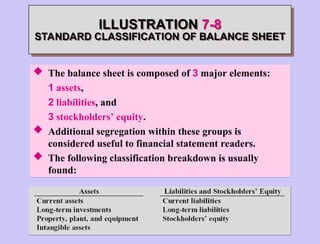
STANDARD CLASSIFICATIONOF BALANCE SHEET
The balance sheet is composed of 3 major elements:
1 assets,
2 liabilities, and
3 stockholders’ equity.
Additional segregation within these groups is
considered useful to financial statement readers.
The following classification breakdown is usually
found:
27.
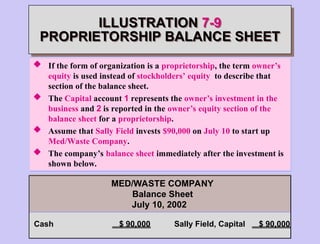
MED/WASTE COMPANY
Balance Sheet
July10, 2002
Cash $ 90,000 Sally Field, Capital $ 90,000
ILLUSTRATION 7-9
PROPRIETORSHIP BALANCE SHEET
If the form of organization is a proprietorship, the term owner’s
equity is used instead of stockholders’ equity to describe that
section of the balance sheet.
The Capital account 1 represents the owner’s investment in the
business and 2 is reported in the owner’s equity section of the
balance sheet for a proprietorship.
Assume that Sally Field invests $90,000 on July 10 to start up
Med/Waste Company.
The company’s balance sheet immediately after the investment is
shown below.
28.
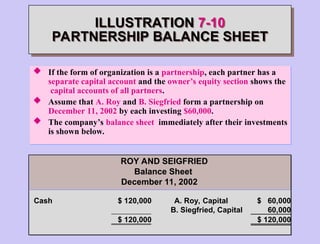
ROY AND SEIGFRIED
BalanceSheet
December 11, 2002
Cash $ 120,000 A. Roy, Capital $ 60,000
B. Siegfried, Capital 60,000
$ 120,000 $ 120,000
ILLUSTRATION 7-10
PARTNERSHIP BALANCE SHEET
If the form of organization is a partnership, each partner has a
separate capital account and the owner’s equity section shows the
capital accounts of all partners.
Assume that A. Roy and B. Siegfried form a partnership on
December 11, 2002 by each investing $60,000.
The company’s balance sheet immediately after their investments
is shown below.
29.
FINANCIAL STATEMENT
PRESENTATION ANDANALYSIS
The multiple-step income statement for Sellers Electronix,
Inc. in Chapter 5 included the following:
1 Sales revenue section – Presents the sales, discounts,
allowances, and other related information to arrive at
the net amount of sales revenue.
2 Cost of goods sold – Indicates the cost of goods sold to
produce sales.
3 Operating expenses – Provides information on both selling
and administrative expenses.
4 Other revenues and gains – Indicates revenues earned or
gains resulting from nonoperating transactions.
5 Other expenses and losses – Indicates expenses or losses
incurred from nonoperating transactions.
30.
Income taxes mustbe paid and reported for
a corporation since a corporation is a legal
entity that is separate and distinct from its
owners.
Corporate income taxes (or income tax
expense) are reported in a separate section
of the income statement before net income.
NET INCOME
INCOME TAX
INCOME TAX EXPENSE
31.
LEADS INC.
Income Statement
Forthe Year Ended December 31, 2002
Sales $ 800,000
Cost of goods sold 600,000
Gross profit 200,000
Operating expenses 50,000
Income from operations 150,000
Other revenues and gains 10,000
Other expenses and losses 4,000
Income before income taxes 156,000
Income tax expense 46,800
Net income $ 109,200
ILLUSTRATION 7-11
INCOME STATEMENT WITH INCOME TAXES
Note
that
income
before
income
taxes is
reported
before
income
tax
expense.
32.
46,800
46,800
RECORDING INCOME TAXES
Incometax expense and the related liability for
income taxes payable are recorded as part of the
adjusting process preceding financial statement
preparation. Using the previous data for Leads
Inc., the adjusting entry for income tax expense at
December 31, 2002, would be as follows:
33.
ILLUSTRATION 7-12
EARNINGS PERSHARE FORMULA -
NO CHANGE IN OUTSTANDING SHARES
Net
Income
Number of
Shares
Outstanding
Earnings
per
Share
÷ =
Earnings per share (EPS) indicates the net
income earned by each share of common stock.
Thus, earnings per share is only reported for
common stock.
The formula for computing earnings per share
when there has been no change in outstanding
shares during the year is as follows:
34.
ILLUSTRATION 7-13
BASIC EARNINGSPER SHARE DISCLOSURE
Due to its importance, EPS is required to be
reported on the face of the income statement.
This amount is usually simply reported below net
income on the statement.
Leads, Inc. has net income of $109,200.
Assuming that it has 54,600 shares of common stock
outstanding for the year, EPS is $2.00 ($109,200 ÷
54,600), and is presented as follows:
35.
GENLYTE INC.
Balance Sheet
December31,2002
Assets Liabilities and Stockholders’ Equity
Current assets $ 156,000 Current liabilities $ 70,000
Plant and equipment (net) 74,000 Long-term liabilities 114,000
Intangible assets 14,000 Stockholders’ equity 60,000
Total assets $ 244,000 Total liabilities and stockholders’ equity $ 244,000
ILLUSTRATION 7-14
FINANCIAL STATEMENTS – GENLYTE INC.
In analyzing and interpreting financial statement
information, 3 major characteristics are generally evaluated:
1 liquidity,
2 profitability, and
3 solvency.
36.
GENLYTE INC.
Income Statement
Forthe Year Ended December 31, 2002
Net sales $ 430,000
Cost of goods sales 295,000
Gross profit 135,000
Selling and administrative expenses 109,000
Income from operations 26,000
Other expenses and losses 5,000
Income before income taxes 21,000
Income tax expense 7,000
Net income $ 14,000
Earnings per share $ 0.35
ILLUSTRATION 7-14
FINANCIAL STATEMENTS – GENLYTE INC.
37.
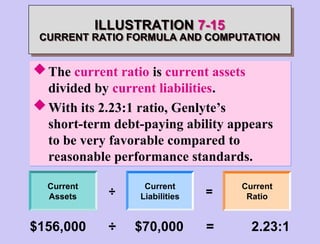
ILLUSTRATION 7-15
CURRENT RATIOFORMULA AND COMPUTATION
The current ratio is current assets
divided by current liabilities.
With its 2.23:1 ratio, Genlyte’s
short-term debt-paying ability appears
to be very favorable compared to
reasonable performance standards.
$156,000 ÷ $70,000 = 2.23:1
Current
Assets ÷ =
Current
Liabilities
Current
Ratio
38.
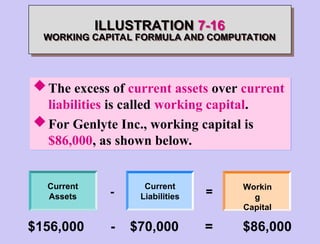
ILLUSTRATION 7-16
WORKING CAPITALFORMULA AND COMPUTATION
The excess of current assets over current
liabilities is called working capital.
For Genlyte Inc., working capital is
$86,000, as shown below.
$156,000 - $70,000 = $86,000
Current
Assets - =
Current
Liabilities
Workin
g
Capital
39.
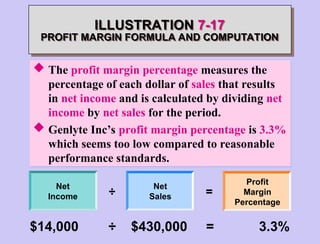
ILLUSTRATION 7-17
PROFIT MARGINFORMULA AND COMPUTATION
The profit margin percentage measures the
percentage of each dollar of sales that results
in net income and is calculated by dividing net
income by net sales for the period.
Genlyte Inc’s profit margin percentage is 3.3%
which seems too low compared to reasonable
performance standards.
$14,000 ÷ $430,000 = 3.3%
Net
Income ÷ =
Net
Sales
Profit
Margin
Percentage
40.
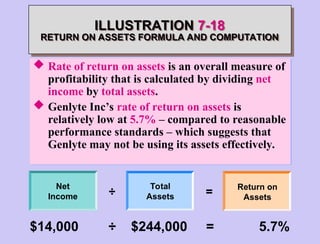
ILLUSTRATION 7-18
RETURN ONASSETS FORMULA AND COMPUTATION
$14,000 ÷ $244,000 = 5.7%
Net
Income ÷ =
Total
Assets
Return on
Assets
Rate of return on assets is an overall measure of
profitability that is calculated by dividing net
income by total assets.
Genlyte Inc’s rate of return on assets is
relatively low at 5.7% – compared to reasonable
performance standards – which suggests that
Genlyte may not be using its assets effectively.
41.
ILLUSTRATION 7-19
RETURN ONCOMMON STOCKHOLDERS’
EQUITY FORMULA AND COMPUTATION
$14,000 ÷ $60,000 = 23.3%
Net
Income ÷ =
Common
Equity
Return on
Common
Stockholders’
Equity
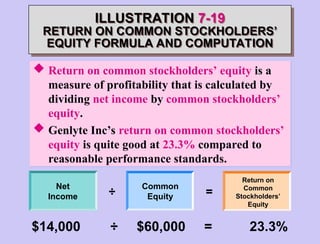
Return on common stockholders’ equity is a
measure of profitability that is calculated by
dividing net income by common stockholders’
equity.
Genlyte Inc’s return on common stockholders’
equity is quite good at 23.3% compared to
reasonable performance standards.
42.
ILLUSTRATION 7-20
DEBT TOTOTAL ASSETS
FORMULA AND COMPUTATION
$184,000 ÷ $244,000 = 75.4%
Total
Debt ÷ =
Total
Assets
Debt to Total
Assets Ratio
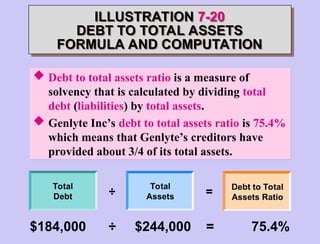
Debt to total assets ratio is a measure of
solvency that is calculated by dividing total
debt (liabilities) by total assets.
Genlyte Inc’s debt to total assets ratio is 75.4%
which means that Genlyte’s creditors have
provided about 3/4 of its total assets.