Acacia
exudate
Pharma Excipient
Presentation by
Primary Information Services
www.primaryinfo.com
mailto:primaryinfo@gmail.com
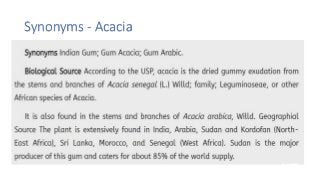
Synonyms - Acacia
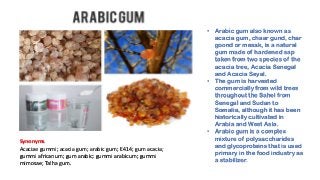
• Arabic gum also known as
acacia gum, chaar gund, char
goond or mesak, is a natural
gum made of hardened sap
taken from two species of the
acacia tree, Acacia Senegal
and Acacia Seyal.
• The gum is harvested
commercially from wild trees
throughout the Sahel from
Senegal and Sudan to
Somalia, although it has been
historically cultivated in
Arabia and West Asia.
• Arabic gum is a complex
mixture of polysaccharides
and glycoproteins that is used
primary in the food industry as
a stabilizer.
Synonyms
Acaciae gummi; acacia gum; arabic gum; E414; gum acacia;
gummi africanum; gum arabic; gummi arabicum; gummi
mimosae; Talha gum.
Method of Manufacture
Acacia is the dried gummy exudate obtained from the
stems and branches of Acacia senegal (Linne´) Willdenow
or other related species of Acacia (Fam. Leguminosae)
that grow mainly in the Sudan and Senegal regions of
Africa.
The bark of the tree is incised and the exudate allowed to
dry on the bark. The dried exudate is then collected,
processed to remove bark, sand, and other particulate
matter, and graded. Various acacia grades differing in
particle size and other physical properties are thus
obtained. A spray-dried powder is also commercially
available
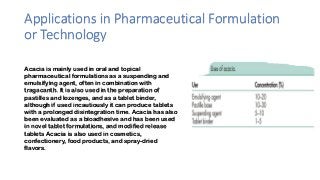
Applications in Pharmaceutical Formulation
or Technology
Acacia is mainly used in oral and topical
pharmaceutical formulations as a suspending and
emulsifying agent, often in combination with
tragacanth. It is also used in the preparation of
pastilles and lozenges, and as a tablet binder,
although if used incautiously it can produce tablets
with a prolonged disintegration time. Acacia has also
been evaluated as a bioadhesive and has been used
in novel tablet formulations, and modified release
tablets Acacia is also used in cosmetics,
confectionery, food products, and spray-dried
flavors.
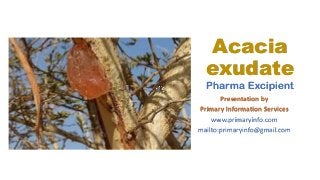
Acacia exudate
Acacia exudate
Acacia exudate
Acacia exudate

Acacia exudate

  • 1.
    Acacia exudate Pharma Excipient Presentation by PrimaryInformation Services www.primaryinfo.com mailto:primaryinfo@gmail.com
  • 2.
  • 4.
    • Arabic gumalso known as acacia gum, chaar gund, char goond or mesak, is a natural gum made of hardened sap taken from two species of the acacia tree, Acacia Senegal and Acacia Seyal. • The gum is harvested commercially from wild trees throughout the Sahel from Senegal and Sudan to Somalia, although it has been historically cultivated in Arabia and West Asia. • Arabic gum is a complex mixture of polysaccharides and glycoproteins that is used primary in the food industry as a stabilizer. Synonyms Acaciae gummi; acacia gum; arabic gum; E414; gum acacia; gummi africanum; gum arabic; gummi arabicum; gummi mimosae; Talha gum.
  • 5.
    Method of Manufacture Acaciais the dried gummy exudate obtained from the stems and branches of Acacia senegal (Linne´) Willdenow or other related species of Acacia (Fam. Leguminosae) that grow mainly in the Sudan and Senegal regions of Africa. The bark of the tree is incised and the exudate allowed to dry on the bark. The dried exudate is then collected, processed to remove bark, sand, and other particulate matter, and graded. Various acacia grades differing in particle size and other physical properties are thus obtained. A spray-dried powder is also commercially available
  • 6.
    Applications in PharmaceuticalFormulation or Technology Acacia is mainly used in oral and topical pharmaceutical formulations as a suspending and emulsifying agent, often in combination with tragacanth. It is also used in the preparation of pastilles and lozenges, and as a tablet binder, although if used incautiously it can produce tablets with a prolonged disintegration time. Acacia has also been evaluated as a bioadhesive and has been used in novel tablet formulations, and modified release tablets Acacia is also used in cosmetics, confectionery, food products, and spray-dried flavors.