The Abstract
           vs.
The Annotated Bibliography

          What’s
           the
       difference?
The Abstract

• A summary of a work’s content
• Like all summaries, abstracts cover the main
  points of a piece of writing
• Abstracts help you decide whether an article is
  relevant for your purposes
The Annotated Bibliography
• A list of sources that provides publication
  information and a short description of each
  source called an annotation
• Some annotations merely describe the
  content and scope of the source
• Others evaluate the source’s authority,
  currency, and relevance to a researcher’s
  purpose
Article from Scholarly Publication
               (APA Citation)

Grindstaff, D. (2008). The Fist and the Corpse:
  Taming the Queer Sublime in Brokeback
  Mountain. Communication & Critical/Cultural
  Studies, 5(3), 223-244.
  doi:10.1080/14791420802206817

• Please Note: APA, 6th ed. encourages use of the DOI (digital
  object identifier) if available. DOI is a way of uniquely
  identifying documents, publications and other resources on
  the Internet rather than using a URL, which can change over
  time.
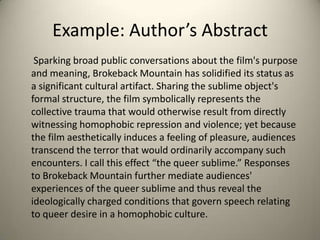
Example: Author’s Abstract
 Sparking broad public conversations about the film's purpose
and meaning, Brokeback Mountain has solidified its status as
a significant cultural artifact. Sharing the sublime object's
formal structure, the film symbolically represents the
collective trauma that would otherwise result from directly
witnessing homophobic repression and violence; yet because
the film aesthetically induces a feeling of pleasure, audiences
transcend the terror that would ordinarily accompany such
encounters. I call this effect “the queer sublime.” Responses
to Brokeback Mountain further mediate audiences'
experiences of the queer sublime and thus reveal the
ideologically charged conditions that govern speech relating
to queer desire in a homophobic culture.
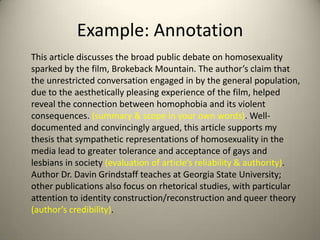
Example: Annotation
This article discusses the broad public debate on homosexuality
sparked by the film, Brokeback Mountain. The author’s claim that
the unrestricted conversation engaged in by the general population,
due to the aesthetically pleasing experience of the film, helped
reveal the connection between homophobia and its violent
consequences. (summary & scope in your own words). Well-
documented and convincingly argued, this article supports my
thesis that sympathetic representations of homosexuality in the
media lead to greater tolerance and acceptance of gays and
lesbians in society (evaluation of article’s reliability & authority).
Author Dr. Davin Grindstaff teaches at Georgia State University;
other publications also focus on rhetorical studies, with particular
attention to identity construction/reconstruction and queer theory
(author’s credibility).
Online Resources

More information on Annotated Bibliographies
 from authoritative sources:
• Cornell University Library

• Purdue University OWL (Online Writing Lab)

Abstract.vs.annotated.show

  • 1.
    The Abstract vs. The Annotated Bibliography What’s the difference?
  • 2.
    The Abstract • Asummary of a work’s content • Like all summaries, abstracts cover the main points of a piece of writing • Abstracts help you decide whether an article is relevant for your purposes
  • 3.
    The Annotated Bibliography •A list of sources that provides publication information and a short description of each source called an annotation • Some annotations merely describe the content and scope of the source • Others evaluate the source’s authority, currency, and relevance to a researcher’s purpose
  • 4.
    Article from ScholarlyPublication (APA Citation) Grindstaff, D. (2008). The Fist and the Corpse: Taming the Queer Sublime in Brokeback Mountain. Communication & Critical/Cultural Studies, 5(3), 223-244. doi:10.1080/14791420802206817 • Please Note: APA, 6th ed. encourages use of the DOI (digital object identifier) if available. DOI is a way of uniquely identifying documents, publications and other resources on the Internet rather than using a URL, which can change over time.
  • 5.
    Example: Author’s Abstract Sparking broad public conversations about the film's purpose and meaning, Brokeback Mountain has solidified its status as a significant cultural artifact. Sharing the sublime object's formal structure, the film symbolically represents the collective trauma that would otherwise result from directly witnessing homophobic repression and violence; yet because the film aesthetically induces a feeling of pleasure, audiences transcend the terror that would ordinarily accompany such encounters. I call this effect “the queer sublime.” Responses to Brokeback Mountain further mediate audiences' experiences of the queer sublime and thus reveal the ideologically charged conditions that govern speech relating to queer desire in a homophobic culture.
  • 6.
    Example: Annotation This articlediscusses the broad public debate on homosexuality sparked by the film, Brokeback Mountain. The author’s claim that the unrestricted conversation engaged in by the general population, due to the aesthetically pleasing experience of the film, helped reveal the connection between homophobia and its violent consequences. (summary & scope in your own words). Well- documented and convincingly argued, this article supports my thesis that sympathetic representations of homosexuality in the media lead to greater tolerance and acceptance of gays and lesbians in society (evaluation of article’s reliability & authority). Author Dr. Davin Grindstaff teaches at Georgia State University; other publications also focus on rhetorical studies, with particular attention to identity construction/reconstruction and queer theory (author’s credibility).
  • 7.
    Online Resources More informationon Annotated Bibliographies from authoritative sources: • Cornell University Library • Purdue University OWL (Online Writing Lab)