ADT
Abstract Data Type
Abstract Data Type
A.A. 2012/2013Tecniche di programmazione2
ADTs store data and allow various operations on the
data to access and change it
ADTs are mathematical models
ADTs are extremely useful when designing a complex
algorithms
ADTs are not classes (well, not quite)
Abstract Data Type
A.A. 2012/2013Tecniche di programmazione3
ADTs are “abstract” because they specify the operations
of the data structure and leave implementation details to
later
More similar to “abstract classes” or “interfaces”
(whether the language supports them)
Note: Not all implementation
details can be deferred!
Why study ADTs?
A.A. 2012/2013Tecniche di programmazione4
How many of you will actually go out and create your own ADT
from scratch?
Different ADTs, each one with its own pros and cons
Picking the right one for the job is an important step in design!
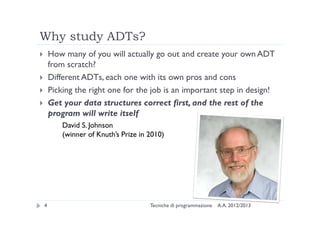
Get your data structures correct first, and the rest of the
program will write itself
David S. Johnson
(winner of Knuth’s Prize in 2010)
Why study ADTs?
A.A. 2012/2013Tecniche di programmazione5
The goal is to learn
how to learn how to
use and create ADTs
Built-in ADT
A.A. 2012/2013Tecniche di programmazione6
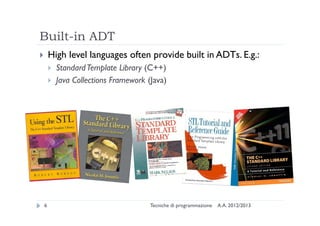
High level languages often provide built in ADTs. E.g.:
StandardTemplate Library (C++)
Java Collections Framework (Java)
Common Ground
A.A. 2012/2013Tecniche di programmazione7
Almost every ADT provide a way to
add an item
remove an item
find, retrieve, or access an item
Most Collection ADTs provide more possibilities
check whether the collection is empty
make the collection empty
give me a subset of the collection
…
A very simple ADT: Santa’s Sack
A.A. 2012/2013Tecniche di programmazione8
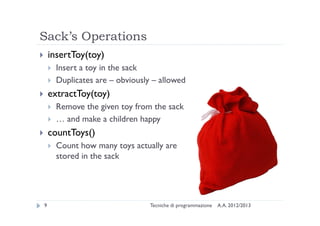
Sack’s Operations
A.A. 2012/2013Tecniche di programmazione9
insertToy(toy)
Insert a toy in the sack
Duplicates are – obviously – allowed
extractToy(toy)
Remove the given toy from the sack
… and make a children happy
countToys()
Count how many toys actually are
stored in the sack
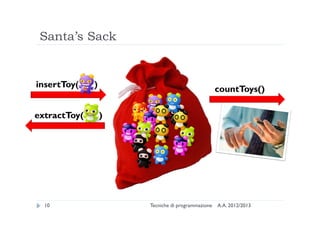
Santa’s Sack
A.A. 2012/2013Tecniche di programmazione10
insertToy( )
extractToy( )
countToys()
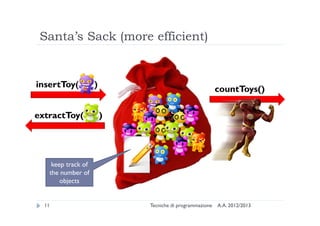
Santa’s Sack (more efficient)
A.A. 2012/2013Tecniche di programmazione11
insertToy( )
extractToy( )
countToys()
keep track of
the number of
objects
The lesson
A.A. 2012/2013Tecniche di programmazione12
ADTs do not specify the details of the implementation
BUT
Some information about the algorithms is essential to
choose the right ADT
Very high-level, qualitative information
Complexity
Licenza d’uso
A.A. 2012/2013Tecniche di programmazione13
Queste diapositive sono distribuite con licenza Creative Commons
“Attribuzione - Non commerciale - Condividi allo stesso modo (CC
BY-NC-SA)”
Sei libero:
di riprodurre, distribuire, comunicare al pubblico, esporre in pubblico,
rappresentare, eseguire e recitare quest'opera
di modificare quest'opera
Alle seguenti condizioni:
Attribuzione — Devi attribuire la paternità dell'opera agli autori
originali e in modo tale da non suggerire che essi avallino te o il modo in
cui tu usi l'opera.
Non commerciale — Non puoi usare quest'opera per fini
commerciali.
Condividi allo stesso modo — Se alteri o trasformi quest'opera, o se
la usi per crearne un'altra, puoi distribuire l'opera risultante solo con una
licenza identica o equivalente a questa.
http://creativecommons.org/licenses/by-nc-sa/3.0/

Abstract Data Types

  • 1.
  • 2.
    Abstract Data Type A.A.2012/2013Tecniche di programmazione2 ADTs store data and allow various operations on the data to access and change it ADTs are mathematical models ADTs are extremely useful when designing a complex algorithms ADTs are not classes (well, not quite)
  • 3.
    Abstract Data Type A.A.2012/2013Tecniche di programmazione3 ADTs are “abstract” because they specify the operations of the data structure and leave implementation details to later More similar to “abstract classes” or “interfaces” (whether the language supports them) Note: Not all implementation details can be deferred!
  • 4.
    Why study ADTs? A.A.2012/2013Tecniche di programmazione4 How many of you will actually go out and create your own ADT from scratch? Different ADTs, each one with its own pros and cons Picking the right one for the job is an important step in design! Get your data structures correct first, and the rest of the program will write itself David S. Johnson (winner of Knuth’s Prize in 2010)
  • 5.
    Why study ADTs? A.A.2012/2013Tecniche di programmazione5 The goal is to learn how to learn how to use and create ADTs
  • 6.
    Built-in ADT A.A. 2012/2013Tecnichedi programmazione6 High level languages often provide built in ADTs. E.g.: StandardTemplate Library (C++) Java Collections Framework (Java)
  • 7.
    Common Ground A.A. 2012/2013Tecnichedi programmazione7 Almost every ADT provide a way to add an item remove an item find, retrieve, or access an item Most Collection ADTs provide more possibilities check whether the collection is empty make the collection empty give me a subset of the collection …
  • 8.
    A very simpleADT: Santa’s Sack A.A. 2012/2013Tecniche di programmazione8
  • 9.
    Sack’s Operations A.A. 2012/2013Tecnichedi programmazione9 insertToy(toy) Insert a toy in the sack Duplicates are – obviously – allowed extractToy(toy) Remove the given toy from the sack … and make a children happy countToys() Count how many toys actually are stored in the sack
  • 10.
    Santa’s Sack A.A. 2012/2013Tecnichedi programmazione10 insertToy( ) extractToy( ) countToys()
  • 11.
    Santa’s Sack (moreefficient) A.A. 2012/2013Tecniche di programmazione11 insertToy( ) extractToy( ) countToys() keep track of the number of objects
  • 12.
    The lesson A.A. 2012/2013Tecnichedi programmazione12 ADTs do not specify the details of the implementation BUT Some information about the algorithms is essential to choose the right ADT Very high-level, qualitative information Complexity
  • 13.
    Licenza d’uso A.A. 2012/2013Tecnichedi programmazione13 Queste diapositive sono distribuite con licenza Creative Commons “Attribuzione - Non commerciale - Condividi allo stesso modo (CC BY-NC-SA)” Sei libero: di riprodurre, distribuire, comunicare al pubblico, esporre in pubblico, rappresentare, eseguire e recitare quest'opera di modificare quest'opera Alle seguenti condizioni: Attribuzione — Devi attribuire la paternità dell'opera agli autori originali e in modo tale da non suggerire che essi avallino te o il modo in cui tu usi l'opera. Non commerciale — Non puoi usare quest'opera per fini commerciali. Condividi allo stesso modo — Se alteri o trasformi quest'opera, o se la usi per crearne un'altra, puoi distribuire l'opera risultante solo con una licenza identica o equivalente a questa. http://creativecommons.org/licenses/by-nc-sa/3.0/