Using critical thinking and reflection to deliver
behaviour-changing environmental education:
the Coffs Ambassadors Tours story
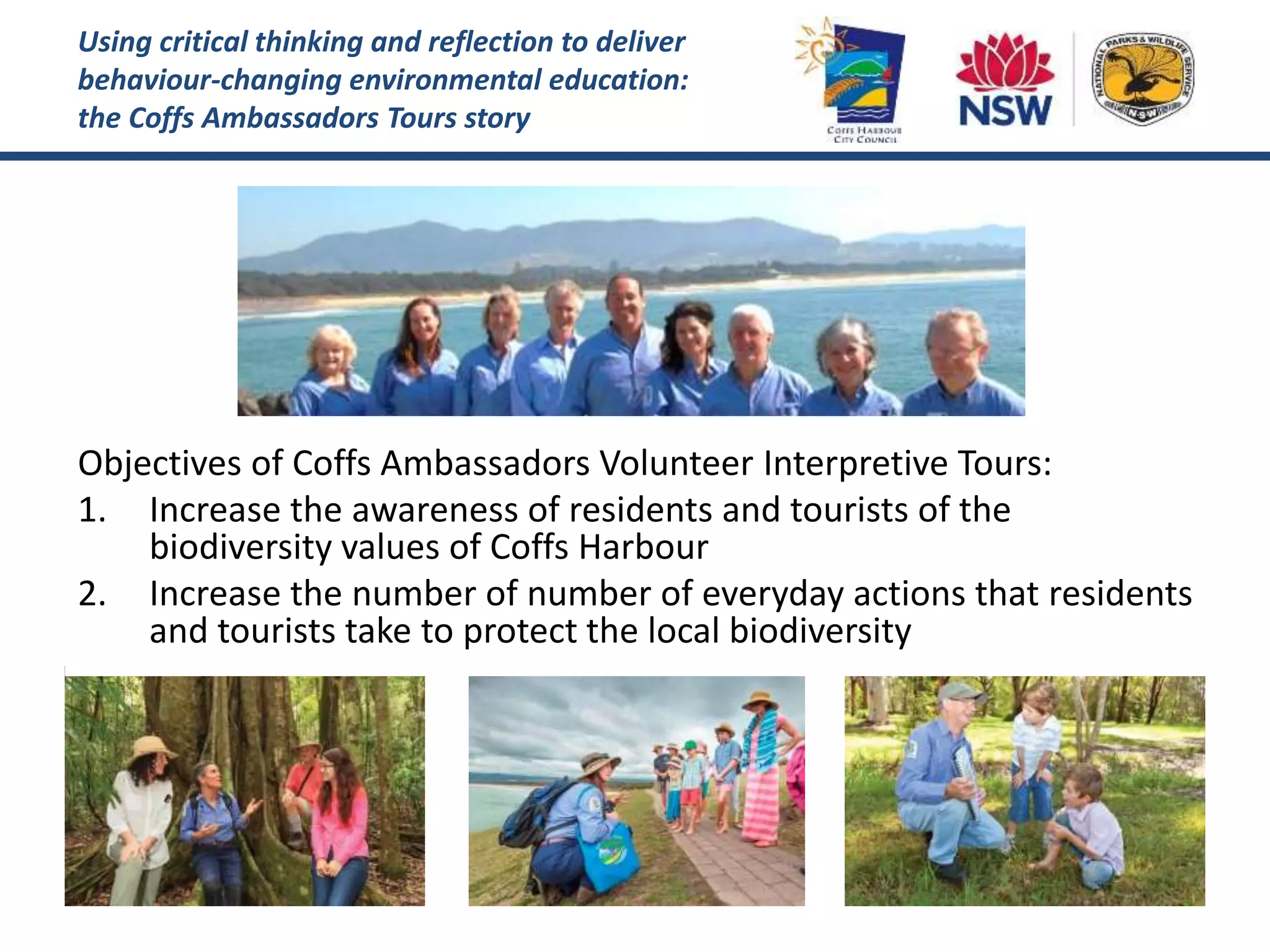
Objectives of Coffs Ambassadors Volunteer Interpretive Tours:
1. Increase the awareness of residents and tourists of the
biodiversity values of Coffs Harbour
2. Increase the number of number of everyday actions that residents
and tourists take to protect the local biodiversity
Using critical thinking and reflection to deliver
behaviour-changing environmental education:
the Coffs Ambassadors Tours story
The value of evaluation
Demonstrates the value of your
program to Managers,
Councillors and funding bodies.
Is critical to ensure funding
continues
Helps to win awards
Using critical thinking and reflection to deliver
behaviour-changing environmental education:
the Coffs Ambassadors Tours story
What did we discover by doing evaluation?
 85% of tour participants LEARN about biodiversity
 58 - 66% of tour participants ADOPT biodiversity
protection BEHAVIOURS:
 picking up rubbish
 removing weeds from their gardens
 planting native species in their gardens
 50- 75% of participants INFLUENCE OTHERS to:
 adopt behaviours that protect biodiversity
 be more environmentally aware
 go on the tours
 visit the natural areas they had been to on the tour
Using critical thinking and reflection to deliver
behaviour-changing environmental education:
the Coffs Ambassadors Tours story
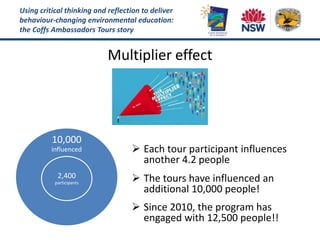
Multiplier effect
10,000
influenced
2,400
participants
 Each tour participant influences
another 4.2 people
 The tours have influenced an
additional 10,000 people!
 Since 2010, the program has
engaged with 12,500 people!!
Using critical thinking and reflection to deliver
behaviour-changing environmental education:
the Coffs Ambassadors Tours story
Listen and act on feedback from
EVERYONE!
 Solved problems and improved our
community engagement:
 Better marketing
 Adoption of new technology
 Formation of new partnerships
 More people have come on tours
Using critical thinking and reflection to deliver
behaviour-changing environmental education:
the Coffs Ambassadors Tours story
Making A Tour Guide in 5 Easy Steps
1. RECRUIT
2. TRAIN & RESOURCE
3. ENABLE
4. MENTOR
5. REVIEW
Using critical thinking and reflection to deliver
behaviour-changing environmental education:
the Coffs Ambassadors Tours story
Reflections: Why it Worked?
NPWS involved from the start
Pragmatic training by highly experienced
practitioners
Volunteers enabled to “own” their tour ideas
Mentoring develops relationships built on trust
Reviews are affirming but honest
Using critical thinking and reflection to deliver
behaviour-changing environmental education:
the Coffs Ambassadors Tours story
What Have I Learned So Far?
• Volunteers guides have a unique appeal
• It’s tricky to develop professional skillset yet
preserve the lay person style
• Storytelling format is key to tour success
• How to move beyond eco-voyeurism
• Tour progress reviews are GOLD but depend
on relationship of trust and respect
Using critical thinking and reflection to deliver
behaviour-changing environmental education:
the Coffs Ambassadors Tours story
Erika Van Schellebeck
Coffs Harbour City Council
evserika@chcc.nsw.gov.au
P: 02 6648 4668
Andrew Turbill
NSW National Parks & Wildlife Service
Andrew.turbill@environment.nsw.gov.au
P: 02 6657 5935
www.coffsambassadors.com.au

AAEE 2014 CA Presentation

  • 1.
    Using critical thinkingand reflection to deliver behaviour-changing environmental education: the Coffs Ambassadors Tours story Objectives of Coffs Ambassadors Volunteer Interpretive Tours: 1. Increase the awareness of residents and tourists of the biodiversity values of Coffs Harbour 2. Increase the number of number of everyday actions that residents and tourists take to protect the local biodiversity
  • 2.
    Using critical thinkingand reflection to deliver behaviour-changing environmental education: the Coffs Ambassadors Tours story The value of evaluation Demonstrates the value of your program to Managers, Councillors and funding bodies. Is critical to ensure funding continues Helps to win awards
  • 3.
    Using critical thinkingand reflection to deliver behaviour-changing environmental education: the Coffs Ambassadors Tours story What did we discover by doing evaluation?  85% of tour participants LEARN about biodiversity  58 - 66% of tour participants ADOPT biodiversity protection BEHAVIOURS:  picking up rubbish  removing weeds from their gardens  planting native species in their gardens  50- 75% of participants INFLUENCE OTHERS to:  adopt behaviours that protect biodiversity  be more environmentally aware  go on the tours  visit the natural areas they had been to on the tour
  • 4.
    Using critical thinkingand reflection to deliver behaviour-changing environmental education: the Coffs Ambassadors Tours story Multiplier effect 10,000 influenced 2,400 participants  Each tour participant influences another 4.2 people  The tours have influenced an additional 10,000 people!  Since 2010, the program has engaged with 12,500 people!!
  • 5.
    Using critical thinkingand reflection to deliver behaviour-changing environmental education: the Coffs Ambassadors Tours story Listen and act on feedback from EVERYONE!  Solved problems and improved our community engagement:  Better marketing  Adoption of new technology  Formation of new partnerships  More people have come on tours
  • 6.
    Using critical thinkingand reflection to deliver behaviour-changing environmental education: the Coffs Ambassadors Tours story Making A Tour Guide in 5 Easy Steps 1. RECRUIT 2. TRAIN & RESOURCE 3. ENABLE 4. MENTOR 5. REVIEW
  • 7.
    Using critical thinkingand reflection to deliver behaviour-changing environmental education: the Coffs Ambassadors Tours story Reflections: Why it Worked? NPWS involved from the start Pragmatic training by highly experienced practitioners Volunteers enabled to “own” their tour ideas Mentoring develops relationships built on trust Reviews are affirming but honest
  • 8.
    Using critical thinkingand reflection to deliver behaviour-changing environmental education: the Coffs Ambassadors Tours story What Have I Learned So Far? • Volunteers guides have a unique appeal • It’s tricky to develop professional skillset yet preserve the lay person style • Storytelling format is key to tour success • How to move beyond eco-voyeurism • Tour progress reviews are GOLD but depend on relationship of trust and respect
  • 9.
    Using critical thinkingand reflection to deliver behaviour-changing environmental education: the Coffs Ambassadors Tours story Erika Van Schellebeck Coffs Harbour City Council evserika@chcc.nsw.gov.au P: 02 6648 4668 Andrew Turbill NSW National Parks & Wildlife Service Andrew.turbill@environment.nsw.gov.au P: 02 6657 5935 www.coffsambassadors.com.au

Editor's Notes

  • #2 Hi, I’m Erika from Coffs Harbour City Council and today myself and my colleague Andrew from the NSW National Parks & Wildlife Service will share with how critical thinking and reflection has helped us to deliver behaviour-changing environmental education. Coffs Harbour is located on the mid-north coast of NSW is one of only three places in eastern Australia where the Great Dividing Range meets the sea. This unique landscape means we have a diversity of ecosystems with incredibly rich biodiversity, including 122 threatened species such as the Koala. Unfortunately though, because we are an area of rapid population growth- habitat loss, weed spread and pest invasion are all impacting on our biodiversity. To help address this, Coffs Harbour City Council created the Coffs Ambassadors Tours program in partnership with the NSW National Parks & Wildlife Service. Since 2010, 18 volunteer ‘Coffs Ambassador’ Tour Guides have taken 2, 400 people on free interpretive tours of our bushland and beaches. Coffs Ambassadors are everyday people who are passionate about their local environment and receive training by National Parks and Wildlife Service Discovery Rangers. The objectives of the program are to: 1. Increase the awareness of residents and tourists of the biodiversity values of Coffs Harbour and 2. Increase the number of everyday actions that residents and tourists take to protect our local biodiversity. 1min 47
  • #3 Evaluation is a formal method of critical thinking and reflection. It has enabled us to demonstrate the value of Coffs Ambassadors Tours to Managers, Councillors and funding bodies, by showing that the program’s objectives are being achieved. Evaluation is also critical to ensure continued funding. From working in local government for 15 years and having sat in many meetings with Directors and Managers who have little understanding or appreciation for environmental education, I believe that without this critical thinking and reflection, Coffs Ambassadors tours would not have continued for this long. I also believe that our program evaluation contributed greatly to Coffs Ambassadors tours winning two awards at the 2012 NSW Local Government Excellence in the Environment awards. Winning these two awards has reinforced the value of the program to our Council, which I’m sure has in turn also helped in getting continued funding. 1min 14sec
  • #4 So what did we discover by doing evaluation? Feedback forms handed out at the end of each tour have told us that 85% of tour participants reported a greater knowledge on biodiversity after going on a tour. On these forms we also asked people whether the tour had inspired them to do anything differently in their daily lives, and then gave them a list to choose from of everyday biodiversity protection actions. 69% of tour participants ticked one or more of these boxes, so we were really interested to see whether these people would actually adopt the behaviour changes that the tour had inspired them to undertake. This lead us to survey tour participants 3- 12 months after going on their tour, to see whether our program was actually leading to community behaviour changes that help to protect our amazing local biodiversity. We used two survey methods to do this. First we emailed tour participants an online survey two years in a row, using the tool Survey Monkey. Then, because we wanted to validate these results with a non-prompted questions from a random, rather than self-selected group of tour participants, we had a phone survey undertaken by a market research company. We were understandably pretty happy with the results: 58 - 66% of people do adopt biodiversity protection behaviours after coming on the tours, with the top behaviours being picking up rubbish, removing weeds from their gardens and planting native species in their gardens. We also wanted to find out about the ripple or multiplier effect of the tours- that is, whether tour participants were also influencing others since coming on a tour. The results were very significant: 50 – 75% of tour participants had influenced other people in a range of ways including encouraging them to adopt behaviours that protect biodiversity, to be more environmentally aware, to go on the tours and to also visit the natural areas they had visited on the tour. 2 min 20 sec
  • #5 And by also finding out that each tour participant has influenced an average of 4.2 other people, we have been able to calculate that the 2,400 people who have been on a Coffs Ambassador tour have influenced an additional 10,000 people, meaning that the program has engaged with an amazing 12,500 people since it began in 2010. 25 sec
  • #6 Before I hand you over to Andrew, I would like to highlight that informal feedback is another form of critical thinking and reflection that is just as important as formal evaluation. As you will hear from Andrew, a lot of effort has been put into designing and creating effective tours to deliver our program objectives. This work is pointless though if no one participates, and once you have a great environmental education program, the other half of the fun and a lot of the work goes into ensuring that you have bums on seats. By listening to and acting on all the feedback we have received on the program, from the good to the bad, from managers through to the person on the street, we have solved many problems and continuously improved our community engagement. This has been through better marketing, adoption of new technology and formation of new partnerships. And the better you engage with your community, the more people participate in your program. 50 sec Total 6 min 30 secs