1-1
Cost Management
Fourth Edition
ACCOUNTING AND CONTROL
HANSEN & MOWEN
1-2
Task Force Clip Art
included in this electronic
presentation is used with
the permission of New
Vision Technology of
Nepean Ontario, Canada.
1-3
Introduction to
Cost Management
Prepared by
Douglas Cloud
Pepperdine University
1-4
1. List the similarities and differences between
financial accounting and cost management.
2. Identify the current factors affecting cost
management.
3. Discuss the importance of the accounting
system for internal and external reporting.
4. Explain the need for today’s cost accountant
to acquire cross-functional expertise.
Objectives
After studying this
chapter, you should
be able to:
1-5
5. Describe how management accountants
function within an organization.
6. Understand the importance of ethical
behavior for management accounts.
7. Identify the thee forms of certification
available to internal accountants.
Objectives
1-6
Financial Accounting Versus
Cost Management
 Financial accounting is devoted to providing
information for external users; these users
include investors, government agencies, and
banks.
 Cost management identifies, collects,
measures, classifies, and reports information
that is useful to managers in costing
(determining what something costs), planning,
controlling, and decision making.
1-7
 Cost accounting attempts to satisfy costing
objectives for both financial and management
accounting.
 Management accounting is concerned
specifically with how cost information and
other financial and nonfinancial information
should be used for planning, controlling, and
decision making.
Financial Accounting Versus
Cost Management
1-8
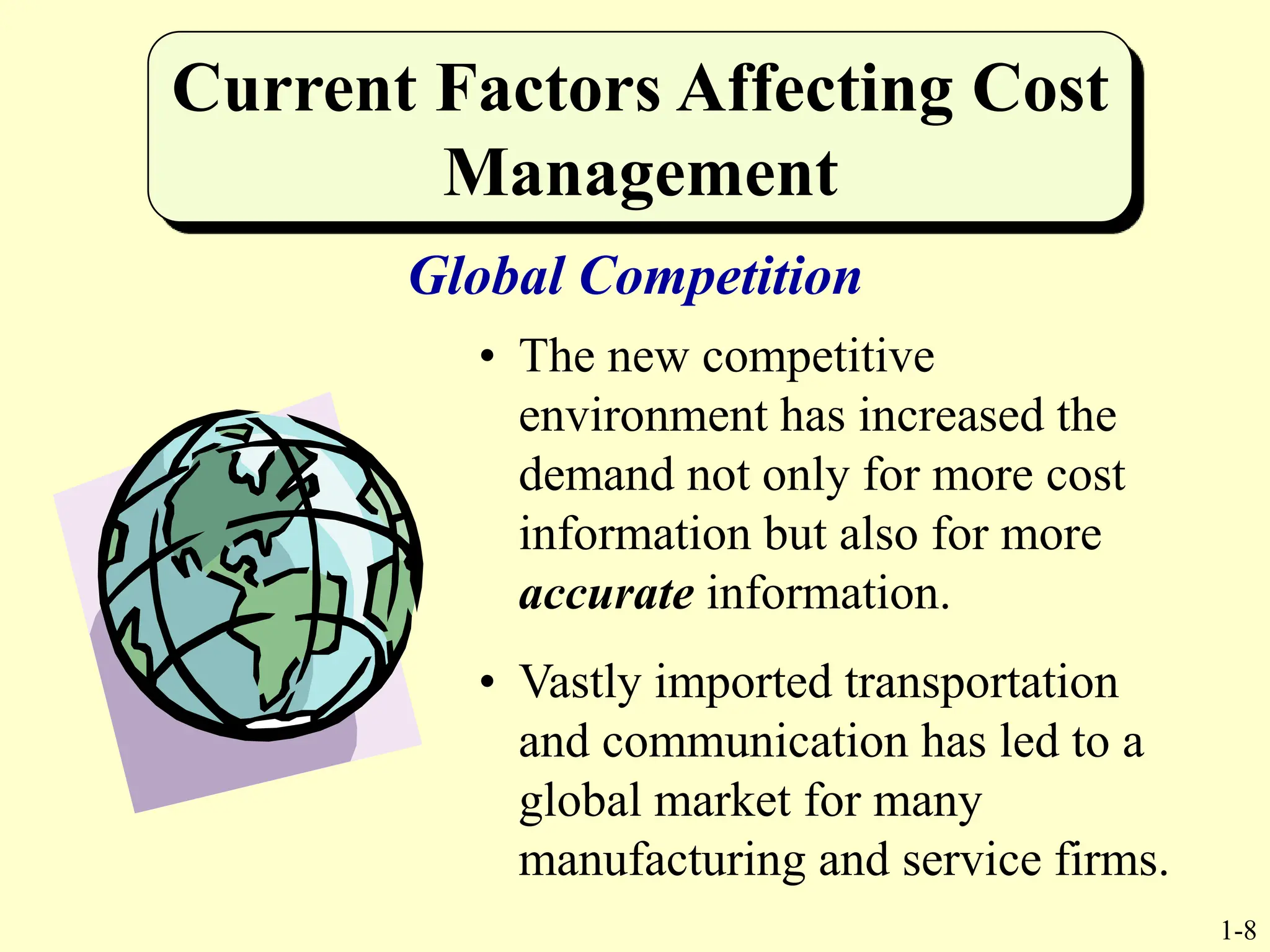
Current Factors Affecting Cost
Management
• The new competitive
environment has increased the
demand not only for more cost
information but also for more
accurate information.
• Vastly imported transportation
and communication has led to a
global market for many
manufacturing and service firms.
Global Competition
1-9
Current Factors Affecting Cost
Management
Growth of the Service Industry
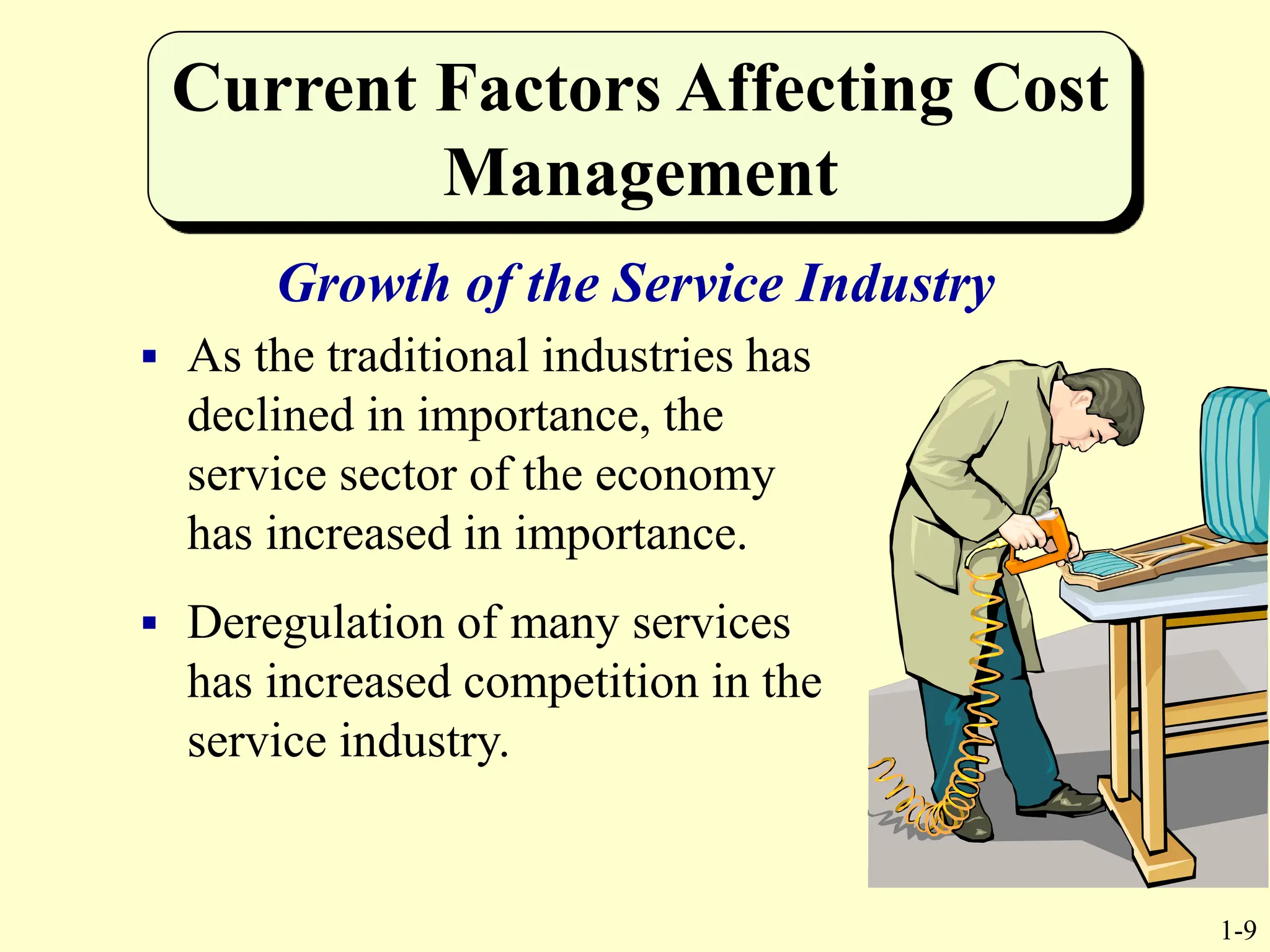
 As the traditional industries has
declined in importance, the
service sector of the economy
has increased in importance.
 Deregulation of many services
has increased competition in the
service industry.
1-10
Current Factors Affecting Cost
Management
Advances in Information Technology
 Computers are used to monitor and
control operations, which allows for a
considerable amount of useful
information to be collected and
provided to management
instantaneously.
 The emergence of electronic
commerce which allows buyers and
sellers to come together electronically.
1-11
Current Factors Affecting Cost
Management
Advances in Management Environment
The theory of constraints is a method used to continuously
improve manufacturing activities and nonmanufacturing
activities.
Just-in-time manufacturing is a demand-pull system that
strives to produce a product only when it is needed and
only in the quantities demanded by customers.
Computer-integrated manufacturing is the automation of the
manufacturing environment.
1-12
Current Factors Affecting Cost
Management
Customer Orientation
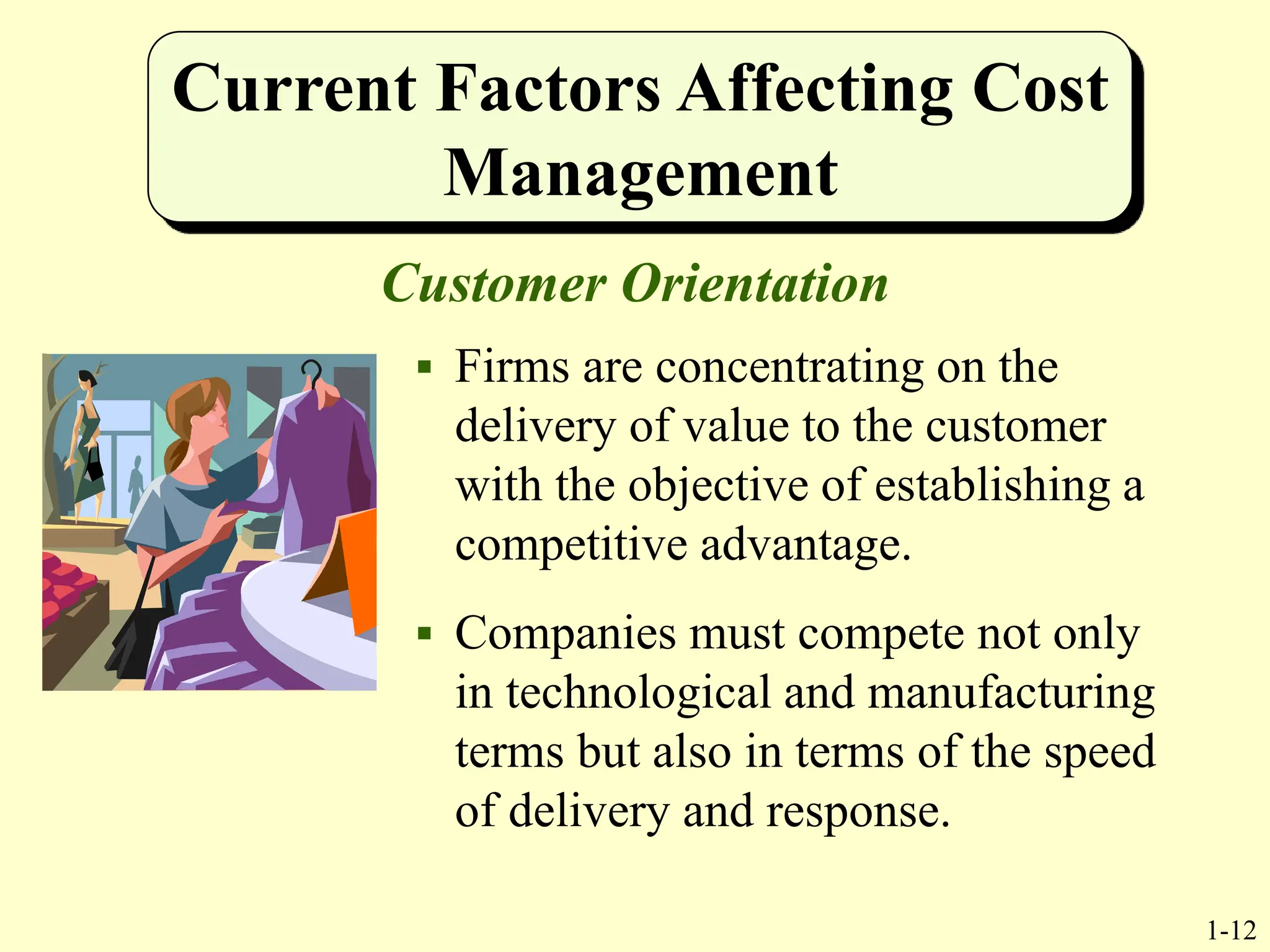
 Firms are concentrating on the
delivery of value to the customer
with the objective of establishing a
competitive advantage.
 Companies must compete not only
in technological and manufacturing
terms but also in terms of the speed
of delivery and response.
1-13
Current Factors Affecting Cost
Management
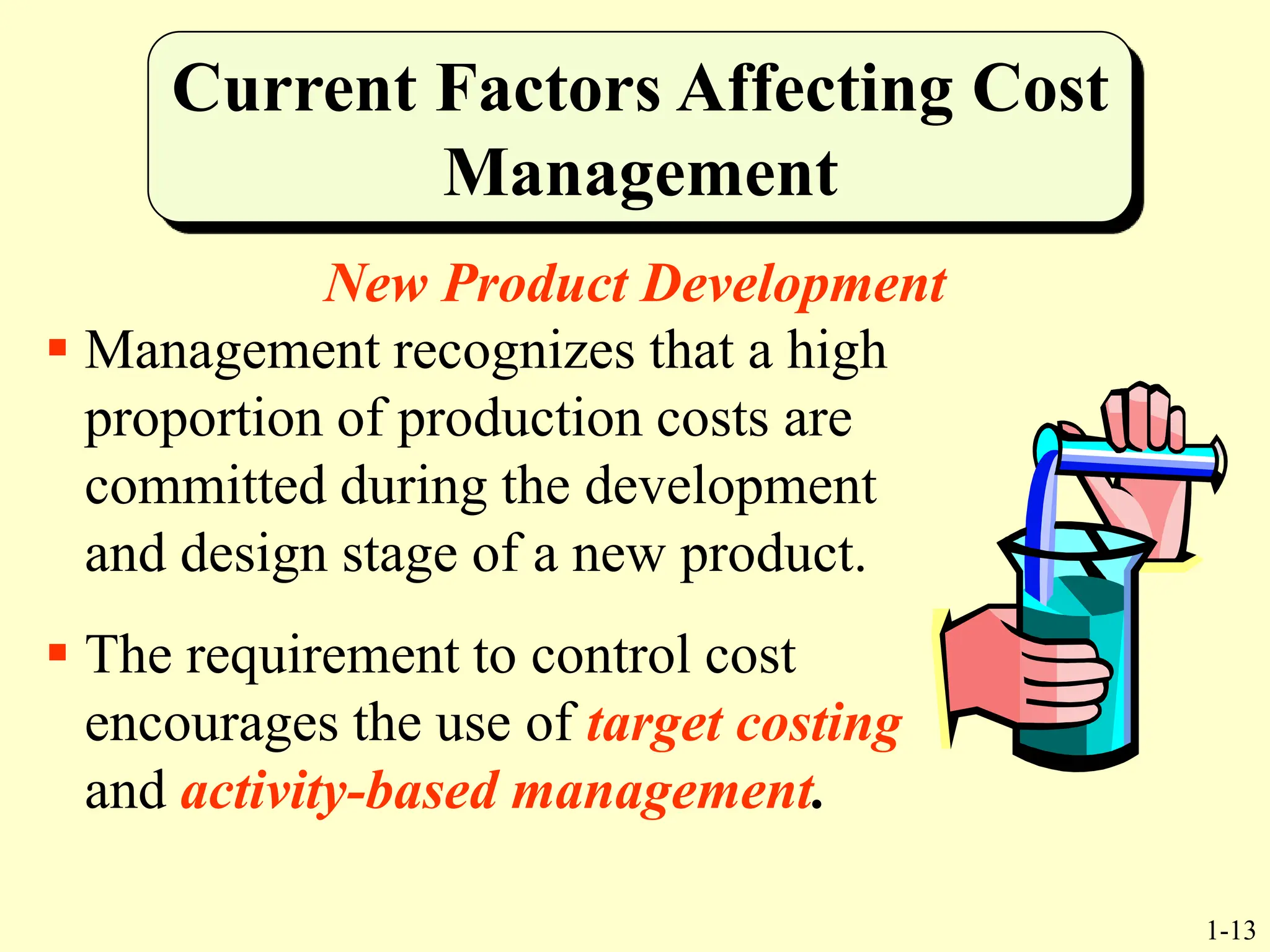
New Product Development
 Management recognizes that a high
proportion of production costs are
committed during the development
and design stage of a new product.
 The requirement to control cost
encourages the use of target costing
and activity-based management.
1-14
Current Factors Affecting Cost
Management
Total Quality Management
 Continual improvement and elimination of waste are
the two foundation principles that govern a state of
manufacturing excellence.
 A philosophy of total quality management, in which
managers strive to create an environment that will
enable organizations to manufacture perfect products,
has replaced the acceptable quality attitudes of the
past.
1-15
Current Factors Affecting Cost
Management
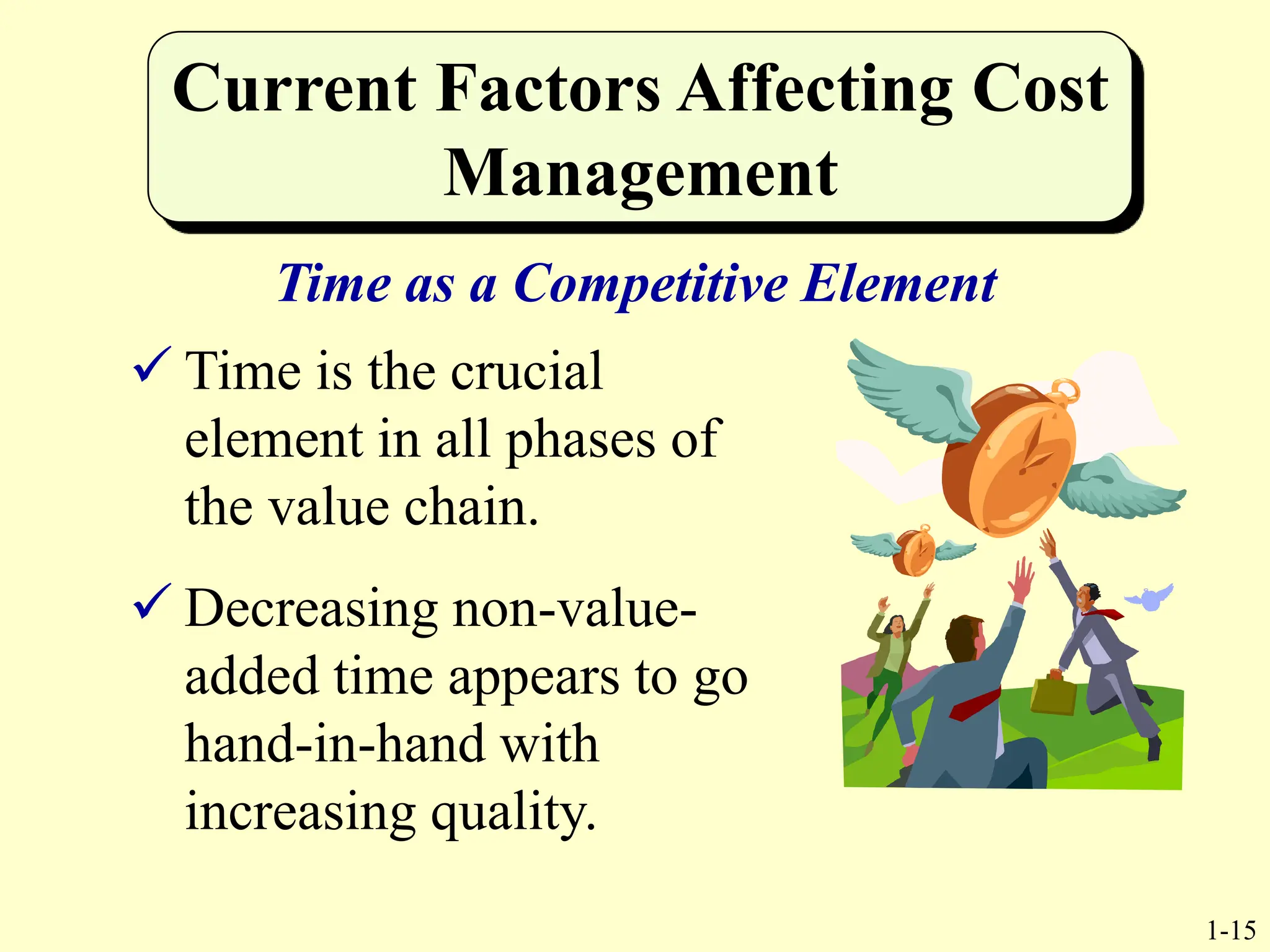
Time as a Competitive Element
 Time is the crucial
element in all phases of
the value chain.
 Decreasing non-value-
added time appears to go
hand-in-hand with
increasing quality.
1-16
Current Factors Affecting Cost
Management
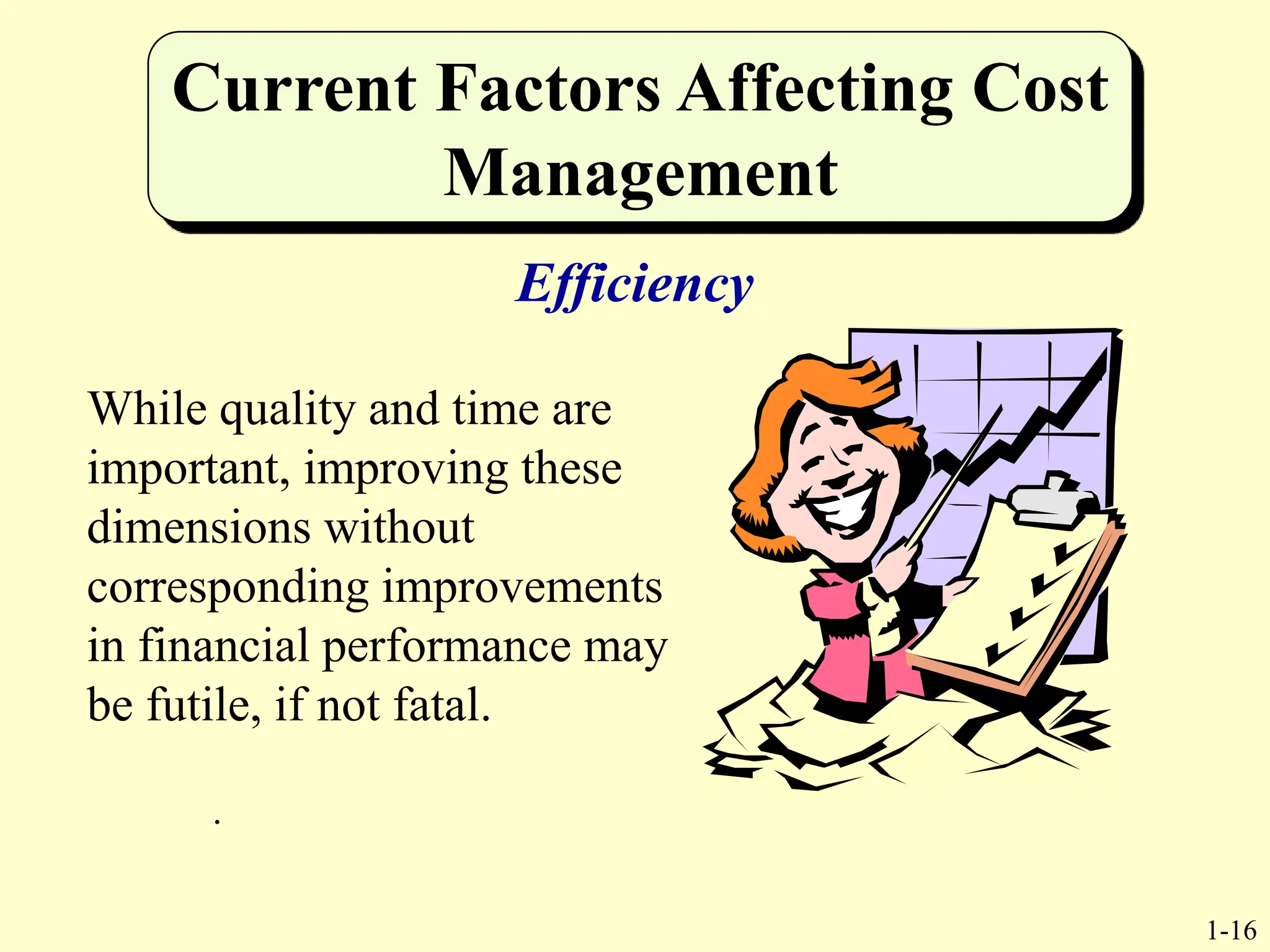
Efficiency
While quality and time are
important, improving these
dimensions without
corresponding improvements
in financial performance may
be futile, if not fatal.
.
1-17
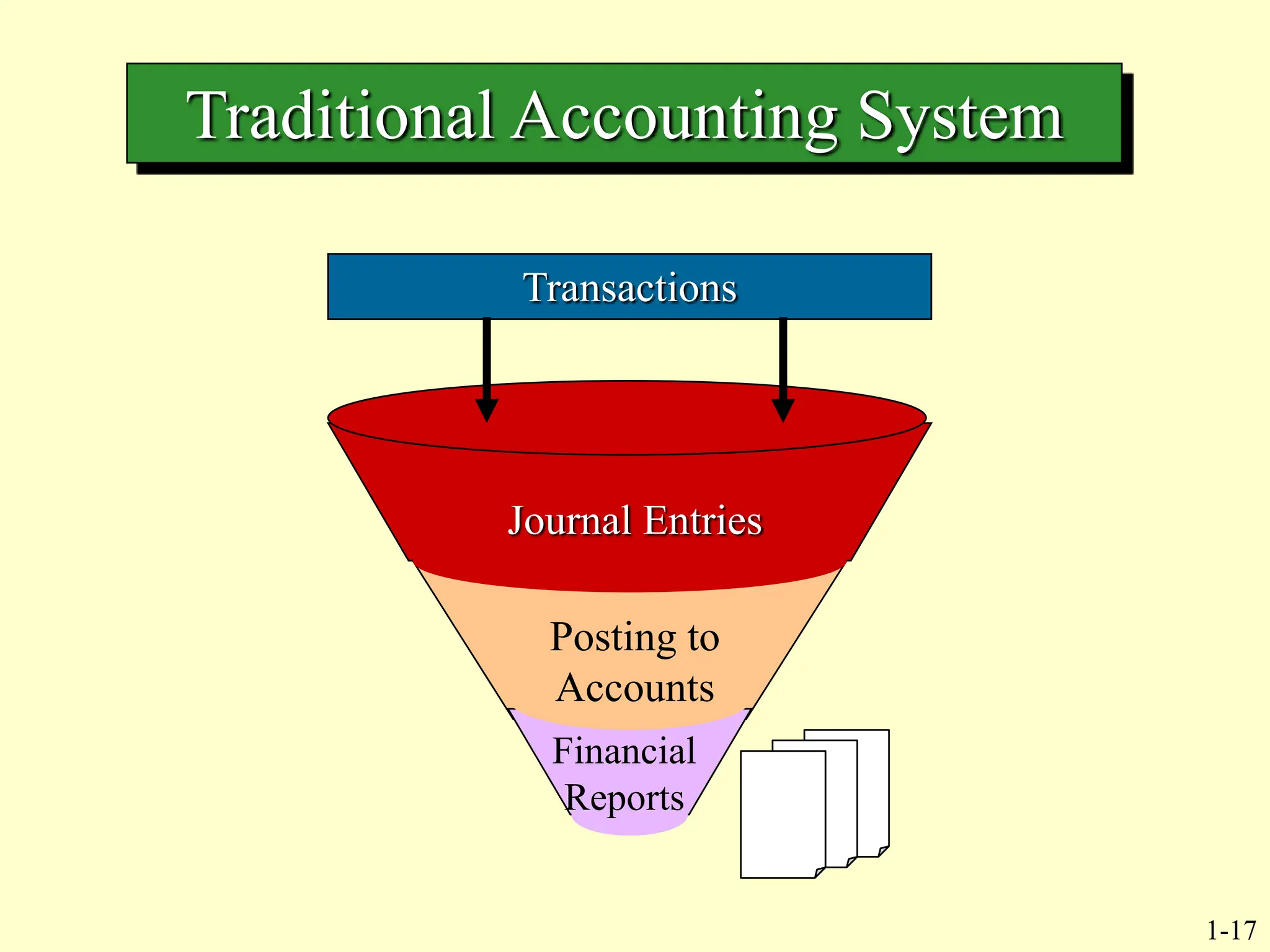
Journal Entries
Posting to
Accounts
Financial
Reports
Transactions
Traditional Accounting System
1-18
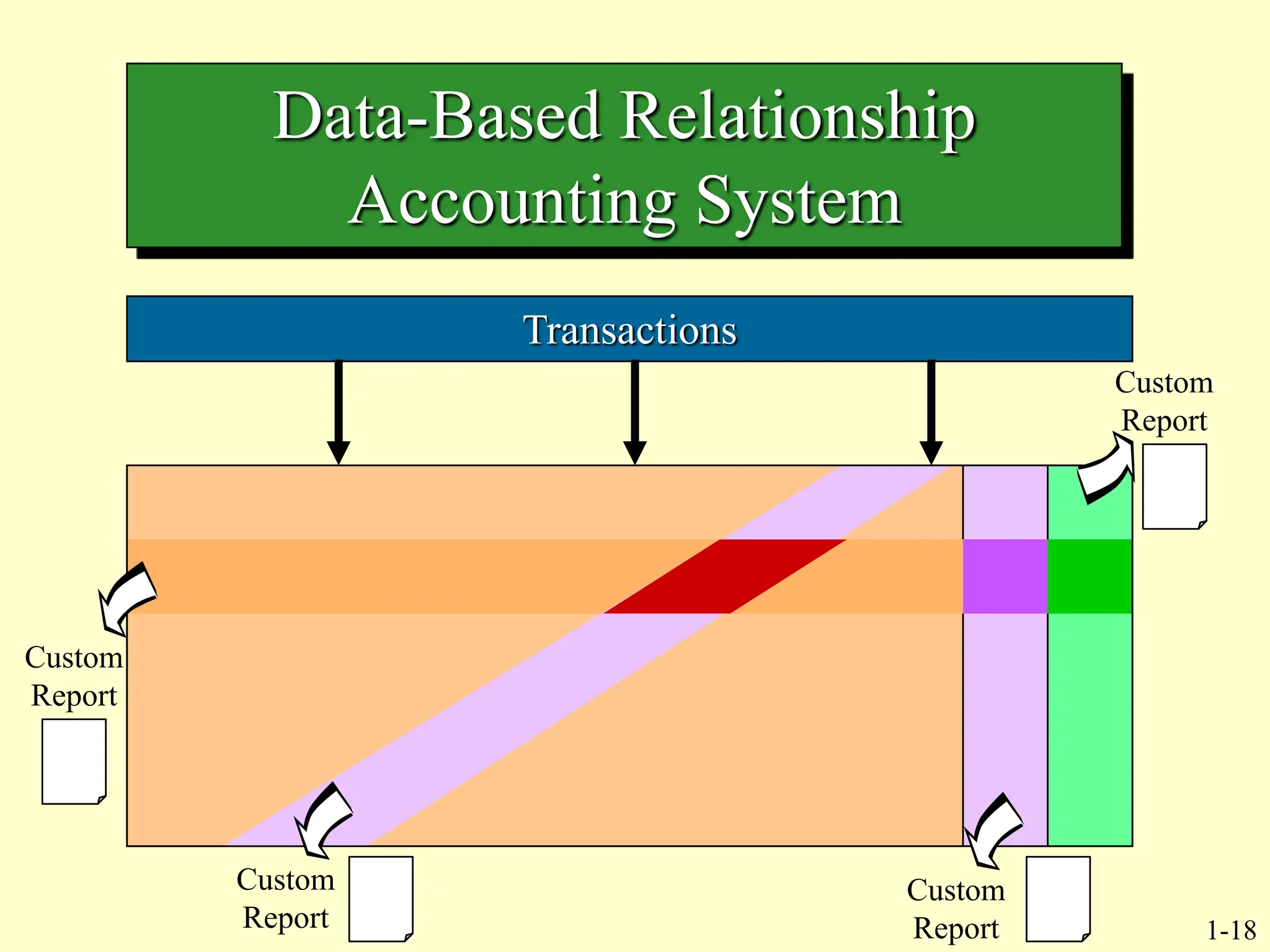
Transactions
Data-Based Relationship
Accounting System
Custom
Report
Custom
Report
Custom
Report
Custom
Report
1-19
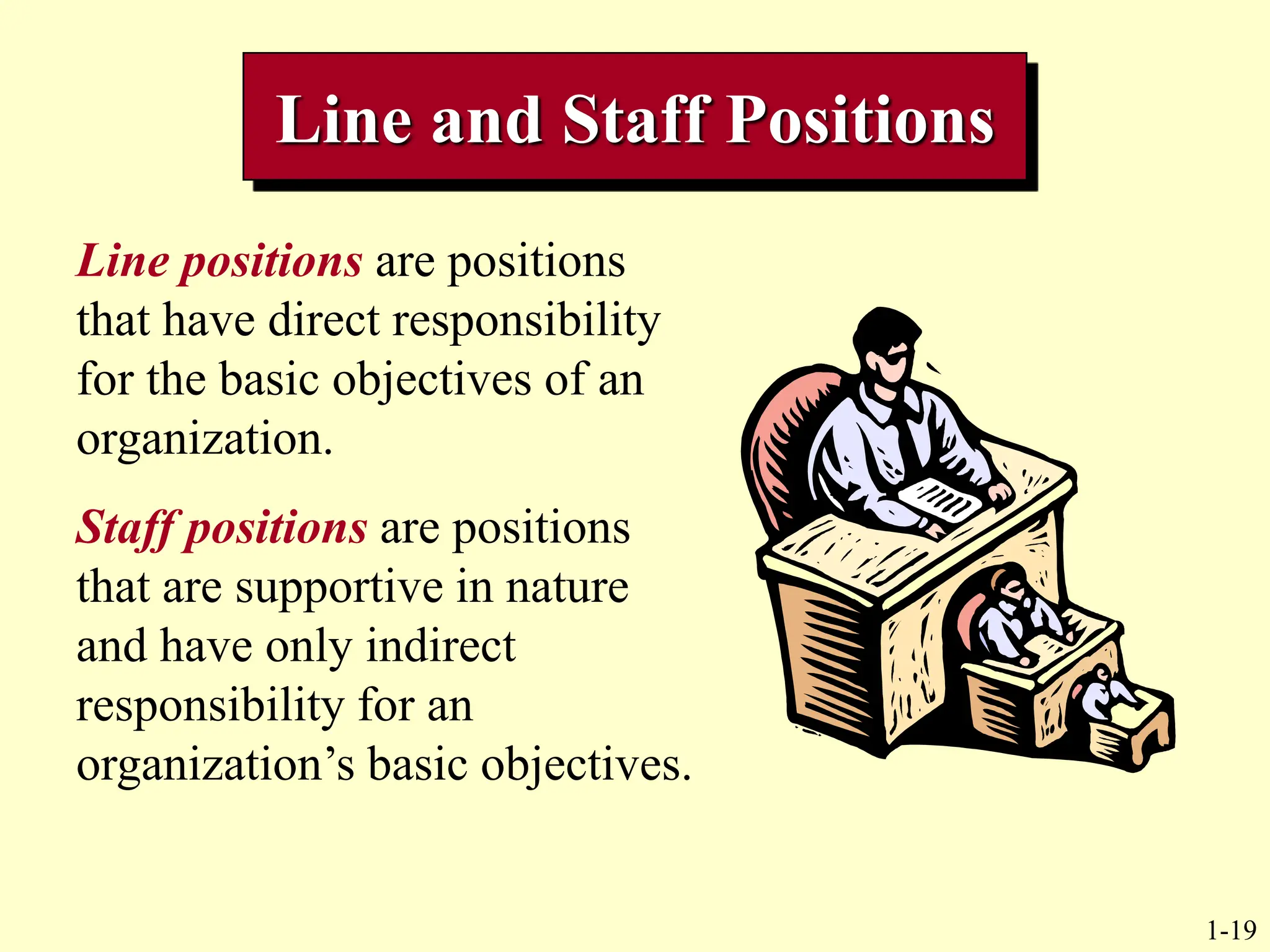
Line and Staff Positions
Line positions are positions
that have direct responsibility
for the basic objectives of an
organization.
Staff positions are positions
that are supportive in nature
and have only indirect
responsibility for an
organization’s basic objectives.
1-20
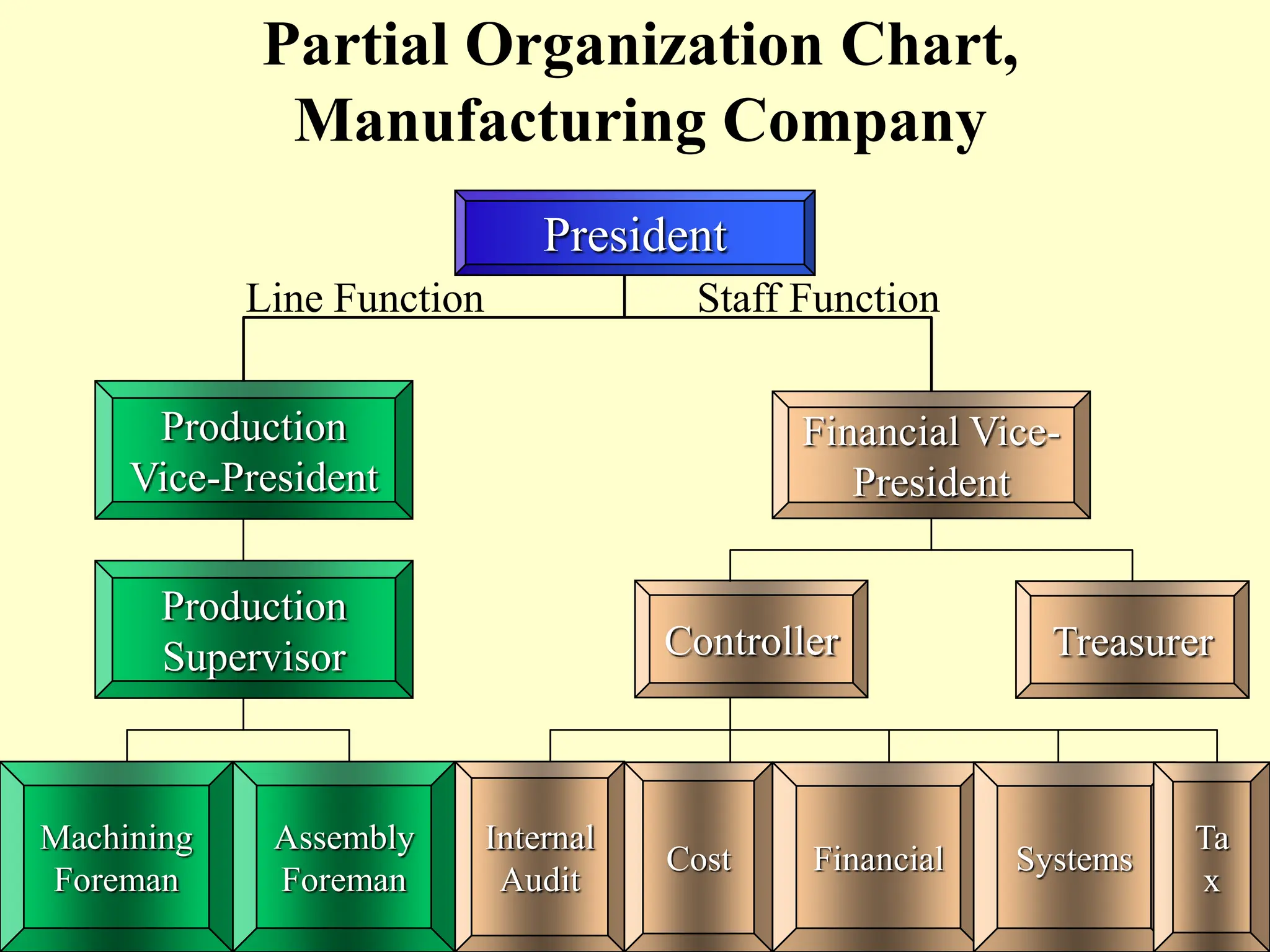
Partial Organization Chart,
Manufacturing Company
President
Line Function Staff Function
Financial Vice-
President
Controller Treasurer
Internal
Audit
Cost Financial Systems
Ta
x
Production
Vice-President
Production
Supervisor
Assembly
Foreman
Machining
Foreman
1-21
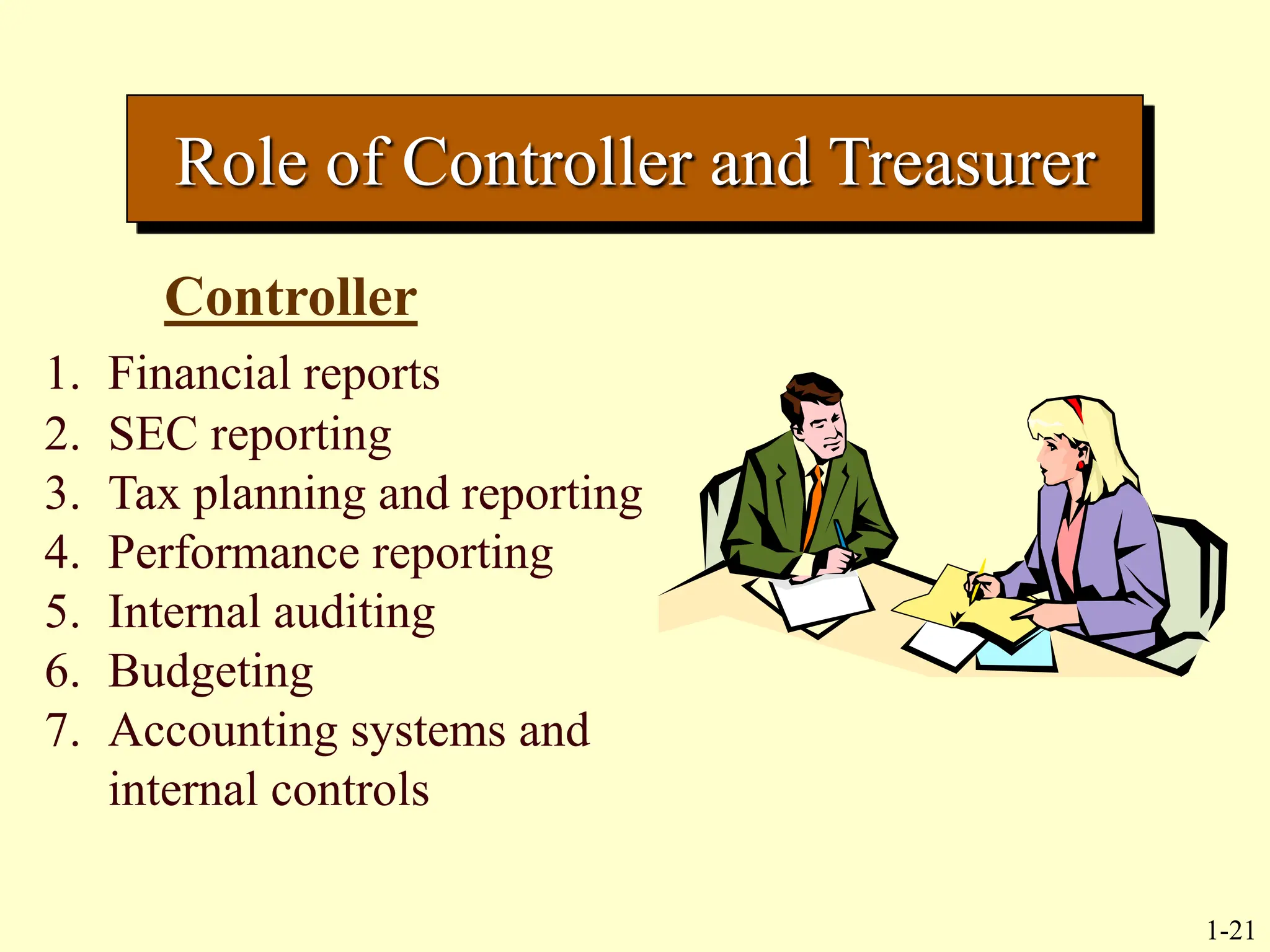
Role of Controller and Treasurer
1. Financial reports
2. SEC reporting
3. Tax planning and reporting
4. Performance reporting
5. Internal auditing
6. Budgeting
7. Accounting systems and
internal controls
Controller
1-22
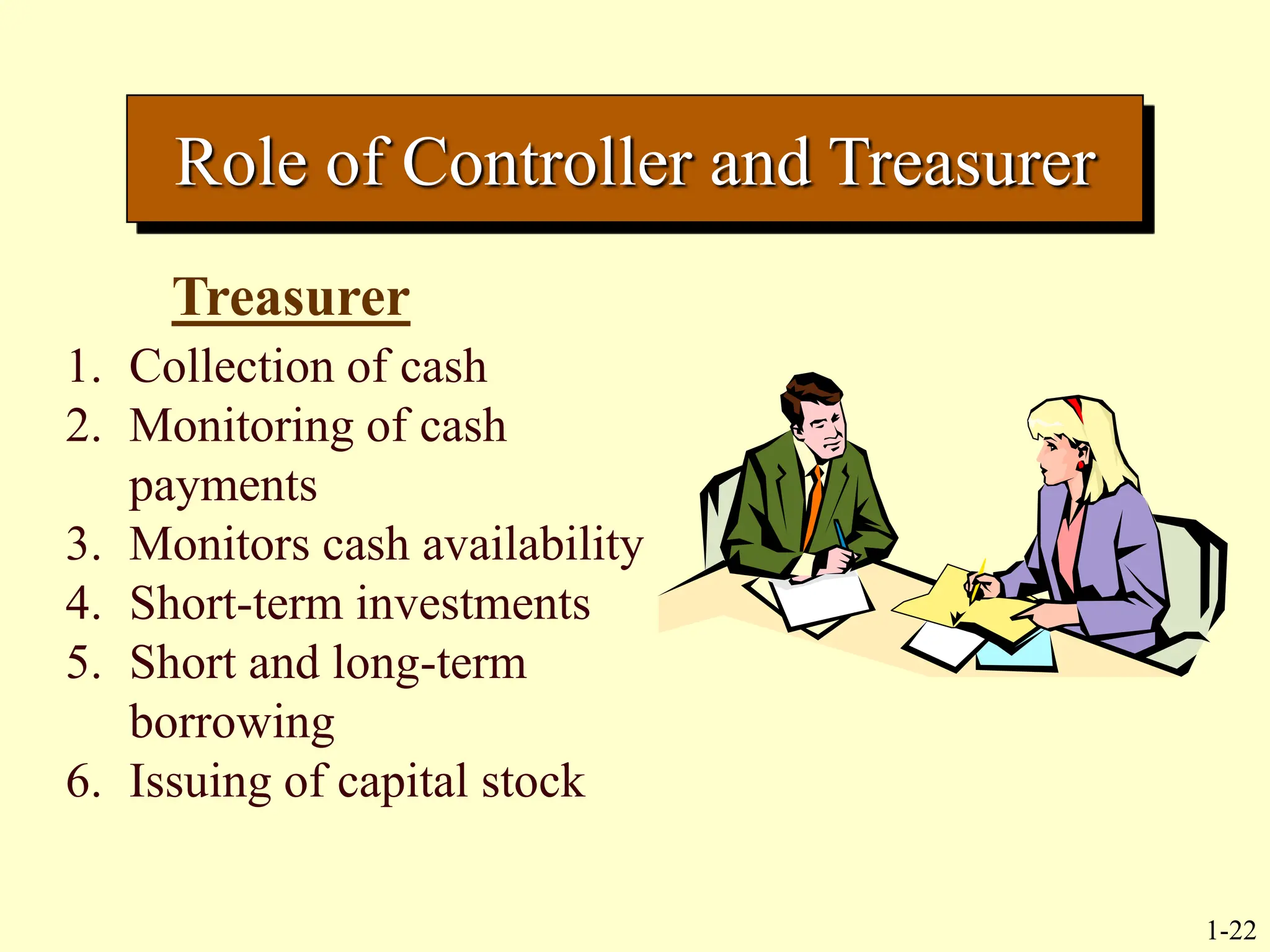
Treasurer
1. Collection of cash
2. Monitoring of cash
payments
3. Monitors cash availability
4. Short-term investments
5. Short and long-term
borrowing
6. Issuing of capital stock
Role of Controller and Treasurer
1-23
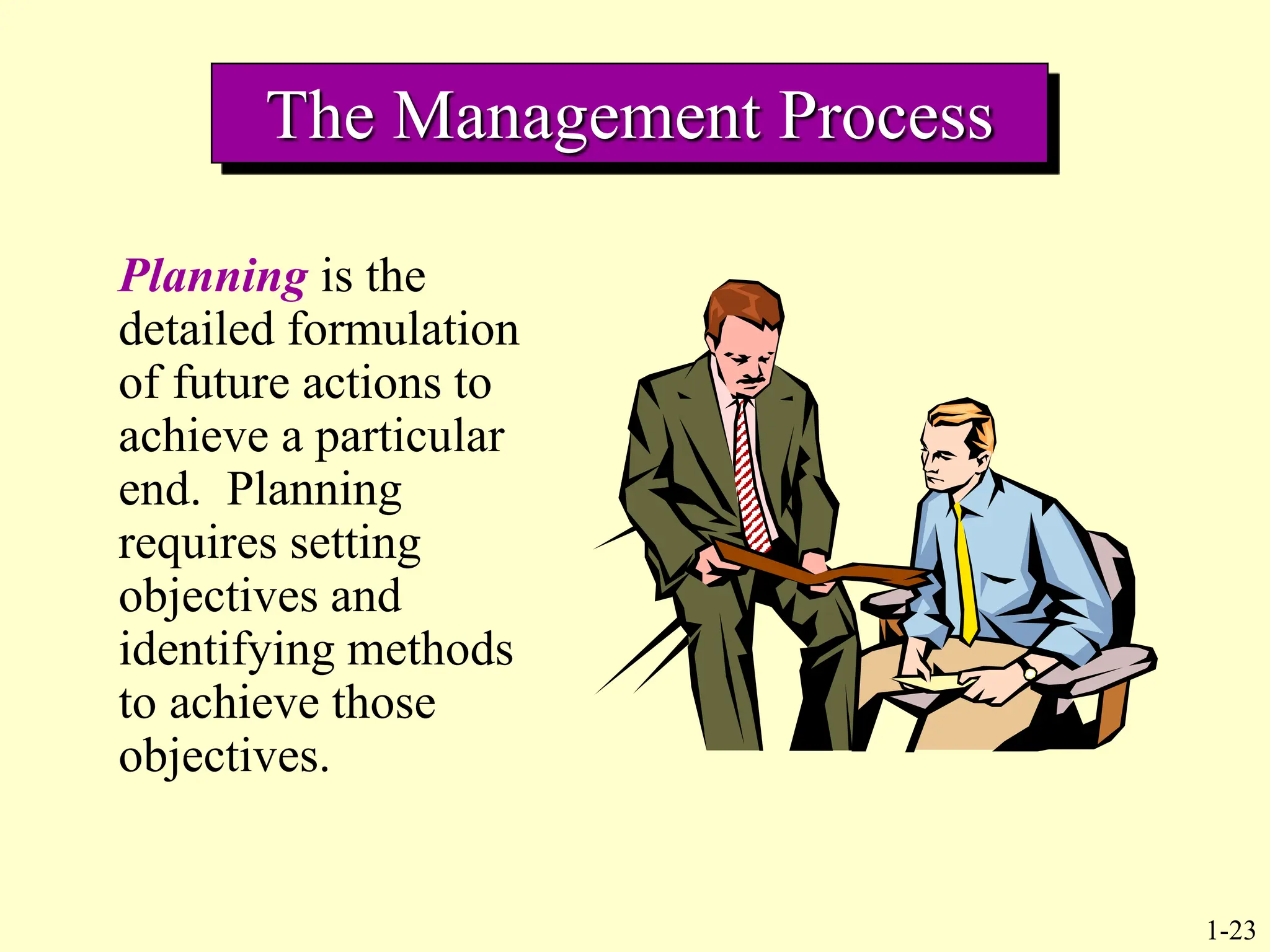
Planning is the
detailed formulation
of future actions to
achieve a particular
end. Planning
requires setting
objectives and
identifying methods
to achieve those
objectives.
The Management Process
1-24
The Management Process
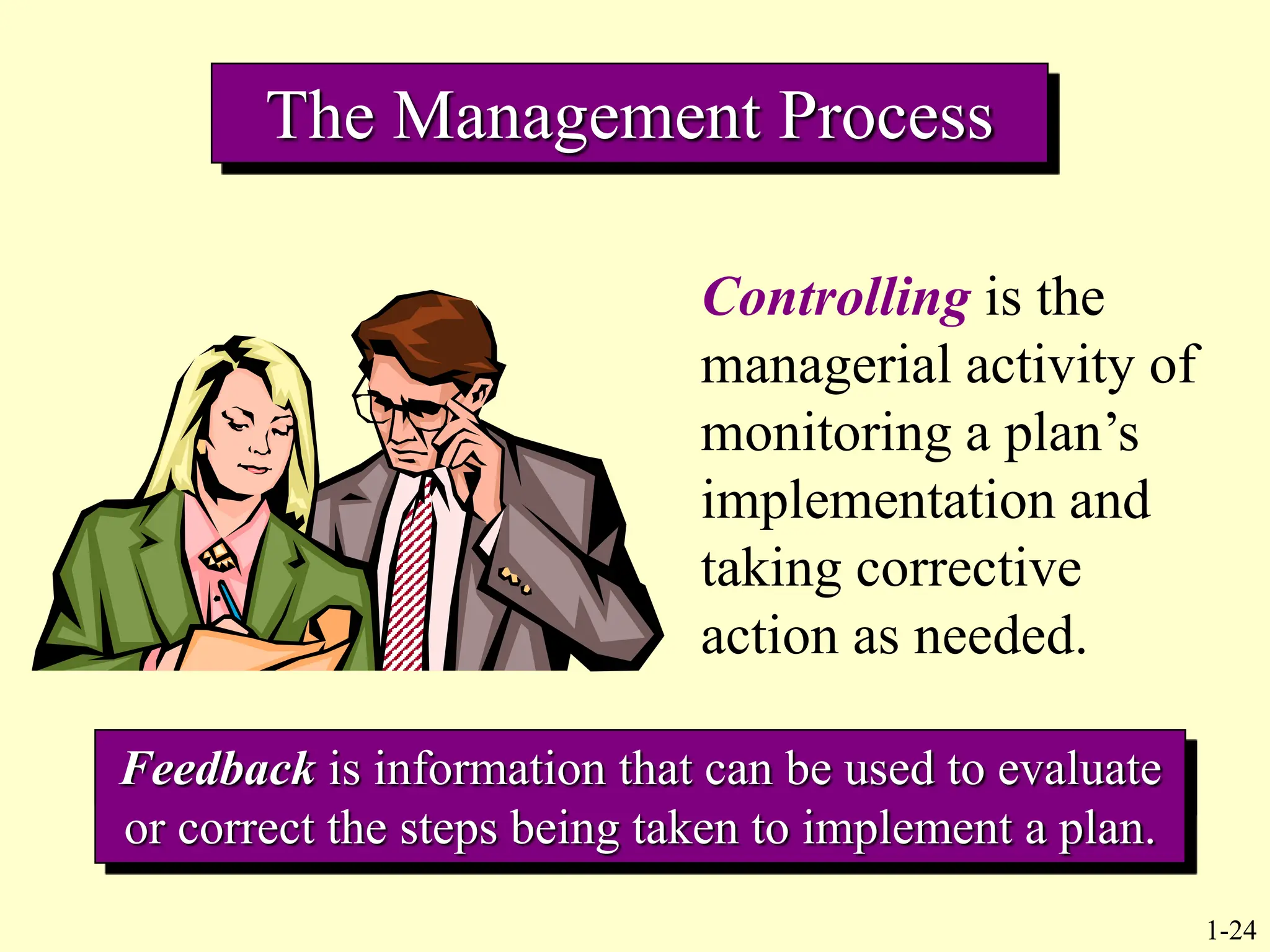
Controlling is the
managerial activity of
monitoring a plan’s
implementation and
taking corrective
action as needed.
Control is usually achieved with the use of feedback.
Feedback is information that can be used to evaluate
or correct the steps being taken to implement a plan.
1-25
The Management Process
Continuous
improvement is
required in a dynamic
environment if a firm is
to remain competitive
or to establish a
competitive advantage.
1-26
The Management Process
Decision making is
the process of
choosing among
competing
alternatives.
1-27
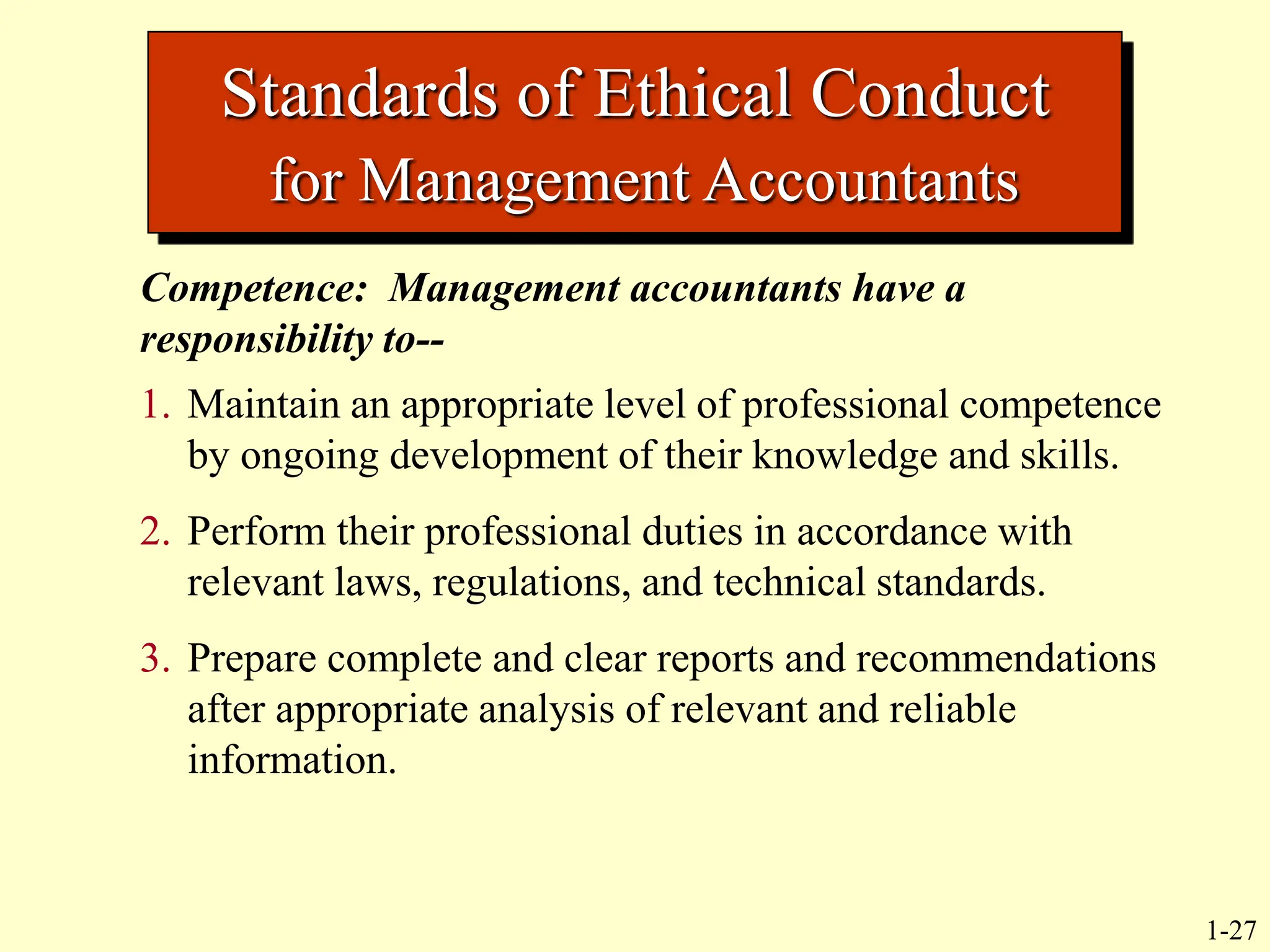
Standards of Ethical Conduct
for Management Accountants
Competence: Management accountants have a
responsibility to--
1. Maintain an appropriate level of professional competence
by ongoing development of their knowledge and skills.
2. Perform their professional duties in accordance with
relevant laws, regulations, and technical standards.
3. Prepare complete and clear reports and recommendations
after appropriate analysis of relevant and reliable
information.
1-28
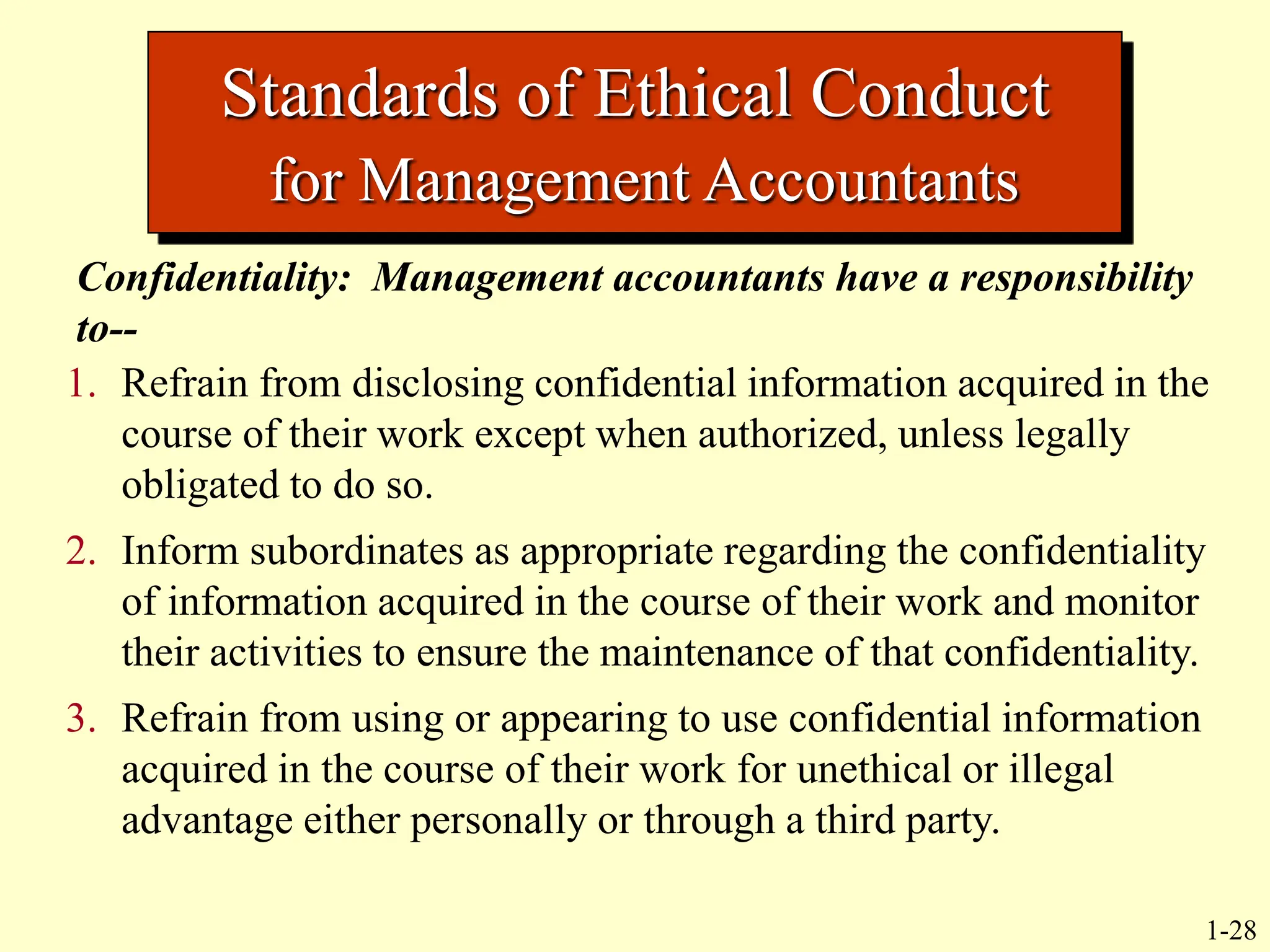
Standards of Ethical Conduct
for Management Accountants
Confidentiality: Management accountants have a responsibility
to--
1. Refrain from disclosing confidential information acquired in the
course of their work except when authorized, unless legally
obligated to do so.
2. Inform subordinates as appropriate regarding the confidentiality
of information acquired in the course of their work and monitor
their activities to ensure the maintenance of that confidentiality.
3. Refrain from using or appearing to use confidential information
acquired in the course of their work for unethical or illegal
advantage either personally or through a third party.
1-29
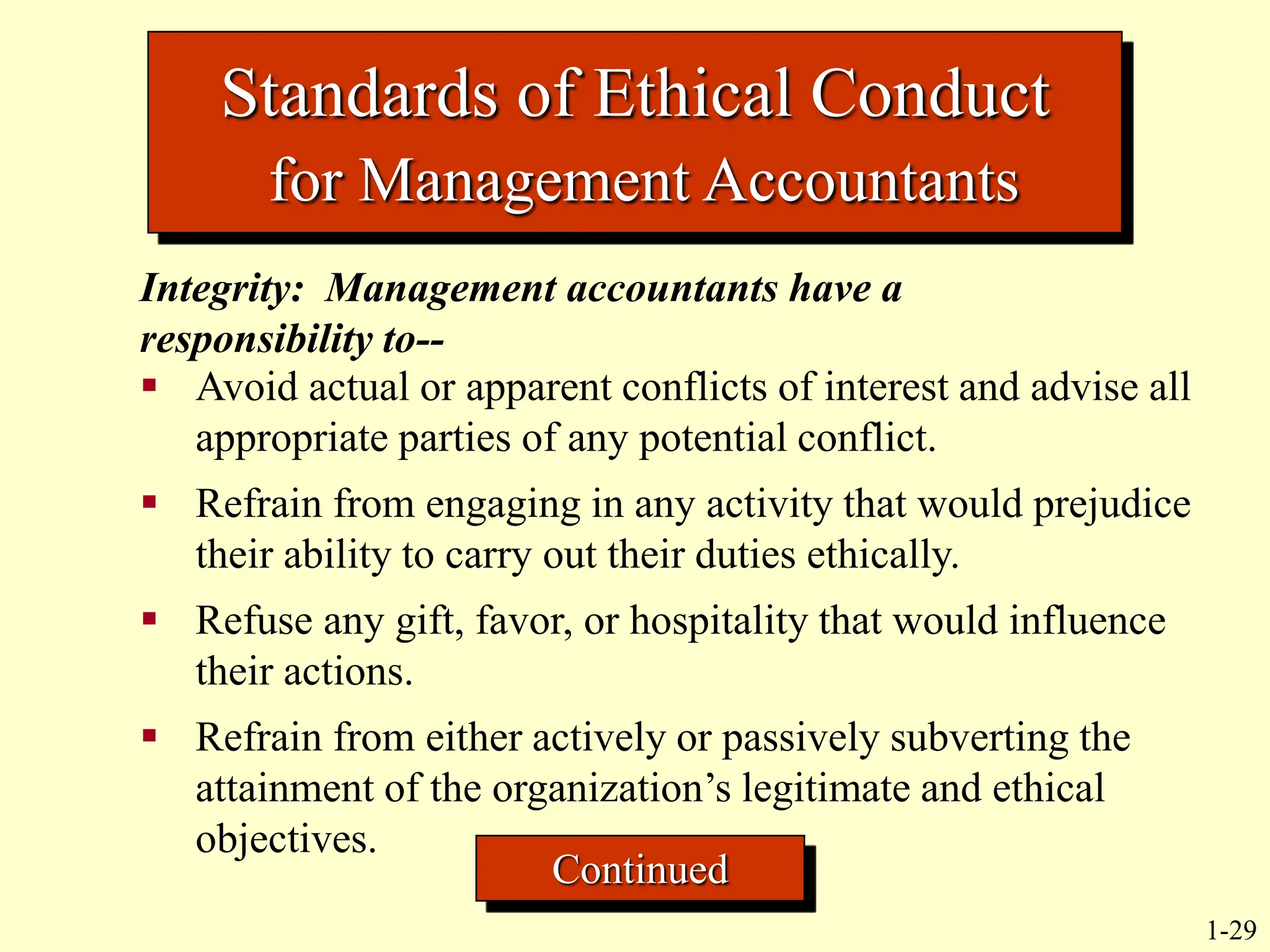
Standards of Ethical Conduct
for Management Accountants
Integrity: Management accountants have a
responsibility to--
 Avoid actual or apparent conflicts of interest and advise all
appropriate parties of any potential conflict.
 Refrain from engaging in any activity that would prejudice
their ability to carry out their duties ethically.
 Refuse any gift, favor, or hospitality that would influence
their actions.
 Refrain from either actively or passively subverting the
attainment of the organization’s legitimate and ethical
objectives.
Continued
1-30
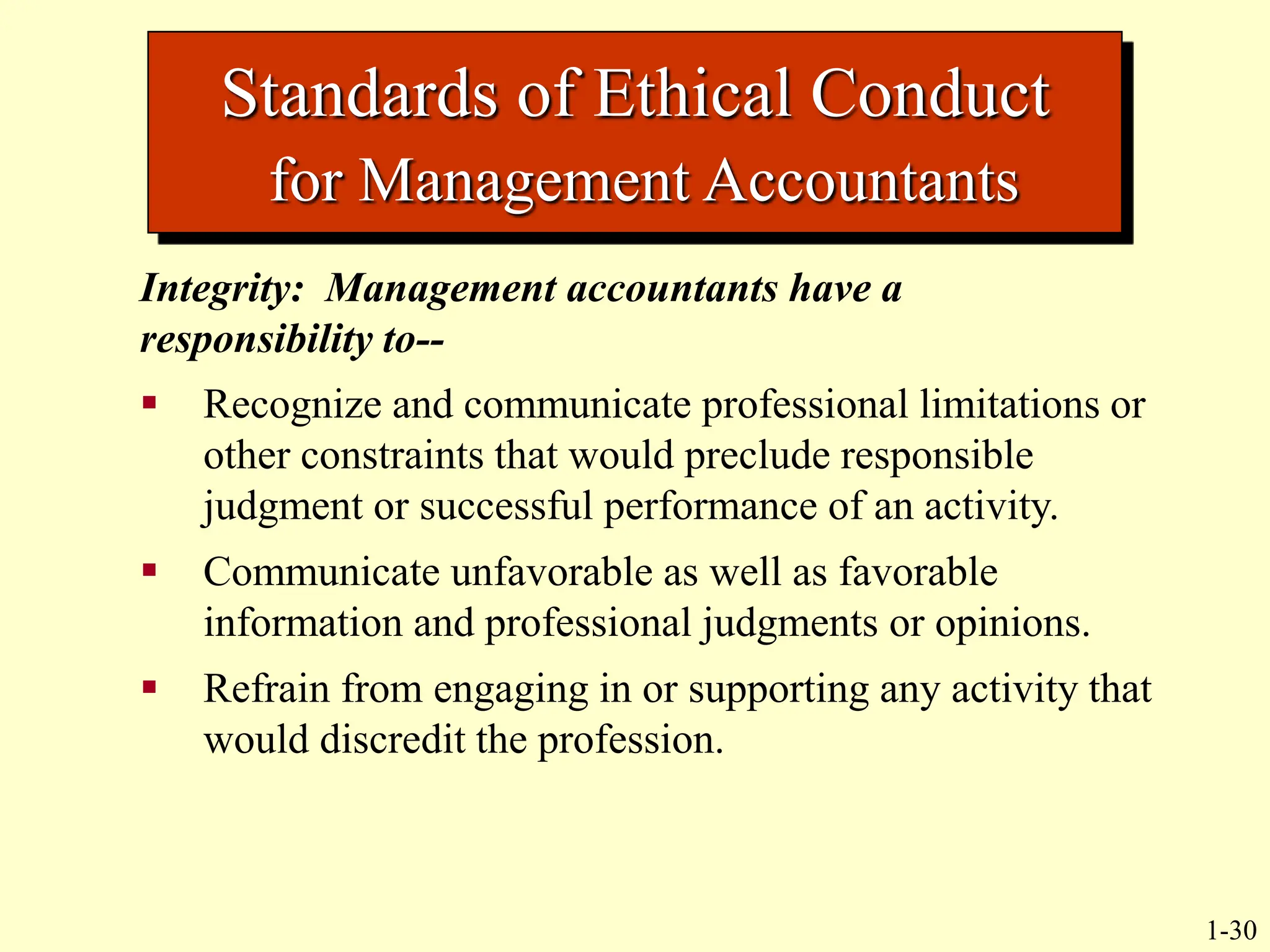
Standards of Ethical Conduct
for Management Accountants
Integrity: Management accountants have a
responsibility to--
 Recognize and communicate professional limitations or
other constraints that would preclude responsible
judgment or successful performance of an activity.
 Communicate unfavorable as well as favorable
information and professional judgments or opinions.
 Refrain from engaging in or supporting any activity that
would discredit the profession.
1-31
Objectivity: Management accountants have a
responsibility to--
1) Communicate information fairly and objectively.
2) Disclose fully all relevant information that could
reasonably be expected to influence an intended user’s
understanding of the reports, comments, and
recommendations presented.
Standards of Ethical Conduct
for Management Accountants
1-32
 CMA: One of the main purposes of the CMA was to
establish management accounting as a recognized,
professional discipline, separate from the profession
of public accounting.
 CPA: The responsibility of a CPA is to provide
assurance concerning the reliability of financial
statements.
 CIA: The focus of the CIA is to recognize
competency in internal auditing rather than external
auditing as with the CPA.
Professional Certifications
1-33
The CMA
Four areas emphasized on the exam:
1) Economics, finance, and management
2) Financial accounting and reporting
3) Management report, analysis, and behavioral
issues
4) Decision analysis and information systems
1-34
Chapter
End of
1-35

aaccounting lesson material chapter 1 university

  • 1.
  • 2.
    1-2 Task Force ClipArt included in this electronic presentation is used with the permission of New Vision Technology of Nepean Ontario, Canada.
  • 3.
    1-3 Introduction to Cost Management Preparedby Douglas Cloud Pepperdine University
  • 4.
    1-4 1. List thesimilarities and differences between financial accounting and cost management. 2. Identify the current factors affecting cost management. 3. Discuss the importance of the accounting system for internal and external reporting. 4. Explain the need for today’s cost accountant to acquire cross-functional expertise. Objectives After studying this chapter, you should be able to:
  • 5.
    1-5 5. Describe howmanagement accountants function within an organization. 6. Understand the importance of ethical behavior for management accounts. 7. Identify the thee forms of certification available to internal accountants. Objectives
  • 6.
    1-6 Financial Accounting Versus CostManagement  Financial accounting is devoted to providing information for external users; these users include investors, government agencies, and banks.  Cost management identifies, collects, measures, classifies, and reports information that is useful to managers in costing (determining what something costs), planning, controlling, and decision making.
  • 7.
    1-7  Cost accountingattempts to satisfy costing objectives for both financial and management accounting.  Management accounting is concerned specifically with how cost information and other financial and nonfinancial information should be used for planning, controlling, and decision making. Financial Accounting Versus Cost Management
  • 8.
    1-8 Current Factors AffectingCost Management • The new competitive environment has increased the demand not only for more cost information but also for more accurate information. • Vastly imported transportation and communication has led to a global market for many manufacturing and service firms. Global Competition
  • 9.
    1-9 Current Factors AffectingCost Management Growth of the Service Industry  As the traditional industries has declined in importance, the service sector of the economy has increased in importance.  Deregulation of many services has increased competition in the service industry.
  • 10.
    1-10 Current Factors AffectingCost Management Advances in Information Technology  Computers are used to monitor and control operations, which allows for a considerable amount of useful information to be collected and provided to management instantaneously.  The emergence of electronic commerce which allows buyers and sellers to come together electronically.
  • 11.
    1-11 Current Factors AffectingCost Management Advances in Management Environment The theory of constraints is a method used to continuously improve manufacturing activities and nonmanufacturing activities. Just-in-time manufacturing is a demand-pull system that strives to produce a product only when it is needed and only in the quantities demanded by customers. Computer-integrated manufacturing is the automation of the manufacturing environment.
  • 12.
    1-12 Current Factors AffectingCost Management Customer Orientation  Firms are concentrating on the delivery of value to the customer with the objective of establishing a competitive advantage.  Companies must compete not only in technological and manufacturing terms but also in terms of the speed of delivery and response.
  • 13.
    1-13 Current Factors AffectingCost Management New Product Development  Management recognizes that a high proportion of production costs are committed during the development and design stage of a new product.  The requirement to control cost encourages the use of target costing and activity-based management.
  • 14.
    1-14 Current Factors AffectingCost Management Total Quality Management  Continual improvement and elimination of waste are the two foundation principles that govern a state of manufacturing excellence.  A philosophy of total quality management, in which managers strive to create an environment that will enable organizations to manufacture perfect products, has replaced the acceptable quality attitudes of the past.
  • 15.
    1-15 Current Factors AffectingCost Management Time as a Competitive Element  Time is the crucial element in all phases of the value chain.  Decreasing non-value- added time appears to go hand-in-hand with increasing quality.
  • 16.
    1-16 Current Factors AffectingCost Management Efficiency While quality and time are important, improving these dimensions without corresponding improvements in financial performance may be futile, if not fatal. .
  • 17.
  • 18.
  • 19.
    1-19 Line and StaffPositions Line positions are positions that have direct responsibility for the basic objectives of an organization. Staff positions are positions that are supportive in nature and have only indirect responsibility for an organization’s basic objectives.
  • 20.
    1-20 Partial Organization Chart, ManufacturingCompany President Line Function Staff Function Financial Vice- President Controller Treasurer Internal Audit Cost Financial Systems Ta x Production Vice-President Production Supervisor Assembly Foreman Machining Foreman
  • 21.
    1-21 Role of Controllerand Treasurer 1. Financial reports 2. SEC reporting 3. Tax planning and reporting 4. Performance reporting 5. Internal auditing 6. Budgeting 7. Accounting systems and internal controls Controller
  • 22.
    1-22 Treasurer 1. Collection ofcash 2. Monitoring of cash payments 3. Monitors cash availability 4. Short-term investments 5. Short and long-term borrowing 6. Issuing of capital stock Role of Controller and Treasurer
  • 23.
    1-23 Planning is the detailedformulation of future actions to achieve a particular end. Planning requires setting objectives and identifying methods to achieve those objectives. The Management Process
  • 24.
    1-24 The Management Process Controllingis the managerial activity of monitoring a plan’s implementation and taking corrective action as needed. Control is usually achieved with the use of feedback. Feedback is information that can be used to evaluate or correct the steps being taken to implement a plan.
  • 25.
    1-25 The Management Process Continuous improvementis required in a dynamic environment if a firm is to remain competitive or to establish a competitive advantage.
  • 26.
    1-26 The Management Process Decisionmaking is the process of choosing among competing alternatives.
  • 27.
    1-27 Standards of EthicalConduct for Management Accountants Competence: Management accountants have a responsibility to-- 1. Maintain an appropriate level of professional competence by ongoing development of their knowledge and skills. 2. Perform their professional duties in accordance with relevant laws, regulations, and technical standards. 3. Prepare complete and clear reports and recommendations after appropriate analysis of relevant and reliable information.
  • 28.
    1-28 Standards of EthicalConduct for Management Accountants Confidentiality: Management accountants have a responsibility to-- 1. Refrain from disclosing confidential information acquired in the course of their work except when authorized, unless legally obligated to do so. 2. Inform subordinates as appropriate regarding the confidentiality of information acquired in the course of their work and monitor their activities to ensure the maintenance of that confidentiality. 3. Refrain from using or appearing to use confidential information acquired in the course of their work for unethical or illegal advantage either personally or through a third party.
  • 29.
    1-29 Standards of EthicalConduct for Management Accountants Integrity: Management accountants have a responsibility to--  Avoid actual or apparent conflicts of interest and advise all appropriate parties of any potential conflict.  Refrain from engaging in any activity that would prejudice their ability to carry out their duties ethically.  Refuse any gift, favor, or hospitality that would influence their actions.  Refrain from either actively or passively subverting the attainment of the organization’s legitimate and ethical objectives. Continued
  • 30.
    1-30 Standards of EthicalConduct for Management Accountants Integrity: Management accountants have a responsibility to--  Recognize and communicate professional limitations or other constraints that would preclude responsible judgment or successful performance of an activity.  Communicate unfavorable as well as favorable information and professional judgments or opinions.  Refrain from engaging in or supporting any activity that would discredit the profession.
  • 31.
    1-31 Objectivity: Management accountantshave a responsibility to-- 1) Communicate information fairly and objectively. 2) Disclose fully all relevant information that could reasonably be expected to influence an intended user’s understanding of the reports, comments, and recommendations presented. Standards of Ethical Conduct for Management Accountants
  • 32.
    1-32  CMA: Oneof the main purposes of the CMA was to establish management accounting as a recognized, professional discipline, separate from the profession of public accounting.  CPA: The responsibility of a CPA is to provide assurance concerning the reliability of financial statements.  CIA: The focus of the CIA is to recognize competency in internal auditing rather than external auditing as with the CPA. Professional Certifications
  • 33.
    1-33 The CMA Four areasemphasized on the exam: 1) Economics, finance, and management 2) Financial accounting and reporting 3) Management report, analysis, and behavioral issues 4) Decision analysis and information systems
  • 34.
  • 35.