
A workhorse named Mule


The speaker
   Mule in Action, co­author
   Project despot of Mule JCR Transport
       Common Retry Policies
       HTML Dashboard
   Mule Community Committee Member
   Lead of NxBRE
   Judge for the Jolt Awards
   And a few other stuff...
                       
Non­agenda
   eMule
   Mule pre 2.2.0, EE
   Tutorial
   Works on my machine
   Alternative configurations


Agenda
   Introduction
   Exploration
   Construction
   In Action


Introduction


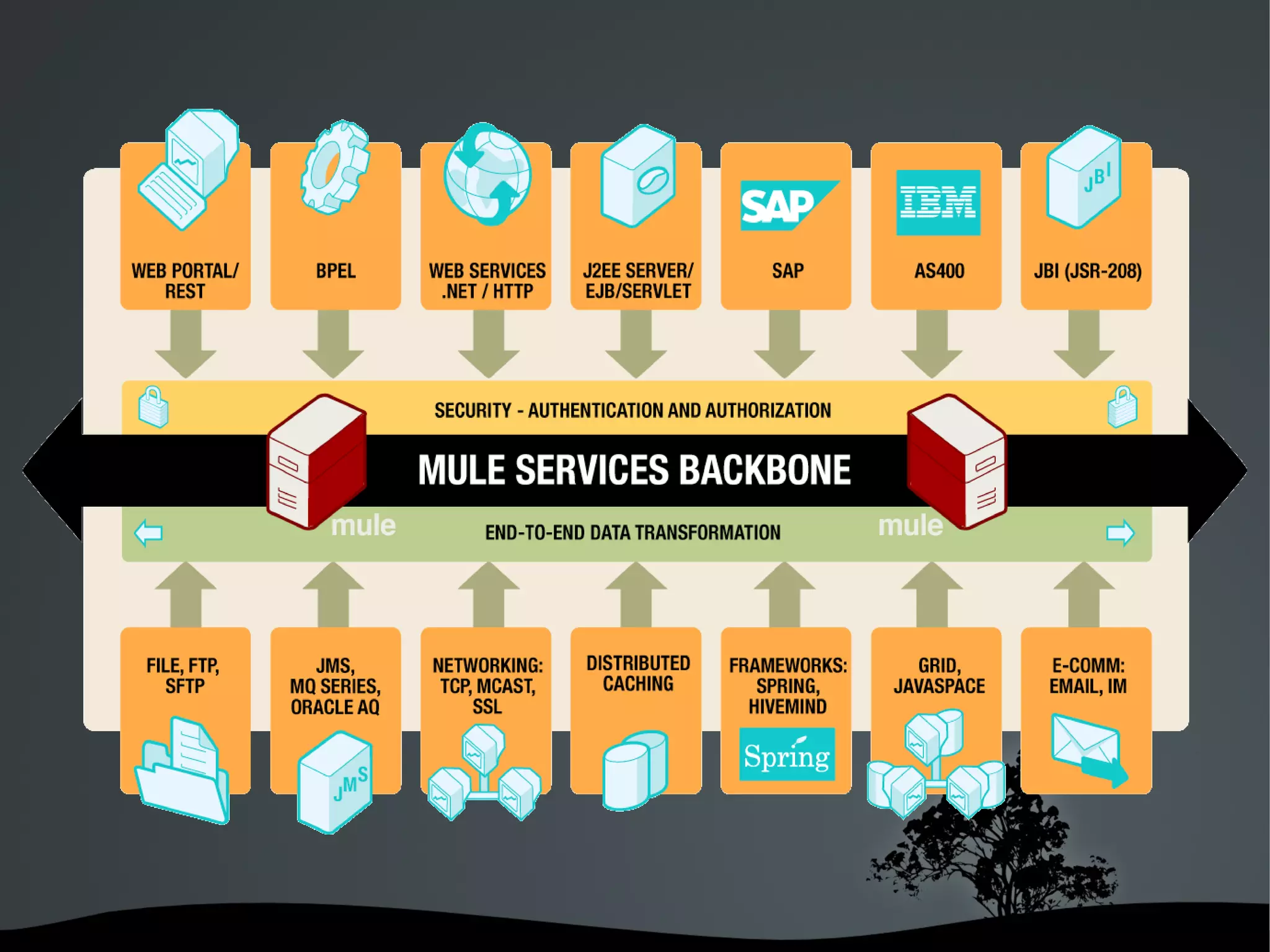
What is Mule?


”Mule is a lightweight messaging framework and 
        highly distributable object broker”


What? No ESB? No SOA?
   ESB is a deployment topology
       Mule can be deployed as ESB
       But also: ESN, Hub and spoke...
   SOA can leverage an ESB
       Just an extra tool in a tool box
       Mule has no dogma nor methodology

   More on this later...

                        
And what about Java?
   Written in Java
       Leverages zillions of Java open source 
        libraries
   Can do a lot without Java though
       XML and Groovy can go a long way


Genesis
   Founded by Ross Mason
   SourceForge project created in April 2003
   Version 1.0 in April 2005
       Moved to CodeHaus
   Architecture based on:
       EIP
       SEDA


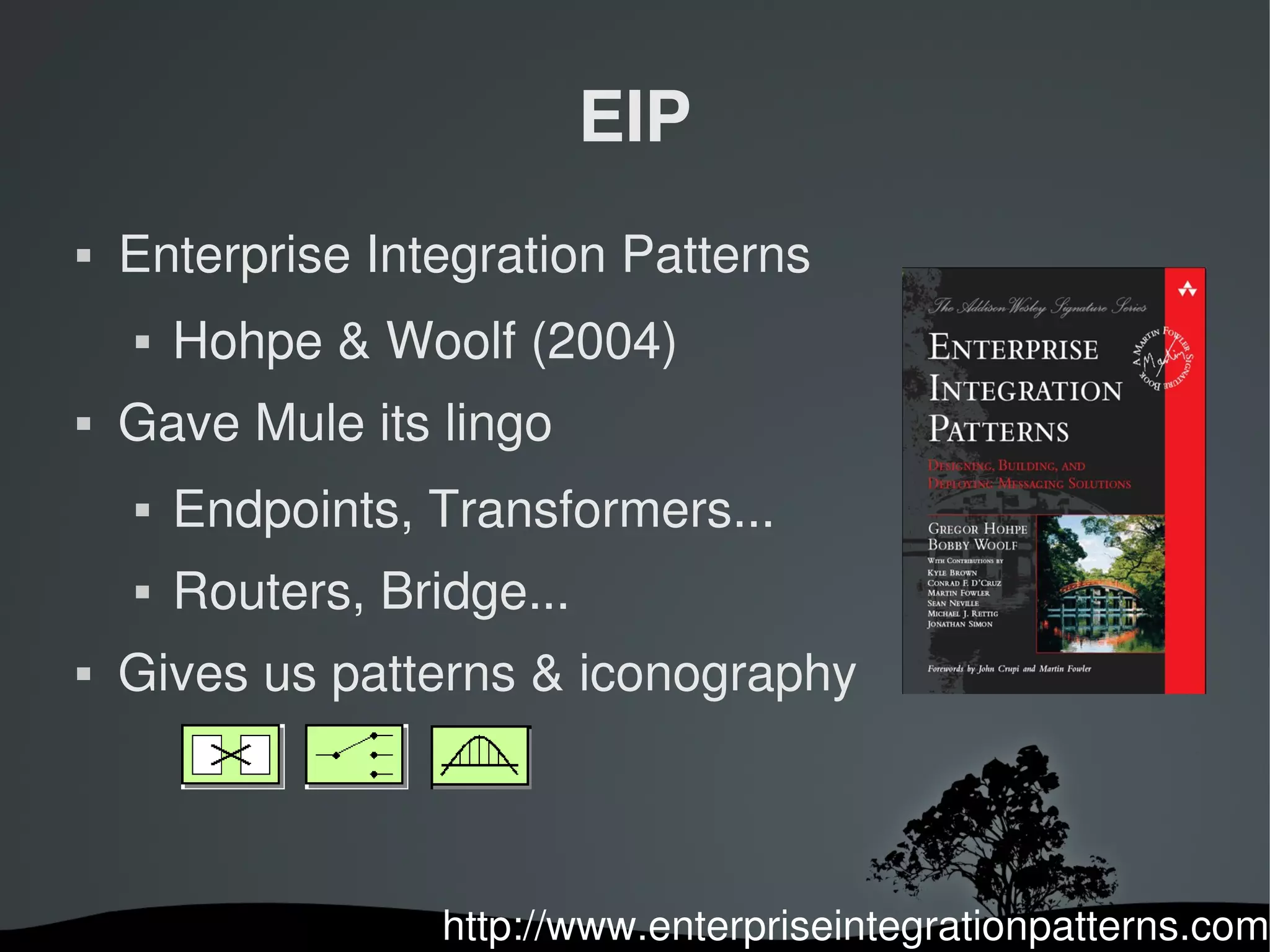
EIP
   Enterprise Integration Patterns
       Hohpe & Woolf (2004)
   Gave Mule its lingo
       Endpoints, Transformers...
       Routers, Bridge...
   Gives us patterns & iconography


                    http://www.enterpriseintegrationpatterns.com
                         
SEDA
   Staged Event­Driven Architecture
       Welsh (2001)
   Disciplined approach to overload management
       Event­driven application
       Stages connected by queues
   Graceful degradation under load
   By default Mule is asynchronous and SEDA


What's in a name?
”After  working  on  a  couple  of  bespoke  ESB 
systems,  I  found  that  there  was  a  lot  of 
infrastructure  work  to  be  done  before  you  can 
really start thinking about implementing any logic. 
I regard this infrastructure work as 'donkey work'
as  it  needs  doing  for  every  project.  I  preferred 
Mule over Donkey and Ass just didn't seem right.
A  Mule  is  also  commonly  referred  to  as  a  carrier 
of load, moving it form one place to another. The 
load  we  specialise  in  moving  is  your  enterprise 
information.”
                                                Ross Mason
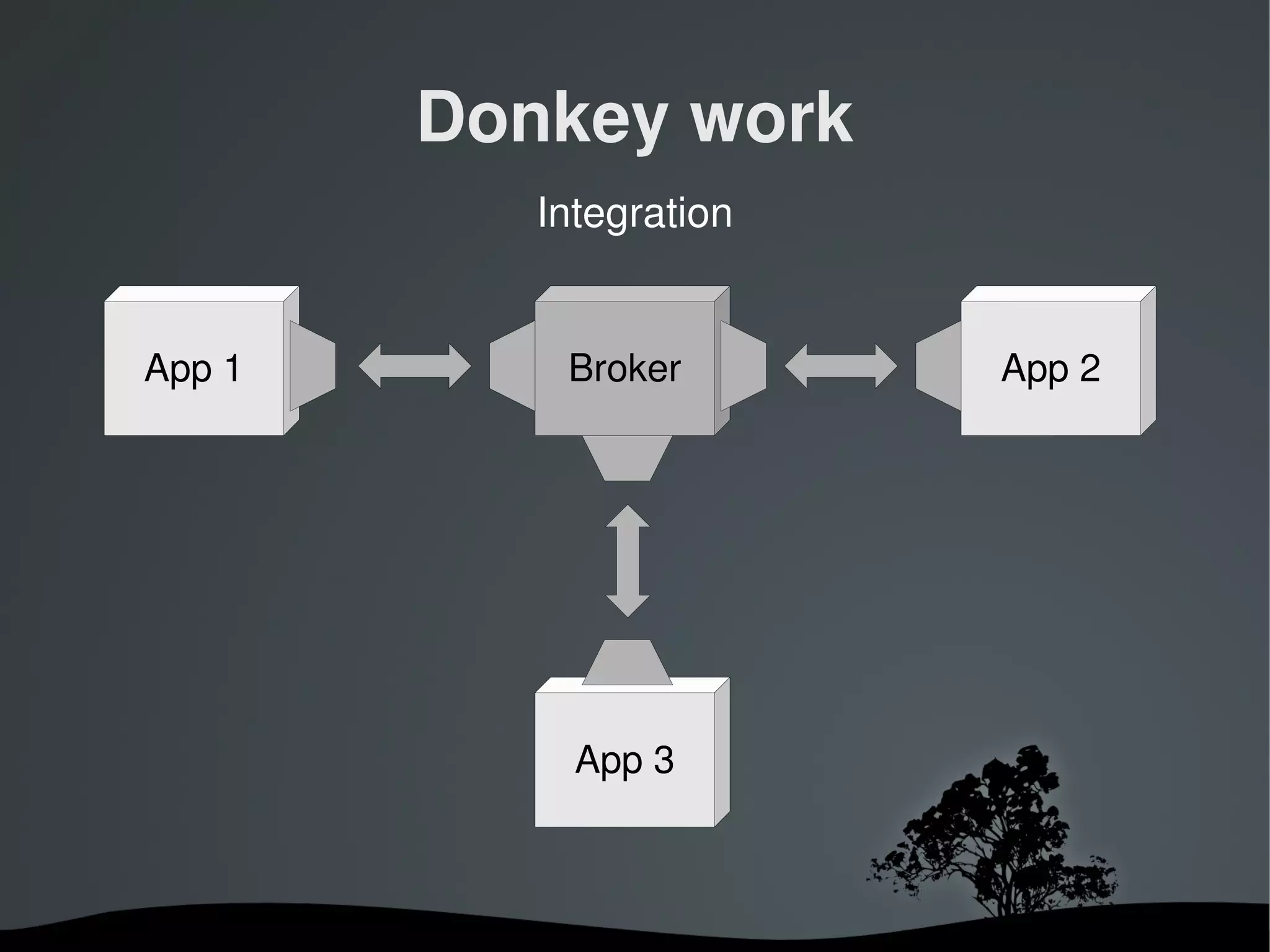
Donkey work
              Integration


App 1          Broker       App 2


                App 3


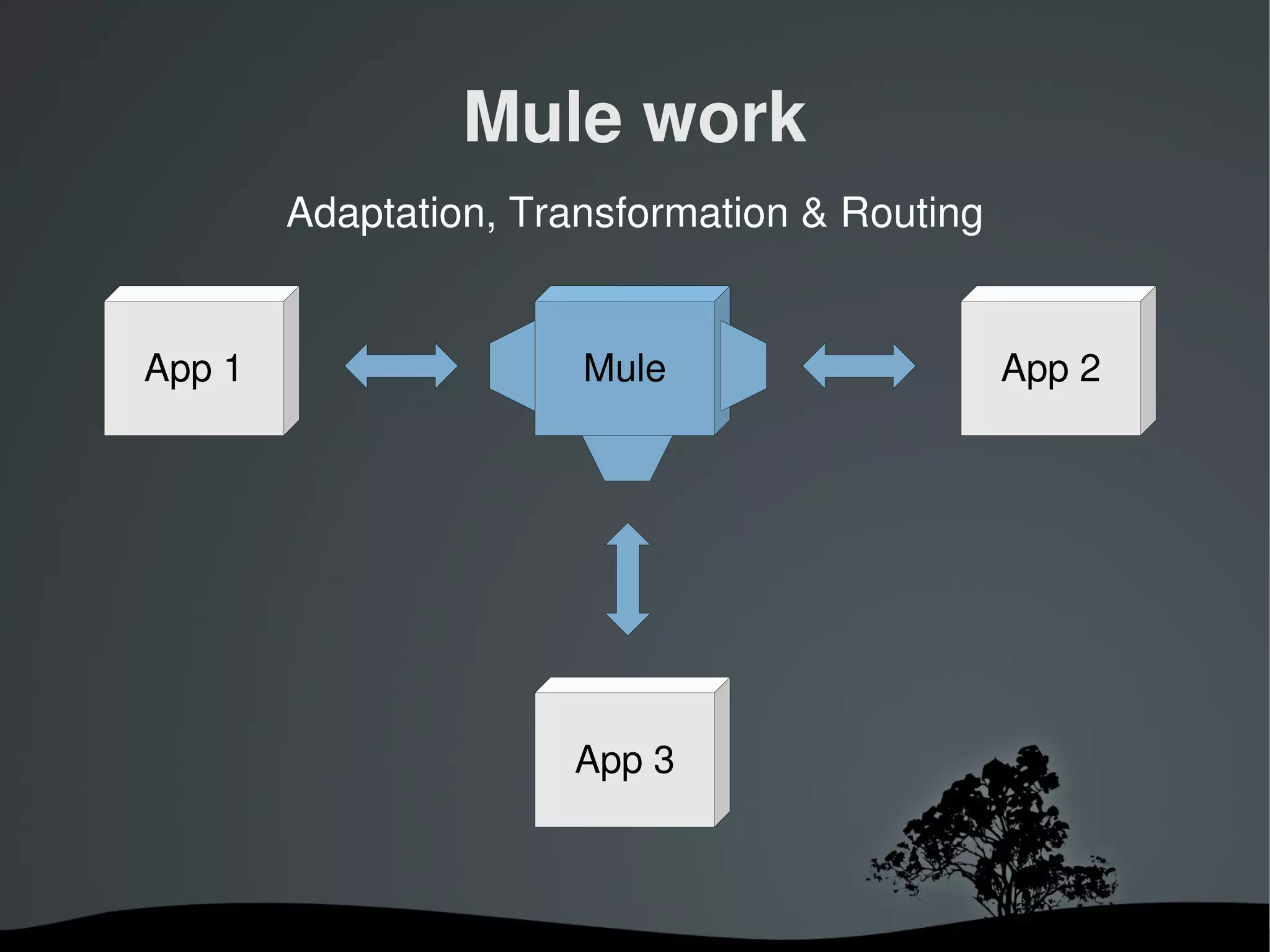
Mule work
        Adaptation, Transformation & Routing


App 1                  Mule                    App 2


                       App 3


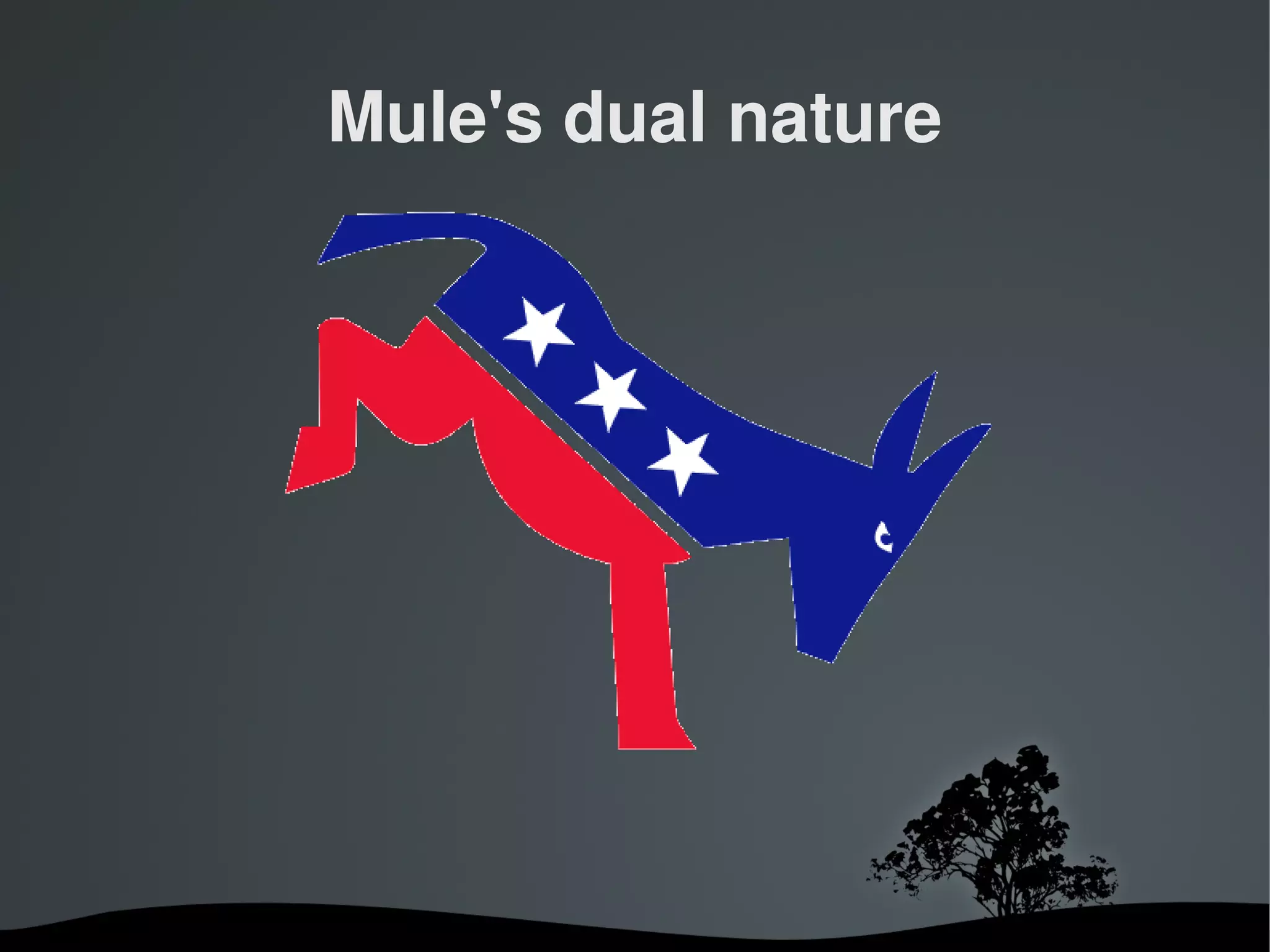
Mule's dual nature


Mule's dual nature


”Mule is a lightweight messaging framework and 
        highly distributable object broker”


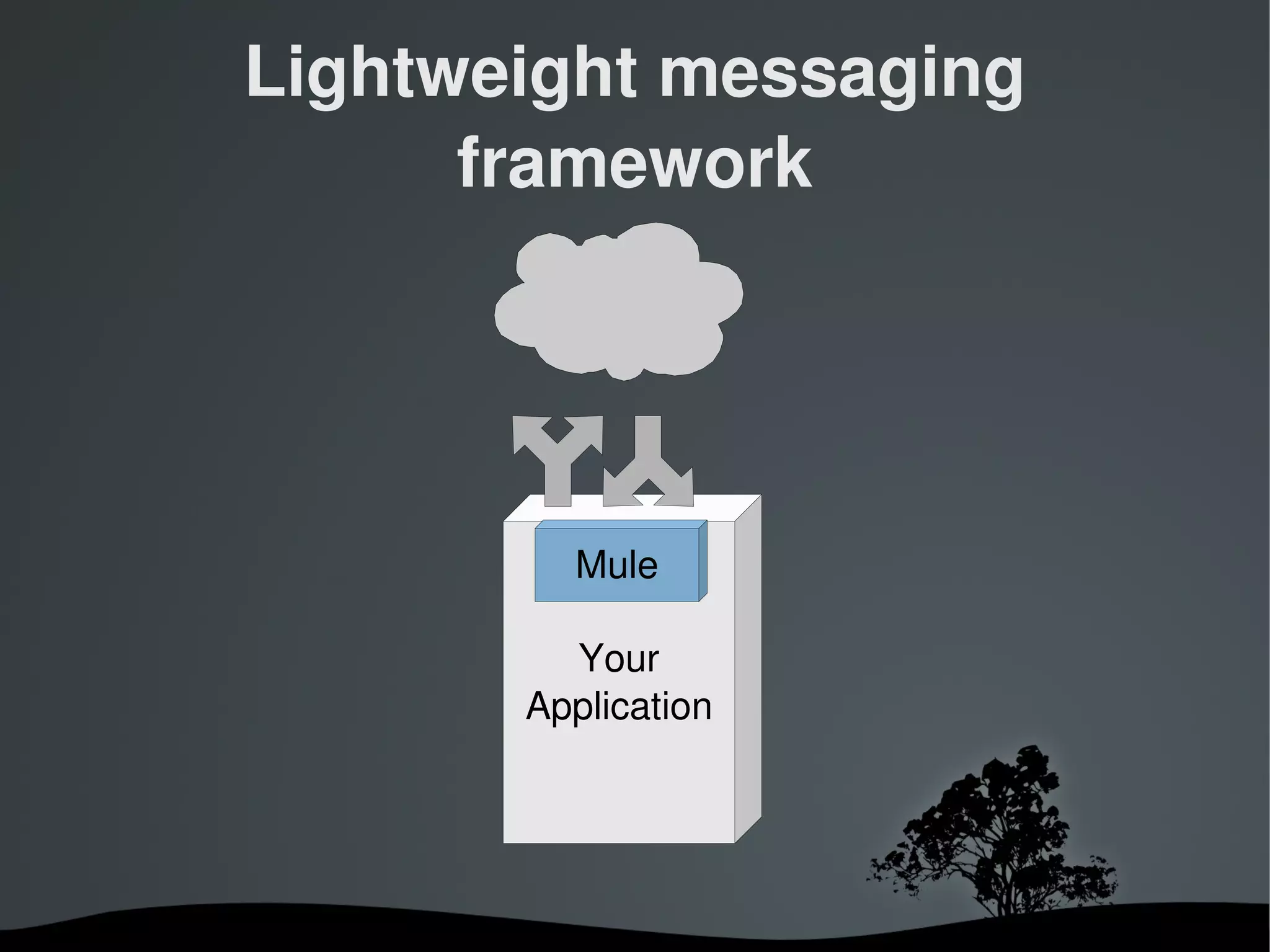
Lightweight messaging 
          framework


                 Mule

                 Your
               Application


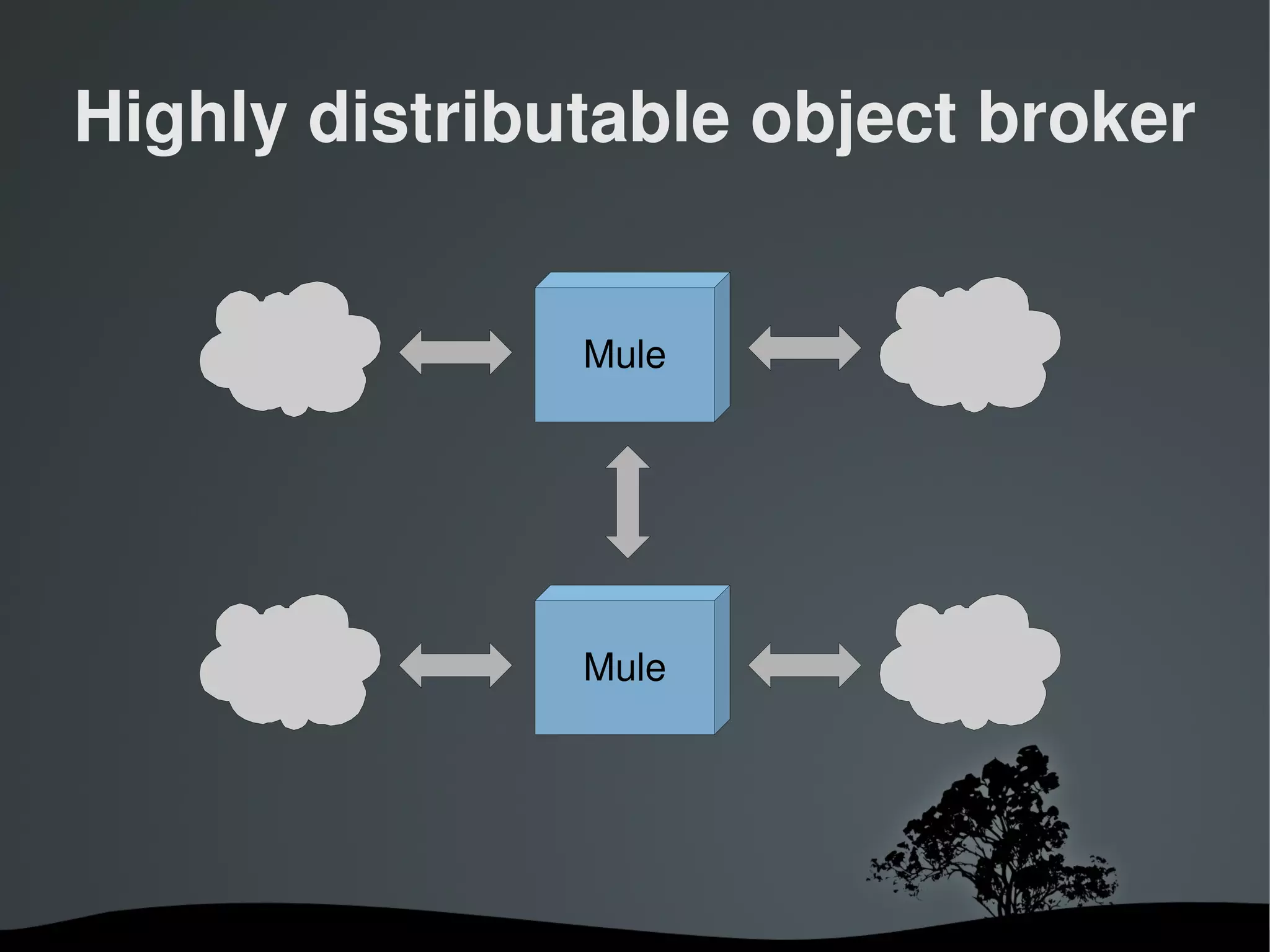
Highly distributable object broker


                 Mule


                 Mule


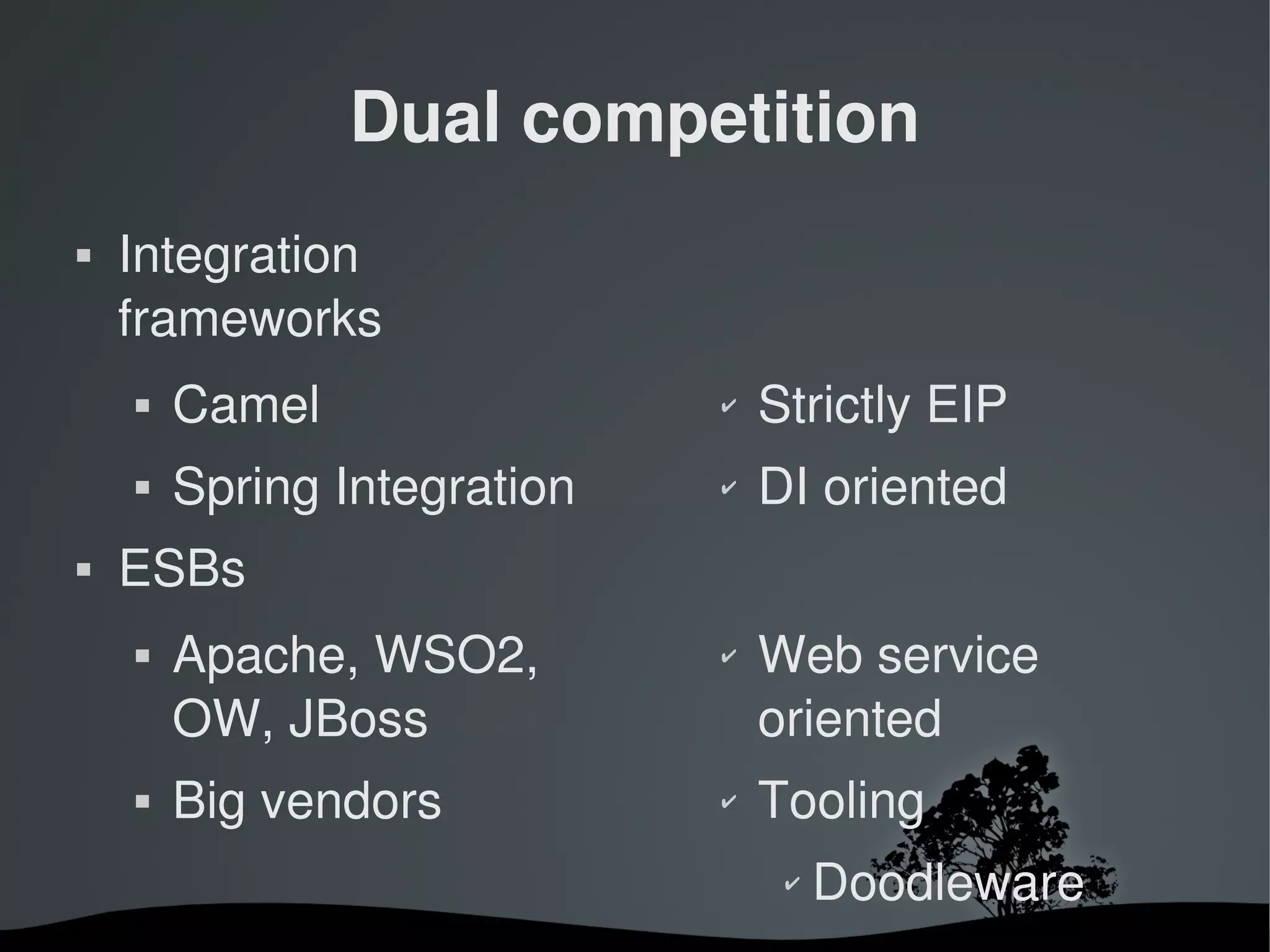
Dual competition
   Integration 
    frameworks
       Camel                ✔   Strictly EIP
       Spring Integration   ✔   DI oriented
   ESBs
       Apache, WSO2,        ✔   Web service 
        OW, JBoss                oriented
       Big vendors          ✔   Tooling
                                  ✔   Doodleware
                        
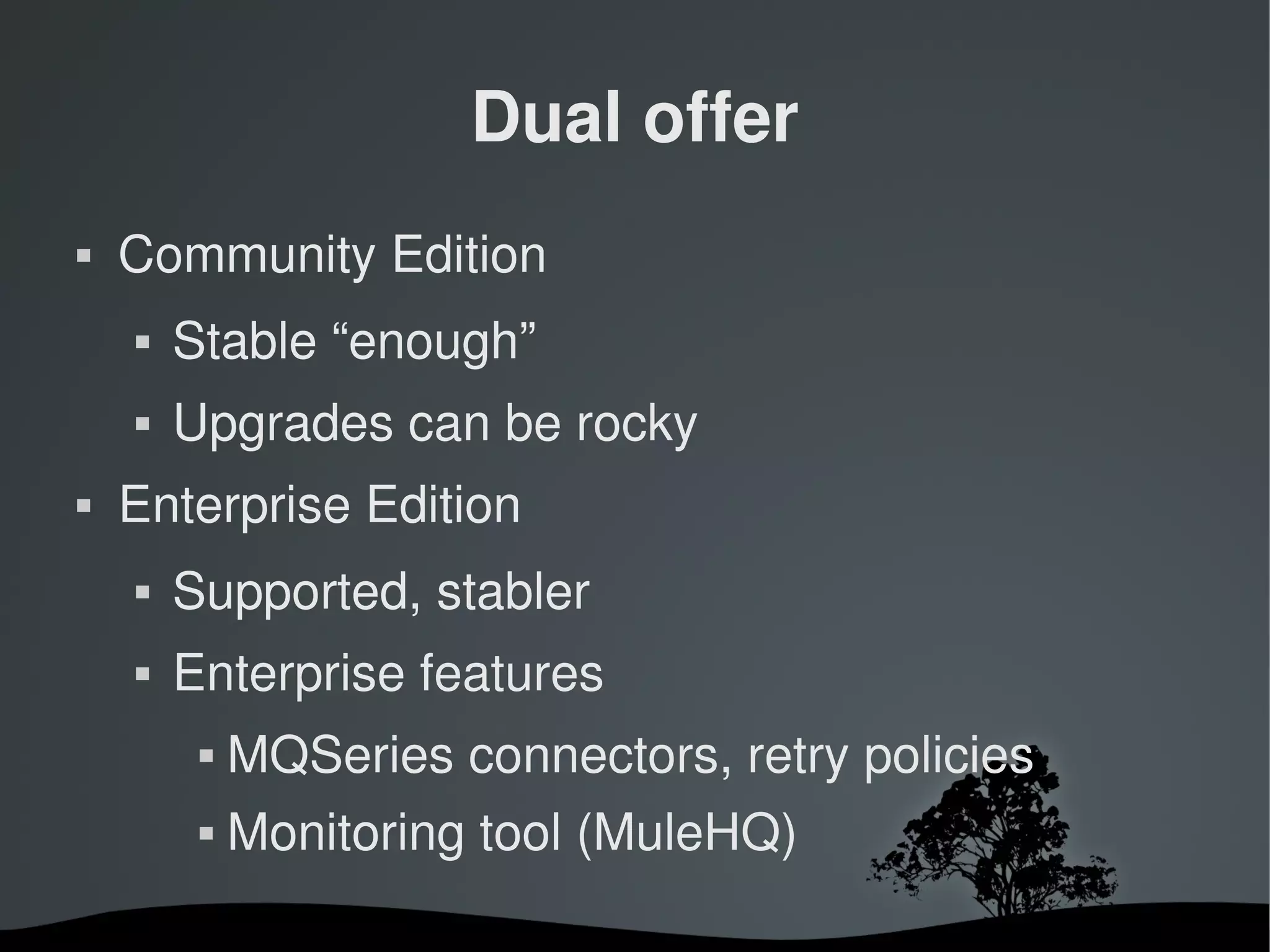
Dual offer
   Community Edition
       Stable “enough”
       Upgrades can be rocky
   Enterprise Edition
       Supported, stabler
       Enterprise features
                MQSeries connectors, retry policies
                Monitoring tool (MuleHQ)
                              
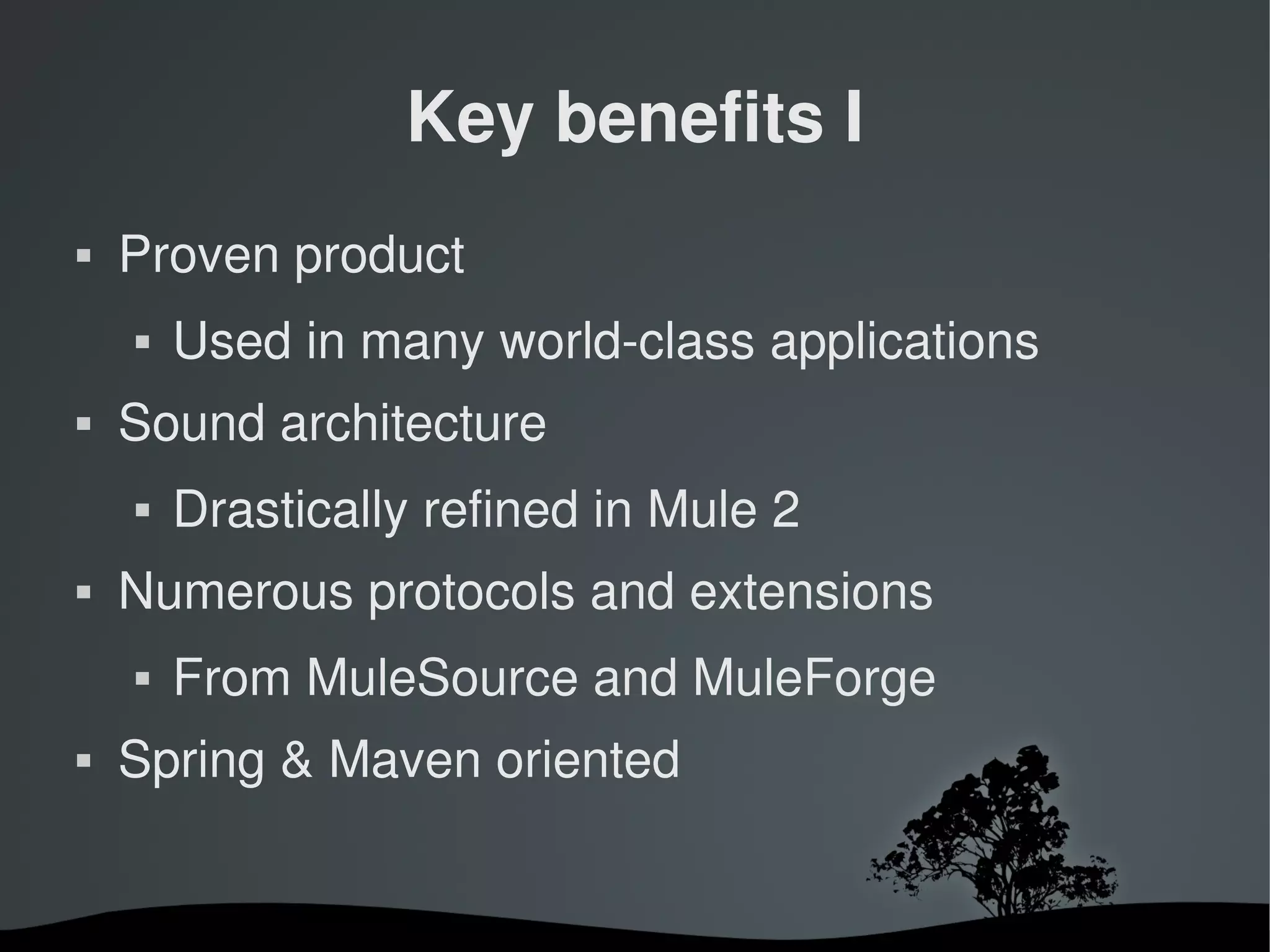
Key benefits I
   Proven product
       Used in many world­class applications
   Sound architecture
       Drastically refined in Mule 2
   Numerous protocols and extensions
       From MuleSource and MuleForge
   Spring & Maven oriented


Key benefits II
   Good tooling
       Mule IDE
       Galaxy
   Active community
       Support, MuleForge
   Shared code base CE / EE
   Professional support available


Main drawbacks
   Unified messaging abstraction
       Acts as a potential keyhole on the real deal
   Brings its own idiosyncrasies
       Like any framework...
   Standards based but not standards compliant
       But what standards? JBI? SCA?
       Not fully EIP but uses much of its lingo


Exploration


”A messaging framework”
   Mule is about abstraction and adaptation
       Message
       Protocol
   As a framework
       You can code to it
                Wisely
       You can extend almost every aspect of it
                Wisely
                           
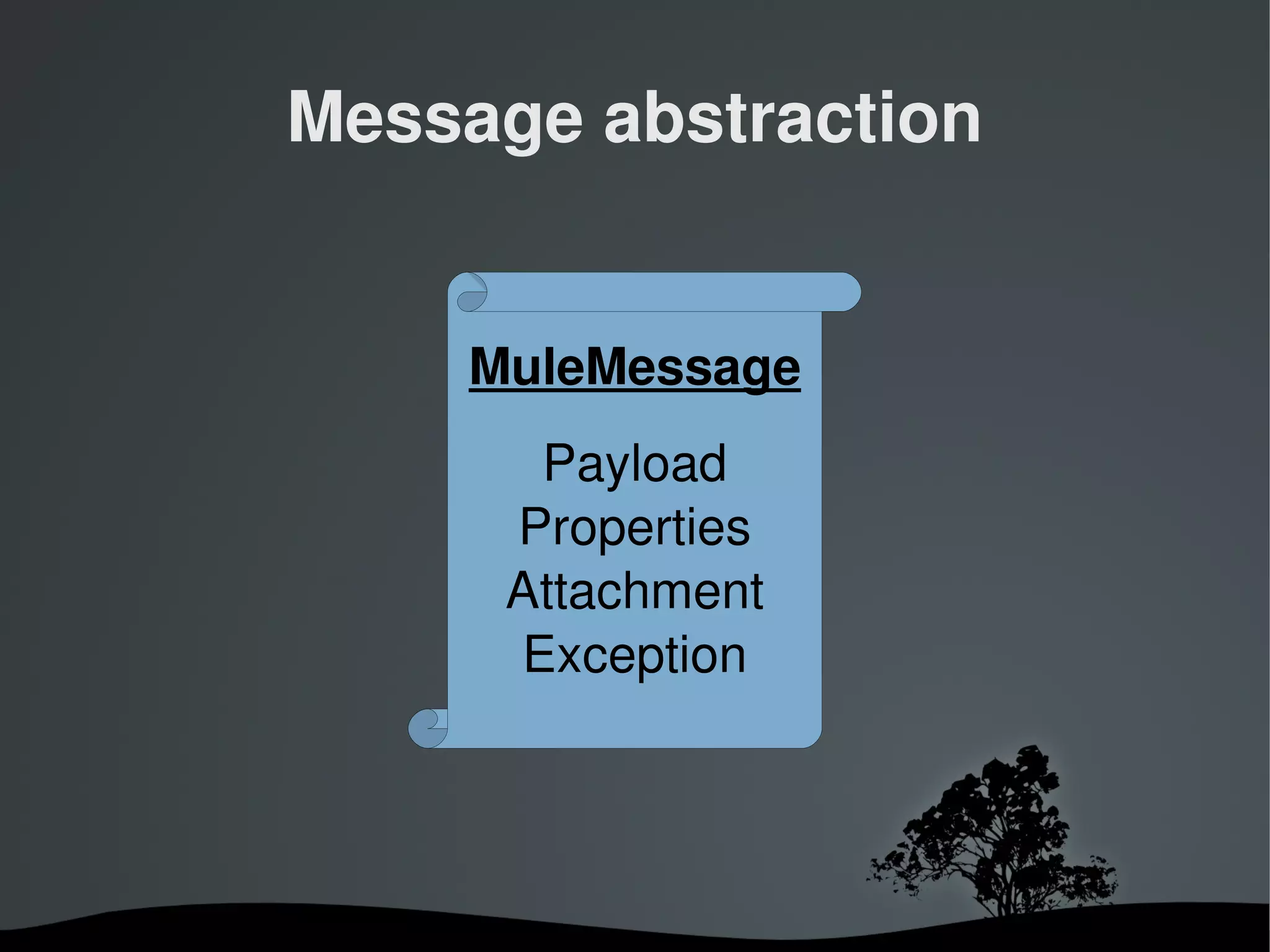
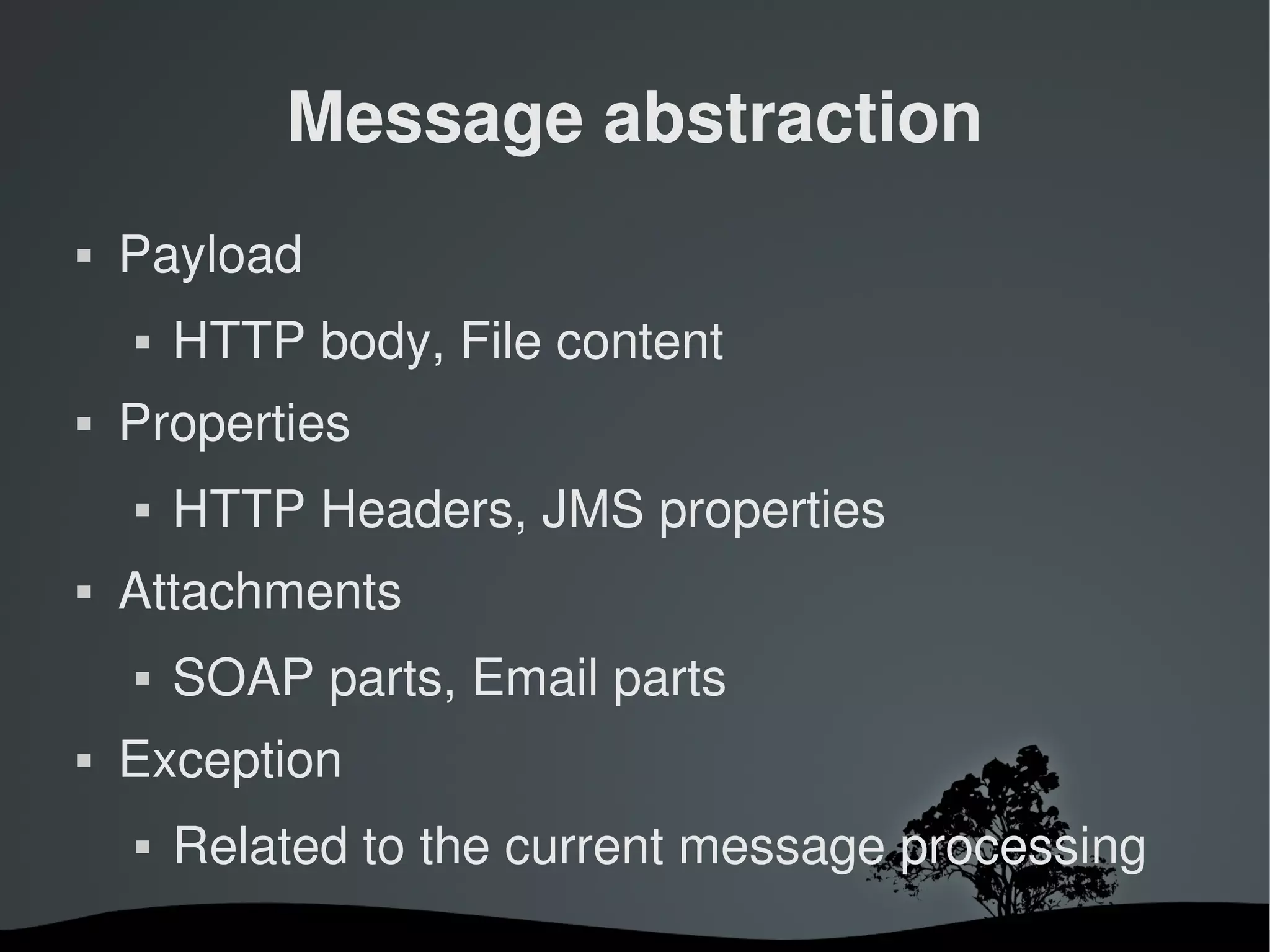
Message abstraction


        MuleMessage
          Payload
         Properties
         Attachment
         Exception


Message abstraction
   Payload
       HTTP body, File content
   Properties
       HTTP Headers, JMS properties
   Attachments
       SOAP parts, Email parts
   Exception
       Related to the current message processing
                       
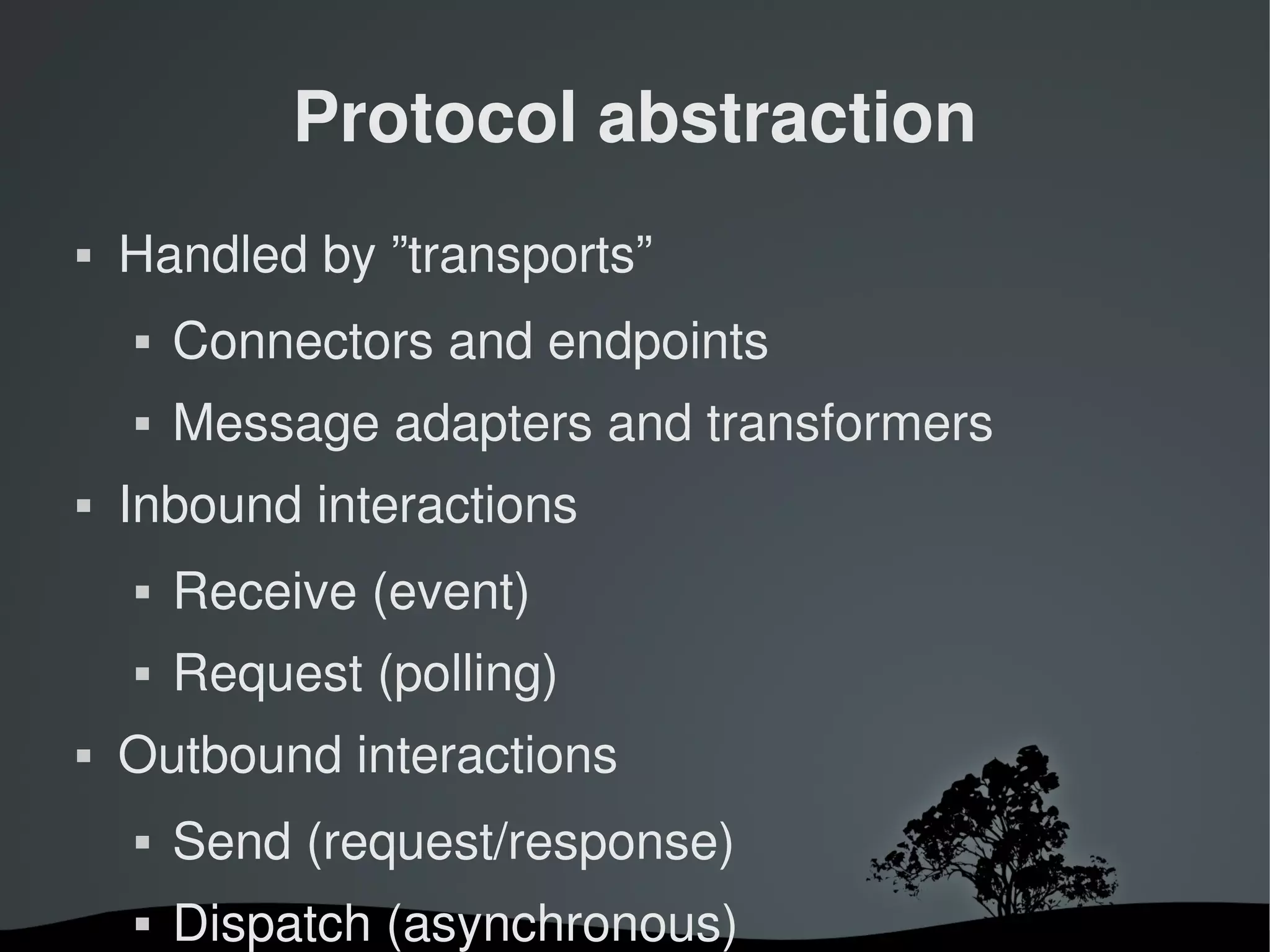
Protocol abstraction
   Handled by ”transports”
       Connectors and endpoints
       Message adapters and transformers
   Inbound interactions
       Receive (event)
       Request (polling)
   Outbound interactions
       Send (request/response)
       Dispatch (asynchronous)
                       
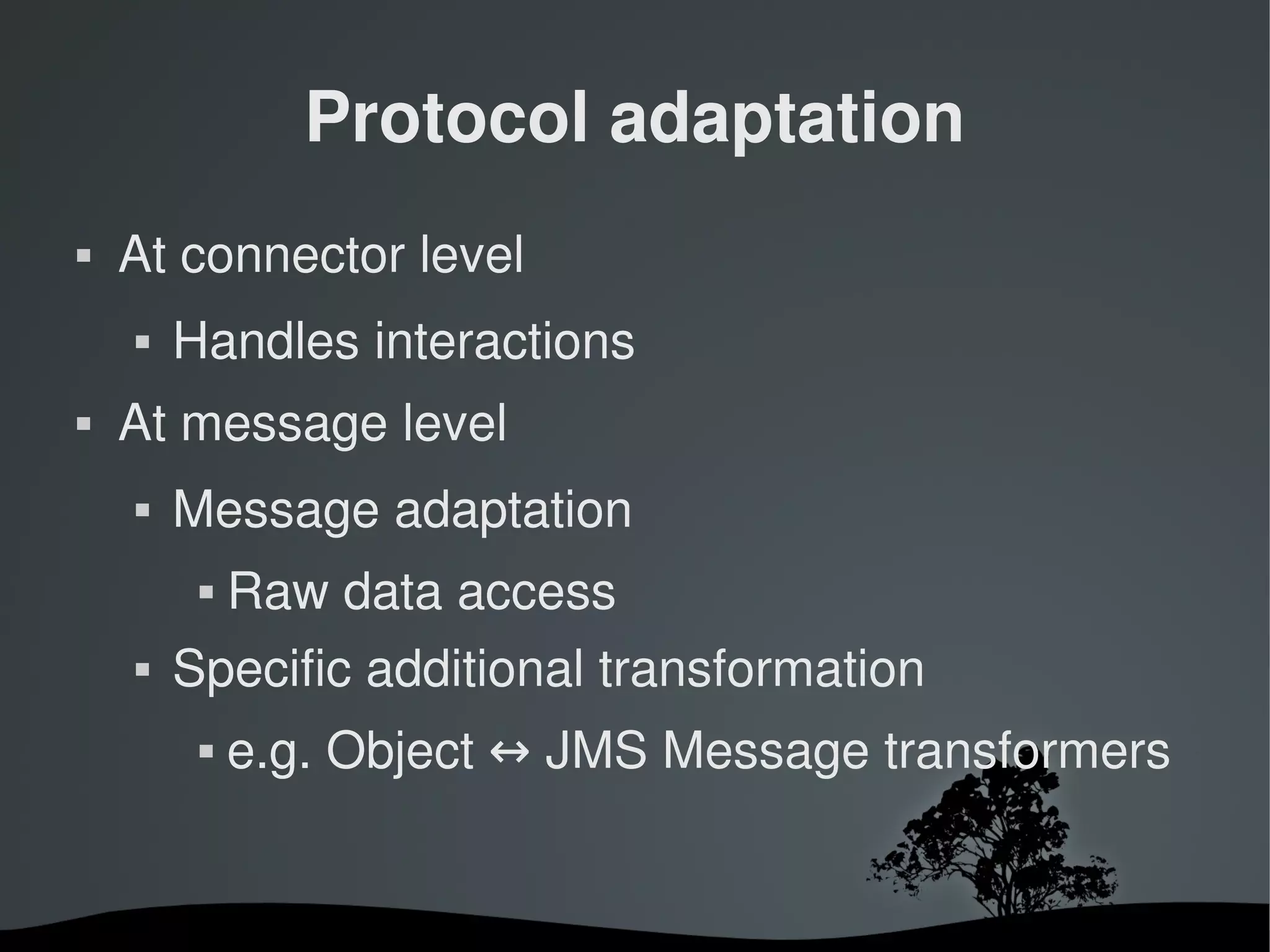
Protocol adaptation
   At connector level
       Handles interactions 
   At message level
       Message adaptation
                Raw data access
       Specific additional transformation
                e.g. Object ↔ JMS Message transformers


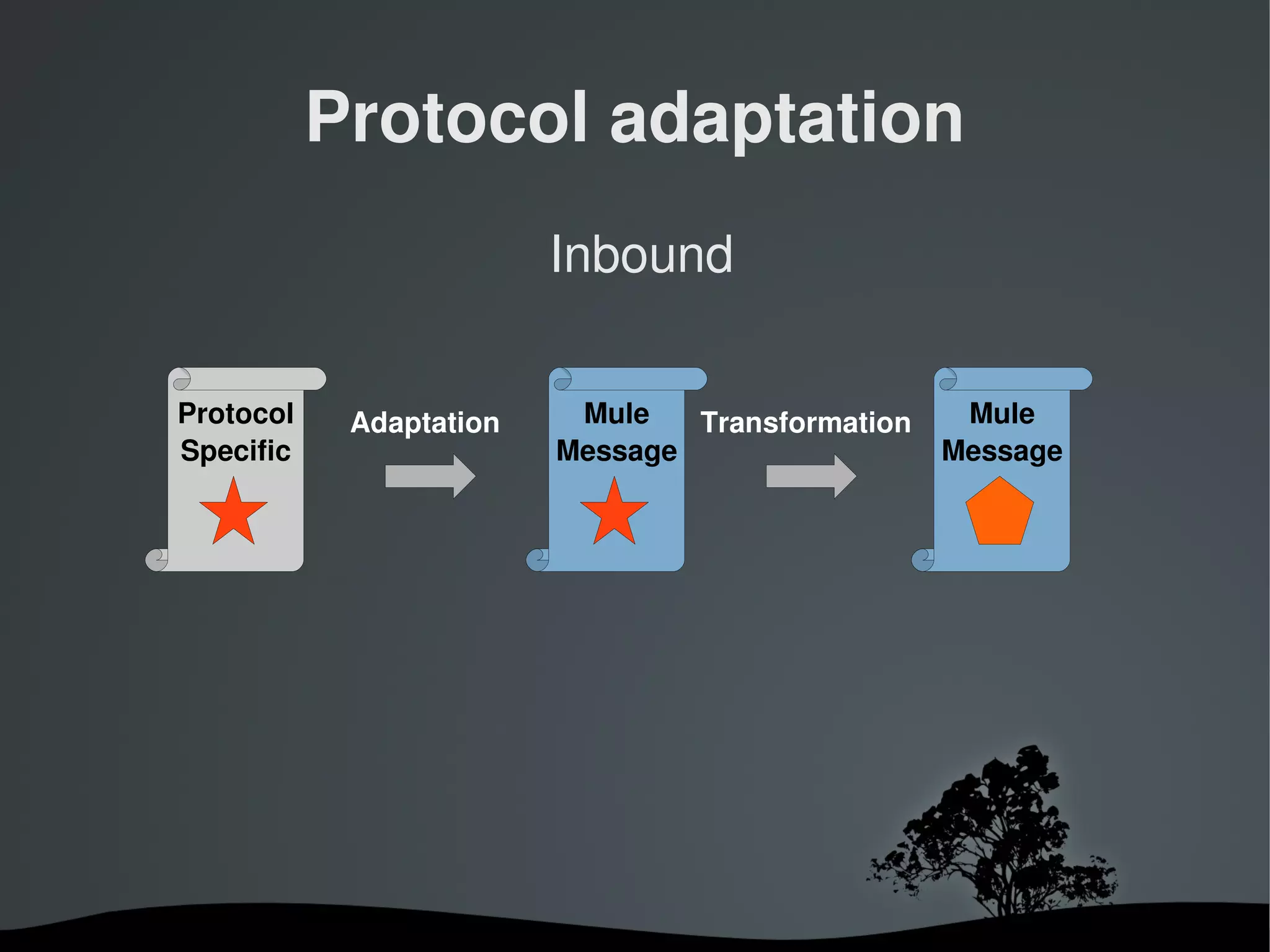
Protocol adaptation
                             Inbound

Protocol    Adaptation        Mule   Transformation    Mule
Specific                     Message                  Message


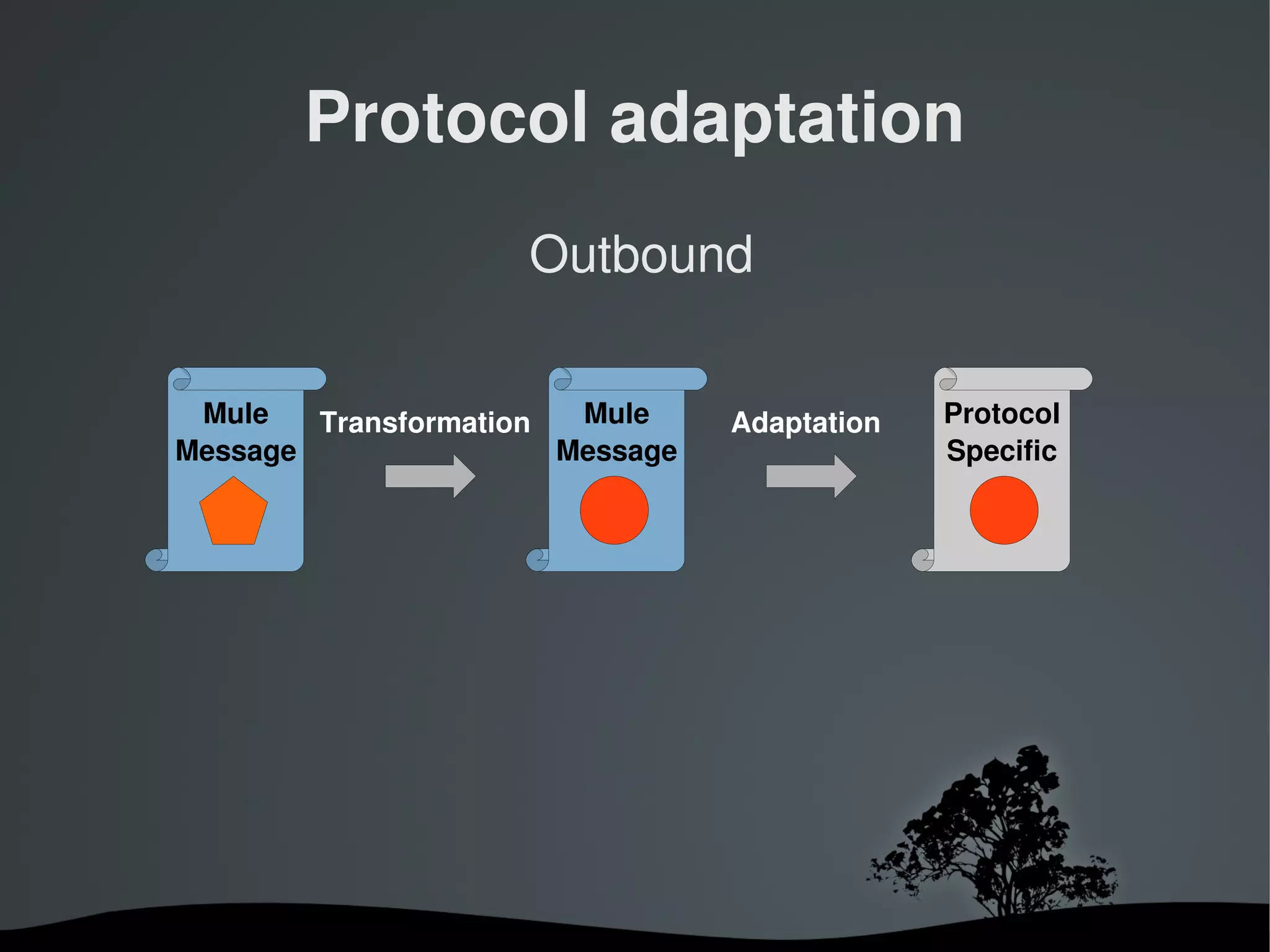
Protocol adaptation
                        Outbound

 Mule   Transformation  Mule     Adaptation   Protocol
Message                Message                Specific


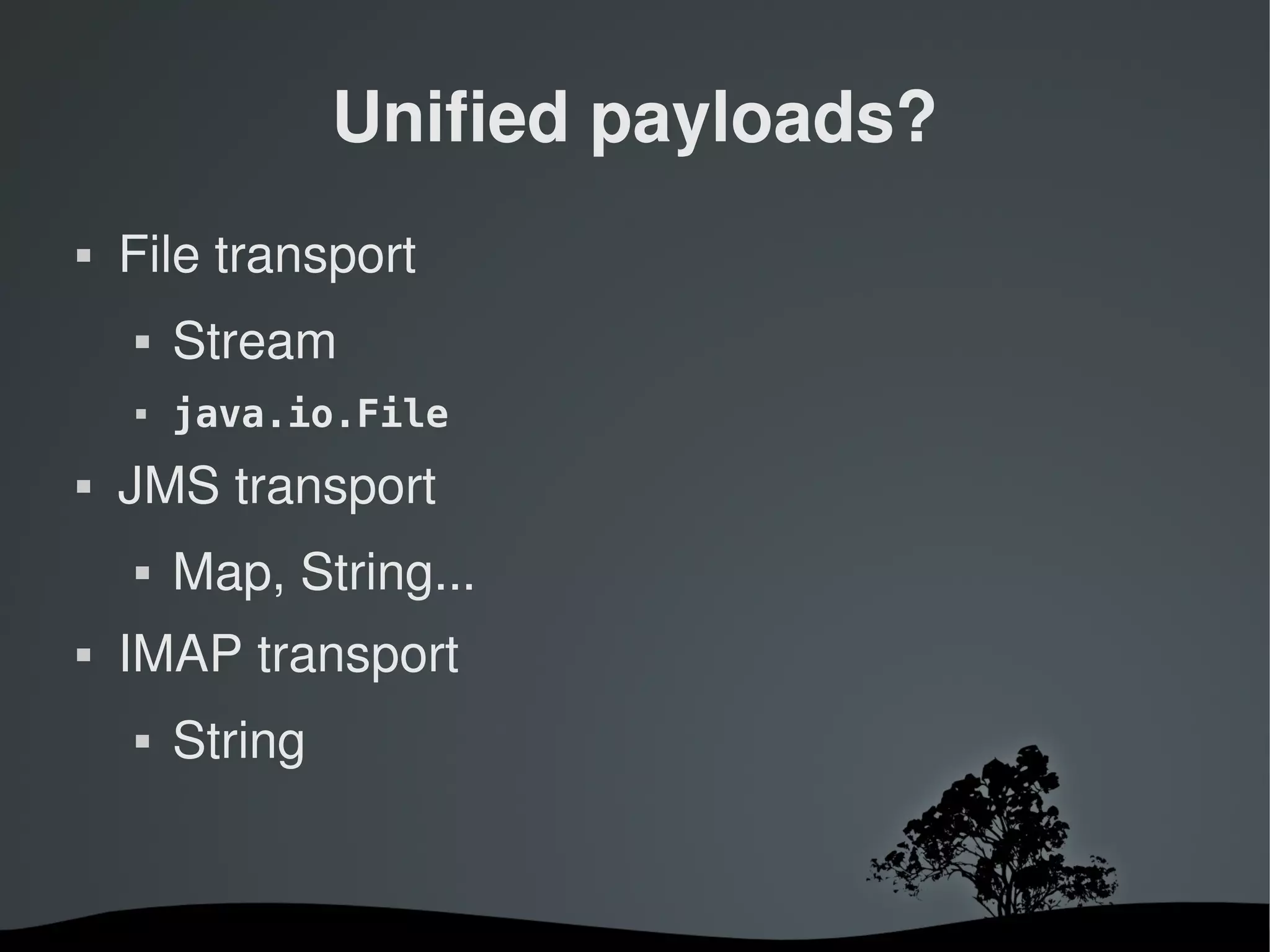
Unified payloads?
   File transport
       Stream
       java.io.File
   JMS transport
       Map, String...
   IMAP transport
       String


xmlns:context="http://www.springframework.org/schema/context"
      xmlns:file="http://www.mulesource.org/schema/mule/file/2.2"
      xmlns:jms="http://www.mulesource.org/schema/mule/jms/2.2"
      xmlns:xm="http://www.mulesource.org/schema/mule/xml/2.2"
      xsi:schemaLocation="
       http://www.springframework.org/schema/beans
http://www.springframework.org/schema/beans/spring-beans-2.5.xsd
       http://www.springframework.org/schema/context http://www.springframework.org/schema/context/
spring-context-2.5.xsd
       http://www.mulesource.org/schema/mule/core/2.2
http://www.mulesource.org/schema/mule/core/2.2/mule.xsd
       http://www.mulesource.org/schema/mule/file/2.2
http://www.mulesource.org/schema/mule/file/2.2/mule-file.xsd
       http://www.mulesource.org/schema/mule/jms/2.2 http://www.mulesource.org/schema/mule/jms/2.2/
mule-jms.xsd
       http://www.mulesource.org/schema/mule/xml/2.2 http://www.mulesource.org/schema/mule/xml/2.2/
mule-xml.xsd"
        >

   <notifications dynamic="true">
                                 Need help!
       <notification event="ENDPOINT-MESSAGE"/>
   </notifications>

   <global-property name="jms.url" value="vm://localhost"/>

   <jms:activemq-connector name="jmsConnector" specification="1.1" brokerURL="${jms.url}"/>

    <file:connector name="FileConnector"
                   streaming="false"
                   autoDelete="true"
                   pollingFrequency="1000">
       <file:expression-filename-parser/>
   </file:connector>

   <model name="jmsInboundModel">
       <service name="jmsInboundService">
           <inbound>
               <jms:inbound-endpoint topic="backup-reports" >
                   <transformers>
                       <jms:jmsmessage-to-object-transformer/>
                   </transformers>
               </jms:inbound-endpoint>
              
           </inbound>                  
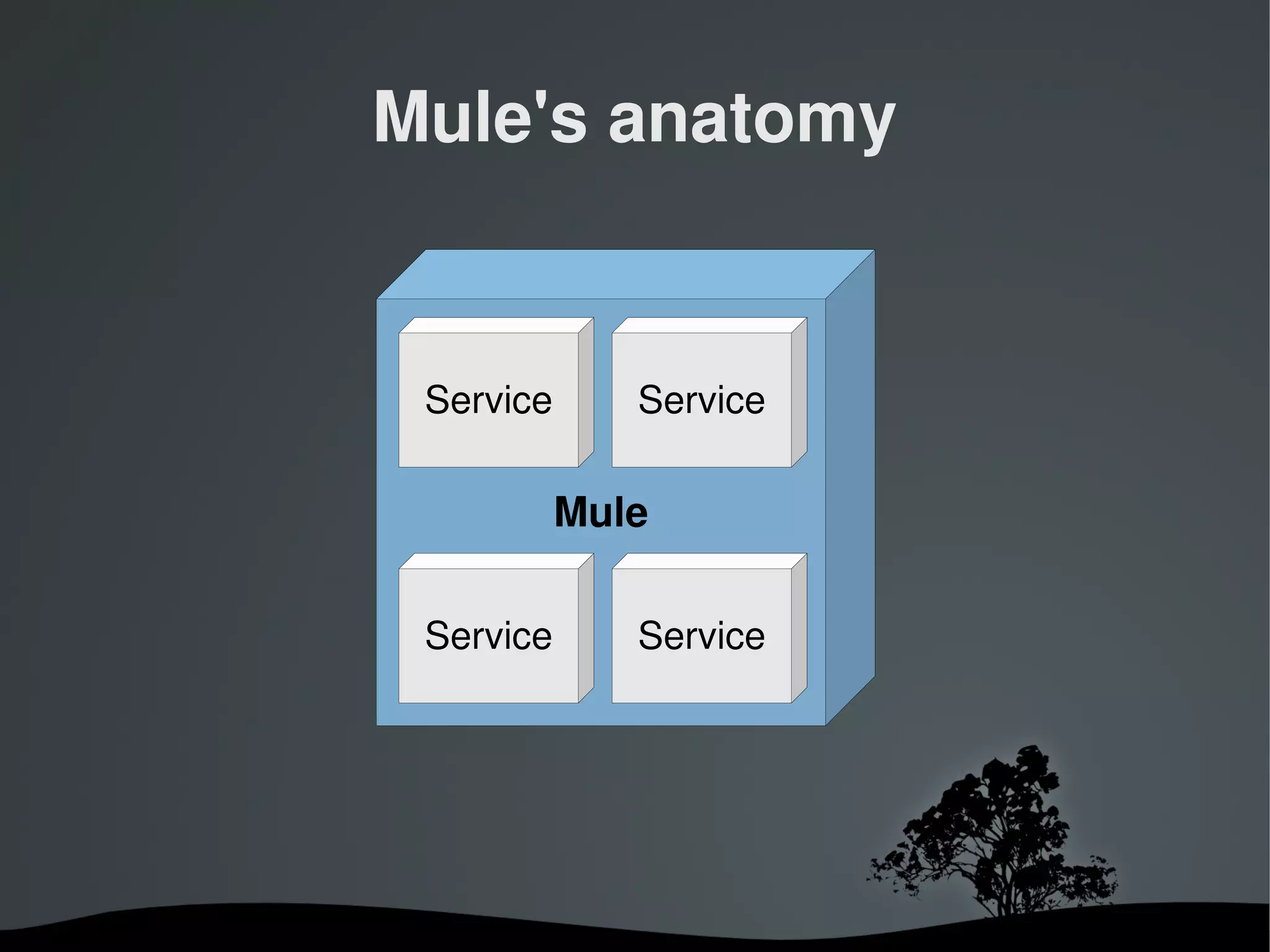
Mule's anatomy


Mule's anatomy


     Service      Service

               Mule

     Service      Service


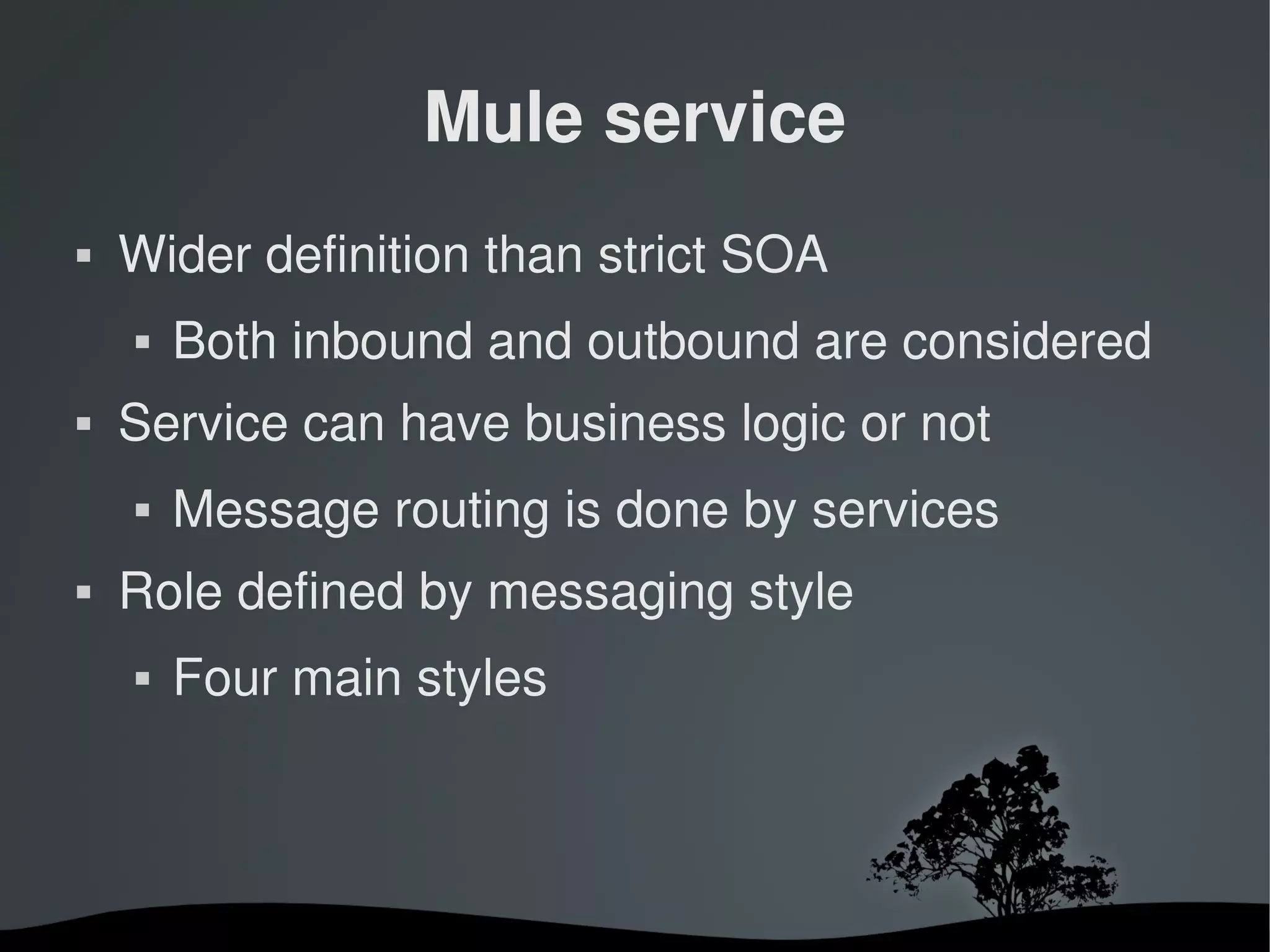
Mule service
   Wider definition than strict SOA
       Both inbound and outbound are considered
   Service can have business logic or not
       Message routing is done by services
   Role defined by messaging style
       Four main styles


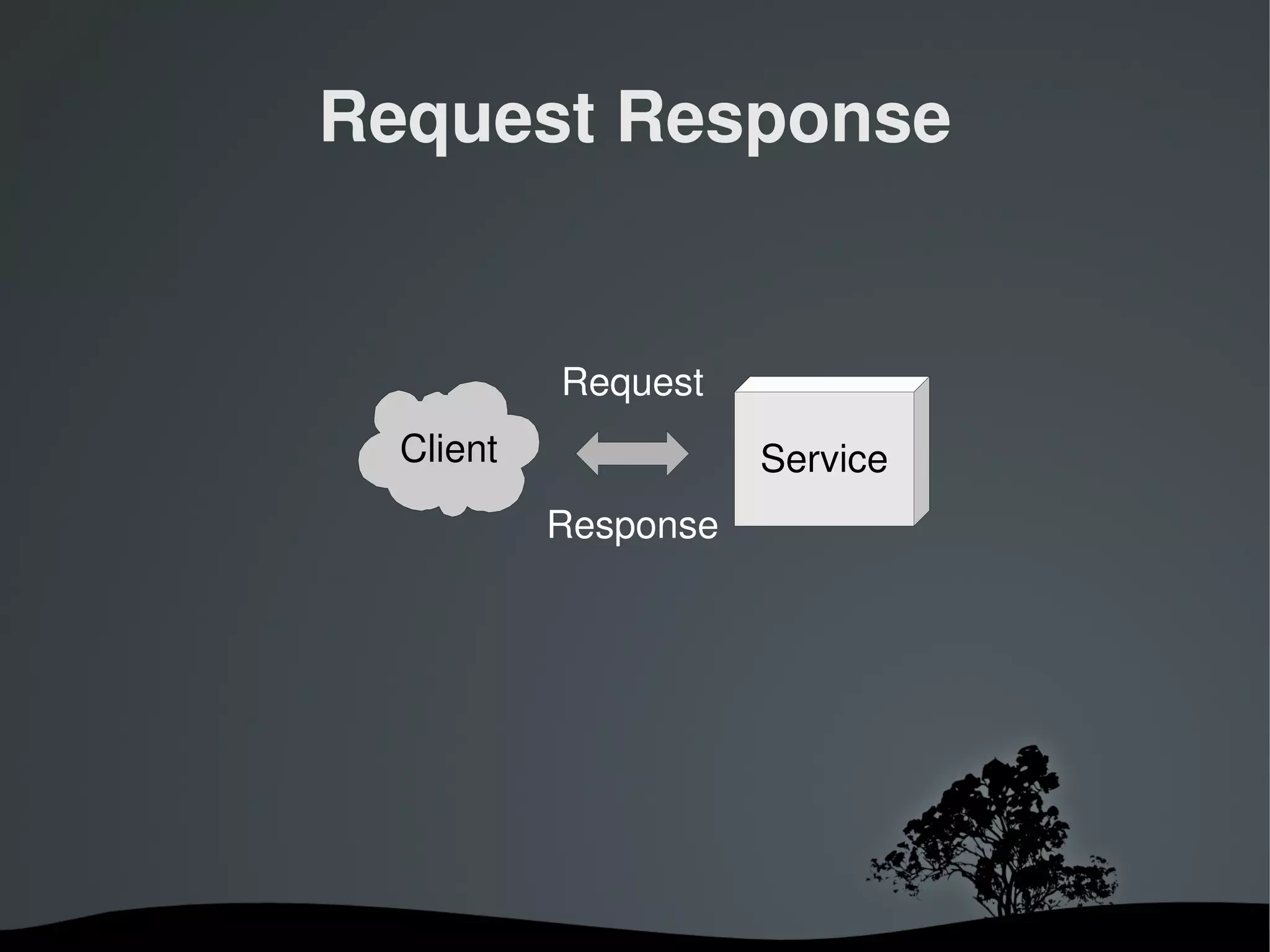
Request Response


                   Request
      Client                  Service
                   Response


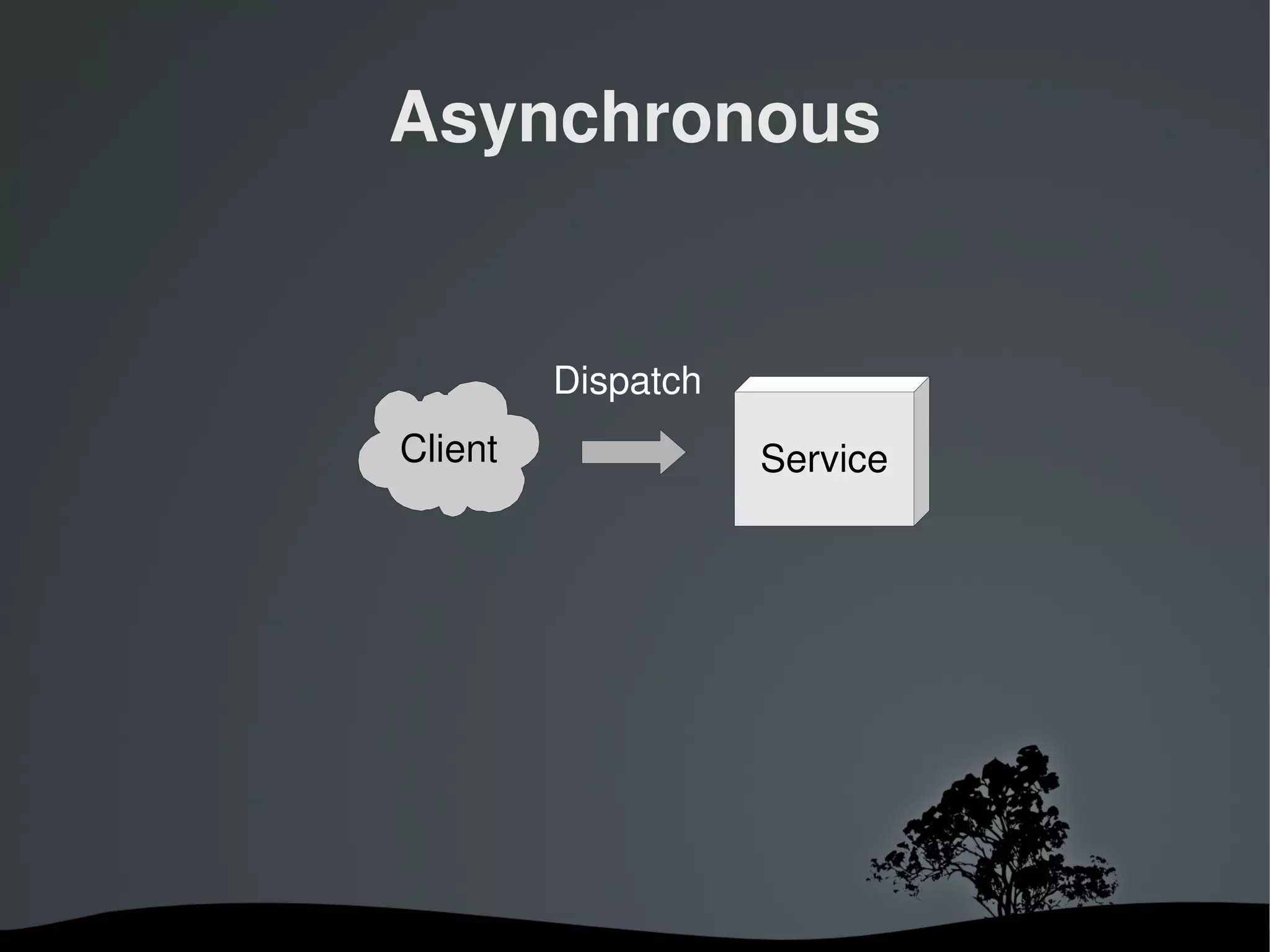
Asynchronous


                 Dispatch
    Client                  Service


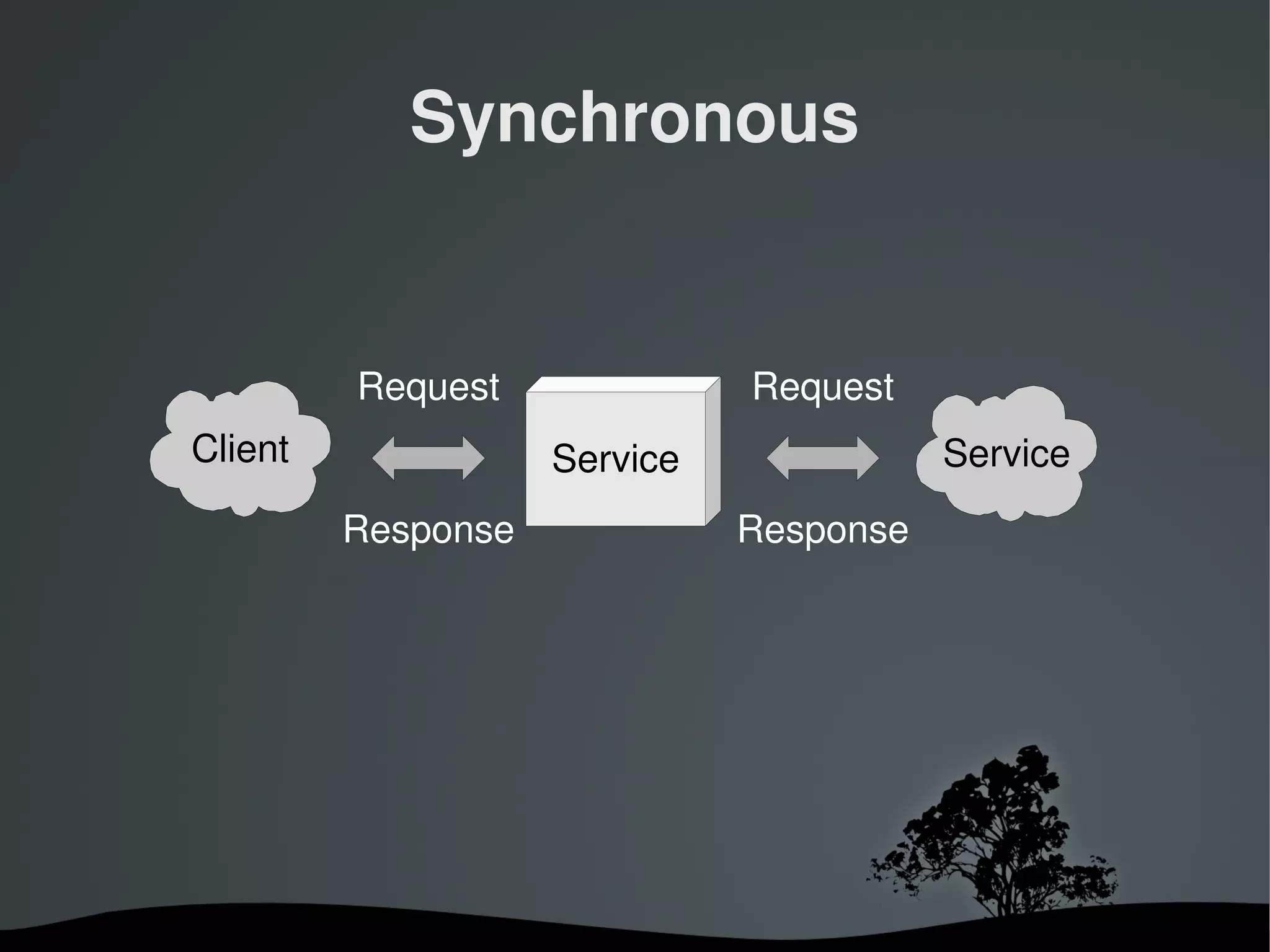
Synchronous


         Request                 Request
Client                 Service              Service
         Response                Response


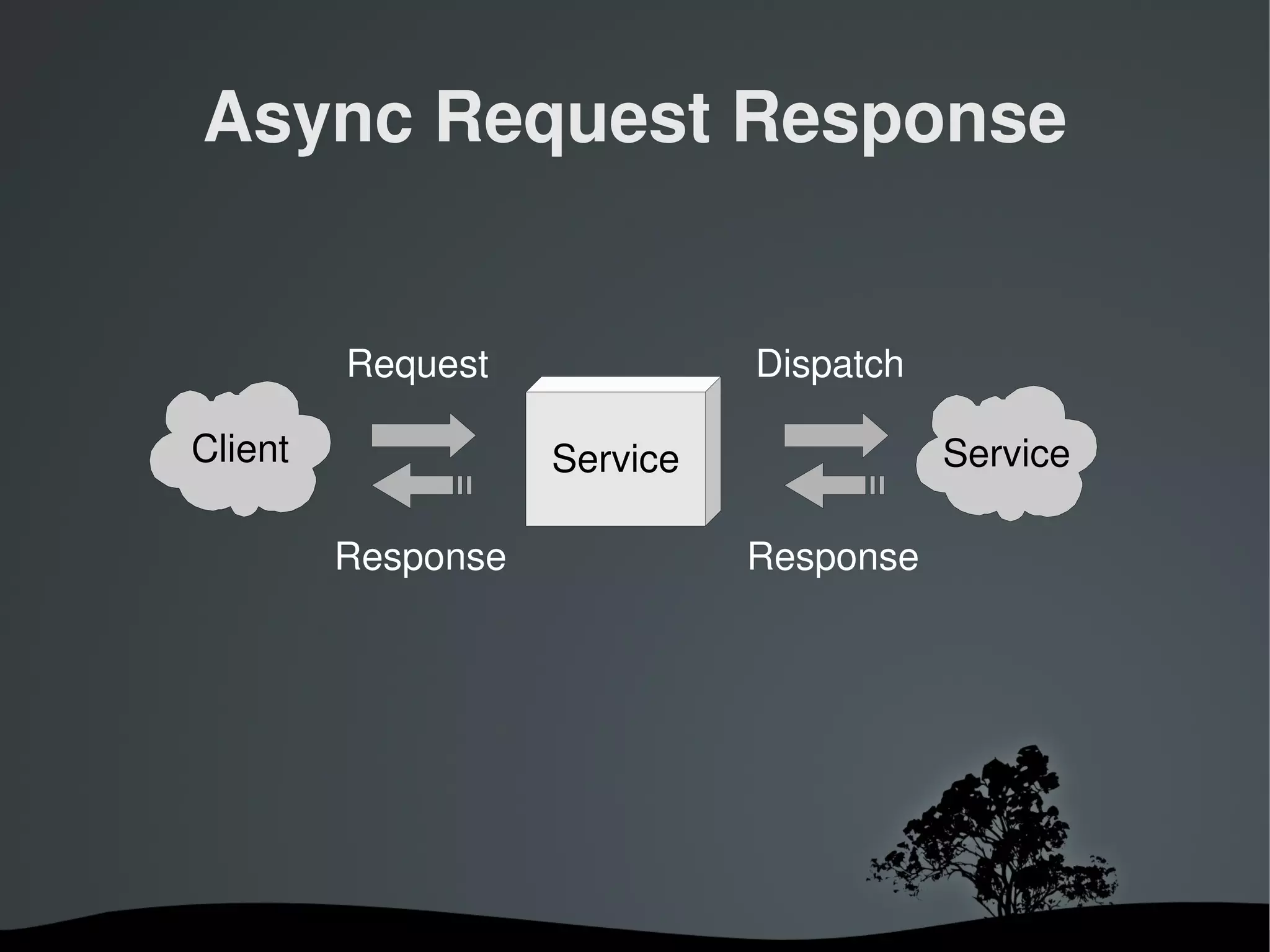
Async Request Response


         Request                  Dispatch

Client                  Service              Service

         Response                 Response


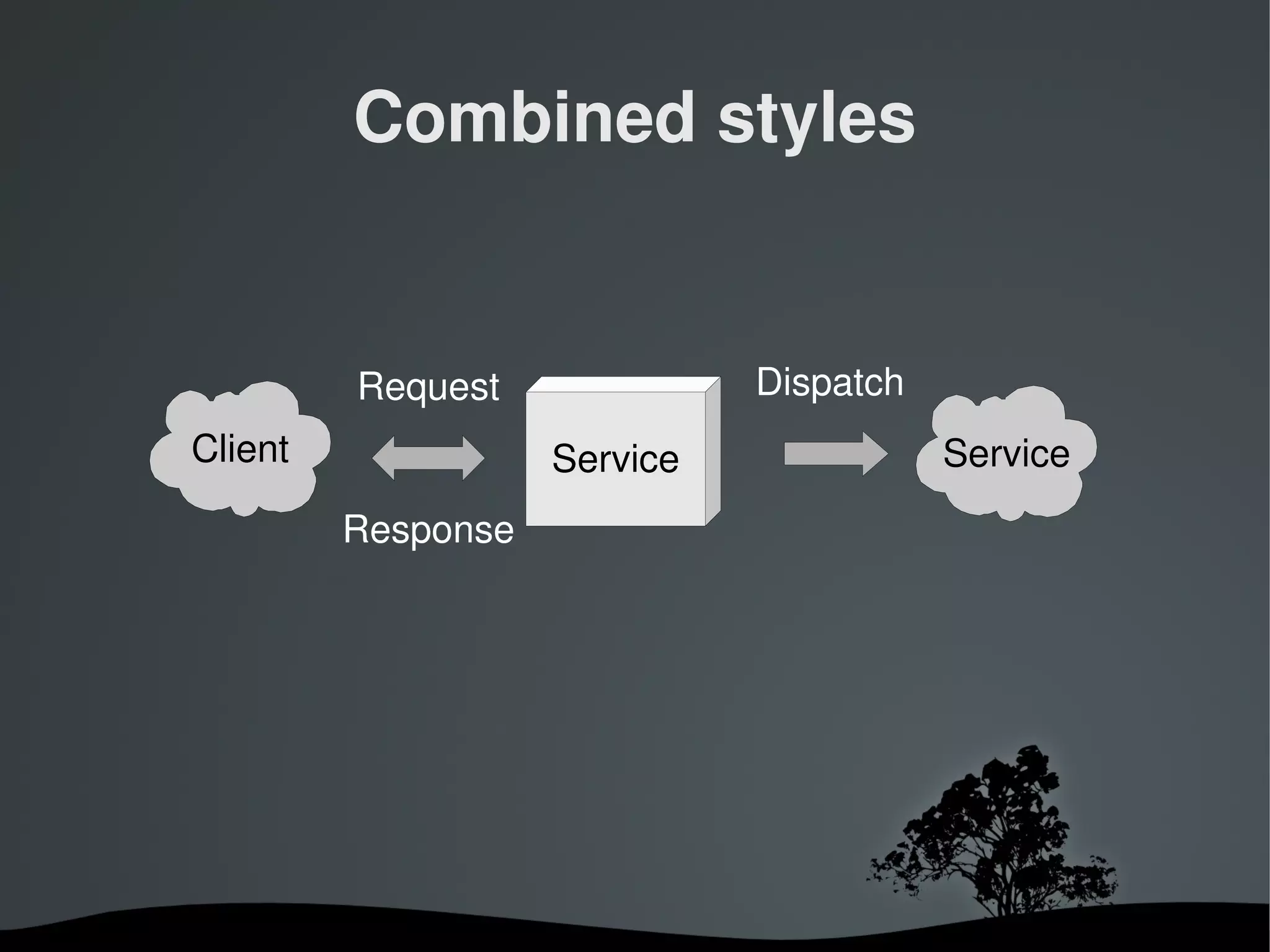
Combined styles


         Request                 Dispatch
Client                 Service              Service
         Response


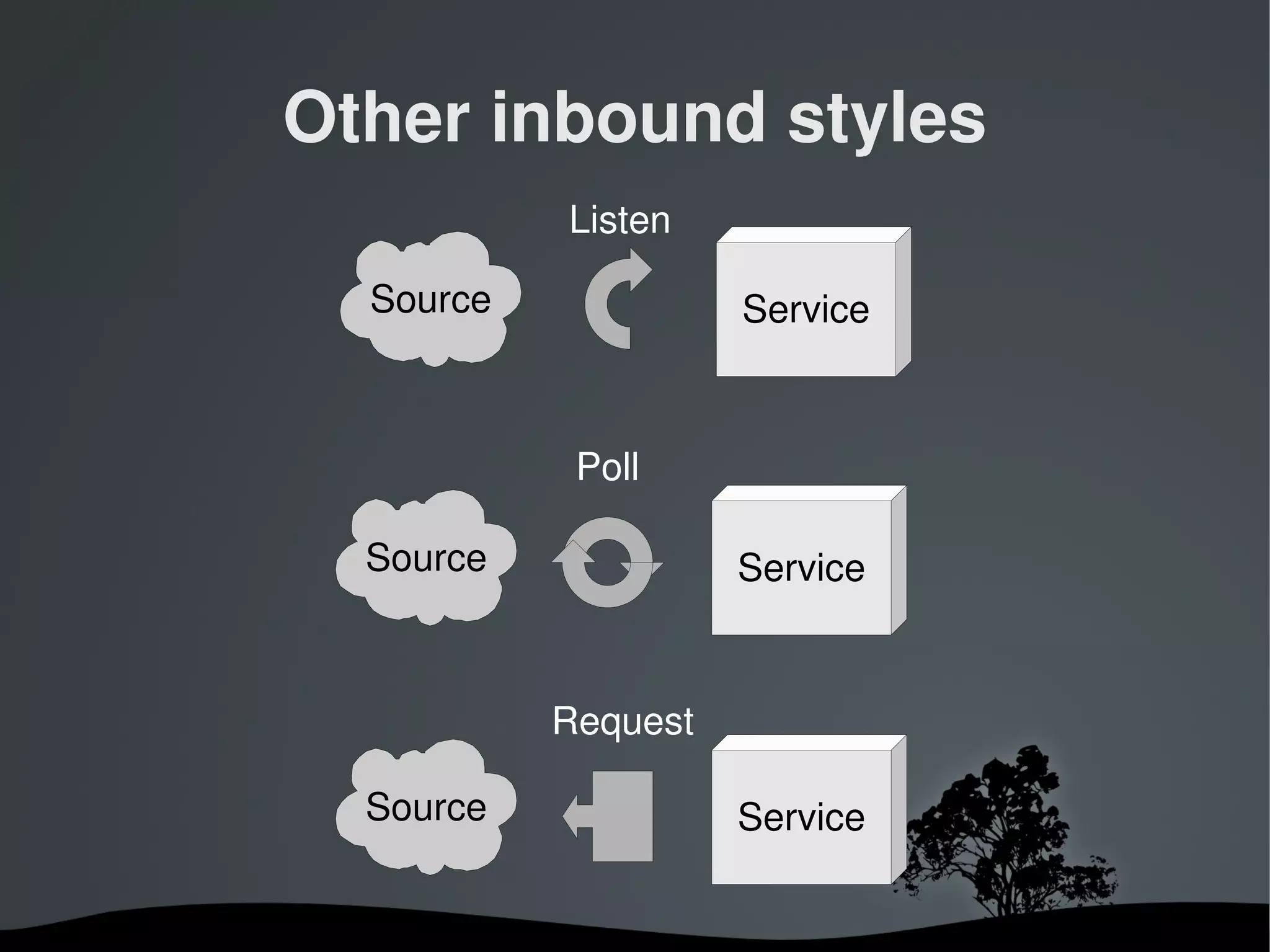
Other inbound styles
                   Listen

      Source                 Service


                    Poll

      Source                 Service


                   Request

      Source                 Service


Mule's service anatomy


               Service
                 ?


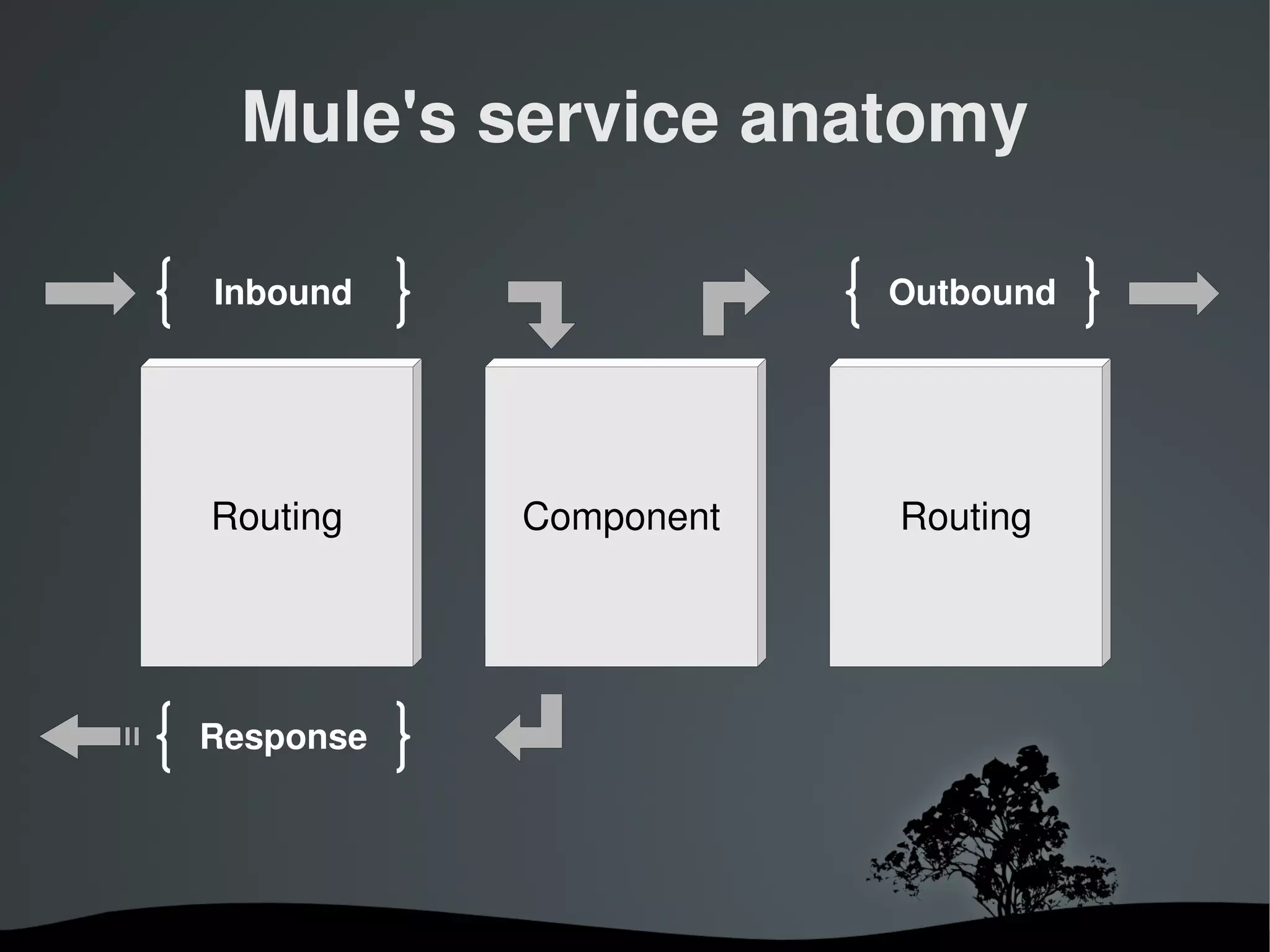
Mule's service anatomy

Inbound                     Outbound


Routing         Component   Routing


Response


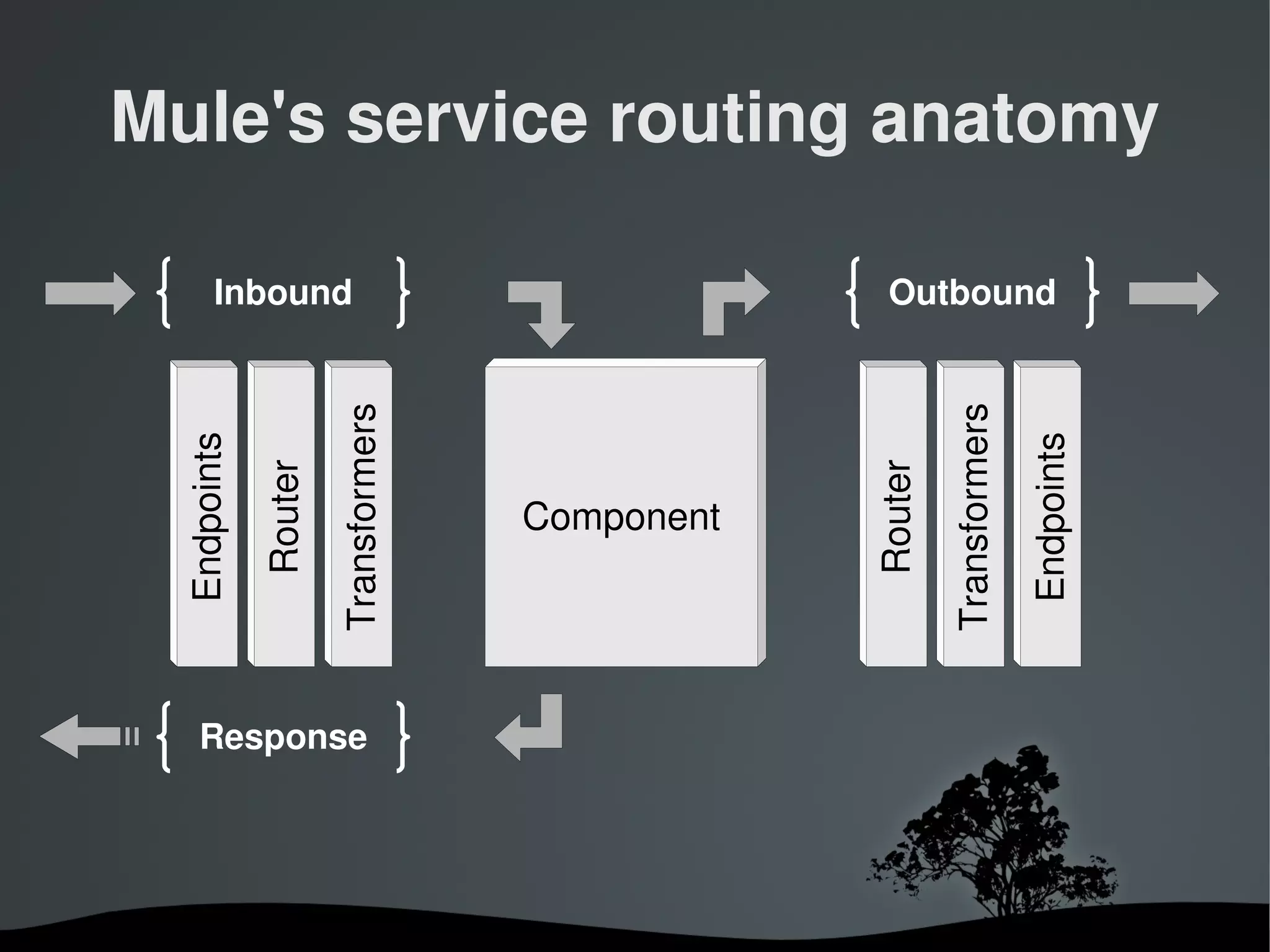
Mule's service routing anatomy

       Inbound                                         Outbound

                       Transformers


                                                               Transformers
  Endpoints


                                                                              Endpoints
              Router


                                                      Router
                                          Component


    Response


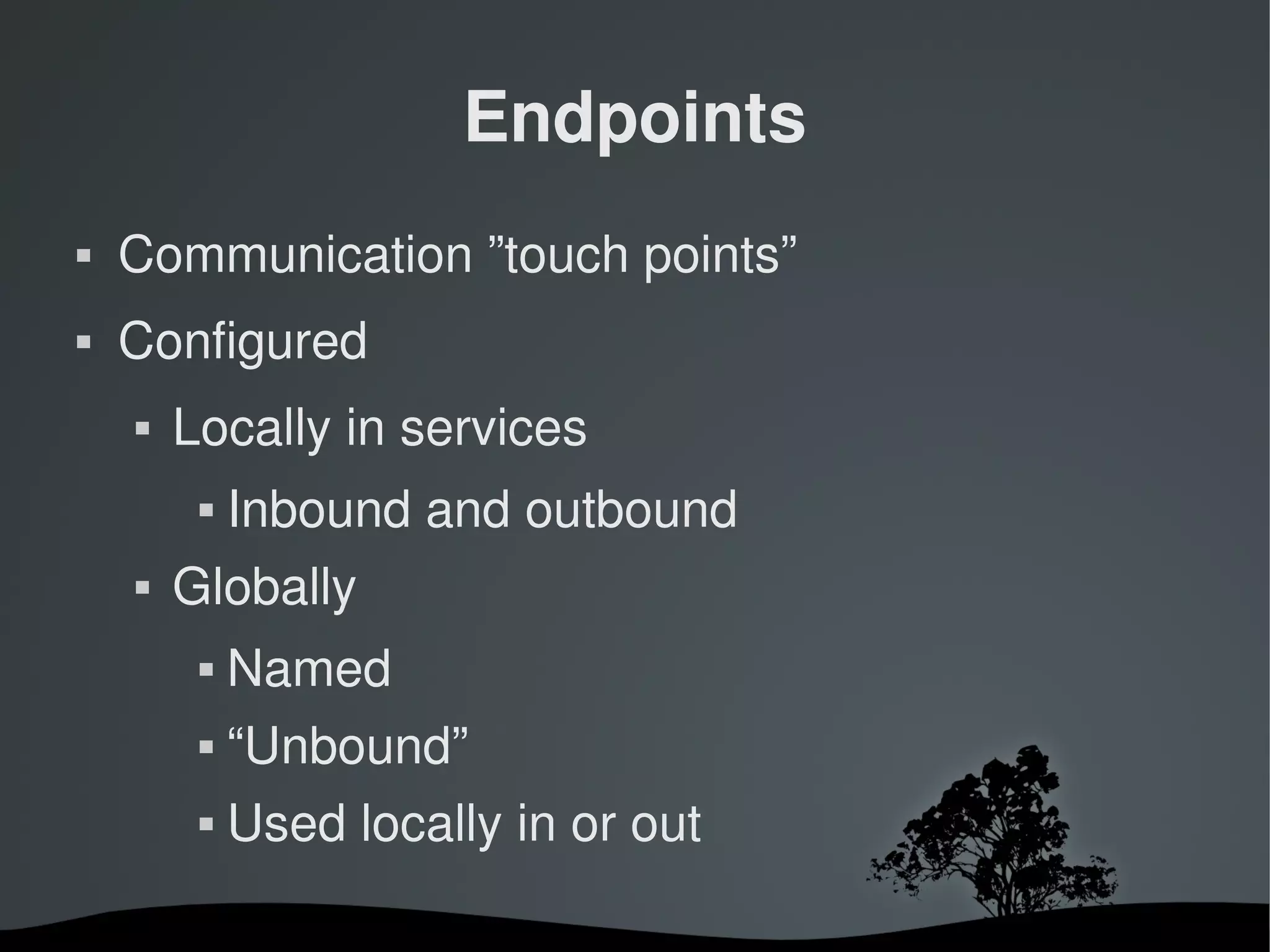
Endpoints
   Communication ”touch points”
   Configured
       Locally in services
                Inbound and outbound
       Globally
                Named
                “Unbound”
                Used locally in or out

                               
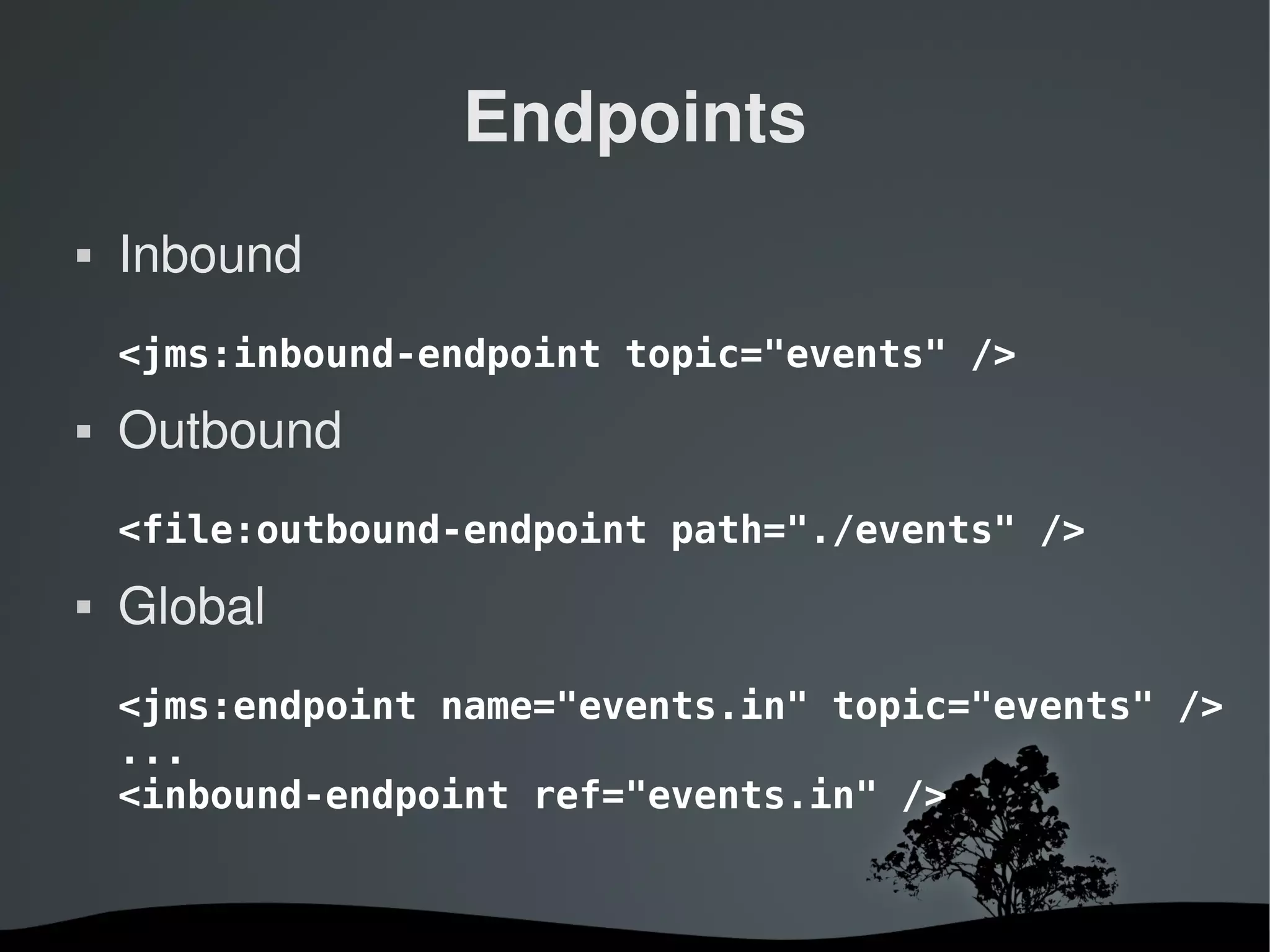
Endpoints
   Inbound
    <jms:inbound-endpoint topic="events" />
   Outbound
    <file:outbound-endpoint path="./events" />
   Global
    <jms:endpoint name="events.in" topic="events" />
    ...
    <inbound-endpoint ref="events.in" />


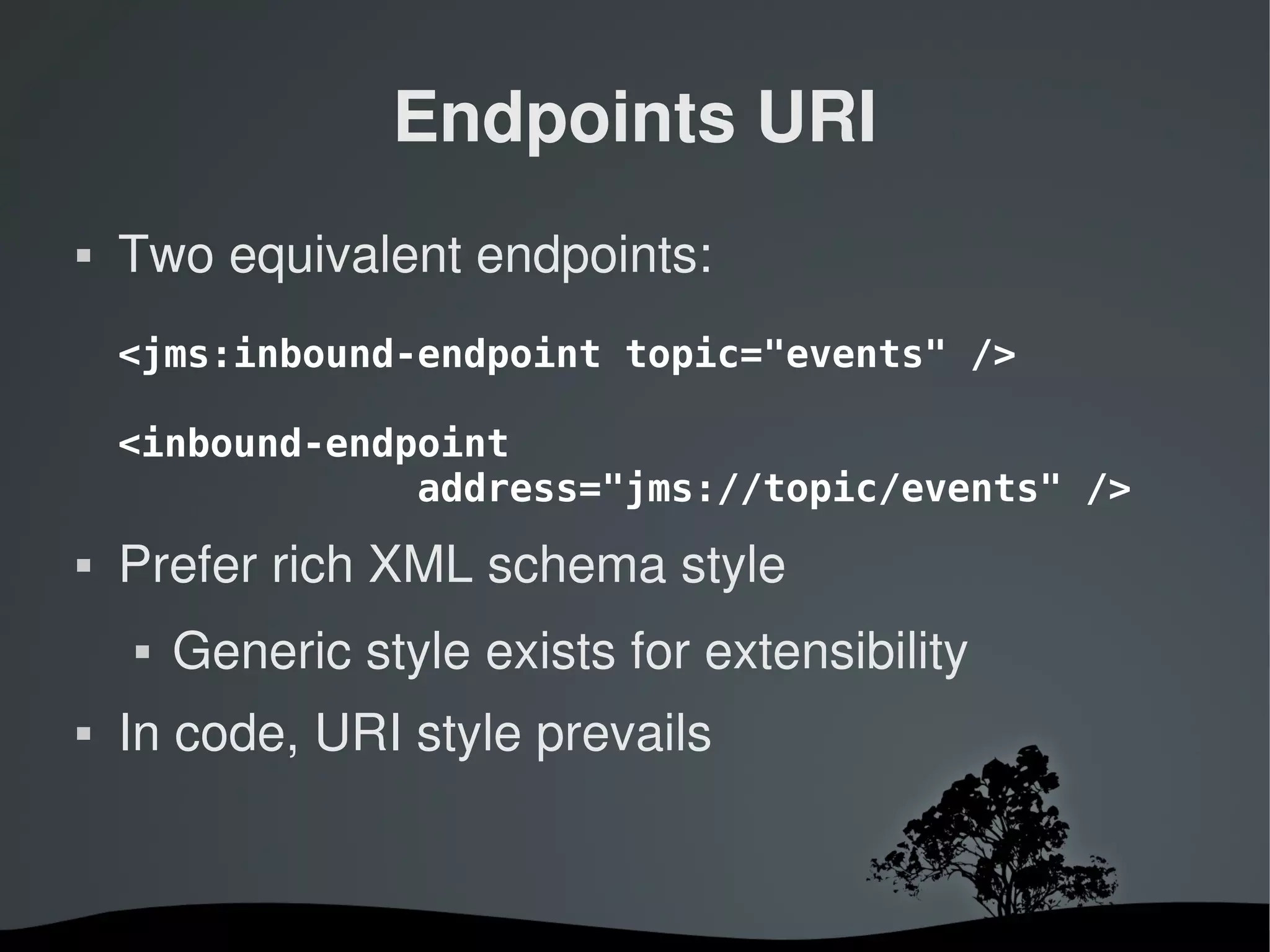
Endpoints URI
   Two equivalent endpoints:
    <jms:inbound-endpoint topic="events" />

    <inbound-endpoint
                 address="jms://topic/events" />
   Prefer rich XML schema style
       Generic style exists for extensibility
   In code, URI style prevails


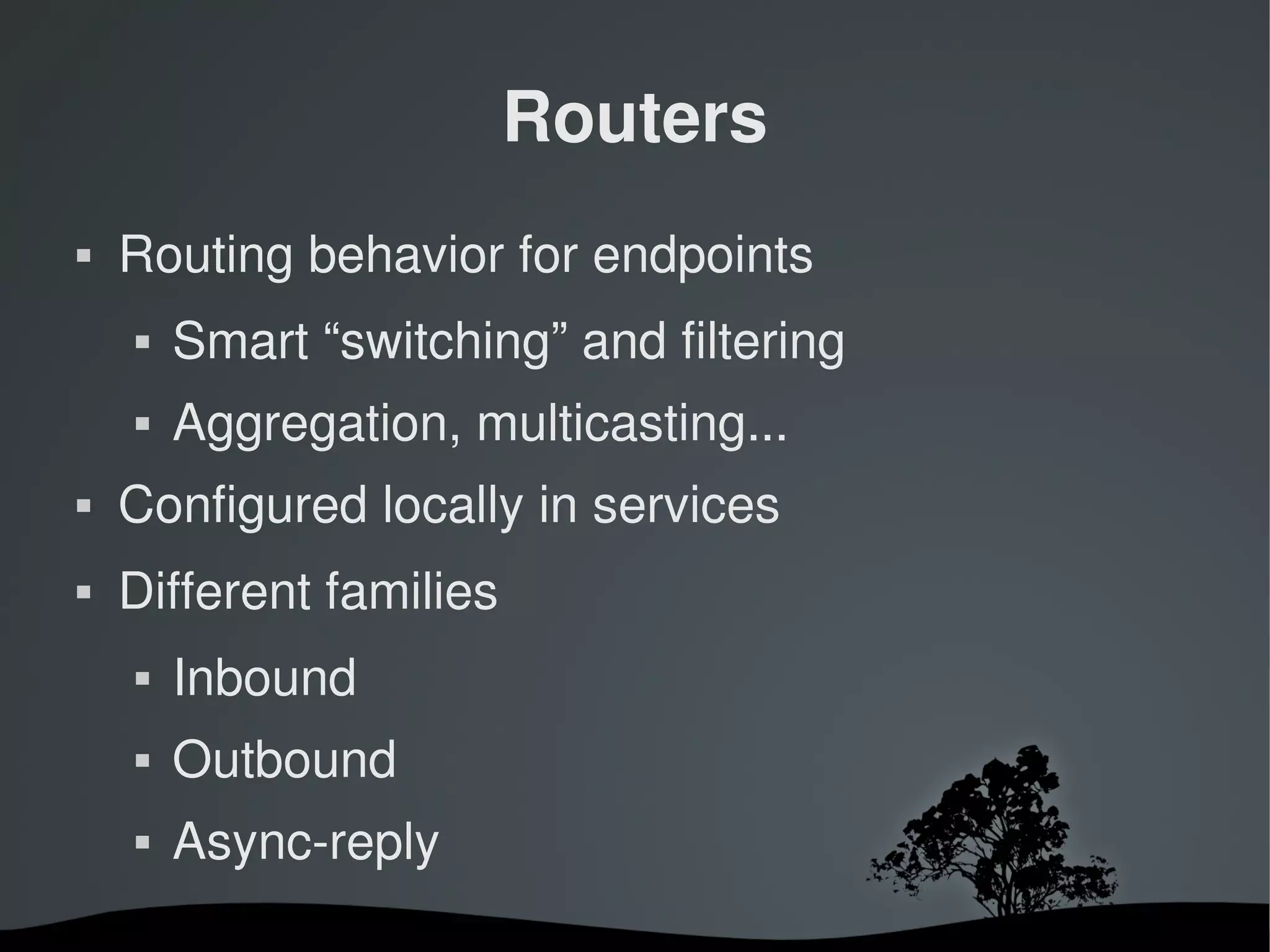
Routers
   Routing behavior for endpoints
       Smart “switching” and filtering
       Aggregation, multicasting...
   Configured locally in services
   Different families
       Inbound
       Outbound
       Async­reply
                          
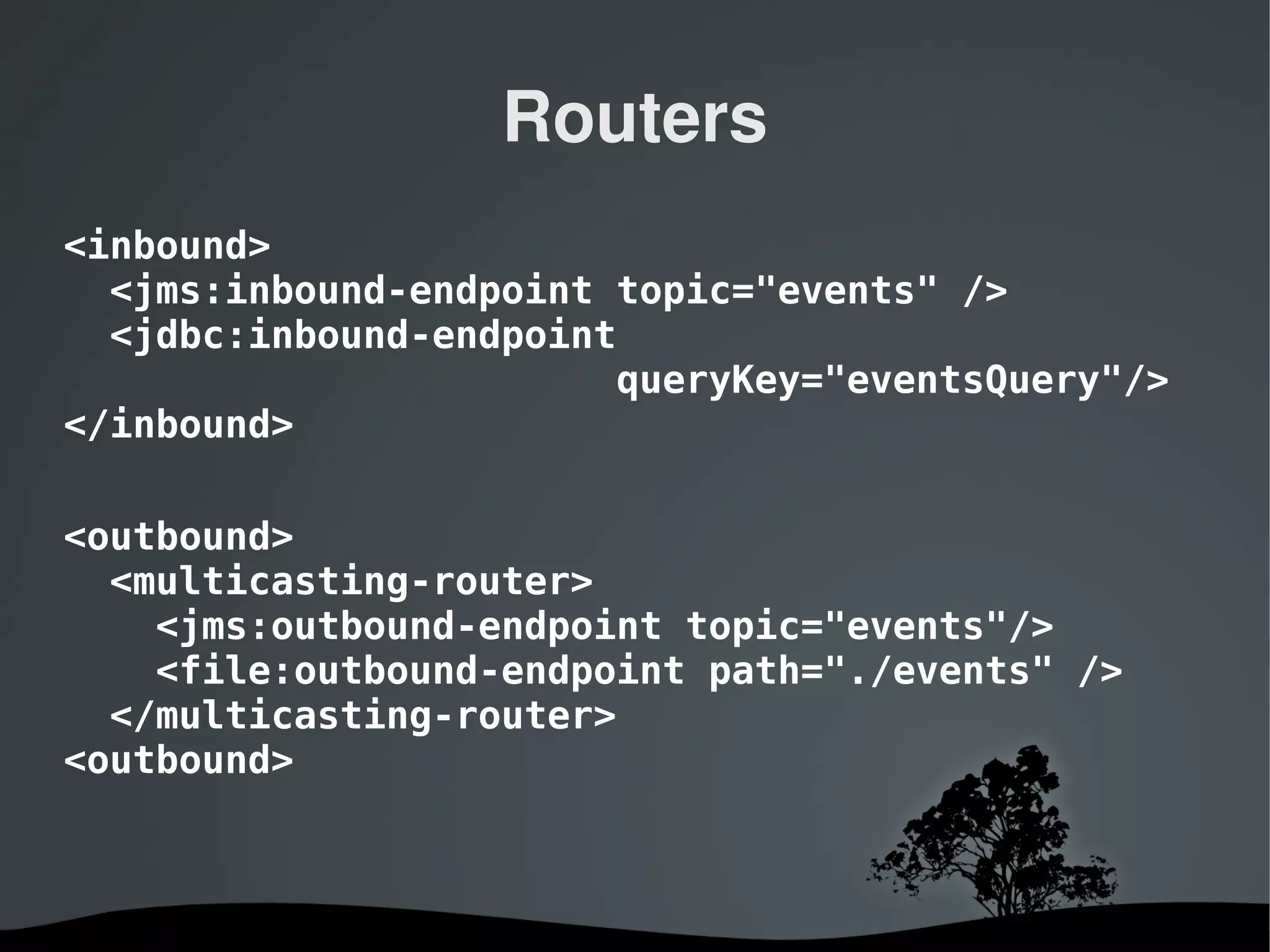
Routers
<inbound>
  <jms:inbound-endpoint topic="events" />
  <jdbc:inbound-endpoint
                        queryKey="eventsQuery"/>
</inbound>

<outbound>
  <multicasting-router>
    <jms:outbound-endpoint topic="events"/>
    <file:outbound-endpoint path="./events" />
  </multicasting-router>
<outbound>


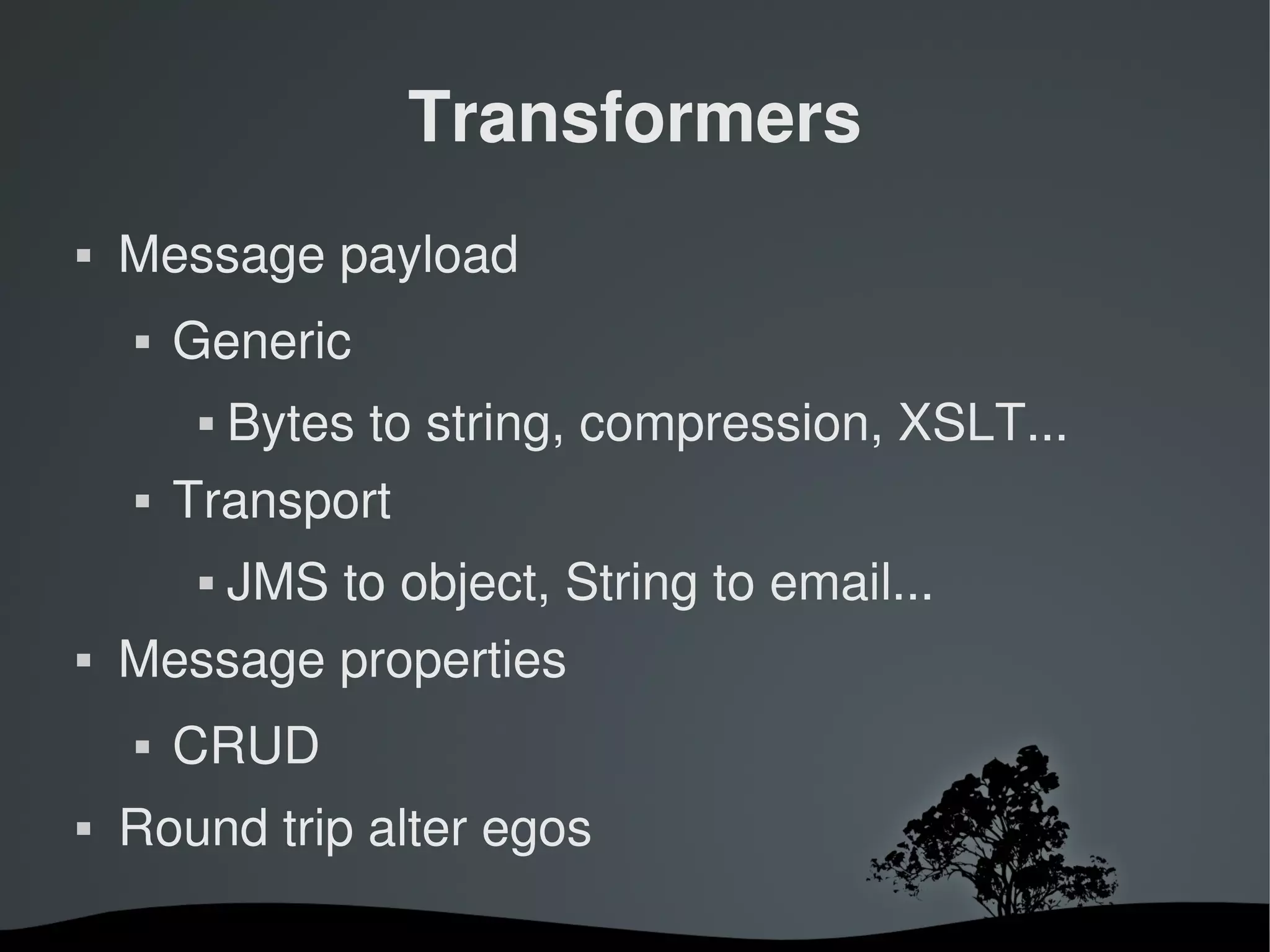
Transformers
   Message payload
       Generic
                Bytes to string, compression, XSLT...
       Transport
                JMS to object, String to email...
   Message properties
       CRUD
   Round trip alter egos

                               
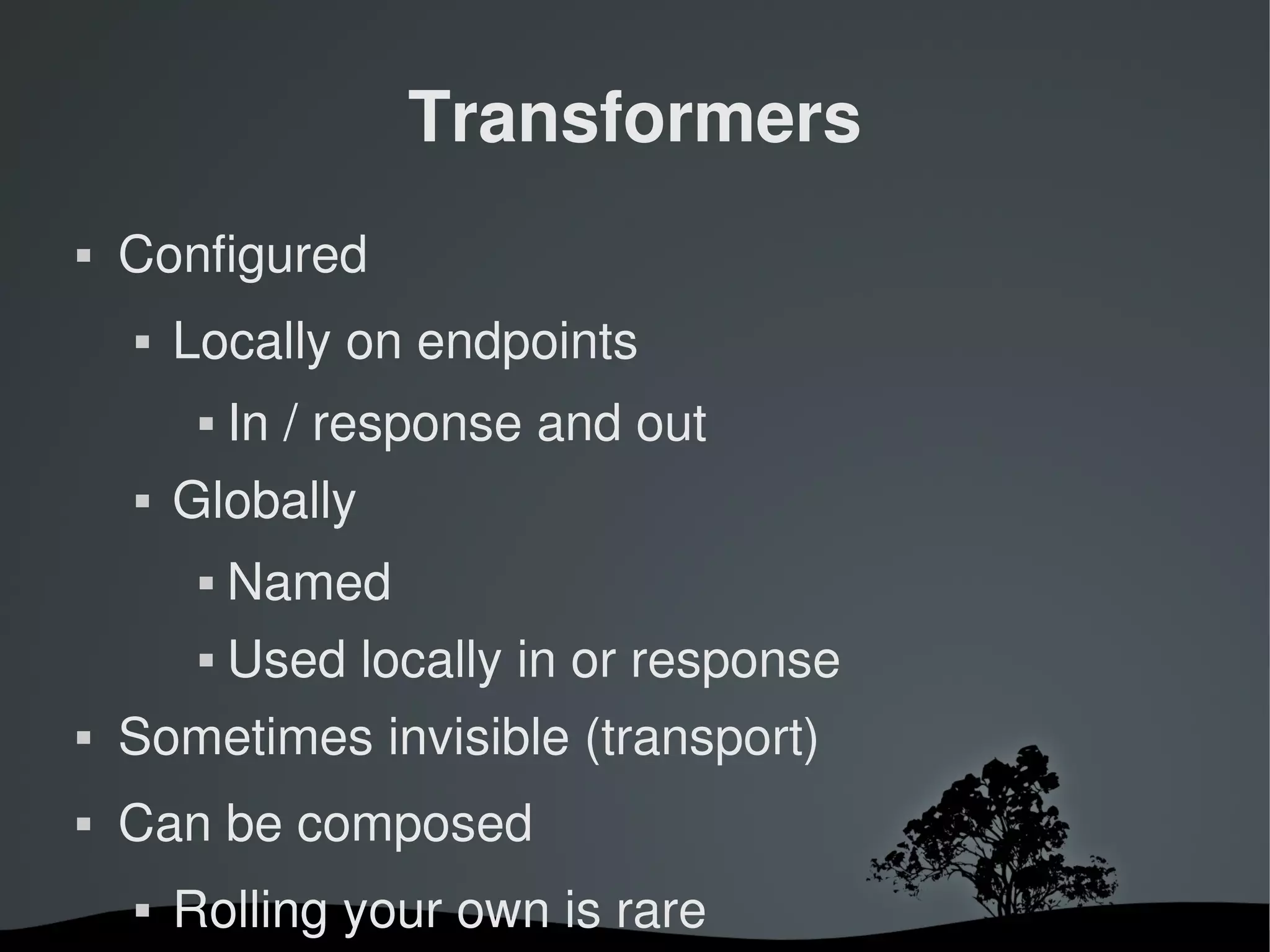
Transformers
   Configured
       Locally on endpoints
                In / response and out
       Globally
                Named
                Used locally in or response
   Sometimes invisible (transport)
   Can be composed
       Rolling your own is rare
                              
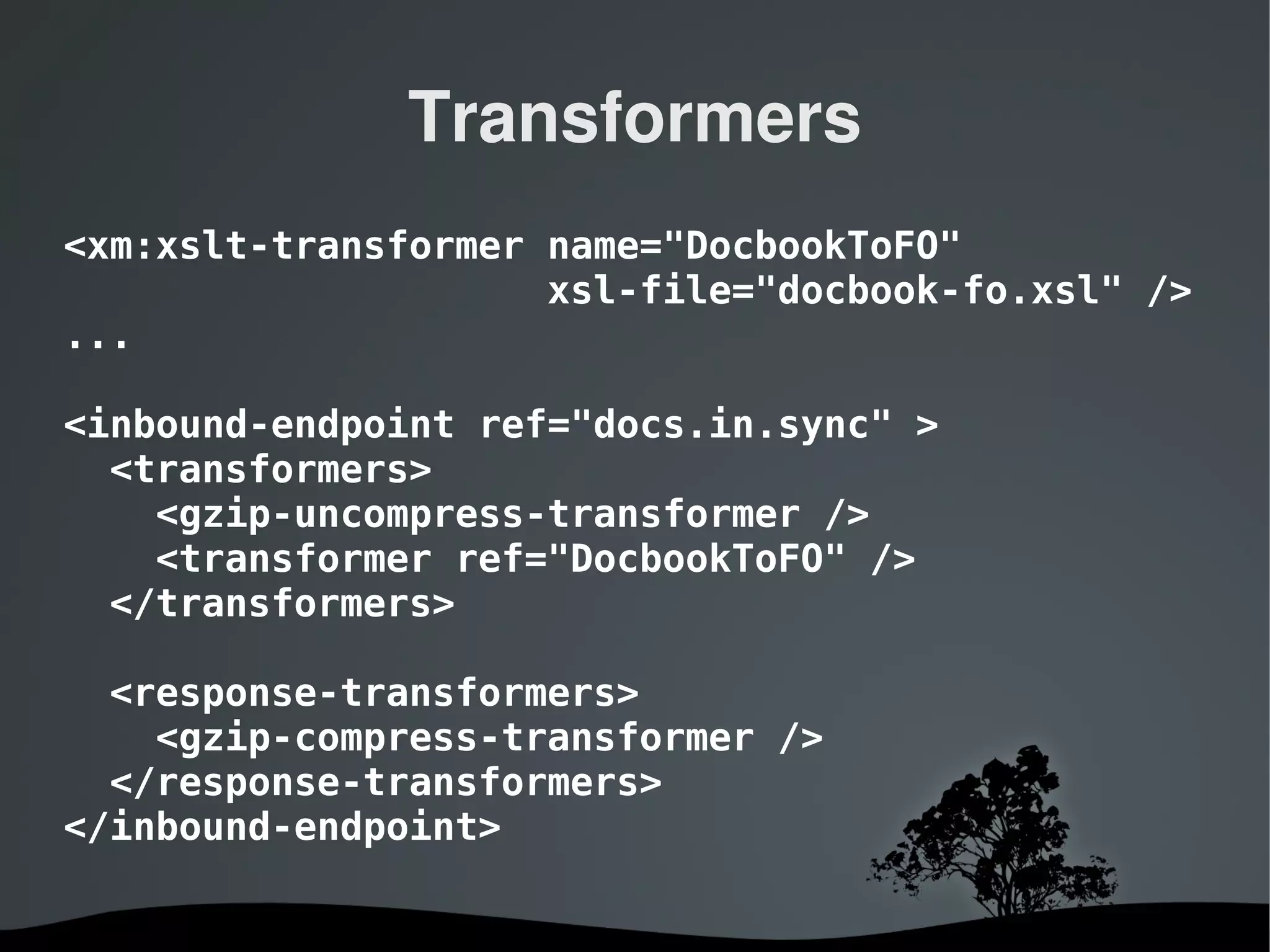
Transformers
<xm:xslt-transformer name="DocbookToFO"
                     xsl-file="docbook-fo.xsl" />
...

<inbound-endpoint ref="docs.in.sync" >
  <transformers>
    <gzip-uncompress-transformer />
    <transformer ref="DocbookToFO" />
  </transformers>

  <response-transformers>
    <gzip-compress-transformer />
  </response-transformers>
</inbound-endpoint>

                    
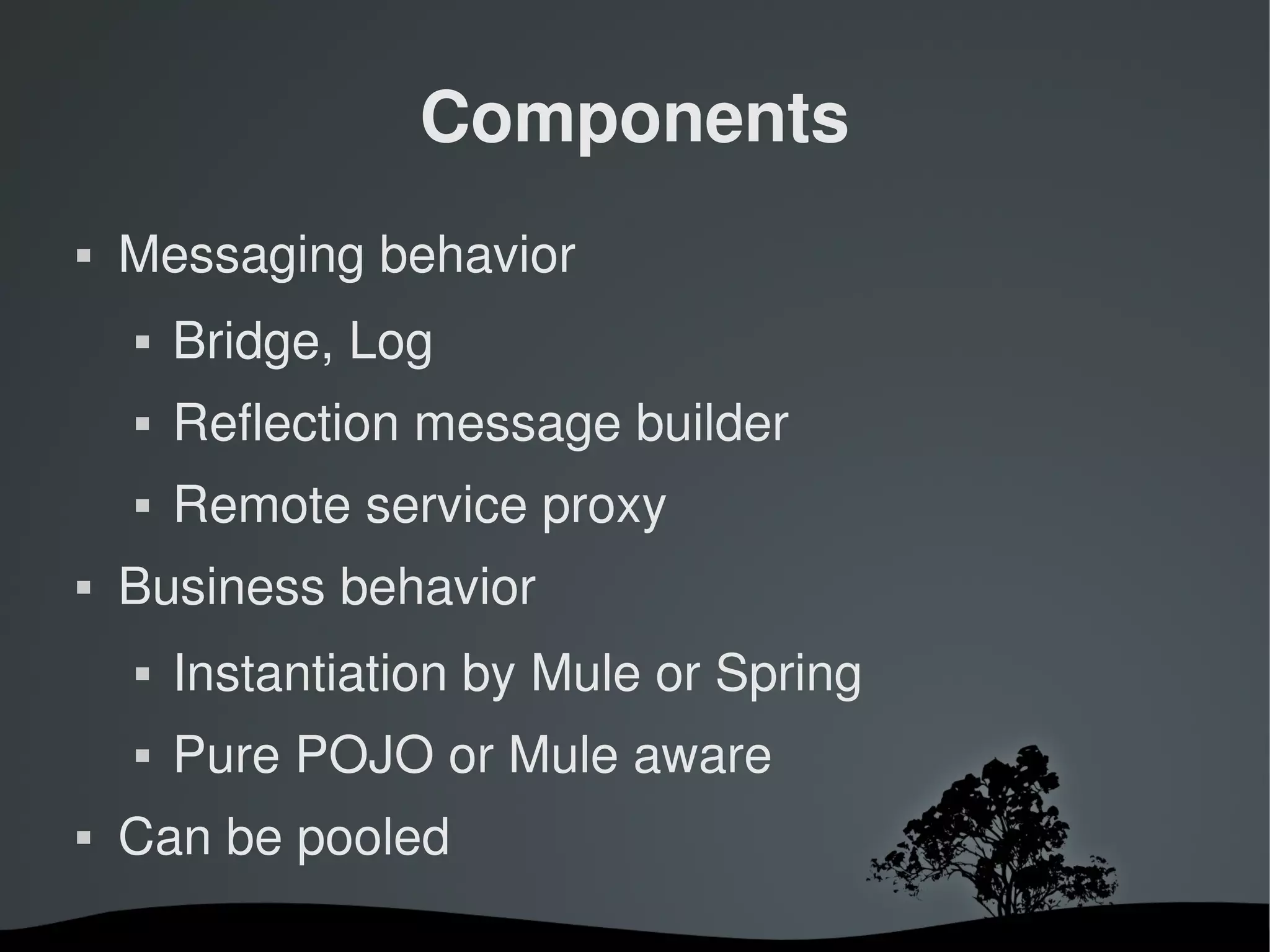
Components
   Messaging behavior
       Bridge, Log
       Reflection message builder
       Remote service proxy
   Business behavior
       Instantiation by Mule or Spring
       Pure POJO or Mule aware
   Can be pooled
                        
Components
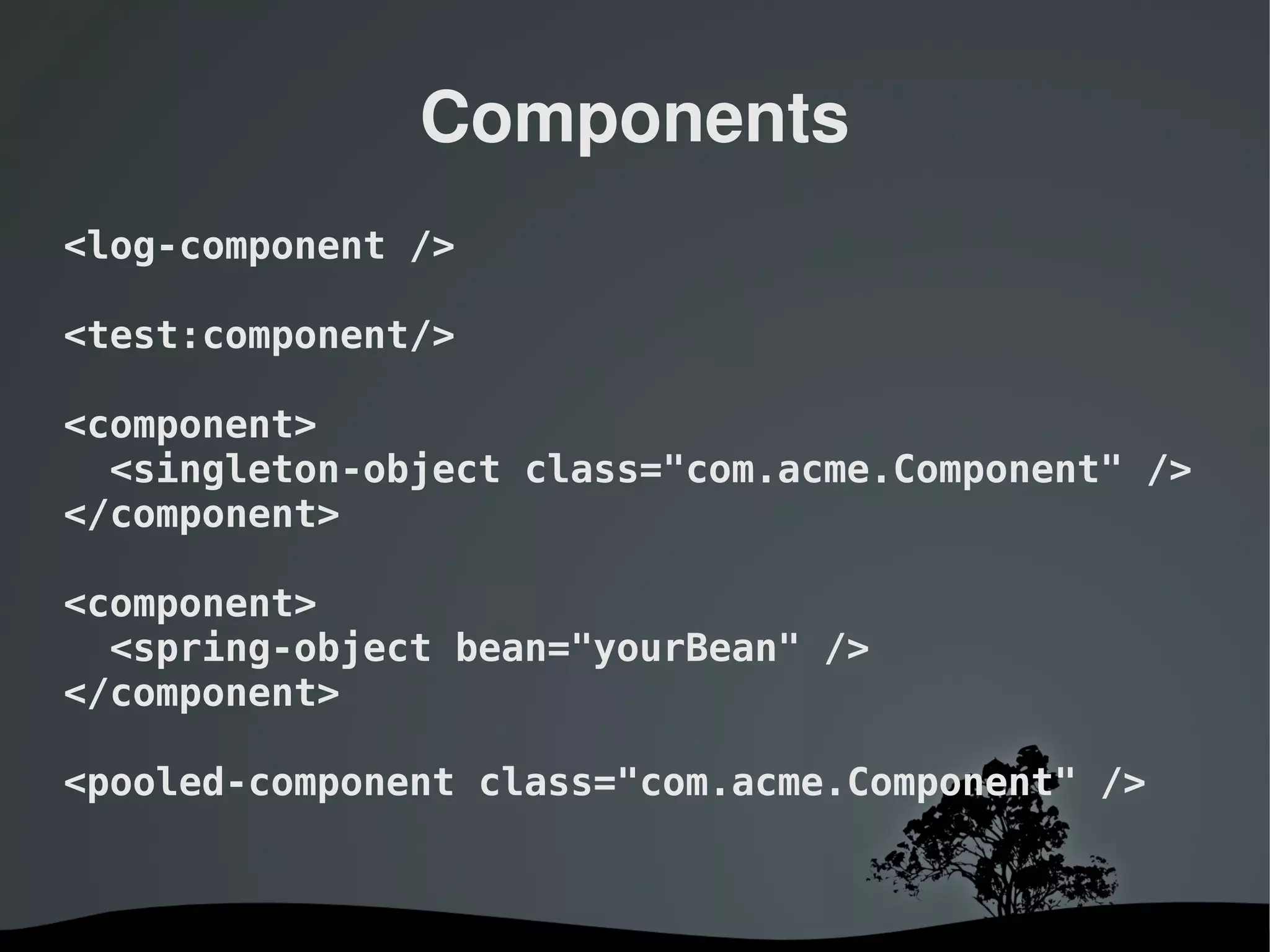
<log-component />

<test:component/>

<component>
  <singleton-object class="com.acme.Component" />
</component>

<component>
  <spring-object bean="yourBean" />
</component>

<pooled-component class="com.acme.Component" />


http://www.springframework.org/schema/beans/spring-beans-2.5.xsd
       http://www.springframework.org/schema/context http://www.springframework.org/schema/context/
spring-context-2.5.xsd
       http://www.mulesource.org/schema/mule/core/2.2
http://www.mulesource.org/schema/mule/core/2.2/mule.xsd
       http://www.mulesource.org/schema/mule/file/2.2
http://www.mulesource.org/schema/mule/file/2.2/mule-file.xsd
       http://www.mulesource.org/schema/mule/jms/2.2 http://www.mulesource.org/schema/mule/jms/2.2/
mule-jms.xsd
       http://www.mulesource.org/schema/mule/xml/2.2 http://www.mulesource.org/schema/mule/xml/2.2/
mule-xml.xsd"
        >

   <notifications dynamic="true">
       <notification event="ENDPOINT-MESSAGE"/>
   </notifications>


                                  Pwned!
   <global-property name="jms.url" value="vm://localhost"/>

   <jms:activemq-connector name="jmsConnector" specification="1.1" brokerURL="${jms.url}"/>

    <file:connector name="FileConnector"
                   streaming="false"
                   autoDelete="true"
                   pollingFrequency="1000">
       <file:expression-filename-parser/>
   </file:connector>

   <model name="jmsInboundModel">
       <service name="jmsInboundService">
           <inbound>
               <jms:inbound-endpoint topic="backup-reports" >
                   <transformers>
                       <jms:jmsmessage-to-object-transformer/>
                   </transformers>
               </jms:inbound-endpoint>
           </inbound>
           <outbound>
               <pass-through-router>
                   <file:outbound-endpoint path="./data/reports"
                                           outputPattern="BACKUP-REPORT-#[function:dateStamp]"/>
               </pass-through-router>  
Service configuration

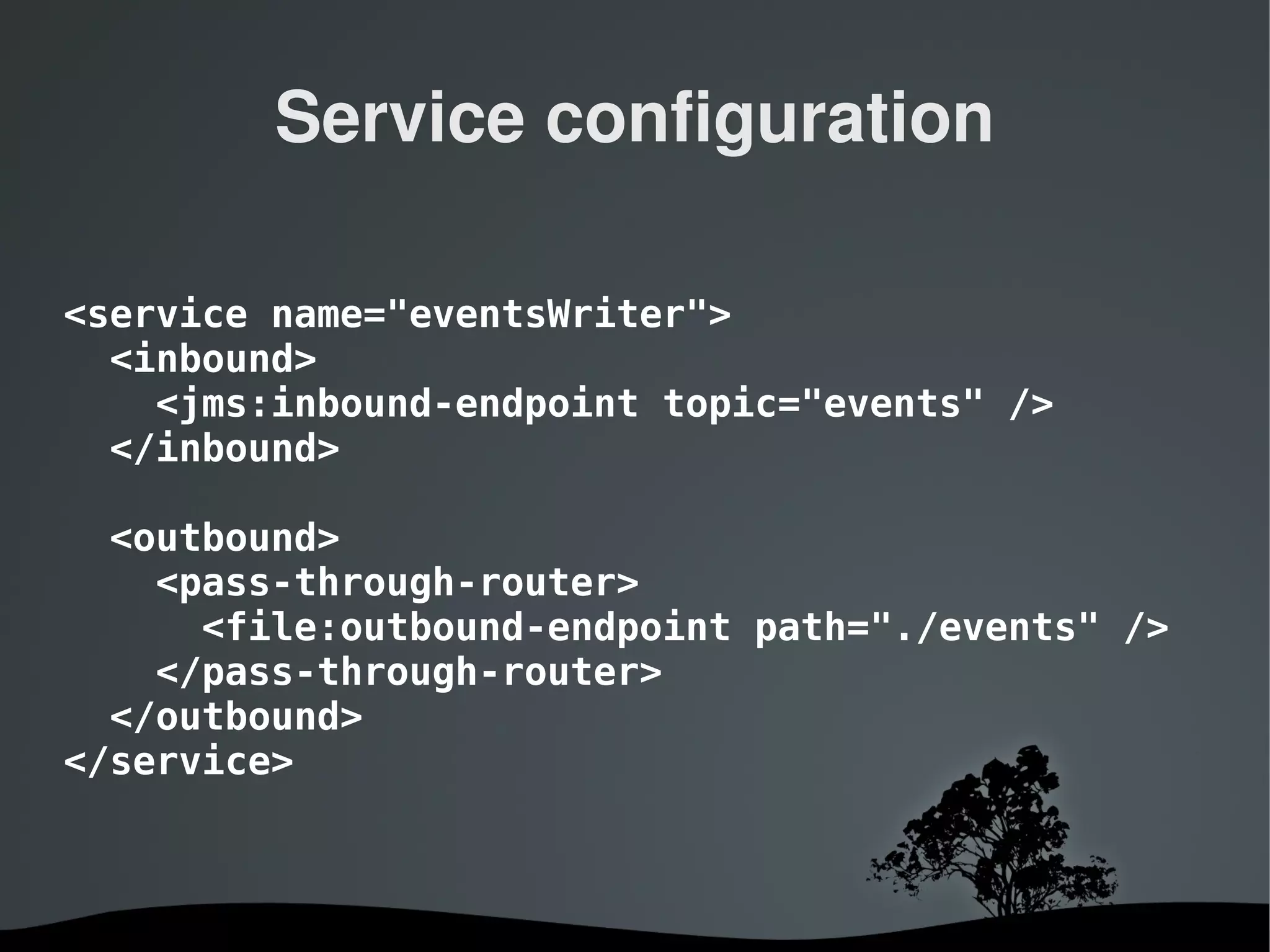
<service name="eventsWriter">
  <inbound>
    <jms:inbound-endpoint topic="events" />
  </inbound>

  <outbound>
    <pass-through-router>
      <file:outbound-endpoint path="./events" />
    </pass-through-router>
  </outbound>
</service>


Service configuration

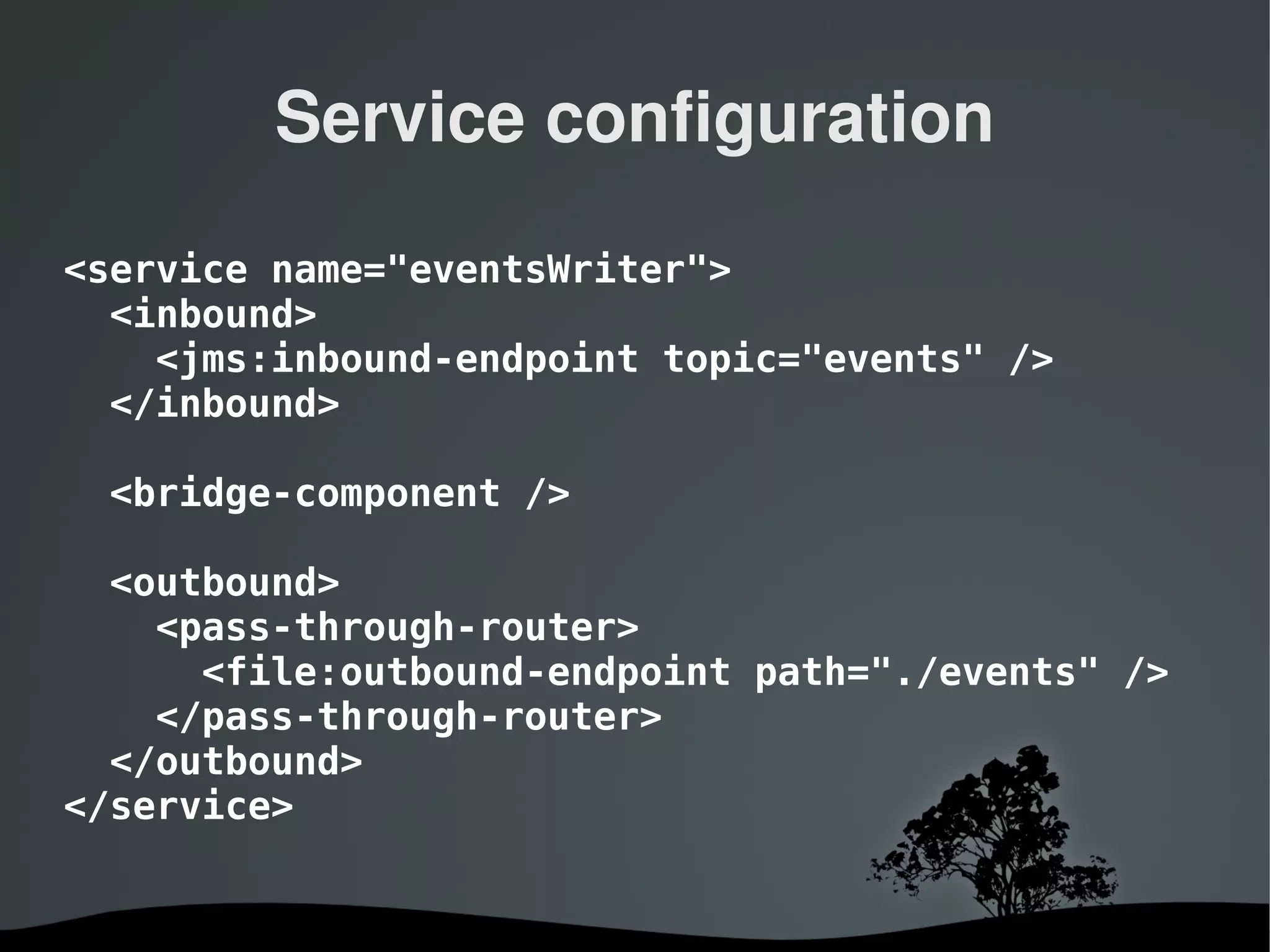
<service name="eventsWriter">
  <inbound>
    <jms:inbound-endpoint topic="events" />
  </inbound>

 <bridge-component />

  <outbound>
    <pass-through-router>
      <file:outbound-endpoint path="./events" />
    </pass-through-router>
  </outbound>
</service>


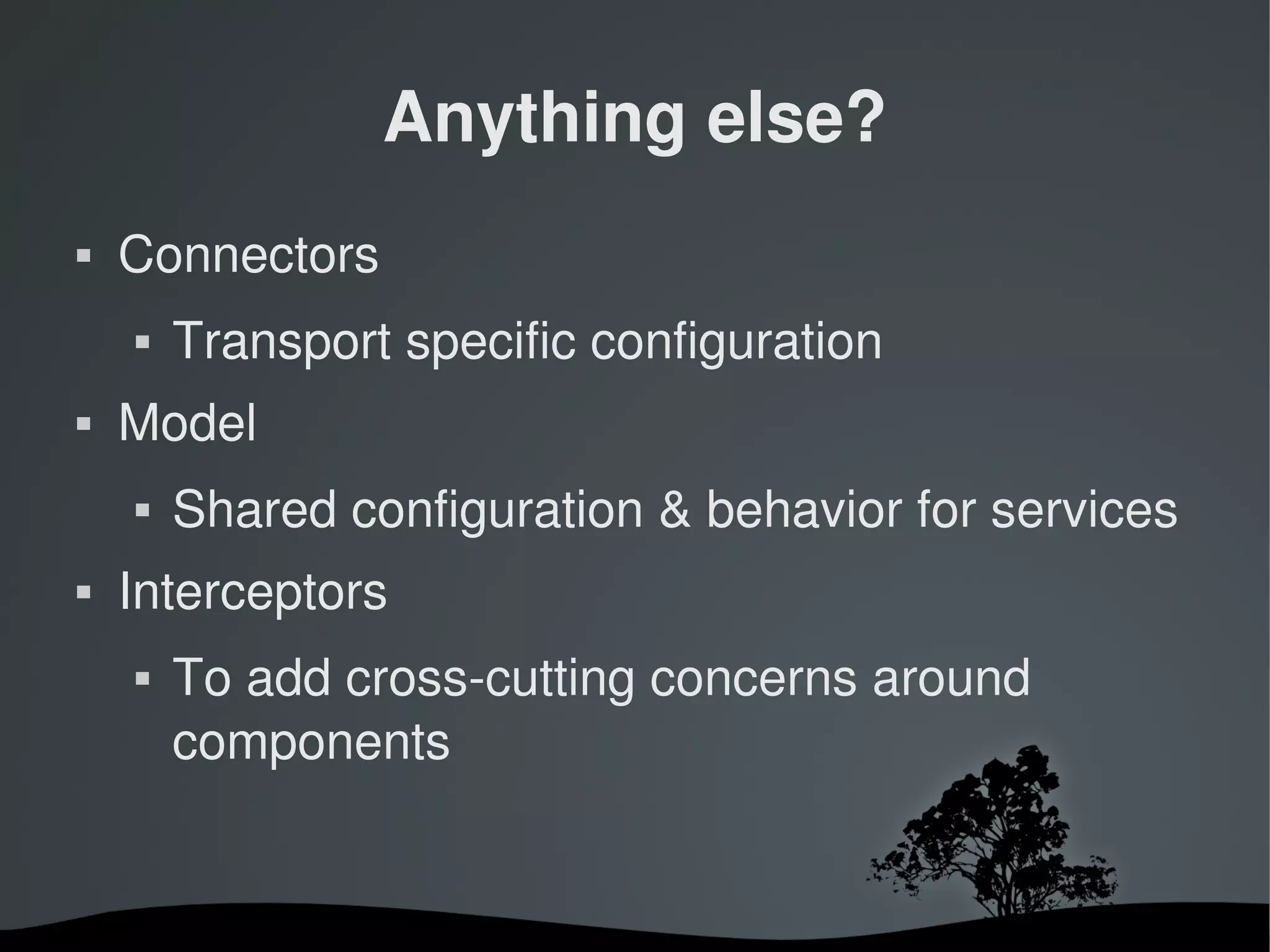
Anything else?
   Connectors
       Transport specific configuration
   Model
       Shared configuration & behavior for services
   Interceptors
       To add cross­cutting concerns around 
        components


The mysterious Mule client


The mysterious Mule client
   Why a client?
   In­memory access to an instance
       Message generation
       Functional testing
   Remote access to an instance
       Proprietary remote invoker
   Raw transport usage


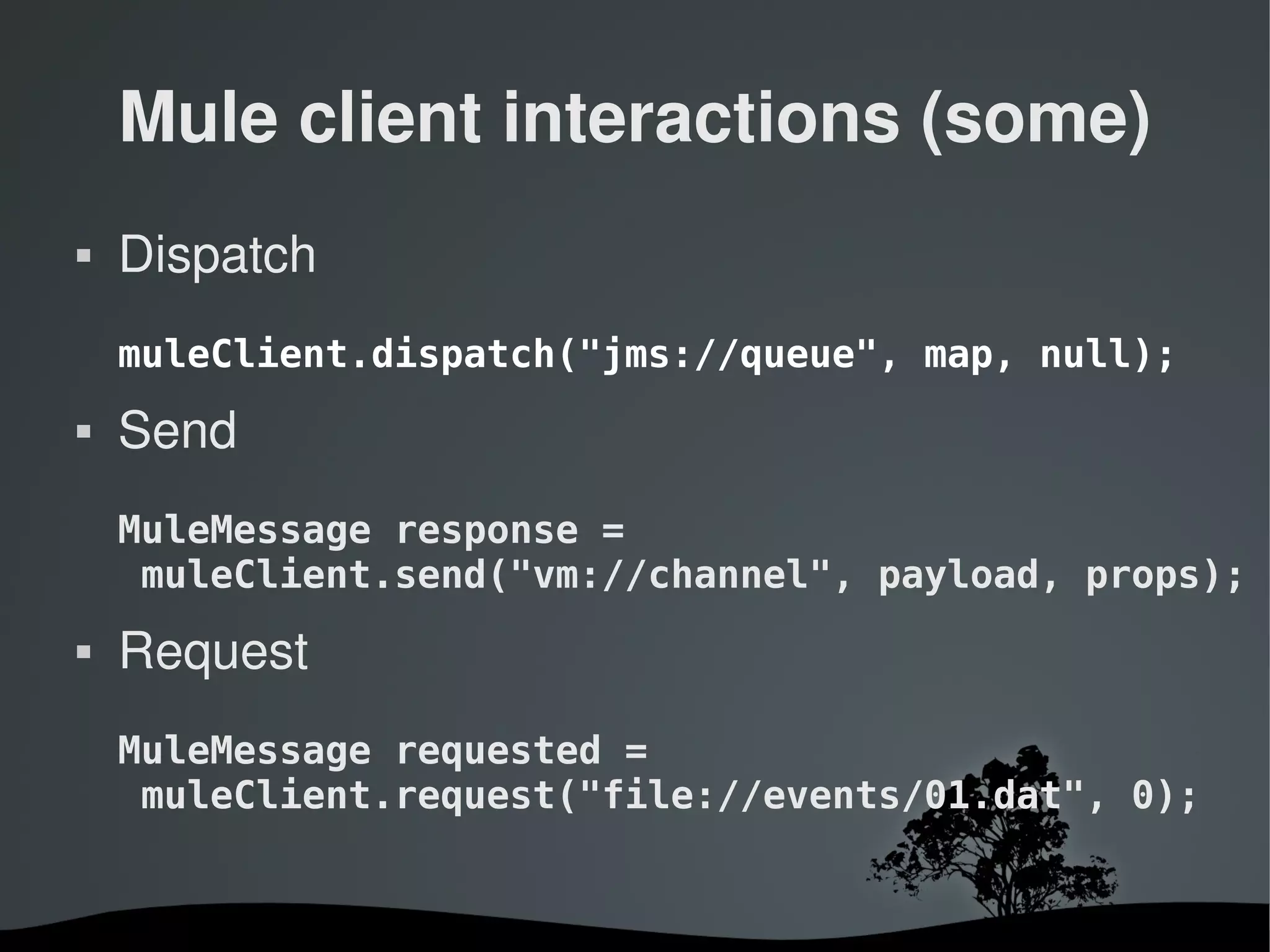
Mule client interactions (some)
   Dispatch
    muleClient.dispatch("jms://queue", map, null);
   Send
    MuleMessage response =
     muleClient.send("vm://channel", payload, props);
   Request
    MuleMessage requested =
     muleClient.request("file://events/01.dat", 0);


Construction


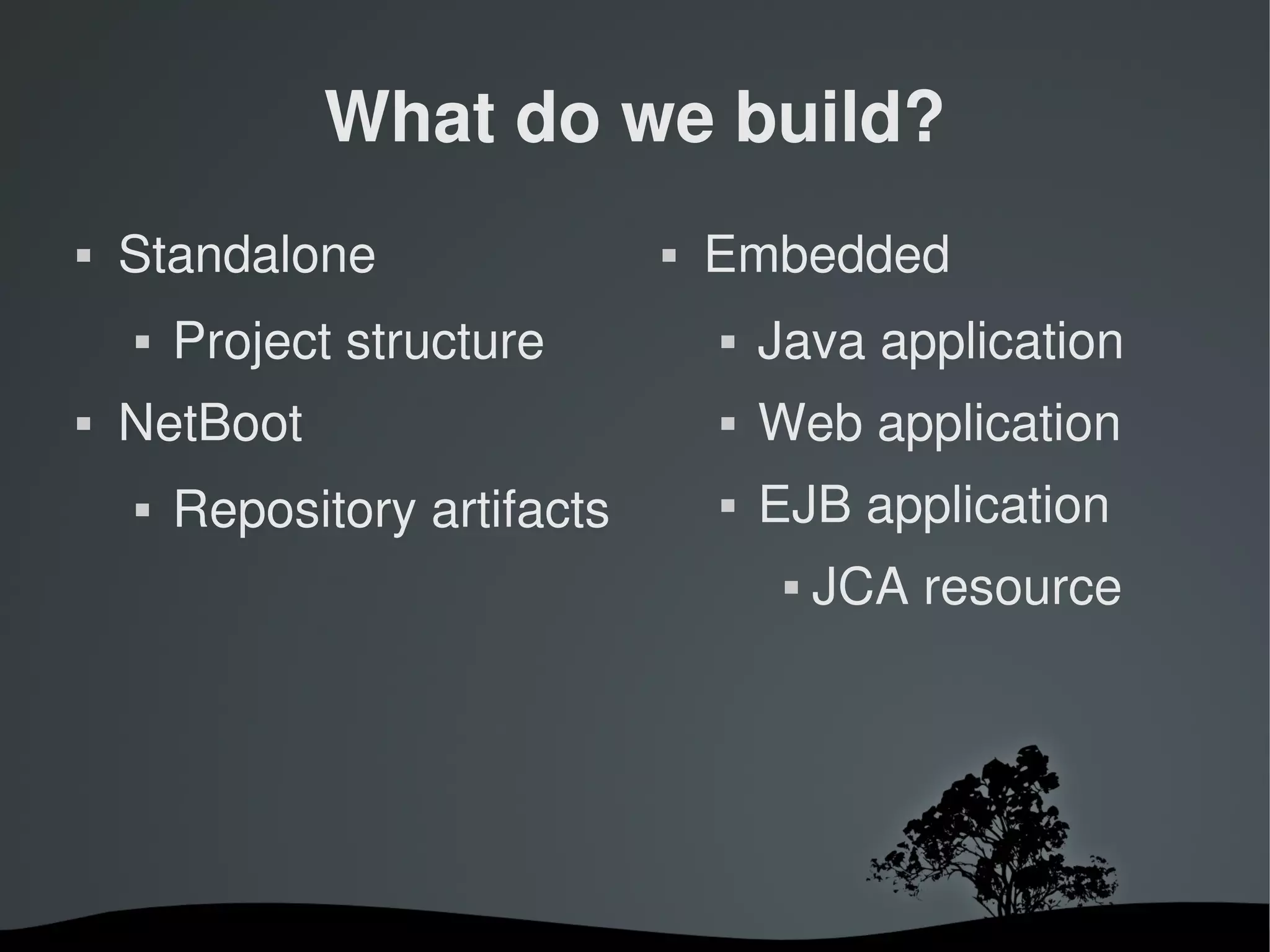
What do we build?
   Standalone                    Embedded
       Project structure             Java application
   NetBoot                           Web application
       Repository artifacts          EJB application
                                           JCA resource


Just ship it!
   A Mule project is just a bunch of XML files
       Tinker with them a little
       Ship them to production
       And you are good to go!


       Right?


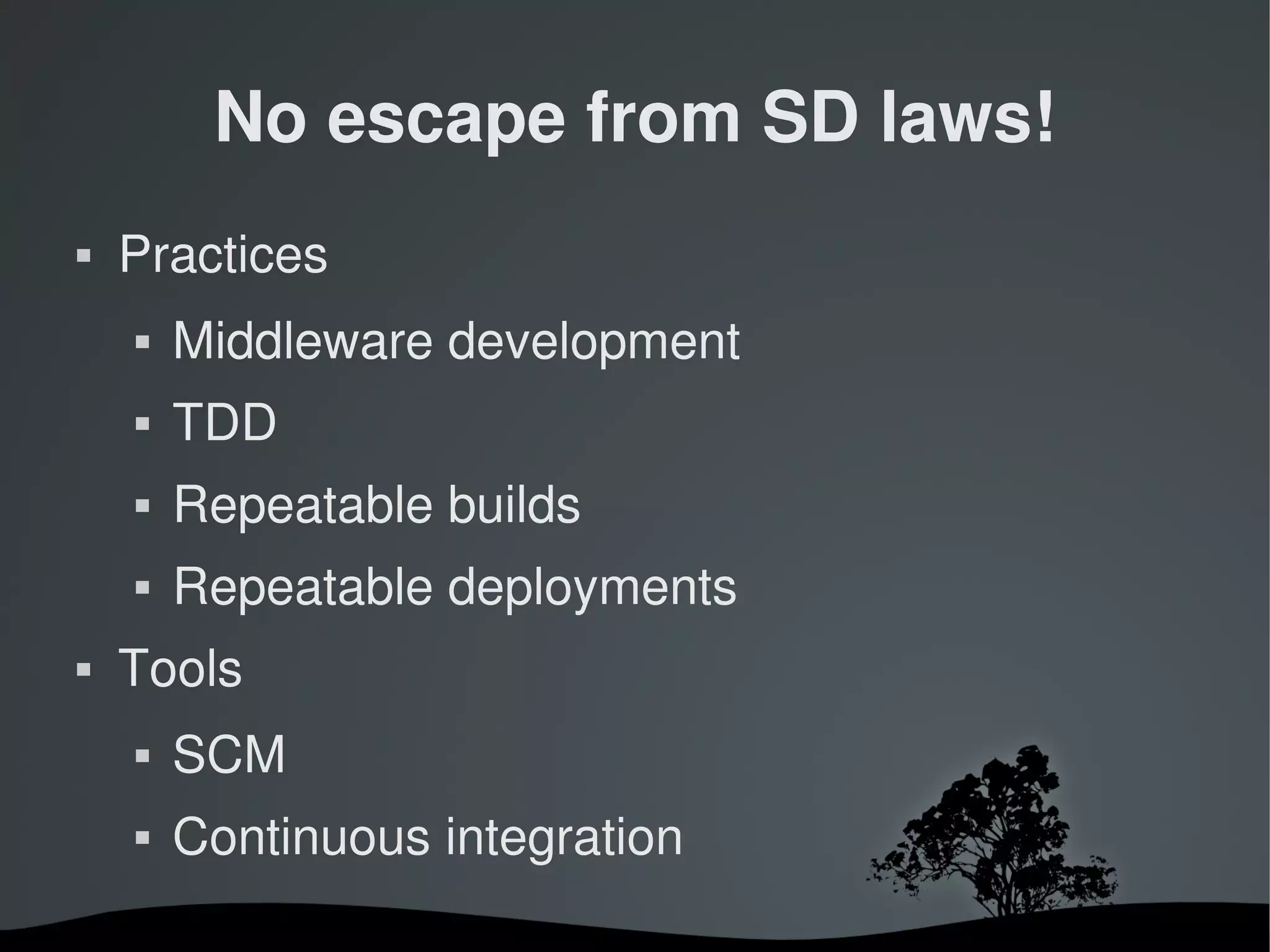
No escape from SD laws!
   Practices
       Middleware development
       TDD
       Repeatable builds
       Repeatable deployments
   Tools
       SCM
       Continuous integration
                       
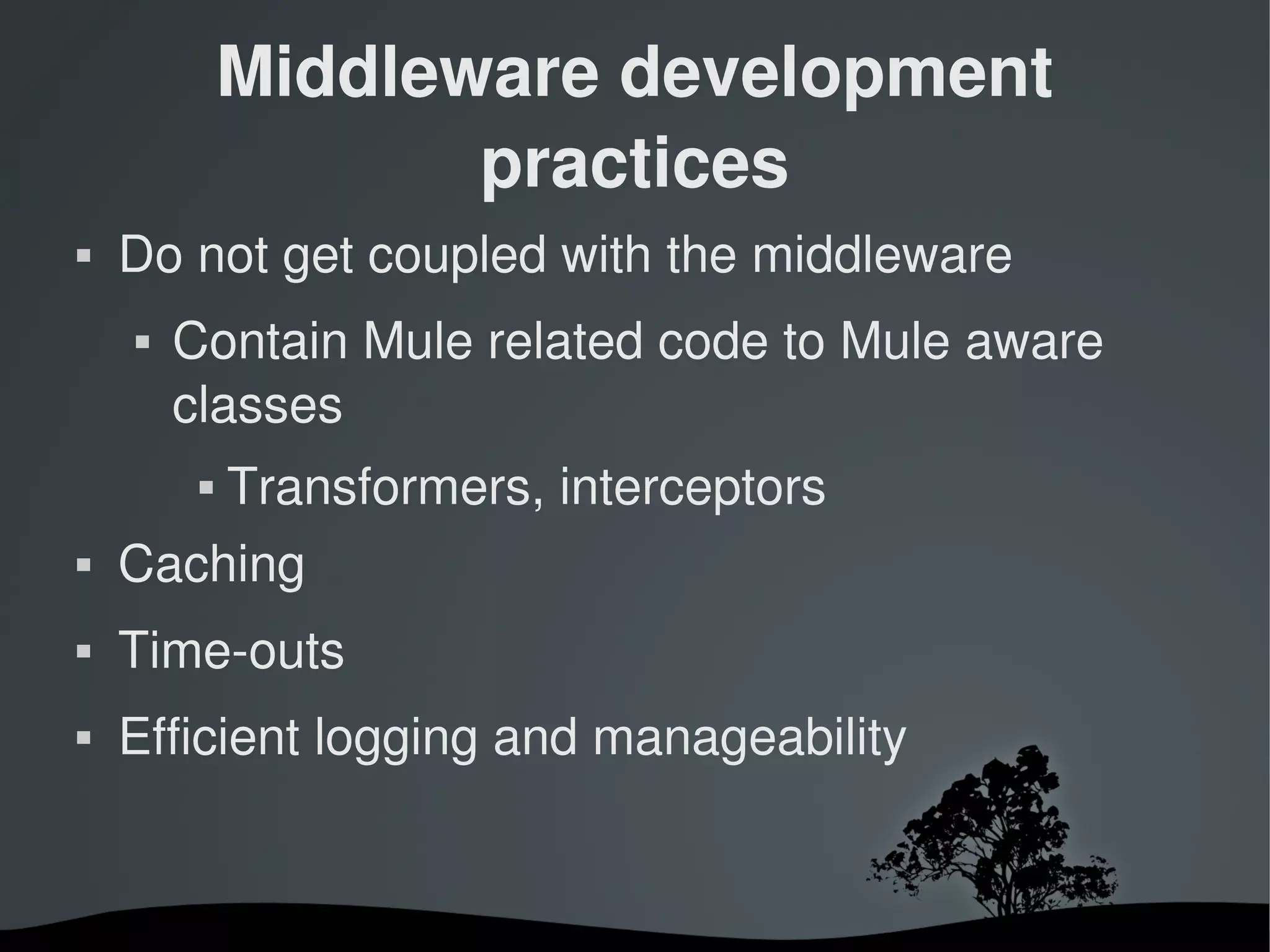
Middleware development 
                    practices
   Do not get coupled with the middleware
       Contain Mule related code to Mule aware 
        classes
                Transformers, interceptors
   Caching
   Time­outs
   Efficient logging and manageability


Unit Testing
   For components, transformers...
   Outside of Mule
   xUnit


Functional Testing
   For routing, configuration...
   Test­scoped instance
       Mule client
       Test component
       Substitution endpoints
       In­memory infrastructure
       Jitr


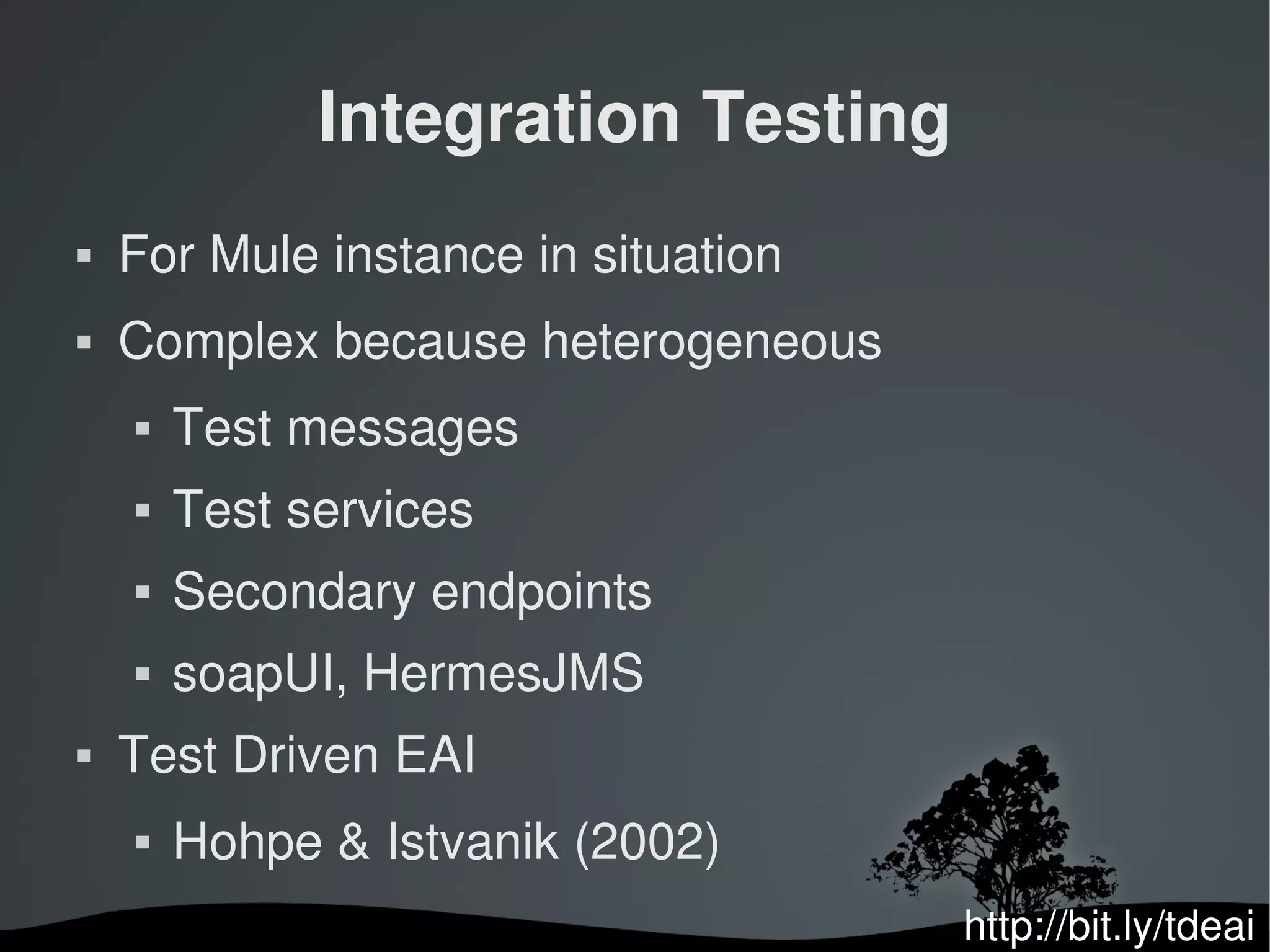
Integration Testing
   For Mule instance in situation
   Complex because heterogeneous
       Test messages
       Test services
       Secondary endpoints
       soapUI, HermesJMS
   Test Driven EAI
       Hohpe & Istvanik (2002)
                                     http://bit.ly/tdeai
Other Testing
   Load tests
       Use JMeter
   Profiling
       Use the YourKit Profiler Pack


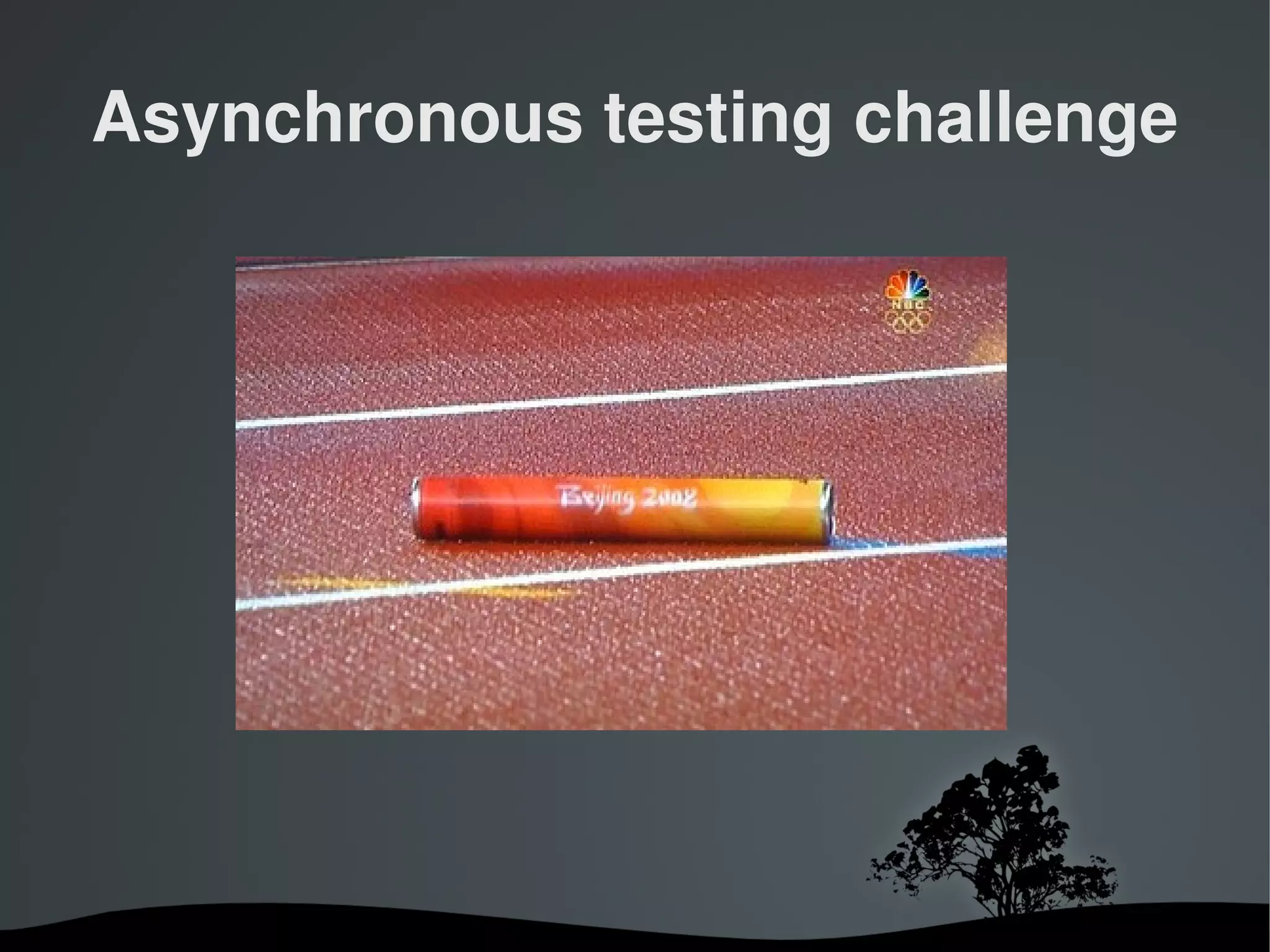
Asynchronous testing challenge


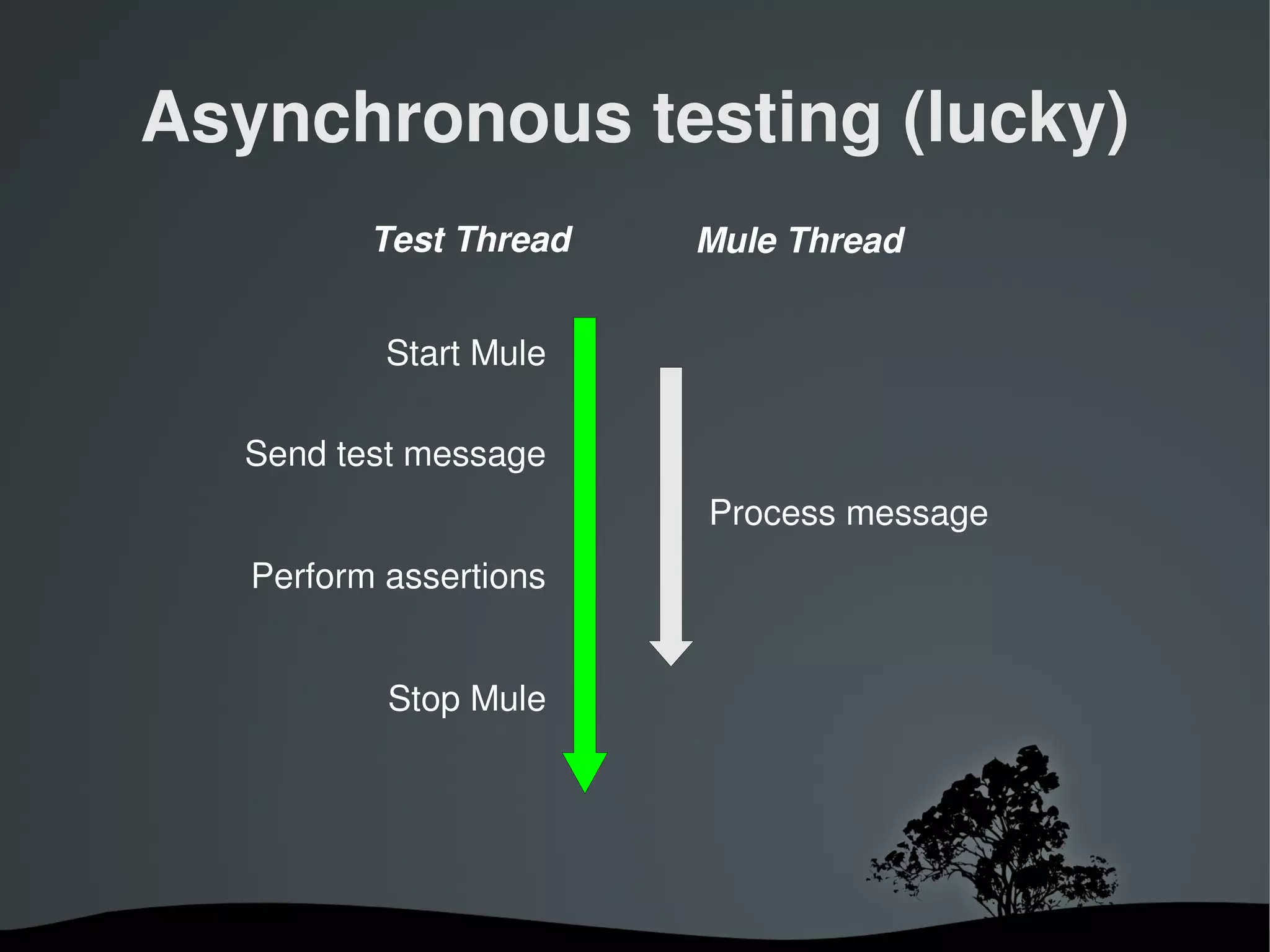
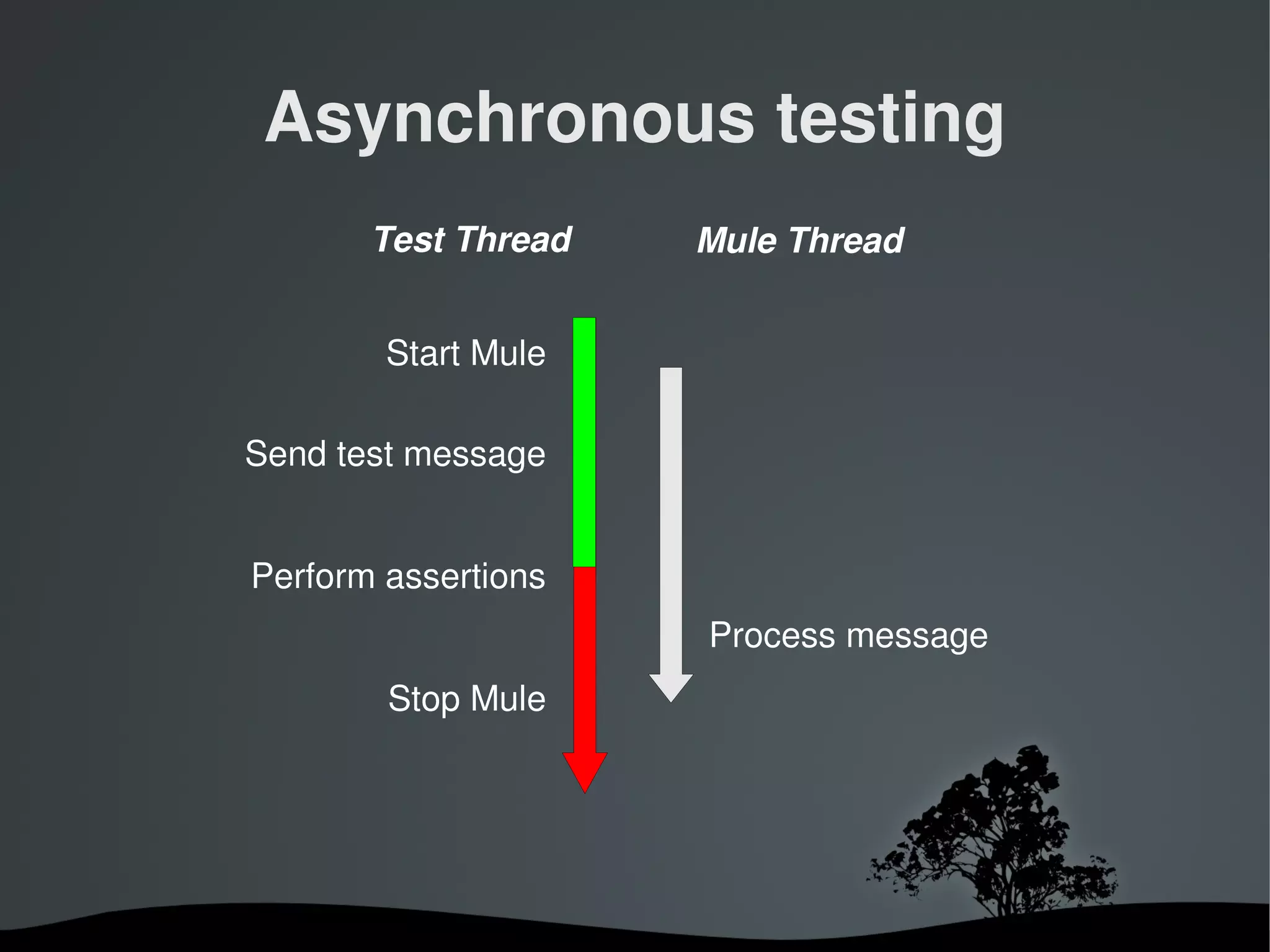
Asynchronous testing (lucky)
             Test Thread   Mule Thread


              Start Mule

      Send test message
                           Process message
      Perform assertions


              Stop Mule


Asynchronous testing
           Test Thread   Mule Thread


            Start Mule

    Send test message


    Perform assertions
                         Process message
            Stop Mule


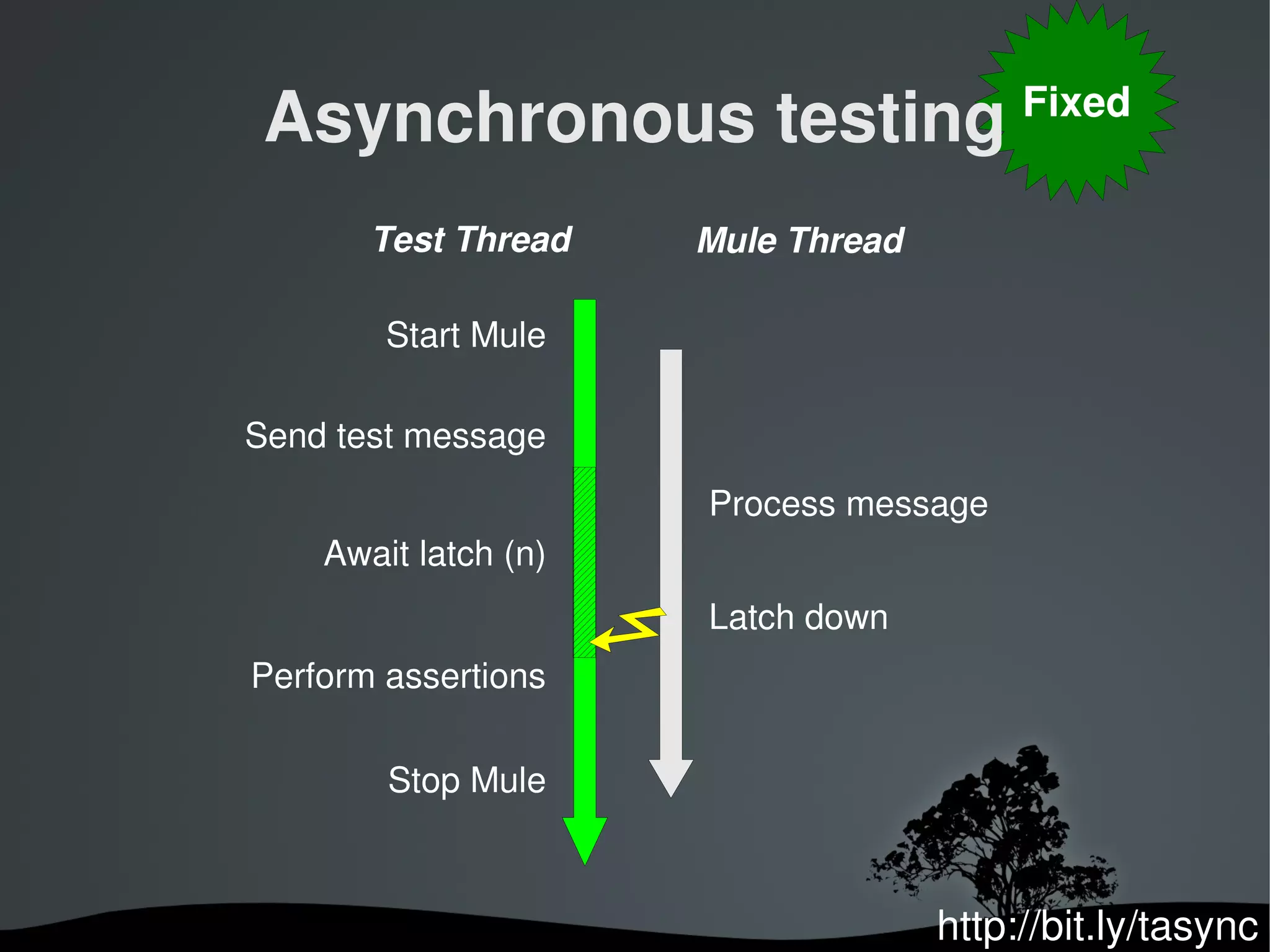
Asynchronous testing                    Fixed


           Test Thread    Mule Thread

            Start Mule

    Send test message
                          Process message
        Await latch (n)
                          Latch down
    Perform assertions

            Stop Mule


                                        http://bit.ly/tasync
Unleashing Mule


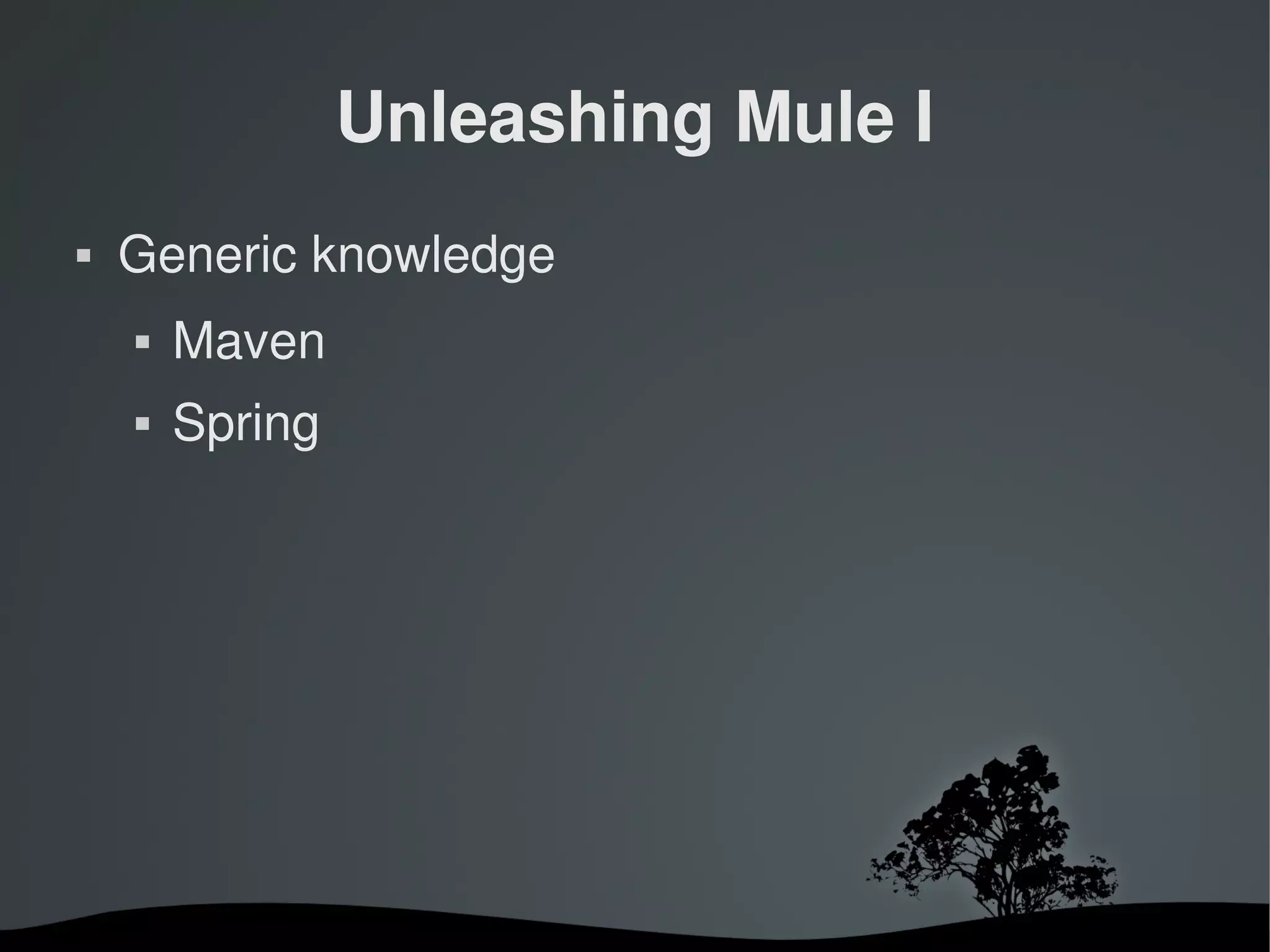
Unleashing Mule I
   Generic knowledge
       Maven
       Spring


Maven
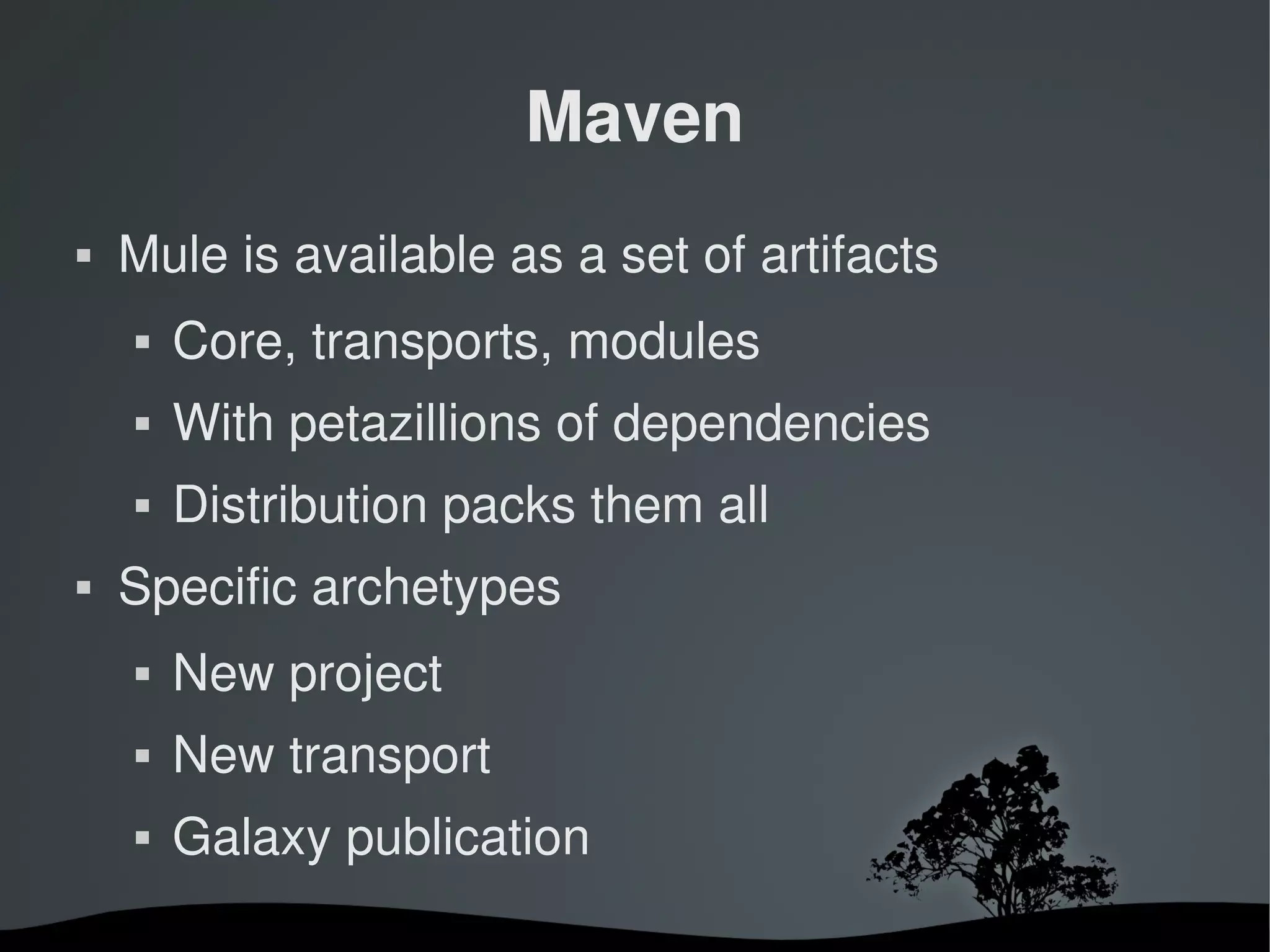
   Mule is available as a set of artifacts
       Core, transports, modules
       With petazillions of dependencies
       Distribution packs them all
   Specific archetypes
       New project
       New transport
       Galaxy publication
                         
Spring
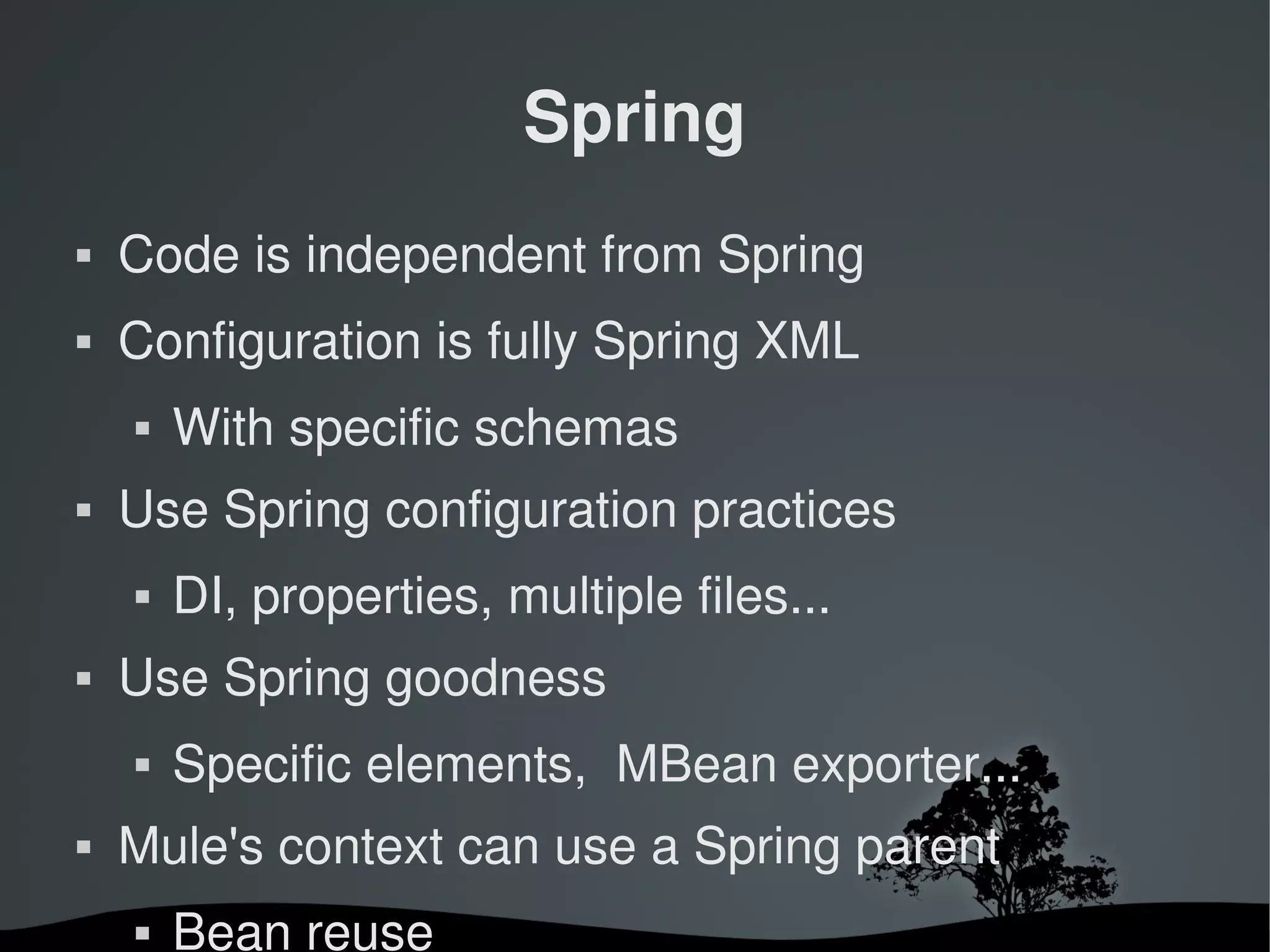
   Code is independent from Spring
   Configuration is fully Spring XML
       With specific schemas
   Use Spring configuration practices
       DI, properties, multiple files...
   Use Spring goodness
       Specific elements,  MBean exporter...
   Mule's context can use a Spring parent
       Bean reuse
                         
Unleashing Mule II
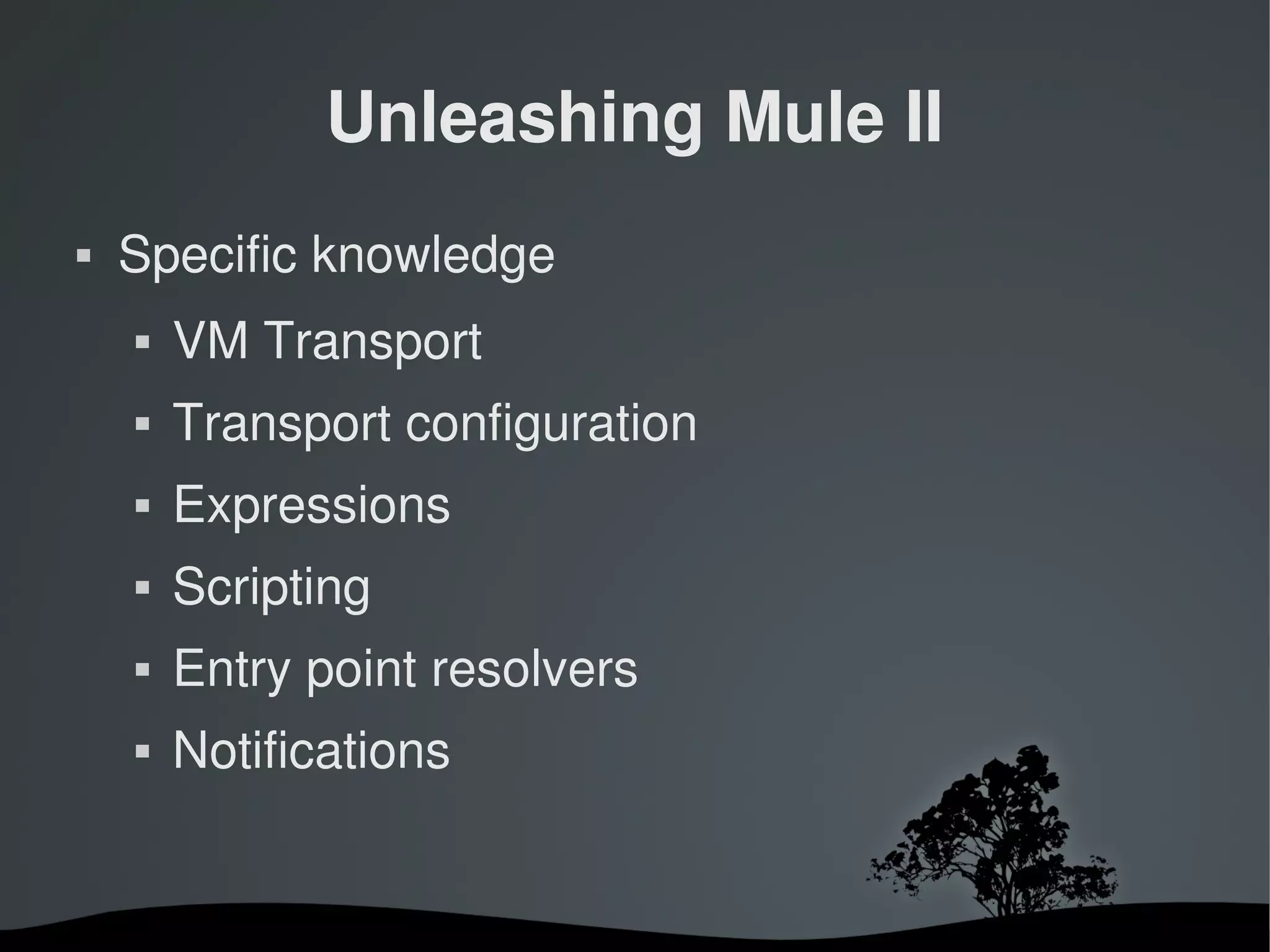
   Specific knowledge
       VM Transport
       Transport configuration
       Expressions
       Scripting
       Entry point resolvers
       Notifications


VM Transport
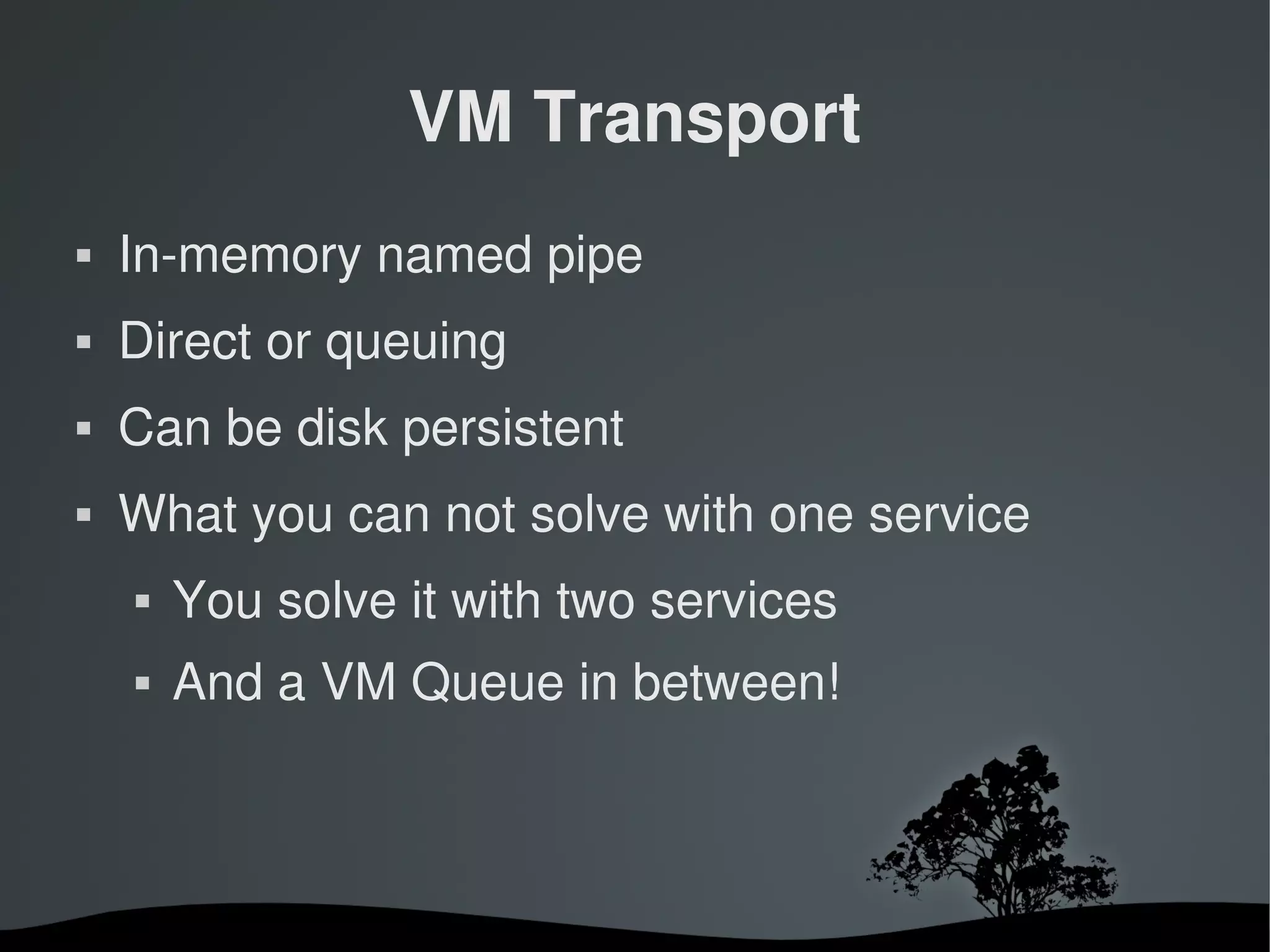
   In­memory named pipe
   Direct or queuing
   Can be disk persistent
   What you can not solve with one service
       You solve it with two services
       And a VM Queue in between!


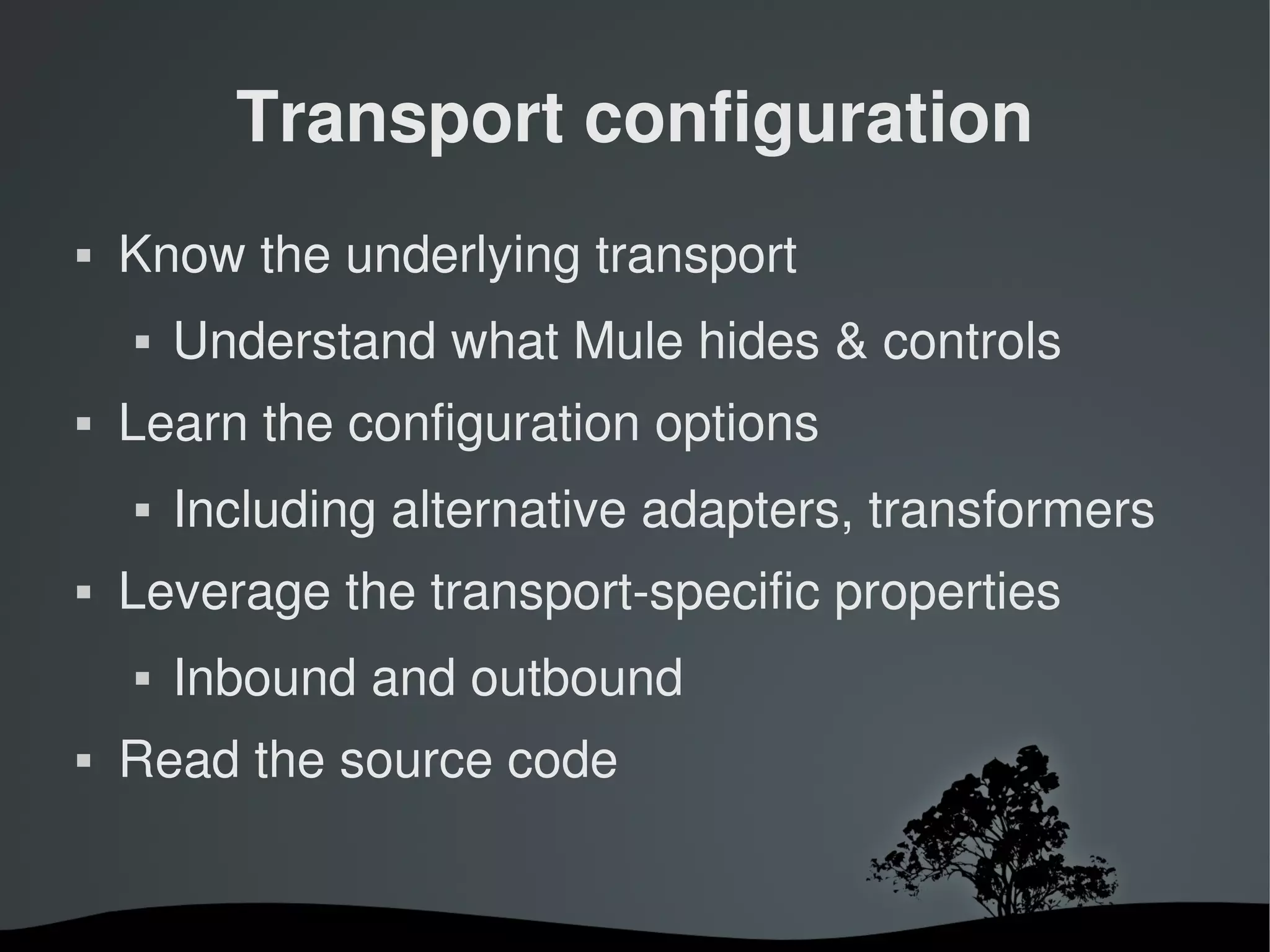
Transport configuration
   Know the underlying transport
       Understand what Mule hides & controls
   Learn the configuration options
       Including alternative adapters, transformers
   Leverage the transport­specific properties
       Inbound and outbound
   Read the source code


Expressions
   Dynamic properties in configuration
       #[evaluator:expression]
       Filters, transformers, endpoint URIs
   Usually evaluated on the current message
       Standalone and Mule­wide evaluators exist
   Many evaluators available
       Groovy, XPath, Map Payload, OGNL...
   Can also be invoked from code

                        
<message-properties-transformer name="SetTo">
  <add-message-property key="toAddresses"
     value="#[xpath:/Receipts/SendToEmail]" />
</message-properties-transformer>

...

<smtp:outbound-endpoint
  host="${smtp.host}"
  port="${smtp.port}"
  from="${smtp.fromAddress}"
  subject="${smtp.subject}"
  transformer-refs="SetTo StringToEmailMessage" />


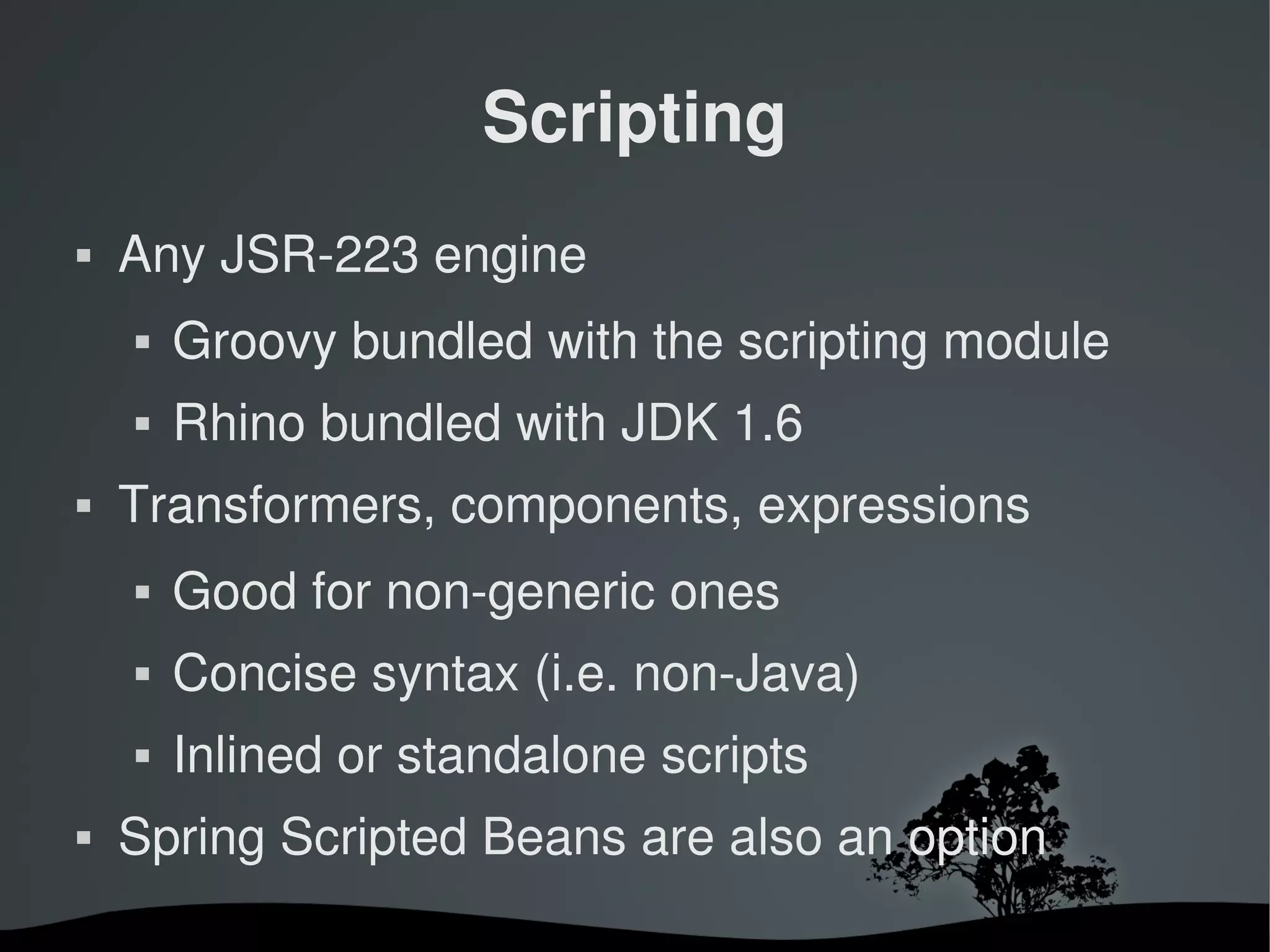
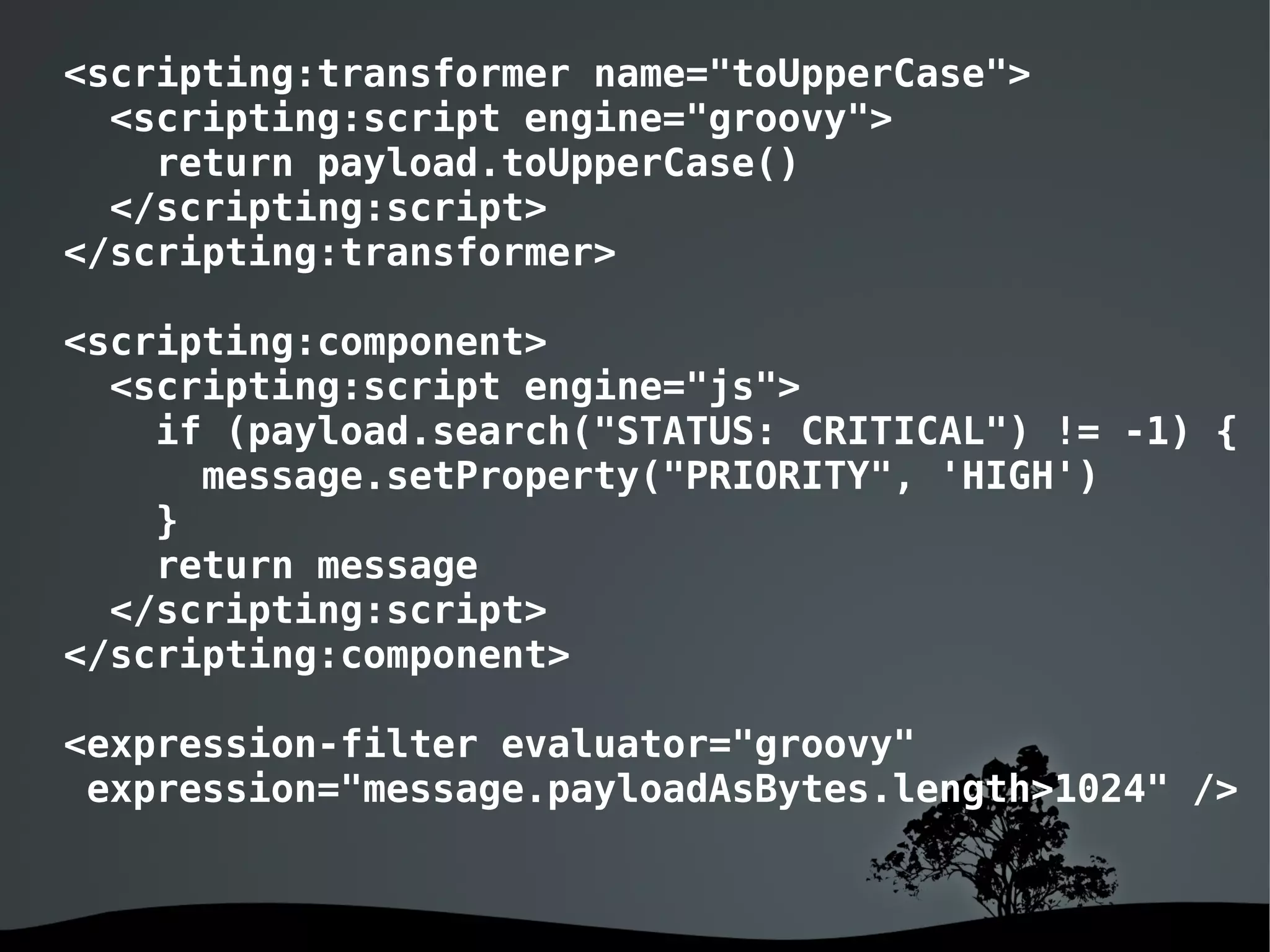
Scripting
   Any JSR­223 engine
       Groovy bundled with the scripting module
       Rhino bundled with JDK 1.6
   Transformers, components, expressions
       Good for non­generic ones
       Concise syntax (i.e. non­Java)
       Inlined or standalone scripts
   Spring Scripted Beans are also an option
                        
<scripting:transformer name="toUpperCase">
  <scripting:script engine="groovy">
    return payload.toUpperCase()
  </scripting:script>
</scripting:transformer>

<scripting:component>
  <scripting:script engine="js">
    if (payload.search("STATUS: CRITICAL") != -1) {
      message.setProperty("PRIORITY", 'HIGH')
    }
    return message
  </scripting:script>
</scripting:component>

<expression-filter evaluator="groovy"
 expression="message.payloadAsBytes.length>1024" />


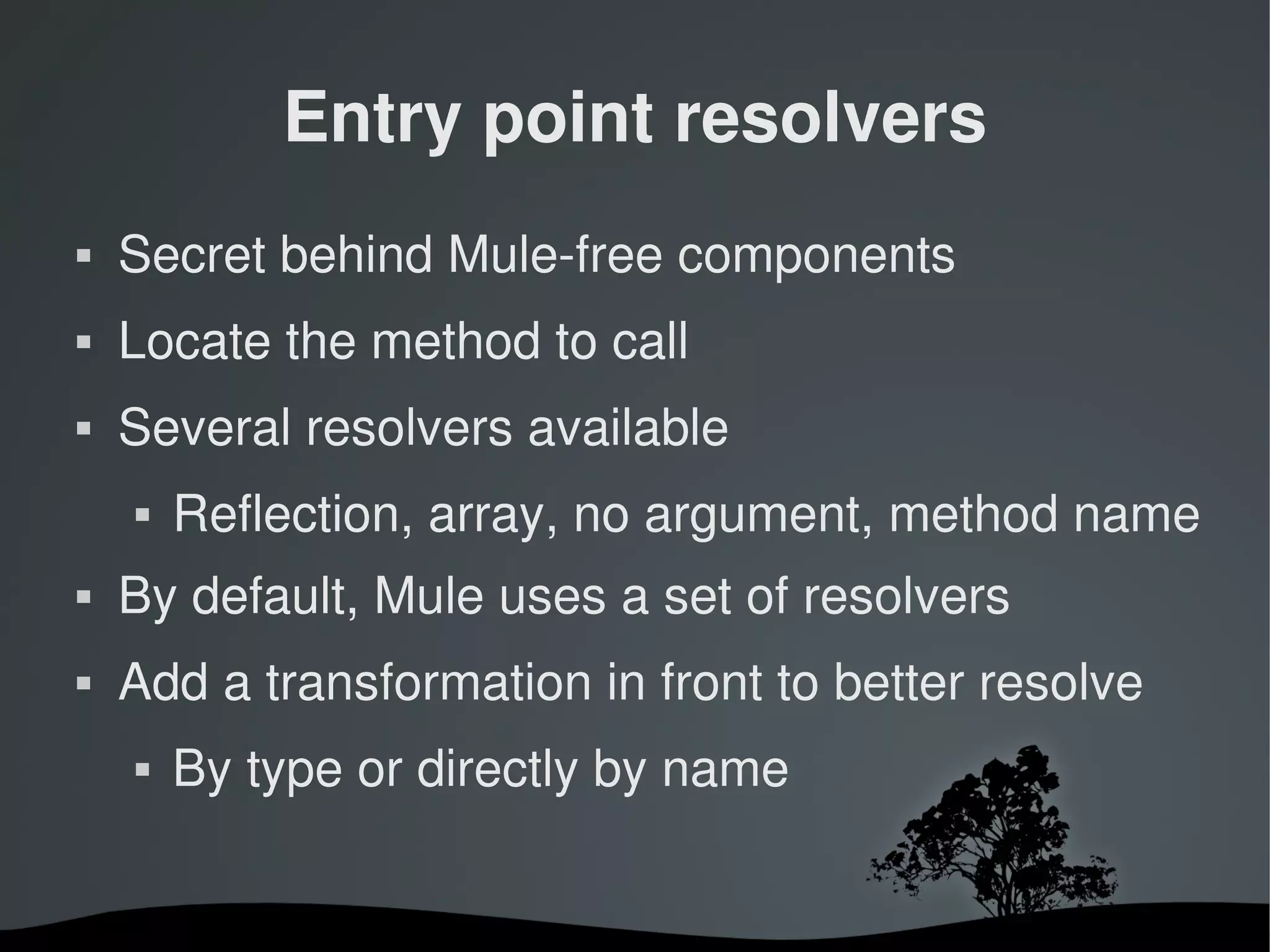
Entry point resolvers
   Secret behind Mule­free components
   Locate the method to call
   Several resolvers available
       Reflection, array, no argument, method name
   By default, Mule uses a set of resolvers
   Add a transformation in front to better resolve
       By type or directly by name


Notifications
   Internal notification framework
   Extreme diversity of events
       Mule lifecycle, routing, errors, time­outs...
   Standard consumers
       JMX, Log4J, publish to endpoint
   Custom consumers
       Components, interceptors...


In Action


The tough questions


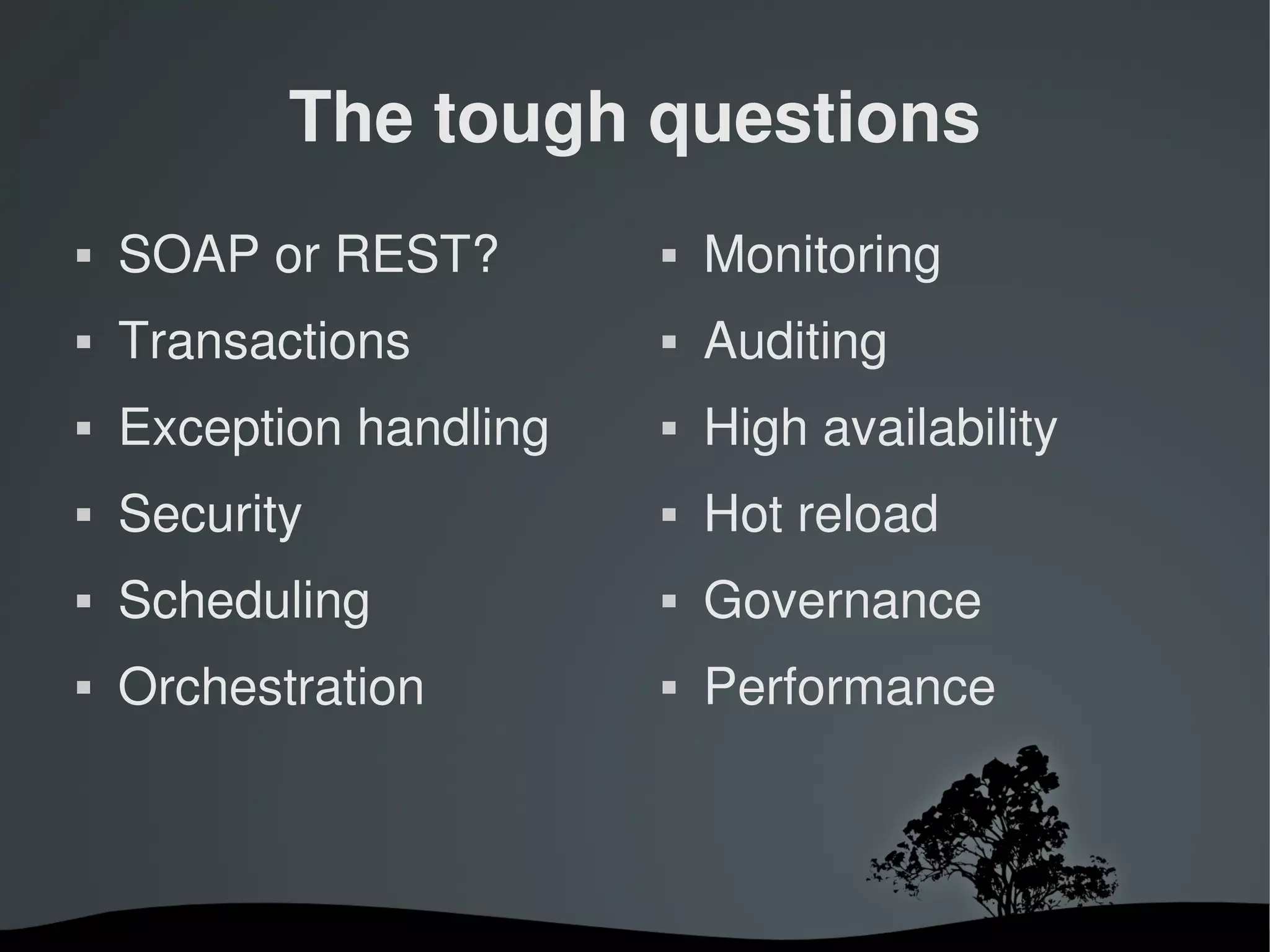
The tough questions
   SOAP or REST?           Monitoring
   Transactions            Auditing
   Exception handling      High availability
   Security                Hot reload
   Scheduling              Governance
   Orchestration           Performance


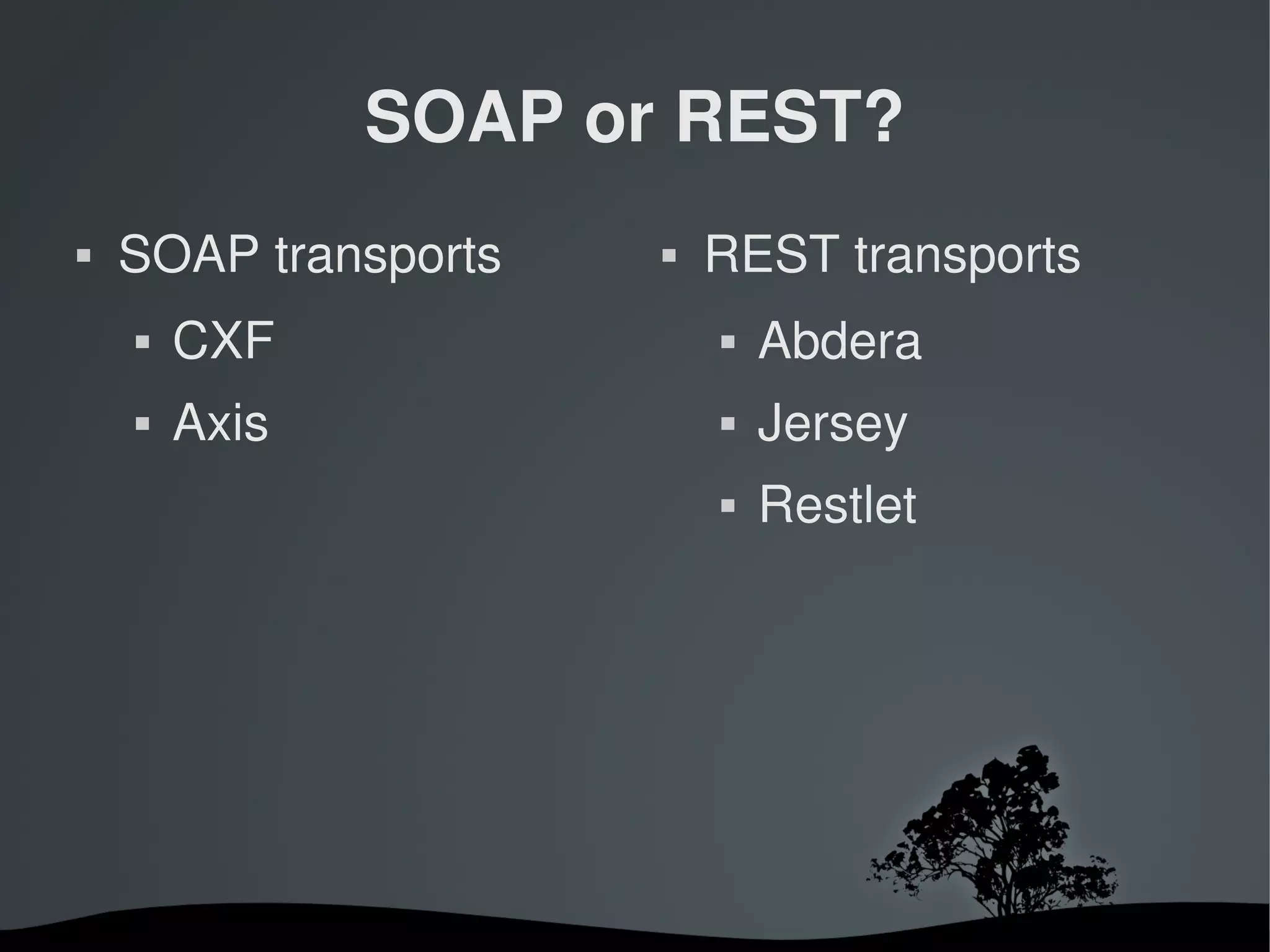
SOAP or REST?
   SOAP transports          REST transports
       CXF                      Abdera
       Axis                     Jersey
                                 Restlet


Transactions
   Supported by a handful of transports
       VM, JDBC, JMS
   Mostly useful for bridging
       Like Queue to Topic
   Consider eventual consistency
       Conversation based
       Idempotent services
       Compensation
                        
Exception handling
   Exceptions are handled at several levels
       Connector and service
       Retry policies
   Different strategies
       Logging, dispatch to endpoint
       Transaction roll­back
   Exception based outbound router
       Localized error handling via fallback
                          
Security
   Secure endpoints
       Authentication and authorization
   Secure payload
       Encryption
   Security manager
       Can delegate to Spring Security
       Can use JAAS
   Transport security handled at connector level
                        
Scheduling
   Based on Quartz
   In inbound router
       To regularly send a fix payload
       To request an endpoint (polling)
   In outbound router 
       To schedule a delayed dispatch


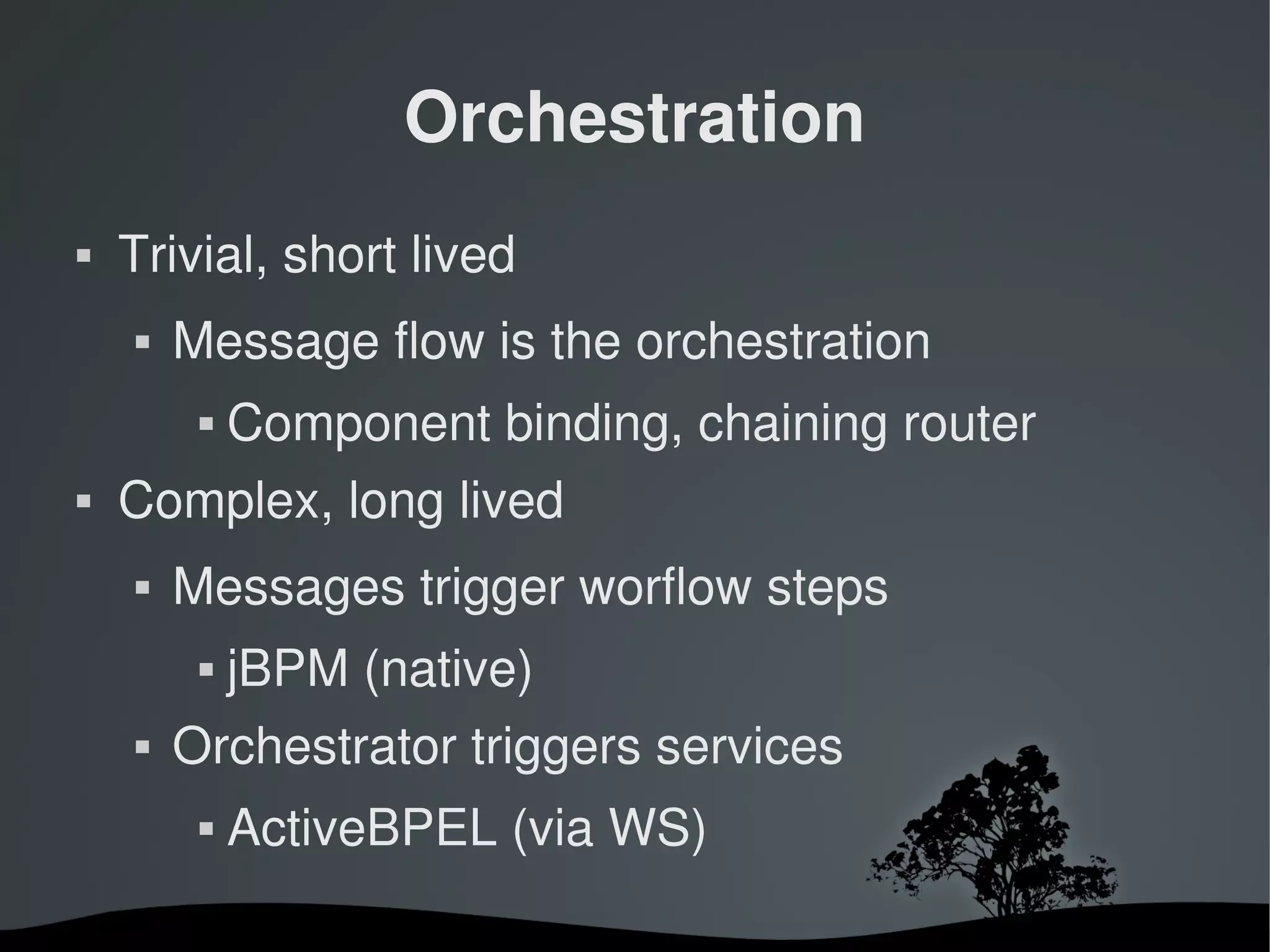
Orchestration
   Trivial, short lived
       Message flow is the orchestration
                Component binding, chaining router
   Complex, long lived
       Messages trigger worflow steps
                jBPM (native)
       Orchestrator triggers services
                ActiveBPEL (via WS)

                              
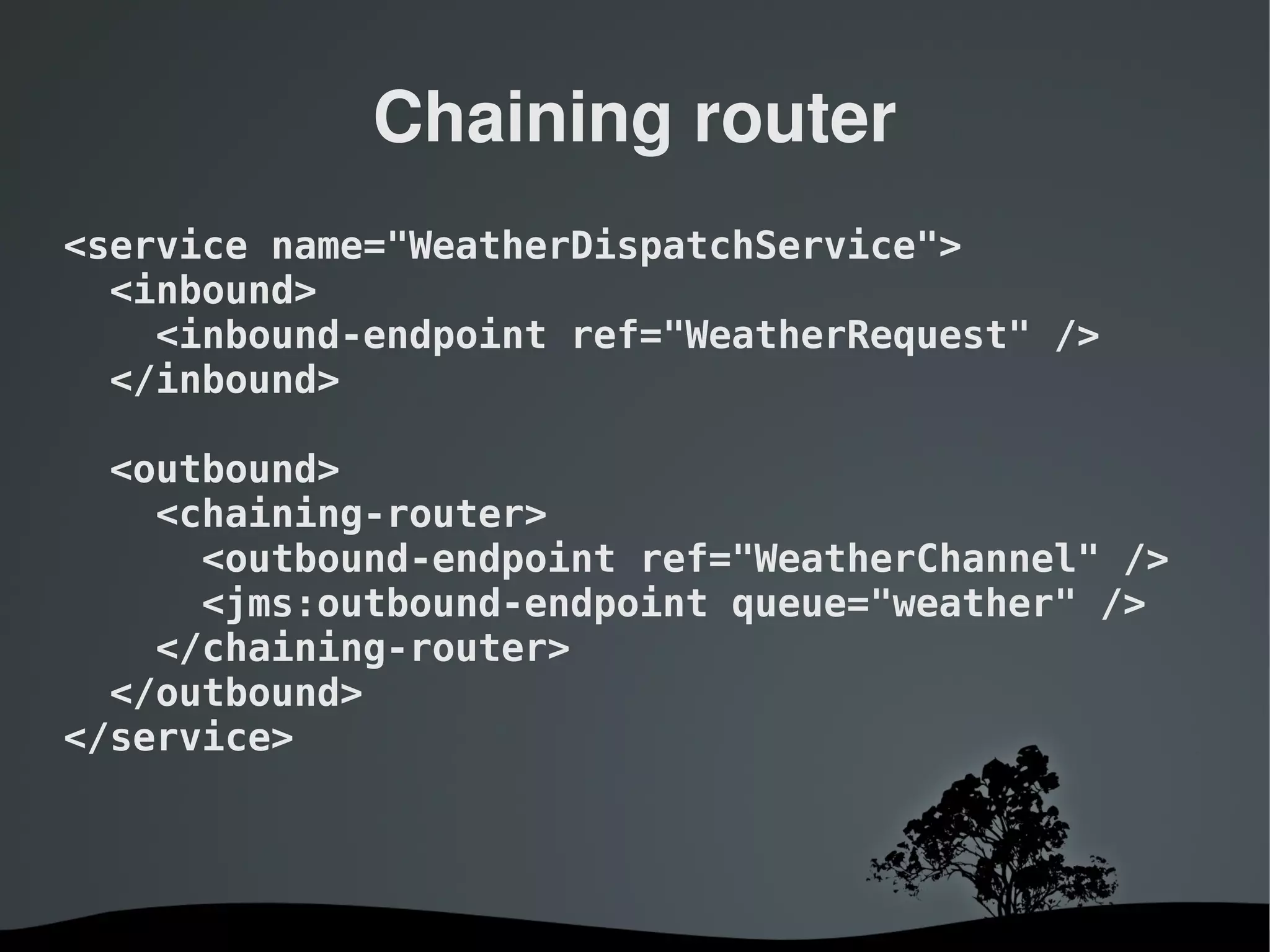
Chaining router
<service name="WeatherDispatchService">
  <inbound>
    <inbound-endpoint ref="WeatherRequest" />
  </inbound>

  <outbound>
    <chaining-router>
      <outbound-endpoint ref="WeatherChannel" />
      <jms:outbound-endpoint queue="weather" />
    </chaining-router>
  </outbound>
</service>


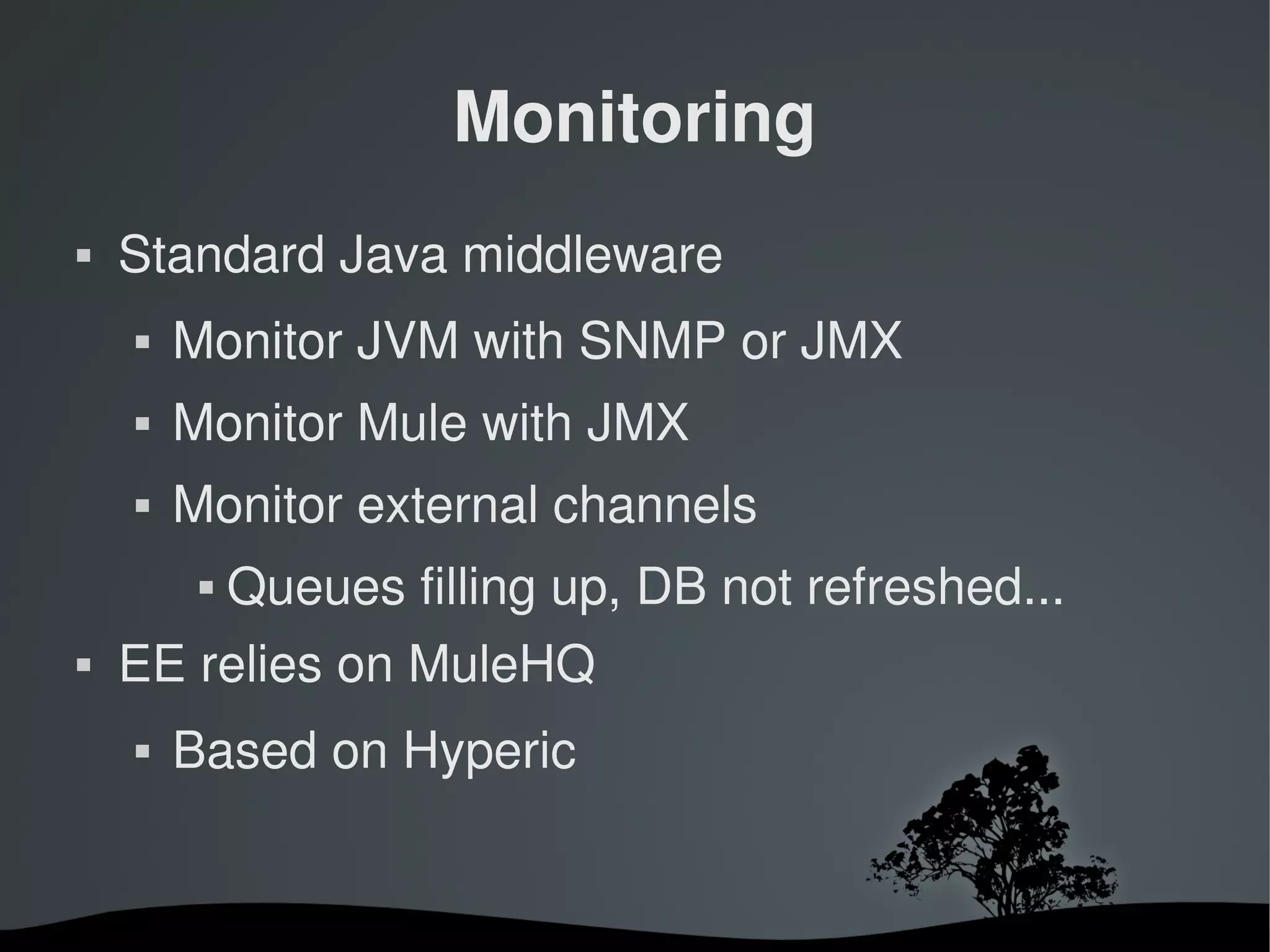
Monitoring
   Standard Java middleware
       Monitor JVM with SNMP or JMX
       Monitor Mule with JMX
       Monitor external channels
                Queues filling up, DB not refreshed...
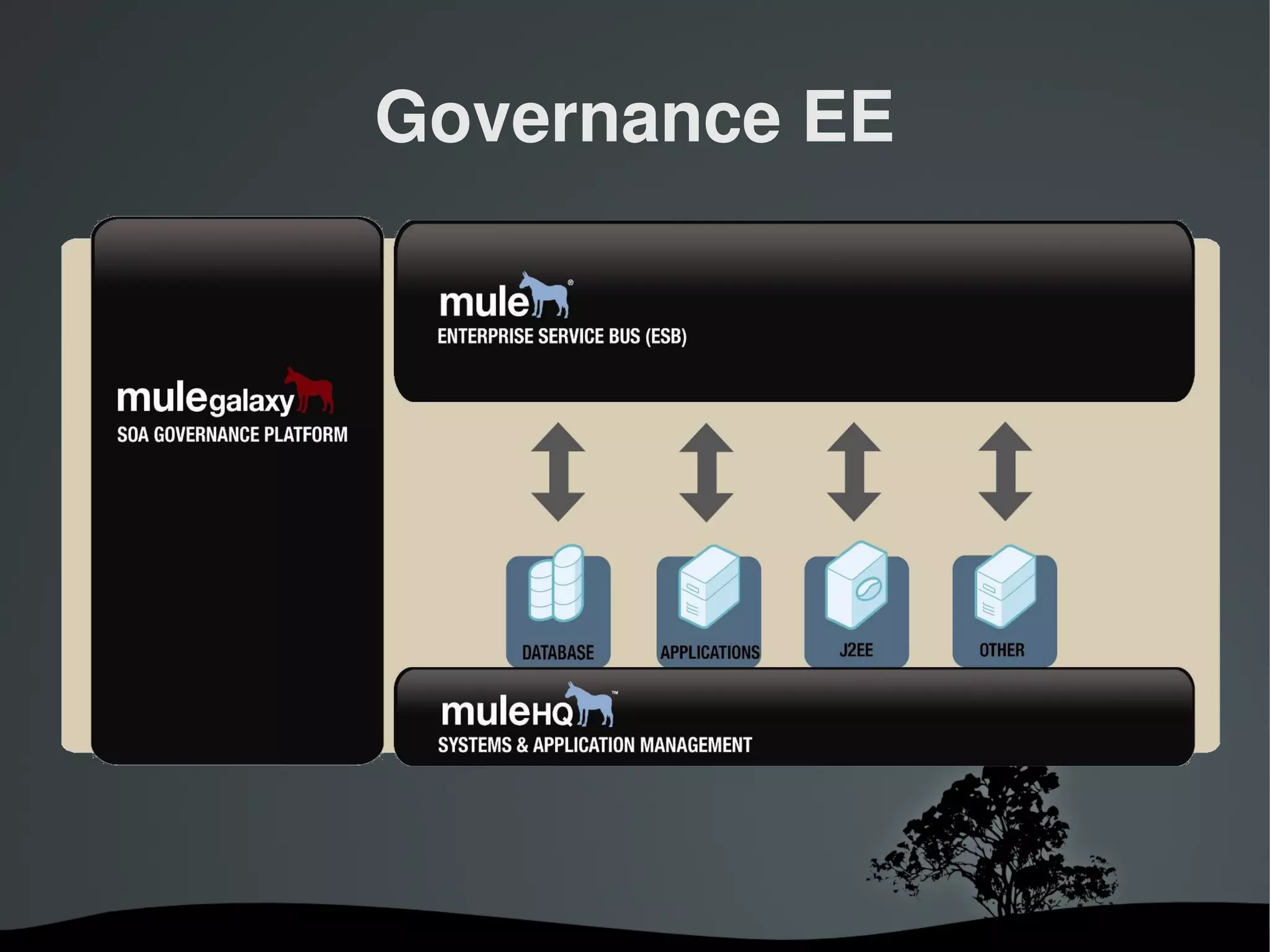
   EE relies on MuleHQ
       Based on Hyperic


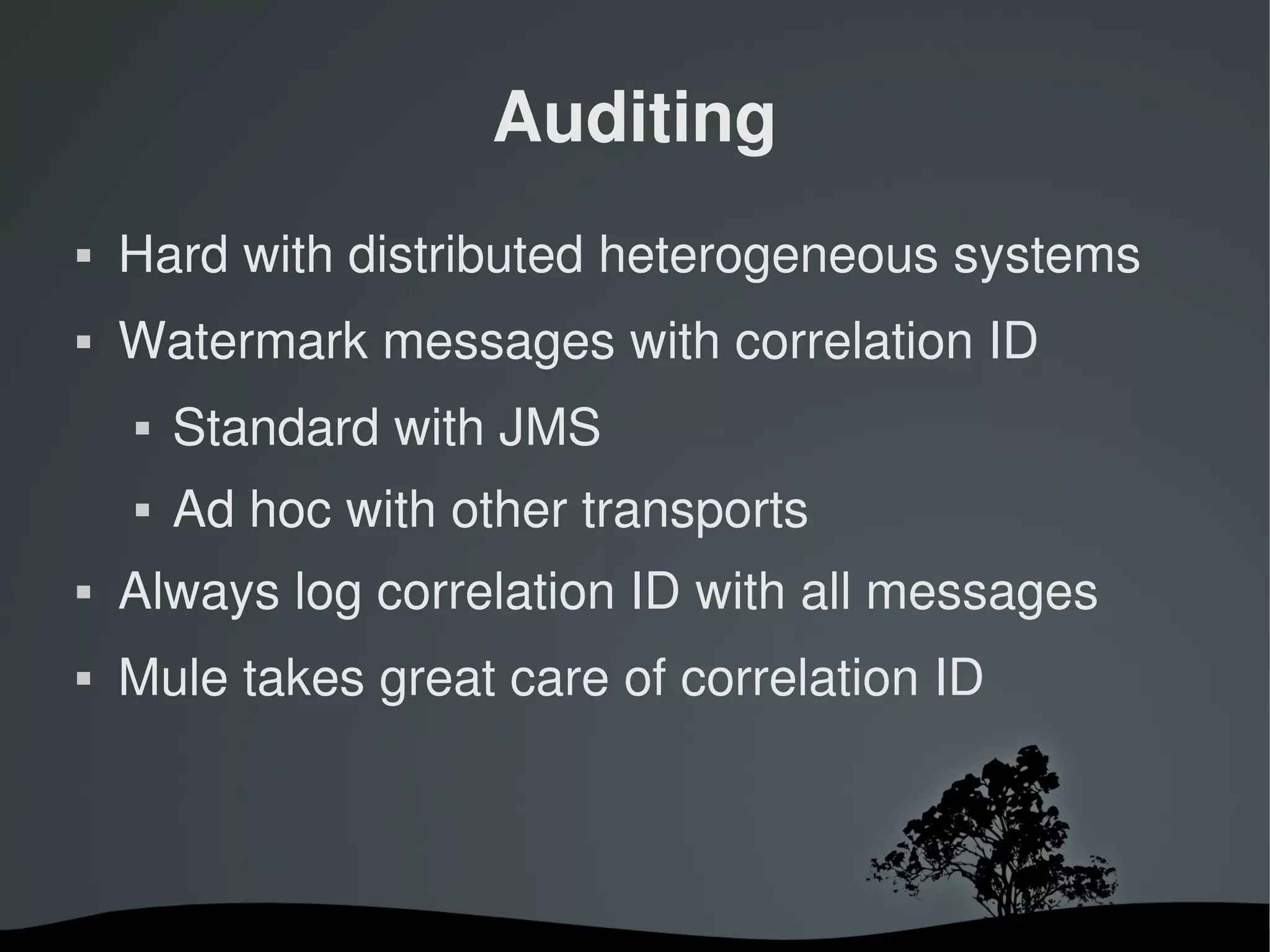
Auditing
   Hard with distributed heterogeneous systems
   Watermark messages with correlation ID
       Standard with JMS
       Ad hoc with other transports
   Always log correlation ID with all messages
   Mule takes great care of correlation ID


High availability
   Easily achieved with stateless instances
       Redundancy & network load balancer
   Clustering needed with stateful instances
       EE will offer GigaSpaces
       Terracotta
       DB, in some cases
                ID store for idempotent receiver


Mythical hot reload
   Everybody wants it
       Really?
   Mule configuration can be hot reloaded
       Since 2.2.2
   Mule libraries are OSGi bundles
       But Mule is not (yet) running on OSGi


Governance
   Publicly exposed services are commitments
   Required by compliance rules
   Galaxy
       Repository and registry
       Versioning
       Backwards compatibility check
       Galaxy EE is HA


Governance EE


Performance


Performance I
   Beware benchmarks
   SEDA is tricky to tune
       Many thread pools
                Some not directly handled by Mule
   Threading 
       Configured with profiles
       Affected by transactions, synchrony
       Follow MuleSource's methodology
                             
Performance II
   Consider streaming
       Smooks for efficient processing
   Tune the transports
       HTTP chunking, JMS acking...
   Profile first!
       YourKit Profiler Pack


The big picture


To ESB or not? I
   ESB in the middle of all service calls
       Looks good on slides
       But a big mess inside
   Remember Jim Webber
       “Guerilla SOA”
       ESB == “Egregious Spaghetti Boxes”


                                             http://bit.ly/g­soa
To ESB or not? II
   “A good ESB is a dead ESB”?
       Decision points: http://bit.ly/to­esb­or­not
   “MuleSource is Open for Integration.”
       Don't get confused on branding/naming
   ESB is a topology not a tool
       There are others...


Topology
   ESB
         JMS backbone
   ESN
         Direct service to service
   Hub & Spoke
         Centralized broker
   Client / Server
   ...
                          
Methodology
   None officially preached by MuleSource
       But lots of experience with many clients
   Fits with the one in­house
       Nespresso Open Architecture (NesOA)
   Read MuleSource's articles
       To get the gist of their approach
       Pragmatism first!


Bottom­up SOA
  ” I’ve seen firsthand that the more successful
  enterprises that have adopted SOA have done so
  at the grassroots level.

  (...) Certainly many of our customers choose Mule
  not on a strategic initiative, but because they have
  pockets of successful implementations and decide
  to work with us to help pull the pieces together.”


http://bit.ly/bup­soa
                                              Ross Mason
Time to hit it!


Getting started
   www.mulesource.org
       Download CE, browser user guide
   www.mulesource.com
       Professional support
   http://code.google.com/p/muleinaction/
       Mule in Action source code


Going further
   Submit bug reports
   Improve the on­line documentation
   Contribute transports, modules, examples
       MuleForge
   Blog about your Mule adventure
       Let MuleSource know


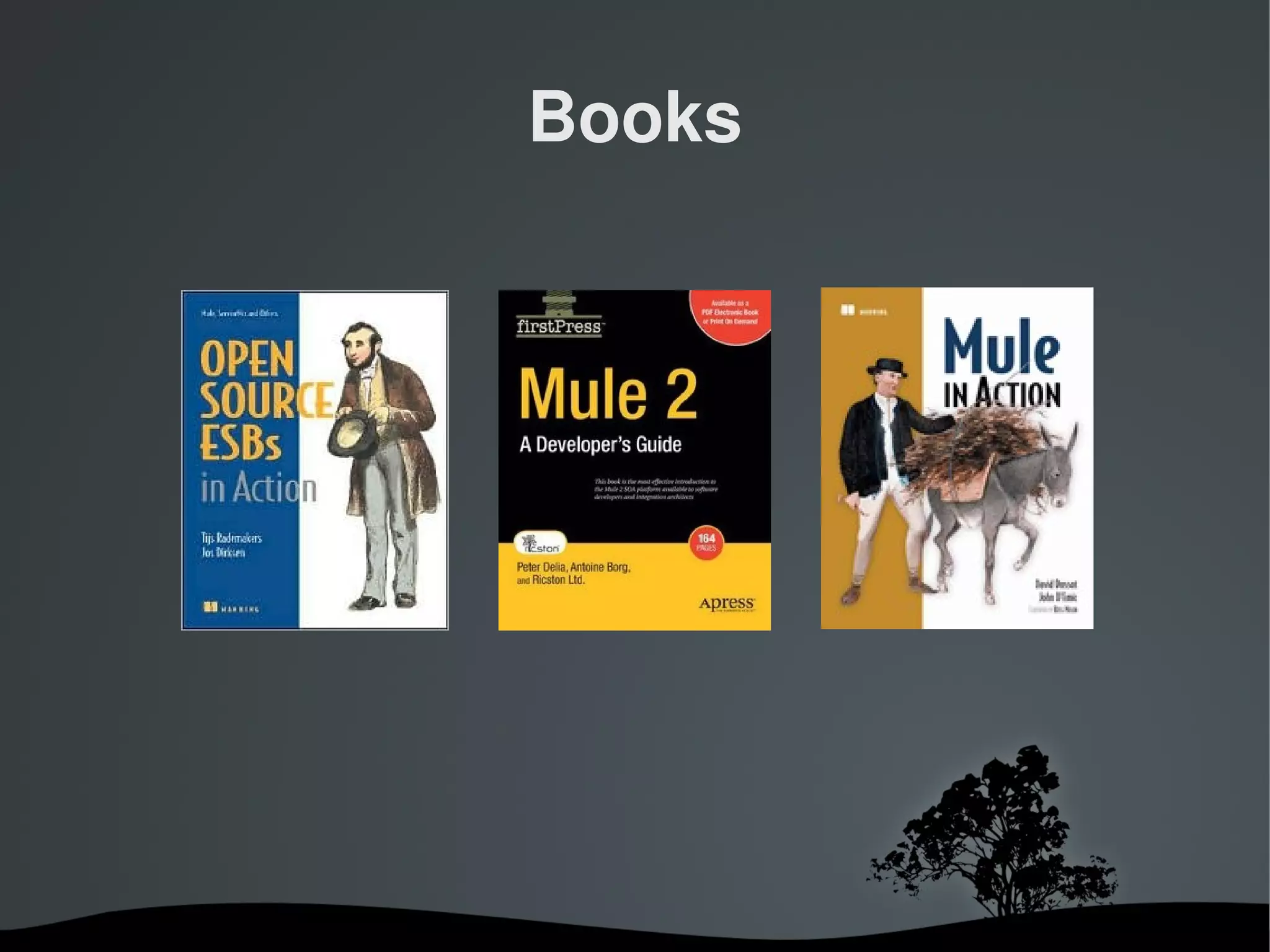
Books


Thank you!
   VIJUG
   Manning Publications
   VIJUG's sponsors

   ... and you!


Questions?


    david@muleinaction.com

    http://muleinaction.com

       http://dossot.net


A Workhorse Named Mule

  • 1.
  • 2.
    The speaker  Mule in Action, co­author  Project despot of Mule JCR Transport  Common Retry Policies  HTML Dashboard  Mule Community Committee Member  Lead of NxBRE  Judge for the Jolt Awards  And a few other stuff...    
  • 3.
    Non­agenda  eMule  Mule pre 2.2.0, EE  Tutorial  Works on my machine  Alternative configurations    
  • 4.
    Agenda  Introduction  Exploration  Construction  In Action    
  • 5.
  • 6.
  • 7.
    What? No ESB? No SOA?  ESB is a deployment topology  Mule can be deployed as ESB  But also: ESN, Hub and spoke...  SOA can leverage an ESB  Just an extra tool in a tool box  Mule has no dogma nor methodology  More on this later...    
  • 8.
    And what about Java?  Written in Java  Leverages zillions of Java open source  libraries  Can do a lot without Java though  XML and Groovy can go a long way    
  • 9.
    Genesis  Founded by Ross Mason  SourceForge project created in April 2003  Version 1.0 in April 2005  Moved to CodeHaus  Architecture based on:  EIP  SEDA    
  • 10.
    EIP  Enterprise Integration Patterns  Hohpe & Woolf (2004)  Gave Mule its lingo  Endpoints, Transformers...  Routers, Bridge...  Gives us patterns & iconography   http://www.enterpriseintegrationpatterns.com  
  • 11.
    SEDA  Staged Event­Driven Architecture  Welsh (2001)  Disciplined approach to overload management  Event­driven application  Stages connected by queues  Graceful degradation under load  By default Mule is asynchronous and SEDA    
  • 12.
    What's in a name? ”After  working  on a  couple  of  bespoke  ESB  systems,  I  found  that  there  was  a  lot  of  infrastructure  work  to  be  done  before  you  can  really start thinking about implementing any logic.  I regard this infrastructure work as 'donkey work' as  it  needs  doing  for  every  project.  I  preferred  Mule over Donkey and Ass just didn't seem right. A  Mule  is  also  commonly  referred  to  as  a  carrier  of load, moving it form one place to another. The  load  we  specialise  in  moving  is  your  enterprise  information.”     Ross Mason
  • 13.
    Donkey work Integration App 1 Broker App 2 App 3    
  • 14.
    Mule work Adaptation, Transformation & Routing App 1 Mule App 2 App 3    
  • 15.
  • 16.
  • 17.
    Lightweight messaging  framework Mule Your Application    
  • 18.
  • 19.
    Dual competition  Integration  frameworks  Camel ✔ Strictly EIP  Spring Integration ✔ DI oriented  ESBs  Apache, WSO2,  ✔ Web service  OW, JBoss oriented  Big vendors ✔ Tooling ✔ Doodleware    
  • 20.
    Dual offer  Community Edition  Stable “enough”  Upgrades can be rocky  Enterprise Edition  Supported, stabler  Enterprise features  MQSeries connectors, retry policies  Monitoring tool (MuleHQ)    
  • 21.
    Key benefits I  Proven product  Used in many world­class applications  Sound architecture  Drastically refined in Mule 2  Numerous protocols and extensions  From MuleSource and MuleForge  Spring & Maven oriented    
  • 22.
    Key benefits II  Good tooling  Mule IDE  Galaxy  Active community  Support, MuleForge  Shared code base CE / EE  Professional support available    
  • 23.
    Main drawbacks  Unified messaging abstraction  Acts as a potential keyhole on the real deal  Brings its own idiosyncrasies  Like any framework...  Standards based but not standards compliant  But what standards? JBI? SCA?  Not fully EIP but uses much of its lingo    
  • 24.
  • 25.
    ”A messaging framework”  Mule is about abstraction and adaptation  Message  Protocol  As a framework  You can code to it  Wisely  You can extend almost every aspect of it  Wisely    
  • 26.
    Message abstraction MuleMessage Payload Properties Attachment Exception    
  • 27.
    Message abstraction  Payload  HTTP body, File content  Properties  HTTP Headers, JMS properties  Attachments  SOAP parts, Email parts  Exception  Related to the current message processing    
  • 28.
    Protocol abstraction  Handled by ”transports”  Connectors and endpoints  Message adapters and transformers  Inbound interactions  Receive (event)  Request (polling)  Outbound interactions  Send (request/response)  Dispatch (asynchronous)    
  • 29.
    Protocol adaptation  At connector level  Handles interactions   At message level  Message adaptation  Raw data access  Specific additional transformation  e.g. Object ↔ JMS Message transformers    
  • 30.
    Protocol adaptation Inbound Protocol Adaptation Mule Transformation Mule Specific Message Message    
  • 31.
    Protocol adaptation Outbound Mule Transformation Mule Adaptation Protocol Message Message Specific    
  • 32.
    Unified payloads?  File transport  Stream  java.io.File  JMS transport  Map, String...  IMAP transport  String    
  • 33.
    xmlns:context="http://www.springframework.org/schema/context" xmlns:file="http://www.mulesource.org/schema/mule/file/2.2" xmlns:jms="http://www.mulesource.org/schema/mule/jms/2.2" xmlns:xm="http://www.mulesource.org/schema/mule/xml/2.2" xsi:schemaLocation=" http://www.springframework.org/schema/beans http://www.springframework.org/schema/beans/spring-beans-2.5.xsd http://www.springframework.org/schema/context http://www.springframework.org/schema/context/ spring-context-2.5.xsd http://www.mulesource.org/schema/mule/core/2.2 http://www.mulesource.org/schema/mule/core/2.2/mule.xsd http://www.mulesource.org/schema/mule/file/2.2 http://www.mulesource.org/schema/mule/file/2.2/mule-file.xsd http://www.mulesource.org/schema/mule/jms/2.2 http://www.mulesource.org/schema/mule/jms/2.2/ mule-jms.xsd http://www.mulesource.org/schema/mule/xml/2.2 http://www.mulesource.org/schema/mule/xml/2.2/ mule-xml.xsd" > <notifications dynamic="true"> Need help! <notification event="ENDPOINT-MESSAGE"/> </notifications> <global-property name="jms.url" value="vm://localhost"/> <jms:activemq-connector name="jmsConnector" specification="1.1" brokerURL="${jms.url}"/> <file:connector name="FileConnector" streaming="false" autoDelete="true" pollingFrequency="1000"> <file:expression-filename-parser/> </file:connector> <model name="jmsInboundModel"> <service name="jmsInboundService"> <inbound> <jms:inbound-endpoint topic="backup-reports" > <transformers> <jms:jmsmessage-to-object-transformer/> </transformers> </jms:inbound-endpoint>   </inbound>  
  • 34.
  • 35.
    Mule's anatomy Service Service Mule Service Service    
  • 36.
    Mule service  Wider definition than strict SOA  Both inbound and outbound are considered  Service can have business logic or not  Message routing is done by services  Role defined by messaging style  Four main styles    
  • 37.
    Request Response Request Client Service Response    
  • 38.
    Asynchronous Dispatch Client Service    
  • 39.
    Synchronous Request Request Client Service Service Response Response    
  • 40.
    Async Request Response Request Dispatch Client Service Service Response Response    
  • 41.
    Combined styles Request Dispatch Client Service Service Response    
  • 42.
    Other inbound styles Listen Source Service Poll Source Service Request Source Service    
  • 43.
  • 44.
    Mule's service anatomy Inbound Outbound Routing Component Routing Response    
  • 45.
    Mule's service routing anatomy Inbound Outbound Transformers Transformers Endpoints Endpoints Router Router Component Response    
  • 46.
    Endpoints  Communication ”touch points”  Configured  Locally in services  Inbound and outbound  Globally  Named  “Unbound”  Used locally in or out    
  • 47.
    Endpoints  Inbound <jms:inbound-endpoint topic="events" />  Outbound <file:outbound-endpoint path="./events" />  Global <jms:endpoint name="events.in" topic="events" /> ... <inbound-endpoint ref="events.in" />    
  • 48.
    Endpoints URI  Two equivalent endpoints: <jms:inbound-endpoint topic="events" /> <inbound-endpoint address="jms://topic/events" />  Prefer rich XML schema style  Generic style exists for extensibility  In code, URI style prevails    
  • 49.
    Routers  Routing behavior for endpoints  Smart “switching” and filtering  Aggregation, multicasting...  Configured locally in services  Different families  Inbound  Outbound  Async­reply    
  • 50.
    Routers <inbound> <jms:inbound-endpointtopic="events" /> <jdbc:inbound-endpoint queryKey="eventsQuery"/> </inbound> <outbound> <multicasting-router> <jms:outbound-endpoint topic="events"/> <file:outbound-endpoint path="./events" /> </multicasting-router> <outbound>    
  • 51.
    Transformers  Message payload  Generic  Bytes to string, compression, XSLT...  Transport  JMS to object, String to email...  Message properties  CRUD  Round trip alter egos    
  • 52.
    Transformers  Configured  Locally on endpoints  In / response and out  Globally  Named  Used locally in or response  Sometimes invisible (transport)  Can be composed  Rolling your own is rare    
  • 53.
    Transformers <xm:xslt-transformer name="DocbookToFO" xsl-file="docbook-fo.xsl" /> ... <inbound-endpoint ref="docs.in.sync" > <transformers> <gzip-uncompress-transformer /> <transformer ref="DocbookToFO" /> </transformers> <response-transformers> <gzip-compress-transformer /> </response-transformers> </inbound-endpoint>    
  • 54.
    Components  Messaging behavior  Bridge, Log  Reflection message builder  Remote service proxy  Business behavior  Instantiation by Mule or Spring  Pure POJO or Mule aware  Can be pooled    
  • 55.
    Components <log-component /> <test:component/> <component> <singleton-object class="com.acme.Component" /> </component> <component> <spring-object bean="yourBean" /> </component> <pooled-component class="com.acme.Component" />    
  • 56.
    http://www.springframework.org/schema/beans/spring-beans-2.5.xsd http://www.springframework.org/schema/context http://www.springframework.org/schema/context/ spring-context-2.5.xsd http://www.mulesource.org/schema/mule/core/2.2 http://www.mulesource.org/schema/mule/core/2.2/mule.xsd http://www.mulesource.org/schema/mule/file/2.2 http://www.mulesource.org/schema/mule/file/2.2/mule-file.xsd http://www.mulesource.org/schema/mule/jms/2.2 http://www.mulesource.org/schema/mule/jms/2.2/ mule-jms.xsd http://www.mulesource.org/schema/mule/xml/2.2 http://www.mulesource.org/schema/mule/xml/2.2/ mule-xml.xsd" > <notifications dynamic="true"> <notification event="ENDPOINT-MESSAGE"/> </notifications> Pwned! <global-property name="jms.url" value="vm://localhost"/> <jms:activemq-connector name="jmsConnector" specification="1.1" brokerURL="${jms.url}"/> <file:connector name="FileConnector" streaming="false" autoDelete="true" pollingFrequency="1000"> <file:expression-filename-parser/> </file:connector> <model name="jmsInboundModel"> <service name="jmsInboundService"> <inbound> <jms:inbound-endpoint topic="backup-reports" > <transformers> <jms:jmsmessage-to-object-transformer/> </transformers> </jms:inbound-endpoint> </inbound> <outbound> <pass-through-router> <file:outbound-endpoint path="./data/reports" outputPattern="BACKUP-REPORT-#[function:dateStamp]"/>   </pass-through-router>  
  • 57.
    Service configuration <service name="eventsWriter"> <inbound> <jms:inbound-endpoint topic="events" /> </inbound> <outbound> <pass-through-router> <file:outbound-endpoint path="./events" /> </pass-through-router> </outbound> </service>    
  • 58.
    Service configuration <service name="eventsWriter"> <inbound> <jms:inbound-endpoint topic="events" /> </inbound> <bridge-component /> <outbound> <pass-through-router> <file:outbound-endpoint path="./events" /> </pass-through-router> </outbound> </service>    
  • 59.
    Anything else?  Connectors  Transport specific configuration  Model  Shared configuration & behavior for services  Interceptors  To add cross­cutting concerns around  components    
  • 60.
  • 61.
    The mysterious Mule client  Why a client?  In­memory access to an instance  Message generation  Functional testing  Remote access to an instance  Proprietary remote invoker  Raw transport usage    
  • 62.
    Mule client interactions (some)  Dispatch muleClient.dispatch("jms://queue", map, null);  Send MuleMessage response = muleClient.send("vm://channel", payload, props);  Request MuleMessage requested = muleClient.request("file://events/01.dat", 0);    
  • 63.
  • 64.
    What do we build?  Standalone  Embedded  Project structure  Java application  NetBoot  Web application  Repository artifacts  EJB application  JCA resource    
  • 65.
    Just ship it!  A Mule project is just a bunch of XML files  Tinker with them a little  Ship them to production  And you are good to go!  Right?    
  • 66.
       
  • 67.
    No escape from SD laws!  Practices  Middleware development  TDD  Repeatable builds  Repeatable deployments  Tools  SCM  Continuous integration    
  • 68.
    Middleware development  practices  Do not get coupled with the middleware  Contain Mule related code to Mule aware  classes  Transformers, interceptors  Caching  Time­outs  Efficient logging and manageability    
  • 69.
    Unit Testing  For components, transformers...  Outside of Mule  xUnit    
  • 70.
    Functional Testing  For routing, configuration...  Test­scoped instance  Mule client  Test component  Substitution endpoints  In­memory infrastructure  Jitr    
  • 71.
    Integration Testing  For Mule instance in situation  Complex because heterogeneous  Test messages  Test services  Secondary endpoints  soapUI, HermesJMS  Test Driven EAI  Hohpe & Istvanik (2002)     http://bit.ly/tdeai
  • 72.
    Other Testing  Load tests  Use JMeter  Profiling  Use the YourKit Profiler Pack    
  • 73.
  • 74.
    Asynchronous testing (lucky) Test Thread Mule Thread Start Mule Send test message Process message Perform assertions Stop Mule    
  • 75.
    Asynchronous testing Test Thread Mule Thread Start Mule Send test message Perform assertions Process message Stop Mule    
  • 76.
    Asynchronous testing Fixed Test Thread Mule Thread Start Mule Send test message Process message Await latch (n) Latch down Perform assertions Stop Mule     http://bit.ly/tasync
  • 77.
  • 78.
    Unleashing Mule I  Generic knowledge  Maven  Spring    
  • 79.
    Maven  Mule is available as a set of artifacts  Core, transports, modules  With petazillions of dependencies  Distribution packs them all  Specific archetypes  New project  New transport  Galaxy publication    
  • 80.
    Spring  Code is independent from Spring  Configuration is fully Spring XML  With specific schemas  Use Spring configuration practices  DI, properties, multiple files...  Use Spring goodness  Specific elements,  MBean exporter...  Mule's context can use a Spring parent  Bean reuse    
  • 81.
    Unleashing Mule II  Specific knowledge  VM Transport  Transport configuration  Expressions  Scripting  Entry point resolvers  Notifications    
  • 82.
    VM Transport  In­memory named pipe  Direct or queuing  Can be disk persistent  What you can not solve with one service  You solve it with two services  And a VM Queue in between!    
  • 83.
    Transport configuration  Know the underlying transport  Understand what Mule hides & controls  Learn the configuration options  Including alternative adapters, transformers  Leverage the transport­specific properties  Inbound and outbound  Read the source code    
  • 84.
    Expressions  Dynamic properties in configuration  #[evaluator:expression]  Filters, transformers, endpoint URIs  Usually evaluated on the current message  Standalone and Mule­wide evaluators exist  Many evaluators available  Groovy, XPath, Map Payload, OGNL...  Can also be invoked from code    
  • 85.
    <message-properties-transformer name="SetTo"> <add-message-property key="toAddresses" value="#[xpath:/Receipts/SendToEmail]" /> </message-properties-transformer> ... <smtp:outbound-endpoint host="${smtp.host}" port="${smtp.port}" from="${smtp.fromAddress}" subject="${smtp.subject}" transformer-refs="SetTo StringToEmailMessage" />    
  • 86.
    Scripting  Any JSR­223 engine  Groovy bundled with the scripting module  Rhino bundled with JDK 1.6  Transformers, components, expressions  Good for non­generic ones  Concise syntax (i.e. non­Java)  Inlined or standalone scripts  Spring Scripted Beans are also an option    
  • 87.
    <scripting:transformer name="toUpperCase"> <scripting:script engine="groovy"> return payload.toUpperCase() </scripting:script> </scripting:transformer> <scripting:component> <scripting:script engine="js"> if (payload.search("STATUS: CRITICAL") != -1) { message.setProperty("PRIORITY", 'HIGH') } return message </scripting:script> </scripting:component> <expression-filter evaluator="groovy" expression="message.payloadAsBytes.length>1024" />    
  • 88.
    Entry point resolvers  Secret behind Mule­free components  Locate the method to call  Several resolvers available  Reflection, array, no argument, method name  By default, Mule uses a set of resolvers  Add a transformation in front to better resolve  By type or directly by name    
  • 89.
    Notifications  Internal notification framework  Extreme diversity of events  Mule lifecycle, routing, errors, time­outs...  Standard consumers  JMX, Log4J, publish to endpoint  Custom consumers  Components, interceptors...    
  • 90.
  • 91.
  • 92.
    The tough questions  SOAP or REST?  Monitoring  Transactions  Auditing  Exception handling  High availability  Security  Hot reload  Scheduling  Governance  Orchestration  Performance    
  • 93.
    SOAP or REST?  SOAP transports  REST transports  CXF  Abdera  Axis  Jersey  Restlet    
  • 94.
    Transactions  Supported by a handful of transports  VM, JDBC, JMS  Mostly useful for bridging  Like Queue to Topic  Consider eventual consistency  Conversation based  Idempotent services  Compensation    
  • 95.
    Exception handling  Exceptions are handled at several levels  Connector and service  Retry policies  Different strategies  Logging, dispatch to endpoint  Transaction roll­back  Exception based outbound router  Localized error handling via fallback    
  • 96.
    Security  Secure endpoints  Authentication and authorization  Secure payload  Encryption  Security manager  Can delegate to Spring Security  Can use JAAS  Transport security handled at connector level    
  • 97.
    Scheduling  Based on Quartz  In inbound router  To regularly send a fix payload  To request an endpoint (polling)  In outbound router   To schedule a delayed dispatch    
  • 98.
    Orchestration  Trivial, short lived  Message flow is the orchestration  Component binding, chaining router  Complex, long lived  Messages trigger worflow steps  jBPM (native)  Orchestrator triggers services  ActiveBPEL (via WS)    
  • 99.
    Chaining router <service name="WeatherDispatchService"> <inbound> <inbound-endpoint ref="WeatherRequest" /> </inbound> <outbound> <chaining-router> <outbound-endpoint ref="WeatherChannel" /> <jms:outbound-endpoint queue="weather" /> </chaining-router> </outbound> </service>    
  • 100.
    Monitoring  Standard Java middleware  Monitor JVM with SNMP or JMX  Monitor Mule with JMX  Monitor external channels  Queues filling up, DB not refreshed...  EE relies on MuleHQ  Based on Hyperic    
  • 101.
    Auditing  Hard with distributed heterogeneous systems  Watermark messages with correlation ID  Standard with JMS  Ad hoc with other transports  Always log correlation ID with all messages  Mule takes great care of correlation ID    
  • 102.
    High availability  Easily achieved with stateless instances  Redundancy & network load balancer  Clustering needed with stateful instances  EE will offer GigaSpaces  Terracotta  DB, in some cases  ID store for idempotent receiver    
  • 103.
    Mythical hot reload  Everybody wants it  Really?  Mule configuration can be hot reloaded  Since 2.2.2  Mule libraries are OSGi bundles  But Mule is not (yet) running on OSGi    
  • 104.
    Governance  Publicly exposed services are commitments  Required by compliance rules  Galaxy  Repository and registry  Versioning  Backwards compatibility check  Galaxy EE is HA    
  • 105.
  • 106.
  • 107.
    Performance I  Beware benchmarks  SEDA is tricky to tune  Many thread pools  Some not directly handled by Mule  Threading   Configured with profiles  Affected by transactions, synchrony  Follow MuleSource's methodology    
  • 108.
    Performance II  Consider streaming  Smooks for efficient processing  Tune the transports  HTTP chunking, JMS acking...  Profile first!  YourKit Profiler Pack    
  • 109.
  • 110.
       
  • 111.
    To ESB or not? I  ESB in the middle of all service calls  Looks good on slides  But a big mess inside  Remember Jim Webber  “Guerilla SOA”  ESB == “Egregious Spaghetti Boxes”     http://bit.ly/g­soa
  • 112.
    To ESB or not? II  “A good ESB is a dead ESB”?  Decision points: http://bit.ly/to­esb­or­not  “MuleSource is Open for Integration.”  Don't get confused on branding/naming  ESB is a topology not a tool  There are others...    
  • 113.
    Topology  ESB  JMS backbone  ESN  Direct service to service  Hub & Spoke  Centralized broker  Client / Server  ...    
  • 114.
    Methodology  None officially preached by MuleSource  But lots of experience with many clients  Fits with the one in­house  Nespresso Open Architecture (NesOA)  Read MuleSource's articles  To get the gist of their approach  Pragmatism first!    
  • 115.
    Bottom­up SOA ” I’ve seen firsthand that the more successful enterprises that have adopted SOA have done so at the grassroots level. (...) Certainly many of our customers choose Mule not on a strategic initiative, but because they have pockets of successful implementations and decide to work with us to help pull the pieces together.” http://bit.ly/bup­soa     Ross Mason
  • 116.
  • 117.
    Getting started  www.mulesource.org  Download CE, browser user guide  www.mulesource.com  Professional support  http://code.google.com/p/muleinaction/  Mule in Action source code    
  • 118.
    Going further  Submit bug reports  Improve the on­line documentation  Contribute transports, modules, examples  MuleForge  Blog about your Mule adventure  Let MuleSource know    
  • 119.
  • 120.
    Thank you!  VIJUG  Manning Publications  VIJUG's sponsors  ... and you!    
  • 121.
    Questions? david@muleinaction.com http://muleinaction.com http://dossot.net