A Students Guide To Python For Physical Modeling 2nd Edition Jesse M Kinder
A Students Guide To Python For Physical Modeling 2nd Edition Jesse M Kinder
A Students Guide To Python For Physical Modeling 2nd Edition Jesse M Kinder
A Students Guide To Python For Physical Modeling 2nd Edition Jesse M Kinder
A Students Guide To Python For Physical Modeling 2nd Edition Jesse M Kinder
1.
A Students GuideTo Python For Physical Modeling
2nd Edition Jesse M Kinder download
https://ebookbell.com/product/a-students-guide-to-python-for-
physical-modeling-2nd-edition-jesse-m-kinder-47733628
Explore and download more ebooks at ebookbell.com
2.
Here are somerecommended products that we believe you will be
interested in. You can click the link to download.
A Students Guide To Python For Physical Modeling Jesse M Kinder Philip
Nelson
https://ebookbell.com/product/a-students-guide-to-python-for-physical-
modeling-jesse-m-kinder-philip-nelson-34756504
A Students Guide To Python For Physical Modeling Jesse M Kinder Philip
Nelson
https://ebookbell.com/product/a-students-guide-to-python-for-physical-
modeling-jesse-m-kinder-philip-nelson-43190130
A Students Guide To Python For Physical Modeling Jesse M Kinder
https://ebookbell.com/product/a-students-guide-to-python-for-physical-
modeling-jesse-m-kinder-5231358
A Students Guide To Python For Physical Modeling Second Edition School
Jesse M Kinder
https://ebookbell.com/product/a-students-guide-to-python-for-physical-
modeling-second-edition-school-jesse-m-kinder-44621830
3.
A Students GuideTo Atomic Physics Mark Fox
https://ebookbell.com/product/a-students-guide-to-atomic-physics-mark-
fox-45107878
A Students Guide To Infinite Series And Sequences Bernhard W Bach Jr
https://ebookbell.com/product/a-students-guide-to-infinite-series-and-
sequences-bernhard-w-bach-jr-45107880
A Students Guide To Laplace Transforms Daniel Fleisch
https://ebookbell.com/product/a-students-guide-to-laplace-transforms-
daniel-fleisch-45107884
A Students Guide To Special Relativity Norman Gray
https://ebookbell.com/product/a-students-guide-to-special-relativity-
norman-gray-45107886
A Students Guide To Bayesian Statistics 1st Edition Ben Lambert
https://ebookbell.com/product/a-students-guide-to-bayesian-
statistics-1st-edition-ben-lambert-46707332
45
experience is anatural resource, which can and should be mined for
the present and future benefit of mankind. Save possibly in the area
of science, human society has never come near to efficiently
exploiting this resource of its own experience.
When it is mined, this natural resource can make its principal
contribution to social memory by enriching wisdom. We have a
tendency to speak of the “lessons” of history, as though they were
immutable—I do this as much as anyone—but I realize that in a
literal sense this is impossible. One can never recreate, in every
detail and particular, the exact circumstances of a past event. History
can never exactly repeat itself, and so its so-called lessons cannot be
applied blindly or automatically.
But if history doesn’t repeat itself it does, in the words of Herman
Kahn, paraphrase itself. Kahn, incidentally, is a scientist and not a
historian, but he, like Toynbee and other historians, recognizes that
human and institutional relationships in modern times can often bear
a close resemblance to events of the past. One can discern many
parallel patterns in history, and both trends and specific events are
often directly comparable between these patterns. The rise and fall
of nations and dynasties, for instance. And since human reactions to
circumstances and stimuli are not ever likely to change radically, it is
easy to note danger signals from certain circumstances in related
patterns of events, and to see what kinds of actions have been
successful in certain circumstances in the past, and which have
failed, in similar patterns.
Thus, while rejecting the idea that history teaches us lessons from
the past, I am convinced that history will widen our horizons,
revealing new perspective, providing insights, and generally
enriching wisdom in using good judgment in dealing with the
present. There is still one caution, however. If there is any
immutable lesson which history teaches, it is that no quantity
of insights can ever replace or substitute for good judgement or the
basic intellectual capacity which experience transforms into wisdom.
7.
I have triedto indicate what I think the nature of history is, and in
the process I have given you some very general thoughts about the
use and utility of history. I would like to pursue this question of uses
of history a bit further.
What really do any of us have in mind in speaking of the “Uses of
History?” Is it history for the enrichment of one’s life? For the lessons
(so-called) to be gained from experience? For developing patriotism
or a sense of one’s heritage? For making money?
At this point it might be useful to recall that a number of ancient and
not-so-ancient philosophers have commented on the value and
importance of history. Let me simply refresh your memory on four
that I happen to like:
Polybius: For it is history and history alone, which will mature our
judgment and prepare us to take right views, whatever may be
the crisis or the posture of affairs.
Shakespeare: The past is prologue.
Santayana: Those who cannot remember the past are condemned
to repeat it.
John Gardner: “In the renewing society the historian consults the
past in the service of the present and the future.”
But, like so many philosophical sayings, these aphorisms are
somewhat cryptic. We understand them, but they require some
elaboration, and possibly some interpretation.
Many academic historians would insist that history doesn’t need to
have a use. Its existence is as inevitable as life itself; as last night’s
sunset, this morning’s sunrise. These scholars feel that the study of
the events which make up history is rewarding in itself without any
further direct use. It is a part of the well-educated man or woman.
8.
46
There are otherpeople, of course, who would insist that—save for
the scholars who teach it—history has no more utility than
knowledge of Latin and Greek. Having found no adult use for the
contents of their history textbooks, such people might be pardoned
for feeling that history is merely the useless foible of educators. (I
leave it up to you whether it is appropriate to apply the same logic
to the so-called dead languages.)
Yet, if there is any validity to what I said earlier about history being
the memory of human society—and of individual humans as well—I
suspect that history has had some utility—direct and indirect—to
even the most pragmatic amongst us. Certainly something of what
was taught us in our history courses has entered our memories,
even if subconsciously so. Otherwise we could not have any opinions
about it. It is even more certain that the reader of a daily newspaper
will retain some recollection of what he has read in that paper, and
then will relate these recalled events to what he does, what he
thinks, what he talks about, and what he reads in the next day’s
newspaper. These events, recorded in the newspaper, are as much
history as events which happened in the days of Roman
power, as recorded by Julius Caesar, Livy, and other writers of
those times. Thus the man who reads a daily newspaper, or a weekly
newsmagazine, is making definite use of history—otherwise he
wouldn’t bother to read!
Equally, events which happened to us in our daily work last year, last
week, even today, are as much historical events as things which
occurred centuries ago. These events are experience, and our
recollection of these day to day events are used by all of us in
planning and doing things in subsequent days. Deprived of this
memory, we would be both useless and helpless. The same is true of
society as a whole. Recognizing this, there are economic and social
historians who concentrate their efforts on events of the very recent
past, in order to provide useful inputs to the memories of scholars,
policy makers, and others who are concerned with modern economic
9.
or social affairs.It is beside the point whether or not we believe the
job could be done more systematically.
Even more basically, some of us believe that a sense of history, and
a consciousness of participation in history, is a basic human need.
Now there are, of course, different kinds of basic human needs—
there are the powerful and elemental forces of life and the
preservation and continuation of life; instincts and drives relating to
food, shelter, sex, parenthood and survival. Then there are the other,
more social, needs—as for recreation, privacy, living space, and the
like. It is in this latter category that I would place the need for a
sense of history. Aside from the memory aspect, to which I have
already alluded, there is an enrichment and humanizing effect on
peoples’ lives resulting from a consciousness of making history as
they vote in an election, testify at a local hearing, help create a local
institution, or work at responsible jobs. Essential to this enrichment
is some kind of prior realization of what history is, and how these
personal activities can contribute to it.
What I have been saying so far has all been rather theoretical and
ethereal. I believe it is probably time for me to come down to earth
with some practical uses of history, as I see them, and as I have
personally experienced them.
First let me say a few words about how the use of history can be
directly relevant to Loudoun County. Before going further I should
explain to you that, even though I am not a resident, I am no
stranger to the County or to Leesburg. For about twenty years the
Dupuys have been property-owners in Loudoun County. As my father
used to comment, we are thus modern recruits of the Army of
Northern Virginia. My wife and I even have plans for a house which
we someday expect to build on our property on the banks of Goose
Creek.
So I know something about the county, and something about its
history. Not enough to discuss in any detail with this group—but
10.
47
enough to knowthat it is an appropriate place to settle for one who
(like myself) has forebears who fought on both sides in the Civil War
(a conflict which, as most of you know, my friends, Pat Andrews,
always refers to as the War of Northern Aggression; I won’t bother
you with the details of my many Civil War controversies with Pat; I’ll
simply mention the fact that our principal dispute centers over the
question whether McClellan was a greater detriment to the Union
cause than Braxton Bragg was to that of the Confederacy.)
To return to history and Loudoun County.
A number among you know my father—who is still at heart a recruit
in the Army of Northern Virginia, and who left Loudoun County only
because of pressure on him from those of the family who felt that
his age and health required a less rigorous life and a more accessible
home than conditions permitted in their isolated house on Goose
Creek. While he lived here, he took the time to immerse himself in
Loudoun County History; in fact, he probably should be talking to
you tonight instead of me.
Anyway, I recall his telling me about the old canal locks in front of
his house—long since inundated by the dam built largely on what
used to be their property. These canal lock ruins clearly
demonstrated the relationship of past events to the present—and of
the usefulness of being able to interpret such relevance. Even
submerged, they are mute evidence of a dream of mass
transportation—movement of Loudoun County produce to the
Potomac. This dream was a bubble pricked by the unexpectedly
rapid growth of the railroads. The local railroad, in turn, has given
way to the equally unexpected rapid growth of road transportation,
which has not only brought this rural region into the suburban circle
of the nearby metropolis, but has actually brought about the
appearance within the county of the major metropolitan terminus for
a still newer means of mass transportation—and of course I am
speaking of Dulles Airport.
11.
48
This is onlyone of the many manifestations of the fact that history is
certainly sweeping Loudoun County into the Eastern Seaboard
Megalopolis. This historical fact has great relevance and use to this
county—and I should think poses a challenge to this Historical
Society.
I am sure the county must have some plans for coping with this
historical fact, and I imagine that this Society has probably done
much thinking about its role in these plans. But let me mention
anyhow, at the risk of telling you things you have already thought of,
how I visualize using history for planning purposes in Loudoun
County right now.
I understand that Fairfax County has recently begun to prepare to
identify its historical landmarks. There are several reasons for such
identification, particularly to permit the county to preserve the
essentials of its past history, as embodied in places, objects and
memories, while still participating in present history. I would hope
that Loudoun County has done, or will do, the same, relying upon
this Society for advice and counsel.
I should like to spend the next few minutes in telling you about
some examples of practical use of history by an organization created
for the specific purpose of making use of history.
This is the Historical Evaluation and Research Organization—which
we modestly call HERO. HERO is dedicated to stimulating improved
use of historical experience—as well as improved use of the
professional historians who are most competent to marshal and to
evaluate historical experience—in the development of national
security policy.
Interestingly, and not surprisingly, we have encountered some
skepticism amongst Government officials and others who had some
doubts about the need for or the utility of our principal
function: The application of historical experience to the
12.
development of currentand future national security policy. There
were two principal reasons for the skepticism. First, there are a
number of people who feel that the tremendous technological
advances of our times have totally invalidated any possible relevance
of the past experience which is the stuff of history. Secondly, there
are those who feel that the competent Government specialist has no
need for the services of the historian; he is usually far more
conversant with his field of interest than any academic scholar can
be; he has his files available for documentation; he knows what facts
can be considered relevant, and he will include these in any
statement which may be required of “Facts Bearing on the Problem.”
As to the first of these doubts, as I shall show, we have clearly
demonstrated the relevance of history to current policy issues. For
the second, we believe that the dangers of the concept of “every
man his own historian” are becoming apparent to many Government
officials. The historical background of Government specialists, even
in their own area of specialty, is not only spotty, but their recollection
of historical experience is limited mostly to those examples which
tend to support their own pre-conceived ideas. Furthermore, their
own Governmental documentation is often inadequate in most areas
other than in classified documents. More and more people are
beginning to recognize the ability of the trained historian to bring out
all of the pertinent facts, and to weigh their relative value far more
objectively than is possible for the average person without historical
training.
Thus, HERO is convinced of the utility of our primary mission of
mining the rich natural resource which we think history is, and also
of refining the ore so as to permit history to serve mankind, as
philosophers have always said it should. This has never been done
before, either here or in any other country, to the best of my
knowledge—though, as a historian, I am aware of the danger of
using such absolute terms as “never,” or “the first ever.”
13.
49
Rather than goinginto any generalized explanation of how we go
about mining and refining this resource, I think I can demonstrate
how we do it—and at the same time give concrete examples of some
uses of history—by talking about some of HERO’s past and current
work.
The first study which HERO completed was done for the Sandia
Corporation—a special contracting agency for the Atomic Energy
Commission. The purpose of this study—which we dubbed “Pre-
Alert”—was to ascertain the extent to which historical example and
experience could be useful in the area of military command and
control. The Sandia Corporation had the responsibility for developing
the so-called “black box” to provide foolproof, automatic controls
which will prevent accidental or unauthorized employment of nuclear
weapons systems. Our study was unclassified, so we didn’t get into
the classified details of these foolproof, automatic controls. Our task
was to assess the likelihood that such controls might be so
complicated, or might be so inhibiting to individual initiative, as to
preclude adequate military response in the event of unforeseen
emergency conditions or circumstances.
Sandia had, of course, called upon the psychologists and sociologists
to study this problem but the results of these scientific studies
were not completely satisfactory in synthetic “model”
environments. So we were asked to see if anything could be learned
from historical experience.
After surveying the history of weapon systems, and the sometimes
divergent history of command and control systems, we came to the
conclusion that much could be learned from history about the
human aspects of command and control. We laid out a program for
a detailed investigation of a number of pertinent case studies, and
some general areas for intensive research. We don’t know how
useful our study was to the Sandia Corporation. We do know,
however, that it aroused considerable interest in the Army. And it
proved to us, without question, that our thesis about the relevance
14.
of history tocurrent and future problems was as sound in the
nuclear era, and with respect to nuclear weapon systems, as we had
believed would be the case.
Our next study was for the U. S. Arms Control and Disarmament
Agency. Entitled “Riposte,” the purpose of this study was to survey
historical experience in the field of international treaties, to analyze
this experience, and to point out lessons applicable to current and
future treaty negotiations and treaty enforcement, particularly as this
experience might be relevant to arms control treaties.
For over a year we surveyed and analyzed modern treaty
experience, particularly looking at instances of violations of treaties,
and enforcement measures that were taken, or that could have been
taken, in response to these violations. We gave special attention to
the enforcement (and non-enforcement) of the Treaty of Versailles;
to sanctions and treaty enforcement experience of international
organizations like the League of Nations, the Organization of
American States, and the United Nations; and to the details of
experience in negotiating and enforcing agreements with the
Communists since World War II, such as those dealing with access
rights to Berlin, the Geneva Conferences of 1954 and 1961 on
Southeast Asia, and the Korean Armistice.
We were very pleased with the results of this study, and we
understand that the Arms Control Agency was, also. We
demonstrated how our Government may profit from its own
experience and from that of others in the fields of treaty negotiation
and enforcement.
Perhaps the most significant study we have done to date, and the
one which gives promise of having the greatest impact upon policy
makers, is one which we completed for the Army last fall, entitled
“Historical Trends Related to Weapon Lethality.” The purpose of the
study was to provide useful insights to men who are trying to
develop new doctrines, and new organizations, for the most efficient
15.
50
possible employment ofthe terribly destructive new weapons which
are available to the Army today. In the process we surveyed the
history of weapons development from the Fourth Century B. C. to
the end of the Korean War.
This comprehensive survey provided us with a formidable mass of
data on weapon experience in the history of war. We grouped
related facts according to novel schemes of classification and
analysis, and then tried to ascertain what these groupings meant.
From this we derived a number of most interesting conclusions. Let
me mention a few:
We learned that the mere invention of a new weapon has almost
never affected the course of world events, or altered the
balance of power. The real impact of weapons on events
comes from the assimilation of weapons into an effective military
system. (By assimilation of a weapon we mean its integration into
the nation’s milita organization and doctrine in such a way that it is
employed effectively and confidently, and that its employment
usually results in a relative decrease in the user’s casualties, while
permitting the user to inflict higher casualties on military forces that
have not assimilated it.) One interesting pattern which emerged from
our analysis of assimilation, incidentally, is the fact that it has almost
always, through history, taken at least one full generation, or about
20 years, for a weapon to become assimilated after its first adoption.
This time lag of about 20 years seems still to be with us today,
despite the accelerating trends of technological weapon
development. Nuclear weapons, first employed in 1945, have not yet
been effectively assimilated into a tactical system by our army or—to
the best of our knowledge—any other army—though of course the
weapons are available, and can be used.
Of the many significant conclusions that emerged from this study,
however, one seemed to us to be especially important: New and
effective tactical systems in history seem to have been more the
result of new ideas than of new or improved weapons. New and
16.
imaginative concepts haveoften permitted inferior forces to
overcome handicaps in numbers and/or equipment. We suspect that
Vietnam is no exception to this.
Another thing which we did in this report was to develop a basis for
calculating what we term “lethality indices” for all weapons in
history, from hand-to-hand implements of antiquity to nuclear
explosives. Using data derived from history, we have been able to
calculate the relative theoretical efficiency of weapons, and have
discovered that these lethality indices are consistent with actual
combat experience in a number of wars which we analyzed in depth.
This, in turn, permitted us to develop a quantitative relationship
between lethality, mobility, and dispersion in combat.
As a military historian, what we did, and what we ended up with, in
that study are particularly fascinating to me. I might add that we
have also stimulated very gratifying interest in the Army. This very
afternoon I presented a briefing of the study report to the Army
staff, and discussed some new, and we think potentially important,
tactical concepts which the results of the study seem to point out to
us.
Before leaving the subject of this study, I wish to mention that one
of the members of your Society—Mr. Marshall Andrews—was a very
important contributor to that study.
HERO has also done quite a bit of work in a rather different field of
historical research—in which we have concerned ourselves with the
teaching of history in American schools—which also demonstrates
how history can be used.
We became interested in the subject of the teaching of American
history in our schools for two reasons. First, because we have reason
to think that the teaching of history has not been as good or as
effective as it can be and should be. Too often children think of
history as one of the dullest of their subjects, instead of one which
17.
51
can provide endless,dramatic fascination. And, as historians,
we saw in this situation the possibility that historians could
make a direct contribution to one of the great social problems of our
time: the alienation of important minority groups, particularly in our
large urban areas, from the rest of American society.
It is our hypothesis that improvement in the teaching of history will
not only be a contribution to American education in general, but may
also be a start toward the building of a bridge between these
alienated minorities and the main stream of American society. This
will be no easy task. The imaginations of Negro, Puerto Rican, and
Mexican-American children will not be stimulated by such simple
methods as teaching them about great American heroes—nor
teaching them about Negro, Puerto Rican or Mexican-American
heroes. History and historians can play only a contributory role in
this task, which will require the cooperation of many different
specialists. We know that two apparently divergent results must be
achieved by this cooperation: improvement of the self-concept and
self-respect of these minority children, who have been largely
second-class citizens, while at the same time stimulating their feeling
of association with the larger white majority.
As a start toward testing—and we hope proving—our hypothesis that
history can help in the effort to achieve these apparently divergent
goals, we developed a five-city survey plan to see how history is
being taught in five major cities, and particularly how it is being
taught to the underprivileged minority groups in those cities. We
developed these plans with the cooperation of the school authorities
in New York, Washington, D.C., Detroit, Phoenix, and Los Angeles.
We are currently seeking funds which will permit us to undertake
this planned survey which, in turn, will provide the basis for long-
range research and experimentation in the teaching of history to
underprivileged minority groups.
Without waiting for the survey, we have already begun one small
experimental program ourselves. We came to the conclusion, while
18.
we were developingour survey plans, that if History is to have any
effective impact on these minority group children, they should be
exposed to it as early as possible, and as effectively as possible,
before they have become embittered and alienated in their reaction
to the social conditions in which they live. We accordingly developed
a teachers’ source-book for teachers of kindergarten and the early
elementary grades. The book comprises 27 separate essays on
important holidays commemorating events of significance in
American history. I can perhaps best describe the book, and what
we hope it will accomplish, by reading two paragraphs from its
introduction:
“‘Holidays’ has been written primarily for elementary school teachers
who are searching for ways to communicate meaningfully and with
balanced perspective to very young children those values inherent in
American history: patriotism, heroism, self-reliance, and tolerance, to
name but a few. The book is intended to help busy teachers who
need brief, pithy, scrupulously-researched essays that are laced with
ideas for presentation. The authors are specialists, whose experience
and scholarship have particularly qualified them to write with
authority and accuracy on their subjects.
19.
52
“Included in thisbook are regularly celebrated American
holidays for all races, creeds, and regions across the entire
nation. Among these are: Alamo Day, celebrating the memory both
of valiant Mexican-Texans and Anglo-Americans who died together
for the principle of self-government; United Nations Day and Pan-
American Day, which both symbolize world unity and peace;
American Indian Day and Commonwealth Day, neither widely
celebrated, but both undeniably American. From these and the other
stories youngsters can start to learn about their privileges and
responsibilities as members of a pluralistic, democratic society. They
will also begin to establish a useful base of historical knowledge
upon which they can build in subsequent school years.”
In this endeavor, and in some related educational-historical projects,
we believe that we are indeed making some very good use of history
in the national interest.
I have one last HERO project which I should like to mention as being
relevant to the uses of history.
You will recall my concept of history as society’s memory. Several of
us, through long and bitter experience, have come to the conclusion
that the memory of the Government is not very good. We are
dismayed by the duplication of effort in Government research and in
policy-making; by the lack of communication which exists between
people doing related work in different Government offices, and by
the lack of communication within individual Government offices—
which is another way of saying lack of continuity.
We have also been struck by the fact that the richest single source
of material for the Government’s memory has been almost ignored,
and never organized or utilized systematically. This is the mass of
information on all of the varied activities of the Government which is
available in unclassified publications prepared in and for the
Congress. For all practical purposes, this material is not even usefully
20.
53
available, in organizedform, to members of Congress or its
committees. Accordingly, HERO has decided to do something about
this.
We are in the process of developing what we call a “Defense
Memory System.” This comprises the collection of all Congressional
documents dealing with national defense, abstracting them, then
indexing the abstracts so that queries on any aspects of national
defense can be answered by going directly—via the index—to the
abstract or abstracts which deal with the topic in question, and—if
necessary—going to the basic document itself. What we are doing,
essentially, is to apply to the conceptual field of non-technical, non-
scientific policy-type information the same kind of modern storage
and retrieval methods which have been so successfully applied to
the physical sciences, to engineering data, and to hardware
information.
We are in the process of preparing a prototype of this system for
demonstration next month to Congress and to possible private users
of this historical data. In this project, then, we at HERO are not only
making use of history, we are organizing it so that others can use it
as well.
Which is, I think, about as much as I can say about the uses of
history.
21.
The Skirmish AtMile Hill
By Col. A. B. Johnson
U.S. Army (Ret.)
Following the battle of Second Manassas General Lee brought his
Army of Northern Virginia through Loudoun County for the first
invasion of the North. One of Lee’s prime considerations for the
movement through Loudoun is best described in a letter from Lee to
President Davis dated September 4, 1862: “I did not think it
advantageous to follow the enemy into his fortifications. If I had
possessed the necessary ammunition I should be unable to supply
provisions for the troops. I therefore determined to draw troops into
Loudoun County where forage and provisions could be obtained.”
White’s Ford, a low water crossing of the Potomac, offered his best
access to the Maryland shore. (White’s Ford is not to be confused
with present day White’s Ferry. The ford is about three miles
upstream, and can be reached via Routes 661 and 656, east of
Route 15).
General J. E. B. Stuart’s cavalry was to screen the advance, and in
doing so he sent Colonel T. T. Munford with the 2nd Virginia Cavalry
toward Leesburg. Munford’s mission was to clear the enemy from
the river crossings, and in so doing he was to strike the “notorious
Means” who was thought to be at or near Leesburg.
Captain Samuel C. Means of Waterford had organized a company of
Union cavalry known as the Loudoun Rangers from the northern part
of Loudoun. This act had embittered the Confederates and at every
opportunity they tried to annihilate these Virginians who would not
22.
54
support the State.The Rangers had been roughly handled a
few days before at the Waterford Baptist Church by Major E. V.
White’s 35th Battalion, Virginia Cavalry.
On September 1, Munford left the army and bivouaced at Goose
Creek near where it crosses Route 7. In the meantime, Cole’s
Independent Maryland Cavalry (3 companies) and Means’ depleted
company were in Leesburg.
On the 2nd as Munford approached Leesburg he divided his
command, sending Captain Irvine of Company C with a squadron to
drive through the town. With the remainder of the regiment,
Munford turned off Route 7 in a northerly direction, crossing the
Edwards Ferry road and the Trundle plantation (Exeter). While
Munford was making this flanking movement, Captain Irvine charged
into the town wounding four of the Loudoun Rangers and causing
Means to withdraw north on present day Route 15.
Cole’s three companies had taken position on a slight eminence
about a mile north of town. In taking up this position Cole had
dismounted his troopers and sent the horses to the rear near Big
Spring; one holder was in charge of four horses, thus depleting his
fighting strength by one fourth. (Cole’s line was in the “V” between
old Route 15 and the new part that has been recently straightened,
and approximately on the ridge at the entrance to Ball’s Bluff.)
Fences bordered the road and a wheat field in shocks was on the
southeast side. Irvine’s squadron had followed Means from the town
and was firing from behind the shocks as they drove the Loudoun
Rangers back on Cole’s line.
Irvine had performed his work well, for in attacking from the front
he had allowed Munford with the rest of the regiment to circle
around behind Cole unnoticed. Suddenly from the rear came the
horseholders at a full gallop shouting, “Here come the Rebs.”
Munford with most of his regiment riding boot to boot and shouting
23.
55
at the topof their lungs was upon them. No time was lost in formal
maneuvers as Cole shouted to his men to mount up and charge to
the right—the melee was on. Some of the blue troopers were shot
down and sabred before they could mount, others were captured on
foot; many with blood streaming down their faces from sabre cuts
on the head.
The melee developed into a running fight as Cole led his men toward
the mountain road that runs past the Burdett Wright farm toward
Waterford. Again the sabre was freely used as it was impossible to
reload revolvers on moving horses. The pursuit continued for about
two miles until Munford called a halt to secure horses and
prisoners that had been passed in the chase.
From existing reports it is difficult to reconcile either the strength or
the casualties for the opposing forces in this engagement. Munford
officially reported his strength at 163. This figure seems low, for at
this early date in the war a company of only 16 men was the
exception rather than the rule. Munford adds further that: “A
squadron of 40 men under Captain H. Clay Dickinson disgraced itself,
having run as far as Goose Creek and failed to support the regiment
in the fight.” The usual Confederate system for reporting strength
was to count only those on the field with musket in hand; thus, it is
possible that the 2nd Virginia Cavalry had a pre-battle strength of
203 of all ranks.
The Confederates list only 2 killed and 5 badly wounded; evidently
there were no slightly wounded or they failed to report them.
The Union strength was not reported officially. Goodhart, the
company historian, estimates the Loudoun Rangers had 30 men on
the field. Its casualties were 1 killed, 6 wounded and 4 captured;
four of the wounded also fell into the hands of the enemy. Cole’s
strength may be placed at 150 or an average of 50 men per
company for his three companies. The battalion historian gives the
24.
56
names, which total6 killed, 27 wounded, of whom 11 were
captured, as the losses sustained.
Goodhart says that this engagement coming in such close succession
after the debacle at Waterford, and before the company had
attained proficiency in discipline and drill, seriously affected
recruiting and nearly broke up the company.
It is interesting to note the high percentage of officers among the
casualties; this is no doubt due to the fact that in cavalry the officers
rode in front and led the charge.
The psychological effect of a mounted charge, particularly when a
surprise, is powerful. In this instance the 2nd Virginia Cavalry with
about 200 men was reported by Cole as an entire brigade.
Cole’s great mistake was of course in not posting pickets at his rear
and flanks to prevent just what happened, a surprise attack. He left
the Smart’s Mill road, less than a half mile from his flank, entirely
unguarded; a fatal mistake as it left open a road mostly sheltered
from view for Munford to follow to his rear.
Munford appears to have handled his operations without flaw. He
kept his men well under control, even in pursuit of Cole, which so
often broke up commands and caused the men to scatter and not
answer recall. He was completely successful in clearing the
enemy from the area to allow Lee’s infantry and artillery to
make uninterrupted marches to the river crossings.
Source material has been drawn from the following sources:
Goodhart: The History of the Loudoun Rangers
Newcomer: Cole’s Maryland Cavalry
Official Records: Vol. XIX parts 1 & 2
Manuscripts of an unpublished history of the 2nd Virginia Cavalry
now in the library at Duke University
25.
57
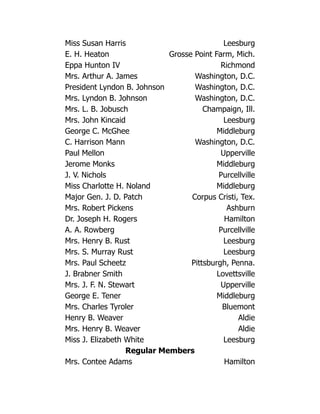
Members of theLoudoun County Historical
Society
Life Members
Lucian M. Abbott Washington, D. C.
Mrs. Hazel T. Allyn Purcellville
Arthur W. Arundel McLean
Major Gen. Milton Arnold Middleburg
Miss Nancy L. Bradfield Leesburg
M. T. Broyhill Corp. Sterling
Edward Chamberlin Hillsboro
Dr. L. L. Cockerille Washington, D. C.
William J. Cox Leesburg
William B. Dew, Jr. Middleburg
Major Gen. Robert L. Dulaney Purcellville
Major Gen. George L. Eberle Leesburg
Mrs. Henry Fairfax Aldie
Mrs. Fenton Fadeley Waterford
Col. Robert H. Fletcher Leesburg
Mrs. Robert H. Fletcher Leesburg
Mrs. A. D. P. Gilmour Leesburg
Mrs. W. Fairfax Griffith Alexandria
George P. Hammerly Leesburg
Miss Nelly B. Hammerly Leesburg
Huntington Harris. Leesburg
Mrs. Huntington Harris Leesburg
26.
Miss Susan HarrisLeesburg
E. H. Heaton Grosse Point Farm, Mich.
Eppa Hunton IV Richmond
Mrs. Arthur A. James Washington, D.C.
President Lyndon B. Johnson Washington, D.C.
Mrs. Lyndon B. Johnson Washington, D.C.
Mrs. L. B. Jobusch Champaign, Ill.
Mrs. John Kincaid Leesburg
George C. McGhee Middleburg
C. Harrison Mann Washington, D.C.
Paul Mellon Upperville
Jerome Monks Middleburg
J. V. Nichols Purcellville
Miss Charlotte H. Noland Middleburg
Major Gen. J. D. Patch Corpus Cristi, Tex.
Mrs. Robert Pickens Ashburn
Dr. Joseph H. Rogers Hamilton
A. A. Rowberg Purcellville
Mrs. Henry B. Rust Leesburg
Mrs. S. Murray Rust Leesburg
Mrs. Paul Scheetz Pittsburgh, Penna.
J. Brabner Smith Lovettsville
Mrs. J. F. N. Stewart Upperville
George E. Tener Middleburg
Mrs. Charles Tyroler Bluemont
Henry B. Weaver Aldie
Mrs. Henry B. Weaver Aldie
Miss J. Elizabeth White Leesburg
Regular Members
Mrs. Contee Adams Hamilton
27.
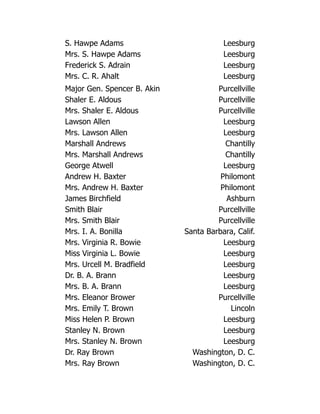
S. Hawpe AdamsLeesburg
Mrs. S. Hawpe Adams Leesburg
Frederick S. Adrain Leesburg
Mrs. C. R. Ahalt Leesburg
Major Gen. Spencer B. Akin Purcellville
Shaler E. Aldous Purcellville
Mrs. Shaler E. Aldous Purcellville
Lawson Allen Leesburg
Mrs. Lawson Allen Leesburg
Marshall Andrews Chantilly
Mrs. Marshall Andrews Chantilly
George Atwell Leesburg
Andrew H. Baxter Philomont
Mrs. Andrew H. Baxter Philomont
James Birchfield Ashburn
Smith Blair Purcellville
Mrs. Smith Blair Purcellville
Mrs. I. A. Bonilla Santa Barbara, Calif.
Mrs. Virginia R. Bowie Leesburg
Miss Virginia L. Bowie Leesburg
Mrs. Urcell M. Bradfield Leesburg
Dr. B. A. Brann Leesburg
Mrs. B. A. Brann Leesburg
Mrs. Eleanor Brower Purcellville
Mrs. Emily T. Brown Lincoln
Miss Helen P. Brown Leesburg
Stanley N. Brown Leesburg
Mrs. Stanley N. Brown Leesburg
Dr. Ray Brown Washington, D. C.
Mrs. Ray Brown Washington, D. C.
28.
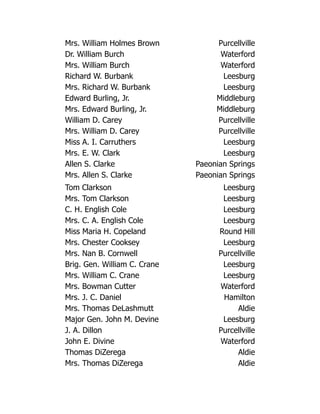
Mrs. William HolmesBrown Purcellville
Dr. William Burch Waterford
Mrs. William Burch Waterford
Richard W. Burbank Leesburg
Mrs. Richard W. Burbank Leesburg
Edward Burling, Jr. Middleburg
Mrs. Edward Burling, Jr. Middleburg
William D. Carey Purcellville
Mrs. William D. Carey Purcellville
Miss A. I. Carruthers Leesburg
Mrs. E. W. Clark Leesburg
Allen S. Clarke Paeonian Springs
Mrs. Allen S. Clarke Paeonian Springs
Tom Clarkson Leesburg
Mrs. Tom Clarkson Leesburg
C. H. English Cole Leesburg
Mrs. C. A. English Cole Leesburg
Miss Maria H. Copeland Round Hill
Mrs. Chester Cooksey Leesburg
Mrs. Nan B. Cornwell Purcellville
Brig. Gen. William C. Crane Leesburg
Mrs. William C. Crane Leesburg
Mrs. Bowman Cutter Waterford
Mrs. J. C. Daniel Hamilton
Mrs. Thomas DeLashmutt Aldie
Major Gen. John M. Devine Leesburg
J. A. Dillon Purcellville
John E. Divine Waterford
Thomas DiZerega Aldie
Mrs. Thomas DiZerega Aldie
29.
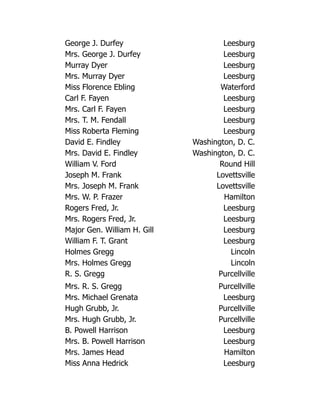
George J. DurfeyLeesburg
Mrs. George J. Durfey Leesburg
Murray Dyer Leesburg
Mrs. Murray Dyer Leesburg
Miss Florence Ebling Waterford
Carl F. Fayen Leesburg
Mrs. Carl F. Fayen Leesburg
Mrs. T. M. Fendall Leesburg
Miss Roberta Fleming Leesburg
David E. Findley Washington, D. C.
Mrs. David E. Findley Washington, D. C.
William V. Ford Round Hill
Joseph M. Frank Lovettsville
Mrs. Joseph M. Frank Lovettsville
Mrs. W. P. Frazer Hamilton
Rogers Fred, Jr. Leesburg
Mrs. Rogers Fred, Jr. Leesburg
Major Gen. William H. Gill Leesburg
William F. T. Grant Leesburg
Holmes Gregg Lincoln
Mrs. Holmes Gregg Lincoln
R. S. Gregg Purcellville
Mrs. R. S. Gregg Purcellville
Mrs. Michael Grenata Leesburg
Hugh Grubb, Jr. Purcellville
Mrs. Hugh Grubb, Jr. Purcellville
B. Powell Harrison Leesburg
Mrs. B. Powell Harrison Leesburg
Mrs. James Head Hamilton
Miss Anna Hedrick Leesburg
30.
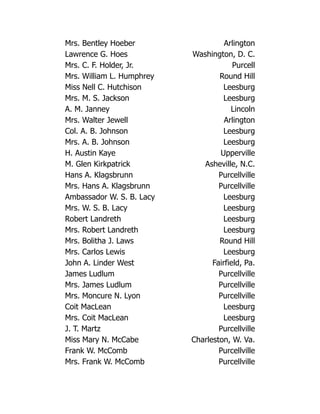
Mrs. Bentley HoeberArlington
Lawrence G. Hoes Washington, D. C.
Mrs. C. F. Holder, Jr. Purcell
Mrs. William L. Humphrey Round Hill
Miss Nell C. Hutchison Leesburg
Mrs. M. S. Jackson Leesburg
A. M. Janney Lincoln
Mrs. Walter Jewell Arlington
Col. A. B. Johnson Leesburg
Mrs. A. B. Johnson Leesburg
H. Austin Kaye Upperville
M. Glen Kirkpatrick Asheville, N.C.
Hans A. Klagsbrunn Purcellville
Mrs. Hans A. Klagsbrunn Purcellville
Ambassador W. S. B. Lacy Leesburg
Mrs. W. S. B. Lacy Leesburg
Robert Landreth Leesburg
Mrs. Robert Landreth Leesburg
Mrs. Bolitha J. Laws Round Hill
Mrs. Carlos Lewis Leesburg
John A. Linder West Fairfield, Pa.
James Ludlum Purcellville
Mrs. James Ludlum Purcellville
Mrs. Moncure N. Lyon Purcellville
Coit MacLean Leesburg
Mrs. Coit MacLean Leesburg
J. T. Martz Purcellville
Miss Mary N. McCabe Charleston, W. Va.
Frank W. McComb Purcellville
Mrs. Frank W. McComb Purcellville
31.
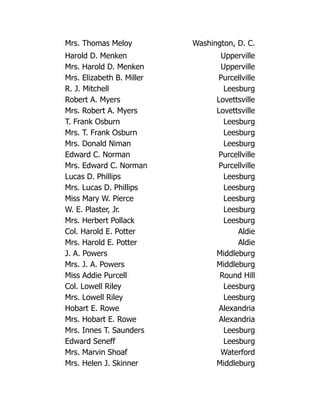
Mrs. Thomas MeloyWashington, D. C.
Harold D. Menken Upperville
Mrs. Harold D. Menken Upperville
Mrs. Elizabeth B. Miller Purcellville
R. J. Mitchell Leesburg
Robert A. Myers Lovettsville
Mrs. Robert A. Myers Lovettsville
T. Frank Osburn Leesburg
Mrs. T. Frank Osburn Leesburg
Mrs. Donald Niman Leesburg
Edward C. Norman Purcellville
Mrs. Edward C. Norman Purcellville
Lucas D. Phillips Leesburg
Mrs. Lucas D. Phillips Leesburg
Miss Mary W. Pierce Leesburg
W. E. Plaster, Jr. Leesburg
Mrs. Herbert Pollack Leesburg
Col. Harold E. Potter Aldie
Mrs. Harold E. Potter Aldie
J. A. Powers Middleburg
Mrs. J. A. Powers Middleburg
Miss Addie Purcell Round Hill
Col. Lowell Riley Leesburg
Mrs. Lowell Riley Leesburg
Hobart E. Rowe Alexandria
Mrs. Hobart E. Rowe Alexandria
Mrs. Innes T. Saunders Leesburg
Edward Seneff Leesburg
Mrs. Marvin Shoaf Waterford
Mrs. Helen J. Skinner Middleburg
32.
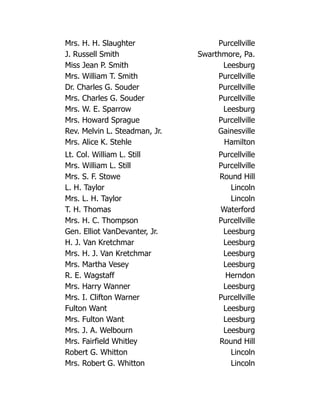
Mrs. H. H.Slaughter Purcellville
J. Russell Smith Swarthmore, Pa.
Miss Jean P. Smith Leesburg
Mrs. William T. Smith Purcellville
Dr. Charles G. Souder Purcellville
Mrs. Charles G. Souder Purcellville
Mrs. W. E. Sparrow Leesburg
Mrs. Howard Sprague Purcellville
Rev. Melvin L. Steadman, Jr. Gainesville
Mrs. Alice K. Stehle Hamilton
Lt. Col. William L. Still Purcellville
Mrs. William L. Still Purcellville
Mrs. S. F. Stowe Round Hill
L. H. Taylor Lincoln
Mrs. L. H. Taylor Lincoln
T. H. Thomas Waterford
Mrs. H. C. Thompson Purcellville
Gen. Elliot VanDevanter, Jr. Leesburg
H. J. Van Kretchmar Leesburg
Mrs. H. J. Van Kretchmar Leesburg
Mrs. Martha Vesey Leesburg
R. E. Wagstaff Herndon
Mrs. Harry Wanner Leesburg
Mrs. I. Clifton Warner Purcellville
Fulton Want Leesburg
Mrs. Fulton Want Leesburg
Mrs. J. A. Welbourn Leesburg
Mrs. Fairfield Whitley Round Hill
Robert G. Whitton Lincoln
Mrs. Robert G. Whitton Lincoln
33.
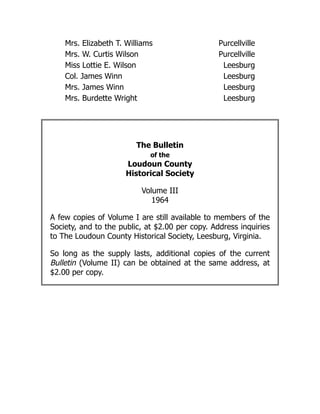
Mrs. Elizabeth T.Williams Purcellville
Mrs. W. Curtis Wilson Purcellville
Miss Lottie E. Wilson Leesburg
Col. James Winn Leesburg
Mrs. James Winn Leesburg
Mrs. Burdette Wright Leesburg
The Bulletin
of the
Loudoun County
Historical Society
Volume III
1964
A few copies of Volume I are still available to members of the
Society, and to the public, at $2.00 per copy. Address inquiries
to The Loudoun County Historical Society, Leesburg, Virginia.
So long as the supply lasts, additional copies of the current
Bulletin (Volume II) can be obtained at the same address, at
$2.00 per copy.
34.
Transcriber’s Notes
Retained publicationinformation from the printed edition: this
eBook is public-domain in the country of publication.
Silently corrected a few palpable typos.
Transcribed in-photo text.
In the text versions only, text in italics is delimited by
_underscores_.
35.
Welcome to ourwebsite – the perfect destination for book lovers and
knowledge seekers. We believe that every book holds a new world,
offering opportunities for learning, discovery, and personal growth.
That’s why we are dedicated to bringing you a diverse collection of
books, ranging from classic literature and specialized publications to
self-development guides and children's books.
More than just a book-buying platform, we strive to be a bridge
connecting you with timeless cultural and intellectual values. With an
elegant, user-friendly interface and a smart search system, you can
quickly find the books that best suit your interests. Additionally,
our special promotions and home delivery services help you save time
and fully enjoy the joy of reading.
Join us on a journey of knowledge exploration, passion nurturing, and
personal growth every day!
ebookbell.com